A History of the County of Middlesex: Volume 3, Shepperton, Staines, Stanwell, Sunbury, Teddington, Heston and Isleworth, Twickenham, Cowley, Cranford, West Drayton, Greenford, Hanwell, Harefield and Harlington. Originally published by Victoria County History, London, 1962.
This free content was digitised by double rekeying. All rights reserved.
'Twickenham: Local government', in A History of the County of Middlesex: Volume 3, Shepperton, Staines, Stanwell, Sunbury, Teddington, Heston and Isleworth, Twickenham, Cowley, Cranford, West Drayton, Greenford, Hanwell, Harefield and Harlington, ed. Susan Reynolds (London, 1962), British History Online https://www.british-history.ac.uk/vch/middx/vol3/pp155-157 [accessed 2 May 2025].
'Twickenham: Local government', in A History of the County of Middlesex: Volume 3, Shepperton, Staines, Stanwell, Sunbury, Teddington, Heston and Isleworth, Twickenham, Cowley, Cranford, West Drayton, Greenford, Hanwell, Harefield and Harlington. Edited by Susan Reynolds (London, 1962), British History Online, accessed May 2, 2025, https://www.british-history.ac.uk/vch/middx/vol3/pp155-157.
"Twickenham: Local government". A History of the County of Middlesex: Volume 3, Shepperton, Staines, Stanwell, Sunbury, Teddington, Heston and Isleworth, Twickenham, Cowley, Cranford, West Drayton, Greenford, Hanwell, Harefield and Harlington. Ed. Susan Reynolds (London, 1962), British History Online. Web. 2 May 2025. https://www.british-history.ac.uk/vch/middx/vol3/pp155-157.
LOCAL GOVERNMENT.
In the Middle Ages Twickenham was administered as part of the manor of Isleworth. Twickenham manor developed later and never had a court leet. Those who held land of the manor of Isleworth rectory also attended its court, which included a leet until modern times, but Isleworth manor provided the effective government of the area. (fn. 1)
In 1648 the vestry submitted to the leet three names of candidates to be constable, and in 1745 the constables of Twickenham and Whitton and the two parish headboroughs were listed as parish officers, though they were probably still formally appointed in the leet. (fn. 2) 'Churchmen' (possibly churchwardens) were mentioned in 1367, (fn. 3) and the government of the parish as a separate unit can be traced from 1618, when the earliest vestry book begins. (fn. 4) Some trouble in church or parish affairs had then just caused the diocesan authorities to establish a co-operative vestry of sixteen members. This seems to have consisted predominantly of gentlemen and farmers. It continued to function until the 1630's, dealing almost entirely with church matters, and particularly with seating in the church, but seems to have lapsed later on. Another similar vestry was ordained by the bishop in 1674, this time after a petition by 'several principal inhabitants' that the parish affairs were neglected and in disorder, and that there had been disorderly meetings of all sorts of the inhabitants. The disorder may well have concerned the poor rates and the parish charities, which were treated as a general 'poor fund'. The first regular payments to the poor of which record survives had been made in 1661. In 1666 and 1667 the annual poor rate was £55, and in 1673 an assessment at 8d. in the pound brought in £78. Out of this, poor persons, most of whom were widows, received pensions of 1s. a week. (fn. 5) The new select vestry of 1674 was to consist of the vicar, churchwardens, and sixteen others, including several who are known to have belonged to the middle or upper classes. In the event, three of those chosen refused to serve, and an inhabitants' meeting came to an agreement to set aside the bishop's instrument so long as at least seven parishioners could be assembled on Monday mornings in answer to a summons to deal with parish business. An order was made at the same time against excessive bell-ringing, which had long been a cause of trouble and was again the subject of an order in 1711. (fn. 6) In spite of some disputes over the overseers' accounts, the parish then settled down to bringing its affairs into order. In 1676 a man was appointed to seek out beggars, lodgers, and intruders, and in 1681 the vestry gave its attention to the problem of settlement and bought four spinning wheels and some flax for the use of the poor. In the early 1680's it also spent a good deal of time setting the charities in order. The vestry gradually became less active and well attended, but the bishop's select vestry was not revived.
The parish started a proper workhouse in 1725. Before this it had owned a number of almshouses. The 'church house', which probably stood on the west side of School Alley, (fn. 7) belonged to the parish by 1643. (fn. 8) Part of it was made into a school in 1648 and leased in 1669, but in 1675 the whole house was put into order to receive four widows, and part had evidently been used as a poor-house all the time. One room was again used as a school between 1683 and 1699, and the whole property was leased later on, perhaps because the workhouse had by then been established. (fn. 9) In 1704 six almshouses were built, with the help of a charity fund, on an acre of ground on the common given by the Duke and Duchess of Somerset. (fn. 10) Six more almshouses are said to have been added to these in 1721 by bequest, (fn. 11) and in 1725 the parish decided to build a workhouse next to them. When any of the adjoining almshouses were themselves first used as part of the workhouse is unknown: by 1823 seven of them had been appropriated time out of mind. (fn. 12)
Efforts to reduce relief systematically seem to have begun in 1730. (fn. 13) The private distilling of gin in the adjoining almshouses disturbed the order of the workhouse in 1735, and from 1736 the house and its inmates were intermittently farmed. (fn. 14) In 1740 and again in 1763 the workhouse was put under the supervision of its trustees, who included the vicar, curate, and parish officers, and for some years after the latter date the workhouse committee virtually took over the management of the poor. There are references to the parish fire-engines at about this period, (fn. 15) and in 1764 the house of correction, roundhouse, or cage, was moved, with the stocks, from the middle of the town to the common, near the gate. The lord of Isleworth manor was asked to repair the cage in 1819. The chief business of the vestry, however, was the management of the poor, the charities, and the schools, and the election of pupils to Christ's Hospital. (fn. 16) Expenditure on the poor stood at £830 in 1775-6 and rose to over £3,000 in 1814-15, with 91 adults in the workhouse, and 112 on permanent relief. (fn. 17) Despite this rise, the parish left much of the work in the hands of its officers, which led to some embezzlement, and it was not until the early 19th century that more than sporadic attempts were made to reform administration. In 1811 the vestry clerk also became parish solicitor, though these posts were separated on the advice of a committee to survey parish affairs in 1817. A salaried surveyor of highways was appointed in 1816 and a salaried assistant overseer in 1820. The vestry resolved to enlarge the workhouse in 1808 and again in 1813, and is known to have done so in 1817 by taking in the remaining almshouses next to it. Further alterations, made so as to separate men and women inmates, were made in 1826. When the 1817 changes were made, it was proposed that the inmates of the remaining almshouses should be moved to three cottages on the west of School Alley, which had until then been let and may have been part of the old church house estate. (fn. 18) This project was, however, allowed to lapse for a time: perhaps the setting up of the Brougham Commission in the interim was responsible for its partial accomplishment by the time the commission reported on Twickenham in 1823. The reparation made did not entirely save the parish from the commissioners' censure against misappropriating charitable endowments. (fn. 19)
The enlargement of the workhouse was part of a general scheme of reform which was undertaken in 1817, and which also included the reinforcement of a parochial committee of management which was apparently already in being. The parish went on farming the workhouse, and in 1834 the vestry reported that no relief was given to those in work, that relief was related to the character of the applicant, and that those in the workhouse were employed there by the master, while those receiving out-relief were sometimes given work on the roads. An annually elected committee did most of the vestry's work, and the vestry was in favour of giving more power to parish officers. (fn. 20) A tendency to leave much to the officers seems, in fact, to have characterized Twickenham. The parish became part of Brentford union in 1836 and the workhouse was sold in 1838, part of the proceeds being restored to the two charities which had provided the funds for the original almshouses on the common. (fn. 21) The workhouse stood between Colne Road and the Green a little east of Briar Road. It had been demolished by 1846. (fn. 22)
The parish twice refused to form a select vestry, (fn. 23) but the Lighting and Watching Act, 1833, was adopted in the same year as it was passed. A watch had first been provided by subscription in 1822, and the lighting was continued after the Metropolitan Police had taken over the watch duties in 1840. (fn. 24) A highway board was formed in 1849 after several previous rejections of the scheme, and a burial board, under the chairmanship of the vicar, in 1866. Lastly, a local board of health was formed in 1868. (fn. 25)
The board comprised 27 members, reduced in 1894 to 24 representing four wards. (fn. 26) It met for a few months in the subscription reading room, and then in rented offices in Queen Street until 1881, when it moved to the Town Hall which had been built in King Street. (fn. 27) This was private property but the board was allowed to use it rent-free, and from 1896 it was leased by the urban district council, as the board had then become. (fn. 28) The chief task confronting the local board was to provide adequate drainage and sewerage for the growing town. This was only accomplished in 1876 after many disputes and delays but, in spite of continuing attacks on the surveyor and of the remodelling and enlargement of the system which was necessary in 1908. Twickenham received a sewerage system in advance of its time. (fn. 29) The local board is said to have leased a cottage as a fever hospital from the date of its formation. (fn. 30) It built a small isolation hospital at the Mereway in 1883, and also used Cross Deep House for the same purpose for some years from 1901. A new hospital approximately on the site of Collingwood Close, Whitton, was opened in 1909, though the Mereway one was used as well for many years. The Whitton hospital was given up in 1938 after the new (now South Middlesex) Hospital had been opened jointly with Richmond and Heston and Isleworth in 1937. (fn. 31) The board formed a voluntary fire brigade in 1868, acquired Moor Mead in 1896, and, again with considerable controversy, laid it out as a recreation ground. (fn. 32) The Public Libraries Act was adopted in 1882 on the initiative of the few remaining members of the moribund subscription reading-room, which seems to have been in existence since 1844. The library was housed in the Town Hall until 1907, when it moved to the present Carnegie building in Garfield Road. (fn. 33)
The site of the new library building bears witness to the council's early interest in town planning and improvement. The local board constructed the Embankment between 1875 and 1882, and first considered the making of a new street to by-pass Church Street in 1892. York Street, as it was named, was opened in 1899. (fn. 34) The widening of King Street was discussed from the early years of the new century but was not achieved until the council had bought Richmond House in 1925. (fn. 35) 'Improvement' rather than preservation was evidently the chief object at this time, though the council had contributed to the London County Council's purchase of Marble Hill in 1902 in order to preserve the view from Richmond Hill. (fn. 36) The York House Society was formed about 1922, (fn. 37) and its efforts to save the house from demolition were rewarded in 1924, (fn. 38) when the council purchased the property. York House was then converted into a council house and offices to replace the old Town Hall, most of which was demolished when King Street was widened. Further agitation resulted in the acquisition of the Orleans House grounds in 1928, though not in the saving of the house itself. (fn. 39) The council opened a swimming bath on the site of the demolished Richmond House, but the redevelopment of the remaining old part of the town between Church Street and the river was only just begun before the Second World War. After the area had been bombed plans were made under the County Development Plan to rebuild it almost entirely, but by 1958 little had been done though controversy had been aroused both inside and outside the borough. (fn. 40)
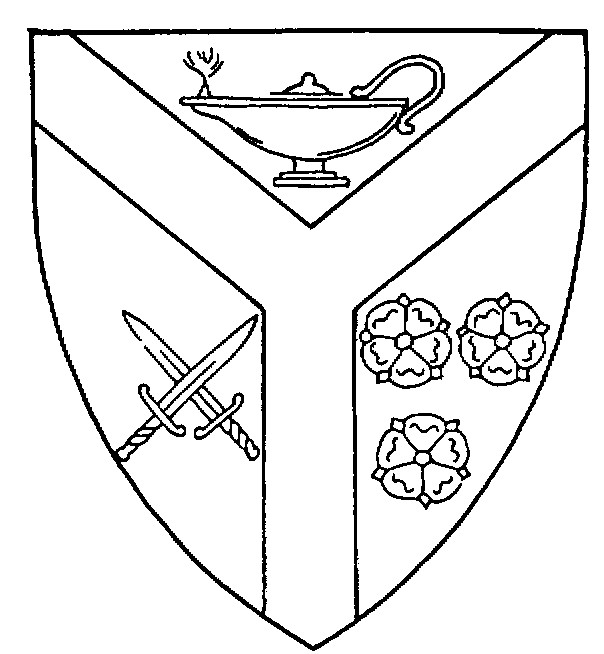
Urban District of Twickenham
Silver, a cross pall vert; in cjief an antique lamp, lighted, proper; dexter, two crossed swords proper with gold hilts; sinister, there red roes. [Granted 1913]
Twickenham had become a borough in 1926. The new council had 8 aldermen and 24 councillors. (fn. 41) Eleven years later, after some years of opposition from Teddington, Hampton, and Hampton Wick, the borough was extended to cover these three urban districts. (fn. 42) The council was then enlarged to have 10 aldermen and 30 councillors, and by 1958 there were respectively 11 and 33. (fn. 43) There was little definite grouping in the council along the lines of national parties before the charter of 1926, and during the 1930's the majority did not officially accept the title of Conservative. (fn. 44) There are references to a Ratepayers' Association in the 1870's and to a Twickenham Advancement Association which put forward candidates to the council in 1913 and 1919. (fn. 45) In 1928 a new Ratepayers' Association was formed, whose members formed a small but influential minority on the council in the 1930's. Their first-and unsuccessful-objective was to prevent the council from acquiring the brewery by the station as a council depot. (fn. 46) In 1945 the Labour party, which had been represented on the council since the 1920's, became the largest single group, but it did not have an absolute majority, and in the following year the Conservatives returned to power. In 1958 they had a large majority, and there were only two independents left, one of whom still represented the Ratepayers' Association. (fn. 47)
In 1868-9 the local board spent just over £3,000. (fn. 48) In 1900 it spent over £40,000 and this rose to some £238,000 in 1937, before the enlargement of the borough, and to about £1,323,000 in 1958. Of this last sum £268,000 was spent by the corporation itself, the rest going to precepting authorities. (fn. 49) In 1899 the council seems to have had twelve full-time officials, a part-time medical officer of health, and an unpaid treasurer. (fn. 50) The first full-time treasurer was appointed in 1938. In 1958 the council had 225 officers and 500 workmen on its staff, and used Elmfield House at Teddington as well as York House for its offices. Between 1920 and 1937, 975 council houses were built in Twickenham; there were already 690 in Teddington and the Hamptons by the time the borough was enlarged. By 1958 the borough council had built a further 2,507 permanent houses and flats, and there were also about 600 temporary or converted buildings. In 1958 the council managed 208 acres of the open spaces in the borough, which altogether comprised over 2,000 acres. (fn. 51) There was a branch library at Whitton (first opened 1940), and others at Teddington, Hampton, Hampton Wick, and Hampton Hill. (fn. 52)