A History of the County of Middlesex: Volume 4, Harmondsworth, Hayes, Norwood With Southall, Hillingdon With Uxbridge, Ickenham, Northolt, Perivale, Ruislip, Edgware, Harrow With Pinner. Originally published by Victoria County History, London, 1971.
This free content was digitised by double rekeying. All rights reserved.
Diane K Bolton, H P F King, Gillian Wyld, D C Yaxley, 'Ruislip: Local government', in A History of the County of Middlesex: Volume 4, Harmondsworth, Hayes, Norwood With Southall, Hillingdon With Uxbridge, Ickenham, Northolt, Perivale, Ruislip, Edgware, Harrow With Pinner, ed. T F T Baker, J S Cockburn, R B Pugh (London, 1971), British History Online https://www.british-history.ac.uk/vch/middx/vol4/pp140-142 [accessed 30 April 2025].
Diane K Bolton, H P F King, Gillian Wyld, D C Yaxley, 'Ruislip: Local government', in A History of the County of Middlesex: Volume 4, Harmondsworth, Hayes, Norwood With Southall, Hillingdon With Uxbridge, Ickenham, Northolt, Perivale, Ruislip, Edgware, Harrow With Pinner. Edited by T F T Baker, J S Cockburn, R B Pugh (London, 1971), British History Online, accessed April 30, 2025, https://www.british-history.ac.uk/vch/middx/vol4/pp140-142.
Diane K Bolton, H P F King, Gillian Wyld, D C Yaxley. "Ruislip: Local government". A History of the County of Middlesex: Volume 4, Harmondsworth, Hayes, Norwood With Southall, Hillingdon With Uxbridge, Ickenham, Northolt, Perivale, Ruislip, Edgware, Harrow With Pinner. Ed. T F T Baker, J S Cockburn, R B Pugh (London, 1971), British History Online. Web. 30 April 2025. https://www.british-history.ac.uk/vch/middx/vol4/pp140-142.
LOCAL GOVERNMENT.
In 1246 the Abbot of Bec was exercising various liberties in his manor of Ruislip, including view of frankpledge and the assize of bread and ale. (fn. 1) During the 13th century the single manorial court was attended by both free and unfree tenants. The court met twice yearly under the supervision of an itinerant steward who toured Bec's English manors after Easter and again about Martinmas. (fn. 2) Occasionally additional courts might be held, usually during the summer months. (fn. 3) Further informal meetings may have been held under the lord's bailiff who is first mentioned in 1280 and who discharged many of the functions of local government. (fn. 4) There were two bailiffs in the manor by 1296. (fn. 5)
A curious case argued in the royal courts in 1305 seems to call in question the abbot's right to demand suit of court from Ruislip freeholders. (fn. 6) The result of the case is not recorded, but freeholders appear to have continued to render suit until the end of the 14th century, when a separate court leet was established. (fn. 7)
By 1300 the court was appointing reeves for Ruislip and Northwood, a hayward, and a forester. (fn. 8) Four reeves were elected in 1394, but two of them paid a fine for release, (fn. 9) and by 1334 some of their duties appear to have been assumed by two foresters. (fn. 10) Both of these seem to have presented trespasses in the Ruislip court, but one of them also held land in Ruislip of the lord of Harmondsworth and presented trespasses on the Harmondsworth land in Ruislip at the Harmondsworth court. (fn. 11) This official was said to owe suit of court at Harmondsworth, but appears to have held a largely autonomous position in Ruislip. About 1390 Richard Palmer, the Harmondsworth forester, felled large amounts of timber in abuse of his rights of housebote and firebote, and subsequently became involved in a series of disturbances in the parish. (fn. 12) The Harmondsworth forester is not mentioned again, but a forester, presumably the Ruislip official, had a room in the manor-house in 1435, (fn. 13) and was said to be paid 5s. 2d. a year in 1442. (fn. 14)
Tenants on the Harmondsworth land in Ruislip were generally bound to make suit of court at Harmondsworth. (fn. 15) Occasionally, however, licences were granted in the Ruislip court for Ruislip tenants to live on Harmondsworth land on condition that they continued to pay services to the lord of Ruislip. (fn. 16)
After the manor came into the possession of King's College, Cambridge, in the mid 15th century, courts leet and baron were held in no clearly defined sequence, but rarely at less than quarterly intervals. A franchise coroner was appointed by the college for Ruislip and two other manors in 1455, (fn. 17) but there is no evidence of his activities. Until 1565 leases of the manor generally reserved the courts to the college, but after this date, although there were continued complaints of the exactions of lessees, (fn. 18) court perquisites normally accompanied grants of the manor. During the 16th and early 17th centuries at least two courts leet and baron seem to have been held each year. (fn. 19) In 1693, however, the constables of Ruislip had to petition quarter sessions for their discharge, since the lord of the manor had not held a leet during the preceding year. (fn. 20) A court leet was held annually during the 19th century, (fn. 21) and courts continued to meet, with varying regularity, until 1925. (fn. 22)
There were stocks and a pillory at Ruislip in 1296. (fn. 23) The stocks were still in use in 1617. (fn. 24) Little is known of the parish administration which superseded the manorial organization. By 1582 there were two constables for the parish, (fn. 25) and by 1634, and presumably earlier, two overseers of the poor and two churchwardens. (fn. 26) During the early 17th century, however, the lessee of Ruislip manor was responsible for repairs to the pound in Eastcote Road. (fn. 27) Extensive alterations to the 'parish house' took place in 1616. (fn. 28) Full responsibility for the parish house was assumed by the overseers from about 1670, and their accounts for the late 17th century include payments for flax and other materials for the use of the poor. A scheme for schooling poor children seems to have been discontinued about 1705, perhaps in consequence of a rapid increase in the sums laid out on the poor. The poor-rates rose from about £50 a year in the 1660s to more than £100 in 1709, and to £130 in 1711. (fn. 29) By 1776 the poor-rate was £477, and in 1803 £605. (fn. 30)
From the late 18th century, and presumably earlier, the vestry was in effective control of the parish. Records of the vestry are preserved, with gaps in the earlier years, from 1787. (fn. 31) The vestry seldom met more than five times a year, and there were usually fewer than ten people present. Adjournments from the church to the 'Bell' or 'Black Horse' at Eastcote were better attended. Vestry business was concerned mainly with the provision of clothing for the poor and the apprenticing of pauper children. Cheap or free dwellings for poor families were provided in the almshouses in Eastcote Road on the north side of the churchyard. The history of these 'church-houses' is obscure, but extensive alteration of the old parish house in 1616 probably resulted in its conversion into the small, two-roomed dwellings which comprise the present almshouses. (fn. 32) During the 18th century the almshouses seem to have been used as a workhouse, and in 1776 they accommodated about 30 paupers. (fn. 33) By 1787 this limited accommodation was inadequate and in 1789 the vestry resolved to erect a workhouse on land taken from the Common just north of Reservoir Road and granted to the parish by King's College. (fn. 34) The parish farmed out the administration of the workhouse to a governor at an annual rent of £353. The appointment of successive governors and the fixing of the annual farm, which increased to 550 guineas in 1805 and to £780 by 1810, provided the staple business of the vestry during the first two decades of the 19th century. Numbers in the workhouse during these years fluctuated between 20 and 30. (fn. 35) After the 1834 Act the parish was included in the Uxbridge Union, and in 1838 the inmates of the Ruislip workhouse were removed to the union workhouse at Hillingdon. (fn. 36) The building was then sold, later converted into flats, and after renovation in the early 20th century became a private house. (fn. 37) It is approached from Ducks Hill Road and is a red-brick structure with a symmetrical front of two stories and five bays. A plaque above the door is dated 1789 and gives five names, presumably those of members of the vestry.
About 1820 a revival took place in the vestry, and, until the ending of parochial responsibility for poor relief, monthly meetings became the rule. No select vestry was ever formed, and meetings were still normally attended only by the vicar and parish officers. The vestry dealt with removal and bastardy cases and with the provision of outdoor relief. They also regulated rights of pasture on common and the poor's land. From 1820 poor labourers were permitted to cultivate potatoes and vegetables on land at Ducks Hill for the support of their families. With the ending of parochial responsibility for poor relief, vestry meetings again became less frequent, and the appointment of officers was their principal duty.
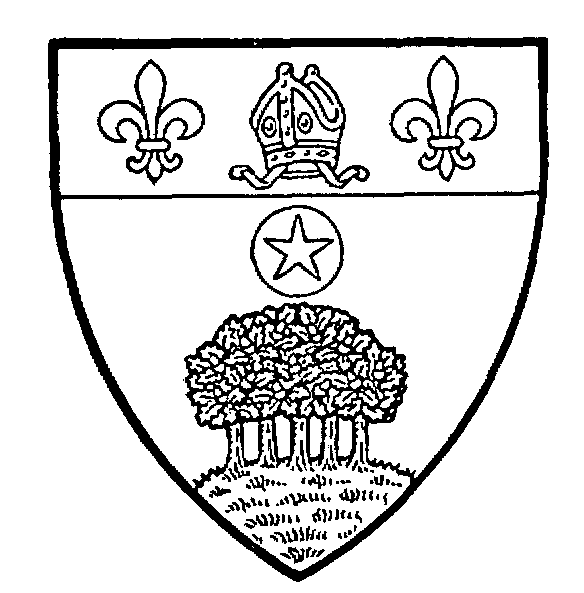
Urban District of Ruislip-Northwood
Argent, a hurst of oak-trees proper growing out of a grassy mount, and above them a roundel azure charged with a star of five points or; on a chief gules a silver mitre between two fleurs-de-lis or [Granted 1937]
After 1894 Ruislip became part of Uxbridge R.D., and had a parish council. In 1904 the parish was separated from the rural districts to form Ruislip-Northwood U.D. The council administered three departments in 1904, with a staff of five, some of whom were part-time, and 15 manual workers. There were four departments in 1962-those of the clerk and solicitor, engineer and surveyor, treasurer, and medical officer of health. These employed an indoor staff of 154, and an outside staff of 280, increased to 340 for seasonal work. With the exception of the housing section of the clerk's department and the health department at 76 High Street, Northwood, the council's offices were in Oaklands Gate.
The number of standing committees varied from 3 in 1904 to 16, including two advisory committees, in 1962. In 1904 the rate was 2s. 2d. in the £, and had risen to 10s. 4d. in the £ by 1929. The product of a penny rate rose from £649 in 1929-30 to £6,010 in 1960-61. Between 1919 and 1962 almost 2,500 council dwellings were completed, 2,000 of them in the period following the Second World War. There were approximately 1,500 a. of open spaces and recreation grounds in 1953, including 72 a. of permanent and temporary allotments. (fn. 38)
Nine councillors were elected in 1904, and by 1920, when the first warding of the District took place, there were 15 councillors. The allotment of councillors between wards was varied in 1929 and again in 1936 when the South Ruislip Ward was created. The number of councillors was increased to 24 in 1939 and to 27 in 1950. In 1954 the number of wards was increased from 4 to 9 with 3 councillors for each ward. (fn. 39) Since 1965 Ruislip and Northwood have formed part of the new London Borough of Hillingdon. (fn. 40)