A History of the County of Middlesex: Volume 6, Friern Barnet, Finchley, Hornsey With Highgate. Originally published by Victoria County History, London, 1980.
This free content was digitised by double rekeying. All rights reserved.
A P Baggs, Diane K Bolton, M A Hicks, R B Pugh, 'Ossulstone Hundred', in A History of the County of Middlesex: Volume 6, Friern Barnet, Finchley, Hornsey With Highgate, ed. T F T Baker, C R Elrington (London, 1980), British History Online https://www.british-history.ac.uk/vch/middx/vol6/pp1-5 [accessed 30 April 2025].
A P Baggs, Diane K Bolton, M A Hicks, R B Pugh, 'Ossulstone Hundred', in A History of the County of Middlesex: Volume 6, Friern Barnet, Finchley, Hornsey With Highgate. Edited by T F T Baker, C R Elrington (London, 1980), British History Online, accessed April 30, 2025, https://www.british-history.ac.uk/vch/middx/vol6/pp1-5.
A P Baggs, Diane K Bolton, M A Hicks, R B Pugh. "Ossulstone Hundred". A History of the County of Middlesex: Volume 6, Friern Barnet, Finchley, Hornsey With Highgate. Ed. T F T Baker, C R Elrington (London, 1980), British History Online. Web. 30 April 2025. https://www.british-history.ac.uk/vch/middx/vol6/pp1-5.
OSSULSTONE HUNDRED
Oswald's stone, from which the hundred took its name, (fn. 1) may well have been the Roman geometric stone standing at the point where Watling Street (Edgware Road) joined the road (Oxford Street) running westward out of Essex. It was in position up to 1822 but was then earthed over. (fn. 2) After Marble Arch had been erected upon approximately the same site in 1851, the stone leant for a while against that edifice but it has not been seen since 1869. (fn. 3) Between 1285 and 1312 there are references to a field called Ossulstone and by 1341 Ossulstone seems to have been a settlement. (fn. 4) In 1484-5 it possessed 'pits', (fn. 5) where the county court met in 1554. (fn. 6) On a map of 1614 Ossulstone was spot-marked as lying at the western end of South Street, Mayfair, where that street joins Park Lane. (fn. 7) While this may then have been the centre of the settlement and even the hundred meeting-place, it need not be concluded that the hundred originally met there, (fn. 8) for the stone itself is the more likely location.
After the Middlesex county court had been reorganized by the Small Debts, Middlesex, Act of 1750 (fn. 9) the court for Ossulstone hundred suitors was held further eastward. In 1793 (fn. 10) and 1808 (fn. 11) it was in Fulwood's Rents (now Fulwood's Place), Holborn, and by 1827 in Kingsgate Street, Holborn, (fn. 12) where it remained (fn. 13) until, after the passage of the County Courts Act, 1846, it ceased to exist in that form. (fn. 14)
In 1086 the components of the hundred that were named and can be identified were Chelsea, Ebury, Fulham, Haggerston, Hampstead, Harlesden, Holborn, Hoxton, Islington, Kensington, Lisson, Stepney, Stoke Newington, Tollington, Tottenham Court, Twyford, Tyburn, and Willesden. In addition there must be added St. Pancras, Westminster, and an area outside Bishopsgate, all of which are identifiable but unnamed, and 'Nanesmaneslande', Rugmoor, and 'Stanestaple' which are named but unidentifiable. (fn. 15) A survey of documents listing the components of the hundred from the early 13th century to 1801 (fn. 16) shows that 14 of the 24 places recorded in 1086 continued to be named more or less regularly, but that Haggerston, Harlesden, Tollington, Tottenham Court, and the 3 unidentified places were not so named after 1086, Ebury and Lisson not after the early 14th century, and Hoxton only in the 16th century and early seventeenth. Three places newly occurred as members of the hundred in the early 13th century, Bromley, Finsbury, and Knightsbridge; 23 in the late 13th century, Acton, Brentford, Chancery Lane, Chiswick, Clerkenwell, Ealing, Finchley, Hackney, Highbury, Hornsey, Kentish Town, Leicester soke, Paddington, Portpool, St. Clement Danes, St. Giles-in-the-Fields, St. Mary-le-Strand, Shadwell, Shoreditch, East Smithfield, Sutton, Westbourne, and St. Margaret, Westminster; and 6 in the 14th century, Friern Barnet, Bloomsbury, West Smithfield, Stratford, St. Martin-in-theFields, and Worcester soke. Fifteen of those places dropped out of the lists before 1801. There were 13 permanent additions to the lists of the 16th century, Bethnal Green, Charterhouse, Haliwell, Holborn, Limehouse, Marylebone, Norton Folgate, Poplar, Ratcliff, St. Katherine, Savoy, Tower, and Whitechapel, and 4 temporary ones. Of these the Savoy replaces St. Mary-le-Strand, which lost its church c. 1548, did not regain it until 1723, and meanwhile was partially divested of parochial status. (fn. 17) In the 17th century 13 new names were listed, of which only Duchy of Lancaster, Hammersmith, Mile End, Saffron Hill, and Spitalfields were listed in 1801, when 6 other names were added, Old Artillery Ground, Glasshouse Yard, St. Luke (Old Street), St. George in the East, Wapping, and Holy Trinity (Minories). The foregoing analysis omits the inns of court and Chancery, some of the parishes in the city and liberties of Westminster, and most of the parishes in the city of London without the walls. The components of Ossulstone hundred as they were c. 1841 are listed elsewhere. (fn. 18) The conclusion is that the extent of the hundred remained unaltered from 1086 onwards, the changes in the names of the component places reflecting variable onomastic usage and the contraction and spread of population. In 1881 the hundred covered 50,593 a. (20,474.2 ha.).
OSSULSTONE HUNDRED
The hundred was never alienated by the Crown. (fn. 19) In 1086 it was assessed at 219¾ hides. (fn. 20) Otherwise its value is never stated, but it cannot ultimately have been high. By 1294 it was admitted that the bishop of London and the abbot of Westminster ought each to hold view of frankpledge in 7 manors, the chapter of St. Paul's in 6, the earl of Oxford in 2, and the prior of St. John of Jerusalem, the abbot of Abingdon, the master of the Temple, the prioress of Stratford, the prior of Holy Trinity, Aldgate, and Thomas de Moese each in one. Moreover the prior of St. John, as lord of Clerkenwell and Highbury, and the abbot of Westminster, as lord of the soke of Mohun, were expressly quit of suit of hundred. The same prior, as lord of Highbury, and Edmund, earl of Cornwall, as lord of the soke of Leicester, claimed a like acquittance, the former with some show of probability. (fn. 21)
The hundred was represented at the eyre of 1294 by 4 electors of jurors and 8 other jurors. Westminster was represented separately. (fn. 22) From c. 1384 the hundred often presented nuisances in the King's Bench (fn. 23) and between 1397 and 1496 there are references to tourns held at Ossulstone. (fn. 24)
For the purpose of mustering the people to arms or of organizing the county funds the hundred was from 1559 (fn. 25) to 1729 (fn. 26) almost invariably associated with Edmonton and Gore. In 1593, however, the eastern part of Ossulstone was associated with Edmonton hundred, (fn. 27) and in 1627 the whole of Ossulstone with the whole of Edmonton. (fn. 28)
A hundred bailiff is mentioned in 1314-15. (fn. 29) By 1572 the Crown had usurped the patronage of the office of bailiff errant in the hundred, an appropriation of shrieval rights paralleled elsewhere. (fn. 30) In that year life appointments were made to Richard Lorchyn (fn. 31) and Robert Lawton. (fn. 32) Lawton surrendered his patent almost at once and was reappointed by the corporation of London, to whom the appointment was said to belong in virtue of their right to farm Middlesex. (fn. 33) On Lawton's death in 1585 the corporation again appointed, choosing Rowland Scudamore, who was a nominee of Secretary Walsingham, and William Sebright, the then Common Clerk. (fn. 34) In 1613 the Crown pressed that the office should revert to one John Owen, (fn. 35) who a little later inaccurately claimed that he had been possessed of it since 1585. (fn. 36) Owen seems to have been bought off and between 1615 and 1617 he, Scudamore, and Sebright surrendered their rights. (fn. 37) In 1621, however, after a suit between the Crown and the city had been started, Owen petitioned the Crown for the bailiwick. (fn. 38) The action was still in progress in 1638. (fn. 39) The incident may be of importance as indicating the profit potential of the bailiwick. On Lorchyn's death c. 1608 the Crown ordered that the office be granted to Thomas Ayrey. (fn. 40) There is nothing, however, to prove that either he or Lorchyn ever took the emoluments.
Hundred bailiffs, whose relationship with the foregoing bailiff errant is uncertain, were appointed by quarter sessions. The number rose from five (1608) (fn. 41) to ten (1617) (fn. 42) and averaged eight. In 1655 there were under-bailiffs. (fn. 43) A chief constable of the hundred is mentioned in 1574. (fn. 44) Between 1608 (fn. 45) and 1618 (fn. 46) four chief constables, always 'gentlemen', were appointed in quarter sessions and no doubt the practice long continued. It was decided in 1614 that their terms of office, unless extended by re-election, should be limited to three years (fn. 47) and this principle was still observed in 1743, (fn. 48) although in 1740 an incumbent served more than five years before he was relieved. (fn. 49) From 1631 the title 'high constable' was preferred (fn. 50) and was still in use in 1745. (fn. 51) By 1692 the high constables were individually associated with the four divisions. (fn. 52) Under-constables were similarly appointed between 1608 and 1612. They averaged 95 a session. (fn. 53)

OUTER PARISHES OF THE FINSBURY DIVISION
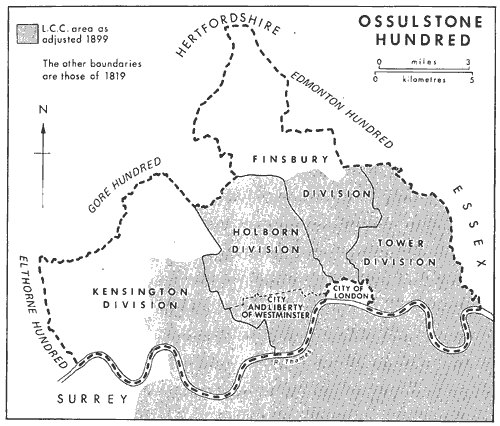
By the late 16th century the relatively dense population of the hundred, described in 1635 as very large and populous, (fn. 54) had begun to make some sub-division necessary. In 1593 an 'east' part was allied with Edmonton hundred in the conduct of an inquiry. (fn. 55) By 1613 there was a 'northern' part to which one of the high constables was attached. (fn. 56) By 1627 there were eastern and western divisions. (fn. 57) By 1634 there were four divisions. They were inter alia petty sessional divisions, areas which appear to have originated in Middlesex. (fn. 58) The Tower and Finsbury divisions are named in 1634, (fn. 59) Holborn division in 1635. (fn. 60) Kensington division has not been noticed eo nomine until 1689 but was obviously much older. (fn. 61) To some degree the four divisions were treated as separate hundreds. Until 1675, when the practice was forbidden, alehouses were licensed at divisional sessions, (fn. 62) and in the census report of 1801 Finsbury division succeeds Elthorne hundred in the alphabetical sequence. (fn. 63) The Registrar General was still grouping the Ossulstone parishes by divisions in 1841 and divisional population totals were published in the census up to 1861. (fn. 64) By them the histories of the parishes and districts in the hundred will be grouped in this and succeeding volumes. The map on p. 2 shows their boundaries.
The city and liberties of Westminster, as defined in a patent of 1604, (fn. 65) were from the 16th century to the 19th in many ways distinct from the parishes of the hundred, as indeed were the liberty of the Tower and the inns of court and Chancery. Westminster, for example, had its own high constable from 1585 (fn. 66) and its own commission of the peace from 1618. (fn. 67) It is clear, however, that in the 17th and earlier 18th centuries it was for fiscal purposes regarded as part of the hundred. In 1635 the whole county was rated to ship money, Westminster paying far more than the rest, (fn. 68) and in 1670 (fn. 69) and 1727 Westminster was forced to contribute to fines under the Statute of Winchester (1285) for failing to arrest robbers. (fn. 70) In 1723 it was rated for certain but not for all county purposes with the rest of the hundred in which it was expressly said to lie. (fn. 71) In 1703 the high constable of Westminster along with the high constables of two of the Ossulstone divisions was ordered by the Middlesex magistrates to observe an order concerned with the quartering of soldiers. (fn. 72) By the early 18th century, however, Westminster was sometimes treated as a distinct 'division' for rating purposes (fn. 73) and is so called in the 1851 and 1861 censuses.
In this History the city and its liberties are not included in the Middlesex volumes but are reserved for treatment under the History of London. The excluded areas consist of the parishes of St. Anne, Soho, St. Clement Danes, St. George, Hanover Square, St. James, Piccadilly, St. John, Smith Square, St. Margaret, St. Martin-in-theFields, St. Mary-le-Strand, St. Paul, Covent Garden, part of the parish of St. Leonard, Foster Lane, London, and the extra-parochial places of St. James's Palace, the Privy Gardens, Whitehall, the close of Westminster abbey, and the verges of the palaces of St. James and Whitehall. The inns of court and Chancery are likewise excluded.
The hundred is remembered partly because it gave its name to the barony of Ossulston conferred upon John Bennet in 1682. John was the brother of Henry Bennet, earl of Arlington (d. 1686), a member of the Cabal, (fn. 74) who built Ossulston House, formerly nos. 1 and 2 St. James's Square and afterwards demolished. (fn. 75) The barony was absorbed into the earldom of Tankerville in 1714. (fn. 76) Ossulston Street, St. Pancras, laid out by 1799, (fn. 77) has existed under that name since 1807. (fn. 78) It has been subsequently extended.