
A History of the County of Middlesex: Volume 7, Acton, Chiswick, Ealing and Brentford, West Twyford, Willesden. Originally published by Victoria County History, London, 1982.
This free content was digitised by double rekeying. All rights reserved.
'Ealing and Brentford: Local government', in A History of the County of Middlesex: Volume 7, Acton, Chiswick, Ealing and Brentford, West Twyford, Willesden, (London, 1982) pp. 144-147. British History Online https://www.british-history.ac.uk/vch/middx/vol7/pp144-147 [accessed 24 April 2024]
In this section
LOCAL GOVERNMENT.
Manorial Government.
In 1294 the bishop of London claimed to have in Ealing, as a member of his manor of Fulham, view of frankpledge, infangthief, outfangthief, chattels of fugitives, tumbril, pillory, gallows, and the assize of bread and of ale. (fn. 1) Courts baron for Ealing were normally held twice a year from 1383 until the mid 19th century, meeting at Fulham from 1445 or earlier. (fn. 2) The spring court was also a view of frankpledge, and other courts baron were held occasionally. There were separate aletasters for Ealing and Old Brentford in 1383, and the number of chief pledges was large and fluctuating. A constable occurred in 1492, a constable for Old Brentford and a constable and chief pledge for Little Ealing in 1509, and a constable for Great Ealing and a constable and chief pledge for West Ealing in 1512. From 1522 until 1834 or later one constable, two chief pledges, later called headboroughs, and one aletaster were elected annually for each of Ealing and Old Brentford wards. The vestry paid the expenses of constables and headboroughs in 1798 and 1806. (fn. 3)
Between 1791 and 1920 the homage of Ealing manor acted as a standing committee out of court, regulating manorial business and convening public meetings of copyholders. (fn. 4) Its continued vitality stemmed from control of the uninclosed waste, which the lord by 1697 could not alienate without consent. (fn. 5) The copyholders maintained the commons as an amenity and spent income from any grants of the waste on charitable purposes.
New Brentford lay within Boston manor. Westminster abbey in 1294 claimed that the manor was part of the liberty where it exercised extensive rights, including view of frankpledge and the assize of bread and of ale, although those rights, with tumbril, were also claimed by the priory of St. Helen, Bishopsgate. (fn. 6) A view of frankpledge and court for Brentford were held at Westminster in 1364 and 1365, in June, (fn. 7) and a solitary roll recorded a view of frankpledge and court baron in 1614. (fn. 8) In the late 17th and early 18th century a court for Boston 'with West Brentford' was usually held in April, often at the Red Lion or the Three Pigeons. Meetings, described sometimes as those of a court leet with view of frankpledge followed by a court baron, later became less frequent: there were 10 between 1743 and 1805 and 4, all at the Three Pigeons, between 1811 and the last recorded court in 1842. (fn. 9) There was a constable and a bailiff in 1378. (fn. 10) Officers elected in 1614 and 1692 were 2 constables, 2 headboroughs, 2 aleconners, 2 flesh and fish tasters, a leather searcher, a leather sealer, and a registrar; from 1692 there was also a pinder. A bailiff and 2 affeerors were added in 1786 and all the offices were filled as late as 1792. (fn. 11) A court baron was held for Coldhall or West Ealing manor from 1504 to 1722. (fn. 12)
Parish Government To 1836. (fn. 13)
Ealing vestry met from two to four times a year between 1704 and 1715, with from 5 to 19 attenders. (fn. 14) In the early 19th century it was thinly attended, except on special occasions, and met at the Cross House, north of Ealing church, possibly the former church house. (fn. 15) A new Cross House, often called simply the vestry room, was built in St. Mary's churchyard in 1840 and replaced in 1880 by the vestry hall in Ranelagh Road.
Churchwardens and overseers were recorded in 1599 (fn. 16) and two surveyors of the highways in 1654. (fn. 17) There were separate overseers for Upper Side (Ealing) and Lower Side (Old Brentford) by 1675, (fn. 18) one churchwarden and one overseer being elected for each from 1798 and two overseers for each from 1834. An assistant overseer was employed in 1812. Highway trustees, under an Act of 1767, were elected by the vestry, with which they were often at variance. The office of vestry clerk, filled by Thomas Jullion from 1796 until 1834, lapsed in 1836 but may have existed in an honorary capacity until its revival shortly before Ealing adopted the Vestry Clerk's Act in 1869. (fn. 19) There was a beadle by 1797, whose duties were defined in 1808 and 1833, and a parish clerk in 1654, (fn. 20) whose office in 1802 was combined with that of sexton. A separate parish clerk was appointed for Old Brentford in 1829 and in 1839 two unpaid sextons were appointed, one for each ward. Other officers included the keeper of the church clock in 1806, the overseers' messenger in 1836, and the bellringer in 1865.
Poverty was not serious in 1599, when the impotent poor were supported by a weekly rate distributed by the churchwardens and overseers. Able-bodied paupers were set to work, with the aid of £5 which had been collected, and the parish officers knew of no vagabond who had not been apprehended. (fn. 21)
The poor of each ward (fn. 22) were relieved by its overseer until 1814, when they were administered jointly by the assistant overseer. By 1698 poverty was causing concern (fn. 23) and in 1724-5 the vestry ordered that casual relief was to cease and that no outsiders should settle without certificates. The building of a workhouse did not eliminate outdoor relief. Paupers increased greatly during the 18th century, as did the poor rates, which stood at 4s. or 5s. in the £ in the 1790s and even higher later. There were 20 regular pensioners between 1789 and 1792 and 141, including 59 widows, in 1832. After 1750 there were increases in settlement litigation and in the apprenticing of poor boys, generally with small premiums. Bread was distributed at times of dearth, and in 1832 paupers were helped to emigrate. (fn. 24)
A workhouse and stock for the poor to work on were to be provided in 1698, whereupon a house for 8 poor was acquired in 1701. After abortive plans for its extension, a new workhouse was built west of St. Mary's Lane in 1728. Its supplies were arranged by the vestry, (fn. 25) which often dismissed the master. The inmates were employed at spinning and later at casual labour, but their work was never profitable: tools were lacking, men were outnumbered by women, and women by children. There were 30 beds in 1743-4 but before 1750 the number of inmates reached 64 on occasion. There were 48 inmates in 1754, 17 in 1760, 86 in 1779, 142 in 1785, and 175 in 1801. In 1797 the workhouse was badly overcrowded. In 1803, when there were 150 inmates for 55 beds, the parish vainly promoted a Bill to take over 14 a. of common at Ealing Dean for a workhouse, (fn. 26) and in 1812 the existing workhouse was enlarged. Its state was found acceptable in 1820 (fn. 27) and again in 1836, when it could accommodate 360 and had only 84 inmates. The buildings were sold in 1839 (fn. 28) but partly survived in 1979. Sums spent on the poor rose steeply from £720 in 1776 to an average of £1,316 from 1783 to 1785; (fn. 29) they were £2,886 in 1834-5 and £2,003 in 1835-6. (fn. 30)
New Brentford was governed separately from the rest of Hanwell by 1621, when the vestry of the chapelry decided to make its own officers more accountable. Two chapelwardens, one of them nominated by the minister, 2 overseers of the poor, also called collectors before 1641, and 2 surveyors of the highways were elected annually, usually at a meeting in the chapel in April. (fn. 31) There was a sexton, paid quarterly, by 1694, a uniformed beadle by 1752, and a salaried vestry clerk (fn. 32) and a salaried organist in 1814. The vestry also elected constables and headboroughs from 1815. (fn. 33) Chapelwardens' accounts, including orders of the vestry, exist for 1615-1814, (fn. 34) together with overseers' accounts ('poor's books') for 1617-61 and 1714-1808, (fn. 35) vestry minutes for 1814-64, and constables' accounts for 1688- 1710. (fn. 36)
The chapelwardens' funds were spent partly on the poor in the early 17th century, being supplemented by money raised at the Whitsuntide games, (fn. 37) although there was already a separate poor rate. (fn. 38) New Brentford was comparatively backward in its poor relief in 1733, (fn. 39) when pauper children were boarded out with the master and mistress of the charity school. A poor house on the Ham common was to be inspected regularly by the beadle in 1753, when the vestry also rented other houses for the poor, and was adapted as a workhouse in 1757, when those who refused to enter were to have their pensions stopped. (fn. 40) The workhouse, with a maximum of 27 inmates in 1758-9 and 32 in 1760-1, (fn. 41) was usually managed directly by the vestry, which considered quarterly tenders from local tradesmen. The poor were farmed, however, from 1796 to 1807 and again from 1832; (fn. 42) out pensions, at first disguised as casual relief, were resumed from 1785-6. (fn. 43) Money spent on the poor of New Brentford totalled £334 in 1776, an average of £383 from 1783 to 1785, (fn. 44) £907 in 1834-5, and £817 in 1835-6. (fn. 45) Originally leased, the workhouse was conveyed to the chapelry in reversion by James Clitherow in 1796. A confinement room for riotous inmates was to be added in 1787 and the building was ordered to be sold in 1838. (fn. 46)
Local Government After 1836.
Both Ealing and New Brentford were included in Brentford poor law union in 1836. (fn. 47) The parish continued to elect trustees of the highways, (fn. 48) who were consulted by a committee of the vestry in 1859 before it recommended adoption of the Local Government Act, 1858. (fn. 49) Six inspectors were appointed in 1851, after adoption of the lighting provisions of the Lighting and Watching Act, 1833, for Ealing village, and a further nine were appointed in 1857, for the lighting of an area farther south. (fn. 50) Agitation for a local board of health was repeatedly frustrated by Old Brentford, with the result that in 1863 the highway trustees were superseded by a local board only in that part of Upper Side extending a furlong north of the G.W.R. line. Northern Ealing, being rural, was not included until 1873, when the board's membership was raised from 9 to 12. (fn. 51)
In 1894 Ealing became a U.D.C. and in 1901 the first municipal borough in Middlesex, with 6 aldermen and 18 councillors representing 6 wards: Drayton, Castlebar, and Mount Park north of Uxbridge Road, Lammas, Manor, and Grange to the south. (fn. 52) Ealing absorbed Hanwell U.D. and Greenford U.D., which included Perivale and West Twyford, in 1926, and Northolt in 1928. There were 15 wards in 1950, represented by 45 councillors and 15 aldermen, (fn. 53) and 16 wards from 1960 with 48 councillors and 16 aldermen. A Bill to achieve county borough status was defeated in 1952 (fn. 54) and Ealing, Acton, and Southall boroughs united in 1965 to form Ealing L.B. The council consisted of 10 aldermen and 60 councillors, representing 20 wards. (fn. 55) Conservatives, who had dominated Ealing M.B., (fn. 56) won control of Ealing L.B. from Labour between 1968 and 1971 and again in 1978. (fn. 57)
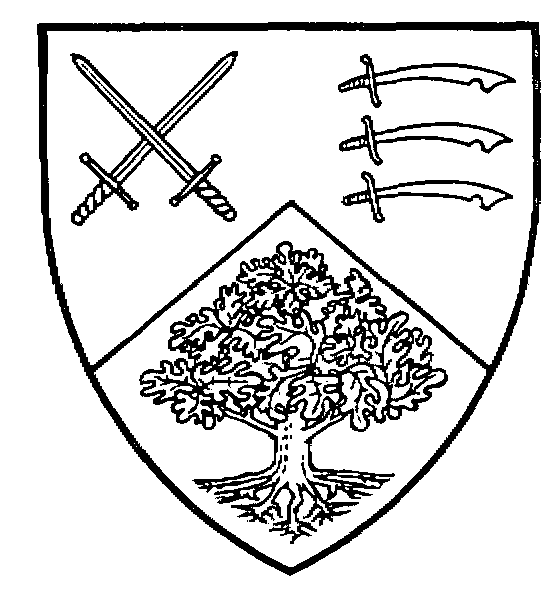
Borough of Ealing
Parted chevronwies gules and argent, in chief dexter two crossed swords and in sinister chief three pommelled and hilted or; and in the base an oak tree eradicated poper[Granted 1902]
Ealing local board first met at Cross House. The officers worked above a shop in High Street (fn. 58) and consisted of a clerk and the local historian Charles Jones (d. 1913), who, as engineer and surveyor, planned much of suburban Ealing. (fn. 59) They moved c. 1866 to the corner of Railway Approaches and the Broadway, and later offices and an engine house, designed by Jones, were built on the corner of the Mall, where the offices survived in 1980 as the National Westminster Bank. The existing town hall in Uxbridge Road, (fn. 60) of stone and designed in the Gothic style by Jones, was opened in 1889 and greatly extended in 1930 and later by G. H. Fellowes Prynne. (fn. 61) In 1979 it housed the main municipal offices of Ealing L.B. except those of the engineer, surveyor, and architect, which were at no. 24 Uxbridge Road, those of the chief education officer at Hadley House (nos. 79- 81), and the children's department, at no. 26 Castlebar Road.
New Brentford had three surveyors of the highways in 1853. (fn. 62) From 1874 Brentford as a whole was governed by its own 12-member local board of health, which was superseded by Brentford U.D.C., itself united with Chiswick U.D.C. in 1927. The local board's offices were at the market house, also the seat of the county court and petty sessions, in 1890, as were those of the U.D.C. in 1908. (fn. 63) From 1907 the courts sat at the vestry hall in the Half Acre, built in 1899, and later, before amalgamation with Chiswick, the council used Clifden House, Boston Manor Road. Clifden House was demolished in 1953 and the former vestry hall in 1963. (fn. 64)
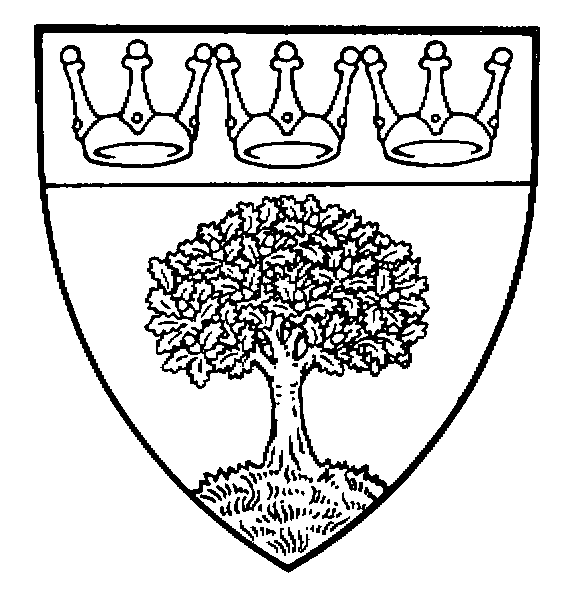
London Borough of Ealing
Argent, an oak tree proper fructed or growing out of a grassy mount; on a chief gules three Saxon crowns or [Granted 1965]
The Redistribution of Seats Act, 1885, established the Ealing parliamentary division of Middlesex, which included Ealing Upper Side, Acton, Chiswick, Greenford, and Perivale. (fn. 65) It always returned a Conservative or Unionist, as did the separate constituency of Ealing between the World Wars. (fn. 66) In 1945 Ealing M.B. was divided into Ealing East, which included most of the former Upper Side and elected a Conservative, and Ealing West, containing most of the newer additions. Under the Representation of the People Act, 1948, it was again reorganized as Ealing South, containing all Upper Side except Mount Park ward, and Ealing North, which covered the rest. Ealing South was represented by a Conservative from 1950 until 1974 and Ealing North by a Labour member, except between 1955 and 1964. Further reorganization in 1974 divided Ealing L.B. into Southall, thereafter represented by Labour, Ealing North, represented by Labour until 1979, and Acton, which returned a Conservative. That part of Ealing which lay within the local government district of Brentford from 1885 was in the Brentford division, which also included Hanwell, Isleworth, Norwood, and Twickenham, (fn. 67) and normally returned a Conservative before the creation of Brentford and Chiswick constituency. (fn. 68)