A History of the County of Middlesex: Volume 9, Hampstead, Paddington. Originally published by Victoria County History, London, 1989.
This free content was digitised by double rekeying. All rights reserved.
T F T Baker, Diane K Bolton, Patricia E C Croot, 'Hampstead: Manor and Other Estates', in A History of the County of Middlesex: Volume 9, Hampstead, Paddington, ed. C R Elrington (London, 1989), British History Online https://www.british-history.ac.uk/vch/middx/vol9/pp91-111 [accessed 30 April 2025].
T F T Baker, Diane K Bolton, Patricia E C Croot, 'Hampstead: Manor and Other Estates', in A History of the County of Middlesex: Volume 9, Hampstead, Paddington. Edited by C R Elrington (London, 1989), British History Online, accessed April 30, 2025, https://www.british-history.ac.uk/vch/middx/vol9/pp91-111.
T F T Baker, Diane K Bolton, Patricia E C Croot. "Hampstead: Manor and Other Estates". A History of the County of Middlesex: Volume 9, Hampstead, Paddington. Ed. C R Elrington (London, 1989), British History Online. Web. 30 April 2025. https://www.british-history.ac.uk/vch/middx/vol9/pp91-111.
MANOR AND OTHER ESTATES.
In a charter of c. 974 King Edgar (d. 975) granted 5 hides (cassati) in Hampstead, defined by their boundaries, to his faithful servant Mangoda for life. (fn. 1) None of the Westminster charters is quite what it purports to be. The so-called charter of 986 recording the grant to the abbey of the same 5 hides (mansiunculae) by King Æthelred the Unready (d. 1016) before 986, while not in itself a genuine charter, was a record made at Westminster during the grantor's lifetime. (fn. 2) The charters of confirmation, by Æthelred in 998 and by Edward the Confessor in 1065 and 1066, are generally agreed to be spurious, the last two probably the work of Prior Osbert de Clare before 1139. Nevertheless a genuine grant almost certainly lay behind the fabrications (fn. 3) and by 1086 Westminster abbey held the manor of HAMPSTEAD as 5 hides. (fn. 4)
Henry I (in 1133) and Stephen confirmed a grant by Westminster to Richard de Balta of 'land of the fee of Westminster of Hampstead' for rent of £2 a year and Abbot William de Humez (1214-22) assigned the £2 rent 'from the manor of Hampstead' to the abbey's kitchen. (fn. 5) It is not clear whether the grant was of the whole manor or of an estate within it, similar to the 1 hide held under the abbey by Ranulf Peverell in 1086. (fn. 6) During the reign of Henry II, however, the whole manor seems to have passed into the hands of Alexander de Barentyn, (fn. 7) the king's butler and kinsman of Richard Ilchester, bishop of Winchester, pluralist, and supporter of the king, who was associated with Barentyn's acquisition of property belonging to other religious houses. (fn. 8) Barentyn had been succeeded by 1203 by his son Richard, who died in debt soon after 1210 (fn. 9) leaving his estates in confusion and probably fragmented. His brother Thomas had to surrender his estate at Yeoveney (fn. 10) and it may have been as a result of that transaction that Ralph of Yeoveney was the lord of 1½ virgate in Hampstead held of him by Constantine son of Alulf in 1222-3 (fn. 11) and of 50 a. held of him by Alice of Westminster in 1225. (fn. 12) Most of the estate passed to Richard de Barentyn's niece (neptem) and heir Sibyl and her husband Andrew de Grendon, (fn. 13) who in the 1220s and 1230s held a messuage and 2 carucates as two-thirds of a 3-carucate holding. The other third was held in 1231-2 by Joscelin of Chichester and his wife Aubrey, possibly the aunt who inherited Thomas de Barentyn's estate in West Stoke (Sussex). (fn. 14) In 1230 Gilbert of Hendon, tenant of the neighbouring manor of Hendon, unsuccessfully challenged Andrew and Sibyl de Grendon's title. (fn. 15)
In 1231-2 the abbot of Westminster was content merely to register his claim to the 3-carucate estate (fn. 16) but Abbot Richard of Crokesley (1246-58) made a more determined effort. He sued Andrew de Grendon in 1253 for his messuage and 2 carucates, (fn. 17) presumably successfully because when he instituted his anniversary in 1256 and endowed it with the rents and profits of the manors of Hampstead and West Stoke (another Barentyn acquisition) he asserted that he had acquired them by his own efforts. (fn. 18) In 1267, in response to a plea by the abbey that the anniversary imposed an unfair burden on it, the pope reduced the endowment to £6 13s. 4d. from the issues of Hampstead manor, (fn. 19) comparable to a year's assized rents. (fn. 20) It is unlikely that Abbot Crokesley succeeded in regaining all the abbey's rights in Hampstead, for two undated charters made grants in free alms to the abbey of a grove and the lands and services of several tenants, including the Knights Templars, and it was not until the abbacy of Crokesley's successor Richard of Ware (1258-83) and probably after 1275 that Robert le Baud quitclaimed all right in the manor and vill of Hampstead. (fn. 21) The abbey administered the manor directly from 1259 (fn. 22) and, although it continued to make grants at farm, (fn. 23) it did not again lose its rents.
Following the surrender of the abbey in 1540, Hampstead manor formed part of the endowment made by the Crown to the new bishopric of Westminster. (fn. 24) When the bishopric was dissolved in 1550 its estates reverted to the Crown, which granted Hampstead manor, together with Northolt and Down Barns, to Sir Thomas Wroth (d. 1573) of Durants, Enfield, gentleman of the Privy Chamber. (fn. 25) The manor descended (fn. 26) to Sir Thomas's son, Sir Robert (d. 1606), and Sir Robert's son, Sir Robert, who died in 1614 leaving the manor to his brother and other trustees, each called John Wroth, to sell to discharge his debts and legacies. In 1620 they sold it to Sir Baptist Hicks, moneylender to the king and London mercer, who became Viscount Campden (d. 1629) and whose heir was his daughter Juliana. Her husband, Sir Edward Noel, Viscount Campden (d. 1643), was a royalist, as was his son and successor Baptist (d. 1682), who had compounded for his estates in 1646. The manor descended to his son Edward (d. 1689), created earl. of Gainsborough, and to Edward's son Wriothesley Baptist, who died without issue in 1690. The title and estate passed to a cousin Baptist Noel (d. 1714), who sold Hampstead manor in 1707 (fn. 27) to Sir William Langhorne (d. 1715) of Charlton (Kent), a former governor of Madras and wealthy East India merchant. Under Langhorne's will the manor passed to his nephew William Langhorne Games (d. 1732) with 14 remainders. (fn. 28) After Games's death the manor passed to the 14th tenant in tail, Margaret (d. 1745), widow of Joseph Maryon and a Langhorne descendant. Her son John Maryon (d. 1760) devised the manor to his niece Margaretta Maria (d. 1777), widow of John Weller, and then to her daughter Jane (d. 1818), wife of General Sir Thomas Spencer Wilson, Bt. (d. 1798). Their son Sir Thomas Maryon Wilson (d. 1821) left the manor for life to his son, also Sir Thomas Maryon Wilson (d. without issue 1869) with remainder to a younger son, Sir John Maryon Wilson (d. 1876). It descended to Sir John's son, Sir Spencer Maryon Wilson (d. 1897) and to his son, Sir Spencer Pocklington Maryon Maryon-Wilson (d. 1944), in whose lifetime the manorial rights lapsed. (fn. 29) The demesne lands were inherited by his brother, the Revd. Canon Sir George Percy MaryonWilson (d. 1965), who was succeeded by his cousin, Sir Hubert Guy Maryon Maryon-Wilson, with whose death in 1978 the baronetcy became extinct. The estate passed to Shane Hugh Maryon Gough, Viscount Gough, grandson of Sir S. P. M. MaryonWilson. (fn. 30)
Small pieces on the edge of the demesne were sold off, mostly in the early 19th century. (fn. 31) In 1804 the northernmost part of the demesne lands east of the heath were sold to Lord Erskine (fn. 32) and by 1841 his successor, the earl of Mansfield, owned 20 a. of former demesne land there as an extension of his Kenwood estate. (fn. 33) In 1804 Church field (2½ a.) at Frognal, on the eastern border of the main block of demesne lands, was sold to the trustees of the will of Richard Arden, Lord Alvanley. (fn. 34) In 1807 Thomas Neave, later Sir Thomas Neave, Bt., purchased 4. a. of demesne land on the western edge of the heath. (fn. 35) Further sales were prevented until 1869 under the terms of the will of Sir Thomas Maryon Wilson (d. 1821) and even when the death of the second Sir Thomas in 1869 released the land, little was sold. Some building plots at Fitzjohn's Avenue were offered for sale in 1875 but most of the estate was developed on building leases. The largest portion sold was East Heath Park (56 a.), which in 1889 was added to the heath, already acquired by the M.B.W. (fn. 36) In 1972 some freeholds were sold to Bryston Property Group (London). (fn. 37)
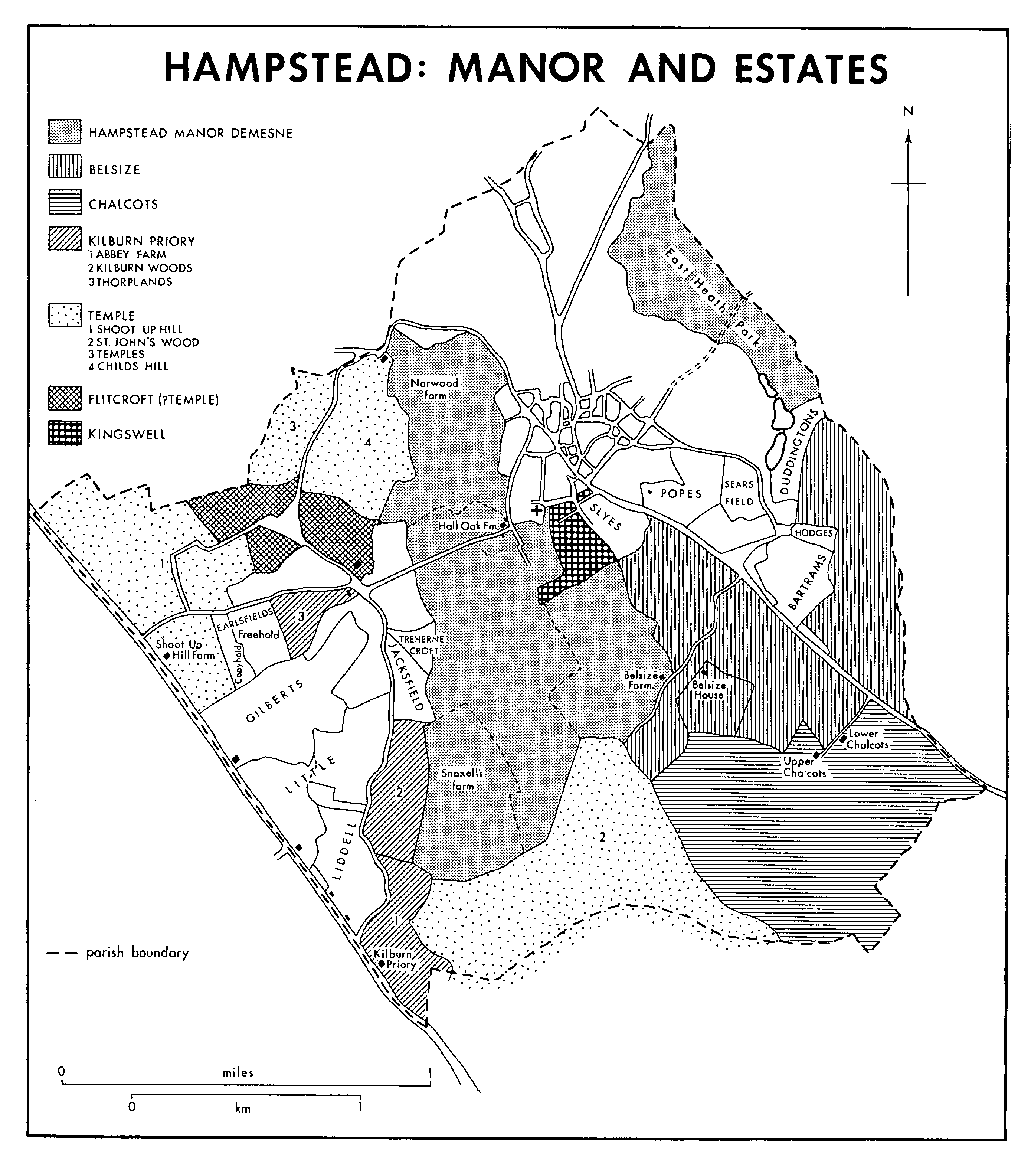
HAMPSTEAD: MANOR AND ESTATES
A messuage formed part of the 3-carucate holding of Sibyl and Andrew de Grendon in 1231, (fn. 38) a kitchen and sheepcote were mentioned in 1259 (fn. 39) and from 1272 to 1322 the grange buildings included an oxhouse, a sheepcote, a dairy, a cowhouse, a henhouse, and a granary, most of them of plaster and wattle. (fn. 40) A hall (aula), first mentioned in 1285, (fn. 41) was distinct from the grange and included a screens passage (1285) and a solar (1347). (fn. 42) The position of Hall Grove and Hall Field, first mentioned in 1379 and 1470 respectively, (fn. 43) suggests that the medieval hall was at Frognal and probably on the site of the later Hall Oak Farm, at the junction of Frognal and West End Lane. (fn. 44) It was called the 'manor place of Hampstead' in 1543-4 (fn. 45) and Manor House or Hampstead Hall in 1619. (fn. 46) None of the post-Reformation owners lived at the manor house, which became a farmhouse, leased out with part of the demesne lands. The lessee subleased part of the house in 1674, when he was assessed for 6 hearths and his undertenant for 4. (fn. 47) The manorial buildings seem to have remained divided throughout the 18th century. In 1762 the farmhouse of what by then was called Hall Oak farm, formed, with a barn, two stables, a coach house, and a cowhouse, three sides of a yard on the north side of West End (later Frognal) Lane, with another barn on the south side. The western buildings were occupied by the largest demesne tenant, William Bovingdon, the eastern by Edward Snoxell. (fn. 48) The house, of which no illustration is known, (fn. 49) was described in the late 18th century as a low, ordinary building in farmhouse style but containing a very capacious hall, (fn. 50) which suggests that the medieval hall may have survived. Snoxell's eastern portion of the house and buildings had passed by 1774 to John Foster who converted them into two houses, later replaced by another house. Bovingdon's portion needed considerable repairs in 1783 and in 1785 it was leased with demesne farmland to Thomas Pool, who, before he renewed the lease in 1798, had begun erecting the Frognal houses on the site. (fn. 51)
The tithes of Hampstead went to the rector of Hendon until Hendon church was appropriated by the abbot and convent of Westminster in 1478. (fn. 52) When the Crown granted Hampstead manor to the bishop of Westminster in 1541 the chapel and tithes of the parish were annexed, and successive lords of the manor were also impropriators of the great and small tithes. In 1650 part of the great tithes were let at £45 a year, the remainder being valued at £30 a year. The small tithes were valued at £10 a year and let to the incumbent. (fn. 53) In 1731 the lord let the tithes of corn, grain, and hay for 21 years at £30 a year, but excluded tithes payable from the demesne. (fn. 54) From 1784 Sir Thomas Spencer Wilson successfully sued occupiers of land in Kilburn, who claimed that the land as part of Kilburn priory was tithe-free like Belsize manor; (fn. 55) a modus of 2s. 6d. an acre was charged for the years 1764-8, and 4s. an acre thereafter. (fn. 56) Most occupiers of titheable lands paid a composition of 4s. an acre until 1786, when Wilson raised it to 5s. (fn. 57) The great tithes were commuted for £398 4s. in 1841, when there were said to be no small tithes payable for any lands in the parish. Sir Thomas Maryon Wilson was impropriator of the tithes of all the 1,739 a. titheable except for 5 a. held by Sir Thomas Neave, Bt. (fn. 58)
The so-called manor of Belassise, Belseys, or BELSIZE, whose name means 'beautifully sited', was first named in 1334-5, (fn. 59) but appears to have originated in the 1 hide of land of the villani which Ranulf Peverell held in Hampstead of the abbot of Westminster in 1086. (fn. 60) In 1259 there were 4 tenants 'of the hide' (de Hyda), one of whom was Gilbert le Kanep. (fn. 61) Since Gilbert was one of those whose services Robert le Baud granted to Abbot Richard, (fn. 62) it is probable that Robert was lord of the hide. About 1260 Robert granted a house, 40 a., and 1½ a. of wood for 6d. a year rent to William the linendraper. (fn. 63) By 1272 the abbey had regained possession of Gilbert's estate, (fn. 64) which in 1286 it leased to Gerin of St. Giles for 10s. a year. (fn. 65) Gerin was perhaps the same as Gerin or Gervin Linendraper, who had evidently succeeded William the linendraper by 1281 and in 1293 successfully defended his title to a house, 46 a. of land, and 2 a. of wood in Hampstead. (fn. 66) In 1296 Gerin of St. Giles also had the lease from John at Lofte of Agardesfield, on the eastern side of Haverstock Hill and later identifiable as part of Belsize, (fn. 67) and c. 1299 he conveyed a large estate to Luke of Hedham (or Stedham). Part of it appears to have passed to Martin de la Rokele, who in 1311-12 sold a house, a carucate, and 4 a. of wood to Roger le Brabazon, a judge. (fn. 68)
In 1312 Roger had two free tenements, a house and 40 a., held at a rent of 10s. 6d., and the tenement of John son of Gerin of St. Giles, which he held for John's life at 19s. a year rent and which reverted to Westminster at John's death. (fn. 69) On his deathbed in 1317 Roger granted to Westminster abbey a house and 57 a. which he held of the abbey at a rent of 10s. 6d. The grant was to endow a daily mass and anniversary for himself and Edmund, earl of Lancaster, and his wife Blanche. (fn. 70) In 1318 an estate was created for the prior of Westminster from all Brabazon's lands on condition that he found a chaplain and chantry to fulfil the obit, responsibility for which was placed on the 'church of St. Mary in the Fields', a possession of the prior of Westminster. (fn. 71) In 1360, in recognition of the considerable benefactions made to the abbey by the then prior, Nicholas of Litlington, his estate of Belsize was discharged from all rents and services due to Hampstead manor. (fn. 72)
Belsize absorbed land from other estates. East field, which in the 1290s was part of the demesne of Hampstead manor, (fn. 73) was leased to the prior in 1322 (fn. 74) and 1347, (fn. 75) and by 1500 it was described as parcel of Belsize manor and identified as the block of land east of the London road. (fn. 76) A customary tenement belonging to John le Lord, who probably died in the Black Death, was by 1354 leased to the prior (fn. 77) and may be identifiable with Lord's meads, part of Belsize in 1650. (fn. 78)
Belsize, like Hampstead manor, was surrendered to the king on the dissolution of Westminster abbey in 1540 (fn. 79) but it did not form part of the endowment of Westminster bishopric. In 1542 it was among the endowments of the newly constituted dean and chapter of Westminster, (fn. 80) confirmed by Elizabeth I in 1560 after being returned to the restored monastic chapter in 1556. It was from Elizabeth's charter, which established the dean and chapter as a corporation, that Westminster subsequently claimed its title. (fn. 81) In 1642 the royalist dean was driven out and the Cromwellian Col. Downes was said to have 'gotten possession' of the estate. (fn. 82) By Act in 1649 the rent from Belsize and other abbey estates was assigned to Westminster school. (fn. 83) In 1650 parliamentary trustees sold Belsize to Richard Mills and John Birdhall, citizens of London. (fn. 84) It was returned to the dean and chapter at the Restoration and remained with them until most of it was vested in the Church Commissioners in 1869 and the rest in 1888. (fn. 85) Some 20 a. were sold to Basil George Woodd in 1857, (fn. 86) 8 a. to Hampstead Junction Railway Co. in 1859, (fn. 87) 3½ a. to Thomas E. Gibb in 1880, and the freehold of the rest, mostly to the sitting tenants of individual houses, between 1948 and 1981, mostly in the 1950s. (fn. 88)
A 99-year lease of Belsize in 1549 by the dean and chapter to Richard Goodrich (Goodwike) was conveyed to Armagil Waad (Wade), clerk of the council, 'the English Columbus', and man of letters, in 1557. (fn. 89) Waad (d. 1568) bequeathed the lease to his son William (d. 1623), (fn. 90) also clerk of the council, lieutenant of the Tower, and diplomat, who was knighted in 1603. He left his property to his son James, a minor, subject to his widow's right of residence. (fn. 91) In 1633 James surrendered his interest to his mother Anne, who obtained a 21-year lease in 1634 (fn. 92) and another in 1642 when she married Col. Thomas Bushell and mortgaged Belsize to raise money for the king's cause. (fn. 93) She died soon afterwards, possibly in 1643 when the undertenants were instructed to pay their rents to the Hampstead parliamentarian, Serjeant John Wilde. (fn. 94) In 1651 she was said to have 'passed away her whole interest' in the estate to her son-in-law John Holgate, who was listed as farmer of Belsize from c. 1644 to 1653 and who 'purchased the inheritance of the contractors'. (fn. 95)
In 1650 Armenigilda Mordaunt, daughter of Sir William and Anne Waad, occupied the house and some of the estate (fn. 96) but the dean and chapter rejected a request by Thomas Bushell for a renewal of the lease in 1660. (fn. 97) Instead they leased it in 1661 for 21 years to Daniel O'Neill, another royalist but one whose great wealth made him a more desirable tenant. (fn. 98) O'Neill (d. 1664) left the lease to his widow Katharine, who had been married twice before. When she died in 1667 she left Belsize to Charles Henry Kirkhoven, Lord Wotton, her son by her second husband, who obtained a lease for lives from the dean and chapter in 1667. (fn. 99) After Wotton's death without issue in 1683 Belsize passed to Philip Stanhope, earl of Chesterfield (d. 1714), Katharine's son by her first husband, who obtained a new lease in 1683. (fn. 100) Chesterfield's son, Philip, Lord Stanhope, renewed the lease in 1707 (fn. 101) and again in 1715, as earl of Chesterfield. (fn. 102) His son, author of the Letters, was the owner from 1726 to 1773, renewing the lease in 1733, 1751, and 1769. (fn. 103) Trustees to whom he devised Belsize for his cousin and heir, Philip, obtained new leases in 1774 and 1786. (fn. 104)
In 1807 the earl of Chesterfield (d. 1815) obtained an Act to enable him to sell his interest in Belsize. (fn. 105) It was purchased by a syndicate of four, Thomas Roberts, who was already an undertenant of Belsize, James Abel, Thomas Forsyth, and Germain Lavie. They divided the estate into lots, kept the best parts, and sold the rest. (fn. 106) In 1808 the dean and chapter made nine separate leases, (fn. 107) still for lives and at the same rent, precisely divided. James Abel took three leases, of Belsize House and 45 a. surrounding it, of a house at Haverstock Hill and 19 a. (Hillfield), and of the Red Lion, another four houses, and 3 a. (fn. 108) Thomas Roberts took three leases, of Shelford Lodge (Rosslyn House) and 21 a., of three houses and 5 a. next to Haverstock Hill (Rosslyn Grove), and of a small timber farmhouse and 40 a. (South End farm). (fn. 109) Thomas Forsyth, of St. Marylebone, took one lease, of a house, three dilapidated tenements, and 45 a. south of South End farm (Haverstock Lodge). (fn. 110) Germain Lavie, who lived at West End, did not take a lease. (fn. 111) The two remaining leases were of five houses and 26 a. on either side of Belsize Lane, to George Todd, a Baltic merchant who was already an undertenant of the estate (fn. 112) and of three houses and 38 a. at the southern end of the estate, to Edward Bliss (d. 1844) of Tower Hill. (fn. 113)
James Abel disposed of his lease of the Red Lion and other houses, which in 1809 were divided among three lessees. (fn. 114) Abel (d. 1817) left his other property to his son-in-law Edward Harvey but in 1822 Hillfield was sold to William Francklin of Lincoln's Inn, the underlessee, to pay off James's debts. Francklin (d. 1826) left it to his sister Martha, who sold it in 1834 to John Wright, banker of Covent Garden, who mortgaged it in the same year to Catherine Blount. Wright & Co., a private bank, failed in 1840 and Hillfield (or Heathfield House) was sold by Catherine Blount in 1841 to Basil George Woodd, a wine merchant of New Bond Street, who was already an underlessee. (fn. 115) In 1857 Woodd obtained the freehold of Hillfield in exchange with the dean and chapter for the Belsize Court estate. On his death in 1872 Hillfield was inherited by Woodd's sons Basil Thomas and Robert Ballard (d. 1901) and the estate was not given over to the builders until the 1890s and 1900s. (fn. 116)
In 1830 Edward Harvey sold the main Belsize House estate to the undertenant John Wright, with whose other property it was sold in 1841 to Sebastian Gonzalez Martinez, a wine merchant. He sold it in 1852 to Charles James Palmer, a Bloomsbury solicitor, who in 1855 exchanged the old lease for lives for a 99-year building lease. About 5½ a. on either side of the Avenue, the access road to Belsize House, was excluded from the lease to give the dean and chapter entrance to their other estates. Palmer had submitted a complete plan for building on the estate in 1853, but was in financial difficulties in 1855, and the dean and chapter converted the lease of the whole estate into separate 99-year leases for each house, as it was completed, to Palmer's nominee, usually the builder Daniel Tidey. (fn. 117)
Thomas Roberts sold Shelford Lodge (Rosslyn House) and 21 a., which the dean and chapter leased in 1816 to Lt.-Gen. Sir Moore Disney, the occupier. Disney sold the estate in 1823 to Henry Davidson (d. 1827), whose son, another Henry Davidson, a West India merchant, obtained a new lease in 1846. (fn. 118) Building started on the northern part of the estate in 1853. In 1859 Davidson sold Rosslyn House to Charles Henry Lardner Woodd, another of Basil George's sons, and further parts of the estate to him in 1863 and 1869, some 8 a. in all. In 1869 he sold the rest of the estate, 13 a. covered with houses, to W. J. Blake. (fn. 119)
Roberts renewed his lease of the Rosslyn Grove estate in 1816 and left it to his wife Mary for life with remainder to his daughters and grandson. In 1828, after his death, a new lease was made to James Campbell, (fn. 120) Roberts's son-in-law or grandson, who was still the owner in 1860. (fn. 121) The third lease, of South End farm, then called Holyland after the undertenant of 1808, was held by Roberts's daughter Sarah and her nephew, James Campbell, in 1859 when they conveyed their interest in 8 a. and the original farmhouse to Hampstead Junction Railway Co. (fn. 122) The lease of 1808 was not renewed and in 1872 the dean and chapter, discovering the reversion to them through the death in 1868 of the last surviving life, leased the remaining 32 a. to the occupier, Joseph Pickett, as a yearly tenant. (fn. 123) A building agreement to lease 15½ a. on a 99-year lease from 1878 was made to Pickett and Ashwell, and by 1880 other parts of the estate had been sold to the London school board and neighbours. (fn. 124)
Thomas Forsyth's lease passed, on his death in 1810, by will to his widow, Jane, who sold it in 1817 to John Lund (d. 1843), a warehouseman of Westminster, who built Haverstock Lodge there and in 1828 purchased 3 a. of adjoining copyhold. His son, William T. B. Lund, succeeded to the estate and in 1852 exchanged the lease for lives for a 99-year building lease and proceeded to develop the estate, which he called St. John's Park. (fn. 125)
By 1817, when he renewed his lease for life, (fn. 126) George Todd (d. 1829) had replaced an old mansion with a new one, Belsize Court (at first called Belsize House, although the main estate house still existed), which was sold with 10 a. in 1841 to Basil George Woodd and returned to the dean and chapter in 1857 as part of their exchange with Woodd. The dean and chapter let 4½ a. on a building agreement to Daniel Tidey in 1865 but Belsize Court, set in the remaining land, stayed a country seat until 1880. Todd's son, also George, sold the other 16 a. south of Belsize Lane, in 1835 to John Wright, and on Wright's bankruptcy in 1841 James Sharp Giles (d. 1854), underlessee of part of the estate, acquired the lease. Giles's son Peter sold it in 1862 to Richard Pierce Barker, who surrendered the lease for a building agreement in 1869. (fn. 127)
Edward Bliss, who made his wealth in Portugal and acquired considerable estates in England, renewed his lease of his 38-a. farm in 1812, 1837, and 1840. (fn. 128) Bliss (d. 1845) left his Belsize estate to trustees for his nephew Henry Aldridge, who took the surname Bliss and later the Portugese titles of Baron de Bliss and Baron Barreto. The trustees renewed the lease in 1848, and in 1854 the dean and chapter, having discovered that Edward Bliss had built houses on 14 a., made a new lease for the 24 a. not built on. In 1864 the chapter bought out the leasehold interest of the 24 a. and later made a regular building agreement for it. It was only in 1890 that the Ecclesiastical Commissioners bought out Barreto's interest in the 14 a. (fn. 129)
A house formed part of the Brabazon estate in 1312 and was conveyed with it to Westminster abbey in 1317. (fn. 130) It may have been built of brick on a much larger scale in 1496. (fn. 131) Although they subleased part of Belsize, (fn. 132) the Waads retained the house, set amid parkland. In 1568 the house contained 24 rooms, including the hall, long gallery, great chamber, and two counting houses. (fn. 133) In 1650 there were still remains of a moated site, a wooded park, and a walk (fn. 134) but the house had evidently suffered from the poverty of the royalists and depredations during the Commonwealth. The house and garden were 'built with vast expense' by Daniel O'Neill (d. 1664); the house, which contained a fine gallery, (fn. 135) formed four sides around a courtyard. The east front, from which the north and south ranges projected, faced a brick court and was approached from the London road by a wooded avenue. A gravel walk along the west side may have been the remnant of a 'highway to St. John's Wood' that had been mentioned in 1650. The stabling and kitchen garden lay to the north and formal gardens to the south, at a lower level than the house and centred on a fountain; there was a cherry orchard to the west. The whole area, 25½ a., was enclosed by a brick wall. (fn. 136) O'Neill's building seems to have enlarged the house from 16 hearths to 36, though he died in the year that the assessment of 16 hearths was made. (fn. 137) It was a Dutch Renaissance building with a central tower and entrance, two storeys, and dormer windows. (fn. 138) Pepys, who in 1668 was particularly enthusiastic about the orange and lemon trees, considered the gardens 'too good for the house . . . the most noble that ever I saw'. (fn. 139) Evelyn, in 1676 more impressed by the contents of the house, notably the porcelain and Indian cabinets, thought the gardens 'large, but ill kept; yet woody and changeable; the mould a cold weeping clay, not answering the expense'. (fn. 140)
Lord Wotton was resident at Belsize from 1673 or earlier to 1681, but after the lease passed to the earls of Chesterfield in 1683 the house and 25½ a., besides the farmland, were let to undertenants. (fn. 141) By 1714, when the 25½ a. were called the Wilderness, they were in the hands of the notorious Charles Povey, (fn. 142) a coal merchant, who was accused in that year of having ruined Belsize by cutting down timber and demolishing outbuildings and of selling thousands of bricks from the walls and all the pipes and lead that 'played the waterworks' and of having filled in the fountain. Povey, a belligerent man who published pamphlets against all who offended him, claimed that he had found the mansion house and outhouses 'little more than a heap of rubbish', the land overrun with briars and weeds, and the walls ready to fall down. He had spent £2,200 on repairs, replaced the old pipes, and renewed the walls so that everything was in good order. Chesterfield was threatened with a pamphlet if he insisted on taking Povey to law. (fn. 143) In 1717 Belsize was 'now turned into a public house' (fn. 144) and in 1718 Povey, a rabid protestant, claimed that he had sacrificed £1,000 a year by refusing to lease the house and park, which included a newly erected chapel, to the French ambassador. Hurt that his gesture was not appreciated by the government and that his offer of the house to the prince of Wales was not acknowledged, Povey in 1720 opened Belsize as a place of entertainment. (fn. 145) In 1726 Chesterfield's agent claimed that the 'Great House' was far from having brought any profit for more than 40 years. (fn. 146) In 1733 the dean and chapter permitted Chesterfield to pull down and replace the present ruinous manor house. (fn. 147) In 1744 Chesterfield subleased the old house and 25½ a. to Joshua Evans on condition that he built a new house of four rooms on each floor. (fn. 148) Evans had built it by 1746 (fn. 149) as a plain building of three storeys and basement, with six bays and a stepped and porticoed entrance on its main front. (fn. 150)
Spencer Perceval, whose wife was the daughter of Sir Thomas Wilson, lord of Hampstead manor, rented Belsize House, the park, and other land, 45 a. in all, from 1797 to 1808. He considered it 'a rambling old place' and 'a miserable hole', spent considerable sums on it, and planted trees of all kinds but remained dissatisfied. (fn. 151) In 1808 the threestoreyed house had a hall, dining room, library, 3 drawing rooms, 6 bedrooms, 6 chambers, a dressing room, and a nursery. (fn. 152) By the 1840s the house had become a more complex building than that illustrated in 1800, (fn. 153) probably through alterations by Perceval and later tenants. In 1841 it was described as an elegant Gothic mansion and included a Gothic conservatory, vineries, aviaries, and a Grecian temple. (fn. 154) After the break-up of the estate in 1808 the house and parkland were occupied by tenants until 1853 when they were given over to the builders; the site of the house is the junction of Belsize Avenue, Belsize Park, and Belsize Park Gardens. (fn. 155)
Chalcots, first named in 1253, (fn. 156) originated in a grant, confirmed by the king in 1204 and 1242, by Alexander de Barentyn to the leper hospital of St. James, Westminster, of 1 hide in Hampstead. (fn. 157) The hospital's title was threatened by the abbot of Westminster's efforts to recover Hampstead from the heirs of the Barentyns (fn. 158) but was confirmed in 1258, when the abbot granted the hospital a house, a carucate, and 40 a. of wood in Hampstead in free alms, to be held of Westminster for £2 a year. (fn. 159) The £2 rent was paid for what in 1312 was described as a free holding of 80 a. of land and wood. (fn. 160) In 1448 Henry VI endowed his foundation of Eton College with the property of the hospital of St. James, the grant to take effect when Thomas Kempe ceased to be warden of the hospital. Eton held Chalcots from 1449 when Kempe became bishop of London. (fn. 161) St. George's chapel, Windsor, received the revenues 1463-7 while Eton was incorporated with it. (fn. 162) When Henry VIII, covetous of the site of the hospital, exchanged property with Eton in 1531, Chalcots was expressly reserved to the college. (fn. 163) In 1842 Eton acquired 32 a. of Crown land in Eton in exchange for 53 a. of the southern portion of Chalcots, which became Primrose Hill public open space. (fn. 164) The rest of Chalcots was covered in housing in the course of the 19th century. During the 1950s and early 1960s the college sold almost half its freeholds to the sitting tenants but in 1985 it retained the freehold of some 75 a., the western portion of the estate. (fn. 165)
As with Belsize, lessees replaced the institutional freeholders as the effective owners of the estate. Chalcots was leased by 1450 to John Rye, (fn. 166) to William Amy in 1481, (fn. 167) to Thomas Leckhampton for 20 years from 1481, (fn. 168) and from 1514 was leased together with Wyldes in Hendon, (fn. 169) to Thomas and William Kempe for 21 years (fn. 170) and in 1531 to William Kempe for 21 years. (fn. 171) The timber, which was reserved in the earlier leases, was leased in 1538 to John Slanning (fn. 172) who in 1556, when a lease to run from 1573 was made to him, was already in possession of the rest of Chalcots and Wyldes. (fn. 173) Slanning (d. 1558) left the lease to his kinsman Henry Cliff. (fn. 174) In 1579-80 a lease was made to the queen to run after the expiry of Slanning's lease in 1593 (fn. 175) but before 1583 the lease was held by Richard Loftis, whose widow Helen (d. c. 1590) brought it to Bartholomew Quyny, clothworker (d. c. 1593), whom she married c. 1583. In 1594 Quyny's widow and daughters were in dispute with friends of Helen, to whom Quyny had mortgaged the estate. (fn. 176) In 1615-16 Eton leased Chalcots and Wyldes for 21 years to Philip Barrett (fn. 177) (d. 1630), who left it to his wife Elizabeth. (fn. 178) The college made 21-year leases in 1632 to William Watkins (fn. 179) and from 1639 until 1676, usually at 7-year intervals, to Sir Thomas Allen (d. 1681) of Finchley. (fn. 180) Sir Thomas's son Edward took a lease in 1683, and in 1692, probably after his death, the estate was leased to Sir William Rawlinson (d. 1703) of Hendon. Rawlinson's heir was his daughter Elizabeth, wife of Giles Earle (d. 1759), the wit and politician, (fn. 181) and in 1720 the lease was held in trust for their children, William Rawlinson Earle and Eleanor Earle, who held it in 1755. (fn. 182) About that time, however, the lease was renewed to William Rawlinson Earle (d. 1771) alone (fn. 183) and it passed under William's will to his son Giles (d. 1811), (fn. 184) to whom leases were renewed in 1775, 1790, 1797, and 1804. (fn. 185) In 1818 and 1825 Giles's widow Margaret (d. 1827) renewed the lease, which was held in 1829 by trustees of her will and later by mortgagees. (fn. 186) Thomas Clarke, Earle's solicitor, was the lessee in the early 1830s and leases were made in 1839 to Charles Bowyer and in 1840 to John S. Hulbert. (fn. 187) In 1867 Ramsay Robinson Clarke was the lessee as mortgagee of Giles Clarke Earle. (fn. 188) Eton obtained a private estate Act in 1826 enabling it to grant 99-year building leases and, as parts of the estate were leased for building, starting with the eastern area next to Haverstock Hill, the Chalcots estate in the main lease shrunk. There were still 120 a. of grassland at Chalcots in 1871. (fn. 189)
A house formed part of the Chalcots estate in 1258 (fn. 190) and wages paid to a tiler and plasterer in 1481 were presumably for work on farm buildings. (fn. 191) The estate contained various messuages in 1594, (fn. 192) although 'Chalcote' was a single site in woodland in 1593. (fn. 193) By 1646 the estate was divided among five undertenants, two of whom had houses, (fn. 194) presumably Chalcot or Upper Chalcot and Lower Chalcot or Low Chalcot as recorded c. 1672. (fn. 195) By 1720 the 212-a. estate was equally divided into two compact farms centred on the two farmhouses, Upper Chalcots at the west end of Upper Chalcots Lane (later England's Lane after an undertenant) and Lower Chalcots on the south side of the same lane. (fn. 196) In 1756 all the buildings were said to be in a good state and the estate to be extremely well tenanted. (fn. 197) There were still two farms in 1774 (fn. 198) but by 1797 most of the land was in the hands of Thomas Rhodes, (fn. 199) who had Upper Chalcots (c. 101 a.) from 1791 and in 1802 and 1841 had 165 a. (fn. 200) Lower Chalcots had ceased to be a farmhouse by 1839, when it was leased with only 2½ a. to Charles Adey, a solicitor. (fn. 201) In 1851 there was only one Chalcots, occupied by a lawyer, (fn. 202) although both were marked on a map of 1862. (fn. 203) Upper Chalcots, called Chalcots, survived in 1873 but had disappeared by 1878. (fn. 204) A third farmhouse, south of the parish boundary at Chalk Farm, was sometimes wrongly confused with Lower Chalcots. (fn. 205)
Kilburn Priory was founded in 1134 and endowed by Herbert, abbot of Westminster, with the site of Godwin's hermitage in Kilburn on the Hampstead side of Edgware Road, 'all the land of that place', and rents. (fn. 206) In 1243-4 the priory acquired 14 a. and 1s. 6d. rent in Hampstead from Robert son of Nicol, (fn. 207) an endowment probably identifiable with its later 18-a. West End estate, described in 13thand 14th-century rentals as freehold called le Rudyng held of Westminster for 13s. (later 13s. 4d.) rent. (fn. 208) By 1535 the priory received nearly £11 from property in Hampstead and Kilburn, which may have included 40 a. in south-east Willesden. (fn. 209) Kilburn was dissolved in 1536 and in the same year Henry VIII granted the site and the demesne and other lands in Kilburn, Hampstead, and Kilburn wood to the Knights Hospitallers of St. John of Jerusalem in exchange for other estates. (fn. 210)
After the dissolution of the Knights Hospitallers in 1540 the king took the rents, including £1 a year from Robert Radcliffe, earl of Sussex (d. 1542), for the site of the priory. In 1547 the whole estate was granted to John Dudley, earl of Warwick, (fn. 211) who sold it in the same year to the Taverner brothers, Richard, Robert, and Roger. (fn. 212) Richard Taverner conveyed it in 1550 to John Lamb (d. 1550), (fn. 213) whose son Richard died in 1557 leaving infant daughters and coheirs, Joan (d. 1567) and Mary (d. 1571), who married Edward Josselyn. (fn. 214) The estate was conveyed in 1584 to Henry Josselyn. (fn. 215) He sold it in the same year to Sir Henry Gate (d. 1589), to whom he may have been connected by marriage, (fn. 216) and his wife Katharine. In 1590 Gate's son Edward conveyed it to Arthur Atye. (fn. 217)
By his will proved 1604 Atye left all his estates to his wife Judith (who later married Sir John Dormer and died in 1618) with remainder to his son Robert. Robert (d. 1612) on his marriage in 1608 to Jane, daughter of John St. John, settled the reversion of what was called the manor of Hampstead on himself and his wife. In 1621, after Robert's widow had married Sir Charles Pleydall, the marriage of his daughter Eleanor, then aged 13, was sold to Sir John Dormer, who married her to Sir William Roberts (d. 1662), her powerful Willesden neighbour. (fn. 218) In 1636 John St. John, trustee of the 1608 marriage settlement, conveyed two thirds of the Kilburn priory estate to Eleanor, the other third presumably being held by Jane Pleydall. (fn. 219) Eleanor's estate, though probably not the Pleydall third, was sold to Edward Nelthorpe, a London merchant, either directly by her in 1663 (fn. 220) or after a sale in 1663 to Edward Kelyng, who resold to speculators John King and Edward Jenkinson in 1673, who resold to Nelthorpe. (fn. 221) Nelthorpe died in 1680 and his property, which included copyhold, was divided between his son Edward (d. 1720) and his daughter Mary (d. 1756), wife of Thomas Liddell, who inherited her brother's portion and whose son Henry (d. 1771) was succeeded by his nephew Richard Middleton of Denbighshire. (fn. 222) Middleton divided his estates: he sold ABBEY FARM, 46½ a., of which 33 a. and the site of the priory lay in Hampstead, in 1773 to Richard Marsh, the underlessee, (fn. 223) and 31 a., formerly Kilburn woods, in 1774 to John Powell of Fulham, (fn. 224) who had bought Shoot Up Hill farm from Middleton in 1773. (fn. 225)
In 1818 Richard Marsh's son Richard was said to be the owner of Abbey farm (fn. 226) although a conveyance, possibly as part of a marriage settlement, was supposedly made by Richard Marsh in 1794 to Daniel Chapman and his daughter Ann and in 1819 Daniel Chapman and Ann Marsh, widow, conveyed the farm to Fulk Greville Howard. (fn. 227) Howard (formerly Upton), through his wife a great landowner, concluded building agreements within a few months of buying the Kilburn estate. (fn. 228) The estate passed on his death in 1846 to his nephew, Col. Arthur Upton, and it was under him that building was completed. (fn. 229)
The other part of the Kilburn estate, formerly KILBURN WOODS, (fn. 230) was combined with 29 a. of copyhold (Liddell) to form a 60-a. estate on either side of West End Lane. John Powell (d. 1783) devised his estates for life to his nephew Arthur Annesley Roberts, who changed his surname to Powell and died in 1814. He was succeeded, under his uncle's will, by his brother John Roberts, who changed his name to John Powell Powell. (fn. 231) Powell died in 1849 and his estates were held by trustees under his will, for the use of his nephew, Col. Henry Perry Cotton, who also inherited his uncle's house at Quex Park, Isle of Thanet, and who was still in possession in 1874. (fn. 232) In 1894 the estate descended to Maj. Percy Horace Gordon Powell-Cotton, a grandson of Col. Cotton. (fn. 233)
In 1535, besides the site of the priory with its dovecotes and other buildings, there was a mansion opposite the church door, (fn. 234) which may have been the chapel house mentioned later in the 16th century (fn. 235) and possibly the building still standing in 1722. (fn. 236) Sir William Roberts, who also owned the Shoot Up Hill estate, had a house and 30 a. in hand and 4 houses and 138 a. divided among six tenants. (fn. 237) In 1764 the Kilburn estate included a farmhouse for Abbey farm and another one for John Pawlett's farm, (fn. 238) which stood on his copyhold land on Edgware Road north of West End Lane. (fn. 239) In 1773 Abbey farm included the site on which the capital messuage of the priory 'lately stood', the Red Lion, and a cottage. (fn. 240) The last remnants of the priory buildings were removed in 1790 although foundations were still visible. (fn. 241)
At least some of the Kilburn priory estate appears to have become detached from the main estate in the 16th or 17th centuries, perhaps because boundaries became confused during the ownership of the Hospitallers and the Atyes, who had other estates in the area, and complicated divisions were caused by several surviving widows' dowries. In 1559 Edward Bacon was licensed to alienate lands in Kilburn late of the Hospitallers to Robert Cripps, who in turn was licensed to alienate them in 1564 to William Bubbington. (fn. 242) Since John Bacon had been an undertenant of the Kilburn priory estate in 1547, when he held a tenement and lands in Kilburn for £1 a year, (fn. 243) Edward Bacon's estate was probably a detached part of the priory's lands.
THORPLANDS, in 1762 an 18-a. freehold estate with a house at West End, was almost certainly the medieval Rudyng. (fn. 244) It had been leased to William Wylde in 1534 and was part of the lands granted to Warwick in 1547, (fn. 245) but it had become detached from the main estate by the mid 17th century, perhaps in 1636. A Mr. Thorpe held it at least from 1646 to 1653. (fn. 246) John Thorpe (d. 1687) left his freehold lands at Kilburn to trustees for his grandson, John Thorpe. (fn. 247) It was presumably the grandson who sold the estate to John Dee (d. 1721), who was succeeded by his cousin Elizabeth, wife of Thomas Draper. (fn. 248) In 1762 the estate was described as tithe-free freehold owned by 'Mr. Draper'. (fn. 249) When Elizabeth Draper died in 1771, her copyhold property descended to her son John (fn. 250) but the freehold estate was held in 1767 and 1771 by Mrs. Robinson and later by Thomas Fentham. (fn. 251) John Thomas Fentham was the owner in 1841 (fn. 252) and Thomas Potter in the 1860s and 1870s when building began. (fn. 253) There was a house on the estate possibly by 1244, probably by 1534, and certainly from 1646. (fn. 254)
Several grants created the TEMPLE estate, which lay in two main blocks on the western side of the parish, one in the north, which was sometimes associated with the Hendon estates of the Knights Templars, and one in the south, linked to Lisson manor in Marylebone. Though not recorded in the 1185 inquest, (fn. 255) the estate may have originated in Henry II's reign since 'Hamstede' was included in John's charter of 1199 among the gifts of his father to the Temple. (fn. 256) The Templars almost certainly had the northern estate by 1239, when they were said to hold 1 hide of the Barentyn estate 'from the parson of Hendon'. The name of the rector of Hendon at that date is unknown and probably the allusion was to Westminster abbey, which owned the Hendon advowson and was Hampstead's overlord. (fn. 257) From 1259 the Templars held a freehold estate in Hampstead from Westminster abbey for £1 a year rent, (fn. 258) which can be identified at the Dissolution with the northern estate, later called Shoot Up Hill. (fn. 259) By the 14th century the estate had a frontage of 100 perches (1,650 ft.) to Edgware Road (fn. 260) and in 1470 it formed the western boundary of Northfield wood, part of the manorial demesne. (fn. 261)
The Templars acquired part of the southern estate before 1237 when Otes (Otho) son of William gave them some land and wood in free alms. In 1238 he granted them the whole manor of Lisson (Lilleston). (fn. 262) In 1243 Hamon son of Roger granted them 80 a. in free alms in Lisson, Hampstead, and Hendon. (fn. 263) The services of the master of the Temple were among those surrendered by Robert le Baud to Westminster abbey; (fn. 264) in 1275 Robert claimed 140 a. of wood in Hampstead against the master, who asserted that the Hampstead wood formed part of Lisson park. (fn. 265) It is not known where the disputed wood lay but there is no evidence that the southern estate, later St. John's Wood, acknowledged overlordship of Hampstead manor. Woodland was apparently not included in the survey of 1308 when the Hampstead and Hendon estates were members of Lisson and only 49 a. of arable was mentioned at Hampstead. (fn. 266)
In 1312 the pope dissolved the order of the Temple and transferred its possessions to the Knights Hospitallers of St. John of Jerusalem. (fn. 267) The Hospitallers, who had possessed a house at Hampstead in 1223, (fn. 268) took over the Temple estate there and in 1327 Lisson manor was described as including 100 a. of arable and 3 a. of meadow in Hampstead, held in 1332 by William Langford for life. (fn. 269) In 1338 Lisson manor was held by Sir William of Cleeve for life and the Shoot Up Hill estate, by then severed from Lisson manor, was part of Clerkenwell bailiwick and leased out at £2 a year. (fn. 270) In 1522 the prior of St. John leased to John Barne, tiler of Hampstead, the Shoot Up Hill estate, which he called the 'manor and farm of Hampstead', together with all the hospital's land in Willesden and Hendon lately held by Edward and Anne Moore. (fn. 271) By 1540 Barne had assigned his 50-year lease to Thomas Bland. (fn. 272) The 1522 lease was for £11 a year and in 1535 'Hampstead' was valued at £11 a year, while the St. John's Wood estate was presumably included in Lisson bailiwick. (fn. 273)
The Hospitallers were dissolved in 1540, (fn. 274) and in 1546 the 'lordship and manor of Hampstead' was granted to Sir Roger Cholmeley. (fn. 275) On Cholmeley's death in 1565 the estate, then called the farm at SHOOT UP HILL, was divided into moieties, one held by his daughter Elizabeth, widow of Leonard Beckwith and wife of Christopher Kenn, the other by John Russell, the 14 year-old son of his other, dead, daughter Frances. (fn. 276) In 1566 Elizabeth (d. 1583) and Christopher Kenn conveyed their moiety to trustees. From Elizabeth's heir Roger Beckwith (d. 1586) the reversion descended to his sister Frances, wife of George Harvey, and then to Frances, wife of Henry Slingsby and daughter of Roger's other sister, Elizabeth Vavasor. (fn. 277) In 1595 Henry Slingsby was licensed to alienate a moiety of the 'manor of Hampstead' and considerable lands and houses in Hampstead, Willesden, and Hendon to Sir Arthur Atye and his wife Judith, (fn. 278) who were already in possession of the Kilburn priory estate. (fn. 279)
Sir John Russell died in 1593 seised of the other moiety, which passed to his widow Elizabeth for life, his son Thomas being then a minor. (fn. 280) In 1590 Russell had entered into a recognizance, possibly a mortgage or pre-nuptial settlement, with Robert North, the lessee of Shoot Up Hill farm and in 1594 Thomas Russell married Anne North. In 1595 North was licensed to alienate the moiety to Sir Arthur Atye and his wife Judith, subject to Elizabeth Russell's life interest which continued in 1621 (fn. 281) but had been extinguished by 1636. The Atyes' rights in both moieties of Shoot Up Hill descended with the main Kilburn estate (fn. 282) until 1773, when Richard Middleton sold Shoot Up Hill, then 112 a. in the north-west corner of Hampstead parish, to John Powell of Fulham. (fn. 283) Thereafter the estate descended with Powell's Kilburn estate. (fn. 284) It was built up after 1880. (fn. 285)
There is unlikely to have been a dwelling house on the Temple estate earlier than the one which the prior of the Hospitallers was said in 1522 to have made at his own expense, a substantial dwelling house with a barn, stable, and tilehouse. (fn. 286) It was probably on the site of the later Shoot Up Hill Farm, which certainly existed by the 1580s, (fn. 287) on Edgware Road just south of its junction with Shoot Up Hill Lane. (fn. 288) The farm buildings remained until the early 20th century. (fn. 289)
The Lisson manor portion of the Hospitallers' estate, which included south-west Hampstead, followed, as ST. JOHN'S WOOD, a separate descent after the Dissolution. It was administered by John Conway and, after 1542, by Sir Henry Knyvett as Crown land. (fn. 290) In 1547 it was granted to Edward Seymour, duke of Somerset. (fn. 291) Queen Mary gave it back briefly to the reconstituted Knights Hospitallers in 1558. (fn. 292) Her successor leased it c. 1583 to Arthur Atye, who was later to build up a large estate on either side of Edgware Road, but in 1594 she granted a 40-year lease to Sir William Waad, to run from the expiry of Atye's lease in 1639, and for the next 150 years St. John's Wood was closely associated with Belsize. Sir William (d. 1623) left the lease to his son James although there is no indication that he ever enjoyed it. St. John's Wood was administered as part of the Belsize estate occupied by Anne Waad during her lifetime. In 1644 James and Philip Cage, her son-in-law and administrator, sold the lease to her other son-in-law, John Holgate, who was still in possession in 1649. (fn. 293) In 1650 John Collins of Great Stanmore, who claimed that Holgate had assigned the lease to him, purchased at least part of the estate from the parliamentary commissioners, who had seized it as Crown land. At the Restoration he maintained that he had tried to delay payment so that he 'could pay it to his rightful sovereign', but his application for a new lease in 1660 failed. (fn. 294) In 1663 Henry Bennet, later earl of Arlington, successfully applied for the lease, which in 1666 was confirmed in possession or reversion. (fn. 295) In the same year Bennet sold his rights to Katharine, countess of Chesterfield (d. 1667), who devised the reversionary leasehold of St. John's Wood, together with the lease of Belsize, to her son Charles Henry, Lord Wotton. In 1673 Charles II granted Wotton the freehold of the whole of St. John's Wood, then 492 a., of which c. 150 a. lay in Hampstead. (fn. 296) Thereafter the estate followed the same descent as Belsize until 1732 when the earl of Chesterfield, who had already mortgaged it, sold St. John's Wood to Henry Samuel Eyre (d. 1754), a London wine merchant. (fn. 297) The estate passed to Eyre's nephew Walpole Eyre (d. 1773) and, on the death of Walpole's widow Sarah in 1823, to their son Col. Henry Samuel Eyre (d. 1851), who had 144 a. in Hampstead in 1838. He left it in trust for his brother Walpole and nephew George John Eyre (d. 1883), the latter being in possession by 1864. It then passed to Walpole's son the Revd. Henry Samuel Eyre (d. 1890), who left it in equal portions to his five children. (fn. 298) The family, which was one of the first to develop its estate for building, still owned the land in 1972. (fn. 299)
It is probable that parts of the Temple estate, like parts of Kilburn priory's, became detached. One such portion was almost certainly TEMPLES, so named by 1632, (fn. 300) 24 a. on the Hendon border. It was probably wrongly classified as copyhold in 1762, (fn. 301) being apparently freehold in 1714, when owned by Elizabeth Baker, (fn. 302) and in 1716, when held by trustees for Thomas Marsh. (fn. 303) In 1767 and 1784 it was freehold belonging to 'esquire Mead' (fn. 304) and in 1798 it was 'late Ashurst'. (fn. 305) It may be identifiable with 23 a. rated to B. Eyles in 1819 and A. P. Johnson in 1826. (fn. 306) It had passed by 1837 to Henry Weech Burgess (d. 1903) who was succeeded by his son Maj. Ardwick Burgess. (fn. 307)
Since the medieval Temple estate extended as far as the manorial demesne, it almost certainly included the estate at CHILDS HILL, called in 1784 Hogmans farm, (fn. 308) 57 a. of freehold land held in 1762 and 1771 by William Pritchard Ashurst. (fn. 309) In 1731 Ashurst had succeeded his father, Sir William Ashurst, to copyhold estates which Sir William had acquired from John and Mary Fletcher in 1694 (fn. 310) and it is possible that Childs Hill followed the same descent. It probably passed to William Smith in 1774 and was held by Hugh Smith in 1798. (fn. 311) The estate was apparently divided soon afterwards and the house and surrounding 6 a. were held by Enoch Hodgkinson from c. 1801 to 1810, then by Thomas Platt, and, probably after 1829, by his son Thomas Pell Platt (d. 1852), the orientalist, (fn. 312) who in 1841 owned the eastern 33½ a., of which he occupied 6½ a. (fn. 313) Platt's representatives were still the owners in 1880 and the estate was sold for building in 1896. (fn. 314) The western part of the estate lost some land to Finchley Road and the remaining 20½ a. was purchased in 1840, possibly from Stephen Beadle, who had a 21-a. farm in the area in 1834, by John Teil, an East India merchant. A strip of land was sold to the West Middlesex Waterworks Co. before 1855, when Teil was dead and the rest of the estate was put up for sale. The portion west of Finchley Road was bought by the son of the owner of the neighbouring Temple estate and the rest, 15½ a. and Kidderpore Hall, by Charles Cannon (d. 1876), a dyer. His daughters inherited the estate, which they sold in 1890 for building, except for the house and 2½ a., purchased by Westfield College. (fn. 315)
KINGSWELL or KINGHALL was a freehold estate lying east of the manorial demesne and defined by its abutments in 1393 and 1713. (fn. 316) It can probably be traced to 1259 when Roger de la Methe paid 1s. rent for an estate later held by Geoffrey de Kingswell. (fn. 317) In 1281 Geoffrey de Kingswell paid 4s. 5½d. rent as a tenant from the Hide, and another 10d. and two geese presumably for another holding; (fn. 318) he was alive in 1296 (fn. 319) but by 1312 had been succeeded by Robert de Kingswell, who then held a freehold estate consisting of a house and 16 a. for the annual rent of 5s. 8d., two geese, and one chicken. (fn. 320) Robert was apparently still a tenant of Westminster in 1319 (fn. 321) but by 1346 the estate had escheated to the lord because rent was not being paid. (fn. 322) By 1372 Thomas son of William Wright (or Wight) held the house and 12 a. and William Robin 4 a. (fn. 323) In 1393 Thomas Wright conveyed his portion, described as Kingswell garden, a croft called Combe, and More Kingswellfield, to William and Alice Gibb, who acquired 6 a. called Little Kingswellfield from William and Christine Ford at the same time. (fn. 324) William Gibb was farmer of the adjoining manorial demesne from 1381 to 1411 (fn. 325) and, probably after 1418, 'Wrythes', together with Popes, which lay north of it, was held by Alice Gibb. (fn. 326) By 1472 Kingswell was one of the many holdings in the hands of 'Master' Watno, (fn. 327) probably John Watno, who by will proved 1484 left his 'place called Kingswell' together with 'an orchard, two closes and a grove lying thereto' to his son Thomas. (fn. 328) In 1621 it was in the hands of Sir William Waad (d. 1623) of Belsize and it passed to his son James, being called Kinghall in 1633 and described as a farm and three closes (20 a.) of pasture. (fn. 329) It descended, heavily mortgaged, (fn. 330) to James's son William and, by 1713, to William's sister Anne Baesh, a widow, who conveyed it in that year to Lancelot Lee, a London linendraper, and Lancelot Baugh of Lincoln's Inn. (fn. 331) In 1717 they conveyed it to Richard Hughes of Holborn, who also acquired all the mortgagors' interests. (fn. 332) Involved in the transaction of 1717 was Charles Humphreys of Hatton Garden and in 1730 the estate was in the hands of his widow Sarah, (fn. 333) who devised it by will dated 1755 to trustees. In 1757 they sold it to Robert Cary (d. 1777), (fn. 334) who was succeeded by his daughters Amy Anne, Lucy Elizabeth (who apparently married brothers, Adam and Thomas Askew), and Mary, who sold the bulk of the estate, by then called Shepherd's Close, in 1797 to Jonathan Key, stationer of Paternoster Row. (fn. 335) About the same time individual houses built in the early 18th century on the south side of Church Row at the north end of the estate were sold off to the occupiers. (fn. 336) In 1797 Key sold 4 a. to George and Thomas Goodwin. (fn. 337) That part was devised by the will of George Goodwin to Harriet and Emma Parkinson, wives respectively of the Revd. Thomas Wynter Mead and Charles Trueman, who sold it in 1845 to George Henry Errington. (fn. 338) The rest of the estate passed by will of William Cade Key, dated 1823, to Rose, wife of the Revd. Barrett Edward Lampet, who sold it to Errington in 1846. (fn. 339) Errington retained it until the development of all his estates in the 1870s. (fn. 340)
There was a house on the estate by 1312, (fn. 341) which may have long been associated with the lessees of the manorial demesne. (fn. 342) The farmhouse was replaced by the south side of Church Row in the early 18th century. (fn. 343) By 1730 a barn had been built next to the lane (fn. 344) which later became Fitzjohn's Avenue, and by 1870 it was called Mount Farm though perhaps containing no dwelling. (fn. 345) It disappeared in the building development of the 1870s.
The 50-a. estate at Fortune Green and West End, called FLITCROFT after its owner in the 18th century, (fn. 346) was then a copyhold of Hampstead manor, though its position and the fact that no heriots were demanded suggest that its origins may have been as part of the Temple estate. The core of Flitcroft was land left by Rachel Farby in 1626 to William Clark (d. 1630). William's son Richard was succeeded in 1644 by his son William, (fn. 347) who had a house and 28 a. in 1646 (fn. 348) and was succeeded in 1651 by his sister Mary (d. 1652), the wife of Ralph Everett. In 1677 Everett sold his life interest to Gerald Conyers, who had already acquired the reversion from Richard Clark's sisters. (fn. 349) Tristram and Gerald Conyers in 1684 sold two houses in West End and 38 a. of meadow or pasture to James Shuter and his wife Elizabeth. (fn. 350) In 1722 Elizabeth died as a widow with that holding and a house and 8½ a. acquired by her father Charles Tilford (or Titford) before 1671. (fn. 351) She was succeeded by her daughters Elizabeth (d. 1728) and Rebecca (d. 1724), and their estate, including three cottages and 12 a. at West End left in 1709 by Charles Tilford's wife Rebecca to Rebecca Shuter (her granddaughter), was held by trustees under the younger Elizabeth Shuter's will until sold by court order in 1755. The buyer was the agent for the architect Henry Flitcroft (or Fleetcroft), who was admitted in 1756. (fn. 352) Flitcroft (d. 1769) was succeeded by his son Henry, (fn. 353) who died a lunatic in 1826. The estate descended to the latter's grand nephew Joseph Walmsley (d. 1836) and, in accordance with the latter's will, to Thomas Bruce Wavell, subject to trusts. (fn. 354) Wavell's son Thomas Brooke Wavell succeeded when his father died intestate in 1866, and he conveyed his estates to Mary Ann, wife of John Vining Porter. (fn. 355) The 20 a. north of Fortune Green was sold to the parish for a cemetery in 1874 and the rest of the estate was given over to the builders in the 1880s. (fn. 356)
There was a farmhouse at West End by the mid 17th century. (fn. 357)
An estate lying between Edgware Road and West End and consisting in 1762 of 54½ a., (fn. 358) copyhold of Hampstead manor, was called from the 17th century GILBERTS, presumably after a former owner, perhaps the 13th-century Gilbert Gers or Ters, whose estate escheated to the lord by the late 1280s. (fn. 359) It was called Cate Mead farm in 1704 and Church Path farm in the late 18th century. (fn. 360) It can be traced to John Badger (d. 1644), a Londoner who held it in 1638 (fn. 361) and whose son Thomas had a house, a cottage, and 40 a. in Hampstead in 1646. (fn. 362) In 1647 Thomas sold the estate to Thomas Tyler (d. 1655) and his wife Judith (d. 1664), who possessed 50 a. in 1649; (fn. 363) their son Joseph surrendered the estate in 1677 to his son William. William died in 1681, followed shortly afterwards by his wife and infant daughter, and his estates passed by will to his father in trust for his sister Judith and her infant son Brune Ryves. (fn. 364) Joseph Tyler conveyed the estate to trustees in 1686 to pay an annuity to the beneficiaries. In 1700, with the approval of Brune Ryves, the surviving trustee conveyed the reversion to the use of Clement Petit of London, (fn. 365) who was admitted in 1706. (fn. 366) His son James succeeded in 1717 (fn. 367) and sold the estate in 1729 to Sarah Bucknell, who paid three heriots, suggesting that the estate was an amalgamation of three ancient customary holdings. (fn. 368) Sarah's daughter Sarah (d. 1753), wife of Thomas Ripley of Westminster, succeeded in 1750 and left the estate by will to her stepson Thomas Ripley (d. 1770). (fn. 369) His son, the Revd. Thomas Ripley of Fulham, succeeded in 1780 (fn. 370) and on his death in 1814 the estate was divided between his two sons. The western 46 a., including a house and cottage on Edgware Road, passed to his eldest son the Revd. Thomas Hyde Ripley, while the other 11 a., together with stables and sheds at West End, passed to Jeremy Jepson Ripley. (fn. 371) Thomas's son, Thomas E. T. Ripley, succeeded to his father's estate in 1865 and to his uncle's in 1864. (fn. 372) The estate was depleted by the sale of c. 6½ a. to the Hampstead Junction Railway Co. in 1864 and of 10 a. to the Midland Railway Co. in 1867, (fn. 373) and the rest was enfranchised in 1868. (fn. 374)
South of Gilberts in 1762 was a 43-a. copyhold estate centred on a farmhouse on Edgware Road and then owned by John LITTLE. (fn. 375) No heriots were asked for it so it may have originated in Kilburn priory or the Temple estate. It can probably be identified with the estate held by Sir Henry Herbert in 1646 and 1649, when it consisted of a house and 36 a. and three cottages, all in the hands of tenants. By 1653 it had apparently passed to a Mr. Plummer. (fn. 376) John Plummer, who held it in 1678, (fn. 377) was succeeded in 1719 by his son Walter. (fn. 378) Walter sold the estate in 1736 to William Orton (d. 1738), who left it to his sister Anne (d. 1786) and her husband John Little (d. 1778). Their son Richard (d. 1796) gave the estate by will to his sister Dorothy, who married John Mills Jackson of Southampton in 1810. (fn. 379) They sold the estate in 1822 to Samuel Ware, the architect and manager of the duke of Portland's London estate. (fn. 380) Between 1823 and 1829 Ware sold most of the estate piecemeal, the largest portion, 17 a., to Henry Aglionby Aglionby (d. 1854) in 1829, (fn. 381) and by 1841 his estate was confined to the 12 a. bordering Edgware Road. (fn. 382) That part passed on Ware's death in 1860 to his nephew Charles Nathaniel Cumberlege. Kilburn Grange was built on the estate. (fn. 383)
The 29-a. copyhold and heriotable estate at Kilburn held in 1762 by LIDDELL, (fn. 384) and confusingly called Abbey Farm in 1704, (fn. 385) had belonged to Thomas Pawlett (d. 1656), who in 1646 had a copyhold and freehold estate of a house, four cottages, and 50 a., and probably to John Pawlett in 1640. (fn. 386) Thomas Pawlett left the copyhold to his wife for life with remainder to his daughters Margaret and Elizabeth. (fn. 387) In 1674 Margaret, then wife of Francis Painter, conveyed her moiety to Edward Nelthorpe, who already possessed the Kilburn priory and Shoot Up Hill estates, (fn. 388) and in 1676 Elizabeth, then wife of Richard Arthur, conveyed hers to Elizabeth Ireton for life, with remainder in 1687 to Mary Nelthorpe. (fn. 389) Nelthorpe's widow Mary was in possession of both moieties by 1704 (fn. 390) but had apparently died by 1713, when the estate was divided between his children Edward (d. 1720) and Mary (d. 1756), wife of Thomas Liddell. The estate descended with the Kilburn Woods portion of the Kilburn priory estate, being sold to John Powell in 1774. (fn. 391)
In 1674 the estate included a tilekiln house and 5 cottages; a house had been added by 1698. The tilekiln house had fallen down by 1756. (fn. 392)
Between Thorplands on the east and Shoot Up Hill on the west lay several fields called EARLSFIELDS. Pastureage sold in 'Erlesfeld' was listed among the issues of the manor in 1322. (fn. 393) It is unlikely that Earlsfield was part of the original manorial demesne because of its position. It may have originated in assarted land that was later leased or granted out or it may have been tenant land which had escheated to the lord. In 1632 John Kemp leased a cottage at Shoot Up Hill and two crofts called Earlsfield (6 a.). They, together with two cottages and a small close at Kilburn, passed on John's death in 1643 to his brother Francis Kemp of Willesden, (fn. 394) who owned three dwellings and 6 a., all leased to tenants, in 1649 and 1653. (fn. 395) In 1657 Francis conveyed the property to Charles Ramsbury, (fn. 396) who had conveyed it by 1678 to Samuel Walter. (fn. 397) It was held in 1704 and 1710 by a widow Waters (or Walter) (fn. 398) and from c. 1750 to c. 1820 by the Greenhill family, by which time the estate was identifiable as two fields south of Mill Lane, forming a long strip of 7 a., copyhold and heriotable. It passed to Samuel Hoare (d. 1847) and his son Joseph, who sold it to the Midland Railway Co. c. 1867. (fn. 399) The other two long fields to the east were freehold, comprising a house and 14 a. in 1705, when Robert Winter conveyed them to John Skinner. (fn. 400) The freehold estate passed to Richard Wilson in 1709, to Rebecca Osgood by 1743, to Osgood Gee in 1754, and to Edward Snoxell (d. 1766), lessee of the main demesne farm in 1759. (fn. 401) In 1764 it was the subject of a marriage settlement between Snoxell's son Armine and Jenny, daughter of Edward Nicoll. (fn. 402) Armine died young, however, (fn. 403) and from 1766 it was held by Jane Snoxell (later Mrs. Hill) and later by John Foster (d. 1785), whose executors were in possession in 1798. (fn. 404) It had passed to Edward Houlditch by 1810, (fn. 405) and was held by Richard Houlditch in 1841, (fn. 406) and by his executors in 1864. (fn. 407)
A customary holding called BARTRAMS (Bertrams or Bartrums) derived its name from a family which held customary and heriotable property in Hampstead from 1259 to 1347. (fn. 408) In 1312 Stephen Bertram held a house and 15 a. (fn. 409) The holding had passed to John Sleigh by 1371 and then passed to his son John (d. 1420), who held two other customary holdings. (fn. 410) It was part of the estate for which Anthony Sands paid five heriots on the death of Robert Sands, probably his father, in 1530. (fn. 411) In 1576 Thomas Sands succeeded his father Anthony to four houses or cottages and c. 50 a., mostly around Pond Street. Thomas's widow Margaret held the estates from his death in 1593 to 1621, when their daughter Frances, wife of Sir Thomas Savile, succeeded and sold them to John Needham and Edward Marsh. (fn. 412) When Needham, a London haberdasher, died in 1641, he divided Bartrams between his daughters. (fn. 413) Catherine (d. 1692) received Upper Bartrams, which passed to Joseph Needham (d. 1736), (fn. 414) to Joseph's son Joseph and, in 1744, to the latter's grandson John Thornhill, who sold it in 1746 to Ralph Farr Winter (d. 1753). Ralph's brother Joshua, (fn. 415) who held the estate as a house and c. 10 a. in 1762, (fn. 416) was succeeded in 1768 by his son Ralph, (fn. 417) who sold it to Elizabeth Baldwin in 1777. (fn. 418) Upper Bartrams, together with a house south of Pond Street, was later divided among five members of the Creed family, who between 1800 and 1809 sold their shares to Charles Cartwright. (fn. 419)
John Needham left Lower Bartrams to his other daughter Anne, (fn. 420) although there is no evidence that she held it. It may have been included in the 25 a. owned in 1646 by 'Mr.' Needham and leased to Edward Marsh. (fn. 421) In 1676 the reversion to Lower Bartrams was conveyed by Thomas Marsh to William Astley, who sold it in 1700 to Theodore Drage. (fn. 422) Drage had acquired possession before his death in 1737 when it was inherited by his son Dr. William Drage. (fn. 423) All William Drage's property passed by will in 1765 to his friend William Harrison (d. 1781) and descended to Harrison's nephew Edmund Horrex, (fn. 424) who sold Lower Bartrams to Charles Cartwright in 1810. Cartwright (d. 1825) left the reunited Bartrams to his cousin William Winfield. (fn. 425) Winfield sold 3 a. at the southern end in 1828 to John Lund, lessee of the neighbouring Belsize estate, (fn. 426) and the rest passed on his death in 1840 to his widow Anne, and on hers in 1855 to William's father Charles Henry Winfield (d. 1864). (fn. 427) In 1867 Winfield's son and heir, Lt. Col. Charles Henry Winfield, sold nearly 10 a. to the Midland Railway Co. and obtained the enfranchisement of the rest. (fn. 428) The estate was put up for sale in that year when most of it, 8 a., was bought by the Metropolitan Asylums Board, which opened a smallpox hospital there in 1870. (fn. 429)
There was a single house on the Bartrams estate from 1312, (fn. 430) at Hampstead Green south of Pond Street, just north of the George. (fn. 431) From 1641, when the estate was split between Upper and Lower Bartrams, the house descended with the first. Between 1762 and the end of the century the old house was replaced by two brick houses. Charles Cartwright in turn replaced one with another, the large irregularly shaped house called Bartrams, c. 1810. (fn. 432) It was purchased in 1867 by the Sisters of Providence as a convent and replaced by a modern block in 1967. (fn. 433)
HODGES, a heriotable copyhold estate east of Bartrams, was probably identifiable with Hoggis, a close and garden held c. 1472 by Richard Kemp. (fn. 434) It was part of Anthony Sands's estates in 1530 (fn. 435) and descended with Bartrams until 1641, when John Needham left it to his widow Mary (d. 1662). (fn. 436) In 1682 their son John sold Hodges, then described as a house and 7 a. in Pond Street, to John Turner, who left it in 1688 to his son Richard. (fn. 437) It was bought by John Dee and his wife Margaret in 1703 and passed in 1721 to John's cousin Elizabeth (d. 1771), wife of Thomas Draper. In 1772 their son John sold it to John Bond, who sold it in 1774 to William Key. George Goodwin purchased Hodges in 1779 from Key's creditors (fn. 438) and sold it in 1789 to Horatio Sharp (d. 1792), whose trustees sold it in 1792 to Charles Cartwright. (fn. 439) Cartwright left it in 1825 to his uncle Charles Henry Winfield and after 1855 Hodges descended with Bartrams. (fn. 440)
ALDENHAMS, named after the family which held it from 1281, (fn. 441) was a small heriotable customary estate on the north side of Pond Street. In 1312 William Aldenham held a house and 4 a. (fn. 442) Although the family still held land in Hampstead in the 15th century, Aldenhams was one of the estates held by 'Master' Watno c. 1472 (fn. 443) and by Anthony Sands in 1530. It was among the property sold in 1621 by Frances Savile to Edward Marsh, (fn. 444) who in 1646 held 11 a., subleased to three tenants. (fn. 445) Edward had been succeeded before 1650 by his son John, who in 1654 sold the estate to Alexander Ratcliff of London, who was succeeded in 1670 by his son Alexander. (fn. 446) His estate was divided, probably in the late 17th century, and Aldenhams, by 1704 consisting of two houses and 3 a., (fn. 447) passed from Susannah to Thomas Cumber and then to S. Bromwich, Blandine Marsh, and Marsh Dickenson, who in 1762 owned three houses and 3 a. Soon afterwards Aldenhams was sold to the lessee, Richard Norris, and descended to Christopher and, in the early 19th century, to Richard Norris. It was held by trustees after his death and in the 1860s was enfranchised and partly sold to Hampstead Junction Railway. (fn. 448)
SEARSFIELD, 8 a. of copyhold north of Aldenhams, may have originated in the estate held in 1259 and 1281 by Asketin Pond, whose daughter Cecily sold part at least in 1296 to William Aldenham, who held 3½ a. of it in 1312. As Ponders it was held by 'Master' Watno c. 1472 (fn. 449) and as Sarisfeld it was part of Anthony Sands's estates in 1530. It descended with Aldenhams until 1682 when it was acquired by Daniel Lodington, who in 1704 held a house and 10 a. (fn. 450) Lodington's seven children sold it to William Drage in 1732 and it descended with Lower Bartrams until 1809, when Edmund Horrex sold Searsfield to Samuel Gambier, who conveyed 8½ a. in 1811 and 2½ a. in 1812 to William Coleman. It formed part of the Downshire Hill estate built up after 1815. (fn. 451)
Duddingtons or Donningtons, in 1576 10 a. of pasture, once called Bedyngs, and 4 a. of wood, (fn. 452) was a copyhold but not heriotable estate stretching along the borders of the Belsize estate from Pond Street to the heath. (fn. 453) It was one of the estates held by 'Master' Watno c. 1472 (fn. 454) and by the Sands family in the 16th century and was among the lands sold by Frances Savile in 1621 to Edward Marsh, (fn. 455) who surrendered it in 1638 to William Marsh, a London tailor, who held it in 1655. (fn. 456) John Marsh surrendered it to Thomas Hussey of London in 1663; (fn. 457) it had passed to Peter Hussey by 1678 (fn. 458) and from Nathaniel to Sarah Hussey in 1698. Joseph Ashton, the owner by 1704, (fn. 459) died in 1728 seised of three closes containing 14 a. called Duddingtons, together with three houses in High Street, including the White Hart and c. 6 a. His widow Mary and daughter were admitted for life (fn. 460) but his nephew Henry Ashton claimed the estate under his uncle's will in 1729 and died seised of it in 1731, when he was succeeded by his son Robert. There were nine houses, including the Crown and Haunch of Venison besides the White Hart by then. (fn. 461) By 1754 Robert was described as a lunatic and the estate was being administered by his sister Mary and her husband John Merry, (fn. 462) and in 1776 Mary, then a widow, inherited on Robert's death. (fn. 463) Mary (d. 1802) was succeeded by her niece Margaret Merry, who sold Duddingtons but not the rest of the estate to Thomas Rhodes (d. 1856) in 1804. (fn. 464) Rhodes was succeeded by his grandson Thomas William Rhodes, (fn. 465) who sold nearly 3 a. to the Hampstead Junction Railway Co. in 1860 and obtained the enfranchisement of the rest in 1865. (fn. 466) In 1871 Rhodes began developing the estate, which he called South Hill Park. (fn. 467)
SLYES, a copyhold estate on the west of High Street, bounded by Church (Perrin's) Lane and the Kingswell and Belsize estates, probably took its name from the Sleigh (Slegh) family, which included two Johns, father and son, who held the office of manorial beadle and rent-collector from 1375 to 1412. (fn. 468) It may be identifiable with the estate held by Gallota atte Pond in 1259, (fn. 469) by William Woodsore (or Wodesour) in 1281, (fn. 470) and by Philip Woodsore in 1312. It was then described as a house and 13½ a. held for an annual rent of 2s. 8d., four geese, and three chickens. (fn. 471) In 1372 Philip Woodsore's holding was, in the hands of John Mareys, William Aldenham, and the elder John Sleigh, who also held two tenements probably near Pond Street. (fn. 472) The younger John Sleigh, described as of London, died in 1420 (fn. 473) and in 1459 Roger Aldenham and Richard Kemp paid an annual rent of 2s. 8d. for crofts, messuages, and lands. (fn. 474) In 1462 Aldenham conveyed to Kemp a croft and an adjoining garden in 'Kingwell Street in length next to the king's highway'. (fn. 475) By 1530 Slyes was one of the heriotable estates held by Anthony Sands and it descended with his other holdings to Frances, wife of Sir Thomas Savile, in 1621. It was then described as two houses and appurtenances in Hampstead town called Slyes, with two orchards, gardens, and three closes (8 a.) of meadow. (fn. 476) In 1623 Henry Fleetwood claimed that Savile had agreed to sell the estate to him (fn. 477) but there is no evidence that he acquired any part of the estate, which was probably broken up about that time.
Part of Slyes had passed by 1648 to Richard Brown, a London merchant who in that year leased a customary messuage in Hampstead Street 'against the common well' with gardens and orchards (2 a.) to a London vintner, who in 1658 assigned the lease to Thomas Hussey (d. 1671), a London grocer. (fn. 478) In 1675 Thomas's son and heir Peter, by then in possession of the copyhold, conveyed the house next the common well, together with another, to Basil Herne. (fn. 479) The property, which seems to have lost one house to John Cubbidge by 1704, descended from father to son, each called Basil Herne, on their respective deaths in 1729 and 1774. (fn. 480)
In 1652 Brown's land abutted a copyhold house called Slyes together with two closes (6 a.) which was sold by Robert Marsh of Hendon to Michael Sparkes (d. 1655), a London stationer, and his wife Isabel. (fn. 481) Under Isabel's will the estate, consisting of two houses and two fields, passed in 1671, after the death of her second husband Robert Davies, to her cousin Susan, wife of William Johnson, a London herbalist. (fn. 482) Johnson was still the owner in 1704 but by 1710 the estate had passed to John Cubbidge, who in 1704 held a house and 5 p. of land and who in 1706 was granted a shop and some waste at the town pond, adjoining his house. In 1704 the property there, apparently from north to south belonged to John Cubbidge, Basil Herne (with a house and 32 p.), William Johnson, and John Hibbert (Hubbard). It seems, therefore, that Cubbidge had acquired one of Herne's houses which thereafter became part of the 6-a. estate. (fn. 483) By 1712 a moiety had passed to John Ward of the Inner Temple and his wife Isabel, possibly Cubbidge's daughter, who conveyed it in that year to Thomas Weedon (d. 1715), a London merchant, and his wife Susanna. (fn. 484) They acquired various pieces of waste 'on the hill before the house' and part of the town pond (fn. 485) and in 1721 Susanna conveyed the whole 6-a. estate, together with the former waste, to Alexander and Margery Staham, (fn. 486) who in turn conveyed it in 1730 to Elizabeth De Cols (or Colls). (fn. 487) After her death her nephew and devisee sold the northern portion, just over 2½ a. together with various buildings, to George Errington (d. 1769) in 1753, (fn. 488) and the southern portion (c. 3 a.), which included the site of the ancient Slyes house, to Thomas Watson in 1754. (fn. 489) Errington's portion descended in the direct line to George (d. 1796), George Henry (d. 1843), (fn. 490) and George Henry Errington of Essex, who enfranchised it c. 1870 and merged it with his freehold Kingswell estate. (fn. 491) Watson sold his portion in 1759 to Robert Cary (d. 1777), who was already the lessee, (fn. 492) and in 1796 Cary's daughters Amy Anne, Lucy Elizabeth, and Mary sold it to Jonathan Key (d. 1805). (fn. 493) Key was succeeded by his widow Elizabeth (d. 1818) and then by his son Jonathan Henry (d. 1838). Under the latter's will the estate was divided in the proportion of 7/10 and 3/10 between his sons, Sir John Key, Bt., a City of London alderman, and Henry Garrett Key of Brixton. (fn. 494)
Col. John Owen, who was assessed for hearth tax in 1664, is unlikely to have been the Welsh Cromwellian of that name (fn. 495) but a London grocer who in 1671 owned land (fn. 496) previously owned by Richard Brown and who in 1681 conveyed a capital messuage with two crofts (3 a.) called Slyes to Grace Andrews, who conveyed it in 1683 to Henry Pollexfen. Although the ancient capital messuage was on the northern, 6-a. estate, the payment of heriot passed with the southern, 3-a. estate. (fn. 497) The latter had passed to William Cope by 1686 (fn. 498) and to William Hibbert (Hubbert) by 1704, who then had a house and close of just over 4 a. (fn. 499) By will dated 1715 Hibbert, a wealthy London skinner, left his copyhold house and appurtenances to his wife Hester for life, with remainder to his daughter Hester (or Esther), wife of Thomas Blunden. (fn. 500) After Hester Blunden's death without issue in 1749 the estate passed to her niece Esther, wife of James Lambe, (fn. 501) who immediately sold it to Joseph Butler (1692-1752), then bishop of Bristol (later of Durham). Under his will it was sold to Andrew Regnier (d. 1768), a tailor from St. Martin-in-the-Fields, (fn. 502) who was succeeded by his son John (d. 1780) and daughters Mary Buffar, widow, and Elizabeth wife of Charles Maddocks Hardey. (fn. 503) In 1787 the sisters sold their interest to James Pilgrim (d. 1813), who directed by will that the estate was to be sold. Most was purchased in 1815 by John Morice in trust for John Peter De Roure (or Rowe) and his wife Mary, who lived there (fn. 504) and were succeeded by Thomas Roper. The estate was sold by John Moore Roper to Henry Littleton Powys (who later added Keck to his surname), enfranchised in 1857, and conveyed to trustees of the Royal Soldiers' Daughters' Home in 1862. (fn. 505) A small portion was retained by Charles Pilgrim and enfranchised by his son Charles in 1882. (fn. 506)
There was a house on the estate by 1312 (fn. 507) and there were two by 1621 (fn. 508) and probably by 1459. (fn. 509) One house may have been that of the recusant John Raynes, which was broken into in 1609. (fn. 510) The ancient Slyes house stood, according to mid-18th century tradition, in the centre of the estate on the southern part of the 6-a. estate, which was sold in 1754 to Thomas Watson. (fn. 511) It was a single dwelling house in 1652 (fn. 512) but had been divided into two by 1671. (fn. 513) Between 1712 and 1721 the house was 'new built and expanded and converted to four tenements'. (fn. 514) It was later converted to three tenements (fn. 515) and in 1762 was again a single house, occupied by the owner Robert Cary together with a coach house, stables, a dairy, a summer house, two gardens, and a pleasure ground, very much a gentleman's seat. (fn. 516) It can probably be identified with the Rookery (also called Mount Grove or Greenhill), which was occu pied by the publisher Thomas Norton Longman (d. 1842) and was demolished in 1870, to be replaced in turn by a Wesleyan chapel and in the 1930s by the Greenhill flats. (fn. 517)
POPES, also called the Honywood or Carlile estate, of 16 a. in 1762, (fn. 518) took its name from a family which held land in Hampstead by 1296. (fn. 519) Heriot was paid after the death of Christopher Pope in 1355 (fn. 520) and in 1393 Popes garden, probably held by William and Alice Gibb, was a northern abutment of Kingswell garden. (fn. 521) In the early 15th century Alice Gibb paid rent for a tenement called Popes, (fn. 522) which probably formed part of the houses and lands held by John Gibb the younger in 1459. (fn. 523) By will dated 1516 John Gibb left his house and three closes on the south and west and one called East Popes field to his stepson William Smith. (fn. 524) The east and west components of the estate had apparently separated by 1621, when the name was applied exclusively to the east part. (fn. 525) By 1660 Popes meadow (8 a.) and a brick house bought from Robert Foster were left to Anne Pitchford by her husband William. (fn. 526) Anne died in 1674 and the meadow, though not the house, passed to her daughter Rebecca, wife of Isaac Honywood (d. 1721). (fn. 527) In 1704 Isaac Honywood had an estate of two houses and four closes totalling 17 a., (fn. 528) which descended in turn to Isaac's sons Edward (d. 1727) and Isaac (d. 1740). (fn. 529) Isaac's son (d. 1764), an eminent London banker (fn. 530) left the estate to his fourth cousin Sir John Honywood, Bt. (d. 1806). (fn. 531) In 1809 Sir John's son Sir John Courtenay Honywood, Bt., conveyed it to Samuel Gambier, first commissioner of the Navy, who sold 5 a. in 1811 (fn. 532) and the rest in 1812 to William Coleman. (fn. 533) Coleman became bankrupt and in 1814 4 a. were bought by Edward Carlile, (fn. 534) to be followed by the rest in 1816. Carlile (d. 1833) left the estate for the use of his wife Elizabeth (d. 1838), his son James (d.s.p. 1859), and the children of his daughter Janette Anne, who married Benjamin Edward Willoughby (d. 1854) in 1833. The estate was enfranchised in 1873 and sold to the British Land Co. in 1875. (fn. 535)
The medieval Popes house probably lay near Popes garden and was therefore west of High Street and north of Kingswell. (fn. 536) Anne Pitchford's house was assessed at 10 hearths in 1664. The Elizabethan Chicken House was on the Honywood estate. In 1674 Mrs. Honywood, presumably Rebecca, occupied the 23-hearth Slyes house, possibly while the main Honywood residence, later called Carlile House, was being built. (fn. 537) In 1692 the dissenting meeting house, between the Chicken House and Carlile House, was first recorded as at the dwelling of Isaac Honywood, who had two houses in 1704. (fn. 538) Fraser Honywood had a 'handsome edifice' in 1755. (fn. 539) It was probably rebuilt and by the 19th century was a stuccoed, rectangular building of three storeys and basement, with a two-storeyed bay at the side. It was demolished in 1876. (fn. 540)
JACKSFIELD, a heriotable copyhold of 8 a. at West End, bordering the demesne, (fn. 541) was mentioned in 1387. (fn. 542) It was held by Nicholas Fletcher (fl. 1397), by William Hunt (d. 1439), (fn. 543) and later by Edward Westby and by John Gilling (d. 1475), parish clerk of St. Sepulchre, who left it to his kinsman Thomas Gilling for life, and then to be sold for charity. (fn. 544) It was held in 1646 by Martin Dawson, who owned, inter alia, three houses and 8 a. (fn. 545) By will proved 1662 Dawson left his copyhold property to his wife Susan, (fn. 546) but he had incurred debts as a royalist and she apparently lost the property between 1664 (fn. 547) and 1668 when it was held by Sir Geoffrey Palmer, Bt. (d. 1670), attorney-general. Palmer left it to his daughter Frances, wife of John De La Fontayne, who conveyed it in 1686 to Anthony Keck. (fn. 548) Anthony was succeeded in 1696 by Francis Keck, (fn. 549) whose estate in 1704 consisted of an 8-a. close (Jacksfield) and a house and 1¼ a. of orchard (Frognal Hall) and 4 a. of demesne land adjoining the churchyard, which he leased. (fn. 550) Francis was succeeded in 1730 by his seven sisters or their heirs, who in 1735 conveyed all the estate to Joseph Stanwix or Stanwick, on whose death in 1747 it passed by will to his widow Mary, with remainder to his daughters Mary, wife of James Battin, and Jane, wife of Robert Slaughter. (fn. 551) Mary conveyed her share to Jane, who in 1765 conveyed Jacksfield to John Taylor, butcher, who in turn conveyed it in 1769 to Christopher Fowler. Thence it passed in 1771 to Thomas Boone and in 1775 to Thomas Wildman. Wildman (d. 1796) left it in trust for Maria Beckford. (fn. 552) It passed in 1800 to Richard Howard, earl of Effingham, as devisee of Maria Beckford and, on his death in 1818, by will to Samuel March Phillips, who was the owner in 1841. In 1858 it passed to one Walters, who enfranchised it. (fn. 553)
The house associated with Jacksfield by 1646 was probably Frognal Hall. (fn. 554) It was presumably one of two houses owned by Susan Dawson in 1664: she occupied one with 11 hearths and another with 10 hearths was empty. (fn. 555) In 1668 Pepys visited Sir Geoffrey Palmer 'in the fields by his old route and house'. (fn. 556) In 1761 Frognal Hall was detached from the Jacksfield estate, and during the 18th century became part of the West End House estate. Canterbury House was built on Jacksfield in the 1860s. (fn. 557)
TREHERNE CROFT, a triangular-shaped 4-a. close north of Jacksfield, (fn. 558) originated as customary land taken into the lord's hand for default of rent, possibly as a result of the Black Death. It was leased to Geoffrey le Fowler 1353-5, (fn. 559) to Thomas Bolton 1372-6, (fn. 560) to John Gibbs 1408-9, (fn. 561) then to Thomas Gibbs and to John Gilling and Hugh Penne in 1459. (fn. 562) John Gilling (d. 1475), left it, with Jacksfield, to his kinsman Thomas Gilling (fn. 563) and it was later held, also with Jacksfield, by Edward Westby. (fn. 564) It was a copyhold again by 1580 when William Jurden and his wife conveyed it to Richard Weeks, gentleman, and his wife Jane. Jane left her husband and married Edward Fust, by whom she had a son, Richard, who leased Treherne Croft and other property to John Wroth, kinsman of the lord of the manor. (fn. 565) A Fust was apparently still the owner in 1660. (fn. 566) By 1704 Treherne Croft was associated with Hillfield, the close to the north, and was held by Charles Herriott, (fn. 567) who conveyed the estate, a house, garden, and nearly 17 a. in three closes, to Henry Binfield in 1720. (fn. 568) The Binfields retained the estate until the end of the 18th century (fn. 569) but by 1841 Treherne Croft had become detached from the land to the north and was owned by Robert Shout. (fn. 570)
Treherne House had been built by 1762, (fn. 571) possibly by 1720. (fn. 572) It was probably rebuilt in the late 18th or early 19th century when it became a grand house, having a seven-bayed main section with attics and central porch and a large bay-windowed wing. In 1825 it was occupied by S. H. Binns (fn. 573) and in 1841 by the owner, Robert Shout. The house survived until the 1890s. (fn. 574)