A History of the County of Middlesex: Volume 11, Stepney, Bethnal Green. Originally published by Victoria County History, London, 1998.
This free content was digitised by double rekeying. All rights reserved.
'Bethnal Green: The North West, Hackney Road', in A History of the County of Middlesex: Volume 11, Stepney, Bethnal Green, ed. T F T Baker (London, 1998), British History Online https://www.british-history.ac.uk/vch/middx/vol11/pp112-114 [accessed 1 May 2025].
'Bethnal Green: The North West, Hackney Road', in A History of the County of Middlesex: Volume 11, Stepney, Bethnal Green. Edited by T F T Baker (London, 1998), British History Online, accessed May 1, 2025, https://www.british-history.ac.uk/vch/middx/vol11/pp112-114.
"Bethnal Green: The North West, Hackney Road". A History of the County of Middlesex: Volume 11, Stepney, Bethnal Green. Ed. T F T Baker (London, 1998), British History Online. Web. 1 May 2025. https://www.british-history.ac.uk/vch/middx/vol11/pp112-114.
THE NORTH-WEST: HACKNEY ROAD.
Despite its antiquity, Hackney Road was, on its southern, Bethnal Green side, (fn. 1) almost devoid of buildings until well after 1700. The land belonged to freehold estates created from demesne land: Milkhouse Bridge in the west, where a farmhouse was apparently built between 1682 and 1703 (fn. 2) slightly north of the junction with Crabtree Lane, the Barnet charities in the centre with, in 1679, a house and outbuildings at the eastern end of Crabtree Lane at the junction with a field way (later Gibraltar Walk) and a path (later Birdcage Walk), (fn. 3) and Sickle Penfield to the east. Most of the western part of Milkhouse Bridge was garden ground in 1703. The Nag's Head inn fronted Hackney Road at the eastern end of the estate and was occupied c. 1706-12 by Edward Carnell, a cowkeeper who in 1710-12 was described as brickmaster, (fn. 4) although in 1720 there was no building nearby except for a few cottages at the Crabtree Row end. (fn. 5) The inn's licensee in 1722 and 1730 was John Pritchard, (fn. 6) whose family was in possession, probably as lessees, of Carnell's interests, which included Sickle Penfield, by 1751. (fn. 7) The family may have been responsible for a small settlement around the Nag's Head and for a few cottages at the northern end of Birdcage Walk by the mid 18th century. (fn. 8)
Development later quickened. Between 1786 and 1789 26 houses were built, mostly by Baker at Greengate north of Crabtree Row, including Crescent Place and Somerset Buildings. (fn. 9) In 1789 John Allport (d. 1807), lessee of the western part of Milkhouse Bridge which he ran as a nursery, bought 6½ a. where in 1797 the Middlesex chapel was built fronting the curve of Hackney Road. (fn. 10) Houses were being built nearby in 1807 (fn. 11) and Middlesex Terrace existed by 1826. (fn. 12) In 1822 the Allport family made an agreement with John Poole, who built behind the chapel in Chapel, King, Queen, and Charles (later Hassard) streets. (fn. 13)
To the east Andrew Pritchard, in 1789 a tilemaker of Hackney Road, (fn. 14) built 11 houses near the Nag's Head in 1789-91 (fn. 15) and bought part of Milkhouse Bridge in 1790, (fn. 16) when John Pritchard, similarly described, took a 99-year lease of ground and five houses on the east side of 'the pathway from Spitalfields to the Nag's Head'. (fn. 17) The pathway was presumably Birdcage Walk, named after the public house which by 1760 had replaced the 17th-century farmhouse on the southern boundary of Barnet hospital estate. (fn. 18) Seven houses were built in Birdcage Walk in 1787-8, (fn. 19) partly by the licensee Samuel Lazonby. (fn. 20) Most were at the northern end, forming a settlement with Edith Gardens, Nag's Yard, and fronting Hackney Road near the Nag's Head by 1800. (fn. 21)
At the southern end of Milkhouse Bridge, north of Crabtree Row and east of Crescent Place, Nova Scotia Gardens existed by c. 1779 (fn. 22) perhaps only as gardens or allotments. Crude, probably wooden, cottages which may have originated as sheds existed by 1800 (fn. 23) and became notorious as the home in 1830-1 of John Bishop and Thomas Williams, the Resurrectionists, who murdered an Italian boy there. (fn. 24)
In 1807 Nag's Head Field, 8 a. of Milkhouse Bridge between Allport's and Pritchard's estates, was leased for 80 years to James Waddilove and John Crispin of Cambridge Heath and Charles Fichet of Hackney. Thirty-eight houses had already been built, mostly two-storeyed and fronting Coldharbour (or Coleharbour) Street at the western end. (fn. 25) The ground was staked out, presumably in building plots, around London Terrace fronting Hackney Road and a group of new streets: Coldharbour, Caroline, Henrietta, and Nelson streets, all projecting south from Hackney Road, and Bath Street, parallel with it. The three men jointly granted building leases before partitioning the ground in October 1808. (fn. 26) Among the builders, whose work was well advanced by the end of 1808 and apparently complete by 1812, (fn. 27) were Thomas Merrett, of St. Luke, Middlesex, (fn. 28) Isaac Clapson, carpenter of Henrietta Street, (fn. 29) Claxton Catchfield (fn. 30) and William Causdell, (fn. 31) of Hackney Road, and Joseph Foulkes, of London Terrace. (fn. 32) James Blake, a Bishopsgate Street auctioneer, had a large area (fn. 33) which he in turn leased out in plots 1 Milkhouse Bridge, 2 Barnet: a Chancel b Jesus Hospital, 3 Sickle Penfield to two carpenters, Robert Scott, of Hackney Road, and William Brailey, of Bishopsgate, and a bricklayer, John Gardiner, of Holborn. (fn. 34) Queen Street formed a westward continuation of Bath Street by 1823. (fn. 35)
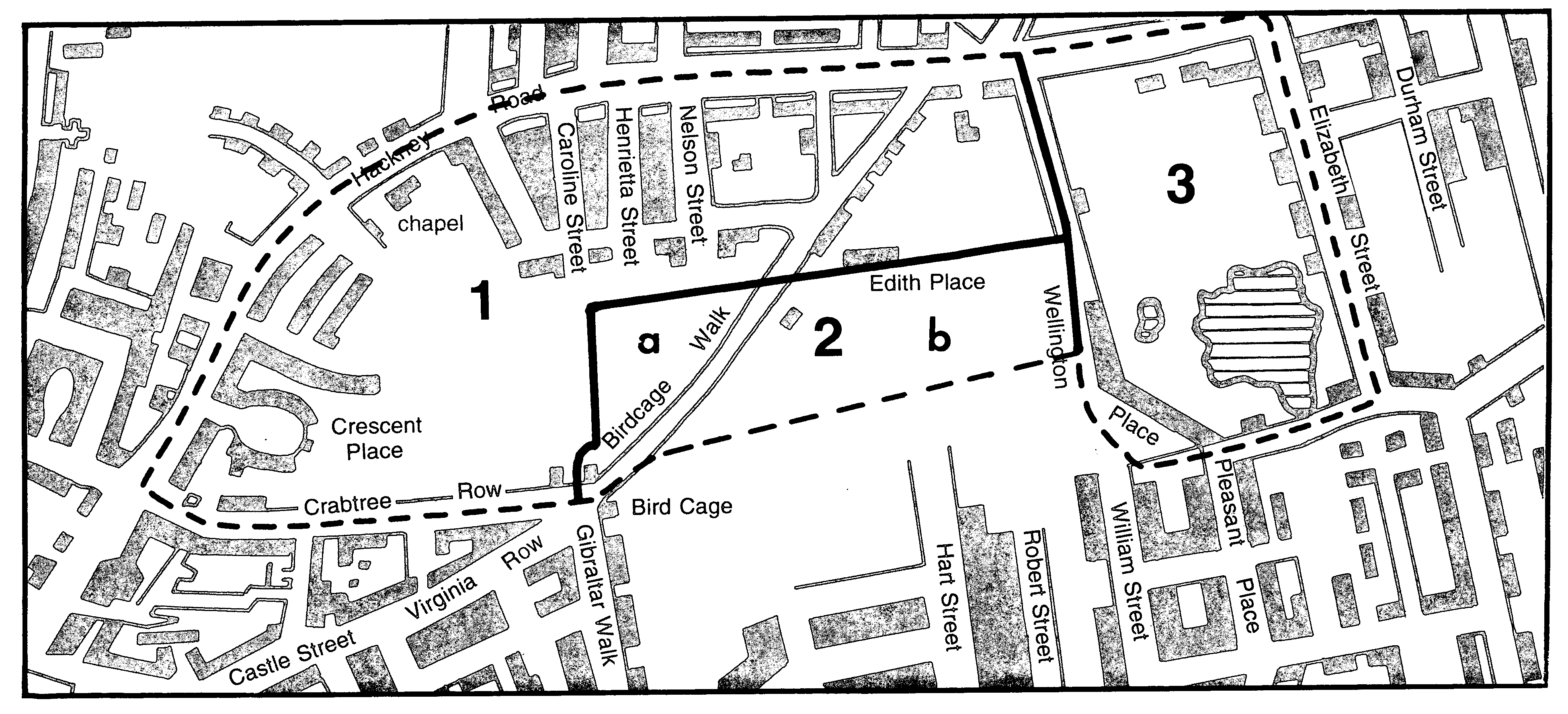
The North-west: principal estates
1 Milkhouse Bridge, 2 Barnet: a Chancel b Jesus Hospital, 3 Sickle Penfield
Ten houses built in Hackney Road in 1786-9 (fn. 36) may have included some new ones on Sickle Penfield assigned to Thomas Darling, a Southwark carpenter, in 1795. (fn. 37) The estate joined Rush Mead and there was building on the west side of Elizabeth Street, the boundary, and in Wellington Place at its south-western side by 1826 (fn. 38) and in Warner Place by 1828. (fn. 39) The Barnet charity lands remained virtually empty until the 19th century, one building fronting Birdcage Walk being added at the northern end of the Jesus Hospital charity estate by 1760 (fn. 40) and another opposite the Bird Cage at the southern end of the Chancel estate by the 1790s. (fn. 41) Willow Walk at the northern part of Jesus Hospital estate had at least one house by 1807, (fn. 42) 11 houses by 1820, (fn. 43) and 21 by 1836. (fn. 44) The Chancel lands on the west side of Birdcage Walk were built up in the 1830s, with Barnet, James, and Ravenscroft streets. (fn. 45) There were 855 houses in the area in 1836, with space for more in the south and east. (fn. 46)