
A History of the County of Northampton: Volume 5, the Hundred of Cleley. Originally published by Victoria County History, London, 2002.
This free content was digitised by double rekeying. All rights reserved.
'Cosgrove', in A History of the County of Northampton: Volume 5, the Hundred of Cleley, (London, 2002) pp. 77-98. British History Online https://www.british-history.ac.uk/vch/northants/vol5/pp77-98 [accessed 25 April 2024]
In this section
COSGROVE
The ancient parish of Cosgrove occupied about 1,760 acres (fn. 1) in the south-eastern corner of Cleley hundred, separated on the south by the river Great Ouse and on the east by the Tove from the Buckinghamshire parishes of Wolverton and Hanslope. In the south-west Watling Street formed a boundary with Passenham; on the west Cosgove was bounded by Furtho. The land rises from about 230 ft. above sea level on the banks of the Ouse to about 300 ft. in the centre of the parish, falling again in the north to 270 ft. The higher ground is covered by Boulder Clay; most of the rest of the parish lies on Oolitic limestones and clays, apart from the alluvial valleys of the two rivers. (fn. 2)
Until inclosure part of Cosgrove village green (about 12 a. out of 40 a.) was in Potterspury, and part of Brownswood Green, adjoining Potterspury village, was in Cosgrove. Under the inclosure Act of 1767 the first of these areas was added to Cosgrove and the latter to Potterspury. (fn. 3) A detached portion of Cosgrove, known as Kenson Field (280 a.), which lay to the west of Watling Street between Potterspury and Passenham, was inclosed under the Potterspury and Yardley Gobion inclosure Act of 1775 (fn. 4) and added to Potterspury in 1882. (fn. 5) In 1720 Bridges noted that four houses in Old Stratford, the village that grew up to the north of the Great Ouse on either side of Watling Street where the road formed the boundary between Cosgrove and Passenham, lay in Furtho parish, although the rest of the houses to the east of Watling Street were in Cosgrove, and three houses in Cosgrove village were said to be in Furtho. (fn. 6) In the 1830s 27 of the 39 houses in Old Stratford were in Cosgrove, nine in Passenham, two in Furtho and one in Potterspury. (fn. 7) The detached portion of Furtho in Cosgrove village had come to be regarded as part of the latter parish by the late 19th century; (fn. 8) the houses in Old Stratford were added to Cosgrove in 1882. (fn. 9) After the changes of that year the area of Cosgrove parish was reduced to 1,444 a. (fn. 10) In 1916 the detached portion of Potterspury in Old Stratford was transferred to Cosgrove, although an attempt on that occasion to make the whole of Old Stratford a single parish and to divide Furtho parish between its neighbours failed. (fn. 11) Only in 1951 was a civil parish of Old Stratford established, to which the southern end of Cosgrove was transferred, and Furtho abolished, when the eastern and northern portions were added to Cosgrove and the rest to Potterspury. (fn. 12)
The open fields of Cosgrove (other than Kenson Field) and Furtho were inclosed under an Act of 1767, when they were found to consist of three distinct tithings, known as Cosgrove tithing, Furtho tithing and Potterspury tithing, which paid tithes to the parishes in question, although all the land lay in either Cosgrove or Furtho. (fn. 13) The survival of these tithings, and the intermixture of lands between the three parishes, perhaps suggests that in the early Middle Ages the whole area formed one estate. Potterspury (and Yardley Gobion) presumably broke away at an early date, but Furtho and Cosgrove may have remained a single unit until somewhat later, since Furtho glebe extended into Cosgrove and vice versa. (fn. 14) In addition, whereas the outer boundaries of Cosgrove and Furtho combined are formed on three sides either by rivers or by Watling Street (the fourth side being the boundary with Potterspury), the boundary between the two mostly runs through fields in an irregular fashion, suggesting that it is a later insertion. The tenancy in chief of the manors of Cosgrove and Furtho descended together from the 11th century and the two lordships also owed quit rents to each other, which continued to be paid at irregular intervals until the extinguishment of manorial incidents in 1935. (fn. 15) The two parishes were taxed as one township in the Middle Ages (fn. 16) and shared a single field system. (fn. 17) In addition, the earliest reference to a church at Furtho suggests that the undertenant may have been seeking to create a new parish there in the late 12th century. (fn. 18)
Domesday records a population of 10 on the three manors in Cosgrove (apart from a further 11 at Furtho); (fn. 19) in 1301 54 people were assessed to the lay subsidy in the township of Cosgrove, a figure which must include Furtho; (fn. 20) and in 1524 there were only about 27 taxpayers in Cosgrove alone. (fn. 21) A total of 65 households were assessed to the hearth tax in 1674 in the constablery of Cosgrove, which evidently includes Furtho but not Old Stratford; only 10 were discharged through poverty. (fn. 22) In the early 18th century there were similarly about 60 houses in Cosgrove, (fn. 23) a figure which had increased to 90, occupied by 505 people, in 1801. The population rose to a peak of 776 in 1861, before falling steadily to 668 in 1911 and then more rapidly, so that by 1951 there were only 410 residents and in 1961 405. Limited new building lifted the figure to 496 in 1981, still only two-thirds of the 19th-century maximum.
At Old Stratford the pre-motorway route from London to Northampton branched from Watling Street at a crossroads at which the road to Buckingham and Oxford turned off in the opposite direction. The Northampton road ran north through the parishes of Cosgrove and Furtho for about two miles before turning north-west towards Yardley Gobion. About half a mile from the crossroads in Old Stratford, near Quarry Bridge, a minor road (the modern Stratford Road) led from the Northampton road into Cosgrove village, ending at the Green at the north-eastern end of the settlement.
Another road (the modern Yardley Road) ran west from the village back to the Northampton road, from where it continued to Furtho and Potterspury. (fn. 24) In 1593 the footpath forming the boundary between Cosgrove and Furtho from the Northampton road at Quarry Bridge to Yardley Road was called Hanslope Way, (fn. 25) which continued from Yardley Road north to Castlethorpe (in Hanslope parish). The latter section survived into modern times; the length between Quarry Bridge and Yardley Road presumably became redundant since it was almost parallel with the Northampton road.
The main line of the Grand Junction Canal runs down the eastern side of the parish, following the right bank of the Tove to near its confluence with the Great Ouse. A public wharf was established about half a mile north of Cosgrove village, where the road to Castlethorpe crossed the canal, which became known as Castlethorpe Wharf and was presumably intended to serve both villages. The canal was originally to have been carried across the Ouse valley by two flights of locks but in December 1799 it was decided to build a masonry aqueduct instead, which was opened in August 1805. The following January part of the adjoining embankment collapsed, followed in February 1808 by the entire structure. A temporary wooden trunk was installed a few months later and in 1811 this was replaced by a cast-iron trough made by Reynolds of Ketley (Shropshire), supported on masonry piers and flanked by lengthy earthen embankments. (fn. 26) At the northern end of the embankment on the Northamptonshire side of the river, a side-cut, opened in 1800, ran to a wharf at Old Stratford close to Watling Street. The following year the branch was extended to Buckingham. (fn. 27) This section fell into disuse after the First World War (fn. 28) and the portion in Cosgrove and Old Stratford was later largely obliterated. The main line of the canal remains an important element in the national network and in the 1990s proposals were announced to rebuild the Buckingham branch.
Landscape and settlement.
During the excavations for the canal numerous Roman coins were found in the south-eastern corner of the parish, about a mile from Watling Street, (fn. 29) where a villa, bath-house and temple were excavated in the 1950s and 1960s. A doublecorridor villa, with a large courtyard, was built c. 100 and survived for about 200 years. The bath buildings were built c. 150 and went out of use before 300. Another less sophisticated double-winged building was occupied between about 100 and 150, and a small temple built c. 300 may have replaced an earlier one. A few Neolithic or Bronze Age flints and some pottery were also found on the site, and c. 1967 a bronze spearhead was found close to the Ouse in the same part of the parish. (fn. 30)
The site of the earliest post-Roman settlement in the parish is presumably indicated by the position of the parish church, which stands alongside Stratford Road at the south-western entrance to the modern village. (fn. 31) In the 18th century Stratford Road continued from there in a north-easterly direction to cross Yardley Road and end at the manor house which stood on the right bank of the Tove about half a mile north of the village. (fn. 32) That layout, however, appears to be the result of closing a road which at an earlier date continued north-east past the church to join the existing main street at the junction with Yardley Road. From there the main street continues to run north-east to Cosgrove Green. The more direct route from one end of the village to the other may have been stopped up in the 18th century when a large new parsonage, with extensive grounds, was built immediately to the north of the church. (fn. 33) Until the early 19th century the lane serving Cosgrove Green continued east, beyond the modern built-up area, to end at a water-mill on the Tove about a quarter of a mile downstream from a later mill which stood closer to the manor house. (fn. 34)
When the canal was built in the 1790s it was carried over the main village street near the junction with Yardley Road on an embankment. Although a tunnel was provided for pedestrians, wheeled traffic was diverted along the road which skirted the rectory grounds and continued to the manor house. That road was carried over the canal about a quarter of a mile north of the tunnel on an elaborate Gothick bridge. Near the bridge a new lane was laid out, which ran south, parallel with the canal, to rejoin the old main street just east of the tunnel. (fn. 35)
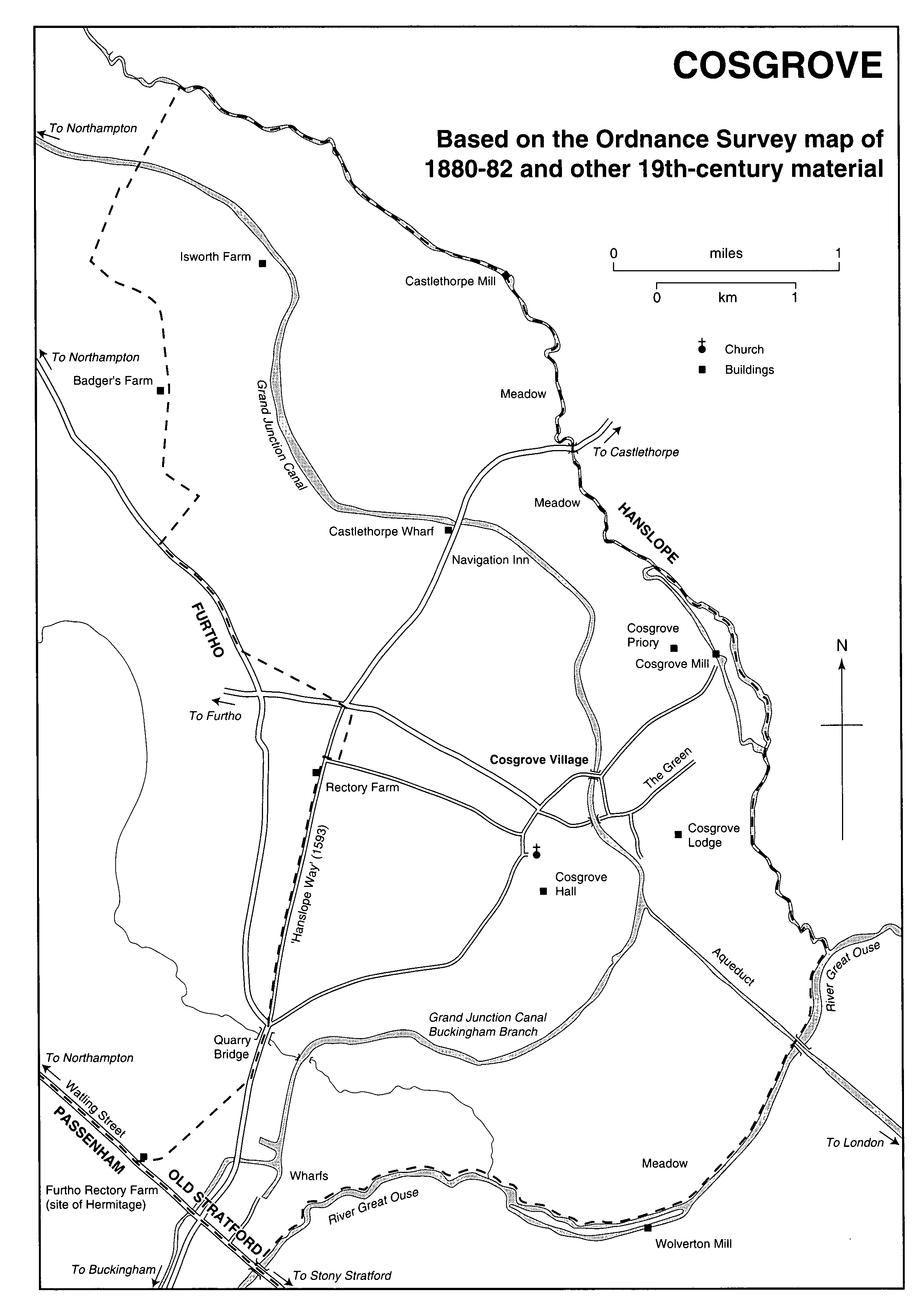
COSGROVE
Based on the Ordnance Survey map of 1880-82 and other 19th-century material
The older surviving houses in the village are built of local limestone and were presumably originally thatched. A cottage at the Green (no. 7) and a former farmhouse, later the Barley Mow public house, both date from the 17th century, as do two more ambitious houses in Yardley Road, The Elms and Mansel Farm House. Both are of three bays, with two-unit plans, on two storeys with attics. The Elms has ovolo-moulded mullioned windows to the first floor; Mansel Farm House has a moulded stone surround, with a pulvinated frieze and broken pediment on brackets to the central front door. Both have collar-truss roofs with wind-braced purlins. (fn. 36) The oldest portion of the house known since the 18th century as The Priory, which stands on the site of the medieval manor house, also dates from the 17th century. (fn. 37)
In the early 18th century a large new house was built to the south of the church, with stables and dovecote, which became known as Cosgrove Hall and in the early 19th century, after the estate was merged with that centred on the manor house, became the principal residence in the parish. (fn. 38) In the 18th century the manor house near the Tove was surrounded by a park, but Cosgrove Hall, where a loop from Stratford Road ran past the main entrance, lacked similar grounds. (fn. 39) By the 1820s the land within the loop had been wooded and a further area between there and the canal imparked. (fn. 40) By 1880 the lane running past the house had been stopped up and removed. (fn. 41) As part of the landscaping a thatched lodge was built on Stratford Road, possibly at about the same time as the nearby row of three estate cottages, which are dated 1832.
Outside the village, most of the land of the parish (and that of Furtho) appears to have been divided in the Middle Ages between open-field arable and common meadows flanking the two rivers, except perhaps in the extreme north, where there was a freehold tenement named Isworth by the early 17th century, if not before, standing in old inclosures. (fn. 42) In the 16th century Cosgrove's three open fields were known as Quarry Field, Middle Field, and Moor Field. (fn. 43) The first of these was presumably in the south-west of the parish, near Quarry Bridge, and the other two further north, perhaps extending as far as the old inclosures belonging to Isworth, although in the absence of an inclosure map and with only fragmentary traces of ridge and furrow visible on the ground or air photographs, it appears to be impossible to reconstruct the arrangement of the fields. (fn. 44) Part of the open fields in Furtho were inclosed in the 16th century by the lords of the manor there, who created a consolidated demesne farm of about 290 acres and depopulated the village. (fn. 45) When the remaining common land in the two parishes was inclosed in 1768 it was found to extend to 1,626 a. (fn. 46)
The only new farmstead built in Cosgrove as a result of inclosure was Rectory Farm, which stood on the Furtho boundary in the centre of the land allotted to the rector of Cosgrove, about half a mile west of the village. (fn. 47) In the mid 19th century a new house was built at the opposite end of the village, south-east of the Green, known as Cosgrove Lodge, which had a small estate running south-east from the house to the Ouse, flanked by the canal embankment on the south and the Tove to the north. (fn. 48) At the Green itself a schoolroom was built in 1844 and a Baptist mission room in 1906. (fn. 49) In the centre of the village there was a brewery just to the west of the canal, which eventually occupied buildings ranged around three sides of a central yard. (fn. 50) Cosgrove mill was rebuilt on a new site in the mid 19th century. (fn. 51)
The modern enlargement of the village began with the building of six blocks of council houses on either side of Bridge Road in the 1930s, near the school opened by the county council in 1912 to replace the National school on the Green, which became first a village hall and later a private house. (fn. 52) A new Victory Hall was built largely with voluntary labour after the Second World War. (fn. 53) The 1940s and 1950s also saw the demolition of much of the older housing at the Green and the enlargement of the upper end of the village by the building of further council houses on Yardley Road and Mansel Close, to the north of the school. In the 1960s two small private estates were built, one off Yardley Road and the other at Park Close, at the eastern end of the Green. By 1970 further development was to be limited to infill schemes within the existing built-up area, (fn. 54) although in the 1980s houses were built on the lane leading from Bridge Road to the Green, just outside the village envelope. More extensive development was deemed impossible, given the unusually convoluted road layout, limited sewerage facilities, and the need to maintain open land between Cosgrove and the northern edge of Milton Keynes. (fn. 55)
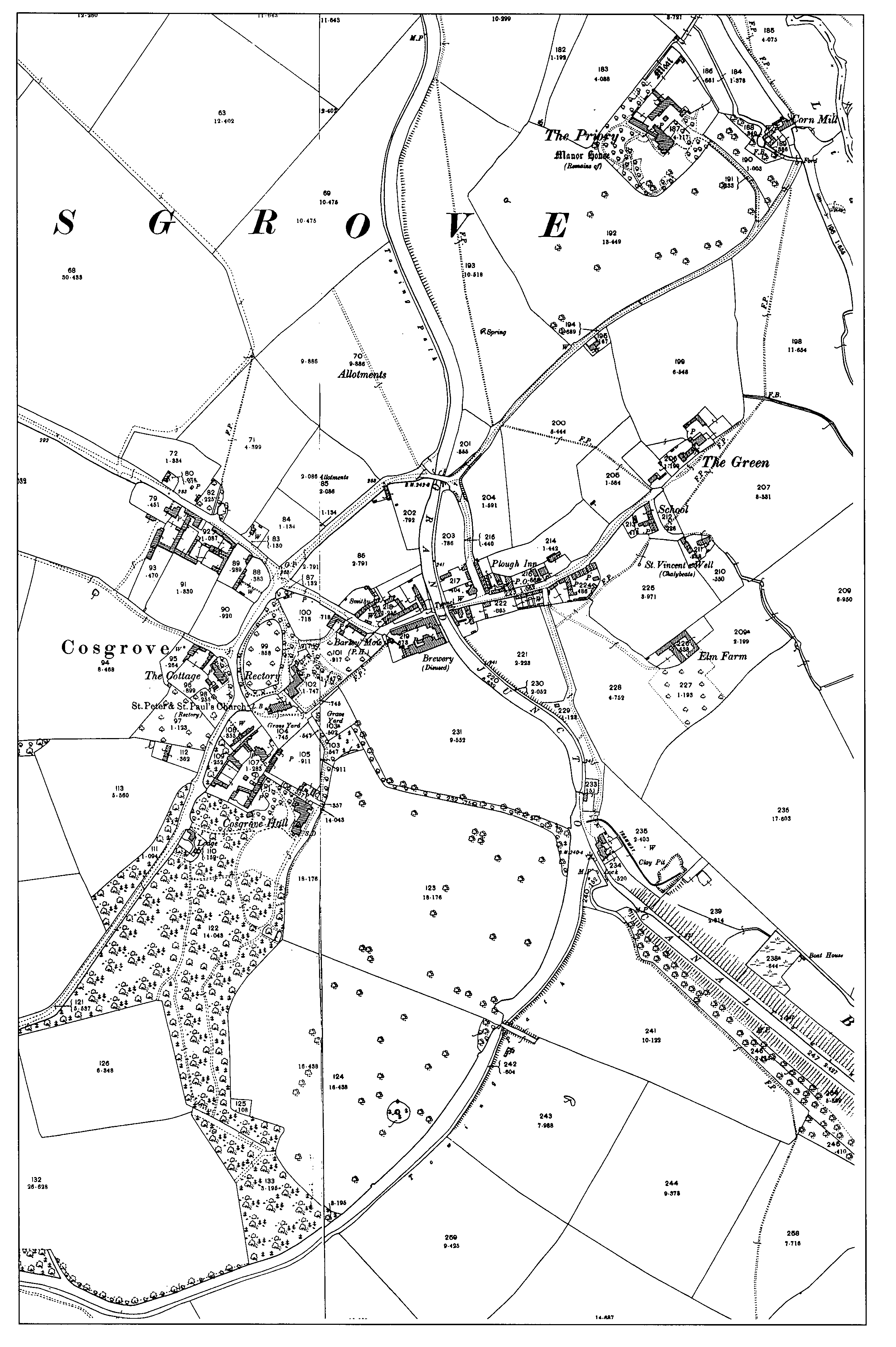
Cosgrove Village
The former brewery near the canal was converted for a time into small unit workshops but in 2000 was largely demolished. On the opposite side of the lane, between the canal and the Barley Mow, a modern tanning business was established. (fn. 56)
The four largest houses in the parish all ceased to be private residences during the later 20th century. The Priory, the Hall and the former rectory became corporate headquarters, (fn. 57) while Cosgrove Lodge became a hotel and its grounds, extensively excavated for gravel in the 1950s and later partly flooded, were developed for camping, touring caravans and water-based recreation. (fn. 58) Several slightly smaller houses, including the Little Manor, the Old Dower House, Mansel Farm House and Green Farm, remained private residences, as Cosgrove shared in the general upgrading of the housing stock characteristic of all south Northamptonshire villages, especially those closest to Milton Keynes.
MANORS AND OTHER ESTATES
The manor of Cosgrove to 1487.
There were three estates in Cosgrove in 1066, held freely by Alden, Ailric and Godwin, (fn. 59) of which the two latter formed part of the lands of the count of Mortain in 1086. (fn. 60) The largest, assessed at half a hide and a fifth of one virgate, was held by Winemar the Fleming in 1086. (fn. 61) Winemar, who held a small barony centred on Hanslope (Bucks.), adjoining Cosgrove, was succeeded by Michael of Hanslope. In c. 1131 Henry I gave Michael's estates to William Maudit, the king's chamberlain, since Michael in his lifetime had made Henry his heir, and also gave Michael's daughter Maud to William in marriage. (fn. 62) The gift was confirmed in 1153 by Henry duke of Normandy (later King Henry II). (fn. 63)
The Hanslope barony remained in the hands of the Maudit family until the death without issue in 1268 of William Maudit, who had become earl of Warwick in 1263 on the death of John de Plessis. The earldom passed to William de Beauchamp, who married William Maudit's sister and heir Isabel. (fn. 64) In 1328 the manor of Cosgrove was held of the heir of the earl of Warwick, a minor in the king's wardship, as of the manor of Hanslope. (fn. 65) By 1397 the manor itself was in the hands of the Beauchamps. (fn. 66)
In the early 12th century Cosgrove remained divided into three fees, of which the largest (9 virgates) was held by one Adam, (fn. 67) who was perhaps Michael of Hanslope's sub-tenant.
Henry Spigurnel, who heads the township's assessment to the lay subsidy of 1301 (fn. 68) and was described as lord of Cosgrove in 1316-18, (fn. 69) died in 1328, leaving his son Thomas as heir, although his widow Sarah was assigned the manor of Cosgrove in dower. Besides the manor, Henry had several other estates in Cosgrove, Furtho and Puxley, held of different lords. (fn. 70) In 1341 Henry de Burghersh, bishop of Lincoln, died holding the manor for life under a grant of 1339 from Thomas Spigurnel, when his heir was found to be his kinsman Walter de Paveley, but the manor initially passed to Henry's brother Bartholomew as remainderman under the gift from Thomas. (fn. 71) In 1345-7 Walter released his claim to the manor of Cosgrove to Sir Adam de St. Philbert and Richard le Forester. (fn. 72) By 1351, however, the manor was in Walter's hands, when he made a settlement on feoffees and secured a release from Richard; (fn. 73) two years later Robert Spigurnel released his claim to the manor. (fn. 74)
Bartholomew de Burghersh died in 1369 and Walter de Paveley six years later; neither appears to have held the manor of Cosgrove at his death (fn. 75) and its descent in the later 14th century is uncertain. By 1397 the manor was in the hands of the Crown as a result of the attainder and forfeiture of Thomas earl of Warwick, and was granted that year in tail male to Sir Henry Green. (fn. 76) When Earl Thomas died in 1401 it was found that long before his death he had granted the the manor of Cosgrove to Nicholas Billing for his life, to hold of the earl as of his manor of Hanslope. (fn. 77) The manor, like the neighbouring lordship of Potterspury, remained in the hands of the Beauchamp earls of Warwick throughout the 15th century, except when their estates were forfeited. (fn. 78) In 1485 David Philip was granted the stewardship of Cosgrove during the minority of Edward earl of Warwick. (fn. 79)
The manor of Cosgrove after 1487.
In 1487-8 Anne dowager countess of Warwick conveyed the manor of Cosgrove to Henry VII, (fn. 80) who in 1507 granted the stewardship to Sir Richard Empson. (fn. 81) Sir William Parr was appointed to the same office in 1523. (fn. 82) In 1521 the site of the manor was leased to Christopher Wren for 21 years, (fn. 83) and in 1541 was leased in reversion for the same term to Robert Matthew. (fn. 84) In 1542 Cosgrove was annexed to the honor of Grafton on its establishment. (fn. 85) Nine years later the manor of Cosgrove (together with Paulerspury and other premises in the honor) was granted to Sir Nicholas Throckmorton, (fn. 86) who died in 1571, leaving Cosgrove to his widow for her life. (fn. 87) In 1596 his son Arthur Throckmorton and Anne his wife made a settlement of their estates, including Cosgrove, which he revoked in 1602. (fn. 88) When his third daughter Elizabeth married Richard Lennard, Lord Dacre of the South, in 1617 Sir Arthur, who died in 1626, settled Cosgrove on her. (fn. 89)
Francis, Lord Dacre, Richard's son, sold the manor in 1653 to Gervase Andrews of London, who almost at once sold the manor house and farm to Christopher Rigby of London, and the manor itself in 1654 to William, 2nd Lord Maynard. (fn. 90) Named as owner in 1667 (fn. 91) and 1675, (fn. 92) Maynard died in 1699, the year in which his daughter Elizabeth and her husband Sir Thomas Brograve Bt., whom she married in 1692, conveyed Cosgrove to John Twisleton and John Preston. (fn. 93) The next owner appears to have been John Beauchamp, who devised the manor to his son-in-law William Gurney, a lieutenant in the Army, and Elizabeth his wife. (fn. 94) Gurney, who died in 1731, made a deputation as lord of Cosgrove in 1713, as did his widow, who died in 1748, in 1740-1. (fn. 95) The Gurneys left two daughters and coheiresses, Elizabeth, wife of William Brookes, and Mary, wife of Littleton Westley; (fn. 96) Westley and Brookes were lords of the manor in 1747. (fn. 97) Brookes, with Westley and his wife, conveyed the manor in 1750 to Christopher Rigby, grandson of the purchaser of the manor house. In 1764 Rigby sold the whole of his Cosgrove estate to John Biggin of London, who died in 1788. (fn. 98)
Biggin's second son, but heir by survivorship, George Biggin, a man of literary and scientific interests, died in 1803, having devised his Cosgrove estate to his nephew George Mansel, the fifth son of Major-General John Mansel, who married George Biggin's sister and heiress Mary Anne. She died in 1790, her husband in 1794, and George Mansel in 1808, when the estate passed to George's eldest brother John Christopher Mansel, who died without issue in 1839. It then passed to another John Christopher Mansel, the eldest son of Admiral Robert Mansel, General Mansel's second son, and his wife Frances Charlotte, the daughter of the Revd. William Thorold of Weelsby House (Lincs.). (fn. 99) The Mansels already owned another estate in Cosgrove, including the mansion known as Cosgrove Hall, where the family made their home, and the capital messuage belonging to the manor, known as Cosgrove Priory, was let for much of the 19th century. (fn. 100)
In 1881 J. C. Mansel sold Cosgrove Hall and the lordship to Alexander William Thorold Grant-Thorold, the son of Alexander Grant and his wife Helen Thorold, Frances's sister. (fn. 101) Mansel, who died in 1895, moved to a smaller house on the estate, which became known as Cosgrove Cottage (later the Old Dower House). (fn. 102) In 1886 Grant-Thorold sold sold Cosgrove Priory, with some land, to John Jepson Atkinson, (fn. 103) and in 1891 conveyed the Hall to his second son Harry Grant-Thorold, (fn. 104) who in 1919 broke up the estate by auction, when the lordship was offered with the Hall and grounds. (fn. 105)
In the early 1920s Cosgrove Hall was the residence of Alexander Agar Ferguson; by 1925 it was the home of Mrs. Bernice Ellen Agar, who was the owner until 1928, (fn. 106) when it was purchased by George Harold Winterbottom, the son of a Manchester cloth manufacturer of the same name who in 1899 had acquired Horton House, where he lived until his death in 1934. (fn. 107) The younger Winterbottom lived at Cosgrove until 1948, when the Hall became the home of Major J. B. Fermor-Hesketh, the younger brother of the 2nd Lord Hesketh. (fn. 108) It was later bought by Charles Mackenzie Hill, a building contractor, who also made the house the headquarters of his business.
The Cosgrove Priory estate.
After it was detached from the main estate, Cosgrove Priory passed from J. J. Atkinson to his son Philip Atkinson, who died in 1972, leaving the Priory to Sir Hereward Wake Bt. of Courteenhall, although Atkinson's widow Grace continued to live at the house until her death. Sir Hereward sold the estate in 1979 to David Moore, who renovated the mansion before selling the main house in 1981 and moving to a new home he had created in the former stables. (fn. 109) At the time of writing the house was owned and occupied by Pericom PLC as their headquarters.
Cosgrove Priory stands close to the Tove to the north-east of the village on a site presumably occupied since the Middle Ages by the capital messuage belonging to the manor. The oldest part of the present house is said to have been built by Christopher Rigby in the 17th century, although it was much altered by later owners. (fn. 110) It was already known by its modern name in 1774. (fn. 111)
The lands Of the count of Mortain, later of the honor of Berkhamsted.
In 1086 Robert count of Mortain had four fifths of half a hide in demesne in Cosgrove, and another five sixths of a hide, of which the soke belonged in Passenham, which was held by Humphrey. (fn. 112) Robert's son William inherited his father's lands, but forfeited them following his capture by Henry I after the battle of Tinchebray in 1106. The Mortain fees were then divided between the honors of Leicester and Berkhamsted, with the remainder shared between the Aquila, Albrinci, Winchester and Mowbray honors. (fn. 113) Thus in 1166-7 Robert earl of Leicester was pardoned 5s. due from Cosgrove. (fn. 114) In 1235 and 1243 William de Montagu owed scutage for the honor of Aquila on three fees of the fee of Mortain, including half a fee in Cosgrove and one in Furtho. (fn. 115) In 1275 Edmund earl of Leicester was said to have held the liberties of Cosgrove for the previous 20 years. (fn. 116) Edmund, the second surviving son of Henry III, had five fees of the little fee of Mortain in Puxley, Cosgrove, and Furtho at his death in 1296. (fn. 117) When Edmund's grandson Henry, created duke of Lancaster in 1351, died in 1361 his estate included the same five fees in Cosgrove and elsewhere. (fn. 118)
Also in 1275, Edmund earl of Cornwall and his father were said to have held estreats of writs, pleas of vee de naam and the assize of bread and ale in Cosgrove for the previous 30 years. (fn. 119) At his death in 1301 Edmund held view of frankpledge in Cosgrove and Furtho as of his barony of Chenduit, which was parcel of the honor of Berkhamsted. (fn. 120) After Edmund's death the earldom of Cornwall, with the honor, passed to the king as his cousin and heir. Both were granted to Piers Gaveston in 1307 but reverted to the Crown when Gaveston was murdered five years later. In 1328 Edward II's brother John was granted the earldom and in 1334 was given the honor and castle of Berkhamsted. He died in 1336 and the following year the king created his eldest son Edward (the Black Prince) duke of Cornwall. Edward died without issue in 1376, when his honours reverted to the Crown. (fn. 121) His estates included a moiety of a knight's fee in Cosgrove and another moiety in Furtho. (fn. 122)
After 1376 the honor of Berkhamsted remained in the hands of the Crown, as parcel of the duchy of Cornwall, and Cosgrove, Furtho and Old Stratford continued to owe suit and service to the honor into the 19th century. In the 15th century the constables attended a court for the duchy at Helmdon; (fn. 123) in the early 19th century the duchy court for the county sat at Blakesley. (fn. 124)
In 1649 (and presumably other years) the three constableries were paying 10d. a year in certainty money to the honor of Berkhamsted. (fn. 125) Between 1542 and 1551, when the manor of Cosgrove was annexed to the honor of Grafton, the constables admitted that they owed 8s. a year certainty money and suit of the honor court, but resisted payment on the ground that Cosgrove was held by the Crown as of the Duchy of Lancaster, whose interests were specifically protected by the Act establishing the honor. (fn. 126) The Cosgrove constable did, however, attend the court for the honor of Grafton on at least one occasion in those years. (fn. 127) In the mid 19th century the outgoings on the Cosgrove Hall estate included a yearly payment of 7s. 10d. to William Peppercorn of St. Neot's (Hunts.), who had purchased what was described as a fee farm rent previously due to the Crown for the manor. (fn. 128) The rent was still being collected in 1866 (fn. 129) but was not mentioned when the lordship was included in the 1920 sale of the estate. (fn. 130)
The Furtho family estate.
The Mortain fee in Cosgrove, like those elsewhere in the county, (fn. 131) appears to have been subinfeudated to a family named Keynes, for in 1219 William son of Ralph de Keynes brought a suit against Richard de Keynes concerning various fees, including one in Cosgrove and Puxley. Richard claimed that he did not have to answer William's writ in Northamptonshire, since the lands were held of the prior of Luffield. (fn. 132) In 1235 and 1243 Richard de Keynes was said to hold in chief five little fees of Mortain in Northamptonshire, including one in Tiffield, Puxley, Cosgrove and Long Buckby. (fn. 133) Richard's daughter and heiress Joan married Roger de Lewknor, (fn. 134) whose son Thomas held the same fee (but of Edmund earl of Lancaster, and not in chief) in 1296. (fn. 135) The following year Sir Thomas Lewknor's daughter Joan, the widow of John de Mershe, quitclaimed and released the fee to Henry Spigurnel and Sarah his wife. (fn. 136) When Henry died in 1328 he and Sarah held six messuages, four virgates of land and 10 a. meadow of Thomas de Lewknor for an eighth of a knight's fee, and also 50 a. of wood in Puxley. (fn. 137) The five fees in Cosgrove and elsewhere belonging to the late Henry duke of Lancaster in 1361 were said to be held by Thomas de Lewknor. (fn. 138) In 1428 the master of St. John's Hospital in Northampton held a third part of a knight's fee in Cosgrove, Puxley and Tiffield of the fee of Keynes. (fn. 139)
In the reign of Henry I the two smaller estates in Cosgrove, containing eight small virgates and six small virgates, were held by Robert Revell and William le Brun respectively. These presumably represent the Mortain share of Cosgrove, although of which fees they were held is not stated. (fn. 140) In 1186-7 Robert Revell was in dispute with Adam son of Warin concerning eight virgates of land in Cosgrove, (fn. 141) and in the early 1190s Robert owed three sums of £100, £50 and 20 marks for his lands in Cosgrove, Puxley, Tiffield and 'Watfeld'. (fn. 142) In 1226-9 Robert's son Hugh Revell was involved in litigation concerning 3½ virgates in Cosgrove and Puxley, (fn. 143) and in 1235 Roger Revell held one of the small Mortain fees in Tiffield, Puxley, Cosgrove and Long Buckby. (fn. 144) Robert Revell held the same estate in 1243. (fn. 145) In 1275 it was said that the fee of Robert Revell in Cosgrove, except his demesne, was accustomed to make suit in the hundred court until about twenty years previously, when it was withdrawn without warrant. (fn. 146)
In 1243 the tenants of the honor of Aquila included Walter de Furtho, who had one small fee in Furtho, and the master of the hospital of St. John in Northampton and Alan de Tiffield, who held in Tiffield one small fee with 1½ virgates of land which Walter de Furtho previously held in Cosgrove. (fn. 147) In 1284 Walter de Furtho held 21 virgates of land in Cosgrove. (fn. 148) When Henry Spigurnel died in 1328 his estate included a messuage and lands in Cosgrove and Furtho held of Henry de Furtho. (fn. 149)
In 1358 Edward the Black Prince granted the wardship of William, son and heir of William de Furtho, to Sir Walter de Paveley, who noted that the father had held a quarter of a knight's fee in Cosgrove, and that the wardship and marriage of the heir belonged to the prince by virtue of older enfeoffment. (fn. 150)
The Furtho family's estate in Cosgrove appears to have descended with their home manor of Furtho. (fn. 151) When Margaret Fleming, late wife of Thomas Furtho, died in 1499 she had four messuages, a toft and six virgates of land in Cosgrove, held of Thomas marquess of Dorset; (fn. 152) after the death of William Furtho five years later what appears to be the same estate was valued at 30s. (fn. 153) In 1558 Anthony Furtho's lands and tenements in Cosgrove, still worth 30s., were found to be held of the Crown as of the earldom of Dorset. (fn. 154) His son and heir Thomas made further purchases in Cosgrove and adjoining parishes, which passed to his son Edward Furtho, who died in 1620, when his estate included a capital messuage in Cosgrove purchased of Michael Tassell and John Whitmell, two messuages purchased of Thomas Emerson, and various other messuages and farms purchased of Thomas Furtho, all held of the Crown as of the Duchy of Lancaster. In addition, he held a capital messuage and farm, lately purchased of Robert Lee, which were held of Sir Arthur Throckmorton as of his manor of Cosgrove. He also owned Brownswood Green, late parcel of the possessions of Snelshall priory; a cottage and land purchased of Thomas Ely and George Merrell; Knotwood Coppice (23 a.), purchased of Sir John Ramsey and Thomas Emerson; and Brownswood itself (8 a.); all of which were held directly of the Crown. (fn. 155)
Brownswood had been purchased by the Crown from John Heneage and annexed to the honor of Grafton; it adjoined the former Snelshall priory woodland at Brownswood Green on the borders of Passenham and the detached portion of Cosgrove and was leased to William Clarke for 21 years in 1550. (fn. 156) By 1568, after the Crown had established the boundary between the two estates, (fn. 157) Clarke's lease had passed to Thomas Furtho, who was granted a new 21-year lease. (fn. 158) In 1575 the estate was prepared for a grant to Lord Cheney but the following year the reversion was granted in fee to John Dudley and John Ayscough, who immediately sold to Thomas Furtho. (fn. 159)
The 4 a. at Brownswood Green previously belonging to Snelshall were also leased to Thomas Furtho in the 1560s. (fn. 160) In 1576 the land was granted in fee to John Mershe and William Mershe, who similarly sold to Furtho. (fn. 161)
Edward Furtho was succeeded by his eldest son of the same name, who died only a year later (1621), leaving two sisters as coheirs, (fn. 162) between whom his estates were divided. The Cosgrove portion was assigned to Nightingale, then the wife of Samuel Mansel and afterwards of Francis Longeville, who died c. 1646. One of the two capital messuages descended to the Mansels and the other she conveyed in her second widowhood in 1659 to her son Henry Longeville, who died in 1713. His son, also named Henry, devised his estate in Cosgrove in 1741 to John Mansel, younger son of the Revd. Christopher Mansel. (fn. 163)
Samuel and Nightingale's heir was their son Edward Mansel of Cosgrove, on whom Nightingale settled part of her estate in 1659 and who the following year married Millicent Draper. (fn. 164) Edward died in 1696, the year after his son of the same name married Frances Saxton. (fn. 165) The younger Edward Mansel died without issue in 1704, (fn. 166) leaving his estate in Cosgrove, Furtho, Yardley Gobion, Old Stratford, Potterspury and Cogenhoe to trustees who were to pay various legacies and hold the estate to the use of his brother Charles for his life, with remainder in tail male to his other brother Christopher. (fn. 167) Charles Mansel died unmarried in 1716 and the Revd. Christopher Mansel in 1741, leaving two sons, Edward, who died without issue the following year, and John, who became a major-general in the Army and was killed in Flanders in 1794. General Mansel married Mary Anne, the sister and heiress of George Biggin, the lord of the manor of Cosgrove. Mansel and his wife predeceased Biggin, on whose death in 1803 both the manorial estate, centred on the house known as Cosgrove Priory, and the former Furtho estate, centred on Cosgrove Hall, passed to their son J. C. Mansel and were merged into one. (fn. 168)
The two capital messuages on the Furtho estate in 1621 can possibly be identified with the house west of the church known in the late 19th century as The Cottage (later the Old Dower House) and the building to the south of the church, in the grounds of Cosgrove Hall, which bears the inscription 'Noli Peccare Deus Videt 1652'. (fn. 169) Both date from the 17th century and are built of local limestone. An inventory of one of Edward Furtho's houses at Cosgrove, taken in 1621, lists a porch, hall, parlour, study, dining room, kitchen, back kitchen, little hall, buttery, larder, cheese chamber, dairy and brewhouse. All the main rooms had chambers over, and cocklofts or attics above. There was a second study over the porch, and another room over the entry. In 1674 Henry Longeville paid tax on ten hearths in Cosgrove, which must represent (or include) the capital messuage acquired from his mother Nightingale, (fn. 170) who was herself by far the largest contributor in the parish to the Free and Voluntary Present of 1662. (fn. 171)
The present Cosgrove Hall, which stands a short distance south of the building of 1652, dates from the early 18th century and was presumably built by either Henry Longeville (who died in 1713) or his son of the same name (d. 1741). The architect may have been John Lumley of Northampton. It was originally a half-H plan house, built of coursed local limestone, of seven bays and two storeys with attics; the central portion of the west (entrance) front was later filled in. The garden side has Doric pilasters, the entrance side Corinthian. The high-pitched roof was originally tiled but by 1913 this had been replaced with slate. Inside one room has some late 16th- or early 17th-century panelling, which may presumably have come from the Furthos' house in Cosgrove, but otherwise the interior was much altered soon after 1800. (fn. 172) In the grounds there is a rectangular dovecote, of stone with a slate roof which has replaced tiles, with nests for 540 birds inside. (fn. 173)
Lands of religious houses.
As well as the advowson, the Knights Hospitallers also had lands in Cosgrove, described in 1295 as six virgates held of Earl Ferrers. (fn. 174) In 1329 the prior claimed view of frankpledge twice a year in Furtho from his tenants there, in Cosgrove and elsewhere, (fn. 175) and in 1407 the Cosgrove tenants did suit to the prior's leet at Stony Stratford. (fn. 176) After the Dissolution, common land in Puxley and Cosgrove, and two closes in Furtho, late parcel of the possessions of the Hospitallers' preceptory at Dingley, were granted to Sir Ralph Sadler in 1550. (fn. 177) When Queen Mary tried to re-establish the order in 1558 the lands in Cosgrove, late of Dingley, were included in the grant. (fn. 178)
Sometime during Henry III's reign Henry clericus of Cosgrove made two grants totalling 1½ acres of land in Stansifurlong, in Cosgrove field, to Biddlesden abbey (Bucks.), which his widow Maud later quitclaimed. (fn. 179) Also in the 13th century Alice, daughter of William de Puxley and formerly wife of Hugh de Brochole, gave the abbey a rood of land near Watling Street. (fn. 180) In 1330 the abbey released a rent of 5s. due from John le Forester of Stony Stratford for the lands he held from them in Cosgrove and Stony Stratford. (fn. 181)
What was described as 'St. John's friary' in Northampton owned an estate in Cosgrove, let in five holdings in the 15th and early 16th centuries, one of which was called the 'Hall Place'. (fn. 182) None of the friaries in the town was known by that name, although the Austin friars' house stood opposite St. John's hospital. (fn. 183)
Isworth, Cosgrove Lodge and other small lay estates.
A freehold farm at Isworth, in the north of the parish, was acquired by Richard Franklin in 1616 and remained in the hands of the family, who were also blacksmiths and maltsters in the 18th century, for several generations. (fn. 184) Nathan Franklin, who died in 1771, was allotted 71 a. at inclosure in 1768. (fn. 185) The family left the parish shortly afterwards (fn. 186) and by the 1830s Isworth was part of the Mansel estate. (fn. 187) It was a holding of 190 a. when the estate was sold in 1919. (fn. 188)
In 1855 a freehold farmhouse at the southeastern corner of the Green was offered for sale with 55 a. forming a block running down to the Ouse, bounded by the canal on the south-west and the Tove on the north-east. (fn. 189) In 1866 the estate was acquired by Lewis Osborn, a Stony Stratford draper, with the aid of a mortgage for £5,000. (fn. 190) Osborn, who tried unsuccessfully to sell what was described as a 'pleasure farm known as Elm Tree Farm', in 1889, (fn. 191) died in May 1898 and in August that year his executors sold the estate for the benefit of Osborn's wife and children to George Frederick Branson of Tottenham (Mddx.) for £3,225, the balance due to the mortgagees. (fn. 192) Branson, then of Cosgrove House, Walthamstow, had previously bought a group of five cottages on the Green in 1889 (fn. 193) and in 1902 acquired the adjoining Green Farm and a further 45 a. (including St. Vincent's well) for £1,515. (fn. 194) In 1911-12 he mortgaged Elm Farm (as it was then called) (fn. 195) for £3,000, (fn. 196) tried unsuccessfully to sell both properties, (fn. 197) and mortgaged part of Green Farm for a further £800. (fn. 198) The following year Branson defaulted and the Green Farm mortgagees sold 4 a., including the well, to the London & South Western Bank. (fn. 199)
Robert Penson was farming at The Elms in 1914 (fn. 200) but from 1920 (if not a few years before) until the Second World War the property, then known as Cosgrove Lodge, was farmed by Charles Reginald Whiting. (fn. 201) After the war Whiting sold the estate for £24,000 to the Cosgrove Sand & Gravel Co. Ltd. for quarrying. (fn. 202) When their operations ceased, some of the former pits were flooded and in 1963 the Clarke family bought 110 a. (including 40 a. of water) and the house at Cosgrove Lodge. (fn. 203) Trading as Cosgrove Lodge Ltd., they developed the estate as a caravan park and camp site offering various types of water-based recreation, with the house converted into a restaurant and hotel. (fn. 204) Both businesses continued at the time of writing.
Green Farm was sold in 1861 by William Franklin to Henry Pearson Gates, the Peterborough diocesan registrar, who died in 1893. (fn. 205) After his widow's death in 1902 his executors sold the property to G.F. Branson. (fn. 206) During and after the Second World War Green Farm was the home of Joan Wake, (fn. 207) the founder and for many years secretary of the Northamptonshire Record Society.
In 1771 John Biggin purchased a farm of 110 a. in Cosgrove from the mortgagees of John Rye. (fn. 208)
ECONOMIC HISTORY
Farming.
In 1086 there was land for one and a half ploughs on Winemar's manor, with one plough in demesne and three bordars. There were also 5 acres of meadow and woodland three furlongs in length and two in breadth. (fn. 209) On the count of Mortain's demesne manor there was land for one plough, which was held by three villeins. (fn. 210) On his other manor, held by Humphrey, of which the soke belonged to Passenham, there was land for a further one and a half ploughs, farmed by four bordars, as well as 10 a. of meadow and two 'quarantenes' of underwood. (fn. 211)
At the death of Henry Spigurnel in 1328, the manor of Cosgrove had eight virgates of land in demesne, together with 4 a. of meadow and 20 a. of wood. (fn. 212) Less than a third of the manor was pasture in 1347. (fn. 213)
As the relatively large quantity of surviving conveyances indicates, throughout the Middle Ages there were a number of free tenements in Cosgrove, some of which included land in Furtho, Potterspury or Passenham. (fn. 214) The supply of freehold land may have increased in the 17th century, since at least one absentee owner of the manor sold individual messuages to local families. (fn. 215) This remained the position up to inclosure in 1768, when there were 27 small owners with claims to a share in the 1,626 a. of Cosgrove common field (some of which lay in Furtho parish), of whom 19 received 10 a. or less. Allotments were made to three larger freeholders, John Rye (52 a.), Nathan Franklin of Isworth (71 a.) and Francis Edward Whalley (123 a.), and also to the rectors of Cosgrove (208 a.) and Furtho (95 a.), but the bulk of the former open fields were divided between John Biggin's Cosgrove Priory estate (298 a.) and John Mansel at Cosgrove Hall (491 a.). (fn. 216)
There was a good deal of consolidation after inclosure, converting what had been a relatively open parish into one dominated by a single resident landowner. John Rye and the Franklins both sold to the Mansels, whose own estate was merged with that belonging to the manor following the death of George Biggin in 1803. (fn. 217) By the 1830s, when the parish was estimated to extend to 1,760 a., nearly two thirds (1,100 a.) belonged to J. C. Mansel of Cosgrove Hall, and most of the rest was divided between the two incumbents and the Grafton estate's land west of Watling Street, near Wakefield Lodge. (fn. 218) The main portion of Cosgrove glebe lay to the west of the village, extending into Furtho, on which Rectory Farm was built after inclosure; there was also an allotment further north, between Northampton Road and the canal, and in the meadows near Castlethorpe mill. Other than this, almost the whole of Cosgrove east of Watling Street, apart from some freeholds on the Green (including Green Farm and what later became the Cosgrove Lodge estate) and at Old Stratford, belonged to the Mansels. (fn. 219) About two thirds of the parish was arable in the early 19th century. (fn. 220)
The Mansel estate had a gross rental of about £2,000 a year in the 1840s, most of which came from half a dozen principal tenants, including the occupier of Cosgrove Priory, which was let, since the family lived at Cosgrove Hall. The largest farm (420 a.) was let for £800 a year and there were two other substantial holdings, one of 220 a. let for £480, and the other of 193 a. let for £270. (fn. 221) Mansel drew around £1,000 a year from the estate, which was heavily encumbered by interest payments totalling roughly a third of the gross income. (fn. 222) In about 1849 these charges were consolidated into a single 4 per cent mortgage of almost £10,000 from A.B. Markham, the Northampton attorney; the following year this was replaced by a mortgage of £18,000 from Arthur Mills, the London banker, on which the annual interest was initially £698. (fn. 223) In 1852 Mills met Mansel halfway in his request for a reduction in interest after Mansel had abated his tenants' rents by 10 per cent, Mills pointing out that hard times had to be shared between landowners and those on fixed incomes. (fn. 224) His concession only reduced the interest by some £50 a year and in the early 1850s Mansel was drawing much the same from his estate as he was paying Mills, leaving barely a third of the gross income to meet other outgoings. From 1854 interest payments reverted to £698, although by this time the gross rental was over £2,100 and Mansel was able to draw about 40 per cent of that figure. (fn. 225)
The extent, organisation and financial position of the estate remained largely unchanged in the 1860s: the gross rental of about £2,200 a year came mainly from one farm let for £850 and two others paying £460 and £340; almost £700 went to pay the interest on the mortgage and Mansel drew between £900 and £1,000. (fn. 226) He suffered a minor blow during the financial crisis of 1866, when his bankers suspended payment with £300 of his money in their hands. (fn. 227)
Signs of more serious difficulties became evident three years later, when Mansel consulted his agent about selling the estate, or at least the outlying farm at Isworth. (fn. 228) When the tenant at Isworth, the smallest of three main holdings, died in 1876, Mansel feared 'trouble and expense'. He was also preoccupied with the need to ensure that the Priory remained let; in 1878 he was approached by the owner of a preparatory school who was looking for a place for about 50 boys. In 1879 one of the other farmers pressed for a substantial reduction in rent if he was not to quit. The agent told him that he (the tenant) knew the circumstances of the estate (presumably referring to the mortgage) and that Mansel's charges were fixed: 'between the two he is squeezed nearly as flat as possible'. (fn. 229) A year later the new tenant at Isworth left and Mansel could not see how he could continue. By the end of 1881 he and his nephew George Christopher Mansel (the heir to Cosgrove under the will of R.S. Mansel) had agreed to sell the estate, still encumbered with the mortgage of £18,000, to a cousin, Alexander Grant-Thorold, who in 1891 transferred Cosgrove to his son Harry. (fn. 230)
The younger Grant-Thorold sold the entire Cosgrove estate, then reckoned as 1,002 a., in November 1919 in 24 lots, of which the Hall and Manor Farm (312 a.) were withdrawn at £15,000. A small parcel of accommodation land and a garden also failed to sell but otherwise the sale was a success, realising over £20,000. (fn. 231) Most of the farmland made between £30 and £40 an acre, including Elms Farm (234 a.) and Cobs Bush (56 a.); Isworth (190 a.) made only £16 an acre. The smaller parcels of land and the cottages sold for between 14 and 25 years' purchase.
The break-up of the former Mansel estate, completed by the sale of the Hall a few years later, (fn. 232) once again changed the character of the parish. Not only did the farms pass into separate ownership, but (in contrast to the outcome of the Grafton sales of the same period) (fn. 233) most of the cottages were bought by their occupiers, many of them men employed at Wolverton carriage works, leaving a shortage of rented housing in the village, at least until the local authority began to build in the 1930s. (fn. 234) The Grant-Thorolds' immediate successors at the Hall do not appear to have played much part in village life, although the Atkinsons at Cosgrove Priory did, as did Major Fermor-Hesketh when he lived at the Hall after the Second World War. (fn. 235)
The mill.
There was a mill worth 13s. a year on Winemar de Hanslope's manor in Cosgrove in 1086, (fn. 236) which Winemar's successor Robert Maudit granted to Roger the miller of Cosgrove and his son Robert for their lives in 1211, together with three mills in Hanslope, for 100s. a year. (fn. 237) Robert, then described as the miller of Hanslope, quitclaimed the agreement eight years later, and shortly afterwards Robert Maudit granted Cosgrove mill, with a messuage, holme and meadow, to John le Brun of Cosgrove for 40s. a year. (fn. 238) Another Robert Miller of Cosgrove (or Robert of Cosgrove Mill) (fn. 239) held land in Furtho in the late 13th century, (fn. 240) as did Nicholas Miller of Cosgrove in the 1320s, (fn. 241) who had a daughter named Sybil, living in 1350. (fn. 242) In 1375 Nicholas (on this occasion surnamed 'at Mill') sold the mill and quite an extensive estate in Cosgrove, Old Stratford, Moor End and Potterspury to Robert Champayne; the mill itself and some of the other premises were then held by Margery at Mill for her life. (fn. 243)
In 1667 Cosgrove mill was said to be let for about £18 a year. (fn. 244) John Hutt held the mill from at least the 1740s until his death in 1770, when he was succeeded by his widow. (fn. 245) Mrs. Hutt was followed c. 1789 by John Dawson, who died in 1806. (fn. 246) Thomas Dawson was the miller at Cosgrove from the 1840s, (fn. 247) if not earlier, until his death in 1878. He was succeeded by Thomas Amos, who carried out some improvements, although his landlord complained that he was costing more in repairs than his rent was worth. (fn. 248) The mill was included in the sale of Cosgrove Priory and grounds by Alexander Grant-Thorold in 1886. (fn. 249) Amos left in the mid 1890s and thereafter the mill seems to have gone out of use, (fn. 250) although many years later it was said to have worked until 1928, when the adjoining house was occupied by a Mr. Simpson. It then stood empty until 1971 when it was burnt down. (fn. 251) In 1979 Sir Hereward Wake, the owner of the Cosgrove Priory estate, applied for planning consent to restore the mill for residential use. (fn. 252)
Quarrying.
Quarrying appears to have taken place in the south of the parish over a long period, given the occurrence of the names Quarry Field and Quarry Bridge in the 16th century. (fn. 253) In the mid 19th century there was a directly managed quarry on the Mansel estate, which in 1860 supplied stone for the building of the church at Stantonbury (Bucks.). (fn. 254) In 1881 the quarry, which had evidently supplied limestone to Heyford ironworks in previous years, was described as almost worked out. (fn. 255) When the estate was sold in 1919 one of the parcels of accommodation land included a chalkpit and limekiln and another what was described as a profitable sand and gravel pit, both of which were then in hand. (fn. 256)
After the Second World War two local builders established the Cosgrove Sand & Gravel Co. Ltd., which bought the Cosgrove Lodge Estate from C. R. Whiting for £24,000 (and some other land at Castlethorpe), from which they extracted minerals for several years. They also operated a haulage and plant hire business. (fn. 257) In 1958 the company secured planning permission to quarry an additional 21 a. at Cosgrove. This consent was later taken over by Dowsett Mineral Recovery Ltd., who (as Dowsett Engineering Construction Ltd.) did not proceed with the workings on the Northamptonshire side of the Ouse, although they did quarry sand and gravel for the M1 just inside Buckinghamshire, using a washery in Northamptonshire. (fn. 258) Cosgrove Sand & Gravel was voluntarily wound up in 1960-2; (fn. 259) midway through the process the company sought consent to build a country club with swimming, sailing and other facilities at Cosgrove. This was granted, since the high water-table made the land unsuitable for agriculture, but in the event the company sold the estate and the new owners developed the property on similar lines. (fn. 260)
Other industry and trade.
In the 1780s and early 1790s John Franklin had a malthouse in Cosgrove, (fn. 261) where he had been succeeded by John Pittam by 1799. (fn. 262) What may be the same business was in the hands of Daniel Warren by the 1840s. (fn. 263) Warren, who was also a coal and corn merchant and wharfinger, died in 1874 (fn. 264) and was followed by Francis Desvaux Bull, who was solely a brewer and maltster. (fn. 265) He sold the business to Phipps & Co., the Northampton brewers, in 1888, staying on as their manager until 1892. (fn. 266) Phipps closed the premises, which latterly were used only as a store, in 1912. (fn. 267) The buildings, which stood in the main village street west of the canal, were sold in 1932 to a local builder (fn. 268) and later occupied by a variety of light industrial and commercial users before being largely demolished in 2000.
Apart from the brewery, there was little other industry in Cosgrove in the 19th century, which was too small to support more than a limited range of village trades. There appears to have been only one shop (which was also the post office), a blacksmith, carpenter and a couple of men who worked on the canal. (fn. 269) By far the most important employer, apart from farming, between the mid 19th century and the mid 20th, was the railway carriage works at Wolverton, to which men walked or cycled using the canal towpath and aqueduct, which provided a shorter route than by road through Old Stratford. (fn. 270)
In the 19th century the village had two public houses, the Barge and the Plough, of which the former was later closed and the licence transferred to the Barley Mow. (fn. 271) Both the Plough and the Barley Mow came on the market when the Cosgrove Hall estate was sold by auction in 1919, when Phipps of Northampton purchased the latter. (fn. 272) They acquired the Plough five years later. (fn. 273) There was also a public house (the Navigation Inn) at Castlethorpe Wharf. (fn. 274) The Navigation and the Barley Mow remained open at the time of writing.
During the later 20th century Cosgrove became essentially a residential community (although socially more mixed than some in the district), with most local people finding employment in Milton Keynes or further afield. At the time of writing the village had one shop (including a sub-post office), open two days a week.
LOCAL GOVERNMENT
The manor.
In the early 15th century (and presumably before) tenants from Cosgrove were doing suit at the court of the honor of Berkhamsted, (fn. 275) as they were in the mid 17th century. (fn. 276) During the short period in the 1540s when the manor was part of the honor of Grafton, (fn. 277) they did suit at the honor court which sat at Grafton (fn. 278) and the Crown also held a court for Cosgrove itself. (fn. 279) Stray items from the 17th and early 18th centuries indicate that the manor court was making orders for the management of the open fields of the township, (fn. 280) but the only surviving court book, covering the years 1787-1848, shows that the court sat only occasionally during that period. In 1787, 1821 and 1838 separate constables were appointed for Cosgrove and Furtho; in 1787 one man served the office of thirdborough for both townships; and on all three occasions another was appointed hayward for both. In 1838 and 1848 a separate thirdborough was nominated for that part of Old Stratford which lay within the manor. In 1848 the court resolved that the appointment of a thirdborough for Cosgrove was unncessary and there was no mention of one for Furtho, although a hayward was still appointed that year. By 1787 leet business had virtually disappeared as a result of inclosure, although two orders were made concerning the grazing of pigs and cutting of rushes. Otherwise the main work of the court was to record the collection of quit rents (including 5s. a year from the manor of Furtho) and to impose rents on recently made encroachments on the waste. On all four occasions a perambulation of the manor bounds was entered in the book. (fn. 281)
The vestry.
In the 1790s, as well as continuing to disburse out relief weekly, the overseers of Cosgrove were renting a cottage from a Mr. Smith to use as a poor house, (fn. 282) and in 1830 J. C. Mansel settled land and cottages in Cosgrove on the churchwardens and overseers for use as a workhouse. (fn. 283) A cottage belonging to the parish was sold in 1843, (fn. 284) but the property at the Green conveyed in 1830 was retained. (fn. 285) Another cottage there, on the Mansel estate, was said to have been previously used for the reception of the poor when it was conveyed to the rector, churchwardens and overseers in 1844 to become the site of the National school. (fn. 286)
Under the 1834 Poor Law Amendment Act Cosgrove became part of Potterspury poor law union and thus from 1894 of Potterspury rural district. It was transferred to an enlarged Towcester rural district in 1935 and became part of South Northamptonshire district in 1974. (fn. 287)
An annual vestry continued to nominate a constable for Cosgrove (but not for Furtho or Old Stratford) (fn. 288) in the later 19th century, and also appointed overseers, a waywarden and tax collectors (or assessors); a separate meeting was held to elect the churchwardens and transact other business relating to the church. (fn. 289) In 1874 the vestry agreed to pay the constable £1 a year, but four years later resolved to pay him for work done, rather than a fixed rate. (fn. 290) From 1885 an assistant overseer was appointed and paid £3 a year. (fn. 291)
The parish council.
Some 80 people attended a meeting in December 1894 to elect a parish council of nine members for Cosgrove, at which 15 nominations were received and a poll demanded. (fn. 292) Unusually for a small village, the council at first resolved to meet monthly, (fn. 293) although from 1897 meetings were held once every two months. (fn. 294) The schoolmaster, Thomas Seymour, was appointed clerk and also made an assistant overseer, so that he could be paid 2 guineas a year. (fn. 295) The council took over the nomination of the constables (one for Cosgrove and another for Old Stratford) and agreed to pay them 5s. a day for time lost on duty. (fn. 296) Apart from Whalley's charity and proposals for street lighting at Old Stratford, (fn. 297) the council's main preoccupation before the First World War was the parish cottages at the Green, which they inherited in very poor condition from the vestry. (fn. 298) Various proposals to sell or refurbish the property were considered but no permanent solution to the problem was found. (fn. 299)
Although Cosgrove and Old Stratford were identified as two of the villages in the rural district most in need of council houses at the end of the First World War, (fn. 300) no steps were taken at Cosgrove until 1930, when the parish council asked the R.D.C. to build at least eight houses near the school. (fn. 301) At the same time the parish pressed for a water scheme for the village, where 37 cottages were said to be without drinking water. (fn. 302) Six council houses were ready for occupation in June 1933, (fn. 303) but the water problem took longer to resolve. A scheme to use a supply from the old brewery fell through (fn. 304) and in 1935 it was decided to enlarge the works at Deanshanger to supply Old Stratford and Cosgrove. (fn. 305) Meanwhile, another four council houses were built (fn. 306) and the parish cottages were scheduled for demolition under a slum clearance scheme, although two of the four remained occupied. (fn. 307) In 1940 the R.D.C. allowed the parish to let the cottages on licence to London families made homeless by air raids. (fn. 308)
There was a large attendance at the parish meeting in March 1946 to elect the first postwar council, which for the first time included two women members (Joan Wake and Mabel Gelley), who quickly secured adoption of a street-lighting scheme for both Cosgrove and Old Stratford, (fn. 309) although a shortage of men and materials meant that the lights were not installed until 1949. (fn. 310) Towcester R.D.C. finally bought the parish cottages as a housing site in 1948, (fn. 311) and in 1950 the parish council opened a burial ground, since the parochial church council declined to extend the churchyard and the R.D.C. would not provide a cemetery. (fn. 312) The district council did, however, install mains sewerage in 1954, (fn. 313) the year in which their housing scheme at Manor Close, off Yardley Road, was completed. (fn. 314) The parish was also offered land for a recreation ground in 1954, when a voluntary committee was established; the site was finally conveyed to the council in 1960 and opened the following year. (fn. 315) Through the efforts of another voluntary committee, a Ministry of Works hut was acquired for use as a temporary village hall, which was opened in 1949 and replaced some 25 years later. (fn. 316)
During the early 1960s the parish council became concerned about the impact on the village of the development of the Cosgrove Lodge estate, and especially the problem of increased traffic in a village with an unusually unsatisfactory road layout. (fn. 317) They did not, however, object to small-scale private housing schemes at Manor Farm and Park Close in the same period, nor to the county planning officer's general rule of confining new building to the existing area of the village. (fn. 318) The council was unenthusiastic about the prospect of a large new town at Milton Keynes, but welcomed the improved shopping and education facilities that it would bring to surrounding villages. (fn. 319) In 1973 they opposed a plan to protect the line of the Buckingham Arm of the Grand Union Canal or any scheme for reopening the branch. (fn. 320) After the council acquired the right to be consulted on planning applications in 1974, such business soon dominated its proceedings. (fn. 321) In particular, the council opposed further expansion of the business at Cosgrove Lodge Park and complained about alleged breaches of planning consents by the owners, who in 1979-80 offered two gifts of £300 and £400 to the parish council, to be used for any purpose of benefit to the village. Both were accepted. (fn. 322)
CHURCH
Advowson.
Sometime before 1221 (when the gift was confirmed by his son Hugh, an undertenant of part of the Mortain fee there) (fn. 323) Robert Revell granted the advowson of Cosgrove to the Knights Hospitallers, (fn. 324) who presented Richard Giffard to the living the following year. (fn. 325) Other presentations by the Hospitallers followed later in the 13th century. (fn. 326) In 1330 the order's attorney claimed that it had held a frankpledge court in (amongst other places in Northamptonshire) Cosgrove and Furtho since time immemorial. (fn. 327)
After the Disolution and the annexation of the manor to the honor of Grafton in 1542, the advowson passed with the lordship until both came into the hands of William, 2nd Lord Maynard. (fn. 328) He sold the manor to John Beauchamp but the advowson remained in his family until 1800, when Charles, 2nd Viscount Maynard, sold it to John Christopher Mansel, who inherited the manor of Cosgrove after the death of his brother George. (fn. 329) Earlier members of the Mansel family had occupied the living at Cosgrove: in 1698 John Mansel was presented by Lord Maynard and remained rector until his death in 1729. (fn. 330) In 1810 J. C. Mansel presented his brother Henry Longueville Mansel to the living. (fn. 331)
From J. C. Mansel the advowson passed to Robert Stanley Mansel, who died in 1881. In 1892 his trustees, Thomas Arthur Preston and Constantine Richard Moorsom Mitchinson Maude, sold the living to Sarah Grace Hewson (later Mrs. William Gardner) for £550. (fn. 332) The following year Henry Newington Clark Hewson was instituted to the living. (fn. 333) Mrs. Gardner died in 1920 without making a bequest of the advowson, which passed to Hewson as her heir-at-law. (fn. 334) He sold the living in 1933 to his son Francis Arthur Alexander Hewson for £350. (fn. 335)
After the elder Hewson's death in 1945 Cosgrove was held in plurality with Passenhamwith-Deanshanger. (fn. 336) In 1952 the diocese suggested that, when the present incumbent left, Cosgrove should be united with St. Giles, Stony Stratford, and transferred to the diocese of Oxford. Passenham-with-Deanshanger was intended to be united with Wicken, and Cosgrove could not be united with the Potterspury living because that parish (which included Yardley Gobion) was already as large as a single incumbent could manage. The P.C.C. strongly opposed transferring Cosgrove to Oxford, and the following year the diocese suggested instead a union with Passenham, which could be done at once since the livings were already held in plurality. The P.C.C. remained unhappy, since a longer-term ambition of the diocese was to sell Cosgrove parsonage and use the proceeds to help with the cost of a new house at Deanshanger, by far the largest village in the proposed united benefice. The parsonage at Passenham had already been sold with this in mind. The P.C.C. were quite willing to continue sharing an incumbent with Passenham as long as he lived at Cosgrove and suggested selling part of the rectory grounds to improve the house. (fn. 337) The union did not go ahead and the parsonage was modernised. (fn. 338)
In 1958 F. A. A. Hewson presented the advowson of Cosgrove to the dean and chapter of Peterborough. (fn. 339) In 1959 his father's successor, J.S. Benson, resigned the living, and the P.C.C. was asked to consider whether Cosgrove should continue to be held with Passenhamwith-Deanshanger. (fn. 340) The council again rejected a union of the benefices and asked that the new incumbent, A.E. Bransby, should hold the two in plurality. This policy was supported by Passenham P.C.C. and Bransby himself, (fn. 341) who in March 1960 was instituted to the two livings. (fn. 342) When he left in 1964 his successor as rector of Passenham-with-Deanshanger was briefly also curate in charge of Cosgrove but from 1966 the parish had its own incumbent, S.C. Woodward. (fn. 343)
The creation of a civil parish of Old Stratford in 1951 (fn. 344) did not affect ecclesiastical arrangements. The village remained without a church of its own and lay a couple of miles from either Cosgrove or Holy Trinity, Deanshanger, which by that date had replaced St. Guthlac's (which actually lay within Old Stratford civil parish) as the focus of church life in Passenham. (fn. 345) In 1970 Canon Woodward regretted that arrangements for the 200 or so residents of his parish who lived in Old Stratford were so poor, (fn. 346) and when he retired the following year the P.C.C. suggested that the whole of the village be transferred to Cosgrove. This would give the parish a population of about 1,200, sufficient to secure a full-time incumbent, who would have the challenge of developing church life in Old Stratford. (fn. 347) Although no such change was made, Cosgrove retained an incumbent of its own until after the departure of Woodward's successor, R. H. Beatty, in 1983, when the living was united with that of Potterspury, Furtho and Yardley Gobion (itself the product of an earlier union of Potterspury (in which a chapel of ease was opened at Yardley Gobion in 1864) and Furtho. From 1984 the patronage of the new living was shared between the dean and chapter (two turns) and Jesus College, Oxford, who had the third turn as the former patron of Furtho. (fn. 348)
Income and property.
The rectory of Cosgrove was valued at 10 marks in both 1254 and 1291. (fn. 349) At the Dissolution the income was said to be £15 1s. 8d., less 10s. 7d. for synodal dues and procurations, (fn. 350) and in 1655 it was worth £100. (fn. 351) In the mid 19th century the income was stated to be about £430. (fn. 352) The figure then fell more sharply than in neighbouring parishes during the agricultural depression to only £150 by the 1890s, or £200 in the following decade. (fn. 353) This remained the published figure until 1931; (fn. 354) later in that decade the income was said to be £314. (fn. 355) In 1940 the incumbent reported that the glebe rents were worth £368, which, with a tithe rent charge of £13 15s. 10d., Easter offering and fees, brought the gross income to £401. Outgoings (mostly dilapidations) totalled £99, towards which Queen Anne's Bounty made a grant equal to two thirds of dilapidations, giving a final figure of £359. This was still above the level at which the Ecclesiastical Commissioners would augment a benefice where the advowson was privately owned, and Cosgrove's poor record for paying its quota made it unlikely that the diocese would help. (fn. 356)
In the early 17th century Cosgrove glebe included land in the three open fields of Cosgrove and Furtho (Quarry Field, Middle Field and Moor Field), as well as portions of common meadow, although the living was said to have lost some pasture lying within Furtho when that parish was inclosed, as a result of an ill-judged exchange agreed to by Christopher Emerson, rector of both Cosgrove and Furtho. (fn. 357) When Cosgrove itself was inclosed the rector was allotted 202 a. in lieu of glebe lands, together with all the tithes from open-field land in Cosgrove tithing and certain old inclosures; at about the same time the Potterspury inclosure commissioners awarded him 23 a. in lieu of tithes from Kenson Field. By the early 1830s, after some exchanges, the rectory had 236 a. of glebe, as well as tithes from about 93 a. in Cosgrove, (fn. 358) which were commuted in 1845 for £33 8s. (fn. 359)
Cosgrove retained its glebe lands for rather longer than most neighbouring parishes, perhaps because of inertia during the exceptionally long incumbency of F. N. C. Hewson, combined with his (or his son's) ownership of the living. In 1952 about 140 a. was sold to Major Femor-Hesketh, without reference to the P.C.C., (fn. 360) leaving some 92 a. let for £140 a year, a smallholding at Bears Watering let for for £24, and Longwood House, divided into two cottages let for 10s. a week each. (fn. 361)
There was a parsonage, with two barns, a stable, orchard and gardens, at Cosgrove in 1633. (fn. 362) Shortly after inclosure Pulter Forrester largely rebuilt the parsonage, which the glebe terriers thereafter called a 'mansion house' and Baker a 'handsome residence', standing in 3 a. of grounds. (fn. 363) In 1948, after it became clear that the churchyard could not be reopened, half an acre of the rectory grounds was sold to the parish council for a public cemetery, where the first interment took place in January 1952. (fn. 364) Most of the rest was put up for sale in 1954 to raise funds to modernise the parsonage, after a proposal to demolish the house and build a new one was abandoned. (fn. 365) In 1962-4 the diocese suggested selling the house and building a new parsonage at Old Stratford or Deanshanger, which Cosgrove P.C.C. strongly opposed. (fn. 366) Their view appeared to be vindicated when the living ceased to be held in plurality with Passenham in 1966, and the parsonage at Cosgrove was retained until the union with Potterspury in 1984.
Incumbents and church life.
Several medieval rectors held other livings with Cosgrove, or were given licence to do so. (fn. 367) Thomas Parker, rector of Althorp and Cosgrove, was given special dispensation by Pope Innocent VIII to hold a third benefice for up to three years, (fn. 368) and John Fraunceys was given licence to reside elsewhere for study. (fn. 369) There were also several exchanges of clergy: in 1415, Henry Drayton, rector of Cheadle, and William Yewdale, rector of Cosgrove, exchanged livings, (fn. 370) as did William Wattes, rector of Hannington, and Nicholas Dowbrygge in 1421. (fn. 371)
In the 16th century Christopher Emerson held Furtho and Cosgrove in plurality for 30 years (1563-92), as did John Mansel, who was rector of Furtho for 50 years and of Cosgrove for 31 until his death in 1729 aged 86. (fn. 372) John Whalley was rector for 38 years between 1601 and 1639 before resigning in favour of his son of the same name, who held office until 1660 and was remembered for giving two cottages to the parish for the use of poor families, although the benefaction was later lost. (fn. 373) The outstanding 18th-century rector was Pulter Forrester (1756- 78), who held Cosgrove in plurality with Passenham (as well as several other offices) and was a generous benefactor to both livings, especially Cosgrove, where he refitted the interior of the church and rebuilt the parsonage. (fn. 374)
John Graham was rector of Cosgrove between 1835 and 1869, a period which, as elsewhere, saw the establishment of a National school and the restoration of the parish church, (fn. 375) although he seems not to have made the same mark on either the parish or wider church life in the district as, say, H. J. Barton at Wicken, Barwick Sams at Grafton Regis, or W.H. Newbolt at Paulerspury. (fn. 376) After two short incumbencies, H.N.C. Hewson was instituted to the living in 1893 (a year after his family purchased the advowson), where he remained until his death aged 93 in 1945, although for at least the last two years of his life he was incapable of performing the duties of his office. In 1943 the vicar of Potterspury was asked to take an afternoon service at Cosgrove (for which he was to be paid by the patron, Hewson's son) but the parish had no morning service in those years. (fn. 377) Throughout Hewson's incumbency, which began after the Mansels had left Cosgrove, the leading lay supporters of the church were the Atkinsons at the Priory. J. J. Atkinson was rector's warden for 40 years and was succeeded by his son P. Y. Atkinson, (fn. 378) until he was removed in favour of the younger Hewson in 1939. (fn. 379) After the elder Hewson had died and his son had left the district, Capt. Atkinson resumed his position as the main pillar, social and financial, of the P.C.C., supported for a time by Joan Wake and Major Fermor-Hesketh, until shortly before his death in 1972. (fn. 380) By that date there were fewer than 50 people on the church electoral roll. (fn. 381)
The parish church.
The church of SS. Peter and Paul comprises a chancel, nave, north aisle and west tower. (fn. 382) The late 12th-century chancel has an external string-course decorated with nailhead and beading, and the remains of grouped eastern lancets cut by the 14th-century east window. Its side walls were laregly rebuilt in the 19th century, but a flat-topped aumbrey on the north side of the sanctuary bears diagonal tooling, as does a high-level doorway visible externally at the west end of the north wall. This unusual feature, combined with the strange mis-alignment of the chancel, suggests the possibility that the chancel was originally a small, free-standing chapel with a west gallery.
The nave is off-centre from the chancel and on a slightly different axis. The mid 13th-century north arcade is of five bays, on slender quatrefoil piers with moulded capitals, and has a hood-moulding with sawtooth ornament. The north doorway of the aisle matches the arcade, but must be re-set if, as seems likely, the aisle was widened in the late Middle Ages. The clerestory of quatrefoil windows above the arcade is probably 14th-century. The west tower, aligned on the nave, with a tall arch containing a mixture of late Curvilinear and Perpendicular tracery, is evidently late 14thcentury. The south wall of the nave and its windows are now entirely Victorian, though the parapet bears a datestone of 1586; windows with Y-tracery and a substantial south porch are recorded. (fn. 383) The 15th- or 16th-century nave roof is of rather rough braced king-post construction, with remains of painted chevrons on its easternmost bay. Re-set in the nave windows are three shields of armorial glass.
There is a blocked doorway (already out of use in 1764) (fn. 384) in the north wall, which may be of early date.
The chancel contains several brass inscriptions for late 16th- and 17th-century incumbents; an elaborate wall-monument for Pulter Forrester, rector, chancellor of Lincoln diocese and chaplain in ordinary to the king (d. 1778); and tablets for the Mansel family and others.
The interior of the church was repaired, the ceiling coved and plastered, the windows reglazed, and a new font, pulpit, desk and pews installed by Pulter Forrester in 1770-4. (fn. 385) In the 1830s the church was described as well paved and pewed, with a north gallery and another across the west end, both added in 1826, of which the latter contained a small organ. (fn. 386)
In 1864 the vestry resolved to re-seat and refloor the church, replace and move the pulpit and desk, restore three windows on the south side of the nave, and make a new entrance to the north gallery. About 30 sittings would be gained by the changes. (fn. 387) The work was carried out the following year to the design of E. F. Law (fn. 388) at a total cost of £421, defrayed by subscription, of which £170 came from the Mansel family. In addition to the original scheme, the organ loft was removed and the organ rebuilt at ground level, and new heating apparatus installed.
A few years earlier, in 1861, the rector, John Graham, provided two stained glass windows for the chancel, (fn. 389) and in 1866 the principal of St. Mary's Hall, Oxford, presented a new pair of doors for the entrance to the church. (fn. 390) The tower was repaired under Law's supervision in 1872 after it was struck by lightning. (fn. 391) A little later, a new east window was installed in memory of Henry Longueville Mansel (1820- 71), Waynflete professor of moral and metaphysical philosophy at Oxford and dean of St. Paul's, who died on a visit to his brotherin-law at Cosgrove. His father, also Henry Longueville Mansel, rector between 1810 and 1835, is commemorated by a memorial window in the south wall of the chancel. (fn. 392) In 1887 the north gallery was taken down (fn. 393) and a new organ, by Allerton of Leighton Buzzard, installed at a cost of 100 guineas. (fn. 394)
A proposal in 1921 to erect a war memorial in the church was initially rejected by the vestry but later approved and the work carried out the following year. (fn. 395)
In 1927 the P.C.C. was advised that the roof of the nave was beyond repair; (fn. 396) a thorough survey by William Weir followed and in 1932 a faculty was obtained to remove the plaster ceiling (beneath which the late medieval roof had been discovered) and also put a stone cross, to a design by Weir, on the eastern gable of the chancel in place of one which was blown down some years earlier. (fn. 397) Money was raised by subscription, with donations of £50 each from the Atkinsons at the Priory and W.W. Dickens at Furtho House, together with a large number of 10s. or less. (fn. 398) In 1934 electric light was installed in the church and two years later the tower was repointed. (fn. 399) The organ was repaired and restored in 1953. (fn. 400)
A fresh survey of the fabric by Lawrence Bond in 1955 revealed the need for a good deal of work, including repairs to the walls and roofs. (fn. 401) By 1958 the P.C.C. had completed the the re-roofing of the tower (fn. 402) but a report by Bond in 1962 recommended further work, including the re-roofing of the chancel. (fn. 403) All his suggestions had been carried out by the time of the next quinquennial inspection in 1967, when the tower was found to be in need of repointing and the Gurney heating stove to be worn out. (fn. 404) Electric heating was installed the following year (fn. 405) and new blowing plant for the organ in 1971. (fn. 406) The P.C.C. borrowed £1,000 from the diocese in 1974 to repair the tower. (fn. 407)
In 1973 a faculty was obtained to install a stained glass window (designed by M.C. Farrar Bell) on the south side of the nave next to the choir in memory of Philip York Atkinson (1886-1972) of Cosgrove Priory, for many years a stalwart supporter of the church. (fn. 408)
The tower contains seven bells, one of which, signed by Covington of Stony Stratford and dated either 1712 or 1772, is in a separate frame. Of the other six, rehung in a steel frame by Alfred Bowell of Ipswich in 1913-14, one is said to be 14th-century, another is dated 1624 and two others, signed I.K., are dated 1631 and 1632. (fn. 409) Two of the 17th-century bells were recast by Bowell in 1913. (fn. 410) The tenor or great bell was made by Richard Chandler in 1707. (fn. 411) The Jubilee Bell, by Taylor of Loughborough, was installed in 1936 to commemorate King George V's Silver Jubilee. (fn. 412)
The parish register was said by Bridges to begin in 1558, (fn. 413) but at least one volume had been lost by the time Baker was writing, when the earliest was that beginning in 1691. (fn. 414)
NONCONFORMITY.
In 1826 a house in Cosgrove in the occupation of John Sargeant was certified as a Dissenting meeting-house, as was one in the possession of the Revd. Thomas Searle in 1830. (fn. 415) In the 1870s and 1880s the Wesleyan Methodists had a meeting-house in Cosgrove, although this was never settled on trustees and had been given up by 1891. (fn. 416) In 1866 a building at Cosgrove Green belonging to Mrs. Mary Ann Baldwin was registered as a meeting-house for Protestant Dissenters. This registration was cancelled and replaced by another in 1906 for a purpose-built Baptist mission room whose own registration was cancelled in 1970. (fn. 417) The single-storey red brick building, also at the Green, was later converted to residential use.
EDUCATION.
There was no school at Cosgrove in 1818, when the poor were said to be desirous of the means of education. (fn. 418) There were two by 1833, one connected with the house of industry (itself established in 1830), (fn. 419) which was free to the children (of both sexes) of labourers, and to others on a small weekly payment; it then had 27 pupils and was supported out of the parish rates. The other taught reading and sewing, had 18 pupils of both sexes, and was supported by fees. There were also two Sunday schools. One, opened in 1820, was attended by 25 boys and supported from the parish rates; the other, taught at the parsonage by the minister's family, was attended by 30 girls, and the expenses were met by the incumbent. (fn. 420) Both the day schools had closed by 1840 and the Sunday schools merged into one, although numbers remained about the same and the boys' master continued to be paid from the rates while the girls' mistress was paid by the clergy. (fn. 421)
In 1844 Maria Margaret Mansel conveyed to the rector, churchwardens and overseers the cottage at Cosgrove Green which was then unoccupied but had lately been the parish house of industry, to be used as a National school. (fn. 422) The cottage was demolished and replaced by a two-storey building in stone, 47 ft. by 21 ft. overall, rising 21 ft. to the eaves, with a schoolroom on the ground floor and apartments for a teacher upstairs. It was erected by George Arnold, a Stony Stratford builder, who may also have designed the building. (fn. 423) A total of £300 4s. 5d. was subscribed towards the cost, including £40 from the Northamptonshire branch of the National Society. (fn. 424) In 1859 there were 16 boys and 23 girls attending, taught by a single mistress. (fn. 425) In 1862 Elizabeth Graham, the wife of the rector of Cosgrove, settled on the rector and churchwardens £166 13s. 4d. in stock, out of her own money, the income from which was to be applied for the benefit of the National school. (fn. 426) By 1867 a night school and parish library had been established at the school. (fn. 427)
In 1870 the school had 31 boys and 26 girls on the books, with an average attendance of 55, taught by a certificated mistress. (fn. 428) The vestry resolved that the school should continue on a voluntary basis under the 1870 Act and sought a grant from the Education Departent to meet their new requirements. (fn. 429) In 1874-5 the existing building was heightened to increase the headroom upstairs from 8 ft. to 12 ft. (as on the ground floor), enabling the first floor to be used as an infants' school instead of rooms for the mistress, and providing places for an additional 24 children. The cost was met partly by the sale of five cottages at the Green belonging to the parish and partly by subscription. (fn. 430) The existing mistress was re-engaged on £52 a year, including a share of the grant and an allowance in lieu of accommodation; she was to be assisted by a pupil-teacher or monitress. (fn. 431) In 1876 there 86 children on the books (45 boys and 41 girls). (fn. 432) The Education Department were unhappy at the arrangement by which the mistress had to supervise the infants' class upstairs as well as her own, and after the grant was withheld in 1877 the managers agreed that all the children should be taught in the main room. (fn. 433) From 1878 the managers appointed a headmaster, with wife to assist, rather than a mistress. (fn. 434) In 1890 the upstairs room was reopened for the infants' class, taught by an additional assistant teacher. (fn. 435)
By 1902 the school had an average attendance of 38 infants and 62 older children, taught by the headmaster, his wife, one assistant and a monitress. The headmaster's salary was £50 a year plus half the grant; the two assistants were paid £25 and the monitress £3 18s. The headmaster also had a house. The school served only the village of Cosgrove; Old Stratford children attended schools in Stony Stratford. (fn. 436) The school remained non-provided under the 1902 Education Act and from 1906 the managers came under pressure from the Board of Education and the local authority to erect new buildings. Although plans for a new church school were prepared in 1910, the managers eventually decided that they could not proceed on a voluntary basis and the county council erected new premises, in red brick with slate roofs, on a larger site closer to the centre of the village, which opened in June 1912. (fn. 437) The new building had two classrooms for the mixed department (20 ft. by 20 ft. and 20 ft. by 18 ft.), approved for 40 and 32 children, and an infants' room 20 ft. by 18 ft. 6 in., approved for 40, (fn. 438) although the total average attendance in 1913 was only 75. (fn. 439) An earlier scheme by the county council in 1907-8 to build a school for 200 children just outside Cosgrove, which would also have served Potterspury, Furtho, Passenham and Old Stratford, was strongly opposed by Cosgrove parish council and rejected by the Board of Education. (fn. 440)
Thomas Seymour, who had been appointed headmaster of the old school in 1888 and became acting head of the new school when it opened, had his engagement terminated by the L.E.A. in 1917. (fn. 441) His successor, Herbert Garratt, raised standards; (fn. 442) he retired in 1924 and improvements continued over the next few years, when the school had a succession of three women heads. The average attendance was about 50, taught by the head, one assistant and a monitress. (fn. 443) In 1930 the L.E.A. rejected a suggestion by its district sub-committee, supported by the managers, that some 40 Old Stratford children attending Buckinghamshire schools should be transferred to Cosgrove. (fn. 444) The issue arose again in 1945, when Cosgrove was scheduled for closure under the county development plan. The managers objected, since the school had the most modern buildings of any in the district, and pointed out that if Old Stratford children attended the increased numbers would justify retaining the school. (fn. 445)
In fact, numbers fell further with the transfer of children at 11, first to Potterspury from 1948 and then to Deanshanger Secondary Modern when that school opened in 1958, (fn. 446) leaving Cosgrove as a county infant and junior school. There were only 31 children on the roll in 1966, when the school was in danger of closing, but the building of new houses in the village led to an increase to about 45 by 1970 and averted the threat. (fn. 447) There were 74 by 1974. (fn. 448) The following year Deanshanger became a comprehensive school; as a result Cosgrove children could no longer sit the 11+ exam and win a place at the former Towcester Grammar School. (fn. 449) At the time of writing the school had 60 pupils, taught by the head and 2.27 assistants. (fn. 450)
After 1912 the old school at the Green was used as a village hall, supported partly by Mrs. Graham's endowment. (fn. 451) The building was sold in 1966 to a local builder for a store (fn. 452) but was later converted to residential use. After the building ceased to be used as a village hall, Mrs. Graham's endowment was applied, with other charities, to the support of Church schools throughout the diocese. (fn. 453)
In 1874 Mrs. Selina Richardson was conducting a private school in Cosgrove. (fn. 454)
CHARITIES FOR THE POOR
Charity of John Whalley.
John Whalley of Cosgrove, by his will dated 12 January 1671, proved on 15 February 1671, left £10 a year, charged on his estate in Cosgrove, Furtho and Potterspury, to be used to apprentice one or two boys a year born in the parish of Cosgrove, whose parents had lived there for at least five years. The parish was not to give more than £10 for a premium and all boys completing their apprenticeship were to given a further £10 to set themselves up in trade. The gift was to take effect after the death of the testator's aunt Ann Cornelius, who was left a life interest in the estate. After her death it was to pass to John Whalley's cousin Roger Whalley for ever, on trust to pay the legacies in his will to the poor of Cosgrove. (fn. 455)
Whalley also left his aunt two cottages in the parish of Cosgrove or Furtho, built by his father, John Whalley clerk (who died in 1647), on trust that she should settle them to the use of the poor of Cosgrove. The churchwardens were to put in poor persons from time to time after the death of Mrs. Cornelius, (fn. 456) who duly settled the premises on the churchwardens and overseers in 1671. (fn. 457) In 1720 one of the cottages was occupied by a poor widow and the other by a 'town servant'. (fn. 458)
In 1740 the vestry ordered that steps be immediately taken for the recovery of John Whalley's charities, including the commencement of suits, the cost to be met by the ratepayers. (fn. 459) In 1787 the rent charge and two houses were vested in Roger Whalley and the churchwardens, although the income had apparently never been paid. (fn. 460) In the 1830s both charities were said to be lost. (fn. 461)
John Whalley also left part of his estate in Hartwell to the ministers of Cosgrove, Calverton and Passenham, and the two churchwardens of Stony Stratford (Bucks.), in trust to use the income for apprenticing boys born in Stony Stratford. (fn. 462) In 1687, to remove doubts that had arisen, Anne Cornelius stated that only the poor of Stony Stratford, and not those of Cosgrove as well, were to benefit from the gift. (fn. 463) That remained the position in the 1830s (fn. 464) but by 1866, when the maximum the trustees might pay in premiums was raised from £25 to £30, or exceptionally £40, boys from Cosgrove were also eligible. In 1895 the trustees were warned against favouring boys from Anglican families and making payments in aid of church schools. (fn. 465) New orders were made in 1899 and 1904 to enable the charity to place boys as apprentices at the railway works in Wolverton. (fn. 466) In 1929 the scheme was extended to girls as well as boys from both Stony Stratford and Cosgrove. (fn. 467)
The charity's main endowment was Chapel Farm, Hartwell, but in addition the trustees had 2 a. in Cosgrove and four cottages near the church, of which the latter were sold in 1918. (fn. 468) The trustees tried to sell the Hartwell estate in 1920, but disposed of only one field; (fn. 469) the farm itself and the 2 a. in Cosgrove were finally sold, amid some controversy, in 1953. (fn. 470) In 1961 the trustees were allowed, if they were unable to use the funds for apprenticing, to assist young men and women under 25 who were entering, or preparing to enter, any trade, profession, occupation or service, by the payments of fees, provision of outfits etc. The Northamptonshire portion of the beneficiary area was extended that year to include Old Stratford civil parish as well as Cosgrove and neighbourhood. (fn. 471) The charity remained in existence at the time of writing. (fn. 472)