A History of the County of Northampton: Volume 5, the Hundred of Cleley. Originally published by Victoria County History, London, 2002.
This free content was digitised by double rekeying. All rights reserved.
'Paulerspury', in A History of the County of Northampton: Volume 5, the Hundred of Cleley, ed. Philip Riden, Charles Insley (London, 2002), British History Online https://www.british-history.ac.uk/vch/northants/vol5/pp245-289 [accessed 1 May 2025].
'Paulerspury', in A History of the County of Northampton: Volume 5, the Hundred of Cleley. Edited by Philip Riden, Charles Insley (London, 2002), British History Online, accessed May 1, 2025, https://www.british-history.ac.uk/vch/northants/vol5/pp245-289.
"Paulerspury". A History of the County of Northampton: Volume 5, the Hundred of Cleley. Ed. Philip Riden, Charles Insley (London, 2002), British History Online. Web. 1 May 2025. https://www.british-history.ac.uk/vch/northants/vol5/pp245-289.
In this section
PAULERSPURY
The parish of Paulerspury occupies 3,038 acres in the north-west of Cleley hundred, to the south of the river Tove, which separates the parish from Easton Neston and Stoke Bruerne. In the north-west Paulerspury extends right up to the southern end of the medieval built-up area of the town of Towcester and elsewhere is bounded by land belonging to the hamlet of Wood Burcote in Towcester parish. In the south-west and south Paulerspury has a lengthy boundary with Whittlebury, and in the east it abuts Alderton.
The parish contained three principal manors, Paulerspury, Heathencote and Plumpton Pury, in the Middle Ages, although the latter was parcel of the manor of Moor End in Potterspury (fn. 1) and in the early 16th century only Heathencote was taxed separately from Paulerspury itself. (fn. 2) In the 1590s Heathencote was described as an 'entire tithing or hamlet with known metes and bounds' (fn. 3) but the parish remained undivided both ecclesiastically and for all local government purposes. (fn. 4) An order made in 1657 to sever Heathencote and unite it with Towcester parish (fn. 5) was not executed.
Paulerspury was one of the nine 'out-towns' of Whittlewood Forest, which adjoined the parish to the south but did not actually extend over the boundary. As such, it was entitled to pasture horses and cattle in the forest between May and September each year and, when Whittlewood was disafforested and inclosed in the 1850s, to claim an allotment of land within the former forest and compensation for loss of the right to collect firewood. (fn. 6) The allotment was made in Whittlebury parish and was eventually acquired by the Grafton estate; (fn. 7) the money received for the loss of fuel was used to subsidise the local coal club. (fn. 8)
Paulerspury is drained by the Tove, which in the north-east of the parish, at about 250 ft. above sea level, is joined by a stream which rises in several channels in the south-west corner, where the land reaches a maximum of 420 ft. Another tributary, which joins the Tove a few miles further downstream, runs east through the southernmost portion of Paulerspury. The south-east of the parish is about 340 ft. above sea level and the north-east 290 ft. The higher ground in the south and west is covered by Boulder Clay; in the north and east the tributaries of the Tove have exposed Oolitic Limestone on the steep valley sides; and the Tove itself here flows in a flat-bottomed valley of Upper Lias Clay and alluvial deposits. (fn. 9)
In 1301 76 households were assessed to the lay subsidy in Paulerspury. (fn. 10) By the 1520s the figure for the parish as a whole was between 80 and 85, of which about a tenth lived at Heathencote. (fn. 11) In 1674 a total of 133 households were assessed to the hearth tax, of which a third (46) were discharged through poverty. (fn. 12) Similarly, in the early 18th century the parish was said to contain about 150 families. (fn. 13) In 1801 the population was returned as 859. It rose steadily to a maximum of 1,233 in 1861 before declining to 804 in 1921. It was only 791 when the 1961 Census was taken, immediately before modern expansion began, lifting the figure to 898 ten years later and 989 in 1991.
Paulerspury is bisected diagonally by Watling Street, which runs in a straight line across the parish from south-east to north-west towards Lactodorum, the Roman town on the site of Towcester. (fn. 14) In general the medieval and modern main road from London to the North West follows the same line as the Roman road, except near Cuttle Mill, where the route crosses the valley formed by the stream which flows north-east through Paulerspury to the Tove. Here the later road takes a slightly easier line down the valley side, leaving the agger of the Roman road visible immediately to the southwest. (fn. 15) About a mile south of this point a minor road branches off Watling Street to the northeast to run through Alderton to join the main road from Old Stratford to Northampton. Between the Alderton turn and Cuttle Mill four lanes leave Watling Street to run east or south-east through Paulerspury village. About half a mile north of Cuttle Mill two other roads branch off, one of which runs south-west to Whittlebury and the other north-east, crossing the Tove at Cappenham Bridge to enter Stoke Bruerne parish. Before Stoke was inclosed in 1844, when the present road between Cappenham Bridge and Shutlanger was laid out, this route continued on a more northerly line to Sewardsley in Easton Neston parish. (fn. 16) William de Paveley, in his testament of 1240 in which he asked to be buried at Sewardsley nunnery, left 5s. for the repair of 'Cademan' bridge (which appears to be Cappenham) and 12d. for a bridge at Hulcote, (fn. 17) both of which were on the road serving Sewardsley.
Although there were proposals for railways between Reading and Northampton or Blisworth in 1845, (fn. 18) and from Towcester to Hitchin in 1865 and 1871, (fn. 19) which would have passed through Paulerspury, the nearest lines that were actually built were those through Towcester, where the station closed in 1952. (fn. 20)
LANDSCAPE AND SETTLEMENT
Before 1800.
A Mesolithic tranchet axe was found in Paulerspury in 1977 and Iron Age settlements have been identified in both the extreme south of the parish and the northwest. At least five separate areas of Roman occupation have been located in different parts of the parish, including two within the village of Paulerspury and others near Park Farm in the south-west. (fn. 21) Morton and Bridges both mention the discovery of a hoard of Roman coins in the parish and there has been at least one other in more recent times. (fn. 22) A site to the north of Pury End, where large quantities of bones of both sexes, including children, have been found over a number of years, and also a few sherds of Roman pottery, has been claimed as a Saxon cemetery. (fn. 23)
The medieval village of Paulerspury, first mentioned in Domesday Book, grew up to the west of Watling Street along the lane which runs from the Roman road to Whittlebury. The settlement extends for over a mile from east to west, with the most easterly group of houses lying about a quarter of a mile to the west of Watling Street and the church about threequarters of a mile away. In the early 18th century, when the village was mapped for the first time, (fn. 24) the village consisted of five more or less distinct clusters of building, all of which had shrunk somewhat since the Middle Ages, leaving a legacy of earthworks indicating the site of abandoned houses and, in some cases, holloways no longer used as roads. (fn. 25) Four of these groups lay between the church and the eastern edge of the village, two of them (known together as Church End) forming the core of the village on either side of the main road, and the other two lying a short distance to the north (in the case of Tews End) or south (Plumpton End) of this west-east axis. The other group of houses, Pury End, formed a distinct settlement nearly half a mile west of the church. Athough the eastern edge of the hamlet is only separated from the church by a couple of fields either side of a brook, the houses appear further removed from the rest of the village than is really the case because the lane from the church to Pury End follows a circuitous course on which there is only one cottage.
The capital messuage belonging to the manor of Paulerspury stood to the west of the church, in the field adjoining the lane to Pury End. There was a capital messuage belonging to the manor of Plumpton Pury in Plumpton End, where there was another substantial house which belonged to the Paulerspury portion of the manor of Ashton Pury. (fn. 26)
About a mile and half to the north of the village of Paulerspury a secondary settlement known as Heathencote developed close to Watling Street. Although not mentioned in Domesday Book, a manor can be traced there from c. 1200. (fn. 27) There was also a chapel at Heathencote by the early 13th century, maintained by St. James's abbey, Northampton, with a resident chaplain. It was endowed by the local lord, to whom the abbey granted the right to appoint the chaplain. (fn. 28) Earthworks alongside the lane leading to Cappenham Bridge indicate that the settlement shrank slightly in the post-medieval period. (fn. 29) In the 16th century the manor had a capital messuage surrounded by inclosed farmland. In the 1720s most of the houses in the hamlet stood to the east of the Roman road, although there were also some on the other side. (fn. 30) Heathencote then consisted of six farms and ten families living in scattered houses; (fn. 31) a century later there were about 20 houses there. (fn. 32) The manor was acquired by the 1st earl of Pomfret in 1725 and absorbed into the rest of the Fermor estate in Paulerspury. (fn. 33)
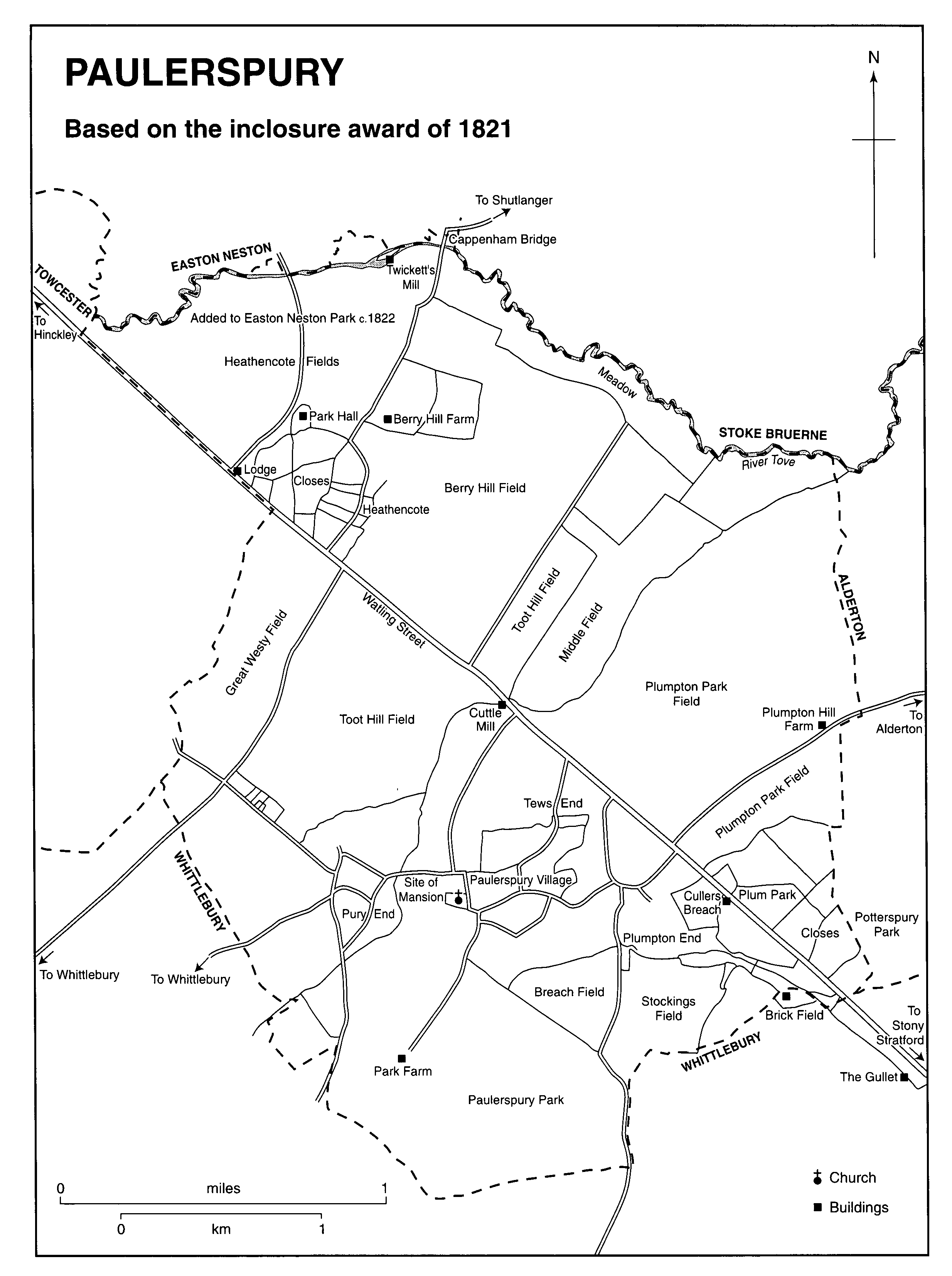
PAULERSPURY
Based on the inclosure award of 1821
Outside the two villages, most of the land of the parish was occupied by common arable and meadow until both Paulerspury and Heathencote were inclosed under an Act of 1819. (fn. 34) In 1540 tenants of the manor of Paulerspury had land in Park Field, Toothill Field and Middle Field, (fn. 35) the first of which is presumably the Plumpton Park Field of the inclosure award, which occupied a broad wedge of land to the east of Watling Street in the south-east of the parish, extending a short distance into Alderton. Middle Field lay immediately to the north of Plumpton Park Field, and Toothill Field further north again. (fn. 36)
Heathencote had its own fields, named simply as the Fallow Field, Peas Field and Wheat Field in 1728, (fn. 37) which presumably correspond with the Berry Hill Field (to the south-east of the hamlet), Great Westy Field (to the south-west, on the opposite side of Watling Street) and an area labelled 'Heathencote Fields' on the inclosure map. The last of these was divided into three portions in the award, named (from north to south) as Towcester Field, Middle Field and Mill Field. (fn. 38) The draft inclosure map also describes the eastern part of Great Westy Field as Little Westy Field. (fn. 39)
In 1819 there were three smaller areas of common field to the south of Plumpton End, named as Cullers Breach, Breach Field and Stockings Field, (fn. 40) which were perhaps remnants of a separate three-field system belonging to the manor of Plumpton Pury. (fn. 41) A triangular area of common arable immediately to the north of Paulerspury village, bounded by Watling Street on the east, was called Hall Field in 1819, a name also used in 1728. (fn. 42) It was presumably part of the open fields of Paulerspury, since it adjoined the three larger fields belonging to the manor, rather than Plumpton Pury.
Before inclosure there were common meadows alongside the Tove throughout the stretch forming the northern boundary of the parish, (fn. 43) which were presumably shared between the three manors. Meadow on the opposite bank belonged to the manor of Stoke Bruerne and in the 1530s (and quite possibly at other times) there was a violent dispute between men of the two parishes concerning a diversion of the course of the river. (fn. 44)
At the southern end of the parish, between Paulerspury village and the edge of Whittlewood, John de Paveley was given licence in 1363 to convert two pieces of woodland, Outwoods and Framstead, into a park of 175 acres. (fn. 45) It is not clear whether the work was carried out on exactly these lines, for in 1410 there were two separate parks in the manor of Paulerspury, called the Old Park and the New Park, separated by Framstead, 100 acres of woodland called Easthill and Outwoods, and another 100 acres of land, all of which Sir John St. John was given permission to inclose into a single park. (fn. 46) The park passed with the manor to the Crown in 1536 and four years later was found to contain 200 acres of land (of which 87 a. were wooded and the rest common pasture), plus 59 a. described as 'Outwards'. (fn. 47) These were presumably the Outwoods of 1363 and 1410 and correspond to the fields named Great and Little Outwood Coppice and Outwood Close (about 50 a. in all) in 1806. (fn. 48) There were 176 deer in the park in 1540. (fn. 49)
During the decade in which the manor remained in Crown hands the park was enlarged, before being granted with the rest of the estate to Sir Nicholas Throckmorton in 1550-1. (fn. 50) Sir Arthur Throckmorton's title to the 165 acres added to the park by Henry VIII was confirmed in 1596, after what appears to have been a fishing expedition by Crown officials in search of concealed rents. (fn. 51) In the 1630s Sir Arthur's daughter and coheir, Dame Mary Wotton, fell victim to Charles I's revival of forest eyres, which found that the park lay within Whittlewood, (fn. 52) and in 1639 she paid a fine of £100 to be allowed to disafforest and dispark the land. (fn. 53) Although a mid 17th-century survey described the park as a single entity consisting of 304 acres of pasture and 181 acres of wood ground, containing 400 deer, (fn. 54) when Benjamin Bathurst bought the estate in 1673 it was divided into more than 20 separate parcels of coppice and pasture, of which some of the latter were reserved for horses and some for deer. (fn. 55)
Some of the land belonging to the manor was sold off in small parcels by Edward Hales in 1670-1, shortly before the remainder was bought by Bathurst, who himself continued to make similar disposals. (fn. 56) By the early 19th century (and probably for some time before), the manorial estate consisted merely of a couple of cottages, a public house at Heathencote, the remains of the manor house near the church, and the former park, which had been cleared of woodland and consolidated into a single farm of about 570 acres, of which some 200 a. were in Whittlebury. (fn. 57) The land belonging to Park Farm was entirely old inclosure and thus the boundary of the 16th-century park (although not its smaller medieval precursors) stands out clearly on the map of 1819. In its fully developed form the park was roughly triangular in shape, widening out from an apex in the north near the medieval manor house to the parish boundary on its western and southern sides (and in fact a short distance beyond, into Whittlebury), and Breach Field and Stockings Field in the east. (fn. 58)
There was a second, much smaller, park in the south-eastern corner of the parish, created by Richard Damory, who in 1328 had licence to inclose the woods on his manor of Plumpton Pury, even though they lay within Whittlewood. (fn. 59) Plum Park, as it became known, passed with the manor to the Crown later in the 14th century and thus in 1542 became part of the honor of Grafton. (fn. 60) In 1605 Plum Park was incorporated into the adjoining (and much larger) Grafton and Potterspury parks, which also belonged to the honor. (fn. 61) The resulting single park, known as Grafton Park and including land in Alderton as well as the three other parishes, was alienated by Charles I and failed to be recovered by his son. (fn. 62) By the early 18th century much of the park, including 80 a. in Paulerspury, of which about 30 a. were definitely described as belonging to the former Plum Park, had been converted to pasture. (fn. 63) A century later Plum Park comprised a readily identifiable block of 83 a. of old inclosure to the east of Watling Street, extending on the east to the Alderton parish boundary and on the north to the edge of Plumpton Park Field. (fn. 64) Ridge and furrow has been found over much of the area, indicating that the park was in fact created (at least in part) from arable, rather than woodland, and some traces of the pre-1605 boundary can be found on the eastern and northern sides of the park. (fn. 65) In the 1820s a house on Watling Street within the park was licensed as the White Hart Inn, (fn. 66) which later became a farm known as Plum Park. (fn. 67)
There were two medieval water-mills in Paulerspury, one on the Tove in the north of the parish, near Cappenham Bridge, known as Twygrist (later Twickett's) Mill, and the other, Cuttle Mill, on the stream which flows north-east from Pury End at the point where the brook is crossed by Watling Street. In the postmedieval period there was also a windmill at Cuttle Mill, as well as one at Heathencote. (fn. 68)
The 19th and 20th centuries.
The inclosure award of 1821 dealt with about 2,000 acres of common arable and meadow in Paulerspury, as well as exchanges involving 91 a. of old inclosure and another 80 a. in adjoining parishes; (fn. 69) unusually, the Act did not provide for the commutation of tithes. (fn. 70) The exchanges mainly concerned the Pomfret and Grafton estates at Heathencote, where their respective holdings were rationalised to give Park Hall and all the land north of the Cappenham Bridge road to Pomfret and the farm at the eastern end of Heathencote and all the land to the south of the lane to Grafton. (fn. 71) This led almost at once to the extension of the park surrounding Pomfret's mansion at Easton Neston south into Paulerspury parish as far as Park Hall. A drive was laid out from Watling Street through the newly imparked land, curving north to approach the mansion from the south, with a pair of lodges and a wrought-iron gate-screen dated 1822 at the entrance. The rest of the Watling Street boundary of the new park was flanked by a long, high wall. (fn. 72)
Both estates did a good deal of new building in the parish in the years following inclosure. Park Hall and the Pomfrets' other farm at Heathencote (on the west side of Watling Street) were rebuilt, as was their farm on the northern edge of Pury End. The 4th duke of Grafton rebuilt the farm at Heathencote acquired from Pomfret and the farm at the southern end of Pury End. He also established a completely new farmstead at the eastern edge of the parish, on the road to Alderton, which became known as The Hill or Pury Hill Farm. In Paulerspury village the rector built a new parsonage, (fn. 73) and Isaac Lovell, the largest of the freeholders, (fn. 74) a new farmhouse. The latter was a handsome building, of two storeys plus attics, three bays wide, with walls of grey ashlar dressed with ironstone, and a central doorcase with Ionic pilasters. (fn. 75)
Other 19th-century changes included the building of an Independent church at the eastern end of Paulerspury village in 1826, a Wesleyan chapel at the southern end of Pury End in 1811 and a Primitive Methodist chapel at the opposite end of the village in 1861. (fn. 76) Also in 1861, Paulerspury school acquired handsome new premises in the middle of the village, thanks to the munificence of the rector, whose intransigence towards the large Nonconformist element in the parish led to the building of a day school by the Independents about the same time. (fn. 77) Probably because of the unusually large number of freeholders in the parish, (fn. 78) compared with neighbouring communities, there appears to have been rather more rebuilding of cottages in both Paulerspury and Pury End in the 19th century than in villages where a single estate owned most of the housing stock. A few larger houses were also built at Paulerspury, again a reflection of the availability of freehold land as well as the attractions of the village in the heart of the Grafton hunting country. A modern residence known as Paulerspury House was advertised on at least two occasions as an ideal hunting box. (fn. 79) In 1892 the Grafton Hunt, whose kennels had hitherto been at Wakefield Lodge and the stables at Towcester, moved both to Paulerspury, where Isaac Lovell's former farmhouse in the main street was acquired for the stud-groom, the buildings behind adapted as stables, and new kennels and cottages for hunt servants erected on the opposite side of the road. (fn. 80) More stabling was added in 1908. (fn. 81)
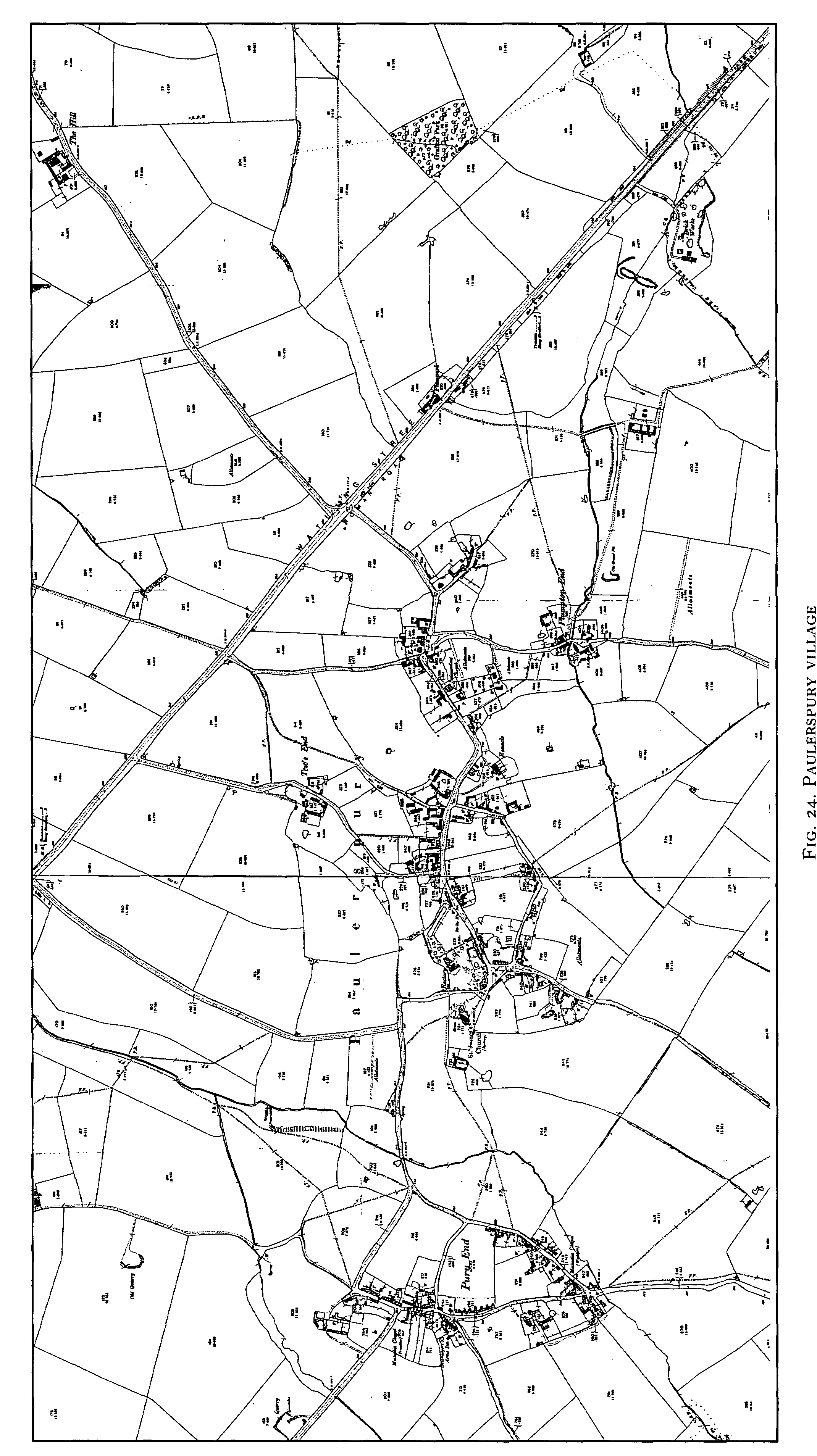
Paulerspury Village
Both the water-mills in the parish went out of use in the late 19th century, although the buildings at Cuttle Mill survived and eventually became a light engineering works. The only other industrial activity in the 19th century was brickmaking, carried on at two sites near Watling Street in the south-eastern corner of the parish. (fn. 82) In both the 18th century and the 19th, the parish seems to have a larger proportion of poor than neighbouring communities. (fn. 83)
The sale of the Grafton estate locally in 1919- 20, and some disposals by the Fermor-Hesketh estate at about the same date, did not lead to any new building, since the population of the parish was in decline and farming in depression. (fn. 84) In the 1930s the revival of long-distance road transport encouraged the establishment of a garage at Alderton turn and cafes there and at Cuttle Mill. (fn. 85) Also in the 1930s, the rural district council built some houses at the eastern edge of Paulerspury village, near the junction with Watling Street. (fn. 86)
A bomb fell on Pury End during the night of 25-26 September 1940, damaging the Primitive Methodist chapel, the Bricklayer's Arms and a number of houses, and causing less serious injury to property in Paulerspury itself and Whittlebury. (fn. 87)
After the Second World War the local authority resumed building on a larger scale in the middle of Paulerspury village and at Pury End. As elsewhere in the district, private housebuilding did not get underway until the early 1960s and within a few years the scope for such development was curtailed by the designation of a planning envelope drawn closely round the existing built-up area, outside which new building would not normally be allowed. No development at all was to be permitted at Heathencote and very little at Pury End. (fn. 88) In consequence, as both Paulerspury and Pury End came to be regarded as among the more attractive villages in the district by professional families who wished to live in the country while working elsewhere, attention turned to the refurbishment and extension of existing houses, infill schemes, and the conversion of redundant farm buildings to residential use. The Primitive Methodist chapel at Pury End was converted into a house, whereas the Wesleyan chapel was simply used for storage after closure. The Independent (later United Reformed) church remained open for worship at the time of writing. (fn. 89) Outside the village, redundant buildings at Pury Hill Farm were converted into business units in the 1990s and extended on a scale considered locally to be inappropriate for the location. (fn. 90) An earlier and less controversial adaptation followed the sale of the Grafton Hunt stables to the Rolls Royce Enthusiasts' Club for their headquarters in 1977. (fn. 91)
The village school was modernised and extended in the 1960s, its pupil numbers gradually increasing as the population grew. (fn. 92) Despite this rise in population after 1961, (fn. 93) and a much greater increase in the wealth of the community, Paulerspury failed to escape the general decline in retail services characteristic of rural areas in the late 20th century. At the time of writing the village possessed not a single shop, although oddly there was one, with a sub-post office, at Pury End.
MANORS AND OTHER ESTATES.
The history of landownership in the parish is complicated. Although Paulerspury was treated as a single manor in Domesday Book, by the early 13th century two other manorial estates had emerged, one at Heathencote and the other at Plumpton Pury; a portion of the latter later became a separate manor known as Ashton Pury. Besides the manor, there were several medieval freeholds in Heathencote and a number of religious houses held land in various parts of the parish. After 1542 the honor of Grafton initially included all four manors in the parish, but the main manor of Paulerspury was alienated in 1551. In the 17th century much of the manorial estate was sold off, creating an unusually large number of small and middling freeholds in the parish. Some of these were later acquired by either the Grafton or Fermor estates. The Paulerspury portion of the latter, which originated in purchases by Richard Empson, was also augmented by the acquisition of the manor of Heathencote in 1725.
Manor of Paulerspury.
In 1066 Paulerspury was held freely by a woman named 'Gitda', a variant of the Old English name Gytha. Although most occurences of the latter name in Domesday refer to the countess Gytha, widow of Earl Godwine and mother of King Harold, the spelling 'Gitda' is found only in Northamptonshire, and appears to refer to another woman of the same name. By 1086 the manor had been transferred to William Peveril. (fn. 94) After William's grandson, also named William, forfeited his estates in 1153, most of the honor of Peveril was granted by Henry II to the king's younger son John, count of Mortain. On John's accession to the throne in 1199 the honor was merged in the Crown, where it has since remained. (fn. 95) The main court for the honor in Northamptonshire was held at Duston, at which tenants from Paulerspury, Plumpton and Heathencote still owed suit in the early 19th century, (fn. 96) as they had in the 14th. (fn. 97)
William Peveril's manor, assessed at 3½ hides and a fifth of a hide in both Domesday and the 12th-century Northamptonshire survey, (fn. 98) was held from him by Robert, who appears to be identical with an undertenant of the same name of two of William's other manors, Great Houghton and South Wingfield (Derbys.), (fn. 99) since all three were later held by a family named de Paveley, who gave their name to Paulerspury. (fn. 100) In the early 12th century Robert de Paveley, possibly a son of the Domesday tenant, was lord of Great Houghton, (fn. 101) and either he or the earlier Robert gave two-thirds of the tithes of his demesnes there to Lenton priory (Notts.), founded by William Peveril, the son of the Domesday tenant-in-chief. (fn. 102) Geoffrey de Paveley, son of Ilbert de Paveley, gave a rent charge of 2s. a year in Paulerpsury to St. James's abbey, near Northampton, in the reign of Henry II. (fn. 103) His successor may have been the Robert de Paveley who died in 1194, leaving a son and daughters under age. (fn. 104) The son was presumably the Geoffrey de Paveley who was fined 200 marks for livery of his lands in 1198. (fn. 105) In 1199 Geoffrey and Richard de Paveley quitclaimed a messuage in Paulerspury to Robert de Badeslegh. (fn. 106) In 1212 Geoffrey was found to hold two fees in Northamptonshire (Paulerspury and Great Houghton) and two in Derbyshire (Risley and South Wingfield). (fn. 107)
Geoffrey must have died around the beginning of Henry III's reign, when Faukes de Breaute was granted the wardship and marriage of his heir, (fn. 108) Robert, who was of age before 1225 (fn. 109) and had two fees in Paulerspury and Great Houghton in 1235-6 (fn. 110) and 1242. (fn. 111) In 1247 he was found to hold four carucates of land in Paulerspury and two in Great Houghton by the service of one knight's fee, worth 30s. a year. (fn. 112) A William de Paveley, whose testament of 1240 asked that his body be buried at Sewardsley nunnery and included numerous bequests to local churches and religious houses, (fn. 113) was perhaps his brother.
Robert de Paveley died in 1250 seised of the manor of Paulerspury and part of Great Houghton, held in chief as of the honor of Peveril for one knight's fee, leaving a son aged 23, also named Robert, as his heir, (fn. 114) who in 1253 demised the manor of Paulerspury to Robert de Eye for 15 years. (fn. 115) Robert was found to be holding a frankpledge court and an assize of bread and ale without warrant in 1275; (fn. 116) in 1277 and 1282, when he was said to be infirm, Robert Mauntell proffered on his behalf the service of one knight in the campaigns against the Welsh; (fn. 117) and in 1284 he was found to hold the manor of West Pury in chief for the service of half a knight's fee. (fn. 118)
Robert de Paveley died in 1288, leaving a widow Sarra and twin sons, Lawrence and Philip, aged 30, of whom Lawrence was the first-born. As well as the manor of Paulerspury, with lands in Great Houghton, which long before his death Robert had given to Lawrence and which were held in chief for one knight's fee, Robert and Sarra were jointly enfeoffed in a messuage, 72 a. of land, 6 a. of meadow and 31s. 2d. of rent in Paulerspury, which they held of Robert Mauntell, who had previously held the same premises of Robert de Paveley for the service of one knight. (fn. 119) Lawrence, who in 1290 gave an acre of land in Paulerspury to Sewardsley nunnery (fn. 120) and in 1293-4 paid one mark to the honor of Peveril for his manor of Pury, (fn. 121) was summoned in 1297 to perform military service as a holder of land worth £20 a year or more. (fn. 122) He was returned as lord of Paulerspury in 1316. (fn. 123) In 1326 Lawrence obtained confirmation of all his lands in Paulerpsury and Great Houghton, as well as Risley and South Wingfield in Derbyshire, as granted to his ancestor Robert de Paveley. (fn. 124) A few years later an assize jury found that he held those estates in chief as of the former Peveril honor of Nottingham by the service of one fee, suit at the court at Duston every three weeks, and a payment to the king by the hands of the bailiff of the honor for the land at Paulerspury by ancient custom of 13s. 4d. a year, known as Sheriff Yield. None of the services was in arrears. (fn. 125) Lawrence was summoned to parliament in 1324 (fn. 126) and in 1326 successfully petitioned for discharge from the scutage which his father had already paid for Edward I's Welsh expeditions of 1277 and 1282. (fn. 127) He was then nearly 70 and must have died not long afterwards, to be succeeded by a son named Robert, who himself died in 1346. (fn. 128)
Robert's heir was his son Lawrence, aged 19, whose wardship was granted to Guy de Brian. (fn. 129) He died in 1349, shortly after coming of age, seised of the manor of Paulerspury, leaving a brother named John, aged 15, as his heir. (fn. 130) John's wardship and marriage were acquired by William Stury, to whom in 1350 two-thirds of the manors of Paulerspury and Great Houghton were committed, the other third being held in dower. (fn. 131) John was still alive in 1392 (fn. 132) but must have died shortly afterwards, for by 1395 the manor and advowson had passed to his daughter and heiress Isabel and her husband Sir John St. John of Fonmon (Glam.), subject to the life interest of John's widow Joan. (fn. 133) In 1403 Joan demised part of her estate to John and Isabel, reserving the gatehouse of the manor, the advowson and various lands. Joan died in 1414, whereupon John and Isabel took possession of the estate. (fn. 134)
Sir John St. John died in 1424, seised of the manor of Paulerspury, held in chief as of the honor of Peveril, leaving his son Oliver as his heir, (fn. 135) who was returned, with Thomas Mortimer, as holding one fee in Paulerspury and Great Houghton in 1428. (fn. 136) Oliver St. John's grandson, also named Oliver, married Margaret, the daughter and heir of Sir John Beauchamp of Bletsoe (Beds.), which thereafter became the family's main seat. (fn. 137) The younger Sir Oliver's grandson, another Sir John St. John, died in 1525, having settled the manor and advowson of Paulerspury and other lands there on feoffees to his own use and that of his son and heir, also named John, and the younger John's wife Margery (or Margaret), the daughter of Sir William Waldegrave. (fn. 138) In 1541 Sir John sold the manor of Paulerspury, including the advowson and extensive lands there, to Henry VIII in exchange for estates in London, Huntingdonshire, Bedfordshire, Cambridgeshire and Glamorgan, and a payment of £468 10s., representing 20 years' purchase on a difference of £23 6s. 8d. in the annual value of the lands exchanged. (fn. 139) The manor, together with other estates in Paulerspury acquired about the same time from Thomas Culpepper and Sir Arthur Longfield, was annexed to the honor of Grafton on its creation in 1542. (fn. 140)
In 1547 Henry VIII awarded Sir Nicholas Throckmorton an annuity of £100, which four years later he surrendered in exchange for a grant of the manors of Paulerspury, Cosgrove, Silverstone and Tiffield, all parcel of the honor of Grafton; Paulerspury Park, also belonging to the honor; other, mostly ex-monastic, estates in Northamptonshire and several other counties; and a number of advowsons, including Paulerspury and Cosgrove. (fn. 141) Sir Nicholas died in 1571 (fn. 142) and was succeeded by his son Arthur, who died in 1626, leaving four daughters and co-heirs, all of whom he survived, except the eldest, Mary, the wife of Thomas, 2nd Lord Wotton of Marley, on whom he settled Paulerspury at her marriage in 1608, subject to his wife's life interest. (fn. 143) Thomas and Mary also left four daughters and co-heirs, but in 1628 made a settlement of Paulerspury and other estates to their own use for their lives, with remainder in tail male, together with contingent remainders to their fourth daughter Anne and her husband, the heirs male of that marriage, and their three other daughters. (fn. 144) At the same time they agreed to pay Dame Anne, Sir Arthur's widow, £10,000 for her life interest in the Paulerspury estate. (fn. 145)
In 1644 Anne Wotton married Edward Hales of Tunstall (Kent), (fn. 146) who in 1654 succeeded his grandfather, Sir Edward Hales, who had been created a baronet in 1611. (fn. 147) In 1668 Hales conveyed the manor of Paulerspury to their son and heir, also named Edward, (fn. 148) who made his home at Paulerspury but in 1673-4 sold the estate to Benjamin Bathurst, a London merchant then living at Seville. (fn. 149) The estate was among those settled by Sir Benjamin at the time of his marriage in 1682 to Frances, the daughter of Sir Allen Apsley. (fn. 150) Sir Benjamin died in 1704, leaving a son and heir Allen, to whom Dame Frances conveyed Paulerspury in 1707 (fn. 151) and who in 1712 was created Baron Bathurst of Battlesden (Beds.). (fn. 152) In 1732 Lord Bathurst and his son and heir apparent, Benjamin, executed a recovery of various purchased estates in Paulerspury and elsewhere not included in the marriage settlement of 1682 or the conveyance of 1707. (fn. 153) Bathurst mortgaged the mansion and park at Paulerspury in 1738 to his second son Henry for £900, (fn. 154) and in 1740-1 raised sums of £6,000 and £8,280 secured on the whole of the manor of Paulerspury. (fn. 155) In 1744 the estate was remortgaged for a total of £12,000. (fn. 156) This was repaid in full in 1772, (fn. 157) although a new sum of £5,000 was borrowed the same year. (fn. 158) Also in 1772, when Bathurst, at the age of 87, was advanced to an earldom, (fn. 159) the Northamptonshire property was re-settled to make good the loss to the entailed estate of a town house in St. James's Square, which was sold to Sir Watkins Williams Wynne. (fn. 160)
The 1st Earl Bathurst died in 1775 and was succeeded by his second son Henry (Benjamin having predeceased his father). (fn. 161) The following year the 2nd earl increased the mortgage on the Northamptonshire estate to £9,000; part of the debt was discharged by the sale of some of the land and the remaining £4,800 repaid in 1788. (fn. 162) The estate itself was re-settled in 1783 (fn. 163) and again in 1789 when Bathurst's son and heir apparent, also named Henry, married Georgina, daughter of Lord George Lennox and sister of the 4th duke of Richmond. (fn. 164) Henry succeeded as 3rd earl in 1794 (fn. 165) and in 1805, having a few years earlier charged land in Paulerspury and Whittlebury with two annuities payable to Major-General Thomas Osbert Mordaunt, (fn. 166) sold the manor of Paulerspury, including land there and in Whittlebury, to Robert Shedden of Gower Street, when the estate was discharged from the payment of the annuities to Mordaunt. (fn. 167) Shedden was a merchant who made a fortune in Virginia, lost it as a loyalist during the American War of Independence, and made another, partly from marine insurance, after his return to England, which enabled him to buy several estates in both England and Scotland. (fn. 168)
Robert Shedden died in 1826, leaving a son George, born in 1769, who in 1796 married Mary Goodrich. They had four sons, of whom the eldest, William George Shedden of London, succeeded his father in 1855 but died without issue in 1872, when the Paulerspury estate passed to his only surviving brother, Roscow Cole Shedden of East Cowes (Isle of Wight), who himself died in 1877, leaving a son George, by which date the estate consisted merely of Paulerspury Park Farm, comprising about 590 acres, of which 386 a. lay in Paulerspury and the rest in Whittlebury. (fn. 169) George Shedden sold the farm to the sitting tenant, Thomas Roddis, in 1920. (fn. 170) Roddis sold on within a few years to Edgar Eales, who was described as lord of the manor up to the start of the Second World War. (fn. 171)
The Manorial Buildings.
The capital messuage belonging to the manor of Paulerspury stood to the west of the church, in the field adjoining the lane to Pury End. (fn. 172) In 1540 the house was held on a 50-year lease from Sir John St. John by Margaret Chauncey, widow, for £7 13s. 4d. a year. (fn. 173) She was presumably the former wife of John Chauncey, by far the largest contributor from Paulerspury to the lay subsidy of 1524-5. (fn. 174) Ten years later it was valued at £8, when it was said to be ruinous and was ordered to be repaired. (fn. 175)
Sir Nicholas Throckmorton, to whom the manor was granted in 1551 and who died in 1571, appears never to have lived there, (fn. 176) but in 1593 his son Sir Arthur Throckmorton began building a new mansion on the site of the old house, which he made his home until his death in 1626. (fn. 177) Early in the campaign he visited two nearby houses, Stowe (Bucks.). and Holdenby, perhaps partly to gather ideas, and also Moulton, to consult James Furness, who in May 1595 was paid 10 French crowns for 'directing the building' (fn. 178) and can probably be identified as the architect of the house. As was customary, Throckmorton made separate piecework bargains with individual master tradesmen, rather than engaging a single main contractor. William Green undertook all the freemasonry (except coloured work and pilasters) at 3d. a foot; (fn. 179) he also did the bricklaying, (fn. 180) which suggests that the house was carcassed, at least in part, in brick, rather than being of stone throughout. (fn. 181) Most of the carpentry was let to a man named Durrant. (fn. 182) Again in common with contemporary practice elsewhere, as many of the materials as possible were drawn from Throckmorton's own estate. Stone came from his quarries at Silverstone and Cosgrove; oak, for scaffolding and floorboards, came from his woods at Silverstone and Tiffield. (fn. 183)
By July 1595 work was sufficiently advanced for a locksmith to be engaged to supply 12 locks and for wainscot to be ordered from a joiner in Southwark, including both plain work and French panelling. (fn. 184) The following month lead was bought from a merchant named Tramell in Bishopsgate Street. (fn. 185) More significant was an order, also placed in August 1595, with Garret Johnson, the Southwark marble carver, for a chimney-piece of 'Sussex marble, alabaster, touch and rance' (i.e. a mixture of cream, red and black stone) for the hall, to be carved according to a pattern left with him. This cost £60 (half in hand and the rest when finished and set up), which was to include the gilding but not the carriage. (fn. 186) In September 1595 Throckmorton bought a Turkey carpet, (fn. 187) although this might have been for his London house. In October he made a bargain for the repair and replacement of the old fences, posts and rails round the park at Paulerspury. (fn. 188)
The surviving portion of Throckmorton's diary ends in 1595 and when it resumes in 1609 he was laying out new gardens around his house, engaging a carpenter named Truslowe to make doors and masons named Russell to build the walls. (fn. 189) A gardener called Bilson came from Mixbury (Oxon.) in September that year to design gardens, although he and his son broke their contract almost at once, (fn. 190) and advice was also obtained from Lord Stanhope's gardener at Harrington, a man named Daniel, and from the gardener at Holdenby. (fn. 191) Terraces were laid out across the slope which runs down from the house towards the stream which bounds the site to the north, (fn. 192) a causeway was built from the mansion to the churchyard, and seats were made for the garden, including one near the bowling place. (fn. 193) Fruit trees, including apricots, were trained and spread in espaliers against one of the walls (presumably southfacing) of the mansion. (fn. 194) In January 1611 Throckmorton bought thousands of privet sets and willow twigs for hedging and also timber from Grafton Park for hedging and ditching his fields. Painters from Stony Stratford came to oil and colour his rails. In the spring of 1611 waterworks were being installed and by July the long walk in the great garden had been levelled. (fn. 195)
Described in the mid 17th century as a fair capital messuage of stone, with barns, stables, coach-houses, outhouses, gardens and orchards, (fn. 196) the Throckmortons' former mansion was then let as a farmstead. (fn. 197) It seems to have been given up as the main holding on the estate (which was reduced by piecemeal sales in the early 1670s) (fn. 198) in favour of the former lodge in the park to the south of the village, which was itself disparked and ploughed up in the mid 17th century. (fn. 199) The buildings, known as the Great House, were still tenanted in 1772, when part of them was being used as a parish workhouse. (fn. 200) In 1791 the Grafton estate was buying stone from the Great House to re-use elsewhere, (fn. 201) and much of the structure was apparently taken down before the end of the 18th century. In Baker's day a barn was still standing (fn. 202) and the workhouse remained in use in 1819. (fn. 203) It may have been given up in the 1820s, when the parish acquired cottages to be used for the same purpose in Pury End, (fn. 204) and was presumably then demolished. The farm buildings survived until the second half of the 20th century, when they too were taken down, leaving only earthworks to indicate the site of the mansion and its gardens running down to the brook west of the church. (fn. 205) It is possible that water was raised from the stream to supply the waterworks mentioned by Throckmorton, (fn. 206) since one of the fields on the site of the gardens was known as Conduit Close in the early 19th century. (fn. 207) A short distance downstream the brook was dammed to create what appears to be a medieval fishpond, rather than an ornamental feature belonging to Throckmorton's gardens, since adjoining fields were known as the Fishweirs in the 19th century. (fn. 208) When the estate was acquired by the Crown in 1541 its resources included free fishery and free warren: (fn. 209) the close immediately west of the site of the mansion was still called the Warren in 1806. (fn. 210)
Manor of Plumpton Pury.
In 1086 William Peveril held of the Countess Judith one hide and the fifth part of a hide in Paulerspury, which in 1066 had been held freely by Biscop. (fn. 211) What is clearly the same estate was held in the early 12th century by the heirs of 'Safleto' of Judith's successor, David I, king of Scots. (fn. 212) This appears to be a corrupt form of the surname Salceto, for in 1212 Robert de Salceto held four quarter-fees in Plumpton, Harpole, Eakley (Bucks.) and Stanton-on-the-Wolds (Notts.), making together one whole fee of the honor of Peveril of Nottingham. (fn. 213) An entry for 'Plumpton', assessed at 6¼ carucates, in the carucage of 1220 probably refers to this estate, rather than the manor in Greens Norton hundred. (fn. 214)
Robert, who in 1210 accused Geoffrey de Paveley of unjustly disseising him of his free tenement in Paulerspury, (fn. 215) died in 1223 and was succeeded by a son of the same name, (fn. 216) who married Beatrice, the daughter of Hugh FitzRalph, whom he endowed in the manor of Plumpton End and land in Stanton. (fn. 217) The younger Robert died in 1236, leaving his six sisters or their issue as his heirs, i.e. Peter de Goldington, son of the eldest sister; Robert le Lou, son of the second sister; Alan de Rumeney, son of the third sister; Waleran de Mortimer, son of the fourth sister; Agnes, the fifth sister, who married Adam de Napton; and Mary, the sixth sister, who married Simon de Thorpe. They were said in 1236 to hold a quarter of a fee in Plumpton End, which Beatrice, Robert's widow, held in dower. (fn. 218)
Peter de Goldington appears to have acquired two of the six shares in the manor, one and a half of which were, with Rumeney's share, alienated in 1258 to Philip Lovell. William de Nowers and Isabel his wife (one of the daughters and coheirs of Peter de Goldington) conveyed to him one-sixth of the manor, Miles de Hastings and Dionise his wife (another coheir) a moiety of a sixth, and Alan de Rumeney his sixth share. (fn. 219) In 1278 Joan, late the wife of Roger Lyons, died seised of 44 a. of arable, 2½ a. of meadow, 2 a. of wood and rent in Plumpton, which her father Adam de Napton had settled on her in marriage. She also had 12 a. of arable in exchange with John le Lou, and 44 a. of arable, 2½ a. of meadow and rent which he held during the minority of Simon, son and heir of Ralph de Thorpe. Joan's heir was her son Richard Lyons. (fn. 220) In 1284 John Lovell, John le Lou, Richard Lyons and Simon de Thorpe held the manor of Plumpton for a quarter of a knight's fee of the king in chief. (fn. 221) Simon was a tenant-in-chief at Plumpton in 1292. (fn. 222)
By 1323 the manor of Plumpton Pury, as it had become known, was in the hands of Richard Damory, who that year granted John de Gorges an annuity of £14 out of the estate. (fn. 223) In 1328 Richard had licence to inclose and impark his wood at Plumpton Pury, even though it lay within the bounds of Whittlewod forest, as established by the perambulation made in Edward II's reign. (fn. 224) Richard died in 1330 seised of a messuage, a carcucate of land containing five virgates of arable and 10 a. of meadow, and 100s. rent in Plumpton Pury, held of Robert de Napton, leaving a son and heir, also named Richard, aged 16. (fn. 225) The manor itself, then called Plumpton Hall, he had previously sold to Thomas de Ferrers. (fn. 226)
In 1353 Thomas de Ferrers died seised of the manor of Moor End in Potterspury and also the manor of Plumpton Pury, of which the latter was held of the heirs of Robert de Paveley by knight service. His heir was his son William, but both Moor End and Plumpton Pury (which he had demised for his life to Robert le Clerk by John de Newnham, Thomas's feoffee) had been settled by Thomas on his late wife Ankaret le Strange, with remainders in tail male to Henry de Lisle and Thomas le Despenser. (fn. 227) By 1363 Plumpton was in the hand of Anne, widow of Edward le Despenser, who that year conveyed the manor, together with the castle and manor of Moor End and lands in Yardley Gobion and Potterspury, to the king in exchange for a moiety of the manor of Burghley (Rutland). Sir Gerard de Lisle and William Ferrers both released any claim of their own on the estate. (fn. 228) In 1369 Robert and Joan Lillingstone, who held the manor of Plumpton Pury for life for £10 a year, asked for the rent to be reduced by 5 marks on account of falling profits. (fn. 229)
Edward III gave the manor of Plumpton Pury 'called Plumpton Hall', with the park adjoining, to his mistress Alice Perrers for her life. After her attainder in 1377 it was found that the estate was worth 10 marks a year and was held of Sir John Paveley by a yearly rent of half a pound of cummin. (fn. 230) The following year the manor was committed to John Russell for eight years at a rent of 10 marks. (fn. 231) In 1389 queen Anne, wife of Richard II, complained that her ministers were being forced to account at the Exchequer for the issues of Plumpton Pury as though it was a manor in its own right, whereas it was parcel of the manor of Moor End, which she had been granted in dower. An inquisition supported her view. (fn. 232) After the queen's death in 1394 custody of the manor was granted the following year to Thomas de Everdon and John Sebright for 10 years at the slightly enhanced rent of 11 marks. (fn. 233) At the same time the whole of the queen's lands were granted for their lives in survivorship to the archbishop of York, bishop of Salisbury and earl of Rutland. The Moor End estate, including Plumpton Pury, was later granted by the duke of Aumale (as Rutland became in 1397) to Philippa, duchess of Ireland, for her life, a grant confirmed by the king in 1399 after Aumale's disgrace. (fn. 234)
Plumpton Pury remained part of the Crown manor of Moor End and was included in the grant of the estate for his life to Thomas Parr in 1516. (fn. 235) Similarly, when William Clarke was appointed keeper of Moor End castle in 1540 the grant included the keepership of the woods at Plumpton Park. (fn. 236) With the rest of the Moor End estate, Plumpton was annexed to the honor of Grafton at its creation in 1542 and (unlike the manor of Paulerspury) remained part of the honor until it passed to the 2nd duke of Grafton in 1706. (fn. 237)
The capital messuage belonging to the manor of Plumpton Pury stood in a field known in the early 18th century as Hall Close at Plumpton End, at the south-eastern edge of the village, where Bridges reported that foundations of old buildings had been dug up. (fn. 238) In 1728 the field was called 'Plumb Hall' by Collier and Baker, who do not mark any buildings there, although a dam survived nearby from a fishpond which presumably belonged to the house. (fn. 239)
Manor of Ashton Pury.
The manor of Ashton included lands in Paulerspury and for this reason the estate was sometimes known as the manor of Ashton Pury, or the manors of Ashton and Pury. (fn. 240) The connection between the two may date from the division of Plumpton Pury between the sisters and coheirs of Robert de Salceto after his death in 1236, since one of them married Robert le Lou, lord of Ashton. (fn. 241) In 1329 John son of Philip de Paveley made a grant of premises in both places to Philip de Hartshill, whose family succeeded the Lous (or Lovells) as lords of Ashton. (fn. 242) John de Hartshill and his wife Margaret made a settlement of the manor of Ashton and tenements in Paulerspury in 1356. (fn. 243) The Hartshills were in turn followed by the Culpeppers and a release of 1411 by John, son of Lawrence Mortimer, to Sir Thomas Culpepper of his right in the manor of Ashton, including lands in Paulerspury, (fn. 244) is possibly a distant echo of the partition of 1236, when one of the coparceners was Waleran de Mortimer. (fn. 245) The Paulerspury portion was regularly included in 15thcentury settlements of the estate, (fn. 246) and in a lease of 1437. (fn. 247) In 1537-8 Sir Alexander Culpepper, his son Thomas and daughter-in-law Elizabeth sold to the Crown what were described as the manors of Ashton and Pury, (fn. 248) which a few years later were annexed to the honor of Grafton at its creation in 1542. (fn. 249)
Alone among the estates included in the honor, the lordship of Ashton (as opposed to lands within the manor) was leased throughout the period in which the honor remained in Crown hands, including the portion in Paulerspury. This led to at least one dispute (in 1595) between the lessee and a farmer in Paulerspury, when the latter claimed that he held his lands of the (former St. John) manor of Paulerspury, whereas Robert Marriott insisted that he was one of his undertenants within the manor of Ashton Pury. (fn. 250)
The main house on the Paulerspury portion of the manor of Ashton and Pury, also at Plumpton End, was known as the 'Wood Hall' in 1542, when it was occupied by Richard Marriott. (fn. 251) What was evidently the same house or its successor was described in 1650 as the capital messuage of the manor of Pury, then in the tenure of John Buncher, when it had a hall, parlour, kitchen and buttery (in all four bays of building), with chambers over; two barns (eight bays); and a stable and cowhouse (three bays). (fn. 252) The Bunchers were still tenants of the 'Manor House of Pury' in 1705, when it was said to have been formerly in the tenure of William Marriott and the premises included a close of pasture called Woodhill Pond and some woodland called Shrubby Woodhill. (fn. 253)
Manor of Heathencote.
There was at least one estate at Heathencote by the later 12th century, when Geoffrey de Lisle, for the souls of his father and mother, Maud his wife, and Agatha his daughter, gave to the chapel of St. Mary in Heathencote the house which Henry the chaplain then held, rendering 2 lb. of wax yearly to the sacrist of St. James's abbey, Northampton. A little later, Walkelin, abbot of St. James between 1180 and 1205, gave Geoffrey permission to elect a chaplain to serve in the abbey's chapel at Heathencote, who should pay St. James the 2 lb. of wax and have for his support all that Geoffrey had given to the chapel. (fn. 254) Other undated, late 12th- or early 13th-century deeds record gifts to St. James by Roger, the son of John de Tremenel (40s. rent out of Denelfescroft in Heathencote), and Eustace de Gerardville (the tenement he held there of Sir John de Tremenel, rendering 40d. yearly to John, as chief lord; Roger de Tremenel later released St. James from this payment). (fn. 255) Sir John de Weedon, for the soul of Geoffrey de Lisle, gave the abbey 46d. rent yearly from a tenement in Heathencote.
In 1316 Ralph de Weedon, presumably John's successor, was lord of Heathencote (fn. 256) and in 1346 either Ralph or a namesake accounted for one fee there, held of the heir of Robert de Paveley. (fn. 257) The estate was probably that held in 1235 and 1242 by Robert as part of his manor of Paulerspury. (fn. 258) When Lawrence de Paveley died in 1349 he held a knight's fee in Heathencote belonging to his manor of Paulerspury, held of the king in chief as of the honor of Peveril. (fn. 259) Heathencote was later acquired by Sir Henry Green of Greens Norton, who died in 1369 seised of the manor, held of Sir John de Paveley by the payment of 8d. (fn. 260) Sir Henry's son, Sir Thomas Green, died in 1391 similarly seised, leaving a son and heir also named Thomas, (fn. 261) who in 1428 held one knight's fee in Heathencote, which Ralph de Weedon had held of the heirs of Robert de Paveley as of the honor of Peveril. (fn. 262) The younger Thomas's widow, Mary, held a third of the manor in dower at her own death in 1434 from the heirs of Sir John St. John as of his manor of Paulerspury, when her heir was her son, another Thomas Green. (fn. 263) In 1482 Maud, the wife of Richard Middleton and widow of Thomas Green, remitted to her son Thomas Green her claim to a third of her previous husband's estate in return for a life interest in the Greens' home manor of Norton, including lands in Heathencote and elsewhere. (fn. 264)
After the death of the last Sir Thomas Green in 1506 Heathencote passed with the rest of the family's estates in moieties to his two daughters, Anne and Maud, and their respective husbands, Sir Nicholas Vaux and Sir Thomas Parr, between whom they were later divided, Anne and Nicholas (created Lord Vaux in 1523, shortly before his death) taking the Northamptonshire portion, which later passed to their son Thomas, 2nd Lord Vaux. (fn. 265) In December 1535 Vaux sold Greens Norton and a number of other former Green manors to Sir Arthur Darcy, who a month later sold to the Crown. (fn. 266) Although Heathencote was not named in the conveyances, it must have been included in these transactions, since it reappears in a grant of the same estate to William Parr, marquess of Northampton (the only son of Sir Thomas Parr and Maud Green), in 1550. (fn. 267) Initially attainted and sentenced to be executed by Queen Mary for his support for Lady Jane Grey, Parr was later reprieved and his lands (although not, until 1559, his titles) were restored in 1555, when the manor of Heathencote was described as parcel of the honor of Grafton (fn. 268) (which it was not in 1550). Northampton died in 1571, when all his estates reverted to the Crown. (fn. 269)
The omission of Heathencote from the conveyance of December 1535 is probably explained by the sale in fee of what was later called 'Heathencote Manor or Farm' in May that year by Vaux to his steward (fn. 270) Robert Downhall, with a reserved rent of £4, which after the sale by Darcy of 1536 became payable to the Crown. (fn. 271) Robert, who was the second son of William Downhall of Geddington (d. 1505), (fn. 272) was already living at Heathencote in the 1520s. (fn. 273) He died in 1549 (fn. 274) (although he and his wife Elizabeth were described as lessees of the farm, then in the tenure of Thomas Bennett, when Greens Norton was granted to Northampton in 1550) (fn. 275) and in 1579 his eldest son and heir Thomas Downhall had licence to settle what was described as the manor of Heathencote on feoffees. (fn. 276) Thomas died the following year (fn. 277) and appears to have been succeeded by Gregory Downhall, who was assessed on lands at Heathencote worth 40s. a year in 1600-2. (fn. 278) Gregory Donhault (as he was later known) was educated at Merchant Taylors' School and Pembroke Hall, Cambridge, and later became a master in Chancery and secretary to Lord Chancellor Ellesmere. (fn. 279) He died in 1614 seised of the manor of Heathencote, said on that occasion to consist of a single capital messuage and lands, held of the manor of Paulerspury in free socage. His heir was his brother Jerome, aged 55, but he willed Heathencote to his cousin 'William Donhault of the Middle Temple', (fn. 280) who appears in fact to have been William Downhall of Geddington (d. 1627), the grandson of Robert Downhalls's elder brother Thomas. William's eldest daughter Frances married Sir William Dove of Upton, near Peterborough, and in 1719 Thomas Dove of Upton obtained a private Act enabling him to sell Heathencote to repay the mortgages with which he and his father, another William Dove, had charged the estate. (fn. 281) In 1725 the farm was sold to the 1st earl of Pomfret (fn. 282) and merged with the rest of the Fermor estate in the parish. (fn. 283)
Heathencote manor appears to have been demised by Gregory Donhault to Richard Catesby of Heathencote, who in about 1589 pledged the estate as security for a debt, although he remained in occupation, as did his son Edward after his father's death. In 1598 Edward attempted to recover muniments which he accused those to whom his father had conveyed the property of wrongly withholding. (fn. 284) During the same period the younger Catesby was in dispute with the Crown's tenants at Heathencote, who accused him of preventing them commoning their animals as they had in the past. Catesby stated then that there was one capital messuage or grange in the hamlet, called Heathencote manor, in whose lands he claimed the other farmers had no rights of common. (fn. 285) The remainder of the Crown estate at Heathencote was let with the rest of the honor of Grafton in the 16th and 17th centuries and passed to the 2nd duke of Grafton in 1706. (fn. 286)
Confusingly, in the early 19th century George Shedden claimed the manor of Heathencote as parcel of his manor of Paulerspury (which had been alienated from the honor of Grafton in 1551), while the duke of Grafton claimed a manor in Paulerspury and Heathencote as part of the honor of Grafton, (fn. 287) the former presumably meaning Plumpton Pury as parcel of the manor of Moor End and the latter as parcel of the manor of Greens Norton, both of which remained within the honor.
In 1651 rents from premises in Pattishall, Eastcote and Astcote, together with the fee farm rent of £4 from the manor of Heathencote, in all a total of £7 16s., were prepared for sale to the trustees of Towcester Grammar School for £109 4s., almost all of which (£107 18s. 4d.) was to be remitted to enable the rents to fund a stipend for the schoolmaster of £7 14s. 2d., which had been granted by an Exchequer decree in 1560 and hitherto paid by the receiver-general of the county. (fn. 288) This sale appears not to have gone ahead, for in the early 19th century the stipend was still being paid out of Crown rents in Northamptonshire. (fn. 289)
Other Estates in Heathencote.
Besides the Greens' manor, there were several other estates in Heathencote, held by freeholders or as parcel of other manors. In 1217 Thomas Murdac paid 5 marks to have seisin of land which his brother Robert then held and which had been assigned as dower to Maud, Robert's wife, (fn. 290) and in 1253 William Murdac acquired half a virgate of land in Heathencote from Simon le Despenser and Agnes his wife. (fn. 291) In 1220 William de Selveston and Alice his wife petitioned against William le Savage concerning a third part of a virgate of land there which they claimed as her dower. (fn. 292) When John de Haustede was granted the manor of Deanshanger in 1307, previously held by the Tingewick family, he also received land and rent in a number of other places, including Heathencote, formerly held by Elias de Tingewick's widow Agnes, (fn. 293) which remained part of the estate until at least the mid 15th century. (fn. 294)
Lands of Religious Houses.
The nucleus of Luffield priory's estate in Paulerspury appears to have been a parcel of 80 acres in the corner of the wood of Greens Norton given by William de Clairvaux c. 1220, (fn. 295) which was augmented by a gift of an assart and 2 a. of wood at about the same date by John Marshall, (fn. 296) and another some twenty years later of a little assart by Henry son of William de Perry. (fn. 297) At least the first of these gifts (and probably all three) lay in Heathencote, since the priory entered into agreements with both Geoffrey de Lisle (c. 1220) and Ralph de Weedon (c. 1250), lords of the manor there, concerning common rights and rights of way in the hamlet. (fn. 298) The priory's lands were described as the manor of Monksbarn when they were demised in 1351 to Adam de Courteenhall and his wife Joan for their lives. (fn. 299) A moiety of the estate was leased again in 1376 to Joan Hauerkus of Wood Burcote for her life, the tenant to do suit of the monks' court at Silverstone. (fn. 300) In 1424 the manor, except for woodland called Monkswood, was demised to Sir John St. John for 50 years at 30s. a year. (fn. 301) The manor of Monksbarn is not heard of again and may have been sold to St. John (and thus merged with his own estate) during the currency of this lease. (fn. 302) Alternatively, if it was not alienated, it may have been included with the priory's adjoining manor of Silverstone in the grant of 1551 to Sir Nicholas Throckmorton of Paulerspury (in which case the lands would presumably then have been absorbed into the manorial estate there). (fn. 303) Silverstone later passed to Anne, dowager Viscountess Baltinglass, the daughter and heiress of Anne Temple, the second daughter and coheiress of Sir Arthur Throckmorton, Sir Nicholas's son. (fn. 304) At a partition of the Temple estate in 1698 between Sir Richard Temple Bt. (later Viscount Cobham), described as the right heir of Lady Baltinglass on her father's side, and Thomas, earl of Sussex, grandson and heir of Elizabeth, Sir Arthur's third daughter and coheiress, the manor of Silverstone Luffield was conveyed to Sussex, who in 1703 sold to Sir Benjamin Bathurst of Paulerspury. (fn. 305) His descendant Henry, 3rd Earl Bathurst, sold to the 3rd duke of Grafton in 1800 and thereafter the former priory lands (which may possibly have included the portion in Paulerspury) were merged with the rest of the Wakefield Lodge estate. (fn. 306)
Sewardsley nunnery received at least two gifts, one of rent in Heathencote and Paulerspury and the other of a house in Paulerspury, from their prioress, Ivetta de Paveley, in the 13th century, (fn. 307) and in 1290 Lawrence de Paveley had licence to alienate an acre of land in Paulerspury to the nuns. (fn. 308) At the Dissolution Sewardsley had half a virgate of land at Heathencote, held at will by Richard West for 10s. a year. (fn. 309) The Heathencote lands were annexed to the honor of Grafton in 1542 and remained so; (fn. 310) they were not included in a grant of the nunnery's estate in Easton Neston to Sir Richard Fermor in 1550. (fn. 311) Either West or a namesake was still tenant at Heathencote at the same rent in 1569 when the premises were included in a Crown lease to John Brafield. (fn. 312)
In 1346 John de Lyons, one of the co-parceners of the manor of Plumpton Pury, (fn. 313) had licence to alienate five messuages in Plumpton to Chalcombe priory in exchange for other lands and tenements belonging to the house. (fn. 314)
St. James's abbey, near Northampton, had 2s. yearly out of a messuage in Paulerspury of the gift of Geoffrey de Paveley, son of Ilbert. (fn. 315) They also also 40s. rent from a tenement named Denelfescroft in Heathencote of the gift of Roger son of John de Tremenel. (fn. 316) Eustace de Gerardville gave St. James the tenement which he held in Heathencote of John Tremenel, and the service which Geoffrey Bennett owed him, subject to a payment of 40d. yearly to his chief lord, Sir John de Tremenel, (fn. 317) which Roger de Tremenel later released. (fn. 318) Confusingly, Sir John de Weedon, for the soul of Geoffrey de Lisle, gave the abbey a rent of 46d. due from Robert Bennett in Heathencote. (fn. 319) The discrepancy in these two sums, which were evidently charged on the same premises, was the subject of a dispute in 1418 between St. James and John Bennett, when the abbey pardoned John for 69 years' arrears in the payment of the odd 6d. on condition that in future he pay the 46d. in full. (fn. 320)
St. Andrew's, Northampton, had lands in Heathencote, which were later annexed to the honor of Grafton and leased to John Brafield in 1569. (fn. 321)
The Paulerspury Estate of The Honor of Grafton.
At its establishment in 1542, the honor included both the manor of Paulerspury and land formerly belonging to several other estates, lay and monastic, in the parish. After the manor was granted to Sir Nicholas Throckmorton in 1551, the rest of the estate remained in Crown hands until the honor passed to the 2nd duke of Grafton in 1706. (fn. 322) The previous owners of the smaller portions included Thomas Grey, marquess of Dorset, in right of his manor of Hartwell; (fn. 323) Thomas Culpepper, whose estate at Ashton was known as the manor of Ashton and Pury; (fn. 324) Sewardsley nunnery, in the adjoining parish of Easton Neston; (fn. 325) and Chalcombe priory, near Banbury. (fn. 326) The estate at Heathencote, parcel of the manor of Greens Norton, became part of the honor in 1542; was granted out to William Parr, marquess of Northampton, in 1550; and reverted to the Crown (and the honor) after Northampton's death without issue in 1571. (fn. 327) The manor of Moor End in Potterspury parish had a number of copyhold premises in Paulerspury, comprising ten separate holdings in 1650, (fn. 328) representing the medieval manor of Plumpton Pury, which had descended with Moor End since the mid 14th century. (fn. 329)
By the 1620s the bulk of the Crown estate in Paulerspury had come to be regarded as the 'manor of Pury', complete with manor house (presumably the capital messuage at Plumpton End) (fn. 330) and manor court, and was demised as such by the Prince of Wales's commissioners. (fn. 331) As well as the Moor End copyholds, the premises belonging to the manors of Ashton, (fn. 332) Hartwell (fn. 333) and Greens Norton (fn. 334) continued to be distinguished from this estate, as did the former Chalcombe property. (fn. 335) When the honor came to be surveyed for the grant in reversion to the earl of Arlington in 1673, not only were the premises belonging to Chalcombe and the manors of Ashton and Pury and Greens Norton specified, but so was a rent of 2s. due from a free tenant of premises late of the monastery of St. James's, Northampton (presumably that given by Geoffrey de Paveley), (fn. 336) and 16d. from free tenants of lands purchased by Henry VIII from Arthur Longfield (part of the manor of Stoke Bruerne) in Paulerspury. No 'manor of Pury' was mentioned on this occasion. (fn. 337)
In 1728 the Grafton estate included 893 a. in Paulerspury, compared with 951 a. belonging to other people. (fn. 338) Apart from a farm at Alderton bought by the 2nd duke of Grafton from the Horton family in the 1720s, (fn. 339) a small part of which lay in Paulerspury, there appear to have been no changes to the former honor estate in the parish until the inclosure award of 1821, when the 4th duke exchanged 148 acres in Paulerspury and Heathencote with the 3rd earl of Pomfret for land in Alderton, where Grafton thus became the owner of almost the whole parish. (fn. 340) At the time of inclosure, the duke claimed a manor in Paulerspury and Heathencote as part of the honor of Grafton (in addition to George Shedden's claim to the lordship of the manor of Paulerspury, including Heathencote), (fn. 341) although in both the 18th century and early 19th tenants of the Grafton estate in Paulerspury attended courts for two other manors (Moor End and Greens Norton), rather than Paulerspury itself. (fn. 342) In 1827 Grafton used part of the Prizage Fund to purchase from John Hall of West Wratting Park (Cambs.) one of the freeholds created by the dismemberment of the manorial estate in 1671; (fn. 343) two years later he bought the estate of John Newman. (fn. 344) In 1836 the executors of James Webb sold the duke an estate comprising the Plumb Park Inn (formerly the White Hart) in Paulerspury and land adjoining at Lower Gullet, just inside Whittlebury parish. (fn. 345) Grafton then owned about 940 acres in Paulerspury. (fn. 346) The only later change came in 1866, when the 6th duke made an exchange with the vicar of Potterspury of lands in that parish and Paulerspury. (fn. 347)
Manor Farm, Paulerspury, together with two cottages and a small piece of pasture, were included in the 1919 Grafton sale, when all four lots were sold at the auction. (fn. 348) The rest of the estate, including Gullet Farm, Plum Park Farm and Paulerspury Hill Farm in the south of the parish, Heathencote Farm in the north, plus several parcels of accommodation land and a number of cottages, were initially offered to tenants the following year, when only Heathencote and Paulerspury Hill, together with some building land in the village and an allotment field which the county council bought on behalf of the parish council, found buyers. (fn. 349) All the rest was auctioned in December 1920, with mixed results. (fn. 350) The tenant of Plum Park afterwards considered buying that farm and Gullet privately but eventually bought only his own holding. (fn. 351)
Fermor-Hesketh Estate.
William Fermor's purchase of Thomas Empson's estate centred on Easton Neston in 1527 included premises in Heathencote, (fn. 352) although no prior deeds appear to survive to show how Thomas's father Richard had assembled this part of his estate. (fn. 353) Richard Fermor made at least one further purchase in Paulerspury and Heathencote, in 1551. (fn. 354)
There is no evidence that Sir William Fermor, 1st Lord Lempster, who improved the Easton Neston estate in various ways, (fn. 355) added to its holdings in Paulerspury, although in 1725 his son, the 1st earl of Pomfret, bought the farm known as Heathencote Manor from Thomas Dove. (fn. 356) The 3rd earl made further additions, beginning in 1798-9 with purchases from William Downe (fn. 357) and Michael Padbury, the latter including Twygrist mill. (fn. 358) In 1804 Pomfret acquired two houses and some land at Plumpton End from Richard Hobson. (fn. 359) The campaign resumed a decade later with the purchase of a farm at Heathencote from Thomas Cooke and his wife in 1815, (fn. 360) followed in 1819-20, when Paulerspury was being inclosed, by no fewer than seven further acquisitions and a major exchange with the duke of Grafton which enabled Pomfret to consolidate his estate in Paulerspury and the duke to round off his holdings in Alderton. (fn. 361) Two of the purchases were from the Cooke family; (fn. 362) the other vendors were the Revd. Walter John Kerrich, (fn. 363) the executors of Thomas Grant, (fn. 364) Richard Linnell, (fn. 365) the devisees of Joseph Lem, (fn. 366) and John Newman. (fn. 367) The 3rd earl's last purchase came in 1829, the year before his death, when he bought a mixed bundle of property in Towcester and Paulerspury from the trustees of the late Thomas Cooper. (fn. 368) None of these transactions individually involved a very large acreage, and all the vendors were small owners, in some cases trustees acting under a will who themselves did not live locally. They were evidently willing to sell at the time of inclosure to the only one of the three major owners in the parish who appears to have been in the market for opportunist purchases of this kind. (fn. 369) Immediately after inclosure Pomfret, who now had about 770 acres in Paulerspury, (fn. 370) extended his park south across the Tove into Heathencote, building a new lodge and driveway from Watling Street up to the mansion. (fn. 371)
The 5th and last earl of Pomfret made two small purchases in Heathencote, buying a farmhouse and 12 acres of land from Caleb Parker in 1849, (fn. 372) and four newly erected cottages near the tollhouse from Thomas Collier in 1858. (fn. 373) The estate then included about a dozen cottages and a pub in the parish, as well as the farmland. (fn. 374)
The Pomfrets' successors, the FermorHeskeths, appear to have made no changes until 1918, when Sir Thomas George FermorHesketh sold various properties in Paulerspury, including a farm of 200 acres, together with accommodation land, several cottages, an allotment field, and the limestone quarry and kilns, as well as premises in Towcester and Pattishall. (fn. 375) Most of the Paulerspury lots were at Pury End and what was probably seen as the core estate in the parish, at Heathencote, closest to the mansion at Easton Neston, was unaffected.
The 3rd Lord Hesketh remained a major owner in Paulerspury at the time of writing, including the southern portion of Easton Neston park, occupied by Towcester racecourse. (fn. 376)
The Freeholders.
In the early 18th century Bridges noted that about 50 of the 150 families in Paulerspury were freeholders (fn. 377) and the number remained nearly as large a century later. (fn. 378) From deeds acquired by the Pomfret and Grafton estates when some of the premises in question passed into their hands it is clear that (although some are older) (fn. 379) several of these freeholds originated in the partial dismemberment of the manorial estate by Edward Hales in 1670-1. Sales from this date which can be identified include those to William Cooke of Paulerspury (a messuage, 4 a. of meadow and 33 a. of open-field land), (fn. 380) James Lem of Chester (a messuage, closes and 67 a. of open-field land, (fn. 381) Michael Lem of Paulerspury (10 a. in the open fields), (fn. 382) Joseph Lem, citizen and tiler and bricklayer of London (Hall Leys, 30 a.), (fn. 383) Sarah Weston of Towcester (a moiety of a messuage in Pury End, a close and 5 a. of land), (fn. 384) John Pollard (a messuage and land in Paulerspury and Whittlebury), (fn. 385) and Henry Gray of Alderton (2 a. in Paulerspury). (fn. 386) The process continued, presumably on a reduced scale, in the 18th century, as for example in 1735 when Allen Lord Bathurst sold a messuage, closes and 57 a. of open-field land in Paulerspury to George Wills, (fn. 387) and another messuage and 67 a. of land to Joseph Lem. (fn. 388) It appears that both Hales and, two generations later, Bathurst, sold farms or blocks of accommodation land to local yeomen, thus reducing the size of the manorial estate (which was only 360 a. in the 1830s, i.e. the Paulerspury portion of Park Farm, the rest of which was in Whittlebury) (fn. 389) and increasing the number of medium-sized owners.
ECONOMIC HISTORY
Medieval Farming.
In 1086 Robert de Paveley's manor at Paulerspury had land for nine ploughs. Two ploughs and seven serfs worked on the demesne and the other seven were shared between 18 villeins, seven bordars and a priest. The manor contained woodland six furlongs in length and two perches in breadth, and 10 acres of meadow. There was a mill worth 26s. 8d. a year and the whole estate was valued, in both 1066 and 1086, at £4. (fn. 390)
In 1288 the manor contained a capital messuage and garden worth 13s. 4d. a year, 100 a. of arable, 30 a. of meadow and 4 a. of wood in demesne, and 2½ virgates held by customary tenants. (fn. 391) In 1425 the manor contained four carucates of arable (a total of 100 a., of which a third lay fallow each year) worth £8 17s. 10d., 33 a. 1 r. of meadow worth 68s. 8d., and an unstated acreage of pasture worth 9s. A proportion of each carucate (15½ a.) owed rent totalling 35s. 6d. yearly to the dowager queen Joan (d. 1437), the second wife of Henry IV. Rents of assize yielded £14 11s. 8½d. The estate had 42 a. of inclosed underwood, cropped for coppice on a 21-year cycle to produce an income of 6s. 8d. a year.; another 4 a. of wood were of no value because they were held in common. Perquisites of court were worth 10s. a year but the site of the manor was worth nothing beyond charges. (fn. 392) A century later the manor was said to comprise 30 messuages, 1,000 a. of arable, 60 a. of meadow, 200 a. of pasture, 200 a. of wood and £10 in rent. It was then worth £40 a year beyond charges. (fn. 393)
The manor was valued at £45 9s. a year when it was acquired by Henry VIII from Sir John St. John in 1541, to which was added £4 for the park and 65s. for 65 a. of woodland, on which there was wood worth £15 8s. a year, bringing the total to £68 2s. The capital value of the wood was stated as £307 17s. 4d., (fn. 394) which appears to imply a 20-year cropping cycle for the coppice.
The smaller manor of Plumpton Pury contained land for three ploughs in 1086. There was one plough and two serfs on the demesne; six villeins and three bordars had the other two ploughs. The estate contained woodland four furlongs in length and two in breadth, and 5 a. of meadow. In both 1066 and 1086 it was valued at 30s. (fn. 395)
In 1379 there were six free tenements worth 3s. a year, five leaseholders (39s.) and 20 tenancies at will (57s.) on Thomas Culpepper's estate in Paulerspury, although only 22 tenants, since some had more than one holding. The largest was William Gibbs, who was paying 20s. 6d. for a leasehold messuage with a virgate and 6 a. of land; the only other tenant paying more than 8s. a year was William Atwood, who held a messuage and virgate at will for 16s. (fn. 396) In the 1480s and 1490s the estate was let for about £6 3s. a year, including 8d. in assised rents. (fn. 397) After the last Thomas Culpepper was attainted in 1542 it was found that his Paulerspury lands were let to seven tenants for £5 19s. 8d. a year, with another 8½d., 1 lb. of cummin and 1 lb. of pepper coming from seven chief rents. What appears to have been the main house at Paulerspury, 'the Wood Hall', was let to Richard Marriott of Towcester, (fn. 398) whose family later leased the entire manor from the Crown and made their home at the manor house at Ashton. (fn. 399)
Farming, 1542-1706.
After the manor of Paulerspury and other estates in the parish were annexed to the honor of Grafton in 1542, (fn. 400) the Court of Augmentations retained the services of the St. John family's bailiff, Richard Oakley, appointed in 1518, who was also keeper of Paulerspury park and had a house at Pury End. (fn. 401) The former St. John estate then had 15 free tenants, paying 34s. a year in quit rents. A further £49 came from 25 lessees, five tenants at will and a solitary copyholder. Margaret Chauncey held the manor house on a 50-year lease for £7 13s. 4d. and Thomas Boughton had a term of 41 years at a rent of 74s. 2d. in a messuage and lands at Pury End. Twygrist Mill was leased for £4 13s. 4d. a year and the remaining holdings were let for 40s. or less. Cuttle Mill was held at will for 40s. Two of the other tenancies at will were cottages but the other two were larger: one was a farm let for 40s. 6d. and the fourth comprised three cottages lying together at Pury End let to Richard Oakley for 32s. The copyhold was for a term of 21 years from 1528 and comprised a cottage with an acre of land, half a virgate in the common fields (10 a.), and an acre of meadow, let for 10s. 8d. Outgoings from the manor included 30s. 6d. 'Sart Money', 12d. to the manor of Duston, and 10d. to the manor of Alderton, all payable to the Crown, as well as allowances to the bailiff, leaving a clear income of £44 a year. (fn. 402)
Paulerspury park contained 176 deer and 200 acres of land in 1540, of which 113 a. were pasture and the remainder woodland, divided into six parcels of between 12 a. and 21 a. each, one of which in fact included 9 a. of meadow. All were described as coppice, although two contained 380 and 480 timber trees and two others were valued at 50 years' growth, implying that they had not been cropped for a long time. The others were valued at two, six, 20 and 26 years' growth, also suggesting either neglect or at least irregular cropping. The woods were valued at a total of £212 and the pasture at 2s. an acre, although since this was evidently grazed in common, the nominal income of £6 13s. 4d. was included in the tenants' rents. The estate also included two parcels of coppice outside the park (the Outwoods), one of 8 a. and the other of 51 a., valued at 14 and 10 years' growth respectively. (fn. 403) Paulerspury park was enlarged by Henry VIII during the 1540s, when the manor was in Crown hands. In the early 1590s some doubt arose as to the Throckmortons' tenure of this additional land, (fn. 404) which was resolved the following year by a grant to Sir Arthur Throckmorton of about 165 a. of coppice within the park, in addition to the area included in the grant to his father in 1551. (fn. 405)
In 1586 Throckmorton had Paulerspury park surveyed by Edmund Osbeston, with a view to leasing it, which he succeeding in doing the following year for £80. (fn. 406) The estate as a whole, managed by a steward named Robert Wright, was let for about £200 a year in the late 16th century, to which was added a variable income from wood sales. (fn. 407) The coppice in the park was being cropped on a 20-year cycle in this period. (fn. 408) In the early 17th century Throckmorton kept more of the estate in hand and prospered from direct farming, chiefly sheep, although he also dealt in cattle at Banbury market and had some arable, as well as the woodland. (fn. 409)
During the 1550s tenancies at will on what remained of the Crown estate in Paulerspury after the grant to Sir Nicholas Throckmorton were converted (as elsewhere in the honor) into 21-year leaseholds, (fn. 410) which in practice were normally surrendered after about ten years in return for a renewal at the same rent. There was a second round of leasing in Paulerspury in 1567-72 (fn. 411) and another in 1579-84. (fn. 412) During James I's reign at least one 40-year lease was granted, (fn. 413) and part of the Paulerspury estate was included in a large lease for 60 years in reversion granted to John Eldred and William Whitmore in 1610. (fn. 414) In the early 1620s the Prince of Wales's commissioners generally made leases of individual tenements in reversion for around 15 years from 1639, although they also granted at least one lease for three lives which included a cottage at Heathencote. (fn. 415) Most, but not all, the leasehold estate in Paulerspury was included in one of the two major leases for 31 years in reversion granted to Thomas England and Richard Fitzhugh alias Caporne in 1638 and to John Chewe and Fitzhugh the following year. (fn. 416) Until the 1620s, when the Crown granted leases to individual tenants, the former Culpepper lands in Paulerspury (i.e. the manor of Ashton Pury) was leased as a single entity, generally to the Marriott family, who had been in possession at the time the Crown acquired the estate. (fn. 417)
The copyholds in Paulerspury were not converted into leaseholds and in 1650 there were ten customary tenants of the manor of Moor End in the parish. The surveyors claimed that most of the copyholders had broken their ancient customs concerning heriots and entry fines, and were uncertain how to state the improved value of this part of the estate. (fn. 418) As well as the house described as the capital messuage of the manor of Pury, then in the tenure of John Buncher, (fn. 419) the leasehold estate included two other four-bay farmhouses and some smaller cottages. The three larger houses all had a mixture of inclosed pasture, open-field arable and meadow. (fn. 420)
After the Restoration Queen Catherine's trustees continued to grant new 21-year leases of premises in Paulerspury (fn. 421) and (at least in the 1660s) admit new copyholders. (fn. 422) The leases were made for a certain number of years in reversion from a date in the future so as to maintain a term of 21 years in total, a policy which remained unchanged until the queen's death in 1705. The main tenant in Paulerspury at this date was still the Buncher family, whose holdings included what was described as the Manor House at Plumpton End. (fn. 423)
Farming on the Grafton Estate, 1706-1920.
The 2nd duke of Grafton's commissioners had the Paulerspury and Heathencote estate surveyed in about 1728, when they reckoned the open-field arable to amount to 1,443 a. and the common meadow to 178 a., with 91 a. occupied by commons, highways and watercourses, and 222 a. by houses and closes. The bulk of the estate was divided into 15 farms (i.e. holdings including a house, closes, openfield arable and meadow) of between 22 a. and 94 a. (some of which had additional land in Towcester open fields), with a mean size of 53 a. and a median of 50 a., as well as three smaller holdings of 3a., 5a. and 13a., apart from the cottages with only gardens. There were also some 20 tenants with accommodation land but no house. (fn. 424) In a parish with so many freeholders, these figures may not reflect the arrangement of holdings as accurately as in places with only one or a few large estates, since some of the duke's tenants may have been freeholders with other land of their own.
In the early 1730s a number of new leases at rack rents without entry fines were granted, mostly for three years but in at least one case for 21. New copyholders were also admitted to the Moor End tenements. (fn. 425) Several of the leases were renewed, generally for nine years, in the early 1750s, (fn. 426) and when the estate was surveyed in 1757 after the death of the 2nd duke there was a mixture of leaseholds, tenancies at will and copyholds. At Paulerspury itself there were three main tenants at will, with 124 a., 98 a. and 83 a. of open-field land respectively, the second of whom also had 47 a. of copyhold in the open fields. There were five other copyholds, one of a single acre, the others with between 15 a. and 30 a. each, and twelve cottages held at will. The copyholds (which totalled 135 a. of open-field land) were all marked with notional rents at which they might be let at will or on lease after the current tenancy fell in. At Heathencote, which was entirely leasehold or let at will, the largest farm had 115 a. of open-field arable, including 13 a. in Towcester and 31 a. in Paulerspury; two other holdings had 52 a. and 78 a., the latter including 9 a. in Towcester. A fourth tenant had 9 a. and there were two others with merely a house and garden. (fn. 427) The entire rental for the parish was then £356 a year. (fn. 428)
Rents increased slowly, mostly on changes of tenancy, during the second half of the 18th century but there appears to have been little scope for the further consolidation of holdings. By 1770 the three farms at Paulerspury were paying £218 and the three at Heathencote (plus the tenant of some accommodation land) about £170 a year. (fn. 429) Ten years later the Paulerspury rental had risen to £246 a year, whereas that for Heathencote was unchanged. (fn. 430) By 1790, thanks to an increase in the rents at Heathencote, the total for the parish was £430; (fn. 431) by the turn of the century the figure was £470, still from three main farms in each township. (fn. 432) At least one copyhold survived on the estate as late as 1785, long after they had disappeared from Moor End itself. (fn. 433)
A survey made in 1811, after the death of the 3rd duke, noted that the parish ought to be inclosed, which would increase its value, although rents had already been raised fairly sharply. There were still three main tenants at Paulerspury, with holdings of 222 a., 205 a. and 135 a., paying £260, £239 and £152 respectively, and two small parcels of accommodation land. The Heathencote farms by this date were 129 a. (let for £160), 102 a. (£125) and 73 a. (£95); the estate also included a 13 a. smallholding and the Red Lion public house. (fn. 434) Both portions of the estate in the parish were let for an average of 23s. an acre.
After Paulerspury and Heathencote were finally inclosed in 1819-21, (fn. 435) the number of farms on the Grafton estate did not immediately change but the rents were increased by about 26 per cent, from £1,023 to £1,297. (fn. 436) Within ten years the farms had been reorganised into three main holdings, one of 152 a. in Paulerspury (of which 51 a. were in Whittlebury), and two in Heathencote (124 a. and 191 a.). Three-quarters of the acreage of the Paulerspury farm was arable, whereas on the two others the proportion was about half. About half the estate's acreage was let with farms in adjoining parishes. (fn. 437)
Tithes were not commuted under the inclosure Act of 1819 and so had to be dealt with under the general legislation of 1836, a prospect which did not appeal to the Grafton estate attorney, given the number of small owners and the strength of the incumbent's position as rector of a wealthy living. After four years of negotiation (fn. 438) agreement was secured in 1842, although the map had been finished three years before. (fn. 439) During the intervening period, the Grafton and Pomfret estates had made a further exchange in December 1841 under the Stoke Bruerne inclosure Act to improve their holdings at Shutlanger and Heathencote respectively. (fn. 440) After this reorganisation, the Grafton estate was found to own 925 a. in Paulerspury, the Pomfret estate 757 a., and the Shedden estate 368 a. The largest of the freeholders, Isaac Lovell, had 223 a., and the next largest, Francis Sheppard, 113 a. The remainder of the 70 owners each had less than 100 a. Of the 2,898 acres in the parish that were titheable, 1,258 a. were then arable, 1,543 a. meadow or pasture, and only 37 a. woodland. The main crops were wheat, barley, peas and beans, although there were small acreages of oats, tares, turnips and clover, a few parcels of oziers and a couple of fields of fruit. (fn. 441)
In 1844 the two Grafton farms at Heathencote had 279 a. (let for £408) and 76 a. (£131); at Paulerspury, as a result of a further reorganisation, there were again three main holdings, of 461 a. (of which 185 a. were arable), 156 a. (124 a. arable) and 140 a. (80 a. arable), let for £670, £151 and £153 respectively. (fn. 442) In contrast with the position a generation earlier, rents per acre varied considerably, between 19s. and 34s., with the two largest farms both let for 29s. an acre.
In 1875 the main farm at Heathencote was 305 a., with a further 80 a. let to a farm in another parish. In Paulerspury there was once again only one farmhouse in the village itself, let with 446 a. (of which 198 a. were described as 'Forest Commons'), and most of the rest of the estate was let in two blocks of 461 a. and 156 a. to farms in other parishes. (fn. 443) By the turn of the century the Heathencote farm had been reduced to 220 a.; most of the rest of the estate in the parish was let (with other land) in two holdings of 309 a. (Plum Park) and 405 a. (Paulerspury Hill Farm). (fn. 444) Plum Park was let for £247 in 1891 (16s. an acre); when the farm changed hands ten years later a figure of £271 (17s. 6d. an acre) was achieved for the same acreage, of which 175 a. were arable. (fn. 445) Paulerspury Hill Farm was let for £450 in 1905 (22s. an acre), when 104 a. (out of 405 a.) were arable. (fn. 446)
The smaller farm in the village itself, Manor Farm (106 a., of which 60 a. were then arable), was let for £90 13s. (17s. an acre) in 1911. (fn. 447)
When Manor Farm was sold privately in 1919 a price of £2,700 was obtained (plus £565 for timber), slightly over 15 years' purchase on a rent of £175 16s. for 160 a. (22s. an acre). (fn. 448) The following year the tenant at Heathencote Farm bought for £7,500 in advance of the auction (against a reserve of £7,000), nearly 22 years' purchase on the rent of £342 for 307 a. (also 22s. an acre). Paulerspury Hill Farm (279 a., let for £283 10s., almost exactly 20s. an acre) was also sold to the tenant, who paid £6,500 against a reserve of £5,750, i.e. nearly 23 years' purchase. (fn. 449) The rest of the estate in Paulerspury was included in the July 1920 sale. (fn. 450) The unsold lots were offered again in December that year, when Gullet Farm (which lay partly in Whittlebury), comprising 92 a., let for £107 or about 23s. an acre, and Plum Park Farm (203 a., let for £247, about 24s. an acre) failed to reach reserves of £2,750 (25 years' purchase) and £5,000 (20 years' purchase) respectively; after some pressure from the agent, the tenant, Thomas Roddis, bought Plum Park (but not Gullet) at the reserve. (fn. 451) By contrast, the smaller farm at Heathencote (80 a. let for £104, 26s. an acre) was sold for £2,150 (about 20 years' purchase, or nearly £27 an acre) against a reserve of £1,800. All the farms were on Lady Day tenancies at the time of the sales. (fn. 452)
Of the accommodation land, cottages and gardens offered for sale in December 1920, only one lot, half an acre with a 200 ft. frontage to Watling Street and therefore described as building land, was sold privately (for £60, against a reserve of £35). (fn. 453) At the auction seven others made a total of £1,935, a modest premium over reserves of £1,760; another seven (with reserves totalling £1,880), five of which consisted of cottage property with each house priced at about £50, failed to sell. (fn. 454)
Farming on the Paulerspury Manor Estate.
In the mid 17th century the manorial estate consisted of the mansion house near the church, the park, (fn. 455) quit rents from freeholders totalling 33s. 6d. a year, and 28 leasehold tenancies, two of which were the two water-mills. (fn. 456) The rents of the other holdings ranged from 30s. a year to £32 2s. 8d. around a median of £7. Two of the farms were let for three lives and two for terms of 11 years granted in 1659; all the rest (where the term was stated) were on 21-year leases granted in the early 1650s. All but the smallest paid an additional 10s. a year in lieu of the service of carrying coal (apparently from Northampton) (fn. 457) and six tenants paid an increment of 2s. or a multiple thereof in lieu of one or more capons. The larger farms each had an acre (or occasonally more) of meadow, let at 16s. an acre. No value was placed on the mansion; the 304 a. of pasture in the park were valued at £202 13s. 4d. (13s. 4d. an acre) and the 181 a. of wood ground at £81 9s. (9s. an acre). Including Purleigh Wood (271 a. valued at £94 17s. a year, i.e. 7s. an acre), which lay outside Paulerspury, the manor was then valued at £792 a year. (fn. 458)
The two remaining leases for lives, one dating from 1624 and the other from 1657, were converted into 21-year leases in 1668 and 1674. (fn. 459) Parts of the estate were sold off in parcels in 1670-1 and more in the 1730s, (fn. 460) leaving only the mansion house, the former park, which was itself disafforested and disparked, (fn. 461) and (until it too was sold in 1778) Twickett's mill. (fn. 462) In 1777 the Bathurst estate in the parish was reckoned to contain just under 600 acres, of which 25 a. were sold with the mill the following year. Most of the rest was divided into four farms of 102 a., 109 a., 143 a. and 176 a.; the remainder consisted of 23 a. in hand, 15 a. let to one of the freeholders, and small acreages let to the overseers with the poor house and to Richard Foxley for his brick-kiln. (fn. 463) The old mansion house was let with the smallest of the four farms, although some of the outbuildings were being used as a parish poor house by 1772, (fn. 464) when the Paulerspury estate as whole was said to be worth £352 a year. (fn. 465)
By the early 19th century (possibly after the sale to Robert Shedden in 1805) (fn. 466) there had been some consolidation of tenancies. The park was divided into two principal holdings of about 225 a. each, one of which (farmed by the Grimsdick family, who had been tenants of the largest of the four farms in 1777) included Pury Park farmhouse, whereas the other consisted entirely of accommodation land. Both were leased in 1813 for eight years at £290 p.a. (26s. an acre). (fn. 467) A third holding of 93 a. was leased in 1817 for four years at £150 (32s. an acre) (fn. 468) but six years later was amalgamated with the Grimsdicks' farm. (fn. 469) In 1850 the Grimsdicks took the whole of the Shedden estate in Paulerspury and Whittlebury at £600 a year for 540 acres (22s. an acre); (fn. 470) the following year George Shedden erected new buildings at Pury Park costing £382. (fn. 471)
In 1893 the tenant of what was now called Park Farm, S. V. Blunt, got into difficulties and the property was taken in hand. (fn. 472) It was later let to Thomas Roddis of Plum Park Farm, who in 1921 was paying £520 rent, which the landlord intended to raise to £600. Roddis offered £11,500 for the freehold, of which he proposed to mortgage £8,000 at 6 per cent, and with other outgoings would have to find £900 a year. Undeterred, Roddis went ahead and paid £16,600 for about 740 acres (i.e. just over £21 an acre, or 19 years' purchase on £600). (fn. 473)
Farming on the Easton Neston Estate.
In the early 19th century the Fermor estate in Heathencote was largely let with farms in adjoining parishes, apart from the Grimsdicks' holding of 270 a., 41 a. of accommodation land let to the Parker family, and 8 a. let with Twickett's Mill, which lay entirely within Paulerspury parish. (fn. 474) The Parkers' land (and possibly the rest of the estate) was then let on a 21year lease. (fn. 475) In 1851 Isaac Manning's farm in Paulerspury (385 a., including land in Wood Burcote and Easton Neston) was let for £489 (25s. an acre), compared with 33s. an acre for Caleb Parker's accommodation land. (fn. 476) A survey of 1851 found that Pomfret owned 703 a. in Paulerspury (out of 5,003 a. for the estate as a whole), which ought to be worth £1,065 a year (30s. an acre) if fully let (out of a notional value for the whole estate of £7,736). Most of the land in the parish was then divided between three tenants, with holdings of 215 a., 189 a. and 257 a., although the first and second of these had other land elsewhere on the estate and the third (Edward Grimsdick) also rented the Sheddens' Pury Park estate. (fn. 477)
The position remained broadly similar in 1872, although a fourth farm of 61 a., described as unquestionably the best on the whole estate, had been created in addition to the three larger holdings. As elsewhere on the estate, the Fermor-Hesketh land in Paulerspury was then let on annual tenancies, with no written agreements. (fn. 478) In the 1880s the Paulerspury farms were being let on 21-year leases, like others on the estate, although by the early 1890s annual tenancies (with written agreements) had been introduced. (fn. 479)
When the main farm at Heathencote was let to W. E. Bennett in 1894 it consisted of 428 a. (259 a. of pasture and 169 a. of arable, some of it in adjoining parishes) for which a rent of £549 was achieved (25s. 6d. an acre). (fn. 480) In the 1890s Bennett was employing between eight and twelve men and boys on the farm (for whom the weekly wage bill varied between £4 and £6). He kept a herd of between 50 and 100 cattle and a flock of sheep and lambs that varied from 100 to 250, as well at at least a dozen pigs and up to ten horses. He bought and sold at the markets at Towcester, Northampton and Stony Stratford. (fn. 481) During the same period a smaller farm of 190 a., entirely within Paulerspury parish, which had 116 a. of arable and 74 a. of pasture, was let for £228 14s. in 1892 (24s. an acre). (fn. 482) In 1904 a tenant of some accommodation land in Paulerspury threatened to quit unless his rent was reduced to £1 an acre, instead of the 24s. 6d. he was then paying. (fn. 483) As elsewhere, the position improved a few years later: when Heathencote Farm changed hands in 1913 a rent of £606 (28s. an acre) was agreed for 433 a. (of which only 106 a. were arable). When a further 79 a. was added to the farm in 1918 (of which 54 a. were arable), the rent was £129 (33s. an acre) for the extra land. (fn. 484) By contrast, in 1933 Harry Montgomery was paying about 25s. 6d. an acre for Heathencote Farm. (fn. 485)
The Mills.
There was a mill at Paulerspury in 1086 worth 26s. 8d. yearly, (fn. 486) which later become known as Twygrist mill and stood on the Tove at the northern end of the parish, downstream from Easton Neston mill and a short distance upstream from Cappenham Bridge. Lenton priory (Notts.) had 2s. yearly rent issuing out of Twygrist mill until the Dissolution, (fn. 487) probably the gift of William Peveril (d. 1113), the founder of the priory and son of the Domesday lord of Paulerspury. (fn. 488) There were two water-mills on the manor by 1425, when they were named as Gristmill and 'Buttemilne' (which appears to be a scribal error for what is later known as Cuttle mill), of which the former was worth £10 a year (less a charge of 26s. 8d.) and the latter £5 (less 40s.). (fn. 489)
There was a water-mill on the manor of Plumpton Pury in 1353 rendering 30s. a year to the earl of Warwick (as lord of the manor of Potterspury, of which the manor of Moor End, of which Plumpton was parcel, was held). (fn. 490) It appears to have no other history, unless this was in fact Cuttle mill, which is not mentioned before 1425 as an appurtenance of the main manor (on which there was apparently only one mill in 1525), (fn. 491) added to which Cuttle mill lies at the Plumpton end of the parish.
In 1540, when the manor of Paulerspury was purchased by the Crown from Sir John St. John, William Richardson held Twygrist mill on lease at £4 13s. 4d.; it had previously been held by Robert Augustine. (fn. 492) A decade later later Richardson was said to be tenant at will at £4 13s. 4d. a year, to be a very wealthy man who had three other mills, and to have suffered Twygrist to fall into ruin and decay, (fn. 493) a view shared by the manor court in 1550, when the mill was said to be worth £10 a year. (fn. 494) A new lease was granted in 1551 for 21 years to John Rythe. (fn. 495) He later assigned to Richard Denby of Ashton, who in turn transferred his interest to Robert Sutton. In 1572 Sir Nicholas Throckmorton granted a new 21-year lease to William Hughes, who accused Sutton of cutting down about 140 willows which protected the property and also dismantling and removing buildings that properly belonged to the mill, when he knew that his lease was coming to an end. Sutton rejected the charges, claiming that the few willows he had cut down were valued at only 2d. each by the manor court. (fn. 496)
Roger Pursell took a lease of the mill in 1651 for 21 years at £28 a year. (fn. 497) When Edward Hales sold the manor of Paulerspury to Benjamin Bathurst in 1673, Twygrist was described as three watermills under one roof, with a mill house adjoining, held with arable in the fields of Paulerspury and Heathencote by Thomas Pursell on a 21-year lease from 1671 at a yearly rent of £26. (fn. 498) The mill, whose name changed from Twygrist to Twicketts (or Twiggets, and later Twickett's) during the first half of the 18th century, was itemised in later settlements of the Bathurst estate (fn. 499) and in 1772 was included, with other premises in Paulerspury, in a mortgage of the manor of Silverstone, when it was in the tenure of Michael Padbury. (fn. 500) Six years later Earl Bathurst and his mortgagee sold the mill, with 12 acres of common-field arable and some meadow in Paulerspury, to Padbury (described as a mealman of Paulerspury) for £1,500. (fn. 501) Padbury rebuilt the mill between 1778 and his death in 1781, (fn. 502) when he left the premises to trustees, who were to install a tenant until his eldest son Michael came of age, who was then to inherit, subject to a annuity of £30 to his mother Alice. (fn. 503) The mill was in fact let to Thomas Perkins, who in 1793 was granted a 65-year of Towcester mill. (fn. 504) Three years later the elder Padbury's trustees conveyed Twygrist mill to his son Michael, who was then the occupier and at once mortgaged the premises to Richard Britten of Great Billing for £700. (fn. 505) The younger Padbury seems to have had considerable financial problems, for in 1797-8 he borrowed a further £1,600 on the same security. In January 1799 the mill was sold by Padbury and his mortgagees to the 3rd earl of Pomfret in consideration of the redemption of the mortgages and subject to a rent charge payable to Padbury's mother. (fn. 506) Charles West, described as a miller of Paulerspury in 1777, (fn. 507) perhaps worked for Padbury.
Pomfret appears to have reinstalled Thomas Perkins at Twickett's mill, until in 1829 it was let to William Greaves of Haversham (Bucks.), who was to have the mill and 69 acres of land on a yearly tenancy for £300. (fn. 508) The mill was later let to John Sheppard, who was there in 1836, (fn. 509) and Joseph Harrold, the tenant in the 1840s. (fn. 510) Harrold was succeeded in 1850 by Edwin Goodman Adkins, who agreed to pay £118 for the mill (then still fully equipped but in need of some repair) and 9 a. of land. (fn. 511) The mill was found to be exempt from tithe, by prescription or otherwise, in 1842. (fn. 512)
Adkins continued to operate the mill until his death in 1864; (fn. 513) in 1872 it was in the hands of William George Stops at a rent (including 8 a. of land) of £134 a year and was still in use. (fn. 514) He seems to have been the last tenant. (fn. 515) The large mill building and adjoining farmstead were still intact in 1883 but, apart from some of the farm buildings, the whole site had been cleared by 1899. (fn. 516)
Cuttle mill stood alongside Watling Street and was powered by the brook which flows north-east through Pury End to join the Tove north of Alderton. Mentioned in 1425 as an appurtenance of the manor, (fn. 517) in 1540 Cuttle mill was held at will by Thomas Bishop (who had succeeded John Briggs) for 40s. a year. (fn. 518) In 1550 it was said to be worth £6 13s. 4d., although it was then ruinous. (fn. 519) Thomas Browne, described as a miller of Paulerspury in 1574, (fn. 520) may have been the tenant of Cuttle mill, since William Hughes had Twygrist mill at about this date. In 1609 Sir Arthur Throckmorton had the dam and leat at Cuttle mill scoured. (fn. 521) In 1659, when it was still part of the manorial estate, Cuttle mill was let to Richard Coleson for 11 years at £5 a year. (fn. 522) By 1728 there was a windmill near the watermill, (fn. 523) then in the hands of William Hopcraft, (fn. 524) who died three years later. (fn. 525) A century later both were owned by Ann Sheppard, (fn. 526) the widow of William Sheppard, miller, whose will, proved in 1820, bequeathed all his estate to Ann. (fn. 527) At her own death in 1823 Mrs. Sheppard left the water-mill and the rest of her estate to her son John, (fn. 528) who was the owner in 1842, when it was determined that Cuttle mill (unlike Twickett's) was tithable. (fn. 529) Sheppard, who described himself in his will as formerly a miller of Cuttle Mill but then of Towcester, gent., died in 1843, bequeathing all his estate to his sister Elizabeth Hughes of Towcester. (fn. 530) William Chapman had the watermill from the 1840s (by which time the windmill had become the Old Windmill Inn) until his death in 1861, (fn. 531) when he left all his real estate to his son John Franklin Chapman as soon as he came of age. (fn. 532) The younger Chapman had taken possession by 1866 and by 1885 had installed steam-power at the mill, (fn. 533) an improvement possibly financed by a mortgage of £1,200 from William Shackleton, a Towcester pawnbroker. (fn. 534) George Dyer of Cuttle Mill died in 1892, leaving his estate to his son Herbert Barley Dyer, (fn. 535) who was milling there in 1894, to be succeeded by John Lucas in 1898 and 1903, and James Haskett in 1906. (fn. 536) In 1910 the tenants were described as Albright & Co., millers by steam and water, (fn. 537) but four years later the building was in the hands of a sack-hirer named James Frederick Emery, who farmed there between the two World Wars. (fn. 538) Some of the mill buildings were later converted to a private residence and others used as a light engineering works; nothing remains of the windmill. (fn. 539)
There was a second windmill in the parish near Heathencote, which appears as a landmark in glebe terriers of 1705 and 1711, but not that of 1720, (fn. 540) nor is it marked by Collier and Baker in 1728, although the name Windmill Furlong remained in use. (fn. 541) There appears to be no evidence for the medieval date claimed for the surviving mound. (fn. 542)
Pottery and Brickmaking.
In 1973 remains of a pottery kiln, which appears to have been in use in the 17th century, producing wares similar to those made by the better known industry at Potterspury, was discovered in an area of former open field about three-quarters of a mile from Paulerspury village. (fn. 543)
Bricks were made locally over a period of at least two centuries, for in 1689 Edward West of Paulerspury was described as a brickmaker. (fn. 544) William Maling, bricklayer, died there in 1729. (fn. 545) An inventory taken after the death of William Ratledge of Heathencote in 1731 includes paving bricks, hard bricks, 'splent brick', red squares, 'whitbrick', hip and square tiles, firebricks, common bricks and lime, worth in all £15 8s. 1d.; his crow, spread shovels, sledge, wheelbarrow, scuttles, forks, rakes and other tools were valued at 16s. 9d. In both his will and inventory (and in the burial register) Ratledge is described as a brickmaker, although he was also farming, since his inventory, which totals £47 18s., lists wheat, barley and peas, horses and carts, and other farm equipment. (fn. 546)
In 1744 a brick-kiln was among the premises in Paulerspury included in a mortgage of the manor (fn. 547) and in the 1770s Richard Foxley was the tenant of a kiln and cottage on Lord Bathurst's estate at Heathencote Green, (fn. 548) which suggests that it was the same kiln as that previously operated by Ratledge. Thirty years later, when the estate was sold to Robert Shedden, Ann Robinson, widow, was the tenant of two cottages and a brick-kiln. (fn. 549) In 1842 (although not apparently in 1827) there was a brickyard on Sir John Mordaunt's Grafton Park estate in the south-east of the parish, let to Belidah Howard and John Jackson. (fn. 550) This may have been operated in the 1850s by Thomas Foxley. (fn. 551)
In 1859 Henry Clements established a new brickyard on the Grafton estate at Meanfallow, (fn. 552) not far from the earlier kilns on the Mordaunts' land, on the southern side of the stream which marks the Paulerspury parish boundary near the Gullet, and thus just inside Whittlebury parish, although it was much closer to Paulerspury village. (fn. 553) The yard was essentially the successor of the estate's earlier kiln at Old Copse in Passenham, which was sold in 1855 when Whittlewood was disafforested. (fn. 554) It was always kept in hand, (fn. 555) although in the 1880s Clements had another works at Greens Norton. (fn. 556) Meanfallow was refurbished after his death in 1890 (fn. 557) and continued to produce common bricks, paving bricks, squares, ridge, crest and common tiles, pantiles, coping tiles and drainpipes, and also supplied clay and sand (both building and moulding). As well as the estate, outside customers included landowners, farmers, churchwardens, builders, local authorities and others. Most were local, since the yard, although close to Watling Street, was some way from the nearest railway. The most distant customers were in Deanshanger, Stony Stratford or occasionally Buckingham or Northampton. Up to the First World War the yard supplied both the estate and quite a wide range of customers but from 1915 the only large account was with E. & H. Roberts Ltd., the Deanshanger ironfounders; after the war they were virtually the only customer. (fn. 558) The yard was lotted with Gullet Farm in the 1920 Grafton sale (fn. 559) and appears to have closed about four years later. (fn. 560) By 1939, when Gullet was included in the last major Grafton auction, the site of the brickyard was let to the district council as a refuse tip. (fn. 561)
William Peake of Paulerspury was described as a potashmaker in 1673-4 (fn. 562) and in 1701 Lord Lempster of Easton Neston paid Nicholas Peake for carrying 10 cwt. of potash (from where is not stated). (fn. 563) A potash kiln and a close called Honey Close in Paulerspury were among the premises mortgaged by Lord Bathurst in 1744. (fn. 564) There was also a potash kiln on one of the Grafton estate farms at Heathencote in 1757. (fn. 565)
Quarrying.
The long history of stone quarrying in the parish is dominated for several generations by the Lepper family, at least eight of whom, between 1741 and 1855, worked as masons. (fn. 566) From the 1840s until his death in 1874 Thomas Lepper was described as a bricklayer, mason and builder (and on occasion farmer and shopkeeper); he also opened the Bricklayer's Arms in Pury End in about 1850, but there is no evidence that either he, or his son William, also made bricks. (fn. 567) The pub passed into other hands but William Lepper continued the family building business, which (as William Lepper & Son) was still in operation in 1955. (fn. 568)
In the 1820s there were stone pits at the southern end of the former Berry Hill Field, near Pury End. (fn. 569) In 1890 Henry Swan became the tenant of two limekilns and a quarry on the Fermor-Hesketh estate near Pury End, which were later taken over by Frederick Pell, (fn. 570) who was succeeded by Thomas Frederick Pell and (in the late 1930s) by Mrs. Mary Ann Pell. (fn. 571) In 1972 the parish council supported a planning application to reopen the quarry, on the understanding that lorries should not pass through the village. (fn. 572) They also raised no serious objection to another application in 1976, (fn. 573) but three years later were worried about traffic through Pury End. (fn. 574) In 1981 the owners, Amey Roadstone, explained that work at the quarry was temporarily suspended because of the recession but it was their intention to reopen it at the earliest opportunity. (fn. 575) Early in 1982 a special meeting of the parish council debated at length a proposal to backfill the quarry: eventually permission was given for inert waste to be tipped there. (fn. 576) In 1985 there was an application to reopen the quarry to get limestone, which was granted the following year, (fn. 577) with consent later extended to 1990 to allow the owners, D.A. Bird Ltd., to continue backfilling with inert material. (fn. 578) A change of plan in the latter year, involving the continued use of the quarry, was not well received by the parish council. (fn. 579)
Lacemaking.
Paulerspury was one of the more important local centres of pillow lacemaking. There was a lace-buyer named Thomas Ratcliffe in the parish in the late 17th century (fn. 580) and for much of the 19th century the trade was dominated by a dealer named Elizabeth Rose and her son Edward. (fn. 581) There were also at least two other lace-dealers in the village in the same period, Mary Smith and William Cross. (fn. 582) After his death in the 1870s Edward Rose's widow had no interest in continuing the business and lacemaking declined, for lack of a regular market. About the same time Isabella Harrison, the wife of the rector of Paulerspury, J. B. Harrison, (fn. 583) and daughter of Barwick John Sams, the rector of Grafton Regis, was struck by the contrast between the small close parish in which she had grown up and the poverty she found in a much bigger open parish with no resident squire. It occurred to her that a revival of lacemaking might help to alleviate the problem and she bought from Mrs. Rose her late husband's collection of 'parchments', the patterns from which the lace was made. Other designs were newly commissioned or collected on the Harrisons' continental holidays. The craft was revived with capital provided by Harrison, which made it possble for the workers to be paid for the lace as it was finished, rather than at longer intervals. Mrs. Harrison sold the lace at cost price and paid for its despatch to customers, making the whole exercise essentially an act of charity, rather than a business. She estimated that for many years about £600 or £700 passed annually through her hands into the parish.
Mrs. Harrison secured support from the wives of neighbouring gentry, clergy and farmers, (fn. 584) and organised a successful exhibition at Northampton in 1891, which was opened by Princess Mary of Cambridge and visited by the future Queen Mary. Another was later held at the Victoria & Albert Museum. There were then said to be between 130 and 180 people making lace in Paulerspury, (fn. 585) including someone in almost every cottage, although it was also claimed that the number employed might triple if a real revival took place. (fn. 586) As a result of the 1891 exhibition a Midland Lace Association was founded in an attempt to re-establish the craft more widely in Northamptonshire, Buckinghamshire and Bedfordshire. This was largely unsuccessful, because of competition from cheaper machine-made lace, but Mrs. Harrison, who left Paulerspury after her husband's death in 1910, could claim to have eased the problem of poverty in the parish. (fn. 587) In the 1920s lacemaking was said still to employ about 100 people in the village, but by 1931 had once again almost ceased. (fn. 588) There were still two lacemakers in Paulerspury in 1955, one of whom could remember a lace school in the village, (fn. 589) and one in 1970. (fn. 590)
Other Trades and Crafts.
There was a framework knitter in Paulerspury in 1777 (fn. 591) and in the 19th century, as one of the larger villages in the district, Paulerspury supported a relatively wide range of trades (although none of special interest), as well as several public houses. (fn. 592) By the 1840s it had a post office (fn. 593) and a carrier, John Elliott, who went to Northampton and Buckingham every week. (fn. 594) He was succeeded by John Brown in the 1860s (fn. 595) and William Rogers in the 1870s, who went to Stony Stratford as well as Northampton. (fn. 596) From the 1880s a service to Towcester is also mentioned, (fn. 597) which had become daily by the turn of the century. (fn. 598) In the 1920s carriers were still going to Northampton twice a week and Towcester daily. (fn. 599) The latter service seems to have survived, still horse-drawn, until the Second World War (fn. 600) but by 1931 the Northampton carrier had been superseded by a motor omnibus operated by George Leonard Edwards, who in 1919 got Leppers to build a detachable 26-seat body for a flat-bed lorry (which had seen service during the First World War but was in origin a London bus) and began running between Paulerspury and Northampton via Alderton on Saturday, Sunday and Wednesday. Edwards retired in 1952. (fn. 601)
For a few years at the beginning of the 20th century George Edwards made bicycles at Paulerspury, (fn. 602) while the revival of long-distance traffic on Watling Street led to the opening of 'refreshment rooms', apparently at Cuttle Mill, by Miss Kate Emery in the 1920s. (fn. 603) In the late 1930s she was joined by the Bungalow Café and the Venture Café & Filling Station, also on Watling Street. (fn. 604) About 1932, when attempts were being made to provide a piped water supply for the village, (fn. 605) a company was formed to exploit the discovery of water with a high mineral content which was claimed to relieve rheumatism. A hotel was planned before the venture collapsed and the well covered over; in 1955 the site was occupied by J. T. Ballinger's Haven Nurseries. (fn. 606)
A distinctive feature of village life for several decades was provided by the Grafton Hunt kennels, built on the High Street in 1892, complete with a house for the stud groom, stables and three cottages, (fn. 607) and extended over the following decade, (fn. 608) which provided several new jobs for local men. (fn. 609) In 1913 there were said to be a hundred couple in the kennels and 40 horses in the stables; by 1955 there were 45 couple and the hunt employed half a dozen men. (fn. 610) In 1977 the stables and kennels, given up some time earlier by the hunt, were taken over by the Rolls Royce Enthusiasts' Club, whose arrival was welcomed by the parish council as a great asset to the village. (fn. 611) The cottages opposite remained occupied by hunt servants at the time of writing and the kennels were also still in use.
From the 1950s, and more rapidly during the last quarter of the 20th century, Paulerspury shared in the general decline of agricultural employment in the district and increasingly became a residential community of predominantly middle-class families whose members travelled daily to work in Towcester, Northampton, Milton Keynes or further afield, a change in the local economy which was accompanied by an upgrading of the older housing stock, as well as a limited amount of new building. (fn. 612) There was still a forge at work in Pury End in 1970 (fn. 613) and at the time of writing a light engineering works occupied the buildings at Cuttle Mill.
LOCAL GOVERNMENT
Manor Courts.
In the mid 14th century separate constables from Paulerspury, Plumpton and Heathencote made presentments at the court for the honor of Peveril which sat at Duston, although a single figure for estreats was returned for the whole of the manor of Paulerspury. (fn. 614) In the early 16th century Alexander Culpepper (or his feoffees) were holding a court for the manor of Ashton Pury, transacting routine leet business; there is no evidence for copyhold tenure on the manor at that period. (fn. 615) The Crown held a court for the main manor of Paulerspury in the 1540s, during the brief period in which it was annexed to the honor of Grafton, where again there is no sign of copyhold tenancies. (fn. 616) On the other hand, a court for the manor of Moor End and its members, including Plumpton Pury, sat throughout the period in which the honor was in Crown hands, and did transact copyhold business. (fn. 617) In the late 16th century Sir Arthur Throckmorton held courts on successive days in June or July for his two Northamptonshire manors of Cosgrove and Paulerspury. (fn. 618)
After the honor passed to the 2nd duke of Grafton, different tenants of the estate in Paulerspury were supposed to do suit to two manor courts, which normally sat on successive days. Those from Heathencote attended the court which sat at Whittlebury for the manor of Greens Norton, of which Heathencote had been parcel in the Middle Ages, (fn. 619) where a separate hayward (but not a constable or other officials) was appointed for the hamlet, while others went to the court sitting at Potterspury for the manor of Moor End and Potterspury, which included what was now called the hamlet of Plumpton End. (fn. 620) There were no separate appointments in this case, although in 1753 a new copyhold tenant of premises in Paulerspury was admitted. (fn. 621) Both courts occasionally recorded transfers of freehold tenements in Paulerspury, (fn. 622) but no field orders for the parish were made at either. In the later 18th century the Whittlebury court (which from 1789 was held at Greens Norton) was said on occasion to be for Heathencote and Paulerspury Church End, (fn. 623) but there was no longer a separate hayward for Heathencote and no transfers of freeholds from the parish were presented in this period. The Moor End court continued to include Plumpton End and did record transfers of freeholds. (fn. 624) Jurors from Paulerspury attended both courts and on two occasions the Moor End court fined men from the parish for refusing to serve. (fn. 625) There were no copyhold surrenders or admissions in this period. Like all the courts on the Grafton estate, those serving Paulerspury sat only once every two years from 1773; (fn. 626) both were still being held in the 1830s. (fn. 627)
The Sheddens continued to hold a court for what was described as the manor of Paulerspury within the honor of Peveril until at least 1846, collecting chief rents and quit rents but not apparently transacting any other business. (fn. 628) At the court held in November 1840 the steward received £3 12s. in rent, £3 7s. in reliefs and fealties, 3s. for constables' oaths, 6s. 10d. in headpence, and 7s. 4s. for 22 acquittances, although outgoings (notably dinner for 21 tenants) reduced the net income to 25s. (fn. 629)
The Vestry.
In both the 18th and 19th centuries the problems of the poor seem to have dominated vestry business at Paulerspury to a greater extent than in neighbouring villages. In 1733 Lord Bathurst conveyed a cottage and half a rood of land in the East End of the village to the rector and two others (presumably either the churchwardens or the overseers) for a term of 1,000 years at 1d. a year, on which a 'workhouse for the habitation of the poor' was to be erected. (fn. 630) A building of this sort was in use in 1777, (fn. 631) although in 1772 the Throckmortons' old manor house was also being used as a workhouse, as it was in 1819. (fn. 632) This accommodation was either supplemented or replaced by four cottages at Pury End, two of which the overseers purchased in 1828 and the other two in 1832- 4. (fn. 633) Also in 1832 the vestry levied a rate of 2s. in the £1 to raise money to pay paupers allotted to work for local farmers, (fn. 634) and engaged a surgeon to attend and vaccinate the poor. (fn. 635) The following year they resolved to set surplus men and boys on road-mending, (fn. 636) and in 1834 considered establishing both a potato plot and an emigration scheme for the poor. (fn. 637)
More fundamentally, in April 1834 a select vestry was appointed, consisting of 13 ratepayers plus the two overseers and two churchwardens, (fn. 638) which immediately abolished the existing system of allotting labourers to local farmers and road-mending, instead instructing each employer to take one man for every £25 on which he was assessed to the poor rate, with the surplus labourers to be disposed of at each monthly vestry to those prepared to take them at the highest price offered. (fn. 639) The overseers were ordered to discontinue outdoor relief except in cases of emergency: those removed from the lists were to go into the workhouse, which was conveyed to the parish, put into repair, and farmed to George Osborn at 2s. 6d. per pauper. (fn. 640) Early the following year the vestry set up an emigration scheme, borrowing £100 from the Poor Law Commission to send about a dozen adults and children to North America. (fn. 641)
The establishment of the Potterspury poor law union later in 1835, in which Paulerspury was included, restricted the vestry's scope for independent action, although at least one further scheme to send children to America was arranged. (fn. 642) The cottages were sold in 1839, (fn. 643) with part of the proceeds used to repay money owing on them and the rest to reduce the debt owed to the union for the parish's share of the new workhouse at Yardley Gobion. (fn. 644) The vestry still appointed two overseers, who in 1844 were distinguished as one for Pury End and another for Plumpton End and Church End, (fn. 645) although the two parts of the parish were never separately assessed to the poor rate. Also that year £50 from the poor rate was used to pay for the emigration of two families of paupers; (fn. 646) the year before the churchwardens had paid £6 12s. 8d. to send two others to Australia. (fn. 647) During the same period some of their less fortunate brethren were still being sent to the parish surveyor to work on the roads. (fn. 648) After the setting up of a district highway board which included the parish in 1862, the vestry elected a waywarden (rather than a surveyor) each year, a practice they continued until the parish council was set up in 1894; (fn. 649) in 1855 (only) they even appointed a hayward. (fn. 650)
The vestry resisted early attempts to improve the water supply. A new well near the church was established in 1853 by voluntary subscriptions collected by the rector; (fn. 651) in 1869 the vestry refused to contribute to sewering Watling Street near a group of very poor cottages known as Jubilee Row on the outskirts of Towcester, even though the opposite side of the road lay within Paulerspury parish; (fn. 652) and in 1888-9, after an outbreak of typhoid, an attempt by the rural sanitary authority's medical officer to get a well closed and a better water supply installed got no further than the issue of warning notices to property owners. (fn. 653)
The Parish Council.
Under the 1894 Local Government Act Paulerspury was entitled to a council of 11 members, who were elected from 16 valid nominations made at a parish meeting attended by 105 residents in December that year. Both the rector (J.B. Harrison) and the Congregational minister (W.J. Harris) were on the original council, which chose the local doctor as their first chairman, although he was not an elected member. (fn. 654) The investigation of the parish's charities and the subsequent appointment of new trustees by the council dominated its first year's work; (fn. 655) the presentation of the charity accounts remained the main (and sometimes only) item of business at annual parish meetings for at least seventy years thereafter. (fn. 656) In other respects, the work of the council remained very limited, as its second chairman, the schoolmaster James Pilkington, lamented at some length in his unusually full annual reports to the parish meeting, which attracted between 40 and 50 electors in most years up to the First World War. (fn. 657) The question of lighting the village was raised in 1901 and 1908 but not proceeded with; (fn. 658) in 1904 the clerk of the peace was consulted as to whether the council could supply a new pair of handcuffs to the parish constable. (fn. 659)
The most serious issue was the water supply. In 1897-8 the county council investigated the sanitary condition of Potterspury and Towcester rural districts, and in particular the parishes of Potterspury and Paulerspury, both of which suffered from outbreaks of enteric fever attributable to polluted well water, and where in both cases proposals for a public water supply had been successfully opposed by small property owners. In Paulerspury it was Pury End that was worst affected, especially in the summer, where 22 wells supplied about 70 houses. (fn. 660) Dr. Linnell, the local general practitioner, reopened the debate in 1906, but was defeated by the strength of opposition at well-attended parish meetings, when it was reported that piped supply for Pury End would cost about £800. (fn. 661) Plumpton End, on the other hand, did get a sewerage scheme in 1909. (fn. 662)
The first parish meeting after the Great War was unusually well attended. It agreed that the council should take over the war memorial presented to the parish by Mrs. Harrison, the widow of the late rector, and urged the council to secure a recreation room for the village. (fn. 663) The old Congregational schoolroom on the green was hired for this purpose by a voluntary committee and opened as a 'Parish Institute' within twelve months. (fn. 664) Thus encouraged, the 1920 parish meeting pressed for a recreation field; (fn. 665) this met with less success, although the council was still looking for a site in 1928 (fn. 666) and tried again in 1937. (fn. 667) When the Grafton estate was sold in 1920, a parish meeting resolved to ask the county council to buy the allotment fields in the village, which the duke agreed to sell for £50 an acre, the county's figure, rather than his. The allotments were then leased to the parish council. (fn. 668) The question of street lighting was raised again in 1924 but dropped three years later, although the parish did join the county council's voluntary library scheme in 1927. (fn. 669)
Housing gradually became the central issue in the inter-war period. Paulerspury was listed as one of the parishes in the R.D.C. most in need of new houses in 1919, (fn. 670) when the matter was briefly considered by the parish council, (fn. 671) although it was not raised again until 1928, when the district council invited applications from parishes. Initially, the parish council reacted cautiously, stressing that rents had to be affordable, but early in 1929 was pressing the R.D.C. to go ahead with four houses because of the poor conditions in the parish. (fn. 672) There was some delay in finding a suitable site, which attracted criticism at the 1930 parish meeting. (fn. 673) Later that year, after the contract for the first four houses had been let, (fn. 674) the parish council asked for a further 16, 12 at Pury End and four at Church End, (fn. 675) but the difficulty of locating sites with a reliable water supply meant that a contract was not let until November 1933. Eventually eight houses were built at the eastern edge of the village near Watling Street and eight at Pury End, for all of which (exceptionally) the Ministry of Health allowed the use of a rainwater-fed water supply system. (fn. 676) Half were ready for occupation by April 1934. (fn. 677) Shortly before Potterspury R.D.C. was abolished and its parishes, including Paulerspury, transferred to a much enlarged Towcester rural district (with effect from 1 April 1935), the council was looking for another half-acre of land in the parish on which to build four more houses, a policy continued by its successor. (fn. 678) In 1936 many of the houses in Paulerspury were described as having long passed the stage at which reconstruction could be carried out, leaving demolition as the only reasonable action; the R.D.C. had then defined clearance areas totalling 62 houses. (fn. 679)
A report by the county medical officer of health in 1933 was scathing in its condemnation of both the water supply and drainage arrangements at Paulerspury and urged that both be improved before any large-scale housing scheme was undertaken, given the difficulties the district council had already encountered. (fn. 680) The R.D.C. accordingly prepared a water supply scheme for Paulerspury, which was explained to a parish meeting in March 1934. Those present were sceptical that the cost would be as low as the £3,500 suggested and resolved that the project was beyond their means. (fn. 681) Despite continuing opposition from the parish council, (fn. 682) the scheme was completed early in 1938. A storage tower was built adjoining a well dug at the western edge of the parish, from which pipes ran to Pury End, Church End, Tews End and Plumpton End, although not the outlying farms and cottages, with standpipes serving each group of houses in the village. (fn. 683)
In 1928 the Northampton Electric Light & Power Co. canvassed the parish to gauge support for installing power. Discouraged by receiving only 15 definite and eight possible requests for connection, and the high cost resulting from the scattered nature of the settlement, they did not go ahead, (fn. 684) a decision which led the parish council to complain, without effect, to the Electricity Commission. (fn. 685) Overhead cables reached the village in 1931 (fn. 686) and the parish council asked the company to quote for installing street lights at Church End and Pury End. Because the lines had not then reached Pury End, the company declined, (fn. 687) and the matter was dropped until after the Second World War.
Right up to the outbreak of war the parish council was pressing the R.D.C. for more houses; (fn. 688) possibly for this reason Paulerspury was one of only two parishes in Towcester Rural District to be allocated a pair of houses built at minimum cost in 1943 under an emergency programme for agricultural workers, with the tenants nominated by the War Agricultural Executive. Those at Paulerspury were ready for occupation in January 1944. (fn. 689) In October that year the parish bid for 50 houses in Towcester's post-war programme (fn. 690) and in 1946-7 the R.D.C. compulsorily purchased sites on Bignell's Lane and the High Street opposite the school for new houses. (fn. 691) At the annual parish meeting in 1951 there were complaints about the allocation of tenancies in the new houses to people from outside the parish and the letting of bungalows to young couples, instead of old people. (fn. 692)
Two other projects considered by the parish after the war were the building of a village hall and the adoption of street lighting, of which the former attracted greater support at a special parish meeting in 1946 and the latter was dropped owing to the heavy cost. (fn. 693) After several frustrating years' search for a suitable site, the proposal for a hall was remitted to a voluntary committee in 1953; (fn. 694) meanwhile in 1949 the parish meeting finally adopted the 1833 Lighting & Watching Act and 24 (later 26) street lights were installed in the village. (fn. 695) Plans for a playing field were also revived in these years, with no immediate success, although by 1962 a recreation ground had been established on land belonging to Spinall's Charity. (fn. 696) In 1959 half the allotment ground at Plumpton End was given up and let as farmland; in 1967-8 the county land agent suggested that part of the remainder be let, given the small number of allotments then being cultivated. (fn. 697) From 1961 the council made contributions to the maintenance of the churchyard, which remained the only burial ground in the parish. (fn. 698)
In 1965 the first private housing schemes in the village were considered and supported by the parish council, (fn. 699) which in 1966 approved the county planning officer's proposals for controlling development. (fn. 700) The council continued to support schemes for new private housing into the early 1970s, (fn. 701) as long they remained within the established planning line. (fn. 702) By 1976 attitudes had hardened: the council felt that the village should not grow much further, since the school could not accommodate more pupils and the village hall was the right size for the present population; they also took comfort from the fact that the limitations of the sewerage system prevented large-scale building. (fn. 703) In 1981 the district council confirmed that only infill development was to be allowed at Paulerspury; (fn. 704) three years later the parish council were divided on the merits of a hotel being opened at 100-108 High Street, (fn. 705) but in 1989-90 they were united in their opposition to a 20-unit low-cost housing scheme at Gray's Close, which was outside the village envelope and not in accordance with the statutory plan. (fn. 706) Throughout the 1970s and 1980s the environmental implications of the reopening of the quarry at Pury End caused the council frequent concern. (fn. 707)
In 1970 the parish council agreed to make a grant to the recently opened village hall (fn. 708) and in 1976 resolved to support the hall by continuing to meet there. (fn. 709) By 1983 the hall committee reported that income from lettings was failing to meet running costs and that they had nothing in hand for repairs and renewals: the council agreed to continue its annual grant of £200. (fn. 710) The hall was eventually demolished and replaced by a new building in 1991, with the council providing £7,000 towards the cost. (fn. 711) During the same period Spinall's Charity Playing Field, held in trust by the incumbents of Paulerspury, Wicken and Stoke Bruerne, together with a representative of the local education authority and the parish council, who in 1971 rejected an approach from a local builder, remained an amenity for the village. (fn. 712)
CHURCH
Advowson.
There was a priest at Paulerspury in 1086 (fn. 713) and in the late 12th century Walter, parson of Paulerspury, witnessed a local deed. (fn. 714) The earliest institution that can now be traced is that of Ralph son of Roger of Northampton in 1229. (fn. 715)
The advowson descended with the manor of Paulerspury until it was sold in 1738 by Allen, Lord Bathurst to the rector, Henry Layng. He resigned the living in 1748 and the following year sold the advowson for £700 to John Pierce, who in turn conveyed it to New College, Oxford, in 1750 for £1,300. (fn. 716) New College presented to Paulerspury for the last time in 1974; in 1984 the living was united with Whittlebury to become Whittlebury with Paulerspury, and thereafter the college alternated with the Crown as patrons. After the union the incumbent, who was also priest-in-charge of Wicken, resided at Paulerspury. (fn. 717)
Income and Property.
The spiritualities of the church at Paulerspury were valued at 24 marks in both 1254 and 1291. (fn. 718) Three years later the church contributed to the granting of an ecclesiastical tenth, for which the rector of Paulerspury, among others, received a grant of protection for one year. (fn. 719) In 1535 the church was valued at £24 14s. 7d. less 10s. 7d. for synodal dues; (fn. 720) a century later the parliamentary commissioners certified it to be worth £210. (fn. 721)
In the 17th and 18th centuries the glebe included, as well as the parsonage and its grounds, 54 acres of arable in the common fields and 16 acres of meadow. (fn. 722) William Master, rector from 1775 until 1818, leased the entire glebe to Richard Linnell, churchwarden, for nine years in 1792. (fn. 723) At inclosure in 1819 the rector was allotted 68 acres in lieu of glebe and common rights. (fn. 724)
In 1382 the Crown confirmed letters patent of the archbishop of Canterbury themselves confirming St. James's abbey, Northampton, in its possession of the tithes of their lands in Paulerspury, including Twygrist mill, granted to the house by Robert de Paveley. (fn. 725) The abbey's post-Dissolution successors were not able to retain this exemption, except in the case of the mill, and in 1842 the whole of the rest of the parish was found to be titheable. (fn. 726) In 1772 the rector, John Godwin, instead of letting the tithes of each holding separately to 36 different occupiers, as had been done for years past, agreed to make a single lease to seven of the larger tenants for six years at £196 a year (in place of £186 previously paid), the lessees to carry coal from Northampton and wood for fuel for the rector at his expense. (fn. 727) One other tenant made a separate agreement with Godwin the following year. (fn. 728) In 1822 W.J. Kerrich brought an action to secure the payment of tithes from the Paulerspury Park estate, which although old inclosure (and thus unaffected by the award of 1821, which in any case did not commute the tithes) had never been part of the Luffield priory estate, as the defendants claimed. (fn. 729) A year later Kerrich leased the tithes due from the estate to Robert Shedden, the owner, for £90 a year. (fn. 730)
The tithes were finally commuted in 1842 for £863 19s. 9d. (fn. 731) In 1872, just before the agricultural depression began to take its toll, the glebe was let for £108 15s. and the net income of the living was £782. (fn. 732) This had fallen to £773 by 1885 (fn. 733) and £556 a decade later, when the tithes raised only £685. (fn. 734) In 1910 tithe income was £614 and the glebe rent £78, which with fees produced a total of £694 gross, £526 net. (fn. 735) The position recovered considerably during the wartime farming boom: in 1920 the tithes were worth £937, the glebe was let for £80, and the total income was £1,019 gross, £858 net. (fn. 736) It apparently remained around £800 into the 1930s, although in 1940 it was said to be only £550. (fn. 737)
Unlike several neighbouring livings, Paulerspury retained the whole of its 68 a. of glebe until after the Second World War. (fn. 738) Distinct from the glebe (although on occasions let to the rector of the day), New College owned a row of cottages (and a paddock) across the High Street from the parsonage. Previously seven houses, the terrace, known as College Row, was rebuilt as five cottages in 1853-4 (fn. 739) and sold in 1921. (fn. 740)
The parsonage, standing on a large plot across the road to the east of the church, was said in 1631 to be a house of seven bays, with an adjoining kiln house of six bays, two barns and a stable of 10 bays, and a close and orchard of 2 acres. (fn. 741) It was rebuilt in 1661 and in 1747 was described as a handsome house, built of stone, containing a hall, two parlours, kitchens and offices, good cellars, six bedchambers (besides garrets), two marble chimney-pieces, a coachhouse, stabling for 12 horses, a granary, brewhouse, woodhouse, greenhouse and two stone barns. The garden extended to an acre and a half, abounding with fruit, and contained a bowling green and fishpond. (fn. 742) A new house, slightly to the west of the old one, was erected in 1819 by W.J. Kerrich. Faced in ashlar limestone, it contained a hall, dining room, drawing room, study and offices downstairs, and nine bedrooms over. (fn. 743) In 1890 J.B. Harrison added bow windows to the drawing room and bedroom above, and a conservatory opening off the drawing room. The grounds included a drive lined by chestnuts and three main walks leading to what was described in 1907 as a 'moat', (fn. 744) presumably meaning the former fishpond. The barns belonging to the earlier parsonge, which stood on the street frontage, survived the rebuilding of 1819. After the property was sold by the diocese, the parsonage itself remained a private house, the barns were converted to residential use, and some infill development was allowed in the grounds. A new parsonage was built at Tews End.
Church Life.
Judging by their surnames, several of the medieval incumbents were local men (fn. 745) and on two occasions, in 1276 and 1345, members of the Paveley family, lords of the manor of Paulerspury, were presented to the living. (fn. 746)
In the early 17th century there was a lengthy dispute concerning the considerable tithe income from Paulerspury. When William Pilkington, rector since 1602, resigned in 1625, Sir Arthur Throckmorton, as patron, was said by Bridges to have taken the tithes into his own hands, made the living a donative and so held it until he was obliged by law to restore the tithes, during which time two curates served the living. (fn. 747) In fact, Gerence (or Gerontius) James was instituted by Throckmorton in 1625 but was removed a few years later for simony. He was succeeded in 1630 by Peter Fawtrart, who was removed almost at once for failing to present articles. He compounded with James for £50 and became rector of St. Brelade's, Jersey. (fn. 748) In 1631 Ezekiel Johnson was instituted on presentation by the Crown (fn. 749) and two years later sued in the consistory court for £200 unpaid tithes. (fn. 750) Early in 1637 Fawtrart reappeared on the scene, noted that both Johnson and James had been deprived for simony, and tried to recover the living and the tithes through an action in the Court of High Commission. (fn. 751) He soon abandoned his attempt, sought pardon from the fines, imprisonment and excommunication with which he had been punished, and successfully petitioned to be allowed to return to Jersey. (fn. 752) Later in 1637 Dr. William Beale, master of St. John's College, Cambridge, was instituted to Paulerspury, on the order of the archbishop of Canterbury. (fn. 753) Imprisoned by Parliament for his part in collecting the university plate to aid King Charles, Beale became chaplain to the court and died in Madrid in 1651. (fn. 754) His successor, Vincent Crupper, was ejected in 1662. (fn. 755)
After the purchase of the advowson by New College in 1750, all the incumbents up to the Second World War were members of the college, including the major 19th-century figures of William Henry Newbolt (1843-78) and John Butler Harrison (1878-1910), (fn. 756) and their immediate successors, William Herbert Cam (1911-26) and Elliott Kenworthy Browne (1926-38). (fn. 757) Cecil Lawrence Dunkerley, who followed Browne, was a Cambridge graduate (fn. 758) and thereafter incumbents were drawn from wider and more modest social origins.
Paulerspury was a wealthy living and both Newbolt and Harrison were able to make substantial contributions to the restoration of the church and the enrichment of its furnishings and decoration, beyond merely repairing the chancel, (fn. 759) and also to the village school. Newbolt's strident advocacy of the cause of the church in a parish with a large number of Dissenters may have been a mixed blessing for the community, whereas Harrison appears to have adopted a more conciliatory approach. (fn. 760) Moreover, his wife Isabella, the daughter of Barwick John Sams, rector of Grafton Regis for 47 years until his death in 1885, (fn. 761) whom he married in 1883, (fn. 762) was a considerable figure in her own right. A talented amateur artist, (fn. 763) Mrs. Harrison attempted to revive domestic lace-making in Paulerspury to counter the poverty chronic in the parish, (fn. 764) as well as engaging in the usual round of visiting, helping to run a parish library and mothers' meetings, and organising soup kitchens and treats for the schoolchildren. The Harrisons appear to have had private means and were on visiting terms with both the local gentry and the duke of Grafton. They also hunted and took holidays on the Continent. (fn. 765) Several years after her husband's death Mrs. Harrison was able to find the entire cost (£200) of a rather grand war memorial at Paulerspury and express strong views as to arrangements for its installation. (fn. 766)
The Harrisons' successors, the Cams, may have been less prominent socially and perhaps more bookish (they educated their daughter Helen, later to become a leading medieval historian, at home until she was 19), (fn. 767) but were clearly still wealthy. In 1907 W.H. Cam personally met the cost of a mission room at Pury End, where there had been no previous provision by the church and where both the Primitive and Wesleyan Methodists had built chapels in the 19th century. (fn. 768)
Elliott Kenworthy Browne, who married a daughter of the 5th Lord Norton, (fn. 769) was the last (and perhaps socially best connected) of the independently wealthy upper middle-class rectors. All were able to live in the very grand nine-bedroom rectory, with its extensive grounds, built by Kerrich in 1819, (fn. 770) which, certainly in the 19th century, had a full complement of servants. (fn. 771) Seated in the largest house in the village, in a parish with no resident gentry and no very large tenant farmers, (fn. 772) this succession of Victorian and later rectors appear to have dominated the community to a greater extent than would have been the case merely by virtue of their office.
In Harrison's time there were two services at the parish church every Sunday and two on the greater Holy Days. Communion was held monthly and at the major festivals: there were between 80 and 90 communicants on the roll in a parish with a population of about 1,100. The church itself seated about 520, of which all but 60 places were unappropriated. The Sunday school had an average attendance of 17 infants and 88 older children in 1890, 28 infants and 52 seniors ten years later. The Mothers' Meeting claimed 31 members in 1890 and (as the Mothers' Union) 50 in 1900; a branch of the Church of England Tract Society, run in connection with a parish library, had about 100 members in the same period; and in 1900 70 people took the parish magazine. (fn. 773)
Cam increased communion to twice a month as soon as he arrived and by 1920 it had become weekly. The pattern of morning and evening Sunday worship at the parish church remained unchanged but there was also a Sunday afternoon service and a week-night service at Pury End. The church, serving a parish with a population of about 900, had 76 Easter communicants in 1910 but only 50 ten years later. Similarly, membership of the Sunday school fell from 120 in 1910 (with an average attendance of 95) to 84 in 1920. Before the war the girls' friendly society had 24 members, a young men's institute 30, the Mothers' Union 30, and the C.E.T.S. 118. All these bodies seem to have lapsed by 1920, although there was an adult Bible class with 11 men. The recently established church roll listed 75 men and and 85 women, and a parochial church council of eight men and five women had been elected. Cam had no assistant clergy but in 1910 (although not in 1920) was paying a lay reader £51 a year. (fn. 774)
The Parish Church.
The church of St. James consists of a clerestoried nave with north and south aisles, a chancel with north chapel, a west tower and north and south porches. (fn. 775) Apart from the tower it was largely rebuilt in the early 1840s and, although the major architectural components were re-used, and no alteration in the ground-plan appears to be recorded, many of the present dimensions differ from those given by Bridges. (fn. 776) The earliest feature is the late 12th-century tub font, carved with ribbed foliage in beaded lunettes. In the north wall of the north chapel are two lavish early 13th-century doubled lancets with internal detached shafts, their capitals moulded and decorated with nailhead. On the south side of the chancel are an elaborate set of early 14thcentury sedilia and piscina, comprising cusped arches with crocketed buttresses; the crenellated frieze above, carved with naturalistic foliage and interlocking dragons, is evidently by the same hand as the font at Alderton. (fn. 777) The 14th-century nave arcades, of five bays, have slender octagonal piers, alternating on the north with round ones. There is a similar arcade between the chancel and the north chapel. The west tower is of the standard Perpendicular type.
A new west door was inserted in the tower in 1719 (fn. 778) and faculties for private pews were granted in 1727, 1742, 1745 and 1770. (fn. 779) Major alterations, however, began only in 1839, when the vestry resolved to repair the great bell, belfry floor and belfry windows, for which a rate of 6d. in the £ was levied. (fn. 780) This work appears to have led to the discovery of more serious problems, and in September 1841 a Northampton surveyor, Richard Griffiths, proposed to take down and rebuild all the roofs of the church, as well as parts of the walls; fix spouting all round; and carry out extensive repairs to the roof timbers and tower. (fn. 781) The vestry agreed to his recommendations and asked for a further estimate to include redecoration of the interior, new pews, and repairs to the doors and windows. (fn. 782) In December that year, however, having decided that the work was sufficiently important to require the services of an architect (although not, apparently, a faculty), the vestry accepted a new estimate by Harvey Eginton of Worcester. (fn. 783)
The contract was let to John Wheeler of Whittlebury and the parish was left to raise £530 after the new rector, W. H. Newbolt, had agreed to find £100 for the chancel promised by his predecessor, W. J. Kerrich. (fn. 784) Application was made to the main landowners for contributions in proportions to their holdings in the parish. (fn. 785) John Lovell of Towcester presented a new clock for the tower. (fn. 786) In October 1843 the vestry decided to refit the interior on a uniform plan, but without interfering with the rights of private pewholders, which resulted in the seats in the nave remaining appropriated but those in the aisles being free. (fn. 787) The work was finished by March 1844, when the church was thoroughly cleaned. (fn. 788) As refitted, the church had new oak pews, a stone pulpit, and a chancel screen. (fn. 789)
Plans for refitting the chancel were prepared in 1850 by Richard Charles Hussey of London, (fn. 790) and in 1854 Newbolt obtained a faculty to insert a new east window, replace the existing flat roof with a pitched roof, install a new floor, reseat the chancel, and build a vestry on the north side of the building. (fn. 791) The work was carried out the following year, when eight stained glass windows were inserted, including the east window (by Clayton & Bell), which was a memorial to Newbolt's mother. (fn. 792) The south window, also said to be by Clayton & Bell (fn. 793) and portraying the miracle of the loaves and fishes, formed a memorial to Newbolt himself, who died in 1878 after serving the parish for 36 years. (fn. 794) It was given by his widow. (fn. 795) The east window had previously contained heraldic stained glass, apparently dating from the Throckmortons' time. (fn. 796)
The north porch was built by Newbolt in 1864 (fn. 797) and in 1870 the churchyard was extended to the east by half an acre through a gift of land by W.G. Shedden, who in return was released from his liability to maintain part of the churchyard wall. (fn. 798)
In 1885 the vestry decided to enlarge the organ and move it from the west end of the church to the north chapel, for which the approval of R. C. Shedden as lord of the manor had been obtained. In consequence the choir was to be moved into the chancel, the reading desk turned to face north, the communion rails lowered and moved to the west (and the gates removed), and the altar raised and enlarged. The church was to be redecorated in colour and lit with lamps. (fn. 799) A faculty was granted the following year and the work carried out in accordance with designs by Edwin Swinfen Harris of Stony Stratford at a cost of £250, found by the rector, J. B. Harrison. (fn. 800) In 1898 Harris designed a new oak reredos to go over the altar, containing four shutters, two on either side, making seven compartments in all. The paintings were by W. H. J. Westlake. Once again Harrison agreed to meet the entire cost of £250. (fn. 801) He also paid for a new west window, by Hardman of Birmingham, in 1893. (fn. 802)
Under the arcade between the chancel and the north chapel, on a freestone tomb panelled with cusped ogee blind tracery enclosing shields, are wooden effigies of a lady (c. 1340) and an armoured man (c. 1346-9), now placed side by side but not necessarily originally associated with each other. The male figure may represent Sir Robert de Paveley. (fn. 803) The monument was restored by Frederick H. Crossley of Chester in 1920, following a report on its condition by the S.P.A.B. in 1915. (fn. 804) At the west end of the chapel is a large altar tomb supporting effigies of Sir Arthur Throckmorton (d. 1626) and his wife, portrayed reclining on their elbows facing each other. (fn. 805) There are wall monuments elsewhere in the chapel to Sir Benjamin Bathurst (d. 1704) and his wife (d. 1727) and to Robert Shedden (d. 1826). (fn. 806) On the chancel floor is a brass inscription, formerly with a figure in mass vestments, for Sir Henry Milner, parson (d. 1512).
A memorial to men of the parish who lost their lives in the Great War was given in 1918 by Mrs. Harrison, the widow of the previous rector, and was eventually erected two years later on a piece of land just outside the churchyard, after the donor refused to allow a monument naming all those who had died, whether or not they were churchmen, to be placed within the precincts of the church. Somewhat unusually, the names were listed in the order in which they died. (fn. 807)
The church tower contained five bells in the early 19th century, which were said to have been brought from Luffield priory (Bucks.) after the Dissolution. (fn. 808) The five, together with a sanctus bell, were rehung by Taylors in 1936 on a new steel frame, replacing that installed in the early 1840s, when space was space was left for another bell. (fn. 809)
The parish register begins in 1557.
Pury End Mission.
A mission room (also described as a parish institute) at Pury End was opened in 1907 on a site donated by George Shedden. The prefabricated corrugated iron building, measuring 35 ft. by 18 ft. and standing on brick foundations, with wooden floor and lining to the walls, was supplied by James R.P. Hawes of Peckham. The total cost was £180, again met by Harrison personally. (fn. 810) It had seats for about 100. (fn. 811) Damaged during the Second World War (possibly during the air raid of 25-26 September 1940), the building was sold and demolished in 1961. (fn. 812)
St. Mary's Chapel, Heathencote.
Probably sometime during Henry II's reign, Geoffrey de Lisle, for the souls of his father and mother, Maud his wife, and Agatha his daughter, gave to the chapel of St. Mary in Heathencote the house which Henry the chaplain then held, rendering 2 lb. of wax yearly to the sacrist of St. James's abbey, Northampton. A little later, Walkelin, who was abbot of St. James between 1180 and 1205, gave Geoffrey permission to elect a chaplain to serve in the abbey's chapel at Heathencote, who should pay St. James the 2 lb. of wax and have for his support all that Geoffrey had given to the chapel. (fn. 813) St. James acquired other premises at Heathencote (fn. 814) but the chapel seems to have no later history and in the 1830s Baker reported that 'No trace or even tradition' of the building remained. (fn. 815)
NONCONFORMITY
Early Meetings.
In 1748 Christopher Sheppard certified his dwelling-house in Paulerspury as a Dissenting meeting-house, (fn. 816) as did John Poynter in 1759 and again in 1771. (fn. 817) In 1784 John Tew and two others gave notice that they intended to hold meetings for worship at his house in Paulerspury, and three years later the house of Thomas Brown in the village was registered. (fn. 818) Tew renewed his registration in 1797 and what may be the same congregation (since John Treen signed both certificates) registered a house in Treen's occupation as a place of assembly for Protestant Dissenters the following year. (fn. 819) Two other private houses, one at Heathencote, occupied by Joseph Smith, and the other owned and occupied by John Lepper, were registered in 1819 and 1820 respectively. (fn. 820)
Wesleyan Methodism.
In 1811 the Wesleyan Methodists erected the first purposebuilt meeting-house in the parish, at Pury End. (fn. 821) The building measured 24 ft. by 18 ft. (fn. 822) In 1851 it had 100 sittings, of which 90 were free. There was no morning service on Census Sunday; 43 attended in the afternoon and 70 in the evening, as compared with average figures of 55 and 80 over the previous twelve months. There were 38 children at the Sunday school. (fn. 823) In 1873 and 1881 the number of sittings was returned as 80; in 1901 the figure was given as 110 and in 1911 and later as 100. (fn. 824) In 1931 the chapel was under the superintendence of the Revd. G.S. Harland of Towcester, the circuit to which it then belonged. (fn. 825) The chapel was still open in 1960, attached to the Buckingham and Brackley circuit, (fn. 826) although by this date it was in decline, with only nine or ten children in the Sunday school, compared with 30 half a century earlier. (fn. 827) It was later closed and at the time of writing the building was being used for storage.
Primitive Methodism.
In 1862 the Primitive Methodists erected a chapel at Pury End, (fn. 828) which was still open in 1940. (fn. 829) It too was later closed and converted into a private house.
Paulerspury Independent, LaterUnited Reformed, Church.
The Independent Chapel at Church End, measuring 35 ft. by 18 ft., was built in 1826, (fn. 830) the cost of which was raised through the efforts of William Hawkins, the Independent minister at Towcester. In 1841 arrangements were made with the Towcester church to put the Paulerspury chapel into trust for the congregation, which was formed into a church with 16 members in February 1844. The congregation so increased that it was found necessary to add side-galleries to the existing front gallery. (fn. 831) In 1851 the church had 450 sittings, of which 350 were free, and claimed congregations of 93 in the morning, 164 in the afternoon, and 240 in the evening of Census Sunday, said to be similar to the average over the previous twelve months. There were 117 children at both the morning and afternoon Sunday schools, described as below the average for the season because several of the boys were employed in the fields that day. (fn. 832) The Sunday school had been formed in 1842 with between 40 and 50 children, but this figure had risen to 200 within a year. (fn. 833) A burial ground was opened in 1843, in which there were more than 50 interments over the next ten years. In 1853 the church had 72 communicants, 159 Sunday school pupils and 40 teachers. (fn. 834)
Much of this success was attributable to Joseph Buckingham, who began to preach at Paulerspury in the autumn of 1841, accepted the pastorate there at the third time of asking in 1847, (fn. 835) and was ordained the following year. (fn. 836) Because of the size of the Sunday school, new schoolrooms were erected in 1850. (fn. 837) Between 1863 and 1877 the Independents had a day school at Paulerspury, run in competition with the National school, which at that period admitted only children from families who attended church. (fn. 838) The chapel was restored in 1872, (fn. 839) and the burial ground extended two years later, thanks to a gift of land from the duke of Grafton. (fn. 840)
During the 1870s and 1880s the church, which in 1882 joined the Northamptonshire Association of Congregational Churches, (fn. 841) struggled to pay a pastor, (fn. 842) until the establishment of a weekly offering scheme in 1885 seems to have improved the position. (fn. 843) In 1880 the church received a gift of £200 in the will of Elizabeth Newman of Paulerspury, who had been the main supporter of the day school. (fn. 844) Miss Newman's will was made in 1876, the year before the school closed, and her gift was evidently intended to secure its future, although since she lived for another four years the money did not become available in time. After the day school closed, the church let the building as a reading room and used the income to support their Sunday school. In 1901 the Charity Commissioners made a scheme for what now became Elizabeth Newman's Educational Foundation (previously Elizabeth Newman's Charity for the Independent School), under which the old schoolroom was transferred to the Official Trustee and the income from lettings used to give prizes to pupils at the National school who also attended the Independent Sunday school. (fn. 845)
In 1896 David Maldwyn Jones was invited to become pastor at Paulerspury, (fn. 846) where he remained until 1910, when he was succeeded by Pearson Cooper. (fn. 847) Throughout this period the church was clearly still very weak financially, despite the insitutions of a Whitsun tea as an annual fund-raising effort. (fn. 848) In 1911 the congregation applied to the duke of Grafton for a gift of land to extend the burial ground, which was almost full; they wished to avoid burying at the parish church, where the departed would be separated from their ancestors. The letter described most of the congregation as poor men, who were unable to purchase the land needed. (fn. 849)
The arrival of Humphrey Williams as pastor in 1923 on a stipend of £180, including a grant from the county union, (fn. 850) seems to have marked a new beginning. Two members each left £100 towards the support of the minister in 1920 and 1925, (fn. 851) new members were admitted for the first time for many years, (fn. 852) a new diaconate was elected, (fn. 853) money was raised through a bazaar to renovate the chapel and manse, (fn. 854) and a big effort was made at the centenary in 1926 to raise further funds. (fn. 855) An envelope system of regular giving was also instituted that year. (fn. 856) Williams left for the Congregational church at Weldon and Corby in 1928 and was succeeded the following year by Frederick S. Rendall, who died in 1933. (fn. 857)
In 1961 Paulerspury joined with the somewhat stronger Potterspury and Yardley Gobion Congregational church to form a group served by a minister living at the manse at Potterspury. The two churches in turn joined those at Buckingham and Tingewick in the early 1970s to form a larger group, whose minister lived at Buckingham. (fn. 858) The chapel at Paulerspury remained in use at the time of writing, served by a minister living at Pury End.
EDUCATION.
William Marriott, by his will dated 17 October 1720, devised his lands in Paulerspury to the rector, Thomas Nichol and three other trustees, to pay out of the rents annually on 1 November £6 to the master of a school in Paulerspury, who was to instruct six boys (nominated by the minister and other trustees) in the catechism, writing and arithmetic, and to bring the boys to church on all church days. The residue of the income was to be distributed in bread to the poor. Among the charitable bequests made by Thomas Nichol in his will dated 15 August 1726 was a payment of £5 a year, charged on lands in Deanshanger, to be applied to teaching six poor boys of Paulerspury for a period of four years, who were also to be taught to read, write and cast accounts, and to learn the catechism, and for whom books were to be provided. The boys were to be nominated by the testator's relations in Paulerspury, or for want of them by the minister of the parish. (fn. 859) These benefactions seem to have been intended to provide additional places at an existing school, since Bridges mentions a free school at Paulerspury, endowed with a house and orchard worth 40s. a year. (fn. 860)
The school was in existence in 1745 (fn. 861) and in the 1790s had about 50 boys in attendance. (fn. 862) From 1767 until his death in 1816 Edmund Carey, the father of the missionary Dr. William Carey (1761-1834), served as parish clerk and schoolmaster. (fn. 863)
After Carey's death it was decided to rebuild the premises and to conduct the school on lines approved by the National Society, which gave £30 towards the cost of the new building, the rest coming from the duke of Grafton, earl of Pomfret, J. C. Villiers and others. A 'highly respectable young man' named Edward Billing was appointed master at a salary of £45 a year, although the endowment income remained only £11. (fn. 864) The existing premises seem to have been put into repair in 1817, when the churchwardens engaged the new master, the parish clerk was appointed to 'to manage the Charity School', and the sexton undertook to look after the boys when they attended church. (fn. 865) More extensive rebuilding was undertaken in 1819, when Villiers sought £60 from New College, as patrons of the living, explaining that the National Society had promised a donation and that the master would be paid by voluntary subscriptions, in addition to the endowment. (fn. 866) Some money from two of the parish's charities for the poor was also diverted towards the cost of the rebuilding, much to the disapproval of the Charity Commissioners. (fn. 867) In 1821, when the rector approached the Northamptonshire branch of the National Society for £5 a year towards running expenses, the school was said to be very flourishing, with 68 boys in the day school and 90 at the Sunday school. There was a Sunday school for the girls, with 94 pupils, conducted by the schoolmaster's wife and three farmers' daughters, under the superintendence of the rector. (fn. 868) The schoolroom, which remained on the same site after it was rebuilt, was in Church End. (fn. 869)
By 1824 Billing and his wife had proved so successful that he was appointed master of the central school at Northampton run by the county branch of the National Society, with his wife to assist. (fn. 870) In 1828 the rector obtained £20 from the county branch towards rebuilding the school house, noting that the parish had no funds for the purpose and had difficulty securing annual subscriptions to maintain the school, which then had about 50 boys in the day school and between 160 and 180 boys and girls in the Sunday school. (fn. 871) The following year the rector asked that the newly appointed master, George Barnett, might receive some training at the central school in Northampton. (fn. 872) Numbers fell slightly in the 1830s, with 30 or 40 boys in the day school, which continued to be supported by the endowment of £11 plus subscriptions, and about 150 children (equally divided between boys and girls) in the Sunday school, where no fees were charged. (fn. 873) In 1834 the rector noted that because so many older boys had recently left and the rest had been there only a short time, the master would be not be a candidate for the society's Langham prize that year. (fn. 874) In 1840 there were 38 boys in the day school and 50 boys and 95 girls in the Sunday school. The day school master received a salary of £20 with house; the girls' Sunday school teachers were paid by the clergy. There was no Dissenting day school in the parish, although the Methodists had a Sunday school. (fn. 875) In 1854 a man named Thomas Watts was running a private day school at Paulerspury. (fn. 876)
The National school was rebuilt and reorganised in 1860-1. In December 1860 the rector and churchwardens announced that from the beginning of 1861 fees would be paid by all pupils. These were set at 1½d. a week for the children of labourers, 2½d. for those of shopkeepers and tradesmen, and 4d. for those 'holding a higher position'; if two boys from a labourer's family attended, the girls of that family might be sent free. At the end of the year twelve boys from labouring families, chosen by the master and approved by the managers on the basis of their conduct, proficiency and attendance, would have their fees refunded from Nichol's and Marriott's charities. Parents who wished to send their children to the school (which would now admit girls as well as boys) had first to see the rector. (fn. 877) The new schoolroom, capable of accommodating 110 children, was erected in 1861 on land belonging to the school that had previously been used as the master's garden. Described as a 'handsome Gothic stone structure', it was built at the sole expense of the rector, W. H. Newbolt, who placed his own arms and those of New College on the two gable-ends of the building, for which the college provided a clock. The master's house was refurbished and the old school became an infants' classroom, as well as being used for vestry meetings, a night school, and as a club room. The cost of the work, for which the architect was John Haite of Southsea (Hants.), was over £1,000. (fn. 878)
At about the same time, Isaac Lovell of Paulerspury, in a will made shortly before his death in July 1861, left £2,500 to trustees, who were to apply the income to four separate charitable uses, including payments to the headmaster and to fund prizes and rewards for the boys at the school. (fn. 879) In 1879 the capital was vested in the Official Trustee. (fn. 880)
After Newbolt's changes the school was run as a private Anglican establishment, open only to children whose parents attended church and who themselves attended the Church Sunday school. (fn. 881) This provoked the Independents into opening a day school of their own in 1863, housed in a purpose-built brick building erected on a site donated by Elizabeth Newman, who together with another benefactor, John Scrivener, also met the cost of construction. The school was was open to all on a non-sectarian basis, with Scrivener meeting the running costs beyond the income raised by school pence. (fn. 882)
In 1870 there were 176 children aged between five and twelve in the parish, although the church school had only 28 boys and ten girls on the books, with average attendances of 19 and seven; the average age of the top class was ten. The infants' room had accommodation for 40 children. The staff consisted of a certificated master and a mistress, plus an infants' mistress, who were under diocesan but not government inspection. Between October and March the master taught a night school three nights a week, attended by up to ten pupils aged between twelve and 21. The school had an endowment income of £41, since the original £11 a year had been augmented by £30 from Lovell's Charity, which also provided £15 a year in prizes. To this was added £36 in subscriptions and about £10 in school pence. What was described as the British school was still in existence, taught by a single mistress. (fn. 883)
The introduction of compulsory elementary education in 1876, coupled a year later by the closure of the Independent school following the death of Scrivener and Miss Newman, (fn. 884) led to pressure from the Education Department for extensions to the church school, which Newbolt and his parishioners continued to regard as his private property. Matters reached a head in November 1877, when a final order was issued for the election of a school board. Before anything could be done, Newbolt died (in April 1878) and the new rector, J. B. Harrison, immediately set about extending the school and placing it under government inspection. Within a year, with the help of landowners, parishioners and friends, and a grant of £15 from the Northamptonshire Church Education Society, he had nearly doubled the size of the school. The old schoolroom of 1819 and the master's cottage were pulled down and a new house built on the site at the rector's own expense. (fn. 885) These alterations cost about £700, of which the rector found £283 himself for the house. (fn. 886) As enlarged, the school had accommodation for 120, and in the 1880s the average attendance was slightly higher, with 55 in the mixed school and 72 infants. (fn. 887) The main room measured 44 ft. by 20 ft., the infants' room 40 ft. by 18 ft. (fn. 888) The school reopened on 23 September 1878, with Richard Butterworth as the certificated headmaster, assisted by his wife (part-qualified) and daughter, a fourth-year pupil teacher. It was to be managed by the rector and two churchwardens. (fn. 889)
A constant complaint by Butterworth and his successor, Stephen Smith, who took over in 1884, was the poor attendance. Not only did children stay away in bad weather or because of some rival attraction, but the guardians refused to allow the attendance officer to prosecute; moreover, the bye-laws concerning half-timers were framed to suit employers and poorly enforced. (fn. 890) Although the Congregational school had closed, some children attended the Wesleyan school in Silverstone, partly (it was claimed) because the master was more liberal in allowing children to leave as soon as possible. (fn. 891) A private school opened in Pury End in 1879, (fn. 892) taught by Miss Fanny Scrivener, (fn. 893) and another, taught by Miss Scott, in 1888. (fn. 894)
Smith's health collapsed in 1891 and he was replaced by James T. Pilkington, who stayed at Paulerspury until his death in 1906 (fn. 895) and appears to have transformed the school. Fees were abolished the year he arrived, which soon led to the closure of Miss Scott's establishment, (fn. 896) and in 1898 Pilkington observed that attendance had risen from 75 to 92 per cent in his time. Although he still granted a half-holiday to enable children to help with potato picking, with the decline of gleaning, poor attendance early in the autumn term was becoming a thing of the past. (fn. 897)
Another classroom was added in 1892, at a cost of £200 raised by donations from landowners and a voluntary rate, and two years later new offices were built at a cost of £80 met in the same way. (fn. 898) The extra classroom, designed by Edward Swinfen Harris of Stony Stratford, (fn. 899) measured 25 ft. by 18 ft. and the infants' room, after the rebuilding, 27 ft. by 18 ft. (fn. 900) In the 1890s the school, which now had accommodation for 200, had an average attendance of about 185. (fn. 901) Reports by H.M.I. speak of a great and sustained improvement in the tone and achievements of the school from the first year in which Pilkington was head. (fn. 902) In 1893-4 he ran a night-school for older boys, teaching elementary subjects and also agriculture, on which H.M.I. reported favourably. He tried again in 1905-6, but numbers remained low. (fn. 903) From 1894 a handful of candidates from Paulerspury won county council scholarships tenable at local secondary schools, (fn. 904) and in 1896 Pilkington won a Langham prize for the quality of religious instruction in the school. (fn. 905) In 1902 the school took about a dozen children who were boarded out in the village by Dr. Barnado's. (fn. 906) Pilkington's last initiative was the introduction of gardening to the curriculum in 1905, at the suggestion of H.M.I. (fn. 907)
In 1884 the Nichol and Marriott charities were merged and, after allowing £10 for prizes, the remainder of the income allotted to education was handed to the managers. Part of Lovell's charity also continued to be paid to the school. Some doubts as to the future of this endowment arose when the parish council took over the administration of the charities, when it was discovered that no trust deed had been executed. (fn. 908) This remained the position when the school sought non-provided status under the 1902 Education Act. At this date the premises were approved for 50 infants and 166 older children. The main room held three classes of 34, 24 and 26; the smaller room was used for a class of 40; and the infants' room had another 40. The average attendance in January 1903 was 173. The staff consisted of a certificated master (Pilkington), aged 40, who was paid £100 plus a share of the grant, his wife (part-qualified, £35), two other part-qualified assistants (£50 and £35), a pupil-teacher (£30) and a monitor (£5). The head and his wife occupied the schoolhouse rent-free. The endowment income was returned as £27 10s. a year from Lovell's charity. The school opened and closed with prayer, and religious instruction was given in accordance with the teaching of the Church of England, following a diocesan syllabus, from which no child had ever been withdrawn. At the most recent inspection H.M.I. noted that the teaching showed zeal and intelligence, and that the school maintained its reputation for good and honest work. (fn. 909) Under the 1902 Act Paulerspury was placed under the control of four foundation managers, one of whom was the incumbent ex officio. (fn. 910)
James Pilkington, whose early death was viewed by both H.M.I. and the diocesan inspector as a great loss, was succeeded by W.E. Norton, (fn. 911) who moved to a Northampton school in 1917. (fn. 912) When Norton arrived, the school had nearly 200 children, (fn. 913) a number which fell to about 140 by the time he left; (fn. 914) throughout this period the school continued to receive good reports. (fn. 915) A school library was opened in 1908; (fn. 916) the evening classes were revived, again with limited numbers, although some pupils were successfully entered for public examinations; (fn. 917) and in 1910 Norton won a Langham prize. (fn. 918)
The next head was H. G. Wills, who arrived in February 1918 only to be called up for military service three weeks before the Armistice, from which he was not discharged until the following January; this, together with the post-war flu epidemic and coal shortage, disrupted the school. (fn. 919) Wills received good reports: (fn. 920) in 1922 he was praised for introducing staff meetings and a rural science course, (fn. 921) and in 1925 instituted an open day for parents. (fn. 922) The number of pupils remained around 140, (fn. 923) but from 1924 Paulerspury took boys over 11 from the Grafton Regis & Alderton School, (fn. 924) so that the number from Paulerspury itself had probably fallen.
The accommodation, recognised for 164, was severely criticised by the Board of Education in 1925. Two large classes were being taught in the main room; the lighting, heating and ventilation of the smaller junior classroom were all faulty; the offices were unsatisfactory; there was no drinking water on the premises; and the playground needed paving. (fn. 925) By 1928 the Board was pressing for improvements (fn. 926) and the managers were seeking help from the archidiaconal education committee. (fn. 927) Sufficient work was completed in 1929 for the Board to continue recognition for 157 children (82 seniors, 75 juniors), but they insisted that the playground be tar-paved the following year. As remodelled, the main room was divided into two by a folding partition; part of the classroom was partitioned off to create a cloakroom and the rest of the space reorganised; and the offices were improved. (fn. 928) At this date it was already envisaged that Paulerspury would eventually become a junior school, with older children going to Towcester. (fn. 929) Electric light was installed later in the 1930s and other minor work done with the help of the archidiaconal committee. (fn. 930)
Despite the shortcomings of the buildings, Paulerspury continued to receive good reports: in 1929 the head was commended for making the school the 'natural centre for the whole village' and for promoting nature study; the school garden was also praised. (fn. 931) That year the older girls (as well as the boys) were transferred from the school at Grafton Regis to Paulerspury, although with the option that they could, if they preferred, go to Yardley Gobion, which was in charge of a headmistress. (fn. 932) When Grafton Regis closed a few years later, the children from that village all went to Yardley, but those from Alderton henceforth attended Paulerspury. (fn. 933) In 1933 H.M.I. commented favourably on the improved premises at Paulerspury and noted that the head had established a promising woodwork class for the older boys. (fn. 934) During these years Paulerspury regularly challenged the neighbouring school at Roade in the contest for the best school garden in the county (fn. 935) and from 1931 pupils began to win free places at Towcester Grammar School. (fn. 936)
The managers continued to receive income from Lovell's Charity for prizes, whereas their share of the Marriott & Nichol Charity could only be given to children who attended both the day school and the Anglican Sunday school; the income from Lovell's Master's Fund was now paid direct to the L.E.A. In 1935, after the managers had spent £400 on the premises, they obtained a new scheme for what became Lovell's (Master's Fund) Educational Foundation, under which £10 a year (out of a total of £25) was to be applied to the maintenance of the buildings and the rest used to assist children attending non-elementary schools, or generally to promote the social and physical health of children attending the elementary school. (fn. 937)
During the Second World War the school took on three allotment plots (fn. 938) and received half a dozen evacuees, far fewer than several nearby villages. (fn. 939) On 24 October 1940 the evacuees were said to be more frightened than the local children by a dog fight in the skies over Paulerspury. (fn. 940) There were still four 'immigrants' at the school in 1943 (fn. 941) but no new children appear to have arrived during the V1 and V2 campaigns. A canteen was established during the war. (fn. 942)
In 1947 the L.E.A. partially reorganised the school by transferring 14 children aged 13½ or over to Towcester Secondary Modern School. (fn. 943) Woodwork classes were arranged for the remaining boys aged over 11, first at Potterspury and later Towcester; (fn. 944) the older girls went to Deanshanger for domestic science. (fn. 945) The school had 105 children on the roll at its first post-war inspection in 1949, when H.M.I. described the syllabus as old-fashioned and the school in need of redecoration; playground accommodation was inadequate and there was no playing field. The head had been in post for 32 years and until 1947 the three assistant staff had remained unchanged for nearly 20 years. (fn. 946)
Wills retired in 1952; (fn. 947) his successor, Clifford Walter Pugh, immediately established a parentteacher association. (fn. 948) In 1954 Paulerspury became a voluntary controlled infant and junior school, transferring its remaining 24 seniors to Towcester; (fn. 949) one consequence of this was the abandonment of the school garden. (fn. 950) The school was left with 105 on the roll and narrowly avoided losing its third assistant teacher. (fn. 951) In the mid 1950s water closets were finally installed, although two-thirds of the playground remained unsurfaced. (fn. 952)
Pugh left for the headship of a new primary school in Corby in 1955, to be replaced by Alwyn Ralph Thompson, who stayed at Paulerspury until his retirement in 1977. (fn. 953) Numbers fell below 100 shortly after Thompson arrived, which led to a reduction in staffing to the head and two assistants, (fn. 954) although this freed a room to be used as a library and dining room and in 1959 the school received an outstanding report from H.M.I. (fn. 955) The P.T.A. continued to support the school (even if relations between the head and rector were at times strained by a disagreement over religious observance) (fn. 956) and in 1966 the third assistant's post was restored. (fn. 957) The following year plans for remodelling were drawn up by Peter Haddon of Northampton, which involved the addition, to the west and north of the existing buildings, of two new classrooms, a staffroom and headteacher's room, an assembly hall and kitchen, and new lavatories; the total cost was £25,000 plus £2,500 for equipment. The scheme involved the demolition of the old schoolhouse and some cottages alongside the school. (fn. 958) The extension was opened in 1968 (fn. 959) and the following year the P.T.A. began raising funds for a learners' swimming pool, which was installed in 1970. (fn. 960) The school now had 120 pupils, thanks partly to the arrival of young families on the new Newbolt Close estate. (fn. 961) After the reorgnisation of secondary education in 1974 most children from Paulerspury went to Kingsbrook School, the former Deanshanger Secondary Modern, which those who failed to secure a place at Towcester Grammar School had attended since it opened in 1958, (fn. 962) although some continued to go to Sponne, created by the merger of the grammar school and secondary modern in Towcester.
In 1978 Janet Allen became the first woman head at Paulerspury. (fn. 963) During her time a school uniform was introduced (in 1980), (fn. 964) the P.T.A. was renamed 'Friends of Paulerspury School', (fn. 965) and the number of pupils continued to fluctuate around 100, although the school retained three assistant teachers. At the time of writing the school had 130 children (including some from Towcester as well as Paulerspury itself), taught by the head and 4.5 assistants. (fn. 966)
CHARITIES FOR THE POOR
Charity of Jane Leeson.
Paulerspury was one of a number of local parishes which benefited from the charity established by the will of Jane Leeson of Abthorpe of 1646, under which it received 30s. a year. (fn. 967) In the mid 19th century this sum was laid out in bread for the poor. (fn. 968) It was later diverted to the village coal club, which remained the position until at least the Second World War. (fn. 969)
Charity of William Marriott.
By his will dated 17 October 1720, William Marriott devised his lands in Paulerspury to the rector, Thomas Nichol and three other trustees, to pay out of the rents thereof annually on 1 November £6 to the master of the school at Paulerspury, and to distribute the residue of the income, at the discretion of the minister and churchwardens, in penny loaves in church every Sunday among the poor of the parish who attended church. (fn. 970) In 1808 the estate consisted of 25 a. 2 r. of common arable and meadow; (fn. 971) at inclosure the charity was awarded an allotment of 21 a. 3 r., (fn. 972) which in the early 1830s was let for £30 a year. The rector was the sole acting trustee and no conveyance to trustees was known ever to be have been made. After the payment to the schoolmaster, £24 was expended on bread, of which 8s. worth was distributed every Sunday in church, and the remainder given away by the rector at other times among the deserving and necessitous poor of Paulerspury, at his discretion. (fn. 973) In 1843 the income was £37 10s. in rent, from which £25 was paid out in bread, with other money going to the school and church; a year later the rent was increased to £46. (fn. 974) In about 1849 the land was converted into allotments for the poor. (fn. 975) In the 1860s and 1870s the income was £49 a year, of which £6 (later £10) was paid to the school, £23 was spent on bread, and the balance was used to meet administrative charges. (fn. 976) In 1863, when new trustees were appointed, the Charity Commission took the opportunity to establish a scheme for the charity and vest the estate in the Official Trustee. (fn. 977)
In 1879 the Commission pressed for a scheme covering all the charities and for a reduction in expenditure on bread doles. This the rector (J.B. Harrison) resisted, claiming that many old people were long accustomed to receive free bread, although he was prepared to close the list of recipients and allow the number gradually to be reduced by deaths, with the money being diverted to a subscription to the Northampton Infirmary. (fn. 978) The Leeson, Clapham and Lepper charities were very small and Harrison considered that their application to the coal club the best use that could be found for them. Only a small amount of Nichol's charity went on bread, and this might also be given up. (fn. 979) For Marriott's charity he proposed that £20 be given to the school managers in return for free education for six boys and six girls, chosen on the basis of good conduct and attendance as well as parental circumstances; £10 10s. be used to buy bread for the deserving poor who attended church; £6 6s. be subscribed to the Northampton Infirmary; and any residue (out of an income of about £50) be given to the clothing and coal clubs. (fn. 980)
The Commission agreed to include only the Marriott and Nichol charities in the new scheme and very reluctantly gave way on the question of disbursing 10 guineas a year in bread, noting that upwards of £16 was available from other charities for money, coal and clothes. Harrison retorted that the Commission seemed to understand little of the ways of a country parish or of clothing and coal clubs, which were savings schemes, not doles, and depended on private benevolence to balance their books. The parish was over-populated and very poor, with many out of work even during the summer. Bread had been given for over a century and suddenly to reduce this expenditure would excite great illfeeling.
In 1882 Harrison secured a further concession, allowing him to bring expenditure down gradually, on the understanding that he did not nominate any new recipients, and in January 1884 a scheme was finally established for Marriott's and Nichol's charities. Two-fifths of the income from the former and 22s. from that of the latter were to be used for the benefit of the deserving and necessitous poor, through the payment of subscriptions to hospitals, provident societies, coal and clothing clubs etc.; contributions to the cost of outfits and tools; and temporary relief in money in cases of emergency. The trustees were allowed to continue the bread doles to existing recipients only. (fn. 981)
Even this compromise led to considerable anger in the village. The trustees were accused of various injustices and correspondence with the Charity Commission was published to show that the scheme did not accord with their wishes. After the scheme came into force the trustees resolved to give the residue of the income from Marriott's charity (after paying the school fees of 12 children and the bread doles) to the school managers. The income from Nichol's charity, after school fees had been paid for six boys, was divided between bread (14s.) and the coal club (8s.), with the residue again going to the school. (fn. 982) This remained the general pattern down to the First World War, a period in which the income from Marriott's charity (i.e. rent from the allotments) fell from about £50 a year to less than £40, whereas that from Nichol's charity (a rent charge) remained constant at £6 2s. The bread dole duly fell from £17 in 1884 to £4 in 1901 and 26s. in 1909; the coal club received between £7 and £12 a year; and the rest went to the school, either to pay fees (until these were abolished) and prizes, or simply as a contribution to the managers' expenses. (fn. 983) The last bread dole (of 4s.) was paid in 1916; (fn. 984) thereafter the income due to the ecclesiastical charity was divided between the day school and the Sunday school, and that from the eleemosynary charity went to the local nursing association and the coal club. (fn. 985) By the 1930s the Marriott estate was let for £31 a year. (fn. 986)
In 1895 the administration of all the charities was reorganised following the establishment of the parish council. The educational section of Marriott and Nichol's charity was judged an ecclesiastical charity and the eleemosynary section was henceforth to have a majority of trustees nominated by the council, which also gained control of Leeson's, Clapham's and the Whittlewood Fuel charity, and (a few years later) the eleemosynary portion of Lovell's charity, together with joint control of Lepper's charity. (fn. 987) The rector objected to the arrangements proposed for Marriott and Nichol's charity, since the income of the ecclesiastical portion depended on the administration of the estate as a whole, which was to be left almost entirely to nominees of the parish council, and obtained some concession on this point. (fn. 988) The objects of both the educational and eleemosynary portions of the charity remained unchanged. (fn. 989)
Charity of Thomas Nichol.
By his will dated 15 August 1726 Thomas Nichol charged his messuage and farm, and all his other lands in Deanshanger and Passenham, with an annual rent charge of £13 4s. clear of taxes. He directed that £5 should be applied to teaching six poor boys of Paulerspury, and that 22s. should be laid out in penny loaves to be distributed on St. Thomas's Day to 24 ancient poor people of the parish that constantly attended church, together with 20s. yearly to the parish clerk, so long as divine service should be continued on Wednesdays, Fridays and holidays. If prayers were discontinued on those days (as was the case by the early 19th century) the payment to the clerk should cease and the money was to go to such persons as were entitled to the lands subject to the rent charge. (fn. 990) Nichol also left 22s. in bread to the poor of Deanshanger and two sums of £2 10s. to maintain services and pay the parish clerk of Abthorpe. (fn. 991)
In the 1850s and 1860s the charity was receiving £6 2s. a year from the land at Deanshanger, of which £5 was paid to the schoolmaster and 22s. laid out in bread for the poor, a policy that continued until at least 1876. (fn. 992) In 1884 Nichol's charity and Marriott's were placed under a single scheme, with revised rules for the eleemosynary portion of both, which were subsequently administered together. (fn. 993)
Charity of Elizabeth Spinall.
By her will dated 10 June 1728, proved at Northampton on 3 December 1728, Elizabeth Spinall of Paulerspury, widow of the Revd. John Spinall, a former rector of the parish, devised £100 to trustees, including the rectors of Paulerspury and Stoke Bruerne, who were to distribute the income on 14 November yearly amongst ten poor widows of Paulerspury of communion of the Church of England who did not receive parish poor relief, or if sufficient widows of that sort could not be found, to other poor housekeepers there. If the money could not be laid out in freehold land, it was to be placed at interest. (fn. 994) By a deed of 26 March 1733 Lord Bathurst conveyed certain land to the two rectors and a third trustee named in Mrs. Spinall's will, on the trusts specified. (fn. 995) Under the inclosure award, the charity was allotted 3 a. 2 r. 34 p., which in the 1830s was let to the incumbent for £8 a year. (fn. 996) In the 1840s, out of the same income, 16s. was being paid yearly to the church and 12s. 3½d. to each of ten aged poor (six of whom were men; one of the women was 'Widow Linnell, schoolmistress'). (fn. 997) In the 1850s and 1860s the land was let for £7 (later £8 15s.) a year, from which about 15s. was paid to nine or ten poor widows. (fn. 998) This arrangement continued until at least the 1930s, although from the 1890s the yearly income fell to £7 15s., and in the 1930s was only £6 10s. (fn. 999) After the Second World War the land belonging to the charity became a recreation ground, although it remained the property of the trustees. (fn. 1000)
Charity of Mrs. Clapham.
In 1742 Mrs. Clapham gave £20 to be put out at interest for the benefit of the poor. The income was for some years distributed by the churchwardens, together with the 30s. received by Paulerspury from the Leeson charity, partly in bread and partly in money, but in about 1820 both sums were appropriated to help repay the debt incurred in 1819 in rebuilding the school. In 1825 the Charity Commissioners warned that this was irregular and recommended that funds should be in future be distributed as formerly. (fn. 1001) In 1856 Mrs. Clapham's £20 was on deposit at the Towcester Savings Bank, with the rector and churchwardens as trustees, and the income of 12s. spent on bread for the poor. From 1861 until at least the Second World War the money was used to buy coal instead. (fn. 1002)
Charity of William Lepper.
By his will of 1762 William Lepper devised a tenement and 5 a. of land in Yardley Gobion to a nephew of the same name, subject to a rent charge of 5s. to be paid to the deserving poor of Paulerspury not receiving parish relief, to be distributed on the Sunday after Christmas at the discretion of the testator and his heirs. In the 1830s this sum was laid out in bread and given among the poor, selected by the proprietor of the land and the rector. (fn. 1003) Twenty years later the same sum was being spent on bread, but from 1861 until at least the 1930s it was being used for coal. (fn. 1004)
Whittlewood Fuel Charity.
In 1854 Paulerspury was one of the seven parishes abutting Whittlewood which successfully established a claim for compensation for the loss of the right to gather sere and broken wood within the forest when it was disafforested, and the parish was allotted £173 12s. (fn. 1005) At least in its early years, the income was used to reduce the price of a further 2 cwt. of coal bought by the parish coal club, in addition to the 10 cwt. which the club was already distributing at cost. (fn. 1006) The interest continued to be applied to the coal club until at least the Second World War. (fn. 1007)
The coal club, to which the income of the parish's four smaller charities had been paid for nearly a century, appears to have been wound up, or at least became dormant, in 1962, when all but £50 of its accumulated fund of £150, together with £104 left over from the clothing club, which had been discontinued in 1954, was divided between the Congregational chapel, the cost of repairing the wall to the playing field, and the church restoration fund. (fn. 1008)
Charity of Isaac Lovell.
The charity established by Isaac Lovell of Paulerspury by his will, proved on 13 September 1861, was mainly intended to support the school and church under four separate schemes, but in the event of there being a surplus under two of those heads money might, in one case, be given to the aged poor of the parish who were members of the Church of England or, in the other, used to buy blankets or warm clothing for the aged poor of any denomination. (fn. 1009) From the start, a portion of the income (about £10 or £12 a year) was used to buy clothing for the aged and infirm, despite the misgivings of the Charity Commission, who specifically forbade the rector simply to hand over the money to the village clothing club. (fn. 1010) Other parts of the income were applied, as intended, to augment the schoolmaster's salary, provide school prizes and pay the organist; but the money left to maintain monuments to the Lovell family in the church appears rarely to have been used for this purpose. (fn. 1011) By the turn of the century the eleemosynary portion of the charity was known officially as Lovell's Charity for the Poor, unofficially as the 'Coats and Cloaks' money, and was also used to buy flannel, shawls, stockings and socks. Tickets valued at between 10s. and 15s. were issued which could be exchanged for goods at shops in Paulerspury and Towcester to a total of about £15 a year, a practice which survived war-time rationing and continued until at least 1952. (fn. 1012) In 1939, because of the large number of applicants, the minimum age of recipients was raised from 55 to 60. (fn. 1013) From 1901 the parish council nominated trustees in place of the churchwardens to administer the eleemosynary portion of the charity (but not the other portions). (fn. 1014)