
A History of the County of Northampton: Volume 5, the Hundred of Cleley. Originally published by Victoria County History, London, 2002.
This free content was digitised by double rekeying. All rights reserved.
'Potterspury', in A History of the County of Northampton: Volume 5, the Hundred of Cleley, (London, 2002) pp. 289-345. British History Online https://www.british-history.ac.uk/vch/northants/vol5/pp289-345 [accessed 25 April 2024]
In this section
POTTERSPURY
The ancient parish of Potterspury stretched across the whole of Cleley hundred near its southern end, from a north-eastern boundary represented by the river Tove to a south-western boundary with Whittlebury parish in the middle of Whittlewood forest; in both the north-east and the south-west it touched the Buckinghamshire border. On the north-west Potterspury was bounded by Grafton Regis, Alderton, and (for a short length) Paulerspury, to the east by Furtho, and to the south by Passenham.
The administrative geography of Potterspury is somewhat complex. From at least the late 17th century (and presumably earlier) the parish was divided into two hamlets, Potterspury and Yardley Gobion, which kept their own poor, (fn. 1) maintained their own roads, (fn. 2) and had separate constables. (fn. 3) The boundary between the two in the 19th century (fn. 4) probably reflects early medieval manorial boundaries. (fn. 5) Two areas within the ancient parish were in neither hamlet for civil purposes but were common to both, paying half their rates to Potterspury and half to Yardley. (fn. 6) One was Potterspury Park to the east of Watling Street, the other Wakefield Lawn, which lay within Whittlewood to the west of the Roman road. The boundaries of what were by the 1880s known as the 'Undivided Land between the parishes of Potterspury and Yardley Gobion' (fn. 7) were established by 1776 (fn. 8) and probably long before. In 1935 the portion of the Undivided Land east of Watling Street around Potterspury Lodge was added to Yardley Gobion civil parish and the area to the west, including Wakefield Lawn and some adjoining woodland, to Potterspury. (fn. 9)
In 1767 it was found that an undivided part of Cosgrove Green (about 12 a. out of a total of 40 a., including two houses) was reputed to be in Potterspury, while some 55 a. of Brownswood Green, adjoining Potterspury village to the west of Watling Street, was in Cosgrove. The former was transferred to Cosgrove and the latter to Potterspury. It was also established that the common land of Cosgrove formed one large open field, consisting of three tithings, known as Cosgrove, Furtho and Potterspury tithings, which were intermixed within the field, although none of the land was said to lie within either Furtho or Potterspury parish. (fn. 10) When Potterspury and Yardley were inclosed in 1776 the award also included Kenson Field immediately to the west of Watling Street just south of Potterspury village, which lay within Cosgrove parish. (fn. 11) In the 1830s one of the 39 houses forming the village of Old Stratford (of which 27 were in Cosgrove, nine in Passenham and two in Furtho) was in Potterspury. (fn. 12) The detached 280 a. of Cosgrove which had previously formed Kenson Field was transferred to Potterspury in 1883, but the two small detached areas in Old Stratford were not dealt with, as appears to have been intended. (fn. 13) Only in 1916 was the portion of Potterspury to the north of Watling Street in Old Stratford added to Cosgrove; (fn. 14) the detached parcel on the other side of Watling Street seems to have been amalgamated with Passenham without specific authority.
When the civil parish of Furtho was abolished and that of Old Stratford created in 1951, part of the former, including Manor Farm, the church and the site of the deserted village, was added to Potterspury civil parish. (fn. 15)
Potterspury has remained a single ecclesiastical parish. (fn. 16)
In the 1830s the entire parish of Potterspury contained about 3,200 acres, (fn. 17) a figure later refined to 3,163 a. (including the detached portion in Old Stratford), of which Yardley Gobion hamlet accounted for 1,593 a. (fn. 18) In 1903 the area of Potterspury civil parish was given as 1,283 a., that of Yardley 1,074 a., (fn. 19) which evidently excludes the Undivided Land. Figures of 2,078 a. for Potterspury and 1,423 a. for Yardley in 1936 (fn. 20) reflects the apportionment of the Undivided Land between the two parishes.
Almost the whole of Potterspury is covered by Boulder Clay, except around the village and in the south-east, where limestones are exposed. At Yardley, the lower ground close to the Tove is on Upper Lias Clay and riverine deposits. Bands of limestone are exposed on the steep slopes northeast of the village and at Moor End. The higher ground is covered by Boulder Clay. (fn. 21)
In 1301 a total of 102 households were assessed to the lay subidy in the 'vill of Eastpury', (fn. 22) which presumably included Yardley as well as Potterspury. There were about 40 taxpayers in Potterspury and 30 in Yardley in the 1520s. (fn. 23) In 1674 109 households were assessed to the hearth tax in Potterspury constablery, of which nearly half (51) were discharged through poverty. (fn. 24) In 1720 Potterspury was a village of 'near fourscore houses', (fn. 25) whereas in 1801 there were 139 houses. The population was then about 700 and rose to just over 1,000 by 1851, around which it levelled off for forty years. From 1891 there was a steady fall until 1961, when the figure was below 800, before a rapid increase in building lifted the figure to over 1,400 in 1971, at which it again stabilised. In Yardley Gobion 77 households were assessed to the hearth tax in 1674, of which 30 were discharged. (fn. 26) Described as a 'considerable hamlet of threescore houses and upwards' in 1720, (fn. 27) Yardley contained 96 houses and about 450 inhabitants in 1801. The population rose to just under 700 by the mid 19th century, followed by a decline to slightly over 400 in 1921. There was a slow increase between then and the Second World War, before post-war building led to more rapid growth. A population of nearly 600 in 1961 more than doubled to almost 1,400 ten years later, at which it then settled.
Watling Street enters Potterspury from the south and runs in a straight line in a northwesterly direction across the western side of the parish towards Paulerspury and Towcester; the road to Northampton which leaves the Roman road at Old Stratford passes through the parish for a rather shorter distance, running roughly parallel with Watling Street about a mile away to the north-east. Two minor roads link Watling Street and the Northampton road, and two other lanes run south-westward from Watling Street to Puxley, Deanshanger and Wicken. A short stretch of the Grand Junction Canal, opened in 1800, passes through the northern part of the parish, again roughly parallel with the Northampton road, from which a lane runs to the site of a wharf. (fn. 28)
LANDSCAPE AND SETTLEMENT
Villages and Fields.
Flint and stone implements have been found in the north-west of the parish, including a Bronze Age stone battle axe. Iron Age and Roman settlements have been located in several places, including a villa found beneath the 18th-century lake at Wakefield Lodge. (fn. 29)
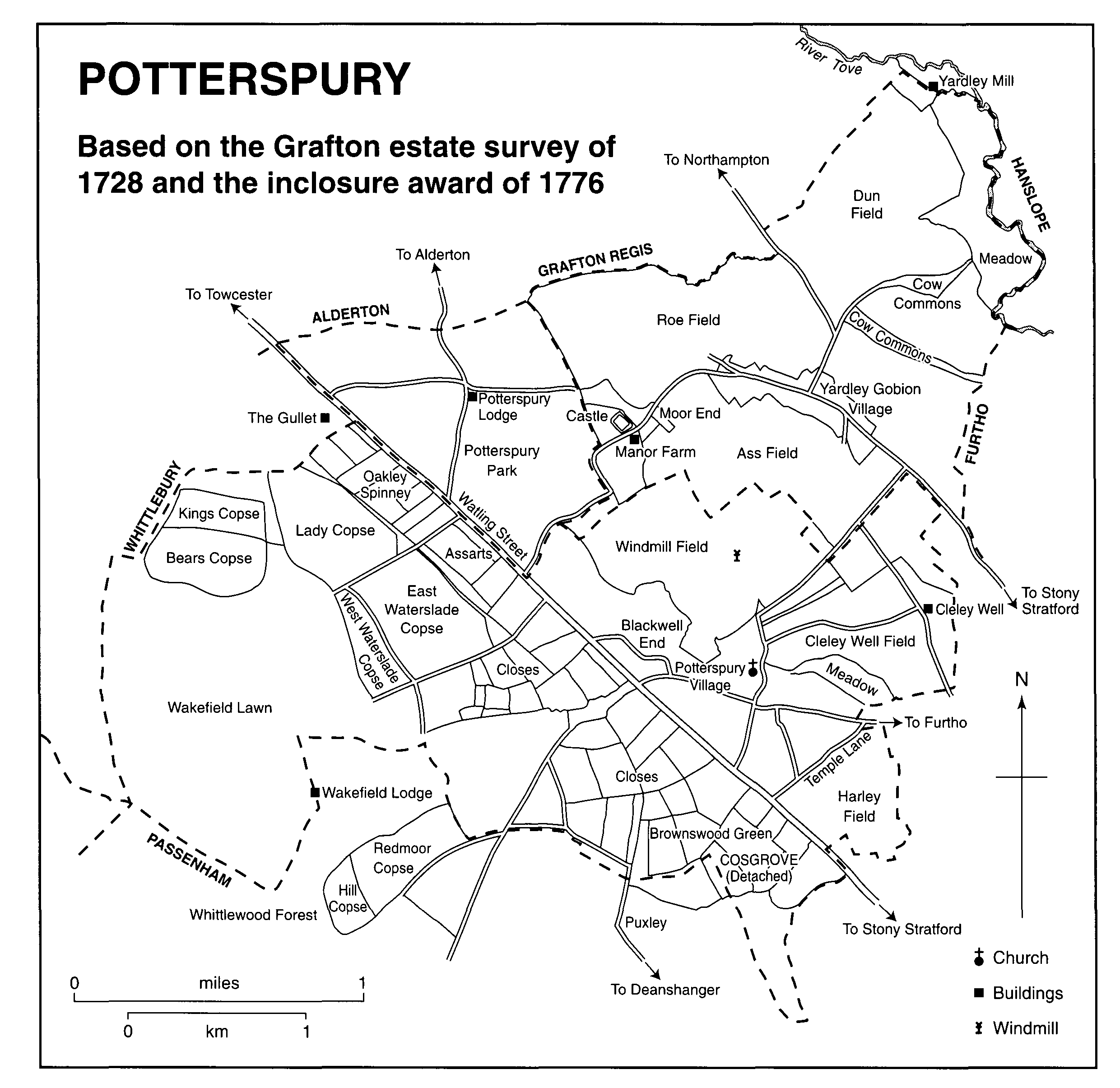
POTTERSPURY
Based on the Grafton estate survey of 1728 and the inclosure award of 1776
The site of the earliest post-Roman settlement in Potterspury is presumably indicated by the position of the parish church, which stands on the south bank of the unnamed tributary of the Ouse which rises in Whittlewood forest west of Watling Street and flows east through Potterspury Park and Moor End before turning south to pass beneath one of the two lanes linking Watling Street and the Northampton road. The church was built alongside this lane, just under half a mile east of the Roman road. Immediately upstream stood a water-mill, presumably that recorded in 1086. (fn. 30) The village of Potterspury evidently developed from a nucleus around the church and mill, and appears to have spread gradually west along a road which runs parallel with Watling Street for a about half a mile before turning to join the main road at a crossroads, where a lane ran west from Watling Street to Puxley. In the 18th century the village had two distinct 'Ends', with clusters of houses near the church to the east and near Watling Street to the west, the former known as Lower End (later Church End) and the latter as Blackwell End. (fn. 31) Only in the 19th century did the growth of population lead to the complete development of the High Street frontage. (fn. 32) Both 18th-century maps also show some cottages built on the waste on the east side of Watling Street north of Blackwell End.
In 1235 the Crown granted 15 chevrons and four squared timbers from Puxley and Shrobb to William de Ferrers, earl of Derby, for his hall at Potterspury, (fn. 33) but there appear to be no other references to a manor house on the estate, which in general lacked a resident lord, both in the Middle Ages and later. (fn. 34) In the post-medieval period the largest house in Potterspury itself may have been the capital messuage near the church belonging to the rectory, which owned some 235 a. in the parish in the 18th century. (fn. 35)
The village of Yardley Gobion grew up on either side of the Northampton road near its junction with the lane which runs to Moor End and Watling Street. On the south side of that lane, about a quarter of a mile west of the junction, a moat, which disappeared beneath housing in the 1960s, appears to indicate the position of a manor house belonging to the Gobion family, the medieval lords of Yardley, from whom the village takes its name. (fn. 36) In 1621 the former Gobion estate included the site of the manor of Yardley called Hall Yard. (fn. 37) At the junction itself the former Packhorse inn evidently occupies the site of a medieval chapel dedicated to St. Leonard. (fn. 38) In 1728 the village of Yardley extended from just west of the moated site, where a track branched from the lane to Moor End to run into the fields, eastward for about half a mile to a similar junction on the Northampton road, with a more or less fully built-up frontage of farmhouses and cottages on both sides of the street. There were also some cottages built on the waste on the west side of the Northampton road north of its junction with the lane to Moor End. (fn. 39) About a mile to the north of the village, close to the parish boundary with Grafton, stood Yardley mill, powered by a leat from the river Tove. (fn. 40)
Each of the two villages had its own open fields and common meadows, occupying about 1,400 acres in all, which were inclosed under a single Act of 1775. (fn. 41) Before this date, apart from closes immediately adjoining the two villages, there were two other areas of old inclosure in the part of the parish which lies east of Watling Street. At Moor End, about half a mile west of Yardley Gobion, there was a small group of closes on either side of the lane, which may be part or all of the 30 a. 'in Lamore' mentioned in 1198-1200. (fn. 42) In 1304 John de Tingewick had a capital messuage at Moor End, (fn. 43) which was evidently the nucleus of a manor, where Thomas Ferrers had licence in 1347 to make a fortalice and a park. (fn. 44) The castle was purchased by the Crown in 1363. (fn. 45) In 1384 a Northampton merchant was abducted at Horton by, amongst others, the abbot of Crowland and imprisoned at Moor End until he made a fine for his release. (fn. 46) In 1394 Queen Anne confirmed William Dyngley as porter at the castle; (fn. 47) he later exchanged the post for an annuity of 100s. (fn. 48) The castle was ruinous by the 16th century and a farmhouse on the opposite side of the lane came to be regarded as the capital messuage of the manor. (fn. 49) In 1728 there was another, smaller farm at Moor End and five cottages; (fn. 50) by the 1830s there were only four other houses besides the main farm. (fn. 51) Earthworks indicate the position of some of the houses that have disappeared at Moor End. (fn. 52)
The second, larger area of old inclosure in this part of the parish formed Potterspury (or Pury) Park, which in the 19th century occupied some 332 a. between Moor End in the east and Watling Street, extending from the lane running from Watling Street and Moor End in the south to the stream forming the boundary between Potterspury and Alderton and Grafton Regis in the north. (fn. 53) The park originated in a grant to Wiliam de Ferrers, earl of Derby, in 1229. (fn. 54) In the 16th century Potterspury Park was combined with Grafton Park to the north and the small Plum Park in Paulerspury to create a single tract of parkland, about 1,000 a. in all, extending from Watling Street to Grafton village, which remained in the hands of the Crown as part of the honor of Grafton until it was sold in 1644. (fn. 55)
Whittlewood and Wakefield.
The landscape history of Potterspury west of Watling Street stands somewhat apart from that of the rest of the parish, largely because it lay within the royal forest of Whittlewood, which extended across several miles of south Northamptonshire from near Syresham, through Silverstone and Whittlebury, to an eastern boundary formed by the Roman road. (fn. 56) None of the forest was extra-parochial and thus Potterspury parish extended over a mile into the woodland west of Watling Street, although only a small part of that area was cleared and cultivated.
At the north-western end of the parish, on the opposite side of Watling Street from Potterspury Park, a rectangular strip of land nearly a mile long and about 300 yards deep, extending south from the Whittlebury parish boundary to near the northern end of Potterspury village, was clearly assarted from the forest early in the Middle Ages. This area is bounded at its southern end by a track running from Watling Street into the forest and is divided into two roughly equal portions by a similar track halfway along its length. The southern half of this assart belonged to Potterspury hamlet, the northern half to Yardley. Although it lay some distance from the rest of the hamlet, the latter was not, strictly speaking, a detached portion of Yardley, since half the width of Moor End Lane, from the north-western corner of Windmill Field (which here lay within Yardley, even though the field as a whole belonged to Potterspury) to its junction with Watling Street, and also half the width of Watling Street from the same junction to the entrance to the track separating the two areas of assart, also lay in Yardley hamlet. The two roads thus provided a corridor linking the main part of the hamlet with its assart on the edge of Whittlewood, and also a means of access to the forest, since the track dividing the two halves of the assart lay entirely in Yardley. The residents of Potterspury had their own way into the wood further south, via the track which forms the southern boundary of the same assart. (fn. 57)

Potterspury Village
To the south of the track, encroachment into Whittlewood appears to have proceeded on a more piecemeal basis, creating a mixed landscape, extending up to three-quarters of a mile into the forest on either side of a stream which flows east out of Whittlewood to reach Watling Street near the crossroads at Blackwell End. To the north of the brook lay an area of old inclosure, which in the early 17th century was divided between several owners. (fn. 58) Between the stream and the lane from Potterspury to Puxley an area of open field was inclosed in 1776, (fn. 59) described in 1728 as part of Holywell Field, which was said to belong to Puxley, (fn. 60) a hamlet straddling the boundary between Potterspury and Passenham whose name implies late clearance from woodland. (fn. 61) In the 17th century the whole of this area, and also land to the south of the lane as far as the parish boundary with Passenham, was called Brownswood, (fn. 62) whereas in 1776 only the portion nearest the lane (which was no longer wooded) was described as Brownswood Green and the land further south and east was Kenson field, the two together forming the detached portion of Cosgrove included in Potterspury inclosure award. (fn. 63)
Within this last area, standing alongside Watling Street and surrounded on the other three sides by Kenson field, was a parcel of inclosed ground containing a moated site. (fn. 64)
To the west of Kenson Field, Brownswood Green and Holywell Field lay the portion of Whittlewood in Potterspury parish, forming part of one of the principal divisions of the forest, Wakefield Walk, which also extended further west into Whittlebury parish and south into Passenham. On the boundary between Potterspury and Passenham (which actually bisected the house) stood Wakefield Lodge, which appears to have become the official residence of the keeper of Whittlewood in the 16th century. The house passed into the hands of the 2nd duke of Grafton in the early 18th century, when he secured control of the honor of Grafton and the office of hereditary keeper of Whittlewood. His decision to make Wakefield Lodge his family's Northamptonshire seat, rather than the house at Grafton built on the site of Henry VIII's mansion there, which had been the original administrative centre of the honor, was crucial in determining much of the later history of the parish (and more especially the village) of Potterspury. (fn. 65)
At Wakefield itself, the 2nd duke began to build a new lodge c. 1747, a process completed c. 1770 by the 3rd duke, who also established a large home farm on the estate. In the mid 19th century, when Whittlewood was disafforested and inclosed, the 5th duke of Grafton was allotted Wakefield Lodge and grounds as compensation for his loss of office as keeper of Whittlewood, and purchased a further adjoining area from the Crown. The home farm was rebuilt, a large kitchen garden created, and by 1875 the estate had some 2,000 a. in hand at Wakefield. (fn. 66) In addition, a small tenanted holding, Assart Farm, was built in the mid 19th century near Watling Street. (fn. 67)
The Victorian parish.
Apart from the changes at Wakefield Lodge itself, the only new farmstead built by the estate in this period was Beech House (or The Beeches), set back from Yardley Road about a quarter of a mile northeast of Potterspury church. In the village the estate undertook only a limited amount of new building and most of the increase in population was absorbed by infilling and the subdivision of plots owned by the relatively large number of small owners. In 1817 the 4th duke erected a schoolroom on the south side of High Street; (fn. 68) later in the century the estate built two blocks of cottages (a row of four and another of eight) immediately to the west of the school. (fn. 69) In 1849 the estate provided the site for a new cemetery at the eastern end of the main street, and in 1865 a new vicarage was built. (fn. 70) The other large new house of this period was Potterspury House, built in 1856 on a strip of ground at the junction of Watling Street and the road leading into the village which had previously formed part of the Nash Mason estate (i.e. the remnant of the manor of Yardley Gobion). (fn. 71) The house was considerably altered in 1904, when a new wing was added. (fn. 72)
At Yardley Gobion a workhouse to serve Potterspury Union was built on the south side of the main street in the middle of the village in the 1830s. (fn. 73) In 1864 St. Leonard's church was built on the same side of the road a short distance to the west, (fn. 74) and in 1874 a small infants' school, later extended to serve all ages, was erected between the workhouse and church. (fn. 75) In 1865 the Grafton estate built a social club and reading room near the western end of the village. (fn. 76) The largest private development in this period was Yardley House, built about 1860 at the end of a short drive behind existing houses near the junction of the Northampton road and Moor End Lane, on land sold when the Nash Mason estate was broken up. (fn. 77) Two other substantial private houses, Stone Bank and Highcroft, date from 1902 and 1904. (fn. 78)
Two new Nonconformist meeting-houses were built in the parish in the 19th century, a Congregational church at Yardley Gobion, which was a branch of the 17th-century foundation at Potterspury, and a small chapel at Blackwell End, which for most of its life was occupied by the Primitive Methodists. (fn. 79)
In 1896, after serving as a farmhouse for several generations, Potterspury Lodge became a private residence and was much enlarged, with newly laid out grounds and a lodge at the entrance to the drive leading from Watling Street. (fn. 80)
The Modern landscape.
The break-up of the Wakefield Lodge estate in 1920, followed by further sales in 1939-40, did not immediately lead to extensive new building in the parish. The mansion itself remained a private residence, the home of the 3rd Lord Hillingdon, retaining its extensive grounds, and Wakefield Farm continued as a working farm. (fn. 81) Some council houses were erected in Potterspury (on High Street and at Blackwell End) but not at Yardley, where the workhouse was converted privately into 18 cottages after the rural district council had considered and abandoned such a scheme. (fn. 82) Apart from this, the erection of a village hall at Potterspury in the early 1920s, and the conversion of the Methodist chapel at Blackwell End into a pair of cottages, (fn. 83) there was only limited building in either village. In 1934 a house was built at Yardley for the curate who took services at St. Leonard's, (fn. 84) and the following year new police houses were built on Watling Street. (fn. 85)

Yardley Gobion Village
From immediately after the Second World War Towcester R.D.C. built houses and bungalows extensively in both Potterspury and Yardley over a period of about ten years, (fn. 86) and further land was later released for private house-building. At Potterspury most of the land between the High Street and Watling Street was developed, partly by the local authority and partly by private builders; other council houses were built at the beginning of the lane leading to Furtho, at Blackwell End, and on the north side of High Street. At Yardley almost all the new housing, both local authority and private, was concentrated to the south of the main road, where new school buildings were opened in 1968. Potterspury school remained on its original site, but was considerably extended in the mid 1970s. (fn. 87) In 1953 a village hall was built at Yardley by voluntary labour and the old social club became a private house. (fn. 88)
In 1987 the trunk road from Stony Stratford to Northampton was rebuilt on a new alignment to the east of Yardley village, removing most through traffic from the main street. (fn. 89) In both Yardley and Potterspury, where Watling Street in effect served as a bypass, the period between about 1960 and 1990 saw the extensive refurbishment of older property and the infilling of vacant sites as both villages grew in popularity with professional people who worked in Milton Keynes, Northampton or other towns but wished to live in the country. In February 2000 the sale of the last unmodernised cottage in Yardley attracted attention from the national press, when the village was said to have a 'Cotswoldy feel, but on the cheap'. (fn. 90)
The Wakefield Lodge estate changed hands in 1940 and after the Second World War the mansion was considerably reduced in size by partial demolition, although it remained a private residence. (fn. 91) The Potterspury Lodge estate was broken up in the 1950s, when the house became a private school. (fn. 92)
MANORS AND OTHER ESTATES.
Domeday Book appears to treat the whole of Potterspury as a single manor, although there was clearly intermixture of holdings between Potterspury, Furtho and Cosgrove from an early date. Separate manors of Yardley Gobion and Moor End (where a castle was built in the 14th century) can be identified from the mid 12th century, and a third manor in Yardley known as Cromwell's Fee arose from a partition of the main manor in 1297. A small Domesday estate at Wakefield, within Whittlewood, has no later history, but the name survived as a division of the forest, in which the keeper's lodge was transformed in the 18th century into the Northamptonshire seat of the dukes of Grafton. The 13th-century park at Potterspury was greatly enlarged in the 16th century and became a freehold estate in the 17th, its lodge at different dates serving as both a gentry house and a farmhouse. Several religious houses had small estates in Potterspury before the Dissolution, of which the most important was the rectory manor belonging to St. Anne's, Coventry. There were also a number of lay freeholds in the Middle Ages, the origins of the numerous small estates of later centuries.
Manor of Potterspury.
In 1066 'Perie' was held by Tostig, earl of Northumbria. The manor, assessed at three hides and a fifth of a hide, was granted after the Conquest to Henry de Ferrers. (fn. 93) In the early 12th century Potterspury, assessed at three hides and two virgates, was held by Robert de Ferrers from his father earl de Ferrers as part of the honor of Tutbury. (fn. 94) Robert, who made a gift to Bernar the scribe of Pury c. 1130, (fn. 95) succeeded his father in the honor in 1138 and died the following year. (fn. 96) He in turn was succeeded by his son of the same name, who died c. 1162, who was followed by a son and grandson, both named William, of whom the latter succeeded to the earldom of Derby in 1190. (fn. 97) In the 1230s Earl William appears to have settled Pury on his daughter Isabel on her marriage to Gilbert Basset, for in 1241 he granted Gilbert the manor of Mildenhall (Wilts.) in exchange for the reversion of Pury. (fn. 98)
Ferrers died in 1247, to be succeeded by his son and heir, another Earl William, who had a grant of free warren in his demesne lands in Potterspury in 1248. (fn. 99) The following year William's eldest son Robert, aged nine, was contracted to marry Isabella, the eight-year-old daughter of Hugh le Brun, count of Angoulême, half-brother of Henry III, and Potterspury was assigned as part of Isabella's dowry, which also included a grant from William of £100 a year. (fn. 100) She died before the marriage could take place and Robert instead married her sister Mary. (fn. 101) In 1249 the king granted Ferrers the annuity of £100 to hold in trust until Robert came of age, (fn. 102) and in 1253 the earl assigned the manors of Potterspury and Stanford (Berks.) to Mary in accordance with the agreement. (fn. 103) Earl William died in 1254 and his son can be found making grants of both land and villeins in Potterspury in the early 1260s. (fn. 104)
Earl Robert rebelled against Henry III in 1264 and the following year secured pardon by offering the king 1,500 marks and a golden drinking vessel, which he had been given by Michael Tony in return for a mortgage of the manor of Pury. (fn. 105) Robert rebelled again in 1266, was defeated at a skirmish at Chesterfield (Derbys.), taken prisoner to London and disinherited. Three years later he made an agreement whereby he was allowed to retain some of his estates, but not the honor of Tutbury, which was granted to Edmund, the king's son. (fn. 106) The honor was instead incorporated into the earldom and later duchy of Lancaster, which was itself annexed to the Crown in 1399. (fn. 107) Potterspury continued to be described as parcel of the honor of Tutbury into the 15th century. (fn. 108)
Michael Tony also rebelled against Henry III and lost his half-fee in Potterspury, (fn. 109) which in 1266 the Lord Edward granted to William de Gunneville. (fn. 110) In 1270 Michael granted this estate to John FitzGeoffrey, in lieu of the repayment of the redemption price owed to William. (fn. 111)
This gift reunited the manor into a whole fee. In the late 1180s the first Earl William had granted 10 virgates in Potterspury and Yardley Gobion, 120 acres of his demesne in Potterspury, and one third of his demesne meadow and wood to Ralf FitzStephen to hold as a third of a knight's fee in exchange for land at Stanford. (fn. 112) Almost immediately Ralph granted the lands to Geoffrey FitzPeter, earl of Essex, for the same service, a gift confirmed between 1203 and 1213 by Ralph's widow Maud de Cauz. (fn. 113) The exact service by which Geoffrey held Potterspury was not specified in the original grant and in 1224 William de Ferrers sought to secure suit of court and frankpledge from John FitzGeoffrey. (fn. 114) Twelve years later it was established that, although John owed a third of a knight's fee, he did not owe either suit of court or frankpledge. (fn. 115) In 1243 John held one third of a knight's fee in Potterspury, Henry Gobion's manor of Yardley counting for another third, and William's demesne for the remainder. (fn. 116) John's son, John FitzJohn, joined the rebellion against Henry III, in the aftermath of which he was said to hold half a fee in Potterspury, (fn. 117) i.e. the half not then in the hands of Michael Tony.
Unlike Michael, John retained his estate, added Michael's half-fee to his own, and at his death in 1275, when he was succeeded by his brother Richard, held the whole of the manor of East Pury for one knight's fee of Robert earl of Derby. (fn. 118) Shortly before he died he was accused of holding view of frankpledge and an assize of ale and bread without warrant. (fn. 119) Richard FitzJohn, returned as lord of East Pury in 1284, (fn. 120) died childless in 1297, (fn. 121) when his lands were divided between his sisters, Maud, Isabel de Vieuxpont, Joan la Boteiller, and Aveline de Burgh, countess of Ulster, and their heirs. (fn. 122) The actual partition was made between Maud Beauchamp, Robert de Clifford and Idonea de Leybourn, the daughter of Isabel de Vieuxpont; Joan la Boteiller; and Richard de Burgh, earl of Ulster, Aveline's son. (fn. 123) Richard challenged the original division of 1298 and a new one was made the following year, in which Potterspury remained allocated to Maud, the widow of William Beauchamp, earl of Warwick, who died in 1298. (fn. 124) She died in 1301, seised of the manor of Potterspury, 20s. of assised rents from the fee farm of Cleley hundred, and six virgates of land in Yardley Gobion. (fn. 125)
Maud's son and heir, Guy Beauchamp, earl of Warwick, died in 1315 seised of Potterspury, (fn. 126) which was among the estates assigned to his widow Alice in dower. (fn. 127) She died in 1325, seised of Potterspury for her life, (fn. 128) leaving a son and heir Thomas Beauchamp, who the same year married Catherine, daughter of Roger de Mortimer, earl of March. (fn. 129) In 1344 Thomas settled Potterspury and other estates to the use of himself and his wife, thereafter to his sons in tail male, (fn. 130) and in 1352 Thomas had a grant of free warren in Potterspury. (fn. 131) Earl Thomas, who died in 1369, had three sons, Guy, Thomas and Reynbrun, of whom only Thomas outlived him (fn. 132) and who in 1376 was still seeking redress over rents and arrears from his lands during their possession by the Crown in 1369-70. (fn. 133)
Thomas Beauchamp was one of the appellant lords during the 'Merciless Parliament' of 1387. Ten years later Richard II had his revenge and Warwick was attainted and his lands forfeit. (fn. 134) Part of the animosity directed towards Warwick was a result of his rivalry with Thomas Mowbray, earl of Nottingham. In 1396 Warwick lost a suit against Mowbray, (fn. 135) the costs of which obliged him to mortgage a number of manors, including Potterspury, to Thomas Arundel, archbishop of Canterbury, and others. (fn. 136) Following Warwick's attainder, his lands, including Potterspury, were granted to Mowbray, shortly to become duke of Norfolk. (fn. 137) In 1398 Mowbray clashed with Henry Bolingbroke, earl of Derby, which led to the exile of both and the forfeiture of their lands and offices. (fn. 138) A number of Warwick's estates in Norfolk's hands were granted to Edmund of Langley, duke of York and uncle of Richard II, in October 1398. (fn. 139) Within a year the lands had changed hands again following Thomas Beauchamp's restoration after the accession of Henry IV in 1399. The mortgagees of 1397 quitclaimed any rights in Warwick's manors in 1400. (fn. 140) Thomas Beauchamp died in 1401 seised of the manor of Potterspury, for the service of one knight's fee, by virtue of the settlement made by his father in 1344. (fn. 141)
Earl Thomas's son and heir Richard, earl of Warwick, died in April 1439, his widow Isabel in December the same year. Both were found to have been seised of the manor of Potterspury under the terms of the settlement of 1344 and another of 1423 made by Earl Richard. Their heir was their son Henry, then aged 15, (fn. 142) who died without male issue in 1446, shortly after being created duke of Warwick. (fn. 143) His heir was his only daughter Anne, aged two, (fn. 144) who died in 1449, when her estates passed to her aunt, also named Anne, the wife of Richard Neville, son of the earl of Salisbury and brother-in-law of Duke Henry. (fn. 145) Richard was confirmed as earl of Warwick in 1449-50. (fn. 146)
After Neville, who succeeded his father as earl of Salisbury in 1462 and settled Potterspury on his wife in 1466, (fn. 147) was killed at the battle of Barnet in 1471, his widow was stripped of the Warwick family estates, which were settled on her two daughters, Isabel, wife of George duke of Clarence, and Anne, wife of Richard duke of Gloucester. (fn. 148) Only in 1487, after both daughters had died, were her estates restored. (fn. 149) Later the same year Anne conveyed the whole of the Warwick inheritance, including Potterspury, to the king. (fn. 150) Thereafter the manor, annexed to the honor of Grafton at its creation in 1542, remained in Crown hands until it passed with the rest of the honor to the 2nd duke of Grafton in 1706, from whom it descended to the 11th duke. (fn. 151)
From the inquiry of November 1397 as to the estates of Earl Thomas until the sale to the Crown in 1487 the manor of Potterspury is coupled in conveyances of the Warwick lands with what is described as the 'manor of Cosgrove', and from 1439 the estate is said also to include the 'manor of Puxley'. (fn. 152) These phrases appear to refer to land in adjoining parishes which may at an earlier date have been regarded simply as part of the manor of Potterspury and not separately enumerated; like the existence of the three tithings in Cosgrove field, they must reflect the intermixture of holdings in Potterspury, Cosgrove and Furtho from an early date. (fn. 153)
Manor of Yardley Gobion.
In 1167 Hugh de Gobion held a third of a knight's fee in Potterspury of William de Ferrers, earl of Derby, by a grant from William's father, Earl Robert. (fn. 154) In 1228 John FitzGeoffrey was in dispute with Henry Gobion concerning 15 acres in Yardley. (fn. 155) Henry in turn was engaged in litigation with William de Eldington in 1231 over the felling of timber from an estate in Hertfordshire which William had taken to Yardley. (fn. 156) Henry was returned as holding a third of a fee in Yardley of William Earl Ferrers, as of the honor of Tutbury, in 1242, (fn. 157) a year in which he was prosecuted for forcibly ejecting a tenant from a carucate of land in Yardley. (fn. 158) In January 1243 Henry was given three oaks from Whittlewood (fn. 159) but seems in fact to have died the previous year, when his widow Isabel brought an action of dower against John Gobion for a third of three virgates in Yardley, against Simon Gobion for a third of 40 acres and half a virgate, and against William Lambert for a third of one virgate. (fn. 160)
When Richard FitzJohn died in 1297 his estate at Potterspury included a messuage and four virgates of land at Yardley held by Henry Gobion for a third of a knight's fee. In the subsequent partition of Richard's lands, Yardley, like Potterspury, was allocated to Maud, widow of William Beauchamp, earl of Warwick, (fn. 161) who also received six virgates in Yardley which she held in demesne at her death in 1301. (fn. 162)
Maud's son and heir Guy, earl of Warwick was found to have one-sixth of a fee at Yardley, valued at 20s. a year and held by Henry Gobion, when he died in 1315. (fn. 163) Ten years later his widow Alice was simply said to hold unspecified rents in Yardley. (fn. 164) Either the same Henry Gobion or a namesake in the next generation was granted a letter of absolution in 1344 (fn. 165) and two years later, as Henry Gobion senior, accounted for a sixth part of a fee in Yardley, held of the honor of Tutbury. (fn. 166) Henry Gobion and his son Hugh were assarting land in Whittlewood in the 1330s. (fn. 167)
In 1384 Joan, the widow of Ivo Gobion, leased a messuage called Bataylesplace and another once of Thomas Gobion, together with land and meadow, all in Yardley Gobion, to William Boveton and Alice his wife. (fn. 168)
In 1402 the 'heirs of Henry Gobion' held a quarter of a fee in Yardley, still valued at 20s., (fn. 169) as they did in 1446. (fn. 170) This phrase conceals a division of the estate. In 1431 William Edy purchased a third of the manor of Yardley Gobion 'called Gobions Manor' from John Gyffard and his wife Elizabeth, (fn. 171) and in 1438- 9 William Ive of Northampton, spicer, and John Scales of Northampton, gent., with their respective wives, Christian and Margery, conveyed a moiety of a third of the manor of Yardley Gobion and a moiety of a messuage there, previously owned by Henry Wikemill, to William Furtho of Furtho, (fn. 172) who bought other lands in Yardley from Henry in 1437. (fn. 173) Christian and Margery were two of the three heirs of Alice Wikemill, Henry's mother. (fn. 174) When William's grandson, also named William, died in 1499, his lands in Yardley were held of the king as of the earldom of Warwick. (fn. 175) Anthony Furtho likewise held lands in Yardley of the earldom of Warwick at his death in 1558. (fn. 176) The lands passed with the manor of Furtho until the death in 1621 of the last Edward Furtho, when his estate was divided between his two sisters. (fn. 177)
In 1625 Sir Robert Banastre of Passenham purchased the Yardley and Furtho portions of the Furtho family's estate from Anthony Staunton and his wife Anne, one of Edward Furtho's sisters and coheirs. (fn. 178) In 1666 much of the estate was sold to pay the debts of Sir Robert's grandson, Banastre Maynard, including what was then known (from the name of the tenant, John Tombs) as Tombs Farm in Yardley Gobion, which was bought for £1,065 by George Goodman. (fn. 179)
Goodman, who sold a number of small parcels in Yardley during the 1670s and 1680s, (fn. 180) died in 1695 after settling Tombs Farm on his wife Elizabeth and leaving the majority of his estate to his eldest son Everard. His four younger sons, John, William, Francis and Samuel, each received a legacy of £450; if only one survived their mother, he would receive £800. (fn. 181) In 1708 Samuel Goodman, the only surviving younger son, purchased land at Yardley worth £960, (fn. 182) drawing on his legacy of £800 and a mortgage of £160 on Tombs Farm provided by Edward Bearcroft. (fn. 183) The balance was not forthcoming and a second mortgage from Thomas Ryder was secured. (fn. 184) In 1711 Samuel released his right to his £800 legacy to his elder brother Everard to enable the mortgage to be redeemed. (fn. 185) Samuel died childless in 1720 and Tombs Farm passed to Everard. (fn. 186)
Everard Goodman died in 1743, leaving the farm to his son-in-law Nash Mason, (fn. 187) who died in 1788, when the estate passed to William Sotheby, his wife's son from her first marriage. By 1831 the estate had passed to Admiral Sotheby and in 1845 was put up for sale in several lots. (fn. 188) Although there was some speculation that the duke of Grafton might purchase the whole estate, he declined to do so, (fn. 189) and in 1846 Tombs Farm was sold to William Callard for £3,750. (fn. 190) Also in the sale were a number of closes, including the Pightle and Hall Close, and Townsend Farm, which was bought by the tenant, William Clare, for £4,540. (fn. 191)
Cromwell's Fee.
The partition of the lands of Richard FitzJohn following his death in 1297 left Idonea Leybourn, his niece, and Robert de Clifford, his great-nephew, with lands and rents in Yardley worth £10 15s. 10¾d. (fn. 192) In 1304 John de Tingewick held lands in Yardley and owed suit at Robert de Clifford's court there. (fn. 193) By 1316, however, what is evidently the same estate was held by John Cromwell, Idonea Leybourn's second husband. (fn. 194) John was a supporter of Queen Isabella and fled abroad with her in 1326. (fn. 195) Edward II seized his lands, including those in Potterspury and Yardley, and granted them to the custody of Roger de Bilney. (fn. 196) The issues of the Cromwell lands were granted to Idonea at the king's pleasure. (fn. 197)
Idonea died in 1334, when her manor of Yardley passed to Edward Despenser under an agreement she had made with Edward's grandfather Hugh. (fn. 198) Edward granted the manor, with remainder to his wife, to William de Castleford and, following Despenser's death in 1347, it was granted to his widow Anne. (fn. 199) In 1363 Anne and her son Thomas sold their manors of Yardley Gobion and Plumpton Pury (in Paulerspury), together with the castle of Moor End, to Edward III in exchange for the manor of Burghley (Rutland). (fn. 200) Plumpton and Moor End were granted by Edward to his mistress Alice Perrers. (fn. 201) In 1378 it was established that Cromwell's Fee was a manor of itself and not part of Moor End, although by 1389 both Yardley and Plumpton were, it seems, treated as part of Moor End. (fn. 202)
In 1523 Cromwell's Fee was granted to William Parr. (fn. 203) In 1541 the manor of Yardley Gobion (meaning this estate, rather than the Gobion family's manor) was annexed to the honor of Grafton on its establishment and descended with the other manors making up the honor until 1987, when the lordship was offered for sale by the 11th duke of Grafton. (fn. 204) In 1998 Mr. Alan Paine, a London optician who was said to have paid £10,000 for the title, was in dispute with British Waterways when he claimed the right as lord of the manor, under the Grand Junction Canal Act of 1793, to abstract water from the canal to create a 45berth marina. (fn. 205)
Moor End.
At the end of the 12th century Robert son of William de Pury was in dispute with his brother John concerning a messuage and two virgates of land in Pury, held of William de Ferrers, and 30 acres in Lamore. (fn. 206) In 1304 John de Tingewick died seised of a capital messuage and other premises at Moor End in Yardley Gobion, leaving a widow Rose and son and heir William. (fn. 207) William died in 1316, when the estate at Moor End was said to be held of John de Cromwell, lord of Cromwell's Fee in Yardley, by the service of 3s. 1d. a year and suit of court at Yardley every three weeks. (fn. 208) In 1378 it was said that the manor of Moor End had anciently been held by John de Tingewick. (fn. 209)
In 1347 Thomas de Ferrers was given licence to crenellate his house at Moor End. (fn. 210) After Thomas's death in 1353 his manor of Moor End (containing 180 a.) and Plumpton Pury (in Paulerspury), which he had settled on John de Newnham, were granted as dower to his wife, Ankaret le Strange, with remainder to Henry de Lisle and Thomas Despenser. (fn. 211) Both manors passed to Edward Despenser and his wife Anne, who sold to the Crown in 1363 in exchange for a share of the manor of Burghley (Rutland). (fn. 212) In 1376 Moor End was found to be part of the earl of Warwick's manor of Potterspury and the earl sought to recover rent arrears from 1363. (fn. 213) Also in 1376 the king granted the manor and castle to feoffees, (fn. 214) although Alice de Perrers retained immediate possession of both. (fn. 215)
Alice was attainted following the death of Edward III in 1377 and forfeited Moor End. (fn. 216) In December that year custody of the castle was granted to Richard Waldegrave. (fn. 217) In 1378 Moor End was found to be held of the earl of Warwick and the heirs of Henry Gobion; neither Plumpton Pury nor Cromwell's Fee was parcel of Moor End, although Plumpton was a parcel of Paulerspury and held of John de Paveley. (fn. 218) In 1389 it was established that Plumpton was fully part and parcel of the castle and manor of Moor End, although separate from them. As well as the castle and lands in Moor End, the manor included lands and tenements in Old Stratford, Furtho, Cosgrove, Alderton, Bozenham and Shutlanger. (fn. 219)
In 1382 Richard II granted Moor End to his wife Anne of Bohemia as part of her dower. (fn. 220) Queen Anne died in 1394 and in 1395 Moor End was granted to John Sebright and Thomas Everdon for ten years, (fn. 221) although this was superseded by a grant of all Queen Anne's lands to Thomas Arundel, archbishop of Canterbury, John Waltham, bishop of Salisbury and Edward, duke of Aumale and earl of Rutland. (fn. 222) Edward subsequently granted Moor End to Philippa de Vere, duchess of Ireland. Following Edward's desertion of Richard II, Philippa was pardoned and the grant of Moor End confirmed. (fn. 223)
Henry IV granted the reversion of Moor End to Thomas Longley, keeper of the privy seal, Thomas Erpingham, John Norbury and Thomas Clanvowe in 1404. (fn. 224) In 1405 Moor End was granted to Queen Joan as part of her dower, although Philippa de Vere was allowed to collect the issues of the manor for her life. (fn. 225) This grant was confirmed in 1408 and in 1409 John Cope was appointed porter of the castle. (fn. 226) Following the accession of Henry V, his brother Humphrey, duke of Gloucester, was granted Moor End, which he settled on feoffees in 1415. (fn. 227) Humphrey died in 1447 and Moor End reverted to his nephew, Henry VI, who in turn granted the manor to Robert Roos. (fn. 228) Robert died a year later and custody of his heir and his lands, including Moor End, was granted to his wife Anne and his executors. (fn. 229)
In 1453 the manor and castle were granted to Jasper Tudor, earl of Pembroke, the king's halfbrother, although within a few months he surrendered the grant in exchange for lands in Nottinghamshire, Derbyshire and Wales. (fn. 230) The following year Henry VI granted Moor End as dower to his wife Margaret. (fn. 231) After the accession of Edward IV in 1461, Moor End was granted to Richard Neville, earl of Warwick, (fn. 232) so that Moor End was briefly reunited with Potterspury; both were forfeited following Warwick's death at Barnet in 1471, (fn. 233) when his possessions were divided between his co-heirs and their husbands, George, duke of Clarence, and Richard, duke of Gloucester. Clarence received Moor End in 1474 (fn. 234) but the manor was forfeited following his attainder in 1478.
In 1495 Henry VII settled on his son, Henry duke of York (later Henry VIII), the reversion of all the possessions which Jasper duke of Bedford then held by grant from the king or his uncle, Henry VI, with certain exceptions, including the castle and manor of Moor End, which immediately on the death of Bedford were to pass to the king, since they were either in the possession of Henry VI before the grant to Bedford or had been so later in Henry VI's reign. (fn. 235) A year later, after the duke's death, Moor End was in the hands of the Crown (fn. 236) and remained so until 1516, when Henry VIII granted the castle and lordship to Sir Thomas Parr and Maud his wife in survivorship. (fn. 237) In 1517 Wolsey hinted to the king that, with Sir Nicholas Vaux's death imminent, Parr would probably ask for his offices in Northamptonshire, in which case the king could resume the manor of Moor End, (fn. 238) although Henry did not act on the suggestion.
The manor was still in the hands of the Parr family in 1535, when Moor End Farm, the adjoining park and some other premises, were leased to William Smith alias Kent, (fn. 239) but had been sold back to the Crown by Sir William Parr by 1537. (fn. 240) Moor End was annexed to the honor of Grafton at its creation in 1542 (fn. 241) and in 1551 Edward VI renewed Smith's lease of Moor End Farm for a further 21 years, with a slight reduction in the rent because 2 a. had been lost to the enlargement of Potterspury Park in the 1530s. (fn. 242) Either he or a namesake obtained a further renewal in 1567, together with other land in Potterspury, (fn. 243) and again in 1580. (fn. 244) The farm was leased in reversion in 1585 to Sir Robert Constable for 50 years from the expiry of the lease of 1580. (fn. 245)
Moor End was one of the manors in the honor of Grafton mortgaged to Sir Francis Crane in 1628. (fn. 246) Several years later, when Sir Miles Fleetwood was attempting to recover the estate for the Crown, he complained that he had laid out much of his own money and had to borrow £1,000, as well as bringing an action in the Exchequer against Crane. As recompense, he asked for the reversion of Moor End Farm. (fn. 247) In 1650 there were two years to come in Constable's lease; the sub-tenant was then Francis Rushworth of Northampton, (fn. 248) who had in turn sub-let to John Oakley (fn. 249) and who contracted to buy the premises at 15 years' purchase. (fn. 250) The manor as a whole was sold by the Commonwealth to what appears to be a syndicate of four tenants, Richard Packington alias Rockingham of Potterspury, William Brown and Thomas Scrivener of Yardley, and Richard Stokes of Paulerspury. (fn. 251)
After the Restoration several suitors petitioned for a lease of Moor End Farm, (fn. 252) but in March 1664 it was demised, together with the mansion and demesnes at Grafton Regis and premises in Towcester, to Charles Viscount Fitzhardinge (later earl of Falmouth) for 31 years. (fn. 253) The lease passed to his widow, (fn. 254) who in 1673, when the honor was being prepared for the grant in reversion to the earl of Arlington, agreed to surrender. (fn. 255) Grafton, Moor End and the other premises were later leased in turn to Arlington, the 1st duke of Grafton and the 2nd duke, the beneficiaries of the grant of 1673, (fn. 256) all of whom appear to have sub-let Moor End Farm to a local farmer. (fn. 257)
Throughout the period in which the honor was in the hands of Queen Catherine's trustees, the copyholds making up the rest of the manor of Moor End were dealt with alongside those on the manor of Potterspury. After the honor passed to the 2nd duke of Grafton the whole estate was converted to leasehold and Moor End simply became one of the larger farms in the parish. (fn. 258) The duke's officials held a single court for what was described as the manor of Potterspury and Moor End, at which the separate Moor End jury dealt mainly with leet business relating to Yardley Gobion. (fn. 259)
The castle at Moor End, which stood on the north side of the lane running through the hamlet, (fn. 260) was presumably built shortly after 1347, when Thomas de Ferrers was granted licence to fortify his house there and create a park. (fn. 261) After the manor passed to Edward III in 1363 John de Newnham was given custody of the castle and appointed to oversee building work there. (fn. 262) The king, who visited Moor End frequently during the 1360s, (fn. 263) spent £860 over two years, building a new royal chamber and a royal chapel, and substantially rebuilding the gatehouse. (fn. 264) Work on the castle finished in 1369 and John de Ipres was granted custody for life. (fn. 265) In 1378 the castle was said to be in need of repairs to the value of 40s. and yearly expenditure of 10 marks, (fn. 266) and in 1382 John de Daventry was commissioned to carry out repairs under the supervision of Hugh de Springfield, (fn. 267) who had been appointed gatekeeper two years before in 1380. (fn. 268)
In 1478 John Hulcote was made constable of the castle, although by 1485 the office was held by Sir William Catesby; in both cases the appointment included the keepership of the park there. (fn. 269) Henry VII later made Thomas Green constable and granted the office of bailiff of the lordships and manors of Moor End and East Pury to Thomas Philip. (fn. 270) In 1496 Stephen Fleming was installed as constable and keeper of the castle and lordship; (fn. 271) he was still living at Moor End in 1509, when he was also bailiff of the manor of Higham Ferrers. (fn. 272) In 1510 Henry VIII appointed two auditors (Thomas Combes and Thomas Roberts), a bailiff (Robert Neswick) and a steward (Sir Nicholas Vaux) for the lordship. (fn. 273) In 1537 the king granted the reversion of the auditorship to Richard Mody in succession to Thomas Combes (Thomas Roberts having died), (fn. 274) and in 1540 William Clarke, serjeant-at-arms to the king, was made keeper of the castle, and of the parks there and at Plumpton (in Paulerspury), (fn. 275) an appointment renewed four years later. (fn. 276)
By 1580 the castle was described as utterly decayed, with no timber or stone remaining. The stone had been taken to Grafton House for repairs there. (fn. 277) In 1650 (fn. 278) and 1728 (fn. 279) the site was known as Castle Yard, and in the 1830s it was noted that a recent tenant of Castle Close, in digging up the foundations of the castle, had recovered over 2,000 yards of stone. A few 'architectural fragments' had been incorporated in the outbuildings of Moor End Farm. (fn. 280) In the 1970s the only feature visible on the site of the castle was a much-altered moat, fed by the stream which flows from Potterspury Lodge through Moor End to Potterspury village. (fn. 281)
After the castle became ruinous, it was superseded as the capital messuage of the manor by Moor End Farm, on the opposite side of the lane, which in 1650 contained a hall, parlour, kitchen and buttery, with four chambers over and a range of outbuildings. The farm had 66 a. of inclosed pasture, 7 a. of meadow, and 99 a. of arable in the common fields of Yardley. The manor as a whole included nine copyhold tenements in Yardley Gobion, one each in Potterspury and Shutlanger, and ten in Paulerspury, paying a total of £19 11s. 6d. To this figure were added fines and heriots worth an average of £4 17s. 10½d., quit rents from tenants in Potterspury holding in free socage worth 18s. 1½d., and perquisites of court worth 10s. to give a total value of £24 17s. 5d. (fn. 282) When Moor End was included in the reversionary grant of the honor of Grafton to the earl of Arlington in 1673, it was rated at the same as in 1650, plus the additional rent payable under the lease of 1664, to produce a total figure of £28 19s. 1½d. (fn. 283)
Wakefield: the estate.
In 1086 Count Alan of Britanny held four-fifths of half a hide of the king in Wakefield, which Ralph Dapifer held of him. (fn. 284) Alan died without issue and the undertenancy may have ended with his death, for the early 12th-century Northamptonshire Survey merely notes that at Wakefield there were four small virgates of the king's fee, (fn. 285) and the estate has no later manorial history. It was part of the royal demesne in the mid 12th century (fn. 286) and in 1170-1 the sheriff accounted for repairs carried out to the hall there. (fn. 287) Wakefield seems then to have been abandoned as a royal residence in favour of Silverstone, (fn. 288) and in the 13th century the name refers merely to the eastern part of Whittlewood, from which oaks were cut down from time to time for various building projects or as royal gifts. (fn. 289) The same was true in the 14th and 15th centuries. (fn. 290) During that period the keeper of the forest had his official residence at Puxley. (fn. 291)
The Act of 1541 establishing the honor of Grafton annexed to it both Whittlewood and Salcey forests. (fn. 292) Thereafter the position of keeper or master forester of Whittlewood was one of a bundle of offices granted by both Henry VIII and later sovereigns to a succession of magnates, beginning in 1545 with Sir John Williams. (fn. 293) They in turn appointed deputies to discharge their duties who had the use of the lodges in the forest. The deputy (or lieutenant) keepership of Whittlewood seems to have been held by minor gentry or wealthy yeomen, such as Cuthbert Ogle, who was described as the deputy lieutenant of the forest in 1598 and was of Wakefield Lodge when he died in 1633. (fn. 294) William Lane, who had a large house at Ashton, was appointed 'steward' of Whittlewood and Salcey in 1640. (fn. 295)
After the Restoration Whittlewood, with the rest of the honor, was granted to Queen Catherine, (fn. 296) whose council in 1670 warned the earl of Northampton, who was reinstated as warden of Whittlewood and retained the office until 1681, (fn. 297) that they were dissatisfied with the conduct of his tenant, George Goodman, the lieutenant of the forest, and instructed Northampton to discharge him. (fn. 298) Goodman was living at Wakefield Lodge at the time of his death in 1673. (fn. 299) His successor was Thomas Newton, (fn. 300) although in 1679 another official, named Kingston, was resident at Wakefield, when both were the subject of complaints about abuses in the forest. Northampton was instructed to dismiss them and Kingston was told to vacate the lodge, (fn. 301) although Newton (or a namesake) was continued in office as woodward until his death in 1718, when he was succeeded by John Warner. (fn. 302)
The grant of the honor of Grafton to the earl of Arlington of 1673, with remainder to Henry FitzRoy, earl of Euston, included the coppices and underwoods (but not the timber) in Whittlewood and Salcey. (fn. 303) This was followed in 1681 by a grant in reversion to Arlington, with the same remainder, of the offices of master of the forest and parks of Whittlewood. (fn. 304) When Queen Catherine died at the end of 1705 the honor passed to the 2nd duke, who also sought the office of master forester, which, shortly after the grant of 1681 (but before Arlington's death in 1685), the queen had granted (under a power given her in 1667 to name the forest officers) to the earl of Feversham. The attorney-general's initial advice in 1706 was that both appointments were invalid and that the office was a matter of favour vested in the Crown. (fn. 305) Five years later, after Feversham's death in 1709, Grafton petitioned again, complaining that both during the queen's lifetime and since he had been unjustly kept out of the office to which he was entitled. Feversham's appointment should have been determined by Queen Catherine's death but he had refused to give up the office. On this occasion the attorney-general concluded that Queen Anne had the power to supply defects in the grant of the office to the duke's father. (fn. 306) In June 1712 the queen made an amended grant to the duke and his heirs male, under which they were to hold Wakefield Lodge and its grounds (116 a.) and the pasture called Wakefield Lawn (245 a.). Various clauses intended to preserve the resources of the forest were also inserted at the suggestion of the surveyor-general. The dukes were authorised to appoint the under-officers, including a lieutenant or deputy warden, who in the 18th century had the use of Sholebrooke Lodge. The only duty required of the dukes in return appears to have been to supply deer to the royal household and public offices. (fn. 307) From 1712 until his death in 1757 the 2nd duke made Wakefield Lodge, rather than Grafton Manor (where his mother, Duchess Isabella, and her second husband, Sir Thomas Hanmer, lived until her death in 1723), his Northamptonshire seat, (fn. 308) a policy which his descendants continued until 1920.
Wakefield Lodge, together with the Home Farm, Assart Farm, Gullet Farm (including Meanfallow brickyard, then out of use), Plum Park Farm, Briary Lodge Farm and 38 houses and cottages, the gasworks, a saw-mill, and the disused Grafton Hunt kennels, in all a total of 2,282 acres, including 12 a. of grounds, 696 a. of woodland and 27 a. of water, were put up for auction in July 1920 (fn. 309) but failed to sell, either as a whole or in lots. Lengthy negotiations ensued over the next two years, until the 3rd Lord Hillingdon (formerly Arthur Mills, a partner in Glyn, Mills & Co., the bankers, who had succeeded to the title in 1919) (fn. 310) offered to take a lease, with an option to purchase during the first ten years. The duke's advisers recommended acceptance, and at the same time indicated that they were prepared to sell the mansion and grounds outright. Hillingdon replied that he could not find the cash to buy the freehold but went ahead with a lease, (fn. 311) for which detailed terms were agreed early in 1923, by which time he had moved into the Lodge. Hillingdon was to pay £1,600 a year for a 21-year lease and undertook to spend at least £8,000 on improvements during the first twelve months. (fn. 312) In the event, in December 1924 he paid £72,500 for the freehold of the mansion, Home Farm, Assart Farm and 1,911 a. of land. (fn. 313) In the meantime, the contents of the Lodge were sold at a six-day auction in the summer of 1921. (fn. 314)
Lord and Lady Hillingdon remained at Wakefield Lodge until 1940, when they moved to Grafton Manor. (fn. 315) In June that year the mansion and 1,910 a. of land were bought for £32,000 by George Coldham Knight of Cambridge, who two months later sold the house and 1,433 a. to Gee, Walker & Slater Ltd. of Derby (acting on behalf of the Gee family) for £21,335. (fn. 316) These transactions partly preempted an auction planned for August that year, when the mansion and 1,338 a. were to be offered in 30 lots, with the park divided into small parcels and the stables, Home Farm and other buildings sold separately from the main house. The woods had already been sold in several lots before Norman Gee bought the rest of the estate. (fn. 317) Later in 1940 Gee, again through his company, bought Home Farm from F. G. Hilsdon. (fn. 318)
In 1952 Gee sold the mansion and 2,549 a. (including land in Whittlebury and Paulerspury not included in the sales of 1924 and 1940) for £115,000 to Bernard Sunley of London, who also owned an estate at Ashton. (fn. 319) He in turn sold the Wakefield Lodge estate in 1955, when it consisted of the mansion, about 350 acres of woodland and six farms, (fn. 320) to R. N. RichmondWatson, whose son Mr. J. H. Richmond-Watson remained the owner at the time of writing. (fn. 321)
Wakefield Lodge.
Wakefield Lodge is shown as a large two-storey house on an early 17th-century map of Whittlewood. (fn. 322) It is said to have been rebuilt, presumably in the 1650s, by John Claypole of Northborough (c. 1625-88), the son-in-law of Oliver Cromwell, through whom he secured the keepership of the forest during the Protectorate. (fn. 323) Repairs to both Wakefield Lodge and Shrobb Lodge were ordered in 1682. (fn. 324)
Shortly after he took office as ranger, the 2nd duke reported on the repairs needed to the lodges in Whittlewood and in 1715 the surveyor-general was authorised to fell sufficient dotard timber to carry out the work. (fn. 325) A similar order was made two years later for repairs to Wakefield Lodge, Wakefield Lawn Lodge and Shrobb Lodge. (fn. 326) In 1727 Grafton claimed that Wakefield Lodge needed repairs costing £3,500, which he was prepared to find himself, if he was allowed 150 loads of rough timber from the forest, to which the Treasury agreed. (fn. 327) In all 210 loads were delivered in 1727 and 1729; the duke was also given £420 towards the work. (fn. 328)
More fundamental changes began in 1747, when the duke erected a large stable range in brick against the south-east corner of the existing house, for which it served in part as a service pavilion, with rooms for male staff on the first floor. In April that year work began on a new residential block designed by William Kent (1685?-1748), which stood to the north of the old house, half of which remained in use after Kent's scheme was completed in the early 1750s. The workmen employed on the house were mostly local but the principal craftsmen were metropolitan. John Marsden, a carpenter, was the main contractor, and was paid regularly until August 1750. Samuel Calderwood was the plasterer and John Devall the plumber. Stephen Wright designed a fireplace in 1750, which may have been the one in the hall. Lancelot Brown was working on the garden by 1750. Several craftsmen from the Office of Works visited the house officially in 1753, presumably to inspect work done to a property that still belonged to the Crown, not the duke of Grafton, (fn. 329) who had been allowed £2,000 in 1747 towards the cost of rebuilding. (fn. 330)
As originally built, the new lodge was of two storeys over a basement, with three-storey corner pavilions, one bay wide and two deep, either side of a five-bay central range, to which a third storey was later added. The plan consisted of a central hall flanked by suites of lodgings, each probably of three rooms, served by separate staircases. The hall rises through two storeys and has a first-floor gallery with balustrade. Brick and lime were obtained locally; stone for the core of the walls was brought from Cosgrove and ashlar from Grafton. During the 1750s work continued on repairs and alterations to the old lodge, possibly under the supervision of Matthew Brettingham, who worked for the duke at Euston between 1750 and 1756 and in 1759 was paid for work at Wakefield. (fn. 331)
In 1770 the 3rd duke reported that the remaining portion of the old lodge was no longer habitable and sought £2,000 from the Treasury to complete the rebuilding scheme. This was granted and timber from the forest cut and sold to raise the money. (fn. 332) The old lodge was taken down and replaced by two new parallel ranges, each of three bays and three storeys, built of brick with hipped roofs, which stood to the south of the lodge of 1747-50, filling the gap between Kent's building and the stables. The east range presumably contained service rooms and the west range reception rooms, including a drawing room overlooking the gardens on that side of the house. An additional room was inserted between the two new wings at the back of the earlier building. (fn. 333) In 1770 the 3rd duke stated that his grandfather had laid out at least £4,000 more than the grant of £2,000 made in 1747 during the first phase of rebuilding; (fn. 334) in 1792 he claimed that between them they had spent fully £10,000 on the improvement of the lodge; (fn. 335) and in 1833 the total was said to have reached £15,000. (fn. 336)
Further changes followed the disafforestation of Whittlewood, when the mansion and grounds were allotted to the duke of Grafton in compensation for loss of office, and the Prizage Fund used to buy a large additional acreage from the Crown. (fn. 337) At Wakefield Lodge itself an entrance porch was added on the east side and a passage cut through the east suite and stair. The western pavilion was extended to the south and a third storey added to the main range between the two pavilions. (fn. 338) In 1912-13 over £2,000 was spent improving the drainage to the stables, farm buildings and cottages at Wakefield Lawn. (fn. 339)
During the Second World War the house was used as a German prisoner-of-war camp. In 1946-8, after it was derequisitioned, a number of alterations were made to the mansion to the designs of A.G.S. Butler, (fn. 340) including the demolition of the wings of 1770 and various 19thcentury additions, the removal of the original western staircase, and the insertion of a replacement in a slightly different position. (fn. 341) Apart from the retention of the third storey to the main front, these changes largely restored the exterior of the house to its original appearance. Further work was done at the house in 1994-5. (fn. 342)
Potterspury Park.
In 1229 William de Ferrers earl of Derby was granted licence to impark his wood at Pury; (fn. 343) the following year he was given permission to construct a deerleap in his new park; (fn. 344) and in 1231 the king gave him 10 deer from Salcey forest to help stock the park. (fn. 345) Three years later William was allowed to move the deerleap (fn. 346) and in 1235 received a further gift from the king of deer from Shrobb and Puxley. (fn. 347) In 1272 the justiciar of the forest south of Trent was ordered to give John FitzJohn 20 cartloads of underwood from Wychwood for inclosing his park at Pury, (fn. 348) which suggests that it was then being extended. In 1301 Maud countess of Warwick died seised of the manor of Potterspury and an inclosed park with beasts of chase, underwood and herbage. (fn. 349)
Potterspury Park passed with the manor to the Crown in 1488 and thus from 1542 became one of several adjacent parks in the honor of Grafton. (fn. 350) A few years before the creation of the honor, in 1537-8, Potterspury and Grafton parks were enlarged to form, with the much smaller Plum Park in Paulerspury parish, a single tract of parkland which extended from Watling Street in the west to the Northampton- London road in the east. (fn. 351) In 1558 Potterspury Park itself comprised 305 a., of which 195 a. were pasture, and contained 500 deer. The keeper was John Lord Williams; his deputy was allowed 20 loads of wood for fuel yearly. There was one lodge of six bays in good repair and another of three bays in great decay. (fn. 352)
The enlarged estate, on which there were two principal residences, Potterspury Lodge and Grafton Lodge, one belonging to each of the two main medieval parks combined into one by Henry VIII, was generally known as Grafton Park and remained in the hands of the Crown until 1644, when it was granted in fee to Sir George Strode and Arthur Duck. (fn. 353) Six years later the two parks were found to contain 1,003 acres, timber worth £4,982 17s. 6d. and deer worth £200. The two lodges appear to have been in poor condition: the materials were valued at £253 6s. 4d. beyond the cost of taking the buildings down. (fn. 354)
After the Restoration the Crown failed to recover the Grafton Park estate, which was eventually acquired by the owners of the Wicken Park estate a few miles to the south and passed by the same title until the late 19th century. (fn. 355) During most of this period Grafton Lodge and Potterspury Lodge (which was rebuilt in 1664) (fn. 356) were occupied by farm tenants. In 1776 Elizabeth Prowse of Wicken Park claimed 'manors' in both Potterspury and Paulerspury by virtue of her ownership of the Grafton Park estate. (fn. 357)
In 1896 the 2nd Lord Penrhyn, the owner of Wicken Park, sold 515 a. centred on Potterspury Lodge Farm to Arthur Henry Newton, a member of the firm of Windsor & Newton, the artists' materials suppliers, who made the purchase with the aid of a mortgage of £14,000. (fn. 358) In 1899 Newton made extensive alterations and additions to the 17th-century house, principally the addition of a new west wing, which transformed a farmstead into a gentleman's seat, with an adjoining home farm. The work has been attributed to Sir Edwin Lutyens, (fn. 359) although firm evidence appears to be lacking.
Newton died in 1901 leaving all his property to his sons, Henry Charles and Arthur Henry, in trust for sale, subject to his widow, Georgina Tregonning Newton, being allowed to live at the house. In 1907 Lutyens designed a lodge ('St Anthony-at-the-Gate') at the entrance to a new drive from Watling Street, when the client was named as 'Henry Newton', (fn. 360) presumably the elder son. The mortgage of 1896 was discharged in 1912 and Mrs. Newton remained at Potterspury Lodge until her death in 1918, when the trustees sold the estate for £18,750 to Herbert Frank Sturdy of Lingfield, Surrey, who took up residence there. Sturdy sold ten years later for £25,500 to George Beale of Regent's Park, London, who also made his home at Potterspury Lodge and built a new farm, known as Homestead Farm, on Watling Street, which was let with 280 acres of land from the estate. (fn. 361) He also created a Roman Catholic chapel in the house, which was attended by worshippers from neighbouring communities. (fn. 362)
George Beale died in 1953 and the following year Thomas Gerrard Beale and William Francis Beale, his personal representatives, both of Ilford (Essex), sold the estate to Baron Eugene Amable Adolphus Edward de Veauce of West Byfleet (Surrey) and his wife, the Baroness Ethel Marie de Veauce. Later in 1954 the de Veauces sold Home Farm, i.e. the farm buildings immediately adjoining Potterspury Lodge itself, with about 200 acres of land to the east of the main house, for £13,000 to Northamptonshire County Council, which the following year bought a further 10 a. adjoining. In 1955 the de Veauces disposed of the lodge (known as St. Anthony's) at the entrance to the drive to Kenneth George Slinn and his wife, and a year later sold another property on the estate, the White House, to David Early of Whittlebury. Also in 1956 Bertram Albert George Brice of Stourbridge and Henriette Francois of Edinburgh purchased Potterspury Lodge itself for £7,500. The final stage in the break-up of the estate came in 1961 with the sale of Homestead Farm (287 acres) for £24,200 by the de Veauces (then of Englefield Green, Surrey) to the Trustees of the Will of Dr. John Radcliffe (1650-1714). (fn. 363)
The ultimate object of the de Veauces' purchase and dismemberment of the Potterspury Lodge estate was the conversion of the house into a Rudfolf Steiner school, which opened in 1958; it continued to be occupied for this purpose at the time of writing. (fn. 364) The portion of the estate acquired by the county council in 1954-5 was let as two county smallholdings, known as Queen's Oak and White Rose farms, both of which were sold to the tenants in 1996. (fn. 365) In 1981 Dr. Radcliffe's Trust purchased Gullet Farm, comprising 136 acres on the west side of Watling Street near the Homestead; the trust immediately re-sold the house but added the land to their adjoining farm. Both properties were sold to the tenant in 1996. (fn. 366)
Estates of religious houses.
Probably sometime in the 1130s, Robert de Ferrers, who succeeded his father Henry as lord of Potterspury in 1138 and died the following year, (fn. 367) made a gift to Savigny abbey (Loir-et-Cher), not far from the family's French seat of La Ferriere, of 40 solidates of land in Potterspury, which King Stephen confirmed c. 1140. (fn. 368) In 1205-7 the abbey brought actions against Robert le Forester (fn. 369) and Richard de Yardley and five others (fn. 370) concerning land at Yardley.
Chalcombe priory had 10s. yearly out of half a virgate of land in Yardley Gobion and in 1206 Robert le Forester was summoned to answer why he acknowledged only 7s.; he came and admitted that 10s. was due. (fn. 371)
In 1225-6 Agnes, late wife of Hugh le Forester, and her second husband brought an action of dower against Alan the Templar concerning a third part of 24 acres in Pury. Alan, on behalf of the master of the Knights Templars in England, produced a charter of enfeoffment from Hugh and upheld his claim to the premises. (fn. 372) The Hospitallers' Dingley preceptory had an estate in Potterspury which at the time of the abortive refounding of the order in 1558 was in the tenure of Robert Addington. (fn. 373)
St. James's abbey, Northampton, had a parcel of inclosed woodland called Frith Coppice (30 a.), lying between Watling Street, Grafton Park and Potterspury common fields, which became part of the Crown estate in Potterspury after the Dissolution. In 1650 the wood was let to Mrs. Mary Butler of Alderton for 27s. a year. (fn. 374) St. John's hospital, also in Northampton, had premises worth 6s. 11d. a year in Potterspury, occupied by four tenants, in 1524. (fn. 375)
St. Anne's, the Carthusian priory in Coventry, had an estate in Potterspury in addition to the advowson, which both before and after the Dissolution was treated as a rectory manor. (fn. 376)
Smaller lay owners.
It is clear from the quantity of surviving conveyances that there were a number of small and medium-sized freehold estates in both Potterspury and Yardley Gobion from an early date, as well as an intermixture of lands belonging to different fees in Potterspury, Cosgrove and Furtho. (fn. 377) For example, after John Arden of Evenley was attainted for high treason in 1586-7, his estate in Potterspury was the subject of litigation, (fn. 378) in the course of which deeds were produced showing that it had been built up chiefly in small parcels by William Brown of Yardley Gobion in the last quarter of the 15th century. (fn. 379) It had then passed to William's son John, (fn. 380) who made some further purchases (fn. 381) before bequeathing the property to his daughter Anne, who married another local freeholder, Henry Addington (d. 1551), (fn. 382) who was John Arden's grandfather. Other deeds appear to record earlier transactions relating to parts of the estate back to the 13th century, when some of the premises later acquired by William Brown were held by a family named Wood. (fn. 383) The litigation of 1588-9 also led to the production of a shorter series of deeds concerning a smaller freehold estate in Potterspury which belonged to a family name Pyttes in the 16th century. (fn. 384) John Arden's estate passed to the Crown after his attainder and from 1587 was let with the other lands of the honor of Grafton in Potterspury. (fn. 385)
An estate with somewhat different origins was that founded by William Clarke, the son of Richard Clarke of Holsworthy (Devon), (fn. 386) who first appears at Potterspury as lessee and bailiff of the rectory manor in 1516 (fn. 387) and was later bailiff of the Crown manor. (fn. 388) He was a serjeantat-arms to Henry VIII, Edward VI, Mary and Elizabeth, and appears to have prospered by acquiring other offices in the honor of Grafton, including the keepership of Moor End castle and Plumpton Park. (fn. 389) The profits of office evidently enabled him to acquire an estate that by the time of his death in 1563 included the advowson of Potterpury and the rectory manor. (fn. 390) In 1562 his eldest son and heir Henry purchased the manor of Great Addington (including Willywatt mill in Woodford), although he made his home at Stanwick, (fn. 391) where he died in 1574, leaving estate in both the north of the county and in Potterspury, Yardley Gobion, Cosgrove, Furtho and Old Stratford. (fn. 392) William Clarke also had leasehold premises in Potterspury, (fn. 393) some of which passed in 1564 to his younger son Nicholas, who lived there, (fn. 394) although ten years later the lease had been assigned to Thomas Pyttes. (fn. 395)
Henry's eldest son and heir, another William, was of Potterpury when he died in 1604, leaving a widow but no issue, so that his brother Gabriel succeeded to the family estate. (fn. 396) Gabriel Clarke, who also lived at Potterspury, sold Great Addington in 1607-8. Although this sale was said to include Willywatt mill, (fn. 397) Clarke must either have retained or re-purchased the premises, for when he died in 1624 he not only still owned an estate at Potterspury but also the mill, which he left to his nephew Robert and charged with a payment of 40s. a year to the poor of Potterspury. (fn. 398) He was a bachelor and his heir was Christopher, the 11-year-old son of his late brother of the same name. (fn. 399)
By this period the Clarkes were clearly influential figures in Potterspury: in addition to the rectory manor and other land, they acquired a three-lives copyhold grant of Potterspury mill in 1591 (of which the elder Christopher Clarke, who died in 1622, (fn. 400) was the last surviving life) and had erected a windmill on their freehold estate, which led to litigation with the next holder of the watermill. (fn. 401) Gabriel Clarke was buried beneath an impressive monument in the chancel at Potterspury, adorned with the arms of an unrelated family of the same name, originally from Willoughby (Warwicks.), of which branches had settled at West Haddon, Guilsborough, Kingsthorpe and elsewhere. (fn. 402) His father had persuaded the heralds to accept the same coat as his own in 1564, although in 1618 Gabriel entered his pedigree without claiming (or at least being allowed) any arms. (fn. 403) The family also had a statement inserted in the parish register recording that John Clarke, a member of the Willoughby family, was knighted and granted the advowson in fee by Henry VIII for military service in France, whereas the elder William Clarke simply bought it from an intermediary to whom the Crown had sold it. (fn. 404) The story deceived Bridges but not Baker. (fn. 405)
A tradition to which Baker did give credence was that the family's fortunes declined later in the 17th century (fn. 406) and it was certainly the case that the last member to live locally, William Clarke, had to be buried at the expense of the parish in 1712. (fn. 407) The younger Christopher Clarke seems to have died without issue, leaving his estate to his brother Robert, who in 1652 borrowed £510 against a mortgage of the property. The debt had grown to £650 by 1666, when the mortgage was taken over by Francis Crane of Stoke Bruerne, and in 1667 Clarke sold outright to Benjamin Gladman of Gray's Inn for £1,550, two-thirds of which was represented by the rectory manor, which was eventually acquired (in 1772) by the 3rd duke of Grafton. (fn. 408) The rest appears to have been broken up into small lots. Part of Gabriel Clarke's estate in Potterspury was called the White House in 1624 (fn. 409) and a house of the same name was owned by a labourer, Edward Dunn, in 1711. (fn. 410)
ECONOMIC HISTORY.
Medieval farming.
In 1086 there was land for 10 ploughs at Potterspury, of which three were in demesne, on which there were three serfs, and the other seven shared between 20 villeins, seven bordars and a priest. The manor contained woodland 6 furlongs and 14 perches long and 2½ furlongs broad, and 16 acres of meadow. Including a mill, the manor as a whole, in both 1066 and 1086, was worth £6 a year. (fn. 411)
In 1297, after the death of Richard FitzJohn, there were found to be 340 a. of arable in demesne on the manor, in addition to 12 a. of meadow. (fn. 412) Three years later Maud Beauchamp had 200 a. of arable in demesne, 8a. of meadow and pasture at Taylors Moor. (fn. 413) When her son Guy died in 1315, the demesne arable was reduced to 123 a. There were then 27 free tenants, paying a total of £7 4s. 4d. for their lands. (fn. 414) 10½ virgates were held in villeinage, the tenants rendering 16s. 9d., as well as three days' work in the common fields between Michaelmas and the feast of St. Thomas. (fn. 415)
Potterspury and Yardley each their own three-field system in the Middle Ages and later. In general, the two sets of fields were confined within the boundaries of the two hamlets, although in the early 18th century (and possibly before) there was some intermixture of land, with some furlongs in the fields of Potterspury being farmed with the Yardley fields and vice versa. (fn. 416) Potterspury's fields lay entirely to the east of Watling Street, where there was also a good deal of old inclosure in the 18th century, alongside the main road but outside the village itself. (fn. 417) To the north of the village, on either side of the stream, lay what was called Windmill Field in 1776, (fn. 418) which in 1728 was Lye and Pondmead Field, when it contained about 195 a. (fn. 419) East of the village and north of the stream Cleleywell Field ocupied 122 a. in 1728, when a number of individual lands were cultivated with the fields of Yardley. (fn. 420) Between the stream and Watling Street, south-east of the village, lay Harley Field, as it was called in 1776 (fn. 421) (elsewhere Hardley (fn. 422) ), which contained 168 a. in 1728. (fn. 423) Part of this field, including a strip of land north of the brook, provided Potterspury with its only area of common meadow, which in the early 18th century was divided into 19 small parcels. (fn. 424)
Yardley had a larger area of common meadow, some 85 a. in all, forming a broad swathe of land on the right bank of the Tove extending from near Yardley mill in the north to near the Furtho parish boundary in the south, most of which (apart from Yardley Mill Holme) was known as King's Holme Meadow. (fn. 425) Much of the land between the meadow and the Northampton road was occupied by Dun Field (276 a.), apart from an area immediately north of the village and east of the main road, which belonged to Ass Field, the rest of which lay south of the village, extending as far as the hamlet boundary in the north-west (where it marched with Windmill Field in Potterspury) and encroaching into Potterspury further to the south-east, near the lane running between the two villages. In all, Ass Field contained 348 a. in 1728. (fn. 426) At the northern end of the hamlet, north of Moor End Lane, Roe Field occupied 233 a. west of the Northampton road and east of the old inclosure around Moor End castle and Potterspury Lodge.
Including four small, unnamed parcels of open field near the village, Potterspury had just over 500 a. of common arable and meadow in 1728, whereas Yardley had 840 a. (fn. 427)
In 1227 William Ferrers, earl of Derby, was granted the right to assart 3½ acres in the forest at Pury (fn. 428) (i.e. in Whittlewood) and two years later given power to inclose his wood of Pury and make a park there. (fn. 429) Also in 1229 he was granted the crops from 12 acres of assarted land at East Pury then in the king's hands. (fn. 430) In 1235 he was given timber for his hall at Potterspury. (fn. 431) The following year William seems to have taken concerted steps against both John FitzGeoffrey, to whom he had subinfeudated land at Yardley Gobion, (fn. 432) and at least seven free tenants elsewhere on the manor, in an effort to enforce customs and services due to the lord and define the tenants' rights of common, (fn. 433) which led to a series of agreements with John and the other tenants. (fn. 434) In 1241 Gilbert Basset, who married Earl William's daughter Isabel, prosecuted four men for taking crows without licence in the park at Potterspury. (fn. 435)
On the opposite side of Watling Street from the park, the woodland alongside the road appears to have been assarted piecemeal by the two townships during the Middle Ages. (fn. 436)
Farming, 1541 - 1705.
When acquired by the Crown in 1487, the manor of Potterpury contained a mixture of free tenancies, tenancies at will and copyholds in both Potterspury and Yardley Gobion. In 1541-2, the year in which the estate became part of the honor of Grafton, the manor was worth £24, including 29s. 3½d. from rents of assize in Potterspury, 101s. 4½d. from copyholders, and £6 17s. 7d. from tenants at will. The corresponding figures for tenements in Yardley were 60s. 2d., 71s. and 62s. 9d. Seven parcels of land worth a total of 40s. a year had been inclosed within the enlarged Potterspury Park a few years before and now paid nothing, nor was herbage of the park of any value, because it had been granted to William Clarke, the park-keeper, for his life rent-free. Perquisites of court had realised 17s. 4d. the previous year. (fn. 437)
As elsewhere in the honor, the tenancies at will were converted into 21-year leases from 1543 onwards, but the copyholds (the only such tenancies anywhere on the estate) were left untouched. (fn. 438) The first round of leases were renewed in the 1560s, (fn. 439) before they ran their full term, and there were further renewals in the 1570s and 1580s. (fn. 440) In 1580 90 a. of woodland in Potterspury, Alderton and Paulerspury was leased to William Gorges and Edward Langham, apparently for the first time. (fn. 441) After the attainder of John Arden of Evenley in 1587, his freehold estate in Potterspury was leased in 1591 and again in 1595. (fn. 442) In 1596 two sets of premises which had been leased for 21 years in 1574-5, and then for a further 21 years in reversion shortly before the earlier leases expired, were demised for three lives, with the entry fine remitted, in consideration of the lessee surrendering the whole of his reversionary interest. (fn. 443)
From the end of Elizabeth's reign, and to a greater extent during James I's time, tenements in Potterspury and Yardley were leased for much longer periods. When the estate was surveyed in 1650 one farm was found still tp be held under a lease granted in 1585 for 50 years in reversion from 1601; (fn. 444) another had been leased in 1603 for 60 years from 1616; (fn. 445) a third in 1598 for 50 years from 1606; (fn. 446) and a fourth for 80 years from 1612 to the same family who had been granted the three-lives lease on another property in 1596. (fn. 447) The two latter, together with the premises leased in reversion in 1598 and a cottage leased for 31 years from 1624 by the Prince of Wales's commissioners, had also been included in the lease for 31 years in reversion granted to Thomas England of Shutlanger and Richard Fitzhugh alias Caporne of Heathencote in 1638. (fn. 448) The total income from leasehold tenements in 1650 was £9 19s. 11½d. (fn. 449)
At the same date nine copyholders paid a total of £10 16s. 11d. yearly, to which fines and heriots worth 44s. one year with another could be added. The custom of the manor was for tenants to hold for three lives but without power to assign. If a life died before he could succeed, the tenement reverted to the lord, but the next of kin could redeem it on payment of four years' rent. Four of the copyholds then in being had been granted in 1637, one in 1632 and two in 1640. In 1650 the tenants complained that of late years 'cruel sharp stewards' had been exacting unreasonable fines for the addition of lives to copies; the surveyors alleged that most of the copyholders had broken their ancient customs and it was therefore difficult to state the value of the properties. (fn. 450) Quit rents from tenants holding in free socage were reckoned to be worth £4 4s. 10d. a year in 1650, to which was added 15s. 9d. due from seven cottages built on the waste (plus 3s. 6d. from another cottage belonging to the manor), 20s. for the profits of the manor court, (fn. 451) and £3 6s. 3d. payable in chief rents by free tenants of the manor, who paid a double rent as relief when a new tenant succeeded. (fn. 452) Slightly different figures were given when the manor was sold in 1651, to produce a total annual value of £20 8s. 6d. (fn. 453)
In 1660 there were seven leasehold tenements on the Crown estate in Potterspury, including one large farm of 167 a., of which 62 a. were arable; two holdings of 90 a. and 73 a., both mainly arable (74 a. and 57 a. respectively); another of 35 a., of which all but two acres were arable; two smallholdings; and a parcel of woodland. The largest farm was then in hand; the other leases had between five and 26 years to come. In each case greatly increased new rents were listed alongside the old rents, which appeared to be unchanged from the mid 16th century. There were also 15 copyhold tenements in Potterspury and eight in Yardley Gobion, with an average of about 25 a. of arable each. Copyholds belonging to the manor of Moor End were listed separately: there were 12 in Potterspury, amounting to about 50 a. of arable in all, and two in Yardley Gobion, which were rather larger, with 31 a. and 43 a. of arable. Eight copyhold tenants of the manor of Moor End in Paulerspury parish had about 200 a. of arable between them. Overall the two manors included 1,061 a. of arable, 192 a. of pasture and 98 a. of meadow, let for a total of £47 5s. 2d. at existing rents, a figure said to be capable of being increased to £442. Quit rents from freeholders in Potterspury and Moor End were worth £3 9s. 8d. a year, plus 16s. 5d. from Furtho. (fn. 454)
Immediately after the Restoration the Surveyor-General was asked to advise on petitions from tenants in Potterspury, (fn. 455) and after the honor was assigned to Queen Catherine as part of her jointure, her council continued to admit new copyhold tenants, renew leases for 21 years, and deal with disputes between tenants. The traditional rents were not increased, although entry fine were. (fn. 456) In 1672 the council agreed to treat with several tenants of very small copyholds in the country, to save them the expense of coming to London, as had been the practice in the days of the Prince of Wales's commissioners, fifty years before. (fn. 457) When the honor was granted in reversion to the earl of Arlington in 1673 the manor of Potterspury was still rated at figures totalling £21 17s. 4d., which were unchanged since the honor had been created and included an entry for tenancies at will, all of which had long been converted to leaseholds. (fn. 458) Three years later a rental of the jointure estate in Potterspury, including copyholds, leaseholds and chief rents, totalled £51 18s. (fn. 459)
The manor of Moor End, which was finally acquired by the Crown in the mid 1530s and thus formed part of the honor of Grafton fron its creation, remained entirely copyhold throughout the 17th and 18th centuries, apart from Moor End Farm, which succeeded the medieval castle as the capital messuage of the manor and was demised by lease from the 1530s onwards. (fn. 460) In 1650 quit rents due from tenants of the manor in Potterspury holding by free socage were worth 18s. 1½d. a year and perquisites of the court a further 10s. Moor End Farm at this date consisted of a house containing a hall, parlour, kitchen and buttery, with four chambers over and a range of farm buildings, 66 a. of inclosed pasture (including the site of the castle), 7 a. of meadow and 99 a. of arable in the common fields of Yardley Gobion, as well as 336 timber and other trees. In addition there were nine copyholds in Yardley, one each in Potterspury and Shutlanger, and ten in Paulerspury, paying a total of £19 11s. 6d. The customs of the manor appear to have been identical with those of Potterspury and the surveyor made the same complaint that most of the copyholders had broken their ancient customs, making it difficult to value the estate. (fn. 461)
During the period in which the honor of Grafton was in the hands of Queen Catherine's trustees, her council administered the Moor End copyholds in the same way as those on the manor of Potterspury, resolving disputes between tenants and granting new tenancies on payment of entry fines. (fn. 462) Moor End Farm was demised in reversion on the same lines as leasehold premises in other manors on the estate: when the honor passed to the 2nd duke of Grafton in 1705 it was subject to a lease of 1700 to Theodore Marks of Pattishall and Lewis Rye of Blakesley for five years from 1716, and another of 1705 to Henry Plowman of London for the same term beginning in 1721, both at the improved rent of £8 12s. 1d. established when the farm was granted to Viscount Fitzhardinge in 1664. (fn. 463)
Farming, 1706-76.
When the grant of the honor of 1673 took effect at the beginning of 1706, the Potterspury and Yardley leaseholds, like those elsewhere on the estate, all had lengthy periods to run, since new grants in reversion to maintain a term of 21 years had been made right up to Queen Catherine's death at the end of 1705, still at the traditional rents. (fn. 464) They were, however, starting to fall in when the 2nd duke of Grafton's commissioners began to reorganise the estate in the mid 1720s, and (as elsewhere) new leases were made for no more than 12 years at rack rent. (fn. 465) Lengthy negotiations took place with Henry Plowman, the lessee of Moor End and several other tenements in the parish, concerning his neglect of repairs, and in 1729 Moor End was taken in hand, although it was not immediately re-let. (fn. 466)
The commissioners also took up their tenants' complaints that the common meadows were being damaged by the water at Yardley mill being penned up too high. (fn. 467) The mill was a freehold belonging to Alice Horton, with whom the duke became embroiled in a much more serious dispute concerning the right of copyholders in Potterspury and Moor End (which by this period were regarded as a single manor) to nominate three new lives in cases where the last life named in a previous grant had died without doing so, and to require the lord to admit the new tenants on payment of a fine. In 1723 Mrs. Horton's husband John died in such circumstances and the duke's officials, possibly in an attempt to abolish copyhold on the only manor on the estate where it survived, refused to admit their son Thomas, who was then a minor. Mrs. Horton, as Thomas's next friend, sued the duke in Chancery, citing the customs stated at the court of survey of 1650, (fn. 468) and initially secured an order in her favour, as a result of which she was admitted to the tenement in October 1723. (fn. 469) In May 1726 the court ordered the issue to be tried at the next Northamptonshire assize. (fn. 470) The duke then appealed to the House of Lords, which in March 1727 ruled in his favour and dismissed the original bill. (fn. 471) The duke's commissioners immediately ordered their attorney to assemble details of all copyholds in Potterspury and Moor End. (fn. 472) Two years of negotiations followed, until Mrs. Horton agreed to take her former copyhold lands on a twelve-year lease at rack-rent (and also to lower her mill dam by several inches). (fn. 473)
This judgment, which helped to define the law relating to a tenants' rights to renew copyholds, (fn. 474) effectively marked the end of copyhold tenure in the parish, since no new tenancies were created (fn. 475) and existing grants for three lives would gradually expire. On the other hand, even in the 1750s assigns under existing grants were still being admitted, the steward was having difficulty collecting fines, and he was also reporting other signs of dissent, (fn. 476) which suggests continuing resistance by copyholders unhappy at the disappearance of ancient customs. When the parish was surveyed in 1728 about 45 per cent of the duke's estate in Potterspury, amounting to 464 a., was held on lease and the remainder was copyhold; in Yardley almost three-quarters of the total (767 a.) was copyhold. Seven of the Potterspury tenants were copyholders and five were leaseholders; in Yardley the corresponding figures were 19 and two. (fn. 477) By contrast, in 1757 five copyholders in the two townships had about 150 a., compared with some 970 a. held at will. There were only three leaseholders (one for nine years, two for twelve), with 150 a. between them. (fn. 478) All the copyholds and leaseholds seem to have gone by the time the parish was inclosed in 1776; (fn. 479) thereafter, as elsewhere on the estate, the farms and cottages were let on annual tenancies until the sale of 1920. (fn. 480)
The duke's total holding in Potterspury and Yardley in 1728 was reckoned to amount to 1,372 a., including land belonging to cottages (39 a.), cow commons in Yardley (27 a.), and roads, water and waste (83 a.). A further 659 a. belonged to several small owners, apart from the Potterspury Park estate (which was not surveyed by Collier and Baker) and the portion of Whittlewood in the parish, which belonged to the Crown. In Potterspury four tenants had between 60 a. and 95 a. each in 1728, amounting to about two-thirds of the estate, with most of the rest divided between six other holdings of between 17 a. and 35 a. By contrast, the two largest tenants in Yardley (with 179 a. and 83 a.) accounted for a third of the total, and ten others (with between 26 a. and 67 a.) for another 60 per cent. In Potterspury there were four small tenancies with 5 a. or less, whereas in Yardley there were three smallholders with between 8 a. and 12 a. and also seven tenancies of an acre or less (apart from cottages built on the waste). The largest tenant in both townships was Henry Plowman, with 274 a. (of which Moor End accounted for 179 a.), or just under a quarter of the combined acreage of the two manors. (fn. 481)
By the 1740s the Potterspury and Yardley portion of the estate was producing a gross rental of £450 a year from 15 farm tenants, of whom the four largest were paying a total of £256 (about 57 per cent). (fn. 482) The number was virtually the same in 1760, (fn. 483) but as a result of breaking up the smaller farms when tenancies came to an end there were only three holdings in Potterspury of the eve of inclosure, paying £213 a year, although the total rental was greatly increased from 1773 by the purchase of the rectorial tithes, which were let for £150 a year. (fn. 484) In Yardley at the same date, perhaps because the greater number of copyholds made consolidation a slower process, there were still nine names on the farm rental, paying a total of £354 a year. Four of nine holdings were let for £30 or less, another for £36 and two more for £40. The two largest tenants were paying £52 and £104, or about 44 per cent of the total. (fn. 485)
The inclosure award of 1776 dealt with a total of 2,454 a., of which about 10 a. lay in Cosgrove, Furtho and Deanshanger, and another 119 a. in Kenson Field, the detached portion of Cosgrove west of Watling Street. After the common fields had been divided, the duke of Grafton had 1,426 a., of which 1,088 a. were new inclosures in Potterspury (453 a.) and Yardley (635 a.); most of the old inclosure lay in Potterspury (286 a.), with only small areas in Yardley (15 a.) and at Moor End (31 a.). By contrast, of 1,028 a. belonging to the smaller owners, only 486 a. were new inclosure in Potterspury (121 a.) and Yardley (365 a.), with another 119 a. represented by Kenson Field. Home closes in the two villages accounted for another 82 a. (59 a. in Potterspury and 23 a. in Yardley) but the main area of old inclosure in the parish (which was not part of the Grafton estate) was Potterspury Park (332 a.). (fn. 486)
Farming, 1776-1920.
Both the Potterspury and Yardley portions of the Wakefield Lodge estate were substantially reorganised after inclosure. In Potterspury, from Lady Day 1776, three farms were let at £117, £154 and £198 a year. In Yardley, apart from a small tenancy worth £4 17s., there were now four main farms paying £96, £120, £150 and £176. (fn. 487) The parish as a whole was thus producing £1,016, compared with £717 before inclosure, the latter figure including the tithes. (fn. 488) By 1790 the rental had risen to £1,059 (fn. 489) and ten years later to £1,151. (fn. 490) Rents were then raised sharply during the Napoleonic War and afterwards, although in 1821 several tenants in Potterspury and Yardley (as elsewhere on the estate) were given allowances, mostly of 7½ per cent on their rent. (fn. 491) That year the nominal rental for Potterspury was £1,500, although £580 was in respect of land in hand. The largest tenant was the duke's agent John Roper (£414, plus £35 in Yardley); of the other two farmers John Scrivener (£280) quit at Lady Day 1822 after running up large arrears and the land was re-let for only £192. The third farm was let for £200. At Yardley (where there was no land in hand) the rental in 1821 was £1,160, four-fifths of which came from three farms let for £290, £360 and £270. (fn. 492) In 1822-3 the smallest of these, let to William Roper, was considerably enlarged and the rent raised to £391, making the total for the township £1,280. (fn. 493)
Some of the increase in the rentals in this period came from additions to the estate, rather than the effects of rising prices. The 3rd duke of Grafton, who succeeded in 1757 and died in 1811, made numerous opportunist purchases, particularly in Potterspury, Yardley Gobion and the adjoining parts of Passenham and Cosgrove. After his death the 4th duke used some of the Prizage Fund to purchase these estates from the trustees of the 3rd duke's will, when it was calculated that the Potterspury purchases had a total annual value of £561 (of which £510 was represented by the rectory manor bought in 1772) and those in Yardley Gobion an annual rental of £122, of which £75 was represented by one farm. Other purchases included three in Puxley, on the borders of Potterspury, Cosgrove and Passenham, together worth £47 a year, two closes in Passenham (£38), two houses and some land in Cosgrove (£104), and a house at Brownswood Green (partly in Passenham and partly in Potterspury) (£5). (fn. 494) The 4th duke secured the release of further sums in 1825 to buy several other estates, including one in Potterspury and Cosgrove (104 a.) from the devisees of the late Joseph Scrivener. (fn. 495) The estate continued to make small purchases in Potterspury later in the 19th century, among them the water-mill. (fn. 496)
When the estate was surveyed in 1823 it was found that the duke owned 810 a. in Potterspury and 785 a. in Yardley. This land, together with smaller areas in Furtho (54 a.), Cosgrove (141 a.) and Deanshanger (125 a.), which were included in the same survey, was divided into seven main holdings, of which the largest (412 a.) was the home farm at Wakefield Lodge, then in hand. The two next biggest (351 a. and 252 a.) were held by John Roper, the duke's agent, and William Roper; the other farms were occupied by Thomas Kirby (231 a.), Elizabeth Wood (186 a.), Joseph Gallard (174 a.) and John Wise (136 a.). (fn. 497) In 1830 the six tenanted farms totalled 1,354 a., of which 58 per cent was arable, although this average conceals a noticeable difference between the three whose land lay entirely or mainly in Yardley (Joseph Gallard, 176 a., 24 per cent arable; Thomas Kirby (232 a., 52 per cent arable; and William Roper, 249 a., 60 per cent arable) and the three with land chiefly in Potterspury (John Roper, 371 a., 65 per cent arable; John Wise, 138 a., 66 per cent arable; and Elizabeth Wood, 188 a., 77 per cent arable). (fn. 498)
By 1844, after the disgrace and dismissal of John Roper, (fn. 499) the farms had been reorganised. A total of 1,553 a. in the two townships was now let at an average of 28s. an acre in Potterspury and 29s. in Yardley. The five Potterspury holdings, totalling 949 a., ranged from 120 a. to 256 a.; on two of the three farms for which the information is available just under two-thirds of the land was arable, on the other only a third. At Yardley 604 a. was divided into three tenancies of 154 a. (62 per cent arable), 215 a. (56 per cent arable) and 235 a. (24 per cent arable). (fn. 500) Thirty years later the home farm at Wakefield had been resumed by the estate and the remaining 898 a. in Potterspury had been rearranged into three holdings of around 250-260 a., with a fourth (John Wise, 131 a.) largely unaffected. At Yardley neither the overall acreage nor the size of the three farms had changed materially since the 1840s. (fn. 501)
The Potterspury and Yardley farms shared in the general reduction of rents on the Grafton estate in the late 19th century. In 1891 Puxley Farm was let at 21s. 6d. an acre, (fn. 502) as was Moor End Farm (243 a., of which 124 a. were arable) in 1897. (fn. 503) In 1896 23s. 6d. an acre was achieved for the Elms at Yardley Gobion (219 a., 58 a. arable). (fn. 504) By contrast, when Prospect House (161 a., 52 a. arable), also in Yardley, was let in 1919 the rent was 28s. an acre.
Wakefield Lodge.
As well as completing his grandfather's rebuilding of the mansion, the 3rd duke of Grafton also considerably developed the land adjoining the house. For a short time, between the 1760s and 1788, he held race meetings on Wakefield Lawn. (fn. 505) For a much longer period (until new stables and kennels were built at Paulerspury in 1891-2) the Grafton Hunt hounds were also kept at Wakefield. (fn. 506) Of greater significance was the 3rd duke's decision to develop a large home farm at Wakefield, where the estate had only about 70 a. in hand in 1757. (fn. 507) By 1780 Wakefield farm extended to nearly 400 a., including land in Potterspury, Passenham and the detached portion of Cosgrove, (fn. 508) a figure at which it remained into the early 19th century. (fn. 509) The farm lay entirely to the west of Watling Street, where in 1823 almost all the land owned by the estate was in hand. (fn. 510)
Other changes stemmed from the gradual reform of forest administration by the Crown. In 1792 the Land Revenue Office assured the duke that any changes affecting Whittlewood would be fair to all parties and that there was no question, if the area was disafforested, of allotting land near Wakefield Lodge to the Crown, since that would lessen the value and beauty of the house. (fn. 511) In fact, they suggested selling the Crown's right in the timber, deer etc. to Grafton, which would lead to Whittlewood being better managed. If this was not done, the Crown should improve its management of the forest. (fn. 512) The duke proposed dividing the forest, with him taking the eastern side near Wakefield Lodge, which the commissioners were prepared to recommend, subject to safeguards for the Crown and the commoners. (fn. 513) The duke made a number of detailed suggestions for the improved management of the forest, in which he claimed that the wood had been better cared for by him and his grandfather than on any private estate. At this date he held as ranger 52 a. of meadow and about 300 a. of lawn, as well as a lake of 40 a., which the 2nd duke had made. (fn. 514)
There was no change in policy until 1824, when an Act authorised the disafforestation of Hasleborough Walk on the western side of the forest. (fn. 515) In 1827-8 the 4th duke secured permission from the Office of Woods and Forests to improve the main approach to Wakefield Lodge from Brownswood Green by inclosing two coppices in Whittlewood close to the mansion, in return for throwing open for grazing by the commoners an equivalent area elsewhere. (fn. 516)
More fundamental improvements could only come after the disafforestation and inclosure of the whole of the remaining part of Whittlewood by an Act of 1853, under which an award was made three years later. The duke made extensive claims for loss of office and, after protracted negotiations, was allotted Wakefield Lodge and land immediately adjoining in compensation. He was also able to buy a further 760 a. from the Crown, including most of the rest of Wakefield Lawn, for £58,000, using some of the capital remaining in the Prizage Fund. (fn. 517) By 1875 the estate had nearly 2,000 a. in hand at Wakefield, (fn. 518) where a large new home farm was erected, with nursery gardens nearby. (fn. 519) The estate also had its own gasworks, which stood a short distance to the south-east of the mansion. (fn. 520) In addition to these improvements, a small tenanted holding, Assart Farm, was built in the mid 19th century near Watling Street. (fn. 521)
Farming after 1920.
As the parish containing the mansion, the park and a large home farm, and thus in a sense forming the heart of the estate, Potterspury was not included in the sales of 1913 and 1919. Early in 1920, however, the farms and cottages in Potterspury and Yardley were offered to tenants in advance of the auction in December that year. At Yardley, H. T. F. Weston agreed to pay £7,250 (29 years' purchase on a rent of £248) for the Elms (226 a.), against a reserve of £7,000, but the only other sales were eight cottages, a parcel of accommodation land and the smithy, which realised £1,340, against reserves totalling £760. It was a similar story at Potterspury, where a mixed bundle of cottages, accommodation land, the smithy and a building plot realised £4,980 (reserve £3,515), but the only major sales were of Puxley Farm (123 a., much of it in Passenham parish), for which W.P. Cooper paid £3,300 (£50 over the reserve), or 25 years' purchase on a rent of £132, and Hill House, the home of William Paterson, the agent, who paid £1,800 (reserve £1,600), or 23 years' purchase on a notional rent of £78. (fn. 522)
Although Paterson regarded these sales as encouraging, (fn. 523) the results of the auction were disappointing. At Yardley 26 lots with reserves totalling £18,600 were offered: only six were sold for a total of £2,675, of which £1,750 (25 years' purchase) came from a 50 a. smallholding let for £70 a year, and another £420 from a smallholding of 11 a. let for £22 12s. 6d. (18 years' purchase). Six cottages accounted for the rest. At Potterspury, only 11 out of 38 lots were sold, realising £11,485 compared with reserves of £31,865. The only major property sold was Beeches Farm (313 a.), which made £10,000 (reserve £9,750), or 22 years' purchase on a rent of £454; otherwise all that was sold were 16 cottages, the village social club and a one-acre paddock. (fn. 524) Some private sales followed: the three other farms and the mill in Potterspury had all gone by Christmas 1920 at their reserves or slightly over, and the agent remained resolutely optimistic as he dealt with enquiries, although there appear to have been no other sales over the next couple of years. (fn. 525) Meanwhile, Paterson was preoccupied with other aspects of the break-up of the Grafton estate in Potterspury, such as the fate of Wakefield Lodge and its contents, a vacancy in the living of which the duke was patron, the future of the school and even the village social club, whose members moved to a hut in place of their old premises, from which they wished to buy the contents. (fn. 526) More so than in any other parish on the estate, the sale of 1920 marked the end of a way of life in Potterspury, not merely a chance for tenants or investors to buy farms and cottages.
Wakefield Lodge was first leased and later (in 1924) sold, with 1,911 a., to Lord Hillingdon, who took up residence at the house and, with his wife (who was an active school manager), (fn. 527) filled to a limited extent the position previously occupied by the dukes of Grafton in Potterspury (although not in other parishes which had once belonged to the estate) until they in turn left for Grafton Regis in 1940. (fn. 528)
Potterspury water-mill and windmill.
The older of the two water-mills in the parish stood to the north-west of the parish church and was powered by the unnamed stream which skirts the churchyard to the north. There was a mill at Potterspury in 1086, valued at 18s. 4d. (fn. 529) Sometime during the 13th century Muriel, late the wife of Richard de Levendon, quitclaimed to Henry Bonde of Alderton and Alice his wife for their lives all her right in the fourth part of a moiety of a water-mill in Yardley and the fourth part of a water-mill in East Pury, which had previously been held by her father, Peter de Clerne. (fn. 530) 'Clakke Mill' was an appurtenance of the manor of Potterspury in 1325 (fn. 531) and in 1488 it was farmed for 26s. 8d. a year. (fn. 532) Sixty years later the mill was a copyhold tenement held by Robert Packington alias Rockingham at the same rent, (fn. 533) which in 1548 he sub-let for his life to George (or Gregory) Goodred, who in turn assigned to Thomas Jackson. (fn. 534) Richard Bate was the miller there in 1568-9. (fn. 535) In 1585 there were two millers at Potterspury (as well as the tenant of Yardley mill), (fn. 536) one of whom perhaps had a windmill, unless they had somehow divided the water-mill between them.
In 1591 the Crown granted Potterspury mill, the millhouse and two parcels of land (as a copyhold) to three brothers, William Clarke (who died in 1604), (fn. 537) Christopher Clarke and Silvester Clarke, for their lives at a rent of 26s. 8d. a year. (fn. 538) Together with Kingsthorne mill in Greens Norton and others in Lancashire, Herefordshire and Leicestershire, the mill was rated for a grant in fee to Sir Arthur Ingram in 1614, when it was in the tenure of Christopher Clarke, the last of the three lives. (fn. 539) In 1615, however, a grant in reversion was made to George Lowe and Edward Sawyer, who within a few years assigned to Sir Thomas Hesilrige of Noseley (Leics.) (1564-1629), who also acquired the seisin of Yardley mill. (fn. 540) In 1620 Hesilrige complained that William Clarke, while he had Potterspury water-mill, had built a windmill on his own freehold within the manor, which Christopher now kept in good repair while allowing the water-mill to decay. In addition Edward and William Gibbs had built a new windmill in the adjoining manor of Cosgrove (fn. 541) and both Edward Gibbs and Christopher Clarke had been encouraging farmers to grind their corn at these windmills, to the damage of Hesilrige's two water-mills and in breach of both manorial custom in Potterspury and Moor End and the terms of the grant of 1615, in which the Crown had covenanted not to erect any new mill within such a distance as would damage Potterspury mill. Clarke claimed that tenants did not owe suit of mill in either Potterspury or Moor End; that many continued to use the two water-mills by choice; that when water was short the windmill, built long before the grant of 1591 on freehold land belonging to Potterspury rectory, was an asset to both manors; and that he had not combined with the Gibbses in enticing corn away from the two mills. (fn. 542)
Hesilige returned to the attack in 1623, after he had obtained possession of Potterspury mill following the death of Christopher Clarke, when the windmill pased to Clarke's two sons, Christopher and Robert, who, together with William Saunders, had leased the mill to Henry Hunt alias Robinson. He was causing great loss to the two water-mills by operating the windmill, which Hesilrige wished to see pulled down. Saunders and Hunt again denied that suit of mill existed in either manor, or that they had coerced their neighbours to use the windmill. (fn. 543) The following year Hesilrige brought a new action against eight local farmers, accusing them of confederating with William Clarke to build the windmill at about the time of the grant of 1591, and of enticing tenants to take their corn to Stony Stratford mill. He also claimed that the Paulerspury tenants of the manor of Moor End owed suit of mill at Yardley as well as those in Yardley itself. (fn. 544) The defendants denied confederacy, and said that they used the other mills because of lack of water and excess of work at Potterspury and Yardley mills, which in any case charged excessive tolls and produced poor flour. (fn. 545)
In 1640 Thomas Hesilrige, the first baronet's grandson, (fn. 546) who was then in possession of Bozenham mill in Hartwell (fn. 547) as well as Yardley mill, claimed that all the inhabitants of Yardley, Potterspury, Grafton, Alderton, Moor End, Ashton and Hartwell, and some in Hanslope (Bucks.), owed suit of mill at either Bozenham or Yardley; that the grants under which his family had acquired the two mills included covenants preventing the erection of others in the neighbourhood; and that the Gibbs family of Cosgrove and the miller at Stony Stratford had confederated to try to capture trade that should have come to Hesilrige's mills. (fn. 548)
The fee farm rent of 26s. 8d. due from what was called Clapp Mill in Potterspury was sold off, together with similar rents due from Yardley and Bozenham mills, to Thomas Hesilrige in 1650, (fn. 549) and in 1671 Elizabeth Hesilrige of Fillongley (Warws.), the widow of John Hesilrige of Harlestone, conveyed the three mills, together with all her property in Alderton, to trustees. (fn. 550)
In the early 18th century both Potterspury water-mill and a windmill which stood on the high ground between Potterspury and Yardley Gobion (fn. 551) were owned by Thomas Pittam, from whom John Richardson was in the process of purchasing them at the time of his death in 1713, when he left them to his son, also named John. (fn. 552) The younger Richardson appears as the owner of the water-mill in 1728; (fn. 553) the windmill lay within what was then called Lye and Pondmead common field but elsewhere is described as Windmill field. (fn. 554) John Richardson died in 1757, leaving all his property in Potterspury, including the two mills, to his tenant Thomas Onan, (fn. 555) who at the time of inclosure in 1776 was allotted a parcel of ground in Windmill field containing the mill. (fn. 556) He appears to have been succeeded by Henry Onan, presumably his son, at the end of the 18th century. (fn. 557) In 1811 it was noted that John Tarry of Yardley Gobion, a farmer who died in 1817, had recently sold the water-mill and mill holme to Hatton Cox, who died at Shutlanger in 1849, when he was described as a miller. (fn. 558)
In 1867 Potterspury water-mill and adjoining land were sold by Ellen Smith, formerly of Stony Stratford but then of Sandwell, near Birmingham, to Richard Wood of Potterspury; (fn. 559) twelve years later his son Joseph Wood sold the premises to Alfred Scrivener the younger. (fn. 560) In 1883 Scrivener's mortgagee foreclosed on a loan of £800 and the mill was sold to Enoch Iliffe, a Potterspury butcher, for £850. (fn. 561) Iliffe himself, who had borrowed £1,200 on the mill and other premises from a local farmer, (fn. 562) was out of business five years later, when he remortgaged the property for £1,500 to William Mitchell, a contractor from Penarth, near Cardiff. (fn. 563) Iliffe was subsequently declared bankrupt and his estate at Potterspury put up for auction by Mitchell in 1891, (fn. 564) when the duke of Grafton bought the mill and adjoining land for £650. (fn. 565)
In 1854 Potterspury water-mill was occupied by William Collins, (fn. 566) who was succeeded by William Wilkins Sanders in the 1860s. (fn. 567) Richard and Joseph Wood operated the mill themselves, (fn. 568) and this may also have been the younger Alfred Scrivener's intention, since he was described as a miller when he bought the property in 1879. (fn. 569) In 1885 Samuel Valentine was at the mill, when steam power is mentioned for the first time. (fn. 570) After the purchase by the Grafton estate, Job Scrivener became tenant from 1891 at £45 a year for a three-year lease; he was succeeded in 1898 by Ralph Busby of Uxbridge at £35 for an annual tenancy. (fn. 571)
The mill was included in the sale of 1920, with about 4 a. of land, and initially offered to the tenant for £600 (18 years' purchase on a rent of £29 10s.). (fn. 572) Busby did not take up the offer, nor did he bid at the auction, when neither the mill nor some adjoining accommodation land which he also rented found a buyer. (fn. 573) Ten days later, however, the duke's agent sold the mill for £575 and the land for £150 (to whom is not stated), thus achieving modest premiums on the auction reserves of £525 and £140. (fn. 574) The mill was then described as a three-storey building, fitted with two pairs of stones driven by water or steam power. (fn. 575) This implies some reorganisation (and possibly rebuilding) during Busby's time, since in 1891 the mill was said to be of four storeys, with four pairs of stones (three French and one Peak), powered by a 12 h.p. steam engine and a 16 h.p. Cornish boiler as well as a waterwheel. The garners had accommodation for 300 quarters of corn and there was sack storage for 50 quarters. The property also included a fourbedroomed house with extensive outbuildings and gardens. (fn. 576)
Busby was still the tenant in 1940, when he described himself as a farmer and coal and wood dealer, as well as a miller established over forty years. Directory entries up to 1936 continue to describe the mill as operating by steam and water, but in 1940 only oil power is mentioned. (fn. 577)
After it went out of use, Potterspury mill was used for storage until the 1990s, when the premises were combined with the mill house to make a single dwelling.
Sometime in the early 19th century ownership of the windmill passed to Thomas Scrivener, who died in 1842, leaving it to his unmarried daughter Margaret. (fn. 578) It later became part of the extensive estate accumulated by two brothers, Job and Alfred Scrivener, of whom the former died in 1875 leaving his share of the business to Alfred, (fn. 579) who became insolvent three years later. (fn. 580) Windmill Close and the mill were thus included in a liquidation sale in May 1879. (fn. 581) The property was not acquired by the duke of Grafton on this occasion and at the time of the 1920 sale remained a private freehold, which then belonged to A. Smith. (fn. 582)
By this date the mill itself had long been abandoned. In the 1840s and 1850s it appears to have been operated by Richard and Joseph Scrivener; (fn. 583) in 1866 only the water-mill is listed at Potterspury; (fn. 584) and in 1869 James Blunsom, 'beer retailer and miller', (fn. 585) may have been the tenant. When the property was sold in 1879 no statement was made as to whether the mill was still in use, (fn. 586) and it may have been abandoned around this date, although it was not described as disused by the Ordnance Survey in 1884. (fn. 587) Only one miller is listed at Potterspury in directories in 1874 and later; (fn. 588) it is possible that the tenants of the water-mill also operated the windmill, although from 1885 (fn. 589) only steam and water power are mentioned.
Yardley Mill.
Yardley mill stood on the river Tove in the northernmost corner of Potterspury parish, powered by a leat which left the river just inside Grafton Regis. In 1252 Ralph de Cheney purchased a moiety of a virgate of land and one mill in Yardley from Robert de Twyford and Rose his wife, (fn. 590) and in 1259 Robert and Rose conveyed the other moiety to Hugh de Morse. (fn. 591) An undated 13th-century charter records a grant by Muriel, late wife of Richard de Levendon, to Henry Bonde of Alderton and Alice his wife for their lives of all her right in the fourth part of a moiety of a water-mill in Yardley and a fourth part of the water-mill in East Pury, which Muriel's father Peter de Clerne had previously held. (fn. 592) In 1353 the mill at Yardley was held by Thomas de Ferrers as parcel of his manor of Moor End, paying 30s. to the earl of Warwick, lord of the manor of Potterspury; it was said to be worth nothing beyond this. (fn. 593) In 1376, however, John de Ipres, keeper of the castle at Moor End, was ordered, on the petition of the earl of Warwick, to pay rent to the earl for various premises which he had shown were within the bounds of his manor of Potterspury, including the water-mill at Yardley and two parcels of meadow adjoining, for which 30s. and a 1lb. of pepper was payable annually. (fn. 594) The same rent (with no mention of the 1lb. of pepper) was payable by Jasper duke of Bedford in 1488. (fn. 595) Similarly, in 1542 the mill was a free tenement of the manor of Potterspury, held for his life by Lord Parr for a yearly rent of 30s. and 1lb. of pepper, and was said to belong to the king's castle of Moor End. (fn. 596) Robert Basse was the miller there in 1543; (fn. 597) three years later the manor court ordered repairs to be carried out to the mill, for which timber was to be taken from various local woods. (fn. 598)
In about 1551 the mill, with half an acre of meadow, was leased to William Smith alias Kent for 21 years at 53s. 4d. a year, when it was once again described as parcel of the manor of Moor End, where Smith was lessee of the capital messuage. The lessee, who appears already to have been in possession in 1546, (fn. 599) was to keep the premises in repair, finding all materials except millstones and great timber. (fn. 600) In 1566 the mill was said to be ruinous because the Crown had failed to provide timber, and a new lease was granted, without an entry fine because of the decay, to Richard Peacock, who undertook to carry out repairs. The previous occupier was named as William Marriott, holding under a lease to Lady Parr. (fn. 601) In 1568-9 William Panton was the miller. (fn. 602) The mill was still in decay in 1582, when a new lease, this time for 30 years, was granted at the same rent to John Brafield, and the Crown once again covenanted that it would provide the necessary timber. (fn. 603) In 1591, however, the jury complained to the manor court that the mill was still in great decay and that 15 trees were needed to repair the premises. Five years later a new lease for 30 years was granted, at the same rent, to William Goodson, with no fine and yet another promise by the tenant to carry out repairs. (fn. 604) In the intervening period Brafield had transferred his interest to Anthony Allen of Yardley Gobion, miller, who had himself assigned to Roger Richardson (who was there in 1585), (fn. 605) and he in turn to Goodson. (fn. 606)
The mill was granted in fee farm to Edward Ferrers and Francis Phelips in 1610 at a reserved rent of 53s. 4d. but by 1620 was in the hands of Sir Thomas Hesilrige of Noseley, who had also acquired the reversion of Potterspury mill, and whose attempts (and those of his grandson Thomas) to enforce suit of mill from local farmers have already been mentioned. (fn. 607) The rent of 53s. 4d. was sold off in 1650. (fn. 608)
Yardley mill was included with Potterspury in the conveyance by Elizabeth Hesilrige to trustees in 1671, (fn. 609) but thereafter appears to have a separate history, since by 1723 it belonged to John Horton, who that year left the property to his younger son, also named John. (fn. 610) The elder Horton had bought the mill, possibly from Everard Goodman. (fn. 611) It was about this time that his widow was in dispute with the duke of Grafton over the rights of copyholders in the manor of Moor End and the damage caused by the mill-dam at Yardley. (fn. 612) In 1736 the younger Horton, having secured a release of the property from his mother and elder brother Thomas, (fn. 613) conveyed the property to the trustees of his marriage settlement. (fn. 614) John Horton died intestate in 1739, (fn. 615) when the mill passed to his son John Sheridon Horton, (fn. 616) who in 1786, when he was described as a shopkeeper of Paulerspury, made a fresh lease of the property. (fn. 617) J.S. Horton died in 1812, when John Sheppard, a Towcester solicitor, became the owner of the mill. (fn. 618)
John Horton's marriage settlement of 1736 described the property as formerly a cornmill, now converted into a paper-mill, (fn. 619) and the following year it was referred to as a paper-mill when the manor court jury queried whether Horton had done fealty for the premises for the previous 23 years. (fn. 620) When the change of use took place is unclear. In 1683 a Quaker named James Wanley was said to be of Yardley mill when he was married at Bugbrooke: although he was not described as a papermaker on that occasion, a papermaker named John Wanley, also a Quaker, was of Boycott mill in Stowe (Bucks.) when he had daughters baptised in 1668 and 1670, and what is presumably the same man, said to be of a paper-mill in Oxfordshire, was buried at the Quaker meeting house in Whittlebury in 1678. (fn. 621) In 1705 Thomas Haines was described as a papermaker of Yardley mill when he was buried at Grafton Regis, (fn. 622) although it is not clear whether he was then the tenant of the mill. The same is true of Robert and Thomas Russell, both of whom were described as papermakers of Yardley Gobion when Thomas acted as Robert's administrator in 1729. (fn. 623)
In fact, all three men may have been employed by John Radcliff (or Ratcliffe), who died in 1730, (fn. 624) having been described the previous year as a papermaker of Yardley mill. (fn. 625) He appears to have been succeeded by another John Radcliff, who was the occupier in 1736, (fn. 626) and in 1750 the tenancy is said to have passed to William Radcliff. (fn. 627) When William died in 1784 he was described as a papermaker of Yardley Gobion mill and left his stock of paper and utensils to his son John, (fn. 628) who moved within a few years to Bourne End (Herts.), where he continued to work as a papermaker. (fn. 629)
John Radcliff was followed at Yardley by Francis Hayes, a Northampton papermaker, who in 1786 took a lease of the mill for 42 years at £21 a year, promising to carry out, within twelve months, such repairs to the mill as the lessor considered necessary. (fn. 630) Francis was the third son of William Hayes, who was of Wansford papermill in 1752, (fn. 631) and appears to have assigned the lease almost at once to his elder brother William, since he himself operated Rush Mills in Hardingstone as a papermill in this period. (fn. 632) William Hayes was certainly living at Yardley by 1788, when the first of a number of children was baptised at Potterspury. (fn. 633) In 1793, 1797 and 1803 he advertised the disappearance of apprentices from Yardley mill. (fn. 634) William Hayes died in 1808, (fn. 635) when he is said to have been succeeded by his son, also named William, (fn. 636) who left in 1831, when his furniture and a large stock of paper of his own manufacture were advertised for sale. (fn. 637)
After William Hayes's departure, the mill seems to have passed through a succession of short-term tenants, including a man named Robinson, who died in 1833; (fn. 638) Thomas Bradbury, who died in 1836 aged 29 and is said to have been related to Hayes; (fn. 639) Bradbury's widow, who was in occupation when the mill was advertised to let in 1837; (fn. 640) and John Collins, who appears to have taken over from Mrs. Bradbury but may have stayed only until 1841, when the mill was advertised to let again. (fn. 641) In 1848 the estate had the machinery there valued, suggesting that the tenancy was changing hands. (fn. 642) In 1851 a papermaker named John Gray was living there, and another papermaker, John Tebbet, was living at Moor End, (fn. 643) which implies that the mill was still in use, although it is not listed in directories of 1847 (fn. 644) or later. Papermaking must have ended around mid-century and by 1861 the buildings were occupied by farm labourers, as they were ten years later. (fn. 645) By 1875 the site, still containing one cottage, had been acquired by the Grafton estate and was let to Potterspury guardians, (fn. 646) who were perhaps using it as a rudimentary isolation ward, given its remote position well away from Yardley village. By the time of the Wakefield sale in 1920, the buildings had been demolished and the site (described as a rickyard) was part of Grafton Fields farm. (fn. 647)
The fee farm rent of 53s. 4d. was one of a number charged on property elsewhere in Northamptonshire, including Potterspury and Bozenham mills, which were sold in 1693 by Maurice Hunt to Obadiah Sedgewick, a London merchant. In 1721 his son John Sedgewick of Hazleton (Gloucs.), together with William Birkes, another merchant who in 1695 had bought a similar bundle of fee farm rents in Worcestershire, conveyed one-third of both groups to Daniel and John Finch, sons of the earl of Nottingham, in trust for Lady Dorothy Savile, one of the three daughters and coheiresses of William, late marquess of Halifax. Both Birkes and the elder Sedgewick had originally acquired the rents on behalf of Halifax's father George, the previous marquess. (fn. 648) In 1809 the whole of the Northamptonshire portion of these rents, together with other property in several counties, was acquired by John Heaton from George Henry Cavendish. (fn. 649) Four years later the Northamptonshire rents were the subject of a recovery by Charles Heaton against Cavendish. (fn. 650)
Pottery manufacture.
Apart from milling, the other industry in the parish whose history can be traced from the Middle Ages is the manufacture of pottery, which accounted for the use from the late 13th century of the alternative name 'Potterspury' for what had previously been Pury or East Pury. (fn. 651) During the 1960s fieldwork in north Buckinghamshire demonstrated that a fine sand-tempered ware, sometimes slightly gritty, generally buff to pink in colour with a grey core, had a distribution area with Potterspury roughly at its centre, which appears to be the obvious site for its production, although other kilns have been found in both Buckinghamshire and south Northamptonshire. Gardens in Potterspury have also produced a quantity of sherds of this ware and the excavation of a post-medieval kiln yielded sherds from a medieval level. The idea that the industry did not begin in the Potterspury area before the mid 13th century (as the place-name evidence suggests) is also supported by the absence of any recognisable earlier forms in this ware among examples so far examined. (fn. 652)
A kiln in the garden of 102 High Street, Potterspury, which appears to have operated during the 14th century and perhaps into the 15th, was excavated in 1949, when the finds included a much-used silver halfpenny dating from the last decade of Edward I's reign. (fn. 653) Two other medieval kilns have since been found in Potterspury and two more in Yardley Gobion. (fn. 654) In 2000 another collection of kilns was discovered at the west end of Potterspury, behind 29 High Street. Five kilns spanning the 14th to 17th centuries were identified among vast heaps of wasters. The medieval kiln produced a range of jugs, bowls, cooking pots and green-glazed roof tiles. A larger, late 17th-century kiln and its waster heaps yielded a wider range of glazed jugs, cups, mugs and flower-pots, and also an enormous number of large bowls and platters which had been decorated with different coloured clay slips to form elaborate and ornate patterns. Also found was a pottery button bearing a decorative device which may be the 'fair maiden' symbol of the Worshipful Company of Mercers. (fn. 655)
A freeholder named Richard Potter occurs in Potterspury deeds between 1393 and 1413, and other members of the same family are mentioned down to the 1470s. (fn. 656) Their ancestors presumably made pottery (unless they were brassfounders), but the only medieval Potterspury potter securely identified from deeds is William Lacy, who was so described in 1482. (fn. 657) Either he, or perhaps his father of the same name, occurs in 1467-71, but is not ascribed an occupation. (fn. 658) A reference to 'John Smith the younger, potter' in 1513 (fn. 659) seems definitely to mean a man named Smith who made pots. Confusingly, what is probably the same person was called 'John Potter' the following year, (fn. 660) and called himself 'John Smyth alias Potter' in his will of c. 1538, (fn. 661) the name used by the manor court in 1548 when others were admitted to copyhold tenements he had occupied. (fn. 662) There are two entries for men named John Potter and a third for John Potter the elder in the lay subsidy assessment for Potterspury of 1524. (fn. 663) Similarly, 'William Smith, potter', perhaps John's son, also occurs as 'William Smith alias Potter' in the 1540s and served as the Potterspury thirdborough in 1545. (fn. 664) There was another potter named John Ingram in Potterspury in the 1540s. (fn. 665)
In 1965 two adjacent kilns were excavated in the garden of the former vicarage at Potterspury, which appear to have been in use for much of the 17th century, making a wide variety of ware. (fn. 666) They may have been operated for part of their life by Leonard Benton, who is described as a potter in deeds of 1649 and 1653 (fn. 667) and died early in 1665, leaving all his pottery and potash-making equipment to his grandson Leonard, who was also to have all his real estate after the death of his widow Diana. She was to become a partner with her grandson in the potting trade for a year after Leonard's death; if the younger Leonard refused to join the partnership the bequest of the tools was to be void. (fn. 668) An inventory of his personal estate totalling £113 4s. 10d. (fn. 669) and a terrier of his real property, valued at £240, (fn. 670) show that Benton was farming about 30 a. of open-field land and lived in a house containing a hall, parlour, buttery and kitchen. A parcel of ashes in his potash house was valued at 6s. 8d. and he had pots sold and to be sold worth £3 10s. at the time of his death, but otherwise there is nothing to distinguish Benton from other local farmers. Similarly, lists of debts due from the estate and disbursements by his executrix make no reference to pottery. (fn. 671) The younger Benton continued potting until at least 1673, (fn. 672) but when he died in 1681 his inventory, which totals £690 16s., is simply that of a wealthy farmer, with no evidence that he was operating a kiln. (fn. 673) His heir was a son named Leonard, (fn. 674) who seems to have left the district.
The Bentons' successor may have been John Stowe, who described himself as a potter in his will, proved in March 1695, in which he asked his brother William to go on with his art of making pots and to bring up his son John to the trade. John was to inherit his father's house and land when he was 21; William was to have the use of the testator's potter's utensils and his farming equipment. (fn. 675) The younger John Stowe was of age by 1702, (fn. 676) the year in which year he married, when he described himself as a potter, (fn. 677) and voted in the parliamentary election of 1705; (fn. 678) he was said to be of Potterspury on each occasion. John's uncle William died in 1706. (fn. 679)
It was about this time that John Morton provided the only contemporary description of the Potterspury industry, which he described as the oldest in the county, mentioning that the clay was found in Cosgrove field near 'Goldsbury mill' (which cannot apparently be identified) and that, although it was of good quality, the pots made from it (however carefully) were more brittle and less durable than those of, for example, Ticknall (Derbys.). Morton believed that the trade could never flourish in competition with those of Derbyshire and Staffordshire because of the higher cost of living in Northamptonshire, which enabled Midlands pottery to be imported by travelling dealers bringing their wares on packhorses to sell for less than the local product. (fn. 680)
A potter named John Hoare was buried at Potterspury in 1680. (fn. 681) He was no doubt related to Robert Hoare of Yardley Gobion, who died in 1744, leaving a daughter Abigail, the wife of Thomas Woodward of Yardley, (fn. 682) who died in 1756, when he described himself as a potter and left his house and (apart from 1s. to each of his children) all his personalty to his widow. Mrs. Woodward died in 1764, leaving a guinea to each of four surviving sons, a daughter-in-law who had been married to a deceased son, and two daughters, but the residue, including her house, was bequeathed to her son Robert Woodward. (fn. 683) He was presumably identical with the 'Robin Woodward, Yardley Gobion' whose name appears on an earthenware jug dated 1761. (fn. 684) Robert Woodward was still living in Yardley in 1776 (fn. 685) and it seems likely that his family and the Hoares before them operated a kiln there for at least a hundred years. An Edward Woodward helped to appraise Leonard Benton's inventory in 1665, (fn. 686) but this may be a coincidence. Similarly, one of four cottages in Yardley Gobion acquired by Thomas Horton in 1749 from the successors of a family named Brown, who were the owners from at least 1672, was known as 'ye Potters' and was then occupied by Thomas Hoare. (fn. 687)
What appears to have been the site of a postmedieval pottery kiln was found at Yardley Gobion, to the west of the village, during housing development in 1968, when layers of 18th-century wasters were reported. (fn. 688) This could presumably have been the kiln operated by the Hoare and Woodward families.
When the last pottery kiln in the parish ceased work has not been established, although Baker noted in the 1830s that the trade had been discontinued for many years. (fn. 689)
Tanning.
At least three generations of the Hillier family operated a tannery in Potterspury. A John Hillier is mentioned in the 1540s and 1550s, when John Woodfield was also described as a tanner of Potterspury. (fn. 690) John Hillier died in 1567, leaving personal estate valued at £123 16s. 4d., including farms in both Potterspury and Hanslope. (fn. 691) His son Thomas occurs in 1577; (fn. 692) and Thomas's son John, who was dead by 1649, was a tanner. The younger John's own son, another John, was a tailor. (fn. 693)
Bellfounding.
In 1688 Alexander Rigby, a bellfounder of Earls Barton, bought a cottage in Potterspury from Thomas Herne of Potterspury. (fn. 694) Shortly afterwards Rigby rebuilt the premises as a 'workhouse', presumably to use as a foundry, borrowing £35 from Thomas Herne, a joiner of St. Martin's in the Fields, in 1689 and £20 from Henry Revis, a Newport Pagnell lace merchant, two years later. The property was bounded by the churchyard on the the east and the water-mill on the north. (fn. 695) Dated examples of Rigby's work in Northamptonshire churches extend from those at Great Billing (1684) to Bainton (1702); he also supplied a treble bell to Badgeworth (Gloucs.). Rigby was buried at St. Martin's, Stamford, in 1708, although there appears to be no evidence to connect him with the bell-foundry in that town run by the Norris family throughout the 17th century. (fn. 696)
After Rigby's death the premises at Potterspury passed to Thomas Herne under the terms of the loan of 1689, and in 1712 he and his heir William Herne, both described as coach-joiners of St. Martin's in the Fields, sold them to Christopher Rookes of Potterspury, who three years earlier had purchased the unexpired term of the mortgage of 1691. (fn. 697) By 1725 the buildings had been converted into a malthouse occupied by William Marriott, who died in 1731. (fn. 698) From at least 1738 until 1861 (if not later) the property was owned by a dynasty of maltsters named Wise. (fn. 699)
Other trades and crafts.
In the early 19th century Potterspury, a relatively populous village close to a major highway and a large forest, supported a wide range of craftsmen, as well as two or three timber merchants, a horsedealer and a lace-dealer. (fn. 700) John Robinson was described as a hemp-dresser of Potterspury in 1777 (fn. 701) and in the 1840s William Robinson & Son had a rope-and sack-making business in the village, which was continued by other members of the family (latterly Thomas Robinson) until shortly after 1900. (fn. 702) The timber dealers are not listed in directories after 1866, (fn. 703) possibly reflecting a change in the management of Whittlewood after disafforestation. Similarly, the lace-dealer is not heard of after about 1850, (fn. 704) although in the 1950s Mrs. Chettle, the wife of the farmer at the Beeches, was still remembered as a lacebuyer. She also ran a lace-school to encourage the craft in the village in the late 19th century. (fn. 705) Lace-making continued on a small scale into the 20th century: one celebrated practitioner, Mrs. Wootton, who made lace for the Royal Family, died in 1949 age 92. (fn. 706)
An alehouse in Potterspury named the Talbot was purchased by John Lee in 1735 and was still licensed in 1766. (fn. 707) There were at least two alehouses in the village in the 1770s, the Black Horse and the Blue Ball. (fn. 708) In the 1840s there were three, the Anchor, Red Lion and Reindeer, as well as two or three beerhouses, (fn. 709) one of which had become the Old Talbot by 1854. (fn. 710) The Red Lion closed about 1890 (fn. 711) but the village retained four licensed houses up to the First World War, by which time the Anchor, acquired by Phipps of Northampton in 1888, was advertising good stabling and catering for parties. (fn. 712) The Blue Ball, which Phipps bought in 1886, closed in 1917 as a consequence of the war-time reduction in licences (fn. 713) and became a private house. (fn. 714) The Anchor, the Reindeer and Old Talbot were joined by a new Phipps house, the Cock, in about 1920; all four were still licensed in 1940. (fn. 715) The growth of motor traffic on Watling Street in the 1930s is reflected in the establishment of 'Refreshment Rooms', operated by Mrs. Mary Emmett, and the Nelson Café (Mrs. Mary Bailey). (fn. 716)
From the 1840s (and presumably before) until the First World War at least one carrier went from Potterspury to Northampton on Wednesdays and Saturdays (and sometimes Mondays as well); there was also a service to Stony Stratford on Fridays, and from the 1870s to Towcester on Tuesdays. (fn. 717) By 1920 only the last of these, together with a carrier to Northampton on Saturdays, survived, and neither is listed in later directories; instead, by 1924 there were motor omnibuses daily between Northampton and Stony Stratford, (fn. 718) which originated in 1919 as a service on Wednesdays and Saturdays only operated by Grose's Ltd., the Northampton garage. (fn. 719) At about the same time Thomas Cooper opened a garage business in Potterspury; he was succeeded within a few years by Cyril Brian Thomas Lawson, who was still in business in 1940. (fn. 720) As early as 1921 H. B. Jefcoate was running a motor charabanc business in the village (fn. 721) and in the late 1930s Sydney Edward Smith set up as a motor-bus proprietor. (fn. 722)
In 1801 the Grafton estate built a public wharf on the canal where it passed closest to Yardley village, (fn. 723) and from then until his dismissal in 1831 John Roper, the dukes' steward, leased a warehouse, coalyard and brick-kiln, supplying bricks, lime, coal and other goods to the estate. (fn. 724) Here also Edward Charlton kept the Wharf public house from around the same date, which in the 1820s, after the tenancy had passed to Edward William Charlton, was known as the Peace & Plenty. (fn. 725) E. W. Charlton took over the wharf itself in 1832, (fn. 726) to be succeded six years later by Messrs. Druce & Warr. (fn. 727) In the early 1840s Robert Warr described himself as a dealer in coal, slate, bricks, tile etc. at Yardley Wharf, (fn. 728) by which period the brick-kiln was in the hands of Thomas Foxley (fn. 729) and the pub was called the Grand Junction Inn. (fn. 730) The tenant of both the wharf and pub in 1844 was the Derbyshire landowner and colliery proprietor, Edward Miller Mundy of Shipley Hall, who was perhaps trying to develop trade on the canal in competition with the recently opened London & Birmingham Railway. (fn. 731) Wakefield Lodge had been burning Shipley coal since at least the early 1830s (fn. 732) and possibly since the canal route to Derbyshire had been completed. In the late 1790s John Roper was supplying Wednesbury (Staffs.) coal to the estate. (fn. 733)
The brick-kiln at the wharf was mentioned in an estate survey of 1875, (fn. 734) although not in directories in this period, suggesting that it was being run directly by the estate. A boatbuilder named William Barnsdale made a brief appearance at Yardley Wharf in 1861. (fn. 735) By 1866 the pub had become the Navigation Inn (fn. 736) and last appears in a directory in 1906; most of the licensees were also wharfingers or coal merchants. (fn. 737) After the pub closed the premises, which had always been let with some land, became a small farm. It failed to sell in 1920 (fn. 738) and continued to be let (fn. 739) until it was included in the sale of remaining portions of the Grafton estate in 1939, when it was bought by the 1st Lord Hesketh. (fn. 740)
In the village itself, a 'machinist and implement maker' named William Walter is mentioned in 1861. (fn. 741) As in most villages in the area, lace-making was a common employment for women in the 19th century and continued on a small scale until the 1950s. (fn. 742)
There were two public houses in Yardley in modern times, the Coffee Pot and the Packhorse, of which the latter was already licensed in 1749 (and in the occupation of George Stevens) when it was acquired (as one of four cottages in Yardley) by Thomas Horton of Yardley. It appears to have been a private house when conveyed at various dates between 1672 and 1741. (fn. 743) Either the same or another Thomas Horton sold in 1784 to Samuel Kennell, a hog-dealer of Yardley, (fn. 744) who the following year leased the house for 14 years to Thomas Meacher, a common brewer of Newport Pagnell (Bucks.), when it was in the occupation of Charles Fancutt. (fn. 745) The house that later became the Coffee Pot was also owned by Thomas Horton, who sold to George Harris, mason, in 1795; by 1814 either he or a namesake had opened it as a pub, (fn. 746) which was acquired by Phipps, the Northampton brewer, in 1887. (fn. 747) Both houses remained open until after the Second World War; (fn. 748) the Packhorse, which stands on the site of (and may incorporate fabric from) a medieval chapel, (fn. 749) was later converted into a private house but the Coffee Pot remained licensed at the time of writing.
From 1920 until the mid 1930s the Yardley blacksmith, Henry John Smith, in partnership with his son, ran a cycle agency in the village. (fn. 750) Also in the 1930s Thomas de Blois Leach appears to have carried on a business as a disinfectant manufacturer from his home at Yardley. (fn. 751)
Daniel Whirlett of Yardley Gobion was described as a carrier in 1666 (fn. 752) but, oddly considering the village's position on the main road from London to Northampton, directories do not mention a carrying service until 1874, when James Bloore was travelling to Northampton on Wednesdays and Saturdays. (fn. 753) Later directories also list carriers to Stony Stratford on Fridays and Towcester on Tuesdays. (fn. 754) All appear to have ended soon after the First World War. (fn. 755) By the early 1930s (if not before) the village was served by motor buses running between Northampton and Stony Stratford. (fn. 756)
From the late 19th century until the 1960s a considerable number of men from both Potterspury and Yardley Gobion were employed at the railway works at Wolverton, some of them (before bicycles and later buses became common) walking down the canal towpath and over the aqueduct at Cosgrove. (fn. 757) During the Second World War and afterwards another major employer, especially for men from Yardley, was the Pianoforte Supplies factory at Roade. (fn. 758) In the early 1950s some women from Potterspury were travelling to Manfield's shoe factory at Towcester on a bus provided by the company; a few men and women were also working at Plessey, near Towcester. (fn. 759) The decline of shoemaking and the railway works in the last quarter of the 20th century (and also of farm work) was to some extent balanced by the growth of new manufacturing, office and retail jobs at Milton Keynes. In addition, as a local journalist noted as early as 1970, the economic and social structure of both villages changed as professional families moved into newly built houses and also acquired and modernised older property, most of whom worked outside the area, chiefly at Milton Keynes. (fn. 760) On the other hand, because Potterspury and Yardley are among the largest villages in the district and saw considerable building of houses by the local authority after the Second World War, (fn. 761) as well as relatively modest private housing schemes a little later, both retained a wider social mix than smaller communities, such as Alderton and Grafton Regis.
LOCAL GOVERNMENT
Manor and parish before 1834.
In the 16th century, both before and after the creation of the honor of Grafton, a court was held at Potterspury at which separate constables and other officials were appointed for Potterspury and Yardley. Routine leet business was transacted, together with the admission of new copyhold tenants. (fn. 762) A second court was held for the manor of Moor End, which dealt with copyhold business relating to lands in Paulerspury, Cosgrove, Furtho and Shutlanger, as well as Yardley. (fn. 763)
By the 1630s a single court for Potterspury and Moor End was being held by the Crown, (fn. 764) and this practice was continued by the duke of Grafton's officials in the 1720s. Two juries were empanelled, one for Potterspury and the other for Moor End, of which the latter was mainly concerned with business from Yardley Gobion. Both made orders for the management of the common land (and occasionally fined transgressors), noted the transfer of freehold tenements, and nominated a constable, two thirdboroughs, and a hayward for each township. (fn. 765) After the duke's success in his action against Alice Horton, which freed him from the obligation to add new lives to copyholds at the request of the tenant, (fn. 766) no new tenancies of this sort were created, and the manor court proceedings do not include any surrenders or admittances. All the Potterspury freeholds lay within that township, whereas the Moor End jury still occasionally recorded the admission of tenants to premises in Shutlanger (fn. 767) and (more frequently) Paulerspury. (fn. 768)
By 1764 the court had been divided into two again, with one for Potterspury and the other for Moor End, Yardley Gobion and Plumpton End (in Paulerspury). (fn. 769) In some years two of the Moor End jurors were specifically said to be from Plumpton. (fn. 770) Initially, each court sat once a year, in April or May, but after 1773 sittings were held only in alternate years. Until 1775 both juries continued to make field orders and appoint a hayward and two field tellers each year. (fn. 771) After Potterspury and Yardley were inclosed the following year only a constable and headborough were nominated, with separate appointments for the two hamlets, (fn. 772) until 1811, when a hayward was appointed for Potterspury for the first time for many years and a list of fines for the release of animals impounded drawn up. (fn. 773) In general, after 1776 the only leet business to come before either court concerned incroachments on the waste. (fn. 774) Both continued to record the transfer of free tenements, including, at the Moor End sittings, premises in Paulerspury. In 1795 two closes in Furtho and a house in Cosgrove were said to lie within the manor of Potterspury. (fn. 775)
Both courts were still sitting in the 1830s, when that for Potterspury was said also to serve Furtho, (fn. 776) and that for Moor End the manors of Yardley Gobion, Paulerspury and Plumpton End. (fn. 777) A leet was held at Potterspury in 1861, (fn. 778) perhaps for the last time, since a few years earlier a meeting of Potterspury parishioners had resolved to appoint a constable for the township, although a proposal to pay him 12s. a week was defeated. (fn. 779) Annual (or occasionally more frequent) meetings between the 1850s and early 1890s also appointed (or nominated) a waywarden, two overseers, two guardians, and two 'assessors' for Potterspury. (fn. 780) Until 1866 the meeting also approved lists of those who had compounded for the payment of poor and highway rates. (fn. 781) This assembly, which represented the hamlet of Potterspury rather than the parish, was only described as a vestry meeting from 1887 (when it actually began to meet at the vestry, rather than a public house), (fn. 782) and only in 1892 was the vicar definitely said to have taken the chair. (fn. 783) If similar meetings were held for Yardley Gobion no record of them has survived.
The payment by the Cosgrove overseers in 1789 of 'Mr. James Bill, Potterspury Workhouse' (fn. 784) indicates that the vestry there had established a workhouse, to which paupers from neighbouring parishes were admitted. The workhouse at Potterspury was repaired by the Grafton estate in 1806 (fn. 785) and in 1830 the Potterspury overseers were renting a half-acre plot in the village containing the workhouse from the estate. (fn. 786)
During the winter of 1830-1 the duke of Grafton paid for a night watchman to patrol Potterspury to protect the estate's property there. (fn. 787) In what may be a sequel to this episode, for several years from 1836 the estate subscribed £4 a year towards a body described as Potterspury Night Police. (fn. 788)
Parish Administration After 1834.
Under the 1834 Poor Law Amendment Act, Potterspury and Yardley Gobion became part of a poor law union which took its name from the former parish and built its workhouse at the latter. (fn. 789) Both were part of Potterspury rural district between 1894 and 1935, of the enlarged Towcester R.D. between 1935 and 1974, and of South Northamptonshire district after 1974. (fn. 790)
In 1848 the Yardley overseers asked the poor law union to raise £20 to establish a parish emigration fund; (fn. 791) three years later the Poor Law Board refused to allow another £20 to be levied on the ground that the money had already been spent to send several families to America. (fn. 792) In 1860 the duke of Grafton agreed to meet half the cost of sending a Potterspury woman and her four children to Western Australia to join her husband there, if the union would find the balance. (fn. 793)
As separate poor law parishes with populations well over the statutory minimum, Potterspury and Yardley both held meetings in December 1894 to elect parish councils. Whereas at Potterspury eleven names were proposed for as many places, (fn. 794) at Yardley there were 17 nominations for nine places and a poll had to be held. (fn. 795) At the first meeting of the council there were recorded votes for the election of the chairman and treasurer, and on a motion to admit the press, (fn. 796) and the following year saw contests for the election of overseers as well as the chairmanship of the council. (fn. 797) Within a couple of years, however, there were fewer nominations than places. (fn. 798) At Potterspury members invited the duke of Grafton to become honorary chairman. (fn. 799) He retained the office until 1915, when (at the age of 94) he was succeeded by his agent, who had in practice been chairing meetings for the previous few years. (fn. 800)
In both parishes the most important issue confronting the district and parish councils before the First World War was the need to improve the drainage and water supply of the two villages, which was severely criticised in 1897. (fn. 801) At Yardley, the rural district council proposed a drainage scheme in 1895 but abandoned it the following year in the face of opposition from ratepayers. (fn. 802) At Potterspury, neither a series of outbreaks of enteric fever (including fatalities) nor pressure from the duke of Grafton and the Local Government Board was sufficient to overcome opposition from smaller owners to a succession of schemes proposed between 1888 and 1898. (fn. 803) Only in 1914, after a renewed condemnation of the existing supply by the district medical officer, was piped water finally installed at Potterspury. (fn. 804)
When the Grafton estate in Potterspury was sold in 1920, the parish council decided not to ask the county council to buy the village allotments but left the matter to the allotment holders. (fn. 805) When electricity reached Potterspury in 1934 the parish council favoured installing street lighting but the scheme was overwhelmingly rejected by the parish meeting. (fn. 806) Attempts on several occasions between 1924 and 1939 to provide a recreation ground met a similar fate. (fn. 807) By contrast, the Yardley council secured both the village allotments (in 1921) and a recreation ground (in 1922), (fn. 808) although a proposal to install street lighting after power reached the village in 1931 was rejected four years later. (fn. 809) In 1929 the parish council co-operated in the establishment of a county branch library in the village, with the Women's Institute providing an honorary librarian. (fn. 810)
Potterspury was identified by the medical officer in 1919 as one of the parishes in the rural district most in need of new houses, (fn. 811) but in its initial return to the Ministry of Health the council offered to build only one pair of cottages. (fn. 812) Nothing was done until 1928, when the parish council asked for six houses and the R.D.C. agreed to build four, (fn. 813) which were erected on a site at Blackwell End in 1930. (fn. 814) A further 12 were built in High Street in 1933 (fn. 815) and another eight at Blackwell End in 1935. (fn. 816) The following year Potterspury was described as remarkable for the number of slum dwellings it contained: badly placed, neglected property, much of it beyond any possibility of repair or reconstruction. (fn. 817)
At Yardley the R.D.C. proposed in 1920 to convert the workhouse, which was no longer used by the guardians, into 14 dwellings, a scheme which the housing commissioner initially approved but was later abandoned. (fn. 818) Five years later a similar conversion was carried out privately, (fn. 819) but no council houses were built in the parish until after it was transferred to Towcester R.D.C. Yardley did, however, receive piped water in 1934. (fn. 820)
After the Second World War Towcester R.D.C. built houses in both Potterspury and Yardley Gobion in much larger numbers than before 1939. They also drew up a comprehensive scheme for improving the water supply to the whole of their area, in which Potterspury was said in 1946 to be among the worst affected by shortages. (fn. 821) Potterspury parish council installed street lighting in 1948, (fn. 822) Yardley two years later. (fn. 823) Also after the war a voluntary committee was formed in Potterspury to establish play areas in the village. Two were created and equipped, which were later taken over by the parish council, and a third was provided by the developer of the Mays Way estate. In 1972 the council acquired a field adjacent to the Meadow View estate to lay out a recreation ground large enough for football and cricket. On this site, through voluntary effort, a sports and social club was built later in the 1970s. (fn. 824) The Yardley council opened a new playing field in 1970 on land donated by a developer. (fn. 825)
When asked by the county council to comment on policies to be included in the structure plan drawn up under the 1971 Planning Act, Yardley parish council suggested that a few small businesses (although not an industrial estate) be allowed to prevent the village becoming purely a dormitory; that more recreational facilities were needed because of the growth of population; and that there should be a wider spread of property available in the village, particularly a few larger houses. (fn. 826) In the 1970s Potterspury parish council consistently opposed applications for house-building outside the existing built-up area, partly because the village was so close to Milton Keynes, (fn. 827) and in 1976 made no observations on the district council's local plan for Towcester since most residents worked and shopped in Stony Stratford. (fn. 828) When the county structure plan was revised in 1985, the council was unhappy at the designation of Potterspury as a 'restricted village', in which small-scale developments of up to eight houses each would be permitted, allowing for the building of about 45 dwellings on 19 infill sites over the following 15 years. (fn. 829)
Potterspury Poor Law Union.
As soon as the 1834 Poor Law Amendment Act received royal assent the duke of Grafton's agent explained to the Poor Law Commission that a new 'central poor house', built at the duke's expense, was about to be finished to serve Potterspury, Yardley, Grafton and Alderton, which the duke considered should form a union, adding that 'The Parishes are all Agricultural and there is a Super-abundant Poor Population'. (fn. 830) In vain the commission tried to explain that the Act envisaged much larger unions, centred on market towns, and in 1835 Potterspury Poor Law Union was established (the first in the county), consisting initially of 11 Northamptonshire parishes, of which Grafton was sole proprietor in four and the main owner in four others. Four Buckinghamshire parishes were added the following year, (fn. 831) one of which was later to see considerable population growth as Wolverton railway works developed, but at its inception the union was anomalously small, covering 35 square miles with a population of just under 6,000, and lacking a market town. The 4th duke of Grafton was appointed an exofficio guardian but rarely came to meetings; the 5th duke, who succeeded in 1844, was a more diligent attender. The other guardians were mostly farmers and the assistant commissioner who was present at their early meetings complained that, with no gentleman to take the lead, they were unused to business. (fn. 832)
The workhouse was converted by the Grafton estate from existing buildings at Yardley Gobion (not from the former parish workhouse at Potterspury, which appears to have occupied the two cottages there sold by the union to the Grafton estate in 1847) (fn. 833) and was taken over by the guardians in 1835. They only purchased the building in 1841, when they also leased an additional 1½ a. of garden adjoining the house. (fn. 834) As early as March 1835 it was said that 'idlers are more obedient, and the unfinished Workhouse . . . is already the terror of many. (fn. 835) In 1848 an old hovel at the back of the workhouse was converted into a lodging-house for casual vagrants and a passage in the workhouse yard adapted to accommodate the Yardley Gobion fire engine. (fn. 836) A laundry was erected two years later. (fn. 837)
In 1856, after the Poor Law Board recommended that the workhouse be repaired, the guardians voted in favour of dissolving the union, although not by the two-thirds majority necessary under the Act, and eventually resolved (on the casting vote of the chairman) to have the repairs done. (fn. 838) Ten years later they closed the casual ward at the workhouse and opened other premises at Old Stratford, which was more convenient for tramps travelling along Watling Street. (fn. 839) By 1868 the workhouse was again in need of repair and once more the guardians considered dissolving the union, or removing the children to a local school. (fn. 840) Neighouring unions were asked for the terms on which they would take some of Potterspury's paupers. (fn. 841) A motion to dissolve produced a tied vote and at the suggestion of the duke of Grafton an architect was engaged to prepare plans for additions to the premises, which involved converting the old tramp ward into better accommodation for children, including a schoolroom. (fn. 842) The new work was in red brick with white brick string courses, since the Grafton estate quarry was unable to supply stone to match the original building. (fn. 843) In 1884 the tramp ward at Old Stratford was given up and a new vagrants' ward built at the workhouse. (fn. 844)
The future of the union was considered again in 1889, when Northamptonshire County Council suggested that the Northants. parishes be added to Towcester Union. This was strongly opposed by the guardians, who claimed that their district had no connection with Towcester and that the 11 parishes should instead become a union in their own right, to which the four Bucks. parishes would become contributory. (fn. 845) Five years later the guardians from Buckinghamshire voted in favour of their parishes becoming contributory to Newport Pagnell Union, whereas the Northamptonshire guardians, whose greater numbers carried the day, insisted that they should not, to avoid the loss of rate income from Wolverton works, and reiterated their opposition to being joined with Towcester. (fn. 846) Under the 1894 Local Government Act the Buckinghamshire parishes became a separate Stratford & Wolverton Rural District Council, which continued to send members to sit with those from Potterspury R.D.C. to form the board of guardians for the entire union. Both councils opposed either the abolition or division of the union, or any transfer of parishes to Towcester or Newport Pagnell. (fn. 847) The 7th duke of Grafton only retained his co-opted place on the reconstituted union after a recorded vote; (fn. 848) in 1899 the first woman guardian was elected. (fn. 849)
In 1898 the guardians carried out repairs and alterations at the workhouse, (fn. 850) which subsequently received favourable reports from the Local Government Board. (fn. 851) In 1904, at the request of the Registrar General, it was agreed that the premises should be known as The White House, to avoid using the word 'workhouse' on birth certificates. (fn. 852)
In January 1917, shortly after the matron died and the master wished to retire, the L.G.B. recommended the temporary closure of the premises (which were now described as unsuitable) until the end of the war, with the transfer of the Northants. inmates to Towcester and Hardingstone and those from Bucks. to Newport Pagnell. The guardians agreed and handed the building over to the Northamptonshire V.A.D. for use as a convalescent home for wounded soldiers. (fn. 853) In May 1918 it was taken over as a prisoner of war camp for about 50 German soldiers working on local farms. (fn. 854) After the War Office gave up their tenancy in November 1919, (fn. 855) it was agreed to sell the building; (fn. 856) the furnishings had already been auctioned. (fn. 857) Although the rural district council's plan to convert the building into rented cottages was abandoned, the master's house was let to a homeless couple. (fn. 858)
At the end of 1922 the guardians agreed to move their meetings to Stony Stratford (fn. 859) and proposed to convert the workhouse into a children's home. That was rejected by the Ministry of Health, which suggested that the children, if not boarded out, be sent to Newport Pagnell Institution from the age of three, to which that union agreed. (fn. 860) The workhouse was then sold, (fn. 861) which enabled the guardians to purchase premises in Stony Stratford. (fn. 862) When the union was dissolved in 1930 the office there was sold to Potterspury R.D.C. (fn. 863)
After the sale of 1925 the workhouse was converted into private rented accommodation, in a manner that was roundly condemned a few years later. (fn. 864) Much improved, the buildings remained in residential use at the time of writing.
CHURCH
Advowson.
There was a priest on Henry de Ferrers's manor at Potterspury in 1086. (fn. 865) Henry gave two-thirds of the demesne tithes of Potterspury and a villein to Tutbury priory (Staffs.) on its foundation at the end of the 11th century, a gift confirmed by his grandson Robert de Ferrers, earl of Derby, in the 1150s, and by the pope a few years later. (fn. 866) In the early 13th century the rector of Potterspury agreed that two-thirds of the lesser tithes of the demesnes of the earl of Derby and Geoffrey FitzPeter, and the tithes of certain assarts, belonged to Tutbury and the other third to his church, an arrangement also confirmed by the pope. (fn. 867)
Henry de Ferrers's gift to Tutbury did not explicitly include the advowson of Potterspury and in 1219 the abbey of St. Pierre-sur-Dives, in the diocese of Sées, presented Silvester de Everden to the living. (fn. 868) The abbey may have acquired the advowson from the priory, to whom in 1226 they granted their cell at Wolston (Warws.). (fn. 869) Tutbury undoubtedly retained their share of the tithes of Potterspury and also a rent of 5s. from lands there. (fn. 870) The abbey of St. Pierre continued to present to the living for the rest of the 13th century. (fn. 871) In 1275 their rector, Ralph de Chaddesdon, was found to be holding a frankpledge court and an assize of bread and ale without warrant. (fn. 872)
The outbreak of war with France brought the living, as a possession of an alien priory, into the hands of the Crown, which presented in 1326, 1338, 1344, 1345 and 1348. (fn. 873) In 1366 the prior of Tutbury, as procurator of the abbey of St. Pierre, presented. (fn. 874) Further royal presentations followed in 1383, 1389 and 1390 (fn. 875) and in 1394 St. Pierre sold their English possessions, including the advowson of Potterspury, to the recently founded Carthusian priory of St. Anne at Shortley in Coventry. (fn. 876) In 1414 the Crown, St. Anne's and Tutbury all claimed the right to present to Potterspury. The case was heard by King's Bench and decided in favour of the Carthusians, (fn. 877) who continued to present throughout the 15th century. (fn. 878) In 1488 a fine fortifying the sale of the manor of Potterspury by Anne countess of Warwick to Henry VII also included the advowson, although a conveyance the previous year had not. (fn. 879) In fact, it clearly remained in the hands of the Carthusians, who in 1494 received licence to appropriate the church, provided that the vicarage was sufficiently endowed, that sufficient sums were distributed among the poor of the parish, and that the prior prayed daily for the king and his family during his lifetime and for his soul after his death. (fn. 880)
In the early 16th century the Potterspury glebe, together with land in Cosgrove field which paid tithe to Potterspury, was leased to Jake Rigby of Cosgrove. (fn. 881) The rectory was demised in 1516 to William Clarke, the existing lessee, for 50 years at £18 a year. The priory was to pay the bishop, vicar and a priest who served the chapel at Yardley, but the lessee was to keep the church and parsonage in repair. Clarke was described as bailiff of the lordship of East Pury, presumably meaning the priory's estate there, which also included land in Yardley, Moor End, Cosgrove, Old Stratford and Whittlewood, (fn. 882) although either he or a namesake in the next generation was also bailiff of the Crown manor in Potterspury in the 1540s. (fn. 883) In 1538 the priory granted Robert Burgoyne a lease of the rectory for 61 years in reversion at the same rent, (fn. 884) and appointed Robert Brooksby as bailiff of what the priory called their 'manor of Eastpury' for life at a salary of 26s. 8d. a year. (fn. 885)
After the Dissolution the rectory was annexed to the honor of Grafton and remained in Crown hands until 1552, when it was prepared for a grant to Clarke. (fn. 886) In the event, the sale was made to two intermediaries, Thomas Reve and George Cotton, (fn. 887) although Clarke had acquired the estate by 1555, when he presented to the living, as did his widow Anne in 1568. (fn. 888) In 1571-2 some small pieces of land worth in all 6d. a year, said to be in Potterspury, Cosgrove and Furtho, given for obits in the churches there, were sold off by the Crown. (fn. 889)
William Clarke's son Henry died seised of the rectory in 1574, as did Henry's own son, another William Clarke, in 1604. (fn. 890) William's heir was his brother Gabriel, who died in 1623, to be succeeded by his nephew Christopher. (fn. 891) In 1652 Robert Clarke mortgaged what appears to be the whole of his family's estate in Potterspury, Cosgrove and Furtho, including the rectory, for £510, a debt which had grown to £650 by the time the mortgage was taken over by Francis Crane of Stoke Bruerne in 1666. A year later Clarke sold the estate outright to Benjamin Gladman of Gray's Inn. Gladman was also heavily indebted and in 1675 sold the Potterspury portion of the rectory manor to Benjamin Bathurst, a London merchant who had then recently purchased the manor of Paulerspury. The land and tithes in Cosgrove, Furtho and Old Stratford he sold to John Godfrey. (fn. 892) Bathurst's son Allen, 1st Lord Bathurst, made a lease of the rectory, tithes and glebe to George Wills the younger of Potterspury in 1726 for nine years, (fn. 893) but four years later sold the estate, with all the tithes in Potterspury and Yardley (although reserving the advowson of the vicarage), to Annabella Brydges and her son Robert. She was the wife of Henry Brydges of Adlestrop (Gloucs.), who died in 1728, whereas she survived until 1763. Robert was found to be insane in 1746 and after her death his person and estate were committed to her other son James. In 1772 James Brydges and his three sisters obtained an Act enabling them to sell the estates, when Potterspury rectory was purchased by the 3rd duke of Grafton. (fn. 894)
The duke was in some doubt as to whether he had also acquired the advowson, as was the bishop, and in 1790 recommended a candidate for the living whom Bathurst presented, on the understanding that if necessary the man would resign and be presented again by Grafton. (fn. 895) In fact he had not bought the advowson, although he seems to have considered doing so a few years later, together with Bathurst's manor of Silverstone (which he did purchase). (fn. 896) On that occasion the advowson was valued at £400 by Lord Bathurst, (fn. 897) although an estimate prepared for the duke suggested that since the living was worth barely £50 a year, the advowson would be very dear at £150. (fn. 898)
The advowson remained in the Bathursts' hands until 1905, (fn. 899) when it passed to the 7th duke of Grafton. (fn. 900) In 1921 the vicarage of Potterspury cum Yardley Gobion (as the living was known after the building of a chapel of ease at Yardley in 1864) (fn. 901) was united with the rectory of the adjoining parish of Furtho (which contained only a handful of houses) and thereafter the dukes of Grafton and Jesus College, Oxford, presented alternately to what became the vicarage of Potterspury cum Furtho cum Yardley Gobion. Such a union had previously been considered in 1911 and 1919 and eventually went ahead when both benefices fell vacant. (fn. 902) In 1984 the living was united with that of Cosgrove and the duke of Grafton transferred his share of the patronage to the dean and chapter of Peterborough, who thenceforth presented two turns out of three, Jesus retaining the third turn. (fn. 903)
Income and property.
Potterspury rectory was valued at 16 marks a year in both 1254 and 1291, (fn. 904) as it was in 1345. (fn. 905) In 1535 it was said to be worth £18 a year, (fn. 906) the figure at which it was leased in 1516 and 1538, (fn. 907) but when it was sold in 1552 the gross rental, from premises in Potterspury, Yardley Gobion, Moor End, Cosgrove, Old Stratford and Whittlewood, was reduced by payments due to the bishop of Peterborough (6s. 8d.) and archdeacon of Northampton (13s. 7d.) to £8 19s. 9d., for which William Clarke was to pay 24 years' purchase (£215 14s.). (fn. 908) When the younger William Clarke died in 1604, the rectory manor was valued at 90s. a year. (fn. 909). It was said to be worth £120 a year in 1655, (fn. 910) although when Robert Clarke sold his estate to Benjamin Gladman in 1667 (admittedly a forced sale by a vendor heavily in debt) the rectory manor appears to have counted for only £1,050 out of a total purchase price of £1,550. Gladman secured £1,750 for the Potterspury portion of the estate (including the advowson) when he sold to Benjamin Bathurst in 1675 (again under pressure from a creditor, who had obtained judgment for £2,000 against him, charged on the Potterspury estate). (fn. 911) Lord Bathurst leased the estate (other than the advowson) in 1726 for £150 a year, when it included the great and small tithes, a farmhouse, a cottage, 10 acres of inclosed pasture, and 35 acres in the common fields. (fn. 912) The duke of Grafton paid £8,000 for the rectory in 1772 (fn. 913) and at inclosure four years later received an allotment of 320 acres in lieu of the glebe and impropriate tithes of Potterspury and Yardley Gobion. (fn. 914) An additional modus of £8 12s. 6d. was paid by Pury Lodge Farm (i.e. the former Potterspury park lands, which were old inclosure and therefore unaffected by the award) when its 200 acres were under grass, a figure (about 10¼d. an acre) which in 1822-3 counsel felt was excessive. (fn. 915) The whole of the former rectory manor in Potterspury, which after inclosure was simply absorbed into the rest of the Grafton estate in the parish, was then let for £510 a year. (fn. 916)
When the vicarage was established in 1494 the Coventry Charterhouse was simply required to provide a sufficient endowment, without a figure being stated; (fn. 917) in 1535 the living was said to be worth £8 6s. a year. (fn. 918) When the rectory was sold by the Crown in 1552 a stipend of £8 a year payable to the vicar was charged on the estate, in addition to the 20s. 3d. due to the bishop and archdeacon. (fn. 919) In 1655 the impropriator was said to pay the vicar £18 6s. 8d. a year. (fn. 920) Twenty years later the parishioners of Potterspury tried to have their minister appointed in plurality to the adjoining rectory of Furtho, since his existing stipend was so small, most of the income from the living going to the impropriator. (fn. 921) They failed, although the minister was left £10 a year from the charity established by the will of Edmund Arnold of Furtho, also in 1675, (fn. 922) a figure which later incumbents tried unsuccessfully to have increased as the trustees' total income rose far beyond the amount originally envisaged. (fn. 923) In 1726 Cuthbert Ogle left £100 to be invested at 6 per cent, with half the income to be given to the poor and the other half to the minister of Potterspury. Half the capital was lost through the failure of a borrower and in the early 19th century the vicar received only £1 10s. a year. (fn. 924)
Potterspury was granted an augmentation of £200 from Queen Anne's Bounty in 1722 to meet a legacy from Mrs. Joanne Alford, which was used to buy 46 acres of land in Paulerspury. (fn. 925) The occasion was felt to merit a special sermon (later printed) in which the vicar concocted fanciful stories concerning the impoverishment of the living by Richard II and Henry VIII. (fn. 926) In 1809 the gross income of the living from all sources was returned as £75 11s. 8d., including the composition from the impropriator, the Arnold and Ogle bequests, Easter offerings and surplice fees, or £63 6s. 7d. net. There was no vicarial glebe. Potterspury received a further £600 in 1813 by lot from Q.A.B. and £200 in 1833 to meet gifts of £50 from the duke of Grafton, £50 from the incumbent, and £100 from Mrs. Pyncombe's trustees. These benefactions were invested in 3 per cent stock. (fn. 927)
The living was said to be worth £116 in 1866 (fn. 928) but only £90 ten years later. (fn. 929) It continued to fall thereafter, to £63 in 1898 and a low of £59 in 1906. (fn. 930) These figures did not include the £100 a year with which the duke of Grafton endowed the chapel at Yardley in 1864, on condition that two full services be held there every Sunday, (fn. 931) effectively requiring the vicar to employ a curate. When William Paterson was trying to fill the living shortly before the union with Furtho, he did include the Yardley income in the advertisement, 'which makes it read fairly decent'. (fn. 932) Its attractions were further enhanced the following year, after most of the Furtho glebe was sold, to give that living an income of £150, so that a new incumbent might expect about £350, (fn. 933) as proved to be the case immediately after the union. (fn. 934)
When the united living first fell vacant in 1926, the outgoing incumbent stated the gross income as £410-£420, depending on the Easter offering and excluding the endowment (now worth £96 a year) for Yardley, which was paid to a curate, to whom the rector gave a further £50 from his own stipend and the congregation another £25. (fn. 935) In 1933 a later rector tried unsuccessfully to get Jesus, as joint patrons, to augment the curate's income, to which the diocese was giving £25 a year. (fn. 936) His successor made another attempt, which also failed, in 1937, when the curate was receiving a total of £175. (fn. 937) When Reginald Clarke vacated the living in 1941, complaining that the parsonage was too large and damp for his wife to manage with only daily help, he told Jesus that his successor should be a man of some means. The college instead tried to secure the £96 from Yardley for the vicar, by insisting that he take all the services at both churches himself, as Clarke had done for six months, and despite opposition from the priest-in-charge at Yardley. (fn. 938)
The early 16th-century lessees of the rectory were required to keep a parsonage house in repair; (fn. 939) either the same house, which stood to the north of the church, or its successor was rebuilt and enlarged in 1849. (fn. 940) In 1865 this house, along with 4 a. of grounds, was exchanged with the duke of Grafton for a substantial building to the south of the church. The bay windows were removed from the old parsonage and placed in the new one. (fn. 941) By the 1930s the house was in need of considerable repair and modernisation; electric light was installed in 1932. (fn. 942)
A curate's house was built at Yardley Gobion in 1935, which by 1970, long after the days when the parish had two clergy, was redundant and offered for sale. (fn. 943)
Incumbents and church life.
The rector of Potterspury in the mid 14th century, William Rothwell, received papal dispensation in the 1350s to hold several other prebends and benefices in Sussex, Essex, Lincoln and London. (fn. 944) Walter Bate received a similar dispenstion in 1460. (fn. 945)
In 1851, when the church had 600 sittings, of which 150 were free and 200 reserved for children, the vicar claimed an average attendance of 250 at morning service and 310 in the evening, while the Sunday school, established in 1845, had 150 members. There were also about 40 people at a morning service held at Yardley, probably in the workhouse, and a similar number a of children attended Sunday school there, started two years earlier. (fn. 946) At the beginning of the 20th century there were about 120 Easter communicants in the parish (but twice that number in 1905 after a Lent mission) and some 30 confirmations a year. In 1907, as well as the two Sunday schools, with 150 members at Potterspury and 90 at Yardley, each village had a girls' friendly society, branches of the Church of England Temperance Society and the Band of Hope, and mothers' meetings. In addition, Potterspury had a Church of England Men's Society, men's and women's Bible classes, a Young People's Union and a Mothers' Union. All these organisations (apart from the Sunday schools) had been established after 1890, (fn. 947) during what appears to have been the late Victorian and Edward heyday of church life in the parish.
The church of St. Nicholas.
The church stands on the northern side of the main part of the village. (fn. 948) It consists of a tower, nave, north and south aisles and a south porch. The tower is an impressive four-stage structure with massive buttresses, dating from the mid 15th century; the oldest surviving windows are also Perpendicular. Inside, the nave is separated from the north aisle by five arches, one of which contains a circular pillar with a Norman capital, perhaps of c. 1150; the others are Decorated, as are the three dividing the nave from the south aisle. There were probably altars or chapels at the east end of the two aisles before the Reformation, which modern sources state were dedicated to the Virgin and St. Thomas. Early 16th-century wills include bequests to the high altar of St. Nicholas, the chapel of Our Lady, the Jesus altar, the Trinity, St. Thomas, the Holy Rood, the Sepulchre, the Sacring Light, and to the torches. In 1510 6s. 8d. was left towards the building of a new south porch. (fn. 949)
The arrangement of arches separating the nave from the chancel, consisting of a central arch resting on piers on each side, with a small arch supported by a bracket on the north and south, may date from the 16th century and result from the removal of a rood loft. The tower contains five bells, one of which is dated 1774. A gallery was erected at the west end of the church in 1760. The font is octagonal and dates from the 14th century.
The church was thoroughly restored in 1847- 8 at a cost of about £3,000, a third of which was contributed by the 5th duke of Grafton, (fn. 950) to designs by R. C. Hussey. (fn. 951) The church was reroofed and a south porch built, but the most substantial work was undertaken in the chancel. A new tripartite chancel arch was built several feet further east than the existing one, effectively shortening the chancel and extending the nave. New stalls were provided, as were altar rails and a reredos and the floor of the chancel was tiled. (fn. 952) The boardroom at the workhouse at Yardley was used for services while the work was being carried out. (fn. 953) At the same time the churchyard was closed and a new cemetery laid out on the opposite side of the road, for which both the site and the chapel buildings were given by the duke, which was consecrated in 1850. (fn. 954) E. F. Law drew up plans for further restoration of the church in 1861 (fn. 955) and in 1867 a vestry was added to his design. (fn. 956) Later changes included the installation of a new organ, the gift of the 6th duke of Grafton, in 1874; (fn. 957) the insertion in 1882 of a stained glass west window, the gift of the 7th duke, (fn. 958) who in 1891 gave an oak pulpit and brass lectern (fn. 959) and in 1905 filled the nave windows with stained glass; (fn. 960) and the gift of a stained glass east window by the Revd. Walter Plant. The east window of the south aisle is a memorial to the dead of the First World War. (fn. 961)
The interior was considerably reordered in 1991, when the Victorian pews were removed in favour of 'comfortable, easy to pray on chairs', the floor repaved, the Lady Chapel moved from the south aisle to the chancel, and a kitchen, lavatories and upstairs meeting room added. The church was reopened after these changes on 15 September 1991. (fn. 962)
The parish register begins in 1674.
The medieval chapes at Yardley Gobion.
When the rectory was leased to William Clarke in 1516 the Charterhouse in Coventry agreed to pay a stipend to the vicar and also a fee to the 'priest that sings at Yardley', (fn. 963) where a chapel had evidently been built. After the Dissolution the chapel passed with the rest of the rectory estate to the Crown, which in 1550 made a grant to Sir Ralph Sadler and Lawrence Wennington that included the late chapel of Yardley Gobion, an acre of land there belonging to it, and small parcels of property in Shutlanger, Stoke Bruerne, Paulerspury and elsewhere, which had been given to the chapel, worth in all 3s. 6½d. a year. (fn. 964)
The building, which stood in the centre of the village at the junction of the main Northampton road with the lane leading to Moor End, later became the Packhorse inn, and in Bridges's day remains of the chapel could still be seen there. He appears also to be the sole authority for a dedication to St. Leonard. (fn. 965) Baker merely noted that the house had been modernised by his time, (fn. 966) and although the local curate claimed in 1907 to have found the 'old arch by which the church was entered' between the former brewhouse and tap-room, as described by Bridges, (fn. 967) any trace of medieval fabric eluded the more perceptive eyes of C. A. Markham twenty years later. (fn. 968) A field between the house and the main road leading out of the village towards Grafton Regis is said to have been a cemetery belonging to the chapel. (fn. 969)
St. Leonard's, Yardley Gobion.
Proposals for a modern chapel of ease at Yardley seem to have originated in 1852, when the duke of Grafton engaged E. F. Law of Northampton to prepare plans (fn. 970) and the guardians declined to contribute to the cost. (fn. 971) The project then appears to have lapsed, although services were held in the dining hall at the workhouse in the 1850s and early 1860s, with the duke paying the chaplain. (fn. 972) A curate was resident in the village in those years. (fn. 973)
The project was revived in 1863 and a site of just over one acre near the workhouse was conveyed by the duke to the Ecclesiastical Commissioners in January the following year. (fn. 974) The church was erected, to Law's design, in the summer of 1864 at a cost of about £1,750, (fn. 975) and consecrated on 22 December. (fn. 976) The duke conveyed to Queen Anne's Bounty stock to the value of £3,333 6s. 8d. as an endowment for the new church, the dividend from which was to be handed to the vicar of Potterspury to enable him to pay a curate until a separate district should be assigned to the church and a separate minister licensed. A condition of the gift was that the vicar or his curate must celebrate two full services at Yardley every Sunday. After a separate district was assigned, the funds were to be used to augment the endowment of the church. (fn. 977) In fact, Yardley never became a separate ecclesiastical district and the obligation to hold matins and evensong there every Sunday became increasingly onerous for 20th-century incumbents as the duke's endowment no longer met the full cost of a curate. (fn. 978)
The church, which was originally intended to be dedicated to St. Gregory (fn. 979) but, from at least the 1870s, was known as St. Leonard's, (fn. 980) presumably in honour of Bridges's statement concerning the dedication of the the medieval chapel nearby, (fn. 981) consists of a nave, chancel, porch and vestry. The walling is of coursed rubble, with quoins, copings, door and window openings, and other dressings in Bath stone. Inside the floor is tiled, with magnesian limestone steps to the chancel and altar; the pulpit is of Caen stone. The interior walls were originally rough stuccoed, the roofs ceiled and plastered. All the windows were initially leaded and glazed in clear glass. The church is clad in Bangor slate, ridged with Staffordshire tiles decorated with fleurs-delis. (fn. 982) The nave measures 68 ft. by 28 ft., the chancel 22½ ft. by 16 ft. (fn. 983)
A set of communion plate was presented by the duchess of Grafton after the church opened, (fn. 984) and in 1868 a stained glass west window was inserted by Lady Charles FitzRoy in memory of her husband, the second son of the 4th duke, who died in 1865 and is buried at Grafton Regis. (fn. 985) An east window was inserted in 1903 in memory of the 6th duke of Grafton, who died in 1882, by his widow, who the following year gave an oak reredos to the church. (fn. 986) The war memorial at Yardley was dedicated in 1921 and in 1925 a new burial ground was consecrated. (fn. 987)
No separate register for the chapel has ever been kept.
NONCONFORMITY
Independents, Congregationalists and the United Reformed Church.
An Independent church was established at Potterspury in 1690 by Michael Harrison, who had previously been minister of Caversfield near Bicester (Oxon.), which met in the back premises of Pedder's Farm. In 1691 Harrison purchased the property, apart from 10 a., and settled at Potterspury. When he left in 1709 to become minister at St. Ives (Hunts.), Harrison sold the premises, reserving the pulpit and meeting-house furniture to the congregation, who rented the buildings from the new owner. They later bought the premises and had them vested in trustees. (fn. 988) Harrison's successor was Isaac Robinson, who was followed by William Bushnell (1714-35) and Samuel Taylor (1735-9), but the outstanding figure in the early history of the congregation was John Heywood, who came from Lincoln in 1739, was ordained minister at Potterspury the following year, and stayed until his death in 1778. (fn. 989)
In Harrison's day the congregation had about 16 members, including some from Stony Stratford, Paulerspury, Hanslope and Towcester, as well as Potterspury and Yardley. (fn. 990) Under Bushnell the number grew to 24, of whom nine were from Paulerspury and one each from Luffield Abbey and Towcester. (fn. 991) There were 19 members in Taylor's time, still drawn from several villages, (fn. 992) as there were during Heywood's ministry. (fn. 993)
In 1741 Heywood established a committee to manage the church, comprising himself, three elders and four deacons, the two latter groups to be 'no more than assistants' to the pastor. (fn. 994) In 1744 Heywood, who preached at a number of places around Potterspury, (fn. 995) agreed to admit a candidate who lived at Caldecote (who was a member of the Independent church at Northampton but could not get to meetings there) when he next administered the sacrament at Towcester, (fn. 996) as he did every third Sunday. (fn. 997) The committee also admitted members of other churches as occasional members at Potterspury, (fn. 998) or allowed them to 'sit down with us' if staying in the area. (fn. 999)
After Heywood's death the church was without a pastor until John Goode, from the Independent church at Buckingham, was admitted a member in October 1782 and shortly afterwards was ordained pastor. In August 1780 a new meeting-house, measuring 45 ft. by 30 ft., was opened at Potterspury, replacing the barn which the congregation had hitherto used. A manse was built at the same time: until then the minister had lived in the old farmhouse. (fn. 1000) When Goode arrived the church had 17 members, including six from Yardley, four from Stony Stratford, two each from Towcester and Potterspury, and one each from Shutlanger and Paulerspury. (fn. 1001) Another 30 were admitted between 1783 and 1792, including nine from Hanslope and eight from Towcester, (fn. 1002) where the Independents split from the Baptists in 1782 and erected their own church three years later, at which Goode was also pastor during his time at Potterspury. (fn. 1003)
After Goode moved to the Independent church at White Row, Spitalfields, in 1794, members at Towcester established their own church and were granted letters of dismisson from Potterspury. (fn. 1004) Those from Hanslope followed the same course in 1795. (fn. 1005) The remaining congregation heard several ministers on trial over the next few years, including students from William Bull's academy at Newport Pagnell. (fn. 1006) In March 1799 one candidate, Ebenezer White from Mr. Simpson's academy at Hoxton, reorganised the church, which then had only eight members (compared with 47 under Goode) and admitted another five. White continued to preach at Potterspury until October 1800, when he declined a call to the pastorate and removed to Hertford. (fn. 1007) In January 1801 the Revd. Samuel Greathead of Newport Pagnell met four Potterspury members and impressed on them the need to unite and exert themselves to preserve their church. Five years later he recommended Isaac Gardner as a pastor. Although he stayed for 16 years until his death in 1821, Gardner was elderly and infirm when he came and 'the cause did not much improve' during his time. (fn. 1008) For at least the last couple of years of his ministry, he received an annual allowance of £10 from the 4th duke of Grafton. (fn. 1009)
Students from Newport again served the church following Gardner's death, until one of them, James Slye, was invited to become pastor and was ordained in June 1825. The church then had 23 members. (fn. 1010) Soon after he arrived Slye installed galleries in the meeting-house for the Sunday school children (who numbered at least a hundred in the 1820s), (fn. 1011) and in 1826 the church built a second meeting-house at Yardley Gobion, where the minister officiated on Sunday evenings, (fn. 1012) having previously preached in the village once a fortnight. From 1828 he also preached at Alderton (fn. 1013) and in the same year a burial ground was opened at Potterspury. (fn. 1014) In 1831 Slye published a short history of the church. (fn. 1015)
In 1851 Potterspury claimed an average attendance of 150 at morning service and 130 in the evening. The Sunday school, which acquired its own building in 1846, (fn. 1016) had 85 in the morning and 45 in the evening. The chapel was said to have 500 sittings, of which half were free. (fn. 1017) At Yardley, which Slye described as a chapel of ease to Potterspury, there were 300 sittings, of which 200 were free. The Sunday afternoon service had an average attendance of 110, although, as he admitted, the congregation was to some extent the same as that which worshipped at Potterspury in the morning and evening. (fn. 1018)
Slye resigned in 1873, shortly after receiving a purse of 80 guineas from the congregation at celebrations to mark the jubilee of his pastorate, (fn. 1019) and the pulpit was supplied by students from Hackney College until in 1875 William Attwell, who had recently returned from Madagascar, accepted the pastorate. (fn. 1020) The church then had 42 members. (fn. 1021) Attwell's attempts to alter the style of worship aroused strong opposition, with a threat that if implemented they would probably lead to a separation of the Potterspury and Yardley congregations. He at first gave way but later announced that he would introduce communion cards from the beginning of 1876 and remove from membership anyone who missed three consecutive weekly services. (fn. 1022) During the resulting disagreement Attwell resigned but was persuaded to remain, on condition that members agreed to new rules, which stressed that Yardley was no more than a branch of the Potterspury church, which would henceforth be known as Potterspury & Yardley Gobion Congregational Church. Services would be held twice every Sunday at Potterspury and once at Yardley; there would be a midweek service once at week at both chapels and baptism would be administered twice a year at each place. Communion would be administered one a month at Potterspury and from time to time at Yardley, but only to those too infirm or aged to travel to Potterspury. A church meeting would be held monthly, which would settle business relating to both chapels, whose expenses were to be defrayed from a common fund. An annual congregational meeting was to be held in January. Another set of rules was made for the Sunday school, in which again it was stressed that, whether meetings were held in one village or both, the school served the entire congregation and was to be managed by a single meeting, presided over by the pastor. The existing branch Sunday school at Yardley was to be closed. (fn. 1023)
Plans prepared by a Birmingham architect, George Ingall, for improvements at Potterspury were approved in January 1876. (fn. 1024) The chapel was refloored and reseated; the old galleries were replaced with a new 'wide and open' gallery; the seats were rearranged and a large platform erected on which the pulpit and organ were placed and which also accommodated the choir. The windows were reglazed and the old leaded casements removed. A lobby was erected at the entrance and lamps replaced candles. (fn. 1025)
Once this work was complete Attwell left Potterspury in the summer of 1876 and was succeeded the following year by James Ault, (fn. 1026) who stayed only until 1879. (fn. 1027) During this time the church began to subscribe to the Congregational Union, having for many years been a member of the North Bucks. Congregational Association, from which in 1878 it sought financial support. (fn. 1028) The next pastor (from July 1879) was David Griffith of Littledean (Gloucs.). Both he and the next two pastors stayed for only a short time, during which the congregation appears to have had difficulty guaranteeing their stipend, even with help from the North Bucks. Association. (fn. 1029) In 1883 church membership was 41, with 80 children in the Sunday school and an average attendance of about 60. (fn. 1030) In 1890 James White moved from Middleton by Youlgreave (Derbys.) to become pastor at Potterspury, where he stayed until 1911. (fn. 1031) He brought renewed stability to the church, although its financial position remained finely balanced. (fn. 1032) The chapel at Potterspury was renovated in 1891. (fn. 1033) In 1894 membership was 61; the Sunday school had 119 scholars and 19 teachers. There was a Bible Reading Association (32 members), a Young People's Guild (62 members) and a Band of Hope (56 members) associated with the church. (fn. 1034)
Further restoration took place at Potterspury in 1902, when the chapel was repewed to seat 350. (fn. 1035) In 1908 the average Sunday congregation at Potterspury was said to be 100 adults and 25 children under 16, at Yardley 35 adults and 15 children. There were much smaller mid-week congregations at both chapels. Church membership was then 76, with an average of 37 at communion. The Sunday school had 70 on the books and an average attendance of 55, with 12 teachers. (fn. 1036)
James White resigned the pastorate in 1911 (fn. 1037) and was succeeded by William Angel. (fn. 1038) In 1914 Miss Caroline Wood died, after 51 years of membership, leaving £800 to the church, including £300 to convert an outbuilding into a meeting hall. (fn. 1039) In the event, it was felt better to take down the existing building and erect a new structure on the old foundations, which was opened as the Wood Memorial & Institute on 24 February 1916. (fn. 1040)
Angel resigned in 1924 to take charge of the Stony Stratford and Whaddon Congregational churches, and invited Potterspury to become part of a group (possibly also including Paulerspury) served by a minister living at Stony Stratford. (fn. 1041) This the members decided against and invited J. D. Allan of London to become their pastor. (fn. 1042) Allan stayed little more than twelve months, complaining that his work was overshadowed by Angel's influence, (fn. 1043) and was replaced in June 1926 by J. H. Bolton, (fn. 1044) who remained at Potterspury until his retirement ten years later. (fn. 1045) During this period, when membership remained static, the congregation raised funds to renovate Yardley chapel to mark its centenary in 1926, (fn. 1046) modernised the manse, (fn. 1047) transferred the freehold of both chapels to the Congregational Union, (fn. 1048) and gradually installed electricity in its premises. (fn. 1049)
Despite the war, the church went ahead with successful celebrations to mark its 250th anniversary in 1940, (fn. 1050) but these years saw recurrent tension between the pastor (W. H. Whitehouse, who succeeded Bolton in 1936) and the congregation concerning the inadequacy of his stipend. (fn. 1051) The financial position was eased by a decision to hire the Wood Institute to the local education authority one afternoon a week from 1949. (fn. 1052) A much younger pastor, Denis Heginbottom, came to Potterspury in 1951 but left five years later, having found it 'tough going' on a small stipend. (fn. 1053) In 1953 the chapel at Potterspury had a congregation of about 50. (fn. 1054) Heginbottom's successor, Maurice Husselbee, was appointed straight from Mansfield College, Oxford, in 1958 and during his four years at Potterspury put special emphasis on work with young people, establishing a successful youth club at the Wood Memorial Hall. (fn. 1055) He also steered through a scheme to group Potterspury and Yardley with the church at Paulerspury, which took effect in January 1961, (fn. 1056) although the group seems to have been dominated by the larger (and financially slightly stronger) Potterspury church. (fn. 1057)
Gerald Gossage moved from Kent to the group pastorate in 1963, where he also stayed for four years. (fn. 1058) After 1967 the group accepted the services of the Congregational minister from Buckingham. (fn. 1059) Part of the Potterspury manse garden was sold in 1970 and the house itself let. (fn. 1060) From 1973, a year after the group had joined the United Reformed Church, there were proposals (but no decision) to combine Potterspury, Yardley and Paulerspury with Buckingham and Tingewick into a larger group served by a single minister. (fn. 1061) When Yardley chapel celebrated its 150th anniversary in 1976 the average congregation was between 15 and 20. (fn. 1062) In 1991 the church once again secured a minister of its own, living at the manse, (fn. 1063) and at the time of writing both the Potterspury and Yardley chapels remained in use.
United Brethren and Primitive Methodists.
In 1868 'John Lumbert' of Yardley Gobion, local preacher, registered a building at Potterspury belonging to William Masom for worship; the registration was cancelled in 1876. Confusingly, a building belonging to John Lambert, baker, said to be at Yardley Gobion, was also registered in 1868 by John Harrison (described as a Baptist minister of 'Old Stratford (Stoney Stratford)'), for use by the United Brethren. (fn. 1064) Either or both of these registrations (if they are not duplicates) (fn. 1065) may be precursors of the registration in 1872 of a United Christian (or United Brethren) Church (which was not connected with the Moravian Church, despite the similarity of name) (fn. 1066) by Joshua Meakins of Potterspury. (fn. 1067) This was a purpose-built chapel at Blackwell End. (fn. 1068) The United Brethren were still described as the occupiers in 1900, (fn. 1069) although the registration was cancelled in 1896, (fn. 1070) and the same building was also said to be used by a Primitive Methodist congregation in the 1880s and later. (fn. 1071) The building was in fact re-registered as a Primitive Methodist Chapel by Joshua Biggs of Buckingham in 1901 (fn. 1072) and the Methodist minister joined the vicar and Congregational pastor in a procession to mark the Coronation of George V in 1911. (fn. 1073) The chapel was evidently still in use in 1920 (fn. 1074) but was sold shortly afterwards to a builder. By 1924 there were two cottages on the site. (fn. 1075) The registration was cancelled in 1925. (fn. 1076)
Other meetings.
In 1827 the house of John Henson at Potterspury was certified as a dissenting meeting-house, as was a house at Blackwell End in the occupation of Joseph Green in 1840, and another in Yardley occupied by William Johnson the following year. (fn. 1077) None of these meetings made a return in 1851.
Recusancy.
In 1592-3 Jeremy Lowe was recorded as a recusant 'of Yardley'; (fn. 1078) it is not clear whether this refers to Yardley Gobion or Yardley Hastings.
EDUCATION
Before the National School at Potterspury.
From at least 1779, if not earlier, the 3rd duke of Grafton was paying Thomas Paxton 25 guineas a year for schooling twelve poor boys of Potterspury and Yardley Gobion. (fn. 1079) In 1791-2 the duke built a school house at Yardley, (fn. 1080) where Paxton continued to teach until his death in 1797, when he was succeeded for a couple of years by Thomas Jones. (fn. 1081) A new master, John Gleadah, was appointed in 1804, (fn. 1082) for whom a new schoolhouse was built (or converted from a cottage) at Potterspury the following year, (fn. 1083) although the duke continued to pay Ann Jones, probably Thomas's widow, for schooling a few boys at Yardley. (fn. 1084) By 1816 Gleadah had been succeeded by Thomas Watts, (fn. 1085) who was compensated for the loss of his post and the schoolhouse when the National school was set up the following year. (fn. 1086)
The Early Years of the National school.
In January 1817 the vicar, John Hellins, told the Northamptonshire branch of the National Society that his hopes of establishing a National school had unexpectedly revived thanks to the support of the 4th duke, who was willing to assist if the society made a contribution. (fn. 1087) In February Thomas Hall became schoolmaster at Potterspury. (fn. 1088) He had been recruited by the duke from the National Society's Central School in London and was prepared to take charge of Potterspury for £60 a year, plus schoolroom and cottage rent free, which the duke agreed to provide, together with half the salary. Hellins hoped to obtain a further £6 or £8 a year from the other owners in the parish, although 'it would be be imprudent to solicit subscriptions from the farmers at rack-rent'. (fn. 1089) Within a couple a weeks Hellins had secured £20 a year, which with the duke's £30 and the offer of £20 from the Northamptonshire Society had enabled him to engage the master. The school opened with about 50 boys, although Hellins expected at least 70 and possibly a hundred in due course, since 'This populous parish abounds with poor labouring men, who are unable to give their children much good instruction, or pay for any'. (fn. 1090)
The opening of the school immediately improved the behaviour of local boys. (fn. 1091) On the other hand, more remained to be done, especially in Yardley, from which at least another 30 boys might attend, if there was space for them. The school had opened in a ground-floor room about 20 ft. by 12 ft. 6 in., with a ceiling only 8 ft. from the floor and a chamber over, which meant that the classes were too close to one another and the air was unwholesome. (fn. 1092) The dimensions are those of a cottage, presumably the one used as a schoolroom before the National school had opened. (fn. 1093) In June 1817 the vicar told the Northamptonshire Society that he wished to erect a new building 36 ft. by 18 ft., capable of holding 80 boys. He had consulted the duke (who had paid for fitting up the existing room and also the books and slates), who had agreed that if the Northamptonshire Society would give a building grant of £100 (in addition to their maintenance grant of £10 a year) he would find the rest. (fn. 1094)
The society agreed (fn. 1095) and by March 1818 the building was almost ready. (fn. 1096) Although designed for 80, the school had between 60 and 70 boys attending in its first few years, together with between 24 and 30 at Sunday school. (fn. 1097) About £6 a year was collected in school pence. (fn. 1098) In 1821 Hellins noted that the average age of pupils at the day school had fallen somewhat, as boys who had reached 10 or 11 were sent to work on local farms, although he blamed this as much on the influence of the Independents in the parish as on the parents or farmers. (fn. 1099) He renewed his complaint concerning the 'sectaries who live among us' the following year, claiming that they were trying to undermine the school, which was nevertheless flourishing. The master was a man of 'good morals and manners and far better grammar' than could be expected of one in his position; he was diligent and took the boys to church every Sunday. He also taught a Sunday school for about a dozen older boys, while Mrs. Hellins had established a Sunday school for girls, where the numbers had grown from 12 to 30, thanks to the support of two of the duke's daughters. That had reduced support for the Independents' Sunday school from over 60 to less than 20. (fn. 1100) There was no prospect of establishing a day school for the girls, who at the age of five were put to learn lacemaking at a private school where they were supposed also to be taught to read and write. (fn. 1101)
The number of boys attending the day school remained around 60 in the 1820s, with a further 30 at the Sunday school. (fn. 1102) Hall was drowned in the canal near Old Stratford in 1830 (fn. 1103) and was succeeded by Richard Church. (fn. 1104) His appointment led to an increase in numbers, to 81 in the day school, and 102 boys and 104 girls in Sunday school. (fn. 1105) There was a further rise in the day school numbers during the 1830s, while those attending the Sunday schools fell somewhat, (fn. 1106) although by then there was also a Sunday school at Yardley, with an attendance of 32 in 1838. (fn. 1107) About 90 per cent of the boys at the day school, where they seem to have spent on average two or three years, became farm labourers, apart from a few who went into service or were apprenticed to local craftsmen. (fn. 1108) By 1840 the number (aged five and upwards) attending school had reached 102, although there were said to be 300 boys aged between four and twelve in the parish not attending any school, who were able to earn 6d. or 1s. a day, presumably mostly for farm work. Although about 15 dissenters' children were sent to the National school (the Independents still had Sunday schools, attended by about a hundred boy and girls, but no day school), farmers' children did not attend, and the vicar, replying to a circular from the Northamptonshire Society, thought there was no opening for a middleclass school. (fn. 1109)
The local society continued to give an annual grant of £10 until 1835 (by which time Potterspury had received a total of £280), (fn. 1110) when it was obliged to withdraw funds and suggested that that school pence and an annual sermon might fill the gap. (fn. 1111) In 1840 Church was receiving a salary of £50, most of it found by the duke of Grafton. Sir John Mordaunt, the owner of the Grafton Park estate, gave £3 a year (fn. 1112) and some of the pupils seem to have paid fees. (fn. 1113)
Church, who in 1832, 1840 and 1843 was awarded one of the prizes offered for village schoolmasters by the Northamptonshire Society from funds provided by Sir James Langham, (fn. 1114) retired in 1845 and was succeeded by William West. (fn. 1115) He in turn was followed by G. Bigwood, who stayed for about a year in 1852-3, to be replaced by Job Wright, who was there until 1877. (fn. 1116) In 1857 a girls' department was added and the building extended; the duke gave £30 towards the mistress's salary and provided a house. (fn. 1117) The first girls' mistress was Emily Jeffrey, who was there until 1872. (fn. 1118) During this period there were at least two private schools in Potterspury, one (presumably for boys) run by Thomas Watts in the late 1840s, (fn. 1119) and another (presumably for girls) conducted by a Miss Baker in the 1860s. (fn. 1120)
The National school after 1870.
In 1870 the Northamptonshire National Society found Potterspury well equipped with boys' and girls' schools each capable of accommodating 143 children, although there were only 114 boys and 48 girls on the books. (fn. 1121) An infants' school had been added that year, (fn. 1122) with space for 96 and 83 on the books. The Education Department produced rather different figures (100 places for boys, 90 for girls and 75 for infants, a total of 265, compared with an estimated requirement of 176 for Potterspury, excluding Yardley), but agreed that the existing school met the needs of the new Act. (fn. 1123) The boys' school had a master and monitor; there were two teachers in the girls' school; and a mistress for the infants. (fn. 1124) Only the latter was certificated, although she received the lowest figure (£20) from the duke towards her salary. The girls' mistress had £30 and the master £40; all three were housed rentfree in the village. (fn. 1125) The diocesan inspector's opinion was that the school had ample space but there was scope for improvement in the teaching; of the boys' school he commented that 'The master is painstaking, but has too many young children in a crowded room'. The average age of the top boys' class was still only 10. (fn. 1126)
The schoolrooms were also used for a night school three nights a week, again supported by the duke, at which the vicar's family provided the teaching for six pupils aged under 12 and 24 aged between 12 and 21. (fn. 1127)
By the mid 1880s the three departments at Potterspury (augmented since 1874 by a separate infants' school at Yardley) (fn. 1128) had recognised accommodation for 250 and an average attendance of the same figure. There was still a private girls' school in the village, run by Emma Scrivener. (fn. 1129) In 1890 the duke paid for an extensive refurbishment of the classrooms and the offices at the National school, (fn. 1130) including two new classrooms (one for boys, the other for girls) and a cloakroom for the infants' department. (fn. 1131) This gave the three departments two rooms each. (fn. 1132) In the mid 1890s the school had recognised accommodation for 300 and an average attendance of 260. (fn. 1133) In 1903 the six classrooms were said to provide space for 116 infants and 236 older pupils, although the average attendance was about 190. (fn. 1134)
Under the 1902 Education Act Potterspury became a non-provided school, managed by the vicar (who was chairman) and churchwardens ex officio, the duke of Grafton, as owner of the building, and William Paterson, his agent. In 1903 the boys' department was headed by a certificated master on a salary of £65 a year, together with 17s. a head grant, giving him an average of £141. He had one part-qualified assistant paid £70. The head of the girls' department was also certificated, with a salary of £53 and a third of the grant, which gave her a total of £76. She also had a part-qualified assistant paid £20. The infants' mistress was on a fixed salary of £63 and was assisted by two monitresses aged 18 and 15 paid £8 and £6. The boys' and girls' heads each had a house. All three departments received generally good reports from H.M.I. in 1902. (fn. 1135)
Two years later the managers were being pressed by H.M.I. to improve the buildings, (fn. 1136) which were leased from the duke at 1s. a year, (fn. 1137) and between 1903 and 1907 the Kettering architect J. T. Blackwell prepared six abortive schemes for remodelling, (fn. 1138) before suggesting that the managers lease the school to the county education committee. (fn. 1139) In 1909 H.M.I. had threatened to withhold the grant unless the premises were improved. (fn. 1140) The school was closed for rebuilding between Easter and June 1910 before reopening as a mixed school with an infants' department, (fn. 1141) with accommodation recognised for 72 infants and 169 older children. (fn. 1142) It then had an average attendance of 215 and only the boys' master still had a house provided by the duke. (fn. 1143)
The school and schoolhouse were included in the Grafton sale of 1920, since they remained the property of the duke and had never been conveyed under the School Sites Act. The archidiaconal education committee tried to purchase the premises (fn. 1144) but gave up when the parish proved unable to raise sufficient money, (fn. 1145) and the buildings were offered to the county council. (fn. 1146) Potterspury reopened in 1924 as a county mixed and infants' school for 241 children. (fn. 1147) The headmaster and five assistant teachers transferred from the old school. (fn. 1148) Within a few years the managers came under pressure from the L.E.A. to reduce the staff as the number of children fell: in 1930 the school had a staff for 165, whereas there were only 127 on the roll. This they successfully resisted (fn. 1149) but in 1935 were again faced with a reduction in numbers, since there were only 103 children at a school with staff for 135. (fn. 1150) In June 1937, when the head estimated that the number on the roll the following autumn would be only 90, although there were 40 children in the village under school age, the L.E.A. pressed for a reduction to three staff (head, uncertificated teacher and assistant), but after a protest from the managers agreed that the second teacher should be qualified. (fn. 1151) There were no further changes until after the Second World War, partly because of the fortuitous arrival of 22 evacuees in 1940, which lifted the number on the roll to 107, with the staff counting for 105. (fn. 1152) By the end of that year 25 of the 112 children in the school were evacuees. (fn. 1153)
In 1924 the managers persuaded the authority to modernise the headmaster's house. (fn. 1154) At the school, central heating was installed in 1932 (fn. 1155) and electric light in 1936. (fn. 1156)
In 1928 Potterspury was identified by the archidiaconal education committee as the best location in the district for a senior school of the type proposed by the Hadow Report, (fn. 1157) and in 1933 H.M.I. noted with approval that there was a 'definite break' in the teaching at 11, with older children taught by the head in a separate class divided into three year-groups. (fn. 1158) In 1934 the managers urged the authority, without success, to establish a domestic economy and handicraft centre, to serve both boys and girls from a number of neighbouring villages. (fn. 1159) They tried again for a practical instruction centre in 1936 (fn. 1160) and for a handicraft and domestic economy centre in 1938, (fn. 1161) but nothing was achieved. From 1929 the school housed a county branch library (fn. 1162) and was also used for evening classes, including some arranged at the request of the supervisor of instruction at Wolverton carriage works. (fn. 1163)
In their post-war development plan, issued in 1947, the education committee included Potterspury among the schools which were to be improved; there was also to be a new secondary school, then intended to be built at Old Stratford. (fn. 1164) In the meantime, Potterspury had to face sharply increased numbers. From January 1948 the authority transferred children at 11 from Cosgrove to Potterspury and from April that year those aged 13-15 were moved from Yardley Gobion. (fn. 1165)
Potterspury remained an all-age school until Deanshanger Secondary Modern opened in 1958, the first such school in the district, (fn. 1166) whose establishment both Potterspury and Yardley Gobion parish councils opposed. (fn. 1167) Once the new school was opened, Potterspury lost its woodwork centre, which had been housed in the Wood Memorial Hall at the Congregational church because of lack of space at the school, (fn. 1168) and also its canteen, opened in 1949, (fn. 1169) since meals could be supplied from Deanshanger. (fn. 1170)
After reorganisation Potterspury became an infant and junior school with a head and two assistant teachers; a third teacher, who was senior-trained, transferred to Deanshanger. (fn. 1171) In 1968, after several years of house-building in the village had led to a rise in the number of pupils and and an increase in the staff to a head and four assistants, (fn. 1172) the managers sought extensive improvements to the premises. (fn. 1173) The following year the L.E.A. pointed out that the number of pupils might reach 260 (i.e. ten classes) by 1974 and suggested rebuilding the school on a new site. The managers supported the idea, (fn. 1174) although it was not acted upon. Instead, the existing premises were extended in the early 1970s. (fn. 1175)
In 1974 Deanshanger became a comprehensive school, to which all pupils from Potterspury transferred at 11, and thus no longer had the opportunity to sit a selection examination for the former Towcester Grammar School, which itself became part of the Sponne School. (fn. 1176) In 1990 Potterspury was renamed the John Hellins School, in memory of the vicar responsible for its foundation. (fn. 1177) At the time of writing the school had 98 pupils, taught by the head and 3.6 staff. (fn. 1178)
Yardley Gobion village school.
Although there was a school at the workhouse from 1842 (fn. 1179) and a private school conducted by Ann Barrows Maltby in the 1860s, (fn. 1180) the only public elementary school serving Yardley Gobion for many years was the one at Potterspury. In 1861 the guardians declined a request from the vicar to allow him to use a room at the workhouse in Yardley for a night school (fn. 1181) and four years later withdrew permission to use the boardroom as a school for village children on Sunday. (fn. 1182)
The Education Department estimated that 120 places were needed at Yardley to meet the requirements of the 1870 Act, of which roughly half could be provided at Potterspury. Various schemes for a school to meet the balance were discussed (fn. 1183) until in 1874 the vicar took the initiative in establishing an infants' school, conducted according to National Society rules, on a plot measuring 652 square yards adjoining the workhouse, but set back from the main road, given under the School Sites Act by the duke of Grafton. (fn. 1184)
The schoolroom, measuring 30 ft. by 17 ft. with an entrance porch but no house for the head, was designed by the Stony Stratford architect Edward Swinfen Harris the younger. (fn. 1185) It opened on 10 January 1876 (fn. 1186) and initially both boys and girls transferred to Potterspury at the age of seven. (fn. 1187) In 1883, however, only the boys were moved, since the girls' school at Potterspury was overcrowded, (fn. 1188) and the following year an additional classroom was built at Yardley to accommodate girls aged over seven. A new certificated mistress was appointed to take charge of both departments and the school at the workhouse was closed. The children there were transferred to the National school, where their mistress became the assistant teacher. (fn. 1189) As a result of these changes, the number of pupils more than doubled from about 50 to 110. (fn. 1190) Some parents objected to boys as young as seven having to walk to Potterspury in the winter and in 1885 the managers agreed that they should not transfer until the spring. (fn. 1191)
In 1891 the small classroom (measuring only 10 ft. by 14 ft.) was dismissed as 'practically useless' and the managers were pressed to enlarge the overcrowded building. (fn. 1192) They did so the following year, extending the smaller room and building a large new classroom measuring 38 ft. by 18 ft., but the resulting disruption, combined with changes of staff and sickness among the children, led to such a drop in standards that the Education Department threatened to withdraw recognition. (fn. 1193) At the next inspection H.M.I. required a strengthening of the staff to meet the requirements of the code and improvements to the premises. (fn. 1194) The infants' department was again threatened with loss of grant in 1896-7 and withdrawal of recognition in 1898. (fn. 1195) The pressure was maintained at the next two inspections (fn. 1196) and in 1900 the work was finally undertaken. (fn. 1197)
A change of head in 1901 led to a fresh start, and over the next decade H.M.I. praised her teaching while criticising the premises and the poor quality of the assistant staff. (fn. 1198) The average attendance was just over 60 in 1903, (fn. 1199) by which date, in addition to the original room, with accommodation for 60 infants, the two other classrooms provided a further 70 places. All three rooms were used for a Sunday school. The headmistress and assistant were on salaries of £80 and £40, assisted by two monitresses paid £4 each. (fn. 1200)
After 1902 Yardley became an all-age school for both boys and girls. There were 67 on the books in 1923 (fn. 1201) and only ten more a decade later, (fn. 1202) after half a dozen children from Grafton Regis had been admitted following the closure of the school there in 1934. (fn. 1203) A new headmistress was appointed in 1926 who introduced machine sewing for the older girls and annual open days for parents. (fn. 1204) H.M.I. praised the head for developing the aesthetic and cultural side of education, and inculcating a sense of responsibility and self-respect in her pupils. (fn. 1205) On the other hand, the head herself complained about endemic lying among pupils, which she attributed to the constant struggle against poverty faced by most of the village. She felt that her predecessor had achieved much in a struggle against physical uncleanness (a view shared by H.M.I.), but she had to battle against moral uncleanness. (fn. 1206)
In 1933 Yardley acquired its first headmaster, who established gardening and woodwork for the older boys. (fn. 1207) One of the two assistant teachers retired in 1937 after almost 50 years' service, and the following year the school was reorganised into two classes. (fn. 1208) In September 1939 Yardley received 29 secondary school boys, with a master, evacuated from Holloway (London), who for a time used a spare classroom at the school. (fn. 1209) A year later a party of women and children arrived from Ipswich, which led to nine evacuee children being admitted, although only a couple were still at the school two years later. (fn. 1210) Greater difficulties followed the opening in 1940 of a boys' home at Yardley House, which was a branch of Fegan's Home at Stony Stratford, to which the boys transferred at nine. The presence of a disproportionately large number of infant and lower junior boys, many from very unhappy backgrounds, made the organisation of the school (which still only had one assistant teacher) particularly difficult, (fn. 1211) although the new head appointed in 1941 was praised by H.M.I. for developing a more modern senior curriculum and establishing a parents' association. (fn. 1212) The second assistant's post was restored during the war and in 1943 the parents' association raised funds to install electric lighting. (fn. 1213) In 1946 there were 84 children at the school, of whom 30 were boys under nine from Fegan's Home. It remained impossible to make a clear distinction between senior and junior teaching, when only ten of the 28 children in the top class were 11 or over. (fn. 1214)
In 1948 children aged over 13½ were transferred to Potterspury (fn. 1215) and the following year Yardley was reorganised as an infant and junior school, with 83 on the roll. (fn. 1216) Children who did not secure grammar school places at Towcester (or occasionally Wolverton) moved at 11 to Potterspury. (fn. 1217) In 1951 Yardley acquired voluntary controlled status. (fn. 1218) Three years later H.M.I. particularly praised the staff for their work for the Fegan's boys. (fn. 1219) The closure of the boys' home in 1957 led to a fall in numbers, and although for a few years Fegan's used Yardley House as a girls' home, when that closed in 1962 the third post was lost. (fn. 1220)
In 1964 a new headmaster was appointed, who remained at Yardley until he retired thirty years later. (fn. 1221) Although at the beginning of his headship numbers remained below 50, they passed 60 in 1967, when the third post was restored. (fn. 1222) The school moved to new premises on the outskirts of the village in 1968 with 75 children on the roll; (fn. 1223) within a year the managers were pressing for a third assistant teacher and a temporary classroom as numbers passed 100. (fn. 1224) In January 1971 a permanent extension containing two classrooms, a cloakroom, lavatories and a general purpose room was opened. (fn. 1225) Staffing rose to a head (who was non-teaching from 1972) and four assistants, one of whom was designated deputy head from 1971. (fn. 1226) Within a few years, with almost 200 children at the school, another extension was needed, which was opened in February 1977, by which time the staff had risen to a head, deputy, six assistant teachers and one ancillary helper. (fn. 1227) At the time of writing the school had 133 pupils, taught by a head and four full-time and two part-time staff. (fn. 1228)
In 1968 the old school buildings reverted to the duke of Grafton. Two years later the vicar of Potterspury was hoping to buy the premises to convert into a church hall and youth club, possibly selling a redundant curate's house elsewhere in the village to fund the purchase. (fn. 1229) This scheme was not successful and both properties were sold, with the old school buildings being converted to residential use.
The workhouse school.
In December 1842 Mary Ann Manning was appointed to the new post of schoolmistress at Yardley Gobion workhouse at a salary of £15 a year (plus lodging) to teach the children and assist the matron in cutting out and making the children's clothes. (fn. 1230) Both she and her immediate successors left after only a short time. (fn. 1231) In 1848 the inspector of workhouse schools recommended that the master also be appointed schoolmaster, to which the guardians agreed, while retaining his wife as schoolmistress. (fn. 1232) A year later the inspector suggested that the guardians lease land adjoining the workhouse and teach gardening to the boys: the guardians again responded positively and the duke of Grafton made the land available. (fn. 1233) In 1852 a new master and matron were appointed, who did not also act as schoolteachers, and a succession of mistresses came and went over the next few years. (fn. 1234) In 1859 H.M.I. considered that the younger children in the school made reasonable progress but the older boys did not, because of time spent gardening and helping the master in the house, with the result that they were not receiving the three hours a day instruction required by law. (fn. 1235) The garden was given up the following year. (fn. 1236) By 1863 the number of children in the house was so small that the master resigned his joint appointment as schoolmaster, leaving all the teaching to the mistress. (fn. 1237)
In 1869-71 the guardians (for at least the second time) considered dissolving the union or alternatively boarding out the workhouse children, but eventually decided to improve the buildings to make better provision for the children. A school, with an apartment for the mistress, designed by E. S. Harris the younger, was completed in December 1871. (fn. 1238) A new schoolmistress started the following year but both she and her successors stayed only a short time. (fn. 1239) In 1883 the Local Government Board were unhappy with the state of the school, including the frequent changes of staff, although they accepted that the teachers were doing their best, given the class of children they had to deal with. (fn. 1240) This prompted the guardians to consider sending the children to the village school, which was next door and about to be enlarged; the mistress would teach in the school, where the childen would mix with those from the village; she would take the children to and from school and supervise them in the workhouse at other times. The L.G.B. cautiously agreed to this plan (fn. 1241) and also to the replacement of the mistress when the post fell vacant the following year, since the children had still to be looked after outside school hours. (fn. 1242) Another appointment was made on this basis in 1888, (fn. 1243) but the following year, when the 'school attendant' resigned, the post was not filled (fn. 1244) and thereafter the children simply attended the village school. (fn. 1245) The former schoolroom and mistress's bedroom and sitting-room were converted to other uses when the workhouse was remodelled in 1897-8. (fn. 1246)
In 1891 the L.G.B. allowed the guardians to let a room in the workhouse for a county council cookery class organised under the Technical Instruction Act but a few years later refused to allow a carpentry class to be held there, which was to have been taught by one of the inmates. (fn. 1247)
Potterspury Lodge School.
In September 1956 a school based on the teaching of Rudolf Steiner was opened at Potterspury Lodge, occupying the house itself and about 25 a. of grounds retained after the rest of the estate was broken up. (fn. 1248) The following year an educational trust was formed, comprising the principal, George Albert Brice, his wife Hettie Michele, a senior teacher, a lawyer and an accountant, to run the school. (fn. 1249)
In 1958 there were 32 pupils (of whom four were girls) aged 6-14 at the school, which catered for children who had made an unfortunate start in life, were maladjusted, or needed a degree of special attention possible only in small groups. Nine of the children, who were all of normal or above average intelligence, were in the care of a local education authority (or in one case the Church of England); 14 were sent by L.E.A.s on a voluntary basis; eight were attending privately. The school had 19 staff, including the principal and his wife, most of whom shared the teaching and domestic work. The majority of the teaching staff were from the Continent (mainly West Germany) and most had teaching qualifications in their own country. The teaching varied in quality but was careful and conscientious, with the children divided into five classes of between four and nine. The school taught the normal range of subjects, including French and German, with special emphasis on art, craft, drama, outdoor activities and work with animals. The premises were felt to be pleasant and generally adequate. H.M.I. concluded that 'This appears to be a good school for normally intelligent children with some difficulties in behaviour'. The pupils had the advantage of living with friendly, cultured adults and were benefiting from the regime. There was a tolerant attitude to behaviour, but children were expected to be obedient and discipline was firm. (fn. 1250)
By 1963 the number of pupils had grown to 57 (12 girls and 45 boys), aged 7-16, two of whom were sent privately, the rest by L.E.A.s, including 24 who were in care. The policy of only taking children of near-average or higher ability continued, with preference given to younger children who would spend some years at the school; those over 12 were rarely admitted, nor could the school accept those with epilepsy or similar conditions. The main house accommodated 32 children, with the other 25 living in five staff houses in family groups. The house also contained six classrooms and the chapel, with the outbuildings used for craftwork. Although the school secured provisional recognition as efficient, grant was withheld until three new classrooms were completed.
The number of staff was virtually unchanged since the earlier inspection, with most also acting as house-parents or assisting with the domestic work. There were six teaching groups, who spent the morning in conventional classes and the afteroons on practical and outdoor work. The teaching was described as successful with the older and more able pupils, but in other respects too academic and unrealistic by modern standards, unsuited to the children's needs. Overall, H.M.I. felt that Potterspury Lodge had a great deal to offer in the rehabilitation of disturbed pupils, and would be a very good school if the teaching was as good as the childcare. (fn. 1251)
CHARITIES FOR THE POOR
Nicholas Saxby's Charity.
At some date before 1554 Nicholas Saxby enfeoffed John Benson and others in the Talbot Inn in Buckingham, the rent from which was employed to repair Potterspury church and the bridges belonging to Potterspury and Yardley Gobion, and also towards the relief of the sick, poor, maimed and diseased people of the two villages, or any other uses approved by a majority of the feoffees. (fn. 1252) In 1554 a group of feoffees headed by William Clarke of Potterspury demised to George Walton of Buckingham a tenement in Buckingham held by them to the use of the townships of Potterspury and Yardley Gobion for 21 years at 20s. a year. A fresh lease for the same term at the same rent was granted by different feoffees, one of them Henry Clarke, in 1568 to Joan Mitchell of Buckingham. (fn. 1253)
New feoffees were appointed in 1672 (fn. 1254) but in 1783 the administration of the charity was transferred to the churchwardens of Potterspury. (fn. 1255) By the 1830s the house in Buckingham had ceased to be licensed and was let for £16 a year. The rent continued to be received by trustees, who handed the money to the churchwardens, who applied it to the repair of the parish church and to the general benefit of the inhabitants of Potterspury and Yardley, divided between the two townships in proportion to their rateable value. (fn. 1256) In the 1920s the property was sold and the proceeds handed to the Ecclesiastical Commissioners, who in 1928 were paying an income of about £20 a year. (fn. 1257)
Gabriel Clarke's Charity.
Gabriel Clarke of Potterspury gent., by will dated 7 May 1623, proved on 2 December 1624, gave to the minister, churchwardens and overseers of the poor of the parish of Potterspury a rent charge of 40s. issuing out of Willywatt mill in the parish of Woodford near Thrapston, to be paid quarterly and distributed to the ten poorest people of Potterspury on his gravestone in the chancel of the parish church. The mill itself he left to his nephew Robert Clarke and his heirs for ever. (fn. 1258)
In 1683 it was found that the rent charge had been duly paid, although not on the gravestone, and that the overseers had been put to expenses of up to 4s. a time collecting the money. An order was made that the money was to be paid out according to the terms of the will. (fn. 1259) In the early 19th century the rent charge was applied according to the provisions of the will but, owing to a great increase in the number of poor, it had become customary by the early 1830s to let the fund accumulate until it amounted to about £10, when the whole was distributed among all the poor of the parish considered deserving, in sums corresponding to their needs and the size of their families. (fn. 1260) In 1895 it was established that for over fifty years money had been disbursed annually on 21 December: up to 1849 ten people had received 4s. each, and since then twenty beneficiaries had had 2s. (fn. 1261) The rent charge was still being paid in 1985. (fn. 1262)
Clarke also gave £10 to be paid by his executors towards the repair of Potterspury parish church, the income from which had, it was found in 1683, been regularly applied. The capital was then in the hands of Richard Packington alias Rockingham of Potterspury and Richard Warren, and had been lent by them to the minister and churchwardens of Potterspury in 1674, secured by a bond in £20. In 1683 the debt was regarded as desperate, although the borrowers were ordered to repay the money. (fn. 1263)
Charity of Cuthbert Ogle and others.
Thomas Addington of Potterspury yeoman, by his will dated 1 July 1622, proved on 25 October 1623, left £3 in the hands of his son-in-law and executor Richard Scrivener, out of the interest on which he and his heirs were to pay 4d. to each of 18 of the poorest people of Potterspury yearly on St. Thomas's day in the church porch there. If they failed to do so, the money was to be entrusted to two sufficient men chosen by the inhabitants of the parish. (fn. 1264) In 1683 it was found that the money had been duly paid and that the £3 was then in the hands of Margaret Scrivener, relict and executrix of Thomas Scrivener. (fn. 1265) The commissioners ordered that the feoffees appointed to administer Cuthbert Ogle's much larger charity should also become trustees of Addington's gift, to whom Mrs. Scrivener should forthwith pay the capital belonging to both. In future, when the number of trustees fell to three, the survivors should appoint successors. (fn. 1266)
According to the jury in 1683, John Barrow of Potterspury gent., by his will gave £3 to the use of the poor of Potterspury, and in 1653 his grandson Thomas Barrow entered into a bond with the rate-collectors for Potterspury in £6 to secure the payment of £3 3s. 6d. The £3 principal had ever since remained in the hands of Thomas, who in 1683 was in arrears for the interest for the previous 18 years. He was ordered to pay in both the £3 and the arrears of interest. (fn. 1267)
Thomas Pedder of Potterspury gent., who died in 1634, gave £5 to the use of the poor of Potterspury, the interest on which, it was found in 1683, had been duly paid and employed. The principal was then in the hands of Richard Jones of Potterspury, who was bound to the ratecollectors to make the payments. (fn. 1268) Similarly, Henry Harris deceased, late citizen of London, was said in 1683 to have made two gifts about 12 years earlier, each of £5, to the poor of Potterspury and Yardley Gobion respectively, the interest to be distributed in bread. In both cases the income had been received and used: the gift to Potterspury was then in the hands of Thomas Herne of that place, maltster, who in 1671 was bound to the churchwardens and overeers; that to Yardley was in the hands of Richard Scott and Thomas Battoms, both of Yardley, on good security. (fn. 1269) Finally, it was found that someone apparently named 'Buskins' had given £5 to the use of the poor of Yardley, which was also in the hands of Scott and Battoms, who were paying the interest due. (fn. 1270)
Cuthbert Ogle of Wakefield Lodge esq., by his will dated 19 July 1633, gave £100 to William Knight, William Bird, Francis Ayres and Laurence Carter, who were to lay out £50 at 3 per cent interest or in the purchase of land, and dispose of the income in bread for the poor people of Potterspury and Yardley Gobion, giving out 15d. worth every Friday at the direction of the minister and churchwardens. The other £50 was to be invested in the same way and the income paid towards the maintenance of the minister of Potterspury, who was to have 5s. a month for ever. (fn. 1271) The will was proved on 18 September 1633 by Ogle's relict Beatrice. (fn. 1272)
By 1664 Knight, Bird and Ayres were all dead, the last having died insolvent after borrowing £25 of Ogle's benefaction, which had not been invested as instructed. The surviving trustee, Carter, and the executors of the three others were therefore ordered to pay £100 to Robert Clarke, Richard Scrivener, Thomas Barrow and Thomas Scrivener, all of Potterspury, and Thomas Smith alias Caves and William Brown of Yardley Gobion, who were henceforth to administer the charity. (fn. 1273) Twenty years later, when Barrow was the only surviving trustee, the capital was in the hands of Margaret Scrivener, who was ordered to pay it over to a new body of seven trustees (including Barrow), who were ordered to appoint successors whenever their number fell to three. (fn. 1274)
In the early 18th century the vicar of Potterspury was receiving £2 10s. a year from his half of Ogle's bequest. (fn. 1275) The £50 left to the poor was combined with Gabriel Clarke's £11 and seven small benefactions to create a parish stock which in the 1730s amounted to £155. The other contributors were Thomas Addington (£3), Thomas Barrow (£6), Henry Harris (£5, specifically for the poor of Yardley), Thomas Pedder (£5), Mr. Buskins (£5), Richard Scrivener (£10), and Thomas Woodward (£5). (fn. 1276) Initially, the entire £155 was lent out on private security. In 1744 William Hobbes of Nash (Bucks.), to whom £20 of the £105 had been lent, became bankrupt and his assignee paid only £8 18s. 6d., reducing the £155 to £143 18s. 6d. After that experience, the parish invested the vicar's £50 and a similar sum from the parish stock in South Sea Annuities. This was done sometime before 1761, by which date a further £40 of the parish stock had been lent on note of hand to John Bloxham, the Stony Stratford attorney, while the remaining £3 18s. 6d. had been lost as the result of another ill-judged private loan. (fn. 1277) In 1780 the £40 was on loan to Henry Banks of Potterspury, (fn. 1278) and 1786 to his widow. (fn. 1279) In the 1830s half the dividend from the South Sea stock, £3 a year, continued to be paid to the vicar; the other half was laid out in bread, which was given on five successive Sundays during the winter in 6d. loaves to poor widows chosen by the vicar and churchwardens. (fn. 1280) When this stock was closed in 1855 the money was invested in £106 0s. 10d. 3 per cent Consols. in the name of the vicar, (fn. 1281) which in 1895 was producing an annual income of £3. (fn. 1282)
In 1808 £63, consisting of the £40 of parish stock not invested in South Sea Annuities and a further sum whose origin appears to be unknown, was used to buy a cottage in Potterspury, divided into two tenements, which was conveyed to trustees, who were to apply the rent to such as uses as the majority of ratepayers should think fit. In the 1830s the premises were occupied rent free by paupers chosen by the overseers, but it was proposed that in future the cottage should be let at rack-rent and the income distributed among the industrious and deserving poor. The premises were then worth about £4 a year. (fn. 1283) In 1847, with the consent of the Poor Law Commissioners, the cottages were sold to the duke of Grafton for £96. This was reduced to £86 12s. 6d. after expenses and in 1848 invested in stock, the interest from which was received by Potterspury guardians and credited to Potterspury parish, until 1891, when the stock was sold and the sum of £98 15s. 10d. transferred to the rural sanitary authority, to the credit of the parish's special expenses account. (fn. 1284)
William Peake's Charity.
William Peake of Puxley Green, by his will dated 8 April 1685, proved at Northampton on 16 May 1685, left a rent charge of 30s. a year on his estate at Puxley, in the parishes of Cosgrove and Passenham, to provide gowns for four of the poorest widows of good report in the village of Potterspury, chosen by the minister and churchwardens. The gowns were to be of green cloth, with the testator's initials on the left sleeve, and were to be ready to wear on 1 November each year, beginning on 1 November next following his mother's death. Two widows were to have gowns the first year, the other two the next year, and so on for ever. (fn. 1285) In 1739 the estate was in the hands of Joseph Peake, (fn. 1286) presumably William's brother, who was named in his will as the recipient of the estate after their mother's death. By 1753 it was owned by William Peake, the son of George Peake, the donor's nephew and heir. He in turn left it in 1756 to his nephew John Rookes, who in 1783 sold to the duke of Grafton. (fn. 1287) Thereafter the estate paid the rent charge, (fn. 1288) although by the 1830s the cost of materials and making up generally exceeded the rent charge and the deficiency was supplied by the duke's agent. (fn. 1289)
Mary Harris's Charity.
Mary Harris of Yardley Gobion, by her will dated 19 December 1751, proved on 3 February 1753, bequeathed the house in Yardley in which she dwelt to her brother Christopher Harris for his life, thereafter to Christopher Harris of Hanslope, subject to an annuity, payable yearly from immediately after her death, of 10s. to be laid out in the purchase of New Testaments and prayer books to be given to the poor children of Potterspury and Yardley. (fn. 1290) By 1783 the property was owned by the duke of Grafton, but no power was given in her will to enter a charge on her estate. (fn. 1291) The charity appears therefore to have been lost.
Whittlewood Fuel Charity.
When Whittlewood was disafforested under an Act of 1853, the commissioners sold some of the land in the forest to purchase, in December the following year, £189 9s. 4d. 3 per cent Consols. in the name of the incumbents of the various parishes whose inhabitants had previously been entitled to gather sere wood (i.e. firewood) in the forest, including Potterspury and Yardley, which in the 1890s were receiving £5 4s. a year. The capital was later transferred to the Official Trustee. Until 1869 the money was given to the poor in coal; from that date until 1895 it was added to the funds of coal clubs in the two villages. (fn. 1292)
The charities after 1894.
All the charities were the subject of an early inquiry by a committee of Potterspury parish council appointed at its first meeting in December 1894. (fn. 1293) A month later the committee recommended that a standing committee of three, together with the vicar, administer all the parochial charities, other than those purely concerned with the maintenance of the church and incumbent. They also reported that the charities had hitherto been managed in a satisfactory manner. (fn. 1294) A joint meeting was subsequently held with Yardley Gobion parish council, at which it was agreed that the coal charity should be administered separately from any club by two trustees from Yardley and three from Potterspury, while recipients of the Ogle bread charity should be chosen by one representative from each village, with the vicar as chairman. Potterspury would receive 20s. and Yardley 10s., although in 1895 there were twelve beneficiaries from Potterspury and eight from Yardley. Nothing was said of William Peake's green gowns charity, except to note that the duke of Grafton continued to pay 30s. a year. (fn. 1295) There was some discussion as to the objects of the Buckingham House charity established by Nicholas Saxby and in the end the Charity Commissioners ruled that it was a purely ecclesiastical charity. (fn. 1296)
In January 1896 Potterspury council was told that 26 people had each received 2¾ cwt. of coal from the Whittlewood charity and 12 people would be given five quartern loaves during Lent. (fn. 1297) In 1899 recipients of the gown charity were reported to the council, in addition to beneficiaries of the other two, (fn. 1298) but over the next few years the income from Peake's charity seems to have been used to supplment the coal and bread doles, rather than disbursed separately. (fn. 1299) Both charities continued to be given in kind during the inter-war period. In 1931 16 people from the two villages each received 2 cwt of coal and 10 people were given bread. (fn. 1300) By 1945 the Whittlewood charity was being disbursed in cash, rather than coal, whereas the Lenten bread was still being given in kind. (fn. 1301) Two years later the Charity Commissioners established new arrangements for both charities, which were to be administered separately by two identical bodies, each comprising the vicar and churchwardens of Potterspury, together with two trustees appointed by Potterspury parish council and one by Yardley Gobion council; neither the curate nor the churchwardens of Yardley were to be connected with the charities. (fn. 1302) In January 1948 the joint charity committee of the two councils suggested that in view of the small amount of money available it would be better if help was given to fewer people, but the Yardley members felt that this would cause problems in their village and no action was taken. (fn. 1303) Until 1951 bread continued to be disbursed in kind while cash was given in place of coal, with one third of each charity going to Yardley and two thirds to Potterspury; (fn. 1304) from 1952 both charities were given in cash for several years. (fn. 1305)
In 1954 the number of recipients of the Whittlewood trust was reduced to twelve, who were each given 5s. 5d. in lieu of coal, while three people were given 5s. 7d. each from the bread charity. (fn. 1306) By 1960 the two charities had been merged, and the trustees had only 6s. 9d. to give to each of twelve people from Potterspury and three from Yardley Gobion. (fn. 1307) The figure remained around this level over the next few years, (fn. 1308) until in 1964, when there was 7s. 6d. available for each recipient, the charity committee resolved to allow the number to fall by natural wastage until it was possible to give each person 10s. (fn. 1309) The following year, for the first time, two members of the committee made personal donations to increase the money available so that it was possible to pay 10s. a head, (fn. 1310) a practice that had to be repeated in later years. (fn. 1311) The Yardley members of the committee reverted to giving coal and bread in kind in this period. (fn. 1312)
In 1972 the trustees accepted a recommendation from the Charity Commissioners to sell their holdings of Consols. and reinvest the proceeds in the Charities Official Investment Fund. (fn. 1313) Although there was sufficient income that year for Potterspury recipients to be given a cash dole of 50p and those in Yardley Gobion to receive coal and bread to the same value, (fn. 1314) this change in investment policy meant that in 1973 the trustees had only £3.86 to disburse, with seven people in Potterspury receiving 36p and four in Yardley Gobion 33p, in each case in cash. (fn. 1315)