A History of the County of Oxford: Volume 4, the City of Oxford. Originally published by Victoria County History, London, 1979.
This free content was digitised by double rekeying. All rights reserved.
Eleanor Chance, Christina Colvin, Janet Cooper, C J Day, T G Hassall, Mary Jessup, Nesta Selwyn, 'Early Modern Oxford', in A History of the County of Oxford: Volume 4, the City of Oxford, ed. Alan Crossley, C R Elrington (London, 1979), British History Online https://www.british-history.ac.uk/vch/oxon/vol4/pp74-180 [accessed 3 May 2025].
Eleanor Chance, Christina Colvin, Janet Cooper, C J Day, T G Hassall, Mary Jessup, Nesta Selwyn, 'Early Modern Oxford', in A History of the County of Oxford: Volume 4, the City of Oxford. Edited by Alan Crossley, C R Elrington (London, 1979), British History Online, accessed May 3, 2025, https://www.british-history.ac.uk/vch/oxon/vol4/pp74-180.
Eleanor Chance, Christina Colvin, Janet Cooper, C J Day, T G Hassall, Mary Jessup, Nesta Selwyn. "Early Modern Oxford". A History of the County of Oxford: Volume 4, the City of Oxford. Ed. Alan Crossley, C R Elrington (London, 1979), British History Online. Web. 3 May 2025. https://www.british-history.ac.uk/vch/oxon/vol4/pp74-180.
In this section
EARLY MODERN OXFORD
Introduction, p. 74. Development of the City, p. 85. Economic History, p. 101. City Government, p. 121 (Charters, p. 121; Freemen, p. 126; Council, p. 130; Finance, p. 140; Officers, p. 143; Parliamentary Representation, p. 150). City and University, p. 155 (Annual Oath and St. Scholastica's Day Ceremony, p. 159; Privileged Persons, p. 161; Control of Trade, p. 165; University Jurisdiction, p. 168; Night Watch, p. 172). Religious Life, p. 173.
In the 16th century and 17th Oxford recovered from its long decline of the later Middle Ages. In 1524 it was a small and not wealthy town, (fn. 1) but on the basis of the hearth-tax assessments of 1662 it ranked eighth among English provincial towns, with Cambridge significantly close behind: (fn. 2) both had grown in population and prosperity because of the revival of the universities in Elizabeth's reign. (fn. 3) The city's growth, much of it achieved in a short period between the 1580s and the Civil War, provides the dominant theme of its history in the early modern period, but there were other important changes. The town was granted the status of a city when the see of Oxford was created in 1542. (fn. 4) Its constitutional development was completed by a royal charter in 1605, which was still the city's governing charter at municipal reform in 1835. The citizens' renewed vigour expressed itself in fierce and continuing struggles with the university over almost every aspect of the community's life. There were great improvements in the city's communications, with the development of a network of carriers, road-improvements under the Mileways Act of 1576, and the re-opening of the river Thames to Oxford in the early 17th century. (fn. 5) To this period belong the development of a system of parochial government and poor-relief, the establishment of a piped water-supply, and the beginnings of a slightly more enlightened attitude to public health. Above all it was a time of profound social and religious change, in which the old medieval community, dominated by the friars and the great local religious houses, basing its social life on the traditional ceremonies of the medieval calendar and the festivities of the religious guilds, was swept away. It was replaced by a vigorous, opportunistic, and eventually better-educated urban community, which found its social outlets at one extreme in the multitudinous ale-houses and at the other in the sombre city-subsidized Puritan lectures. The solid citizen looked to the craft guilds and the city council to provide a measure of his status and to indulge his liking for ceremonial.
Perhaps the greatest change was in the city's appearance, transformed by the provision of houses and college buildings for the growing population. By the 16th century the city was already regarded as a beautiful place: 'If God himself on earth abode would make / He Oxford sure would for his dwelling take'. (fn. 6) By the 18th century, enriched by a wealth of monumental buildings, the city was regarded as 'the delight and ornament of the kingdom, not to say of the world'. (fn. 7) The growth of tourism among the gentry brought more great names to a city well acquainted with famous men. Usually the townsmen were bystanders at this continuing pageant, but one of the greatest literary visitors came not to the university but to the town: William Shakespeare was a friend of John Davenant, mayor (d. 1622), and stayed with him at the Crown tavern in Cornmarket Street; Davenant's son, William, became a poet, and John's own will survives as a notable example of testamentary prose. (fn. 8)
After the upheaval of the Civil War Oxford seemed for a while to have recovered the prosperity of the 1630s; in the later 17th century, however, the university entered a period of decline (fn. 9) and the city's growth came to an end. In the 18th century the townsmen were reasonably prosperous, but, as in many corporate towns, there was a steady decline in civic life. In the 1680s the citizens were still confident enough to participate in political dispute with the university, and the city was something of a Whig stronghold. (fn. 10) Gradually apathy took over, trouble with the university ceased, and the impecunious corporation meekly accepted the political dominance of local magnates. The craft guilds and the council fought a rearguard action to save the exclusive trading privileges of the freemen, but without much conviction.
For the subsidy of 1524 (fn. 11) only 533 people were assessed, including privileged persons of the university but not scholars. If, as has been suggested, (fn. 12) that number represents about two-thirds of the adult male population, which itself might amount to some 30 per cent of the whole population, Oxford's population was only c. 2,665. Similar multipliers applied to the subsidy of 1543–4, after adjustments for the absence of wage earners, yield a population figure of not much more than 3,000. (fn. 13) An attempt to reconstitute the deficient chantry certificates of 1547 for Oxford produced a population figure of between 5,500 and 6,000, (fn. 14) but the certificates are unreliable, and for Oxford include the unlikely figure of 700 communicants in St. Martin's parish, (fn. 15) implying a population greater than it contained in the 17th century. Moreover, since there appears to have been little growth in Oxford between 1524 and 1547, the high population figure derived from the certificates would imply a vast untaxed population in 1524, higher than seems likely even in industrial towns. (fn. 16) It seems safer to conclude that Oxford's population in the early 16th century was c. 3,000.
Parish registers show a sharp increase in recorded events (baptisms and burials) from the late 16th century, (fn. 17) coinciding with an increase in university population. (fn. 18) In St. Peter-in-the-East the population appears to have tripled between the 1570s and 1630s, but in a more central parish like All Saints, already well built up, population growth seems to have been slightly less. For four parishes where comparison between figures for the 1580s and 1630s is possible the average increase in recorded events was 80 per cent. That figure takes no account of suburban parishes like St. Mary Magdalen and St. Thomas's where the rate of growth was probably much higher. It seems likely that by the 1630s the population was at least twice that of the 1580s, which itself was probably much higher than in the 1560s. The evidence of parish registers accords with that of apprenticeship enrolments, (fn. 19) which also show a dramatic increase from the late 16th century. Comparison of parish registers of the 1630s with those of the 1660s suggests that Oxford's population was very similar in those decades, and for the 1660s there is something approaching a census, in the poll-tax assessments of 1667. (fn. 20) In all 8,566 persons were assessed, of whom 6,499 were citizens and 2,067 members of the university. The chief exemptions were those supported by alms and the children of those not assessed for poor-rates. In St. Mary Magdalen parish, for instance, it is evident from other listings of inhabitants (fn. 21) that the exemptions were substantial, but in the prosperous 'High Street' parishes, where there were few poor, exemptions were probably negligible. If the poll-tax figures for the poorer parishes are 'corrected' on the basis of recorded events in their parish registers, and a small allowance made for exemptions in the richer parishes, the total population suggested by the assessment of 1667 is over 10,000, including the university. That would imply a population of 5,000 or fewer in the 1580s, which agrees reasonably with estimates for the earlier 16th century. The parish registers reveal a slight natural increase in most parishes in the period of rapid growth, despite disastrous plague years, but most of the population growth was accounted for by immigration: over three-quarters of the non-university deponents in the chancellor's court in the 1620s claimed to be immigrants, and of those as many as 56 per cent claimed to have moved to Oxford in their teens, presumably as apprentices. (fn. 22)
In the 18th century Oxford's population fell slightly. The registers reveal little or no natural increase over the century as a whole, despite a considerable preponderance of births over deaths in the last decades; in some parishes, such as St. Mary Magdalen, there was a large excess of burials over baptisms in the early 18th century. According to a survey of 1750 there were 1,814 houses in the city, containing 8,292 inhabitants, excluding those living in colleges. (fn. 23)
Although Oxford maintained a reputation for healthiness (fn. 24) its inhabitants suffered heavily from disease, especially bubonic plague and later smallpox. According to payments made to the curates of All Saints and St. Michael's parishes for funerals and churchings (fn. 25) there were twice as many deaths as births in the late 15th and early 16th century, with a significantly high proportion of deaths in the late-summer months. The records of colleges (fn. 26) show the regular withdrawal of fellows to rural mansions as soon as plague threatened the near-by streets; during the plague of 1571 exercises performed in such retreats were deemed to be done within the university. (fn. 27) In 1517 there was rumour in London that 400 Oxford students had died of plague, (fn. 28) and in 1518 sufferers from sweating sickness in Oxford were charged to stay in their houses and mark them with wisps of straw. (fn. 29) In 1582 cottages next to the schools were ordered to be demolished for fear that the plague had started there, and the mayor wrote to the mayor of London asking him to prevent Londoners coming to St. Frideswide's fair without certificates confirming that their houses were uninfected. (fn. 30) In 1593 precautionary measures sanctioned by the mayor and vice-chancellor included removal of rubbish and pigs from the streets, restrictions on lodging strangers, especially from London, and a ban on plays and various games; the concourse of people attending the university Act (the forerunner of Encaenia) was blamed for the outbreak of plague that year. (fn. 31) Altogether there were recorded epidemics in 16 years of the 16th century, most of them plague, among the worst years being 1571 when deaths in at least two Oxford parishes rose to four times the normal level. In 1577 an outbreak of gaol fever at the assizes in Oxford castle produced the name Black Assize; it seems to have been especially shocking because of its mysterious nature, its virulence, and the fact that it killed important men such as Sir Robert Bell, Chief Baron of the Exchequer. (fn. 32)
In the early 17th century the most serious epidemics were in 1603, when churches were closed and grass grew in the market place, 1625–6, when the infection was blamed on the adjournment to Oxford of parliament, (fn. 33) and during the Civil War. (fn. 34) Regular taxes 'for the infected' were levied in Oxford during plague time, and cabins were erected on Port Meadow for the receipt of victims. (fn. 35) In 1665 precautionary measures were particularly stringent because of the removal of parliament to Oxford. (fn. 36) From the later 17th century there were regular epidemics of smallpox (fn. 37) and in the early 18th century outbreaks in 1710, 1719, and 1728 seem to have been particularly deadly. (fn. 38) There was prolonged official opposition by both university and city to inoculation. (fn. 39)
Because of the presence of the university Oxford reacted sharply to great national events; bonfires and disturbances followed quickly upon the receipt of news. The town perhaps came closest to the centre of affairs during the Marian reaction, when Cranmer, Ridley, and Latimer were imprisoned and then burnt in Oxford in 1555 and 1556; (fn. 40) in the Civil War, when it was the royalist headquarters; in 1715–17 when, as a stronghold of Jacobitism, it was the scene of serious disturbances which attracted the attention of the government; (fn. 41) and in 1768 when the corporation was involved in a political scandal for attempting to bribe the city M.P.s. (fn. 42)
In the 16th century and early 17th most of the riots seem to have been student affairs. (fn. 43) The first openly political riot in the 17th century was in 1658 when scholars pelted the mayor and his brethren while they were proclaiming Richard Cromwell Protector, but in the hysteria of the Popish plot there were several riots and assaults, usually clashes between the Tories and Monmouth's supporters, many of them townsmen. (fn. 44) There were disturbances in 1748 and after the great county election of 1754. (fn. 45) There were bread riots in Oxford market in 1693; (fn. 46) corn was seized by 'the mob' in 1757, and in 1766 the local corn-mills were attacked. (fn. 47)
There were fairly frequent royal visits, which were occasions for elaborate and expensive ceremonial. The visits were mainly to the university, the city's role usually confined to greeting the monarch on arrival and escorting him to the city boundary on his departure. Thus Henry VIII was honoured by a special university Act in 1510, and greeted with great solemnity by the university in 1533. (fn. 48) The visit of Elizabeth I in 1566 seems to have set a pattern for future royal visits. She was met by the university at Godstow Bridge, then, probably at Green ditch (the boundary of the city's liberty), by the mayor and councillors, who presented her with a silver cup containing £40 in gold; during the next seven days the queen was entertained by the university, and at her departure was escorted to Magdalen Bridge by the mayor and Thirteen. (fn. 49) Elizabeth's visit in 1592, preceded by extensive cleaning and repairing of public and private buildings, followed a similar pattern. (fn. 50) James I visited in 1603 (fn. 51) and 1605, when he and his queen were presented with cups containing money. (fn. 52) Charles I stayed at Christ Church in 1625, when parliament was adjourned to Oxford because of the plague at Westminster, but fear of infection prevented any official reception by the mayor and citizens. (fn. 53) The king's welcome in 1636 was more elaborate than previous ones, the mayor and Thirteen riding out to the city boundary carrying white staves and attended by footmen, and the returning procession being met at North Gate by the craft guilds of the city. (fn. 54) The ceremonies marking the arrival of Charles I in 1642 and his queen in 1643 to start their residence during the Civil War were probably less splendid. (fn. 55)
Charles II visited Oxford in 1661, 1663, 1665 (when, to escape the plague, parliament and some of the law courts were adjourned there), and 1681 for the Oxford parliament. (fn. 56) James II visited while duke of York in 1683 and as king in 1687. William III visited the university in 1695. (fn. 57) The last great ceremonial visit of the period, before Oxford became isolated by its Jacobitism, was by Queen Anne in 1702; it led to a major disagreement between city and university over precedence, after a scuffle during the procession. (fn. 58)
The Civil War
Although leading councillors may have objected to the levies of ship-money in 1635 and succeeding years, (fn. 59) and certainly were no friends of Archbishop Laud, (fn. 60) the onset of war seems to have found them in moderate mood: the mayor in 1642 co-operated with the vice-chancellor in denying that gunpowder found at the Star inn was anything to do with a popish plot, (fn. 61) and the city authorities were unable or unwilling to execute a parliamentary writ ordering the arrest of the vice-chancellor and others for assisting the king. Despite the hysterical opposition of one councillor, George Heron, the mayor duly published royal proclamations announcing the raising of the king's standard and condemning the earl of Essex. (fn. 62) Both city and university armed in August 1642. (fn. 63)
When royalist forces under Sir John Byron entered Oxford in late August they were welcomed by the vice-chancellor, but the mayor was less enthusiastic. Some townsmen were imprisoned; others, including Alderman John Nixon, fled to Abingdon. (fn. 64) The mayor's attempt to persuade the city to join the university in building fortifications or in a 'defensive war' foundered on the opposition of the council. (fn. 65) On the approach of Lord Say in September Byron's forces left, the vice-chancellor, attempting to negotiate, was arrested, and the parliamentarian forces entered Oxford on 13 and 14 September. (fn. 66) Some townsmen offered their services as guards and soldiers. (fn. 67) The royalist fortifications were demolished, college plate confiscated (though later returned), university men disarmed, and recusant houses searched. In October the council agreed to chain the gates against a feared attack by Prince Rupert and to purchase a little gunpowder and match. (fn. 68)
Parliamentary troops moved in and out of Oxford until mid October, not always peacefully: some mutinied at a muster in the Parks and drunken rival factions fought at Carfax. A company of London dragoneers went armed to church because of the enmity of the town and scholars, and when the mayoral elections were held on 19 September the city rejected Lord Say's candidate, John Nixon, because of his earlier flight to Abingdon, and elected Thomas Dennis. (fn. 69)
No resistance was offered when Charles I and his army reached Oxford on 29 October after the battle of Edgehill. The king was welcomed in the traditional manner at Penniless Bench and given £250. (fn. 70) The city and the county were soon disarmed, however, (fn. 71) and in December the city's M.P., John Whistler, was arrested for supporting parliament and urging the citizens not to take up arms or fortify the town for the king. (fn. 72) Work on new fortifications began late in November and continued throughout the royalist occupation, but the townsmen usually worked reluctantly. (fn. 73) When the queen reached Oxford in July 1643 flowers were strewn before her and the mayor presented her at Penniless Bench with a purse of gold. (fn. 74) About the same time the mayor, on the king's orders, raised a regiment of townsmen for the city's defence, and in October, despite the mayor's protests, Sir Nicholas Selwyn, one of the king's gentlemen pensioners, was appointed colonel. (fn. 75) The appointment of the cruel and overbearing Sir Arthur Aston to be governor of the town was even less popular, (fn. 76) but he remained governor until incapacitated in December 1644.
In April 1644, presumably in anticipation of a parliamentarian attack, the city regiment of 600 or 700 men was ordered to be increased to 6 companies, a total of c. 800 men, and two auxiliary regiments were formed from scholars and 'strangers' in the city. (fn. 77) At the end of May the parliamentarian forces began a determined effort to trap the king in Oxford; an army under the earl of Essex crossed the Thames at Sandford and marched through Cowley and Bullingdon Green to Islip, while another army under Waller forced a crossing of the Thames at Newbridge and marched towards Eynsham. Essex then crossed the Cherwell at Gosford and advanced as far as Woodstock. (fn. 78) The king escaped on the night of 3 June by an allnight march through Wolvercote and Yarnton to Burford and so to Worcester. The parliamentarian armies abandoned their encirclement of Oxford to pursue the king, (fn. 79) and made no further serious attempt that year to take the town. (fn. 80) On 6 October 1644 much of the western part of the city was burnt in a fire. (fn. 81)
The year 1645 opened with the death in a skirmish at Culham Bridge of the newly-appointed and popular governor, Sir Henry Gage, (fn. 82) who was succeeded by Col. William Legg, an associate of Prince Rupert. In April Sir Thomas Fairfax took command of the parliamentary forces around Oxford, and although the king left for the north on 7 May (fn. 83) Fairfax continued his preparations, building siege-works east of the Cherwell, (fn. 84) and crossing the river at Marston. The royalists countered by flooding the meadows, burning houses in the suburbs, and garrisoning Wolvercote. On 31 May the royalist outpost at Gaunt House, Standlake, fell, but on 2 June the garrison at Oxford made a successful sally against the parliamentarian guard at Headington Hill. Fairfax, who was anxious to pursue the king and the main royalist army, raised the siege, (fn. 85) but left an army under General Browne in the area. In September 1645 the royalists decided to pull down all houses within three miles of Oxford to prevent the enemy finding billets. (fn. 86) The governor, William Legg, victimized because of Prince Rupert's disgrace, was replaced by Sir Thomas Glemham. At the end of the year the Venetian ambassador reported distress and discord everywhere in Oxford, presumably among members of the court. (fn. 87)
The second siege of Oxford began in April 1646. The outpost at Woodstock manor-house fell on 26 April, and on the night of the 27th the king fled from Oxford in disguise. His escape was soon known to parliament and on 30 April Fairfax was ordered to allow no one out of the city except to negotiate terms of surrender. On 2 May the parliamentarian headquarters were established at Headington, and in the next few days strong points or quarters were built at Headington Hill, Marston, Cowley, and Elsfield; the Cherwell was bridged at Marston, and a line constructed from Headington Hill around St. Clement's. Inside the town, the magazine for provisions was opened on 6 May, and on the 28th the authorities ordered the death penalty for soldiers found taking food from civilians. (fn. 88) During the siege there was some exchange of cannon fire, and one of the outworks surrendered. Early negotiations between the two sides (18–23 May) broke down, but on 20 June articles of surrender were signed, which included provisions against plundering, and promised respect for the ancient rights and privileges of the university and city. (fn. 89) Prince Rupert and Prince Maurice left the city and it was formally surrendered on 24 June when the main body of the royalist garrison marched out; on 25 June the keys of the city were handed to Fairfax.
From the king's arrival in 1642 until its surrender in 1646 Oxford was the royalist capital of England, housing not only the king and his court, but also the central law courts, (fn. 90) the exchequer, parliament, and a mint. Some judges and court officers moved to Oxford; those who remained in London were held to have forfeited their places and were replaced. (fn. 91) In 1643 parliament issued several orders forbidding the courts to move, and in January 1644 ordered all court officers to take the covenant or lose their places. Thus in 1644 and 1645 there were two sets of courts, one in Oxford and one in London. (fn. 92) A proclamation of December 1642 established a mint at New Inn Hall, (fn. 93) and in January 1643 the equipment and officials arrived from Shrewsbury. When college plate was requisitioned only Exeter and St. John's tried to evade the order; (fn. 94) the city agreed that the citizens would give what little plate they had. (fn. 95) The mint remained in operation throughout the royalist occupation. (fn. 96)
In June 1643 the king issued a proclamation inviting members of parliament to Oxford, and declaring the Westminster parliament guilty of high treason. When parliament met in Oxford on 22 January 1644, (fn. 97) the king addressed 44 lords and 118 members of the house of commons in Christ Church hall. The lords later met in the 'upper schools', the commons in the 'great congregation house'. A parliamentarian report in February spoke of c. 100 lords or their proxies and c. 180 commons 'not as yet under the notion of Parliament'. (fn. 98) The session was prorogued in April, and met again from November 1644 to March 1645, 83 lords and 175 commons apparently attending at one time or another. It accomplished little and was less compliant than the king wished; he referred to it in 1645 as 'the place of base and mutinous motions (that is to say our mongrel parliament here)'. (fn. 99)
Ordnance officials (fn. 100) began work in Oxford in December 1642, using the Schools tower and New College tower and cloister as armouries and employing local gunsmiths and metal workers to repair arms and equipment; the artillery was parked in Magdalen Grove. In January 1643 metal-working shops in the city were taken over, and the citizens' brass kitchen-ware was collected and melted down for ordnance. (fn. 101) In 1644 the city's corn-market was demolished and the lead from its roof used to make bullets. (fn. 102) Foundries were set up in Christ Church and Frewin Hall and ordnance was bored at one of the nearby mills. A mill was built at Wolvercote for grinding sword blades forged at Gloucester Hall. (fn. 103) Oseney and other mills were used to grind gunpowder, and a house was turned into a factory for the production of match from hemp. (fn. 104) Uniforms for the soldiers were made in the music and astronomy schools. (fn. 105)
Only the city regiment and the two auxiliary regiments of scholars and strangers were in the city throughout the royalist occupation, but ten regiments of foot and three of horse were there for part of the time. (fn. 106) In December 1642 there were 2,000–2,500 foot in the garrison, as well as three troops of horse. (fn. 107) Parliamentary spies in December 1643 reported a garrison varying from 2,000 to 10,000. (fn. 108) After the king's escape in June 1644 the garrison was said to be 1,500 besides the city regiment and a regiment of scholars, (fn. 109) but numbers probably increased in 1645 and 1646 as the king's remaining troops were concentrated there. Many of the soldiers were Welsh, and the language problem caused concern. (fn. 110) Disorder and pillaging were common, not only caused by the soldiery but by the Irish and Welsh women in the town, who were greatly feared; a general curfew was ordered in February 1646 after a particularly serious outbreak. (fn. 111)
The king and his household occupied Christ Church, the queen and her household Merton; other colleges were occupied by members of the court, royal servants, soldiers, and hangers on. Jesus College accommodated 'persons of quality' from Wales. (fn. 112) The French ambassador was lodged at St. John's in October 1643. (fn. 113) Conditions were often cramped, and in June 1643 the small Pembroke College housed 79 men, 23 women, and 5 children. (fn. 114) Other royalists lodged with townsmen, Prince Rupert and Prince Maurice in the town clerk's house, probably at nos. 10–12 High Street. Anthony Wood's family moved out of their house in Merton Street to make way for a privy councillor. The more important royalists naturally occupied the best houses; noblemen, knights, and gentlemen were recorded in the parishes of All Saints, St. Mary's, and St. Peter-in-the-East. (fn. 115) St. Aldate's in June 1643 housed three earls and three barons, besides several baronets and knights, but in the smaller houses were the king's surgeon, apothecary, barber, tailor, and seamstress. (fn. 116) Some of the lower royal servants were lodged in St. Ebbe's. (fn. 117)
Several officers seem to have lodged in the suburban St. Thomas's parish, (fn. 118) although most were probably housed more centrally. The ordinary soldiers seem to have been particularly numerous in St. Michael's and St. Mary Magdalen's parishes; some, perhaps wounded judging by the large number buried from there, were lodged in the bridewell; for short periods some were billeted in St. Michael's church. (fn. 119) Soldiers were also lodged in St. Peter-le-Bailey church, and the churchwardens paid several of them to go out of town. (fn. 120) Parliamentary prisoners from Cirencester, kept in St. Giles's, St. Mary Magdalen's, and St. Thomas's churches in February 1643, caused damage for which the king apparently paid some compensation. (fn. 121) Most parliamentary prisoners were kept in the castle, where conditions were said to be intolerable. (fn. 122)
In June 1643 there were found to be 3,320 men between the ages of 16 and 60 in the town, and a further 1,478 in the colleges and halls, a total of 4,798. (fn. 123) In January 1644 a census found 408 'strangers' lodging in 74 houses in St. Aldate's parish. (fn. 124) The accounts of the Easter offering kept by the rector of St. Ebbe's showed a total of 625 people, 368 of them 'communicant parishioners' in the parish at Easter 1644. The fire in October so reduced the accommodation that by Easter 1645 there were only 287 people in the parish, nearly all of them apparently ordinary parishioners. By Easter 1646 the number had fallen to 248. (fn. 125)
The overcrowded, insanitary, conditions in the town contributed to the outbreak in the summer of 1643 of an epidemic disease, probably typhus, called 'morbus campestris'. Although a medical pamphlet claimed that mortality from the new disease was considerably lower than from plague, (fn. 126) parliamentary spies reported that many people died, as many as c. 40 a week in July 1643; parish registers confirm that mortality in the town was at its highest in 1643 when a total of 875 burials were recorded in seven parishes, over 200 each in St. Mary Magdalen's and St. Michael's. (fn. 127) The years 1644 and 1645 were plague years, but although some of the dead were apparently buried at Jews Mounts by the castle, mortality does not seem to have been very high. (fn. 128)
Bad food was one of the causes suggested for the 'morbus campestris' in 1643, (fn. 129) but the city seems to have been reasonably well provisioned most of the time. In December 1642 corn was brought into Oxford and stored in the law and logic schools, while other food was stored in the town hall. (fn. 130) In 1643 a great store of provisions was brought into Oxford and the bakers employed to make biscuit. (fn. 131) Large stocks of wood, hay, and corn, were apparently laid in for the winter of 1643–4. (fn. 132) In the spring of 1644 all those in Oxfordshire and Berkshire with surplus grain were ordered to bring it to Oxford, and colleges were inspected as potential store-rooms. (fn. 133) Soldiers were forbidden on pain of death to hinder provisions from coming to the city. (fn. 134) In June 1644 the mayor was ordered to assist in procuring and distributing the soldiers' allowance of 1 lb. bread and ½ lb. cheese a day. (fn. 135) The king regularly ordered the inhabitants to lay in siege-supplies, (fn. 136) and although a stock provided in January 1646 was used during the siege that summer, there were said to be six months' supplies in reserve at the time of the city's surrender. (fn. 137)
When the king first asked the citizens for money in January 1643 he was told that all they could afford, because of loss of trade from the scholars and surrounding countryside, was £300. (fn. 138) In February, however, they were ordered to provide £450 a month (fn. 139) and in June the king asked for £2,000 from citizens and the university, which caused a dispute over apportionment. The money was raised partly by borrowing from senior councillors. (fn. 140) Even greater amounts were soon required, (fn. 141) and in July, on the security of courtiers and royal servants, the citizens lent c. £3,600, of which £1,000 was provided by the town clerk, Timothy Carter. (fn. 142) The city regiment was supported by parochial taxation, (fn. 143) and the city also had to raise money for the governor's pay (fn. 144) and provide for maimed soldiers. (fn. 145) There seems to have been strong resistance to providing for the unpopular Sir Nicholas Selwyn and his brother officers of the city regiment, (fn. 146) and in a detailed complaint in 1644 the council claimed that they were paying c. £120 a week for the city regiment, £21 a week for the governor, and c. £20 for guards; meanwhile the 'better sort' of townsmen had died or left, trade had decayed, much of the city had burnt down. Resistance was quickly defeated by the imprisonment of an alderman and two assistants, (fn. 147) as was similar resistance at a lower level by parish officers. (fn. 148) The vast sums provided by townsmen suggests that trade was not quite decayed, since the city was crowded with wealthy customers, and much additional income could be made from lodgings.
At the beginning of the war most townsmen, if only to disagree with the university, were probably sympathetic to parliament. Significantly few, however, were willing to make personal sacrifices, and there were some, like Leonard Bowman, the mayor, who evidently favoured the king. (fn. 149) Lord Say's troopers complained that they had not been so well entertained in Oxford as they had expected, and it was not the citizens but the Puritan principal of New Inn Hall, Christopher Rogers, who pressed for a parliamentarian garrison, complaining that townsmen jeered at honest men and called them 'Roundheads'. (fn. 150) In October 1642 Clarendon described Oxford as the only city in England which the king held 'entirely at his devotion', which suggests that he knew of no strong anti-royalist movement among townsmen. (fn. 151) The parliamentarian commissioners who came to negotiate for peace in February 1643 were apparently badly received by both townsmen and scholars. (fn. 152) The reluctance to pay the heavy royalist taxes or work on the fortifications is explicable in other than political terms. Even so it must be significant that the town was disarmed as soon as the king and his army arrived.
Most townsmen were moderates, and although there were political purges of the city council after the war, and again at the Restoration, (fn. 153) they affected relatively few men and arose as much from outside interference as from ill-feeling within the town. More typical, perhaps, was the fate of Thomas Dennis, elected mayor during the brief parliamentarian occupation in 1642, who petitioned to compound in 1646 and in 1649 was accused of being 'a great opposer of parliament proceedings'; in 1650 the county commissioners and the mayor, George Potter, testified that he had acted under constraint and had since shown 'great affection' to parliament. He was declared to be not within the ordinance of sequestration, (fn. 154) and no objection was raised when he was elected mayor again in 1657.
On the surrender of the royalist garrison in June 1646, a parliamentarian garrison was placed in the town. Other soldiers were quartered there from time to time, 1,000 in June 1647 and 750 later that year. (fn. 155) An attempt in June 1647 to disband the garrison led to a brief mutiny. (fn. 156) In 1648 a royalist plot to overthrow the garrison was discovered, and the plotters, including some townsmen, fled or were imprisoned; (fn. 157) continuing fears of royalist attack led to orders for an increase in the garrison in August 1648. (fn. 158) After the suppression of the Leveller rising in Burford in 1649, Cromwell and Fairfax visited Oxford and were presented with the traditional pairs of gloves. (fn. 159) Some Levellers, notably Col. William Eyres, were imprisoned in Oxford, and contrived to inspire a mutiny in the garrison, quickly suppressed by Col. Richard Ingoldsby and others; two of the ring-leaders were shot in Broken Hayes. (fn. 160)
The soldiers from Ingoldsby's regiment who had garrisoned Oxford since its surrender were withdrawn in May 1651 to join the army gathered to oppose the Scots, and were replaced from other regiments. (fn. 161) In July parliament decided to put the city 'into a posture of defence'; the garrison was reinforced, the magazine at New College fortified, and the citizens encouraged to enlist in a city militia regiment. (fn. 162) In August, however, the military authorities decided that Oxford was untenable and ordered the slighting not only of the city's defences but also of the castle which had been strengthened and made into a 'citadel' in 1649; the citizens were ordered to help with the work. (fn. 163) Although Ingoldsby's regiment returned to Oxford in the later years of the Interregnum, (fn. 164) there were no further hostilities.
DEVELOPMENT OF THE CITY
Between the 16th century and mid 18th the city's appearance was transformed by a long period of intensive building. With a few notable exceptions—the cathedral, St. Mary's church, the Divinity School, parts of Magdalen, Merton, and New College—the Oxford of the guide books, its towers and pinnacles, its quadrangles and high-walled gardens, was the creation of that period, as was most of the surviving domestic building of any antiquity. Much was destroyed, beginning with the removal in the mid 16th century of the houses of Black, Grey, White, and Austin friars, and the abbeys of Oseney and Rewley, their buildings used as quarries to provide stone for colleges, houses, and garden walls. (fn. 165) Later, as the university's population increased sharply, the colleges rebuilt and heightened their existing buildings, and then acquired and rebuilt the neighbouring properties. The townsmen, equally hungry for space, crowded their houses against both sides of the medieval town wall, of which much was built over and quarried away. The town's west and south gates disappeared in the earlier 17th century. The castle's steady decay was accelerated by the Civil War and its aftermath. The ravages of time and fire, the exigencies of fashion, brought down most of the medieval domestic buildings. The basic street plan, however, changed little, and the great medieval bridges to the south and east of the city, though desperately decayed, survived until the era of Improvement in the late 18th century and early 19th.
Some minor streets were built over or closed during the period. The buildings of Christ Church covered several lanes; (fn. 166) a new street, Tresham's Lane (later Blue Boar Street), was opened along the college's north side in 1553, where William Tresham, the sub-dean, built the high curtain wall. (fn. 167) Several streets, depopulated or otherwise made redundant during the Middle Ages, were taken over by colleges, notably the lane between Corpus Christi College and Christ Church, leased to the former by 1606, and Kybald Street, leased to Corpus Christi in 1567 on condition that it was gated. (fn. 168) In 1579 Brasenose Lane was closed by gates because it was a rubbish dump and 'resort of disorderly characters'. (fn. 169) The intra-mural road west of Smith Gate was blocked by the Schools quadrangle in 1612, and its extension north of Exeter College was closed by 1623 when the college leased it from the city. (fn. 170) Kepeharm Lane was closed by 1606, later becoming the yard of the New Inn, (fn. 171) and other small private lanes shared a similar fate. The chief additions to the street-plan were the opening before 1551 of the northern end of Turl Street through 'the hole in the wall', (fn. 172) the development of Broad Street, Holywell Street, and George Street on the line of existing ways in the 17th century, the development of Bulwarks Lane in the late 16th century, and of Gloucester Green (formerly Broken Hayes) in the later 17th. (fn. 173)
Although the immediate approach roads to the city were improved by arrangements made in the Five Mile Act of 1576, (fn. 174) the streets in the central area were usually in poor condition throughout the period; much was left to individual householders who were constantly fined for neglect. (fn. 175) The doleful presentments of leet jurors and the hurried rescue efforts preceding royal visits (fn. 176) suggest that streets were badly paved, inadequately drained, littered with rubbish, and blocked by encroachments. In the main streets the surface, usually gravel, drained into a central channel, but apparently some important streets were not paved in that way until comparatively late. Queen Street seems to have been a 'new causeway' in 1556; (fn. 177) George Street was paved in the mid 17th century, (fn. 178) Broad Street was made into a 'causeway' in 1674, with the help of contributions from colleges, and St. Giles's Street may have been paved only slightly earlier. (fn. 179)
Carfax, paved at the mayor's expense in 1556, (fn. 180) and the university precincts around St. Mary's church and the schools, were repaired and swept regularly, but the intra-mural lane outside Exeter College, 'a stinking, unpitched cartway ... a depraved and incommodious place', (fn. 181) was perhaps more typical. Drainage was a constant problem, particularly on the northern perimeter of the city where the ditch outside New College was 'noisome ... to the whole town' in 1532, and in 1637 'floundered up with houses of office'; (fn. 182) west of North Gate the ditch, already a nuisance in 1515, (fn. 183) was reported in 1640 as a common sewer, the receptacle of offal from near-by slaughter-houses, so that when it rained the gate was flooded, and blocked with dirt 'in many loads'. (fn. 184) In 1636 butchers in the Queen Street shambles seem to have been expected to 'empty their blood and filth' into the street channels, which had neither pump nor water-course to cleanse them. (fn. 185) The main streets were littered with public dunghills, reported at various times in prominent places such as near the city's gates, and 'against' the churches of St. Aldate, St. Ebbe, and St. Michael, the Sheldonian Theatre, and the Clarendon Building. (fn. 186)
The corporation, as owner of the 'waste' of the city and, after 1592, of Northgate hundred, (fn. 187) controlled encroachments on the streets and in the important areas surrounding the city walls. Its policy of allowing encroachments under licence for a small annual fee called a landgable (fn. 188) caused repeated conflict with the university authorities, who complained bitterly that townsmen were allowed to 'jetty out' their buildings (fn. 189) and obstruct streets with chimneys and signs. The city council claimed to have allowed no shops or cellars 'to the defacement of High Street', (fn. 190) and its leases stipulated frequently that encroaching porches should be handsome, and fences aligned with others, since the council was unwilling to countenance 'an eyesore to any man'. (fn. 191) Even so the city's recorder pointed out to the mayor in 1613 that 'it were pity those streets so beautiful by largeness should be more and more straightened by thrusting out buildings'. (fn. 192) In the 1630s the university persuaded the Privy Council to order the removal of encroaching houses at Smith Gate and upon Magdalen Bridge, and of a new extension to the shambles, which narrowed the passageway and was too high (28 ft.), taking the light from the 'fair houses' on either side. (fn. 193) Such successes, regarded by the council as mere 'vainglory' on the university's part, (fn. 194) were rare; Carfax conduit, completed in 1617, was soon regarded as a serious obstruction, the leet jurors complaining that on market days passers-by were likely to be 'thronged to death', (fn. 195) but both conduit and street-market continued undisturbed until the late 18th century. There is abundant evidence that inns and shops became cluttered with large hanging signs, (fn. 196) and streets obstructed with pumps, posts, and protruding buildings; their removal became the first task of the Improvement Commissioners of 1771. (fn. 197)
There is little sign of growth in Oxford between 1500 and 1578, when Ralph Agas made a map or birds-eye view of the town; (fn. 198) few surviving houses seem to have been built in the early 16th century. (fn. 199) Townsmen like Alderman William Fleming (d. 1542), his house enriched by large glass windows painted with birds, (fn. 200) lived in comfort and style, but Agas's picture of a town of well-spaced dwellings and vacant plots, streets with few houses, and large gardens and orchards within the walls confirms documentary evidence of medieval decline and early-16th-century stagnation. The south-east corner of the town, crowded with houses and academic halls in the Middle Ages, was given over almost entirely to gardens, and New Inn Hall Street, Beef Lane, Bear Lane, and other small streets in the central area had lost most of their former habitations. (fn. 201) Only along High Street and in other principal streets close to Carfax were houses and shops abundant, and plots built up behind street frontages. The suburban areas, St. Giles's Street, St. Thomas's parish, and Holywell, were built up fairly thinly, and there was no sign of housing in the Gloucester Green area. Although Agas's measurements and draughtsmanship may be questioned, (fn. 202) there is little to suggest that he omitted large areas of housing. The town thus contained much room for expansion, which may have begun some time before Agas's map; in the 1550s, when even the university schools were lying waste or in use by citizens as gardens, (fn. 203) the town may have been even less built-up.
During the 16th century the walled city east of Carfax and the northern suburb east of St. Giles's Street became dominated by large college buildings, most of them on the quadrangular plan. In the first decade of the century Magdalen College tower and the adjacent ranges were completed, and in the second decade Brasenose College quadrangle, with its lofty gate-tower, and Corpus Christi College front quadrangle replaced clusters of old or decayed academic halls. The largest addition to the town was Cardinal College (later Christ Church), begun in 1525, its great quadrangle lying open on the north side until the 17th century; Wolsey's ambitious plan caused the removal of the west end of St. Frideswide's church, a number of near-by houses, and the church of St. Michael at the South Gate. Wolsey also began the almshouses opposite Christ Church, now the master's lodgings of Pembroke College. The monastic colleges in the northern suburbs, Durham, St. Bernard's, and Gloucester colleges, were taken over respectively by Trinity (1555), St. John's (1557), and Gloucester Hall (1560), but few major additions were made to the existing buildings until the 17th century. Jesus College was founded in 1571, but by the time of Agas's map only a small range at the south-east of the site had been completed. (fn. 204)
In 1578 the circuit of town walls was still intact except on the south-east side, and the castle retained its moat, curtain wall, perimeter towers, and keep, dominating the western side of the city. The town hall was extended by the acquisition of the Domus Conversorum in the mid 16th century, and in 1545 the churchwardens of St. Martin's built Penniless Bench against the eastern end of their church, overlooking Carfax. (fn. 205) In 1536 John Claymond of Corpus Christi College built a covered corn-market in the middle of Northgate Street, and was also credited with improving the western approaches to the city by building a causeway from Botley. (fn. 206) In 1556 a butchers' shambles, apparently at first a single-storey row of shops, was built in the middle of Queen Street. (fn. 207)
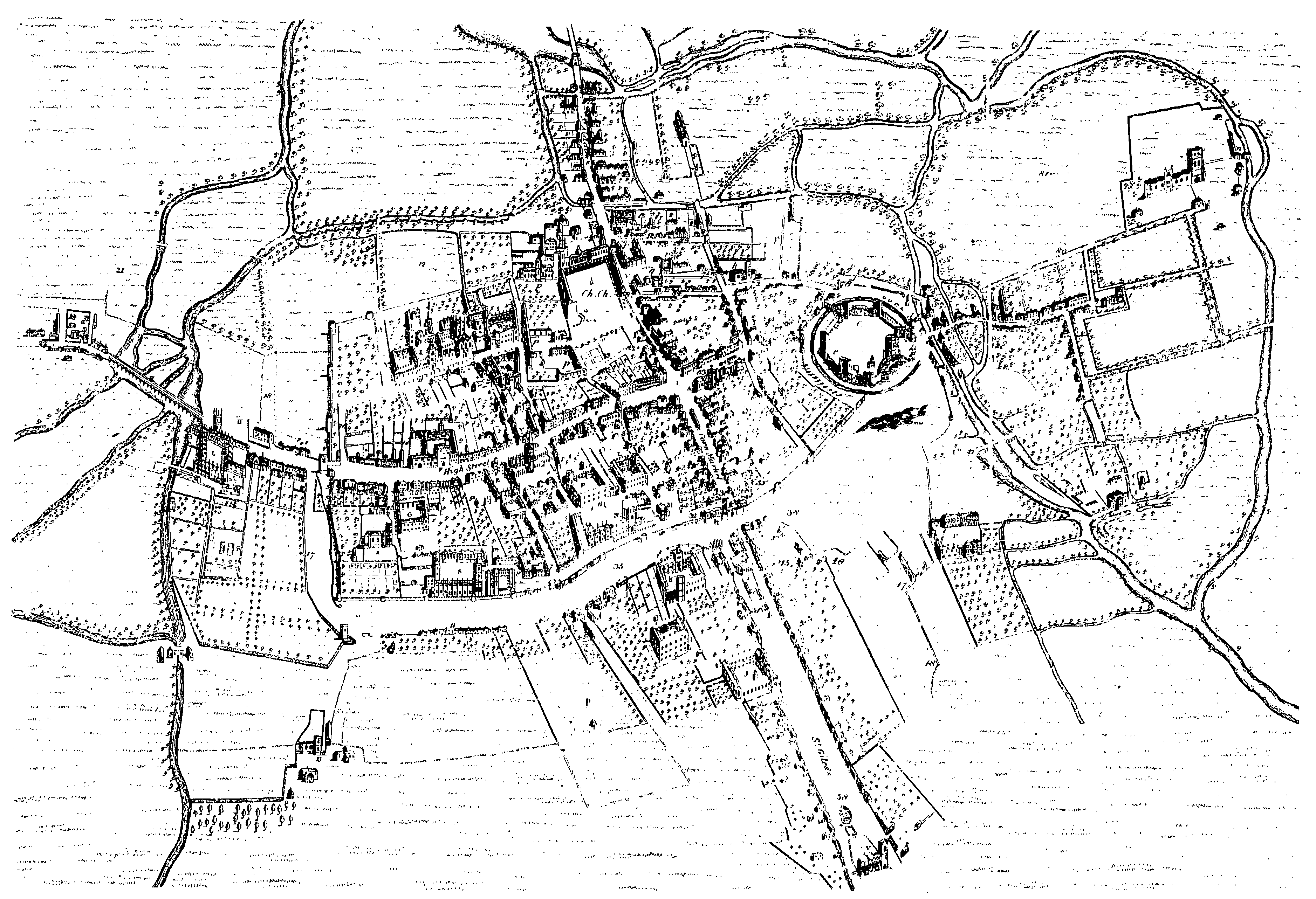
Agas's Map of Oxford, 1578
(with south at the top)
As a result of rising population in both city and university the spacious city depicted by Agas was built up heavily during the next century. The increased population was absorbed by filling up vacant plots along street frontages, building back along the length of plots, subdividing larger properties, developing the waste land around the city walls and the castle, and heightening buildings. Three- and four-storey houses became common throughout the city in the 17th century, and many colleges, too, responded to pressure of space by expanding upwards rather than outwards: attics and cock-lofts were added, for example, at New College, Corpus Christi, Exeter, and several other colleges in the late 16th century. (fn. 208) Within the city walls the size and number of gardens, except for those of colleges, was greatly reduced, but around the edges of the town, particularly in St. Ebbe's, large market gardens were established to meet the changing demands of the growing population. No new suburbs were created, but in the parishes of St. Thomas, St. Giles, and St. Clement there was a similar process of infilling, building behind street frontages, and slightly extending the built-up area. (fn. 209) The process was continuous from the later 16th century, but perhaps reached peaks in the first decade of the 17th century, when recruitment to the building trades in Oxford rose sharply, (fn. 210) and again in the 30 years after the Civil War, when many of the city's finest old houses were built and there was considerable expansion in the Gloucester Green area. (fn. 211)
Hollar's map of 1643 (fn. 212) shows a half-way stage in the great period of development. Housing density in the central area had much increased; Hollar's roof-lines, though frequently inaccurate in detail, suggest tall crowded houses on narrow plots; there was heavy development on both sides of Holywell and Broad Street and some scattered housing around the castle ditch in Castle Street and Bulwarks Lane. There are grave doubts, however, about Hollar's accuracy: a map of c. 1617 shows that the castle area was already fully developed, as it was in 1675, and there is no evidence of disaster or heavy rebuilding in that area between those dates; (fn. 213) there is no sign in Hollar's map of houses known to have been built in the early 17th century in the middle of Broad Street, in Ship Street, and in the city ditch west of North Gate. It would be unsafe to regard the map of 1643 as more than an impressionistic picture of housing changes since 1578.
The rapid growth of domestic housing was beginning to alarm the university authorities by the 1580s. The corporation was blamed for allowing obstructive encroachments in the central area and indiscriminate cottage-building on the city waste; the council blamed the development of such housing on 'the wonderful great number of poor people' who could not be housed elsewhere since there was no further 'compass of soil or freehold' within the walls. At the same time the council claimed that privileged persons of the university were deeply involved in the building activity and that the few houses built on the waste were there to safeguard the gardens and orchards. (fn. 214) The argument over cottage-building continued until the Civil War, reflecting the general confusion caused by the city's rapid growth; although there was much talk of vagrancy and poor-relief, neither seems to have been an especially serious problem in Oxford, (fn. 215) and relatively few of the new houses were slums. In 1606 the two universities combined in an attempt to secure an Act of Parliament to remove cottages, which were thought to increase the likelihood of plague and to house 'idle persons' who debauched the scholars. (fn. 216) In 1612 the university accused the city of building c. 150 cottages whose tenants robbed the king's woods, but the city blamed its lessees for building them, and argued that the problem of the poor owed more to the division of existing tenements than to the building of new ones, some of which were occupied by such worthy tenants as building-workers. (fn. 217) The Privy Council apparently ordered the removal of the cottages, (fn. 218) but was obliged to intervene again in 1626 after an almost identical complaint. (fn. 219) The council, meanwhile, because of the 'great imputation' laid upon it for building 'squab houses', required its lessees to guarantee the city and parish against claims from any poor inmates, (fn. 220) but cottage-building continued and the only recorded demolitions were the few encroachments at Smith Gate, Magdalen Bridge, and Butcher Row mentioned above.
Finally, in 1640, the Privy Council ordered a survey to be made of all cottages and houses built in the previous 20 years on formerly vacant ground, and of the number of inmates in each parish. (fn. 221) The survey found 241 inmates and c. 180 new houses; (fn. 222) many were 'squabs', but others were expensive houses, such as that built in Broad Street in the 1630s by John Prideaux, rector of Exeter College, worth £400. (fn. 223) According to the survey there had been a lull in building in the later 1620s, perhaps after the disastrous plague of 1625, but in the 1630s there had been renewed activity. Despite the continued attacks by the university on the city it was found that only 63 houses were on city land, while 86 were on college land. Townsmen of all degrees, under leases or on freehold, had built all but 54 of the houses, but privileged persons, too, were involved in speculative development of 'squabs': Thomas Broad, apothecary, had built 20 houses on Christ Church land in St. Thomas's parish, and was amerced in the university court leet in 1637 because of the squalid condition of his properties. One townswoman, credited in the survey with harbouring 11 inmates in St. Michael's parish, had an 'alley of tenements' near the Star inn 'not fit for Christians to live in'. (fn. 224)
The survey confirmed that, with the exception of St. Thomas's parish, the chief development areas in the period 1620–40 were along the northern edges of the town, on Merton College land in Holywell, and on city land along both sides of the city wall in the parishes of St. Michael, St. Peter-le-Bailey, and St. Mary Magdalen. Much had been built in those areas before 1620. Development of the south side of Holywell began in the late 16th century under Merton College leases that stipulated in some cases that tenants should build houses worth at least £60 and pave the frontage as far as the central gutter. (fn. 225) One group of houses towards the west end of the street was built by the university soon after 1612 to re-house those made homeless by the building of the Schools quadrangle, and for the same purpose the university also built four cottages between the Bodleian Library and the city wall. (fn. 226) In 1616 Merton College made arrangements for laying out and paving a street at least 33 feet wide in Holywell, presumably to aid further development, (fn. 227) and between 1620 and 1640 at least 22 houses were built there. (fn. 228) Hollar's map shows development on the south side as far as the east end of New College chapel, and though the arrangement of plots appears implausible in the light of their arrangement by 1675, (fn. 229) there is confirmatory evidence that the eastern end was built up later, chiefly in the 1670s. (fn. 230) In the 18th century the later plots were noticeably more regular and uniform than those developed earlier, where subdivision had been in progress much longer. (fn. 231)
In the early 17th century the spring named Crowell at the eastern end of Holywell was covered by a decorative well-head, apparently given by John Aglionby, principal of St. Edmund Hall; it was destroyed during the Civil War and a cottage built on the site. (fn. 232) The ditch in Longwall Street, leased in three sections as gardens in the 17th century, was built up at the southern end by 1675 and there were a few houses further north; probably most were fairly recent. (fn. 233) There were plans to re-route and cover the water-course there in 1670 and build four-storey stone houses, but the buildings were mostly timber and the water-course, an open sewer, continued to run a yard from the houses until the area was redeveloped in the late 18th century and early 19th. (fn. 234)
The city lease books (fn. 235) confirm that university complaints of development in the northern ditch from the late 16th century were fully justified. There were cottages on the south side of Broad Street between Smith Gate and the Turl by 1585, many more by 1606, and the house next to the Turl was mentioned in 1610. (fn. 236) The houses built in the Middle Ages at the north-east end of Broad Street, many of them purchased by the city in 1569, were mostly rebuilt in the early 17th century. (fn. 237) Further west the large stone house, Kettell Hall, was built c. 1620 by Ralph Kettell of Trinity College, (fn. 238) but although Hollar's map shows a continuous line of housing in front of the college the surviving cottages there seem to have been built on vacant land in the 1670s. (fn. 239) A 'middle row' of six houses in the centre of Broad Street, its eastern end roughly on the site of the entrance to the Sheldonian Theatre forecourt, was developed in the early 17th century, and was removed in 1667 when the university bought the leases in order to improve the aspect of the Sheldonian. (fn. 240) The south side of Broad Street west of the Turl was built up in the early 17th century. The area was leased as gardens in the 1580s, but by 1603 there was building on some of the plots and by the 1630s most were developed. (fn. 241) As elsewhere the early plots were large, but it is evident from the narrowness of surviving 17th-century buildings that subdivision by lessees rapidly took place. There was some cottage-building in the ditch west of North Gate by 1586, (fn. 242) and more in James I's reign, but much garden ground remained; the great period of building activity along George Street and around the former bowling green in Broken Hayes began after the Civil War, when there was an outcry from the parishioners of St. Mary Magdalen over the influx of poor caused by cottage-building on the waste. (fn. 243) Plots on the north side of Ship Street and St. Michael's Street, cramped by the proximity of the wall, seem also to have been developed chiefly in the later period, although there were a few early cottages in both areas. (fn. 244) There was some housing development near the timber wharf at Hythe Bridge in the early 17th century, but Upper Fisher Row was probably developed after the Civil War. (fn. 245) City property along the east side of King Street (the eastern end of Merton Street) was built up with cottages by the mid 17th century, and by 1675 both sides of the street were fully developed. (fn. 246)
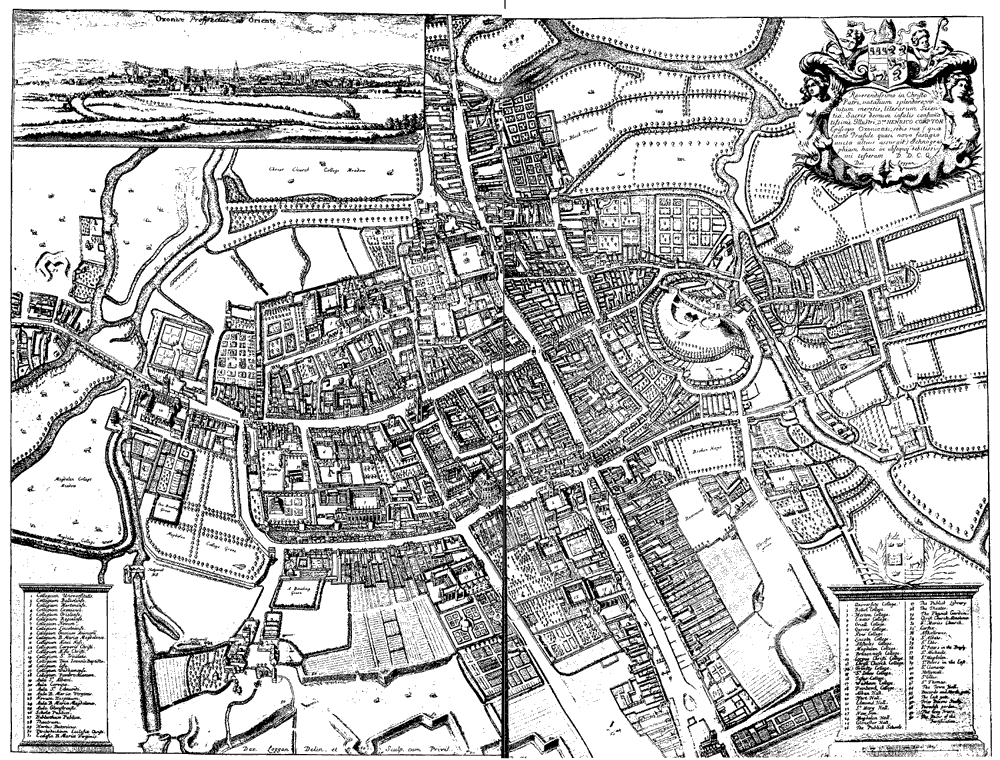
Loggan's Map of Oxford 1675
(with south at the top)
City leases frequently stipulated that new houses should be valuable, (fn. 247) and that tenants should pave the frontage and clean the water-courses, but there was no attempt to control sub-letting. Leases in the development areas were sometimes held by prominent men, such as Alderman John Sare and the bailiff, Henry Hedges, who built several houses on their plots. (fn. 248) The urgency of development is illustrated by a single site in the ditch next to North Gate, which in 1588 comprised a new house, a garden, and some ground formerly taken up by a bowling alley; by 1606 it was divided into six, and soon afterwards at least one of the holdings was further divided into three. (fn. 249) Other indications of the pressure for space were the early conversion into dwellings of several towers on the city wall and of the early-16th-century chapel of Our Lady at Smith Gate. (fn. 250) In the central area the building up of long, narrow tenements produced complex alleyways of houses, cottages, and out-buildings such as Swan Court, demolished in the 19th century when King Edward Street was built, (fn. 251) Amsterdam, demolished for new buildings at Brasenose College in the early 20th century, (fn. 252) the housing on the site of the New Bodleian Library, (fn. 253) and the surviving alleyway next to the Chequers in High Street. Loggan's map of 1675 shows many other similar developments.
Although only two colleges (Wadham and Pembroke) were founded in the 17th century it was one of the greatest periods of university building. Extensions to the Divinity School and library by the building of Arts End (1612), the Schools quadrangle (1613–18), and Selden End (1638–40), and the building of the Sheldonian Theatre (1664–9) and the Old Ashmolean Museum (1678–83) established the university's dominance of the area between St. Mary's church and Broad Street, where much housing was destroyed. The Physic Garden (1621–33) and its associated buildings took up an important site at the eastern entrance to the city, and Wadham College was built (1610) on the site of the former Austin friary. New quadrangles were built at University, Merton, Exeter, Oriel, Lincoln, Brasenose, Trinity, St. John's, and Pembroke colleges, and there were major extensions at St. Edmund Hall and Christ Church, including, at the latter, Tom Tower, a dominating feature of the Oxford skyline. (fn. 254) New public buildings included a council house (1615) and Nixon's school (1658) on the town hall site, Carfax conduit, and the bridewell at North Gate (1631). The shambles, destroyed in 1644, were rebuilt in the centre of Queen Street in 1656. (fn. 255) The demand among students for sport was reflected in the numerous tennis courts, bowling greens, dancing schools, and cockpits built in the city during the period. (fn. 256)
In Cornmarket, near the Golden Cross, stood a pillory, and in the High Street a tall stone pump with carved heads, called the two-faced pump. (fn. 257) The council made some effort to plant trees in the city, notably on Gloucester Green, (fn. 258) and Loggan's map shows trees also in St. Giles's Street.
The great courtyard inns expanded during the 16th century and 17th taking up much of the available space in the central streets; the Mitre, the Golden Cross, the Star (later the Clarendon Hotel) and several others acquired new ranges, and all were eager to find more space at the rear for stabling. (fn. 259) A small inn in High Street, called the Tabard in the Middle Ages, had grown large by 1523 when it was the Angel, and was probably further enlarged c. 1663 when the tenant spent c. £1,000 on improvements; by the late 18th century its frontage on High Street was 110 feet and its stabling was vast. (fn. 260) The four inns mentioned, together with at least seven other identified major inns, were all assessed on the maximum of 20 windows for the tax of 1696. (fn. 261) In 1756 a survey of the city's potential accommodation for soldiers, which presumably included chiefly inns, found that there were c. 270 beds and stabling for 550 horses. (fn. 262)
During the Civil War the earthworks thrown up around the city (fn. 263) involved some destruction of property, particularly in the St. Clement's area, and more suburban houses were burnt by the garrison in May 1645. (fn. 264) By 1675, however, the earthworks were prominent only on the northern edges of the town, and the housing destroyed in St. Clement's had been rebuilt; the castle had been severely slighted. (fn. 265) The greatest destruction of houses during the Civil War period was a fire in October 1644 which began in George Street and swept southwards as far as St. Ebbe's parish, destroying property in George Street, New Inn Hall Street, St. Michael's Street, Queen Street (including Butcher Row), and many streets in St. Ebbe's, where over eighty houses were burnt. Damage was estimated at £300,000, and included seven brew-houses, twelve bake-houses, and nine malt-houses. (fn. 266) By 1675 the area was heavily rebuilt, but some families suffered badly; Anthony Wood certainly claimed that his mother's loss of two houses was permanently damaging, and collections for sufferers by the fire were still being made in 1661. (fn. 267) From the 16th century onwards the city and university authorities made by-laws and stipulations in leases discouraging the use of thatch or of chimneys made of other materials than brick or stone, (fn. 268) but all strictures seem to have been ignored; long after the great fire of 1644 an alderman was presented in the university leet for having low wooden chimneys on his thatched cottages. (fn. 269) There were serious fires in 1657 in Broken Hayes, and in 1671 in St. Aldate's. (fn. 270) The danger of fire was one of the incentives for the building of a city waterworks in 1694 at Folly Bridge. (fn. 271)
Although some fine stone houses were built in the later 16th century and 17th most Oxford houses of the period were timber-framed structures, frequently 'hung' around a massive central stone chimney. (fn. 272) The predominance of timber, jettied houses before the large-scale refronting and demolition of the 19th and 20th centuries is evident in early street-views and in surviving groups of old houses, notably in Holywell, Ship, and Pembroke streets. The townsman's need to reconcile his desire for ostentation with the restrictions of narrow sites in the central streets may have encouraged the continued use of carved timber and elaborate pargetting, despite the ready availability of stone and of skilled craftsmen to work it. House-types ranged from simple two-storey cottages with one room to each floor, sometimes crowded together on a single plot, (fn. 273) to large many-gabled houses with cross-wings, such as Kemp Hall, built for Alderman William Boswell c. 1637. Boswell created sufficient space for such a house by aligning it along a narrow plot behind his existing house, no. 130 High Street; further down the same passage a house had already been built by 1611. (fn. 274) In contrast to such 'passage-type' houses were those of the 'long type', usually in suburban areas where more generous street frontages could be acquired, notably nos. 35 and 68 Holywell Street. (fn. 275) Most of the houses in the central streets had cellars and many had three or four storeys, with attics in addition. Exterior pargetting, barge-boards, and carved brackets supporting oriel windows were used extensively to decorate facades; (fn. 276) perhaps the most elaborate was the Three Tuns in High Street built in 1642 and demolished for the western extension of University College c. 1842. (fn. 277) Good examples of ranged oriel windows survive at the Old Palace, Kemp Hall, and no. 30 St. Giles's Street, formerly the Pheasant inn, which in the 19th century was twice its present size. (fn. 278) A later and more sophisticated timber front survives at no. 126 High Street, where a medieval jettied building was re-fronted in the later 17th century, probably by Alderman Robert Pauling; (fn. 279) the use of a projecting central bay, triangular pediments, round-arched windows with keystone-like cornices, and large expanses of glass has suggested a likeness to the contemporary Sheldonian Theatre. (fn. 280) Similar round-arched windows were used in Nixon's School (1658, demolished 1896) (fn. 281) and the later-17th-century south range of the Golden Cross.
Stone houses tended to be built on larger sites away from the crowded shopping centre, such as in St. Giles's Street and Merton Street, where, in addition to Beam Hall and Postmaster's Hall (Anthony Wood's house) there are several houses of squared rubble. Several stone houses provide good examples of the 'long-type' house, notably no. 3 Holywell Street, which has four rooms in a row along the front, and a small house of c. 1600 in Kybald Street. (fn. 282) Kettell Hall in Broad Street, one of the larger stone houses, though a private dwelling, was obviously built as an adjunct to Trinity College, and with its gables and rows of mullioned windows with dripmoulds resembles a contemporary college range. Several other large stone houses were built for men outside the town community proper, notably Perrot's House in Gravel Walk near Magdalen College, built for the Perrot family possibly in 1548 and demolished in 19th century; (fn. 283) Black Hall, in St. Giles's Street, extensively remodelled c. 1700, but probably built by the Eveleigh family a century earlier; (fn. 284) and Frewin Hall, probably remodelled after it ceased to be a bridewell and was leased by the chancellor of the diocese, Dr. Griffith Lloyd, c. 1582. (fn. 285)
The medieval Littlemore Hall in St. Aldate's was rebuilt in the 17th century in a mixture of stone and timber-framing, possibly by Richard Hannes, brewer (d. 1618), who bought it in 1609. (fn. 286) Among other notable houses employing such a mixture were Kemp Hall, built on a stone base perhaps because of the awkward fall of the ground; Greyfriars, formerly Paradise House, built in the late 17th century possibly by William Bodley, a councillor; (fn. 287) nos. 13–14 Pembroke Street, built by a later Richard Hannes in 1641; and two houses in St. Aldate's parish built by the Smith family of brewers. The main block of nos. 1–2 Brewer Street was built in stone c. 1600, probably by Alderman Thomas Smith (d. 1601), whose son Oliver (d. 1637) added on the west side a separate house, which contains a fine plaster ceiling, and contained an elaborate carved overmantel and stone fireplace, later both removed to Oxford colleges. (fn. 288) The Old Palace, nos. 96–7 St. Aldate's, was originally two separate houses. The main house, abutting the street, was built between c. 1622 and 1628 by Thomas Smith (d. 1646), Oliver's eldest son, reputedly at a cost of £1,300. (fn. 289) The smaller portion, sometimes known as the Hither Friars, was probably built by Edward Barkesdale, tanner (d. 1596), and was sold to the Smiths by Thomas Barkesdale in 1621. When Oliver Smith died in 1637 Thomas Smith seems to have moved to the Brewer Street house, selling the larger portion of the Old Palace to Unton Croke, M.P., who was already occupant of the smaller portion. That portion continued to be occupied by John Smith, Thomas's brother, but the house seems to have been united by 1672 when Unton Croke the younger was living there. In 1665 the smaller portion contained nine hearths, the larger thirteen, making it one of the largest domestic properties in the city. It was given the name Bishop King's Palace in the early 19th century, although no bishop ever lived there. (fn. 290)
It may be significant that this most distinguished of Oxford houses was 'no college lease ... but good freehold'. (fn. 291) Many expensive houses, however, were built on leasehold land. No. 90 High Street was built c. 1625 by John Williams, apothecary, a tenant of Christ Church; (fn. 292) the house was given a plain front c. 1812, but its interior is richly detailed early-17th-century work, particularly the very large room on the first floor (36 ft. long) with elaborate overmantels and one of the finest ceilings in Oxford, drawn in 1838 by John Ruskin when his parents were lodging there. (fn. 293) In 1655, when the tenant was Arthur Tillyard, apothecary, one of the earliest Oxford coffee-houses was opened there, and in the 19th century the large room was used by the university sporting club, Vincent's. (fn. 294)
The wealth of Oxford citizens is revealed by the quality of detail and ornamentation of their houses. Carved overmantels and fine panelling, some removed to college rooms, were common. (fn. 295) The houses were rich in plasterwork, notably the surviving ceilings and plastered beams at nos. 82–3 St. Aldate's, Frewin Hall, the Old Palace, no. 2 Brewer Street, and nos. 86–7, 90, and 104 High Street. A ceiling in Lloyd's Bank at Carfax was made from casts of a ceiling in Slatter and Rose's shop on that site, and the original is in the principal's lodgings at St. Hugh's College. (fn. 296) A number of wall-paintings, chiefly of the mid or late 16th century, survive at no. 3. Cornmarket Street and the Golden Cross, the former painted when the house was the Crown tavern, occupied by a councillor, John Tattleton. (fn. 297) Among fine domestic staircases of the period may be mentioned those at Kemp Hall, nos. 13–14 Pembroke Street, Greyfriars, and no. 41 St. Giles's Street (c. 1700).
The relative wealth and social structure of different areas of the city changed little over the period. Assessments for the subsidy of 1524 show that the wealth of townsmen was concentrated in the parishes of All Saints and St. Martin, the central commercial area, while the parishes of St. Mary the Virgin and St. Aldate were also reasonably prosperous. (fn. 298) In the suburban St. Mary Magdalen parish there was a wide range of assessments, and probably a large number of exempt poor. The ring of parishes around the central area, St. Peter-le-Bailey, St. Michael at the North Gate, St. Ebbe's, and St. Peter-in-the-East were characterized by high concentrations of wage-labourers and artisans; the average assessment in St. Peter-le-Bailey was very low, and in St. Ebbe's very high, but there four-fifths of the total assessment was paid by two wealthy brewers and many were probably exempt. The taxpayers in St. Martin's and All Saints were predominantly distributors and victuallers, while in the inner ring of poorer parishes they were tailors, leather-workers, and building craftsmen; brewers were prominent in the south-western parishes and in St. Mary Magdalen. In the early 16th century privileged persons probably lived mostly in the area east of the Turl and in St. Aldate's, but as new colleges were founded they became more scattered: by 1590 the chief concentrations were in the parishes of St. Mary the Virgin, St. Peter-in-the-East, St. Aldate, St. Mary Magdalen, and St. Giles. (fn. 299) Most city councillors in the early 16th century lived in St. Martin's and All Saints, but there were many from the two St. Mary's and St. Aldate's; by the early 17th century St. Aldate's had become much more fashionable, while St. Mary Magdalen produced few councillors and the other suburbs hardly any. (fn. 300)
As the city grew there are signs that the parishes at the eastern end of High Street, St. Mary's and St. Peter-in-the-East, became more prosperous, and for ship-money in the 1630s they were assessed highly along with the two central parishes and St. Aldate's, while the suburban parishes, and St. Ebbe's, and St. Peter-le-Bailey were evidently regarded as comparatively poor. (fn. 301) St. Peter-le-Bailey, and later St. Mary Magdalen, were so burdened with poor that other parishes contributed to their relief. (fn. 302) For the hearth tax of 1665, by which date many poorer men in single-hearth houses had been exempted from payment, the average assessment for the whole city was 3½ hearths. The parishes which fell far below that average, and where also most exemptions had been allowed since 1662, were St. Thomas's, St. Mary Magdalen, St. Peter-le-Bailey, and St. Ebbe's, while those well above the average were St. Aldate's, St. Martin's, All Saints, St. Mary's, and the small parish of St. John, which comprised only a few houses in Merton Street. (fn. 303) Although the figures are distorted by the presence in some parishes of large inns with many hearths, the general picture of parochial wealth is confirmed by other evidence, notably the poll-tax assessments of 1667. (fn. 304) There the small average household size in such parishes as St. Peter-le-Bailey, St. Mary Magdalen, and St. Thomas's reflects the exemption of the children of the poor, the lack of living-in servants, and probably the early departure of young children to live as servants in other households; again the parishes of St. Martin, St. John, St. Aldate, All Saints, and St. Mary seem the most prosperous, with average households of about five persons and a heavy incidence of men paying tax on money, titles, and practices (as attorneys and physicians). Such averages only indicate roughly the social structure of parishes, the balance of rich and poor: there were many prosperous men with large households living in poorer parishes such as St. Thomas's, and there were poor cottages and yards in St. Aldate's and All Saints. By the late 17th century there was, however, a definite development of 'better areas', reflected, for instance, in the quality of housing at the northern end of St. Giles's Street; the poll-tax assessments of 1702, (fn. 305) though largely valueless because of numerous exemptions, suggest that St. Peter-in-the-East and Holywell, which appear to be the most populous Oxford parishes, were in reality simply the most 'middle-class'. Holywell Street and the eastern end of High Street became increasingly fashionable places to live, and they housed few poor.
Loggan's map of 1675 shows the city at the limits of its expansion in the early modern period; as population began to fall in the late 17th century the development of waste areas ceased. There were few complaints of serious encroachments in the 18th century; (fn. 306) much of Penniless Bench was removed c. 1750, but some of the more obvious obstructions—Carfax conduit, the east and north gates, the 'middle row' on each side of St. Mary Magdalen church—seem to have been tolerated though hardly admired. There were relatively few 18th-century houses of quality, and of those that survive the largest concentration is in St. Giles's Street. The majority of 18th-century fronts are stucco, many of them refronting earlier timber-framed houses. In 1744 a visitor described the houses in High Street as 'meanly built' and asserted that inhabitants on college leases preferred to 'patch up their clay tenements' rather than build in brick or stone; he conceded that some of the houses in St. Aldate's and Cornmarket Street were preferable to those in High Street, but above all he was satisfied with St. Giles's, with its elms and its houses of white hewn stone. (fn. 307) A later tourist remarked on the preponderance of timber-framed houses, but found them not so ugly as in other towns. (fn. 308)
One of the most outstanding stone houses was St. Giles's House, built in 1702 for Thomas Rowney, Oxford's M.P., possibly by the local builder Bartholomew Peisley, on the site of an existing large house; from 1852 it served as the Judge's Lodging. (fn. 309) Vanbrugh House in St. Michael's Street, attributed to Sir John Vanbrugh, (fn. 310) was the house of the builder Bartholomew Peisley, (fn. 311) who presumably built it and may have acquired the ideas for the design from his experience of working at Blenheim. (fn. 312) A house similar in date and design, also attributed to Vanbrugh, (fn. 313) stood at the corner of Catte Street and Holywell Street until replaced by the Indian Institute; (fn. 314) it may have been built for Alderman John Knibb, (fn. 315) and it later became Seal's coffee-house. (fn. 316) Linked to Carfax improvements in 1709–13 was a large stone building for the Fleur de Lys inn, (fn. 317) and another imposing early-18th-century stone house was the wharfinger's house north-east of Folly Bridge; (fn. 318) it was removed for road-widening c. 1826. (fn. 319) A distinguished timber-framed range of the early 18th century survives at nos. 102–3 High Street, built c. 1714 by William Ives (d. 1739), a wealthy mercer. (fn. 320)
The chief college buildings were Queen's College, rebuilt between the 1670s and 1760, when the High Street range was completed, and Worcester College, begun in 1720; there were major additions to most colleges, including the library and Peckwater quadrangle at Christ Church, the Codrington Library and north quadrangle at All Souls, the Fellows' Building and quadrangle at Corpus Christi, the New Buildings at Magdalen, and the Radcliffe quadrangle at University College. To the central university area were added the Clarendon Building (1715) and the Radcliffe Camera (1749). (fn. 321) All Saints church was entirely rebuilt in the early 18th century, a crucial addition to High Street and the Oxford skyline; the south-west corner of Carfax was rebuilt between 1709 and 1713, when the city created a colonnaded butter bench; the Holywell Music Room was built in 1748 and a new town hall in 1751. (fn. 322) An outstanding Oxford builder, William Townesend (d. 1739) was concerned in 'nearly every important building erected in the university between 1720 and 1740'. (fn. 323)
RADCLIFFE'S LIBRARY AREA in its ancient state.
Much of the new building involved the destruction of domestic housing, and in 1717 the parishioners of St. Peter-in-the-East asked for a reduction of their land-tax assessment because of houses lost beneath Queen's College and other buildings; (fn. 324) the Clarendon Building replaced a number of houses protruding into Broad Street. (fn. 325) The Radcliffe Camera, its site decided upon as early as 1714, was long delayed partly because of the difficulties of buying up the houses crowded between St. Mary's church and the Bodleian, but by 1733 the site was empty. (fn. 326)
In 1712 or 1713 Nicholas Hawksmoor drew up a bold, and presumably unofficial, scheme to replan much of central Oxford, creating a forum universitatis (Radcliffe Square) and a forum civitatis (Carfax), each adorned with statuary; great vistas were to be opened, a new university temple built east of the Bodleian Library to replace St. Mary's church, which was to be demolished along with such other Gothic intrusions upon the classical scene as the complex of buildings at Bocardo. (fn. 327) This early venture into city planning, anticipating the sweeping proposals of Dr. Edward Tatham in the 1770s, (fn. 328) suffered the fate of many of its successors: the Improvement Commissioners appointed in Oxford in 1771 settled for more limited aims and achievements.
ECONOMIC HISTORY
In 1574 Oxford's high steward described the university as 'the ground and cause' of the town's wealth, 'if any there be'. (fn. 329) Despite the city's rapid economic growth in the early 17th century a university petition of 1640 claimed that 'Oxford lies out of the road, and is in no way useful to the public by any trade or manufacture. It serves only for the entertainment of scholars, and the townsmen have no other possible means of subsistence'. (fn. 330) Such contemporary estimates of the city's dependence on the university were justified to a great extent, although they neglected Oxford's function as the market for a prosperous corn-growing region and perhaps exaggerated its remoteness from important trading routes.
In the early 16th century Oxford's comparative insignificance in wealth and population and its unusual occupational structure suggest a heavy reliance on local consumption. There was little primary industry in cloth and leather: weaving, fulling, and tanning, so important in the medieval town, had shrunk in importance or disappeared entirely. Most townspeople were small craftsmen or shopkeepers, and the nearest approach to an industry involving substantial capital investment and production was brewing, but that too, because of distribution problems, was limited to supplying a small area.
Assessments for the subsidy of 1523–5 show that 111 persons, about a fifth of the taxable population, were directly employed by the university, colleges, or halls, and enjoyed the privileges of the university. (fn. 331) The two surviving lists of non-privileged taxpayers in 1524 and 1525 (fn. 332) contain a total of c. 600 names of which only 272 occur in both, implying a turnover, in only a year, of between a third and a half of the taxable population; the turnover was much greater among those assessed on wages rather than goods (70 per cent compared with 20), since movement or changing fortunes were inevitably more frequent among the journeymen and smaller craftsmen. Despite such high turnover the size of the non-privileged taxable population hardly changed between the two assessments (422 and 431), figures which suggest, since there is no evidence that Oxford contained an unusually large untaxed population, a town of only moderate size. On the basis of assessed wealth in 1524 it ranked only 29th among English provincial towns and cities. (fn. 333) The average assessed wealth of its taxpayers (c. £5 10s.) was much lower than in large cities such as Norwich (c. £10 10s.) (fn. 334) or in many smaller market towns, although there the presence of a few exceptionally wealthy taxpayers might sometimes give a false impression of overall prosperity.
The distribution of assessed wealth in Oxford (see Table V) was not unusual for a town of its size: (fn. 335) the poorer men, assessed below £5, comprised three-quarters of the taxable population but held less than a quarter of the assessed wealth, while a mere 3 per cent of the population held almost a third of the wealth. Oxford was unusual, however, in having no men of exceptional wealth, and certainly none of the stature of Robert Jamys of Norwich, the Wyggestons of Leicester, or the Springs of Lavenham. (fn. 336) Its wealthiest taxpayer in 1524 was assessed on only £90, its aldermen on 100 marks or less, whereas in Norwich, Exeter, and smaller towns such as Lewes or Chichester the dominant group contained men assessed at well over £100; indeed in other market towns in Oxfordshire there were several men apparently wealthier than the leaders of the county town. (fn. 337)
Sources: E 179/161/198, printed, with serious errors, in Oxf. City Doc. 53–75; Hammer, 'Town–Gown', figs. I, VI, VIa, used with Dr. Hammer's kind permission. Figures have been rounded to the nearest whole number.
Oxford was unusual, too, in having only a third of its taxpayers assessed on wages, whereas in Coventry, Exeter, and many smaller towns the proportion was over 40 per cent; (fn. 338) the household scale of the town's economy, the lack of large industrial undertakings, perhaps accounts for that disparity. Almost all the wageearners in 1524 were living-in journeymen, and the only significant employer of such men, besides the abbot of Oseney who had twelve servants, was Oxford's wealthiest man, John Seman, cordwainer, with nine; a few others had three or four servants but most employers had only one. Then, as later, there was probably much reliance on apprentices to provide cheap labour, while some enterprises may have employed numerous unskilled labourers earning less than the taxable minimum; the fewness of assessed wage-earners, however, suggests that in Oxford the unknown substratum of poorer men was smaller than elsewhere.
Of the non-privileged taxpayers in 1524 the occupations of only about a fifth, mostly in the poorer groups, escape identification altogether, although many are known only from much earlier or later sources. Multiple occupations were common, and since it is frequently uncertain which yielded the bulk of an individual's wealth all have been enumerated (see Table VI). Council orders of the 1530s forbidding men to practice more than one victualling trade seem to have been ineffective. (fn. 339) By the later 16th century there was increasing specialization, and although a few wealthier men maintained several interests it is usually clear which took priority. Popular multiple occupations were those of chandler and fishmonger, tailor and brownbaker, barber and chandler, mercer and vintner; the town's numerous tailors were particularly keen to indulge in other trades, but there was more specialization in the metal crafts, building, whitebaking, and butchery. Brewing for sale was a profitable sideline for many whose chief income came from other sources, but in 1524 the specialist brewers were, on average, far wealthier than the part-time brewers; by contrast the specialist tailors were poorer than those deriving income from other, more profitable, sources.
Sources: Hammer, 'Town–Gown', figs. XXVII, XXVIII, XXXVII.
The dominant occupational group was that of the victuallers. Most important were the brewers, especially those licensed by the university, who benefited from an artificial monopoly created by the rota-system which the university had established and supervised. (fn. 340) The specialist university brewers in 1524 accounted for about a fifth of the assessed wealth of the town, while the assessed wealth of all who engaged in brewing amounted to almost a quarter of the town's wealth. The brewers included many of the town's leading figures, such as the aldermen Michael Hethe and Thomas Shelton, assessed at over £60. Neither seems to have pursued any other occupation in the town, although both had landed income; Hethe was a graduate, and Shelton, who began his career as a carpenter, may sometime have worked as a college rent-collector. (fn. 341) Another wealthy brewer, Richard Hampden, had entered the trade by marrying a widow, Alice Haville; by 1526 his wife was dead, and because of that and his loss of an annuity of £10 a year his assessment was reduced by half, (fn. 342) an indication of the fragility of urban fortunes at that time.
The distributive trades, although not heavily represented, also included some of the wealthiest townsmen. The mercers and drapers of the 1520s were almost all assessed highly (between £10 and £60), and the chandlers were almost as wealthy as the brewers. One of them, Thomas Wayte, was assessed on £80; another, John Pye, later an alderman, was also involved in fishmongering, and butchery. (fn. 343) Grocery by that time was practised usually with mercery; in the course of the 16th century Oxford men ceased altogether to call themselves grocers, although the appellation began to reappear in the early 17th century. Mercers, chandlers, and drapers all might deal generally in hardware and foods, but the mercers and drapers concentrated on cloth, while chandlers specialized in candles. William Clarke, mercer (d. 1612) sold not only a wide range of cloths, but also groceries, nails and screws, chains and padlocks, some basic books and stationery, and medicine, thus encroaching on the interests of ironmongers, cutlers, stationers, and apothecaries. (fn. 344)
The clothing occupations were well-represented in 1524; most were tailors, by far the most popular single occupation in the town in the 16th and 17th centuries. Their average wealth was low, even if those who combined tailoring with other trades are included. The large number of building craftsmen in 1542 reflects the availability of plentiful work on university buildings, particularly at that time on Cardinal College; (fn. 345) most were assessed on less than £5, but a notable exception was William Orchard, son of the prominent Oxford master mason of that name, and brother of a wealthy brewer. (fn. 346) Some of the more prosperous Oxford masons may have lived outside the town, closer to the quarries. The leather trades were dominated by the cordwainers and glovers, and there were few involved in the processing of leather. Apart from John Seman, who evidently produced shoes on a fairly large scale, the cordwainers were not prosperous. The glovers, too, apart from one man, perhaps with other interests, assessed on £40, were mostly poor; John Lyth, an earlier master of the glovers' guild, (fn. 347) was assessed on only £5. Possibly Oxford was not yet established as the centre of the flourishing local industry. In 1536 a wealthy glover from Eynsham, John Barry, settled in the town, became an alderman at once, and built the glovers' chapel in All Saints church; (fn. 348) earlier the guild had complained of him working in the town while not a freeman, (fn. 349) perhaps using it as a collection and distribution centre. His settlement there may have contributed to the great development of the industry in Oxford during the 16th century, when Oxford gloves, prized for their pliability (fn. 350) and sometimes highly decorated, became renowned nationally. (fn. 351)
The decline of the textile industry in Oxford is confirmed by the 1524 subsidy: no weavers can be identified and, although there were five fullers, only one seems to have thrived solely by that trade. The metal trades were also poorly represented; there was a handful of smiths, a claspmaker, and a pinner, but none of the pewterers and cutlers who occur in Oxford later in the 16th century. William Thomas, assessed highly at £30, was a plumber, but also derived income from several properties, including a brew-house. (fn. 352) The miscellaneous tradesmen not classified in the main groups were not wealthy men. There was a group of 25 widows, some of whom continued to practise their husbands' trades, as they were allowed to do; some were wealthy, and their combined assessed wealth (£191) was greater than that of several leading occupations. Of the c. 120 wage-earning servants whose masters' trades are known almost a third were working in the leather trades, chiefly as shoemakers, while the rest were scattered thinly through the various trades; the high number of journeymen shoemakers may reflect the exclusive attitude of the cordwainers' guild, which seems to have discouraged men from becoming masters. (fn. 353)
Of the privileged persons in 1524 only the bedels of theology and law were assessed on more than £20. (fn. 354) A high proportion of privileged persons paid on wages, since so many were servants. Like townsmen the privileged persons tended to be involved in more than one occupation, showing a predilection for the victualling trades, presumably because of the university's influence over those trades through the assizes and through licensing. (fn. 355) The occupation of manciple brought men into close contact with the purveying of food and drink, and it was a natural tendency for manciples to trade on their own behalf. (fn. 356) In the later 16th century the privileged community contained wealthy representatives of the distributive trades, but they had usually become privileged persons by taking up extra employment as rent-collectors or stewards. Such movement in and out of the privileged community was common, and prevented it becoming an entirely separate social and economic group within the town, even though some families maintained a traditional association with university employment over many generations. Some occupations, notably those of bookseller and stationer, were reserved almost entirely to privileged persons throughout the period. Although the privileged community grew more slowly than the freeman body in the later 16th century and early 17th, it remained a substantial element in the city's economic structure. (fn. 357)
Comparison of Oxford's occupational structure with that of other towns in 1524 shows how heavily the presence of the university had biased the economy towards supplying local consumption. In towns of similar size but without a captive body of consumers, such as Leicester or Northampton, only c. 40 per cent of the taxpayers were engaged in the victualling, distributive, clothing, and building trades; (fn. 358) in Oxford the proportion in those trades was about three-quarters, and there was a further fifth directly employed by the university.
Later Tudor subsidies, although increasingly unreliable in detail, suggest that the town's dependence on the university continued. Despite the foundation of Cardinal College the university remained in decline in the early 16th century apparently reaching a low point in mid century before beginning a dramatic rise in Elizabeth's reign; (fn. 359) until that time Oxford was a small and not specially prosperous town, its rent-levels very low. (fn. 360) In 1543 441 persons, including privileged persons, were assessed for a subsidy; wage-earners were excluded, but the apparent increase since 1524 of men taxable on goods probably represents a different approach to the assessment rather than a rise in prosperity. (fn. 361) The distribution of wealth among taxpayers was similar to that of 1524. The 38 persons (c. 9 per cent) assessed on £20 or more were almost all senior councillors or prominent privileged persons, and of the 30 freemen in that group as many as 26 were involved wholly or partly in the food and drink or distributive trades. A few of the wealthiest taxpayers were assessed on lands, mostly acquired as a result of the Dissolution. (fn. 362) The wealthiest privileged persons were Robert Perrot, a graduate and landowner, James Edmonds, bedel and draper, and Thomas Lee, a doctor of medicine, who may have practised in the town, since resident members of the university seem to have been exempted. In 1576–7 (fn. 363) the number of men assessed in Oxford was only a seventh of that in Norwich, and Oxford's wealthiest men (ten assessed between £13 and £24) were far fewer and much poorer than the leading men in Norwich. (fn. 364) Oxford's ranking among provincial towns was almost unchanged since 1523–5. Its two wealthiest men, William Frere and Simon Perrot, heirs of two of the leading taxpayers of 1543–4, probably derived their wealth largely from lands rather than trade. (fn. 365) Others assessed above £13 included the mayor and four aldermen, two assistants, and the widow of a former mayor; three were mercers, of whom at least one owned an inn, and there was an apothecary, a chandler and fishmonger, a whitebaker, a grazier, and a brewer. (fn. 366) The assessments confirm the close relationship between wealth and conciliar status; the bailiff class dominated the group assessed at between £8 and £12, and the wealthiest chamberlains were assessed at £6 or £7, the common councillors at the lower levels. (fn. 367) Most of the privileged persons were assessed at £5 or less.
Because Oxford's economy was characterized by small household enterprises its apprenticeship enrolments perhaps give a better indication of the range and relative strength of the city's occupations than in other, more industrialized cities. Craft guilds and the council regulated enrolments closely, (fn. 368) and there seems to have been comparatively little evasion, although the records exclude the important class of privileged persons and perhaps seriously under-represent such occupations as brewing, fulling, building, and innkeeping where unskilled wage-labour may have played an important part. The first thousand apprentices enrolled in Elizabeth I's reign were divided among 392 masters (see Table VII). (fn. 369) Over a fifth of all apprentices entered the tailor's craft, nearly twice as many as entered shoemaking, the next most popular occupation. Over 40 per cent of the identified masters in the city were involved in clothing or leather trades, while food and drink and distributive trades accounted for another third, bakers and mercers being particularly numerous. As in 1524 the building trades were well-represented, and the metal trades were much more prominent. Those involved in leather processing included two prosperous tanners, and the textile industry was not entirely defunct, although neither the enrolments nor other sources suggest that it formed an important part of the city's economy. Gloving was very well established, and the number of master cutlers suggests that at least one other small industry was catering for more than a local market. An enigmatic proverb, first recorded in the 17th century, likened Oxford knives to London wives, but whether for sharpness or bluntness is not clear; an 18th-century commentator thought that the proverb might point a contrast between appearance and utility. (fn. 370) Certainly Oxford knives were highly decorated in the later 17th century, when a local cutler introduced a new 'engine' for carving the handles. (fn. 371)
Source: City Arch. A.5.3.
Oxford's economic expansion in the late 16th century and early 17th brought an increase in population and rents. (fn. 372) National demographic changes and a revival of internal trade, which stimulated the growth of other provincial centres in that period, contributed to Oxford's prosperity, but the scale and timing of Oxford's growth, and incidentally of Cambridge also, (fn. 373) suggests that the university's role was ultimately decisive. Apprenticeship enrolments give some measure of that growth and show that it was characterized by the expansion of existing crafts and trades rather than by new industrial enterprises. In the first two decades of Elizabeth I's reign an average of fewer than 30 apprentices were enrolled each year, but by the 1590s there were nearer 50 a year, and in the early 17th century enrolments increased rapidly to c. 85 a year by the 1630s. (fn. 374) Overall the occupational structure revealed by the enrolments (see Table VIII) changed remarkably little between the later 16th century, when the city was expanding slowly, and the early 17th, when growth was rapid. In detail, however, the revival of the economy was uneven in its incidence, and there are signs that the initial cause of recovery was not so much changes in the university population as other factors. In the 1560s four-fifths of Oxford's apprentices entered four principal trade groups (food and drink, distributive, leather, and clothing) in almost equal proportions. The first sharp increase in enrolments was in the leather trades, particularly gloving, in the 1580s and 1590s. Enrolments in the clothing trades also rose at that time, but the sharpest increase came later and continued longer. Membership of the tailors' guild in the period 1571–1641 rose from 47 to 187, and membership of the journeyman tailors' company, which included apprentices, rose from 73 in 1571 to over 250 in the late 1620s. (fn. 375) For a short time in the early 17th century gloving involved more masters and apprentices than shoemaking, accounting for a twelfth of all apprentices and a tenth of all identified masters in the period 1590–1609, but by the 1620s, although the craft continued to flourish, cordwainers were more numerous than glovers. The leather and clothing trades appear to have been almost equally strong by the second decade of the 17th century, accounting for c. 46 per cent of all apprentices. Numbers in the distributive trades, which involved more capital and were largely the preserve of the city's wealthier men, inevitably increased less rapidly, but there was steady growth from the 1590s. The food and drink trades, however, more completely dependent on local consumption, do not seem to have grown until the second decade of the 17th century, as the impact of university growth made itself felt; thereafter apprentices flooded into those trades and by the 1630s the victuallers, in terms of numbers of apprentices, ranked third in importance to the leather and clothing workers. The increase in the number of cutlers in the later 16th century was maintained, and in the period 1590–1609 17 cutlers enrolled 37 apprentices. In that period a tenth of all masters and apprentices were engaged in the building trades, the sharpest increase coming in the first decade of the 17th century when three times as many builders' apprentices were enrolled as in the 1590s.
Sources: Apprenticeship enrolments in City Arch. A.5.3, L.5.1–5. A few of unknown occupation are omitted. Occupations are classified as in J. F. Pound, 'Social and Trade Structure of Norwich', Past and Present, xxxiv, pp. 65–9. There are no enrolments for 1603.
The impression that the food and drink trades were temporarily overtaken by other trades (fn. 376) is confirmed by an examination of the occupations of city councillors (see Table IX), which shows that in the later 16th century the brewers and bakers, who earlier had held the wealth of the town and the power in the council, had to a large extent given way to mercers, chandlers, and drapers. In the early 17th century the victuallers recovered their strength on the council; in the period 1599–1638 they were mostly brewers (or maltsters) and bakers (21 of each). The distributive trades, accounting for over a fifth of the council at all periods, were dominated by the mercers, of whom there were 35 among the councillors of 1599–1638. The councillors engaged in metal trades were mostly goldsmiths or cutlers, those in clothing trades almost exclusively tailors, and the leather workers were evenly divided between gloving, shoemaking, and leather processing. Leather and clothing workers were inevitably well-represented on the council because they were so numerous, but they were restricted through lack of wealth to the lower levels.
Sources: Council lists and apprenticeship enrolments in City Arch. A.5.3, L.5.1–5; O.C.A. passim; misc. court records, deeds, wills etc. The councillors are grouped according to their date of entry into the council and trades are classified as in J. F. Pound, 'Social and Trade Structure of Norwich', Past and Present, xxxiv. 65–9.
Senior councillors were drawn from a narrow range of occupations. Of the 399 entrants to the council between 1559 and 1638 only 64 went on to join the Thirteen, and of those over three-quarters were engaged in the food and drink or distributive trades, a clear indication of the comparative wealth of individuals in those trades. The 24 victuallers comprised 10 brewers or maltmen, 7 whitebakers, 3 butchers, 3 vintners, and an innholder, while the 25 distributors comprised 14 mercers (of whom 3 were also called drapers), 5 woollendrapers, 5 chandlers, and an apothecary. There were 3 goldsmiths, a cutler, an attorney, and one gentleman, William Frere, the landowner. Only 5 clothing workers and 4 leather workers reached the Thirteen.
Oxford's lack of wealthy primary producers or great merchants thus left the victuallers and mercers dominant to an extent not approached in towns where the industrial element was strong. Such men, especially when the university was in a low state in the early 16th century, were not especially wealthy: much of Oxford's central area at that date was owned by colleges and religious houses, and few townsmen had even the capital asset of freehold property, although many held two or three long leases. Few early-16th-century townsmen disposed in their wills of large sums of money or impressive estates. (fn. 377) Even so, though offering no great riches, the university-based economy provided fairly secure employment at all levels; individual fortunes were always at risk (fn. 378) but townsmen as a whole appear to have escaped any prolonged recession between 1500 and the Civil War.
In the short term the dissolution of the local religious houses, together with the apparently continued decline of the university in the mid 16th century, presumably caused some distress. In St. Thomas's parish, where Oseney abbey was a considerable employer, there were vacant houses, rent-arrears, and an apparent turnover of population between the subsidies of 1524 and 1543 which, even by the standards of that time, seems exceptional. (fn. 379) The subsidy of 1543, however, shows no sign of serious decline in the town's size or prosperity. (fn. 380) Those responsible for dissolving Oxford's religious houses expressed concern about the poor, recommending schemes for setting up cloth manufacture to alleviate the problem, but such schemes, similar to those at Abingdon, Stamford, and Gloucester, (fn. 381) were perhaps a fashionable palliative and may not imply that Oxford was especially desolate.
Dr. John London, the chief agent of the Dissolution in Oxford, (fn. 382) felt that the houses of Black and Grey friars should be turned over to the town, since the waters there were suitable for fulling-mills, offering the townsmen 'great occasion to fall to clothing'. (fn. 383) His plan was ignored, but in 1547 Christ Church leased the site of Oseney to William Stumpe, a Malmesbury clothier, to set 2,000 people on work 'if they may be gotten'. (fn. 384) Stumpe quickly gave way at the new Oseney fulling-mill to James Atwood, and although the Atwoods continued as clothiers in Oxford until at least the 1580s they do not seem to have operated any scheme to employ the poor. (fn. 385) In 1555 Christ Church leased land at Rewley to Thomas Mallinson, alderman and merchant tailor, to set up a fulling-mill; at his death in 1557 the mill was unfinished and his apparent intention to provide a fund for setting the poor to work was not fulfilled thereafter. (fn. 386)
The release of Oxford's monastic and chantry land on to the market at the Dissolution yielded comparatively little immediate benefit to the townsmen. Much town property had passed during the Middle Ages from the religious houses to colleges, and at the Dissolution the town possessions of Oseney abbey, the greatest single property-owner in Oxford, passed almost intact to Christ Church. (fn. 387) The bulk of the remaining ecclesiastical property passed to outsiders, notably George Owen, the king's physician, who acquired at various times the site of Godstow nunnery, Wolvercote manor, two manors in Walton, town properties belonging to St. Mary's chantries in the churches of St. Giles and St. Mary Magdalen, and other properties formerly belonging to Henry VIII's College. He also acquired the site of Rewley abbey, but that passed after an exchange to Christ Church in 1546. (fn. 388) Much of St. Frideswide's Oxford property passed to the speculators Richard and Roger Taverner, having been granted first to Cardinal, then to Henry VIII's College. (fn. 389) Other possessions of Henry VIII's College were bought by speculators from London and elsewhere in the 1550s, (fn. 390) although some remained in the Crown's hands in the late 16th century. The White friars' house was bought in 1542 by Edmund Powell of Sandford and passed in 1560 to St. John's College. The sites of the monastic colleges, except for St. Mary's, all passed into college hands. (fn. 391) Of the chantry land some was retained by the parishes, some was divided among speculators, and a little was purchased by townsmen, although frequently only after its price had been inflated by several transactions: tenements formerly belonging to St. Thomas's chantry in St. Mary's church, were granted to two Londoners in 1549, sold to a St. Alban's man the following day, and sold soon afterwards to James Dodwell, an Oxford mercer. (fn. 392)
A few Oxford men profited directly from the dispersal of ecclesiastical property. Among the wealthiest taxpayers of 1543 were some assessed on lands, including the graduate, Robert Perrot, 'one who enriched himself by the spoil of religious places', (fn. 393) and the aldermen John Barry, William Frere, and Richard Gunter. Perrot acquired a lease of the site of the Trinitarian friary in 1540 and may also have bought the abbey church at Rewley; he held a share in Minchin mead and Alban Hall and acquired a long lease of Binsey manor. (fn. 394) His son Simon inherited most of his Oxford property and by 1553 also held tenements formerly belonging to Henry VIII's College. (fn. 395) John Barry's landed interests lay outside Oxford in the area where he had made his wealth from gloving. His estate included lands in the Eynsham, Charlbury, and Hanborough areas, much of it former Eynsham abbey property; he held several mills and large flocks of sheep, and the culmination of his investment activity was the purchase in 1544 of Hampton Gay manor for £1,100. (fn. 396) William Frere, one of Cardinal Wolsey's chief local agents in the building of Christ Church and a close associate of John London, (fn. 397) increased by land speculation the wealth he had acquired already through his father, also an alderman, (fn. 398) and from his trade as a tanner, mercer, and vintner. (fn. 399) Two other aldermen, William Bannister and John Pye, were also associated with London, but even with his backing seem to have been unable to compete against formidable outside speculators such as Richard Andrews of Hailes (Glos.). London asked, for example, that Bannister, who 'had nothing but 4d. a day from the king', might be given the Whitefriars' site for life and that Pye might have the Austin friary, but neither request was granted. (fn. 400) Although Frere and Pye became lessees of the Blackfriars and part of the Greyfriars in 1540, they seem to have been outbid for the freehold in 1544. Frere, however, managed to buy back the Blackfriars from Richard Andrews, (fn. 401) and his family continued to acquire monastic and other property in Oxford, notably the Austin friary, until they moved out of Oxford in the late 16th century to a country estate at Water Eaton, formerly Oseney abbey's property. (fn. 402)
Much of the Greyfriars' site was bought back from Richard Andrews in 1544 by Alderman Richard Gunter, (fn. 403) whose career illustrates many characteristic features of successful Oxford townsmen of that period. He was an immigrant from south Wales, (fn. 404) whence came many early-16th-century Oxford men, and by 1524 was manciple of Gloucester Hall; the following year he entered the council as chamberlain for the year, and made an astute marriage to the widow of a wealthy brewer. He continued to work both as a manciple and a brewer, and was involved in at least two serious disputes with the university in 1529 and 1546, while holding civic office. (fn. 405) By 1530 he was lessee of Eynsham abbey property in Merton (Oxon.) and in 1534 was granted a long lease of the abbey's Oxford property; (fn. 406) he also held tenements in Oxford belonging to a Gloucestershire chantry, and in 1536 acquired the lease of some of Studley priory's Oxford houses. (fn. 407) The purchase of the Greyfriars was followed by further speculation, in conjunction with James Gunter of London, in land in Gloucestershire, Glamorgan, London, and Somerset. (fn. 408) His stepson, Thomas Reve, a graduate, may be identifiable with another prominent speculator who acquired Oxford properties. (fn. 409) Gunter's own son, Richard, however, seems to have ignored his father's dying wish that he 'give himself to some good study of learning', and instead devoted himself to ceaseless litigation, buying more property, selling most of it, leaving Oxford, and returning in poor circumstances. (fn. 410) He ended his life as an almsman of St. Bartholomew's, and when granted a weekly allowance by the city in 1605 was referred to as 'old Gunter being in great misery'. (fn. 411)
The rolls of suitors to the husting court, as argued elsewhere, (fn. 412) give an overall impression of the freehold land market in Oxford from the 16th century. There was no sudden increase in the number of freeholders at the Dissolution, but as the Crown and the speculators sold off their property the number of townsmen owning freehold increased, despite fierce and successful competition from the colleges and from the corporation. (fn. 413) From 1529 to the end of Edward VI's reign there were usually between 40 and 50 husting suitors, but by the beginning of Elizabeth I's reign there were 65; there was again a marked increase in the 1570s and a much sharper rise in the 1590s, when numbers reached 90. By that time the suitors included 11 colleges, but at least some of the leading citizens owned properties in the central area and were able to benefit from rising land values. Thereafter numbers remained between 85 and 110 until the 18th century; (fn. 414) because so much land belonged to the colleges or the corporation most townsmen had to be content to occupy leasehold property.
The type of lease increasingly favoured by corporate bodies in Oxford in the 16th century, however, made leasehold property fairly attractive to townsmen. The usual term was 40 years, renewable after 14 years for a fine based in the 17th century on one years' rack-rent; the rents paid under such leases were very low and were increased only rarely. (fn. 415) Tenants were responsible for repairs, and were usually confident enough of the renewal of their lease to spend money on their houses. In the 18th century the predominance of leasehold property in the city was blamed for the poor quality of domestic housing, (fn. 416) but in the 16th century and 17th many expensive houses were built on leasehold land. Sub-letting was common and many townsmen, scholars, and privileged persons seem to have invested in leasehold and freehold property in the centre of the city. Walter Payne (d. 1619), one of the poorer aldermen of the period, made bequests which relied heavily on income from leasehold houses in the central area; (fn. 417) Thomas Flexney (d. 1623), an alderman's son who was a graduate and the bishop's registrar, held six tenements and a brew-house, mostly in St. Michael's parish, and a further four houses in St. Giles's parish in the right of his wife. (fn. 418)
Among leading townsmen investment in realty continued to be the chief guarantee of long-term security, although many invested also in plate and jewelry. (fn. 419) In general, judging by wills and inventories, 17th-century townsmen were wealthier than those of the mid 16th century. Large cash legacies, such as the £3,000 or so given by William Bailey, mercer (d. 1683), (fn. 420) had no counterpart in 16th-century wills; houses and furnishings became steadily more elaborate; above all the holding by townsmen of large amounts of real property, both in the city and outside, became more general. It is difficult to distinguish in wills between land acquired as an investment and that taken for other purposes, such as for grazing or providing grain for malting; much land, too, was acquired through marriage, inheritance, or mortgage dealings. (fn. 421) Thus of the estate of Alderman Edward Glympton, brewer of St. Giles's parish (d. 1554), the tenements in the city centre may represent investment; his land in Drayton St. Leonard may have been acquired through his wife, since under the terms of his will she was banished there 'to meddle no further'; his arable, meadow, and orchards on the outskirts of the city, his cattle, and his sheep wintering in North Leigh show that he was an active farmer as well as a brewer. (fn. 422) Properties in Reading held by John Bridgeman, mercer (d. 1556), came to him through his wife Mary, (fn. 423) sister of Sir Thomas White; she became a leading Oxford figure, later marrying William Matthew, mercer, and continuing in business long after his death. (fn. 424) Roger Taylor, grazier (d. 1578), not only held Walton farm but also at least five houses in the city, a brew-house and land in the Greyfriars, a lease of the profits of Northgate hundred, and other properties in Kidlington and Maidenhead (Berks.). (fn. 425) Other notable landholders whose acquisitions were more clearly for investment included William Boswell, mercer (d. 1638), with estates in Oseney, South Leigh, Stanton Harcourt, and several other Oxfordshire villages, much of the land leased from Oxford colleges; Henry Bosworth (d. 1634), with college leases in Wheatley and Garsington; and William Bailey (d. 1683), with freehold and college leases in several Oxfordshire villages, including the impropriation of Chesterton. (fn. 426) The Smith family of brewers illustrate the deepening connexion between trading wealth and landed property: whereas Thomas (d. 1601) left numerous freehold and leasehold properties in St. Aldate's but little outside the town, his son Oliver (d. 1637) acquired properties in Kennington, Deddington, Abingdon, Buckland, Reading, and Kingsclere (Hants). (fn. 427)
Townsmen had always featured prominently among the holders of agricultural land close to the town, especially the meadow and pasture. (fn. 428) All freemen held limited grazing rights in Port Meadow, but some, particularly the butchers, had much greater requirements. In the 16th century the town and its surrounding ditches contained numerous gardens and orchards, apparently producing excellent apples, (fn. 429) but as the population grew such land was rapidly built over, while the pasture requirements of tradesmen such as butchers and innkeepers increased. The pressure on the available land was reflected in an enquiry of 1640 into the activities of Oxford butchers. The university complained that, taking advantage of a statutory ban on royal purveyance within five miles of the university, (fn. 430) the butchers had 'engrossed great numbers of grazing grounds', and were combining their trade with that of grazier, thus inflating the price of pasture so that local innkeepers could not provide for visitors' horses or were forced to charge excessive prices. The butchers were accused, moreover, of forestalling the market by buying up large numbers of cattle and keeping them on their pastures until the market price rose, or selling off fatted cattle outside Oxford, 'to Thame and so to London'. (fn. 431) In that year, when similar charges were made in Star Chamber against a group of London butchers, the university had gone to the length of securing a copy of the proceedings. (fn. 432) A survey of Oxford butchers revealed that some held large acreages within the five-mile area, one holding c. 135 a. at a rent of over £150 a year; most claimed to be running a dairy on their lands rather than fattening cattle. (fn. 433) It is noteworthy that rents of pastures near to the city were much higher than those further away, but the prices were all much lower than in the London area. (fn. 434)
A feature of land-use in this period, particularly after the Civil War, was the development of market-gardening to provide for the growing population. The number of apprentice gardeners increased greatly in the later 17th century, and the Badger and Wrench families in St. Ebbe's, and the Budworths in Holywell were among the most prominent employers. (fn. 435) Thomas Wrench (d. 1714) of Paradise Gardens (formerly the orchard of the Greyfriars) (fn. 436) was called 'the best kitchen gardener in England'; his successor, a former apprentice named Tagg who married his widow, was said to be paying his workmen as much as £700 in 1725. (fn. 437) The Taggs continued at Paradise Gardens until the area was built up in the 19th century. (fn. 438) A leading 18th-century family of gardeners, the Pensons, (fn. 439) were recalled in the street-names Penson's Gardens in St. Ebbe's and St. Clement's.
Throughout the period Oxford relied heavily on London as a supplier and consumer. As elsewhere the city's fairs declined rapidly in the 16th century, (fn. 440) their role taken over by regular contacts between individual traders. Most leading Oxford men had relatives or former apprentices in the capital. Apart from regular purchases of wine from Southampton or Winchester (fn. 441) and a variety of dealings with Bristol, (fn. 442) most recorded long-distance trading contacts were with London, although products such as Oxford gloves were presumably distributed widely. (fn. 443) From London came a wide range of products, from salt-fish (fn. 444) to spices and other luxuries, and the easy acceptance of dependence upon the London market is demonstrated by a parish vestry's purchase there, despite the prominence of leather trades in Oxford, of its supply of leather buckets for fire-fighting. (fn. 445) The reopening of river communications with the capital in the early 17th century was widely supported and partly financed by Oxford tradesmen, (fn. 446) and although the river remained an unreliable route until improvements in the 18th century, it was used regularly, especially for the transport of heavy goods such as stone and coal. (fn. 447) There were connexions between metal craftsmen in Staffordshire and Oxford, (fn. 448) the debtors of an Oxford clothier in 1557 included men from Bedfordshire and Wiltshire, (fn. 449) and cattle purchased in the city came from as far afield as Chepstow and Hereford, (fn. 450) but such contacts seem trivial among the overwhelming evidence for trade with London or with towns and villages in Oxford's immediate neighbourhood.
Despite the limited range of its trading contacts and its relative insignificance as an industrial or commercial centre in the 16th century, migrant workers flowed into Oxford from an unusually wide area. Four-fifths of the town's apprentices in the early 16th century came from outside the city, and of those migrants over 40 per cent came from the upland counties to the north and west. Almost half of all the enrolled apprentices came from over 40 miles away, a fifth from over 100 miles; many came from Wales, Lancashire, the Lake District, the West Riding of Yorkshire, and above all from Staffordshire. (fn. 451) In the later 16th century (fn. 452) the volume of apprentices from distant places, particularly from the counties named, remained unchanged, and was reduced only slowly in the early 17th century, but by then long-distance apprentices constituted only a small proportion of the total body. As the city began to flourish apprentices poured in from the surrounding countryside, and from the 1590s a substantial proportion came from the city itself; whereas in the decade 1559–68 fewer than a fifth of all apprentices came from the city by the 1630s the proportion was almost a third. By that time the area within which Oxford's pull was strongly felt, roughly within a radius of 25 miles from the city, provided 87 per cent of all apprentices. By the early 17th century the long-distance migrant, perhaps because of the increase in opportunities in other provincial towns, tended to come from between 25 and 70 miles of the city, from Leicestershire, Warwickshire, Worcestershire, and Wiltshire, although a thin stream continued to flow from the highland zone.
In the 16th century the long-distance migrant played a prominent role in Oxford's life. Although only a small proportion of apprentices went on to become freemen those that were successful frequently rose high in municipal life, and many of the town's leading figures were northerners and Welshmen. A pattern of long-distance migration from the poorer highland areas into the richer south-east of England has been established by other urban studies, but the range of Oxford's migration field seems unusual for a town of its size. The general distribution of apprentices' places of origin suggests the importance of routes to London. Areas known to be exporting apprentices, such as the west country, sent almost none to Oxford, and few apprentices came from the east of England, except from Yorkshire. Even within the immediate neighbourhood of Oxford there was a tendency for apprentices to come from north and west of the city; few came from Buckinghamshire and few from south of the Berkshire Downs, presumably because such areas looked to the capital. Although the main route from Gloucester to London passed well to the south of Oxford, and even the Worcester–London road by-passed Oxford through Islip, the city's isolation should not be exaggerated. The university stood at the centre of an early and elaborate network of carriers' routes, which penetrated the far north and west of England (fn. 453) and may have been influential in determining Oxford's migration field. In 1583 a carrier's son from Carleton (Yorks. W.R.) was apprenticed in Oxford at almost the same time as a gentleman's son from the same village, who had come to be apprenticed to a relative; perhaps they had travelled together in the carrier's cart.
It is evident that many, and perhaps most, apprenticeship contracts in 16thcentury Oxford resulted from the deliberate use of established contacts rather than from the accidental arrival of wanderers towards London. Although such connexions are difficult to trace enough have been found to explain why distant places such as Shepshed (Leics.) and Kettlewell (Yorks. W.R.) produced several Oxford apprentices at different periods. Constantly renewed contacts may be traced between Oxford and south-west Lancashire for at least a century, involving many apprentices and linking, incidentally, the Smith family of brewers who dominated the city in the early 17th century, with William Smith, founder of Brasenose College in 1509. (fn. 454) Similar influences were presumably already at work when Oxford's apprenticeship enrolments began in the early 16th century, so that the pattern of migration evident then may reflect much earlier conditions: movement into the town from the north and north-west, which influenced Oxford's development profoundly, may have begun in the Middle Ages. In the formation of the network of contacts the university presumably played a continuing role. Although there is little overall similarity between the town's recruitment area and that of the university, (fn. 455) nor any exact correlation with the distribution of college estates, it seems likely that the alumni of the university, widely distributed and frequently influential in the rural communities whence most apprentices came, contributed greatly to the widening of Oxford's migration field. (fn. 456) The other factors mentioned above and the natural attractions of a non-specialised and reasonably secure economy may also have played a part.
The economic life of the city was closely controlled by the craft guilds, and above them by the city council and the university. The university's struggle to control the supply, price, and quality of goods caused regular conflicts with the corporation, which are described elsewhere. (fn. 457) The instinct of both bodies was to control economic life closely, and when a new product like tobacco appeared its sale was restricted to a few licencees. (fn. 458) As the city grew the university's control over guilds weakened but it maintained much influence over prices and the market into the 18th century. Even so it continued to regard itself as the victim of the townsmen's avarice, and there were repeated complaints about the monopolistic and restrictive attitudes of the guilds, about forestalling and engrossing, about poor products and high prices. The citizens were accused absurdly in 1640 of reducing competition by suppressing ancient markets and making St. Frideswide's fair 'nothing in a manner but hobby-horses and babies for children'. (fn. 459) It was claimed also that Oxford, 'despite its convenience of situation, commodiousness of the river, fertility of the soil, and great resort of the country to that market', was 'the dearest place in all the land' for food, clothes, and other necessities. (fn. 460) Usually, however, Oxford prices seem to have compared favourably with those of Cambridge and London; (fn. 461) at the time of the complaint, books, for example, were cheaper there than in Worcester. (fn. 462) Wages paid in Oxford were not specially high, and in the building trades were very low in the later 16th century and early 17th, (fn. 463) perhaps because of the university's employment of 'foreign' workers.
The corporation's chief role in the city's economic life was to enforce the freeman's monopoly of trade and to defend his right to trade freely elsewhere. As in other corporate towns there was a rule, from which the privileged persons of the university were excepted, that none but freemen should set up or 'occupy' any trade or craft in Oxford, and that non-freemen should buy goods only from freemen and sell only to them. (fn. 464) The city justices enforced the statutory provisions against men exercising trades when not apprenticed to them. (fn. 465) The city council, the magistracy, and the guilds maintained such principles with varying success into the 19th century; (fn. 466) they had to waive it in the case of woollen merchants because of statutory provisions, (fn. 467) and in the case of builders because the university established its right to import outsiders; (fn. 468) in the later 17th century the tailors lost a prolonged struggle against the introduction by 'foreigners' of ready-made clothes. (fn. 469) By the early 18th century the council, fearful of litigation costs, was content usually to grant to the craft guilds the use of the city by-laws concerning trade, rather than to institute its own proceedings; (fn. 470) although the guilds frequently resolved to bring actions against offenders it seems likely that they restricted most of their efforts to the more obvious scapegoats.
Earlier, however, some Oxford guilds were effective bodies, (fn. 471) striving to restrict competition both from outsiders and from within, and to secure by regular 'searches' a high standard of workmanship. In the 1570s there were at least twelve active guilds, ranging from the ancient guilds of weavers and shoemakers, created by royal charter, to a recently formed 'omnibus' guild of mercers and other distributors; two guilds, the barbers and cooks, were entirely under the university's control. In the 17th century guilds like the brewers' and the bakers' had caused such continuing controversy between city and university that they were abandoned. The mercers and drapers seem to have given up their guild, perhaps because their interests were so well served by the council on which their representation was dominant, but they re-formed it after the council's control of economic life was shaken during the Civil War.
The regulations enforced by Oxford's craft guilds were indeed restrictive. The glovers, for example, insisted that only gloves sewn and cut in the city should be sold there and that 'naughty foreign wares' should be rooted out. Most guilds insisted that masters and servants work only on their own premises, and certainly not in colleges or halls. There were strict rules against the enticement of other men's servants, and enterprise such as the working of extra hours, especially at week-ends or by candlelight, was discouraged. In 1560 the bakers were forbidden to give more than 13 loaves to the dozen or to deliver bread unless there was good reason why it might not be collected. The cordwainers forbade members to keep more than one shop without licence, and, significantly, the recipient of such a licence was expected to make a donation to poorer members of the craft. The number of apprentices allowed to masters was frequently limited, perhaps to prevent too many qualifying for the freedom, but also to prevent men like John Lewis, whitebaker, (fn. 472) who enrolled 25 apprentices between 1542 and 1574, from using apprentices as cheap labour, or simply to take their premiums 'for their private profit and lucre's sake'. The cordwainers dictated the piece-rates to be paid to journeymen for all types of shoes, the amounts to be asked of journeymen for board and lodging, and even the diet to be served to them on fast days. Only rarely were journeymen allowed to work on their own account. (fn. 473) All the guilds were jealous of encroachment on their trades; the mercers sought to prevent tailors selling cloth by retail, the cordwainers to restrict cobblers to mending old shoes, the tailors to prevent glovers making leather breeches. (fn. 474) Such attitudes reflected an ideal view of the town's economy as a cake of fixed size to be divided into an unchanging number of segments. The guilds maintained such a view even when the economy was expanding, but in practice most bent with the wind: the tailors and cordwainers, the most insistent on restricting numbers, both accepted a large increase to meet the growing demand.
Temporary disruptions of economic life, such as plague, fire, and famine, continued to affect the city throughout the period, (fn. 475) but their impact was upon individuals, usually the poor, rather than upon the community as a whole. Even the royalist occupation during the Civil War was not disastrous overall: the tradesmen who fled from the city, notably John Nixon, founder of the freeman's school, seem to have returned in reasonable prosperity after the siege. Those that stayed in Oxford, while groaning under a heavy burden of taxation, profited from increased rents and trade, since the city was crowded with gentry from whom great sums were obtained for indifferent board and lodging. (fn. 476) During the siege the number of enrolled apprentices dropped sharply, but rose again in the later 1640s: in the whole decade the number recruited from the city or from within 5 miles was much the same as in the 1630s, but there was a steep decline, never to be arrested, in the number from longer distances. In the 1650s only half as many as in the 1630s came from further than 15 miles, and although the total number of apprentices in the 1660s was almost as high as in the 1630s the recovery was accounted for entirely by greater recruitment within the city and suburbs. By the 1690s three-fifths of all apprentices were sons of Oxford men, and four-fifths came from within 10 miles of Carfax. London was beginning to export its sons in growing numbers, and some came to Oxford, but none came from further away. (fn. 477) At the same time there was a great increase in the number of apprentices following their fathers' trades. In the later 16th century less than half the apprentices came from craft or trade backgrounds, and even of those only a third followed their fathers' occupations. (fn. 478) By the early 18th century, partly because Oxford was the chief source of its own apprentices, the numbers able and willing to follow their fathers' trades were much higher. Of 56 shoemakers' sons in a sample of early-18th-century apprentices as many as 35 took up shoemaking, 15 of them with their own fathers. The hereditary element was strong, too, among tailors, chandlers, and butchers, and above all in the building trades. (fn. 479)
There was a steep decline in the number of enrolled apprentices in the later 17th century. After the temporary recovery of the 1660s, when c. 780 were enrolled, numbers fell to c. 520 in the first decade of the 18th century, and in the following decade, which was characterized by high food prices, recurrent smallpox epidemics, and heavy expenditure on poor-relief, the number of enrolments fell below 400 for the first time since the 1580s. (fn. 480) The decline coincided with that of the university: by 1685 the town was 'very dead for want of scholars' and in 1687 it was recognized that this was causing tradesmen to suffer. 'Popery' was blamed, (fn. 481) but the university's problems were more deep-seated, and matriculations continued to fall in the 18th century. (fn. 482)
Other evidence, particularly that for population, (fn. 483) confirms that the city's economy settled back after the optimism and feverish house-building of the Restoration period. In the 18th century the problems of poor-relief increased, and the quality of most domestic housing suggests that the citizens were not specially rich. Property-rents, which had risen sharply in the period 1660–90, levelled off. (fn. 484) Even so, the lack of contemporary complaints and the city's high assessment for such taxes as the royal aid of 1707 (fn. 485) imply that the contraction of Oxford's economy was not disastrous. To some extent the decline in undergraduate numbers was offset by rising standards of consumption, an increasing love of show and fashion among the 'smarts' of the 18th-century university. (fn. 486) In 1721 it was noted that 'Oxford daily increases in fine clothes and fine buildings, never were bricklayers, carpenters, tailors, and periwig-makers better encouraged there'. (fn. 487) The century saw the full development of the subservient Oxford tradesmen, eager to encourage undergraduates to incur large debts at high interest, (fn. 488) patronised for products such as 'Oxford sausage', mutton pies, (fn. 489) and 'Oxford cake', whose reputation might have been challenged in a wider world. (fn. 490) Credit had long been a feature of Oxford life: in 1681 it was reported that 'the Mermaid Tavern is lately broke, and we Christ Church men bear the blame of it, our ticks . . . amounting to £1,500'. (fn. 491) There is no sign, however, in the detailed shopping notes of Anthony Wood (fn. 492) of the extended credit taken for granted a century later.
The closed community of Oxford shopkeepers, beating off the comparatively few threats of external competition, was content to cater peacefully for a small but lavish academic community, undisturbed by the beginnings of the industrial revolution. The cessation of town-and-gown disputes reduced the likelihood that leading tradesmen would suffer the penalty of discommoning, which even in the 1680s had been used to bring the political enemies of the university close to ruin. (fn. 493) At the same time the prosperity of the city's shopkeepers and innkeepers increased with the development of the town as a coaching and tourist centre, and as a social centre, particularly during the assizes, the university Act, and the Oxford races.
The occupational structure of the city in the later 17th century (see Table VIII) changed considerably, although the leather trades continued to dominate, accounting for a quarter of all apprentices in the period 1660–99. The reduced proportion entering the clothing, distributive, and food and drink trades reflected partly the growing importance of the building trades, and an increase, as consumption became ever more refined, in new and specialised occupations not classifiable under the former groupings; many such 'miscellaneous' workers were market-gardeners or nurserymen, tennis-court keepers, instrument-makers, earthenware dealers, and tobacco-pipe makers, who used white clay from Shotover besides imported clay. (fn. 494) There was an increase in the comparative importance of woodwork, metal, and transport workers. Oxford tradesmen issuing tokens in the later 17th century included, besides many mercers, milliners, and chandlers, and several tailors, bakers, and shoemakers, three representatives each of vintners, innkeepers, and tennis-court keepers, and two of clock-makers and ironmongers; among the rarer issuers were a coffee-house keeper, a rug-maker, a saddler, and a tobacconist. (fn. 495) Malting remained important in later-17th-century Oxford, and also the making of starch, chiefly sold in powdered form for dressing hair. (fn. 496) By the early 18th century Oxford was producing fine-quality paper at Wolvercote mill. (fn. 497)
The fall in the number of apprentices affected occupations unevenly. Comparison of enrolments of the 1660s with those of the first decade of the 18th century shows little change in recruitment to the food and drink, woodwork, and miscellaneous trades, a rise in recruitment to the building and transport trades, and a large fall in that to the clothing, leather, and distributive trades. (fn. 498) Other factors besides the decline of the university market may have been responsible for the fall. From the late 17th century, gloving in Oxford declined and the centre of the industry moved to Woodstock; (fn. 499) the shoemakers may have suffered from competition from the Northampton industry, while the tailors were threatened by the influx of ready-made clothes. The apparent contraction of the distributive trades, steady in the 1670s and 1680s and rapid thereafter, is difficult to reconcile with other evidence, since in the early 18th century the council, still representative of the wealthier city tradesmen, continued to be dominated by mercers, chandlers, and grocers (see Table IX). The increased wealth of the building trades is reflected by their heavy representation on the council; the Townesends, the Peisleys, and other highly regarded Oxford craftsmen found lucrative work on college buildings and elsewhere, notably at Blenheim Palace. (fn. 500) Metal craftsmen, especially goldsmiths and gunsmiths, were also well represented on the council, but there was only one cutler, since numbers in that craft declined seriously in the later 17th century, presumably because of competition from the Midlands or Sheffield.
During the 18th century the occupational structure changed little. Among the 658 freeman voters of 1768 (fn. 501) the most popular occupations remained those of shoemaker (95) and tailor (76); other prominent occupations were those of carpenter and joiner (48), butcher (36), smith (31), baker (24), grocer (22), bargeman and boatman (20), cooper (15), and cabinet-maker (15). Mercers, victuallers, brewers, gardeners, and saddlers were well represented, as were slatters, glaziers, and masons. There were many gentlemen, labourers, and servants who cannot be assigned to an occupation. The decline of the glovers and cutlers was almost complete, but the poor representation of other trades, such as booksellers, printers, and barbers, who were mostly privileged persons, and of innkeepers, livery-stable keepers, and coachmen reflects the limitations of the source. In general, however, the occupational structure revealed by the poll-book is confirmed by apprenticeship enrolments of the later 18th century. (fn. 502)
CITY GOVERNMENT
Charters
In 1510 the town's charters were confirmed and a general pardon granted to the burgesses for all former offences against the Crown. (fn. 503) In 1533 both town and university surrendered their charters during a prolonged dispute which was not resolved until 1543. (fn. 504) In 1542, when the diocese of Oxford was established, the town was constituted a city, a grant confirmed in 1546 when the see was transferred to Christ Church. (fn. 505) Its charters were confirmed in 1551 and 1565, and the corporation was licensed in 1567 to hold lands in mortmain worth 100 marks a year, a grant repeated in 1614. The liberties and privileges of the city were safeguarded in an Act of 1571 making the university a corporation; (fn. 506) the city's boundaries were clarified in 1592 by the purchase of Northgate hundred, and in 1667 by a decision that Holywell belonged to the liberty. (fn. 507)
In 1605 the city acquired a charter which, despite changes in the later 17th century, was regarded as its governing charter in 1835. (fn. 508) It confirmed that Oxford was a free city and corporate body under the name of the mayor, bailiffs, and commonalty, with power to make by-laws and punish breaches by fine or imprisonment, to sue and be sued in the corporate title, and to hold property or dispose of it under a common seal. All the city's ancient rights, enjoyed in return for payment of the annual fee farm, were confirmed, among them the rights to have a corner, an escheator, a court of record, cognizance of pleas, felons' and fugitives' goods, and deodands. For the first time the constituents and powers of the council were defined, its officers enumerated, its election procedures described. Much of the charter confirmed practice of great antiquity, but some new offices, including that of deputy mayor, were created. (fn. 509)
The annual fee farm of £35, payable in the Exchequer, remained unchanged in the 16th century, but a sum payable to Oriel College, originally part of the farm, was reduced in 1536 by £4 to £19. (fn. 510) The bailiffs were also held reponsible for other royal revenues, including a few ancient rents and payments made by guilds, which meant that the sum paid annually in the Exchequer was usually c. £39. (fn. 511) Under an Act of 1650 the corporation bought out the fee farm, (fn. 512) but at the Restoration, in a loyal petition to Charles II, promised to continue payments, although they quickly fell into arrears. (fn. 513) In 1671 the city appears to have bought the reversion of the fee farm, which had been granted to the queen in dower, but after her death in 1705 the rent was still paid, presumably in error. (fn. 514) Finally, in 1787, the city compounded for the farm for £960. (fn. 515)
In 1618, while, so it was alleged, the chancellor of the university was absent from court, the privy seal was attached to a new city charter. (fn. 516) The charter was based on that of 1605, but included new arrangements for electing officers, intended to exclude the commons altogether, and extended legislative power to the whole council, including the class of bailiffs and chamberlains who had not been mentioned specifically in 1605. The university objected to clauses creating the mayor and others J.P.s ex officio, giving the corporation all fines levied within the city, the probate of wills, the control of weights and measures, the power to make by-laws concerning the sale of victuals, and extending the city's liberties beyond South Bridge. A combination of university opposition and dispute within the council hampered the charter's progress, (fn. 517) and although it was put forward again in amended form in 1621 (fn. 518) it never received the great seal. In 1630 the council was considering redrafting the city charter, (fn. 519) but it was neither amended nor confirmed in Charles I's reign. In 1642 the mayor was licensed to swear his oath of office in future in the guild hall, instead of in Westminster or elsewhere before the barons of the Exchequer. (fn. 520)
Because of the struggle for power between city and university the Crown intervened in Oxford's affairs more than in most other provincial towns in the 16th and early 17th centuries, sometimes curtailing liberties which the city claimed by charter and prescription. (fn. 521) In the later 17th century, as in other boroughs, government intervention took the new form of changing the personnel of the council either by charter or royal mandate. (fn. 522) In 1643 13 men, including 5 councillors and an alderman, John Nixon, were disfranchised at the king's request for leaving the city when it became a royalist garrison. After the garrison's surrender in 1646 the councillors returned and Nixon was elected mayor. The following year there was 'a great difference' among the councillors; the House of Commons intervened to quash the election of a royalist mayor, and in 1648 the County Committee removed 4 members of the mayor's council and at least 12 other councillors. Two of the exiles of 1643 were then elected mayor and bailiff, and a third joined the mayor's council. The purge was completed in 1649 by the replacement of the high steward, Thomas Howard, earl of Berkshire, by Bulstrode Whitelocke, Oxford's recorder since 1647 and one of the Lords Commissioners of the Great Seal.
Political purges during the Interregnum included the dismissal by the council of an alderman in 1651, and the removal, by order of the Committee for Indemnity, of 5 common councillors in 1653. Among the proposed replacements was a leading Baptist, Richard Tidmarsh, whose reluctance to serve, either then or later, did not save him from being treated as a political pawn during the upheavals of the next thirty years. In 1658 the Council of State refused to accept the election of a delinquent mayor, but withdrew after a petition from 98 councillors testified to his integrity. (fn. 523)
The Restoration (fn. 524) brought the return to the council of at least 18 men purged since 1646, including a former bailiff, Sampson White, who, as mayor in 1660, was knighted for performing the traditional service of butler at the coronation. Thomas, earl of Berkshire, was restored as high steward, and Richard Croke, deputy recorder and M.P. for much of the Interregnum, but a man who 'always ran with the times', (fn. 525) was elected recorder despite a government attempt to support the defeated candidate. Most of the councillors of 1659 accepted the new régime, but in 1662 commissioners appointed under the Corporations Act removed 31 of them, including many Presbyterians; the town clerk, Matthew Martin, a protégé of Alderman Nixon, resigned before his inevitable dismissal. In 1663 16 more councillors were removed, but 10 were honorary bailiffs, mostly military figures of the Interregnum who no longer lived in the town. Finally, in 1664, the city charters were confirmed with provisos that city officers and magistrates should swear the oaths of obedience and supremacy, and that no recorder or town clerk should enter office until approved by the Crown. (fn. 526)
The practice of 'occasional conformity' and the rapid political changes of Charles II's reign brought back into civic life many of those excluded in 1662–3. In 1667, for example, the council welcomed back a former mayor, John Lambe, 'a Presbyterian, an enemy of Academians'; (fn. 527) during his mayoralty in 1668–9 other purged men were offered bailiffs' and chamberlains' places. Several refused, among them Robert Pauling, mercer, (fn. 528) whose subsequent career was characteristic of that troubled period. In 1679, at the height of the Popish Plot and the Exclusion controversy, he re-entered city government as mayor, (fn. 529) bringing with him several like-minded men, notably John Bowell, purged in 1663, who succeeded him as mayor. On the day of Pauling's election the council granted the freedom of the city to Titus Oates and his brother. In 1680 it similarly honoured James, duke of Monmouth, and many prominent Whigs, including John, Lord Lovelace, whose admission was celebrated with a toast 'to the confusion of all Popish princes'. (fn. 530) The Whig group on the council was led by Alderman William Wright, one of the city's M.P.s in the three parliaments of 1679–81, whose electoral majorities revealed the predominance of Whig sympathies among the Oxford citizens.
With the turn of the political tide after the Oxford Parliament of 1681 the corporation came under severe government pressure. Its high steward since 1669, George, duke of Buckingham, was out of favour at court, and, after a brief and futile association with James, earl of Anglesey, it fell increasingly under the influence of James Bertie, Lord Norreys, a Tory of independent views, created earl of Abingdon in 1682. (fn. 531) Norreys, who lived at Wytham and Rycote, extended his influence in Oxford during the election of a town clerk in 1681, when he supported Thomas Baker against the Whigs' nominee, Edward Prince. During a visit to Oxford the duke of Monmouth 'roused the crowd' against Baker, who, at the poll, 'lost it among the populace' although he had secured a majority in the council chamber. (fn. 532) Whig strength on the council was perhaps not broadly based, although according to another contemporary observer, only one man of note in the town was 'for the king'. (fn. 533) The king vetoed Prince's appointment and, after two years of uncertainty, (fn. 534) the government insisted that Baker be town clerk. (fn. 535)
Early in 1682 the government resolved on a purge of the city magistracy and in July issued a Quo Warranto against the city's charter on trumped-up charges. (fn. 536) The city resisted the challenge with a vigour unequalled except by London, but the earl of Abingdon isolated the Whig leaders by refusing to present their loyal address after the Rye House plot, (fn. 537) and persuaded them to surrender their charter in January 1684 by promising to support certain concessions in a new charter. (fn. 538) The concessions included provisions that the mayor should be a county magistrate, that there should be 8 aldermen, additional markets and fairs, extension of the boundaries to include St. Clement's parish, and various limitations of the university's police and licensing powers. (fn. 539) The university, however, used its influence with the Secretary of State to undermine the leading councillors and to defeat the proposals; (fn. 540) the earl of Abingdon's fury with the university (fn. 541) greatly increased his popularity among the citizens. In October 1684 he delivered the new charter amid great rejoicings. (fn. 542)
The charter was a remodelling of that of 1605, but as well as changing council personnel and making minor changes in the council and its officers, it made the recorder and town clerk officers for life instead of during the corporation's pleasure, reserving to the Crown the right to remove councillors and officers at will. The liberties and franchises of the city, and the council's power to make by-laws, were confirmed. (fn. 543) The purge of the council, as in many boroughs, (fn. 544) was moderate, partly because few troublesome Whigs were left. The university had warned the government in 1683 that 'your reformation will mean nothing' without the removal of Wright, Pauling, and the duke of Buckingham. (fn. 545) Wright and Pauling were duly removed by the new charter, but their position had been undermined much earlier: Wright had been broken by a persecution campaign characteristic of the period, and he resigned on the eve of the charter's delivery; (fn. 546) Pauling, discommoned by the university in 1681, was already in serious financial difficulties, (fn. 547) and was later arrested, during Monmouth's Rebellion in 1685, and proceeded against for writings found in Wright's house. (fn. 548) The duke of Buckingham was retained as high steward, but real influence lay with the earl of Abingdon, who was appointed his successor in 1687. The charter confirmed Thomas Baker as town clerk and Sir George Pudsey, a protégé of the earl of Abingdon, (fn. 549) as recorder. The moderation of the purge is shown by the sparing of men like the aldermen John Bowell, described as a 'rank fanatic' in 1681, and John Townsend, a resolute opponent of the charter's surrender until Wright's arrest. (fn. 550)
The election of the earl of Abingdon as high steward in 1687, greeted by an effusive address from Wright's son, William, describing him as 'the darling of this city', (fn. 551) marked another turning point in Oxford's affairs: the earl's popularity with the government was waning, (fn. 552) and Wright's eulogy and the names of those elected to honorary bailiffs' places at that time attracted unfavourable attention at court. (fn. 553) In January 1688, as part of a general policy of securing support in boroughs for the repeal of the Test Act and Penal Laws, (fn. 554) the Privy Council ordered the removal of 31 city councillors, most of them honorary bailiffs of the earl of Abingdon's circle. Among the active councillors the most significant dismissals were of two aldermen, whose intended replacements were William Wright the elder and Robert Pauling; Richard Carter, brewer, a dissenter, was nominated to the mayor's council, and among 8 new bailiffs and 15 chamberlains were other known dissenters, notably Richard Tidmarsh. All were dispensed from oaths other than the usual oaths of office. When Pauling refused his place the king ordered the election of Richard Carter, but the freemen showed their displeasure by repeatedly choosing the wrong candidate from the two offered to them, according to custom, by the council; a painting by Egbert van Heemskerk depicts the confusion of the occasion. (fn. 555)
In April 1688 the council decided almost unanimously to fight against a Quo Warranto issued against the city charter, but in June the corporation was dissolved by Order in Council. (fn. 556) In September a new charter was received without the customary festivities. It confirmed the appointment of most of those intruded earlier in the year, dispensing them from the statutory oaths and declarations. (fn. 557) The new council met only twice, managing at once to antagonize the university over the annual oath, and was dissolved on 22 October by a royal proclamation read at Carfax. (fn. 558) All charters issued since 1679 were annulled, and officers appointed under them removed. (fn. 559) The council lists were quickly adjusted: the earl of Abingdon was elected unanimously to the high stewardship, William Wright the younger replaced the deceased recorder, Sir George Pudsey, and Edward Prince returned to claim the town clerkship as a right, although the council felt it safer to go through the form of electing him again. William Wright the elder and Richard Tidmarsh retired from city government; Pauling, although entitled to rejoin the mayor's council, continued to live outside Oxford, and was dismissed in 1689 after making 'unhandsome reflections' on the high steward.
The charter of 1664, with its proviso requiring royal approbation of the appointments of town clerks and recorders, remained in force, and Wright and Prince hurriedly secured such approval in 1688. (fn. 560) A prolonged dispute over Prince's successor, however, brought the issue of royal approval to a head. In 1694 Job Slatford was elected town clerk by a narrow majority, but in a second election, held because he had not received the sacrament during the previous year, he was defeated by Samuel Thurston. (fn. 561) Party issues were involved, but the chief significance of the incident was constitutional, for Slatford's attempts to secure the annulment of Thurston's appointment, on the grounds that royal approval was wanting, failed twice. In 1699 and 1700 the corporation carefully obtained exemplifications of the two judgements, (fn. 562) and thereafter the city's governing charter was assumed to be that of 1605.
Freemen
The basis of the city's constitution, as of the medieval guild merchant, continued to be membership or freedom 'of the guild'. The council and officers were representatives of the freemen or hanasters, (fn. 563) and, except for privileged persons of the university, none but freemen were allowed to set up as tradesmen or craftsmen within the liberty. Other inhabitants of the city, even freeholders, were regarded as 'foreigners' and were 'not to meddle' in city affairs. (fn. 564) Freemen were admitted either in the city courts or at council meetings, and their names enrolled in hanaster lists or in the council books. (fn. 565) In 1572, perhaps because of distrust between the body of freemen and the council, it was agreed that new freemen should swear their oath 'openly in court' even if they had already sworn in the council house. (fn. 566) Freemen were given a copy of the oath, (fn. 567) and those gaining admission through patrimony were thus said to do so 'by their father's copy'.
The earliest surviving form of the oath (fn. 568) dates probably from 1575, although its language suggests a medieval origin. The freeman swore, among other things, to obey the city's officers, to keep its liberties, to share in its taxation and other burdens, to join no guild without the council's consent, to report to city officers any foreign merchant 'that useth any craft buying or selling', and to implead no freeman out of the city courts, although removal of actions to Westminster courts was accepted. (fn. 569) As well as having trading privileges in Oxford freemen claimed the benefit of the city's charters when trading elsewhere. (fn. 570) Only freemen could take part in elections of the city's chief officers and in the principal festivities of the municipal year, or share in the valuable pasture of Port Meadow or many of the municipal charities, including the freemen's school. A university apologist complained c. 1640 that men were buying the freedom merely to vote at mayoral elections and 'put a three-legged jade in the hospital of Portmead'. (fn. 571) Even in the city gaol freemen had special privileges: there was a freemen's room, with comforts such as 'a standing bed with curtains', given in the mid 16th century, (fn. 572) and freemen prisoners were allowed to supply their own food and drink, entertain friends, carry on their trades, and 'hang out the bag' to collect alms from passers-by. (fn. 573)
The chief burdens of freedom were taxation for various city purposes, and the serving of office, refusal of which was punishable by fine or imprisonment. The office of constable, for example, was served by freemen below the level of councillor, and new councillors who had not so served paid a fine instead. (fn. 574) Some men, particularly those working for the university, paid much larger sums to be relieved from office. (fn. 575) The burdens of freedom were summed up in the phrase 'scot and lot', and one of the city's recurrent complaints against privileged tradesmen was that they did not pay scot and lot with the citizens as they ought. (fn. 576)
Admission to the freedom was open to freemen's sons and to those who had served a full apprenticeship to a freeman. It could also be granted by the council, usually on payment of a fee. In the early 16th century freedom by purchase cost 19s., while apprentices, freemen's sons, and more distant kin paid 9s. 6d.; officers' fees were payable, and it was customary before 1551 to produce two sureties for all fees. (fn. 577) A special entry fee of 10s. was proposed in 1531 for cobblers, ale-house keepers, and other poor townsmen; (fn. 578) no such admissions were recorded, but it may be significant that the cordwainers' guild in the 16th century licensed cobblers to work in Oxford for that sum. (fn. 579)
In 1551 the council, with the consent of the commonalty, established a system of admission which survived almost unchanged until 1835. Before presentation to the council prospective purchasers were to gain acceptance to a craft guild. No purchaser should pay less than £5 for his freedom. Properly qualified apprentices, presented by their guild for admission in the city court, should pay officers' fees only. Freemen could present one son, aged 21 or more, for admission in the court, paying officers' fees only, but their other sons should pay a fee of 9s. 6d., and remote kinship should no longer qualify men for freedom. (fn. 580) Officers' fees remained at 4s. 6d. for much of the period, (fn. 581) but from 1590 some categories of freemen were expected also to provide a leather bucket for fire-fighting; later other objects, such as cushions and leather jacks, were expected. (fn. 582)
In 1551 it was ordered that men living outside the city should enter bonds or find sureties to guarantee that within three months of admission they would settle within the liberties or deposit within a freeman's house a chest containing 40s., from which taxes or other levies upon freemen might be taken. Such 'foreign freemen' were to enjoy no benefit from freedom while non-resident, except for freedom from 'through toll', and their apprentices were to be regarded as foreigners. (fn. 583) Close control of foreign freemen continued throughout the period, and men were refused the freedom because their fathers had failed to leave 40s. in the city chest. (fn. 584) It became customary to leave an obligation rather than cash, (fn. 585) and such 'bonds in the chest' became an object of careful scrutiny when out-voters began to play an important part in parliamentary elections. (fn. 586)
Another method of acquiring the freedom, referred to in 1551 but perhaps of some antiquity, was as the 'mayor's child'; (fn. 587) during his year of office the mayor could present one of his children, paying only a 'gilt penny', which, whatever its original value, was worth only 1d. by the early 17th century. (fn. 588) Mayors were allowed later to present men other than their sons as the mayor's child, or instead to elevate a common councillor to the rank of bailiff. (fn. 589) By the early 18th century those admitted as mayor's children were usually given a chamberlain's place at once, (fn. 590) but in 1797 the council restricted mayors to presenting to the freedom only those of their sons who were not otherwise entitled. (fn. 591)
The legislation of 1551, with its stricter limitations on entry through purchase and patrimony, reflected the increased influence of the craft guilds and the establishment of apprenticeship as the basis of the city's economic organization. The council, however, retained control of the admission process; although it consulted the guilds and even allowed reduced fees for their favoured presentees, (fn. 592) it took priority when there was a clash of interests. Special agreements made between the council and certain guilds from the late 16th century, that no foreigner would be admitted to those crafts without the guilds' approval and for less than £5 and officers' fees (fn. 593) suggest that the rules of 1551 were no longer strictly observed. In 1608 the council conceded that no man should trade unless he belonged to a guild, but stated openly that it could bestow freedom on men who were not presented by a guild; in 1610 it imprisoned officers of the tailors' company for admitting a member before he became a freeman. (fn. 594)
In the earlier 16th century c. 60 per cent of recorded entrants purchased their freedom. (fn. 595) The effect of the legislation of 1551 was to reduce that proportion to less than 40 per cent in the 1550s, but the trend was quickly reversed as, on various pretexts, the council began to waive much of the new entry fee; (fn. 596) in the 1560s the usual fee was only £2 and the proportion of purchasers was again 60 per cent. As the city's economy flourished in the late 16th century and the number of apprentices rapidly increased, the aims of the legislators of 1551 were fulfilled. The proportion of purchasers, still over 40 per cent in the 1580s, fell rapidly; on the eve of the Civil War nearly 70 per cent of all entrants were apprentices, and in the 1660s the proportion was still c. 60 per cent despite many special admissions in council at the Restoration.
Many of those purchasing freedom in the early 16th century for very low fees were presumably journeymen and former privileged persons of no great substance. As the city generated more and more qualified apprentices opposition to purchasers seems to have grown, although the chief deterrent was much less the city's fees, still £5 or less in the early 17th century, than those of the guilds, which reached much higher levels. (fn. 597) By the mid 17th century, however, the city's fees had increased sharply. In 1641 a soap-boiler, the subject of a controversial election to the freedom, was asked to pay as much as £20. In 1647 the council ordered that no tradesmen 'living in the country' should purchase freedom for less than £50, unless he was 'some gent or great person which may be for the honour of this city'. Lower fees were still charged for 'foreigners' who lived in the town, and few entrants paid the new fee, or indeed a reduced fee of £30 set in 1650. (fn. 598) In the later 17th century purchasers were comparatively rare, perhaps because prospects in the city were less attractive; fees were usually less than £10. In the 18th century, to boost the council's finances, much larger sums were charged occasionally, mostly to men in the distributive trades. (fn. 599)
Throughout the period the council exercised a right to admit freemen without payment or for services. (fn. 600) Many were admitted 'because of their poverty' and were given almsmen's places at St. Bartholomew's hospital. In 1579 a fletcher was admitted in return for 6 sheaves of arrows and the servicing of the city's archery equipment, and there were similar admissions of cleaners of East Bridge, painters of the town hall, and herdsmen for Port Meadow. Others were granted freedom for services already rendered, and in the 17th century it was customary to grant freedom, and sometimes places on the council, to officials of the city courts or assistants in the town clerk's office. The granting of honorary freedom was mainly a mid-17th-century development, although it was customary earlier to admit prospective M.P.s to the freedom, and there were a few other examples. (fn. 601) Honorary freemen were usually granted bailiffs' places, and during the Civil War and Interregnum several military men connected with the city were thus honoured. After the Restoration such grants were common, the recipients including many political figures and visiting dignitaries. They were entitled to vote, and they occasionally attended council meetings. (fn. 602)
The decline in admission through patrimony from 20 per cent of all entrants in the 1550s to only 7 per cent by the 1580s may have been caused by the increasing insistence on the formal apprenticeship contract, even between sons and fathers, (fn. 603) or perhaps by a greater tendency among younger sons to seek their fortunes outside the town. A rule of 1585 disqualifying freemen's sons born before the father became free was observed, (fn. 604) so even eldest sons were forced to seek entry through apprenticeship or purchase. In the 1660s the proportion of freemen qualified by patrimony was still only c. 16 per cent, but it increased rapidly thereafter. Probably more sons stayed in the town, and apprenticeship lost some of its importance, but the main reason for the increase was that, because the freedom conferred a vote in parliamentary elections, it became usual to make use of the patrimonial qualification, whether or not sons were intending to trade in the town. In 1733–4 200 new freemen were qualified by patrimony, only 179 by apprenticeship, and 8 by act of council. (fn. 605)
The overall rate of admissions to the freedom followed a pattern similar to that suggested for the total population of the city, (fn. 606) reaching a low point in the mid 16th century, and doubling between the 1580s and 1630s, when over 40 freemen were enrolled each year. H. E. Salter estimated that the total number of freemen in the 1580s was c. 400 and in the 1620s c. 700; (fn. 607) by 1640 there may have been over 800 freemen, and at least 759 appear to have voted in an election in that year. (fn. 608) There are signs that from the mid 17th century the freedom was steadily devalued, and men were admitted who earlier might have remained as unfree journeymen. In the 1650s, for example, the high rate of admission was not matched by a corresponding increase in apprenticeship enrolments, which might be expected if the number of masters was genuinely augmented. In the 1660s the entry rate may reflect a slight revival in the town's trade, but in the later 17th century there was little relationship between the number of entrants and the city's economic fortunes. Not only were there many grants of honorary freedom, but in years of contested parliamentary elections there was a significant increase in all types of admission: in 1660 and 1661 many freemen were admitted immediately before the election, and in the municipal year 1678–9 160 freemen were enrolled, about four times the usual number at that date. (fn. 609) After the election of 1679 the council ordered that no admissions should be made on future election days, to prevent malpractices in the 'huddle' of the poll. (fn. 610) Even so in 1693–4, when there was a controversial election of a town clerk, 86 freemen were admitted, and in 1733–4, when a parliamentary contest was anticipated, as many as 387; during the election campaign in 1768 as many as 160 freemen were admitted at a single court. (fn. 611) There were an estimated 1,200 freemen by the early 18th century. (fn. 612)
Some admissions in election years were fraudulent, but comparison of hanaster lists with apprenticeship enrolments suggests that most new freemen had a genuine claim. The electioneers persuaded anyone with a qualification to secure admission; many entrants lived outside the town, many were labourers and servants. (fn. 613) It was alleged that men delayed taking up their freedom 'till they can be paid to do so at a contested election'. (fn. 614) Before the mid 17th century, because the freedom involved burdens as well as privileges, few sought admission unless they wished to set up in trade; once the possession of a vote began to assure substantial rewards in money or kind the freedom became attractive to the poor.
Disfranchisement, the council's most powerful sanction, was used rarely. In 1520 it was threatened against those refusing the mayor's summons, and in 1535 against men suing other freemen outside the city courts. It was used in 1578 against a prominent citizen who had matriculated as a privileged person to escape the city's jurisdiction; in the 1650s against men who had grazed foreigners' cattle on Port Meadow, pretending it was their own; in 1661 against the ringleaders of a riot at a mayoral election; and in 1725 against a man who had conspired to provide fraudulent apprenticeship qualifications. (fn. 615) Formal resignations from the freedom were uncommon until the later 17th century; the most usual reasons thereafter were age, incapacity, or departure from the city. (fn. 616) Several resigned so that they could give evidence in suits where the city was plantiff, and others because they had matriculated, (fn. 617) although many privileged persons continued to enjoy the freedom.
The Council
In the 16th century the council reached its full development along lines established in the Middle Ages. (fn. 618) Councillors were elected for life, subject only to resignation or removal by act of council. The principle, common among medieval guilds, that members serving one of the senior offices should retain thereafter a rank and influence consistent with that office, continued to be observed; thus a group of former bailiffs and chamberlains, swelled by those who had merely compounded for office, were included in the council, ranking below the mayor, 4 (or 5) aldermen, and 2 bailiffs for the year, and above the common council of 24 men. In late-15th and early-16th-century council-lists those above the common council formed the mayor's council, which in 1518 comprised the aldermen, the bailiffs for the year, and 31 others, of whom the first 21 were former bailiffs, ranked according to their year of office, and the rest former chamberlains. The inclusion of chamberlains seems to have been a development since the late 15th century; (fn. 619) because many of them rapidly became bailiffs the class of former chamberlains was usually fairly small. From 1545 the council-lists formally divided the council into the aldermen, the class of bailiffs, the chamberlains, and the common councillors. Finally, in 1554, a group of 8 assistants to the mayor was revived with additional powers; (fn. 620) together with the mayor and aldermen the assistants formed an inner council known as the Thirteen or mayor's council, which took over much of the day to day running of city government. By the mid 16th century the council had acquired the shape which survived until municipal reform in 1835.
The common council of 24, to which new members were elected, theoretically, by all the freemen. (fn. 621) was largely integrated into the full council, voting with it, for example, on an important constitutional issue in 1519. (fn. 622) In one respect, however, it continued to be regarded as a direct representative of the freeman body, for in elections, while the other councillors were responsible for the nomination of candidates, the common councillors left the council chamber and cast their votes with the freemen. (fn. 623) In the early 16th century the freemen were sometimes consulted directly, as in 1529 when 'the whole body of the town' rejected a proposal for arbitration with the university, and in the 1530s and 1540s when 'general councils' of freemen deliberated over Port Meadow, and there were other meetings of the 'whole commons'. (fn. 624) Perhaps senior councillors were seeking the widest possible support in their struggle against the university: certainly in 1537 Cromwell's agent John London complained that 'all commoners . . . hath interest . . . with sage burgesses . . . so as sad men cannot rule'. (fn. 625) In 1551 the 'more part of the inhabitants' were concerned in the revision of rules for the admission of freemen, but thereafter the commonalty's participation was limited to elections, and even that was threatened in 1618. (fn. 626) The development of compounding for office increased the power of the council, at the expense of that of the freemen, to control access to the city's ruling group.
The class of bailiffs and chamberlains attended and voted at council meetings throughout the period. The charter of 1605 made no reference to the former officers, granting legislative power to the Thirteen, the two acting bailiffs, and the common council, but in 1608 the full council was said to be responsible for making all laws and ordinances, (fn. 627) and one of the aims of the attempted charter of 1618 was to secure recognition of the legislative role of bailiffs and chamberlains. Decisions were rarely made by so few as the 39 legislators specified in the charter of 1605. In 1631 it was agreed that no major ordinance requiring the city seal should be approved without a majority of 'all those that have a voice in the council house' being present; it was usual thereafter to declare as a quorum half the total number of councillors listed at the beginning of each municipal year. (fn. 628)
The size of the council ensured that a considerable proportion of freemen took part. The council grew in the 16th century, chiefly because of the development of compounding; it contained between 60 and 70 members in the 1520s, between 80 and 90 in the later 16th century, and over 130 by 1630. It was smaller after the Civil War, but frequently numbered over 100 in the early 18th century, and after a decline rose to that level again by 1770. It may thus have contained as much as a fifth of the freemen body in the 16th century, and still perhaps an eighth in the more populous 1630s.
An inner council, comprising the mayor, aldermen, and 8 assistants, in existence in the Middle Ages, (fn. 629) cannot be traced in the early-16th-century council lists, but in 1535 a decision made by the mayor, aldermen, and 2 bailiffs was approved by 'eight of the discreetest burgesses which be associate with them'. (fn. 630) When, therefore, the body of assistants or associates was revived in 1554 it had not long been defunct. It was revived, apparently, not as an advisory body but as an extension of the group from which future mayors might be chosen. Before 1554 mayors were chosen from a group comprising the existing mayor and four other aldermen, but the new rules increased the number eligible to 13 and stipulated that aldermen were to be recruited only from among the 8 assistants, who were all named. (fn. 631)
The timing of such a constitutional change in a period of religious unrest suggests an attempt to open the city's leadership to candidates of approved religious views. The high steward, John Williams, Lord Williams of Thame, was a prominent Marian partisan, and it has been argued, on the basis of the phraseology of their wills, that three or four aldermen in 1554 held 'advanced' religious views, while some of the new assistants were clearly conservative. (fn. 632) The first mayor chosen under the new rules, however, was an existing alderman of supposedly advanced views, and his successor, chosen from the new assistants, was John Wayte, whose future career hardly suggests undue enthusiasm for the Marian reaction. Having been removed from the council in 1557 because of a financial scandal during his mayoralty, Wayte was brought back to power in 1561 at the intervention of the high steward, the strongly protestant earl of Bedford, who described Wayte as 'an honest and religious governor'. (fn. 633) Wayte's return provoked a rebellion in the council, led by a chamberlain, John Comber, supported by three of the Thirteen and several other councillors, who were all removed temporarily; (fn. 634) again religious issues may have been involved, for Comber many years later was removed from the council for failing to attend church and was listed as a recusant in 1577 and 1581. (fn. 635)
Whatever the motives behind the revival of the Thirteen it survived as a permanent feature of city government, although in its troubled early years its numbers were changed several times to accommodate the return of Wayte and others. (fn. 636) Not until 1568 was the Thirteen finally separated from the bailiffs in the annual lists of councillors, and by 1576 the institution was threatened once more, perhaps again because of religious differences in the ruling group; (fn. 637) the council agreed that future mayors should be chosen only from the aldermen, and thereafter no attempt was made to replace assistants who died or resigned. By September 1579 death had reduced the town's leadership to three aldermen and two assistants, of whom neither appears to have played any part in city government. The rule of 1554 that aldermen could be chosen only from the assistants was revoked and two bailiffs were chosen aldermen. In 1581, however, the assistants were made up to the full complement of eight, the rule that mayors and aldermen should be chosen from them was restored, and a heavy fine was threatened for any future mayor who meddled with the constitution of the Thirteen. (fn. 638)
Thereafter the inner council met regularly, using the 'house under the council house', probably the town clerk's office; in 1637, when the Thirteen were meeting weekly, they moved to the audit house for greater privacy. (fn. 639) By then they were dealing with business similar in range to that of the full council, (fn. 640) except for official acts such as the admission of freemen or the sealing of leases; they settled disputes between masters and apprentices or the succession to butchers' stalls, supervised taxation, made decisions over the borrowing of money, and even the launching of a new campaign against the university. Occasionally, as in 1637 when it was decided to increase the mayor's allowance, (fn. 641) it seems to have been accepted that the full council's approval would be required. During the Civil War siege the pressure of business increased; in 1644 there was reference to 'great losses' because of the Thirteen's failure to meet, and resolutions were made to meet twice a week or more. In 1665 thrice-weekly meetings were proposed, but by the 1670s only about a dozen meetings a year were recorded, many of them devoted to the administration of charitable funds. (fn. 642) The few meetings recorded in the 18th century were concerned almost entirely with charities. (fn. 643)
The full council met irregularly, at the mayor's bidding. (fn. 644) Meetings were held in the council chamber in great formality, the councillors wearing gowns appropriate to their rank. (fn. 645) Councillors were deeply conscious of their dignity, and a characteristic ruling was that of 1623 threatening drunkards with permanent dismissal. (fn. 646) Despite careful procedural rules (fn. 647) council meetings were frequently disorderly, and evictions for 'opprobrious words' and 'saucy speeches' were common. (fn. 648) An oath 'for the keeping of the council', sworn by councillors at the beginning of the mayoral year, presumably enjoined secrecy, and men were punished severely for revealing the substance of council debates. (fn. 649) Failure to attend meetings without reasonable cause was usually punished by a fine. Attendances varied from c. 40 to more than 80 in the early 17th century, (fn. 650) and after the introduction of the quorum system in 1631 it was found occasionally that business could not be transacted.
In the early 16th century there seem to have been rarely more than nine meetings a year, and sometimes only one or two. Even allowing for obvious omissions in the record it seems that meetings were frequent only at times of crisis, such as during the struggle over Wolsey's charter or in the 1550s. In the later 16th century, however, the council met very frequently, usually between 20 and 30 times a year. A slight fall in the number of meetings in the early 17th century may reflect the increasing power of the Thirteen, but the steady fall from the later 17th century to fewer than a dozen meetings a year by the 1750s probably reflects apathy. Throughout the period the bulk of meetings took place in September and October, at the beginning and the end of the municipal year; in the early 16th century and in the 1690s almost half the recorded meetings were in those months, hardly any in high summer.
Council decisions were backed by a variety of sanctions, including fines, imprisonment, and disfranchisement. No distinction was made between the council's 'private' business as the representative of the freemen and its 'public' duties, deriving originally from the king's grant to the town of the fee farm and greatly augmented by the vigorous legislation of the Tudors. The management of city property, the election of officers, the protection of privileges, the administration of municipal charities, and the control of craft guilds belong to the first category, while to the second belong the collection of royal revenues, the execution of writs, the upkeep of a prison, the provision of soldiers, and the publishing of royal proclamations. Much of the council's 'private' work, such as its control of the city's economic life, affected the whole body of inhabitants, but in outlook the council remained representative only of the freemen. Thus its responsibility for public services was, by later standards, very limited, and it was customary to leave much to individuals, to parochial officers, and to other institutions; moreover the principle that the council might provide public services from rates levied on all inhabitants was never established, and the lack of funds alone explains the council's anxiety to share, for example, the repair of bridges with the authorities of Oxfordshire and Berkshire, with the university, or the Mileways commissioners. It was characteristic that the initiative for the city's first piped water-supply came from a private benefactor, and that the works were later purchased by the university. The council's activities in public health and poor-relief were more substantial, particularly the co-ordination of efforts to control plague, measures against vagrancy, and the provision of a bridewell. The council also contributed largely to the re-opening of the river Thames to Oxford in the early 17th century, (fn. 651) but, as with the improvement of road communications to the city, ultimate responsibility lay not with the council but with statutory commissions.
The council's role in the social and ceremonial life of the city became increasingly important after the suppression of religious guilds and fraternities at the Reformation. Craft guilds continued to play their part, but the council initiated, controlled, and in part financed most of the celebrations of great national events. It spent large sums entertaining royal and other visitors and took a leading part in processions associated with great events. When the city received new charters, and on other festive days, it was the practice to fill Carfax conduit with claret, distributing beer to the poorer freemen.
The municipal year began at Michaelmas (29 Sept.) but the annual elections of the chief officers took place usually on the Monday before St. Matthew's day (21 Sept), beginning with a service in St. Martin's church and ending, if funds were available, with an election dinner for all freemen. In the early 16th century the mayor paid for the dinner, but as costs rose they were met out of the city's income, and the mayor paid instead for other dinners. (fn. 652) From 1629 the election dinner, along with other entertainments paid for wholly or partly by the various ranks of councillors on their election, were commuted, and the 'entertainment money' was used to pay for making the river Thames navigable, and later to meet the city's debts. By the 18th century it was customary for the outgoing mayor to give a breakfast to the freemen: in 1733, for example, the 'meaner sort' were entertained at the town hall, and the council in St. Edmund Hall, where, in the evening, the former mayor also provided a ball for councillors and their wives. (fn. 653)
The bailiffs customarily gave a dinner 'to the worship of the whole city' on the afternoon of Michaelmas, the day when the old mayor handed over to the bailiffs the city treasure and the keys of the four gates; in 1563 the banquet was replaced by a small drinking 'given as it will please them to bestow with their white ashen cups'. (fn. 654) Ashen bowls were apparently given to each of the council, a custom thought in the early 17th century to be related to the fee of ashen cups given to the mayor of Oxford at coronation feasts. In 1619 it was decided to give Oxford gloves in future since the bowls had to be bought from 'foreigners', but in 1621 the old custom was restored at the insistence of the high steward. (fn. 655) The bailiffs' ceremony was frequently excepted when other entertainments were commuted.
When the mayor returned from London at Michaelmas, having sworn his oath of office in the Exchequer, he was met at the East Gate by the citizens in formal procession. The bailiffs later entertained the mayor with a 'banquet', limited in 1582 to wine and pears. (fn. 656) Other ceremonies included the annual, controversial visit by the council to St. Mary's church to swear an oath to the university, and another visit on 10 February for the St. Scholastica's day ceremony. (fn. 657) A survey of city properties, known as the 'reparations view', (fn. 658) and a riding of the franchises usually took place in August or September and both were the occasion of festivities. The franchise riding was attended by large numbers of freemen and was sometimes riotous; beer was provided at certain points, and musicians played to the mayor as he dined in his boat at Godstow. The day concluded with a feast, sometimes elaborate, paid for by those attending; traditionally the high steward provided venison. (fn. 659) Other dinners for the council were given by the mayor at the quarter sessions, and by the bailiffs after meetings of the courts leet. It was customary for the mayor to attend church on Sundays accompanied by 'a great multitude', usually councillors, although in the 16th century freemen were also expected to attend. In 1582 freemen were ordered to assemble at Penniless Bench to follow the mayor to the church of his choice, 'every man in his degree and calling, orderly apparelled'. (fn. 660) Later the mayor always attended St. Martin's church and the council paid regularly for the provision of suitable accommodation there for councillors and their wives.
As was common in such strictly ordered communities (fn. 661) there was a ritual challenge to authority in the form of a lord of misrule or mock mayor, known in Oxford as the King or Judge of Slovens Hall and later as the King of Slavonia or of the Slavonians. This figure, usually a waterman, added greatly to the disorderliness of election contests, and participated in the annual franchise ridings, traditionally meeting the mayor's party at the Freewater Stone. (fn. 662) In 1651 the 'irregular and profane practices of the lower court, commonly called Slovens Hall' were prohibited as 'dishonourable to so eminent a city', but were quickly resumed at the Restoration. (fn. 663)
Until the later 17th century almost all men of any substance in the city, except for privileged persons of the university, served on the council, (fn. 664) not only because it conferred legislative power, but also because it confirmed social status. In communal activities of all kinds men occupied a place 'in going and standing' appropriate to their conciliar rank; it is noticeable how frequently men elected to office in the tailors' company, for example, (fn. 665) underlined their increased status by purchasing higher rank in the council, even if a chamberlain's place was all that they could afford. There was an obsession with conciliar rank and precedence. After 1554, when it was possible to be a mayor before becoming alderman, there was confusion over where such men should sit, and what gowns they should wear, after their year of office; a related dispute over aldermanic precedence in 1620 was finally settled by the Earl Marshal. (fn. 666) Throughout the council strict seniority was observed; men who had compounded for a bailiff's place might later serve as bailiffs for the year, but they never again served an inferior office. Councillors who dared to 'sit or go' above their place were fined, and disputes over precedence among their wives arose frequently; (fn. 667) in 1664 the parish clerk of St. Martin's was admonished for allowing women 'not of rank and quality with the aldermen, Thirteen, or bailiffs' wives' to join them in their pews. (fn. 668)
The structure of the council, as of the craft guilds, comprised a hierarchy through which, in theory, men progressed with the accumulation of experience or of years, the common council being recruited from freemen who had served as constables, the chamberlains from among the common councillors, the bailiffs from the chamberlains, the assistants from the bailiffs, and the mayors and aldermen from the assistants. (fn. 669) In practice such a cursus honorum was not always followed, and despite its apparently settled structure the council changed greatly in character throughout the period.
The chief means of rising quickly was to compound for office, a rarity in the late 15th century, (fn. 670) but important by the 1520s, not because of the numbers involved, but because compounding facilitated the rise of prominent outsiders, many of them privileged persons. Thus Michael Hethe, William Frere, William Fleming, and John Pye, who compounded in the period 1519–21, all became aldermen within a decade and led the town in its struggle against the university in the 1530s; Hethe and Fleming were Oxford graduates, and Frere was a former privileged person. (fn. 671)
In the 1540s almost half the new entrants into the council were compounders, and since many subsequently served office their reason for compounding was presumably impatience to enter town government at a level appropriate to their wealth or status. There was little sign of economic recovery at that time, and the apparent surplus of established men may have arisen because Reformation changes such as the dissolution of religious houses had reduced the opportunities outside the town community. There was little compounding later in the 16th century, except in the first year of Elizabeth I's reign when all eleven new councillors were compounders, perhaps men who had stood apart from city government for religious reasons.
The city's rising prosperity in the early 17th century produced a surplus of freemen requiring higher council status, and also attracted established outsiders into the city community. In the decade 1610–19 half of the 80 new councillors were compounders, and many men already within the council compounded for higher status: 21 councillors purchased bailiffs' places in the years 1614–17 alone. By the 1630s compounding began to be seen as a threat to office-holding, and those who served office were given seniority over compounders of the same rank; (fn. 672) perhaps because of that ruling many compounding bailiffs later served the office. In 1653 the fee for a bailiff's place, which had remained fairly static at around £5 or £6, was increased to £30 to deter common councillors from compounding, and fees, though varying, remained high thereafter. (fn. 673) The purchase of such places became increasingly rare in the later 17th century, except when associated with grants of honorary freedom to country gentlemen and political figures, who took little part in council business and were omitted from the annual council-lists. Throughout the period, some men were given the rank of bailiff or chamberlain without payment, as a reward for services, as 'mayor's children', or because such status was regarded as appropriate to their office. (fn. 674)
Of 206 councillors elected in the period 1519–58 only a quarter had served the office of constable; fewer than three-quarters, and only 9 of the 21 who became mayors, began their careers at the lowest level of the council. While some men reached the mayoralty after more than 20 years' service, others, notably John Barry and William Matthew, achieved power after only a few years in the town; Barry, an Eynsham glover, came to Oxford in 1536, was chosen alderman when a vacancy arose in 1537, and was mayor in 1539; (fn. 675) Matthew, a mercer, formerly mayor of Abingdon, (fn. 676) compounded for a bailiff's place in 1558 and was mayor by 1564. Their rapid advancement shows how readily townsmen accepted that wealth and experience should command political position. The careers of new councillors in the next 40 years (1559–98), when compounding was rare, reflect a much more stable council; although the council was larger, men served longer, and there were only 162 entrants, of whom 87 per cent, including all who became mayor, began as common councillors. In the period 1599–1638, however, only 64 per cent of the 238 new councillors, and only 15 of the 26 who became mayor, entered at the lowest level; only a quarter of those who reached the inner council followed anything like the full cursus honorum, for even though some began as common councillors they tended to move quickly and directly into the bailiff class by gift or compounding. The common council and even the chamberlain class seem to have become slightly unfashionable, the preserves of men with limited prospects.
Longevity, family connexions, and education (fn. 677) played some part in successful council careers, but wealth was decisive. Judged by their tax assessments the aldermen were, on average, the wealthiest group on the council in 1580–1, the common councillors the poorest. (fn. 678) Such a gradation of wealth was taken for granted, and the council frequently taxed its members according to their rank. (fn. 679) The financial burdens of office were considerable, and it was accepted that even common councillors should be 'sufficient subsidy men': in 1596 the council dismissed five men who were assessed for subsidies at less than £3 and in 1721 disbarred from the council a former chamberlain who was 'well known to be an almsman'. (fn. 680) Prolonged spells in the lower levels of the council were usually caused by business failure: William Dodwell, chamberlain 1596–1630, was so poor that he applied for an almsman's place in 1622, and Thomas Billingsley, common councillor 1604–41, was among a group of councillors discharged from a levy in 1618 'for the respect this house hath unto them'. (fn. 681) Some men, such as Bartram Lant, common councillor 1549–84 but also organist and choirmaster of Christ Church, were inactive in council affairs because of other commitments, particularly if they were connected closely with the university. The rare failure of a rich man to reach the inner council was caused presumably by such connexions, or by defects of character, or prolonged absence. (fn. 682)
While councillors were recruited from a wide variety of occupational groups, the city's leaders were almost all involved in the wealthier victualling and distributive trades; in the early 16th century the brewers were dominant and in the later 16th century the mercers and drapers. (fn. 683) A comparison of the council careers of early17th-century mercers and tailors shows that the mercers, a much richer group, not only progressed much further, but on average entered the council much younger, aged 31 compared with 35; while all but three of the 57 masters of the tailors' company in the period 1571–1640 (fn. 684) became councillors, only 7, of whom several were drapers, reached the inner council.
In general councillors were, by the standards of the period, old men: in 1609 they were referred to as 'dotards' by an alderman who was himself c. 50 years old. (fn. 685) In 1584–5 the average age of mayors' councillors was 59, of bailiffs 52, and of common councillors 49; the youngest mayors' councillors was 44 years old. (fn. 686) Since councillors usually became freemen in their mid 20s and joined the council before they were 35 there was a considerable body of experience in the inner council. Long service alone, however, brought few men to positions of real power; William Chillingworth, who served as a councillor for 39 years before reaching the mayoralty in 1644, would presumably have remained at a humbler level but for the upsets of Civil War. There are signs that in the more competitive atmosphere of early-17th-century Oxford the age range in the council might have widened: a third of those entering the inner council were less than 45 years old, and the careers of Oliver Smith, brewer, his son John, and Francis Harris, vintner, who all reached the mayoralty in their early thirties, show that the town's leadership was open to younger men. (fn. 687)
The rapid promotion of the Smiths and Harris owed much to the fact that they were sons of prominent councillors. The ruling group was closely knit, and council careers were frequently speeded by the support of influential men: many of those who later reached the Thirteen in the early 17th century were raised to the rank of bailiff at the mayor's request. The council was not, however, dominated by a few long-established dynasties; urban fortunes were often fragile, some successful men established themselves as country gentlemen, (fn. 688) others moved to London, and some families died out. Only a few families retained power in the town for several generations. Thomas Frere, a saddler from High Wycombe (Bucks.), created alderman in 1525, was father of William Frere, alderman in 1527; William's son Edward was M.P. and one of the Thirteen, and his grandson William also joined the Thirteen in 1574, resigning in 1603 after living for many years on his country estate at Water Eaton. (fn. 689) The Flexney family of chandlers and fishmongers provided aldermen in 1534 and 1547, and a senior bailiff in the period 1550–72; Ralph Flexney, chandler and butcher, was mayor in 1612, and another Ralph, innholder, was a councillor until 1674, although he never rose higher than the rank of chamberlain. (fn. 690) The Smith family of St. Aldate's, wealthy brewers, were perhaps the most prominent family in late-16th- and early-17th-century Oxford; Thomas was mayor in 1585, his son Oliver in 1619, and Oliver's sons Thomas and John in 1638 and 1639, but other leading members of the family, although apparently still living in Oxford, took no part in city government and John, son of the mayor of 1639, seems to have moved to a country estate in Kennington (Berks.). (fn. 691)
The rarity of such dynasties is shown by the fact that fewer than a fifth of the councillors of 1600 were sons of councillors, and the proportion in 1638 was even lower. The council, like the freeman body as a whole, was strongly influenced by men who came from outside Oxford, mostly from rural backgrounds. Over half the new councillors in the period 1599–1638 had qualified for the freedom as former apprentices in the city, and of that group four-fifths came from outside Oxford; similarly of those councillors who had qualified by patrimony, purchase, or gift only a fifth were certainly Oxford men, although the proportion would be higher if the origins of purchasers were known. A quarter of the former apprentices came from beyond 25 miles of the city. The composition of the inner council was very similar: of 25 early-17th-century assistants whose place of origin is known only 8 were Oxford men and 7 came from very distant places.
The 18th-century council retained the same structure as the earlier body, but was very different in character. Compounding for bailiffs' places had almost ceased, presumably because competition for conciliar status became less intense as the town's economy declined; three-quarters of the 172 new councillors in the period 1700–39 entered as common councillors, 40 as chamberlains, and 3 as bailiffs for the year. Service as bailiff appears to have become obligatory for men proceeding to the top of the council hierarchy. Even so, successful men tended, as before, to find short cuts: instead of purchasing bailiffs' places they entered the council as chamberlains, usually at the behest of the mayor, as his 'child'; (fn. 692) 9 of the 21 councillors who reached the mayoralty were 'mayor's children'. The usual time lapse between admission to the freedom and entry to the council (c. 14 years) was much longer than before, but a small group, including many who reached high rank, entered within a year or two of admission; many were sons or apprentices of established councillors. The occupational structure of the council was rather wider, with the clothing and building trades almost as well represented as the distributive and victualling trades, and there were more professional men, particularly lawyers; the Thirteen, however, were still recruited largely from the distributive trades. The geographical origins of early-18th-century councillors, as of the city community as a whole, were much less diverse: a large proportion were Oxford men, and hardly any came from more than a few miles away. More than half those who reached the inner council were the sons of councillors.
By the 18th century, as in many other corporate towns, the council had lost much of its vitality. It showed initiative occasionally, as in its scheme for the city waterworks in 1694, its continued co-operation with the university over the bridewell, its improvements to the market-place (1709–13) and its rebuilding of the town hall (1751). It met less frequently, however, the range of its business contracted, its control of the city's economic life was less confident, its financial arrangements precarious and finally corrupt; the inner council hardly met at all.
The council's decline was partly a symptom of changes in the community as a whole: the flourishing economy of early-17th-century Oxford, based on the growing university, attracting large numbers of opportunists from distant towns and villages, had contracted as the university declined and as new industrial centres developed. The council's imposition, through the failing craft guilds, of out-dated and restrictive economic regulations was increasingly challenged; despite occasional triumphs, its efforts had the character of a rearguard action. Changes in the composition of the freeman body, under the influence of party politics, widened the gulf between the council and freemen, who, by the early 19th century, if not earlier, were protecting their interests by meeting in their own 'common halls'. (fn. 693) The growth of nonconformity, and the political purges of the council from the mid 17th century onwards, created for the first time a body of substantial townsmen who played no part in city government. (fn. 694) Resignations from the council, and refusals to serve office, although severely fined, became more common. After the intense political struggles of the late 17th century the predominantly Jacobite council submitted to the dominance of local aristocratic patrons, forfeiting its independence and, presumably, among those who stood apart from city government, its prestige. Thus what had been the proud representative of the 'whole commons' of the town, the apex of a structured community based on the hierarchical organization of craft guilds, the natural focus of most of the wealth, talent, and social aspiration of townsmen, degenerated gradually into little more than a poorly endowed private club. Even to fulfil its very limited ambitions the council was driven to desperate financial measures. When changing attitudes brought a demand for root-and-branch solutions to the city's problems the council had neither the means nor the will to take the lead, and control of much of city government passed to statutory bodies in 1771.
Finance
In the 16th century the five keykeepers or 'keepers of the chest with five keys' emerged as the city's chief financial officers. Keepers of the 'common chest' were not appointed after 1523, the bailiffs were never accountable to the city for their transactions, and the two chamberlains continued to deal with routine income and expenditure. (fn. 695) Any surplus or deficit in the chamberlains' accounts was passed to the keykeepers, to whom, in the mid 16th century, several other minor officers accounted, notably the fairmasters, the millmasters, and collectors of weekly taxes. The keykeepers' accounts thus give some indication of the overall condition of the city's finances, but are difficult to interpret because of the intermingling of income with assets in bonds and plate derived from the former keykeepers, and with loans and even charitable bequests. The funds under the keykeepers' control were sometimes referred to as the city treasure, a term used more frequently for a small fund entrusted at the beginning of each municipal year to the new bailiffs: (fn. 696) the fund began as a few pence in 1569, (fn. 697) but was augmented each year by the bailiffs, and amounted to c. £75 by 1754; presumably it was used as petty cash, but from the 1750s was drawn upon to purchase gowns or to make up a deficiency in the bailiffs' other income.
The keykeepers' and chamberlains' accounts were audited annually, in the mid 16th century by 24 councillors, comprising 2 representatives from each of the 11 city parishes and headed by 2 aldermen; in 1562 the attempt to represent the parishes was abandoned. (fn. 698) The auditors were sometimes vigilant guardians, in 1556 disallowing a claim by the mayor, John Wayte, for £40 spent on building materials purchased from the high steward, and in 1589 imprisoning the chamberlains for overspending on the election dinner. (fn. 699)
The chamberlains' income came from city properties and freemen's admission fees, augmented by intermittent fees for the use of the common bell at funerals and, from c. 1600, from new freemen in composition for leather buckets. The chamberlains sometimes handled funds given to them by the keykeepers for special purposes, as in 1624–5 when they received £50 to build cabins for plague victims. Although rents of individual city properties changed little during the period, the amount of property increased greatly and the rent income rose from only £31 in 1553–4 to c. £200 by 1640, and over £400 by the later 17th century. Few, if any, properties were acquired in the early 16th century, but in the later 16th century the council bought 5 houses in Broad Street (later nos. 46–7 and 50–3), nos. 141–2 High Street, half of the castle mills, the site of the Augustinian friary, and in 1592 the manor or hundred of Northgate. (fn. 700) The friary site was sold to the founders of Wadham College in 1610, under pressure from the king and for a price which the city considered inadequate; the money received was invested in agricultural land at Eynsham. (fn. 701) The other properties proved a valuable investment, particularly the Northgate hundred, which included land on the north side of Broad Street and in Walton Street. As the population rose sharply in the early 17th century such areas, and all the 'waste of the manor' of Oxford, which the city had acquired in return for the fee farm in 1199, (fn. 702) yielded an increasing rent income.
Income from the admission of freemen varied greatly, but was as much as £40 in 1561–2, and in 1646–7, as men returned to Oxford after the seige, as much as £187 from 40 entrants. The chamberlains' total income was c. £40 in the mid 1550s, over £100 by 1586, over £200 in the early 17th century, and between £450 and £500 in the 1680s. By the mid 18th century the chamberlains had surrendered some of their sources of income to the keykeepers including admission fees and some rents, and were receiving only c. £160. (fn. 703)
The chamberlains' regular expenditure was on fees paid to city officers and lecturers, and on official festivities: in 1566–7, out of an income of c. £50, they spent c. £29 on fees and c. £21 on the election dinner, and in 1625–6 they spent almost £100 out of a total of c. £160 on officers' and lecturers' fees. The chamberlains paid some of the costs of entertaining visitors, and spent much in the 16th century on the traditional gifts of Oxford gloves to judges and royal visitors. There were regular payments to the bringers of proclamations and to entertainers such as the queen's 'bearward' and groups of strolling players; in the 17th century fewer gloves were distributed, payments to entertainers ceased, and there were more payments for sermons and special church services. The chamberlains also paid for repairs to public buildings and punitive instruments such as the cage and stocks, and the gallows at Green Ditch; they kept up a stock of armour and supervised the city's fire-fighting equipment. They paid the costs of the city's early attempts at poor-relief, of constables for whipping vagabonds and removing cripples, of measures taken against plague, and of other public services such as scavenging.
The keykeepers' regular income came from the profits of Castle mill, the fairs, which yielded little, fees of compounders for office, and 'entertainment money' paid by new officers: in 1583–4 the mills yielded c. £192 and the fairs £11 towards a total of £230. Renewal fines for leases of city property were increasingly lucrative, yielding £40 in 1591–2, £80 in 1627–8, and almost £200 in 1664–5. The city, like the Oxford colleges, leased its properties for 40 years with renewal every 14 years, usually for a fine amounting to one year's rack-rent. (fn. 704) Fines for refusal to serve office yielded over £65 in 1632–3, a year of exceptional disturbance in the council, but were rarely an important source of income. By the early 17th century the profits of fairs were negligible, and the mills, which yielded as much as £300 in 1596–7, were leased for only £80 a year from 1623.
The raising of funds from freemen, or even from all inhabitants, was considered occasionally. In the 1550s and 1560s there was a weekly levy on freemen, collected parochially and known as the 'Sunday penny'; men paid according to rank, ranging from the mayor (8d.) to the ordinary freemen (1d.). In 1560 such taxation was said to be 'for our necessary affairs' and in 1561 for lawsuits. (fn. 705) Similar parochial collections were ordered in the 1590s to support plague victims and for a proposed county court-house, in 1630 for the levelling of Broken Hayes, in 1652 for cleansing the river, and in 1665, 'as of old time', for the repair of Magdalen Bridge. (fn. 706) Money was also raised from freemen for Sunday afternoon lectures and from all of the inhabitants to pay some of the costs of scavenging and caring for plague victims; there was taxation for the provision of soldiers both for the city's trained band and for impressment. Senior councillors were occasionally called upon to provide money in a crisis, as in 1629 when the mayor provided £70 towards arrears claimed by the Exchequer, (fn. 707) and frequently during the Civil War; as late as 1667 there were levies on councillors, graded according to rank, to pay for repairs to Penniless Bench. (fn. 708) In the 1650s the keykeepers made some profit from the sale of tradesmen's tokens. (fn. 709) None of those sources yielded much money, and the corporation's chief method of meeting its increasing commitments was to raise loans secured upon the city seal or to use capital entrusted to it for charitable purposes.
Much of the keykeepers' regular expenditure overlapped with that of the chamberlains, for both at times paid the costs of royal visits, building plague cabins, and providing armour; in general the keykeepers paid when the costs were high, and by the later 17th century they had taken over, for example, some of the officers' salaries formerly paid by the chamberlains. Apart from meeting any deficit incurred by the chamberlains and paying £20 a year to the bailiffs towards the fee farm the keykeepers concerned themselves largely with the city's extraordinary expenditure, such as the purchase of properties, the provision of public buildings, and the financing of lawsuits. In 1584–5 Alderman Noble was paid almost £120 for costs incurred by a dispute with the university; in 1611–12 similar 'suits and controversies' cost c. £140, in 1626–7 the same, and in 1648–9 c. £230. There were many concealed costs associated with town-and-gown disputes, such as extra payments to the recorder 'for his pains', and gifts and entertainment for those expected to influence the city's cause, especially the high steward: in 1610–11 c. £100 was spent on gifts and visits to Lord Knollys and in 1677–8 over £120 on entertaining the duke of Buckingham. (fn. 710) Royal visits were costly, and celebrations at the Restoration, including the establishment of the mayor's claim to butlery service and the changing of the mace, cost over £350. Other major expenditure was on charters, the ill-fated purchase of the fee farm, repairs and extensions to Bocardo, a new city mill in 1596–7, a new council house in 1616, the provision, with the aid of private benefactions, of a bridewell, and the reopening of the river Thames to navigation, for which the council contributed £300 in 1633–5 and more later.
In the early 1580s the city was lending over £400 to outsiders, but heavy legal expenses and the purchase of the Augustinian friary and Northgate hundred forced it to call in the loans and to raise others itself. Money was borrowed from Dame Margaret Northern's chest, (fn. 711) and for the royal visit of 1592 the council raised c. £164 by a forced loan on all freemen, graded according to rank; (fn. 712) from 1589–90, however, various Londoners were lending money, and in the early 17th century loans were also raised from senior councillors, university men, and neighbouring country gentlemen. Eighteenth-century burgesses blamed the Civil War for the city's financial decline, (fn. 713) but the treasure was already 'wasted and spent' because of litigation by 1629, and in 1638 the city was 'without funds'. (fn. 714) At the end of war the city owed over £1,000, and more than twice as much by 1652, when it was agreed to give priority to the reduction of the debt. (fn. 715) By 1668–9, despite additional borrowings, the debt had apparently been reduced to only a few hundred pounds: evidently some of the considerable charitable funds entrusted to the corporation at that period had been used to defray the debt, although the city also tried to secure the necessary charity income by buying estates at Garsington (1664) and Churchill (1666–7), by adding to its Eynsham estate (1674–5), and by lending out some of the capital. The reduction of the debt was illusory, since instead of paying interest the keykeepers were committed to producing large sums for charities, over £180 a year by 1681–2. Debts increased once more, and by 1689 the city was forced to sell the Churchill estate. (fn. 716)
In the 18th century the corporation continued the practice of repaying pressing creditors by raising further loans; many of the city's friendly societies, and some of the parishes and craft guilds, lent money in return for city bonds, and other funds were raised in return for annuities at high rates of interest. The city tried to boost its regular income by granting honorary freedom to the local gentry at 10 gns. each and levying heavy fines on men resigning from the council, but at the same time rent income fell, especially the rents of the castle mill and city waterworks. (fn. 717) Expenditure in the period 1740–61 exceeded income by £9,300. (fn. 718) In 1762, when a committee was set up to investigate the city's finances, the bond debt alone was nearly £6,000, and it was calculated that the total assets of the city were worth less than its debts. There were rumours of corruption, including charges that the council intended to include in the debt sums spent on election contests in the earl of Abingdon's interest. (fn. 719) The reduction of officers' salaries, the sale of city properties, and the inclosure and leasing of Port Meadow were considered, but little was done except to raise further loans to pay the yearly interest on the debt: several councillors and local political figures contributed to a voluntary subscription for the purpose, but enthusiasm waned and the city was forced by 1763–4 to sell some stock. (fn. 720) Finally, in 1766, the corporation decided to solve its financial problems by selling the representation of the city, which led to a national political scandal in 1768; (fn. 721) despite the censure of the House of Commons the stratagem worked well, for in 1766 the duke of Marlborough and the earl of Abingdon began to pay the annual interest on the debt, and in 1768–9 the duke paid over £6,000 to discharge the bond debt and interest. (fn. 722)
Officers
The mayor and two bailiffs were elected annually, usually on the Monday before St. Matthew's day (21 Sept.), allowing the new mayor time to journey to London with certificates of his and the bailiffs' election and to swear his oath in the Exchequer, before taking up office at Michaelmas. (fn. 723) The other annual officers were elected and sworn as soon as possible after Michaelmas. (fn. 724) All the freemen were entitled to vote for the mayor and bailiffs; the council, from which during the elections the 24 common councillors were excluded, chose two candidates for the mayoralty and three for the bailiffship, presenting them for a final choice to the commons and common councillors, who waited in the guildhall or its courtyard. (fn. 725) Sometimes the final choice was made 'by acclamation', implying a measure of unanimity; at other times a count was taken, and the votes cast in the council chamber were added to the 'voices' of the commons, at least after 1578. (fn. 726) In 1562 the mayor, John Wayte, introduced an elaborate procedure for arriving at the nominations in council, involving a new electoral body of 24 'associates' and a ballot, but it was abandoned in 1563. (fn. 727) An act of 1721, introducing a secret ballot for all elections in council, was repealed the same year. (fn. 728) In 1618 a group of councillors tried to secure, in a new charter, the exclusion of freemen from all elections, but the move was defeated; its opponents argued that Oxford's elections were 'neither confused nor inconveniently popular', and that the public counting of the commons was much less open to abuse than the procedure of the council chamber, where votes given 'secretly in the ear by scrutiny' were recorded by one man only. (fn. 729) Elections 'by scrutiny' of the house and commons seem, in other contexts, to have involved a division, parties standing on one side or the other of the hall or courtyard, or being counted as they passed through a doorway. (fn. 730)
An attempt in 1519 to limit the participation of the commons to the elections of mayors and bailiffs failed, (fn. 731) and they continued to vote for the city's M.P.s, high stewards, aldermen, town clerks, chamberlains, common councillors, and even for 'barge commissioners' appointed under the early-17th-century Navigation Acts, and for almsmen of St. Bartholomew's hospital. (fn. 732) It is unlikely that the council ever offered a real choice of high steward to the commons, who were expected merely to give their 'acclamation': in 1564 the council chose Sir Francis Knollys long before his formal election, and in 1632, when the mayor proposed the earl of Berkshire to the commons, it was recorded that 'almost all . . . gave their voices also'. (fn. 733) Until the early 19th century the commons chose only one chamberlain, and the other was the mayor's nominee; the commons, however, sometimes vetoed the mayor's choice 'in great measure'. (fn. 734) The freemen were excluded from elections of recorders, coroners, members of the inner council, (fn. 735) and most minor officers, and had no control over the influx into the council of compounder bailiffs and chamberlains. In 1511 elections for the recordership were said to be governed by the custom of London, (fn. 736) only the mayor and aldermen voting, but later recorders were chosen 'by scrutiny of the house'.
In 1579 the mayoral election aroused so little interest that only just over half the councillors voted, (fn. 737) but many other elections were riotous, even before party political issues became involved. Infiltration by non-freemen was alleged even in 1511 when the freeman body was small, (fn. 738) and was a recurrent problem as numbers increased. The exclusion of common councillors from the voting in the council chamber caused ill-feeling, (fn. 739) and the freemen frequently showed resentment of their restricted options by voting against the council's wishes. In 1634, when there was some reluctance among the city's leaders to serve as mayor or bailiff, perhaps because of anticipation of impending trouble over ship-money, the commons refused to vote for replacements, forcing the men they had chosen to serve. In 1637 the council was obliged to elect two common councillors without help from the freemen, and in 1688 the freemen seriously embarrassed the council by refusing to elect a royal nominee as alderman. (fn. 740)
'Labouring for office' was forbidden in the mid 16th century, and canvassing was again frowned upon in 1621 by an arbitrator appointed by the Privy Council after a disputed mayoral election. (fn. 741) The practice continued however, and Thomas Smith, brewer, was accused by Archbishop Laud of gaining the mayoralty in 1638 after a canvass of many days, during which large quantities of beer were distributed; the election was violent and drunken, and in the guild hall was a hogshead of wine, 'in so much that they drank wine there in pails and kettles'. (fn. 742) In the later 17th century the election of officers, particularly of mayors and town clerks, was openly political, notably the choice of a clerk in 1681, when 971 votes were cast (fn. 743) and of a mayor in 1695, when the canvassing was said to be the greatest ever, because of 'the stroke it gives in the election of the burgesses'. (fn. 744) In the early 18th century political patrons even took an interest in the election of assistants, where 'formerly such bustle never used to be made': in 1732 the earl of Abingdon voted in council as an honorary bailiff, but his candidate failed to secure the assistantship. (fn. 745) The drunkenness and disorder of Oxford elections, severely castigated in 1835, (fn. 746) was taken for granted: drink distributed after a mayoral election in 1679 seems to have caused a prolonged town-and-gown riot, and by contrast in 1762 there was an uproar because a mayor refused to provide the customary entertainment. (fn. 747)
Until 1554 mayors were elected from among the aldermen, and therefore commonly served the office many times; William Frere (d. 1546) was mayor seven times, including several successive terms. (fn. 748) After 1554, except for the period 1576–81, mayors were chosen from a larger body, the Thirteen, and were not allowed to serve a second term until after a certain interval, finally settled in 1599 at 4 years. (fn. 749) By the 17th century it was unusual for men to serve more than twice, but in the 18th century service for three or four terms became more common. The only instances of mayors serving in successive years after 1554 were by government command in 1647 and 1684. (fn. 750)
The mayoralty was almost a full-time occupation: besides attending council meetings, entertaining visitors, travelling to London and elsewhere in connexion with the city's almost constant litigation, the mayor was also the chief magistrate, presided at quarter sessions, attended the city's weekly courts, and was a member ex officio of several statutory commissions. His power and prestige were great, and from the later 17th century he might acquire a knighthood, usually bestowed when the mayor performed his customary service as butler at coronation feasts. (fn. 751) Under the charter of 1605 the mayor was allowed, when disabled or absent, to appoint an alderman as deputy, but in 1770 there was a dispute when the mayor elect appointed a deputy at once instead of paying the fine for refusing to serve. (fn. 752)
The mayor was usually reimbused for his extraordinary expenses, and was also paid a fee to cover his oath-taking journey to London and his 'kitchen'; (fn. 753) the fee rose from £13 in 1565 to £40 by 1591, and in 1615 the council granted the mayor a bushel of wheat weekly from Castle mill, a privilege replaced from 1623 by a payment of £10 a year. The salary was still £50 in 1681–2 (fn. 754) and, even with perquisites such as 'capon money' from city lessees (fn. 755) and the profits of an annual 'fishing day' in the city waters, (fn. 756) probably left mayors heavily out of pocket. Another financial risk attached to the mayoralty was the increased possibility of being discommoned by the university during town-and-gown disputes. In 1678 the council renewed a vintner's wine license freely, (fn. 757) in recognition of the great losses sustained during his mayoralty, and in the 18th century the burdens and expenses of the office persuaded many to pay large fines for refusal to serve. Earlier there were few refusals, except in the 1630s; according to the townsmen the reluctance to serve then was because of the humiliations inflicted upon mayors by the university, (fn. 758) although fears regarding ship-money may have been responsible. In 1762, perhaps because of the corporation's insolvency, there were several refusals, and the mayor who was eventually elected showed his resentment by withdrawing all entertainments, locking up the mace, and neglecting many of his duties. (fn. 759)
The two bailiffs were, in their sphere, as powerful and independent as the mayor, although theoretically subservient to him. (fn. 760) In origin they were royal officials, and they continued to be responsible for peace-keeping, the city prison, some of the town courts, and for collecting and paying to the Crown the annual fee farm; as long as they paid the farm they were not accountable to the corporation for the funds that they handled. No accounts survive to show the division of duties between the senior and junior bailiffs, or the full range of their sources of income. In the early 16th century the chief sources were the profits of courts, markets, and the city's mills, but from 1549 they gave up the mill profits in return for payments by the corporation of £20 a year and another £19 payable to Oriel College, originally part of the fee farm. (fn. 761) The bailiffs were entitled to waifs, strays, and felons' goods, forfeited recognizances, and the fines and amercements, not only of their own court, but of quarter sessions, city leets, and even of part of the university leet. (fn. 762) In the 17th century they were usually granted the keeping of the court of Northgate hundred, but in the early 18th century refused the offer because it was unprofitable. (fn. 763) Probably more lucrative was the income of piccage and stallage, and of tolls paid on goods passing into and through the town. (fn. 764) The bailiffs also received a few 'rents, duties, and landgables' payable towards the fee farm; the landgables, which were small annual payments for encroachments on the city waste, usually projections from house frontages, never yielded more than a few pounds. (fn. 765)
The bailiffs were expected to provide considerable entertainment, and, when 'entertainment money' became payable instead, their fee was much higher than the mayor's; (fn. 766) they also paid the costs of obtaining gaol deliveries, procuring the annual quietus for the fee farm, and running the courts and the gaol. Since bailiffs rarely complained about their income or refused office (fn. 767) it seems likely that they normally made a profit. Those responsible for the custody of the 'Oxford martyrs' in Bocardo in 1555–6, however, were still trying to recover their heavy costs from the government 10 years later. (fn. 768) In 1634, when the bailiffs' income was threatened by university claims to amercements and felons' goods, and the corporation failed to pay them their customary fee, one bailiff distrained plate from the mayor's table during a public feast to cover the whole value of the fee farm. At that time it was doubted that the bailiffs' income was sufficient to provide the necessary £15 for the farm, (fn. 769) but their usual income was probably much greater: after the city's purchase of the fee farm in 1787 the bailiffs were paying only £2 to the council, but tolls alone were so profitable that from 1815 the council was able to lease them for over £130 a year. (fn. 770) The bailiffs' task was probably as onerous as the mayor's, and they were at least as vulnerable to attack by the university, particularly over issues such as the courts leet, the night watch, and felons' goods. A few 16th-century bailiffs held the office twice, (fn. 771) but the practice ceased in the 17th century.
By the later Middle Ages there were 5 aldermen, of whom one was always mayor. Early-16th-century council lists contain only 3 aldermen in addition to the mayor, but there was a return to the medieval arrangement in the 1520s. When the mayoralty was opened to non-aldermen in 1554, there continued to be 5 aldermen; the charter of 1684, however, in excluding Alderman William Wright, reduced the number to 4, of whom one was the mayor, (fn. 772) and thereafter the number was unchanged. Aldermen were elected for life, before 1554 from among the bailiffs and thereafter, except for the period 1579–81, from the assistants. (fn. 773) At the beginning of the municipal year the city's 4 wards were each allotted to an alderman, and the suburbs were placed in the charge of the mayor or fifth alderman; (fn. 774) an alderman did not necessarily live in his ward. Wards were units for peace-keeping, the collection of some taxes, and for other administrative purposes; the ward constables were appointed by the aldermen. (fn. 775) An alderman elected in 1599, when all the wards were already allotted, was dispensed from his entry fee of £10 until he was given charge of a ward. (fn. 776) It was rare for men to refuse an aldermanship, but a few who did so in the early 16th century were nevertheless allowed an honorary place next to the aldermen in the council chamber.
Aldermen were magistrates, shared in the work of the city's courts, were usually named on statutory commissions concerning the city, and were active in the affairs of the inner council. They were allowed to appoint deputies, but several resigned because of old age or ill-health. One of the few aldermen to be removed by act of council was Thomas Harris, a colourful and able early-17th-century councillor; he was removed in 1611 for suggesting that the high steward, Lord Knollys, who had adjudicated in a disputed election of an assistant, could not read the city's charters, a view which Knollys would not accept from a 'base mechanic'. Harris was already at odds with a powerful section of the council, led by the recorder, because of his overbearing manner and his attempts to maintain good relations with the univer sity. (fn. 777) The university persuaded Knollys and the council to restore him to his aldermanship in 1616; he was dismissed again in 1626 for publicly abusing the mayor, but he acquired a writ of restitution from King's Bench in 1628. (fn. 778) Aldermen and assistants were expected to reside in the city, and to serve as mayor when required; men were forced to resign because of non-residence or reluctance to serve. An exception was made in the late 16th century for William Frere of Water Eaton, who was encouraged against his will to retain his assistant's place, presumably because of his family's long connexions with, and continued interest in, city affairs. (fn. 779)
The office of high steward, as in many boroughs, was an early-16th-century creation. Charles Brandon, duke of Suffolk, high steward by 1535, may have been given the post at the behest of Thomas Cromwell as a municipal counterpart to the university's chancellor and steward. (fn. 780) High stewards continued to provide a link between the court and the city, sometimes of advantage to the latter, sometimes providing a useful instrument of royal control. For both it was important that the high steward should be politically approved; the high steward during the Marian reaction was the Catholic, John, Lord Williams, and his successor the Protestant earl of Bedford; the replacement of Thomas, earl of Berkshire by Bulstrode Whitelocke in 1649 similarly reflected national political changes. The city used its costly high stewards as arbitrators in internal disputes, and relied heavily on their support in struggles against the university or the Crown; in return it offered the nomination of one of its M.P.s, and sometimes other patronage. (fn. 781) Until the 18th century, when local political figures were appointed, the high stewards were influential courtiers such as Francis, earl of Bedford (1559–63), Robert, earl of Essex (1596–1601), Sir Francis Knollys (1563–92), George, duke of Buckingham (1669–87), and James, earl of Abingdon (1687–99).
The earliest known recorder died in 1511, and no elections are known thereafter until 1554. (fn. 782) The recorders were usually distinguished lawyers with local connexions, such as Sir John Pollard (recorder 1554–7), M.P. for Oxfordshire and speaker of the House of Commons, (fn. 783) his successor, Thomas Denton of Hillesden (Bucks.), M.P. for Banbury in 1554, (fn. 784) and Robert Atkinson, son of Alderman Richard Atkinson (d. 1574), who was nominally Oxford's recorder from 1566 until 1607; Atkinson was penalized heavily as a recusant, however, (fn. 785) and it seems that from the 1580s onwards the city relied increasingly on another barrister, George Calfield, who was the town's M.P. from 1586 and was made a member of the inner council. (fn. 786) From Calfield's time it became the custom for the recordership to be linked to the city's representation in parliament: Thomas Wentworth (recorder 1607–27), like his father, Peter, was a champion of parliament against the Crown, (fn. 787) and many other recorders held one of the city's seats, notably John Whistler (recorder 1627–46). (fn. 788) In the 18th century the practice was less common, but Matthew Skinner and George Nares, elected M.P.s in 1734 and 1768 respectively, were recorders.
The office involved regular consultation with town officers and prolonged work in local and London courts; in the 17th and 18th centuries it was usual for deputy recorders to be appointed. Residence in the city was not insisted upon, but most recorders lived in or close by Oxford; a request in 1660 that Bartholomew Hall, a close friend and adviser of Bulstrode Whitelocke, should resign unless he moved nearer to the city was probably motivated by political considerations. (fn. 789) From 1664 the offices of recorder and town clerk were subject to royal approval, (fn. 790) and from the later 17th century elections to those offices were usually decided by party political pressure. Recorders were paid a small fee, and received regular entertainment and bonuses for extra work caused by the city's constant litigation; there seems little evidence, however, for an assertion (fn. 791) that they made a fortune from their office. Thomas Wentworth was particularly zealous on the city's behalf, and endured discommoning by the university between 1611 and 1614 for his leadership of a vigorous attack on university privilege. (fn. 792)
In the 16th century the town clerk was paid 4 marks a year and allowed the use of an office under the council house; clerks were also paid extraordinary expenses, and were allowed fees for official enrolments, such as of freemen, apprentices, wills, final concords, and Statute merchant bonds. They received some of the profits of court, including the fees of replevin, (fn. 793) and were paid for their work as clerk to all the city's craft guilds. Clerks frequently acted as the corporation's solicitors, (fn. 794) and were probably the foremost private solicitors in the city, acting, as in the Middle Ages, (fn. 795) for leading citizens. A few town clerks were graduates, but most were trained through service to an attorney, and none seem to have attended inns of court; George Banger, elected town clerk in 1646, had been apprenticed to a former town clerk. Timothy Carter, elected in 1628, came to Oxford from an established practice in London. (fn. 796)
As the city grew in the late 16th century the burdens of the clerkship increased and separate city solicitors, sometimes members of the town clerk's staff, began to be appointed; (fn. 797) deputies and servants to the town clerk were licensed to serve in the city courts and swore the council's oath of secrecy so that they could attend meetings. At the same time the clerk's status rose; in the mid 16th century he ranked above the chamberlain class and below the bailiffs, but by the early 17th century he was placed between the bailiffs for the year and the remainder of the bailiff class. (fn. 798) Clerks were becoming formidable figures, rich enough to feature prominently among the city's creditors; (fn. 799) Ralph Ratcliffe (1614–28), warned by the council in 1619 for devoting too much time to his London practice, was said to have been the force behind the proposed drastic alterations to the city's constitution at that time, manipulating the mayor, a man 'very weak of capacity and not able to read', for his own ends. (fn. 800) The political struggles over the clerkship from the late 17th century indicate the power of the office, and 18th-century clerks like Thomas Walker (1756–95) were recognized by townsmen and political patrons as dominant figures in city affairs. (fn. 801)
Of the minor officers the two chamberlains, five keykeepers, and the serjeants were the most important. (fn. 802) When first established in 1448 the keykeepers were supposed to comprise a bailiff and chamberlain for the year and 3 members of the common council, but by the 16th century there was usually at least one member of the inner council and only one or two common councillors. Keykeepers were re-elected each year, but sometimes men served in consecutive years. By the mid 18th century the senior keykeeper was called the city treasurer. In the 16th century there were three serjeants-at-mace, one for the mayor, the others for the two bailiffs; they were the executive officers, paid largely by fees charged for arrests and other business connected with the city courts, particularly for acting as attorneys; the mayor's serjeant received fees from new councillors, including 20s. in a purse from new aldermen, later changed to a 'Jacobus piece of gold'. Under the charter of 1605 the mayor was allowed two serjeants, (fn. 803) the senior one usually called the macebearer, the junior combining his office with that of town crier, hitherto held separately. The mayor's serjeant or macebearer was authorized in 1561 to supervize all payments made by the chamberlains, and ranked, along with the town clerk, above the bailiffs. (fn. 804) The post was important enough for the high steward to impose his nominee on the council in 1614. (fn. 805) Serjeanties were held for life, and were sometimes farmed out by the holders to deputies. Councillors were not eligible for the office. (fn. 806)
The 4 constables were the executive officers of aldermen in their wards, carrying out such tasks as policing, tax-gathering, and summoning suitors to the ward courts. The posts were usually held by young freemen as a stepping stone on the way to the council; new councillors who had not so served were fined 3s. 4d. Fairmasters and millmasters, accountable to the keykeepers, were appointed from among the councillors from the mid 16th century until c. 1620; keepers of Dame Margaret Northern's chest, later called moneymasters, were also appointed annually, (fn. 807) as were surveyors of nuisances, tasters of flesh and fish (until c. 1620), and searchers of cloth and leather. The surveyors, whose work included regulating property boundaries, (fn. 808) were usually senior councillors; the tasters and searchers were presumably recommended by the craft guilds, and were not necessarily councillors. Among minor salaried officials were a keeper of the common bell, usually nominated for life by the mayor's wife, and a city marshall, who in 1611 took over the duties performed by beadles of beggars since 1563, (fn. 809) as well as carrying out a variety of minor administrative tasks.
Parliamentary Representation
Procedure for electing the city's two M.P.s was similar to that for senior officers, the council offering a limited choice to the waiting freemen and adding the votes cast in the council chamber to those cast in the guild hall or courtyard. (fn. 810) In the later 17th century there were sometimes many candidates, in 1681 9 and in 1690 11; among them were aldermen and councillors, with only one or two recorded votes, who were presumably never presented to the commons. (fn. 811) In 1660 there may have been a poll in writing, for two clerks were appointed for each of the 5 serious candidates, and from 1661 scrutators, each with an overseer, were appointed. In 1698 the scrutiny was said to be 'in writing', although the earliest surviving poll book is of 1768. (fn. 812) When there was a contest each freeman was allowed two votes, but could 'plump' for one candidate, using only a single vote. The number of voters is thus uncertain, but there were over 750 by 1640 and well over 1,000 by the later 17th century, (fn. 813) by which time, for political reasons, the freedom was taken up by almost all those who could claim a qualification. (fn. 814)
The earliest known 16th-century M.P.s were John Latton and Alderman William Fleming, elected, apparently after a contest, for the Reformation Parliament of 1529–36. (fn. 815) Latton, a Berkshire lawyer and woolman, may have owed his nomination to the influence of Sir Thomas More, (fn. 816) but local pressures may have been more important, since Latton was brother-in-law of Sir John Daunce, one of the county's M.P.s. (fn. 817) In 1536 Thomas Cromwell sent 'instructions' that Latton and Fleming be re-elected; Alderman William Frere, a Cromwellian agent, pointed out that Fleming was too old and there is no evidence that he served again. (fn. 818) In 1542 one of Oxford's M.P.s appears to have been William Lenthall of Great Haseley, grandfather of the later Speaker, and the other was probably a townsman. From 1547 until 1558, however, all the M.P.s were prominent townsmen, with the exception of Christopher Edmonds (1553), who probably owed his election to his stepfather, Sir John Williams, later Lord Williams of Thame, the town's high steward. (fn. 819) Although during the Marian reaction the town's high steward and recorder were Catholics there is nothing to connect the borough's representatives with Catholicism, (fn. 820) and indeed one of them, John Wayte, was later closely associated with the Protestant earl of Bedford. (fn. 821)
One of Oxford's M.P.s in Elizabeth's first parliament, Thomas Wood, apparently of Cumnor, may have been a high steward's choice, (fn. 822) although he later maintained close connexions with the city. (fn. 823) In 1564 the high steward, Francis, earl of Bedford, nominated William Page, one of his gentleman servants, the council merely asking that before the election he should appear to be made a freeman. In 1568 the council ruled that future candidates should have been resident freemen for at least three years and should have reached the rank of bailiff, but when an election was announced in 1571 they suspended the rule 'temporarily' to allow the high steward, Sir Francis Knollys, to present his son Edward. (fn. 824) Thereafter until the 1620s the city meekly accepted (fn. 825) that one of its seats should be disposed of by its high steward, usually to a relative. (fn. 826) In 1620 William Knollys not only nominated Sir John Brooke 'to be elected by you a burgess', but asked to name a second M.P. 'if you do not nominate one of your own body'. (fn. 827)
The citizens usually exercised a free choice for the other seat, which was held by William Owen of Wolvercote (1572–83), Alderman William Noble (1584–5), the unofficial recorder George Calfield (1586–1601), and the recorder Thomas Wentworth (1604–26). For the parliament of 1621, perhaps following Lord Wallingford's offer to nominate both M.P.s, Wentworth's seat seems to have been taken by an outsider, Sir Francis Blundell, but after a dispute Wentworth was confirmed and the mayor admonished. (fn. 828) From 1624 Wentworth shared the representation with the deputy recorder, John Whistler, who in 1628, as recorder, was elected with Wentworth's son, Thomas. (fn. 829) For the Short Parliament of 1640 Oxford's M.P.s were the high steward's son, Charles Howard, Viscount Andover, and Alderman Thomas Cooper, who died later that year. (fn. 830) For the Long Parliament John Whistler was the city's choice, and when the other M.P., Lord Andover, was summoned to the House of Lords in November 1640 he was replaced by a former mayor, John Smith. (fn. 831) Both M.P.s sat in the king's parliament at Oxford and were disabled as royalists, although earlier in his career Whistler had been an active reformer. (fn. 832)
In 1646 the city elected John Doyley of Chiselhampton and the mayor, John Nixon, who had recently returned from his exile during the royalist occupation. (fn. 833) Doyley was secluded from parliament by Pride's Purge in 1648; Nixon, thanked by the Speaker for his 'good affections', survived the purge, but seems to have abstained from the Rump's activities. (fn. 834) In 1654 the city was asked to send one representative only, and, in a very low poll, elected its high steward, Bulstrode Whitelocke, but he decided to sit for Buckinghamshire and Richard Croke of Marston, the deputy recorder, was elected unanimously. Croke was elected in 1656 in preference to Major-General William Packer, (fn. 835) and in 1659 Croke shared the representation with his brother, Unton, high sheriff of the county, after a contest in which the Presbyterian John Nixon was heavily defeated. (fn. 836)
From the Restoration party political interests began to influence Oxford's elections, arousing such enthusiasm that over 2,000 votes were cast in 1681 and 2,135 in 1695, figures not again approached until the 19th century. The period was characterized by the wholesale recruitment, in election years, of new freemen, and the extension of the party struggle even to elections of city officers, particularly the mayor and the town clerk. (fn. 837) Between 1660 and 1685 there was no dominant aristocratic interest in the city, although several peers attempted to influence individual elections. For the Convention Parliament of 1660 Oxford elected Henry, Lord Falkland, and James Huxley, a local landowner who kept a house in St. Aldate's; although described by Wood as a Presbyterian he was given his freedom at Falkland's request (fn. 838) and was presumably his nominee. For the Cavalier Parliament of 1661 Falkland was elected for one of the county seats, but the two country gentlemen supported by him in Oxford (fn. 839) were defeated by Richard Croke and Brome Whorwood of Holton, both of whom were out of sympathy with the court: (fn. 840) Croke's election as recorder had been challenged by the king, (fn. 841) but he was notoriously flexible in his politics and later favoured the court; Whorwood, who had royalist antecedents, later developed as a violent Whig. The opposition sympathies of the city were shown more clearly in the two elections of 1679 and another in 1681. Whorwood and Alderman William Wright, the city's leading Whigs, aided by the duke of Buckingham and John, Lord Lovelace, easily defeated the only other serious contender, George Pudsey of Elsfield. Pudsey was supported by the Court party and 'some great persons in the county' and spent £300 on the first election; an exceptionally large number of new freemen were created in 1679, but apparently Pudsey's creations proved undependable, and his defeat in 1681 was also attributed to the defection of those who had promised support. (fn. 842)
Pudsey was knighted in 1681 at the instance of James, Lord Norreys, later earl of Abingdon, whose involvement in Oxford politics began at this time; (fn. 843) by 1685 he had defeated the Whigs and obtained a dominant interest in the city. (fn. 844) In that year his brother, Captain Henry Bertie, and Sir George Pudsey won an easy victory on a relatively low poll. Bertie and his father-in-law, Sir Edward Norreys, held the seats in 1689 and 1690, but riots and a high poll in 1695 were symptoms of a continuing struggle between the city's Tories, backed by Lord Abingdon, and the Whigs, backed by Philip, Lord Wharton. (fn. 845) Two Tories, Norreys and Thomas Rowney, were elected. Rowney, son of a wealthy Oxford attorney, probably owed his initial selection to the influence of Simon Harcourt, M.P. for Abingdon, with whose affairs he was involved from at least 1688. (fn. 846)
The Tory success of 1695 began a period of stability in the city's representation. Rowney (d. 1727) and his son, Thomas (d. 1759), in turn held one of the seats for 64 years, the other seat going to country gentlemen supported by, and often related to, the Berties. Interest in voting declined and, after a 'foolish opposition' in 1722, (fn. 847) there was no contest until 1768, although one was anticipated in 1734. The careers and relationships of Oxford's members from the late 17th century onwards suggest that the city representation was treated by local magnates, notably the Berties, Harcourts, Dashwoods, and later, the Churchill family, as part of a network of political patronage within the county and beyond. Candidates for Oxford's seats continued to be nominated by the council, but initial selection was made by the magnates. In 1753 Lord Harcourt's secretary wrote that 'if the leaders of the town are nice, it may be proper to consult their opinion . . . and give them their choice, provided the person or persons they shall pitch upon be in other respects right men'. (fn. 848)
Despite Tory successes there remained for a time a small but active Whig party on the council. Richard Carter, the Whig candidate in the by-election of 1706, was supported by Sarah, duchess of Marlborough, (fn. 849) the first step in a long and finally successful campaign by the Churchill family to extend its electoral influence to Oxford. In 1726, when Montagu, earl of Abingdon offended the citizens by interfering with the organization of the Oxford races, the duchess was 'quick to strike in' and began to employ Oxford tradesmen. It was reported that unless the university opposed with all their might, 'the great Berties' were likely to lose all their interest. (fn. 850) In 1734 it seems probable that the dowager duchess, who at the time was anti-government, was behind the candidature of James Dawkins, brought in by the younger Thomas Rowney to stand against Matthew Skinner, the recorder, who was favoured by Lord Abingdon. Much money was spent, 'not less, they say, than a thousand pounds', and 'a great number of new freemen (most of them very poor) were made'. Such interest was aroused that there was a risk that Rowney himself might be defeated and Dawkins withdrew to become member for Woodstock, probably after negotiations with Lord Abingdon, who had been sharing the Woodstock representation with the duchess since 1727. (fn. 851) During the campaign for the notorious county election of 1754 (fn. 852) Charles, duke of Marlborough, encouraged by Simon, Lord Harcourt, was deterred from extending the battle to the city only by a complete failure to find a New Interest candidate. (fn. 853)
From 1760 George, duke of Marlborough had an agreement with the Old Interest magnates to share the county representation, (fn. 854) and, with the help of the town clerk, Thomas Walker, (fn. 855) he continued to woo the council. In 1761 he and other supporters of the New Interest were given the freedom, (fn. 856) an honour reserved for many years for friends of the earls of Abingdon. In the end it was the city's financial crisis which allowed the duke to prevail. In 1766 (fn. 857) the council asked the sitting M.P.s, Sir Thomas Stapleton and Robert Lee to help discharge the city's bond debts of nearly £6,000, telling them that certain persons were offering the representation of the city for £4,000. Stapleton and Lee had already made generous gifts to the city (fn. 858) and it was probably the price asked for their seats, rather than the principle, which caused them, after a significant delay, to refuse the council's proposal. The council, already in contact with the duke of Marlborough over their representation, turned to him for financial help, and he made an agreement with the earl of Abingdon to discharge the debt jointly and then share the city representation: their proposed candidates were Lord Robert Spencer, the duke's brother, and William Craven, who was associated with Lord Abingdon's electoral interests in Berkshire. The two families, despite their different political views, had earlier made similar agreements over the representation of Woodstock and the county. They began to pay the interest on the city debt, and in January 1768 the duke also contributed £150 for poor-relief. (fn. 859) In that month, however, the agreement between the magnates became known, (fn. 860) and Stapleton and Lee reported to the House of Commons as a breach of privilege the council's proposal made a year and a half earlier. The mayor and bailiffs for 1765–6 and seven members of the council were summoned before the bar of the House and sent to Newgate for five days before being released with a reprimand. (fn. 861) While in prison they continued their negotiations with the duke, but they broke entirely with Lord Abingdon who was thought to have been responsible for their affairs becoming public. Neither peer dared play any open part in the 1768 election, which, although only 879 persons voted, (fn. 862) was vigorously contested. The new members, William Harcourt and George Nares, the recorder, both nominated by the council, had no current connexion with Lord Abingdon, who did not dare even to support his earlier nominee, William Craven. (fn. 863) The duke's gift of over £6,000 was recorded in the city's benefactions book, (fn. 864) and thereafter the Blenheim interest remained dominant in Oxford until the early 19th century.
CITY AND UNIVERSITY
Relations between town and gown at a personal level, at least between councillors and senior members of the university, were frequently close: in 1556 Alderman Edmund Irish was able to ask the rector and fellows of Exeter College to 'fetch me to church the day of my burial', and one of the most persistent enemies of the university in the late 16th century, Alderman William Noble, was father-in-law of the rector of that college. (fn. 865) Between the 16th and 18th centuries there was probably an increase in the number of councillors who were graduates, or sent sons to university, or made connexions with the academic community through marriage. The narrowing of the educational and social gap between the two communities did nothing, however, to solve the differences between them over their shared government of the city. In the early 16th century conflict was renewed on a wider range of issues than in the Middle Ages. There was less physical violence than before, although that was not unknown, (fn. 866) but for almost two centuries the Crown, Privy Council, and Parliament were assailed by claims and counter-claims affecting most aspects of city government. There was little difference in scope between petitions of the 1530s and those of the 1690s; few decisive gains were made by either side, but in the skirmishes the university usually fared the better. Kings frequently expressed a personal interest in the privileges of the university, (fn. 867) and while the city's high stewards were sometimes influential courtiers, the university was backed by chancellors of the stature of Robert, earl of Leicester and William Laud; during the critical disputes of the 1680s the university could rely upon the Secretary of State, Sir Leoline Jenkins, 'our best friend'. (fn. 868)
The city had no sanction to equal the university's power of excommunication or the 'thunderbolt' of discommoning, (fn. 869) which denied to the victims all trade or other contact with scholars and privileged persons. (fn. 870) In the 1530s the chancellor's power to summon an alderman for the 'health of his soul', or publish his excommunication in every parish church in Oxford was said to be driving the ablest men from the town. (fn. 871) Although two of the foremost opponents of the university, Thomas Cogan and William Noble, endured the penalty of discommoning for several years, they submitted eventually because of illness and the fear of dying excommunicate. (fn. 872) Discommoning was used to undermine the masons' company in the early 17th century, (fn. 873) to punish the city's 'most malicious and implacable' recorder, Thomas Wentworth, in 1611, (fn. 874) and to break leading Whigs in the 1680s. (fn. 875) The university continued to use the device until the 19th century, particularly to control certain trades. (fn. 876) Sometimes the city's complaints about discommoning, 'a plain way to set up a monopoly', (fn. 877) were heard sympathetically, as in 1534 when Thomas Cromwell rebuked the university for its 'ungentle demeanour' and in 1612 when the Privy Council ordered that discommoning should be used sparingly. (fn. 878)
Personal animosities played an important part in town-and-gown disputes: the bitterness of William Noble's campaign against the university in the 1570s owed much to his earlier discommoning, after his wife had insulted the vice-chancellor in Noble's tavern; (fn. 879) tactless proctors or mayors frequently caused protracted litigation. (fn. 880) On both sides the regard for truth was slight: in 1598 the mayor complained of an assault by university men on the city's trained band as it returned peaceably from an exercise, but the university's version was that an armed mob, some dressed as women, brought into town a May Queen, indulged in morris dancing, and resisted legitimate arrest by university officials. (fn. 881) Such evidence wasted the time of innumerable judges and Privy Councillors. Compromise between the two bodies on a scale likely to produce permanent settlement was attempted seriously on few occasions, notably in the 1530s, in 1588, 1650, and 1668, but each time negotiations broke down. (fn. 882)
The intensity of town-and-gown disputes in the 16th and early 17th centuries was partly the reflection of a litigious age, partly the result of the town's renewed economic vigour, which altered the balance between town and university and produced town leaders who were unwilling to suffer the kind of humiliation implied by the burgesses' annual oath to the university. Some early-16th-century councillors seem to have had connexions with Thomas Cromwell, (fn. 883) and their self-confident hostility to the university suggests a familiarity with current political attitudes. Many of their successors in the leadership of the town showed similarly independent views, even if they were not all the Puritans and Presbyterians of Wood's sharp characterizations. (fn. 884) They claimed on the town's behalf the honour apparently bestowed by ancient charter but withheld by the university. In 1574 Noble complained of the presumption that 'the worst boys of the university is better than the mayor'. (fn. 885) Archbishop Laud did not conceal his contempt for the city, referring to 'the liberties you use under our favour and goodness', and threatening to make a city deputation 'come with their halters again', an allusion to a myth illustrating the town's medieval subjection. (fn. 886) In 1643 the townsmen had their revenge when Alderman John Nixon gave evidence against Laud at his trial. (fn. 887)
The university's claim to priority was stated clearly in 1640: 'where two corporations live together there is a necessity that one of them be subordinate to the other . . . as hath been found heretofore by bloody experience'. The university was 'more considerable both in the Church and state, consisting of the flower of the nobility and gentry . . . which will not endure to be subordinate to mechanical persons'. (fn. 888) The issue of precedency was argued as persistently as any of the more practical matters dividing the two bodies. In 1609 the sheriff of Oxfordshire angered the corporation by acknowledging that the custody of the city lay with the university, but three years later the Privy Council concluded that custody belonged to the corporation, and denied that the university could make by-laws binding the inhabitants. (fn. 889) In 1636, however, the Laudian Statutes claimed that the chancellor shared the custody with the mayor, and in 1668 the sheriff repeated the earlier mistake. (fn. 890) In commissions of the peace the vice-chancellor was usually named before the mayor; in sessions it was customary for the mayor to sit beneath the royal arms, with the vice-chancellor on his right and the recorder on his left. (fn. 891) After a farcical incident at the sessions when the mayor refused to yield to the vice-chancellor his seat at the right hand of a visiting judge, the Privy Council in 1612 ruled, enigmatically, that the vice-chancellor's precedency should not be challenged, although the mayor's authority was 'in his kind absolute also, and in no way subordinate to the other'. (fn. 892) Mayors continued to demand precedence over the vice-chancellor, (fn. 893) and the argument reached a climax in 1702 in an unseemly brawl during a procession accompanying Queen Anne through the city: university men were forced to ride among the citizens, 'in the highest dishonour of good literature', fighting broke out, and visiting dignitaries were injured. Many citizens were discommoned before a settlement was reached by a complex plan to govern future processions. (fn. 894) The university again contrasted the two corporations, the one 'engaged in the profession of the most noble and useful sciences; the other consisting partly of creditable retail tradesmen, but for the most part of the lower rank of mechanics'. (fn. 895)
The immediate cause of the renewal of full-scale conflict in the early 16th century was the university's charter of 1523, 'Wolsey's charter', (fn. 896) which was finally brought to Oxford in 1528. (fn. 897) The town not only opposed the new privileges contained in the charter, which were relatively few (fn. 898) and which the university itself was trying to disown soon after Wolsey's fall, but extended its attacks to most of the privileges granted during the Middle Ages. Thus in the 1530s the major issues dividing the two bodies during the next two centuries were raised: the annual oath and St. Scholastica's day ceremony, the chancellor's jurisdiction, the control of the market, of trades and guilds, and of the night watch. (fn. 899) In 1532 both bodies submitted to royal judgement and were asked to surrender their charters; there is a possibility that Thomas Cromwell then took advantage of the town-and-gown struggle to wring from the university a satisfactory answer on the question of papal authority. (fn. 900) The dispute was not settled until 1543 when the Privy Council reprimanded Alderman William Frere, 'a great stirrer of this garboil', and ordered the restoration of the university's privileges until they were disproved at law. (fn. 901) In that year the privileges were confirmed by charter, and the problem of Wolsey's charter was solved by the university binding itself to claim no benefit therefrom; (fn. 902) the charter was thus nullified without the king's losing face, and it was ignored in confirmations of university privileges in 1547 and 1555. (fn. 903)
It was rediscovered by accident in 1566, included in an inspeximus of 1567, and confirmed by an Act incorporating the university in 1571. (fn. 904) The reappearance of Wolsey's charter provoked another major confrontation between city and university, particularly over the control of trades and guilds, and it influenced several later disputes. In 1597 it was reported that the townsmen 'scoff at . . . and utterly contemn' the charter, which the chancellor regarded as 'the largest and chiefest' which the university possessed; (fn. 905) the charter influenced the Privy Council in 1612 to favour the university's claim to 'set up' manual occupations, (fn. 906) and although it was largely superseded by the university's charter of 1636 it was still cited on the university's behalf in 1690. (fn. 907)
Town-and-gown disputes were almost continuous between the 1570s and the Civil War. To the issues raised in the 1530s were added those of the taxation of privileged persons, the monopoly of the city's mills, the responsibility for streetcleaning and poor-relief, the licensing of alehouses and taverns, the right to felons' goods, and the apportionment of blame for the building of slum property. (fn. 908) Comprehensive judgements by the Privy Council in 1575, 1612, and 1640, (fn. 909) and an arbitration in 1636, solved few of the major problems. (fn. 910) The university's charter of 1636 began a new series of disputes, for it granted extensive new powers; (fn. 911) on the eve of the Civil War the city was attempting to secure redress from the House of Lords. (fn. 912)
After the war the city launched an attack on the 'overruling power' of the university in a petition to Parliament which included most of the grievances expressed in 1640. (fn. 913) Even bolder claims were made in proposals towards a 'compromise' with the university in 1650. (fn. 914) Although the university made concessions during the negotiations it appears to have avoided total defeat, (fn. 915) and indeed by 1658 was confident enough to reassert many of its traditional claims. (fn. 916) In 1661 the university petitioned the king to restore all that had been lost, and the mayor was ordered to cease interfering with any privileges enjoyed by the university in 1640. (fn. 917)
Although there were disputes over the oath, the market, the night watch, and privileged persons in the later 17th century, (fn. 918) the more important confrontations were over charters. The university was successful in preventing the corporation from acquiring new privileges by charter in 1684, (fn. 919) and in 1689 the city in turn raised objections when the university was seeking parliamentary confirmation of its great charter of Charles I. (fn. 920) Parliament was dissolved in 1690 before the bill was passed, and the charter was never confirmed, (fn. 921) although some of its grants, such as the right to appoint coroners, continued to be enjoyed.
The confrontation of 1689–90 was the last occasion when the full range of issues dividing the city and the university was debated at once. After the clash over precedency in 1702–3 there were few town-and-gown disputes in the 18th century. With the defeat of the city's Whigs the two bodies moved closer together in politics, and were in accord during the riotous years 1715–17. (fn. 922) The university, which participated in county elections, discreetly maintained its traditional remoteness from parliamentary contests in the city. The number of privileged persons seems to have fallen; the increasing hostility of lawyers to many aspects of the university's jurisdiction may have reduced its confidence in its power to govern townsmen, and likewise the corporation's difficulties in enforcing its economic regulations on outsiders perhaps caused it to worry less about small encroachments by the university and privileged persons. In 1759 it was possible to write of the replacement in town-and-gown relations of 'the folly and wickedness of . . . violent partisans' by 'that salutary union . . . which still continues'. (fn. 923) The university appointed Delegates of Privileges from 1768, perhaps because ignorance of its rights was beginning to cause difficulty, (fn. 924) but the city did not challenge university privileges seriously until the turn of the century.
Although it was noted in 1612 that town-and-gown disputes were 'no little scandal both to religion and government', (fn. 925) their disruptive effect was probably small. Despite uncertainties over the right to control the market it continued to be held twice weekly; despite repeated quarrels over the chancellor's jurisdiction townsmen made ample use of his court. Many of the apparently urgent claims were largely habitual and academic: the university continued to claim wide powers over the city's trade long after it had accepted a much less ambitious role; both bodies wrangled over the control of street-cleansing and repair, but neither was keen to carry out those tasks. For both sides the expense of the disputes, in court fees, travel, bribes, and professional advice, was out of all proportion to the benefits. In 1611–12 the city spent nearly half its annual income on 'suits and controversies', (fn. 926) and litigation was the chief cause of its indebtedness before the Civil War.
The principal gain from two centuries of strife was incidental. In 1636 the mayor regretted that the city's lawyers would be no match for 'the antiquary who maketh nothing else his study . . . one of the chiefest actors in causing these controversies'. (fn. 927) He was referring to Brian Twyne, first keeper of the university archives, (fn. 928) whose attempts, often fanatical, to document the university's privileges involved the transcription of many of the town's medieval archives which were afterwards lost. (fn. 929) Much that was written about Oxford city thereafter, including most of Anthony Wood's History, (fn. 930) depended upon Twyne's researches.
The following account of the principal arguments between city and university omits those relating to the market, street supervision, the monopoly of the city's mills, and slum properties. (fn. 931)
Annual Oath and St. Scholastica's Day Ceremony
The foremost symbols of the town's subjection to the university were the annual oath of 63 burgesses to observe university privileges, usually sworn in October, and the annual attendance of 63 burgesses at a ceremony at St. Mary's church on St. Scholastica's day (10 Feb.). (fn. 932) The oath was refused from the late 1520s, the town complaining that it conflicted with the mayor's and bailiffs' oaths of loyalty to the Crown, (fn. 933) although in fact the oath to the university in the early 16th century seems to have saved 'the fidelities' given to the king. (fn. 934) After the Privy Council settlement of 1543 the oath, in a revised form saving the town's liberties, (fn. 935) was taken regularly until the 1570s, although many burgesses were pronounced contumacious for failing to appear. (fn. 936) In 1575 the Privy Council confirmed that the oath should be taken in St. Mary's church, and ordered that the town's liberties need not be saved but that the word 'lawful' should be applied to the university's privileges. (fn. 937) The burgesses, however, continued to challenge the oath, (fn. 938) arguing that the Privy Council order of 1575 implied that only the mayor and bailiffs should attend. (fn. 939) From 1586 only those officers swore the oath, (fn. 940) but in 1612 the Privy Council restored the obligation of the full complement of burgesses. (fn. 941) There was no further refusal until the Civil War. (fn. 942) The oath was restored by order of the Privy Council in 1661, (fn. 943) and, though there were complaints, (fn. 944) it was not again challenged seriously until the 19th century.
In 1546 the mayor attended the St. Scholastica's day ceremony only after intervention by the Privy Council. (fn. 945) By 1575 the university was claiming that in accordance with an agreement of 1357 the corporation owed a penalty of 1,500 marks for failing to observe the ceremony for 15 years. (fn. 946) The corporation argued that its obligation to procure a mass had become obsolete at the Reformation. The Privy Council discharged the arrears but ordered that in future the mass should be replaced by a communion or a sermon and the 63 pence be paid. (fn. 947) The ceremony was held regularly thereafter, although no communion or sermon seems to have been established. (fn. 948)
The ceremony was refused in 1642 and 1643, the council complaining of jeering scholars who taunted the mayor with wearing 'a halter about his neck on that day'. (fn. 949) In 1650 the city proposed that its offering of 63 pence, matched by a sum from the university, should be 'expended friendly between them' or given to the poor. (fn. 950) In 1661 the Privy Council restored the ceremony, (fn. 951) and the council restored the 'ancient custom' whereby burgesses paying 1d. at the ceremony were reimbused 2d. at the guild hall. In the 16th century such payments were made from two charitable bequests, and were accompanied by a small festivity. (fn. 952)
In 1681, taking advantage of current political hysteria, Alderman William Wright led an attack on the ceremony as 'a great relic of popery'. When only the mayor and 20 citizens attended St. Mary's on 10 February the vice-chancellor refused their oblation. (fn. 953) By the following year, however, Wright was fearful enough for the city's charters to advise his colleagues to attend in full strength. (fn. 954) In 1690 the university defended the ceremony against the city's charge that it was superstitious, 'unless it be so to make satisfaction for murder or robbery'. (fn. 955) The ceremony was not challenged again until the turn of the 18th century. (fn. 956)
Privileged Persons
'Privileged persons' were those who, while not scholars, were matriculated and enjoyed the privileges of the university, including exemption from the city's jurisdiction and many of the ordinary burdens of freemen; the acquisition of privileged status was one way in which a non-freeman might practise a trade in the town. In 1524 about a fifth of the town's taxable inhabitants were privileged persons; (fn. 957) they included university and college servants, members of certain occupations regarded as of special university concern, and scholars' servants, the servientes de roba. An agreement of 1459 had defined fairly closely the classes of allowable privileged persons, (fn. 958) but in the 16th and 17th centuries the city complained frequently of the extension of privilege to an ever wider range of occupations.
Even before Wolsey's charter the agreement of 1459 was frequently abused, (fn. 959) but the charter effectively nullified that agreement by allowing to privileged persons complete freedom to buy and sell within the town and the right to take up any kind of occupation. (fn. 960) William Fleming, mayor in 1527–9, forbade privileged persons to engage in manual trades, (fn. 961) and in the 1530s the town's defence of that position (fn. 962) was closely linked with its struggle to control guilds. The complaint was not only of 'foreigners' not properly apprenticed trading under university privilege, but that some colleges were becoming self-sufficient by employing their own bakers, tailors, and mercers. (fn. 963) In 1534 Thomas Cromwell forbade the university to 'suffer any scholar to occupy as a burgess unless he agree with the burgesses', but that was only a temporary reverse for the university. (fn. 964)
The argument flared up again in the 1570s after the confirmation of Wolsey's charter; the university complained of the city's interference with privileged persons who were 'merchandising', (fn. 965) and the Privy Council confirmed in 1575 that privileged persons might indulge in trade, although they should be taxable for their merchandise with the other burgesses. (fn. 966) In the 1580s and 1590s the city continued its attacks, with particular reference to the setting up of bakers and brewers, (fn. 967) which confused the argument over privileged persons with another over the university's rights derived from the assizes of bread, of wine, and of ale.
In disputes of 1609–12 the city argued that there were far too many privileged persons, that many were not apprenticed, and that their trades were too diverse; the city referred particularly to the building trades, where the university had indeed made serious inroads, partly to defeat the mason's company. (fn. 968) In 1612 the Privy Council confirmed the university's right to set up manual tradesmen, but repeated that privileged persons should be subject to 'scot and lot' with the townsmen; they should be appointed sparingly so as not to weaken the city, and the agreement of 1459 should be taken as a guide. (fn. 969) Although the city continued to complain about the range of tradesmen covered by university privilege, (fn. 970) it seems that the university on the whole accepted that ruling; in 1689 it attempted to prove that a man it was defending was not a painter-stainer but a limner, and therefore justifiably privileged. (fn. 971) There were serious confrontations over individual cases, notably that of the clockmaker, Joseph Knibb, who in 1667, having been refused the freedom of the city, was making clocks in Holywell while privileged as a gardener of Trinity College. He was eventually allowed to buy his freedom when the university agreed to withdraw its support. (fn. 972) At the end of the 18th century the city, sometimes with the vice-chancellor's co-operation, (fn. 973) was still recording triumphs over men who were exercising trades to which they had not been matriculated, (fn. 974) but it had probably long been more concerned with those who traded while neither privileged nor free.
The city was equally hostile when the university granted its privileges to men who wished merely to acquire access to the chancellor's court, escape the city's court, or avoid the burdens of civic office. In 1517 townsmen petitioned the king on that subject but with little effect. (fn. 975) In the 1570s the struggle was renewed, perhaps because, after a lapse of several decades, important townsmen were once more finding privileged status attractive. (fn. 976) In 1576 the council ordered the disfranchisement of any freeman who sought the 'half seal' of the university to remove a case from the city courts; (fn. 977) probably the order was provoked by knowledge of the plans of John Wayte, one of the Thirteen, who shortly afterwards used his status as a privileged rent-collector to remove from the city courts a case which appeared to be going against him. (fn. 978) The chancellor, Robert Dudley, earl of Leicester, ruled that such a stratagem was 'against both law and reason', and in 1578 the Privy Council endorsed his criticism of the university's compliance. (fn. 979) Later there were similar incidents, (fn. 980) and the university was still promising to forbid such practices in 1668; (fn. 981) several men became privileged to avoid civic office, notably in 1689 when the city won an action against Henry Wildgoose, who had matriculated as a scholar's groom allegedly to escape serving as city chamberlain. (fn. 982) Most such quarrels, however, were in cases of flagrant abuse, or because relations between city and university had broken down over other issues. For much of the time there was not only a free flow of personnel between the privileged and freeman bodies, but even considerable tolerance by both sides of 'double status'.
In the late 15th and early 16th century the commonest way for townsmen or 'foreigners' to acquire privileged status was by becoming a scholar's servant, despite a stipulation of 1459 that such men should be true servants, without 'fraud or malign'; even prominent townsmen availed themselves of the institution, although they ceased to do so later in the 16th century. (fn. 983) In 1527 the council forbade senior councillors to become scholars' servants, (fn. 984) but the institution probably became less attractive because of a change in the comparative wealth of scholars and townsmen: in the 1570s an alderman remarked contemptuously to his former apprentice, who claimed to be a scholar's servant, 'thou art better able to keep him than he thee'. (fn. 985) In the later 16th century, however, prominent townsmen acquired privileged status by taking up university and college posts, notably rent-collectorships and mancipleships, which were attractive to townsmen, particularly victuallers, because of the possibilities of the occupation itself rather than the fact that they carried privileged status. (fn. 986) Both were, in the city's view, used with 'fraud and malign' on occasions, as were the less elevated posts of gardener, groom, or porter in the 17th century.
In the 1570s and 1580s the city, attempting to prove its right to a monopoly of trade, compiled lists of privileged persons who had been 'obliged' to take up freedom before engaging in commerce in the city. The lists showed that many leading townsmen of the early 16th century, including several aldermen, had begun their careers, and frequently established their fortunes, as privileged persons. (fn. 987) Later the movement from the privileged body into the ranks of freemen was chiefly by lesser figures, but examples of prominent men were Martin Wright, Thomas Cooper, and Stephen Townsend, listed in 1624 among the college stewards and rent-gatherers, who all purchased bailiffs' places on the same day in 1626. (fn. 988) Wright, a goldsmith, was the son of an alderman, and became one himself; Cooper, qualified by apprenticeship as a mercer, became mayor in 1630 and later an alderman; Townsend had married a mercer's widow and wished to carry on the business. (fn. 989)
It was not uncommon for men to be both privileged and free at the same time. (fn. 990) The university's attitude to 'double status' was ostensibly much more hostile than the town's, expressly forbidding it in the Laudian statutes, (fn. 991) which repeated orders of convocation in 1565 and 1576 that freemen before matriculation should renounce the town's liberties and swear to neither bring nor answer suits in the town's courts. (fn. 992) The council retaliated in 1576 by threatening to discharge from the council men who swore the 'new oath' to the university, (fn. 993) but attitudes at that time were especially rigid because of the Wayte case. Negotiations in 1588 (fn. 994) failed to solve the problem of conflicting oaths raised by double status, and the university was determined that its bedels, for example, should not be freemen. (fn. 995) The tolerance shown by the council in 1591 in excusing a man from its meetings because of 'his office in Christ Church' (fn. 996) was probably more typical of attitudes on both sides. Some men resigned their freedom when becoming privileged, others did not. If action was taken against individuals for holding double status there was usually a special reason: (fn. 997) the discommoning of a privileged barber in 1674 for accepting office as town bailiff was related to the proposed refoundation of the barbers' company by the university at that time. (fn. 998) The disqualification of an M.A. from voting in convocation in 1759 because he had accepted the honorary freedom of the city was evidently ad hominem and anachronistic. (fn. 999) In city parliamentary elections in the 18th century, and probably earlier, many college servants voted as freemen, (fn. 1000) although they were presumably privileged.
In the early 17th century the city complained that there were over 200 families of privileged persons, over 1,000 people in all, (fn. 1001) and tax assessments suggest that the city's claims were not greatly exaggerated. For the subsidy of 1524 111 privileged persons were assessed and 422 freemen. (fn. 1002) In 1592 147 privileged persons (omitting widows) were assessed for fifteenths, including 60 miscellaneous servants such as the university's carriers, servants to the clerks of the market, a parchment-seller, and the clock-keeper of St. Mary's church. (fn. 1003) In 1625 199 privileged persons were assessed, (fn. 1004) suggesting considerable growth in the privileged community, though hardly matching that among freemen in the early 17th century.
Despite the university's continued claim to the right to 'set up' tradesmen, particularly victuallers, most privileged persons by 1625 fell within the broad classification of the agreement of 1459. Although the university licensed brewers, bakers, and vintners, very few were matriculated, (fn. 1005) and those that were usually held college posts; the colleges were employing more builders, but otherwise the range of trades among privileged persons was probably narrower than in the 16th century. Twyne repeatedly bemoaned the fact that the university had given up its control of certain trades, notably the tailors. (fn. 1006) The few surviving enrolments of apprentices to privileged persons in the period 1591 to 1663 show a predominance of the approved university trades, especially the book trade, a few barbers, apothecaries, and bakers, and one mercer. (fn. 1007)
There may have been fewer privileged persons in the later 17th century: in 1665 121, including sons and servants over 16 years old, swore the Oath of Allegiance in the university leet; it was probably not far short of a complete list. (fn. 1008) Only a handful were employers, and there seems to have been no parallel to such men as the 16th-century privileged baker and manciple, John Lewis, who employed apprentices on a large scale. (fn. 1009) Of the 17th-century citizens whose trading tokens survive hardly any were privileged. (fn. 1010) In the 18th century matriculated tradesmen included members of the book trade, barbers, cooks, carriers and coachmen, vintners, masons, apothecaries, and surgeons, an occasional baker, mercer, or poulterer. (fn. 1011) Throughout the period, despite the university's claims, there were few 'privileged trades' in the sense of occupations open to privileged persons only. The book trade and the occupations of cook and surgeon (fn. 1012) came close to that definition, but there were even occasional freeman booksellers; (fn. 1013) there were numerous freeman barbers, carriers, and leather-sellers, and leading townsmen such as the 16th-century aldermen Nicholas Todd and William Levins were apothecaries. (fn. 1014)
The exemption of privileged persons from subsidies, musters, purveyance, and grinding at the city mills was frequently challenged; (fn. 1015) the city used some of those issues to discredit the university, although freedom from purveyance, for example, was presumably advantageous to the citizens. In 1580 the mayor blamed his difficulties in meeting the demands of a muster on the greatly increased number of exempt persons, and in 1588 the university was blamed for failing to contribute anything 'in these dangerous times'. (fn. 1016) Despite clear statutory exemption of privileged persons from certain subsidies the city frequently attempted to tax privileged persons along with townsmen. (fn. 1017) Wolsey's charter and the Laudian statutes exempted privileged persons from all contributions to the city, but the city was successful in establishing, in 1575 and 1612, that those who engaged in trade should be tallageable for their merchandise, as in various medieval agreements. (fn. 1018) The university in turn was able to maintain the principle, established by charter of 1355 and confirmed in 1523, that when privileged persons did pay taxes they should be assessed by the chancellor or his representatives; (fn. 1019) it was successful in its struggle to escape the monopoly of the city mills (fn. 1020) and its right to prevent townsmen from taking post-horses, challenged on several occasions, (fn. 1021) was confirmed in 1575 and 1612. (fn. 1022) In the Civil War the university failed in attempts to escape taxation for soldiers, (fn. 1023) but it was still maintaining that privileged persons were exempt from subsidies and musters in 1690. (fn. 1024) Even so, privileged persons contributed to many 16th- and 17th-century subsidies, and to the hearth, poll, and window taxes of the later 17th century, as well as to poor rates and other parochial levies.
Control of Trade
Conflict over the control of trade in the town was inevitable in a situation where a body of tradesmen and a largely captive body of consumers were mutually dependent. The town complained that the university supported unfair competition by privileged persons, interfered with the free market, and set unrealistic prices; the university complained of poor quality goods and inadequate supply from townsmen who were 'extreme in their prices and make us pay like beggars or gypsies'. (fn. 1025) In 1793, when the Oxford brewers threatened a substantial price increase, college bursars combined to make terms with brewers from outside the town: (fn. 1026) but as long as craft guilds were strong and communications poor the university was obliged to secure its ends by less simple methods. Its influence over the town's trade structure was not limited to 'setting up' privileged tradesmen; acquisition in the Middle Ages of the assizes of bread, of ale, and of wine, and of weights and measures led it to claim control not only of the market and of leet jurisdiction but also of victualling trades, and of the licensing of alehouses and wine-taverns. It also claimed the right to create guilds or 'make corporations'.
Through assizes and market proclamations the university set prices for a wide range of commodities. It charged a fee to license bakers and brewers, and also organized a brewing rota. (fn. 1027) In the 1520s and 1530s the leading townsmen, of whom most were victuallers, tried to escape the university's control, encouraging bakers and brewers to ignore university ordinances, (fn. 1028) and petitioning against licensing fees; the university blamed the ill-feeling on 'the importunity of the victuallers', whose prices and products required constant supervision. (fn. 1029) Brewers and bakers continued to be licensed by the university and to use its court. (fn. 1030) After an unsuccessful attempt by the city to seize control of the victualling guilds in the 1570s, (fn. 1031) both city and university concentrated on disputes over licensing brewers and bakers and over recently imposed charges levied on victuallers for assizes, or for approved weights and measures. (fn. 1032) A compromise of 1588, whereby the university's right to 'set up' bakers and brewers was limited to three of each, was not successful for long, (fn. 1033) and the university's harsh treatment of John Willis, a privileged brewer who became a freeman in 1601, (fn. 1034) was an indication of continued strife. The university continued to license victuallers, hold assizes, and set rotas in the 17th century. (fn. 1035) In 1649 the city was still complaining of victuallers' licensing fees, although three years earlier the brewers had used the need for a university licence to beat off competition from Abingdon brewers. (fn. 1036) By the late 17th century brewers and bakers required no licence, but they continued to give an annual present to the vice-chancellor and clerks of the market instead of paying for the testing of weights and measures. (fn. 1037)
Besides controlling the activities of butchers and chandlers in the market, the university claimed the right to take recognizances of butchers against selling meat in Lent, (fn. 1038) and in 1640 began a detailed inquiry into the methods of Oxford butchers, who were thought to be forestalling, ingrossing, and combining their occupation with that of grazier. (fn. 1039) Although the town council sometimes set prices for candles in the early 16th century (fn. 1040) the university claimed that chandlers came under its jurisdiction in the same way as other victuallers, (fn. 1041) and in 1550–1 overcame resistance from some chandlers by discommoning; the chancellor regularly set prices for candles by proclamation, and chandlers and butchers were presented in the university leet for such offences as exporting tallow and candles to other market towns. (fn. 1042) In the 1580s chandlers complained that they were prevented from marketing their candles, which were seized for college use and paid for only quarterly. (fn. 1043) The university repeatedly complained about the price and quality of candles. (fn. 1044) Chandlers were still regulated by the vice-chancellor in the mid 17th century. (fn. 1045) The university's attempts to control and monopolize the book trades and medical practice were fairly successful, but similar claims over other activities, such as coaching and carrying (fn. 1046) or leather-selling, (fn. 1047) were not. The university also insisted on its right to employ non-freemen in the building trades. (fn. 1048) In 1575 the Privy Council, at the university's request, confirmed Edward III's charter granting freedom for all men to sell woollen and linen cloth in Oxford, although the freedom was sometimes challenged by the city. (fn. 1049)
Under the terms of Wolsey's charter the university claimed the right to make corporations. The university had long controlled guilds not only of privileged persons, such as the cooks and the barbers, but also of victuallers because of the assizes, and of tailors because of an agreement of 1491. (fn. 1050) In 1528 the university came to a similar agreement with the skinners, imprisoning one man who refused to accept its terms; and in 1529 the university made further regulations for the tailors. (fn. 1051) Wolsey's charter empowered the university to make 'corporations, statutes, and ordinances' regulating the sale of all kinds of merchandise; glovers, chandlers, and cordwainers were mentioned expressly. (fn. 1052) The town claimed that statutes regulating guilds made it illegal for the university to create corporations, (fn. 1053) but the university claimed that it was only making certain 'compositions'. It accused the town of maintaining corporations of its own, some of them demanding extortionate entry fees without authority. (fn. 1054) The town was evidently planning to create new guilds in 1534. (fn. 1055)
The outcome of the struggles of the 1530s and the abandonment of Wolsey's charter was that the university retained some control over guilds made up of privileged persons and of guilds which it could control through the assizes, but lost its influence with the tailors and made no attempt to create other guilds. In the 1570s the prospect of the university again claiming power to 'make corporations' encouraged the town to hurry through new incorporations of the brewers and tailors and to consider similar action for the bakers. The Privy Council in 1575 cancelled the brewers' incorporation and confirmed the university's rights under Wolsey's charter. (fn. 1056) During the next twenty years there was inconclusive dispute over the control of guilds. In 1585 the council was anxious enough to threaten to imprison any freeman who joined a university guild. (fn. 1057) The university achieved little, however, apart from renewing an ancient agreement with the tailors in 1604. Instead it was content to operate negatively, defeating attempts to establish a masons' company in 1605 and 1640 and to acquire a royal charter for the tailors in 1629. It continued to control guilds of privileged barbers and cooks in the 17th and 18th centuries.
By the early 16th century the university was licensing vintners and controlling the quality of wine, (fn. 1058) and later it based its claim to license on a wide interpretation of its powers derived from the assize of ale. (fn. 1059) In the mid 16th century the city magistrates, who included university representatives, called all tipplers before them once a year, sending acceptable townsmen to register and find sureties with the town clerk, and privileged persons to the university's registrar. (fn. 1060) By c. 1585, however, the city was complaining that the university had begun to license its own alehouses outside the sessions. (fn. 1061) Although the magistrates of city and university sometimes co-operated thereafter, as in 1605 when they agreed to restrict the number of licences to 70 for townsmen and 20 for privileged persons, (fn. 1062) there were frequent complaints that the university magistrates proceeded alone and failed to notify the sessions about their licences. (fn. 1063) In 1629 the city magistrates refused to suppress town alehouse-keepers until the university suppressed its own. (fn. 1064)
The university's control of licensing was affirmed by its charter of 1636 and by Privy Council orders which made the vice-chancellor the only quorum. (fn. 1065) The vice-chancellor told Laud in 1640 that William Bosworth, a brewer and magistrate, had licensed a hundred tipplers on condition that they purchase his beer; by contrast the university had managed to reduce the number of alehouses from c. 300 to only a hundred. (fn. 1066) Some inns were licensed by the city to hang out signs, (fn. 1067) but inns were not otherwise licensed by either body. (fn. 1068) During the Civil War 'all sold drink that would', (fn. 1069) but later both bodies continued to issue licences; (fn. 1070) there were frequent disputes, as in 1681 when the bench refused to recognize university licences unless they were returned to sessions. (fn. 1071)
In 1549 there were at least nine vintners in the city, but an Act of 1553 limited the number to three. (fn. 1072) Characteristically both the corporation and the university thereafter claimed and exercised the right to issue the three licences, so there were at times six vintners, although some men prudently acquired licences from both bodies. (fn. 1073) The university successfully defended its privileges against outsiders on many occasions, notably against several royal licensees in the 1550s, (fn. 1074) and against royal patentees attempting to license Oxford taverners in 1635 and 1673–5. (fn. 1075) In 1620 William Potter, alderman, was 'restrained' by the vice-chancellor from selling wine under a city licence, and other city taverners submitted to the university at the same time. (fn. 1076) Although disputing the corporation's right to issue licences in 1684–5, 1732–4, and 1740, (fn. 1077) the university was less persistent than usual, perhaps aware that the corporation's claim was stronger than its own. (fn. 1078) The university continued to license wine retailers until the late 19th century. (fn. 1079) The succession of city licences may be traced from the mid 16th century; the last extension of a city licence was granted in 1731 and all had run out by 1751. (fn. 1080) The cessation was caused by the changing nature of the wine trade in the city, (fn. 1081) which accounted also for several discommonings of vintners in the 1730s and 1740s. (fn. 1082)
University Jurisdiction
The 'large and miscellaneous assortment of jurisdictions' (fn. 1083) acquired by the chancellor in the Middle Ages was enlarged by Wolsey's charter and confirmed in 1571. (fn. 1084) Thus in the 16th century the chancellor's court exercised the normal jurisdiction of ecclesiastical courts over members of the university, over the morals of both clerks and laymen, and over testamentary causes; its criminal jurisdiction extended to all offences below felony and mayhem where one party was a scholar or privileged person; the chancellor or his deputy was, under the terms of Wolsey's charter, a perpetual justice of the peace in Oxford and its suburbs, as well as in Oxfordshire and Berkshire; the court's civil jurisdiction extended to all actions, except those relating to freehold, in which a scholar or privileged person was party, even when the case arose outside the precincts of the university. Appeals might be made against the chancellor's court first to Congregation and then to Convocation, but if all three verdicts concurred no further remedy was available. The court's procedure was that of canon or, after the Reformation, civil law, and under the Act of 1571 it was able to continue to use that procedure even when exercising secular jurisdiction, both civil and criminal. Under the university's charter of 1636 the chancellor's court was formally constituted as a court of record, with a common seal. (fn. 1085)
Throughout the 16th and 17th centuries townsmen challenged most aspects of the chancellor's 'tyrannical court'. (fn. 1086) The chief grievances were that men were excluded from the common law because writs of error were not allowable; that the chancellor proceeded by 'ecclesiastical censures', banishing and excommunicating townsmen arbitrarily, and fining heavily for 'suspicion of incontinence' without proof or purgation; and that suitors were imprisoned until they found sureties. (fn. 1087) The complaints were fruitless, however, and the chancellor's jurisdiction was confirmed by the Privy Council in 1575 and 1612, and by charter in 1636. (fn. 1088) Despite its complaints the town relied heavily on the chancellor's court in the early 16th century, particularly to recover debts from scholars and privileged persons. Not all actions involved privileged persons, for prominent victuallers sometimes obtained general licences to cite all their debtors before the court, and thus were involved in actions against fellow townsmen. Several of the town's guilds used the court, sometimes to enforce internal discipline. Townsmen also brought actions against townsmen by such devices as cession of debts to privileged persons or by matriculating as scholar's servants. (fn. 1089)
By the later 16th century townsmen used the court much less, partly because of the university's declining influence over the organization of trade, partly because of the town's firmer prohibition on the use by freemen of courts other than its own, (fn. 1090) and perhaps because the town courts had become more efficient. (fn. 1091) Townsmen continued perforce to use the court in actions against privileged persons, and the 'half seal' of the university was frequently employed to remove actions from city courts. (fn. 1092) At times such removal caused irritation but in other respects the chancellor's jurisdiction by the 17th century was probably much less significant to the city than heated petitions alone might suggest. Even by the mid 16th century the bulk of the court's business was civil jurisdiction, particularly debt, and there were relatively few cases involving breach of the peace or morals. (fn. 1093) Like other ecclesiastical courts the chancellor's court lost much of its power in the later 17th century, and by the late 18th century its scope was limited almost entirely to debt actions. It continued to exercise testamentary jurisdiction until 1858, but few wills were proved after the mid 18th century. (fn. 1094) The university's right to claim cognizance of suits begun in the central courts was rarely used by the early 19th century. (fn. 1095)
The immunity of privileged persons from the normal processes of law caused great confusion, (fn. 1096) and legal opinion became increasingly disturbed about the nature of university jurisdiction. (fn. 1097) The solicitor-general expressed surprise that c. 1700 an Oxford brewer accused of brewing bad beer was proceeded against not in a leet but in the chancellor's court, under civil law procedure and without a jury. (fn. 1098) From the late 17th century, in several cases where the chancellor's equitable jurisdiction was at issue, judgement was given against him, and his criminal jurisdiction was even less securely based. (fn. 1099) Individual townsmen occasionally challenged the chancellor's jurisdiction, as in 1668 when an Oxford attorney, arrested for night-walking, caused the university 'great trouble' in the Court of Common Pleas, and in 1732 when a freeman carrier appealed successfully to a central court against his imprisonment for unlicensed carrying. (fn. 1100) From the late 17th century, however, debate over the university's jurisdiction was not so much between town and gown as between the university and the legal profession.
The university steward's court for treasons, felonies, and mayhem, established in 1406 and confirmed in 1555, (fn. 1101) was active in the 16th century, but only four indictments were recorded for the early 17th century and none thereafter. (fn. 1102) By 1634, when it met in the guild hall for the trial of two M.A.s for manslaughter, (fn. 1103) it had the character of an antiquarian revival: Brian Twyne described the trial as, 'the greatest for company that I ever saw in Oxford', and the proceedings began with a congratulary address to the court by the deputy steward on 'so well preserving the liberties of the university'. (fn. 1104)
The vice-chancellor and other senior members of the university continued to be included in commissions of the peace throughout the period, but they were usually heavily outnumbered by townsmen. (fn. 1105) Wolsey's charter stipulated that the university should also be represented on commissions for gaol delivery; it was still seeking such representation in 1585, (fn. 1106) but was included in early-17th-century commissions. (fn. 1107) Wolsey's charter also empowered the university to provide a gaol, but it continued to use either Bocardo or the county gaol. Since privileged persons were exempt from the city sessions, (fn. 1108) the university magistrates acted separately when the need arose. (fn. 1109) In the early 18th century, finding that university magistrates tended to commit prisoners to the county sessions, the council instructed the city solicitor to reclaim cases arising from offences within the liberty. (fn. 1110)
The university acquired the right to appoint two coroners by its charter of 1636, (fn. 1111) but the city quickly began to refuse to provide juries for university inquests. (fn. 1112) Certain fiscal privileges such as felons' goods and deodands, which would normally necessitate the appointment of a coroner, had been granted to the university by Wolsey's charter, but the profits seem to have continued to be taken by the bailiffs as part of the fee farm, (fn. 1113) except for a few cases where the university established a claim. (fn. 1114) There were quarrels over felons' goods in 1623, and they became one of the principal issues between city and university in the 1630s. (fn. 1115) Arbitrations of 1634 and 1636, and the university charter of 1636, awarded felons' goods to the university, (fn. 1116) while the city's charters of 1605 and later granted them to the city. (fn. 1117) Confusion continued throughout the 17th century; (fn. 1118) a compromise suggested in 1667, whereby the university should make a long lease to the city of all felons' goods except those of bona fide privileged persons, (fn. 1119) does not seem to have been effected, but profits may have been shared on those lines thereafter. The university continued to appoint coroners who dealt exclusively with scholars and privileged persons until franchise coroners were abolished in 1928. (fn. 1120)
In the early 16th century the university claimed the right to hold a court leet twice yearly in the guild hall, to which the town bailiffs were expected to summon a jury of 18 townsmen. (fn. 1121) The court was not granted expressly by charter, but presumably resulted from the transfer to the university of the assize of bread and of ale in 1355. Thereafter twice-yearly assizes were probably held, and by the early 16th century had developed into something approaching a normal view of frankpledge, a phrase first used in 1502. (fn. 1122) The university included in the leet other 'cognizances' acquired during the Middle Ages, (fn. 1123) so that its jurisdiction extended to forestallers, regrators, weights and measures, corn prices, putrid meat and fish, street-repairs and nuisances, 'corrupt livers' and peace-breakers, besides breakers of the assizes. (fn. 1124) By the later 16th century there were presentments of recusants, unsatisfactory alehouses, and chandlers selling candles outside the town. (fn. 1125)
The town strongly opposed such extension of university leet jurisdiction, particularly as privileged persons refused to attend the town's own leets, (fn. 1126) which had survived the diminution of town liberties in the Middle Ages. In the 16th century the bailiffs frequently refused to impanel satisfactory juries for the university leet, or refused access to the guild hall for the court's sittings. (fn. 1127) The city also claimed that the amercements, except those for market offences and breaches of the assizes, belonged to the bailiffs; certainly a grant of 1459 had given those for street offences and nuisances to the bailiffs, on condition that they were collected within three days. (fn. 1128) The Privy Council made an inconclusive judgement in 1575 (fn. 1129) and arguments over the nature of the leet and its amercements, one of Twyne's obsessions, reached a peak in the 1630s. (fn. 1130) Twyne's case was weakened by his inability to produce court rolls dated earlier than the 16th century, and by the Attorney General's opinion, of 1633, that the grant of a leet in Wolsey's charter carried no weight. (fn. 1131) The university's charter of 1636 granted a full leet, (fn. 1132) but an arbitration of that year ruled that it was complete only over privileged persons, who were exempt from the city's leets; over townsmen it was a qualified or partial leet only, and the amercements for street offences and weights and measures were, with some conditions, awarded to the town. The double jury was confirmed. (fn. 1133) Archbishop Laud reflected the confusion when he advised the university to hold the courts at least once a year, 'be they qualified leets or full leets'. (fn. 1134)
By 1639 Laud, wearying of the dispute, pointed out that since the leet was ineffective and costly it might be better for the vice-chancellor to exercise the same jurisdiction, 'in his private chamber without contradiction', as he was entitled to do. (fn. 1135) Surviving court rolls show that the struggle to retain amercements was a matter of principle only, since profits were rarely more than a few pounds, and even when more substantial, as in 1630, were impossible to collect. (fn. 1136) Wide powers continued to be claimed for the university leet even during the Interregnum but it fell into disuse in the 1660s. (fn. 1137) It was revived once in 1733, but was by then a moribund and costly institution and the experiment was not repeated; the city showed its irritation by choosing as jurors 'very unsuitable people', the amercements were trivial, and the leet-dinner expensive. (fn. 1138) Thereafter the university chose more effective ways of exercising its jurisdiction.
The Night Watch
By the early 16th century the university's right to police the streets at night was well established and complaints against the proctors were devoted rather to their inefficiency or brutality than to their right to noctivagate. Henry VIII may, however, have considered removing the watch from university control in 1522, (fn. 1139) and as complaints against the proctors mounted in the early 1530s the town began to question the basis of the university's claims. At that period town life was sometimes violent despite the operation of a curfew in the hours of darkness: in 1517, for example, it was alleged that a prominent citizen had tried to kill a proctor with the help of a small armed band of 'turbulent Benedictines' and laymen; (fn. 1140) in the 1530s the town complained of proctors failing to prevent midnight attacks on an alderman's house, of proctors' servants committing assault, if not murder, and of clashes between those servants and the town constables, (fn. 1141) later a regular feature of disputes over the night watch. The university argued that townsmen contributed nothing to the costly watch, insisted on wearing weapons, and appointed as constables 'the most seditious fellows'. (fn. 1142) Thomas Cromwell intervened in the dispute in 1534 apparently on the city's side, but in 1536 there were renewed complaints, including stories of a proctor striking innocent townsmen with a pole-axe. (fn. 1143)
Although Alderman Noble complained of many 'riots and misdemeanours' in the town in the 1570s (fn. 1144) the conduct of the night watch was not again disputed between town and university until 1595; the town then complained that its constables were imprisoned for refusing proctorial requests to break into townsmens' houses ('being their castles') at night. (fn. 1145) In 1609 the right to police the town at night became a central issue because the bailiffs were fined in the chancellor's court for noctivagation 'under pretence of taking felons' goods'. They were imprisoned for refusal to pay, but after an unsuccessful attempt to secure redress in King's Bench they submitted. The chief difficulty was that city officers felt bound to carry out the 'hue and cry' irrespective of the curfew, but there was also resentment of the proctors' practice of entering at night the houses of 'well-demeaning citizens'. (fn. 1146) The quarrel continued until in 1612 the Privy Council ruled that the watch belonged to the university, but that bailiffs should be allowed to pursue their reasonable business at night. (fn. 1147)
The university's charter of 1636 not only confirmed the university's right to seek out suspicious persons by night and day, but required the mayor and bailiffs to help when requested. (fn. 1148) In 1640, while soldiers were in the city on their way to Scotland, the mayor was allowed by the vice-chancellor to set watches on the gates, but the experiment led to conflict between the new watchmen and the university watch; a proctor increased tension by making ill-considered arrests. (fn. 1149) The Privy Council ruled that under the Statute of Winchester the city might set watches at the gates, but that no watchman should leave his post except to suppress sudden tumult. (fn. 1150) In 1641 townsmen attacked a proctor while he was arresting a 'lewd woman' at curfew time, and 'rang their great bell at Carfax ... as at the great slaughter'. (fn. 1151) In 1647 a bailiff, attempting to suppress an illegal gathering at an inn, was attacked by a proctor, and the night watch was prominent among the city's grievances in 1649–50. (fn. 1152) In 1658 the city again organized a night watch, with householders assisting constables on a rota system; privileged persons refused to serve but apparently were harassed into co-operating in 1659 and 1660. (fn. 1153)
At the Restoration the city was ordered to meddle no further with the night watch, (fn. 1154) but resentment of the proctors and the curfew continued, and led to at least two serious confrontations in the central courts. (fn. 1155) One mayor, in 1679–80, insisted on carrying out the watch himself. (fn. 1156) The city tried to limit the pernoctations of the proctors by an amendment to the city's charter in 1684, (fn. 1157) and in 1690 won an admission from the university that it had no power to punish men who broke the curfew with reasonable cause. (fn. 1158) When the watch again became a source of dispute in the 19th century traditional roles were reversed, since by then the university wished to shed a costly burden and the city no longer wished to take it over.
RELIGIOUS LIFE
During the upheaval of the Reformation the townsmen were confused and divided, but made little open objection to government policy. Some of the changes in the higher levels of city government may have been inspired by religious differences, but no certain identification of religious groupings on the council may be made. (fn. 1159) Fear and discretion triumphed over opinion: lawyers inserted in leases a proviso, unknown before or since, that the lease would be void if the tenant did anything 'whereof by the king's laws he or his assigns ... be attainted at the king's pleasure, or do maintain whoredom or heresy'; (fn. 1160) in 1553 a prominent townsmen, while providing for an elaborate obit, was evidently doubtful that his arrangements would conform to the king's laws. (fn. 1161)
In 1536 the chaplain of All Saints church, a former monk, claimed to have the support of the mayor and his parishioners when he complained of the prevalence of 'papistical superstition', (fn. 1162) and at least one councillor attended a feast held in Lent 1539 by 'favourers of God's word'. (fn. 1163) Most early Protestant sympathisers, however, were probably members of the university; as early as 1530 an Oxford bookseller sold 13 copies of Luther's works, but the most popular author was Erasmus, of whose books 158 copies were sold that year. (fn. 1164) In 1536 two university sermons supporting the doctrine of purgatory and condemning reformed views (fn. 1165) were presumably provoked by debate within the university. In 1540 some university men were forced to burn their heretical books at Carfax. (fn. 1166) Of 25 townsmen's wills proved in the archdeacon's court during Henry VIII's reign only five, dated between 1540 and 1546, failed to bequeath the soul to God, the Virgin Mary, and the company of heaven, and of those only one might be interpreted as showing Protestant views. (fn. 1167) By contrast the will of Alderman William Fleming (1542) was uncompromisingly Catholic, and his and one other will made provision for chantries. (fn. 1168) In 1541 a townsman was pilloried for saying that he would live to see 'friars and monks up again'. (fn. 1169)
The presence in the university during Edward VI's reign of reformers like Peter Martyr (fn. 1170) was probably counteracted by that of such men as the fellow of Corpus Christi College who preached against the reformed doctrine in 1551; (fn. 1171) the controversy does not seem to have affected most townsmen's religious conservatism. Of the 33 surviving townsmen's wills of the reign, ten commended the soul to the Virgin and saints, and three to the saints alone. (fn. 1172) Alderman John Pye in 1548 and Robert Huckvale in 1553 provided for masses for their souls; (fn. 1173) others combined a faith in prayers for their souls and the intercession of the saints with the Protestant belief in salvation through Christ's passion alone. (fn. 1174) No townsmen seem to have been involved in the popish uprising in the county in 1549 (fn. 1175) and in parish churches new prayer books were bought, altars destroyed, plate and vestments sold, and medieval ceremonies abolished in accordance with government orders. (fn. 1176) Only William Thomas, plumber and brewer, made a firmly Protestant will. (fn. 1177)
At Mary's accession altars, statues, and lights were restored and churches re-equipped for Catholic worship. In some parishes collections were made to purchase vestments and ornaments; at others, notably St. Martin's, parishioners returned goods they had been keeping during the Protestant ascendancy. (fn. 1178) The cult of Thomas Becket, suppressed under Henry VIII, was reinstated at St. Mary the Virgin and St. Martin's; St. Thomas's church, which had changed its name to St. Nicholas's, reverted to its former dedication. (fn. 1179) Most of the surviving wills, 22 out of 36, committed the soul to the Virgin and saints, and two others, both of aldermen, provided for masses for their souls, and one man endowed an obit. (fn. 1180) Other wills showed a mixture of Protestant and Catholic elements, (fn. 1181) and there was one clearly Protestant will. (fn. 1182) The dignity and sincerity shown by the Protestant bishops Cranmer, Latimer, and Ridley during their public trial and execution at Oxford may have influenced some townsmen to favour the reformed religion. (fn. 1183)
All the Oxford incumbents seem to have conformed to the Elizabethan settlement (fn. 1184) and the parish churches made the required alterations in their ritual and furnishings in the first years of Elizabeth's reign. Some churches kept a few furnishings or vestments for several years, (fn. 1185) but the practice probably indicated uncertainty about future religious changes rather than devotion to pre-Reformation ritual; St. Peter-le-Bailey which possessed a few vestments until the early 17th century was dominated in the late 16th century by Puritan elements. (fn. 1186) Some clergy may have shared the Romanist tendencies of the colleges to which they belonged, (fn. 1187) but others were adaptable, like the archdeacon Walter Wright, who conformed under Mary, and in 1559 preached a sermon refuting popery and commending the Protestant liturgy. (fn. 1188) In the first two years of Elizabeth's reign two men committed their souls to the Virgin and saints and three to the saints alone. (fn. 1189) The only man who made any statement of belief was the firmly Protestant John Rodshaw. (fn. 1190) Others probably continued to accept elements of both faiths. Three councillors accused c. 1585 of lighting candles in the freemen's room in Bocardo, replied that they had not acted superstitiously, as they favoured the established religion. (fn. 1191)
On the institutional level the Reformation and the accompanying Dissolution were the last and greatest in a series of changes which had been taking place throughout the Middle Ages. The major change before 1500 was brought about by the suppression in 1458 of St. John's hospital for the foundation of Magdalen College. (fn. 1192) Greater changes took place in 1524 when Cardinal Wolsey suppressed St. Frideswide's priory and the nearby Littlemore priory and destroyed the church of St. Michael at the South Gate for the foundation of Cardinal College. (fn. 1193) There still remained Oseney and Rewley abbeys and the four friaries which were dissolved between 1536 and 1542. The advowsons and rectories of St. Mary Magdalen's and St. Thomas's passed from Oseney abbey to Christ Church. The rectory and advowson of St. Giles's, which had belonged to Godstow abbey, was bought by St. John's College in 1572, and the advowson of St. Aldate's, which had belonged to St. Frideswide's and Abingdon abbey, was given to Pembroke College in 1636. (fn. 1194) The parish churches thus were tied more closely to the university, as ten advowsons were held by colleges; the remaining four, including the suburban St. Clement's, were held by the Crown. For the townspeople the greatest change and main shock of the Reformation must have been the sweeping away of the parochial cults and chantries, and the consequent weakening of the bond between the church and civic, commercial, and industrial life.
The main support for Catholicism in 1558 seems to have been in the university, where the visitors of 1559 expelled a number of members including nine heads of houses. (fn. 1195) In 1561 the fellows of Lincoln College at their traditional gaudy on St. Hugh's day rang the bells of All Saints church, and when accused of popery answered that they were celebrating the Queen's accession, thus apparently starting a tradition of ringing Oxford church bells on that day. (fn. 1196) In the mid 1570s Cardinal Allen expected to find most of the recruits for his Catholic college at Douai at Oxford university. (fn. 1197) Among the 73 recusants in the university and city in 1577 were the wife of the stationer Rowland Jenks who had been tried at the 'Black Assize' that year, and a former chamberlain John Comber who was removed from the council in 1581 for not going to church. (fn. 1198) Robert Atkinson, recorder from 1566 to 1607, had Catholic sympathies and ceased to act as recorder after c. 1580 although he avoided being deprived of the office for recusancy. (fn. 1199) The Catholics were served by a succession of seminary priests and Jesuits, supported largely by the Napper family at Holywell and Temple Cowley and Richard Owen at Godstow. Two priests and two laymen were executed in Oxford in 1589, and one priest, George Napper, in 1610. (fn. 1200)
There was a shortage of preachers in the university, and perhaps also in the city in the 1560s, and a Puritan layman, Richard Taverner, High Sheriff of Oxfordshire, preached in St. Mary's. (fn. 1201) In 1573 the town showed moderate Puritan sympathies by supporting a Tuesday lesson or sermon; in 1576 it was agreed that contributions to the cost should be made from devotion rather than compulsion, (fn. 1202) and the sermon was not recorded again. In 1579 the council ordered all freemen and their families to attend a sermon at St. Martin's church every Sunday and Holy Day, and in 1583 it agreed to pay a suitable man to preach there. (fn. 1203) In 1585 two preachers were appointed, the city paying them a stipend of £10, and in 1613 an afternoon lecture was started. (fn. 1204) Both lectures survived until the closure of Carfax church in 1896. (fn. 1205) The first two lecturers were zealous Calvinists, but their successors were less extreme and included three royal chaplains, one of whom, Richard Field (1591), was offered the bishopric of Oxford just before his death in 1616. In 1620 the Laudian rector of the church, Giles Widdowes, was lecturer, but in 1632 the Puritan party seems to have been in the ascendant, and Henry Tozer, a popular Puritan preacher, was appointed. Henry Wilkinson, lecturer in 1643, was a Parliamentary Commissioner in 1648. (fn. 1206)
There were Puritan elements in the university from the 1580s. In 1586 a divinity lecturer advocated a Presbyterian form of church government, (fn. 1207) and the Puritan John Penry, later associated with the Marprelate tracts, apparently preached in Oxford about the same time. (fn. 1208) In 1619 a university man was committed to gaol for preaching a sermon at Paul's Cross denouncing the Chancellor's court and ridiculing his latinities. (fn. 1209) In 1622 another was imprisoned for maintaining, in a sermon in St. Peter-in-the-East, that it was lawful to oppose royal interference in religious matters; later that year the book on which he had based his teaching was burnt at Oxford. (fn. 1210) Another Oxford man was attached for non-appearance before the court of High Commission in 1639 but his offence was not recorded. (fn. 1211)
In the early 17th century St. Peter-le-Bailey was the centre of Puritanism in Oxford. By 1593 the congregation seems to have followed the Puritan practice of receiving the Sacrament sitting instead of kneeling. (fn. 1212) In 1634 two parishioners, 'factious men and puritans', appeared before the archdeacon's court for disrespectful behaviour in church and opposition to the Whitsun and May Day sports and celebrations. (fn. 1213) In 1640 Edward Golledge or College, 'a great puritan' was holding frequent conventicles in his house in the parish. His picture was placed in a tub on top of a maypole in Holywell in 1641 and fired at by some of the revellers; it was removed by some 'precise scholars' who were with difficulty prevented from attacking the parishioners. (fn. 1214) The chaplain of St. Michael at the North Gate in 1632 failed to read the 'Book of Sports' to which the puritans objected strongly. (fn. 1215)
The centre of the Laudian revival in Oxford was St. Martin's under Giles Widdowes, rector 1619–45. A large crucifix allegedly set in a window there was, with the statue on St. Mary's porch, cited as evidence of Archbishop Laud's popery at his trial. (fn. 1216) Widdowes met with some violent opposition, mainly from undergraduates who created disturbances in the church in 1637 and 1640. (fn. 1217) St. Giles's, whose rectory and advowson were held by Laud's own college and whose vicars included the Laudians William Juxon and Thomas Turner, was also influenced by the movement. Other incumbents who seem to have held Laudian views included Robert Burton at St. Thomas's, and perhaps William Stampe and John Bowles at St. Aldate's. (fn. 1218)
Most parish churches were served by fellows of colleges, an arrangement which did something to counter the poverty of their endowments. The main source of clerical incomes in the 16th and 17th centuries, except in the suburban parishes where tithes were paid, was the Easter offering of at least 2d. from each communicant. (fn. 1219) In 1561 the Easter offering at St. Peter-le-Bailey amounted to c. £1 8s., about half the net value of the living in 1535. (fn. 1220) At Easter 1644, when the population of the parish was swollen by royalists in Oxford with the court, the rector of St. Ebbe's collected c. £17 14s. in offerings, five times the value of the living in 1535. (fn. 1221) Some personal tithes were still paid, or at least demanded: in 1573 the vicar of St. Giles's sued the occupier of a brewhouse for tithe of his gains. (fn. 1222) The payment of 'Sunday pence' by the 'offering houses', those which paid an annual rent of more than 25s. or 30s., continued in the 16th century, although it was disputed in St. Thomas's parish in 1570. (fn. 1223) It died out in most parishes in the 17th century as the identity of the offering houses was forgotten, (fn. 1224) but Lincoln College demanded payment from houses in St. Michael's parish as late as c. 1821. (fn. 1225) Another offering of 1d. on each of the quarter days seems to have been made by every parishioner. (fn. 1226)
The royalist occupation of Oxford from 1642 to 1646 probably strengthened the Laudian tendencies of the parish clergy. The six Presbyterian ministers sent by Parliament to settle their doctrine in the town after its surrender in 1646 found the place 'much corrupted' and 'hopeful men' there 'very much unsettled', but in the town as opposed to the university they also found 'much love and respect'. After several weeks of preaching and holding conferences and discussions, they reported considerable success. (fn. 1227) The parliamentary visitors of 1648 ejected five incumbents, and a sixth was expelled in 1649. The vicar of St. Mary Magdalen's had already left the parish in 1646. In 1647 the city lecturer, Henry Tozer, was removed from St. Martin's church by the soldiers for praying for the king and teaching 'unsound doctrine', (fn. 1228) but the lecturer appointed in 1648 was the royalist Thomas Lamplugh, later archbishop of York. He continued to preach, upholding the doctrines of the Church of England, until c. 1657. (fn. 1229) In the parish churches Presbyterian worship was established, and some changes made to the furnishings, notably the painting out of the royal arms; the number of communion services declined, and public lectures and sermons were established in churches and college chapels. (fn. 1230)
The main opposition to the Presbyterian establishment came from the Independents of the parliamentarian garrison. In 1649 one of them, Nicholas Darton, complained that the Presbyterians did not preach Christ crucified but preached themselves into power and government. He protested at the Presbyterian monopoly of churches in Oxford, although they could not supply enough ministers for them: St. Thomas's was then without a preacher, and St. Peter-in-the-East was locked up, apparently to prevent Darton himself from preaching there. (fn. 1231) In 1651 Independent meetings in private houses were rudely broken up by undergraduates and the government ordered an inquiry. (fn. 1232) While the Presbyterians took over the central churches the 'prelatical party' based itself on St. Mary Magdalen's, and some clergy expelled from Christ Church continued to use the Prayer Book services in a room in St. John's parish. (fn. 1233) Anabaptists and Quakers also established themselves in Oxford during the Interregnum. The Anabaptists probably started meeting in 1646; the first Quaker missionaries arrived in 1654. (fn. 1234) George Fox visited Oxford in 1656, and the Anabaptists and Fifth Monarchists Vavasour Powell and John Belcher preached in parish churches in the city in 1657 and 1660. (fn. 1235)
At the Restoration the Oxford churches duly reverted to Anglican worship, but even the royalist Anthony Wood complained in 1660 that the ejected preachers had been replaced by bad ones and in 1661 that there was neglect of the Fathers and 'none but foolish, vain and florid preaching'. (fn. 1236) The restored organs at Christ Church, Magdalen, New College, and Merton, and the singing of prayers there attracted many people by their novelty. (fn. 1237) In 1660 townspeople set up an unusually large number of maypoles, apparently to spite the Puritans. (fn. 1238) In 1679 the Puritan mayor forbade the selling of coffee on Sundays. (fn. 1239) Most late-17th-century councillors were presumably more moderate, and the city lecturers they appointed included three royal chaplains and two future bishops. (fn. 1240)
A number of Presbyterian or Independent ministers ejected from the university in 1662, including the former heads or fellows of colleges Christopher Rogers, Henry Cornish, Thomas Gilbert, Henry Langley, and John Troughton, preached unhindered in private houses until the passing of the Five Mile Act. (fn. 1241) Quakers and Anabaptists were more severely treated; in 1661, in the aftermath of the Fifth Monarchist rising in London, their Oxford meeting-houses were surrounded by the militia and several members of the sects arrested. (fn. 1242) In 1664 the justices ordered the breaking up of Anabaptist and Quaker conventicles, and many members of both sects were imprisoned between 1662 and 1672 for attendance at meetings or refusal to take the oath of allegiance. (fn. 1243) Even the Presbyterians were persecuted during the vice-chancellorship of Peter Mews (1669–72). (fn. 1244) During the brief period of toleration in 1672 one Baptist and three Presbyterian or Independent meeting-houses were registered, (fn. 1245) but official toleration did not prevent the disruption of meetings by undergraduates, and on one occasion Mews as vice-chancellor was forced to act to protect the nonconformists. (fn. 1246)
Harassment of dissenters was less severe later, even after the withdrawal of official toleration, but their numbers remained low; only 62 (33 of them in St. Ebbe's) were reported in 1676, against 3,628 conformists and 29 papists. (fn. 1247) In 1678, at the time of the Popish Plot, anti-Catholic feeling broke out in both university and city; scholars burnt the pope in effigy, and Catholic houses were searched for arms. (fn. 1248) In 1683, however, the Anabaptist Lawrence King's house was among those searched. (fn. 1249)
Several nonconformists, including the Anabaptist leader Richard Tidmarsh, and one Roman Catholic, Thomas Kimber, were among those who entered the council on James II's orders in 1688. (fn. 1250) No Oxford incumbent read the king's declaration for liberty of conscience that year; its chief beneficiaries were the Roman Catholics, and mass was said in oratories in University College and Christ Church, and in Magdalen College chapel, as well as in private houses. (fn. 1251) Obadiah Walker's private mass in University College had provoked a minor riot in 1686, and the strength of feeling against the Catholics was shown at the end of 1688 when, after the recusant landlord of the Mitre had expressed the wish to see the town in ashes and to wash his hands in the earl of Abingdon's blood, the mob broke the windows of all known Catholic houses. (fn. 1252)
All the parish clergy in Oxford took the oath to William and Mary, but there was a group of non-jurors in the town in the early 18th century. They met in St. Mary's parish, (fn. 1253) and presumably included clergy who had retired to Oxford having refused the oaths elsewhere and non-juring members of the university. (fn. 1254) Oxford was among the towns which welcomed Dr. Sacheverell on his progress through the country in 1710. (fn. 1255)
In 1715 a dinner held by a university club in honour of George I's birthday sparked off two nights of serious rioting against the dissenters, who had supported the Hanoverian succession. The mob sacked the Presbyterian, Baptist, and Quaker meeting-houses. The Presbyterians' pulpit was burnt at Carfax, their 'amen raiser' put in the stocks, and their minister burnt in effigy. The house of the Quaker, Thomas Nicholls the elder, was severely damaged. The Presbyterian minister, William Roby, who had published a sermon of thanksgiving for the peaceful accession of George I, was forced to keep guards round his house, and finally fled to London. (fn. 1256) The troubles led directly to the passing of the Riot Act, and the government paid compensation to the victims, the largest amount, c. £109, going to the Presbyterians. (fn. 1257) With the money, and further donations from members, the Presbyterians were able in 1719 to buy the site of the later New Road Baptist chapel; the chapel was opened in 1721. (fn. 1258) For the Baptists and the Quakers, already declining in numbers, the riots of 1715 marked the end of any effective witness in Oxford until 1780 and 1888 respectively. (fn. 1259)
For the Church of England the poverty of the Oxford livings was a continuing problem, only partly off-set by the availability of college fellows to serve them. In the earlier 18th century only St. Aldate's (c. £54), St. Mary the Virgin (£35), and St. Giles's (£22 plus £20 for the afternoon lecture) were worth more than £20 a year; all the others except St. Ebbe's (£7) were worth between £10 and £20, sums quite inadequate to support an incumbent: a century earlier £80 was a 'competency' for a clergyman. (fn. 1260) Although the values of all the Oxford livings rose during the 18th century, largely through augmentations by Queen Anne's Bounty, in 1831 their values, ranging from £160 a year for St. Giles's to £38 a year for St. Mary the Virgin, were still well below the average for the diocese of £285. (fn. 1261) Consequently, Oxford churches were almost always held in plurality with a university or college post, or with another church. Few incumbents stayed long or devoted much attention to the cure while they held it; as they lived in colleges, the earlier parsonage-houses were lost to the livings. Moreover, as a fellowship could not be held with any but a poor living, there was a strong disincentive to augment the Oxford benefices. At times no incumbent was presented; St. Giles's, St. Peter-in-the-East, St. Cross, and St. Thomas's were treated virtually as private chapels by St. John's, Merton, and Christ Church for much of the 18th century, and the bishop had little authority over them until their augmentation by Queen Anne's Bounty forced the colleges to regularise the position. Even then the situation was not necessarily ideal: in 1764, for instance, the curate of St. Peter-in-the-East was cited to the bishop's court for neglect of his parochial duty. (fn. 1262) The three livings which remained in the king's hands were no better off, particularly as they were among the poorest of the city churches. Most of the city lecturers were also fellows of colleges or incumbents of neighbouring churches. (fn. 1263)
Under such circumstances, it is hardly surprising that church life in Oxford declined steadily during the 18th century. Although both John and Charles Wesley were fellows of Lincoln College and began their work in Oxford, reading to small groups in 1738, the Wesleyan revival was slow to have any effect on the town. (fn. 1264) The 'despised Methodists' of the university received Communion once a month at the castle where Wesley often preached and visited the prisoners. (fn. 1265) The only parish church to be influenced by the movement was St. Mary Magdalen's, where the vicar was sympathetic and the curate from 1757 to 1762 was Thomas Haweis, who later became a well-known Methodist preacher. Haweis also preached occasionally at St. Giles's. (fn. 1266) Wesley's own preaching and teaching apparently contributed to a revival of the New Road chapel, then the only nonconformist place of worship in Oxford, in the 1770s. (fn. 1267) Other Methodists attended their parish churches, and it was not until 1783 that a Methodist 'preaching house' was opened in New Inn Hall Street. (fn. 1268)