A History of the County of Oxford: Volume 4, the City of Oxford. Originally published by Victoria County History, London, 1979.
This free content was digitised by double rekeying. All rights reserved.
Eleanor Chance, Christina Colvin, Janet Cooper, C J Day, T G Hassall, Mary Jessup, Nesta Selwyn, 'Castle', in A History of the County of Oxford: Volume 4, the City of Oxford, ed. Alan Crossley, C R Elrington (London, 1979), British History Online https://www.british-history.ac.uk/vch/oxon/vol4/pp296-300 [accessed 30 April 2025].
Eleanor Chance, Christina Colvin, Janet Cooper, C J Day, T G Hassall, Mary Jessup, Nesta Selwyn, 'Castle', in A History of the County of Oxford: Volume 4, the City of Oxford. Edited by Alan Crossley, C R Elrington (London, 1979), British History Online, accessed April 30, 2025, https://www.british-history.ac.uk/vch/oxon/vol4/pp296-300.
Eleanor Chance, Christina Colvin, Janet Cooper, C J Day, T G Hassall, Mary Jessup, Nesta Selwyn. "Castle". A History of the County of Oxford: Volume 4, the City of Oxford. Ed. Alan Crossley, C R Elrington (London, 1979), British History Online. Web. 30 April 2025. https://www.british-history.ac.uk/vch/oxon/vol4/pp296-300.
CASTLE
The castle was built for the king by Robert d'Oilly in 1071, (fn. 1) and was owned by the Crown until 1611. It was then sold to two speculators, Francis James and Robert Younglove of London, (fn. 2) who in 1613 sold it to Christ Church, (fn. 3) already owners of the site of St. George's-in-the-Castle. The college leased the site to Oxford tradesmen, notably to successive members of the Etty family, (fn. 4) until 1785 when it was sold to the county justices to enlarge the gaol. (fn. 5) In 1850 the site was settled in trust upon the inhabitants of Oxfordshire. (fn. 6)
In times of civil war or disturbance the castle, normally in the sheriff's charge, was entrusted to special keepers. Thus Brian FitzCount fortfied it for the Empress Matilda in 1138; in 1140 King Stephen's constable, Robert d'Oilly, declared for the empress, who was besieged in and escaped from the castle in 1142. (fn. 7) In 1147 King Stephen's supporter William de Chesney was constable, and in 1153, under the terms of the agreement between Stephen and the future Henry II, Roger de Lucy was given charge of the castle. (fn. 8) King John's captain, Fawkes de Breauteacute;, held the castle from 1215 until at least 1223; (fn. 9) in 1216 it was besieged by the baronial forces, but was relieved by a royal army. (fn. 10) During the baronial revolt of 1255-66 the castle was again put into a state of defence; (fn. 11) the king's supporter Walter Giffard, made keeper in 1256, (fn. 12) was succeeded in 1258 by John son of Bernard, and, in the same year, by Philip Basset, who in 1261 became sheriff as well. (fn. 13) In 1264 the baronial justiciar Hugh le Despenser was put in charge of Oxford and several other castles, but was succeeded the same year by Roger of St. John, appointed by the barons. (fn. 14) Walter Giffard, then bishop of Bath and Wells, was keeper again in 1265, (fn. 15) but on the restoration of peace the sheriff resumed responsibility. (fn. 16) The castle was kept in a state of defence for much of Edward II's reign, under Richard Damory, keeper from 1308 to 1321. (fn. 17) The garrison remained until 1322. (fn. 18) Thereafter the castle seems to have played no part in military affairs until the Civil War when it was the headquarters successively of both the royalist and parliamentary garrisons. In 1650 it was considerably altered and improved by Parliament to make it into a 'citadel', (fn. 19) but was slighted the following year. (fn. 20)
There is no early record of castle guard at Oxford, but in the later 15th century eleven Oxfordshire estates paid rents in lieu of that service. (fn. 21) In 1200 £21 was paid to knights and serjeants in Oxford castle, and in 1216 Fawkes de Breauté was instructed to pay wages due to knights and other members of the garrison. (fn. 22) In 1225 the constable was assigned the profits of the county and of the castle mills for the knights and men serving in the castle, and in 1266 Philip Basset was allowed £92 to equip the castle and pay the expenses of the garrison, including knights and crossbowmen. (fn. 23) Wages were paid to 18 men in 1312 and to 30 in 1317. (fn. 24)
The castle served as a royal residence and as a centre of administration for the county. The king's hall, chamber, and other buildings were kept in repair, (fn. 25) and were occasionally used even after the building of the king's houses or Beaumont Palace; in 1266 Henry III was at the castle on St. George's day, and the following year he was there during the summer. (fn. 26) Money collected for aids or taxes or at judicial eyres was sent to the castle. (fn. 27) In 1222 the shire court met there; (fn. 28) in 1275 it seems to have met at Beaumont Palace, (fn. 29) but presumably returned to the castle after the palace became a friary in 1318. (fn. 30) Assizes were presumably also held in the castle. In the 16th century the courts met in the shire hall or sessions house in the castle yard, but after the Black Assize of 1577, when over 300 people, including the Chief Baron and the High Sheriff, died of gaol fever, (fn. 31) the building was abandoned. Assizes and county quarter sessions moved to the town hall, (fn. 32) where they remained until 1841 when a new county hall was built on the castle site. (fn. 33) In 1889 the hall became the centre of the newly organized county council (fn. 34) and remained so in 1974.
The surviving motte of the Norman castle is c. 250 ft. in diameter at its base, 81 ft. in diameter at the top, and 64 ft. high having been heightened in the 13th century when the well chamber was built; the bailey originally covered c. 2½ acres. (fn. 35) St. George's tower, (fn. 36) which stood on the outer edge of the bailey, may have served as a keep in the earliest phase of the castle's development, but if so was soon replaced by the motte and its tower. The bailey was presumably surrounded by a rampart and ditch. In 1142 the main features of the castle were still the motte with its tower, and St. George's tower. (fn. 37)
The castle was improved in 1173-4, (fn. 38) probably by the building of the bailey wall with its turrets. (fn. 39) In the later 12th century one tower, presumably that on the motte, was large enough to contain 'houses'. (fn. 40) Fawkes de Breauté in 1215 or 1216 built a barbican on the east side of the castle. (fn. 41) In 1235 a new corner tower was built, possibly north of the motte at the junction with the new city wall. (fn. 42) 'The great tower', probably on the motte, fell down in 1239, (fn. 43) and a new tower, perhaps the decagonal shell keep whose ruins survived on the motte in the 17th century, was built in 1253. (fn. 44) Two bridges led across the ditch into the castle, a small one leading from St. George's tower west to Oseney, and the main one (40 paces long in 1480) leading south into the town. (fn. 45) The bridge to Oseney was demolished during the troubles of Edward II's reign and rebuilt in 1324. (fn. 46)
Despite frequent repairs and building works in the earlier 13th century, (fn. 47) the castle buildings threatened to collapse in 1255, and the following year the king's hall, chambers, wardrobes, gaol, and bridges were repaired. (fn. 48) When the castle was equipped for defence during the baronial revolt, the walls, bridges, engines, and 'other necessary matters', including bars and doors, had to be repaired at considerable expense. (fn. 49) Further extensive repairs were carried out in 1285, in 1308, and between 1312 and 1317, (fn. 50) but in 1327 the castle, particularly the mantlet wall in front of the great gate, the west gate, and the great tower, was in such bad condition that £800 was needed to repair it. Nothing seems to have been done until 1331 when the sheriff was authorized to spend up to 40 marks. (fn. 51) Despite repairs in 1381-2 the castle was said to be ruinous in 1388. (fn. 52) By the early 17th century only the decagonal keep on the motte, St. George's tower, and the ruins of five other towers, including one over the great gate, survived of the medieval castle; the city had built houses in the ditch, but, in a dispute between 1615 and 1622, Christ Church was unsuccessful in its claim that those houses were within the castle. (fn. 53) A shire hall or sessions house of two storeys, the lower open and arcaded, had been built in the castle bailey by the mid 16th century. (fn. 54) The castle was presumably strengthened as part of the elaborate fortification of the town by the royalists. In 1650 the Parliamentarians took down the surviving towers and built bulwarks on the mounts, (fn. 55) but the new work was demolished in 1651. (fn. 56) In about 1770 New Road was made through the castle yard, cutting off the northern edge of the site, (fn. 57) which in 1790 was used for the wharf at the terminus of the Oxford canal. The wharf site was sold in 1937 for the building of Nuffield College, and the canal house in 1949 to the university. (fn. 58)
The sessions house was a ruin by 1675. (fn. 59) A new shire hall, designed by John Plowman and built in 1841, (fn. 60) was later described as 'quite the most abominable pseudo-gothic assize court in all England'. (fn. 61) A castellated militia armoury, designed by J. C. Buckler, was built in 1854 on the north west side of the motte, (fn. 62) and demolished in 1966. Additional county council offices were built in 1905, 1912 (the education offices), (fn. 63) and 1969 (Macclesfield House). In 1974 much of the site was in process of redevelopment, but Plowman's shire hall was preserved.
In the 16th century and probably much earlier there was a gallows in the castle yard. (fn. 64) The last public execution took place there in 1863. (fn. 65)
The castle gaol was first recorded by name in 1230, (fn. 66) but the Oxford gaol recorded in 1166, 1173, and 1185 was presumably in the castle. (fn. 67) It probably stood in the castle bailey and contained an upper and a lower gaol by 1248; it was rebuilt or enlarged in 1284-5. (fn. 68) It was used mainly for prisoners from Oxfordshire and Berkshire, (fn. 69) and for scholars from the university. In 1236 the chancellor was granted the right to use it to correct rebellious clerks; (fn. 70) clerks and scholars accused of robbery in the Jewry were imprisoned there in 1244 (fn. 71) as, probably, were some of those involved in the assault on the papal legate in 1238. (fn. 72) The university's charter of 1255 provided that clerks accused of minor offences should be imprisoned in the town gaol, those accused of great offences in the castle. (fn. 73) Difficulties had arisen by 1331 when the chancellor asked to be allowed to imprison malefactors in the castle or the town gaol, and the sheriff was ordered to receive them in the castle gaol; (fn. 74) in 1334 the gaol was so full that the constable asked that the chancellor should not commit any clerks there except those suspected of serious crimes. (fn. 75) Other prisoners included a man charged with adhering to the rebels, who escaped from the castle in 1326, (fn. 76) and William de Aylmer, indicted in 1327 for abetting the robbery of Berkeley castle (Glos.), the taking of Edward II, and levying war against the king. (fn. 77) Among those imprisoned for forest offences in 1345 was the abbot of Eynsham. (fn. 78) A new prison, built in the 'Jewyn' tower in 1420, had a 'grate' which may have covered a dungeon or pit; it seems to have contained several rooms, as 19 doors were repaired there. (fn. 79)
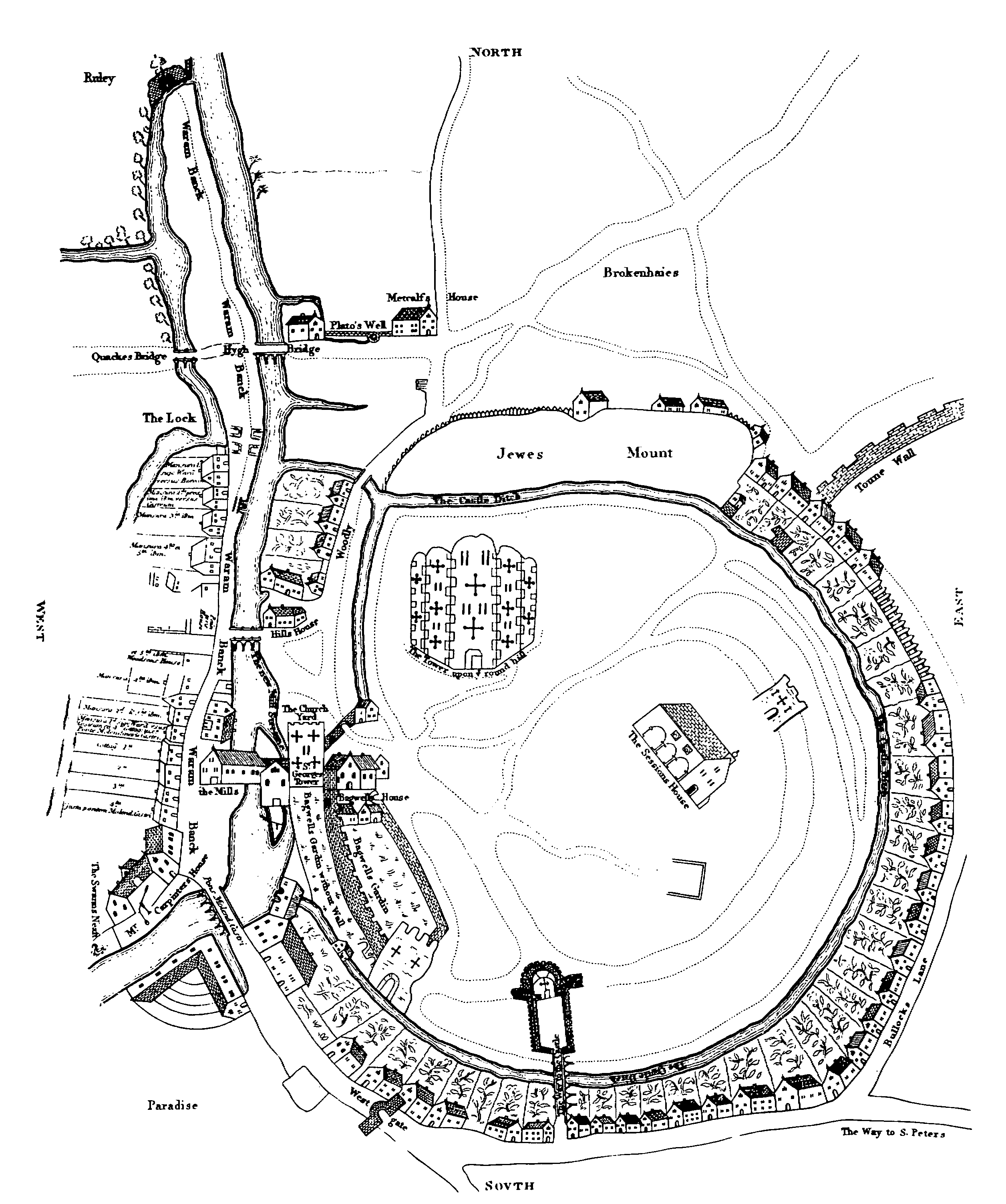
Plan of the Castle in the early 17th Century
from a map of c. 1617 in Christ Church archives
In the later 16th and early 17th centuries the prisoners included recusants (fn. 80) and debtors; among the latter was Sir William Cope of Hanwell, a prominent landowner. (fn. 81) In 1640 a number of north Oxfordshire constables were imprisoned there for resisting the collection of ship money. (fn. 82) During the Civil War prisoners of war from both sides were kept in the castle, mainly in St. George's tower. Unhealthy conditions, for which the royalist gaoler was blamed, apparently caused many deaths among the parliamentarian soldiers. (fn. 83) Quakers were imprisoned in the castle from 1658 onwards, one of them for five years (1661-6). (fn. 84) Some supporters of the duke of Monmouth were committed to the castle in 1685. (fn. 85) In 1690 a debtor complained that the debtors' prison was worse than a dungeon, and the keeper, Mrs. Thorpe, 'the Devil'; conditions in the felons' prison were as bad as they had been in the 1640s. (fn. 86) Among the 18th-century prisoners was a highwayman, Dumas, whose presence aroused considerable interest, particularly in the university, (fn. 87) and a Frenchman, John Peter le Maitre, alias Mara, imprisoned for theft of coins from the Ashmolean, who may have been identical with the revolutionary J. P. Marat. (fn. 88)
The gaol was housed in a building adjoining St. George's tower in the early 17th century, (fn. 89) and was unsafe in 1649; (fn. 90) the gaoler lived in a house beside the gaol. (fn. 91) In 1780 John Howard commented that the wards were so close and offensive that he would not be surprised if there was another Black Assize. The debtors' cells were too few and too small, male felons slept in a verminous dungeon with only a small window, and women in a windowless room 6½ ft. by 4 ft.; male and female felons shared a small day room. There was no infirmary, and no bath. (fn. 92) In 1784 the grand jury presented the prison as insufficient and in need of repair, (fn. 93) and in 1786 it was completely rebuilt (fn. 94) under the direction of George Moneypenny. A Benthamite visitor commented favourably on the new prison in 1790, when the prisioners were employed on the continuing building work or on mending the turnpike road. (fn. 95) The building was still unfinished in 1806. (fn. 96) The keeper's house stood in the centre of the new gaol, flanked by two wings of cells, one for debtors, and the other for felons and convicts; in St. George's tower were the dungeon and condemned cell. The house of correction for the county, added in 1788 (fn. 97) and comprising a men's wing and a women's wing, was behind the keeper's house. The gaol was surrounded by a curtain wall, and all the buildings had a 'very castellated appearance'. (fn. 98) The gaol, which could hold 133 prisoners in six classes, (fn. 99) was altered in 1819 and 1820, and two yards designed by Thomas Hooper were added. (fn. 100) In 1848 a new governor's house, designed by Benjamin Ferrey, was built outside the prison walls. (fn. 101) Between then and 1856 in order to make it possible to carry out the 'separate' system the whole prison was enlarged and remodelled under the direction of J. C. Buckler to plans by H. J. Underwood, (fn. 102) a new wing for women being completed in 1851 and one for men in 1855. (fn. 103) The enlarged prison could accommodate 218 male and 24 female felons and 133 male and 25 female debtors. (fn. 104)
The employment of prisoners, commended in 1790, had ceased by 1806, (fn. 105) and as late as 1857 a government inspector criticized the continuing use of the crank and a treadmill, which worked nothing so that the prisoners' labour was 'entirely thrown away'. (fn. 106) New and less stringent regulations for the prison were drawn up in 1809, (fn. 107) but were not put into effect completely. (fn. 108) About half the prisoners in 1820 were vagrants; others had been committed for poaching (38) and for various minor thefts (28). (fn. 109) In 1842 agricultural labourers formed the most numerous class of prisoners; the prison itself was then 'not in the worst rank of county gaols', although 'much below the best in point of accommodation and general arrangement'. (fn. 110) Later reports were more favourable. (fn. 111) In 1901 the prison contained 160 cells of which 26 were for women. (fn. 112) Women were not imprisoned there after 1924. (fn. 113) Serious overcrowding began at the end of the Second World War, (fn. 114) and by 1967 the average number of inmates (c. 270) was more than double the number for whom normal accommodation was available. (fn. 115)
A chapel for the prisoners was built, on part of the site of St. George's church, in the late 17th century, and was served occasionally by a clergyman paid by Sir Thomas Horde of Cote near Bampton, who had himself been imprisoned in the castle at the time of the Restoration. (fn. 116) Although a number of clergy, including John Wesley, (fn. 117) visited the prison during the 18th century no permanent chaplain was appointed until enforced by law in 1773. (fn. 118) A chapel was built in 1798 (fn. 119) as part of the new prison.
In 1621 and 1713 Thomas Whyte, (fn. 120) canon of Christ Church, and Thomas Horde, mentioned above, respectively gave rent-charges of £2 and £24 a year for poor prisoners. The second was to be distributed monthly, and in 1780 was only £1 13s. monthly. (fn. 121) John Swinton (d. 1777), chaplain of the prison, left the reversion of £100 stock as a bread charity for churchgoing prisoners. Catherine Mather by will dated 1805 left £400 to provide necessaries for the prisoners in the county and city gaols. George Powell (d. 1830), fellow of Brasenose College, left shares yielding £10 a year (not received until 1844) for poor prisoners who had been acquitted of the charges against them. Several colleges (Trinity, Exeter, Magdalen, Corpus Christi, Oriel, and Christ Church) gave doles or gifts of food, which in 1849 were commuted to money payments. Many of the gifts seem to have originated in the gifts or bequests of individual fellows, including John Claymond (d. 1537) first president of Corpus Christi. By a Scheme of the Charity Commissioners in 1873, altered by Schemes of 1879, 1886, and 1959, the goal charities were combined to form the Oxford County Gaol Benefactions, the income of which was to be applied to helping satisfactory prisoners on leaving the gaol, or to contributing to the funds of prisoners' aid societies, or reformatories for juvenile offenders.