
A History of the County of Shropshire: Volume 4, Agriculture. Originally published by Victoria County History, London, 1989.
This free content was digitised by double rekeying. All rights reserved.
'Domesday Book: 1750-1875', in A History of the County of Shropshire: Volume 4, Agriculture, (London, 1989) pp. 168-231. British History Online https://www.british-history.ac.uk/vch/salop/vol4/pp168-231 [accessed 23 April 2024]
In this section
1750–1875
The second half of the 18th century and the first three quarters of the 19th were a period of relative prosperity for British agriculture. At first export bounties helped grain prices to recover from the low levels of the earlier 18th century. (fn. 1) Subsequently population growth (fn. 2) (stimulated locally by industrialization) (fn. 3) and almost a quarter of a century of war (1793–1815) increased domestic demand for food and raised prices, rents, and land values to unprecedented levels. Inclosure was stimulated, arable farming expanded, and the new farming techniques devised in the arable parts of the kingdom spread widely; their adoption, perhaps later and more unevenly in Shropshire than in some other regions, (fn. 4) amounted to an agricultural 'revolution' which increased the productivity of the land and has given its name to the period. After the war the protection enacted in 1815 (fn. 5) kept up confidence in British farming; protection was strongly supported in the county (fn. 6) where, however, repeal of the corn laws in 1846 (fn. 7) did not, except perhaps briefly, (fn. 8) sap that confidence. Investment in feeds and fertilizers, buildings and machinery continued. Many of the succeeding generation of Shropshire farmers earned a good livelihood in the 1850s and 1860s from 'high farming', well suited to the county's mixed husbandry. (fn. 9) The great improvement in transport effected by the building of railways in the 1850s and 1860s (fn. 10) made distant markets more accessible to Shropshire produce. High farming, with its emphasis on the rearing and feeding of livestock, seems to have brought about some reduction of the county's arable acreage, particularly that under wheat, (fn. 11) a foreshadowing of the more drastic changes (arising from different causes) that came with the deepening depression of the 1870s. (fn. 12) Towards the end of the period, from 1865 to 1867, a very severe outbreak of foot and mouth disease caused much hardship in the north Shropshire dairying district, particularly among the smaller farmers. (fn. 13)
In Shropshire, as perhaps elsewhere, the period marks high summer in the influence of landed society. (fn. 14) The most prominent landowners controlled the county's representation in parliament, (fn. 15) took a leading role in county and local government, (fn. 16) and even continued to influence the affairs of the larger boroughs; (fn. 17) they led in sport and fashion. (fn. 18) Their influence rested mainly on agricultural prosperity and in turn, during George III's reign (fn. 19) and later, the example of the improving landlord came to contribute greatly to the progress of agriculture. The landlord's influence, however, was most effective when he resided on his property or was at least represented by an efficient agent. The dullness (fn. 20) and inconvenience (fn. 21) of country life in the later 18th century caused many landowners to spend part or (more rarely) all of the year in London or other fashionable towns. In the late 18th and early 19th century Joseph Plymley (later Corbett), landlord, magistrate, (fn. 22) churchman, and author of the 1803 General Survey of the Agriculture of Shropshire, pondered the varieties of social intercourse in the countryside, deplored such absenteeism, and noted the beneficial results of a good landlord's residence. (fn. 23) Gradually during the period, as transport and communications were improved, the disadvantages of living in the country were diminished. Prestige came to attach to agricultural improvement. Horses, ploughteams, cattle, and estate landscapes were painted by artists such as Thomas Weaver of Shrewsbury (1775–1844) (fn. 24) and, somewhat later, William Gwynn of Ludlow. Many landlords who set good examples of modern farming and breeding techniques were by no means averse to the acclaim they received.
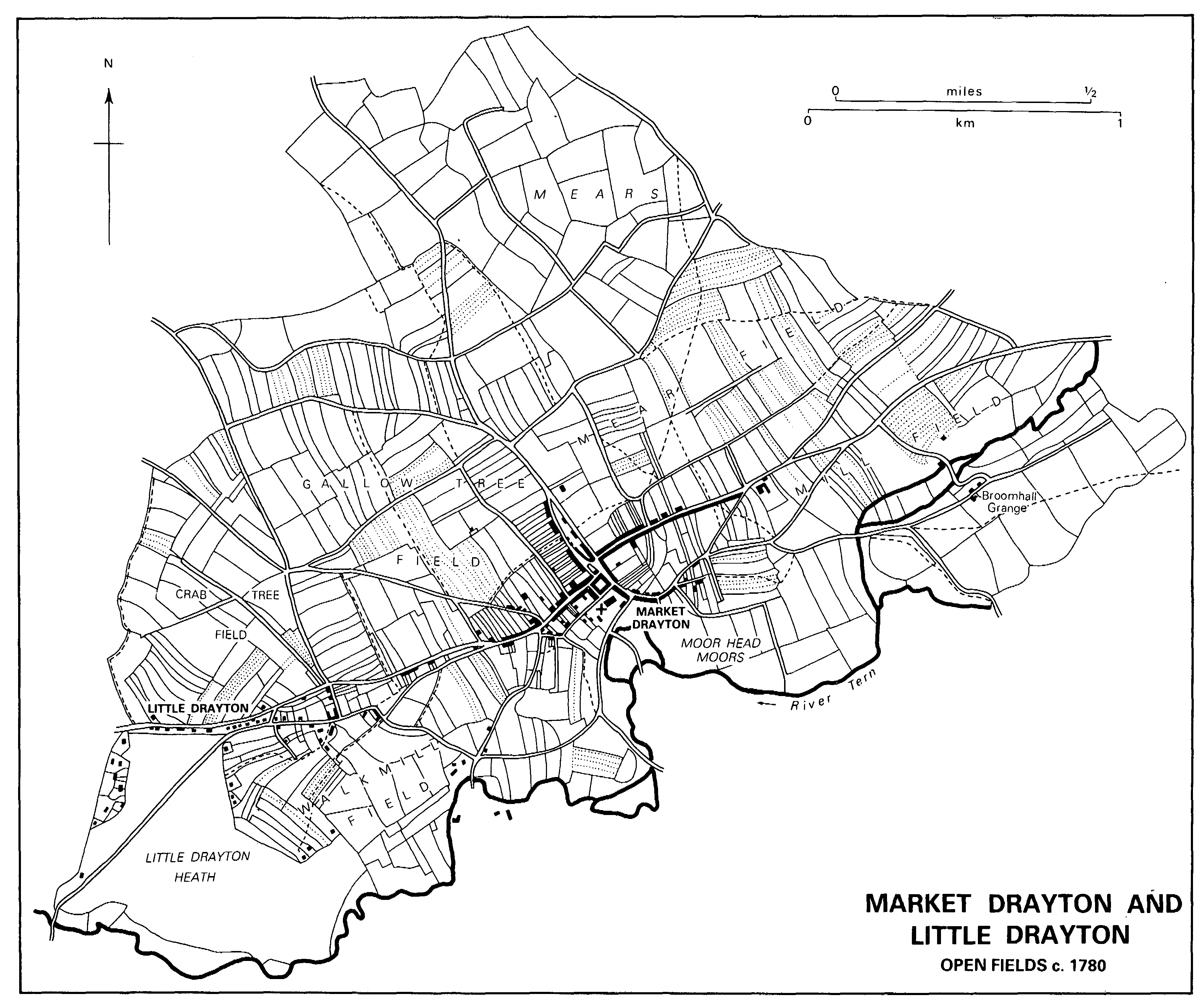
MARKET DRAYTON AND LITTLE DRAYTON open fields c. 1780
Based on S.R.O. 1096/1.
In many instances the improving landlord probably earned more in reputation than in cash profit, for many inventive and respected farming landlords—such as William Childe of Kinlet, William Wolryche Whitmore of Dudmaston, and the 2nd Lord Hill—left heavy mortgages to their successors. Only one large Shropshire estate, however, was broken up during the period (fn. 25) and one or two of the largest continued to expand. (fn. 26) Some smaller squires sold up or had retrenchment forced on them; paradoxically the fact that they were usually those who had lived beyond their means or inherited heavily encumbered estates is evidence of over-confidence in the considerable recuperative powers of the landed estate. Land that came up for sale did not wait long for purchasers. Few country houses went out of use; (fn. 27) indeed new ones were built and many older ones rebuilt or altered.
Shropshire farmers, whether freeholders or rack tenants, enjoyed a share in the period's prosperity. Many farmhouses were built or altered, and better furnished, for a more genteel type of family. (fn. 28) Many farmers spoke at agricultural meetings on equal terms with their landlords, (fn. 29) and by the 1870s they were beginning to take an independent line even in politics. (fn. 30)
Save in exceptional circumstances the farm labourer did not share in the prosperity. Wages were kept low and the general standard of housing was very bad. The working life was long, and after 1834 the threat of the workhouse overshadowed the old age or impotence of all but those who had been most fortunate or rigidly provident. Almost all other work was more eligible than farm labouring and, whether or not mechanization was involved in the process, most rural parishes (especially in the south) lost population. (fn. 31)
Inclosure
Even at the end of the Middle Ages Shropshire was an area of old inclosure, and by the mid 18th century the work of two more centuries had further diminished the extent of the open fields and common wastes. (fn. 32) Thus it is hardly surprising that parliamentary inclosure was relatively insignificant in the county, as it was in all the counties on the western border of England. (fn. 33) Nevertheless, in what was to be the last phase of inclosure, (fn. 34) a very considerable quantity of Shropshire land was dealt with. By parliamentary methods almost 7½ per cent (63,775 a.) of the county area was inclosed (Table VIII) and, as in earlier periods, there were many inclosures by private agreement. Fifteen private agreements leading to awards made 1787–1835 and deposited with the clerk of the peace dealt with 4,874 a. (fn. 35) Eleven of those agreements belonged to the years 1806–15, (fn. 36) and the war years had seen many other small inclosures without recourse to parliament or trace in the clerk of the peace's records. Indeed during the war private agreement seems to have been the normal method. (fn. 37) A thousand acres in the manors of Child's Ercall and Howle, for example, were privately inclosed in 1801, (fn. 38) while at Bronygarth, in St. Martin's, a 'large quantity' of waste land, and at Aston on Clun a 160-a. common, were similarly divided and allotted. (fn. 39) Such inclosures, however, unrecorded by the clerk of the peace, were by no means confined to the war years: for instance, the only record of the disappearance of Farley common (58 a. inclosed in 1818), in Much Wenlock, is a private deed. (fn. 40) Dates are sometimes hard to establish: all that is known of the end of Presthope common in the same parish, 14 a. in 1769, is that it was inclosed by 1846. (fn. 41) If all inclosure agreements that did not find their way to the clerk of the peace's office may reasonably be supposed to have brought the total of Shropshire land inclosed between 1765 (fn. 42) and 1891 (fn. 43) to approach 10 per cent of the county area, (fn. 44) then that was an acreage approximating to that of the southern division of Bradford hundred. (fn. 45)
Sources: below, Table IX; Tate, Domesday of Eng. Encl. Acts, 223–7, supplemented by S.R.O., incl. awards A 13/2, 14/5, 5/13, 18/51, 17/53, B 11–12, 14, 24, 29, 33–5, 38–40, 42, 44, 46, 49, C 4/36, 3/43. Where no extant award is known acreages have been estimated from S.R.O. 81/309; 1900/3/29–36 (for Newport); S.R.O. 1709, box 203, copy map and ref. on incl. of Long Mynd and Picklescott Hill; 299/1/1, nos. 4–5, 14–16,35–6,41–3, 150–260; 1/2, no. 1411 (for Ch. Stretton); S.R.O. 32/1–2 (for Siefton forest); and S.R.O. 3121/1 (for the Weald Moors). The acreage for Hine and Shawbury heaths, etc., is that stated in 37 Geo. III, c. 109 (Priv. Act), that for Upton common, Shifnal, is that stated in 53 Geo. III, c. 17 (Local and Personal, not printed).
aIncluding 579 a. inclosed in Sheriffhales, part of which parish was in Staffs. until 1895, but excluding inclosures in Oldbury, transferred to Worcs. in 1844.
Shropshire open-field land inclosed by Act amounted to some 2,500 a. (Table IX). (fn. 46) The figure, though to an extent artificial, (fn. 47) is unlikely to have been exceeded very greatly in fact. Two considerable areas of open-field land were inclosed by private agreement in 1775–7 (at Siefton) and 1813 (at Sheinton), (fn. 48) but by the late 18th century changes on such a scale normally made it desirable to have an Act. Where there were numerous freeholders a pattern of landowning sometimes survived which preserved the shapes of the open-field strips. That seems to have happened in Minton where, in 1822, 41 a. of strips were abolished by exchanges under an Act of 1816. (fn. 49) When no Act was procured, as in the case of Market Drayton, (fn. 50) a complicated pattern of landowning might well survive for very many years. (fn. 51) The late survival of open fields, however, cannot be assumed from every example of intermixed landowning (fn. 52) or of rationalization by exchange. (fn. 53) The inclosure of 2,500 a. of open-field land in the county was spread over six decades (Table IX), extents of land and time that do not corroborate the suggestion that parliamentary inclosure of open fields was a rapid response to a general crisis in open-field agriculture, (fn. 54) though corroboration could hardly be expected from Shropshire where such a crisis would have had minimal effects.
Sources: S.R.O., dep. plans B 1, B 9, C 1/48,C 2/47; q. sess.rec.parcel 283, reg. of enrolled incl. awards, pp. 25–49; S.R.O. 3879/Enc/1–3; 3880/Enc/1–3.
aNot counting land inclosed before the awards but included in them. Three townships in the 7 awards here tabulated had no open-field land inclosed; though not tabulated here, their acreages contribute to the total of 5,500 a. inclosed under the awards. They are Knockin (where 27 a. were inclosed in 1813), Morton in Oswestry (66 a. in 1813), and Hopton in Stanton Lacy (54 a. in 1828).
Thus almost all Shropshire land inclosed during the period was common waste, and the sequence of inclosures in the county helps to substantiate the suggestion that commons inclosure spread from one region to another as its effectiveness was demonstrated locally. (fn. 55) If, as seems reasonable, the sequence of parliamentary inclosures may be held to represent that of all inclosures, by whatever method, then from the 1760s to 1820 there was almost four times the amount of inclosure in north Shropshire as in the south (Fig. 12). (fn. 56) Despite the serious drainage costs involved in some cases, the heavier clay soils and the peat mosses in the north seem to have been inclosed first, doubtless because of their great potential fertility. One of the largest of those tackled was the extensive Baggy Moor in the Perry valley; 1,283 a., formerly under water every winter, were drained under an Act of 1777 and made valuable. In a later phase of inclosure in the north, as war and dearth forced up grain prices, the less fertile but more easily tackled heathlands were dealt with. (fn. 57)
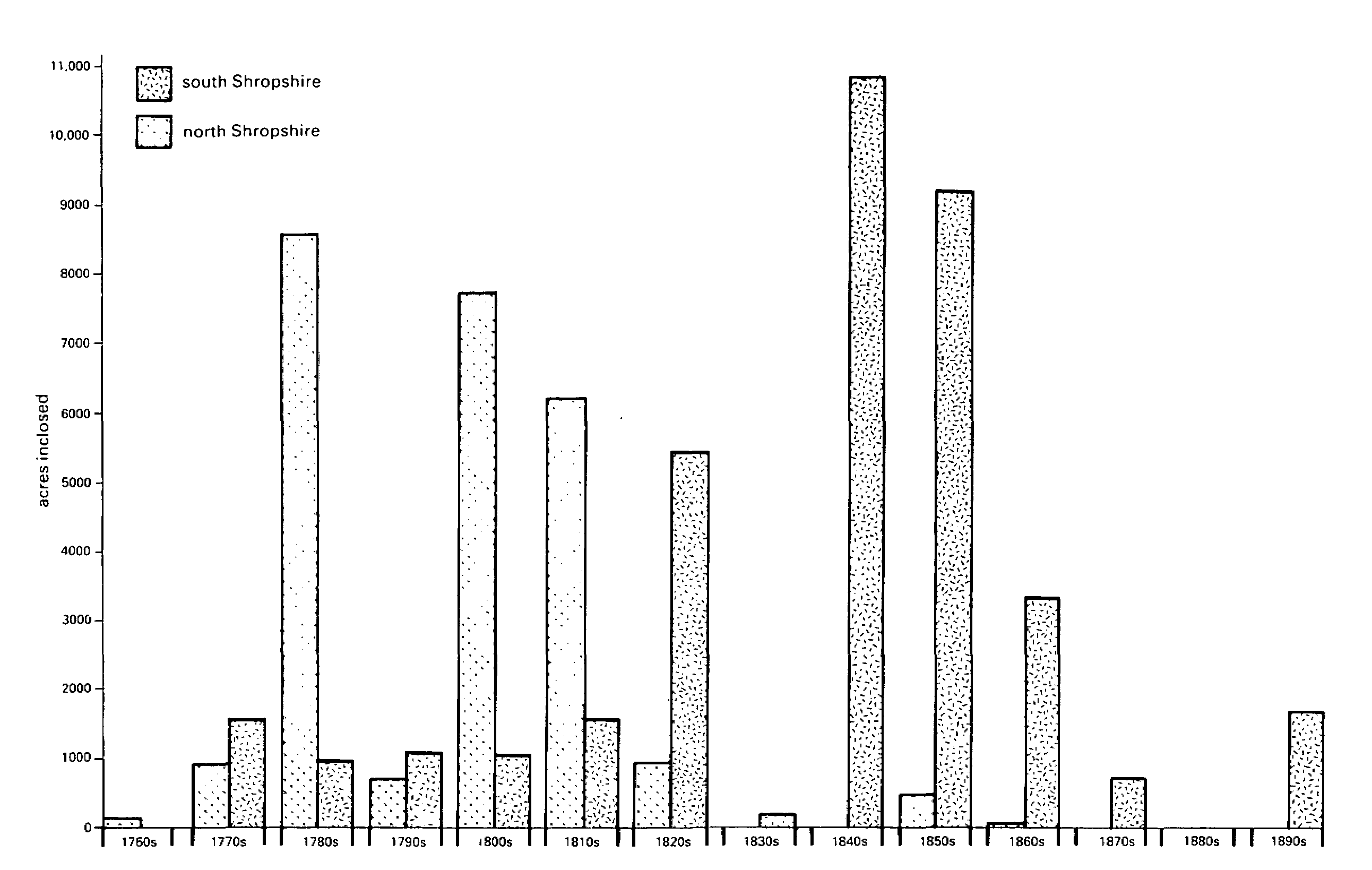
Parliamentary Inclosure 1765–1891 Based on sources cited for Table VIII.
By 1820 north Shropshire landowners had inclosed more than 24,000 a. by Act (Fig. 12). Thereafter, as the Shrewsbury solicitor and banker Thomas Salt testified in 1844, there were very few commons left in the north though large uninclosed areas survived in the south. (fn. 58) During the seventy-odd years from 1820 almost all parliamentary inclosure was confined to the extensive hills of the south-west and the south-east where, earlier, inclosure had seemed unprofitable. (fn. 59)
The profitability of inclosure in the south was not in doubt by the 1840s. Much was then being done: nearly 11,000 a. were inclosed by parliamentary means during the decade, and there were high expectations of profit. The possibilities had been long forseen. In 1760 Clun forest had been advertised to be 'as profitable a sheep walk as any in England' and it was claimed that 'great advantage' might be made of it by 'inclosing, ploughing, and sowing acorns, granting sheep walks, or making advantageous leasows for improvements'. Expectations of profit after inclosure were apparently well founded. Good land inclosed from Clun forest increased in annual value from 2s. or 3s. an acre when it was open sheep pasture to 10s. or 12s. by 1844 when inclosure was nearly complete; some of it was then growing oats, rye, and turnips or, in lower situations, wheat. (fn. 60) Francis Marston of Aston on Clun, a landowner and farmer with much experience of inclosure, (fn. 61) considered that open commons were worth nothing, indeed—conventional wisdom by Plymley's time—that they had a deteriorating effect on neighbouring inclosed lands. That was partly because they discouraged farmers from thinking of their closes as anything but winter pasture, so that they were left uncultivated, and partly because sheep commoned on open land could not effectively be fenced out of the neighbouring closes where they did much damage. (fn. 62) Crime, particularly the theft of livestock, was alleged to be another characteristic of the open commons that was injurious to farming. (fn. 63) Inclosure, Marston testified, more than doubled the value of the closes adjoining the former commons because they could then grow green crops, an important new element in improved livestock husbandry. (fn. 64)
Improvement of livestock by good feeding and controlled breeding was a most important development in 19th-century farming, (fn. 65) and there too the open commons obstructed progress. The small 'common sheep' of Shropshire did not prosper when turned out on the common; farmers never sent breeding ewes there, only wethers, and they came down 'very poor indeed', often in worse condition when they were gathered in at Michaelmas than when they had gone out in the spring. In south-west Shropshire the farmer's motive for pasturing his sheep on open land was not an economic one: all had to do it in order to preserve their common rights as long as the land remained open. (fn. 66) At Aston on Clun sheep profits more than trebled after inclosure. (fn. 67)
Particularly in the uplands of south Shropshire the greater part of the newly inclosed commons became separate pastures, (fn. 68) but some common land, even in the hilly districts, was capable of cultivation or conversion to meadow. Good grain was grown c. 1800 on parts of the Long Mynd inclosed in 1790 (fn. 69) and, as has been seen, cultivation was extended into Clun forest in the 1840s. Francis Marston, an enthusiast for inclosure, urged the cultivation of oats on high land; the conversion of wild land on the slopes of hills to water meadows, as had been done with the lord of the manor's permission in Clun forest even before inclosure was completed; and, wherever there was soil and an absence of rock, the extension of cultivation up the slopes even of commons as high as Clunbury common and the Long Mynd. (fn. 70)
Parts of one or two inclosures made during the period were used to round off a
park or extend plantations, as at Sansaw in 1783, where the western side of Sansaw
heath was added to Sansaw park, and at Wootton Fawnog near Oswestry, part of
which was planted after inclosure in 1789. The Revd. Samuel Wilding, owner of
a substantial estate at All Stretton, planted part of the newly inclosed northern
edge of the Long Mynd with oak after the inclosure of 1790. At Leaton a small
part of the southern edge of Leaton heath (inclosed 1813) seems to have been
incorporated in the Leaton Shelf plantations stretching north from Leaton Knolls (fn. 71)
and in a similar way perhaps part of Winscote heath was added to Apley Terrace
plantations extending south from Apley Park. (fn. 72) Plymley, enthusiastic advocate of
inclosures though he was, yet acknowledged his regret that 'a great deal of beauty'
was often spoiled by them:
it seems a pity to lose scenes of pure Nature, in a country so artificial as that of South Britain.
This applies chiefly to very large wastes, for instance, Clun forest... is a fine specimen of smooth
and extended turf, with every variation of swelling banks and retired dingles.
A later age might agree with his aesthetic sentiments (fn. 73) but in the utilitarian
1840s Francis Marston uttered a perhaps more prevalent opinion, that inclosure
and plantation made the land more useful and no less fair: he considered that the
side of Clunbury Hill and the whole top of the Long Mynd should be planted to
increase their utility and beauty and at the same time to improve the local climate. (fn. 74)
The main deterrent to inclosure was expense. (fn. 75) In 1796, when Andrew Corbet of Acton Reynald had the open wastes on his estate surveyed and found that some 2,380 a. might be inclosed for him, it was noted that some of the smaller landowners were against inclosure by Act. Tact and caution were necessary (fn. 76) and four of the twelve townships were left out of the Act procured next year and were dealt with privately. (fn. 77) During the early 19th century professional and legal costs, especially perhaps those involved in parliamentary inclosure, were increasing. The smaller owners were those who faced the most difficulty over costs. In the private inclosures of the early 19th century very many small owners evidently failed to secure fair treatment, though at Aston on Clun, where the large commoners kept the small ones off the common, it was only at inclosure in 1804 that the small men's rights were duly acknowledged by allotments inclosed from the common. (fn. 78) Sometimes road making cost a good deal. (fn. 79) Fencing was another potentially large expense (fn. 80) for all owners of newly inclosed land, though local resources occasionally reduced the cost: on the Baggy Moor, for example, wide drainage ditches were made to serve as fences in the late 18th century, (fn. 81) and at Bronygarth there were plentiful supplies of stone to hand in 1804. (fn. 82)
In rural England at least (fn. 83) it might still be maintained in the earlier 1840s that the public—as distinct from the lord of the manor, the owner of the soil, and the commoners—had no rights deserving consideration on inclosure. (fn. 84) There was nevertheless a growing feeling that some part of common land, even when it was far from large towns, should be devoted to public and recreational purposes at inclosure. In Shropshire an early voluntary example of such provision was Richard Reynolds's assignment of parts of his manorial waste and woodland around Coalbrookdale for public recreation. (fn. 85) The 1845 Inclosure Act empowered the Inclosure Commissioners to allot recreation ground when unstinted commons were inclosed, (fn. 86) and out of the 8,208 a. of Clun forest inclosed in 1847, besides the provision of 35 miles of public roads 30 ft. wide and the allotment of 21 a. to the highways surveyors as stone quarries, gravel pits, and public watering places for cattle, 5 a. were allotted for the building of a parochial chapel and curate's house at Newcastle, plots amounting to 1½ a. for schools at Newcastle, Whitcott Keysett, and Mainstone, and 1 a. for a public recreation ground in the Vron promontory fort, Newcastle. (fn. 87) Such provision, though small, was probably fairly typical of the standards prevailing in the mid 19th century. (fn. 88) Only one Shropshire inclosure was effected after the passing of the 1876 Commons Act which, for the first time, required the Inclosure Commissioners to make provisions for the benefit of the neighbourhood. (fn. 89) It was that for the Llanfair hills (1,634 a.) in 1891, in which 15 a. were allotted for labourers' 'field gardens', 10 a. beneath the summit of Llanfair hill were allotted as a parish recreation ground, and the 1½-mile stretch of Offa's Dyke that passed through the newly inclosed land was preserved as a public footpath. (fn. 90)
The Agricultural Revolution
Inclosure of land and rational consolidation of estates by exchange were essential prerequisites for the advancement of arable and livestock-breeding techniques. Without convenient field boundaries the progressive farmer could neither improve his livestock nor derive any advantage from new crops and crop rotations, underdraining schemes, or the expense of applying fertilizers. With fences in position, however, the county's agriculture was set for 19th-century progress as improved scientific farming began to displace outmoded methods. In Shropshire, as elsewhere, convertible, and eventually alternate, husbandry (fn. 91) were practised more widely and skilfully as the new feeding and breeding (fn. 92) techniques and new fertilizers became available. The consequent increase in the productivity of the land—the very essence (fn. 93) of the Agricultural Revolution—led to the mid 19th-century period of high farming, for which Shropshire's mixed farming practices were peculiarly well adapted.
On the lighter soils of eastern England the practice of alternate husbandry, interspersing temporary grass and clover leys and turnips (fn. 94) with the more demanding corn crops, had been employed from the late 17th century. (fn. 95) In a typical fourcourse rotation the well manured turnip crop prepared the soil for the following season's barley, after which a one-year clover ley restored nitrogen to the ground (fn. 96) for use by the next year's wheat. Such a system kept the soil in good heart, provided valuable fodder for livestock, and eliminated fallowing. The new techniques spread from east to west; that seems no less true of Shropshire, whose light eastern soils were best adapted to the improved husbandry, than of the country as a whole. (fn. 97) At the time of Arthur Young's visit to Shropshire in 1776 elements of alternate husbandry were already present, and it was particularly in the east that he found clover leys on the farms which he visited and turnips cultivated on the lighter soils. At Benthall, for example, turnips were sown in well prepared ground that had been ploughed four times and received heavy dressings of dung and lime. (fn. 98) In some other places, however, the fallows were still being preserved and taking as much fertilizer as the growing turnips: at Cruckton and Petton they received 1–1½ wagon load of lime an acre in addition to farmyard manure. (fn. 99) Nowhere in the county did Young record the strict Norfolk four-course rotation, though then, or soon after, John Bishton of Kilsall was using it on the eastern edge of the county and it was in use in the hilly south Shropshire parish of Hope Bowdler by 1793. (fn. 100) By the 1790s in fact various rotations were in use and adjustments to suit terrain and the farmer's preferences had lengthened them to six or seven courses. (fn. 101)
In the years following Young's tour the new rotation crops, which had been known in Shropshire before, gained further popularity, though dissemination of new ideas was uneven. (fn. 102) Clover in 'old' and 'new' ricks had been offered for sale at Edgmond in November 1778 while rye grass, in two stacks, was on sale at Ensdon House, Montford, in March 1781. (fn. 103) It was after the late 1780s, however, that stacks of rye grass, and especially clover, formed a regular part of farm-based dispersal sales. Advertisements for turnip seeds, of the Norfolk Ox and Stubble varieties, appeared in the local press, (fn. 104) and their cultivation was no doubt stimulated by the offer of awards for the best crops, such as those given by the 2nd Lord Clive to his turnip-growing tenants on the Walcot and Montford estates. (fn. 105) Peas, which had been included in several of the rotations noted by Young, continued to spread in popularity in a manner not seemingly matched in other counties. Plymley, when discussing commonly cultivated crops, claimed that peas were 'more grown upon our sound soils than any other county'. (fn. 106) Like turnips they could be hoed, so restricting weed infestation, while they also shared the nitrogen-fixing benefits of the clover ley.
From the 1790s Bishton, Plymley, and others lent support to the enlightened system of alternate husbandry. It was, however, more in the nature of a recommendation than an observation of the county's common standard. Several alternative rotations were noticed, generally of five to seven courses, along with one designed to improve wheat lands that ran to nine years and was one of several to retain a fallow and three summer ploughings, harrowings, and rollings. To that requirement was often added an earlier ploughing during the previous winter, so elevating a 'tolerable' fallow to the status of a good one. (fn. 107)
The successful cultivation of turnips within a rotation was never an easy task on those Shropshire farms with a heavy, unyielding soil. The potato, which was gaining in popularity for both animal and human consumption, was suggested as one alternative by John Cotes of Woodcote in two letters to the Board of Agriculture in 1800–1. He drew on personal experience, having partly planted his fallow with potatoes, and he contended that with adequate manure they would not impoverish the soil. (fn. 108) Within a generation further alternatives were provided by the more adaptable swede and the hardier mangold-wurzel: in December 1832, in the earliest noticed reference to Swedish turnips and mangold-wurzels, Lord Kilmorey offered 700 measures of mangolds and 11 a. of Swedish and Scotch turnips for sale at Shavington farmyard. (fn. 109) Both roots were to gain in popularity during the 19th century.
Elsewhere in the county other fodder crops were being tried. By the 1770s cabbages were being grown for stall feeding to cows, as Arthur Young observed at Mr. Badder's farm at the Bank, between Cruckton and Shrewsbury. (fn. 110) Subsequent newspaper advertisements attested the seedsmen's claim that 50–60 lb. specimens were attainable. (fn. 111) Vetches, mentioned c. 1800 as being used for the soiling of horses, (fn. 112) were another leguminous crop capable of improving land and being made into hay; a crop was offered for sale at Condover in 1798, the earliest noticed mention in a farm sale advertisement. (fn. 113)
The 1801 crop returns, (fn. 114) though deficient for large areas of eastern and northwest Shropshire, (fn. 115) show that turnips and rape were then being grown in appreciable quantities virtually everywhere in Shropshire. So were peas, but peas were a well established rotation crop in the county (fn. 116) and it is clear that they preponderated over turnips and rape in the south-eastern parts of the county—the hop-growing district adjoining Herefordshire and the higher, relatively backward Wheatland to the north. The largest quantities of turnips and rape were naturally grown on east Shropshire's light sandy soils, and it was there that they greatly outweighed peas in importance. Beans were recorded in only two dozen of the 141 places for which returns survive; only eight places grew 10 a. or more. Potatoes were grown in 131 of the places with extant returns and in most parts of the county. Though potatoes were useful as animal feed and a rotation crop, acreages were fairly small. (fn. 117) The largest acreages were grown conveniently near the populous areas of Shrewsbury and the east Shropshire coalfield, probably an indication of the potato's increasing use to feed the poor: 'it has been the chief means of their support', it was reported from Longford, for bread corn and butcher's meat were beyond them 'and nothing will tend more to check the exorbitancy of the farmer than attention to the cultivation of this nutritious root'. (fn. 118)
During the years 1793–1815 there was a great extension of cereal farming, notably of barley growing on the newly inclosed heaths of the north (fn. 119) and of wheat in the Wheatland of the south-east; (fn. 120) even steep former waste land, as high as 200 m. or more and in the wetter north-west, could be made to yield profitable crops of wheat and oats. (fn. 121) War and bad harvests, pushing corn prices up to unprecedented levels, were the causes. (fn. 122) By 1801 wheat (40,425 a.) was much the most important cereal crop in Shropshire, and in the south-eastern parishes, even in the hop country, it occupied very high proportions of the cereal acreage. Oats (22,520 a.) were grown widely in south Shropshire and apparently in the northwest too; in those areas they occupied the biggest proportion of the cereal acreage in areas of high land where cereal acreages were small and other grains would not do. In the northern dairying district, another area where arable acreages were Vignette, naive in style, of farm work in north-west Shropshire. The harvest is being got in, cart-horses watered, pigs fed, and a cow milked. small, oats were grown perhaps as horse feed or as a bread corn for Cheshire and Lancashire. (fn. 123) In 1801, as in earlier periods, (fn. 124) rye seems to have been grown mainly in east, central, and north Shropshire, areas where barley too was grown, though rye (probably under-recorded at 556 a.) was the least important cereal (fn. 125) and barley (23,466 a.) the second most important and increasing in importance; (fn. 126) barley was also grown in the south-west around Bishop's Castle and Hopesay.
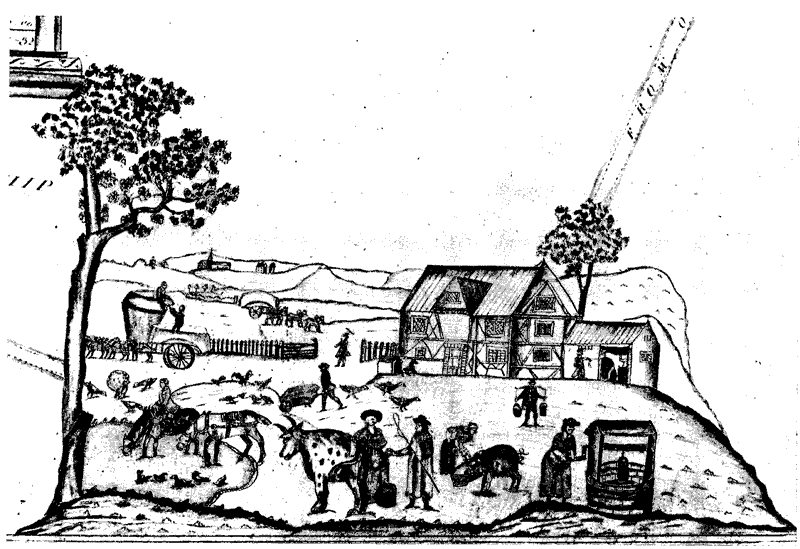
The Fords Farm, Twyford, 1797 Vignette, naive in style, of farm work in north-west Shropshire. The harvest is being got in, cart-horses watered, pigs fed, and a cow milked. The Fords (120 a.), had belonged to the Lloyds, a yeoman or minor gentry family, for generations; Samuel Lloyd owned it in 1797. The drawing is on the edge of a map.
Arable extension during the years of dearth and war, 1793–1815, greatly assisted the progress in Shropshire of that mixed farming which combined cereal growing with the keeping of sheep or cattle or both and which, because there was no general arable shrinkage in the county after 1815, was to lead eventually to the high farming of the mid 19th century. (fn. 127) Though the techniques of alternate husbandry were practised with more and more sophistication as the new root and green rotation crops spread, the story revealed by local evidence is not simple. Ford, for instance, was chiefly an arable parish in the 1790s, (fn. 128) and one of the best farmers in the area regularly grew enough potatoes to feed his livestock and, during the famine of 1799, to sell several thousand bushels for pauper consumption. In 1800 the perpetual curate campaigned for more potato growing to relieve famine, provide animal food, and prepare the soil for wheat, (fn. 129) but in 1801 only 4 a. in the parish grew potatoes. (fn. 130) The undoubted conservatism of the local farmers' attitude to the potato (fn. 131) cannot wholly explain the discontinuities of the local story. The heavy dunging which the potato required caused some prejudice against it as an 'exhausting crop', (fn. 132) but even that does not seem to explain the grassing down which appears to have been taking place. In 1801, a year of excellent harvests, a succession of disastrous crop failures with consequently high cereal prices was still a recent experience; even so in Baschurch the tillage was estimated at only one third of the average, and the perpetual curate of Ford opined that nationally the diminution of arable by grassing down more than balanced the additions made by inclosure: in his own parish and many adjoining ones he observed that 'great quantities' of land formerly growing grain had lately been converted to pasture and hop-yards, the latter engrossing the local supply of dung so that arable lands suffered from want of manure. (fn. 133) The truth seems to be that farmers were very ready to cultivate whatever seemed to promise quick profits. Hops were planted in Ditton Priors too, though with disappointing financial results, and the increasing importance of barley as a north Shropshire crop seems to have owed something to the maltsters' needs. (fn. 134) Nevertheless, in spite of local fluctuations and notwithstanding the vagueness of the available evidence, (fn. 135) there does seem to have been a steady general increase of arable. In Ford it may have tripled between 1801 and 1847 (fn. 136) and the parish was by no means untypical: for example the balance was tipping in favour of arable in Wrockwardine 1801–37, (fn. 137) and at Woolstaston the arable acreage more than tripled in the last quarter of the 18th century and almost doubled again 1801–40. (fn. 138)
With the fall in cereal prices after the end of the war some of the new arable lands seem to have been returned to grass; probably, however, they were the rougher, more marginal ones impoverished by overcropping. In fact far from there being any general post-war grassing down of arable it seems rather that tenants had often to be forbidden to replough the newly grassed marginal lands. Landlords who supervised rotations had often to prohibit tenants from ploughing up permanent pasture for, as corn prices fell after 1815, many farmers who had come to rely on corn crops for cash during the years of high prices were trying to keep up their income by extending tillage. (fn. 139)
Maintenance of the arable acreage helped to accommodate the techniques of alternate husbandry which, along with all forms of agrarian improvement, (fn. 140) were making headway in the post-war period. Already by 1820 it seems that Norfolk practices—the crop rotation and ploughing technique—were coming in, (fn. 141) even in parts of south and west Shropshire, (fn. 142) though presumably only on farms suited to it. There, by the 1830s, land lettable at only 8s. an acre was cultivated on a threecourse rotation, though sometimes with two white crops in succession. It had for the most part been first cultivated after c. 1760 and some of it had paid 16s. rent during the war. It was the lowest quality land cultivable (annual rent for Shropshire arable then averaged 25s. an acre), yielding 9 bu. of wheat an acre (after a bare summer fallow) or 12–15 bu. of oats, and growing green crops and (after liming) turnips, though peas and beans only indifferently. Eight-shilling land could not be made to pay its rent but it hardly ever made up a whole farm and in the new mixed-farming systems it could contribute to the overall profitability of a farm by, for instance, providing straw for livestock. (fn. 143) By the 1840s much of the overcropped land that had had to be grassed down in the county after 1815 was evidently considered fit to be ploughed again and incorporated in a balanced system of alternate husbandry. (fn. 144)
By the 1850s unwieldy rotations had been replaced in almost all parts of the county by Norfolk or Northumberland ones of four or five courses in which no land had to endure corn crops in successive years. Nevertheless the amount of fallow ground long remained extensive, especially on the stiffer, heavier soils in the west and south-east. Bare fallows seem to have amounted to over 14 per cent of the county's arable acreage in the 1830s and to just over 7 per cent in the 1850s. It was then declining in virtually every area except the Wheatland of the southeast, to be replaced by roots—mangolds, swedes, potatoes, and turnips—on drier ground, and green crops, such as rape and vetches, where the land was wetter. Peas and beans were less frequently found and were often grown only as an alternative to a clover and rye-grass ley. By the early 1870s bare fallows accounted for little more than 4 per cent of arable. The more productive rotations and techniques, developed first on light lands, had been extended more and more generally as a result of improved methods of fertilizing and draining and the consequent extension of the growing and working seasons. (fn. 145)
The late 18th-century farmer had a range of traditional fertilizers to draw on. In the 1790s dung, highly prized, was applied to fallows or root ground at 10 cu. yd. an acre, (fn. 146) and additional supplies were often sought to supplement the farm's own production. The street soil and night soil of towns and populous places was collected for farm land: by 1776 farmers in Petton were accustomed to buy manure from Shrewsbury, 15 km. away, at 5s. a cart load, and in Great Dawley a farmer was contracting to take the street soil away c. 1781. (fn. 147) About 1800 lime, though costing between 10s. and 12s. a wagon load (of 40–50 bu.), was used extensively on arable land, where it was usually spread at 72–80 bu. an acre. (fn. 148) Also used were soot, as a dressing for wheat (as at Benthall) and grass (as at Petton) in the 1770s, (fn. 149) and marl; the labour of digging marl, however, and the cost of its transport were persuading farmers to try lime instead, though marling was kept up around Preston Brockhurst, for example, where the soil was sandy. (fn. 150)
From the 1840s a combination of agricultural science and improved sea transport brought the farmer new alternatives in soil treatment. The experiments of a German chemist, publicized in 1840, (fn. 151) attracted attention at about the same time that J. B. Lawes began to produce superphosphate at his Deptford factory in 1843. (fn. 152) That low-cost substitute for crushed bone spread into the county early. Its presence no doubt stimulated two of Shropshire's progressive agriculturists, T. C. Eyton (fn. 153) of Donnerville and William Wolryche Whitmore of Dudmaston, into conducting their own experiments in bone-based manures: Eyton (like Lawes) tried the action of sulphuric acid on bones to make a fertilizer, reputedly costing ¼d. a bu., for turnip crops, while Whitmore produced various artificial manures from bones and charred vegetable refuse. Both men communicated their results to the Royal Agricultural Society. (fn. 154)
Rising to popularity as a fertilizer during the same period was guano, which consisted largely of sea birds' droppings; imported from the Peruvian coast, on many Shropshire farms it provided the organic partner for superphosphates. Sir Baldwin Leighton and his father-in-law T. N. Parker, of Sweeney, saw it at the Royal Agricultural Society's Liverpool show in 1841 and Leighton then thought that, at £25 a ton, it was 'almost too high' to come into general use. Nevertheless guano's rise to popularity was swift, with national imports increasing from just 1,700 tons in 1841 to 220,000 tons only six years later. (fn. 155) During that period it had already made its way into the county, (fn. 156) where it was commonly applied to root land and as a top dressing for wheat at a rate of 2–3 cwt. an acre. (fn. 157) By 1844 African guano from Liverpool docks cost just over £9 a ton. (fn. 158) Along with guano, British ports were also admitting increasing quantities of Chilean nitrates, and, from the 1860s, German potash as the pace of the fertilizer revolution quickened. (fn. 159) Despite the undoubted benefits of the new fertilizers, farmyard manure was still highly prized, and highly spoken of, for its contribution to the rotation. Nevertheless in 1858 Tanner considered that the management of dung was generally 'too much neglected' (fn. 160) and its management and application formed the subject of a talk to the Wenlock Farmers' Club in 1868. (fn. 161) It was applied to green crops in the 1850s at 7–8, and to roots at 12–16, cu. yd. an acre. To supplement this home-produced fertilizer, guano and superphosphate were commonly applied by broadcasting and drilling respectively. (fn. 162)
On the heavier land the full benefit of expensively purchased new fertilizers could be realized only after draining, when root growth was no longer checked by cold waterlogged conditions. Underdraining had been practised in Shropshire since the later 18th century. At first, however, it was undertaken only by the 'gentlemen' and 'best farmers', who could afford the high costs associated with the improvement. (fn. 163) For the installation of stone drains a cost of 6d. per 8 yd. was given c. 1800. (fn. 164) Despite that, and despite the far from prosperous years that followed the peace of 1815, large drainage schemes were undertaken by, for example, the marquess of Stafford's tenants, with Cheswell Grange farm receiving 34,000 yd. of new drains in the three years before 1820. (fn. 165) William Childe of Kinlet extended his demesnes and drained his large home farm, thereafter, in the years 1817–21, applying some 15,000 cartloads of burnt clay to cold fallows (for wheat, turnips, and cabbages) and to meadow and pasture; the effects were very good and were well publicized by the Kinlet annual sale and agricultural meeting. Later the Hon. R. H. Clive carried out extensive drainage schemes on his estates around Bromfield and in lower Corve Dale, and his progress was regularly reported to the Royal Agricultural Society in the late 1830s and early 1840s. (fn. 166) By 1843 Sir Francis Lawley too had achieved much in the way of draining on his Bourton estate near Much Wenlock. (fn. 167)
Most of the heavy land in need of draining was incapable of benefiting from the timber- or stone-filled drains which were liable either to collapse or to become clogged and eventually to require attention. During the 1840s, however, and contemporaneously with the changes in the use of fertilizer, there came a new era of underdrainage. In 1843 a cylindrical clay land-drainage pipe was produced, and two years later a pipe-making machine was patented that enabled its large-scale manufacture. (fn. 168) In 1846, moreover, the government introduced drainage loans at the cheap rate of 3½ per cent and repayable over 22 years. (fn. 169) In such a technical and financial climate much of the county's heavier land was improved. Subsoiling was similarly encouraged by local interest groups including the Shropshire Agricultural Society, which the Hon. R. H. Clive addressed on the subject in 1844; it was then claimed that subsoiling could be satisfactorily achieved with 4–6 horses. (fn. 170) By the late 1850s tile and pipe drains, 3–4 ft. in depth, were to be found in most areas of the county. (fn. 171)
The seeds sown in the enriched and drained soil were increasingly identified by name from the 1850s and so enabled the discerning farmer to select the strain that performed best on his land. Not surprisingly optimum yields of wheat and barley climbed during the period. In 1776 Arthur Young was told of a wheat sowing at Petton of 2½ bu. an acre that realized a crop of 20 bu. and of a barley sowing of 3 bu. an acre that yielded 30 bu. (fn. 172) Those yields were perhaps high for the time. In 1801, a year of exceptionally good harvest, wheat seems to have yielded on average some 16½ bu. an acre, perhaps rather more in the north and rather less in the south, though the best yield (21 bu. an acre) was recorded at Sidbury in the south-eastern Wheatland. Barley yields averaged c. 19 bu. an acre that year, once again more in the north and less in the south. (fn. 173) In 1858 Tanner found the wheat yield to vary in the county's different regions: 22–24 bu. an acre in the Wheatland and 25–30 bu. in Corve Dale (30–36 bu. in a season of ideal weather) for a sowing of 2–2½ bu., and 35 bu. average on the best parts of the rest of the county, though 40-bu. crops were known on the best land and rare 48-bu. crops had been recorded. William Childe claimed that his improvements to Kinlet home farm produced 46 bu. of wheat an acre in 1820 on some land that had never before yielded more than 16. Nowhere, however, could the county match the 40–48 bu. averages of eastern England. Barley yields seem to have risen less, though with similar regional variations, and it is perhaps significant that Tanner recorded insufficient attention to a change of seed. In the late 1850s 30 bu. an acre was produced in the Wheatland and western Shropshire, 30–35 bu. in Corve Dale (40 bu. in a dry season), and 35–45 bu. in north and east Shropshire from sowings of 2½–3 bu. (fn. 174)
Increased cereal yields were an important result of the revolution in agricultural techniques, at first for the increased profits realized from cash crops but later for the part they played in the 'high feeding' of livestock. In the later 1850s, after the end of the Crimean War, wheat prices began steadily to fall. (fn. 175) Meanwhile, from the 1840s, 'high farming' was increasingly seen as the substitute for protection. (fn. 176) It was a mixed-farming regime of alternate husbandry and high feeding; it aimed at maximum soil fertility and productivity; and it implied the efficient management of manure and regular use of the new, purchased, fertilizers and of the new feeds— oil cake, for example, besides roots and green crops grown on the farm. Where the system was most consistently employed some redesign of farmyard might be necessary, partly for reasons of general efficiency (fn. 177) and partly (in some instances) to achieve covered feeding and so avoid waste of manure: the latter, however, as some critics alleged, might involve unacceptably high capital and labour costs.
Model farm buildings in England, apt symbols of the revolution in agricultural practices, are found most thickly in the eastern grain-growing counties and on the large estates of the north. (fn. 178) Central and eastern Shropshire, however, contain many early examples, though improvements to farm buildings were by no means confined to those areas. Elegant Gothick farms were built at Stoke upon Tern (Woodhouse Farm 1754–6) and Acton Scott (Home Farm 1769), and in 1782 a classical farmhouse was built at Boreton, in Condover. At Kilsall, where John Bishton farmed, new farm offices and cattle sheds were built c.1790. (fn. 179) Most notable of all was the rebuilding campaign of 1811–22 on the marquess of Stafford's Lilleshall estate, directed by James Loch and financed by the Bridgwater fortune. At an average cost of £1,500–£1,600, 14 farmsteads were rebuilt in the parishes of Lilleshall, Edgmond, Ercall Magna, Longdon upon Tern, Longford, and Sheriffhales. Plain neo-classical farmhouses stand beside highly organized, logically planned farmyards, practical and utilitarian in conception (fn. 180) and without decoration or disguise (fn. 181) of any kind. Such plain improvements characterized the whole period. In 1786–7 Sir Robert Leighton was putting up new farm buildings in Alberbury and Cardeston. New barns, stables, cart houses, granaries, cow and calf houses, pigsties, and drift houses (fn. 182) were erected. Sometimes the work was done on a contract between the landlord and the builder; then the farmer seems to have paid extra rent as an interest charge on the investment. Sometimes the farmer contracted to have the work done for a corresponding rent reduction. (fn. 183) Similarly farmhouses and outbuildings were being improved or newly erected by Sir Francis Lawley on his Bourton estate c. 1840, by Sir Baldwin Leighton on the Loton and Sweeney estates, and by Lord Powis at Montford, where the 1st Lord Clive had reorganized the farm boundaries. (fn. 184) Later Sir C. H. Rouse-Boughton was building on his estates in the south: the outbuildings (but not the house) of Crowleasows farm, Middleton, for example, bear the date 1863 and the landlord's initials; about the same time Rouse-Boughton also rebuilt others, such as Upper Wood Farm, Hopton Cangeford. (fn. 185)

PLAN & ELEVATION of a HOUSE and FARM OFFICES, at the DAY HOUSE ERECTED 1812-3.
High farming in the county, the local culmination of the Agricultural Revolution, may be considered, merely technically, as a mixed-farming regime based on high feeding and aimed at maximizing the productivity of the farm. (fn. 186) James Caird, however, saw high farming in starker financial terms—as high capital investment to achieve high productivity, (fn. 187) and there was much to invest in: inclosure, fencing, draining, fertilizers, feedstuffs, new buildings, (fn. 188) and new tools and machines. (fn. 189) Did high farming repay the necessary investment? The question is as difficult to answer for Shropshire as it is generally. Few Shropshire families have left accounts sufficiently revealing to give the complete financial background to their agricultural holdings and enterprises. Estate accounts alone rarely give a full account of the sources of investment in agriculture or the destination of agricultural profits. The Leveson-Gowers' records are exceptionally abundant (fn. 190) and there were other Shropshire landlords who, like them, had substantial surplus incomes from nonagricultural sources which they could invest in their land, as the Hon. R. H. Clive did in his Oakly Park estate. Among them, naturally, were some of the families new to landowning, such as the Fosters of Apley Park or the Wrights of Halston, with fortunes made in industry or commerce. Their position, however, by no means resembled that of many of the heavily encumbered Shropshire squires, and their motives for high investment were often in part social as much as financial: high farming was prestigious (fn. 191) and men who invested lavishly, like W.O. Foster on his Apley Park estate, (fn. 192) doubtless aimed at making a big impression, in his case on the landed gentry whose ranks he had just joined. Apley was over-priced when Foster bought it in 1867 and its capital value fell over the next thirty years. Foster, like the dukes of Sutherland, could have earned a greater income from his capital had he invested it judiciously in stocks or the funds, but a generation was yet to pass before landownership lost its social mystique. (fn. 193)
The 2nd Lord Hill (d. 1875) was well known as an agriculturist and was a successful breeder on the scale that required commitment of capital, but his Hawkstone estate was run without financial control or discipline, a state of affairs in which high-farming investment was likely to be burdensome rather than beneficial. By contrast his kinsman the 5th Lord Berwick, living inexpensively and in strict retirement from society, probably made his farming enterprises pay: certainly the investment which built up his celebrated herd of Herefords (fn. 194) enabled him eventually to export stock to France, the U.S.A., and Australia. Men with less capital, many of them tenant farmers, built up renowned flocks of Shropshires, in which there was also a vigorous export trade. The answer to the question 'Did high farming pay?' seems to be trite: investment paid where financial control was strict, as it was, to take a landlord as example, on Sir Baldwin Leighton's Loton Park estate. (fn. 195) Among the Shropshire tenantry, who also had an investment in the success of high farming, enterprising skills and financial discipline were equally important and seem, in the thirty or so years after the repeal of the corn laws, to have brought them the rewards of higher profits and an improved standard of life.
Motive power, tools, and mechanization
The decades around 1800 marked the eclipse of the working ox by the more intelligent and versatile horse. Until the mid 18th century ploughing with 5 yoked pairs of oxen had been a regular sight. (fn. 196) The size of team had been commonly reduced to 3 pairs by the 1770s (fn. 197) and to 5 oxen, working in line and wearing horse gears, by the early 1800s. Some farmers preferred a team of 4 oxen with a horse to lead them, (fn. 198) and by the time that the Shropshire General Agricultural Society offered a prize for working oxen in 1816 the specified size of the team had been further reduced to 4. (fn. 199)
Reductions in the size of ploughteams were made possible by improvements in technology and in plough design. Those developments, however, only hastened the ox's demise. Though the ox was considered to thrive on poorer quality food and provided a more useful carcass than its equine rival, and despite the reputed difficulty of shoeing the latter, the balance of advantage tipped from the ox to the horse, for the ox was unable to tackle a range of the newly mechanized farm tasks. Apart from ploughing, the ox's only commonly recorded duty was wagon haulage, although that use of oxen was never as common as in the southern counties of England. (fn. 200)
The speed of the ox's decline was not uniform throughout Shropshire; in 1776 Arthur Young reported that oxen were 'commonly used' in the Benthall area, although, if a second team was kept, it was a horse team. Around Cruckton, farther west, many oxen had been used some years before but there were 'scarce any' then; in the north, around Petton, there were 'very few'. (fn. 201) Several instances of the ox's survival into the 19th century were on large estates or in the hands of keen advocates of a particular breed. For instance Farmer Flavel used them at Alberbury, on the Loton estate, c. 1800. (fn. 202) William Childe of Kinlet regularly included working Devon bullocks in his annual stock sales until his death in 1824, (fn. 203) while at Shrawardine Castle 2 teams of 5 oxen were introduced in the late 1820s. They were regarded as something of a novelty, being Indian cross-bred stock, and remained there until 1835; (fn. 204) they may well have been the half-bred oxen advertised for sale at Montford on Lord Powis's behalf in 1836. (fn. 205) Finally the 5th Lord Berwick, who took a number of prizes for Hereford cattle in the Royal Agricultural Society's shows, was still breeding oxen for sale in 1860, when he entered two 3year-old draught oxen in W. G. Preece's fatstock sale. (fn. 206) By the later 1860s draught oxen were probably unknown in Shropshire. (fn. 207)
The horses of the early 19th century were a disparate collection. Stallions of the 'cart breed' were kept, but their breeding was indifferent: they were small, hardy, and useful for work but lacking consistency and conformation. (fn. 208) Such inattention to breeding seems odd in a county that was all but pre-eminent in the breeding of hunters, (fn. 209) but even that distinction was lost during the 19th century. In 1853 R.A. Slaney expressed the hope that Shropshire horse breeding would regain its former eminence, but there was a great lack of good thoroughbreds to cover inexpensively for the farmers. That lack, and Shropshire's decline as a breeding county, continued beyond the end of the period (fn. 210) and working stock with any claim to a recognized pedigree, such as the Suffolk Punches in William Childe's annual Kinlet sale of 1808, (fn. 211) remained a rarity until the last quarter of the 19th century.
Initially the horses were harnessed in line, with 4 or 5 commonly being used to haul a single-furrow plough: in 1776 Arthur Young found that to be common practice on the farms he visited in Shropshire. (fn. 212) Three quarters of a century later Tanner reported that a similar practice still prevailed in parts of south-eastern Shropshire, although he explained that it was often used as a means of exercising animals normally held in reserve for the busier periods. (fn. 213) Many farmers on heavier land had by that time progressed to ploughing with only two horses abreast, a Norfolk practice. (fn. 214) Colts were introduced to work at 4, sometimes 3, years old, and many would leave the farm for the town or manufacturing district before their sixth year. That remunerative trade, which in the late 1850s brought the farmer between £40 and £50 for each good horse, (fn. 215) was to grow steadily throughout the late Victorian age as more attention was paid to selective breeding.
In addition to haulage, horses were also used on Shropshire farms to operate horse engines or horse works, and thus to power a widening range of barn machinery. In the early 19th century horse engines were often large, cumbersome structures with the main wheel positioned above the working horses. They were generally used to drive the early designs of threshing machine that would take up to 4 horses to operate. (fn. 216) By the mid century more sophisticated, ground-level engines were available in a portable form. They typically used 2 horses: one in 1865 retailed at 11 guineas and powered root cutter, corn mill, and chaff cutter. (fn. 217)
With the popularity from the mid 19th century of the larger designs of portable thresher came an increased demand for steam engines to provide the required power. Although the smaller fixed engines of 3 and 4 hp continued to have a limited role, (fn. 218) it was the portable engine of between 6 and 12 hp that met the demands of the threshing machine and the ancillary equipment. Numbers of portable engines were brought into the county during the later 19th century (the Lincoln firm of Clayton & Shuttleworth, for example, contributed nearly a hundred between 1852 and 1880) (fn. 219) and a flourishing market in second-hand engines also developed. (fn. 220)
The use of steam power for ploughing and cultivation in the county was less popular. Never endowed with a large arable acreage on terrain suitable for steam ploughing, Shropshire was not to witness the complexities of the technique on a widespread scale. The high cost of the necessary engines and ancillary equipment made such a use of steam beyond the means of all but the wealthiest. During the mid 1860s companies were established at Whitchurch, (fn. 221) Market Drayton, (fn. 222) and Shrewsbury (fn. 223) to provide steam ploughing facilities for the interested farmer. Nevertheless the failure of that use of steam power to match the success of the threshing contractors is symbolized in the brief existence of the Shrewsbury company which was liquidated in 1868, a little over four years after its foundation; the company's equipment, to be auctioned in the Smithfield, included a Howard's patent double-action steam cultivator and a set of Howard's patent steam harrows as well as Garrett winding engines and Howard's patent double-action four-furrow plough. Steam ploughs were still a novelty in Shropshire in the mid 1860s. (fn. 224)
The tools and implements owned by the Shropshire farmer of the mid 18th century did not vary significantly from those of his ancestors. Most originated in the workshops of the village blacksmith and wheelwright and combined traditions, local preferences, and sturdy workmanship in an object usually well designed for its simple task. The transmission of new ideas on the design and construction of tools was as slow to reach the county as were the improved communications that were to bring the mass produced implements of the mid 19th century, and for the first decades of the period Shropshire farmers continued in their well trodden paths. A valuable indicator of the rate of progress of new technology is provided by advertisements for dispersal sales of farm stock and implements in the local press. (fn. 225) Such advertisements, entered by local auctioneers, would naturally list those larger or more modern items that would draw more people to a sale. Their appearance in quantity in such a prominent county paper as the Shrewsbury Chronicle provides a source from 1772 with a good coverage of most classes of farmer throughout the whole county. (fn. 226)
In addition to the plethora of hand tools on the late 18th-century farm—hay rakes, pitchforks, flails, shovels, spades, and wheelbarrows—the vast majority of dispersal sales specified ploughs, rollers, and harrows. Originally the ploughs were locally produced from wood, with iron used only for share and coulter. Ploughs of all-iron construction were not offered in farm sales until the 1840s (fn. 227) and in 1858 Tanner mentioned the Wheatland farmer's reluctance to buy new ploughs to replace the traditionally made wooden ones. (fn. 228) Swing ploughs were initially widespread, but as craftsmanship improved so the wheeled versions were favoured. Plymley referred to the use of double-furrow ploughs at the turn of the century, although he regarded single-wheel ploughs as more widespread. (fn. 229) Sophisticated mole ploughs were less common, although one early example was being sold from Stanton Lacy in 1812 and a hollow drain plough of Yorkshire origin was advertised in the local press the same year. (fn. 230)
Other implements on farms of most sizes were rollers and harrows of various sizes and types. Being of more straightforward construction than the plough they were produced in iron at an earlier date; cast-iron rollers, for example, were advertised as early as the 1780s: William Waller, of Chetwynd Hall, had one 26 in. in diameter in 1781 (fn. 231) and Abraham Darby (III) had another large one at the Hay, Madeley, when he died in 1789. (fn. 232) Nevertheless simple tree-trunk rollers presumably continued in use alongside their cast-iron counterparts, and woodenbeamed harrows similarly persisted. Consistently appearing and described in farm sales were the various wooden vehicles, carts, and tumbrils.
The first significant mechanization came with new methods of threshing and winnowing corn. That winter activity centred on the barn where the hinged wooden flail was used to knock the corn from the straw lying on the threshing floor. The winnowing of the newly threshed corn depended on a convenient wind blowing through the barn to remove the chaff and husk from the grain. The unreliability of such a draught encouraged the development of the winnowing fan, comprising sails fitted to four or more radial arms resting on a stand and revolved by hand to create an artificial wind. In Shropshire over 20 per cent of early 19th-century farm sales, where implements were listed, included a fan in their inventory (Fig. 13). The number of fans on farms declined with the advent of the more complex winnowing machine, a box-like contrivance of shakers and screens that ensured a cleaner grain; it was initially hand powered. With remarkably little alteration to its basic design it became widely adopted and was to be found at over 60 per cent of farm sales until the 1870s.
If the developments in winnowing were welcomed by the labourers, the advent of the threshing machine was not always similarly appreciated. It is easy, however, to understand their disquiet when even a small machine at the beginning of the century was reputed to thresh 5 sheaves a minute. (fn. 233) Mechanical threshing was seen by some rural workers as depriving them of much-needed winter work, although there is little evidence that Shropshire labourers protested in the organized manner of their fellows in southern England: some stacks were fired in 1831–2, but the fires were almost entirely in the Whitchurch area and motivated partly by political feeling against the Hills after John Mytton's withdrawal from the county election in 1831 and partly by personal animosity for one or two farmers. (fn. 234) The threshing machine developed into one of the most complex pieces of apparatus on the Victorian farm. George Ashdown believed that his father, who had farmed in the Hopesay district, had introduced the first threshing machine thereabouts in 1790, and there were several in the county c. 1800; (fn. 235) probably they, like others of the period, were fixed installations in farm buildings. Early hand-powered machines gradually gave way to larger machines powered by water or horses. In 1820, for example, James Loch cited examples of irrigation streams being used to drive threshing machines at Lilleshall Grange and Honnington Grange on the LevesonGower estates. (fn. 236) Nevertheless the majority of the early examples of the machine advertised in the Shrewsbury Chronicle required 3–4 horses working a horse engine to provide the necessary power. (fn. 237)
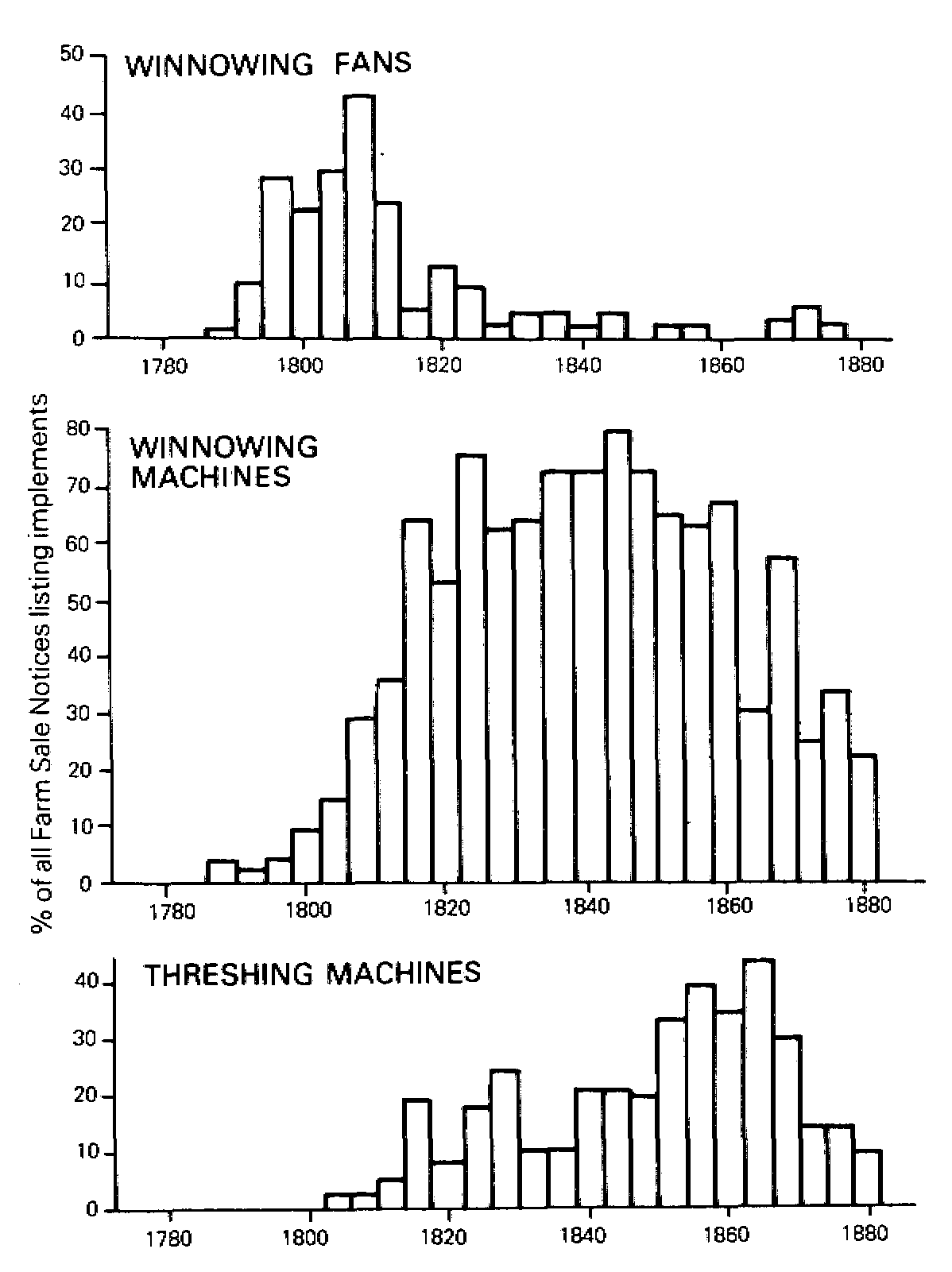
Adoption Of Winnowing And Processing Machinery 1772–1880
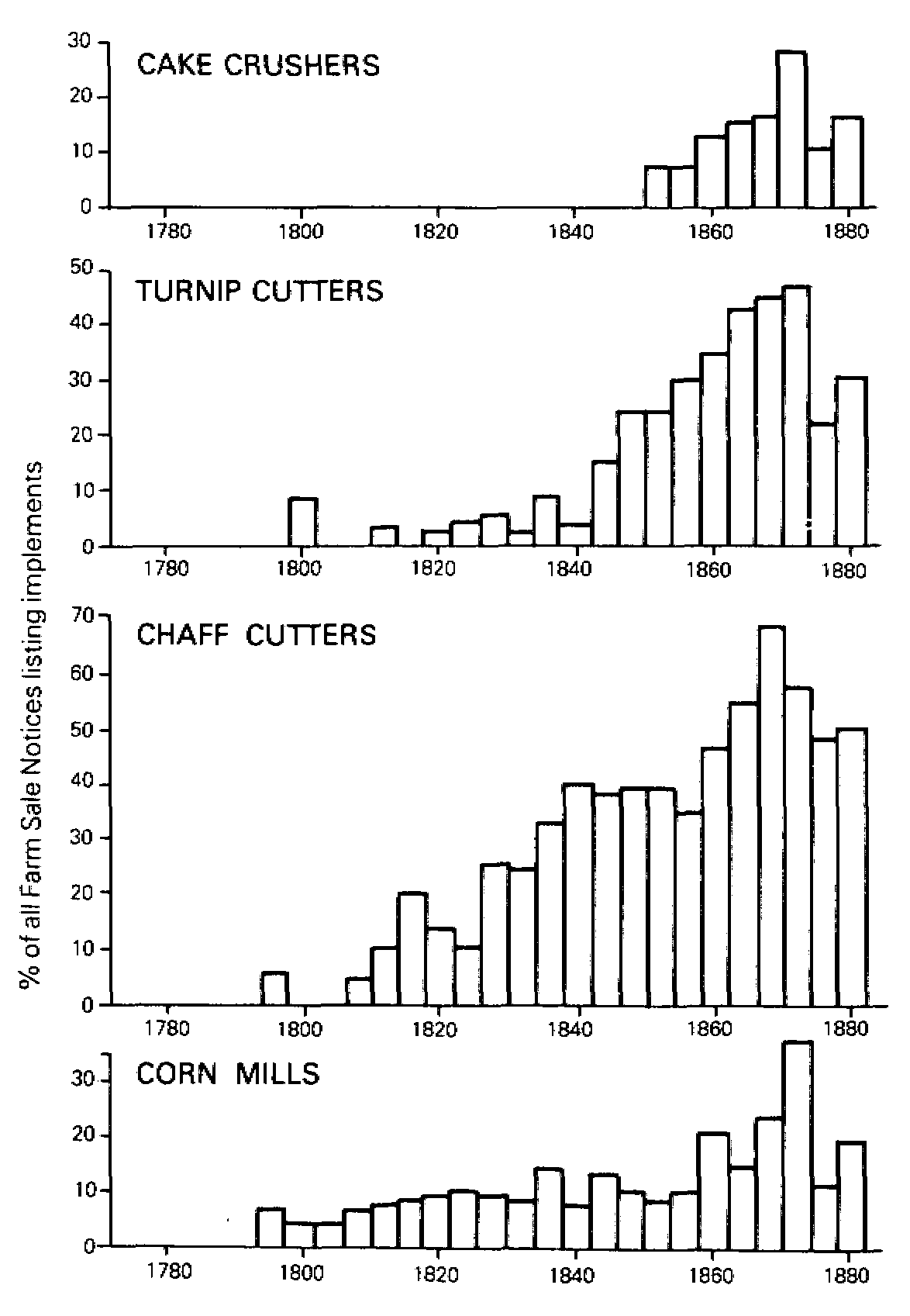
Adoption Of Barn And Processing Machinery 1772–1880 Based on a sample of 2,358 farm sale notices in Shrews. Chron. 1772–1880.
A threshing machine cut the wages bill but required considerable capital: in 1812 a portable thresher, made by William Martin of Bedale (Yorks. N.R.) and powered by two horses, was advertised at 40 guineas. (fn. 238) The development of the portable machine enabled several farmers to share the cost or a contractor to serve a group of farms. By 1812 machines were being manufactured locally: seven were sold at Hazeldine, Rastrick & Co.'s works at Bridgnorth; each needed four horses to pull it. (fn. 239) Initially the portable machines used horses for power, but as the 19th century progressed they became ideal partners for the early portable steam engines which Tanner called 'frequent' in 1858, adding—with reference to his own district, the Wheatland—that most corn was threshed in that way. (fn. 240) With the advent of steam from the 1860s the necessary investment meant that more contractors sprang up. As a consequence the numbers of threshing and winnowing machines at farm dispersal sales fell back to the levels prevailing earlier in the century.
Winnowers and threshing machines were not the only mechanical inhabitants of Shropshire barns. During the earlier 19th century agricultural engineers developed machinery to process a widening range of stock food. Frequently such barn machinery was able to use the same source of power as the threshing machines, so adding to its popularity with cost-conscious farmers.
Cutting straw into chaff for feeding livestock had long been practised in the county (fn. 241) and was a natural candidate for mechanization (Fig. 14). Straw engines, or chaff cutters, were already on farms by 1796, although those with the wheelmounted knives that were to become customary were probably not sold until 1812. (fn. 242) Large numbers were later brought to the county from works as far apart as Manchester (Richmond & Chandler) and Ipswich (Ransomes) to be sold through their local agents. Turnip cutters, common once the feeding of roots to stock had been popularized, came largely from Gardners (later Samuelsons) of Banbury. (fn. 243)
At the time when the expanding railway network might have helped the import of machinery from other counties, Shropshire began the manufacture of implements. Of several manufacturers in the county the most successful was Thomas Corbett of Shrewsbury. (fn. 244) Corbett's products included winnowers, oilcake breakers, and other barn machinery. The son of Samuel Corbett, a Wellington agricultural engineer, Thomas began his career in 1863 as manager of the Samuelson Implement Depot in Shrewsbury. Four years later he had taken his own workshop in Chester Street, where he produced the 'Eclipse' winnower. It was awarded second prize at the Bury St. Edmunds meeting of the Royal Agricultural Society (fn. 245) and created a sound start to Corbett's venture.
In 1868 Corbett bought land in Castle Foregate for his Perseverance Ironworks which, in its final state, was the largest works of its type in the west midlands. His success can be attributed as much to his design and creation of a self-contained factory to provide both castings and wooden components as to his vigorous export drive. As a result of the oversea promotion and exhibition of the firm's products in most west European countries over 400 first prizes had been gained by the end of 1876, and Corbett's ploughs, horse hoes, drills, and rollers were in widespread use both at home and abroad.
An oil-cake breaking machine was in use on Lilleshall home farm as early as 1830 (fn. 246) and improved designs followed in the next decade. Fragments of the residue following the extraction of the oil from linseed and rape seed had long been used as a manure. When those residues began to be used as a highly nutritious livestock food, a strong crushing machine was required to break the large slabs into edible pieces. The first prize to be offered by the Royal Agricultural Society for such a machine was won at the Shrewsbury meeting of 1845 by Alexander Dean of Birmingham. (fn. 247) By the early 1850s oil-cake breakers were being advertised at farm sales. Given the initially high price associated with an unproven product, it was often the landowner or gentleman farmer, relatively well read and widely travelled, who introduced an innovation to an area; that was the pattern with cake-breakers, where three of the first four advertised for sale were the property of titled owners, Lord Liverpool, (fn. 248) the duke of Sutherland, (fn. 249) and Lord Granville. (fn. 250)
While designs of barn machinery were developed promptly to meet the demands of the farms and the crops to be processed, the evolution of the seed drill was an altogether lengthier affair. The subject of experiment by the close of the 17th century and publicized by one of its chief advocates in 1731, (fn. 251) it was nevertheless a rarity in the county until after 1825 (Fig. 15). Time-honoured methods of broadcasting seed remained normal on Shropshire farms, despite 18th-century advertisements in the local press urging the benefits of the drill technique: James Cooke, for example, who patented a seed drill in 1788, published a booklet on drill husbandry which was advertised in the county paper and claimed that his drill enabled a man, a boy, and one or two horses to sow 8 a. a day. (fn. 252) As late as 1820 James Loch regarded use of a seed drill on the marquess of Stafford's Shropshire estates as worthy of special comment (fn. 253) along with its ally in row cultivation, the horse hoe. By that time seed drills had eventually begun to appear in the farm sales advertisements in the local press. Initially drills for sowing turnips and other root crops were the most widespread (Fig. 15), although as the century progressed corn drills of the Suffolk type appeared more regularly. Commonly specified makes included Garrett of Leiston and Smyth of Peasenhall. Smyth was producing drills as early as 1800 and supplied over 180 to Shropshire customers between 1838 and 1871. (fn. 254) The company expanded steadily, with members of the Smyth family leaving their Suffolk base to establish similar concerns elsewhere. A son-in-law of the Smyths, Woodgate Gower, went to Hook (Hants), and one of his sons was established as an agricultural engineer in Market Drayton by 1850. During the 1860s he was sufficiently well established to challenge the East Anglian makers for a share of his local market. (fn. 255)
Although harvest was the most labour-intensive farming occupation, it was the last to receive the benefit of horse-powered mechanization (Fig. 16). About 1800 wheat was normally reaped with broad hooks or saw sickles while barley and oats were mown with a scythe. Where conditions were suitable wheat was sometimes mown and Plymley recommended that. (fn. 256) Such had been the general pattern for the previous fifty years and for the next half century mowing remained commonplace. Reports of trials of experimental reapers reached the local press in the 1820s but, despite the claim that their hourly rate of progress was equal to one man's daily output with a scythe, (fn. 257) the age of the mechanical harvest was still forty years distant.
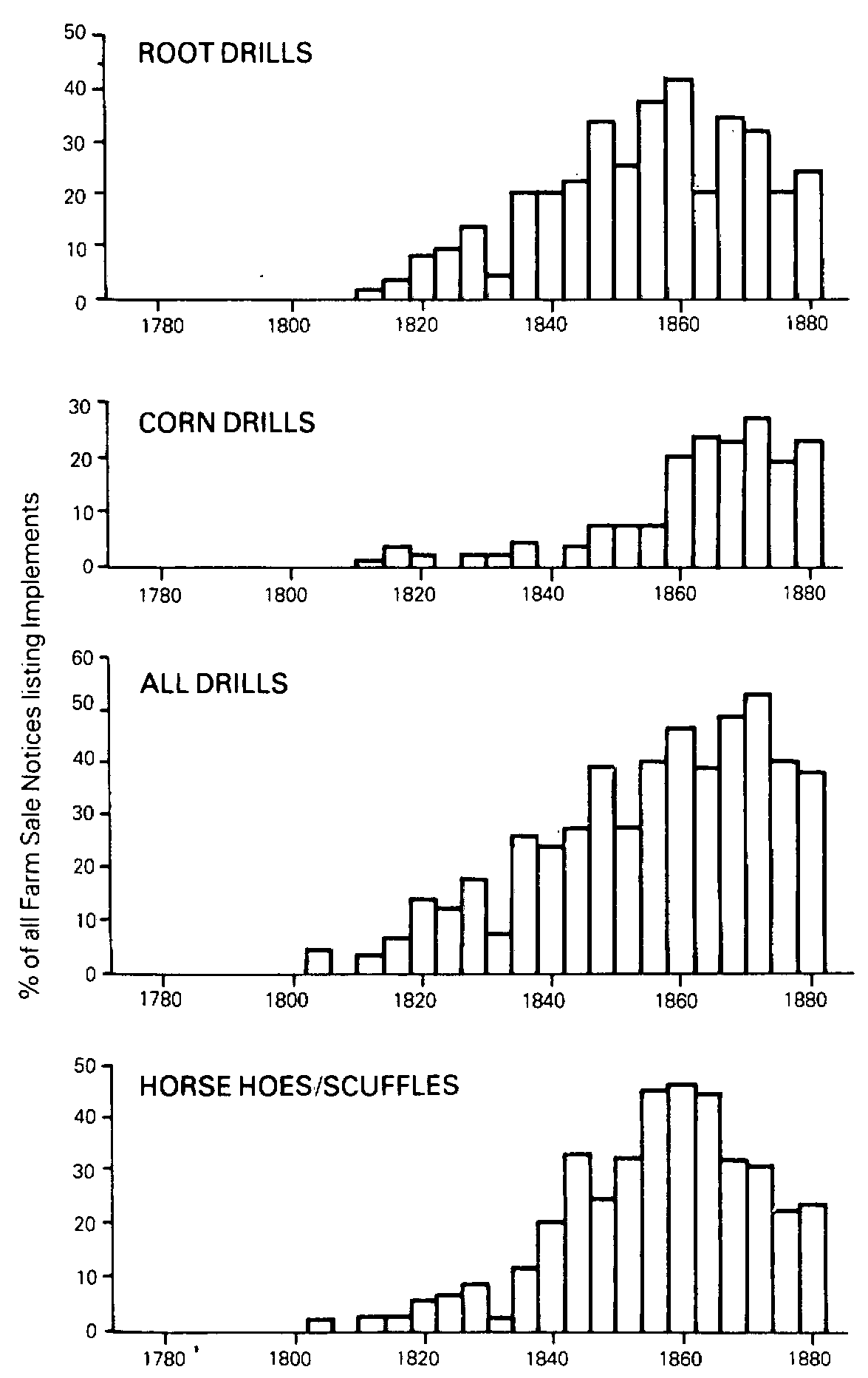
Adoption Of Seed Drills And Horse Hoes 1772–1880
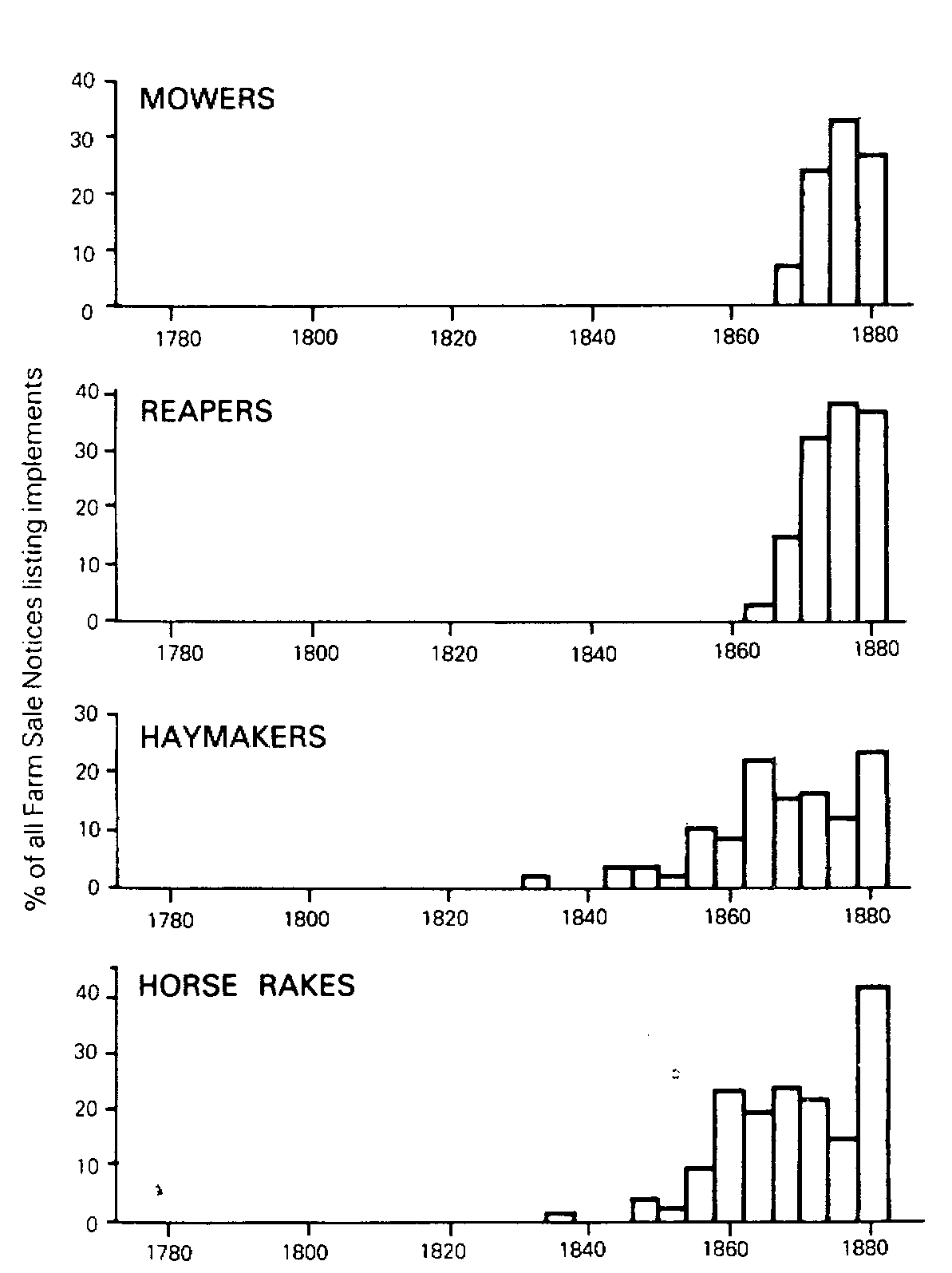
Adoption Of Harvesting And Haymaking Machinery 1772–1880 Based on a sample of 2,358 farm sale notices in Shrews. Chron. 1772–1880.
From the 1840s the mechanization of the hay harvest began as haymakers, or tedding machines, were used to turn the drying crop. Tanner considered such implements to be good investments as they introduced a degree of efficiency seldom found in the county's casual harvest workers. (fn. 258) With the horse hay rake, favoured from the later 19th century, came the speed of operation required for successful hay harvests in a fickle climate, and both implements soon became standard.
It is likely that the cutting of the hay and corn crops remained essentially a manual task on many Shropshire farms until the 1870s and even longer on the smaller or marginal holdings. A Royal Agricultural Society judge doubtless spoke for many farmers when, in 1852, he said that they would never be able to rely solely on a reaping machine to cut their corn, although it made a useful addition to the scythe. Reaping machines were still a novelty in Shropshire in 1865. (fn. 259) For innovative farmers, with cash available, Hornsbys' and Samuelsons' reapers and mowers could be bought from local agents at prices ranging from £15 10s. for a reaper to £24 10s. for a combined reaper-mower. The more efficient self-delivery reaper, where a series of rakes removed the cut corn from the machine's path, was available in 1876 at nearly twice the price of the standard model. (fn. 260)
Livestock breeds
During the first half of the period Shropshire can be regarded as a melting-pot for a variety of sheep types. Into the county came a wide selection of strains, from the nimble Welsh at 6 lb. a quarter to the improving Leicestershire of 30 lb. a quarter, and from the horned Dorset to the highly bred polled Southdown. The range of stock types suited both the county's varied terrain and the differing tastes of the county's landowners. More significantly, it stimulated the more adventurous breeders to improve their local stock, and in some cases the imported breeds provided the means for that improvement. (fn. 261)
During the late 18th century Shropshire's indigenous sheep were still mainly in the southern uplands and commons. On both Morfe common in the east and the Long Mynd range in the west they were recorded as being nimble, hardy, and horned, with face colour ranging from black through brown to speckled. When fat the ewes weighed 9–11 lb. a quarter and gave between 2 and 2½ lb. of 'superior quality' wool; the wethers weighed 11–14 lb. a quarter. (fn. 262) Already c. 1800 Plymley referred to this type as the 'old Shropshire sheep', which, when crossed with the Dorset, produced 'excellent stock'. (fn. 263) The Dorset was one of the earliest identifiable breeds noted in farm sale advertisements in the county's press. Mentioned in a sale in Shifnal parish in 1778, the breed was recorded increasingly further west along the Severn Valley, in Atcham (1789), Bicton (1793), Montford (1796), and Alberbury (1808). The diffusion of the Dorset breed was largely assisted by the dispersal sale on the Attingham estate of the 1st Lord Berwick in 1789 when c. 700 Dorset and Wiltshire sheep were sold. (fn. 264) Elsewhere in the county landowners played an important role in improving the county's sheep: at Sweeney Hall, Oswestry, and Walcot Hall, Lydbury North, various established types of sheep were kept, including Merino rams for crossing with unimproved ewes. (fn. 265)
During the first quarter of the 19th century two breeds of national repute, the New Leicester and the Southdown, were found in increasing numbers on Shropshire farms. Sheep from Leicestershire had been mentioned in farm sales well before the results of Bakewell's longwool improvement were first advertised in 1797 as New Leicesters, belonging to Mr. Hawley of Aston Rogers. (fn. 266) Limited numbers of the compact, short-woolled Southdowns too were found in the county at that time, but the rise to popularity of both breeds can be traced to the period 1800–20 (Fig. 17). Several of the more progressive farmers and landowners assisted the process with regular sales of good quality breeding stock: William Childe supported the New Leicester breed from his Kinlet estate, William Beddoes of Diddlebury and Mr. Tench of Bromfield both advocated the Southdown, while at Hawkstone Park examples of both breeds were offered for sale on a regular basis. (fn. 267)
The improved sheep breeds, standing in marked contrast to slow-maturing indigenous stock, invited cross-breeding experiments. By 1800 the use of a Southdown ram on the hill ewes of the Long Mynd was noted as improving the wool and carcass weight of the local breed without loss of hardiness. (fn. 268) The extent to which pure-bred rams other than Southdowns were used in refining the breeding stock of the new race of Shropshire sheep is less certain. Some 19th-century commentators said that rams from the improved Leicester and Southdown breeds had generally been employed, others that at least some breeders had used only native stock and selective breeding to eliminate unwanted traits and fix the characteristics sought. (fn. 269)
Although the Shropshire breed was the world's first to be catered for by a breed association and flock book society (founded in 1882), (fn. 270) the interval between the efforts of the early breeders and the recording of their rams in the first flock book of 1883 does little to unravel the mysteries of the breed's origins. Nevertheless there was sufficient standardization by 1853 for Shropshires to be included in a new class at the Royal Agricultural Society's Gloucester show and for the judges there to describe the breed as 'very successful'. (fn. 271) By 1860 the society had rewarded the Shropshire sheep with its own class, and the Bath and West of England society first listed Shropshires as a separate class at its 1864 show in Bristol. (fn. 272) Such national recognition by no means implied that the Shropshire was bred just for show; it remained the choice of practical farmers in the county.
Shropshire farmers usually put ewes to the ram from mid October (fn. 273) and lambed from mid February onwards. (fn. 274) The lambs were weaned by June and, following a summer on good quality clover, they were fed roots during the winter and generally sold the following spring. By that time pure-bred hoggets usually weighed 20 lb. a quarter, and if left until 20 months old an average of 35 lb. a quarter was typical. Breed improvements had not reduced the wool's high quality but had increased the average weight of a ewe's fleece to between 5 and 8 lb. (fn. 275)
Not all of the many sheep described as Shropshires in auctions and newspaper accounts would necessarily have been considered pure-bred by the later standards of the flock book society, but mention of the breed in farm sales after 1850 usually implied an improved strain. In 1875, with the breed's heyday at home and abroad still to come, a Royal Agricultural Society judge commented that 'there is not a single breed of sheep which has made greater or more rapid improvement'. (fn. 276) In the face of the Shropshire breed's dominance few other breeds were able to maintain their popularity in the county after the mid century. Numbers of Leicesters and Southdowns declined from the 1840s. The indigenous Clun and Longmynd types persisted in small numbers, the former to evolve into an improved, well respected, hardy race, and the latter to become extinct in 1926. (fn. 277) The finewoolled Ryelands, although of national repute, suffered a local retreat into their Herefordshire heartland (Fig. 17).
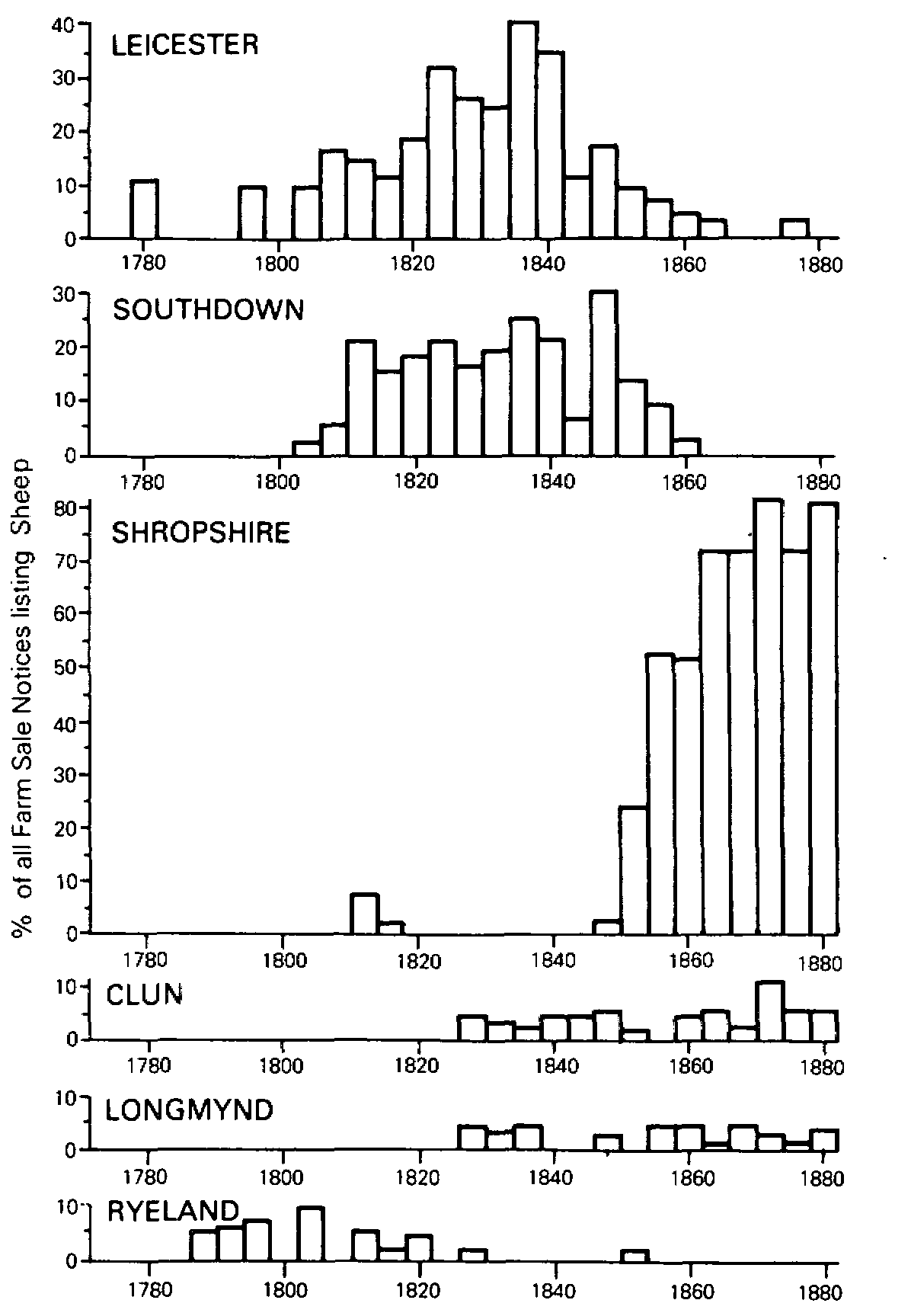
Changing Popularity Of Sheep Breeds 1772–1880
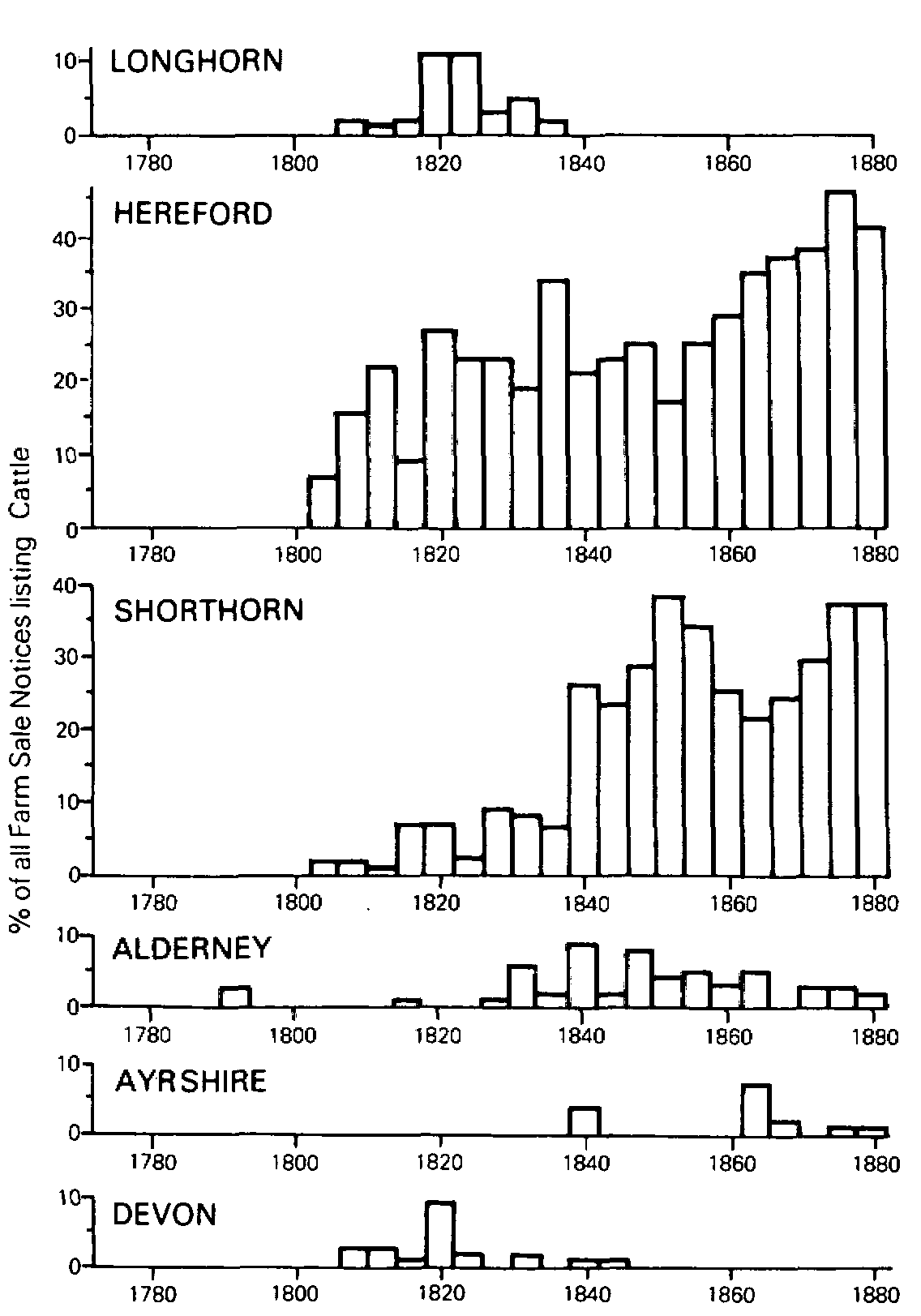
Changing Popularity Of Cattle Breeds 1772–1880 Based on a sample of 2,358 farm sale notices in Shrews. Chron. 1772–1880.
Late 18th- and early 19th-century commentators found it hard to describe the native cattle of Shropshire. Plymley admitted that they could not be ascribed to an identifiable breed, but indicated that they were similar to the original longhorned stock of Warwickshire and Staffordshire. Both Plymley and Arthur Young considered that some native stock had already been improved by the use of better animals from Cheshire and Lancashire, and suggested that the purchase of a better bred Leicester Longhorn bull, at between £15 and £25, would continue the upgrading of local cattle. (fn. 278) Several such bulls from the east midlands were present in the county before 1800 (Fig. 20), with five examples changing hands in farm sales during the 1790s. (fn. 279) Their use is likely to have improved the conformation and fattening qualities of the local Longhorns and is even recorded as having increased the milk yield to 3 gallons 'at a meal'. Such cattle were allowed up to 1½ a. of summer grazing each but did not receive any additional food. In winter they were housed and fed on turnips and straw, an example of unusually enlightened management. (fn. 280)
As the 19th century progressed interest in selective cattle breeding grew. Enterprising farmers were encouraged by the results of earlier improvements to look afresh at other local breeds. The Hereford beef breed had already begun to rise from its unimproved state by the time of its Smithfield club successes from 1799. It continued with the standardization of the breed's colour as the mottlefaced, dark and light grey strains eventually gave way to those with red bodies and white faces, and received further impetus with the publication of the first volume of the breed's herd book in 1845. (fn. 281)
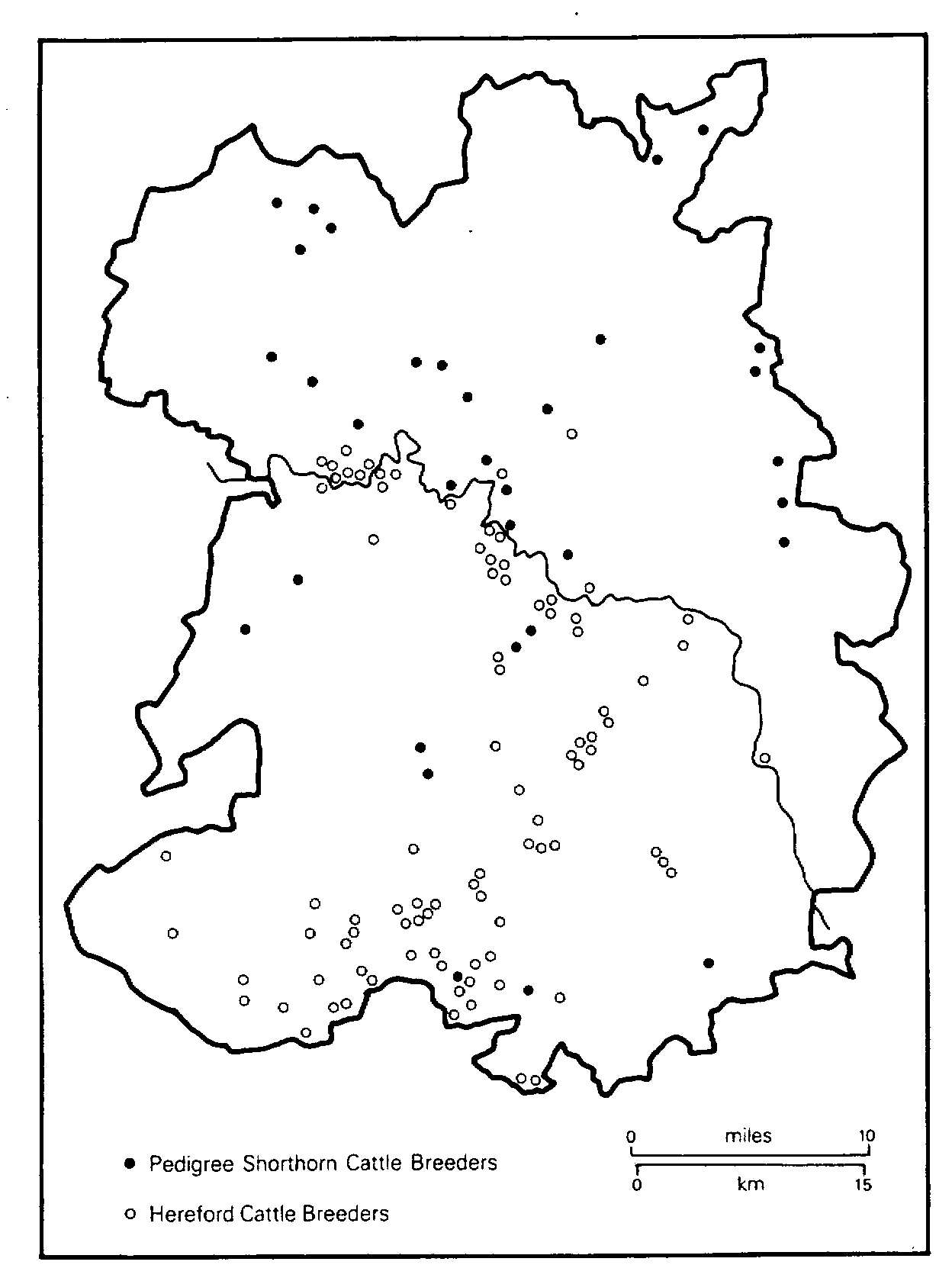
Location Of Pedigree Cattle Breeds 1870–9 Based on the Hereford and Shorthorn herd Books.
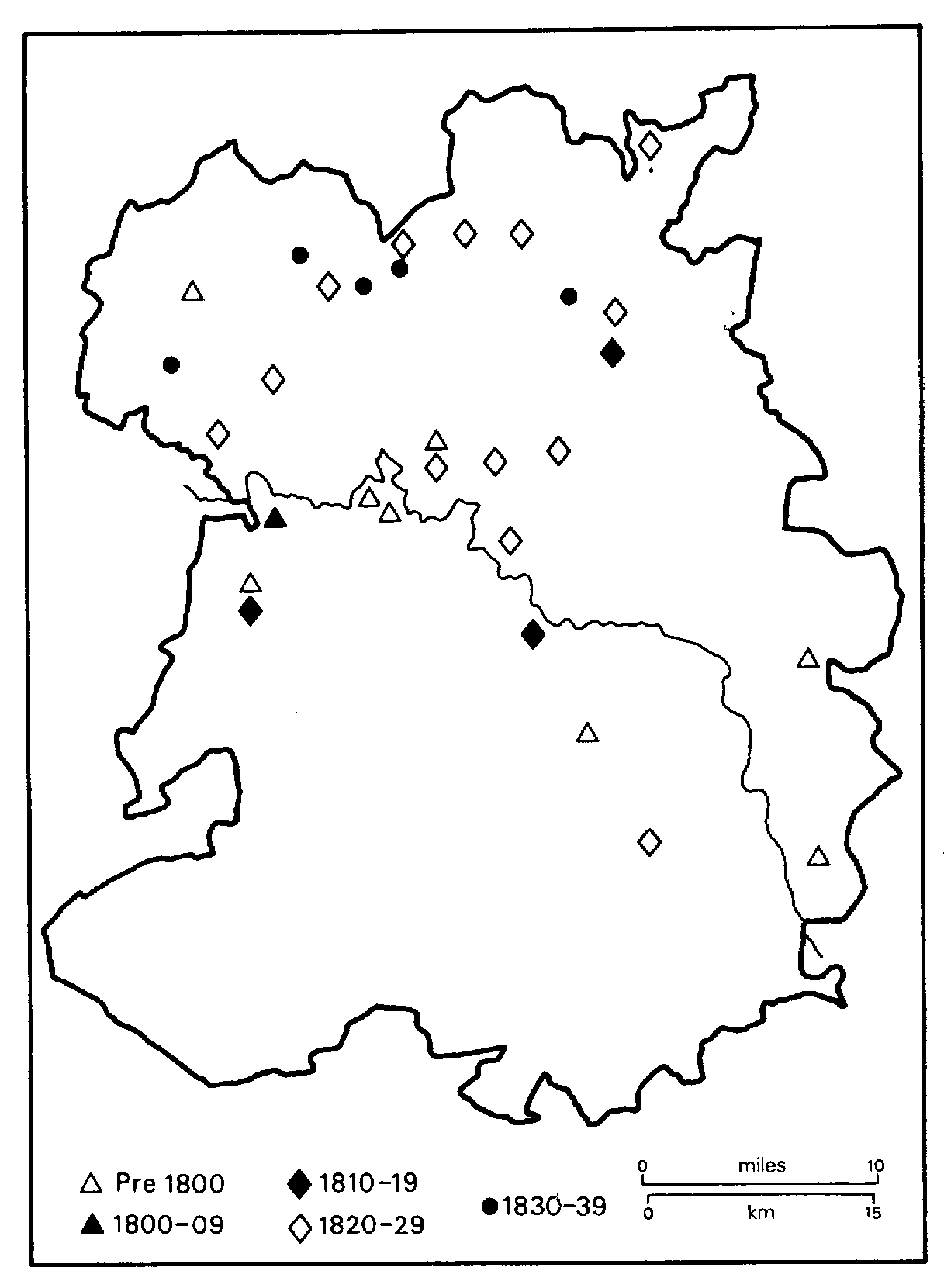
Distribution Of Longhorn Cattle 1772–1839 Based on a sample of 2,358 farm sale notices in Shrews. Chron. 1772–1880.
The fact that the responsibility for compiling the herd book fell to a Shropshire man, T. C. Eyton of Eyton Hall, (fn. 282) demonstrates the links between the county and the Hereford breed. The ability of the cattle to thrive in only moderate conditions, together with the their early maturity, made them a profitable choice for Shropshire farmers intent on producing good beef stock. In the Corve Dale region cows calved in winter or early spring so that the calves were weaned on spring grass. The cows when dry could then be adequately fed on the poorer hill pastures until their calving time approached again, while the calves could be wintered on hay and turnips. Under that system two-year-old stock typically fetched between £18 and £20 at market, the best animals selling for up to £25. (fn. 283)
Besides Corve Dale the important areas for the breed in Shropshire were the fertile Severn valley and the southern hill and dale land adjacent to Herefordshire (Fig. 19). In the 1870s only one breeder of registered Hereford cattle was located well to the north of the Severn valley. (fn. 284) The distribution of Herefords, registered and 'commercial' stock, in farm sale notices confirms that pattern, with the great majority in south Shropshire. Several dispersal sales contained cattle descended from the stock of such successful Herefordshire breeders as Knight, Tully, Price, and Tomkins, (fn. 285) although before long Shropshire could boast its own breeders of repute. Foremost was the 5th Lord Berwick, who won nearly £400 in prize money with Herefords at the Royal Agricultural Society's shows between 1849 and 1857. (fn. 286)
Although the Hereford breed satisfied the beef farmers' requirements it never won widespread respect as a producer of milk. Dairy farmers seeking quality and yields that the improved Longhorn failed to deliver had eventually to look farther afield than a neighbouring county for better stock. At the close of the 18th century at least three farmers in the county tried Holderness cattle. Before 1776 Edward Maurice of Petton had had them, and one of the cows had given over 4¼ gallons at one milking. He gave them up, finding that they were difficult to feed and 'tender' because of their thin hides, which were consequently of little value after slaughter; nor did he consider their milk rich. (fn. 287) Despite Maurice's disappointing experience Holderness cattle were recorded later: a 'very large' animal was offered for sale at the Bank, near Shrewsbury, in 1785, (fn. 288) and in 1792 a Holderness cow in calf, formerly Richard Birkinshaw's, was offered for sale at Berwick Maviston, in Atcham. (fn. 289) Such stock, together with the Durham and Teeswater strains, were later to provide the raw materials for the Shorthorn improvers of the north. Although the Shorthorns could boast a herd book by 1822, (fn. 290) a combination of continued Longhorn popularity and the distance between Shropshire and the Shorthorn's homeland delayed their appearance in numbers in farm sale notices until the 1840s.
Typically, the earliest breeders of Shorthorns in the county were gentlemen farmers of substance. The first four known Shropshire breeders were E. W. Smythe Owen at Condover (1836), Lord Hill at Hawkstone (1840), Edward Corbett at Longnor (1845), and the Hon. Henry Noel-Hill at Berrington (1846). (fn. 291) Their means and their ability to breed prize-winning stock are reflected in the fact that by 1851 three of the four had been successful at Royal Agricultural Society shows ranging from their county town to Northampton and from Windsor to York. (fn. 292)
By c. 1875 the breeders of pedigree Shorthorns were generally located in the northern half of the county (Fig. 19). It was there that the dairy farms turned to Shorthorns in increasing numbers, with the breed's greatest popularity occurring after 1875. Few other breeds of dairy cattle made much impact in the county, and none achieved the numerical position of the Shorthorn (Fig. 18). Alderney, or Channel Islands, breeds had been present since the early 19th century (fn. 293) but were widely kept only after regular sales of breeding stock were organized around the county by E. Parsons Fowler from the 1840s, as at Bridgnorth and Shrewsbury in 1848. (fn. 294) A similar supportive role was performed for the Ayrshire by a Mr. Cotterell, who by 1860 was conducting sales throughout the county; that year his annual Ayrshire sale was at the Raven and Bell, Shrewsbury. (fn. 295) The Alderney and Ayrshire, however, were to remain minority breeds in the shadow of the Shorthorn's success.
Few indigenous cattle breeds of the county survived to the later 19th century in an original form. The dark red Bishop's Castle breed, first noted in a farm sale notice in 1799 (fn. 296) and mentioned c. 1800, (fn. 297) maintained a sporadic presence until 1828, by which time they had spread east to Cressage (fn. 298) and north to West Felton. (fn. 299) Of more continued importance as a local strain was the Montgomeryshire Smoky Faced breed, which could be found on the county's western margins from 1804, when a two-year-old bull was on Thomas Roberts's farm at Wilmington, in Chirbury, (fn. 300) to 1876, when Mr. Pugh of the Beach offered 12 bullocks for sale at Bishop's Castle fair. (fn. 301)
In the later 18th century a large proportion of the county's pigs were to be found in the sties of smallholders and cottagers. To Arthur Young a pig appeared to be a regular member of each family in the Severn Gorge, (fn. 302) consuming household waste and scraps to provide a much prized source of protein when killed. Plymley considered home produced pork and bacon to be a desirable part of the diet of labourers in the county, although he lamented the fact that farmers did not sell small quantities of wheat to their workers any more, so depriving them of the byproduct of the milling, the bran, for feeding to their pigs. (fn. 303)
During the 18th century a breed of white pig, loosely referred to as the Shropshire, was to be found over a wide area of western England. It was reputed to be the largest British pig, with drop ears, a coarse and wiry coat, and a long body. (fn. 304) By the end of the century that native type was being improved by a cross with the Berkshire to produce the spotted type immortalized in the portrait of 'A Shropshire Pig'. (fn. 305) Such cross-bred pigs were reported to fatten on less food than the original hogs of the county, and so were looked upon as being more profitable. (fn. 306) Weights of bacon pigs of between 16 and 20 score were typical, and a final figure of 37 score was not unknown. (fn. 307) What is not recorded is the time taken to get the pig to that weight, although the finished pigs would be unlikely to be less than two years old when killed.
The average litter size of an improved cross-bred pig was seven, with two litters from each sow during the course of a year. Some farmers disposed of the weaned piglets at ten weeks, presumably to local cottagers for fattening. The price obtained for such weaners was 10s. 6d. in the 1780s. (fn. 308) In the mid 19th century Tanner considered that with the use of a good boar the weanlings should fetch £1 when sold on for fattening from the farms of south-eastern Shropshire. (fn. 309)
The Berkshire breed, used to improve the local stock of the 18th century, maintained its popularity within the county throughout the following century. At a time when few pigs were easily identified by breed over 60 per cent of those sold at farm sales before the 1870s were described as Berkshires. There were nevertheless sufficient strains available to satisfy breeders like Lord Hill and Lord Berwick, who were successful at Royal Agricultural Society shows with their Shropshirebred, and locally named, exhibits: Lord Hill at Northampton in 1847 with a boar and sow of Hawkstone breed and Lord Berwick at Norwich in 1849 with a Cronkhill boar. (fn. 310) Comparatively few representatives of the Chinese or Neapolitan lines, so revered by improvers elsewhere in the country, (fn. 311) were recorded in Shropshire, though the Revd. John Hill, of the Citadel, Weston-under-Redcastle, was highly commended (twice) and commended (twice) for his Essex and Neapolitan cross-bred sows at the Royal Agricultural Society's 1845 show in Shrewsbury and Neapolitan pigs descended from his stock were offered for sale at Stanton upon Hine Heath in 1852. (fn. 312)
The large estates
The large, well documented landed estates, with which Shropshire was so well endowed (Table X), yield ample details of the vagaries of landlord management during a period that, save for the uncertainties of the 1820s and 1830s, (fn. 313) was marked by steadily increasing agricultural prosperity. Some large estates received very heavy capital investment with the ultimate objective of increasing the rental. Some, on the other hand, were mortgaged to finance conspicuous expenditure, and when that happened too frequently without intervals of retrenchment or the acquisition of new capital or income, sale was the inevitable end. The very large estates naturally withstood extravagance best; only two such were sold during the period, though in other cases outlying properties had to be relinquished. Some large estates, well run by owners who lived within their ample means, increased. The varying histories of the largest estates help to illuminate those of the more modest estates, which succumbed more quickly to extravagance: many were sold as old landed families were ruined. There was no lack of buyers among the newly rich industrial and commercial men.
Sources: Summary of Returns of Owners of Land in Eng. and Wales, H.C. 335, p. 12 (1876), lxxx; J. Bateman, Gt. Landowners (1883).
The two large Shropshire estates sold were the Craven and Apley Park estates. The latter was sold entire in 1867 (fn. 314) and the Cravens' Shropshire properties, outliers to a great English estate that extended into many counties, thus formed the only large estate in the county to be broken up during the period. Put together in the 1620s, (fn. 315) it amounted to 19,642 a. (fn. 316) worth some £9,000 a year in 1770–1. The 5th Lord Craven died in 1769, and in 1770–1 the Shropshire estates were surveyed for the 6th baron, evidently with a view to sale: by 1772 Capability Brown was spending thousands of pounds for Craven at Benham Park (Berks.) and Combe Abbey (Warws.). (fn. 317) Piecemeal sale of the estate in the north-west—c. 4,000 a. mainly in the manors of Kinnerley, Melverley, and Ruyton-XI-Towns—began in the 1770s and continued in the 1780s; (fn. 318) the Pradoe estate, acquired and built up by the Kenyons from 1803, was formed partly from Craven properties sold at that time. (fn. 319) The 2nd earl of Craven (succ. 1825, d. 1866) resumed sales: (fn. 320) Little Dawley, in the east Shropshire coalfield, was sold in the 1850s (fn. 321) and the south Shropshire estates were broken up: notable purchasers there were the Botfields on the southern slopes of the Clees, (fn. 322) C. O. Childe-Pemberton on the northern slopes, (fn. 323) and J. D. Allcroft in lower Corve Dale. (fn. 324) By 1873 the 3rd earl owned only 803 a. (fn. 325) in Shropshire, of which about half were in Coreley. (fn. 326)
Three of the largest estates that had been assembled in earlier centuries—the Newports', the Leveson-Gowers', and the Egertons'—lasted throughout the period. The vast estate of the Newports, 23,430 a. lying in most parts of the county, (fn. 327) was for a time (1734–62) divided (fn. 328) but fell eventually to the Pulteneys (as trustees until 1783), passing from them c. 1808 to the Vanes of Raby Castle (co. Dur.). The Newports' estates were thus lost to their legitimate heirs, the Bridgemans. The Bridgemans, however, had considerable estates of their own in Shropshire and they added to them in the mid 18th century, (fn. 329) when they also inherited Weston under Lizard (Staffs.) near the eastern county boundary. In 1855 Lord Bradford's consequence as a Shropshire landowner was greatly increased by his purchase of the 2,900-a. Tong estate for £170,000. (fn. 330) The Leveson-Gowers' Lilleshall estate (fn. 331) had been built up, largely from monastic properties, in the 16th century, and the Egertons' Ellesmere estate had been a creation of the late 16th and early 17th century. (fn. 332)
The owners of such estates were non-resident but their agents and officials were substantial and influential men in the county, (fn. 333) though highly centralized estate managements, such as the 2nd duke of Kingston's (fn. 334) or the 2nd marquess of Stafford's, probably restricted the influence of local officials. (fn. 335) Agents often belonged to, or founded, landed families or official dynasties. Offshoots of minor landed families who prospered locally as land agents or stewards included men such as Hugh Pigot who acquired Peplow in the early 18th century, (fn. 336) John Ashby of the Lynches, Yockleton, (fn. 337) Thomas Wingfield of Alderton, (fn. 338) and the Lewises of Marshall & Lewis, the Bridgnorth attorneys who worked for the Foresters and others in the late 18th century; the Lewises bought estates in Deuxhill (the manor) and Chelmarsh for example. (fn. 339) Robert Pemberton, attorney, younger son of the family seated at Wrockwardine Hall, legatee of Millichope, and agent to the Attingham estate in the 1790s, was closely connected with several landed families. His son, the Revd. R. N. Pemberton, builder of Millichope Hall, increased his landed inheritance by purchase and, dying childless in 1848, left it away from his heir at law, Miss Cludde of Orleton, to the Salusburys (fn. 340) and the Childes (later Childe-Pembertons). (fn. 341) By no means all the landless sons of landed families succeeded as agents: in 1859 Charlton Leighton worked for a year with William Smith, the duke of Sutherland's agent at Lilleshall; he then went on to the agricultural college at Cirencester but thereafter never exerted himself to find employment, a failure that would have justified the suspicions of gentlemen agents put to James Loch in 1814. (fn. 342) The monument to John Mytton's agency for the eccentric 2nd earl of Kilmorey in the 1830s was a deserted and dilapidated estate. (fn. 343) Nevertheless from 1855 kinsmen were employed as resident agents for the Ellesmere estate by the 2nd and 3rd Earls Brownlow: Capt. H. F. Cust (later CockayneCust) came in 1855 and was succeeded in 1884 by his son-in-law Brownlow R. C. Tower (d. 1932). (fn. 344)
During the Pulteneys' trusteeship of the Newport estate (fn. 345) the agency was given to the Peeles who founded a dynasty of prominent county officials, (fn. 346) and leading county magistrates such as Charles Bolas and the Revd. Edmund Dana seem also to have been involved in the affairs of the estate. (fn. 347) The Levesons were represented in the county by an almost continuous succession of very able administrators from the Revd. George Plaxton 1685–1720, (fn. 348) through Thomas Gilbert 1760–88, (fn. 349) John Bishton (author of the 1794 General View of the Agriculture of Shropshire) 1788– 1803, (fn. 350) John Bishton the younger 1803–9, and his incompetent brother George 1809–12, (fn. 351) to the ruthless Scot James Loch 1812–55. (fn. 352) During the younger Bishtons' and Loch's stewardships the family's income was greatly (if temporarily) enlarged: from 1803 (fn. 353) to 1833 the 2nd marquess of Stafford (cr. duke of Sutherland 1833), head of the Leveson-Gower family, also enjoyed an income averaging £77,345 a year from the great inheritance of the Egertons, which in Shropshire included the 20,000-a. Ellesmere estate worth £17,500 a year in 1802. It was that windfall that enabled Loch to invest very large amounts of money in his master's estates in order to rack up his rental. (fn. 354) The dowager countess of Bridgwater's agents at Ellesmere were said in 1837 to spend over £20,000 a year on 'the improvement of estates, houses, roads, &c.' (fn. 355)
Two large estates came into existence by the fusion of families: Foresters and Welds in the one case, Herberts and Clives in the other. The dynastic alliances were made more effective by the contribution of the Foresters' mercantile and industrial wealth and of the Clives' nabob fortune. The Foresters' medieval estate near Wellington had been enlarged in the 16th (fn. 356) and 17th (fn. 357) centuries but in 1714 the younger William Forester married the heiress of William Brooke, a rich Londoner (d. 1737), and in 1734 their son Brooke married George Weld's heiress. (fn. 358) William Brooke's East India Co. stock realized almost £18,000, virtually all of which was invested in the improvement of the dilapidated Willey estate (fn. 359) that came to the Foresters on George Weld's death in 1748. (fn. 360) Brooke Forester's interest in the Willey estate (arising from the investment of his inheritance) was kept separate from his son George's after 1756, (fn. 361) Brooke living at Dothill and George at Willey. (fn. 362) On Brooke's death in 1774, however, the Forester properties and his interest in the Willey estate were all added to George's inheritance. (fn. 363) It was a rich and partly industrial estate (fn. 364) with a surplus income that supported the Foresters' political activities, paid for the new Willey Hall (built 1812–20), justified the conferment of a peerage in 1821, (fn. 365) and allowed the acquisition of more land, though purchases consolidating the estate were sometimes financed by sales of outlying properties; (fn. 366) in 1870 the 2nd Lord Forester was said to have added more farms to his inheritance than any other Shropshire landowner. (fn. 367)
By 1750 Henry Arthur Herbert, earl of Powis, owned an extensive estate inherited from his father (d. 1719) and centred on Dolguog (Mont.) and Oakly Park. (fn. 368) He had more recently also inherited the estates of two kinsmen, Lord Herbert of Chirbury (d. 1738) (fn. 369) and the 3rd marquess of Powis (d. 1748) whose daughter he married in 1751; besides the Powis castle estate in Montgomeryshire the marquess's lands had included the lordship of Oswestry. (fn. 370) In 1784 the earl's daughter married the 2nd Lord Clive, owner of Styche (fn. 371) and of the many estates which his father, Clive of India, had bought, mainly for the political influence they gave him over Bishop's Castle and Ludlow (fn. 372) or for the enhancement of his new status as an aristocratic landowner: properties bought for the latter reason included the manors of Kinnerley, Melverley, Munslow, and Ruyton-XI-Towns and the hundreds of Clun, Munslow, and Purslow, which brought him several lordships but very few acres. (fn. 373) After Lady Clive's brother had died unmarried in 1801 the great estates strung out along the county's western border—Clun, Walcot, Bishop's Castle, Chirbury, Montford, and Oswestry (fn. 374) —with others in Wales (fn. 375) and northeast Shropshire (fn. 376) were united; (fn. 377) with the exception of the Oakly Park estate (fn. 378) they were preserved largely intact by a new line of earls of Powis descended from the Indian proconsul. (fn. 379) From the 1760s Clive needed efficient agents to manage his rapidly growing estate and other affairs. At first he used Thomas Wingfield but in 1769 he made Thomas Ashby his chief estate and political agent. (fn. 380) Both Wingfield and the highly competent (fn. 381) Ashby (who married a kinswoman of Wingfield) (fn. 382) were also involved in Lord Powis's affairs, and the patronage of Clive and Powis secured the county clerkship of the peace (1779–1802) for Wingfield and the town clerkship of Shrewsbury (1767–79) for Ashby. (fn. 383)
The Hills of Hawkstone owed their enhanced status during the period to the 'Great Envoy' Richard (d. 1727), (fn. 384) uncle of the 1st baronet, and to that baronet's grandson Rowland, a distinguished soldier (fn. 385) who left a viscountcy to the owner of Hawkstone at his death in 1842. (fn. 386) Richard Hill's benefactions, however, had also included the endowment of two other nephews, Thomas Harwood and Samuel Barbour, who both took the name Hill. When Samuel died in 1758 almost all his settled estates passed to his cousin Thomas (d. 1782), of Tern, (fn. 387) and the combined inheritance, though more scattered (fn. 388) than the large compact estate eventually formed around Hawkstone, (fn. 389) sufficed for the conferment of a peerage on Thomas's son Noel (Lord Berwick 1784) (fn. 390) and for the building (1783–5) of Attingham Hall. (fn. 391) The Tern (later Attingham) estate and its owners were long and well served by Thomas Bell, land and house steward there 1734–73, (fn. 392) though Thomas Hill was a very careful manager of his own affairs and a prudent investor in the funds and additional land. (fn. 393) Hill also drew on the services of professional men. John Olivers (later Oliver), a Shrewsbury attorney, acted for him in financial and other matters, to some extent as a banker. (fn. 394) Such men's usefulness consisted not merely in their business ability and professional skill: involved in the affairs of several estates at once, they could supply confidential information when required. Thus in 1756 Oliver, employed by the Leightons of Loton, (fn. 395) advised Thomas Hill on Sir Charlton Leighton's affairs and the ability of the Loton estate to pay interest on £16,000, (fn. 396) and in 1774 Noel Hill was able to oblige his friend Charlton Leighton (Sir Charlton's son, newly possessed of the paternal estate) by taking over the mortgage for a few years. (fn. 397) Like others of his profession Oliver hoped that his clients could help him to extend his business but in 1757–8 Hill's patronage did not avail him for the stewardship of Lord Montfort's estate or for the county militia registrarship. (fn. 398) Nor in 1779 could he secure the town clerkship of Shrewsbury or the county clerkship of the peace for his son Bold. (fn. 399)
After Bell's death in 1773 his duties seem to have been divided between a house steward, Richard Partridge, who died in 1809 and was succeeded by his son of the same name, (fn. 400) and a land steward or agent, John Hurd of Hatton Grange. Hurd (d. 1792) evidently began by receiving and accounting for rents as Bell had done (fn. 401) but by 1786, probably the date of his retirement in favour of his assistant Thomas Hurd the younger, (fn. 402) that side of the work was being done by the Olivers, first John the younger (d. 1789) then his brother Bold (d. 1791). In 1787 John Oliver hoped that Lord Berwick's interest would make him receiver general of the county (fn. 403) but, like his father thirty years before, he was disappointed. (fn. 404) Early in the 1790s efficient advice was needed as the sale of outlying properties began. (fn. 405) Thomas Hurd was expensive and perhaps dilatory. In 1792 therefore the 2nd Lord Berwick's cousin Edward Burton, a trustee of the estate whose advice and care proved invaluable until his death in 1827, recommended the appointment of Robert Pemberton, a Shrewsbury attorney. (fn. 406) Pemberton took over in 1793 (fn. 407) and much of the work soon seems to have passed to John Dodson, probably Pemberton's deputy but called agent in 1797–8. John Southern, a surveyor who had worked with Pemberton on Lord Berwick's business, became agent in 1799 (fn. 408) but Pemberton (d. 1816) continued to advise on administration and policy: (fn. 409) in 1804 he recommended that Southern be restricted to rent receipt and payment on account. (fn. 410) A new agent, Francis Walford, was appointed. He settled in Nash's new house at Cronkhill (fn. 411) and remained through difficult years, playing his part in the progress of William Hitchcock's 1807 survey (fn. 412) and in subsequent sales to finance Berwick's extravagance. Berwick later received management advice from a firm of Gray's Inn lawyers, but Walford's independent views were also conveyed to him. (fn. 413)
The variety and quality of advice applied to Attingham estate affairs helped to limit the damage inflicted by Berwick's extravagance between 1791 (when he came of age) (fn. 414) and 1827. In the latter year the contents of Attingham were sold to pay his debts and during his last five years Berwick (d. 1832) lived cheaply in Italy. (fn. 415) Attingham was shut up or let to tenants, Berwick's three successors lived unostentatiously, and by 1861 the debts had been cleared. (fn. 416) An unhappier fate awaited the Hills of Hawkstone who seem to have been less well served by their agents. In 1790 Sir Richard Hill's steward, George Downward, was found negligent. (fn. 417) At Attingham the efficiency and economy of agents had been kept under review and changes made, but the owner of Hawkstone did not discharge Downward. (fn. 418) Extravagance continued: in 1796 Hill did not flinch from a very expensive parliamentary contest with his Attingham kinsmen (fn. 419) and in 1816 the Hawkstone estate was hit hard by the failure of Thomas Eyton, receiver general of Shropshire. (fn. 420) Lack of financial control continued to afflict Hawkstone, and Sir Rowland Hill's marriage to a Manchester fortune, Ann Clegg, failed to achieve (fn. 421) what retrenchment and sales (fn. 422) did for Attingham: by the early 1870s Hill's estate, though thrice the acreage of Berwick's, had a gross annual value barely twice the size and was very heavily encumbered. (fn. 423)
An estate comparable to the combined inheritance of Welds and Foresters in the later 18th century was the Whitmores' Apley Park estate. Formed in the early 17th century, (fn. 424) and increased by Catherine Pope's property in 1754 and the Wolryches' Dudmaston estate in 1774, it then extended to some 14,800 a. (fn. 425) As the Clives and Herberts used Oakly Park so the Whitmores' Pope and Wolryche estates served to endow a cadet line. (fn. 426) The main part of the estate, however, remained intact until Thomas Whitmore's time (1803–46). Whitmore inherited an income of £20,000 but with it the increasingly expensive burden of controlling a parliamentary borough (Bridgnorth); his fortune was less equal to the task than were the greater resources of the Clives and Foresters in their boroughs, and in 1811 it had also to pay for a new house. Whitmore is said to have sold £100,000 worth of land and to have left a mortgage of £180,000. The heir, T. C. Whitmore (d. 1865), was left with only £4,000–£5,000 a year after payment of interest, his mother's jointure, and his brothers' and sisters' portions: he had to live very quietly and to stop treating the Bridgnorth voters, his only extravagances being a large game preserve and 300 head of deer. (fn. 427) After his death, however, the estate had to be sold, and in 1867 it was bought lock, stock, and barrel for £550,000 by W. O. Foster, a Stourbridge ironmaster. (fn. 428)
The sale of the Craven and Apley Park estates, the permanent undermining of the Hawkstone estate and the temporary undermining of the Attingham estate, the survival of the Vanes' (formerly the Newports'), the Leveson-Gowers', and the Egertons' (later the Custs') estates, and the expansion of the Weld-Foresters' and Bridgemans' estates all display the various effects of carelessness, conspicuous expenditure, retrenchment, capital investment (in improvement or expansion), and careful management. Th/?/ same themes may be detected in less well documented estates and the estates of the squires and lesser landowners. N. O. Smythe Owen of Condover, for example, came into £15,000 a year in 1790 but half of his property had soon to be sold to pay his debts. (fn. 429) Charles Baldwyn (d. 1801) so mismanaged his affairs that he had to sell Aqualate (Staffs.) in 1797, and his son William, succeeding to his mother's inheritance of Kinlet, took her name Childe. William Childe (d. 1824), the well known agriculturist, left a mortgage debt of £25,000, and his large home farm lost money in the hands of his son William Lacon Childe; by 1862 the Kinlet estate, despite housekeeping economies, was believed to be encumbered to the extent of £150,000 while the extravagant and unbusinesslike Childe was borrowing to pay the interest charges 'and muddling away his money with little or no show for it'. (fn. 430) William Wolryche Whitmore was another inventive agriculturist and 'schemer in things on his own property'; when he died childless in 1858, however, the Dudmaston estate was encumbered with £40,000 of debt, perhaps nine years' income. (fn. 431) The Myttons of Halston were wrecked by the career of that eccentric sportsman John Mytton (d. 1834), and Halston, their last landed possession, was sold in 1848. Mytton's son John, gaoled c. 1856 for a tavern debt of £1,500, was reduced to trying to raise money on his chance of the reversion of the Sundorne estate. (fn. 432) Sir Corbet Corbet (d. 1823), despite harsh dealing with his tenants, left the Adderley estate so heavily encumbered that even after 25 years, during which his trustees had had to spend almost the whole income (£12,000 a year) on repairs and debt repayment, there was still a large debt. (fn. 433) The Sundorne estate was so 'involved' that Andrew Corbet (d. 1856) had to live 'very retired' at Pimley, keeping only two servants at Sundorne Castle to open windows and light fires. (fn. 434) The estates of the 2nd earl of Kilmorey (d. 1880), which included the 3,000a. Shavington estate in Shropshire, were heavily mortgaged from 1863, principally by his grandson (and eventual successor) Lord Newry, who came of age that year. By 1874 the mortgages amounted to £180,000, and in 1885 the 3rd earl sold the Shavington estate (subject to his mother's and aunt's jointures) for £125,000. (fn. 435)
Recklessness and bad judgement might bring a family down as when, during the American War of Independence, Robert Pigott became so 'terrified' at the prospect of imminent revolution and ruin in Britain that he sold the Chetwynd estate cheaply (1779) and retired with the proceeds to Italy, losing much of it there and dying at Toulouse in 1794. (fn. 436) Politics helped to bring down others, like the Warings of Owlbury and the Walcots of Walcot who both had to sell their estates to Lord Clive in the 1760s. (fn. 437) A much commoner cause of trouble, however, was the widespread assumption among genteel landowners at every level that estates could be endlessly milked for levels of expenditure considered necessary to maintain their place in society but unrelated to the income the land could yield. That was as true of the Sutherland-Leveson-Gowers, who had the resources to continue the game so much longer than most, (fn. 438) as of many small landowners like the Griffithses who mortgaged their Braggington estate eight times between 1769 and 1821 (fn. 439) or the Wildings who repeatedly mortgaged their All Stretton property until forced to sell in 1856. (fn. 440) Thomas Harries (d. 1848) of Cruckton, typified their improvident habits: by 'not looking into his affairs and a careless habit of allowing his expenditure to exceed his income' over the years he ran up a debt of £80,000 and c. 1844 was forced to sell his Benthall estate, which was bought by Lord Forester for £60,000. (fn. 441) Henry Lyster (d. 1863) of Rowton Castle was 'a very bad manager' and when his widow advertised the place to let in 1866, putting it about that life there was 'so dull', her neighbour Sir Baldwin Leighton suspected 'very heavy book debts' as her real reason for leaving. (fn. 442) In 1863, when his debts caught up with him, J. W. Dod had to retire from his house at Cloverley to Rhyl; he died soon after and in 1864 the Cloverley estate had to be sold. (fn. 443) E. L. Gatacre left Gatacre in 1870 to live in London 'owing . . . to expenditure exceeding income', and the Oakeleys' Oakeley estate was heavily mortgaged by the 1870s. (fn. 444) No lessons seem to have been learnt from the reckless courses of others. Dod, as a trustee of the Adderley estate, must have known the consequences of Sir Corbet Corbet's overspending, and he was certainly aware of the precarious condition of the Hawkstone estate; yet for fifteen years before he had to give up his home his own estate was progressively encumbered with debt. (fn. 445) William Lacon Childe knew 'everyone's income' and was fond of comparing housekeeping costs with his fellow squires, yet he did not avoid very heavy embarrassments himself. (fn. 446)
There were of course careful and provident landowners. For his retrieval of the family fortunes John Oakeley (d. 1811) of Oakeley was remembered as the 'Old Retriever' by his descendants, who soon undid his work. (fn. 447) Other prudent landowners were the efficient C. K. Mainwaring (d. 1862) of Oteley, enabled c. 1850 to continue doing everying in the 'grand style' by a 'windfall' of £2,000 a year; the very businesslike (though autocratic) E. W. Smythe Owen (d. 1863) of Condover and his 'inexpensive' kinsman Reginald Cholmondeley who owned the estate 1864–96; William Sparling (d. 1870) of Petton, who saved all his life and lived to be 94; Sir Baldwin Leighton (d. 1871); and the 2nd Lord Forester (d. 1874). John Wingfield (d. 1862) of Onslow added seven or eight farms to his inheritance and left £80,000 in money, and C. O. Childe-Pemberton (d. 1883) added £60,000 worth of land bought from Lord Craven, as well as other smaller farms, to the Millichope estate. Purchase of land, however, required prudence. In the mid 1830s the Hon. H. W. Powys of Berwick bought the Rossall estate for the high price of £30,000, which he had to borrow. By 1850, when he was living as a guest in his own house (evidently let), the prospect of falling rents made it likely that his income would not suffice to pay the interest on his mortgages. Rossall was sold in 1852 for £22,500 and immediately after Powys's death in 1875 his nephew Lord Denbigh sold Berwick too. (fn. 448) It was such imprudence that enabled newcomers to acquire land and with it the entrée to society.
The investment of industrial, commercial, and other fortunes in land was well under way by the later 18th century. (fn. 449) Peplow, for example, bought from Sir Richard Vernon by his steward in 1715, was sold c. 1795 to Thomas Clarke, a Liverpool slave trader, for £45,000. After Clarke's death it was sold for £60,000, being acquired by Joseph Clegg, a Manchester merchant whose daughter became Lady Hill. In 1873 Lord Hill sold it to Francis Stanier Phillip Broade, a north Staffordshire ironmaster. (fn. 450) George Durant, enriched by his paymastership of the 1762 expedition against Havana, bought the duke of Kingston's Tong estate in 1764. (fn. 451) In the early 19th century the Bensons of Liverpool, (fn. 452) apparently slave traders, (fn. 453) bought much of the Lutwyche estate and some adjoining properties. (fn. 454) The Liverpool merchant John Sparling (d. 1800), who bought Petton from a Chambre heiress, may have made his money in a similar way. (fn. 455) In 1804 the Irelands sold Albrighton, which they had owned since 1543, and it passed through several hands before being bought in 1853 by W. H. Sparrow of Penn, (fn. 456) the Staffordshire ironmaster. He settled it on his eldest son; other Shropshire estates which he had bought in the 1840s from 'old county families now ruined'—Church Preen (with properties at Eaton under Heywood and Rushbury) and Habberley—he settled on younger sons. (fn. 457) Thomas Wells, another Staffordshire ironmaster, bought Eaton Mascott and Berrington in the 1860s. (fn. 458) J. P. Heywood, a millionaire banker, bought the Cloverley estate in 1864 and on his widow's death in 1887 it was added to the estates which his nephew A. P. Heywood-Lonsdale had begun to buy in the 1870s. (fn. 459) J. D. Allcroft, partner in the Worcester glovers Dent, Allcroft & Co., bought Lord Craven's Stokesay estate in 1869 (fn. 460) and James Watson, a Birmingham businessman, bought Lord Denbigh's Berwick estate in 1875. (fn. 461)
Not all newcomers to landed society came from outside the county or from industry or commerce. The Botfields, the Warters, and the Pritchards were examples of home-grown gentry. The Botfields claimed descent from a minor landowning family (ancestors also of the Thynnes) settled at Botvyle near All Stretton, (fn. 462) but Thomas Botfield (d. 1801), of Dawley, laid the foundations of their wealth in the Shropshire coal and iron trades. He and his sons invested wisely in land, though some estates, such as the Wildings' in All Stretton, were bought for reasons of family sentiment; (fn. 463) in the Clee Hills area much was bought from the Craven estate. Thomas's grandson Beriah, the county's 'richest commoner' and one of the minority of Shropshire landowners who were free traders, married into landed society (the Leightons of Loton) in 1858 but died childless in 1863. The Botfield estates were subsequently divided, passing to the Garnett-Botfields of Decker Hill (7,670 a.), the Woodwards of Hopton Court (4,024 a.), and, after the death of Beriah's widow Mrs. Seymour (2,940 a.) (fn. 464) in 1911, Lord Alexander Thynne (d. 1918). (fn. 465)
The Warters of Longden were copyholders in Ford manor by 1308 and began steadily to accumulate additional lands in the later 17th century. In the 1790s they became manorial lords and by the early 1870s Henry de Grey Warter owned 3,453 a. in Shropshire, most of it in Pontesbury parish where, between 1863 and 1866 and largely to his own design, he built Longden Manor, a big Tudor house. (fn. 466)
John Pritchard (d. 1837), of Broseley, made a fortune as solicitor and (from 1799) banker. From 1794 he was George Forester's 'law agent' and came to do much work for many of the principal landowners around Broseley and Bridgnorth. His sons and partners George and John gave up the law in 1846 and 1836 respectively but stuck to the more gentlemanly occupation of banking. (fn. 467) They bought land and George (d. 1861) became a magistrate, deputy lieutenant, and in 1861 high sheriff. His share of the estates passed to John, M.P. for Bridgnorth 1853–68. The brothers, though 'very worthy men', were too recently landed to be in county society. In the early 1870s John owned 3,254 a. scattered over south Shropshire but with 1,300 a. around Stanmore Hall, in Worfield, a house he built (1868–70) in the Italian style with John Ruskin's advice. (fn. 468)
As communications improved, particularly with the coming of the railways in the last twenty years of the period, small or middling landed estates became especially attractive: without having to be the main source of income or being troublesome to run, they conferred the social cachet that brought their new owners into society. (fn. 469) Such perhaps were the Woodhill estate, near Oswestry and accessible from Whittington railway station (opened 1848), bought by John Lees from Lazarus Venables for £22,000 in 1852, or Henry Justice's 550-a. Hinstock Hall estate on the main road to Wolverhampton bought for £42,200 by a Black Country banker in 1862. (fn. 470) After the end of the period agricultural depression reduced still further the desirability of land (fn. 471) and perhaps what the successful banker wanted in the 1880s was a place like Overley Hall, a big new Tudor mansion built in 48 a. of grounds conveniently near Wellington and the railway. (fn. 472)
Landlords and tenants
As the new rich were infiltrating established landed society relationships between landlords and tenants were changing, though there is no evidence that the one process caused the other. Perhaps the most important changes affecting the tenant's relationship with his landlord were those conditioning his liability to pay rent and to a lesser extent tithe.
Rent was the tenant farmer's biggest outgoing. It was believed in general to represent about a quarter of a farm's gross produce, though perhaps increasingly as the period wore on it may often have come nearer to a third. (fn. 473) After rent the farmer's main outlay was normally tithe, frequently owed to more than one tithe owner. In the mid and later 18th century impropriate tithes on the Leveson-Gower estates probably amounted to little more than 3 per cent of a farm's gross produce. Landlords who were also impropriators could collect their tithes with the rent. (fn. 474) The farmer, however, often had other tithes to pay and in the late 18th century cash payments, with a compounding rate per acre related to rent, were replacing collection in kind. In some districts tithe was valued annually and, if occupiers declined to buy it at that valuation, the tithe was then taken in kind. (fn. 475) A rule of thumb used by the vicar of Madeley in 1756 suggests that he was securing composition at a tenth of the landlord's rent, i.e. between a fortieth and a thirtieth of gross produce; (fn. 476) the Madeley farmers had also to pay the impropriate rectorial tithe (fn. 477) and their total obligation may have been between a thirteenth and a tenth of gross produce. (fn. 478) Moduses depressed many incumbents' tithe income, and many had probably to accept less than their legal due. Often perhaps tithe was only the largest single item that brought a farmer's total outgoings to an average 33 per cent of gross produce after 25 per cent had been paid in rent. Other items were taxes and local rates, and among the latter poor rates were very high for some years after the end of the war against France in 1815. (fn. 479)
The farmer's prosperity therefore depended largely on the relationship between the rent he had to pay and the value of his annual produce, and there seems little doubt that in the later 18th century most landlords were able to maintain their real income in the face of rising prices: that happened even on the Lilleshall estate where leases for three lives granted (for political reasons) in 1755 were not renewed before they expired. (fn. 480) Where landlords continued to sell renewals their real income was doubtless maintained the more easily. Racking naturally made it even easier to keep rent up with prices and increasing numbers of landlords were in fact abandoning leases in favour of rack rents. Tenure at will, in place of freehold or chattel leases, (fn. 481) was making progress on the Newport estate by the 1740s; after control of the estate had fallen into the hands of the notorious miser William Pulteney, earl of Bath, leases seem not to have been renewed and in the 1760s and 1770s many fell in. (fn. 482) Already by 1793 in south Shropshire the survival of leases on Lord Craven's estate was noted as an oddity. (fn. 483) The change to rack rents highlights the final phase of 18th-century agrarian 'improvement' that may be equated largely with improving the rent roll by efficient management. (fn. 484) Improvement of the rental, however, often implied at least the enlargement and greater consolidation of farms and the inclosure of common wastes, and much was achieved in that way by the end of the 1830s. (fn. 485) Such matters were often long and carefully planned as part of the campaign to raise rents. About 1770 John Probert valued Sir Watkin Williams Wynn's Much Wenlock estate and recommended a reorganization of the farms that included enlargement of the biggest ones. He also advised a cautious canvass of the other freeholders about the desirability of inclosing Westwood common by an Act under which the inconveniently interspersed freeholds of Williams Wynn and others could be consolidated; (fn. 486) that part of the programme, however, was not achieved until 1814. (fn. 487)
A second phase of landlord investment began c. 1790 and was characterized by the sinking of considerable amounts of capital in improvement of the land and in new buildings in order to enable the farmer to pay more rent. (fn. 488) The idea of such investment was not new. In 1767 that tireless propagandist Arthur Young had urged Lord Clive to convert some of his 'immense' new fortune from monied to landed property and to invest in an experimental farm to be made from newly inclosed 'barren land'. Equally with military exploits, argued Young, and for an initial outlay of only £26,000, such an enterprise would confer 'immortal fame' and yield a profit. (fn. 489) Clive did buy land and the family estates were improved, (fn. 490) but it was the appointment in 1789 of the elder John Bishton as chief agent for the Leveson-Gower estates that inaugurated the most spectacular Shropshire example of landlord investment as a rent-racking device. (fn. 491)
Between 1789 and 1804 landlord expenditure on the Lilleshall estate more than trebled and there was a dramatic increase in the rental: rents had risen by c. 50 per cent 1750–90 and by 1805 they were double the 1750 figure. There were further big increases under James Loch. Between 1805 and 1809 the marquess of Stafford spent an average £1,767 a year (13 per cent of the rental) on the Lilleshall estate, nine times the 1789 figure; the rental was correspondingly racked—by 60 per cent between 1804 and 1810. Landlord expenditure and rent racking continued and between 1817 and 1822 expenditure averaged £9,316 a year, or 48 per cent of rent receipts, on the Lilleshall estate. (fn. 492) By 1822 low agricultural prices had forced Loch to concede that half of a tenant's rent should vary with the price of wheat. Within two or three years, however, rising wheat prices brought the rents up again, and between 1825 and 1833 average rent levels on the Lilleshall estate exceeded those of the years 1810–20 when wheat prices had been over 50 per cent higher. (fn. 493)
Tenant farmers on the Leveson-Gower estates were very hard pressed by the 1830s. In 1815 the Lilleshall estate was rented at roughly 20s. an acre, slightly higher than a probable national average (18s.) but slightly lower than one suggested for Shropshire (20s.–24s.) By 1833 the Lilleshall estate rents, after an abnormally steep increase, averaged 26s. 8d. an acre compared with a probable national average of 18s. 4d. Shropshire was perhaps an area where rent increases after 1815 were greater than average, (fn. 494) and there were other estates in the county where the landlord's investment, even if not on the scale of the Leveson-Gowers', was nevertheless considerable. The Hon. R. H. Clive's tenants paid a percentage on his capital expenditure, (fn. 495) and tenants had to do so wherever extensive improvements were carried out, as they were on the Bourton estate of Sir Francis Lawley (7th bt. 1834, d. 1851). By 1843 Lawley had rapidly improved his land by drainage schemes, introduced better systems of cultivation, put up new farm buildings and labourers' cottages, and built new roads; (fn. 496) the last-mentioned improvement probably extended cultivation on the estate for in 1793 the remoter parts of Monkhopton parish had lain untilled owing to the impossibility of carting manure there. (fn. 497) The Lawleys had perhaps accumulated capital during the lifetime of Sir Francis's childless elder brother, (fn. 498) and Sir Francis, childless himself, had married an heiress. (fn. 499)
How typical of Shropshire was the position of the tenant farmer on the LevesonGower estates? There were certainly other hard-pressed farmers. In 1799 Sir Corbet Corbet of Adderley was unpopular with his tenants on account of his 'rapacity' (fn. 500) and it has been argued that the phasing and level of the LevesonGowers' rent increases and the amount of investment can be matched on other great estates. It is nevertheless unlikely that many landlords were prepared to face the social consequences of applying policies like the Leveson-Gowers'. (fn. 501) There is, moreover, evidence to suggest that, whatever the case elsewhere in the country, some other large Shropshire landowners had priorities and responsibilities that prevented them from investing in their estates in order to rack rents up to the level attained by James Loch for the Leveson-Gowers. There were, for example, heavy debts charged on the Hawkstone (fn. 502) and Attingham estates, in the latter case owing to the extravagance of the 2nd Lord Berwick between 1791 and 1827. The Attingham debts were cleared off by 1861 (fn. 503) but the Hawkstone debts remained until Lord Hill was made bankrupt in 1894. (fn. 504) The Leveson-Gowers eschewed political expenditure from 1825 (fn. 505) but some leading Shropshire landowners persisted much longer. The Whitmores did not stop treating voters at Bridgnorth elections until after Thomas Whitmore's death in 1846, (fn. 506) and his grandson was forced to sell the Apley Park estate in 1867 to pay off the heavy encumbrances. (fn. 507) After 1832 the Clives continued to use corruption to control Ludlow and the Foresters kept up their political interest at Wenlock. (fn. 508) The Bridgemans (fn. 509) and Foresters seem to have invested heavily in extension of their estates, and in the Foresters' case at least that seems to have been done at the expense of their improvement. (fn. 510) In the later 1830s the dowager countess of Bridgwater (d. 1849), life tenant of the county's third largest estate (over 20,000 a.), was said to invest over £20,000 a year in the property but even so was considered 'a very low letter of land'. (fn. 511)
By the early 19th century, with the onset of scientific farming, tenants had more opportunities of investing in their farms—primarily in new fertilizers, grains, and livestock. (fn. 512) In such circumstances tenant right, an outgoing farmer's entitlement to compensation for unexhausted improvements, became a more urgent matter. It had been discussed by farming writers certainly since the 17th century, (fn. 513) but the subject became more widely canvassed as leases gave way to rack renting and tenant investment increased. William Pinches, president of the Wenlock Farmers' Club and living on 400 a. of his own at Ticklerton, considered the subject for many years and his estimates of improvements deserving compensation ranged from liming (exhausted after 2 years) to fencing (20 years) and draining (30 years). In a period of rack renting the most important improvements, such as fencing and draining, were unlikely to be undertaken by the tenant, even if he had sufficient capital. Pinches stated that racked land in Shropshire was the least improved, but a landlord's reputation counted for much and in Shropshire as elsewhere tenant investment was in practice covered by landlord-tenant agreements.
By c. 1850 it had become the custom either for the landlord to do all the work of draining (except haulage of materials) and charge the tenant 5 per cent or for the landlord to supply pipes and the tenant to lay them at his own expense under the bailiff's supervision. Surviving agreements fill out the details: in 1823 the owner of Sweeney agreed to provide the incoming tenant of one of his farms with drainage stones; the tenant was to carry them and the landlord was to allow him two thirds of the expense of cutting the drains and back-filling. Legislation on tenant right came only at the end of the period, but the Act, (fn. 514) officially recognizing Lincolnshire customs, (fn. 515) was permissive and its procedures complicated and potentially expensive. In Shropshire, as elsewhere, it was probably a dead letter.
It seems not to have been the custom in Shropshire for an outgoing tenant to be compensated by his successor for the use of manure or the newer feeds. No doubt such matters, as at Atcham in 1795, on the Sutherland estates until 1859, (fn. 516) and at Sweeney in 1823, were regulated according to custom by the landlord. So were the general relations between incoming and outgoing tenants: payment for seed sown, the sharing of growing white crops and their straw, the use of boosy pastures, (fn. 517) and the general sequence of handing over sown land, stubbles, meadows, and the house and farm buildings. Standard arrangements were introduced on the Hawkstone estate in 1786 (fn. 518) and next year were embodied in standard two-life farm leases printed on parchment. The late 18th-century Hawkstone arrangements (fn. 519) seem to agree well with the generalized accounts of Shropshire agricultural customs recorded in the mid 19th century: clearly those customs were widely observed and of long standing by 1848.
Landlord-tenant relations were by no means governed exclusively, or even principally, by economic considerations and the clauses of leases and tenancy agreements. Many Shropshire landlords were on the friendliest terms with their tenants, and against the advantages of enlarging farms they weighed 'the honour and respectability conferred by a numerous tenantry': farmers of £50 a year or more were parliamentary electors and increased their landlord's consequence in the county in proportion to their numbers. (fn. 520) Though leasing gave way almost everywhere to rack renting during the period, it remained true that on many large estates the same farm was held by one family for generations. (fn. 521) In Shropshire the large owners were said to be as good landlords as any in the country (fn. 522) and, so far as it affected the improvement of the land, confidence in a landlord made up for the influence of tenure at will on the tenant's willingness to lay out capital. (fn. 523) One land agent writing in the 1830s, when leasing was largely going out, claimed to know on the one hand of some freehold farms that had deteriorated from generation to generation and on the other of many farms under good landlords long occupied by the same family and in a high state of cultivation. (fn. 524) Sir Baldwin Leighton, though strict, was a meticulously fair landlord, (fn. 525) and the dowager countess of Bridgwater was known to be 'always ready to assist a tenant'. (fn. 526) There was in fact much mutual respect between landlord and tenant. Robert Luther held 1,000 a. at Acton, in Lydbury North, under Lord Powis who, it was said, 'had no farmer of whom he felt more proud'. (fn. 527)
Generally the social forces uniting the ranks of landed and farming society were stronger and more varied than the causes of dissension. Sport was a powerful bond, field sports in particular providing those occasions of 'unceremonious intercourse' between gentry and farmers that engendered 'mutual admiration and respect'. Some local hunts were led by yeomen; the mastership of the United (mainly a farmers' hunt), for instance, passed on William Pinches's death in 1849 to Lord Powis's tenant Luther. 'Nimrod' asserted that no other county in England showed more respect for the 'noble science' or had more sportsmen and wellwishers among the 'higher orders' and the yeomen, the result being an 'excellent feeling' between tenant and landlord. (fn. 528)
The tenant farmers of the earlier 19th century were, if contemporary comment may be trusted, superior in intellect and education to many of their predecessors. In 1833 Richard White attributed the general improvement in agriculture to the farmers' activity and to the spirit of emulation among them. Samuel Bickerton thought that education had greatly improved the younger farmers and that tenants showed a great deal more intelligence and knowledge of their business than in the past. (fn. 529) In 1841 the Wenlock Agricultural Reading Society was formed; it established reading rooms and a library in which priority was given to the provision of books on agriculture, thus accessible to local farmers in return for an annual subscription of 6s. It was at Much Wenlock too that one of the leading farmers' clubs in the county was formed next year; its membership of farmers and gentlemen could discuss and write about matters of common interest to all involved in agriculture. (fn. 530) Ironically it was also at Much Wenlock that the squire's wife, Lady Catherine Milnes Gaskell, cherished condescending notions of the ideal farming family. In 1884 she depicted the tenants of 'a farm that pays' as simple people educated narrowly for the work they had to do and leading a life of incessant toil, domestic drudgery, and cheeseparing frugality; without intellectual interests (beyond regular Bible reading) and strictly attentive to the habits of their forefathers, they disclaimed—in homely unpolished speech—any political or other wider interests, content simply to affirm their reverence for the queen. This snobbish effusion, revealing an outlook more than half a century out of date, was skilfully deflated by John Bowen-Jones, the leading Shropshire farmer of his day. He depicted 'a farm that really pays', run with more profit to all classes by a modern tenant living 'a life of comfort and culture' who was at the same time 'a useful member of society'. 'As well try to restore the heptarchy', he concluded, as to 'resuscitate the smock-frock farmer'. (fn. 531)
In the earlier part of the period there were political bonds between the landlords and their tenants, notably the protectionist cause as the free-trade movement gathered strength in the 1840s. The protectionists organized particularly well in central Shropshire (fn. 532) and almost all the landlords (fn. 533) and 8 of the county's 12 Tory M.P.s (fn. 534) were solidly against repeal of the corn laws. (fn. 535) Thus for perhaps the first time the intelligent and prosperous tenant farmers came forward to speak on a political subject on more or less equal terms with their landlords; (fn. 536) Samuel Bickerton of Sandford was one such (fn. 537) and there were many others. That bond, however, was removed after the free traders triumphed in 1846, and in the last 30 years of the period some diminution of tenants' deference is discernible on the increasing number of occasions when they had a forum for their views. Indeed even before 1846 there were early signs of independence: a few Whig or Liberal landowners did not join the Shropshire Agricultural Protective Society formed in 1844, but their tenants joined without them. (fn. 538)
Protectionist organization probably gave an impetus in the 1840s to the formation of farmers' clubs. Two early ones (c. 1800) were on the eastern, more agriculturally advanced, side of the county at Market Drayton and Shifnal; John Cotes of Woodcote was probably the leading spirit in the latter, which was founded in 1800 and lasted over a century; it was well supported by the landowners and both societies evidently included Staffordshire farmers too. (fn. 539) By 1838 there was a practical farmers' society at Ellesmere. (fn. 540) The Wenlock Farmers' Club, however, founded in 1842, (fn. 541) came to be regarded as first and foremost, and its meetings evinced strong protectionist feeling. (fn. 542) The club arranged regular discussion meetings and lectures and soon established itself as a model for others, such as those formed at Atcham (1843), Baschurch and Ruyton (by 1846), Ludlow (c. 1847), and Wellington (1843). There was an agricultural society at Oswestry by 1865. Some of the clubs were short-lived. In 1863, for example, farmers and gentlemen living around Bridgnorth wanted to join the Wenlock club when their own suspended operations, and in fact the Wenlock club's membership came to include gentlemen and farmers from many different parts of the county. The club thus maintained its leading role and in 1866 was asked to assist in the formation of an agricultural association for Shropshire and Montgomeryshire. (fn. 543)
There was no county agricultural society in Shropshire until 1810 when the Shropshire General Agricultural Society was formed. (fn. 544) It organized, as did its successors, an annual stock show with prizes, but the events were restricted to subscribers with the result that the prize competitions were effectively closed to tenants. That exclusiveness, and the inconvenience of a July show, led to the society's dissolution in 1823. (fn. 545) A later society, the Shropshire Agricultural Association, was evidently in a poor way by 1838 when Lord Darlington cancelled its annual dinner. (fn. 546) The name of the Shropshire Practical Farmers' Association, which held its first show in 1840, indicates an intention to avoid the exclusiveness that had earlier proved so harmful. Known, however, as the Shropshire Agricultural Society by the late 1840s, the society and its annual show were then failing to attract the support of either the gentry (mainstay of the earlier societies) or the townspeople of Shrewsbury. The show ground there, near St. Julian's Friars, was cramped and difficult of access and by 1850 the society's future seemed doubtful; the society was, however, revived or re-established in 1853–4 and continued to hold a winter cattle and poultry show in Shrewsbury for a few years more. (fn. 547) The Shropshire Chamber of Agriculture, formed in 1866, was destined to endure. It was paralleled by county chambers all over the country under a Central Chamber, in whose formation R. J. More of Linley, Liberal M.P. for South Shropshire 1865–8, had played a leading part. (fn. 548) In 1874–5 the Shropshire Chamber, with More, one of the county's leading farmers J. Bowen Jones, (fn. 549) and Thomas Corbett of the Perseverance Ironworks, (fn. 550) assisted the formation of the Shropshire and West Midlands Agricultural Society. At first the Chamber evidently hoped that the Wenlock Farmers' Club would form the basis of the new society, which in the event, however, was formed independently. It held its first annual agricultural show in Shrewsbury in 1875. (fn. 551)
The early county agricultural associations, the local farmers' clubs, and the Shropshire Chamber provided forums that were perhaps more welcome to the farmers than the squires, some of whom found the farmers' growing self-confidence brash and irritating. In 1849 Sir Baldwin Leighton had much difficulty in preventing John Meire from inflicting a second long speech on the Shropshire Agricultural Society after an earlier, 'very violent', after-dinner harangue. (fn. 552) A meeting of the Shropshire Chamber of Agriculture in 1869 was said to be attended by a 'very large muster' of the county's 'most influential tenant farmers', and next year the Chamber's dinner, presided over by Lord Bradford, was attended by very many farmers but just 15 gentlemen, only 5 of whom were squires. Leighton, there to support Bradford, considered the Chamber unpopular with the landlords and its meetings likely to engender bad feeling against them. (fn. 553) Nevertheless Leighton himself had not been averse to studying the farmers in the interests of his own political career, and near the end of the period there were clear signs of the farmers occasionally exercising political choices in opposition to their landlords. In the 1865 general election they helped R. J. More, who stood as their candidate, to beat Leighton in the Southern division, (fn. 554) but only at the end of the period was a political clash between landlords and tenants provoked. That was done by Leighton's younger son Stanley, victor in the 1876 North Shropshire by-election. The immediate effects of that contest, however, seem not to have lasted long and party-political rivalries among the squires disappeared after the Liberal split of 1886. Nevertheless the two county members, Leighton (1876–1901) and More (1865–8 and 1885–1903), continued to boast of being 'the Farmer's Friend'. (fn. 555)
Two subjects on which landlords almost invariably found that their own views diverged from those of their tenants were game preservation (fn. 556) and the letting of labourers' cottages. (fn. 557) Preservation was organized with increasing efficiency from the mid 18th century and some well documented estates, such as Apley Park, Hawkstone, and Walcot, show a sustained revival of interest after c. 1850 when landowners' anxieties about a possible repeal of the game laws were dissipated. (fn. 558) Rabbits were not a highly regarded bag and were indeed destroyed by gamekeepers and other agents of the landlord; nevertheless they were a particular irritant to farmers and others. (fn. 559) Sir Baldwin Leighton enforced strict preservation on his Loton Park estate in the 1850s and secured the passing of the 1862 Poaching Prevention Act. That and a prosecution of his own gamekeeper in 1855 for stealing a couple of rabbits later harmed his political career. (fn. 560) The keenest game preserver of all was probably the 2nd Lord Forester, and his Willey estate was so highly preserved that A. H. Brown, the Liberal M.P. who divided the representation of Wenlock with the Conservative Foresters, brought in a Bill in 1870 to repeal the 1862 Act. Col. Edward Corbett, M.P. for South Shropshire, was absent from the Commons when they voted on it because he feared that a vote against Brown would harm him with the farmers. (fn. 561) In 1870 Lord Bradford was compelled to strike a defensive note about game preservation when addressing farmers in the Shropshire Chamber of Agriculture. (fn. 562) Despite farmers' grumbles, however, preservation continued long after the close of the period, and the gentry's enthusiasm for shooting was unchecked before 1914. (fn. 563)
Farmers wished to have cottages for their workers included in their farm tenancies but landlords were well aware that it was not in the labourer's best interests, (fn. 564) and most of them seem to have resisted the farmers' demands. Farmers also complained generally of a shortage of cottages, (fn. 565) but the perennial obstacle to building and improving cottages was the low return on the investment, a consequence of the farm labourer's low wages. (fn. 566)
Labourers and cottagers
About 1775 a Shropshire labourer could probably earn 1s. a day with beer. In 1776 Arthur Young considered that labourers' wages had grown by thirty per cent since c. 1760, and his view may probably be taken as an indication that wages fluctuated in the earlier 18th century. (fn. 567) There was a slight tendency for wages to rise after the mid 1770s, albeit slowly and probably more slowly than elsewhere. (fn. 568) By 1793, when Joseph Plymley visited his archdeaconry and made detailed records of the civil as well as the ecclesiastical character of every south Shropshire parish under his jurisdiction, the average daily wage for ordinary work on south Shropshire farms seems to have been 8d. if the farmer provided meat and drink, 14d. if he did not. (fn. 569) Wages, however, varied with the season and the work being done: by 1793 the daily wage in the 'dark quarter' was often no more than 6d. with meat and drink, though that rate (which was sometimes also the rate for old labourers) seems to have been objected to and was going out. (fn. 570) At harvest 1s. a day with meat and drink was evidently normal and double that rate was known. (fn. 571)
It was an advantage to have 'constant work, wet or dry': those who did in Barrow, Much Wenlock, and Wistanstow, for example, were better off than men who earned higher rates for work 'by measure' or from 'occasional employers'. (fn. 572) As in Wistanstow, so elsewhere it was presumably 'good masters' from among the 'large farmers' who gave constant work and helped their men with gifts of firewood and milk for their families. That seems to have happened even in low-wage parishes like Acton Scott. Nevertheless the farmers, even where they were considerate, could do nothing to improve their labourers' cottages; they belonged to the landlords, and in Wistanstow, for example, many were semi-ruinous c. 1805. (fn. 573) Plymley, though he gave much thought to labourers' wages and housing standards, never connected the two questions in the way that his Madeley statistics might have prompted him to do. There industrial wages were good and domestic comfort increasing in the 1790s. (fn. 574) Elsewhere, however, farm labourers' low wages set low limits to cottage rents. Cottage improvement thus remained an act of benevolence on the landlord's part rather than a normal investment of capital.
Even within south Shropshire there were considerable differences in labourers' living standards between one parish and another. In Habberley the cottagers were wretchedly poor, (fn. 575) whereas in Ashford Bowdler, Clunbury, Hope Bowdler, and Stanton Lacy, for example, they were comparatively comfortable, either because wages were higher than average or because the farmers were considerate. Agricultural improvement seemed to enhance the labourer's prospects. In Middleton Scriven the newly resident lord of the manor (fn. 576) had recently taken 400 a. in hand 'to set an example of good husbandry to a neighbourhood that wants it', and perhaps as a result of his improvements the labourers had 14d. a day in winter (without drink), 18d. a day in summer, 'and they are advancing'.
A landowner's liberality could make much difference to the labourers' condition. In Astley Abbots, where 'the poor' (i.e. labouring families) (fn. 577) were 'supposed to fare hardly', they were also said to benefit greatly from the 'kind consideration' of Mrs. Phillips, the only resident among the parish's nine landowners, and in Cleobury North the lord of the manor Thomas Knight, though not resident there, (fn. 578) did much to improve the poor's lot. In Badger Isaac Hawkins Browne, lord of the manor and much the greatest landowner, allowed the labourers 8s. a week all year, with beer at harvest and a guinea a year to each family for coal. Moreover Browne often continued allowances to labourers in sickness and old age. In Beckbury, where the Badger Hall estate extended but Browne was only one of eight landowners, most labouring was done 'by measure' on a contract between farmer and labourer. Where that was not so labourers got 1s. a day and beer. There was pressure to raise that rate and Plymley believed it could not have been kept so low but for Browne's allowance of 1s. 6d. to 2s. 6d. a week to many poor families in the parish.
An important influence on farm labourers' wages was the opportunity for alternative work, for industrial wages were always higher. In Beckbury it was only Browne's benevolence that kept farm wages down, because the parish lay between the east Shropshire coalfield and Wolverhampton, within the influence of manufactories, collieries, and furnaces 'on almost every side'. In parts of the east Shropshire coalfield wages at the mines and ironworks (1s. 6d. a day in Benthall) and potteries (Barrow) pushed farm labourers' daily rates up to 10d. and 1s. with maintenance (Barrow and Willey) or even 16d. (Benthall). In Linley too wages were rising, and farmers wanting occasional men without maintaining them had to pay 18d. In the industrial parish of Madeley (fn. 579) farmers had to pay 9s. a week in winter and 10s. in summer, for at the furnaces wages were 11s. or 12s. a week and even (presumably for the more highly skilled) up to 40s. Across the Severn in Broseley, where the mines and ironworks paid 20s.–24s. a week, the least able farm labourer could get 10s. at common work. Around the Titterstone Clee industrial wages had an effect. Coal and lime works raised the Coreley farm labourer's daily rate to 2s.–2s. 6d. In Hopton Wafers paper-makers' earnings (10s.–10s. 6d. a week) and miners' (12s.– 15s.) meant that ordinary farm work cost as much as 16d. a day, 2d. more than the prevailing rural rate. Farm labourers in Hope Bagot could hope for 18d. a day because of the lime-rock workers' 2s.
Inexplicably industrial wages had less effect in some parishes. In Stoke St. Milborough 2s. or 3s. a day could be earned in the coal and lime works but farm labourers' rates were if anything slightly below average. West of Shrewsbury industry's effects varied: lime and coal works (fn. 580) and trials for lead had more effect in Alberbury for instance than in heighbouring Cardeston. In Great Hanwood, where there was a drapers' manufactory, labourers seem to have got about 1d. a day more than average but farther south in the mining district no such influence can be detected: coal miners in Pontesbury (fn. 581) and Westbury (fn. 582) and lead miners in Minsterley (fn. 583) earned a guinea in a short week (fn. 584) but farm workers there and thereabouts (fn. 585) could get only the average rates, as they did in Wentnor, despite the presumably recent influx of 100 miners to work the Bog mine, (fn. 586) most of them living in sheds and tabling at small farmhouses.
There is little evidence that the proximity of towns influenced farm labourers' wages. Near Shrewsbury their earnings in Meole Brace (where there was a woollen manufactory) and Sutton seem only average, and at Tasley, outside Bridgnorth, wages had only just begun to rise from 14d. a day with drink.
More vivid indications of the farm labourer's standard of living in south Shropshire in 1793 are provided by comments on his diet and housing. With regard to diet the greatest division appears between men who could kill a pig for their family and those who could not. In a few parishes virtually no labourer could keep a pig, (fn. 587) or at least not for his own consumption. (fn. 588) Even in the numerous parishes where 'several', 'some', or 'a few' labourers had one, it often seems that such phrases meant a small minority: in Farlow fewer than 1 in 6. In Wistanstow only the 'industrious' kept a pig and in Church Pulverbatch 'fewer kill pigs than used to', a change most marked in the previous seven years: 'scarce any labourer has a pig this year and all used to kill one against Christmas formerly'. In a few parishes 'most' or 'many' of the labourers could keep a pig for their family, and that was normally an indication of exceptional local prosperity with particular causes, such as the influence of industry, (fn. 589) considerate farmers, (fn. 590) or a resident landowner. (fn. 591) In Alberbury it was the vicar's sale of tithe pigs to the labourers at 3s. and 4s. apiece that enabled them to rear the animals. The poor of Church Stretton were said to buy flesh meat 'seldom'; elsewhere, when there was no pig (perhaps an increasingly common state of affairs), (fn. 592) meat was beyond the labourer's family. (fn. 593) Their diet, as at Stretton, was bread and potatoes (fn. 594) with a little cheese (fn. 595) and, more rarely, butter; (fn. 596) in Bishop's Castle dripping was used instead of butter. In the poorest parishes, like Habberley, the labourer could not buy even cheese for his wife and family: it had nevertheless to be afforded for the labouring man who could not work on bread and potatoes alone. Some Habberley farmers gave the poor a weak broth called 'supping', (fn. 597) and many labourers, when not at task work, ate at the farmhouse.
By 1793 cottage brewing was almost unknown, (fn. 598) though in Hope Bowdler, some brewed 'a little small beer now and then'; that also happened in Barrow and perhaps Bromfield. In Middleton Scriven the squire thought the higher wages then coming in would permit brewing, 'but it is not done'. In Chirbury the poor were remembered generally to have had small beer and 'plenty' of cheese but by 1793 there was no brewing and they had little cheese.
There were various ways of earning a living in the countryside (fn. 599) but by the 1790s two main groups of rural poor, most easily defined by their respective types of housing, were becoming increasingly distinctive. First there were the cottagers and small occupiers dwelling on or near the commons, owing little beyond an acknowledgement to the lord of the manor and using the common and small inclosures taken from it; for them day labour was perhaps only an occasional supplement to their basic living. Secondly there were the full-time labourers, both the village day labourers who paid proper rents for their cottages and gardens and the living-in farm servants.
Progressive opinion was hardening against the commons squatters. John Bishton inveighed against them and the holdings that afforded them only a trifling income but worked on their minds as 'a sort of independence' productive of idleness and immorality. (fn. 600) Plymley often noted how ineligibly the squatters lived compared with the regular labourers. In Clee St. Margaret in 1793, for example, 22 of the 50 houses were cottages amerced as low as 8d. a year, but generally their occupants seem to have been unable to get a pig and were more expensive to the parish than the labourers who paid rent. In Cardington there were plenty of hills and commons and the cottagers generally paid only small amercements; nevertheless they were poor and getting poorer. Those who paid amercements in Hope Bowdler (6d. or more) and had 'most advantage' from the waste were 'indolent' and fared worse than the labourers paying rent and living in the villages.
Such views of the commons squatters survived as long as the commons themselves. A 160-a. common at Aston on Clun was inclosed c. 1804 by agreement between the lord of the manor and the freeholders; the initiative, however, had come from the new rector of Hopesay, principally concerned to see the immoral commons dwellers cleared off. (fn. 601) In 1844 the surveyor for the inclosure of Clun forest stated that 'one lot' of cottagers living about the waste were very bad, 'terrible sheep-stealers and pony-stealers'; many lived idly, being of such bad character that honest people would not have them on their premises. He believed inclosure might improve their condition but would anyway largely put an end to sheep stealing. (fn. 602) Whether the destruction of an idle way of life was always so consciously intended by inclosers is uncertain. Time, however, was certainly running against the squatters. Sometimes the imposition of rents in place of the old amercements was the first sign of change, though inclosure was usually associated. In the early 18th century the Preen common cottagers had been kindly treated by the lord of the manor and the farmers who helped them with their ploughing to keep them off the rates. Shortly before 1793, however, rents from 10s. to £4 were put on them so that the cottagers, though they had ground enough, could no longer keep a pig or cow, having instead to sell hay from their land to pay the rent. Preen common was inclosed in the 1790s and the cottage settlement then shrank. (fn. 603) Inclosure and the imposition of rents on ramshackle properties worked similar changes elsewhere, as in Astley Abbots and Barrow, both inclosed in 1775. (fn. 604) In Barrow cottages with land for a cow continued for a time to pay amercements of 3s. 4d. but by 1793 rents of 40s. or more had been set, and in Astley Abbots c. 40 occupiers of cottages and grounds worth from 40s. to £30 a year were fighting a rearguard action in claiming prescriptive freedom from rent, fines, and taxes of all kinds.
For the industrious rent-paying labourer in the village farming continued to provide a living, though one that was hard, precarious, and in fact deteriorating by the 1790s. In 1793 Plymley's most frequent comment was that the labourer lived 'worse' or 'much worse' than before. (fn. 605) The main cause was the high and rising price of corn (fn. 606) which brought prosperity to the landowner and farmer but poverty to the labourer. In Edgton the labourers were further impoverished by being forced to buy flour rather than wheat, the price of flour being kept high to retail customers. The same seems true of Woolstaston. In Church Pulverbatch some farmers regularly sold wheat to their labourers below the market price: never more than 7s. 6d. a bushel even if the market went to 10s. 6d. or more. The Pulverbatch labourers earned 9d. a day with meat and drink in summer, and if their families consumed what one Shropshire commentator considered the average of ½ bu. of wheat a week, (fn. 607) then even the farmers' concessionary price meant only that their labourers were enabled to subsist: a week's wheat would take a 3s. 9d. out of the man's 4s. 6d. wage. In Munslow parish no labourer's family kept a pig, brewed beer, or bought butcher's meat; they managed to get a little cheese when the family was small but the wheat or flour for a large family took all the man's wages. In some parishes (fn. 608) a large labouring family could not survive without parish pay added regularly to the man's wage.
Agricultural wages in the county perhaps increased by 67 per cent over the years 1790–1803, an increase that was much smaller than the rise in prices. By 1800 the prices of 1794 seemed like 'a report from ancient times'; all provisions had at least doubled in price and some had quadrupled. (fn. 609) The wild fluctuations in corn prices during the 1790s stimulated profiteering by farmers and millers, and the poor bore the brunt of it. A particularly mean fraud practised on them by millers around Oswestry in 1800 was to exact toll, or payment in kind, amounting to 2s. 6d. worth of wheat instead of the 6d. or 9d. due. (fn. 610) After 1803, it has been suggested, wages made little real progress, though there seems to have been some increase of rates up to c. 1807. (fn. 611)
When peace came in 1815 wages fell as farmers cut their costs: in 1833 it was claimed that labourers' wages went from 2s. 4d. a day in 1815 to 1s. 6d. in 1822, little more than the rate of thirty years before. (fn. 612) If Church Stretton parish was typical c. 1833, the daily rates then remained unchanged since 1822: 9s. a week in summer (with keep in harvest time) and winter. There it was then believed that a labourer's annual earnings (excluding parish relief) averaged £24 or £25. (fn. 613) In one respect Stretton labourers may have been luckier than some others: they were rarely out of work, and indeed some labour had to be imported to the parish in spring and at harvest; (fn. 614) they were said to 'subsist very well' on their earnings, allegedly enjoying bacon, bread, potatoes, cheese, milk, tea, and coffee; (fn. 615) cheap tea had been affordable by the poor since at least the 1770s but c. 1800 coffee had been almost unknown to the mass of the population. (fn. 616) It may by then have become commoner for farmers to sell their men grain below the market price. (fn. 617)
The farm labourer's wife and children could earn something to add to the family income. Nevertheless in the late 18th and early 19th century, and for long after, the countrywoman's earnings were small and unreliable, and many Shropshire women sought summer work in the market gardens around London, picking fruit and carrying it to market. The carrying was 'unparalleled slavery', but the 8s. or 9s. a day they earned was unobtainable at home; if a woman stayed on near London for the lower paid vegetable picking she might, having lived frugally, return with £15 as a small dowry or for the support of old parents. (fn. 618) A labourer's sons were generally taken off his hands (aged c. 11) before they could earn by being informally apprenticed (unpaid until perhaps the last year of service) to farmers who kept them until they could earn; then they were normally allowed to go, or they ran away. (fn. 619) Girls went into farm service younger than their brothers, and owing (as one commentator remarked in 1869) to 'the great evil' of a want of female chastity farm service often led to bastardy. (fn. 620) In Shropshire, as in much of the west, male as well as female farm servants lived in the farmhouses as they always had, though their numbers were probably diminishing during the period and their earnings are hard to chronicle. They included ploughmen, wagoners, and cowmen. (fn. 621)
In many parts of the county in the 1830s a labourer's wife and four children might earn £8–£9 a year, (fn. 622) and thirty years later women (apart from Irishwomen from the towns) were not commonly employed, though in the south-west some took low paid winter work like turnip cutting or stone picking on condition of being allowed to glean. Young children helped with stone picking too. (fn. 623)
The poverty and bad housing of most labouring parents made them indifferent to their children's schooling, though by the 1790s thoughtful commentators, including the clergy, increasingly deplored their want of education. In that respect J. W. Davis, vicar of Loppington, was probably untypical of his clerical brethren. In 1869 he uttered what was probably a more prevalent rural prejudice when he revealed the plan he adopted in his parish by agreement with the landowners: since it was found that the best paid labourers were the illiterate ones, labourers' children were encouraged to begin farm work 'as young as possible' (about 10 years old) and 'by this means it is hoped that the children of the smaller farmers will keep ahead of their labourers in respect of education'. (fn. 624)
In parts of Shropshire by the mid 19th century there were some labourers who were more prosperous and better housed than most. Mainly they lived on estates whose owners were prepared to let smallholdings or allotments to the more enterprising labourers and to improve cottages with little hope of recovering the capital outlay. The allotments were small farming enterprises, usually pastoral and quite distinct from the gardens, plecks, and headlands where they grew their potatoes, vegetables, (fn. 625) and hemp. (fn. 626) Advocacy of the allotment system in the county went back at least to Plymley's day when inclosure of commons and enlargement of farms were widening the social and economic gap between farmers and labourers. Archibald Alison, incumbent of Kenley, began a scheme on the 30-a. glebe awarded to him at inclosure in 1793: ten 3-a. holdings were let at 7s. an acre to 'the poor people of the common' with the largest families. A jury of farmers inspected the holdings annually and the tenant who had improved his land most was excused the year's rent. By 1796 the scheme was working well, benefiting both the tenants and their land, and the 'experiment' was praised c. 1830. In the mid 1790s Edward Harries of Arscott, in Pontesbury, undertook a similar scheme, though by 1840 that hamlet had apparently been reduced to two farmhouses and a private house. (fn. 627) Plymley regretted the 1775 repeal of the 1589 Cottages Act (fn. 628) and asserted unequivocally that to deny labourers the chance of renting land was an 'evil'. (fn. 629) Some landowners (fn. 630) and most tenant farmers—perhaps increasingly as they themselves became rack tenants—disapproved of letting land to labourers, and in the poverty-stricken south-west (it was alleged in 1844) labourers did not want it. (fn. 631) Nevertheless the practice never died out. In north Shropshire it was given an impetus by the 2nd Lord Kenyon, owner of large Welsh estates adjoining Shropshire. About 1833 he subscribed a paper from the Labourer's Friend Society that advocated lettings to labourers, and his agent at Malpas (Ches.) persuaded many other gentlemen to subscribe and circulate it. The agent considered that the plan could do more to improve the labourer's condition than anything else. Sir Rowland Hill (2nd Viscount Hill 1842), a friend of the Kenyons, (fn. 632) was evidently sympathetic (fn. 633) and labourers smallholdings were a feature of the Hawkstone estate, (fn. 634) though many of them seem to have been created by the labourers' own exertions on Prees (fn. 635) and Stanton heaths, two of the largest north Shropshire commons until 1801; (fn. 636) probably that had happened before the beginning of the period and was regularized by successive owners of the estate. (fn. 637) Hill was reputed a cottage improver, and as the owner of 300–400 north Shropshire cottages (fn. 638) he was well placed to do much good. (fn. 639)
The improvement of cottages often accompanied allotment letting. Some of the poor commons dwellers resettled on Kenley glebe in 1793 soon built themselves cottages in which they took pride, and ten years later Plymley prescribed standards for good cottages. (fn. 640) The estate where cottage improvement and the letting of land to labourers was perhaps most intelligently effected was the Loton estate west of Shrewsbury. In 1776 Charlton Leighton (4th bt. 1780) began to improve the amenities of Loton Hall by demolishing the western end of Alberbury village (fn. 641) and offering the dispossessed villagers (fn. 642) three-life leases to move to Wattlesborough Heath, taking land at 10s. 6d. an acre and building their own cabins and cow houses there. (fn. 643) At first sight the change seems against the trend of the times, but the subsequent history of settlement at Wattlesborough Heath shows clearly what the real trend was: villagers were not being made into squatters, but in the long run a squatter settlement was being given more of the social character of a village. In the 1770s the more respectable villagers (fn. 644) diluted an old squatter settlement dating from the 1540s, and when the heath was inclosed c. 1780 a more compact settlement was formed along the Shrewsbury-Welshpool turnpike road. (fn. 645) By 1793 the most ruinous cottages seemed likely to disappear: as they fell down their land was to be set to the large farms adjoining. In the mid 19th century, as the leases granted by his father's cousin fell in, Sir Baldwin Leighton was building new model cottages and moving the inhabitants of the old cabins into them, sometimes willy-nilly. There were few, perhaps only one, of the old squatter cottages left when Leighton died in 1871. (fn. 646) By the 1860s Leighton's parallel policy of letting land to labourers was also achieving remarkable results. Some of his cottages had several acres, the keep of a cow; they were let only to men with savings and Leighton succeeded thereby in his policy of fostering labourers' providence, for there were always applicants for vacant lettings. (fn. 647) Leighton's son Sir Baldwyn continued his father's policy of building good cottages, and in 1872 he addressed the nascent farm workers' union on allotments and cow pastures. (fn. 648)
It had been a constant preoccupation of those advocating labourers' smallholdings that a man's land should not 'interfere with his working for hire'. Landlords therefore tried to restrict landed labourers to pastoral enterprise. (fn. 649) Labourers' holdings on the Loton estate occupied their tenants for one month a year; even so the Alberbury farmers alleged that they made labourers unreliable, especially at busy seasons. (fn. 650) How far such claims were justified is impossible to estimate, though the system may have increased the local farmers' objections if the proportion of landed cottages was higher around Alberbury than elsewhere. In 1869 the Shrewsbury land agent Timotheus Burd stated that within 20 miles of the county town 49 (21 per cent) of the 278 farm workers' cottages on seven estates (20,000 a.) were let with 1–5 a.; the other 229 had only gardens of c. ¼ a. (fn. 651) Nevertheless it is likelier that the farmers' complaints originated in the belief that such labourers were 'better off than many of the small farmers'. (fn. 652) There was almost certainly more truth in that opinion (fn. 653) than in the allegation of Samuel Plimley, an Alberbury farmer and grazier on the edge of bankruptcy, that the landed labourers' relative prosperity was due to the fact that their holdings were let to them 'so low'. (fn. 654) It was generally thought that labourers could pay the same rent as farmers for a few acres, (fn. 655) and Leighton was not the man to mix charity with business. (fn. 656)
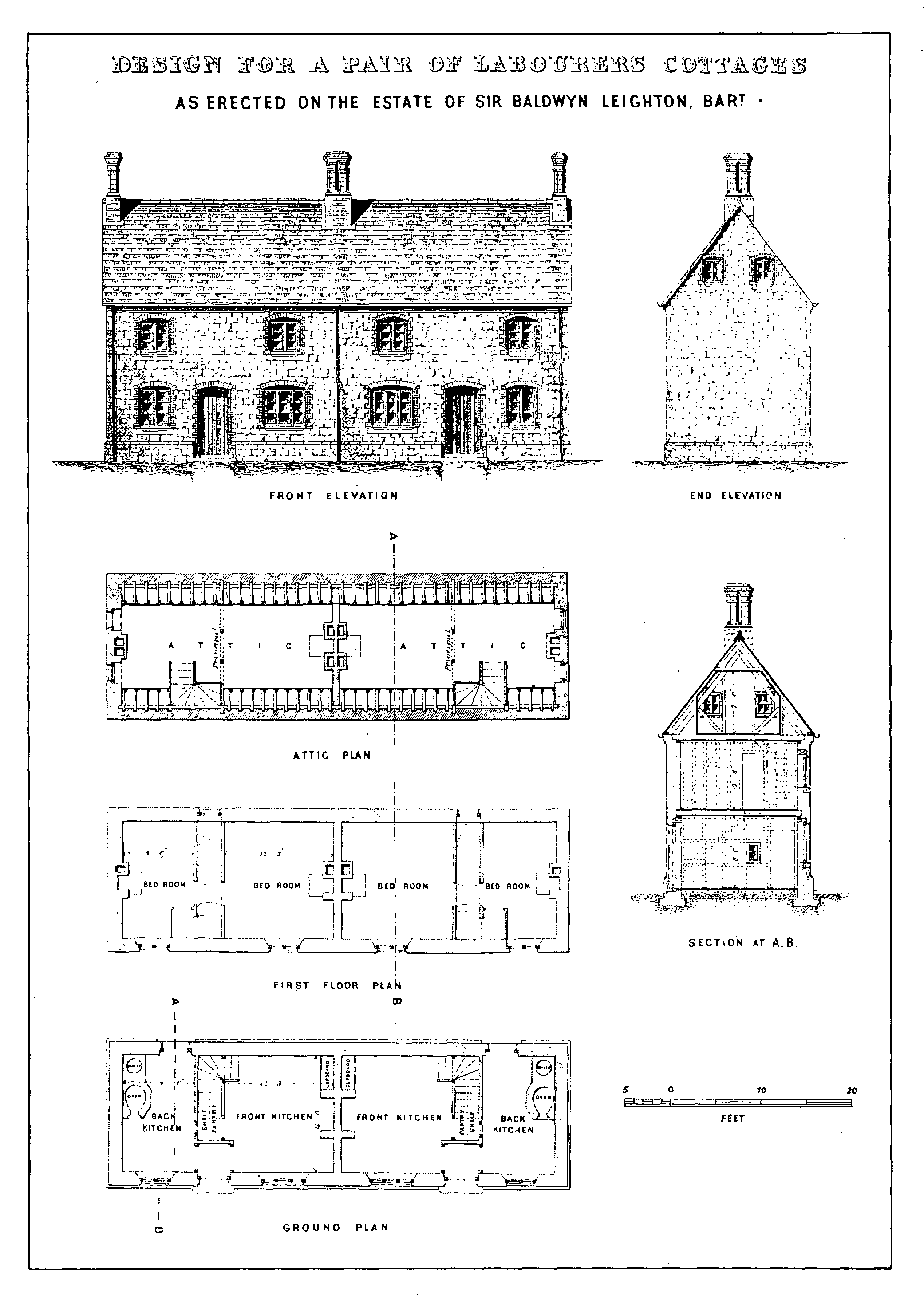
DESIGN FOR A PART OF LABOURERS COTTAGES
A few farmers did favour the scheme. From the time he began farming in the early 19th century Samuel Bickerton, of Sandford, found that allotments improved the labourers' moral character: 'a property at home' counteracted the allure of the public house. (fn. 657) Bickerton, however, may have been better placed than the rackrented farmer more typical of the mid 19th century: occupying a lease of over 300 a. in Sandford and Woolston under Sir T. J. Tyrwhitt-Jones, (fn. 658) he had a longer interest in the property.
Other landlords did something to improve the labourers' conditions. A.C. Heber-Percy of Hodnet let ½-a. pieces of inclosed heath to them because the farmers charged high rent for potato ground. (fn. 659) Lord Craven built two-bedroomed cottages in Stokesay (fn. 660) but is not known to have let land to labourers. The farmers' almost universal disapproval of smallholdings may have influenced landlords who, though less strong-minded than Sir Baldwin Leighton, were otherwise disposed to improve the labourer's standard of living. On the Hawkstone estate, long run less vigorously and consistently than (for example) the Loton estate, farmers' complaints were said in 1869 to have secured discontinuance of the system, though in fact it was not discontinued. (fn. 661)
Any profits of high farming (fn. 662) generally failed to benefit the farm labourer. In 1869 the Hon. Edward Stanhope considered that the living conditions of the peasants of south-west Shropshire were 'deplorably low', worse than in Dorset. Weekly wages in the Clun area were 9s. or 10s. (fn. 663) without a cottage but with ½-2 chains of potato ground rent free; at hay harvest the labourer had part of his daily food and in the grain harvest (there was no piece work) all his food for a month or £1 cash. (fn. 664) Perquisites and payments in kind varied over time and even from farm to farm. Wages in north Shropshire in 1869 were rather higher at 11s.–12s. a week. (fn. 665) That may long have been the case. There is no systematic evidence for the area in the 1790s, but James Caird's mid 19th-century wages line had marked off north-east Shropshire as a higher-wages area. (fn. 666) In the matter of wages, as in other ways, the north-west uplands (where, at times, labour could be had 'for almost anything we please to give' in the 1830s) resembled the south. (fn. 667)
Housing was intimately connected with wages in a number of ways: low wages depressed housing standards, (fn. 668) and where cottages were let to farmers labourers' earnings were depressed. Hiring terms were usually fixed vaguely and later the farmer might vary wages with the corn prices and require longer hours of work. Labourers in cottages under the farmer could not complain, (fn. 669) and in Stokesay parish, where almost all the cottages except Lord Craven's were let with farms, the cottagers bitterly criticized the system as 'slavery'. (fn. 670) Defects in the hiring system were not peculiar to south Shropshire: the rector of Whitchurch called the oral hiring agreements (with 1s. earnest) 'very unsound', and there was no general understanding in the county that pay was due for extra hours worked; overtime was generally paid in food, but as charity and at the employer's pleasure. (fn. 671)
Stanhope considered Shropshire cottages 'infamous': the mud houses occupied by Melverley labourers in 1851 may have been unknown to him but he learnt of similar ones at Whixall (unfit for human habitation), and in most parishes he visited in 1869 he found cottages that were tumbledown, leaky, insanitary, and with too few bedrooms. He attended a meeting of the Shropshire Chamber of Agriculture that called for 'great improvement' to cottages and (to many farmers' cheers) for the provision of more: at least three per 100 a. On some estates there were cottages that were a 'disgrace to a civilized country' and such places were not cheap: for the 'miserable' dwellings in Loppington parish the larger landowners took £3 10s. a year, the smaller proprietors £4 or £5. On some estates cottages pulled down were not replaced: two leading north Shropshire landowners demolished bad properties to escape the reproach of owning them, thereby causing the labourers of their district to 'herd' in 'open' villages. (fn. 672)
Some of the very poorest housing in the 1860s resulted from much earlier rural clearances. In the late 18th century, for example, the poor had been largely shifted out of Lydham parish by the demolition of cottages (fn. 673) and by 1869 there were no labourers' cottages there and none in the neighbouring townships of Lea and Oakeley. Thus many farm labourers had to live in Bishop's Castle and walk to and from their work. Their conditions combined the disadvantages of an urban slum with low agricultural wages. Their houses were of the worst kind: most had only one bedroom and gardens hardly amounted to clothes-drying space. One farm labourer's house in the town, let for 1s. 6d. a week in 1869, had only one room upstairs and one down and no back door; it was only 9 ft. square. Overcrowding was common in other small towns and villages, like Wem and Prees, (fn. 674) and onebedroom cottages were common throughout central Shropshire too, and they were a great cause of pauperism, immorality, incest, and illegitimacy. (fn. 675)
The condition of the south Shropshire labourer was highlighted in 1872 at a meeting of the new North Herefordshire and South Shropshire Agricultural Labourers' Mutual Improvement Society, attended by c. 300. (fn. 676) The standard wage seems to have been 9s. a week (18d. a day) with an extra shilling if Sunday work was required. Even with the usual perks, then worth perhaps 3s. or 4s. a week, it was not enough according to those at the meeting. A labourer from Twitchen, in Clunbury, who had 10s. a week, a free house and garden (the keep of 2 pigs), and perks, admitted that he had more than many but also complained that it was not enough to keep a family. There were new expenses too: it was hard to afford schooling (fn. 677) out of 10s. a week. Even the most industrious labourer, it was claimed, could not in the long run avoid the workhouse. Such had been the fears of a generation or more of labouring men, since the formation of the poor-law unions in 1836–7 and the spreading influence of Sir Baldwin Leighton's (fn. 678) rigorous application of the poor-law principles underlying the Act of 1834. In the 1850s the commonest class of patient in the county asylum consisted of those deranged by the 'ceaseless labours and anxieties of the lowest rank of labouring independence'. (fn. 679)
Conditions appear worst when housing is described. The meeting was reminded
that Shropshire was conspicuous for poor cottages. A labourer from Long
Meadowend, Aston on Clun, thought some not fit for a pig, and the chairman
William Jellicorse, vicar of Clunbury, referred to many that had a ladder instead
of stairs, only one upper room, and no water supply but the river. Such conditions
lend force to a less familiar version of the epigraph to Housman's poem: (fn. 680)
Clunton and Clunbury,
Clungunford and Clun,
Are the dirtiest places
under the sun.
The labourers wanted 15s. a week cash, without perks and with overtime after 6 o'clock; better cottages; a chance to keep a cow and rent ¼ a.; and help to emigrate for those willing to risk it. Respectable opinion was against them. A Kempton labourer keeping a family of eight on 9s. a week said he was under notice for 'sticking up for his rights' by asking 15s. The Conservative Eddowes's Shrewsbury Journal (fn. 681) attributed the labourers' complaints to the work of 'political agitators' seeking their votes at enfranchisement. (fn. 682) The Shrewsbury Chronicle, still nominally Liberal, adopted a more sympathetic tone but was sceptical of all the remedies proposed. (fn. 683) Even the chairman of the meeting thought labourers should continue to be paid partly in kind and should marry later and be thriftier, with young men spending less on pleasure (drink) and young women less on finery (clothes). The society's secretary offered the men addresses of employers in regions where wages were higher, (fn. 684) and many of the next generation abandoned a countryside that yielded so meagre a living. The population of Clun rural sanitary district fell by over 23 per cent in the 1880s, (fn. 685) much the largest drop of any Shropshire district and one that reinforces the other evidence of the area's great poverty.