A History of the County of York East Riding: Volume 3, Ouse and Derwent Wapentake, and Part of Harthill Wapentake. Originally published by Victoria County History, London, 1976.
This free content was digitised by double rekeying. All rights reserved.
A P Baggs, G H R Kent, J D Purdy, 'Heslington', in A History of the County of York East Riding: Volume 3, Ouse and Derwent Wapentake, and Part of Harthill Wapentake, ed. K J Allison (London, 1976), British History Online https://www.british-history.ac.uk/vch/yorks/east/vol3/pp66-74 [accessed 1 May 2025].
A P Baggs, G H R Kent, J D Purdy, 'Heslington', in A History of the County of York East Riding: Volume 3, Ouse and Derwent Wapentake, and Part of Harthill Wapentake. Edited by K J Allison (London, 1976), British History Online, accessed May 1, 2025, https://www.british-history.ac.uk/vch/yorks/east/vol3/pp66-74.
A P Baggs, G H R Kent, J D Purdy. "Heslington". A History of the County of York East Riding: Volume 3, Ouse and Derwent Wapentake, and Part of Harthill Wapentake. Ed. K J Allison (London, 1976), British History Online. Web. 1 May 2025. https://www.british-history.ac.uk/vch/yorks/east/vol3/pp66-74.
In this section
HESLINGTON
The Village of Heslington, an Anglian settlement, lies little over a mile south-east of York, on the lower slopes of the York moraine. (fn. 1) Despite its proximity to the city the parish largely retained its rural aspect until the 1960s, when the estate of the lords Deramore, centred upon Heslington Hall, was split up and sold. Suburban housing development has begun along the northern margin of the parish, but the establishment of the University of York at Heslington has altered the landscape far more. Most of the ground lying between the village and the city boundary has been included in the university campus and by 1972 there were buildings catering for 2,600 students. (fn. 2)
The parish of Heslington, roughly rectangular in shape, formerly covered 2,645 a., of which 1,401 a. were in the parish of St. Lawrence, York, (fn. 3) until 1869, when they were transferred to St. Paul's, Heslington. (fn. 4) The two parts remained separate civil parishes until they were united in 1884. (fn. 5) 'Heslington St. Paul' comprised the lands of the prebendal manor and 'Heslington St. Lawrence' those of the capital manor, and the boundary between them had cut the village in two. The open fields and commons were also divided between them. (fn. 6) Heslington civil parish was enlarged in 1935 by the transfer of Langwith township from Wheldrake, (fn. 7) but in 1968 153 a. in the north of Heslington were transferred to York. (fn. 8)
In the north of the parish the moraine lies mostly at 50 ft. or more above sea-level and in places exceeds 100 ft. To the south is a great expanse of lower ground, with only the modest Holme Hill in the south-east relieving the flatness of the landscape. The open fields lay partly on the boulder clay and glacial sand and gravel of the moraine but extended into the lower ground, which is entirely covered by outwash sand and clay. (fn. 9) A regular field pattern over much of the parish results from the inclosure of the open fields in 1857 and of much of the low-lying commons in 1762. (fn. 10) Part of the commons, however, in the south-western corner of Heslington, remained as open moor and scrub into the present century. (fn. 11) That section lying along the western parish boundary has been occupied by Fulford golf course since 1936, when the club moved from Water Fulford. (fn. 12) On the low ground much of the parish boundary is formed by dikes, and on the moraine it mostly follows the line of the former Roman road from Brough to York. Parts of the western boundary with Fulford follow the line of another Roman road and the prehistoric Green Dykes. (fn. 13)
From the northern end of the village roads lead westwards to Gate Fulford (now Heslington Lane), north-westwards towards York (now University Road), and north-eastwards to join the main road on the northern parish boundary (now Field Lane). Several other roads lead from the village into the fields. One short lane gives access to a surviving stretch of rough pasture known as the Out Gang; the lane was made in 1762, following the inclosure of the copyhold commons, for the benefit of the freeholders and replaced a lane running behind the garths on the west side of the village. (fn. 14)
Improvements were made to the lines of several of the roads by the Yarburgh family. The road to York was altered in 1798, (fn. 15) for example, and in 1855 the Fulford road and its continuation past the hall and church was realigned and straightened. (fn. 16) At the inclosure of the open fields in 1857 the line of the road running north-eastwards was confirmed and a branch from it northwards to the main road, largely on the line of a former field road past the windmill, was laid out. (fn. 17) The improvements of the 1850s took place at a time when Heslington Hall was being remodelled and its grounds improved. The gardens and park, with its fishpond, extended to the west of the hall as far as Spring Lane; the line of the lane was moved further away from the hall in 1865, enabling the park to be extended and a larger pond made. (fn. 18) The former Roman road along the northern boundary of Heslington has become the main York-Hull road. It was turnpiked in 1765 and the trust was renewed until 1872; (fn. 19) an old mile-stone survives. Field Lane was improved and given a new junction with the main road in the 1960s. (fn. 20) A York bypass was being constructed across the south and east of the parish in 1974.
The village lies for the most part along both sides of a long main street, with wide grass verges, which begins at the Fulford road near the hall and the church and ends to the south with a sharp turn into the winding Common Lane. The village pond, which formerly lay at the south end of the street, was filled in in 1855. (fn. 21) Behind the street to the east lies a back lane, now School Lane but known in 1857 as School House Road and Garth Ends Lane. A footpath, called School Lane in 1857, leads from the main street to the back lane. (fn. 22) Behind the garths to the west of the street runs a footpath known as Boss Lane, (fn. 23) on the line of the freeholders' former road to their commons. (fn. 24) Away from the main street a smaller section of the village lies along the Fulford road, beyond the hall grounds; it was entirely in the township of Heslington St. Lawrence, whereas the larger part of the main street was in St. Paul.
The older buildings are concentrated along the main street with only a few outliers along the Fulford road. There are several 17th- and early-18th-century houses, all of brown brick and low profile, and a few larger houses set back behind gardens. The latter include Little Hall, which has a plaster ceiling dated 1734, Moor Hall, which is mid-18th-century in date but was refronted with canted bays later in the century, and Manor House. (fn. 25) The built-up frontage also includes various 19th- and 20th-century houses and farm buildings.
There were three alehouses in the village in the mid 18th century, later generally only two, (fn. 26) known in 1823 as the Robin Hood and the Ship and in 1840 as the Bay Horse and the Fox. (fn. 27) The Bay Horse was renamed the Charles XII after the winner of the 1839 St. Leger flat race, owned by N. E. Yarburgh. (fn. 28) By 1872 the second inn was called the Yarburgh Arms, and in 1967 it was renamed the Deramore Arms. (fn. 29) Apart from 32 council houses in and beyond School Lane and 4 council bungalows in Main Street, few additions were made to the buildings in the village until after the establishment of York University. A conservation area was established in 1969, (fn. 30) and by 1972 Main Street had still been little altered beyond the intrusion of several branch banks. On the Fulford road more than a dozen detached houses of traditional design have been built, as well as one or two, like Patch House (1968), in a more contemporary style. There is also a group of nearly 30 small brick and timber houses and flats (1968–9), and a 'neighbourhood development' of more than 100 red-brick houses and flats (1969–73), built for members of the university. (fn. 31)
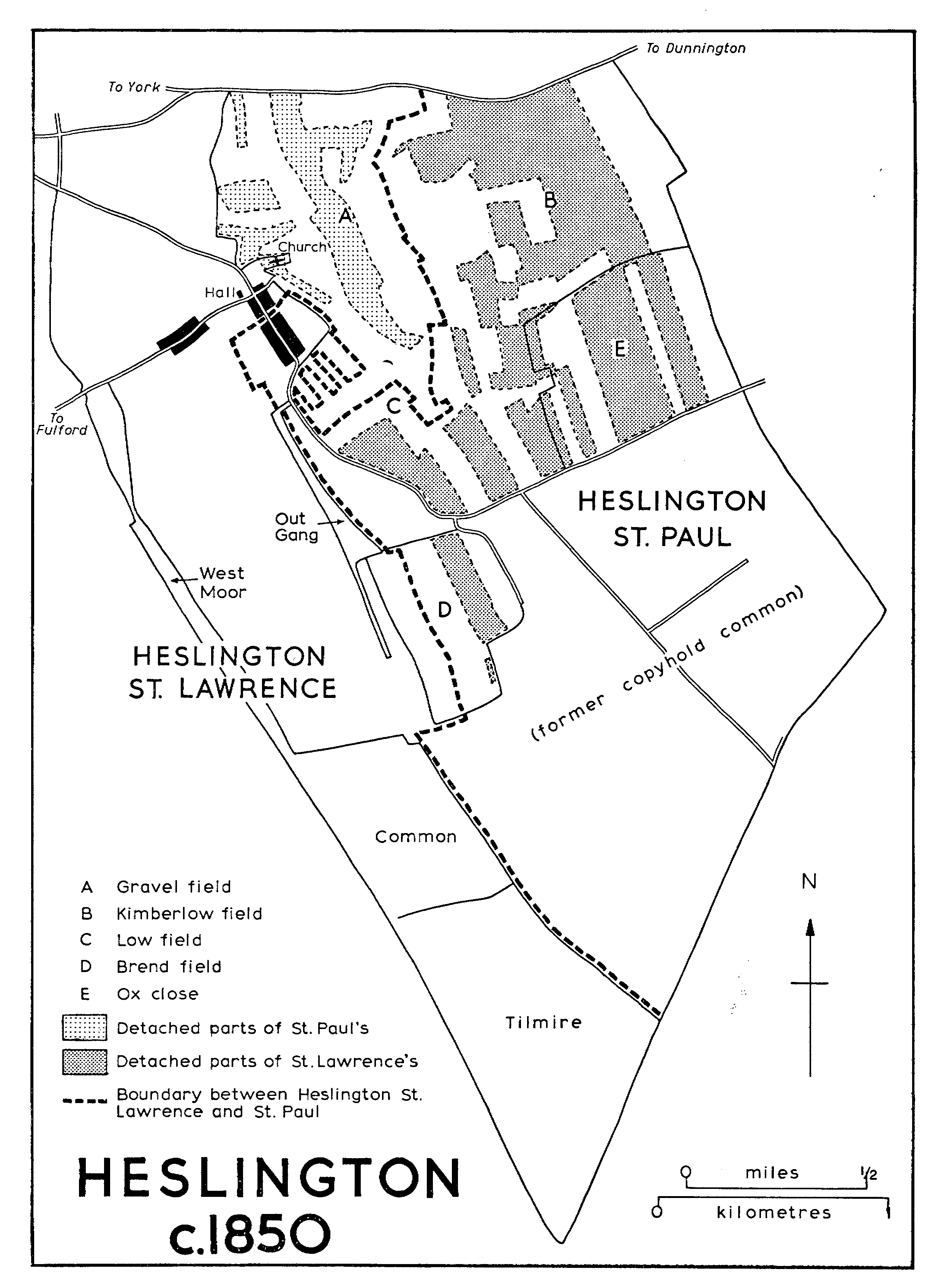
HESLINGTON c. 1850
The university was founded in 1960 and has a site of a little over 200 a., mostly lying between the Fulford and York roads. Heslington Hall forms its administrative headquarters. The old lake was greatly enlarged and many of the new buildings are situated around it. The architects were Robert Matthew, Johnson-Marshall and Partners, and most of the buildings are constructed in 'Clasp', an industrialized building system with a light steel frame and concrete cladding panels. The first two colleges were opened in 1965, and by 1972–3 there were six, together with laboratories, library, central hall, concert hall, and other buildings. Groups of houses are also included, some at Bleachfield and others near the old Spring Lane. (fn. 32)
By 1840 there was an inn, the Black Bull, on the main York-Hull road, (fn. 33) but the growth of the York suburbs into the parish did not begin until the 20th century. By c. 1940 there were 40–50 houses along the south side of Thief Lane, which forms the boundary of Heslington in the north-west, and a similar number near the Black Bull and in near-by Mill Lane. (fn. 34) Playing fields belonging to St. John's College, York, have been situated in Mill Lane since 1937. (fn. 35) In 1957 the York Waterworks Co. built a large water tower, a dominating castle-like structure, on the moraine at Heslington Hill (fn. 36) close to a prominent prehistoric barrow. (fn. 37) By 1972 there was a housing estate, known as Newland Park, south of Thief Lane, and a larger one, called Badger Hill, between the York-Hull road and Field Lane. Archbishop Holgate's Grammar School moved from York to a site near Badger Hill in 1963. (fn. 38)
There were 73 poll-tax payers in Heslington, excluding St. Peter's Liberty, in 1377. (fn. 39) In 1672 there were 59 households, of which 4 were discharged from the hearth tax; of those that were chargeable 40 had one hearth each, 8 had 2, 5 had 3 or 4, one had 6, and Heslington Hall had sixteen. (fn. 40) In Heslington St. Paul alone there were about 23 families in 1743 and 20 in 1764. (fn. 41) The population in 1801 was 416, of which 150 were in St. Paul's township. Heslington St. Lawrence was usually the more populous of the two in the 19th century. The total population rose to 513 in 1821 and 571 in 1861, but fell to 477 in 1881–91; in 1901 it was 506. (fn. 42) The number subsequently fell to 447 in 1931, but with the post-war expansion of the village it reached 882 in 1951, 1,223 in 1961, and 2,029 in 1971. (fn. 43)
Sydney Smith, the renowned canon of St. Paul's cathedral, lived in Heslington in 1809–14, in the house which later became the Vicarage. (fn. 44)
MANORS AND OTHER ESTATES.
Of the three Domesday estates in Heslington one consisted of 5 carucates held by Count Alan of Brittany, and another of 3 carucates held by Hugh son of Baldric. (fn. 45) Hugh's holding later passed into the Mowbray fee. By 1148 a total of 5 carucates from the two fees had been given to St. Peter's (later St. Leonard's) hospital, York, by the under-tenant Robert son of Copsi. (fn. 46) At the Dissolution the hospital's property there was worth about £26. (fn. 47) It had been let to William Mennell in 1520. (fn. 48)
This manor of HESLINGTON comprised property that was often subsequently known as king's hold or freehold. (fn. 49) It was let by the Crown to Sir Thomas Eynns in 1557, and again in 1567 together with other parcels of former St. Leonard's property in Heslington. (fn. 50) In 1575–6 the manor-house was granted in fee to Christopher Hatton, (fn. 51) but he sold it soon after to Eynns's son, another Thomas (d. 1578). (fn. 52) In 1601 Richard Eynns conveyed it to Thomas Hesketh. (fn. 53) After the death of Eynns's widow the lease of the manor was sold in 1584 to Francis Nevill, and it later passed to Sir Richard Lewkenor and then to Thomas Wendy and Adrian Staughton. (fn. 54) In 1601, however, the manor was granted in fee to trustees (fn. 55) and conveyed by them to Thomas Hesketh later that year. (fn. 56)
Apparently in 1693 moieties of the manor were settled upon the daughters of Thomas Hesketh, namely Anne, who in 1692 had married James Yarburgh, and Mary, who in 1693 married Fairfax Norcliffe. (fn. 57) The manor was reunited in 1793 when Thomas Norcliffe Dalton, great-grandson of Mary and Fairfax Norcliffe, sold his share to Henry Yarburgh. (fn. 58) Heslington descended in the Yarburgh family until the death of N. E. Yarburgh in 1852, when it passed to his nephew Yarburgh Greame. (fn. 59) The latter took the surname Yarburgh and died in 1856. He was in turn succeeded by his nephew G. J. Lloyd, who also assumed the surname Yarburgh, and in 1875 the manor passed to his daughter Mary and her husband G. W. Bateson (d. 1893). In 1876 Bateson took the additional surname de Yarburgh and in 1892 he changed his name from Bateson de Yarburgh to de Yarburgh-Bateson; he became the 2nd Baron Deramore in 1890. (fn. 60) Numerous small freehold and copyhold properties were added to the estate in the 18th and 19th centuries. (fn. 61)
After being put to military use during the Second World War Heslington Hall stood empty until it was sold, together with 17 a. around it, in 1956 to the Joseph Rowntree Social Service Trust Ltd. In 1962 the hall was acquired for the new University of York, 165 a. of the estate having been bought for the university site the previous year. (fn. 62) In 1964 the rest of the estate, comprising 2,076 a. in Heslington and 792 a. more in adjoining Deighton, Fulford, and Langwith, was sold to S. A. Spofforth and E. C. Bousfield. (fn. 63) The Deramores continued to live in Heslington, at Manor House, in Main Street, until 1968. (fn. 64)
Heslington Hall, a large brick house, was built between 1565 and 1568 (fn. 65) for Sir Thomas Eynns, secretary to the Council in the North (1550–78). (fn. 66) It extends round three sides of a square courtyard. The central, western, range has a nearly symmetrical elevation to the court with a central doorway and two canted bay windows running the full height of the house. The original planning appears to have been conventional, with the two-storeyed hall and the principal room to the north of the entrance. After 1852 there were extensive alterations, designed by P. C. Hardwick. (fn. 67) The west, garden, front was extended by the addition of new rooms between the original projecting towers which terminated the elevation, the wings were remodelled and most of the windows enlarged, the roofline was decorated with new parapets, gables, and chimneys, and the interior was replanned. Further alterations, which may have included the addition of a southwest wing, were made in 1876. Early in the present century the interior was restored, much of the mid19th-century panelling being removed and replaced by new work in late-16th-century style; minor alterations to the exterior included the removal of the steep 19th-century roofs of the towers. After 1960 further alterations were made when the house was converted to university use. To the west of the house there is a possibly contemporary walled garden, with much topiary work which is probably of 18th-century origin. (fn. 68) A gazebo and orangery are also of that date. The stable block was built after the straightening of the Fulford road in 1855. (fn. 69)
The third estate in Heslington in 1086 consisted of 4 carucates and belonged to the archbishop of York. (fn. 70) The chapter was said to have 5 carucates in 1284–5. (fn. 71) Four of these were assigned to Ampleforth prebend, presumably at its formation before 1219–34, (fn. 72) and c. 1295 the prebend had 32 bovates and other property there. (fn. 73) In the 16th century and later the prebendal estate, sometimes called the manor of HESLINGTON (fn. 74) and comprising land called Peter hold or copyhold, (fn. 75) was usually let along with that in Dunnington and Fulford. It was sold in 1649 by the parliamentary commissioners to Clement Baker, (fn. 76) but was recovered at the Restoration. In the 18th century the lessees were generally the Wickham family. (fn. 77) The estate was vested in the Ecclesiastical Commissioners in 1842, upon a voidance of the prebend, (fn. 78) and in 1851 it was sold by them to N. E. Yarburgh. (fn. 79) It subsequently descended with the capital manor.
The chief house on the prebendal estate may have been the large brick farm-house in the main street known since at least the 19th century as Manor House. (fn. 80) The Yarburghs held a house called Low Hall on the prebendal estate in 1747. (fn. 81)
The remaining carucate of the chapter's land was apparently assigned to Driffield prebend, which had been formed by 1166. (fn. 82) About 1295 the prebend had a toft and a carucate of land at Heslington. (fn. 83) In the 18th and 19th centuries the estate was known as the manor of VERDENAL PLACE, (fn. 84) no doubt after the Verdenel family, who held land in Heslington in the early 14th century. (fn. 85) In 1685 there were 8 houses and 8 bovates of this so-called Vernal hold land. (fn. 86) At least some of it later became part of the Yarburgh estate, for in 1785 3 houses and 4 bovates of it which had belonged to the Wightman family were sold to Charles Yarburgh. (fn. 87)
An estate in Heslington descended, like the capital manor of Fulford, in the Taylors, Oateses, and Keys in the 18th and 19th centuries. (fn. 88) Allotments of 168 a. and 58 a. were made at the inclosures of 1762 and 1857 respectively, (fn. 89) and they comprised practically the whole estate. It was merged with Lord Deramore's estate in 1920, when the 241 a. comprising Tilmire and Grange farms were sold by W. H. Key. (fn. 90)
The tithes of Heslington St. Paul belonged to the prebend of Ampleforth and descended with the prebendal manor. In 1649 they were worth £30, (fn. 91) and in 1841 they were commuted for £190. (fn. 92) The rectory of St. Lawrence's, York, including the tithes of Heslington St. Lawrence, belonged to the chapter of York by the late 12th century. (fn. 93) The tithes on the prebend of Driffield's estate were, however, assigned to that prebend. The chapter's tithes were valued at £30 in 1649 (fn. 94) and the Vernal tithes at £6 13s. 4d. in 1650. (fn. 95) They were commuted in 1841 for £215 payable to the chapter and £37 to the precentor of York, (fn. 96) to whose property the prebend of Driffield had been annexed since 1485. (fn. 97) The lessee of St. Lawrence's rectory leased a plot of ground beside St. Paul's churchyard from the prebendary of Ampleforth in 1299. (fn. 98) A tithe barn was later built on it and still stood in 1855. (fn. 99)
ECONOMIC HISTORY.
No information is given in the Domesday Survey about the condition of the estates in Heslington. Subsequent assarting of waste land in the royal forest of Ouse and Derwent is reflected in a payment of 15s. by the township to the sheriff in 1187 for 30 a. of oats grown in the forest. (fn. 100) About 1295 the prebendary of Ampleforth had 8 bovates of land in demesne and 24 were held by 12 bondmen, each bovate including an acre of meadow. Another 1½ a. of meadow lay in Priest croft. There were also 4 cottars, each holding only a toft and croft. The bondmen and cottars rendered moneyrents, hens, and eggs, and the bondmen also owed mowing and carting works and provided 5 reapers in autumn for each bovate that they held. (fn. 101) Besides the arable land and meadow revealed by the prebendal survey there were extensive common pastures in the southern half of the parish. The pasture and turbary belonging to St. Leonard's hospital there were mentioned in the 12th century and later, (fn. 102) and c. 1295 Ampleforth prebend had a pasture and turbary said to extend to Thursepole in the west, Langwith in the south, and Threkes in the east. (fn. 103) In the extreme south the commons included the wet area known as Tilmire, and dikes draining it were alleged in the 14th century to cause flooding in townships further south. (fn. 104) The value of the capital manor was said in 1364 to have been reduced by flooding. (fn. 105)
The open-field land in the 16th century apparently included Little field, mentioned in 1595, and the meadow land included West ings, adjoining York moor in Fulford. The brecks, also mentioned in 1595, (fn. 106) were presumably intakes from the waste. They were recorded as early as 1520, when St. Leonard's hospital's miller was entitled to summer pasture there for his horse and a cart-load of hay for winter feed. (fn. 107) Mill field was mentioned in the 17th century, and in 1633 there was open-field land in 'the Brend', (fn. 108) later called Brend field. The name Little field used for a close in 1696 suggests that there may have been some early inclosure of openfield land, (fn. 109) probably south-west of the village where 'Little field gate' gave access to the commons. (fn. 110) Other field land may have been inclosed north-west of the village, where 37 a. lay in five Fog closes, between Green Dykes and Mill field, in 1658. (fn. 111) Surviving ridge-and-furrow, both south-west and north-west of the village, (fn. 112) also indicates the former existence of open-field land. Other closes named in 1696 included Tile pits, Clover Grass close, and Whinny brecks. (fn. 113) By the later 18th century there were about 530 a. of closes in the capital manor, mostly north-west and south-west of the village in Heslington St. Lawrence. (fn. 114)
To the east of the village, adjoining Grimston township, was a stinted pasture called Ox close, first recorded in 1649. (fn. 115) It was inclosed and subdivided in 1698 by agreement between the 17 proprietors who enjoyed beast-gates there, 154⅓ gates in all. The close was said to contain 137 a. and allotments totalling 128¾ a. were made. Apparently in 1710 a Chancery decree was sought to confirm the agreement. (fn. 116) Within the commons one early inclosure was made in the extreme south-west, near Pool bridge; it was called Tilmire close in 1658 and was said to contain 100 a., together with a house. (fn. 117) In 1696 another 'great piece of ground' called 'the lord's several' was described as still uninclosed from the commons. (fn. 118)
The commons stretched right across the parish from Fulford in the west to Grimston, and extended from the open fields and early-inclosed lands southwards to the boundary with Langwith. A dike called Wade Gote crossed the commons and there were several ponds and watery areas. From the southern end of the village a wide 'outgang', with a branch on either side of Brend field, gave access to the commons, and a similar drove-way extended from the Fulford road west of the village alongside the parish boundary. (fn. 119) Both freeholders and copyholders shared the commons, but in 1754 the former claimed to have been deprived of their rights and agreed to sustain a law-suit against the copyholders. (fn. 120) It is not clear whether the two groups intercommoned over the whole of the commons or had separate areas within them, but an undated map, apparently earlier than 1754, shows the 'pretended division' between the King's hold (or freehold) and Peter hold (or copyhold) commons. (fn. 121) It was presumably the dispute of 1754 which led to the inclosure of the copyhold common in 1762, (fn. 122) under an Act of the previous year. (fn. 123) Altogether 786 a. were allotted, of which 172 a. went to Charles Yarburgh and 168 a. to Robert Oates; there were also 2 allotments of 50–100 a., 10 of 20–49 a., and 4 of under 20 a. In the outgang 32 a. were inclosed, leaving a much reduced outgang leading to the freehold common. An agreement of 1762 about a lane to the outgang (fn. 124) was signed by 13 copyholders and only 3 freeholders, who were copyholders as well.
The remaining open fields were known in the 18th century and probably before as Gravel, Low, Kimberlow, and Brend fields. (fn. 125) It was Gravel field which had earlier been known as Mill field. Inclosure of the fields took place in 1857, under the general Inclosure Act of 1836. (fn. 126) Allotments totalling 714 a. were made, including 230 a. from Kimberlow field, 214 a. from Gravel field, 173 a. from Low field, and 90 a. from Brend field. G. J. Yarburgh received 600 a., Samuel Key 58 a., and there were 17 allotments of under 15 a. each. There had already been some departure from customary crops and rotations in the fields, for turnips, potatoes, mustard, and flax were being grown in Heslington in the late 18th and early 19th centuries, and potatoes were said to replace a fallow in the open fields. (fn. 127) Chicory was also apparently grown in the parish, as in nearby Dunnington, for a pain laid in the manorial court in the early 20th century prohibited the washing of it in any watercourse. (fn. 128)
The number of farmers in the parish has decreased from more than 20 in the mid 19th century to about a dozen after 1900, and there have usually been one or two market-gardeners as well. About 1930 nearly half of the farmers had 150 a. or more. (fn. 129) The arable acreage remained relatively low until the inclosure of the open fields: in 1801, perhaps in Heslington St. Paul alone, there were only 340 a. under crops, mainly wheat and barley (213 a.), (fn. 130) and in 1839 St. Paul's included 438 a. of arable, 654 a. of meadow or pasture, and 6 a. of woodland. (fn. 131) By 1905, however, there were 1,626 a. of arable, compared with 575 a. of grassland and 56 a. of wood, in the whole parish. (fn. 132) A considerable area of common land has survived in the south of the parish. In 1856 there were 272 a. in Tilmire common and 11 a. in the Out Gang, and 6 men had 166 gates there, all but 14 of them belonging to G. J. Lloyd. (fn. 133) The Out Gang and much of the common remained in 1972, including the former drove-way beside the parish boundary, which had long been known as West Moor and which had become part of the golf course. (fn. 134) The pasture land in the 1930s and later included the area occupied by the University of York in 1972; most of the remaining farmland in the parish was arable. (fn. 135)
There was a gravel-dealer in Heslington in 1840 and gravel was sold from pits on the moraine. (fn. 136) A bleach works north-west of the village was described in 1804 as 'lately built'. It was used by Messrs. Stablers, linen cloth makers of York, and later by John Swale, who had a flax-mill in Lawrence Street in the near-by suburb. By 1857 the works were disused and the property was then bought by the Yarburghs. (fn. 137)
A windmill at Heslington is mentioned in 1530, (fn. 138) and it was called Stublowe mill in 1551. (fn. 139) Two windmills were shown north-east of the village, on the moraine, in 1787. (fn. 140) A new smock mill was built there in 1794–5, (fn. 141) later replaced by a brick tower mill; it is said to have lost its sails c. 1910 and a miller was last mentioned in 1913, but the stump was not demolished until 1941. (fn. 142)
LOCAL GOVERNMENT.
Several fragmentary 16th-century court rolls survive, one of them for a court held by the farmer of the capital manor in 1595. (fn. 143) There are surviving call rolls for 1860–1925, and a court book and pains for 1900–25 which show that two bylawmen, a bailiff, and a pinder were elected. (fn. 144)
There are churchwarden's accounts for Heslington St. Paul for 1712–1883 and for Heslington St. Lawrence for 1753–1823. (fn. 145) Accounts of the constable of St. Paul's for 1754–1823 refer to the existence of a 'freehold constable' for St. Lawrence's. (fn. 146) There were similarly two copyhold and two freehold bylawmen, and the accounts of the former survive for 1748–1817; their sole income was from the letting of common balks in the open fields. (fn. 147) Heslington joined York poor-law union in 1837. (fn. 148) It became part of Escrick rural district in 1894, Derwent rural district in 1935, (fn. 149) and the Selby district of North Yorkshire in 1974.
CHURCH.
The church of St. Paul, Heslington, was in the peculiar jurisdiction of the prebendary of Ampleforth, (fn. 150) who provided a curate to serve it. Though technically a chapel, it appears to have been fully parochial in the Middle Ages and was mentioned in 1299 together with its burial ground. (fn. 151) Part of Heslington, however, was in the parish of St. Lawrence, York, the church of which was near by in the city suburbs. It was separated from St. Lawrence's and united with St. Paul's in 1869. (fn. 152) St. Paul's, which had previously been styled a perpetual curacy, was thenceforth called a vicarage. (fn. 153) The township of Langwith was transferred from Wheldrake to Heslington ecclesiastical parish in 1971. (fn. 154)
Curates were nominated by the prebendary until 1842, when the prebend passed to the Ecclesiastical Commissioners and the advowson became vested in the archbishop of York. (fn. 155) He is still the patron. In 1650 and later the curate received a stipend of £5 from the prebendary's lessee. (fn. 156) The living was augmented from Queen Anne's Bounty in 1740, 1772, 1787, and 1795, each time with £200. (fn. 157) Bounty money was used to buy land and common rights at Grassington (in Linton, Yorks. W.R.), later represented by 18 a., together with 10½ a. at Newton upon Derwent and 17 a. in Holderness. (fn. 158) The average net value of the living in 1829–31 was £63. (fn. 159) Endowments totalling £228 a year were received from the Common Fund in 1870–1, of which £50 was to meet the gift of the Vicarage, (fn. 160) and in 1884 the net value of the living was £270; in 1914 it was £284. (fn. 161)
There was no parsonage house until 1871, when a large existing house in Heslington Lane was provided by the Yarburghs. (fn. 162) It was replaced by a new house in School Lane in 1965, together with an Anglican chaplaincy centre known as Bede House. (fn. 163)
The curate lived in York in 1764; he was also the vicar of St. Lawrence's, York, in 1743 and 1764, and in the former year held Huntington (Yorks. N.R.) as well. (fn. 164) In 1835 the curate was also a vicar-choral and sub-chanter at the minster, perpetual curate of a York living, and again vicar of Huntington. (fn. 165) In the 1860s, before the unification of Heslington as St. Paul's parish, the incumbent also held St. Crux's, York, but employed an assistant curate at Heslington. (fn. 166)
There was one service monthly and Holy Communion was administered three times a year in the 18th century, with about 15 communicants in 1743. (fn. 167) By 1851 there was a weekly service, (fn. 168) and between 1871 and 1894 there were two or three each Sunday, sometimes with a Wednesday service as well. Communion was celebrated four times a year in 1865, once a month in 1871, twice a month in 1877, and weekly in 1884. (fn. 169) In 1972, when the church was used jointly with the Methodists, there were three Anglican services each Sunday.
The old church of St. Peter and St. Paul consisted of chancel, nave with north aisle, and west tower; most of the fabric was said to be 'late and poor', but several windows were described as Norman. (fn. 170) The bylawmen paid £32 in 1769 'for building the church steeple etc.'. (fn. 171) A new church of ST. PAUL was erected on the same site in 1857–8, comprising chancel, nave, vestry, west tower with spire, and south porch. It is of stone, was designed by J. B. and W. Atkinson of York, in the Decorated style, and was paid for by G. J. and Alicia Lloyd. The two undated bells from the old church were retained. (fn. 172) Extensive alterations were made to the building in 1973, including the conversion of the chancel to a chapel, the removal of the high altar to an enlarged nave, and the addition of meeting rooms and vestries on the north side.
The plate formerly comprised a plated cup, paten, and flagon, the last dated 1861. (fn. 173) The chalice and paten were stolen in 1966, (fn. 174) but two new chalices and patens have been acquired. (fn. 175)
The registers begin in 1653 and are largely complete, the chief gaps being those in the marriages in 1656–64, 1703–16, and 1754–8. (fn. 176)
The churchyard was enlarged in 1862 and 1921. (fn. 177)
NONCONFORMITY.
Methodism is said to have been introduced into Heslington in 1812, (fn. 178) and houses were licensed for dissenting worship in 1807, (fn. 179) 1816, 1820, 1826, 1829 (two), and 1846. (fn. 180) A chapel was opened by the Wesleyan Association in the 1830s and was still used in 1851, but no more is known of it. In the 1840s two more chapels were built, by the Wesleyan Methodists in 1844 on the west side of Main Street and by the Independent Methodists in 1847 on the east side. (fn. 181) The Wesleyans had fourteen members in 1884. (fn. 182) The Independent Methodist chapel was acquired by the Primitive Methodists and registered by them in 1887. (fn. 183)
The former Wesleyan chapel was closed in 1949 (fn. 184) but the second Methodist chapel was used until 1971, when the Methodists and Anglicans arranged for the joint use of St. Paul's parish church. (fn. 185) A Methodist service was held in the church each Sunday in 1972. Both the former chapels still stood in 1972; the Wesleyan, then used as a meeting hall, is a brick and slate building with wide overhanging eaves and Tudor windows.
EDUCATION.
The first school in Heslington was built in the back lane (now School Lane) in 1795, on ground given by Henry Yarburgh and at the expense of the township; (fn. 186) the bylawmen paid £4 towards the work that year. (fn. 187) In 1835 20 boys and 20 girls were taught there at their parents' expense. (fn. 188) A new school was projected by Yarburgh Yarburgh and built in 1856, after his death, by G. J. and Alicia Lloyd. (fn. 189) The earlier building, containing two ground-floor rooms and an attic, still stood in 1972. Yarburgh Yarburgh bequeathed £1,000 to the school and in 1858 £31 interest on it was received, as well as subscriptions and school pence. The average attendance was 54 in 1857, (fn. 190) and there were 72 in attendance in 1871. (fn. 191) The school was united with the National Society and it received an annual government grant by 1860. (fn. 192) The stock of Yarburgh's charity was sold to pay for the school's enlargement in 1907. (fn. 193) Attendance was about 90 in 1906–14, but it fell to 53 in 1938. (fn. 194) The buildings were again extended in 1957 and 1965, on the latter occasion to accommodate 280 pupils. The school had been reorganized in 1958 as an infants' and junior school, senior pupils being transferred to Fulford. (fn. 195) The number on the roll in September 1972 was 224. (fn. 196)
A county infants' school was built on the Badger Hill housing estate and opened in 1968. (fn. 197)
CHARITIES FOR THE POOR.
Sir Thomas Hesketh (d. 1605) proposed to found a hospital at Heslington and it was built in 1608 by his widow dame Julia beside the York road, north of the hall. (fn. 198) The hospital was endowed by indenture of 1630 with £50 a year from Castle Mills, York. A master was to receive £6 13s. 4d. a year and eight other inmates, one a woman, were to get £5 each. A further endowment of £5 a year from land at Hutton Rudby (Yorks. N.R.) was probably given by another of the Heskeths. (fn. 199) The hospital was rebuilt on the Fulford road by Henry Yarburgh in 1795. (fn. 200) The twostoreyed brick building had a chapel in the pedimented centre, with terraces of four two-roomed apartments on either side for the men and a room behind for the woman. The hospital was repaired and modernized by Richard, Lord Deramore, in 1968. (fn. 201) In 1974 the endowment income was still £55, the former rent-charge on Castle Mills being paid by York corporation, and contributions were made by the inmates. (fn. 202)
Yarburgh Yarburgh, by will proved in 1856, bequeathed £1,000, three-tenths of the income from which was to go to the poor of Heslington. In 1972 Heslington's share of the income was £6.50, distributed in 50p doles to thirteen people. (fn. 203)
Robert, Lord Deramore, in 1903 built four almshouses for spinsters or widows at the south end of Main Street, in memory of his wife Lucy. (fn. 204) By an indenture of 1902 Lord Deramore endowed the charity with £1,125 stock and declared that the inmates were each to have £10 a year. In 1973 the income was £24 from £959 stock. (fn. 205)
Heslington benefited from the charity of John Hodgson for parishes in York poor-law union. (fn. 206)