A History of the County of Gloucester: Volume 5, Bledisloe Hundred, St. Briavels Hundred, the Forest of Dean. Originally published by Victoria County History, London, 1996.
This free content was digitised by double rekeying. All rights reserved.
A P Baggs, A R J Jurica, 'St. Briavels Hundred', in A History of the County of Gloucester: Volume 5, Bledisloe Hundred, St. Briavels Hundred, the Forest of Dean, ed. C R J Currie, N M Herbert (London, 1996), British History Online https://www.british-history.ac.uk/vch/glos/vol5/pp85-92 [accessed 30 April 2025].
A P Baggs, A R J Jurica, 'St. Briavels Hundred', in A History of the County of Gloucester: Volume 5, Bledisloe Hundred, St. Briavels Hundred, the Forest of Dean. Edited by C R J Currie, N M Herbert (London, 1996), British History Online, accessed April 30, 2025, https://www.british-history.ac.uk/vch/glos/vol5/pp85-92.
A P Baggs, A R J Jurica. "St. Briavels Hundred". A History of the County of Gloucester: Volume 5, Bledisloe Hundred, St. Briavels Hundred, the Forest of Dean. Ed. C R J Currie, N M Herbert (London, 1996), British History Online. Web. 30 April 2025. https://www.british-history.ac.uk/vch/glos/vol5/pp85-92.
ST BRIAVELS HUNDRED
St. Briavels hundred was created between 1086 and 1220, probably before 1154 to provide an administrative structure for the area then within the Forest of Dean. (fn. 1) The history of the hundred and of the Forest administration remained closely entwined.
In 1086 the area of the later hundred was divided between two counties and three hundreds. Lydney hundred, in Gloucestershire, included Hewelsfield and Wyegate, both added to the Forest since 1066 and apparently depopulated, and St. Briavels (then named Lydney); (fn. 2) Westbury hundred, in Gloucestershire, included English Bicknor and a manor called Dean; (fn. 3) and Bromsash hundred, in Herefordshire, named from a tree at a road junction in Weston under Penyard, (fn. 4) included Staunton, 'Brocote', and Whippington (all depopulated and added to the Forest waste before 1066), Ruardean, and Lea. (fn. 5) The woodland and waste of the royal Forest, which evidently covered much of the area, was not directly described in the Domesday survey.
St. Briavels hundred was recorded in 1220 when, in a listing by hundreds, its vills were grouped as the separate responsibility of the constable of St. Briavels, John of Monmouth. (fn. 6) In 1248, under the heading 'Forest of Dean', they were described as a separate hundred, (fn. 7) and in 1270 the hundred was named as St. Briavels. (fn. 8) As a royal hundred with unusually full jurisdiction, it was sometimes called the liberty of St. Briavels in the late 13th century. Among its vills were Mitcheldean, Littledean, and Abenhall (all apparently offshoots of the Domesday manor called Dean), Hewelsfield and Staunton, which had re-emerged as manorial units, and St. Briavels, English Bicknor, Ruardean, and part of Lea. (fn. 9) All those older manors had probably been much enlarged by assarting from the Forest waste, a process which had created two new manors and parishes. Newland (formerly called Welinton) had a church by 1216 and its parish, later in widely scattered parts, was defined in 1305 by a grant of the tithes from all recent assarts from the Forest. (fn. 10) Flaxley was created by Roger, earl of Hereford, c. 1150 as the endowment of his foundation, Flaxley abbey. (fn. 11)
In Westbury-on-Severn parish Northwood tithing, which originated as a manor called Walmore formed by assarting in the 12th century, (fn. 12) was part of the hundred until 1608 or later; it was listed with Westbury hundred from 1672, though detached parts of the Forest demesne in the same area called Walmore common and Northwood green remained in St. Briavels. Blakeney, in Awre parish, was also in the hundred to the 16th century but was regarded wholly or partly as within Bledisloe hundred by 1608. (fn. 13) Blythes Court manor, in Newnham parish, may have originated as part of St. Briavels hundred, though not found recorded as such: like manors of the hundred it owed service as a woodward of a Forest bailiwick and a chief rent to St. Briavels castle. (fn. 14) A part of Lea parish remained in Herefordshire in Greytree hundred: in 1831 it was said to contain 380 a. while the Gloucestershire part of the parish, which was in three divisions, one of them including the church and some of the village, contained 150 a. (fn. 15) In 1844 the Gloucestershire part was transferred to Herefordshire, (fn. 16) and the whole parish is reserved for one of the Herefordshire volumes of this History. In the same area, Herefordshire gained in the 1880s some detached parts of Lea Bailey, a tithing of Newland, and in 1965 much of Lea Bailey Inclosures, formerly in the extraparochial Forest. (fn. 17)
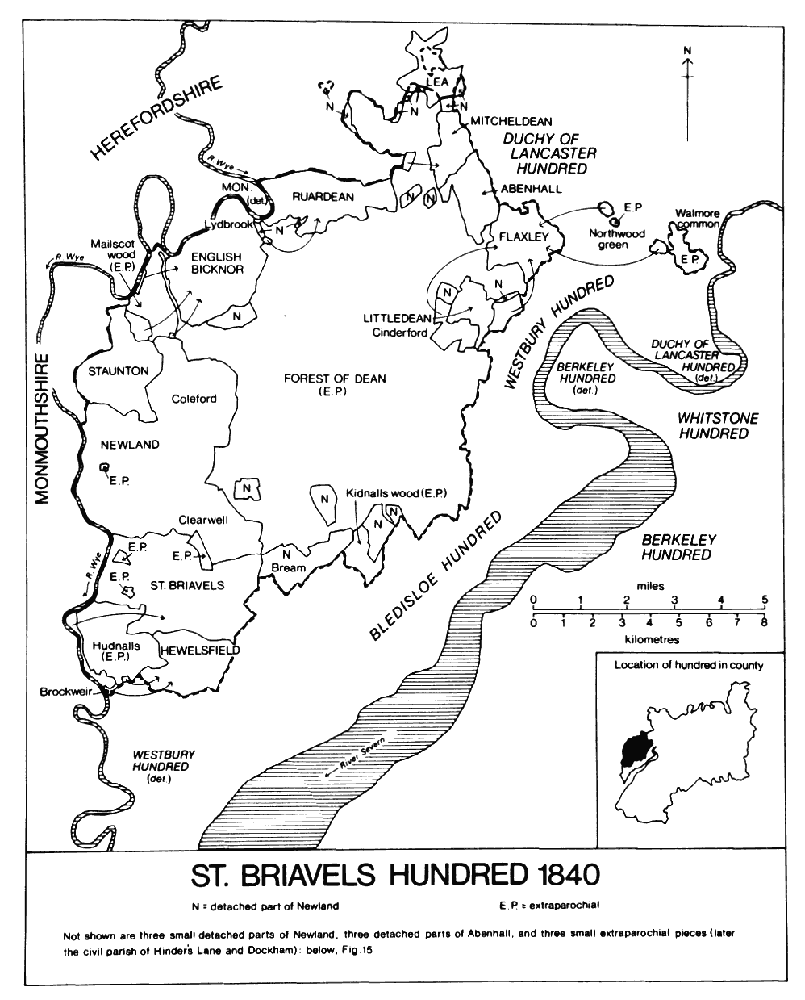
ST. BRIAVELS HUNDRED 1840
The hundred or liberty was centred on St. Briavels castle and manor. In the early Middle Ages that estate supported the royal officer known as the constable of St. Briavels, who administered the Forest and acted as escheator and rent collector for the manors of the hundred. Ten of the manors of the hundred (if Blythes Court is included) supported woodwards of Forest bailiwicks (fn. 18) and paid rents to the constable and to his successors as holders of the castle estate. (fn. 19) The exceptions were Flaxley, which was given to Flaxley abbey in free alms, (fn. 20) and Hewelsfield. Hewelsfield's lack of a bailiwick, and the fact that it was the only place in the hundred removed from the Forest in the early 14th century among vills claimed to have been afforested after 1154, suggest that it was a late addition to the hundred. It also paid no rent, but that was presumably the result of its grant to Tintern abbey (Mon.) in free alms in the late 13th century. (fn. 21) Apart from Hewelsfield, the parishes of the hundred remained in the Forest jurisdiction, which was exercised over manorial lands until 1668. (fn. 22)
The St. Briavels hundred court was kept at the castle by the constable, usually acting through a deputy. It met every three weeks in theory but in the early 15th century the actual number of sessions each year was 13 or 14, and that was the usual number in the late 16th century, when customary adjournments for holidays explained the discrepancy. The court day was Monday, briefly changed to Tuesday in the Interregnum. Ordinary sessions, usually termed the court of pleas or three weeks' court, were combined with the court leet for the hundred on three Mondays, near Michaelmas, St. Hilary, and Hockday. The court also acted as a court baron for the royal manors of St. Briavels and Newland, (fn. 23) and in the early 15th century parcels of waste in those manors, some the sites of mills, were granted to new tenants in the court. (fn. 24) By the 18th century almost its only function as a court baron was receiving the suit of free tenants of the manors. When St. Briavels castle and the two manors were leased away from the constableship (fn. 25) the constable continued to hold the courts, though in the late 16th century, but possibly not later, the lessee received the profits. (fn. 26) For many years during the 17th century and the early 18th the constableship and the lease were held by the same man, making it uncertain whether the right of holding the courts belonged with the constableship or with the lease. In 1755 when constableship and lease passed into separate tenure again Thomas James, who was both deputy constable and steward of the castle estate, began to hold the courts leet in right of the lessee, while continuing the court of pleas in right of the constable. The division was emphasized in 1764 when the constable appointed a separate deputy to hold the court of pleas, while the steward continued the leet. (fn. 27) From that time, though constable and lessee were the same again in the years 1766-1810 and both courts continued on the same day at the castle, the courts were regarded as entirely distinct. (fn. 28) Court rolls survive for some sessions in the years 1633-5 and 1641, (fn. 29) and there are court books for the years 1719-1839, which from 1755 record only the court of pleas. (fn. 30) Some court papers for the separate leet survive for the 19th century and the early 20th. (fn. 31)
The deputy constable, appointed by the constable of St. Briavels, presided over the courts, but by the late 16th century two or more of the chief freeholders of St. Briavels manor sat with him; the failure of such freeholders to attend caused the abandonment of some sessions in the 1570s. The deputy constable's practice of appointing his own deputy, who in his turn deputized someone else to preside, also called in question the legality of some sessions at that period, and further problems were caused when the clerk, appointed by the deputy constable to record proceedings, sent an unqualified person in his place. (fn. 32) During the 18th century, when the constable of St. Briavels appointed a number of local gentry as his deputies, one with legal training, usually a member of the James family of Lydney and Coleford, presided. (fn. 33) Under the duke of Beaufort, constable 1812-35, two Newnham solicitors were appointed as deputy constables to hold the court of pleas, one also having the style of recorder. Jurymen, in theory drawn from the whole hundred, were by the early 19th century in the court of pleas almost always from St. Briavels parish itself. That court appointed a bailiff as its executive officer, (fn. 34) and c. 1743 a Mitcheldean man was appointed as a second bailiff, (fn. 35) presumably to carry out processes in the more distant parishes on the north-east side of the Forest.
The court of pleas remained an active court for minor civil cases. In the early 17th century some pleas of trespass concerned small parcels of land and were settled after two or more suitors were appointed to 'view' the land and report to the court. (fn. 36) By the early 15th century small estates were conveyed in the court by fine, in the same mode as in the Court of Common Pleas; (fn. 37) fines were still levied in 1782 (fn. 38) but the practice was said in 1832 to be long discontinued. (fn. 39) By the early 18th century actions for debt predominated (fn. 40) and they were almost the whole business in the early 19th century. In the 1830s c. 200 pleas were heard each year for debts of up to £20, though most were for under £5. Examples were cited in 1832 of a man who recovered a debt of £2 at a cost of £11 14s. and of another who was imprisoned for six months for a debt of £6, and the court was then said to be of little benefit except to the group of local attorneys who were admitted to plead there. A complex system of fees had developed, most taken by the deputy constables for their salary while others went to the attorneys and to the bailiff. (fn. 41)
The castle, which earlier had been a prison for those indicted by the Forest courts, was used by the late 17th century to confine undischarged debtors. (fn. 42) A room in one of its gatehouse towers was used in the early 19th century, and rooms above were occupied by the gaoler and his family. (fn. 43) In the early 1830s the gaoler allowed the prisoners, who usually numbered less than six, the run of the castle and sometimes trusted them to wander outside it. They were supported entirely by charity until c. 1825 when an allowance of 3s. 6d. a week each was made from the St. Briavels parish poor rates. The gaoler received some fees, and he was allowed to keep an alehouse in the castle until c. 1820 when it was closed and he was given a salary of £25 instead. (fn. 44)
In 1842 an Act abolished the court of pleas and its prison and established instead a court of requests for recovering debts of up to £15 in the hundred. It was to hold sessions at Coleford for the parishes of the west part of the hundred and at Littledean for those of the east. (fn. 45) In 1847 the court of requests was replaced by a county court for the district. (fn. 46)
An important part of the business of the hundred leet in the 16th century and the early 17th was its attempts to regulate commoning in the royal demesne land of the Forest. (fn. 47) The leet also administered the assizes of bread and of ale in 1627, appointing two men for each parish or tithing to enforce them. A constable then attended from each parish to make presentments, (fn. 48) but by the early 18th century the court found it difficult to ensure their attendance and very little leet business was done at the three annual sessions with that designation. (fn. 49) The separate leet, held for the lessee of the St. Briavels castle estate from 1755, met twice a year in the early 19th century. (fn. 50) It lapsed for some years in the mid 19th century and was revived c. 1862 (fn. 51) after the estate had been taken in hand by the Crown. In the early 20th century, when the deputy surveyor of the Forest, as chief local agent of the Crown Commissioners of Woods, acted as steward, it was held no more than once a year; a session in 1921 was perhaps the last. In its later years, though styled the court leet and court baron for the manor and hundred of St. Briavels and the manor of Newland, it apparently dealt only with matters within St. Briavels parish. (fn. 52) Several of the local manor courts of the hundred also exercised leet juridisction within their manors in the late medieval and early modern periods. (fn. 53)
Over 20,000 a. in the centre of St. Briavels hundred, which remained royal demesne land of the Forest of Dean, was only sporadically settled before the mid 18th century and was extraparochial until the mid 19th. Its history is summarized below, at the head of the account of the Forest, (fn. 54) and what follows here relates principally to the parochial lands of the hundred.
The ancient parishes of St. Briavels hundred lie around the edge of a plateau of high land, most of which is occupied by the formerly extraparochial Forest. The parishes on the west side, including Newland and St. Briavels, are mainly on the high land, with steep slopes to the river Wye; English Bicknor and Ruardean, on the north side, are mainly on the slopes from the plateau edge to the river; and a group of smaller parishes, including Mitcheldean, occupy a system of valleys at the plateau's north-east edge. The Old Red Sandstone forms much of the valleys and the hills rising from the Wye, carboniferous limestone, containing iron ore deposits, outcrops around the plateau's edge and forms high cliffs above the river in and near English Bicknor, and the sandstones and shales of the coal measures form the central plateau. Lodgegrove brook, Greathough (or Lyd) brook, the upper Red brook, and the lower Red brook (later Valley brook) are among the streams draining from the high land to the Wye, and Westbury and Longhope brooks are among those draining the north-eastern valleys. Woodland, which with the mineral deposits and the availability of water power determined the mainly industrial role of the hundred, was cleared from much of the parochial land during the early Middle Ages, leaving some substantial stretches on hillsides too steep for cultivation in Flaxley and some of the Wye Valley parishes. Woodland regained some land from agriculture after 1817 with the planting of c. 1,000 a. of the Highmeadow estate in Staunton, Coleford, and English Bicknor. With the late clearance and settlement of much of the land, there was hardly any customary tenure and only a few small open fields; no parish required an Act of parliament for inclosure. The small freehold, often carried on with a trade or craft, was the typical holding in much of the hundred, and even in parishes where substantial estates were formed after the Middle Ages farms remained modest in size, mainly concerned with animal husbandry. Commoning rights in the royal demesne land of the Forest were a cherished asset of the many smallholders, whose vigorous defence of them was inherited in the modern period by those parishioners who settled as squatters on the demesne itself.
The local Cistercian abbeys of Flaxley and Tintern (Mon.) were among manorial owners; otherwise most manors were held in the Middle Ages by small lay lords, with the Greyndours and their successors the Baynhams prominent at the end of the period. Several small castles were established, but only that of St. Briavels, because of its role as an administrative centre, was long maintained. The area retained a strong body of resident gentry in later centuries, most of them serving in the Forest administration as officers by tenure or appointment. The Throckmortons and later the Wyndhams succeeded to the Baynhams' western estates based on Clearwell, in Newland, and another substantial estate was established on the west side of the Forest by the Halls, who built a large mansion at the site of the deserted village of Highmeadow and were succeeded by the Viscounts Gage. Smaller, but locally influential, landowners included the Machens of Eastbach, in English Bicknor, the Catchmays and Rookes of Bigsweir, in St. Briavels, and the Bonds of Redbrook, in Newland. In the north-eastern parishes the chief landowners were the Vaughans, successors to other Baynham estates, the Colchesters, who built a mansion at the Wilderness near Mitcheldean in the 1670s, the Pyrkes of Littledean, and the Boeveys (later Crawley-Boeveys), who lived at Flaxley in a mansion formed from the buildings of the medieval abbey.
For many centuries river transport was probably more important than roads for distributing the products of local industry, which were shipped at creeks on the Severn in adjoining hundreds, the larger river ports of Chepstow and Monmouth, and small landing places on the Forest bank of the Wye; Brockweir, at the lowest point of the hundred on the Wye, was a small community of watermen engaged mainly in the Bristol trade. The principal road routes crossing the hundred were from Gloucester to Monmouth and Wales: one ran through Mitcheldean and the northern part of the Forest and another through Littledean and the central Forest, both converging originally on Coleford. The northern route was largely refashioned in the turnpike age, when, among other improvements, a new Wye Valley road of the 1820s with a bridge at Bigsweir helped to improve accessibility to the western edge of the area. Mitcheldean, where the northern route to Monmouth was crossed by an ancient route from the Severn at Newnham to Ross-on-Wye (Herefs.) and Hereford, was the principal market town in the late medieval and early modern periods; it was supported also by a succession of industries, including clothmaking and pinmaking. Coleford, part of Newland parish until 1894, became the principal centre on the west side of the hundred, securing a market and fairs in 1661. Littledean was a minor market centre in early modern period. Newland did some trade in the 16th century, but it later settled into a more residential role and, with its gentry houses, almshouses, and grammar school grouped around a large church and churchyard, was the most picturesque (in a conventional sense) village in the hundred.
The hundred's mineral wealth and woodland gave most of its villages a strong industrial element: places such as Ruardean, Littledean, and Clearwell had miners, ironworkers, quarrymen, charcoal burners, and makers of barrel staves and hoops, trenchers, shovels, and cardboard. For the miners the boundaries of St. Briavels hundred defined the limit of their customary rights, so that the hundred, unlike most in Gloucestershire, retained a popular significance in modern times. In the Middle Ages numerous itinerant bloomery forges and some larger fixed works were supported by the woodland of the manors and royal demesne. In the 13th century some of the iron produced went to make crossbow bolts at St. Briavels under the direction of the constable, and a specialist trade carried on in later centuries was nailmaking at Littledean. In most parishes the inefficient medieval forges left large mounds of iron slag, or cinders, which were later dug out and rendered down in the water-powered blast furnaces that were established from c. 1600. Bishopswood at the boundary of Ruardean and Walford (Herefs.), Flaxley, Gunn's Mills in Abenhall, and Redbrook in Newland were among sites of the iron industry in the era of water power. At some of those and some other mill sites corn milling, cloth fulling, and paper making were carried on at various times in the 17th and 18th centuries, and Redbrook was the site of copper works. Tanneries, using Forest oak bark, operated in several parishes.
In the 19th century the main centre of activity in the hundred shifted to the royal demesne land of the Forest, where by 1851 there was a larger population than in the old parishes. (fn. 55) The development of deep coal mining and other industry in the central Forest, however, affected most of the parishes, where the agricultural and traditional elements were further submerged by large contingents of miners. The villages of Ruardean, Littledean, and Bream, in Newland, were enlarged and mainly rebuilt and came to share the character of the newer hamlets adjoining them within the Forest demesne. Some small coal and iron mines were worked in Ruardean, Coleford, and other parishes until the early 20th century. Lime burning was a significant trade in St. Briavels and Mitcheldean, among other parishes, and in Mitcheldean cement was made and the red sandstone was quarried. Among tramroads built early in the 19th century to serve the Forest mines and quarries one led to Monmouth through Coleford and Redbrook, which remained an industrial hamlet dominated by a large tinplate works. Another tramroad led to the river bank at Lydbrook, an industrial village, mainly on the extraparochial land, between English Bicknor and Ruardean, and to coal wharves established in Ruardean to supply Herefordshire. Steam railways, including the Wye Valley line which operated from 1876 to 1964, and the short lived Coleford to Monmouth line of 1883-1916, were of little significance in the parishes. Coleford prospered, however, as the main business and retail centre on the west side of the coalfield and was also the principal local base for the nonconformist churches. Mitcheldean, partly because of the development of the new Forest town of Cinderford in that area, had a more limited role, with a brewery the main employer in the town itself. Among the smaller settlements, Staunton after the planting of much of the adjoining farmland became a community of forestry workers. Hudnalls, a tract of extraparochial common land near the Wye added to St. Briavels and Hewelsfield in 1842, was colonized by smallholders and craftsmen, who were largely replaced from the end of the century by a wealthier, residential population.
A wire and cable works established in 1912 at Stowfield, in English Bicknor, became a major employer in the mid 20th century, when the loss of employment by the closure of the Forest deep mines was compensated partly by new factories at Mitcheldean and Coleford. More traditional industry was still represented in the late years of the century by large quarries for roadstone near Coleford and Newland. Most of the villages became residential and dormitory communities for Gloucester and other places outside the Forest area. New housing estates and bungalows were added to most of them and the plain stone cottages of the miners, quarrymen, and forestry workers were restored and enlarged.