A History of the County of Middlesex: Volume 5, Hendon, Kingsbury, Great Stanmore, Little Stanmore, Edmonton Enfield, Monken Hadley, South Mimms, Tottenham. Originally published by Victoria County History, London, 1976.
This free content was digitised by double rekeying. All rights reserved.
A P Baggs, Diane K Bolton, Eileen P Scarff, G C Tyack, 'Edmonton Hundred', in A History of the County of Middlesex: Volume 5, Hendon, Kingsbury, Great Stanmore, Little Stanmore, Edmonton Enfield, Monken Hadley, South Mimms, Tottenham, ed. T F T Baker, R B Pugh (London, 1976), British History Online https://www.british-history.ac.uk/vch/middx/vol5/pp128-129 [accessed 30 April 2025].
A P Baggs, Diane K Bolton, Eileen P Scarff, G C Tyack, 'Edmonton Hundred', in A History of the County of Middlesex: Volume 5, Hendon, Kingsbury, Great Stanmore, Little Stanmore, Edmonton Enfield, Monken Hadley, South Mimms, Tottenham. Edited by T F T Baker, R B Pugh (London, 1976), British History Online, accessed April 30, 2025, https://www.british-history.ac.uk/vch/middx/vol5/pp128-129.
A P Baggs, Diane K Bolton, Eileen P Scarff, G C Tyack. "Edmonton Hundred". A History of the County of Middlesex: Volume 5, Hendon, Kingsbury, Great Stanmore, Little Stanmore, Edmonton Enfield, Monken Hadley, South Mimms, Tottenham. Ed. T F T Baker, R B Pugh (London, 1976), British History Online. Web. 30 April 2025. https://www.british-history.ac.uk/vch/middx/vol5/pp128-129.
EDMONTON HUNDRED
The Hundred lies west of the river Lea in the north-east corner of Middlesex. Crossed by the Great North Road and Ermine Street, it is bounded by Hertfordshire in the north, north-east, and north-west, and by Ossulstone in the south and south-west. In 1881 it covered 31,805 a. (fn. 1) South Mimms, Monken Hadley, and part of Enfield project westward into Hertfordshire and from the later 19th century have been transferred piecemeal to that county.
In 1086 the hundred comprised the manors of Enfield, Tottenham, and Edmonton with the berewick of South Mimms, which presumably included Monken Hadley. It was then assessed at only 70 hides, less than any other Middlesex hundred. (fn. 2) From 1130 it was frequently described as a half hundred. (fn. 3) The early-12th-century Middlesex Hidagium calls it the 'half hundred of Mimms' but some of the details for the area are missing. (fn. 4)
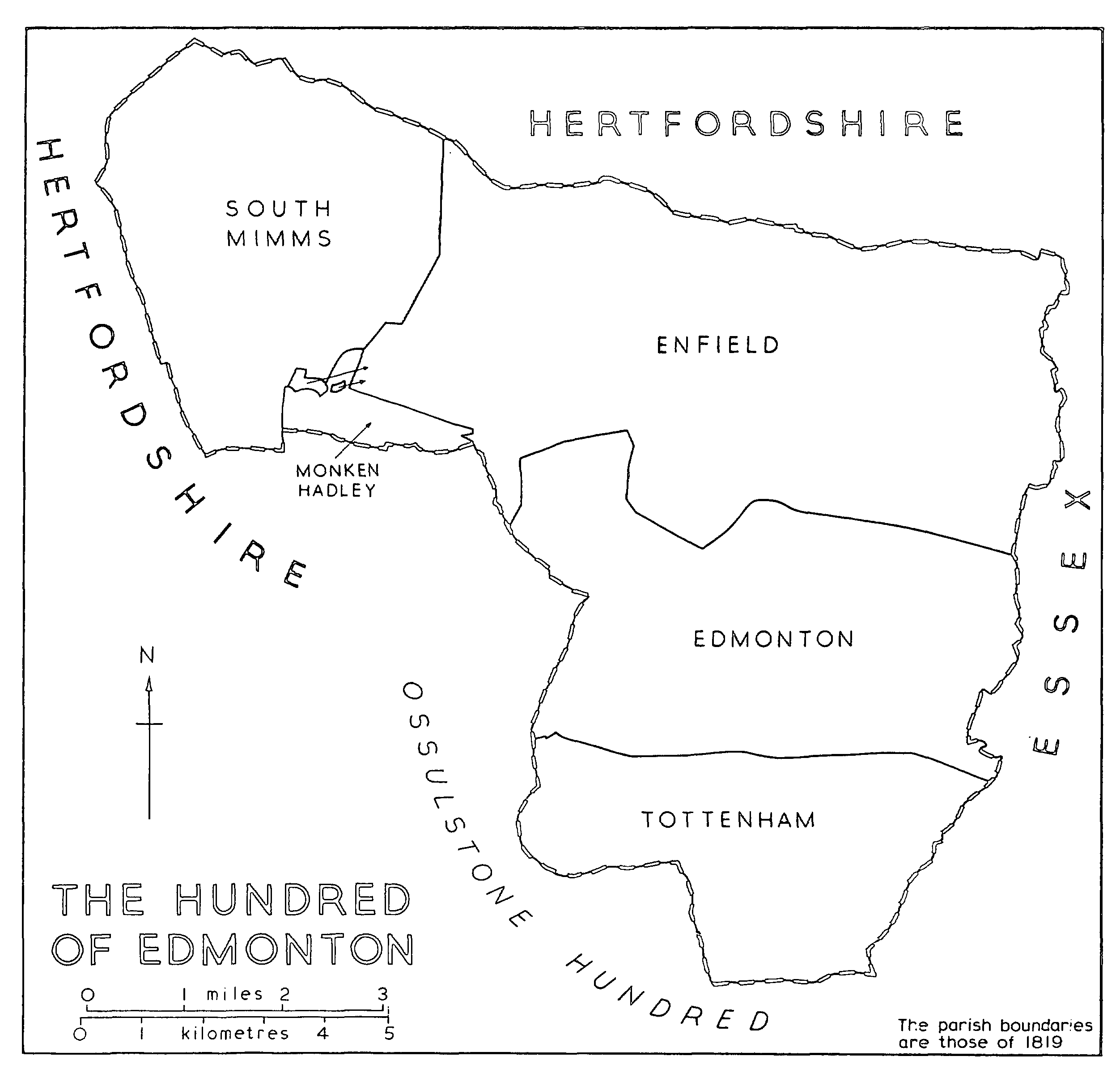
THE HUNDRED OF EDMONTON
The components of the hundred hardly varied after 1086. By 1316 they consisted of the vills of Edmonton, Enfield, South Mimms, and Tottenham. (fn. 5) Monken Hadley was expressly mentioned as a constituent in 1524. (fn. 6) By the late 15th century the number of manors in the hundred had increased to c. 16, excluding those of East and Chipping Barnet and Brookmans, part of whose lands lay in South Mimms. (fn. 7)
The hundred apparently was never alienated by the Crown. (fn. 8) In 1273-4 Tottenham and Edmonton were presented for not attending the hundred court, (fn. 9) to which they owed suit. Only Roger Lewknor at South Mimms and the abbot of Walden and Humphrey de Bohun sustained their claims to view of frankpledge in 1294. (fn. 10)
A bailiff was mentioned in 1273-4 and from 1294 there was a chief bailiff. (fn. 11) In the early 17th century the term of office was apparently indefinite. The chief bailiff, four electors of jurors, and eight other jurors represented Edmonton at the eyre of 1294. (fn. 12) In 1305 actions were heard before a constable of the peace for the hundred. (fn. 13) There was a chief constable in 1486, who was a maltman from Enfield, (fn. 14) and by 1613 there were three chief constables, all gentlemen, responsible respectively for Edmonton, Enfield, and Mimms and Hadley. (fn. 15) Later known as high constables, until at least 1747 (fn. 16) they were elected and sworn at quarter sessions, initially for a three-year term, (fn. 17) although some served for as long as five years. (fn. 18) In the early 17th century about 16 petty constables were responsible to them. (fn. 19) From 1559 (fn. 20) to 1729 (fn. 21) Edmonton was normally associated with Gore and Ossulstone hundreds for musters to arms and administering the county funds.
The meeting-place of the hundred may have been near Potters Bar. (fn. 22) In 1658 a track led from Mutton Lane (the lane near which the moots were held) (fn. 23) to an area of 109 a. in Enfield Chase marked as 'mote plane'. (fn. 24) After the Middlesex county court had been reorganized under the Small Debts, Middlesex, Act of 1750, (fn. 25) the court for Edmonton hundred suitors was held from at least 1808 at the George, Enfield. (fn. 26) The court ceased to function in that form after the passage of the County Courts Act, 1846. (fn. 27)
The bronze matrix of the hundred seal, round, 2.7 cm., made in 1390-1 to seal the passes required by the Statute of Cambridge (1388), survives. (fn. 28) Legends, black letter, EDELME/TONE and SIGILLUM/COMITATUS MIDD' and on the reverse ED.