A History of the County of Middlesex: Volume 5, Hendon, Kingsbury, Great Stanmore, Little Stanmore, Edmonton Enfield, Monken Hadley, South Mimms, Tottenham. Originally published by Victoria County History, London, 1976.
This free content was digitised by double rekeying. All rights reserved.
A P Baggs, Diane K Bolton, Eileen P Scarff, G C Tyack, 'Edmonton: Local government', in A History of the County of Middlesex: Volume 5, Hendon, Kingsbury, Great Stanmore, Little Stanmore, Edmonton Enfield, Monken Hadley, South Mimms, Tottenham, ed. T F T Baker, R B Pugh (London, 1976), British History Online https://www.british-history.ac.uk/vch/middx/vol5/pp175-179 [accessed 2 May 2025].
A P Baggs, Diane K Bolton, Eileen P Scarff, G C Tyack, 'Edmonton: Local government', in A History of the County of Middlesex: Volume 5, Hendon, Kingsbury, Great Stanmore, Little Stanmore, Edmonton Enfield, Monken Hadley, South Mimms, Tottenham. Edited by T F T Baker, R B Pugh (London, 1976), British History Online, accessed May 2, 2025, https://www.british-history.ac.uk/vch/middx/vol5/pp175-179.
A P Baggs, Diane K Bolton, Eileen P Scarff, G C Tyack. "Edmonton: Local government". A History of the County of Middlesex: Volume 5, Hendon, Kingsbury, Great Stanmore, Little Stanmore, Edmonton Enfield, Monken Hadley, South Mimms, Tottenham. Ed. T F T Baker, R B Pugh (London, 1976), British History Online. Web. 2 May 2025. https://www.british-history.ac.uk/vch/middx/vol5/pp175-179.
In this section
LOCAL GOVERNMENT.
Manorial government.
Manorial jurisdiction over the whole of Edmonton, of which South Mimms formed a berewick, seems to have originated before the Conquest. (fn. 1) Although there are no records for the capital manor before the 17th century, there are references to 13th-century courts held at Easter (fn. 2) and to an annual view of frankpledge in 1322. (fn. 3) A court leet or view of frankpledge was held annually on the Thursday in Whitsun week by 1359 (fn. 4) and views, together with a general court baron, continued to be held at Whitsun until the last court in 1861. (fn. 5)
In 1372 Adam Francis, in theory at least, held a court every three weeks. (fn. 6) By the 16th century, however, there was only one court other than the general court, usually in December. (fn. 7) The frequency of other courts, known as special courts baron, was from the 17th century completely erratic. Only a few met in the 17th century; there were many more in the mid 18th century but by the 19th century the Whitsun court alone was held, most tenurial transactions being settled out of court. (fn. 8)
The court of Edmonton was probably originally held at the demesne farm of Sayesbury, the 'court' being described in 1280 as lying near Church field, (fn. 9) before the farm was divided from the lordship in 1571. (fn. 10) During the 18th century courts were held at public houses, usually at the Bell or Cross Keys, later at the Angel. (fn. 11) The only extant court rolls for the capital manor are for 1693-5 and 1700 (fn. 12) but there is a complete series of court books from 1661 until 1933 (fn. 13) and minute books from 1742 until 1844 (fn. 14) and a court leet book covering the periods 1735-6 and 1745-1855. (fn. 15)
From 1661 (fn. 16) the special courts baron were concerned wholly with tenurial business and the courts leet chiefly with electing officials whose presentments rarely appeared in the books. Administration was based upon the division of the manor and parish into wards, which may have originated as tithings. In the mid 16th century there were six wards: Fore Street, Bury Street, Church Street, South Street, Bowes, and Winchmore Hill. (fn. 17) The last two had disappeared by 1650 (fn. 18) and four wards (fn. 19) remained until well into the 19th century. Each ward had its own constable and headborough, both first mentioned in 1607, (fn. 20) and its own aleconner. There was one parish constable from 1785. The election of officials was last recorded in 1855.
Most courts leet were concerned with scouring ditches especially in Edmonton marsh, impounding stray cattle, and preventing encroachments on the waste. (fn. 21) Stocks were mentioned c. 1548 (fn. 22) and 1609 (fn. 23) and there were whipping posts in Angel Road. (fn. 24) In 1714 a presentment was made at the leet court on the subject of two watch-houses (fn. 25) but by then criminal jurisdiction was generally left to the parish or magistrates. Even scouring ditches seems to have been the concern of the vestry rather than the manor by 1748. (fn. 26)
There is no evidence for courts on the manor of Bowes and Polehouse before the 16th century. In 1668 court rolls were extant from 1523-4 (fn. 27) and there are still draft court rolls for 1536-42 (fn. 28) and court books for 1669-1863. (fn. 29) Courts, (fn. 30) always a joint view of frankpledge and court baron, were held once a year, usually in May or June. (fn. 31) Manorial officials were appointed: a constable, a taster of bread and ale, and a headborough in the 1740s. There were stocks on Southgate Green, which survived in 1973. Occasional orders were made for scouring ditches but most of the business was tenurial and after the last court was held in 1863 settlements were made out of court until the last copyhold tenement was enfranchised in 1936. (fn. 32) In 1792 the chapter of St. Paul's emphasized that they could hold courts wherever they wished (fn. 33) and courts were apparently held alternately at Bowes and Polehouse during the 17th century.
John Blund held courts in 1281, (fn. 34) but there is no evidence that his successors, the lords of Dephams manor, or the holders of Willoughbies ever did so.
In 1328, in addition to 55 rent-paying tenants, the canons of the Holy Trinity had ten tenants of the fee of Peverel who owed suit of court, relief, and heriot as well as rent. (fn. 35) The courts were held at Edmonton twice yearly. (fn. 36)
In 1294 the abbot of Walden claimed view of frankpledge and the assizes of bread and ale from his men in several Middlesex parishes, including Edmonton but, when challenged, he acknowledged that his only liberties were in Enfield. (fn. 37) However, there was a court (curia) of Walden in Edmonton in the 13th century. (fn. 38)
Parish government to 1837. (fn. 39)
A churchwarden was mentioned in 1389, (fn. 40) a parish clerk in 1417 and 1529, (fn. 41) and two churchwardens and two oeconomi in 1580. (fn. 42) In the 18th century the churchwardens often served for two years. Overseers of the poor, first mentioned in 1639, (fn. 43) were appointed at the Easter vestry, one for each of the four wards. (fn. 44) By 1834 there were two salaried assistant overseers. (fn. 45) Paid officials appointed in the 18th century included the vestry clerk, who was usually the schoolmaster, the sexton, and the steward and beadle of the workhouse. The vestry instructed the surveyors of the highways, of whom there were two in 1683; (fn. 46) by 1835 there were four, one for each ward. (fn. 47) During the 18th century the post was often occupied by gentry who employed deputies. (fn. 48) After the inclosure of Enfield Chase in 1777 two salaried surveyors were appointed for the Edmonton portion. From 1785 there was only one surveyor but his salary was considerably higher.
The accounts of the churchwardens and overseers, which were submitted monthly to the vestry, have not survived and there is no evidence that the surveyors of the highways kept records. The surveyors of the Chase had to present their accounts in November and those for 1782-5 survived in the vestry minute book. Vestry minutes for 1739- 48, 1782-98, and 1863-85 are extant; (fn. 49) those for 1798-1862 were given as salvage during the Second World War. (fn. 50) The vestry minute book for 1739-48 contains minutes of the workhouse committee for 1732-7. There are also minute books of the later workhouse committee for 1796-1801 (fn. 51) and 1827-30 (fn. 52) and for the select vestry for 1831-5. (fn. 53)
The vestry probably existed before 1739 when the minutes begin. In 1720 the poor-rate was made by 'the vicar, churchwardens, overseers and other inhabitants'. (fn. 54) The workhouse committee or board (1732-7), which derived its name from its meetingplace, seems to have been an early form of select vestry. It consisted of the trustees of the workhouse, the vicar, churchwardens, overseers, and parishioners probably elected at Easter. The committee had wide powers over the parish officers, charities, and church repairs, as well as poor-relief. By 1739 the vestry was the main authority and the workhouse committee which existed from 1741 was concerned solely with the administration of the workhouse. It consisted of a committee of three, chosen monthly and enlarged in 1782 to consist of the churchwardens, overseers, master of the workhouse, and two members (fn. 55) of each ward.
The vestry and the workhouse committees, especially during the early 18th century, were dominated by a few prominent inhabitants, like Merry Teshmaker who was also active in the manorial courts. (fn. 56) Teshmaker, Samuel Clarke of Bush Hill, Samuel Tatem, who married the daughter of John Huxley of Weir Hall, and Pierce Galliard of Bury Hall were J.P.s and the committees sometimes committed people to the parish watchhouse or to Bridewell. Dawson Warren (vicar 1795-1839) was very conscious of his rights (fn. 57) and started legal proceedings in pursuit of his claim to the chairmanship of the vestry. Although the outcome is unknown, he was the dominant personality in parish government in 1834. (fn. 58)
Poor-relief was administered by the workhouse committee and the vestry with more humanity than in neighbouring parishes. Considerable efforts were made to give outdoor relief, in money or goods, and paupers were committed to the workhouse only as a last resort, although it was cheaper to keep them in the workhouse than outside it. Pauper children were apprenticed to tradesmen, mostly in Edmonton and London but also to factories in Lancashire and to the Hudson's Bay Co. in Canada. The latter connexion was probably established through the Lake family of the Firs; Sir Atwell Lake was a governor of the company and it was in his honour that Edmonton, Alberta, was named. (fn. 59)
A select vestry was formed in 1829 and, probably under Warren's influence, the treatment of paupers became harsher. Out-relief was refused to the ablebodied and emphasis was laid on economy. (fn. 60)
A poorhouse was erected on the waste in 1639. (fn. 61) A workhouse was built in 1731-2 in Church Street, west of Edmonton church and Latymer's school, (fn. 62) and a new building was added in 1782. Numbers in the workhouse at any one time ranged from 34 in September 1791 to 142 in December 1800 but in most years were 50-70; 1800 was exceptional in averaging 110 inmates. (fn. 63) There was an average of 87 people in 1829, but there were complaints by the managing committee of over-crowding, with 6 children to a bed. (fn. 64) The workhouse was run by a salaried master or steward until 1737, when a new master was paid a fixed amount for each inmate; in return he was to have the profits of the workhouse labour, the sale of mops made by the women, and the wages of men employed by local farmers and tradesmen. The committee and vestry supervised the master, ordering the cleansing of the house, the supply of new clothes, and the weekly diet. A paid beadle, usually himself an inmate, assisted the master and lived in the workhouse. A salaried parish physician and apothecary was also appointed to look after the workhouse and out-poor and to carry out vaccinations.
The alms-houses and pension and apprenticing charities eased the burden on the ratepayers of Edmonton. (fn. 65) There was also some private relief, such as the money given to 52 people in Southgate ward by the owners of Minchenden in 1778. (fn. 66) Nevertheless there were complaints in 1671, (fn. 67) 1720, (fn. 68) and 1749 (fn. 69) of unfair or excessive rating and the poor-rate of 1733 was quashed. (fn. 70) The annual poor-rate rose from 1s. in the £ in 1764-5 to 4s. in 1800 and 6s. 6d. in 1818-19. (fn. 71) In 1740 the vestry paid out £433, of which £244 was spent on the workhouse, and in 1775-6 £460 was spent on the poor, out of a total raised of £847. (fn. 72) In 1797 £624 was spent on the workhouse. The amount spent on the poor varied from £2,499 in 1803 to £4,561 in 1818; in 1836 it was £3,021. (fn. 73)
The church-rate, which was 6d. in the £ in 1818-19 and the highway-rate, variously 1s. or 9d. in the £, (fn. 74) were not regular exactions but were raised as circumstances required. In 1644 highways were being repaired with the labour of parishioners (fn. 75) but in 1698 by paid labour. The cost was met by a rate levied in 1705. (fn. 76) There are highway-rate books for 1830-1 and 1835. (fn. 77)
Local government after 1837.
Edmonton was the geographical centre of Edmonton union, created in 1837, and the board of guardians met there. Edmonton workhouse was used for all the able-bodied poor of the union until 1842 when a new workhouse to house all adult paupers was built in south Edmonton, on a site later occupied by the North Middlesex hospital. (fn. 78)
For most of the 19th century local government was divided among several bodies, although membership often overlapped. At the time of the cholera outbreak in 1853, the vestry appointed a committee to consider the sanitary state of the parish. (fn. 79) There was a watching and lighting committee, presumably set up after the Act of 1833, (fn. 80) and the overseers collected a lighting rate. (fn. 81) A board of the surveyors of the highway was responsible for the roads in the parish by 1841. (fn. 82) In 1837 Edmonton parish became a medical district within the poor law union and in 1842 it was divided into three, each with its own medical officer. (fn. 83)
Edmonton local board of health (fn. 84) was set up in 1850 under the Public Health Act of 1848. It immediately replaced the highway board and took over responsibility for street lighting under the Local Government Act of 1858. It consisted of 12 members who met twice a month at the watch-house in Church Street. Its salaried officials were a clerk, a combined inspector of nuisances and surveyor, and a collector of rates, who later received a percentage of the collected rates in place of a salary. The board was financed by a general district rate, although sometimes there was a separate highway-rate. Expenditure on highways was nearly always considerably greater than on sanitary improvements.
There were many complaints about sewerage, especially from Southgate, where in 1879 a petition for separation from Edmonton was drawn up by the leading landholders and signed by more than 500 people. (fn. 85) In 1881 Southgate was granted its own local board and Edmonton local board was reduced to 9 members. (fn. 86) Although the loss of the large houses in Southgate deprived it of valuable rates, the Edmonton board seems to have been more active after the separation. Jerry-builders were vigorously prosecuted during the 1880s. (fn. 87) During the 1880s and 1890s there were committees for the town hall, cemetery, works, finance, farms, engines, sanitation, and the library. (fn. 88) A town hall 'in municipal Perpendicular' was built facing Fore Street in 1884 and enlarged in 1903. (fn. 89)
Southgate local board had 9 members, whose first chairman was John Walker of Arnos Grove. The board met twice a month in Ash Lodge and in the village hall until 1893, when council offices were erected to a design by A. Rowland Barker, a Southgate resident; (fn. 90) they were enlarged in 1914. (fn. 91) Salaried officials were a clerk, treasurer, ratecollector, sanitary inspector, medical officer of health, and a combined surveyor and engineer. (fn. 92)
Under the Act of 1894 the two local boards became urban districts. Edmonton local board of health had used the traditional wards of Bury Street, Church Street, and Fore Street. (fn. 93) There had been proposals to add two new wards, Angel Road and Silver Street, (fn. 94) and the new U.D. was organized accordingly, with three councillors for each of the five wards. After an inquiry in 1903 the district again consisted of three wards, with nine councillors each. (fn. 95) In 1933 the area was divided into Bury Street, Church Street, Angel Road, and Silver Street wards, with seven councillors for each. (fn. 96)
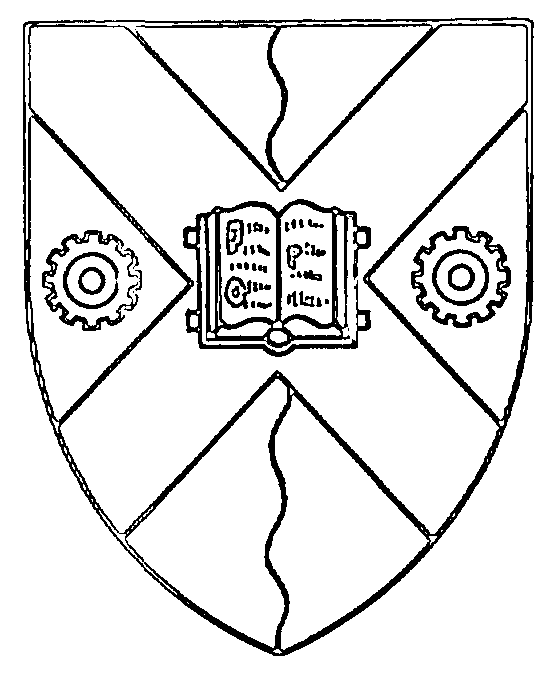
Borough of Edmonton.
Per pale wavy sable and azure, on a saltire or between two cogwheels in fess argent an open book proper bound gules edged gold [Granted 1937]
Southgate U.D. (fn. 97) had nine councillors in 1894 and twelve from 1900. In 1906 it was divided into four wards: Middle, South, North-east, and Northwest. (fn. 98) Swimming baths and a refuse destructor were erected (fn. 99) but the most important achievement was control over the development of the area. Although the number of houses increased eightfold between 1881 and 1931, Southgate remained one of the 'most agreeable of the northern suburbs', (fn. 100) largely because of the council's regulations and its acquisition of 287 a. of park-land. (fn. 101)
Southgate was incorporated in 1933, retaining its four wards. The council, consisting of a mayor, 7 aldermen, and 21 councillors, was enlarged. (fn. 102) Edmonton was incorporated in 1937, after which it had four wards, a mayor, 8 aldermen and 24 councillors. (fn. 103) Southgate B.C. was consistently dominated by opponents of the Labour party, while Edmonton, at least after the Second World War, was controlled by Labour councillors. (fn. 104)

Borough of Southgate.
Azure, a sun rising or; on a chief or a four-barred gate azure [Granted 1933]
In 1965 Edmonton and Southgate were united in Enfield L.B., created under the London Government Act of 1963. (fn. 105) The names of three Edmonton wards, Angel Road, Church Street, and Silver Street, survived among the 30 wards of the new authority. Edmonton and Southgate town halls were retained to house the borough treasurer, architect, engineer and surveyor, area housing and town planning offices. The education department was housed in Church Street, Edmonton. (fn. 106)