A History of the County of Middlesex: Volume 5, Hendon, Kingsbury, Great Stanmore, Little Stanmore, Edmonton Enfield, Monken Hadley, South Mimms, Tottenham. Originally published by Victoria County History, London, 1976.
This free content was digitised by double rekeying. All rights reserved.
A P Baggs, Diane K Bolton, Eileen P Scarff, G C Tyack, 'Tottenham: Local government', in A History of the County of Middlesex: Volume 5, Hendon, Kingsbury, Great Stanmore, Little Stanmore, Edmonton Enfield, Monken Hadley, South Mimms, Tottenham, ed. T F T Baker, R B Pugh (London, 1976), British History Online https://www.british-history.ac.uk/vch/middx/vol5/pp342-345 [accessed 30 April 2025].
A P Baggs, Diane K Bolton, Eileen P Scarff, G C Tyack, 'Tottenham: Local government', in A History of the County of Middlesex: Volume 5, Hendon, Kingsbury, Great Stanmore, Little Stanmore, Edmonton Enfield, Monken Hadley, South Mimms, Tottenham. Edited by T F T Baker, R B Pugh (London, 1976), British History Online, accessed April 30, 2025, https://www.british-history.ac.uk/vch/middx/vol5/pp342-345.
A P Baggs, Diane K Bolton, Eileen P Scarff, G C Tyack. "Tottenham: Local government". A History of the County of Middlesex: Volume 5, Hendon, Kingsbury, Great Stanmore, Little Stanmore, Edmonton Enfield, Monken Hadley, South Mimms, Tottenham. Ed. T F T Baker, R B Pugh (London, 1976), British History Online. Web. 30 April 2025. https://www.british-history.ac.uk/vch/middx/vol5/pp342-345.
In this section
LOCAL GOVERNMENT.
Manorial government.
Separate courts were held for Daubeneys, Bruces, and Pembrokes and, at least from 1422-3, for Mockings (fn. 1) until 1429, after which date a single court served all the manors. (fn. 2) Records survive for most years, although not equally fully for all the subdivisions, from 1318, when a court was held for Daubeneys, to 1920. (fn. 3) In the 14th century there was usually a view of frankpledge around Whitsun and at least one other court, in the autumn; (fn. 4) in the 17th century the view, called a court leet in the 1650s, was held immediately before a court baron in the autumn, with at least one court at another season. (fn. 5) The last view took place in 1847 and the last court baron met in 1870, (fn. 6) although transactions were recorded for another 50 years. Courts met in the 1650s at the White Hart inn (fn. 7) and from 1807, if not earlier, at the Plough. (fn. 8)
In 1294 view of frankpledge, infangthief, outfangthief, and tumbrils were claimed by Hugh de Kendale as grantee for life of the manor of Hastings (later Pembrokes). The same rights, as well as the assizes of bread and ale, gallows, and waifs and strays, were claimed by John de Balliol, king of Scotland, for the manor of Balliols (later Daubeneys), and by Robert de Bruce for his manor of Bruces. (fn. 9) Headboroughs were chosen at the view of frankpledge in 1319, the assizes of bread and ale were held regularly from the mid 14th century, (fn. 10) and constables were chosen by 1394. (fn. 11) All the 13th-century liberties were enjoyed by Richard Turnaunt at his death in 1486, as well as fines of outlawry and the right of free warren. (fn. 12)
There was a pillory in High Road in 1455-6 (fn. 13) but by 1526 Tottenham had neither stocks, a cucking stool nor a pillory, and also lacked weights and measures for the assizes. The lord had supplied none of them three years later, except apparently a cucking stool, with which a woman was threatened in 1530. (fn. 14) During the 17th and most of the 18th centuries 2 aleconners and 4 constables, one for each ward, were chosen annually at the manorial court, as were a hayward, 2 common drivers, and 2 markers of cattle to protect the common lands. (fn. 15) From the mid 18th century there was some competition between the rights of the court and those of the vestry, which first appointed a constable in 1750. (fn. 16) Courts were concerned almost entirely with property transactions from 1780, yet parishioners demanded that a manorial court should consider public nuisances in 1797; (fn. 17) after the lord had named the constables in 1806 the vestry asked to be told of his intentions in future, (fn. 18) as late as 1844 it complained of great inconvenience arising from the court's failure to provide parish officers and in 1847 it approved the appointments which at last had been made. (fn. 19)
Perquisites of court were included in the grant of Tottenham Rectory manor, late of Holy Trinity priory, to Sir Thomas Audley. (fn. 20) A court was held in 1536 (fn. 21) and courts baron, recorded from 1541, were held for the king and then for the chapter of St. Paul's and, in the 1650s, for Stephen Beale. They dealt with the election of homagers and property transactions, meeting nearly every summer and, at least from 1694, normally following courts for the St. Paul's manors in Edmonton. The last session was in 1863, although business which took place out of court was recorded until 1905. (fn. 22)
Parish government to 1837.
The division of the parish into wards can be traced to 1515 when, in the manorial court, two constables were chosen for High Street, one for High Cross, and one for Wood Green. (fn. 23) In 1565 there was a constable for the Hale and High Cross and in 1566 one for the Nether End quarter and another for the Middle quarter. Four wards were represented from 1577, (fn. 24) with boundaries presumably based on population: in William Bedwell's time Nether (afterwards Lower), Middle, and High Cross wards covered the eastern part of the parish from north to south, with a combined acreage roughly equal to that of Wood Green ward, which covered the rest. (fn. 25)
There were two churchwardens by 1577 (fn. 26) and isolated accounts of the upper churchwarden survive from the time of Charles I. (fn. 27) The earliest records of a vestry, the minute books, date only from 1676 (fn. 28) and consecutive churchwardens' accounts from 1732. (fn. 29) Meetings were held at the vestry house, which Lord Coleraine first offered to rebuild in 1688. (fn. 30) The average attendance was 12 in the 1690s and again at the end of the 18th century, but it was no more than 5 in the 1740s. The vicar or his curate often presided and occasional attenders included Henry, Lord Coleraine (d. 1708), Hugh Smithson, Henry, Lord Coleraine (d. 1749), and James Townsend, who served as a churchwarden.
A churchwarden served one year as lower and a second year as upper churchwarden until 1776, when the vicar asserted a right to fill one of the offices. Exemptions could be obtained from this and from other duties, fines being doubled to £10 in 1733. Four collectors, called overseers from the early 18th century, were nominated for approval by quarter sessions. Other salaried appointments were those of a sexton, vestry clerk, and beadle, mentioned respectively in 1691, 1696, and 1730. Surveyors of the highways existed by 1654, (fn. 31) two being chosen at quarter sessions from a list submitted by the vestry. Offices later multiplied: the vestry clerk became assistant overseer in 1756 and the beadle performed a similar function from 1798 before the appointment of a full-time salaried official was recommended in 1818, while a salaried assistant surveyor was provided from 1772 until 1798, when the number of surveyors was doubled. Constables, first nominated by the vestry in 1750, had one assistant for the whole parish from 1798 and two by 1805.
Inhabitants were listed according to wards both for church-rates, by 1628, (fn. 32) and poor-rates, by 1637. (fn. 33) Eighteenth-century poor-rates were normally fixed four times a year and varied considerably, from 2d. in the £ in 1742 to 18d. in 1763. Any person who rented a house worth £5 a year or more was made liable to poor-rates from 1775. In 1775-6, out of £763 raised, £694 was spent on the poor. (fn. 34) Expenditure rose to £2,140 in 1816, £3,133 in 1819, and £4,065 in 1821, (fn. 35) but had fallen to £2,242 in 1836-7, the last year when Tottenham maintained its own poor. (fn. 36) The parish's income was augmented by fines, pew-rents, and, above all, by charities and sums for the waste-land; from 1833, after criticism of the accounts, the income from the waste-lands and parish estates was paid into a separate fund, with its own treasurer.
Poor-relief, in the form of clothing and small payments, was given by the churchwardens at the vicar's direction in 1628. (fn. 37) In 1681 a parish child was supported and in 1682 the vestry ordered that all regular pensioners should be paid by the collector for Wood Green ward, whose colleagues were to hand over their sums for disbursement by the churchwardens: 12 regular pensions, mostly of 2s. a week, were authorized in 1687 and 14 in 1695. Landowners were forbidden to employ strangers between Michaelmas and Lady Day from 1699, in order to provide work for the poor. Ten years later all pensioners had their goods listed and in 1721 they were ordered to wear badges. Casual payments continued to be made both by churchwardens and overseers after the opening of a workhouse; regulations for the workhouse in 1789 laid down that out-relief should be discouraged as much as possible, but considerable casual payments made the overseers' accounts confusing in 1833.
From 1730 to 1744 the poor were housed in rented premises under successive salaried masters the vestry paying the whole cost. From 1744 the poor were farmed until in 1763 a workhouse was built on part of Coombes Croft, Marsh Lane. Thereafter the vestry alternated between direct management and farming out, the contractor receiving either an annual salary, a fixed price per head, or a combination of the two. Under the regulations drawn up in 1789 and substantially reissued in 1818, a committee of 24 guardians was to meet monthly at the workhouse, 4 members were to carry out weekly inspections, and suitable ladies might give their advice; the master and mistress were always to be resident, inmates could keep 2d. in the shilling of their earnings, and children should be taught to read. The workhouse held 44 persons in 1775-6 and was too small by 1818, when 7 Tottenham paupers had recently been kept in other parishes. A proposal to form a select vestry, under the Sturges Bourne Act, (fn. 38) was rejected in 1819 and 1825 but adopted in 1833, when 14 members were elected.
The vestry contributed towards a robbery committee for Edmonton hundred in 1692 and built a parish cage in 1743. It agreed to raise a special rate in 1774 for the trustees of the Stamford Hill turnpike trust, who would light and watch Tottenham High Road during the winter months. In 1800 the cage was replaced by a watch-house near the Blue Coat school, with a keeper from 1821 to 1827. An association to protect property was formed in 1828, earlier nightly patrols having been reduced from lack of funds; (fn. 39) a salaried street-keeper and constable was appointed separately from the watch-house keeper in that year and made a full-time official, under the overseers, in 1830. The vestry declined to seek the introduction of the new police in 1830 and to take over the watching of the turnpike roads in 1831. It adopted the Lighting and Watching Act in 1833 but failed to reappoint the inspectors after three years, leaving private subscribers to support a temporary constabulary. (fn. 40) A board of surveyors was set up in 1835 under the General Highways Act. (fn. 41)
From 1795 an engineer was chosen with other officers at Easter. In 1809 the vestry adopted the City of London's practice of offering graduated rewards to the first machines to reach a fire. It also empowered the engineer to hire up to 20 helpers and, in 1821, ordered him to exercise the machine four times a year. It is not certain whether the first engine-house stood next to the watch-house, as it certainly did after the two had been placed in the same man's charge.
A special rate, mainly to pay for nursing, was levied because of an epidemic in 1637. (fn. 42) Medical services were paid for in 1697 and a surgeon for the poor received an annual salary, with more for dislocations and fractures, from 1739. The workhouse at Coombes Croft does not seem to have been supplemented with a pest-house, as was demanded by the master in 1775, two years after admissions had temporarily been stopped because of fever. In 1785 it was decided to choose one of two local surgeons alternately at Easter and in 1791 to pay him more for maternity cases. Reimbursement for giving free innoculations was approved in 1798. In 1831 the surgeon was required to submit all expenses weekly to the overseers, as in Edmonton, and relieved of some work by the appointment of a parish midwife. A board of health, formed under the threat of a cholera outbreak, functioned for about a year from the end of 1831; (fn. 43) it acted at first without parochial authority, until extra members were added by the vestry.
Local Government after 1837.
Tottenham joined Hampstead, Hornsey, Edmonton, Enfield, Cheshunt (Herts.) and Waltham Abbey (Essex) in the new Edmonton poor law union in 1837. The parish workhouse was then closed and the inmates were transferred to the Edmonton building, pending the establishment of a workhouse for the union. (fn. 44)
Although the temporary board of health had been disbanded after the cholera epidemic in 1832, the vestry, faced with a steady rise in population acquiesced in surrendering most of its powers after the establishment of Edmonton union. (fn. 45) Inclusion within the area of the Metropolitan Police was sought three years before Tottenham achieved it, with neighbouring parishes, in 1840. (fn. 46) Lighting inspectors were appointed after the adoption of the Turnpike Lighting Act in 1841. The parish was among the first to petition for the establishment of a local board under the Public Health Act of 1848 and was empowered to elect a body of 9 members in 1850. (fn. 47)
Tottenham local board of health, which soon superseded the surveyors as the highway authority, took over lighting under the Public Health Act of 1858 and in 1859 became responsible for firefighting. Membership was raised to 12 in 1871 and to 18 in 1887, when the rise in population west of High Road led to the division of the district into 6 wards: High Cross, Middle, Lower, Wood Green, West Green, and St. Ann's. (fn. 48) Despite the board's initial zeal its measures were repeatedly overtaken by the population growth and so incurred fierce local criticism. In 1858 control finally passed from City men to local interests, whose pursuit of rapid building and consequent trouble over sewerage brought the board's reputation to a low point by 1871: in that year, quarrelsome and almost penniless, it was accused in the Herald of having ruined everything and everybody. Conditions thereafter improved, largely under the stimulus of a local pressure group, Tottenham Sanitary Association, which was formed in 1873 and promoted its own candidates at elections. (fn. 49) The board occupied two rooms in Somerset Road, where the grammar school later had a playground, until the beginning of 1874, when it moved to Coombes Croft House after accepting a 21-years' lease. (fn. 50)
As early as 1869 the new middle-class residents of Wood Green demanded their own administration. (fn. 51) In 1888 the Tottenham Local Board (Division of District) Act (fn. 52) made Wood Green ward a separate district. Tottenham was left with some 65,000 people, while 23,000 were placed under the new authority. (fn. 53) The two local boards became urban district councils under the Local Government Act of 1894. Borough status was granted to Wood Green in 1933 and to Tottenham in the following year. (fn. 54)
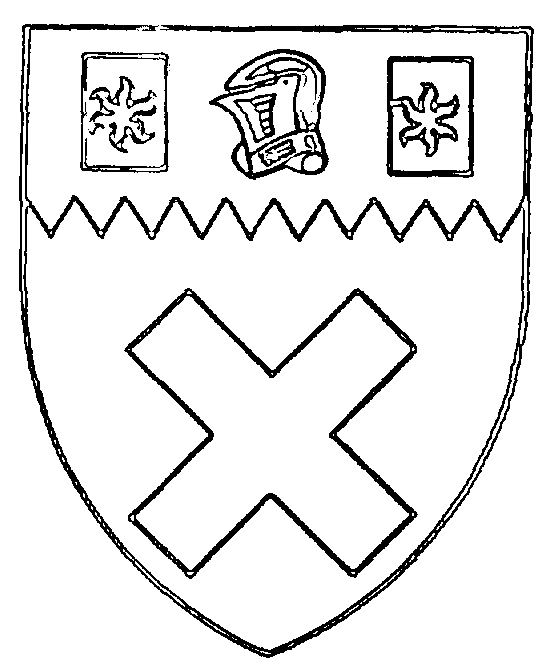
Borough of Tottenham.
Gules, a saltire couped or; on a chief indented or, a helmet sable between two billets azure, each charged with an estoile or [Granted 1934]
Tottenham local board was left with 5 wards and 15 members in 1888. (fn. 55) A proposal to double the membership was resisted in 1893, when the county council complained that the local boundaries did not agree with parliamentary or county electoral divisions, which were themselves brought into line with the wards in 1897. All members retired every third year until 1900, when one member was permitted to retire annually in each ward. By that date middleclass residents on the newly developed land around Haringey House, resenting their inclusion in predominantly working-class wards, were seeking to be transferred from Tottenham U.D. to Hornsey. Harringay ward was therefore created in 1901, (fn. 56) out of parts of West Green and St. Ann's, and the urban district council was enlarged to 18 members. Membership was raised to 30 in 1905 and to 40 in 1925. Reorganization in the 1920s affected all the wards except West Green and raised the number from 6 to 8: Bruce Grove and Stoneleigh, Chestnuts, Green Lanes, Park and Coleraine, Stamford Hill, Town Hall, West Green, and White Hart Lane. By 1951 further changes had produced 11 wards: Bruce Grove and Central, Chestnuts, Coleraine, Green Lanes, High Cross and Stoneleigh, Park, Seven Sisters, Stamford Hill, Town Hall, West Green, and White Hart Lane. Throughout the existence of Tottenham B.C. the Labour party had a large majority. (fn. 57)
Tottenham town hall was opened in 1905, (fn. 58) on the west side of the Green, where Eaton House, Wilton House, the Ferns, and Hatfield House had been acquired as the site for a group of civic buildings. The hall, of red brick with stone dressings, was designed in a baroque style by A. S. Taylor and A. R. Jennett. (fn. 59) It was flanked to north and south by the new central baths and the central fire station, plainer buildings but of similar materials. In 1913 the opening of Tottenham county school next to the baths completed a range which formed an imposing municipal centre. The town hall, which remained the seat of local government until the absorption of Tottenham into Haringey, was used for social services, health, and housing offices in 1972. (fn. 60)
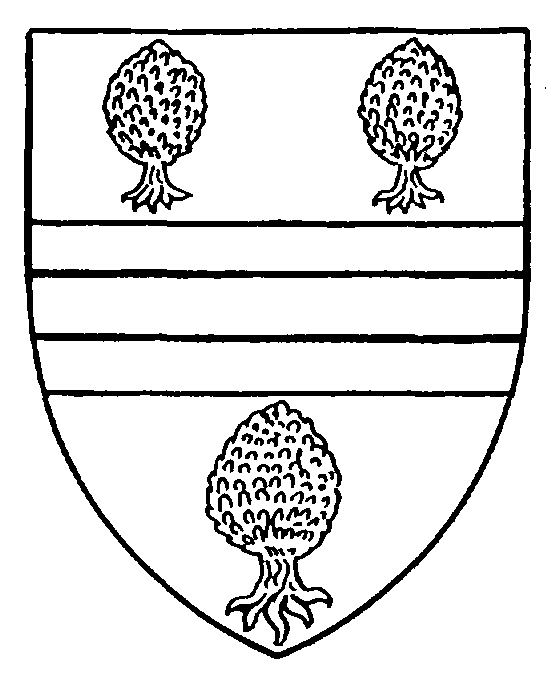
Borough of Wood Green.
Or, on a fess azure between three yew trees eradicated proper a barrulet argent [Granted 1933]
At Wood Green the local board and the U.D.C. began with 12 members. (fn. 61) In 1910 membership was raised to 18 and the district was divided into 5 wards: Alexandra Park, Bowes Park, Central, Noel Park, and Town Hall. There were 23 members from 1919 until 1933, when the charter dissolved Bowes Park and Central wards, leaving the remaining three to return 6 members each to a council which also included 6 aldermen. (fn. 62) Opponents of the Labour party dominated the borough council until 1950, when Labour gained control from the Independents. (fn. 63) Earlham Grove House in Wood Green High Road was occupied by the board in 1890 (fn. 64) and acquired, with nearly 11 a., in 1893. The offices were extended in 1913 (fn. 65) and served as the town hall until the first stage of a new scheme was finished in 1958. The new town hall, facing High Road south of Trinity Road, was designed by Sir John Brown and A. E. Henson, whose original plans had been approved 20 years earlier. (fn. 66) It served as the civic centre of Haringey in 1972.
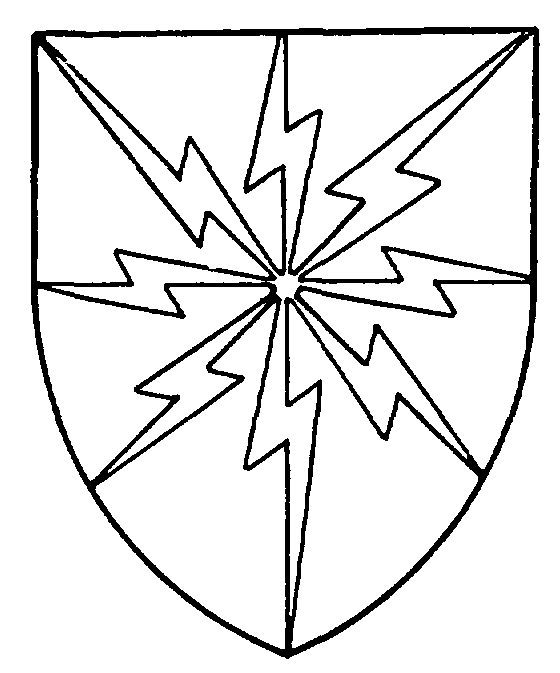
London Borough of Haringey.
Sable, eight rays issuing from the fess point throughout or [Granted 1965]
In 1965, under the London Government Act of 1963, Tottenham joined Wood Green and Hornsey to form the London Borough of Haringey. (fn. 67) The new council, of 10 aldermen and 60 councillors representing 20 wards, met at the civic centre in Wood Green. Administration was reorganized by the appointment of a chief executive and town clerk and of directors of educational, financial, public, social, and technical services. In 1972 the chief executive and town clerk, with the directors of finance and public services, were at Wood Green and the education offices were in Somerset Road, while social services were administered from Tottenham town hall and technical services from Hornsey town hall. Haringey has been Labour controlled except between 1968 and 1971, when the Conservatives had a majority. (fn. 68)