
Journal of the House of Commons: Volume 9, 1667-1687. Originally published by His Majesty's Stationery Office, London, 1802.
This free content was digitised by double rekeying. All rights reserved.
'House of Commons Journal Volume 9: 31 October 1678', in Journal of the House of Commons: Volume 9, 1667-1687, (London, 1802) pp. 524-530. British History Online https://www.british-history.ac.uk/commons-jrnl/vol9/pp524-530 [accessed 25 April 2024]


In this section
Jovis, 31 die Octobris, 1678.
Prayers.
Delays of Writs.
THE Clerk of the Crown being called in to give an Account to the House, touching the Writs for Electing of new Members; acquainted the House, That he delivered the Writs to Mr. Harris, Servant to my Lord Chancellor, to be sealed: and that he shewed him the Order of the House; and demanded of him to have the Writs again, when they were sealed: and that Mr. Harris told him, That my Lord Chancellor would take Care to see the Writs delivered.
Ordered, That a Committee be appointed, to inquire into the Delays of issuing forth and sending down the Writs for Electing of new Members.
And it is referred to Sir Nich. Carey, Mr. Powle, Mr. Williams, Sir Wm. Terringham, Sir Edw. Deering, Sir George Downing, Colonel Birch, Sir Tho. Lee, Sir Anth. Irby, Sir Trevor Williams, Mr. Sachaverell, or any Three of them.
Popish Plot.
Mr. Speaker acquaints the House, That he had something to inform the House of, that might possibly make a further Discovery touching the Plot now under Examination: And that the same had relation to Mr. Robert Wright, a Member of this House, who was absent; and therefore he desired that he may be forthwith sent for to attend the Service of the House.
Ordered, That the Serjeant at Arms do forthwith summon Mr. Robert Wright, to attend the Service of the House.
Mr. Robert Wright being come into the House, Mr. Speaker acquaints him, That he had received Information, that Mr. Coleman was with him in his Lodgings, the Sunday before he was committed, during the Space of Three Hours; and that he carried some Writings into the House, but did not bring the same back again: And that the House expected an Account from him, what Discourse passed between them; and whether Mr. Coleman left any Papers with him.
Mr. Wright standing up in his Place, informed the House, That Dr. Short and himself dined That Day with the Lord Chief Justice Scroggs: And that Mr. Coleman came thither to speak with Dr. Short: And that Dr. Short and Mr. Wright went with Mr. Coleman in his Coach to Mr. Wright's Lodgings; where they were together Three Hours: But that he does not remember any Discourse passed between them, relating to the Plot now under Examination; and that what was there discoursed, was the general News of the Town, and such as uses to pass in common Conversation; and that he neither saw nor knows that Mr. Coleman brought any Papers with him; and that he did not leave any with him: And that he was willing, if the House thought it necessary, that his Lodgings should be searched; and delivered his Keys in order thereunto.
Ordered, That Sir Edmund Windham, Sir John Knight, Sir Wm. Hickman, and Sir John Trevor do go and search Mr. Rob. Wright's Chambers in Lincoln's Inn, and his Lodgings also.
Ordered, That Doctor Short be summoned to attend the House forthwith.
Ordered, That Colonel Birch, Sir Trevor Williams, Mr. Weld, Sir Gilbert Gerrard, and Mr. Progers, do go and search Doctor Short's Lodgings.
Ordered, That Sir Henry Capell, Mr. Powle, Sir Cyrill Wych, Serjeant Maynard, Colonel Titus, or any Three of them, to go to Newgate, and examine Mr. Coleman, touching what Discourse passed between him and Mr. Wright, and Doctor Short, and touching other Passages, on the Sunday before he was committed.
Sir Edmund Windham acquaints the House, That the Persons appointed had searched Mr. Wright's Chamber: And that they found no Papers there, but such as relate to his Profession only; and had likewise searched his Lodgings, but found no Papers there at all.
Dr. Short, being called in, informed the House, That he was that Sunday at Mr. Wright's Lodgings, with Mr. Coleman; and that the Discourse which passed between them was, the general News: That Mr. Coleman did mention Mr. Oates in his Discourse; but the same was so little, and so unintelligible, that he did not remember the Particulars: That he went from Mr. Wright's, with Mr. Coleman in his Coach, to a Patient in Southampton Buildings; where Mr. Coleman left him.
Colonel Birch acquaints the House, That the Persons appointed had searched Doctor Short's Lodgings; but found no Papers relating to the Plot.
Sir Henry Capell reports to the House, That the Persons appointed had examined Mr. Coleman: And that he confesses he was with Mr. Wright; but that he did not discourse any thing with him but what was general Talk, and such as uses to pass in common Conversation; and that he brought not any Papers with him, but some loose ones in his Pocket, which he did not so much as produce there; and carried the same away with him again.
Resolved, That, upon the Examinations which have been taken before this House, and upon the Search that has been made, it does appear, that Mr. Robert Wright has not had any Communication with Mr. Coleman, or any other Person whatsoever, relating to the Plot now under Examination.
Coleman's Papers.
The House being informed, that the Clerk of the Council was attending without, with Mr. Coleman's Papers;
Ordered, That the Papers be delivered to the Clerk of the House; and by him transmitted to the Committee appointed to examine the same.
Here followeth Three Letters, which were entered by Order of the House; viz.
A Letter from Mr. Coleman to Father Le Chese, of the Nine-and-twentieth of September 1675:
Another, from Mr. Coleman to Father Le Chese; acknowledging the Sending of the same:
And the Third, A Letter from Father Le Chese; acknowledging the Receipt of Mr. Coleman's long Letter; viz.
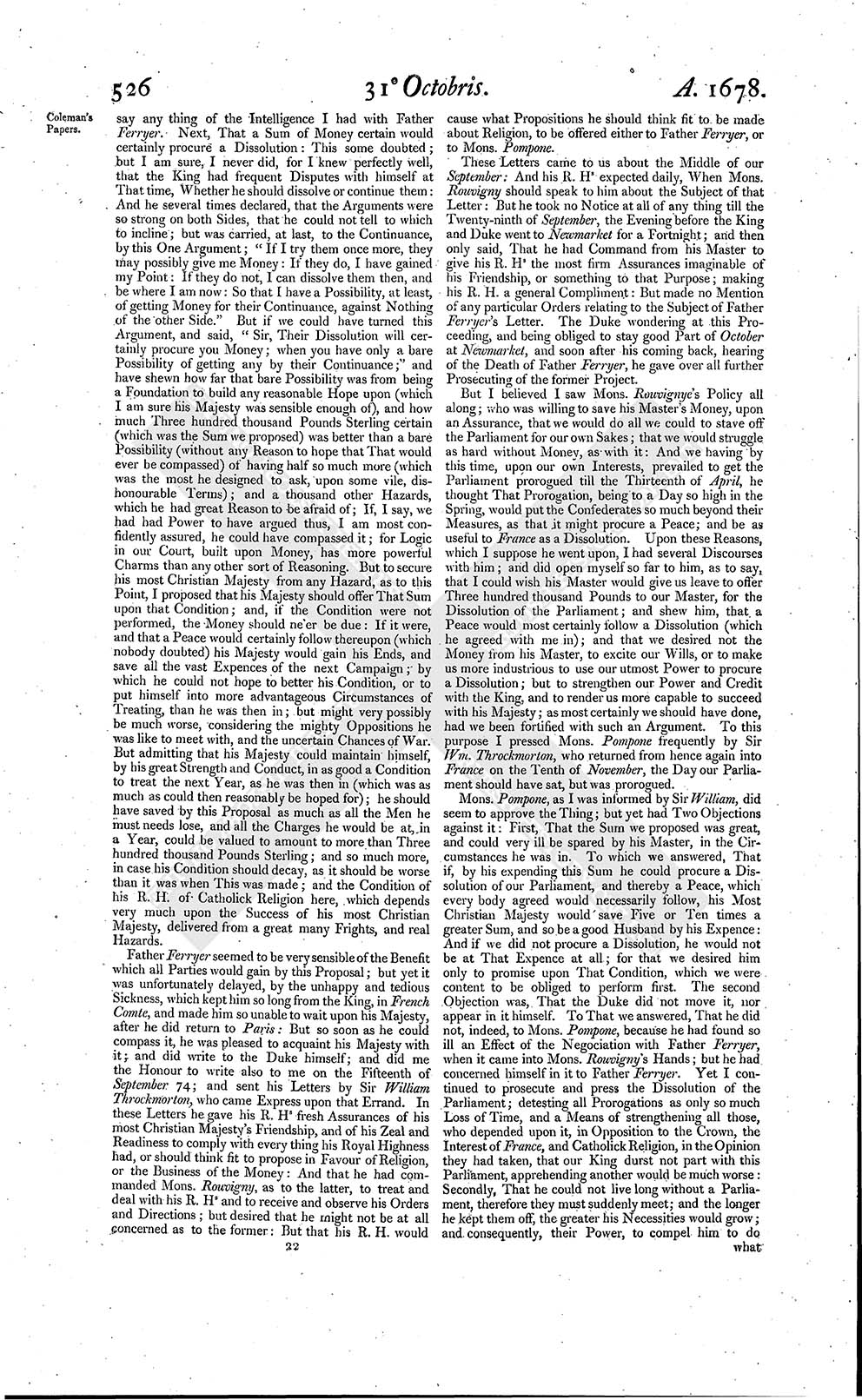
SINCE Father St. Germaine has been so kind as to recommend me to your Reverence so advantageously, as to encourage you to accept of my Correspondence, I will own to him, that he has done me a Favour, without consulting me, greater than I could have been capable of, if he had advised with me; because I should not then have had the Confidence to have permitted him to ask it in my Behalf: And I am so sensible of the Honour you are pleased to do me, that though I cannot deserve it, yet at least to shew the Sense I have of it, I will deal as freely and openly with you at this First Time, as if I had the Honour of your Acquaintance all my Life; and shall make no Apology for so doing, but only tell you, that I know your Character perfectly well, though I am not so happy as to know your Person; and that I have an Opportunity of putting this Letter into the Hands of Father St. German's Nephew (for whose Integrity and Prudence he has undertaken) without any sort of Hazard.
In order, then, Sir, to the Plainness which I profess, I will tell you, what has formerly passed between your Reverend Predecessor Father Ferryer and myself. About Three Years ago, when the King my Master sent a Troop of his Horse Guards into his Most Christian Majesty's Service, he sent with it an Officer, called Sir Wm. Throckmorton, with whom I had a particular Intimacy, and who had then very newly embraced the Catholick Religion: To him did I constantly write, and by him address myself to Father Ferryer.
The First Things of great Importance which I presumed to offer to him (not to trouble you with lesser Matters, or what passed here before and immediately after the fatal Revocation of the King's Declaration for Liberty of Conscience, to which we owe all our late Miseries and Hazards) was in July, August, and September, 1673; when I constantly inculcated the great Danger Catholick Religion and his Most Christian Majesty's Interest would be in at our next Sessions of Parliament; which was then to be in October following: At which I plainly foresaw, that the King my Master would be forced to Something, in Prejudice of his Alliance with France; which I saw so evidently (and particularly that we should make Peace with Holland), that I urged all the Arguments I could (which to me were Demonstrations) to convince Your Court of that Mischief; and pressed what I could, to persuade his Christian Majesty to use his utmost Force to prevent That Sessions of our Parliament; and proposed Expedients how to do it: But I was answered so often, and so positively, That his Christian Majesty was so well assured by his Ambassador here, our Ambassador there, the Lord Arlington, and even the King himself, that he had no such Apprehension at all, but was fully satisfied of the contrary, and looked upon what I offered as a very zealous Mistake; that I was forced to give over arguing, though not believing as I did; but confidently appealed to Time and Success, to prove who took their Measures rightest. When it happened, that what I foresaw, came to pass, the good Father was a little surprised, to see all the Great Men mistaken, and a Little one in the right; and was pleased, by Sir Wm. Throckmorton, to desire the Continuance of my Correspondence: Which I was mighty willing to comply with; knowing the Interest of our King, and, in a more particular Manner, of my more immediate Master the Duke, and his Most Christian Majesty, to be so inseparably united, that it was impossible to divide them, without destroying them all.
Upon this, I shew, that our Parliament, in the Circumstances it was in, managed by the timorous Councils of our Ministers who then governed, could never be useful, either to England, France, or Catholick Religion; but that we should as certainly be forced from our Neutrality, at their next Meeting, as we had been from our active Alliance with France the last: That a Peace, in the Circumstances we were in, was much more to be desired than the Continuance of the War: And, that the Dissolution of our Parliament would certainly procure a Peace: For that the Confederates did more depend upon the Power they had in our Parliament, than upon any thing else in the World; and were more encouraged from thence to continue the War: So that, if That were dissolved, their Measures would be all broken; and they, consequently, in a manner necessitated to a Peace.
The good Father, minding this Discourse somewhat more than the Court of France thought fit to do my former, urged it so home to the King, that his Majesty was pleased to give him Order to signify to his Royal Highness my Master, that his Majesty was fully satisfied of his R. H.s's good Intentions towards him; and that he esteemed both their Interests but as One and the same: That my Lord Arlington, and the Parliament, were both to be looked upon as very unuseful to their Interests; and that if his Royal Hs would endeavour to dissolve this Parliament, his Majesty would assist him with his Power and his Purse, to have such a new one, as should be for their Purpose.
This, and a great many more Expressions of Kindness and Confidence, Father Ferryer was pleased to communicate to Sir Wm. Throckmorton; and commanded him to send them to his R. H.; and withal to beg his R. H. to propose to his most Christian Majesty, What he thought necessary for his own Concern, and the Advantage of Religion: And his Majesty would certainly do all he could to advance both, or either of them. This Sir Wm. Throckmorton sent to me by an Express, who left Paris on the Second of June 1674, Stilo novo. I no sooner had it, but I communicated it to his R. Hs: To which his R. H. commanded me to answer (as I did on the Twenty-ninth of the same Month) that his R. Hs was very sensible of his most Christian Majesty's friendship; and that he would labour to cultivate it with all the good Offices he was capable of doing for his Majesty: That he was fully convinced, that their Interests were both one: That my Lord Arlington, and the Parliament, were not only unuseful, but very dangerous, both to England and France: That therefore it was necessary, that they should do all they could to dissolve it: And that his R. Highness's Opinion was, That if his most Christian Majesty would write his Thoughts freely to the King of England upon this Subject, and make the same offer to his Majesty of his Purse, to dissolve This, which he had made to his Royal Highness to call Another, he did believe it very possible for him to succeed, with the Assistance we should be able to give him here: And that, if this Parliament were dissolved, there would be no great Difficulty of getting a new one, which would be more useful; the Constitution of our Parliaments being such, that a New one can never hurt the Crown, nor an Old one do it good.
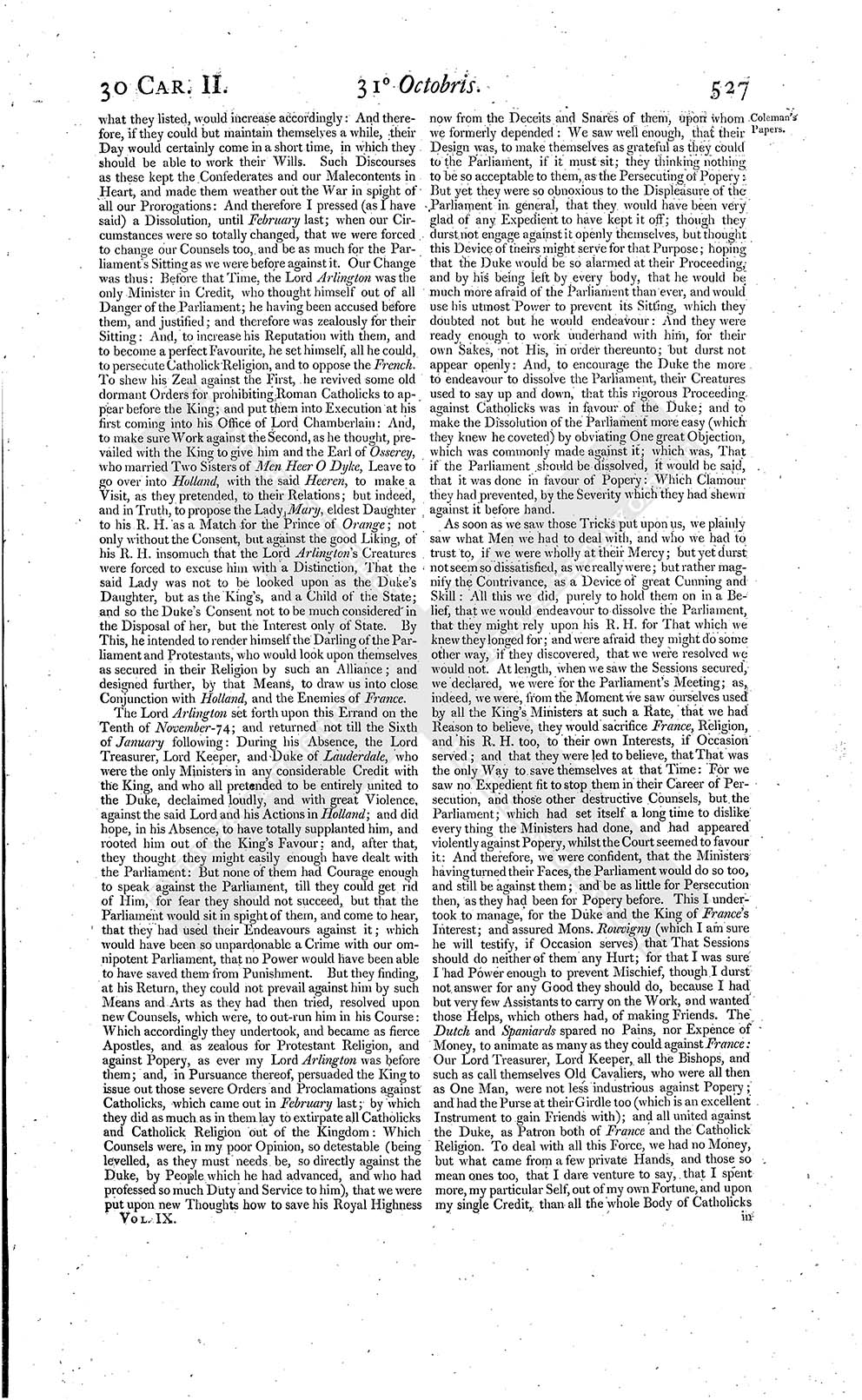
His R. Hs being pleased to own these Propositions, which were but only general, I thought it reasonable to be more particular, and come closer to the Point; that if we happened to agree, we might go the faster about the Work; and come to some Issue before the Time were too much spent. I laid this for my Maxim; The Dissolution of our Parliament will certainly procure a Peace: Which Proposition was granted by every body I conversed withal, even by Monsieur Rovigny himself; with whom I took liberty of discoursing so far: but durst not say any thing of the Intelligence I had with Father Ferryer. Next, That a Sum of Money certain would certainly procure a Dissolution: This some doubted; but I am sure, I never did, for I knew perfectly well, that the King had frequent Disputes with himself at That time, Whether he should dissolve or continue them: And he several times declared, that the Arguments were so strong on both Sides, that he could not tell to which to incline; but was carried, at last, to the Continuance, by this One Argument; "If I try them once more, they may possibly give me Money: It they do, I have gained my Point: If they do not, I can dissolve them then, and be where I am now: So that I have a Possibility, at least, of getting Money for their Continuance, against Nothing of the other Side." But if we could have turned this Argument, and said, "Sir, Their Dissolution will certainly procure you Money; when you have only a bare Possibility of getting any by their Continuance;" and have shewn how far that bare Possibility was from being a Foundation to build any reasonable Hope upon (which I am sure his Majesty was sensible enough of), and how much Three hundred thousand Pounds Sterling certain (which was the Sum we proposed) was better than a bare Possibility (without any Reason to hope that That would ever be compassed) of having half so much more (which was the most he designed to ask, upon some vile, dishonourable Terms); and a thousand other Hazards, which he had great Reason to be afraid of; If, I say, we had had Power to have argued thus, I am most confidently assured, he could have compassed it; for Logic in our Court, built upon Money, has more powerful Charms than any other sort of Reasoning. But to secure his most Christian Majesty from any Hazard, as to this Point, I proposed that his Majesty should offer That Sum upon that Condition; and, if the Condition were not performed, the Money should ne'er be due: If it were, and that a Peace would certainly follow thereupon (which nobody doubted) his Majesty would gain his Ends, and save all the vast Expences of the next Campaign; by which he could not hope to better his Condition, or to put himself into more advantageous Circumstances of Treating, than he was then in; but might very possibly be much worse, considering the mighty Oppositions he was like to meet with, and the uncertain Chances of War. But admitting that his Majesty could maintain himself, by his great Strength and Conduct, in as good a Condition to treat the next Year, as he was then in (which was as much as could then reasonably be hoped for); he should have saved by this Proposal as much as all the Men he must needs lose, and all the Charges he would be at, in a Year, could be valued to amount to more than Three hundred thousand Pounds Sterling; and so much more, in case his Condition should decay, as it should be worse than it was when This was made; and the Condition of his R. H. of Catholick Religion here, which depends very much upon the Success of his most Christian Majesty, delivered from a great many Frights, and real Hazards.
Father Ferryer seemed to be very sensible of the Benefit which all Parties would gain by this Proposal; but yet it was unfortunately delayed, by the unhappy and tedious Sickness, which kept him so long from the King, in French Comte, and made him so unable to wait upon his Majesty, after he did return to Paris: But so soon as he could compass it, he was pleased to acquaint his Majesty with it; and did write to the Duke himself; and did me the Honour to write also to me on the Fifteenth of September 74; and sent his Letters by Sir William Throckmorton, who came Express upon that Errand. In these Letters he gave his R. Hs fresh Assurances of his most Christian Majesty's Friendship, and of his Zeal and Readiness to comply with every thing his Royal Highness had, or should think fit to propose in Favour of Religion, or the Business of the Money: And that he had commanded Mons. Rouvigny, as to the latter, to treat and deal with his R. Hs and to receive and observe his Orders and Directions; but desired that he might not be at all concerned as to the former: But that his R. H. would cause what Propositions he should think fit to be made about Religion, to be offered either to Father Ferryer, or to Mons. Pompone.
These Letters came to us about the Middle of our September: And his R. Hs expected daily, When Mons. Rouvigny should speak to him about the Subject of that Letter: But he took no Notice at all of any thing till the Twenty-ninth of September, the Evening before the King and Duke went to Newmarket for a Fortnight; and then only said, That he had Command from his Master to give his R. Hs the most firm Assurances imaginable of his Friendship, or something to that Purpose; making his R. H. a general Compliment: But made no Mention of any particular Orders relating to the Subject of Father Ferryer's Letter. The Duke wondering at this Proceeding, and being obliged to stay good Part of October at Newmarket, and soon after his coming back, hearing of the Death of Father Ferryer, he gave over all further Prosecuting of the former Project.
But I believed I saw Mons. Rouvignye's Policy all along; who was willing to save his Master's Money, upon an Assurance, that we would do all we could to stave off the Parliament for our own Sakes; that we would struggle as hard without Money, as with it: And we having by this time, upon our own Interests, prevailed to get the Parliament prorogued till the Thirteenth of April, he thought That Prorogation, being to a Day so high in the Spring, would put the Confederates so much beyond their Measures, as that it might procure a Peace; and be as useful to France as a Dissolution. Upon these Reasons, which I suppose he went upon, I had several Discourses with him; and did open myself so far to him, as to say, that I could wish his Master would give us leave to offer Three hundred thousand Pounds to our Master, for the Dissolution of the Parliament; and shew him, that a Peace would most certainly follow a Dissolution (which he agreed with me in); and that we desired not the Money from his Master, to excite our Wills, or to make us more industrious to use our utmost Power to procure a Dissolution; but to strengthen our Power and Credit with the King, and to render us more capable to succeed with his Majesty; as most certainly we should have done, had we been fortified with such an Argument. To this purpose I pressed Mons. Pompone frequently by Sir Wm. Throckmorton, who returned from hence again into France on the Tenth of November, the Day our Parliament should have sat, but was prorogued.
Mons. Pompone, as I was informed by Sir William, did seem to approve the Thing; but yet had Two Objections against it: First, That the Sum we proposed was great, and could very ill be spared by his Master, in the Circumstances he was in. To which we answered, That if, by his expending this Sum he could procure a Dissolution of our Parliament, and thereby a Peace, which every body agreed would necessarily follow, his Most Christian Majesty would save Five or Ten times a greater Sum, and so be a good Husband by his Expence: And if we did not procure a Dissolution, he would not be at That Expence at all; for that we desired him only to promise upon That Condition, which we were content to be obliged to perform first. The second Objection was, That the Duke did not move it, nor appear in it himself. To That we answered, That he did not, indeed, to Mons. Pompone, because he had found so ill an Effect of the Negociation with Father Ferryer, when it came into Mons. Rouvigny's Hands; but he had concerned himself in it to Father Ferryer. Yet I continued to prosecute and press the Dissolution of the Parliament; detesting all Prorogations as only so much Loss of Time, and a Means of strengthening all those, who depended upon it, in Opposition to the Crown, the Interest of France, and Catholick Religion, in the Opinion they had taken, that our King durst not part with this Parliament, apprehending another would be much worse: Secondly, That he could not live long without a Parliament, therefore they must suddenly meet; and the longer he kept them off, the greater his Necessities would grow; and consequently, their Power, to compel him to do what they listed, would increase accordingly: And therefore, if they could but maintain themselves a while, their Day would certainly come in a short time, in which they should be able to work their Wills. Such Discourses as these kept the Confederates and our Malecontents in Heart, and made them weather out the War in spight of all our Prorogations: And therefore I pressed (as I have said) a Dissolution, until February last; when our Circumstances were so totally changed, that we were forced to change our Counsels too, and be as much for the Parliament's Sitting as we were before against it. Our Change was thus: Before that Time, the Lord Arlington was the only Minister in Credit, who thought himself out of all Danger of the Parliament; he having been accused before them, and justified; and therefore was zealously for their Sitting: And, to increase his Reputation with them, and to become a perfect Favourite, he set himself, all he could, to persecute Catholick Religion, and to oppose the French. To shew his Zeal against the First, he revived some old dormant Orders for prohibiting Roman Catholicks to appear before the King; and put them into Execution at his first coming into his Office of Lord Chamberlain: And, to make sure Work against the Second, as he thought, prevailed with the King to give him and the Earl of Osserey, who married Two Sisters of Men Heer O Dyke, Leave to go over into Holland, with the said Heeren, to make a Visit, as they pretended, to their Relations; but indeed, and in Truth, to propose the Lady Mary, eldest Daughter to his R. H. as a Match for the Prince of Orange; not only without the Consent, but against the good Liking, of his R. H. insomuch that the Lord Arlington's Creatures were forced to excuse him with a Distinction, That the said Lady was not to be looked upon as the Duke's Daughter, but as the King's, and a Child of the State; and so the Duke's Consent not to be much considered in the Disposal of her, but the Interest only of State. By This, he intended to render himself the Darling of the Parliament and Protestants, who would look upon themselves as secured in their Religion by such an Alliance; and designed further, by that Means, to draw us into close Conjunction with Holland, and the Enemies of France.
The Lord Arlington set forth upon this Errand on the Tenth of November-74; and returned not till the Sixth of January following: During his Absence, the Lord Treasurer, Lord Keeper, and Duke of Lauderdale, who were the only Ministers in any considerable Credit with the King, and who all pretended to be entirely united to the Duke, declaimed loudly, and with great Violence, against the said Lord and his Actions in Holland; and did hope, in his Absence, to have totally supplanted him, and rooted him out of the King's Favour; and, after that, they thought they might easily enough have dealt with the Parliament: But none of them had Courage enough to speak against the Parliament, till they could get rid of Him, for fear they should not succeed, but that the Parliament would sit in spight of them, and come to hear, that they had used their Endeavours against it; which would have been so unpardonable a Crime with our omnipotent Parliament, that no Power would have been able to have saved them from Punishment. But they finding, at his Return, they could not prevail against him by such Means and Arts as they had then tried, resolved upon new Counsels, which were, to out-run him in his Course: Which accordingly they undertook, and became as fierce Apostles, and as zealous for Protestant Religion, and against Popery, as ever my Lord Arlington was before them; and, in Pursuance thereof, persuaded the King to issue out those severe Orders and Proclamations against Catholicks, which came out in February last; by which they did as much as in them lay to extirpate all Catholicks and Catholick Religion out of the Kingdom: Which Counsels were, in my poor Opinion, so detestable (being levelled, as they must needs be, so directly against the Duke, by People which he had advanced, and who had professed so much Duty and Service to him), that we were put upon new Thoughts how to save his Royal Highness now from the Deceits and Snares of them, upon whom we formerly depended: We saw well enough, that their Design was, to make themselves as grateful as they could to the Parliament, if it must sit; they thinking nothing to be so acceptable to them, as the Persecuting of Popery: But yet they were so obnoxious to the Displeasure of the Parliament in general, that they would have been very glad of any Expedient to have kept it off; though they durst not engage against it openly themselves, but thought this Device of theirs might serve for that Purpose; hoping that the Duke would be so alarmed at their Proceeding, and by his being left by every body, that he would be much more afraid of the Parliament than ever, and would use his utmost Power to prevent its Sitting, which they doubted not but he would endeavour: And they were ready enough to work underhand with him, for their own Sakes, not His, in order thereunto; but durst not appear openly: And, to encourage the Duke the more to endeavour to dissolve the Parliament, their Creatures used to say up and down, that this rigorous Proceeding against Catholicks was in favour of the Duke; and to make the Dissolution of the Parliament more easy (which they knew he coveted) by obviating One great Objection, which was commonly made against it; which was, That if the Parliament should be dissolved, it would be said, that it was done in favour of Popery: Which Clamour they had prevented, by the Severity which they had shewn against it before hand.
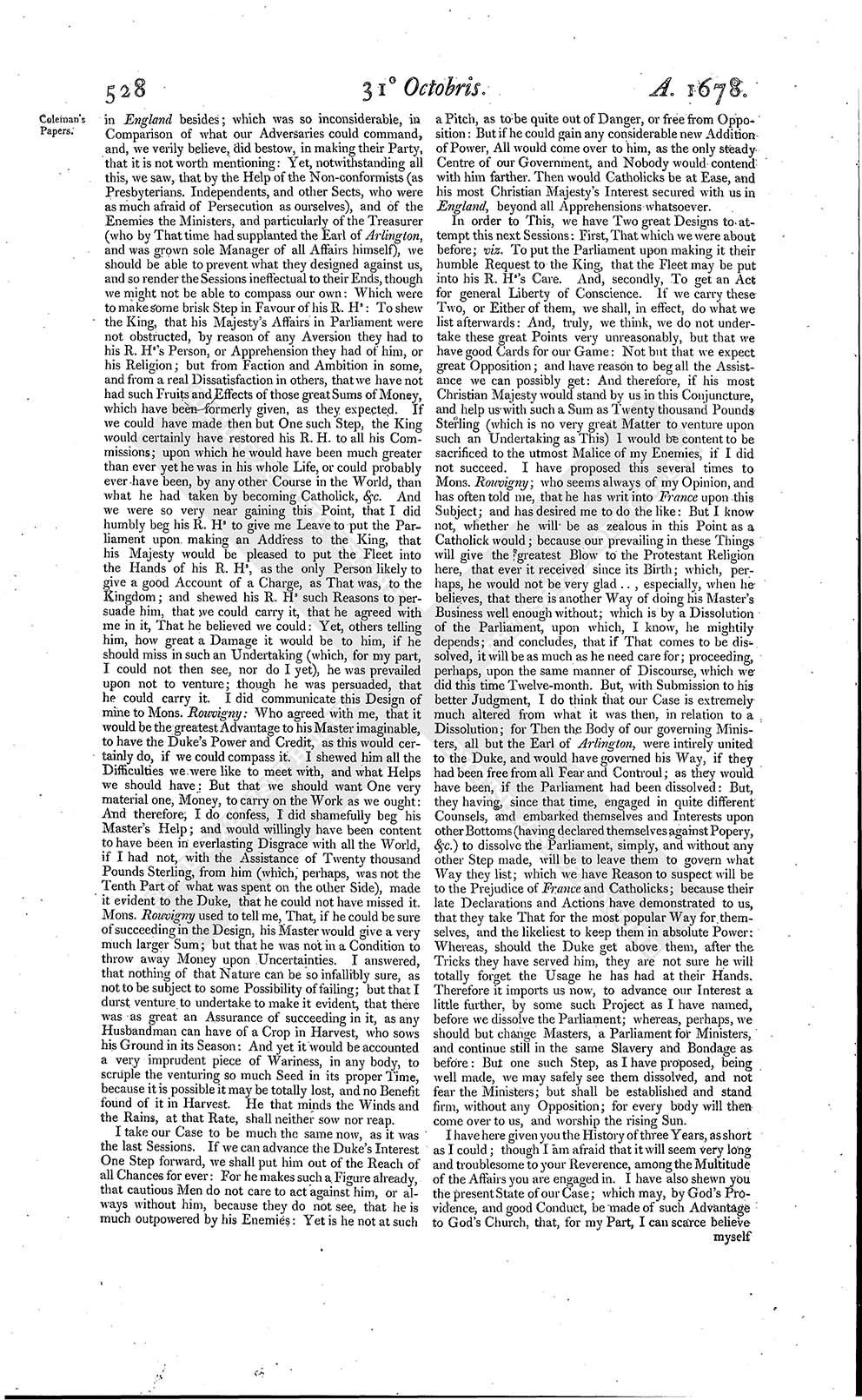
As soon as we saw those Tricks put upon us, we plainly saw what Men we had to deal with, and who we had to trust to, if we were wholly at their Mercy; but yet durst not seem so dissatisfied, as we really were; but rather magnify the Contrivance, as a Device of great Cunning and Skill: All this we did, purely to hold them on in a Belief, that we would endeavour to dissolve the Parliament, that they might rely upon his R. H. for That which we knew they longed for; and were afraid they might do some other way, if they discovered, that we were resolved we would not. At length, when we saw the Sessions secured, we declared, we were for the Parliament's Meeting; as, indeed, we were, from the Moment we saw ourselves used by all the King's Ministers at such a rate, that we had Reason to believe, they would sacrifice France, Religion, and his R. H. too, to their own Interests, if Occasion served; and that they were led to believe, that That was the only Way to save themselves at that Time: For we saw no Expedient fit to stop them in their Career of Persecution, and those other destructive Counsels, but the Parliament; which had set itself a long time to dislike every thing the Ministers had done, and had appeared violently against Popery, whilst the Court seemed to favour it: And therefore, we were confident, that the Ministers having turned their Faces, the Parliament would do so too, and still be against them; and be as little for Persecution then, as they had been for Popery before. This I undertook to manage, for the Duke and the King of France's Interest; and assured Mons. Rowvigny (which I am sure he will testify, if Occasion serves) that That Sessions should do neither of them any Hurt; for that I was sure I had Power enough to prevent Mischief, though I durst not answer for any Good they should do, because I had but very few Assistants to carry on the Work, and wanted those Helps, which others had, of making Friends. The Dutch and Spaniards spared no Pains, nor Expence of Money, to animate as many as they could against France: Our Lord Treasurer, Lord Keeper, all the Bishops, and such as call themselves Old Cavaliers, who were all then as One Man, were not less industrious against Popery; and had the Purse at their Girdle too (which is an excellent Instrument to gain Friends with); and all united against the Duke, as Patron both of France and the Catholick Religion. To deal with all this Force, we had no Money, but what came from a few private Hands, and those so mean ones too, that I dare venture to say, that I spent more, my particular Self, out of my own Fortune, and upon my single Credit, than all the whole Body of Catholicks in England besides; which was so inconsiderable, in Comparison of what our Adversaries could command, and, we verily believe, did bestow, in making their Party, that it is not worth mentioning: Yet, notwithstanding all this, we saw, that by the Help of the Non-conformists (as Presbyterians. Independents, and other Sects, who were as much afraid of Persecution as ourselves), and of the Enemies the Ministers, and particularly of the Treasurer (who by That time had supplanted the Earl of Arlington, and was grown sole Manager of all Affairs himself), we should be able to prevent what they designed against us, and so render the Sessions ineffectual to their Ends, though we might not be able to compass our own: Which were to make some brisk Step in Favour of his R. Hs: To shew the King, that his Majesty's Affairs in Parliament were not obstructed, by reason of any Aversion they had to his R. Hs's Person, or Apprehension they had of him, or his Religion; but from Faction and Ambition in some, and from a real Dissatisfaction in others, that we have not had such Fruits and Effects of those great Sums of Money, which have been formerly given, as they expected. If we could have made then but One such Step, the King would certainly have restored his R. H. to all his Commissions; upon which he would have been much greater than ever yet he was in his whole Life, or could probably ever have been, by any other Course in the World, than what he had taken by becoming Catholick, &c. And we were so very near gaining this Point, that I did humbly beg his R. Hs to give me Leave to put the Parliament upon making an Address to the King, that his Majesty would be pleased to put the Fleet into the Hands of his R. Hs, as the only Person likely to give a good Account of a Charge, as That was, to the Kingdom; and shewed his R. Hs such Reasons to persuade him, that we could carry it, that he agreed with me in it, That he believed we could: Yet, others telling him, how great a Damage it would be to him, if he should miss in such an Undertaking (which, for my part, I could not then see, nor do I yet), he was prevailed upon not to venture; though he was persuaded, that he could carry it. I did communicate this Design of mine to Mons. Rouvigny: Who agreed with me, that it would be the greatest Advantage to his Master imaginable, to have the Duke's Power and Credit, as this would certainly do, if we could compass it. I shewed him all the Difficulties we were like to meet with, and what Helps we should have: But that we should want One very material one, Money, to carry on the Work as we ought: And therefore, I do confess, I did shamefully beg his Master's Help; and would willingly have been content to have been in everlasting Disgrace with all the World, if I had not, with the Assistance of Twenty thousand Pounds Sterling, from him (which, perhaps, was not the Tenth Part of what was spent on the other Side), made it evident to the Duke, that he could not have missed it. Mons. Rouvigny used to tell me, That, if he could be sure of succeeding in the Design, his Master would give a very much larger Sum; but that he was not in a Condition to throw away Money upon Uncertainties. I answered, that nothing of that Nature can be so infallibly sure, as not to be subject to some Possibility of failing; but that I durst venture to undertake to make it evident, that there was as great an Assurance of succeeding in it, as any Husbandman can have of a Crop in Harvest, who sows his Ground in its Season: And yet it would be accounted a very imprudent piece of Wariness, in any body, to scruple the venturing so much Seed in its proper Time, because it is possible it may be totally lost, and no Benefit found of it in Harvest. He that minds the Winds and the Rains, at that Rate, shall neither sow nor reap.
I take our Case to be much the same now, as it was the last Sessions. If we can advance the Duke's Interest One Step forward, we shall put him out of the Reach of all Chances for ever: For he makes such a Figure already, that cautious Men do not care to act against him, or always without him, because they do not see, that he is much outpowered by his Enemies: Yet is he not at such a Pitch, as to be quite out of Danger, or free from Opposition: But if he could gain any considerable new Addition of Power, All would come over to him, as the only steady Centre of our Government, and Nobody would contend with him farther. Then would Catholicks be at Ease, and his most Christian Majesty's Interest secured with us in England, beyond all Apprehensions whatsoever.
In order to This, we have Two great Designs to attempt this next Sessions: First, That which we were about before; viz. To put the Parliament upon making it their humble Request to the King, that the Fleet may be put into his R. Hs's Care. And, secondly, To get an Act for general Liberty of Conscience. If we carry these Two, or Either of them, we shall, in effect, do what we list afterwards: And, truly, we think, we do not undertake these great Points very unreasonably, but that we have good Cards for our Game: Not but that we expect great Opposition; and have reason to beg all the Assistance we can possibly get: And therefore, if his most Christian Majesty would stand by us in this Conjuncture, and help us with such a Sum as Twenty thousand Pounds Sterling (which is no very great Matter to venture upon such an Undertaking as This) I would be content to be sacrificed to the utmost Malice of my Enemies, if I did not succeed. I have proposed this several times to Mons. Rowvigny; who seems always of my Opinion, and has often told me, that he has writ into France upon this Subject; and has desired me to do the like: But I know not, whether he will be as zealous in this Point as a Catholick would; because our prevailing in these Things will give the greatest Blow to the Protestant Religion here, that ever it received since its Birth; which, perhaps, he would not be very glad . ., especially, when he believes, that there is another Way of doing his Master's Business well enough without; which is by a Dissolution of the Parliament, upon which, I know, he mightily depends; and concludes, that if That comes to be dissolved, it will be as much as he need care for; proceeding, perhaps, upon the same manner of Discourse, which we did this time Twelve-month. But, with Submission to his better Judgment, I do think that our Case is extremely much altered from what it was then, in relation to a Dissolution; for Then the Body of our governing Ministers, all but the Earl of Arlington, were intirely united to the Duke, and would have governed his Way, if they had been free from all Fear and Controul; as they would have been, if the Parliament had been dissolved: But, they having, since that time, engaged in quite different Counsels, and embarked themselves and Interests upon other Bottoms (having declared themselves against Popery, &c.) to dissolve the Parliament, simply, and without any other Step made, will be to leave them to govern what Way they list; which we have Reason to suspect will be to the Prejudice of France and Catholicks; because their late Declarations and Actions have demonstrated to us, that they take That for the most popular Way for themselves, and the likeliest to keep them in absolute Power: Whereas, should the Duke get above them, after the Tricks they have served him, they are not sure he will totally forget the Usage he has had at their Hands. Therefore it imports us now, to advance our Interest a little further, by some such Project as I have named, before we dissolve the Parliament; whereas, perhaps, we should but change Masters, a Parliament for Ministers, and continue still in the same Slavery and Bondage as before: But one such Step, as I have proposed, being well made, we may safely see them dissolved, and not fear the Ministers; but shall be established and stand firm, without any Opposition; for every body will then come over to us, and worship the rising Sun.
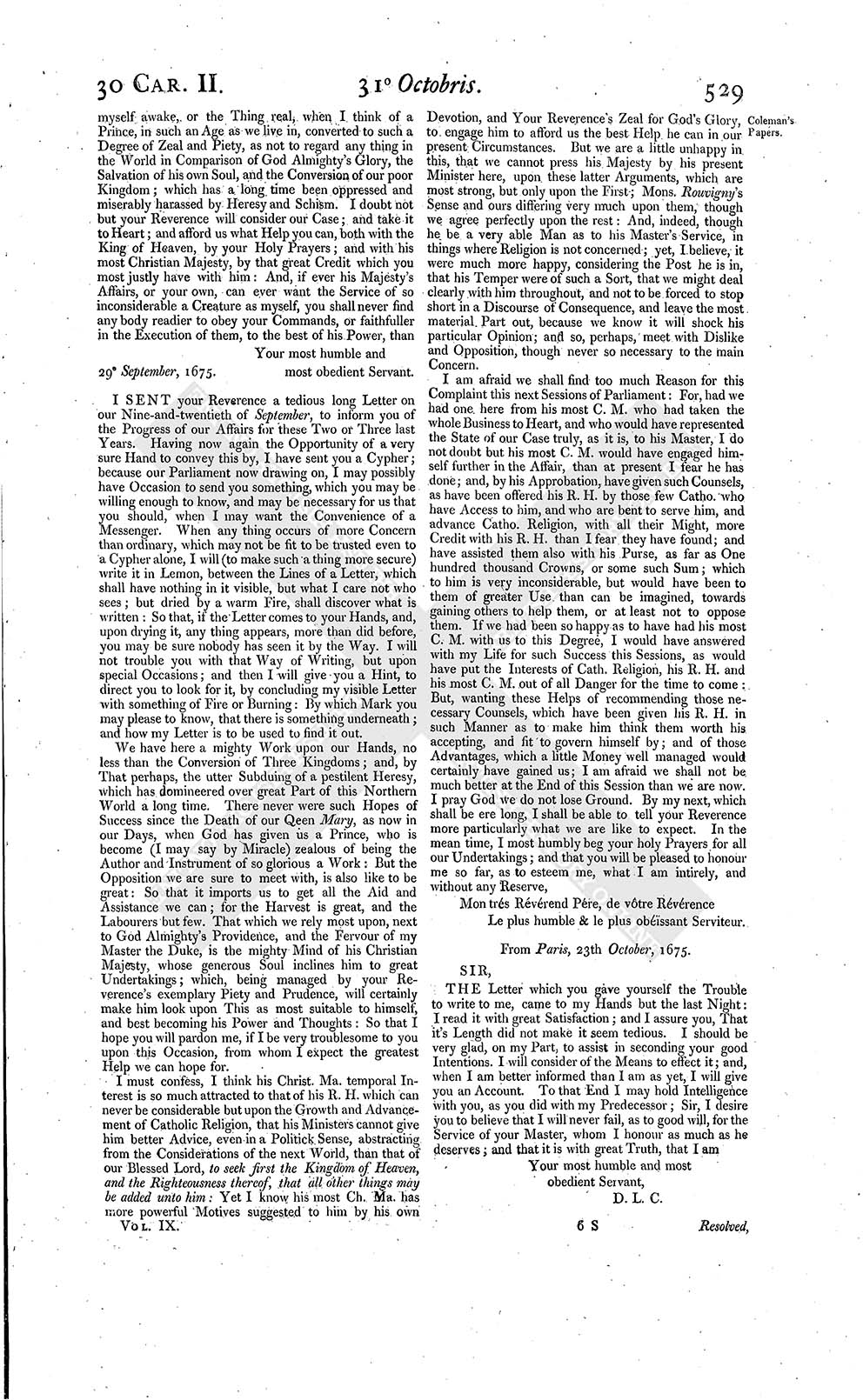
I have here given you the History of three Years, as short as I could; though I am afraid that it will seem very long and troublesome to your Reverence, among the Multitude of the Affairs you are engaged in. I have also shewn you the present State of our Case; which may, by God's Providence, and good Conduct, be made of such Advantage to God's Church, that, for my Part, I can scarce believe myself awake, or the Thing real, when I think of a Prince, in such an Age as we live in, converted to such a Degree of Zeal and Piety, as not to regard any thing in the World in Comparison of God Almighty's Glory, the Salvation of his own Soul, and the Conversion of our poor Kingdom; which has a long time been oppressed and miserably harassed by Heresy and Schism. I doubt not but your Reverence will consider our Case; and take it to Heart; and afford us what Help you can, both with the King of Heaven, by your Holy Prayers; and with his most Christian Majesty, by that great Credit which you most justly have with him: And, if ever his Majesty's Affairs, or your own, can ever want the Service of so inconsiderable a Creature as myself, you shall never find any body readier to obey your Commands, or faithfuller in the Execution of them, to the best of his Power, than
Your most humble and most obedient Servant.
29 September, 1675.
I SENT your Reverence a tedious long Letter on our Nine-and-twentieth of September, to inform you of the Progress of our Affairs for these Two or Three last Years. Having now again the Opportunity of a very sure Hand to convey this by, I have sent you a Cypher; because our Parliament now drawing on, I may possibly have Occasion to send you something, which you may be willing enough to know, and may be necessary for us that you should, when I may want the Convenience of a Messenger. When any thing occurs of more Concern than ordinary, which may not be fit to be trusted even to a Cypher alone, I will (to make such a thing more secure) write it in Lemon, between the Lines of a Letter, which shall have nothing in it visible, but what I care not who sees; but dried by a warm Fire, shall discover what is written: So that, if the Letter comes to your Hands, and, upon drying it, any thing appears, more than did before, you may be sure nobody has seen it by the Way. I will not trouble you with that Way of Writing, but upon special Occasions; and then I will give you a Hint, to direct you to look for it, by concluding my visible Letter with something of Fire or Burning: By which Mark you may please to know, that there is something underneath; and how my Letter is to be used to find it out.
We have here a mighty Work upon our Hands, no less than the Conversion of Three Kingdoms; and, by That perhaps, the utter Subduing of a pestilent Heresy, which has domineered over great Part of this Northern World a long time. There never were such Hopes of Success since the Death of our Qeen Mary, as now in our Days, when God has given us a Prince, who is become (I may say by Miracle) zealous of being the Author and Instrument of so glorious a Work: But the Opposition we are sure to meet with, is also like to be great: So that it imports us to get all the Aid and Assistance we can; for the Harvest is great, and the Labourers but few. That which we rely most upon, next to God Almighty's Providence, and the Fervour of my Master the Duke, is the mighty Mind of his Christian Majesty, whose generous Soul inclines him to great Undertaking; which, being managed by your Reverence's exemplary Piety and Prudence, will certainly make him look upon This as most suitable to himself, and best becoming his Power and Thoughts: So that I hope you will pardon me, if I be very troublesome to you upon this Occasion, from whom I expect the greatest Help we can hope for.
I must confess, I think his Christ. Ma. temporal Interest is so much attracted to that of his R. H. which can never be considerable but upon the Growth and Advancement of Catholic Religion, that his Ministers cannot give him better Advice, even in a Politick Sense, abstracting from the Considerations of the next World, than that of our Blessed Lord, to seek first the Kingdom of Heaven, and the Righteousness thereof, that all other things may be added unto him: Yet I know his most Ch. Ma. has more powerful Motives suggested to him by his own Devotion, and Your Reverence's Zeal for God's Glory, to engage him to afford us the best Help he can in our present Circumstances. But we are a little unhappy in this, that we cannot press his Majesty by his present Minister here, upon these latter Arguments, which are most strong, but only upon the First; Mons. Rowvigny's Sense and ours differing very much upon them, though we agree perfectly upon the rest: And, indeed, though he be a very able Man as to his Master's Service, in things where Religion is not concerned; yet, I believe, it were much more happy, considering the Post he is in, that his Temper were of such a Sort, that we might deal clearly with him throughout, and not to be forced to stop short in a Discourse of Consequence, and leave the most material Part out, because we know it will shock his particular Opinion; and so, perhaps, meet with Dislike and Opposition, though never so necessary to the main Concern.
I am afraid we shall find too much Reason for this Complaint this next Sessions of Parliament: For, had we had one here from his most C. M. who had taken the whole Business to Heart, and who would have represented the State of our Case truly, as it is, to his Master, I do not doubt but his most C. M. would have engaged himself further in the Affair, than at present I fear he has done; and, by his Approbation, have given such Counsels, as have been offered his R. H. by those few Catho. who have Access to him, and who are bent to serve him, and advance Catho. Religion, with all their Might, more Credit with his R. H. than I fear they have found; and have assisted them also with his Purse, as far as One hundred thousand Crowns, or some such Sum; which to him is very inconsiderable, but would have been to them of greater Use than can be imagined, towards gaining others to help them, or at least not to oppose them. If we had been so happy as to have had his most C. M. with us to this Degree, I would have answered with my Life for such Success this Sessions, as would have put the Interests of Cath. Religion, his R. H. and his most C. M. out of all Danger for the time to come: But, wanting these Helps of recommending those necessary Counsels, which have been given his R. H. in such Manner as to make him think them worth his accepting, and fit to govern himself by; and of those Advantages, which a little Money well managed would certainly have gained us; I am afraid we shall not be much better at the End of this Session than we are now. I pray God we do not lose Ground. By my next, which shall be ere long, I shall be able to tell your Reverence more particularly what we are like to expect. In the mean time, I most humbly beg your holy Prayers for all our Undertakings; and that you will be pleased to honour me so far, as to esteem me, what I am intirely, and without any Reserve,
Mon trés Révérend Pére, de vôtre Révérence
Le plus humble & le plus obéïssant Serviteur.
From Paris, 23th October, 1675.
SIR,
THE Letter which you gave yourself the Trouble to write to me, came to my Hands but the last Night: I read it with great Satisfaction; and I assure you, That it's Length did not make it seem tedious. I should be very glad, on my Part, to assist in seconding your good Intentions. I will consider of the Means to effect it; and, when I am better informed than I am as yet, I will give you an Account. To that End I may hold Intelligence with you, as you did with my Predecessor; Sir, I desire you to believe that I will never fail, as to good will, for the Service of your Master, whom I honour as much as he deserves; and that it is with great Truth, that I am
Your most humble and most obedient Servant,
D. L. C.
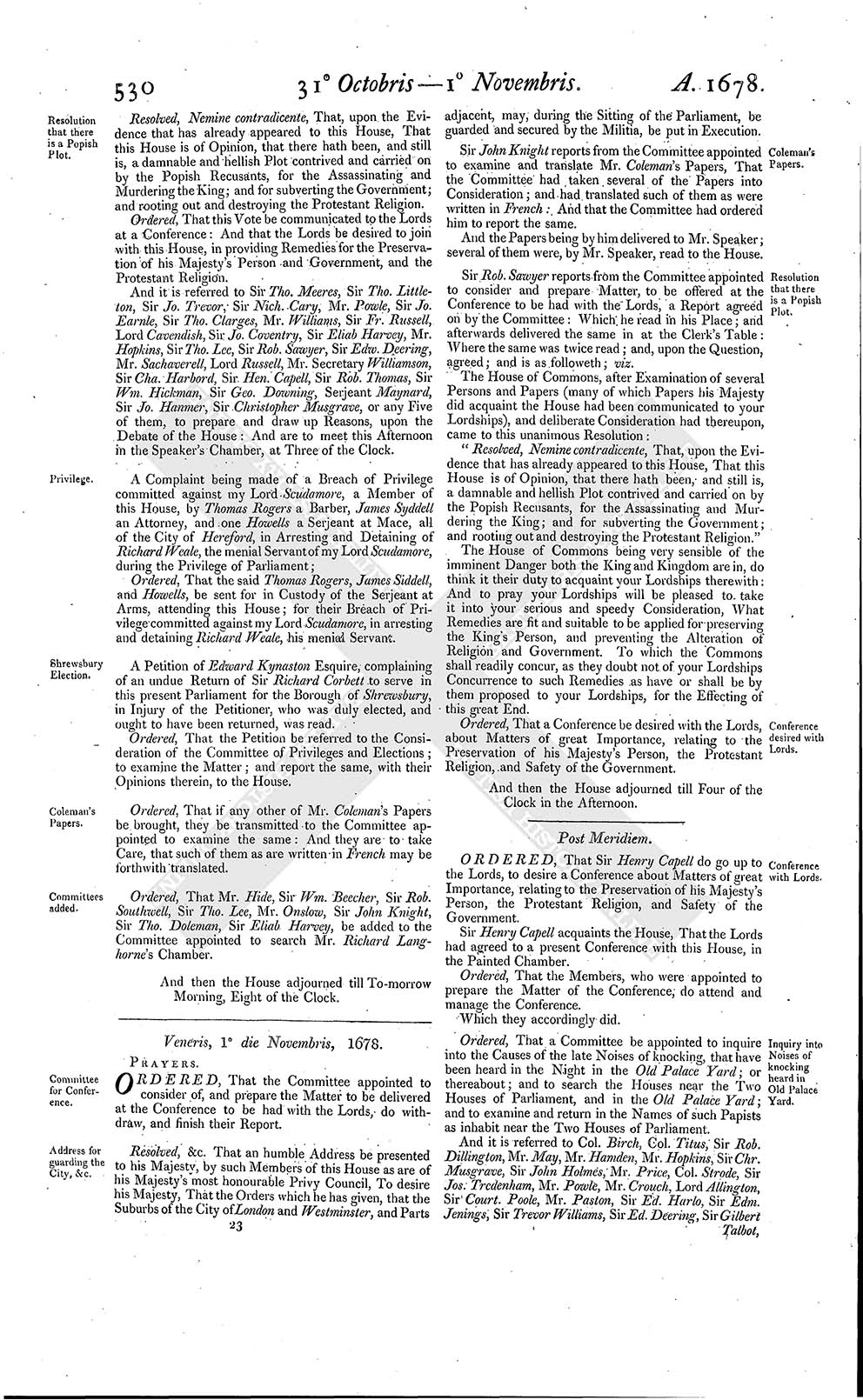
Resolution that there is a Popish Plot.
Resolved, Nemine contradicente, That, upon the Evidence that has already appeared to this House, That this House is of Opinion, that there hath been, and still is, a damnable and hellish Plot contrived and carried on by the Popish Recusants, for the Assassinating and Murdering the King; and for subverting the Government; and rooting out and destroying the Protestant Religion.
Ordered, That this Vote be communicated to the Lords at a Conference: And that the Lords be desired to join with this House, in providing Remedies for the Preservation of his Majesty's Person and Government, and the Protestant Religion.
And it is referred to Sir Tho. Meeres, Sir Tho. Littleton, Sir Jo. Trevor, Sir Nich. Cary, Mr. Powle, Sir Jo. Earnle, Sir Tho. Clarges, Mr. Williams, Sir Fr. Russell, Lord Cavendish, Sir Jo. Coventry, Sir Eliab Harvey, Mr. Hopkins, Sir Tho. Lee, Sir Rob. Sawyer, Sir Edw. Deering, Mr. Sachaverell, Lord Russell, Mr. Secretary Williamson, Sir Cha. Harbord, Sir Hen. Capell, Sir Rob. Thomas, Sir Wm. Hickman, Sir Geo. Downing, Serjeant Maynard, Sir Jo. Hanmer, Sir Christopher Musgrave, or any Five of them, to prepare and draw up Reasons, upon the Debate of the House: And are to meet this Afternoon in the Speaker's Chamber, at Three of the Clock.
Privilege.
A Complaint being made of a Breach of Privilege committed against my Lord Scudamore, a Member of this House, by Thomas Rogers a Barber, James Syddell an Attorney, and one Howells a Serjeant at Mace, all of the City of Hereford, in Arresting and Detaining of Richard Weale, the menial Servant of my Lord Scudamore, during the Privilege of Parliament;
Ordered, That the said Thomas Rogers, James Siddell, and Howells, be sent for in Custody of the Serjeant at Arms, attending this House; for their Breach of Privilege committed against my Lord Scudamore, in arresting and detaining Richard Weale, his menial Servant.
Shrewsbury Election.
A Petition of Edward Kynaston Esquire, complaining of an undue Return of Sir Richard Corbett to serve in this present Parliament for the Borough of Shrewsbury, in Injury of the Petitioner, who was duly elected, and ought to have been returned, was read.
Ordered, That the Petition be referred to the Consideration of the Committee of Privileges and Elections; to examine the Matter; and report the same, with their Opinions therein, to the House.
Coleman's Papers.
Ordered, That if any other of Mr. Coleman's Papers be brought, they be transmitted to the Committee appointed to examine the same: And they are to take Care, that such of them as are written in French may be forthwith translated.
Committees added.
Ordered, That Mr. Hide, Sir Wm. Beecher, Sir Rob. Southwell, Sir Tho. Lee, Mr. Onslow, Sir John Knight, Sir Tho. Doleman, Sir Eliab Harvey, be added to the Committee appointed to search Mr. Richard Langhorne's Chamber.
And then the House adjourned till To-morrow Morning, Eight of the Clock.