
A History of the County of Middlesex: Volume 12, Chelsea. Originally published by Victoria County History, London, 2004.
This free content was digitised by double rekeying. All rights reserved.
'Landownership: Introduction', in A History of the County of Middlesex: Volume 12, Chelsea, (London, 2004) pp. 107-108. British History Online https://www.british-history.ac.uk/vch/middx/vol12/pp107-108 [accessed 26 April 2024]
LANDOWNERSHIP
ALTHOUGH Chelsea manor was only assessed at 2 hides in 1086, perhaps as a royal concession to the holder, the number of ploughs suggests that the manor did cover the whole of the 780-acre parish. (fn. 1) The demesne of the manor probably accounted for less than half the acreage, and several medieval freeholds included lands in Chelsea as well as Kensington, Westminster, Brompton, Knightsbridge, or Eye (Ebury) in various combinations. The detached part of the parish of Kensington lying by Chelsea's riverside, which belonged in the 16th-17th centuries to the manor of Earl's Court, as well as the land in Chelsea detached, may be the remnants of a landholding interdependence between Chelsea and Kensington.
By the 15th century the only tenants of the manor of Chelsea in the records were freeholders paying a small assized rent or quitrent to the manor, of whom there are a few lists from 1453 and the 16th century. (fn. 2) The lack of correlation between the amounts due in 1453 and later suggests much amalgamation and splitting of holdings took place; the extant feet of fines also indicate an active market in land. Unfortunately the changes in holdings has helped obscure any link between medieval estates and those in the 16th century, and not enough evidence for location survives to make firm connections between holdings.
Among local families owning an unknown quantity of land were the Wests (1269-1389), (fn. 3) the Ests (1279-1408), (fn. 4) and the Stokets (1333-1405). (fn. 5) Many large land transactions involving several parishes do not indicate how much land lay in each parish. In 1332, for example, Adam de Bedyk and his wife Sibyl conveyed 250 a. and 2s. ¼d. rent in Kensington, Chelsea, and Fulham to Robert of Wodehouse, archdeacon of Richmond: (fn. 6) there had been disputes in 1301 and 1311 between the Bedyks and the prioress of Kilburn over 20 acres in Chelsea, (fn. 7) and possibly at least part of the estate lay in Chelsea detached and involved Malories manor. (fn. 8) A large estate belonging to John Convers and his wife Joan in 1309 (fn. 9) was eventually acquired between 1350 and 1354 by Westminster abbey, when it consisted of three houses, 91 acres, and 10s. 2d. rent in Knightsbridge, Kensington, Chelsea, and Eye. (fn. 10) Again, the acreage that lay in Chelsea is unknown: a John Convers acquired 1 a. in Chelsea from Roger and Christine West in 1274, (fn. 11) and probably c.1300 he or his son John and his wife Joan acquired at least 10 a. and the reversion to a house in Chelsea with rent in Westminster from John Wolward. (fn. 12) Wolward's father Richard had been in contention with William West over rent in Chelsea in 1285, (fn. 13) and it is possible that the property in John Wolward's grant had been part of the West estate in 1273. (fn. 14)
London merchants were increasingly involved in land in Chelsea. In 1371, for example, John Fish, citizen of London, conveyed a house, 36 a. arable, 1½ a. meadow, and 5s. rent in Chelsea to William Hunt and William Multon. (fn. 15) In 1403 John Hunt conveyed 4 marks rent from the same property to Thomas Garlethorp (Garthorp), citizen and fishmonger of London, (fn. 16) who before 1405 acquired the Stoket estate, (fn. 17) and left instructions in his will of 1412 that his estate was to be sold for an obit after the death of his wife, Margaret. (fn. 18) Some brief accounts of medieval estates and small freeholdings are given below.
By the late 16th century, Chelsea had three principal freehold estates: the manorial demesne, increased by the purchase of two freeholds by Henry VIII; More's estate; and Hungerford's estate. The last two were formed from several smaller freeholdings of the 15th century but when this happened is not certain: More seems to have built up his estate, as at least three purchases by him are known. Both estates also included a large quantity of land in Kensington. By the 17th century, however, the process was in reverse and several separate freehold estates were formed from the two estates. The continuing formation of new estates is apparent in the sometimes complicated descents given in the individual accounts below: this is especially true of the offshoots from Hungerford's estate, belonging to the Young, Blake, Arnold, Mart, and Greene families, where the complexities so obscured the original estate that much of the land has hitherto been claimed as part of More's property. The manorial estate also lost portions of demesne to create separate freeholdings, but as Chelsea manor its identity was not lost.
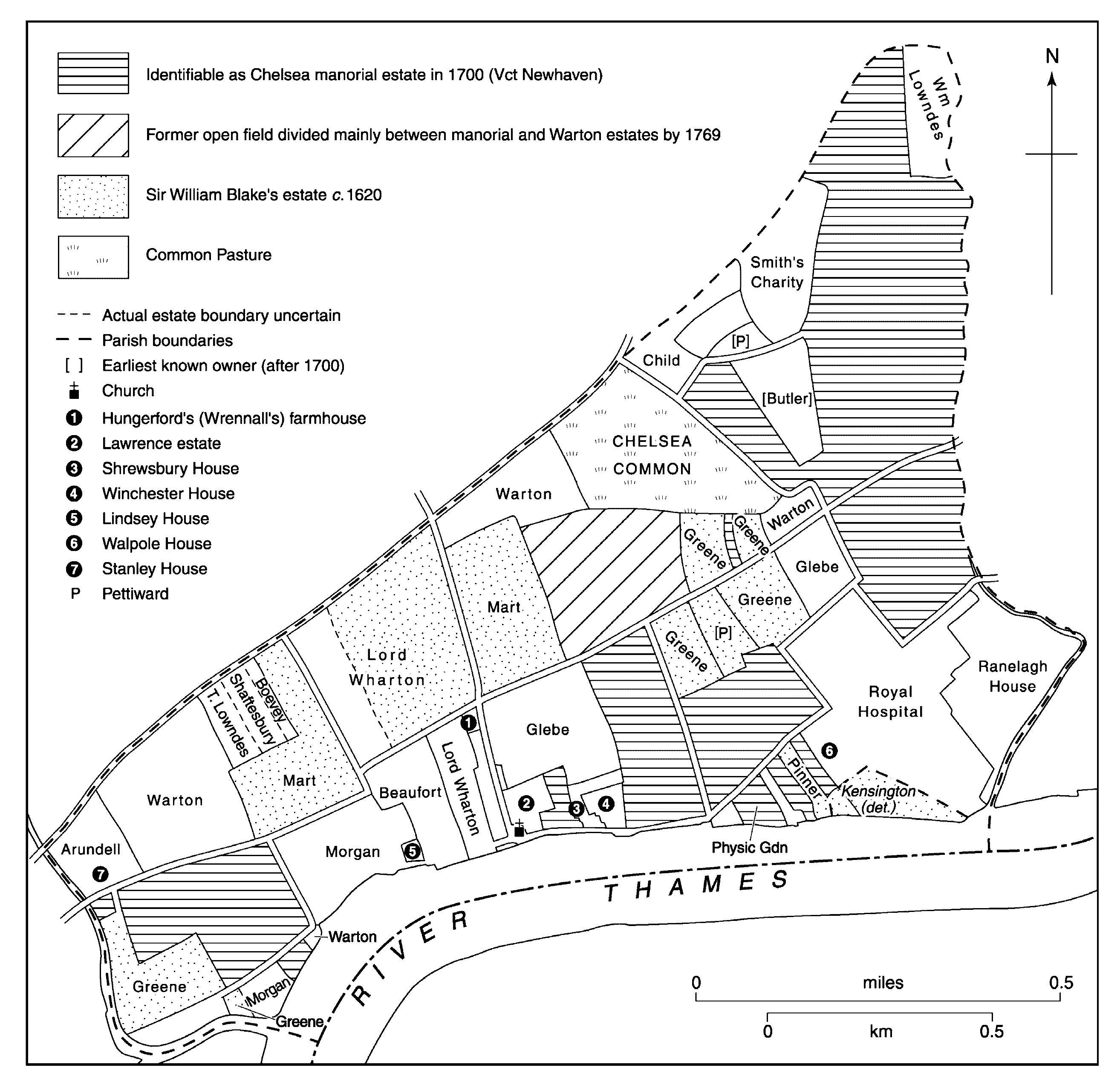
Chelsea's principal estates in 1700
The accounts of the estates are divided into the principal estates: the manorial estate, More's, and Hungerford's; the medieval and small freeholdings; and later estates presented in alphabetical order.