Journal of the House of Commons: Volume 10, 1688-1693. Originally published by His Majesty's Stationery Office, London, 1802.
This free content was digitised by double rekeying. Public Domain.
'House of Commons Journal Volume 10: 5 May 1690', in Journal of the House of Commons: Volume 10, 1688-1693(London, 1802), British History Online https://www.british-history.ac.uk/commons-jrnl/vol10/pp400-405 [accessed 9 May 2025].
'House of Commons Journal Volume 10: 5 May 1690', in Journal of the House of Commons: Volume 10, 1688-1693(London, 1802), British History Online, accessed May 9, 2025, https://www.british-history.ac.uk/commons-jrnl/vol10/pp400-405.
"House of Commons Journal Volume 10: 5 May 1690". Journal of the House of Commons: Volume 10, 1688-1693. (London, 1802), British History Online. Web. 9 May 2025. https://www.british-history.ac.uk/commons-jrnl/vol10/pp400-405.


In this section
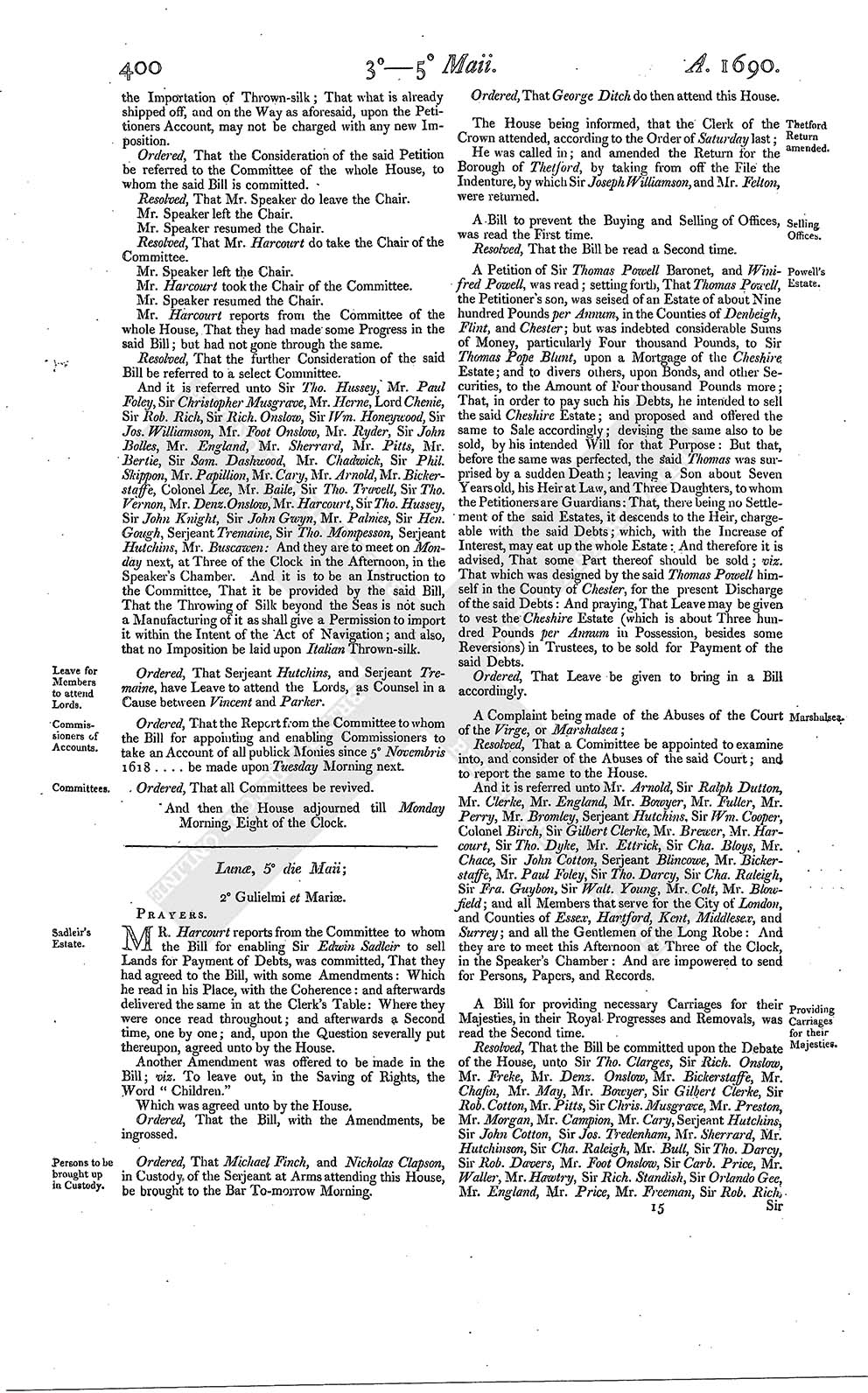
Lun æ, 5 die Maii; 2° Gulielmi et Mariæ.
Prayers.
Sadleir's Estate.
MR. Harcourt reports from the Committee to whom the Bill for enabling Sir Edwin Sadleir to sell Lands for Payment of Debts, was committed, That they had agreed to the Bill, with some Amendments: Which he read in his Place, with the Coherence: and afterwards delivered the same in at the Clerk's Table: Where they were once read throughout; and afterwards a Second time, one by one; and, upon the Question severally put thereupon, agreed unto by the House.
Another Amendment was offered to be made in the Bill; viz. To leave out, in the Saving of Rights, the Word "Children."
Which was agreed unto by the House.
Ordered, That the Bill, with the Amendments, be ingrossed.
Persons to be brought up in Custody.
Ordered, That Michael Finch, and Nicholas Clapson, in Custody of the Serjeant at Arms attending this House, be brought to the Bar To-morrow Morning.
Ordered, That George Ditch do then attend this House.
Thetford Return amended.
The House being informed, that the Clerk of the Crown attended, according to the Order of Saturday last;
He was called in; and amended the Return for the Borough of Thetford, by taking from off the File the Indenture, by which Sir Joseph Williamson, and Mr. Felton, were returned.
Selling Offices.
A Bill to prevent the Buying and Selling of Offices, was read the First time.
Resolved, That the Bill be read a Second time.
Powell's Estate.
A Petition of Sir Thomas Powell Baronet, and Winifred Powell, was read; setting forth, That Thomas Powell, the Petitioner's son, was seised of an Estate of about Nine hundred Pounds per Annum, in the Counties of Denbeigh, Flint, and Chester; but was indebted considerable Sums of Money, particularly Four thousand Pounds, to Sir Thomas Pope Blunt, upon a Mortgage of the Cheshire Estate; and to divers others, upon Bonds, and other Securities, to the Amount of Four thousand Pounds more; That, in order to pay such his Debts, he intended to sell the said Cheshire Estate; and proposed and offered the same to Sale accordingly; devising the same also to be sold, by his intended Will for that Purpose: But that, before the same was perfected, the said Thomas was surprised by a sudden Death; leaving a Son about Seven Years old, his Heir at Law, and Three Daughters, to whom the Petitioners are Guardians: That, there being no Settlement of the said Estates, it descends to the Heir, chargeable with the said Debts; which, with the Increase of Interest, may eat up the whole Estate: And therefore it is advised, That some Part thereof should be sold; viz. That which was designed by the said Thomas Powell himself in the County of Chester, for the present Discharge of the said Debts: And praying, That Leave may be given to vest the Cheshire Estate (which is about Three hundred Pounds per Annum in Possession, besides some Reversions) in Trustees, to be sold for Payment of the said Debts.
Ordered, That Leave be given to bring in a Bill accordingly.
Marshalsea.
A Complaint being made of the Abuses of the Court of the Virge, or Marshalsea;
Resolved, That a Committee be appointed to examine into, and consider of the Abuses of the said Court; and to report the same to the House.
And it is referred unto Mr. Arnold, Sir Ralph Dutton, Mr. Clerke, Mr. England, Mr. Bowyer, Mr. Fuller, Mr. Perry, Mr. Bromley, Serjeant Hutchins, Sir Wm. Cooper, Colonel Birch, Sir Gilbert Clerke, Mr. Brewer, Mr. Harcourt, Sir Tho. Dyke, Mr. Ettrick, Sir Cha. Bloys, Mr. Chace, Sir John Cotton, Serjeant Blincowe, Mr. Bickerstaffe, Mr. Paul Foley, Sir Tho. Darcy, Sir Cha. Raleigh, Sir Fra. Guybon, Sir Walt. Young, Mr. Colt, Mr. Blowfield; and all Members that serve for the City of London, and Counties of Essex, Hartford, Kent, Middlesex, and Surrey; and all the Gentlemen of the Long Robe: And they are to meet this Afternoon at Three of the Clock, in the Speaker's Chamber: And are impowered to send for Persons, Papers, and Records.
Providing Carriages for their Majesties.
A Bill for providing necessary Carriages for their Majesties, in their Royal Progresses and Removals, was read the Second time.
Resolved, That the Bill be committed upon the Debate of the House, unto Sir Tho. Clarges, Sir Rich. Onslow, Mr. Freke, Mr. Denz. Onslow, Mr. Bickerstaffe, Mr. Chafin, Mr. May, Mr. Bowyer, Sir Gilbert Clerke, Sir Rob. Cotton, Mr. Pitts, Sir Chris. Musgrave, Mr. Preston, Mr. Morgan, Mr. Campion, Mr. Cary, Serjeant Hutchins, Sir John Cotton, Sir Jos. Tredenham, Mr. Sherrard, Mr. Hutchinson, Sir Cha. Raleigh, Mr. Bull, Sir Tho. Darcy, Sir Rob. Davers, Mr. Foot Onslow, Sir Carb. Price, Mr. Waller, Mr. Hawtry, Sir Rich. Standish, Sir Orlando Gee, Mr. England, Mr. Price, Mr. Freeman, Sir Rob. Rich, Sir John Key, Mr. Wilmot, Sir Edm. Jennings, Mr. Perry, Mr. Bromley, Mr. Gwyn, Sir Vere Fane, Mr. Frankland, Sir Jervas Elwes, Sir John Parson, Mr. Ryder, Sir Fra. Vincent, Mr. Bockland, Sir Edw. Hussey, Sir Wm. Forester, Mr. Howard, Sir Tho. Mompesson, Mr. Bridges, Mr. Cooke, Sir John Thompson, Colonel Birch, Sir Rob. Clayton, Mr. Felton, Sir Tho. Dyke, Mr. Kenyon, Sir Tho. Hussey, Mr. Colt, Mr. Arnold, Mr. Wharton, Mr. Parsons, Mr. Preston, Mr. Randyll, Sir Hen. Goff, Mr. Turges, Mr. Parker, Mr. Forster, Mr. Greenfeild, Sir Sam. Bernadiston, Mr. Burdet: And they are to meet this Afternoon at Three of the Clock, in the Speaker's Chamber: And it is to be an Instruction to the said Committee, That they do take care to prevent the Abuses in Pressing of Horses and Carts for Carriages for the Army.
Hudson's Bay Company.
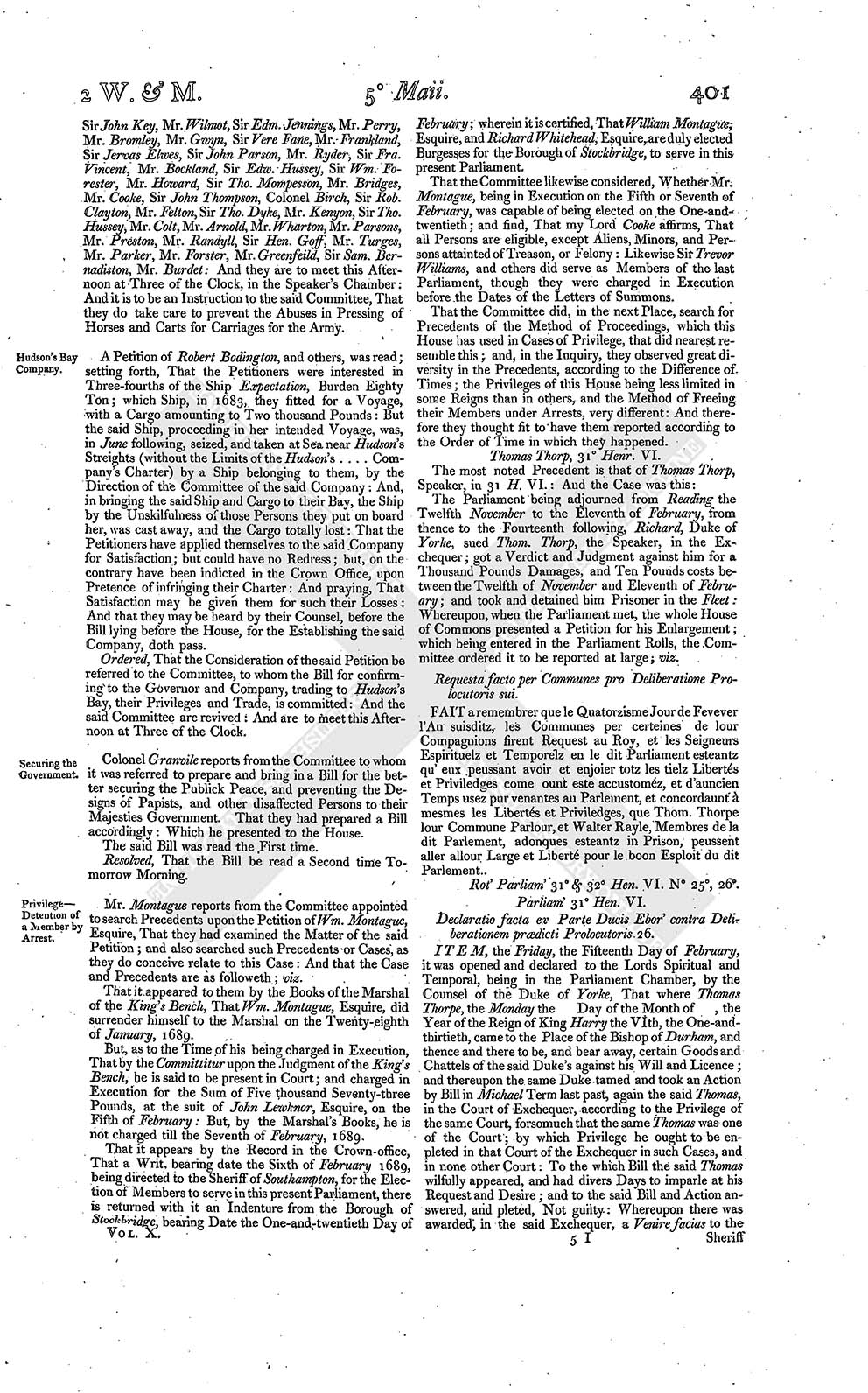
A Petition of Robert Bodington, and others, was read; setting forth, That the Petitioners were interested in Three-fourths of the Ship Expectation, Burden Eighty Ton; which Ship, in 1683, they fitted for a Voyage, with a Cargo amounting to Two thousand Pounds: But the said Ship, proceeding in her intended Voyage, was, in June following, seized, and taken at Sea near Hudson's Streights (without the Limits of the Hudson's . . . . Company's Charter) by a Ship belonging to them, by the Direction of the Committee of the said Company: And, in bringing the said Ship and Cargo to their Bay, the Ship by the Unskilfulness of those Persons they put on board her, was cast away, and the Cargo totally lost: That the Petitioners have applied themselves to the said Company for Satisfaction; but could have no Redress; but, on the contrary have been indicted in the Crown Office, upon Pretence of infringing their Charter: And praying, That Satisfaction may be given them for such their Losses: And that they may be heard by their Counsel, before the Bill lying before the House, for the Establishing the said Company, doth pass.
Ordered, That the Consideration of the said Petition be referred to the Committee, to whom the Bill for confirming to the Governor and Company, trading to Hudson's Bay, their Privileges and Trade, is committed: And the said Committee are revived: And are to meet this Afternoon at Three of the Clock.
Securing the Government.
Colonel Granvile reports from the Committee to whom it was referred to prepare and bring in a Bill for the better securing the Publick Peace, and preventing the Designs of Papists, and other disaffected Persons to their Majesties Government. That they had prepared a Bill accordingly: Which he presented to the House.
The said Bill was read the First time.
Resolved, That the Bill be read a Second time Tomorrow Morning.
Privilege - Detention of a Member by Arrest.
Mr. Montague reports from the Committee appointed to search Precedents upon the Petition of Wm. Montague, Esquire, That they had examined the Matter of the said Petition; and also searched such Precedents or Cases, as they do conceive relate to this Case: And that the Case and Precedents are as followeth; viz.
That it appeared to them by the Books of the Marshal of the King's Bench, That Wm. Montague, Esquire, did surrender himself to the Marshal on the Twenty-eighth of January, 1689.
But, as to the Time of his being charged in Execution, That by the Committitur upon the Judgment of the King's Bench, he is said to be present in Court; and charged in Execution for the Sum of Five thousand Seventy-three Pounds, at the suit of John Lewknor, Esquire, on the Fifth of February: But, by the Marshal's Books, he is not charged till the Seventh of February, 1689.
That it appears by the Record in the Crown-office, That a Writ, bearing date the Sixth of February 1689, being directed to the Sheriff of Southampton, for the Election of Members to serve in this present Parliament, there is returned with it an Indenture from the Borough of Stockbridge, bearing Date the One-and-twentieth Day of February; wherein it is certified, That William Montague, Esquire, and Richard Whitehead, Esquire, are duly elected Burgesses for the Borough of Stockbridge, to serve in this present Parliament.
That the Committee likewise considered, Whether Mr. Montague, being in Execution on the Fifth or Seventh of February, was capable of being elected on the One-andtwentieth; and find, That my Lord Cooke affirms, That all Persons are eligible, except Aliens, Minors, and Persons attainted of Treason, or Felony: Likewise Sir Trevor Williams, and others did serve as Members of the last Parliament, though they were charged in Execution before the Dates of the Letters of Summons.
That the Committee did, in the next Place, search for Precedents of the Method of Proceedings, which this House has used in Cases of Privilege, that did nearest resemble this; and, in the Inquiry, they observed great diversity in the Precedents, according to the Difference of Times; the Privileges of this House being less limited in some Reigns than in others, and the Method of Freeing their Members under Arrests, very different: And therefore they thought fit to have them reported according to the Order of Time in which they happened.
Thorp, 31° Henr. VI.
The most noted Precedent is that of Thomas Thorp, Speaker, in 31 H. VI.: And the Case was this:
The Parliament being adjourned from Reading the Twelfth November to the Eleventh of February, from thence to the Fourteenth following, Richard, Duke of Yorke, sued Thom. Thorp, the Speaker, in the Exchequer; got a Verdict and Judgment against him for a Thousand Pounds Damages, and Ten Pounds costs between the Twelfth of November and Eleventh of February; and took and detained him Prisoner in the Fleet: Whereupon, when the Parliament met, the whole House of Commons presented a Petition for his Enlargement; which being entered in the Parliament Rolls, the Committee ordered it to be reported at large; viz.
Requesta facto per Communes pro Deliberatione Prolocutoris sui.
FAIT a remembrer que le Quatorzisme Jour de Fevever l'An suisditz, les Communes per certeines de lour Compagnions firent Request au Roy, et les Seigneurs Espirituelz et Temporelz en le dit Parliament esteantz qu' eux peussant avoir et enjoier totz les tielz Libert és et Priviledges come ount este accustom éz, et d'auncien Temps usez pur venantes au Parlement, et concordaunt À mesmes les Libert és et Priviledges, que Thom. Thorpe lour Commune Parlour, et Walter Rayle, Membres de la dit Parlement, adonques esteantz in Prison, peussent aller allour Large et Libert é pour le boon Esploit du dit Parlement.
Rot' Parliam' 31° & 32° Hen. VI. N° 25°, 26°. Parliam' 31° Hen. VI.
Declaratio facta ex Parte Ducis Ebor' contra Deliberationem pr ædicti Prolocutoris. 26.
ITEM, the Friday, the Fifteenth Day of February, it was opened and declared to the Lords Spiritual and Temporal, being in the Parliament Chamber, by the Counsel of the Duke of Yorke, That where Thomas Thorpe, the Monday the Day of the Month of, the Year of the Reign of King Harry the VIth, the One-andthirtieth, came to the Place of the Bishop of Durham, and thence and there to be, and bear away, certain Goods and Chattels of the said Duke's against his Will and Licence; and thereupon the same Duke tamed and took an Action by Bill in Michael Term last past, again the said Thomas, in the Court of Exchequer, according to the Privilege of the same Court, forsomuch that the same Thomas was one of the Court; by which Privilege he ought to be enpleted in that Court of the Exchequer in such Cases, and in none other Court: To the which Bill the said Thomas wilfully appeared, and had divers Days to imparle at his Request and Desire; and to the said Bill and Action answered, and pleted, Not guilty: Whereupon there was awarded, in the said Exchequer, a Venire facias to the Sheriff of Middlesex, returnable in the said Exchequer: And there, by the Jure that passed between the said Duke and the said Thomas, it was found, that the same Thomas was guilty of the Trespass contained in the said Bill: And the same Jurors assessed the Damages to the said Duke for the said Trespass to a Thousand Pounds, and for his Costs Ten Pounds: And thereupon Judgment was given in the said Exchequer; and the said Thomas, according to the Course of Law, was committed to the Fleet, for the Fine belonging to the King in that Behalf: and thereupon it was prayed humbly, on behalf of the said Duke, That it should like their good Lordships, considering that the said Trespass was done and committed by the said Thomas since the Beginning of this present Parliament; and also the said Bill and Action were take and tamed, and, by Process of Law, Judgment thereupon given against the said Thomas, in Time of Vacation of the same Parliament, and not in Parliament time; and also, That if the said Thomas, should be released by Privilege of Parliament, or the Time that the said Duke be satisfied of the said Damages and Costs, the same Duke should be without Remedy in that behalf; that the said Thomas, according to the Law, be kept in Ward to the Time that he hath fully content and satisfied the said Duke of his said Damages and Costs: The Lords Spiritual and Temporal, not intending to impeach or hurt the Liberties and Privileges of them that were Commons for the said Commonalties of this Land to this present Parliament, but legally, after the Course of Law, to minister Justice, and to have Knowledge what the Law will weigh in that Behalf, opened and declared to the Justices the Premises; and axed of them, Whether the said Thomas ought to be delivered from Prison, by Force and Virtue of the Privilege of Parliament, or not: To the which Question, the Chief Justice, in the Name of all the Justices, after said Communication, and mature Deliberation had among them, answered, and said, That they ought not to answer to that Question; for it hath not yet been used aforetime, that the Justices should in anywise determine the Privilege of this High Court of Parliament; for it is so high and so mighty in this Nature, that it may make Law, and That that is Law, it may make no Law; and the Determination and Knowledge of that Privilege belongeth to the Lords of the Parliament, and not to the Justices: But as for Declaration of Proceeding in the Lower Courts in such Cases, as Writs of Supersedeas of Privileges of Parliament, be brought and delivered, the said Chief Justice said, There be many and divers Supersedeas of Privilege of Parliament brought into the Courts; but there is no general Supersedeas brought to surcease all Processes; for, if there should be, it should seem, that this High Court of Parliament, that ministereth all Justice and Equity, should lett the Process of the Common Law; and so it should put the Parties complainant without any Remedy, forsomuch as Actions at Common Law be not determined in this High Court of Parliament: and if any Person, that is a Member of this High Court of Parliament, be arrested in such Cases as be not for Treason or Felony, or Surety of the Pleas, or for a Condemnation had before the Parliament, it is used, that all such Persons should be released of such Arrests, and make an Attorney, so that they may have their Freedom and Liberty freely to intend upon the Parliament. After which Answer and Declaration, it was throughly agreed, assented, and concluded by the Lords Spiritual and Temporal, That the said Thomas, according to the Law, should remain still in Prison for the Causes abovesaid, the Privilege of the Parliament, or that the same Thomas was Speaker of the Parliament, notwithstanding: And that the Premises should be opened and declared to them that were comen for the Commons of this Land: And that they should be charged and commanded, in the King's Name, That they, with all goodly Haste and Speed, proceed to the Election of another Speaker. The which Premises, forasmuch as they were Matters in Law by the Commandment of the Lords, were opened and declared to the Commons, by the Mouth of Walter Moyle, one of the King's Serjeants at Law, in the Presence of the Bishop of Ely, accompanied with other Lords, in notable Number: And there it was charged and commanded to the said Commons, by the said Bishop of Ely, in the King's Name, That they should proceed to the Election of another Speaker with all goodly Haste and Speed; so that the Matters for which the King called this his Parliament might be proceeded in, and this Parliament take good and effectual Conclusion and End.
That the King himself was not present during this Session; but the Duke of York did all Things in this Parliament by a Special Commission from the King, as followeth; viz.
Ex Rotul' Parl', 31 Hen. VI. R's, N° 24, de procedendo in Parliamento.
MEmorand', Pro eo quod Dominus Rex qui presens Parliamentum suum nuper apud Redyng inchoavit & tenuit, & usque quartum decimum Diem Februarii Anno dicti Domini Regis tricesimo secundo apud Palatium suum Westm' adjornari ordinavit, propter certas justas & rationabiles Causas in eodem Parliamento, in Persona sua, interesse non potuit: Idem Dominus Rex de Avisamento & Assensu Concilii sui quasdam Literas Patentes sub Magno Sigillo suo signitas coram Dominis Spiritualibus & Temporalibus in presenti Parliamento dicto quarto decimo die Februarii existen' legi fecit in hæc Verba: Henricus Dei Gratia, Rex Angli æ & Franci æ, et Dominus Hiberni æ, Omnibus ad quos presentes Liter æ pervenerint, Salutem. Sciatis, quod cum, pro quibusdam arduis & urgentibus Negotiis nos Statum & Defensionem Regni nostri Angli æ & Ecclesi æ Anglican æ contingentibus, quoddam Parliamentum nostrum nuper apud Redyng teneri, & usque quartum decimum diem hujus instantis mensis Februarii ad Palatium nostrum Westm'r adjornari ordinavimus: Quia vero dicto Parliamento nostro, propter certas justas & rationabiles Causas, in Persona nostra non poterimus interesse: Nos de Circumspectione & Industria carissimi Consanguinei nostri Ricardi Ducis Ebor' plenam Fiduciam reportant', eidem Consanguineo nostro ad Parliamentum pr ædictum Nomine nostro tenend', & in eodem procedend', & ad faciend' omnia & singula qu æ pro nobis, & per nos, pro bono Regimine et Gubernatione Regni nostri pr ædicti, ac aliorum Dominorum nostrorum eidem Regno nostro pertinen' ibidem fuerint faciend', necnon ad Parliamentum illud faciend' & dissolvend' de Assensu Concilii nostri plenam Tenore presentium committimus Potestatem, dantes ulterius de Assensu ejusdem Concilii nostri tam universis & singulis Archiepiscopis, Episcopis, Abbatibus, Prioribus, Ducibus, Comitibus, Baronibus, & Militibus, cum Omnibus aliis quorum interest. ad Parliamentum, nostrum pr ædictum conventur', scilicit Tenore Pr æsentium, firmiter in Mandatis, quod idem Consanguineo nostro intendant in Premissis in Forma pr ædicta. In cujus Rei Testimonium has Literas Nostras fieri fecimus Patentes. Teste meipso, apud Westmon', decimo tertio die Februarii, Anno Regni tricesimo secundo.
Per ipsum Regem & Concilium.
Convenit cum Recordo.
Wi. Petyt.
That the Committee had likewise before them a private Act of Parliament, 1° Hen. VII.; wherein is set forth,
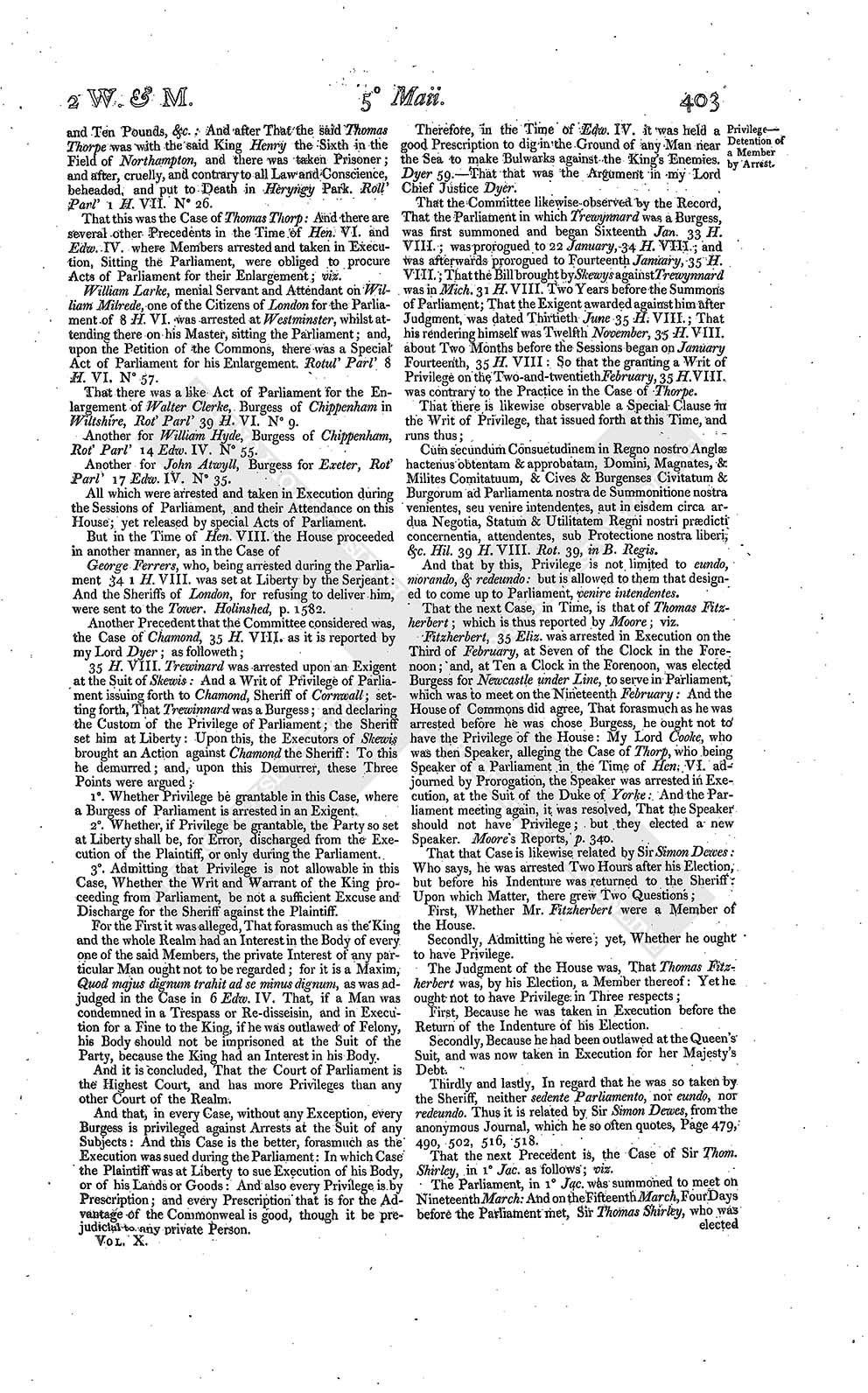
That where Richard, some time Duke of Yorke, by the Excitation, Stirring, and Moving of one Thomas Colt, Esquire, being nigh of Council with the said late Duke, grievously maligned against Thomas Thorp, for the true and faithful Service that he had done and owed to the said late King Henry the Sixth: And thereupon the said late Duke affirmed a Bill of Trespass against the said Thomas Thorpe, in the Court of the King's Exchequer, supposing by the same Bill, That the said Thomas Thorp should have taken from the said Duke divers Goods and Chattels, to the Value of Two thousand Pounds; where, in Truth, the said Thomas Thorp never took no such Goods of the said Duke's: by only the Commandment of the King, the said Thomas Thorp arrested certain Harness and Habiliments of War of the said Duke: To which Action, the said Thomas Thorp, by the special Labour and untrue Means of the said Thomas Colt, was condemned to the said Duke in One thousand and Ten Pounds, &c.: And after That the said Thomas Thorpe was with the said King Henry the Sixth in the Field of Northampton, and there was taken Prisoner; and after, cruelly, and contrary to all Law and Conscience, beheaded, and put to Death in Heryngy Park. Roll' Parl' 1 H. VII. N° 26.
That this was the Case of Thomas Thorp: And there are several other Precedents in the Time of Hen. VI. and Edw. IV. where Members arrested and taken in Execution, Sitting the Parliament, were obliged to procure Acts of Parliament for their Enlargement; viz.
William Larke, menial Servant and Attendant on William Milrede, one of the Citizens of London for the Parliament of 8 H. VI. was arrested at Westminster, whilst attending there on his Master, sitting the Parliament; and, upon the Petition of the Commons, there was a Special Act of Parliament for his Enlargement. Rotul' Parl' 8 H. VI. N° 57.
That there was a like Act of Parliament for the Enlargement of Walter Clerke, Burgess of Chippenham in Wiltshire, Rot' Parl' 39 H. VI. N° 9.
Another for William Hyde, Burgess of Chippenham, Rot' Parl' 14 Edw. IV. N° 55.
Another for John Atwyll, Burgess for Exeter, Rot' Parl' 17 Edw. IV. N° 35.
All which were arrested and taken in Execution during the Sessions of Parliament, and their Attendance on this House; yet released by special Acts of Parliament.
But in the Time of Hen. VIII. the House proceeded in another manner, as in the Case of
George Ferrers, who, being arrested during the Parliament 34 1 H. VIII. was set at Liberty by the Serjeant: And the Sheriffs of London, for refusing to deliver him, were sent to the Tower. Holinshed, p. 1582.
Another Precedent that the Committee considered was, the Case of Chamond, 35 H. VIII. as it is reported by my Lord Dyer; as followeth;
35 H. VIII. Trewinard was arrested upon an Exigent at the Suit of Skewis: And a Writ of Privilege of Parliament issuing forth to Chamond, Sheriff of Cornwall; setting forth, That Trewinnard was a Burgess; and declaring the Custom of the Privilege of Parliament; the Sheriff set him at Liberty: Upon this, the Executors of Skewis brought an Action against Chamond the Sheriff: To this he demurred; and, upon this Demurrer, these Three Points were argued;
1°. Whether Privilege be grantable in this Case, where a Burgess of Parliament is arrested in an Exigent.
2° Whether, if Privilege be grantable, the Party so set at Liberty shall be, for Error, discharged from the Execution of the Plaintiff, or only during the Parliament.
3°. Admitting that Privilege is not allowable in this Case, Whether the Writ and Warrant of the King proceeding from Parliament, be not a sufficient Excuse and Discharge for the Sheriff against the Plaintiff.
For the First it was alleged, That forasmuch as the King and the whole Realm had an Interest in the Body of every one of the said Members, the private Interest of any particular Man ought not to be regarded; for it is a Maxim, Quod majus dignum trahit ad se minus dignum, as was adjudged in the Case in 6 Edw. IV. That, if a Man was condemned in a Trespass or Re-disseisin, and in Execution for a Fine to the King, if he was outlawed of Felony, his Body should not be imprisoned at the Suit of the Party, because the King had an Interest in his Body.
And it is concluded, That the Court of Parliament is the Highest Court, and has more Privileges than any other Court of the Realm.
And that, in every Case, without any Exception, every Burgess is privileged against Arrests at the Suit of any Subjects: And this Case is the better, forasmuch as the Execution was sued during the Parliament: In which Case the Plaintiff was at Liberty to sue Execution of his Body, or of his Lands or Goods: And also every Privilege is by Prescription; and every Prescription that is for the Advantage of the Commonweal is good, though it be prejudicial to any private Person.
Therefore, in the Time of Edw. IV. it was held a good Prescription to dig in the Ground of any Man near the Sea to make Bulwarks against the King's Enemies. Dyer 59.-That that was the Argument in my Lord Chief Justice Dyer.
That the Committee likewise observed by the Record, That the Parliament in which Trewynnard was a Burgess, was first summoned and began Sixteenth Jan. 33 H. VIII.; was prorogued to 22 January, 34 H. VIII.; and was afterwards prorogued to Fourteenth January, 35 H. VIII.; That the Bill brought by Skewys against Trewynnard was in Mich. 31 H. VIII. Two Years before the Summons of Parliament; That the Exigent awarded against him after Judgment, was dated Thirtieth June 35 H. VIII.; That his rendering himself was Twelfth November, 35 H. VIII. about Two Months before the Sessions began on January Fourteenth, 35 H. VIII: So that the granting a Writ of Privilege on the Two-and-twentieth February, 35 H. VIII. was contrary to the Practice in the Case of Thorpe.
That there is likewise observable a Special Clause in the Writ of Privilege, that issued forth at this Time, and runs thus;
Cum secundum Consuetudinem in Regno nostro Anglæ hactenus obtentam & approbatam, Domini, Magnates, & Milites Comitatuum, & Cives & Burgenses Civitatum & Burgorum ad Parliamenta nostra de Summonitione nostra venientes, seu venire intendentes, aut in eisdem circa ardua Negotia, Statum & Utilitatem Regni nostri prædicti concernentia, attendentes, sub Protectione nostra liberi, &c. Hil. 39 H. VIII. Rot. 39, in B. Regis.
And that by this, Privilege is not limited to eundo, morando, & redeundo: but is allowed to them that designed to come up to Parliament, venire intendentes.
That the next Case, in Time, is that of Thomas Fitzherbert; which is thus reported by Moore; viz.
Fitzherbert, 35 Eliz. was arrested in Execution on the Third of February, at Seven of the Clock in the Forenoon; and, at Ten a Clock in the Forenoon, was elected Burgess for Newcastle under Line, to serve in Parliament, which was to meet on the Nineteenth February: And the House of Commons did agree, That forasmuch as he was arrested before he was chose Burgess, he ought not to have the Privilege of the House: My Lord Cooke, who was then Speaker, alleging the Case of Thorp, who being Speaker of a Parliament in the Time of Hen. VI. adjourned by Prorogation, the Speaker was arrested in Execution, at the Suit of the Duke of Yorke: And the Parliament meeting again, it was resolved, That the Speaker should not have Privilege; but they elected a new Speaker. Moore's Reports, p. 340.
That that Case is likewise related by Sir Simon Dewes: Who says, he was arrested Two Hours after his Election, but before his Indenture was returned to the Sheriff: Upon which Matter, there grew Two Questions;
First, Whether Mr. Fitzherbert were a Member of the House.
Secondly, Admitting he were; yet, Whether he ought to have Privilege.
The Judgment of the House was, That Thomas Fitzherbert was, by his Election, a Member thereof: Yet he ought not to have Privilege in Three respects;
First, Because he was taken in Execution before the Return of the Indenture of his Election.
Secondly, Because he had been outlawed at the Queen's Suit, and was now taken in Execution for her Majesty's Debt.
Thirdly and lastly, In regard that he was so taken by the Sheriff, neither sedente Parliamento, nor eundo, nor redeundo. Thus it is related by Sir Simon Dewes, from the anonymous Journal, which he so often quotes, Page 479, 490, 502, 516, 518.
That the next Precedent is, the Case of Sir Thom. Shirley, in 1° Jac. as follows; viz.
The Parliament, in 1° Jac. was summoned to meet on Nineteenth March: And on the Fifteenth March, Four Days before the Parliament met, Sir Thomas Shirley, who was elected Burgess for Steyning in Sussex, was arrested, and committed to the Fleet. Page 39.
Upon a Motion made on his Behalf, the House ordered a Warrant should be directed, under the Hand of Mr. Speaker, to the Clerk of the Crown, for a Writ of Habeas corpus, to bring the Body of Sir Thomas into the House, upon Tuesday following Twenty-second March 1603. Page 39.
It appeared, upon Examination of the Fact, That the Execution was taken forth the Thirtieth January 1603, a Day before the Teste of the Writ; and was delivered to the Serjeant the Eleventh of February, before Sir Thomas was elected.
The Heads of the Debate, upon this Occasion, appear upon the Journal; and concluded with appointing a Committee to consider of all the Questions and Doubts in this Case. - Twenty-seventh March 1604. Page 58.
Upon Report of the Committee, the House ordered, That Sympson, at whose Suit Sir Thomas was committed, and the Serjeant that arrested him, should be committed to the Tower: And that they would hear Counsel, on all Parties, upon these Points:
1. Whether Privilege were to be allowed, since the Execution was taken forth before the Parliament sat.
2. Whether the Action was discharged.
3. Where the Loss should lie.-Ninth April 1604. Page 108.
The Argument of the Counsel, and the Precedents they used, appear in the Journal, Page 128. viz. That of Hide, 14 Edw. IV.; of Larke, 8 H. VI.; and of Clerke, 29 H. VI.
Upon the Reading these Precedents, Three Questions were put;
1. Whether Sir Tho. Shirley should have Privilege.
2. Whether presently, or deferred till further Order.
3. Whether we shall be Petitioners to his Majesty according to former Precedents, for some Course of securing the Debt of the Party, and saving harmless the Warden of the Fleet.
Which were all resolved in the Affirmative. Page 131.
A Bill for securing Sympson's Debt was twice read; and committed.-Page 134, Seventeenth April 1604.
The same Bill read a Third time; and passed. Page 144. Sent up to the Lords, Page 148.-One-and-twentieth April 1604.
A Bill for the Relief of Plaintiffs, where the Defendants in Execution are set at Liberty, altered in the Style; and ordered to be ingrossed Twenty-seventh April 1604.
On the Second of May, a Motion was made, to appoint a Committee to consider of all such Precedents as shall be offered in the Particulars of Sir Tho. Shirlye's Case of Privilege: And there are the Copies of several Records in your Journal.
Resolved, That Sir Thomas Shirley be presently delivered.
Ordered, upon the Question, That a Writ of Habeas corpus shall presently be awarded for the Bringing of his Body, being Prisoner in the Fleet, into the House, Tomorrow at Eight of the Clock in the Morning; and a Warrant, containing the Effect of the Order, under the Hand of Mr. Speaker, directed to the Clerk of the Crown accordingly.
1. Upon the Fourth of May, a Petition was tendered, and read in the House, to be exhibited to his Majesty for the Royal Assent to Sir Thomas Shirlye's Bill, presently to be had: Upon the Reading, it was not approved, nor thought fit by the House to proceed in that Manner, being, as was conceived, some Impeachment to the Privilege of the House. The Petition itself is entered in the Journal; and is according to the Form of those Acts that passed in the Time of Edw. the Fourth: But the House resolved, That a Habeas corpus be awarded, as before.
But the Warden of the Fleet denied to execute the Writ of Habeas corpus, before the King's Royal Assent was procured to the Bill, for the Security of Sympson and himself; and was committed to the Serjeant Seventh May 1604.
The same Day, an Act for new Executions, to be sued after the Parliament, when the Defendants, &c. was read a Third time, and passed. 209.
The Warden of the Fleet continuing obstinate, and refusing to deliver Sir Thomas, unless he would give Security; it was ordered to commit the Warden of the Fleet to the Tower, close Prisoner.
2. To send the Serjeant To-morrow, sitting the Court, to require the Delivery of Sir Thomas Shirley, Eight May 1604. Page 213.
The Serjeant returneth from the Fleet, says, The Warden's Wife refuseth to deliver him.
Mr. Secretary Herbert reports, That his Majesty, upon the Reading of the Precedent of Ferrers, was graciously pleased to leave it to their Liberty, to proceed in the Case of Sir Thomas Shirley, as they thought fit. - Ninth May 1604. Page 2107.
The First Bill for securing the Debt of Simpson being found faulty, after it had passed both Houses, a new Bill was drawn, and passed the House in One Day.
Sir Roger Aston delivered from the King, That, in verbo Principis, he will give his Assent at the End of the Session.-Tenth May 1604. P. 219.
The Warden and his Wife continuing obstinate, the House, at last, committed him to the Prison of Little Ease within the Tower; Eleventh May 1604. Page 222; and upon the Fifteenth, caused Sir Tho. to be delivered: And he was instantly admitted to sit in the House. Page 232.
That there was but Three Cases since the Statute of King James, that the Committee were acquainted with:
The First of Sir Wm. Bampfeild, as followeth; viz.
Sabbati, 9 April', 12 Jac.
Sir John Strangwith moveth, That Sir Wm. Bampfeild, Burgess of Bridport, is committed by my Lord Chancellor since the Time of the Summons of the Parliament, but before his Election; and prays the Direction of the House: Which is referred to the Consideration of the Committees for Privileges.
Jovis, 14 April', 12 Jac.
Mr. Fuller reports Sir Wm. Bampfeild's Case, That he was committed before Election, for a Contempt, for not accepting the Offer of Sir George Wentworth.
Question, Whether Sir Wm. Bampfeild, committed after the Summons, and before the Election, for a Contempt.
Ordered, upon the Question, That he shall have his Privilege by Writ of Habeas corpus.
The Second is that of Sir John Prittyman, as followeth: viz.
The Parliament was prorogued from the Tenth November 1674, to the Thirteenth April 1675.
On the 14 April', 1675.
Information being given to the House, That Sir John Prittyman, a Member of this House, is detained Prisoner in the Prison of the King's Bench;
Ordered, That the Marshal of the King's Bench do bring Sir John Prittyman To-morrow Morning to this House, together with the Cause of his being detained in Prison, from the Attendance of this House.-Fifteenth April 1675.
The Marshal of the King's Bench being called into the House, to give an Account of the Order sent to him, to bring Sir John Prittyman to the House; and having given an Account, Why he had not at present obeyed the Order; the Matter was referred to the Committee of Privileges.
20 April, 1675.
Resolved, That Sir John Prittyman be delivered out of the Custody of the Marshal of the King's Bench, to attend the Service of this House.
Resolved, That Sir John Prittyman be delivered from such Custody, by sending the Serjeant at Arms attending on the House, with the Mace, to bring him to the Service of this House.
The Third is that of Sir Rob. Holt, as followeth; viz.
Upon the Sixteenth of February 1676.
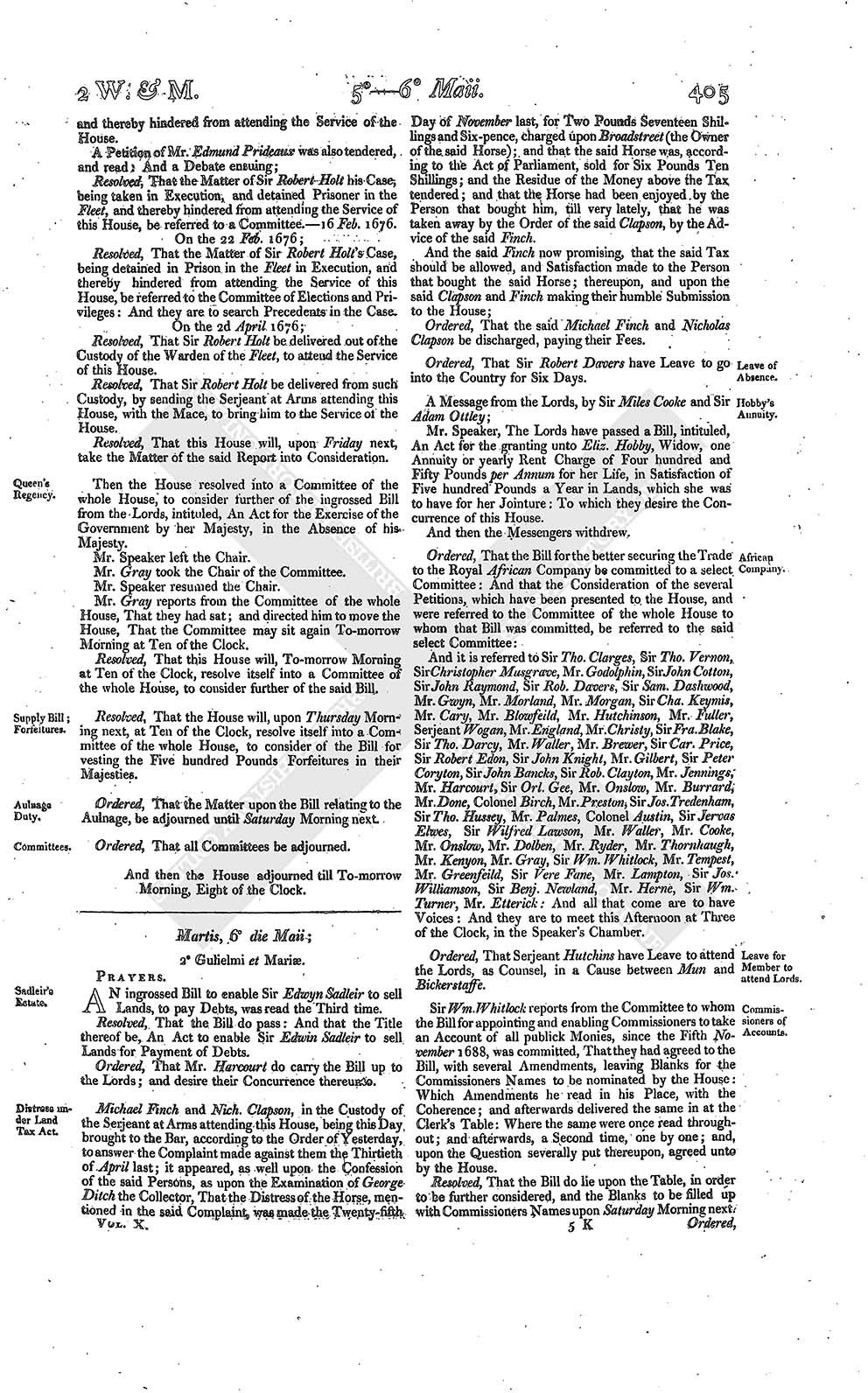
Information was given to the House, from Sir Robert Holt, a Member of the House, That he was detained Prisoner in the Fleet at the Suit of Mr. Edm. Prideaux, and thereby hindered from attending the Service of the House.
A Petition of Mr. Edmund Prideaux was also tendered, and read: And a Debate ensuing;
Resolved, That the Matter of Sir Robert Holt his Case, being taken in Execution, and detained Prisoner in the Fleet, and thereby hindered from attending the Service of this House, be referred to a Committee.-16 Feb. 1676.
On the 22 Feb. 1676;
Resolved, That the Matter of Sir Robert Holt's Case, being detained in Prison in the Fleet in Execution, and thereby hindered from attending the Service of this House, be referred to the Committee of Elections and Privileges: And they are to search Precedents in the Case.
On the 2d April, 1676;
Resolved, That Sir Robert Holt be delivered out of the Custody of the Warden of the Fleet, to attend the Service of this House.
Resolved, That Sir Robert Holt be delivered from such Custody, by sending the Serjeant at Arms attending this House, with the Mace, to bring him to the Service of the House.
Resolved, That this House will, upon Friday next, take the Matter of the said Report into Consideration.
Queen's Regency.
Then the House resolved into a Committee of the whole House, to consider further of the ingrossed Bill from the Lords, intituled, An Act for the Exercise of the Government by her Majesty, in the Absence of his Majesty.
Mr. Speaker left the Chair.
Mr. Gray took the Chair of the Committee.
Mr. Speaker resumed the Chair.
Mr. Gray reports from the Committee of the whole House, That they had sat; and directed him to move the House, That the Committee may sit again To-morrow Morning at Ten of the Clock.
Resolved, That this House will, To-morrow Morning at Ten of the Clock, resolve itself into a Committee of the whole House, to consider further of the said Bill.
Supply Bill; Forfeitures.
Resolved, That the House will, upon Thursday Morning next, at Ten of the Clock, resolve itself into a Committee of the whole House, to consider of the Bill for vesting the Five hundred Pounds Forfeitures in their Majesties.
Aulnage Duty.
Ordered, That the Matter upon the Bill relating to the Aulnage, be adjourned until Saturday Morning next.
Committees.
Ordered, That all Committees be adjourned.
And then the House adjourned till To-morrow Morning, Eight of the Clock.