
Journal of the House of Commons: Volume 10, 1688-1693. Originally published by His Majesty's Stationery Office, London, 1802.
This free content was digitised by double rekeying. All rights reserved.
'House of Commons Journal Volume 10: 23 February 1692', in Journal of the House of Commons: Volume 10, 1688-1693, (London, 1802) pp. 684-693. British History Online https://www.british-history.ac.uk/commons-jrnl/vol10/pp684-693 [accessed 25 April 2024]




In this section
Martis, 23 die Februarii; 4° Gulielmi et Mariæ.
Prayers.
Keeble's Estate.
AN ingrossed Bill from the Lords, intituled, An Act to enable John Keeble, Gentleman, to sell certain Lands in Stow Market in the County of Suffolke; and to settle other Lands of greater Value, to the same Uses; was read the Third time.
Resolved, That the Bill do pass: And the Title . . agreed to.
Ordered, That Mr. Goldwell do carry the Bill to the Lords; and acquaint them, That this House hath agreed to the same, with some Amendments; to which they desire their Lordships Concurrence.
Trade in Cities, &c.
A Bill to prevent the Decay of Trade in Cities, Corporations, and Market Towns, was read the Second time.
Ordered, That the Bill be committed to * * * *.
Fuller's pretended Discoveries.
Mr. Bowyer (according to the Order of the Day) reports, That the Members appointed had repaired to Mr. Fuller; and directed him to report their Proceedings: Which he did do, as followeth: viz.
That they first examined him, as to his Health: And, as to that, they did not only find him sick, but dangerously ill of Vomiting and Looseness, which he had had from Friday, Ten or Eleven of the Clock, and continued in a very violent Manner; and that they were Spectators of it themselves, and that he did bleed both Ways, and had Convulsions.
That then they examined him as to the Affairs of the Government: And that he said, He thought he lay upon his Death-bed, and would not say any thing in his Examination, but for the Discharge of his Conscience, and Service of this Kingdom.
That his Papers he had sent out in a Box to a Friend, that they might be safe, if he miscarried.
That, when they read the Order for Securing of his Papers, he sent for them, and let them examine all his Papers; and all that were material they sealed up, with his Examination.
That, as to the Particulars of his naming his Witnesses, he did it very readily; and they are Persons, that, by the Character that is given of them, are able to do good Service: But Mr. Boyer said, He should not name them, till he have the Commands of the House.
That Mr. Fuller did likewise tell, Where they did reside, and where they were to be found: But that he could not be positive, because he had not seen them since they came into England: And that only Messengers came between him and them; and the Messenger was then asleep; and his Servants would not admit any to him.
That they did discourse the Doctor; and examine Mr. Fuller, Whether there was any foul Play in his Sickness, and whether there was any Poison in the Case: And that the Doctor did give them an Account, That he saw no Symptoms of it: And that Mr. Fuller himself did tell them, That he did not know that he was poisoned; but he had some Suspicion it might be so, because there was certain Persons, that he saw about a Fortnight ago at the End of the Alley where he lies, that he had accused in this House; and, when they saw him, they drove away the Coach; and some other little Particulars, whereby there might be some Suspicion: And that they had secured and brought all his Papers that are material, and Two of his own Hand-writing: His Examination and Information were taken upon Oath: And had sealed up the said Examination, and Information, and Papers; which they had directed him to present to the House: And which he delivered in at the Table.
Ordered, That the same be opened and read.
And the same were opened and read accordingly.
And Mr. Fuller, in his Examination and Information, mentioning Mr. James Hayes, and Colonel Thomas Dallavall, to be Witnesses;
Ordered, That the said Mr. James Hayes and Colonel Tho. Dallavall be sent for immediately to attend the House.
Ordered, That Sir Mathew Andrews, and Mr. Arnold, and Mr. Hutchinson, do go, and take with them the Serjeant's Men to the Place, where Mr. Fuller has directed them the said Persons lodged, and to whom he described them; and bring the said Persons with them.
And accordingly the Members appointed went.
The Members, who went for the Witnesses directed by Mr. Fuller, being returned;
Sir Mathew Andrewes reports to the House, That they had been at the Place, directed by Mr. Fuller; but that, upon Inquiry there, both of the said Persons Names and the Description of their Persons, they could not hear of any such Persons to have lodged either at that Place, or the adjacent Houses; the Persons who owned the said Houses being all ignorant of any such Persons.
Whereupon it was Ordered, That Mr. Fuller do procure Mr. James Hayes, and Colonel Tho. Dellavall, the Two Witnesses he informed this House of, to attend this House To-morrow Morning at Ten a Clock peremptorily.
Ordered, That Mr. Fuller do also procure Mr. Jones, of whom he also informed this House, to attend this House at the same time.
Judges Commissions and Salaries.
A Message from the Lords, by Sir John Francklin and Sir John Hoskyns;
Mr. Speaker, The Lords have agreed to the Bill, intituled, An Act for ascertaining the Commissions and Salaries of the Judges; with some Amendments: To which Amendments they desire the Concurrence of this House.
And then the Messengers withdrew.
And the said Amendments were read; and are as followeth; viz.
Press 4, Line 8, leave out "or any Clause thereof."
Line 13, leave out from "thereby," to "and," in Line 3.
Press 5, Line 14, after "ancient," add "and."
Line 15, leave out "always."
Line 21, after "Courts," add "which Table so allowed, and signed by the respective Judges, shall be by them tendered to the Consideration of the Parliament at the next Session, to be by them approved, or altered, so as to be put into an Act, if they shall think fit."
And the same, being read a Second time, one by one, were, upon the Question severally put thereupon, agreed unto by the House.
Ordered, That Sir Walter Young do carry the Bill to the Lords; and acquaint them that this House hath agreed to the said Amendments.
Irish Forfeitures.
Then Mr. Culleford, according to the Order of the Day, gave his Answer to the Report from the Committee appointed to inquire into the Disposal of forfeited Estates in Ireland: And he delivered the same in at the Table: Where the same was read; and is as followeth; viz.
To the First Part of the said Report, whereby Sir Charles Meredeth, in the said Report mentioned, informed the said Committee, That he the said Sir Charles, and Mr. Vanhomery, were not consulted in the Methods laid down by the Respondent, and the rest of the Commissioners of the Revenue in Ireland, for settling the forfeited Lands there; and that he the said Sir Charles and Mr. Vanhomery, refused to sign the same, after they were drawn fair;
Resp. The Respondent saith, He believes the Lords Justices did send for the Commissioners of the Revenue; and directed them forthwith to consider of proper Methods for settling the forfeited Lands; and to attend them with the same the next Morning, by Eleven a Clock: That the said Sir Charles Meredeth was with them, when they waited on the Lords Justices, and received the said Directions: And, after they had come from the Lords Justices, the said Sir Charles excused himself for that Evening; as did also Mr. May and Mr. Lowther: But at the same time the said Sir Charles, and the said Mr. May, and Mr. Lowther, did advise and agree, that the Respondent and Mr. Ford should call the said Mr. Thompson to them, and go together, and prepare a Scheme or Draught thereof: Which they accordingly did that Night: And the next Morning the Respondent brought the same to the Custom-house: And, Mr. Lowther and Mr. May being there, and also the said Mr. Ford, the said rough Draught was there read, and approved of: And the said Sir Charles Meredith not coming early enough, the same was ordered to be copied over fair: Which was accordingly done, and signed: And the said Sir Charles Meredeth, coming in just before the fair Copy was brought up to them, was in a great Passion, because the same was copied fair before he had seen, and consented to the rough Draught: And the Respondent believes he refused, and did not go with them to the Lords Justices: But, whether Sir Charles signed the same, the Respondent doth not remember; but is induced to believe the said Sir Charles might sign the same, because their Secretary always enters whatever Presentments, Letters, or other Orders, issue from the Board, in a Book; and also the First Letter of the Names, and First Letter of the Surnames, of each Commissioner that signs the same: And the Respondent believes the said Scheme of such Method was so entered, and the Letters of the said Sir Charles Meredeth's Name entered likewise, as one that had signed the same: But doth not remember any such Passage as the said Sir Charles Meredeth's taxing the Secretary therewith, or the raising or blotting the same out afterwards.
And the Respondent saith, That, when they had met to consider of the said Methods, he inquired into the Course . . . had been taken, after the Rebellion in 1641: And that the Forfeitures were then leased, by the then Commissioners, for One Year; and that such a Method would be the easiest, as well as the cheapest, Way; and that, at the Year's End, the Books, wherein such Leases were entered, were returned into the Auditor's Office, to the end Process might issue thereon, if Occasion required.
The Respondent heard, the Exchequer Officers made some Propositions of doing the same at an easy Rate; but, whether as cheap as the Method proposed, remembers not; but well remembers the Reason, Why they thought the other Method easier, was, because the Exchequer was not always open, and many Offices was to be gone through, and every Lease to be entered with the Auditor General, who, of course, every Half-year issues Process for the King's Rents: And they knew it was impossible for the Tenants to pay any till the Year's End; and if this Method were preferred, it would be very uneasy to the Tenants: and therefore they chose the former Methods: Which, when they had signed, and delivered in to the Lords Justices, their Lordships communicated the same to the Privy Council there: Who approved thereof; and ordered them to pursue the same, in the settling the said forfeited Lands: Which they did. And the said Sir Charles Meredeth, being then one of the Privy Council, might there have offered his Objections thereto, if he had so thought fit: And therefore the Respondent knows not what the said Sir Charles Meredeth means by the Expression, "That he looked on this Proceeding as the Rise of our Misfortunes:" For it is well known, that the King's Lands, set by the Commissioners, pursuant to those Methods at That Time, were better set than any private Gentleman did or could lett his Estate in that Kingdom.
The Respondent saith, That the Mills and Wears of Kilmainhair were not forfeited on account of the late Rebellion in that Kingdom: That the Title thereof was controverted betwixt several Protestants; viz. the Dean of Christ Church, Sir Maurice Eustace, and Mr. Flood: And the Chief Governors of Ireland have disposed thereof, for a Term of Years, or otherwise, as they thought fit: And the Quit Rent reserved to the Crown thereout is Twenty three Pounds Ten Shillings yearly: And, in 1685/6, they were, by the then Lord Lieutenant of that Kingdom, granted to the Respondent at the said yearly Quit Rent; which he duly paid, and enjoyed the same till unjustly dispossessed thereof by the Lord Tirconnell: That, just before he was so turned out, he had expended and laid out Fifty-eight Pounds in the necessary Repairs thereof; and no Satisfaction was made him for the same: That soon after his Majesty's glorious Victory at the Boyne, the Respondent (as other Protestants in that Kingdom, in like Cases, did) entered into the Possession thereof, conceiving himself restored thereto by the Intent of the Act made in this Kingdom, for restoring all Protestants who had been unjustly dispossessed of their Possessions: And, as soon as the Commissioners of the Revenue sat in Ireland, this Respondent, to strengthen his former Right, took a Lease from the Commissioners of the Revenue at the yearly Quit Rent aforesaid: But the Respondent saith, the said Mills and Wears never yielded to the Respondent above One hundred and Twenty Pounds in the best of Times: Out of which this Respondent every Year made great Allowances for the Repairs thereof; and the Respondent set them this last Year for One hundred and Three Pounds, and no more: And this Respondent is liable to all Repairs and Accidents: And what That will amount to, the Respondent cannot tell, until he hath had an Account thereof from his Lessee; but saith, that they commonly are very considerable.
The said Respondent saith, That he wonders to find the said Sir Charles Meredeth say, He was surprised in signing the said Lease to this Respondent: Whereas this Respondent saith, the said Sir Charles Meredeth did not sign it; and the said Mr. Vanhomery was not surprised in signing the same: for he knew all the Matters aforesaid relating thereto: And the Reason, Why the said Sir Charles Meredeth did not sign the same, was, as the Respondent believes, because he was not in Ireland, when it was brought thither to be signed: And the Respondent doth not think the said Sir Charles Meredeth was surprised at any time, in the Signing of any Lease; but the Respondent humbly conceived the Excuse made by Sir Charles Meredeth, for not refusing to sign the same, viz. "that the King's Affairs should not be put in Disorder," can be of little Weight; because, at the same time he signed such Leases, he pretends he suspected the same were in Trust for some of the said Commissioners: Which if he imagined to be got by Fraud, or otherwise, to the Prejudice of their Majesties Interest, he ought not only not to have signed the same, not being pressed nor urged thereto by any of the said Commissioners, or any other Person; but also to have made the same known to the Lords Justices: Which the said Sir Charles Meredeth never did, nor pretends to have done the same.
The Respondent further saith, and denieth, that the Lands of Carduffe, Abbots Town, and Deanes Town, or any or either of them, were taken in Trust for this Respondent, by any Person or Persons whatsoever; nor was the Respondent directly or indirectly concerned therein at or before the taking thereof: But, for Manifestation of this Truth to this honourable House, saith, That, according to the said prescribed Methods, the said Lands were duly posted up, and exposed to be set by publick Cant, or Outery: And the same came on before the Commissioners: And many Persons had put in Proposals, and appeared, and canted for the same; and, among them, one Roger Noeland, a Protestant, who had Three several Judgments entered up against Thomas Warren, to whom the said Lands of Cardoffe, Cattleknock, &c. belonged; one of Fourteen hundred Pounds, for Payment of Seven hundred Pounds; the Second for Six hundred Pounds, for Payment of Three hundred Pounds; and the last for Three hundred Pounds, for the Payment of One hundred and Fifty Pounds; as this Respondent remembers: Which were actually extended before the said ThomasWarren was outlawed: And the said Roger Noeland, in Consideration (as this Respondent believes) of his Incumbrance thereon, outbid the other Pretenders; and Deanes Town, and Abbots Town adjoining thereto, took the Whole at Six Shillings and Sixpence per Acre: Which were all included in one Lease; and the whole Rent, for One Year, according to the Rate aforesaid, amounted to Three hundred and Nineteen Pounds Sterling.
And the Respondent doth say, That, at the time of taking and perfecting the said Lease, or at any time before, he was no ways interested or concerned in the taking the said Lands, or any of them: nor gave any Direction for the Taking thereof: And the same were then really and bona fide set to the best Advantage, and for the highest and best Rent could be had or got for the same.
And the Respondent saith, That, some time after the said Lease was so perfected, the Respondent was informed, the said Roger Noland was desirous to have his Money; and he, by Friends, applies to the Respondent, to deal with him for the same: And the Respondent being persuaded to hearken to it, but suspecting the said Judgments were but fraudulent, with Design to cover the said Estate from Forfeiture, and the said Lease was taken in Trust for the said Warren the forfeiting Person, the Respondent went to Counsel: Who advised the Respondent to prefer a Bill in Chancery, to know whether the said Debts, so claimed by the said Noland, were real Debts due to the said Noland, or not; and whether the said Lease was really taken to the said Noeland's own Use, or in Trust for any other, and what Person: And accordingly the Respondent preferred such a Bill: And the said Noeland answered the said Bill on his Oath; and therein swears the said Debts, due on the said several Judgments, were real Debts, and due to him the said Noeland, and not in Trust for any other; and that all the Money was due thereon: And said, That the Judgment of Three hundred Pounds, for Payment of One hundred and Fifty Pounds, was also due, as he conceived, though Satisfaction was acknowledged on Record; because, he said, that in the late Rebellion there, the said Warren had compelled him to receive the same in Brass Money, which was of no Value; and also swore, that he the said Noland had taken the said Lease of all the said Lands in his own Name, and to his own Use, and not in Trust for any Person or Persons; as by the said Bill and Answer, remaining on Record in the Chancery of that Kingdom, may appear. After which the Respondent, and the said Noland, came to an Agreement: And the Respondent then paid down to the said Noland the whole Money due; but would not meddle with the Brass Money Judgment, because of the pretended Satisfaction thereof, as aforesaid: And, on the Payment thereof, the said Noeland did assign the said Lease over to this Respondent, and the said Judgment to this Respondent's Use.
And the Respondent saith, That these Transactions were some considerable Time after the said Commissioners had perfected the said Lease to the said Noland; but the exact Time this Respondent cannot ascertain, because that the said Assignments, and all the Papers relating thereto, are in Dublin; and he hath no Paper or Entry in his Custody or Power in England, to guide or direct him to the Certainty thereof.
And this Respondent saith, That afterwards he lett the said Lands of Abbots Town, and Deanes Town, to the said Thady Birne, and one Mr. Richard Collins, at the same Rent of Six Shillings and Six-pence per Acre, which the said Noeland had contracted to pay for the same: Which Lease was so made by this Respondent, in Trust for him the said Swetman.
And this Respondent confesses, He gave such Acquittance, dated Seventh of May 1691, to the said Thady Birne, for Fifty Pounds, Part of the said Rent: And the Respondent also writ such a Letter to the said Swetman, dated October the Twenty-seventh 1691, requiring him to pay the last Half-year's Rent, being Fifty-four Pounds Ten Shillings, to this Respondent's Brother: But the Respondent saith, No Part of the said Fifty-four Pounds Ten Shillings is yet paid.
And the Respondent saith, He never heard the said Sir Charles Meredeth give such Advice to the Commissioners, not to take any of the said forfeited Lands, as by his Information, he insinuates; nor knows what Command or Directions he gave his Servant Mackanzy concerning the same: But doubts not to prove, with the Leave of this honourable House, That the said Mackanzy took one or more Lease or Leases, in his the said Mackanzy's own Name, of some Part of the said forfeited Estates; and he the said Sir Charles Meredeth knew thereof, and signed such Lease or Leases.
The Respondent further saith, That he does confess, that the said Sir Charles Meredeth did not go over into Ireland sooner than the latter End of August 1690, as, by his Information, he sets forth: And the Respondent saith, He believes most Places in the Revenue were by that time filled up: But further saith, That such Protestants as had been in any Employments in the Revenue, who were turned out in the late Government there for their Religion, and had fled for England, and returned afterwards, were restored to their several Places: And the other vacant Places, where no such Protestant Officer appeared, were filled up by new ones for the necessary Service of their Majesties: But denies, That any in the Enemies Quarters were filled up: But, if the old Officers came, they were, as the Respondent believes, promised to have their former Stations and Places, as soon as those Parts, where their Charge lay, were reduced.
And the Respondent saith, That, after the said Sir Charles Meredeth landed, he recommended as many to Places in their Dispose, as any others; and they were entertained, after they had been examined, and found qualified, as in like Cases.
And this Respondent, with all imaginable Submission, begs Leave of this honourable House, to observe to them, That the said Sir Charles Meredeth, by his Oath of Commissioners of the Revenue, is sworn and obliged to discover and prevent all Frauds and Miscarriages in the Managery of the Revenue, that should come to his Knowledge.
And the Respondent saith, The said Sir Charles Meredeth hath not made either the Lords Justices, or the Privy Council in Ireland, nor the Lords of the Treasury here, acquainted therewith; which he ought to have done, if he thought this Respondent guilty of any Corruption or Mismanagement: Which this Respondent the more admires at, because the said Sir Charles Meredeth hath been in England near Ten Months of the Eighteen, since the Reduction of Dublin; and left the Respondent, and the other Commissioners, to do his Duty; though he received his Salary constantly, as if he had attended the King's Service: Of which this Respondent often complained: For which Reason, and because of the Words of Heat, that passed betwixt the said Sir Charles Meredeth, and the Respondent, at their Board; which the said Sir Charles Meredeth, by his Information, owns; the Respondent humbly lays before this honourable House, as an Evidence, That this Information seems to proceed, and be an Effect rather of Resentment for some private Injuries conceived, than any thing else: And therefore humbly prays the same may be weighed, and considered accordingly.
The Respondent confesseth, The said Colonel Fitzgerrald was one of the Commissioners of Seizures in Ireland; and believes, he served therein Four or Five Months; and that, from those Commissioners, there were several Schedules or Returns sent to the Respondent, and the other Commissioners of the Revenue; which were certified by the said Commissioners of Seizures, to the Respondent and his Brethren, to be true Copies of the Original Returns, to be then made by the Commissioners in the respective Counties; with Orders to their Sub-Commissioners, to give the Particulars thereof up to the Commissioners of the Revenue, as was agreed, and directed by the Lords Justices.
And this Respondent believes, The gross Amount of the Value of the Whole, in such several Schedules, came to near the Sum in the Information mentioned: But the Respondent saith, He never saw the Accompt or Schedule given in by the said Informant to the honourable the said Committee of this honourable House, nor ever heard or believes any such was ever delivered in to the Commissioners of the Revenue; but the same is some Abstract of the said Informant's own Framing: On View whereof, this Respondent saith, Many of the Particulars therein are not chargeable, as he humbly conceives, on the Commissioners of the Revenue in general, or on this Respondent in particular, as doth appear by the said Schedule given in by said Colonel Fitzgerald; the Extract of which Particulars not to be charged to the Accompt of the Commissioners of Revenue, the Respondent hath made, and hath ready to produce; which, in the Whole, amounts to Eighty-four thousand One hundred Thirty-one Pounds Five Shillings Sterling, and is Part of the said Grand Sum charged by the said Colonel Fitzgerrald: Which Sum is to be deducted out of the said Grand Sum: And, besides that Sum, there are the Values of the Particulars follow to be deducted thereout; viz. All the Goods of such who submitted, on the King's Declaration, just after the Victory at the Boyne; all Corn delivered, by the Lords Justices Order, to the Commissaries of the Stores; also the Draught Oxen, and all the Protestants Goods, that were seized in the Hands of Papists; which were restored to the Protestants, making out their Property thereto: Which, the Respondent saith, by the Acknowledgment of the said Colonel Fitzgerrald, under his Hand, amounted to One half of the Goods seized by the Commissioners of Seizures, as forfeited: Which Acknowledgment of the said Collectors the Respondent is ready to prove. And the Respondent humbly offers the following Instance; viz. The Sub-Commissioners in the County of Wicklow made a Return of Seizures by them in that County, which they valued at about Six or Seven thousand Pounds, as he remembers; which they, by Inventory, delivered over to the Officers appointed by the Commissioners of the Revenue to receive the same: And, after several of the said Particulars had been taken away, under the Pretences, and on the Accounts, and by the Orders aforesaid, or some of them, the full Remainder and Residue of the said Particulars, so delivered to their said Officers, were by publick Outcry, disposed of; and the Produce thereof came but to Seventy-five Pounds or Eighty-five Pounds Sterling, and no more; which was the general Case in all other Counties: And, as to the further Accompt of the other Particulars, the Respondent saith, He acted therein with the rest of the Commissioners of the Revenue; and the Respondent doubts not, with the Permission of this honourable House, to prove, that the same was managed, without the least Deceit, to the best Advantage: But all the Accompts thereof are in Dublin; and therefore the Respondent is utterly unable to give any other Answer at present: And the Respondent believes the said forfeited Goods in the said Schedule were seized after the time in the Collectors Information mentioned; and that Part of them were the Goods of Protestants.
The Respondent saith, he knoweth not whether the said Colonel, and the other Commissioners of Seizures, disposed of any of the forfeited Goods; but have heard and believes they did: But saith, That, his Majesty having sent Orders to the Lords Justices, dated the 6th of December 1691, to supersede and determine that Commission; for that the same was found to be of some Prejudice and Inconvenience to the Subject, and little or no Benefit to the King; and the Lords Justices having sent that Accompt to the Commissioners of the Revenue; thereon the Commissioners did signify his Majesty's and the Lords Justices Pleasure and Directions to the said Commissioners of Seizures: Which the Respondent humbly conceives, is the Prohibition in the said Information mentioned to have been sent from the Commissioners of the Revenue to the Commissioners of Seizures.
And the Respondent further saith, That the Commissioners of Seizures had nominated several Sub-Commissioners, in the respective Counties and Places, for the better Managery of that Affair: And, after the Respondent, and the other Commissioners of the Revenue, had the said general Accompt sent them by the Commissioners, for the taking more orderly and exact Accompts of what was returned to them, to be in the Custody or Power of such Sub-Commissioners, the Respondent and his Fellows directed some Collector, or other Officers of theirs in these several Places, to take and receive, from the said SubCommissioners, an Inventory, in Writing, of what they should deliver to such Collectors or Officers, and the Quantity, and the Quality, and Value thereof; and to get the same to be signed by every such Sub-Commissioner or Sub-Commissioners: And, at the same time, directed their said Collector, and other Officer, to sign a Duplicate of such Inventory, and leave the same with such Sub-Commissioner or Sub-Commissioners; which was accordingly done every-where, as the Respondent believes: But the Respondent denies that he, directly or indirectly, had any Part of the said forfeited Goods sold to him, or to any for his Use, or hath any of them in his Custody or Power.
And this Respondent doth confess, he writ the Letter in the Information mentioned, marked (6), and dated the Two-and-twentieth November 1690, to Sir Thomas Atkins: And owns, he took the said Lands of Cardiffe Town, in the said Letter, in such manner, and for the Reasons herein after set forth: But how fairly and handsomely the said Letter was got from the said Sir Thomas Atkins by the said Colonel Fitz Gerrald, may appear by a Letter from the said Sir Thomas Atkins, directed to this Respondent, and ready to be produced, bearing Date, at Dublin, the Second instant; to which this Respondent refers.
And, as to the said Lands at Cardiffe Town, the Respondent saith, the same lies in the County of Kildare; and contains, in the Whole, Two hundred Seventy-seven Acres, and no more; whereof Sixty-five are Part of the King's private Estate, as belonging to the late Duke of Yorke, and the remaining Two hundred and Twelve Acres was the said Mr. Cardiffe's Estate.
And the Respondent further saith, That the said Mr. Cardiffe was Tenant to one Mr. Willet a Protestant, for some other Lands in the County of Meath, which he held by Lease for Twenty-one Years (whereof about Eight or Nine are yet unexpired) at the Rent of One hundred Pounds a Year: And the said Willet having granted the Respondent a Power to receive the Rent and Arrears thereof, and the Respondent having applied to the said Mr. Cardiffe for the same, and the Arrears being Three hundred Pounds at least, the said Cardiffe used all imaginable Subterfuges to avoid the Payment thereof, and privately removes his Stock from the said Willet's Land to Cardiffe's Town, to prevent their being seized for the said Rent; and made several fraudulent Sales thereof, to defraud the said Willet, and the Respondent: After which, the Respondent confesses, when the Lands in the said County of Kildare came to be set, he did direct, that the said Lands of Cardiffe's Town should be canted for: And saith, that the said Lands were accordingly publickly canted for, without any Design or Intent of this Respondent to have the same taken at any lower Rate than other neighbouring Lands of like Goodness.
And the Respondent saith, the same were then set for Three Shillings per Acre: And the Respondent did this innocently, and without any Design of Fraud; in hopes that, if the said Lands came to be sold, he might have some Consideration made him for the said Arrears, or, at least, a Preference to the Purchase thereof: And this Respondent doth believe the same was set at the full Value, and not at any Under-value: And the Respondent did not take the same out of any Hopes of present Advantage, or otherwise.
And, as for the said Sixty-five Acres, Part of the King's said private Estate, he saith, the same was set in the Year 1670, for a long Term, at Two Shillings and Six-pence per Acre: And the said private Estate was not set up by publick Outcry, or Cant; but, by Direction of the Lords Justices, was ordered to be set at the former Rent, as all the private Estate was: And thereupon, the Respondent having taken the said other Parcel, for the Reasons aforesaid, and the said Sixty-five Acres being the worst Part of the said Cardiffe Town, and no Person offering to become Tenant thereto, the Respondent was willing and content to give the former Rent for the same, which was Two Shillings and Six-pence per Acre; which was as much as the said Lands were worth in 1670, when Lands were of a greater Value than now they are: The Rent of which Farms, for One Year, amounted, in the Whole, to Thirty-nine Pounds Eighteen Shillings and Six-pence: And the Respondent laid out necessarily Twenty-two Pounds for repairing the House, and Out-houses, and Building, and to keep them stanch, and from falling down, which otherwise in Probability they would.
And the Respondent saith, That Colonel Redhassell's Servants and Horses were quartered in the said House, and lay there five Months; in which time they consumed all the Corn, Hay, and other Provisions there.
And the Respondent saith, That he lett the said Farm to Mr. Charles Monke for Three Shillings and Six-pence per Acre, and no more, who lett the same to one Mr. Stannus (as the Respondent was informed) for Eighty Pounds a Year, and no more; but it was after that he the said Monk had, at his own Charge, sowed and ploughed the Crop then in the Ground.
And this Respondent saith, The said Increase did not reimburse the Respondent his Charges in Repairs, as aforesaid: And the Respondent denies the said Lands are, or ever were, worth One hundred and Twenty Pounds a Year, as the Informant suggests.
The Respondent heard, several of the protected Irish were plundered by the Army: But the Respondent did not know how to remedy such Disorders; nor knew what the said Colonel Fitzgerald's Thoughts were, nor what occasioned the Irish to fly out in Rebellion at the Bog of Allen: But the Respondent is most certain, he (this Respondent) was no Occasion thereof: Nor doth the Respondent know what Discourse the said Colonel Fitzgerrald had with George Fitzgerrald of Clanbullock's Wife.
The Respondent believes he signed the said Mr. Monke's Commission; but the Respondent denies he ever signed any Commission, either to the said Monke, or any other Person, to seize the Goods of the Protected, as well as Unprotected: and denies the said Monke ever had any such Commission as the said Informant Colonel Fitzgerrald alleges; as, by the said Monke's Commission, to which the Respondent refers, which the Respondent says is in Ireland, may appear.
The Respondent further saith, He knows not the Value of the said Swetman's Estate, other than aforesaid, nor what Estate he had, except the said Lands of Abbott's Town, nor what Offers the said Swetman made the Informant: But the Respondent owns, he is possessed of Abbotts Town under the said Noeland's Assignment, as aforesaid: And the Respondent hath great Reason to think the said Informant Colonel Fitzgerrald brought all the Accounts he could, of any Mismanagements in the Revenue; for that he the said Colonel took such particular Care to get the said Letter writ. by this Respondent, to the said Sir Thomas Atkins, after the unaccountable Manner as by the said Sir Thomas Atkins' Letter appears.
The Respondent saith, He knows not what Commission the Informant Annsley had; but believes he was Sub-Commissioner of Kildare; but doth not know that he seized Newlands in that County, nor whether he seized on all or any other of the Particulars in his said Information; nor knows whether he delivered the same, or any, or what Part thereof, to the said Monk: But the said Respondent owns, the said Mr. Monk was, by the Commissioners of the Revenue, employed to take the Accompts in the said County, from the Sub-Commissioners there: And the Respondent knows not what Pains or Expences the Informant Annsley was at in his Managery; but saith, He knew no Allowance given any of the Sub-Commissioners: And the Respondent believes, the said Sub-Commissioners have stopped, in their Hands, more than in Reason they could have expected for any thing they did: And the Lords Justices are so far from thinking the SubCommissioners made fair and just Returns, that the Respondent hath an Accompt ready to be produced, dated at Dublin the 19th of the last Month; whereby the Lords Justices have lately ordered all the said Sub Commissioners to accompt in the Exchequer, on their respective Oaths.
The Respondent knows not what the Informant Annesley offered for Newlands, nor what he would have given for the same; but saith, That Newlands contains about Five hundred Acres, and is Part of the King's private Estate, which they were directed not to post up or expose to be canted, as the aforesaid Estates were, but the same to lett for One Year to any Person that would pay the Rent reserved thereout in 1670: And, one Sarsfeild being the last Possessor thereof, and fled to Limerick, the Commissioners considered how to dispose thereof, imagining the said Lease was forfeited; and the said Respondent, not having any Account of the said Mr. Annesley's Officer or Intentions, desired he might have the same, paying the former reserved Rent, which was Fifty-eight Pounds a Year (several Years whereof were then undetermined); and accordingly had it; and, he believes, the same was really as much as the same was then worth: And further saith, That some of the Troops of the said Colonel Redhassell's Regiment, being quartered there all that Season, consumed all the Hay and Oats there; and, when they removed, they left only a Bill for Thirty-two Pounds, to be satisfied out of their Pay, no Part whereof has ever been paid or received; and the Tenants there paid this Respondent about Thirty-four Pounds more; and this Respondent sold what Corn the said Troops left, for about Ten Pounds: But the Respondent further saith, That, about Two or Three Months after he had taken the said Lease, the honourable John Jeffreson Esquire, one of the Justices of the Common Pleas, coming into Ireland, sent to the Respondent, and informed him, That the said Farm of Newlands was leased to one Benjamine Hinton, of London, in Trust for one Sarsfeild, an Inhabitant of London, who was no forfeiting Person, and not that Sarsfeild who was fled with the Irish, who the Commissioners thought to have been the Lessee; and, producing the Deeds thereof, the Respondent offered to deliver up the same to the said Mr. Justice Jefferson, for the said Sarsfeild's Use: But the said Mr. Justice Jeffreson desired the Respondent to continue it at the reserved Rent for that Year: Which the Respondent did, and, the last Michaelmas, gave the same up to the said Mr. Justice Jeffreson. The Respondent owns he gathered in the Crop for the last Year; as, with humble Submission to this honourable House, he conceives was just for him to do, for the Reasons aforesaid.
The Respondent doth not know or remember any such Lease of New Abby in the said County of Kildare, to the said Mr. Monk; nor knows at what Rate the same is now set, or was formerly set, nor the Number of Acres the same contains, having no List by him to direct him therein: Nor doth this Respondent know the said Mr. Annesley did any thing for old Connell, in the Information; nor remembers any thing thereof: But the said Informant hath given a good Reason why he had it not; viz. That Mr. Wesely, to whom the same was leased, outbid him. The Respondent knows not whether the same was so leased to the said Weesely, in Trust for the said Richard Thompson: But the Respondent remembers, that the said Mr. Annesley, and his Brother, had taken many Farms of great Value; and the Commissioners insisted, and called on them, for Security for the several Rents; which they delayed for several Months till the Commissioners threatened to expose them to be canted again; and, at length, they gave in Security.
The Respondent denies he used any menacing or threatening Expressions to the said Mr. Annesley. The Respondent saith, as to the said Mr. Fronteyne's Information, he believes he had such a Warrant for some Wines for his Majesty's Use; but, for what Quantity, remembers not: And the Respondent owns the same was brought from Drogheda, where first seised, and taken into the publick Storehouse; and that the Wine or Brandy were near a hundred Hogsheads; and the said Fronteyne, after the King was gone for England; insisted to have the said Wines into his Custody; which the Respondent and his Brethren represented to the Lords Justices: Who, after several Applications made by the said Fronteyne, ordered the Commissioners to dispose thereof: Which they did, for about Eleven hundred Pounds: Whereas the Respondent believes, if the said Fronteine could have got them into his Custody, it had been so much less to the King.
The Respondent, as to the Information of Mr. Heighleigh and Mr. Collins, concerning the settling Beggatroth at an Under-rate by the Commissioners of the Revenue, saith, That, to his Remembrance, he thinks the same contains Two hundred Acres of Land, which they set at Thirty Shillings an Acre, to the said Sheriff and Collins, in the Information; and then thought the same was well set: And further saith, That, before that, they did send for the Tenants, and inquired into the Rents payable by them; but could get no account thereof: And the Respondent and Commissioners offered to them at Thirty Shillings an Acre; but that they would not.
And this Respondent believes they were near Six Weeks in Treaty with the said Tenants; but could bring them to give no more than Two-and-twenty Shillings or Threeand-twenty Shillings an Acre: Whereupon at length they did set the same, as aforesaid.
And the Respondent further saith, He denies he ever signed such Order to the Sub Commissioners of Wicklow, to seize the said Sandon's Goods, notwithstanding his Protection; nor heard of the said Sandon's Name, as he remembers, till on this Information; nor knows that any of the said Sandon's Goods were seised; nor of any Application made, by the said Sandon, for Restitution thereof.
The Respondent owns, He owns St. Dowlas Wells, by Lease from the Church whose Right it is; and denies Mr. Monke, holds or occupies any forfeited or other Lands, for this Respondent. And this Respondent further saith, That he doth not know, that the said Mr. Collins is anyways concerned or employed in the Revenue But saith, That he was a Commissioner of the Revenue under the late King James in Ireland, till the Defeat of the Irish at the Boyne; and is indicted and outlawed in England.
As to Mr. Griffithe's Information, the Respondent saith, The said Mr. Davis is one of the Surveyors of the Excise in the County of Dublin, but not Collector of the Ale Licences; and that he has been in that Employment many Years, and always looked on as a very honest and understanding Officer in that Employment; but never, till by this Information, heard he kept a Brewhouse, or was a Brewer. The Respondent also owns, His Brother is Collector of Excise in the County of Dublin; but never heard he was a Malster, till by the said Information.
As to Mr. Toby Butler's Information, the Respondent saith, That, after the Limerick Articles, the Respondent, just as he was leaving Dublin, had an Account, that the said Warren of Carduffe had made some Applications to the Lords Justices to be restored, as included in those Articles: And the Respondent being ready to go on Shipboard, and not knowing where Warren would prosecute his Demands, he left a Caveat with the Lords Justices Secretary, stating the Respondent's Claim; that, whatever Order was made, the Respondent's legal Right might not thereby be prejudiced.
And, after this Respondent had left Ireland, the Lords Justices did, by their Order, dated the 10th of December 1691, restore the said Warren to such Possession as the King had; with a Saving to all that had any Possession by any legal Title; as, by a Copy of that Order, ready to be produced, may appear.
The Respondent knows of no Complaint made by the said Toby to the Lords Justices; but does not believe the Lord Coningsby made such Return or Answer to the said Toby, as, by his Information, he sets forth.
As to the Information of John Kent, the Respondent saith, He knoweth not of the Discourse passed 'twixt the said Informant, and the said Collector of the Customs at Corke; but doth not believe there was such Discourse; but owns, the Respondent holds the Wharfage and Craneage of Corke in the Name of Wm. Gover: And the Reason of it was this; About 1684, the Respondent being then a Commissioner in Ireland, and having Intimation of great Frauds used 'twixt the Officers and the Merchants at Corke, the Respondent took a Journey on purpose, from Dublin to Corke, to inquire into the same; and on further Inquiry, made a full Discovery thereof, and turned out such Officers as he found faulty: And, observing, that, by the Situation of the Place, and the many private Quays, and several Parts of the Town, which the Merchants had, and no publick convenient Place for landing their Goods in the Presence of the whole Body of Officers, the Respondent communicated the same to the other Commissioners, then at Dublin; who represented the same to the then Lord Lieutenant and Council: Who approved thereof; and then ordered the Respondent to set out and appoint such a Quay, and build a Custom-house thereon: Which the Respondent accordingly did, and fitted the same for the Accommodation of the Merchants; which, the Respondent thinks, cost One thousand Four hundred Pounds.
And the Respondent saith, That the Entries of the Customs rose, the next Year, from betwixt Fourteen and Fifteen thousand Pounds to Twenty-two thousand Pounds; and continued so till the late Rebellion in that Kingdom. And the Respondent saith, That over-and-above his own ordinary Expences, he was out in Disburse near Two hundred Pounds; which was never repaid him.
And the Respondent saith, That, the Cranage and Wharfage being out of Lease, this Respondent took the same at Seventy Pounds a Year, in the Name of the said Wm. Gover; and, by his Agreement, he is obliged to maintain and support the Wharf and Crane, and a Person to attend the same.
And the Respondent saith, That he did not lease the same to any Person whatsoever: And saith, That the whole Produce of the Cranage and Wharfage, the last Year, amounts to Ninety-four Pounds, and no more; out of which he paid Seventy Pounds for the Rent, and Twenty Pounds to the Person that officiated: So that the whole Advantage the Respondent made thereof, the last Year, was Four Pounds, and no more. The Particulars of which Account, this Respondent saith, are amongst his Papers in Dublin; to which he refers.
This Respondent further saith, He owns the said Informant Kent was turned out of the Office or Place of Surveyor of the Port of Dublin, by the Board, because he had been employed all along under the late Government in Ireland, and concerned in many of the Hardships used against the Protestants there, and not really well-affected to their present Majesties Government: And particularly saith, That the said Kent was of such Esteem among the late Popish Commissioners of the Revenue there, that, when the French Fleet brought the Summer Supplies, for the Year 1690, to the late King, the said Kent was purposely sent from Dublin to Corke, to unlade the said Provisions and Stores; and afterwards was employed into all Parts of the Country, to take up the Protestant Goods, to lade on board the said Fleet back for France; which Power the said Kent executed very vigorously, to the great Oppression of the Protestants: For which Reason the Respondent confesses he was turned out: And the Respondent owns his Brother was put into the said Employment: and withal saith, his said Brother was Three Years employed in the Port of London, and fitly qualified, as the Respondent thinketh, for the Employment.
The Respondent denies he oppressed any People in Ireland; and is a Stranger to the Particulars alleged in the last Part of the said Kent's Information; nor knows any thing thereof, or the Particulars, or Persons named therein: But saith, That, when any of the Protestants made their Claim, and proved their Properties, to any the Goods in their Majesties Stores, they had them delivered to them.
And the Respondent humbly hopes, that he hath given this honourable House a satisfactory Account of the several Informations and Charges against him; which is as much as he can do, having little Time, and no Papers, to which to have recourse to help him therein: And, if the Truth of any Particulars of what the Respondent hath insisted on, in his just Defence, be not sufficiently made out; the Respondent humbly desires, That he may be allowed further Time to produce Proofs and Vouchers of every Particular from Dublin; which he will most willingly do; or that this honourable House will please to recommend the further Examination thereof to his Excellency the Lord Lieutenant of that Kingdom.
And, whereas several Persons have industriously and maliciously spread a Report, That this Respondent hath gotten Ten thousand Pounds, of some other great Sum, in Ireland, whilst he was there, not only by his corrupt Management of the Revenue, and forfeited Estates, but also by the Sale of all Offices and Employments of the Revenue: The Respondent, to clear himself from such unjust and scandalous Aspersions and Imputations, and to remove all Suspicions of that kind, humbly offers his Oath voluntarily, for the Vindication of himself therein: Which he prays may be read.
London, February the 22°, 169½.
Wm. Culliford.
The several Papers directed to be read, and so read, are as followeth; viz.
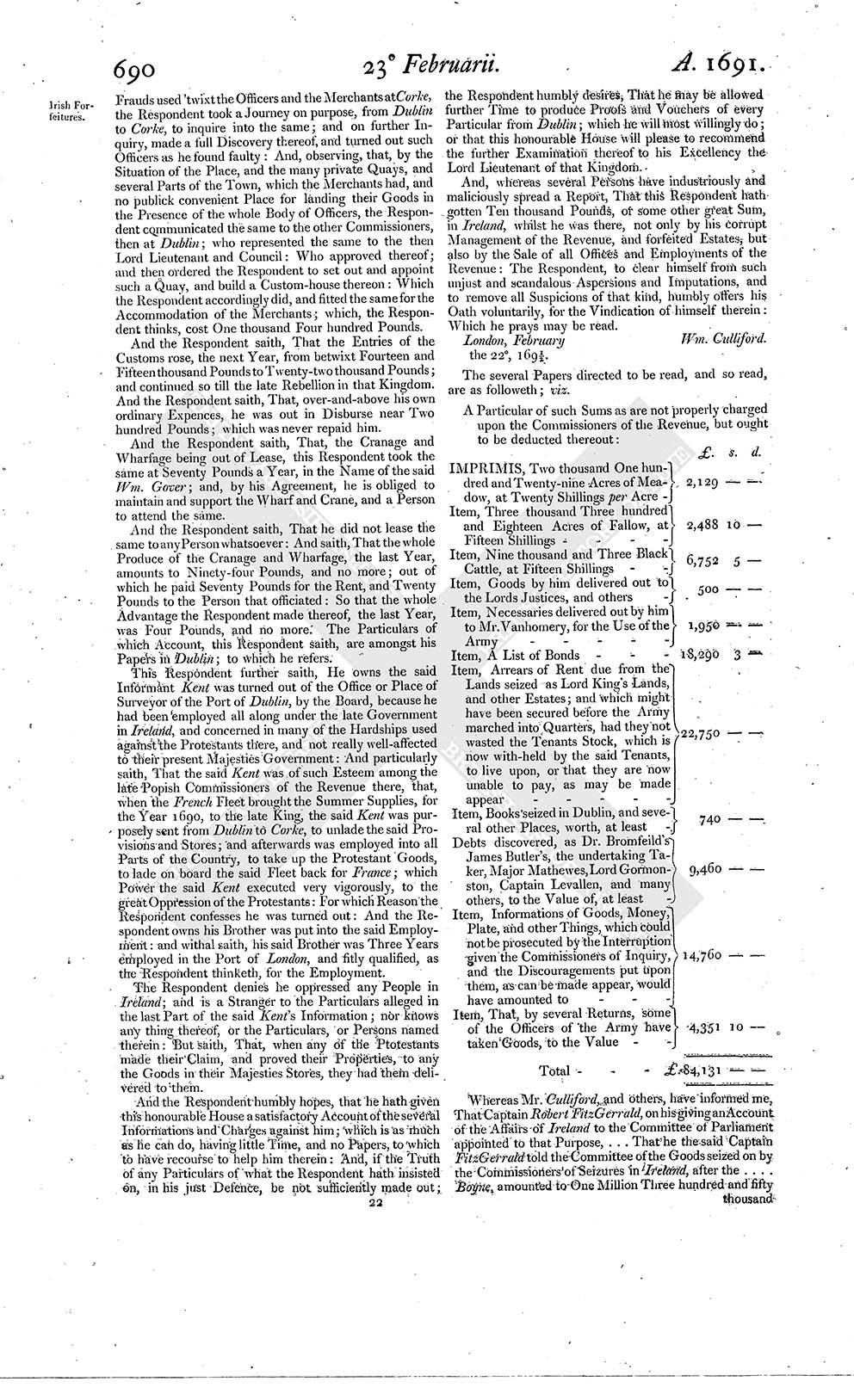
A Particular of such Sums as are not properly charged upon the Commissioners of the Revenue, but ought to be deducted thereout:
Whereas Mr. Culliford, and others, have informed me, That Captain Robert FitzGerrald, on his giving an Account of the Affairs of Ireland to the Committee of Parliament appointed to that Purpose, . . . That he the said Captain FitzGerrald told the Committee of the Goods seized on by the Commissioners' of Seizures in Ireland, after the . . . . Boyne, amounted to One Million Three hundred and fifty thousand Pounds; but that he did not declare, that he knew of any of the said Goods so seized were delivered back to the Protestants, to whom they appeared to belong: I do hereby declare, and am ready to depose, That on a Sabbath-day in the Month of January last, the said Captain Fitz Gerrald being sick in his Chamber, where he the said Captain wrote a Letter to the Lord Sidney, and made me read the same over to him, which he copied as I read the same; wherein, amongst other Things, he informed my Lord Sidney, That he had been examined before the said Committee; and that the Goods, so seized as aforesaid, were to the Value of One Million Three hundred and Fifty thousand Pounds; but that much the better Half were delivered to the Protestants; which, as high as I can remember, were the very Words he used; and which Letter I, at the said Captain's Intreaty, carried to my Lord Sidneye's House that Sunday, and delivered the same to the Lord's Porter; who said he would give the same to his Lord, as soon as he dined.
February the 20th, 1691. Jo. Langham.
William Rex.
Right Trusty and Well-beloved Cousin and Counsellor, and Right Trusty and Well-beloved Counsellor, We greet you well.
WHEREAS We are informed, That the Commission lately granted by Us, under Our Great Seal of England, to Our Right Trusty and Right Well-beloved Cousin Francis Earl of Longford, and others, impowering them to inquire after, and seize for Our Use, such Goods and Chattels as they should find to belong to any forfeited Persons, has been found to be of some Prejudice and Inconvenience to many of Our Subjects there, and of little or no Benefit or Advantage to Us: We think fit, That there be no further Proceedings upon the said Commission; and that you give such Orderes as you shall find to be necessary for the Superseding and Determining thereof, and of all the Powers and Authorities thereby granted: And for so doing, This shall be your Warrant: And so We bid you heartily Farewel. Given at Our Court at Whitehall, the Sixth Day of December 1690, in the Second Year of Our Reign.
By His Majesty's Command,
Dublin. NOTTINGHAM.
Sir,
MY Lord Chief Baron acquainted me, that he had an Account by the last Packet, That Captain Fitz Gerrald had produced a Letter that you writ to me, and had exposed it, to your Prejudice, which much surprised me: But, inquiring into it, my Servants are ready to depose, upon Oath, That, when he lay at my House, I lying sick in my Bed, he got into my Closet; and, finding your Letter, took it away with him. I am sure, I never received any Letter from you (as I told my Lord Chief Baron, and the Lords Justices), but what tended to the King's immediate Service: For, had you been my Brother, and had writ to me any thing reflecting, or prejudicial to the King or the Government, I would immediately have gone and acquainted the Lords Justices with it. I take the Affront and Abuse on myself; and have sent to a Gentleman, a Friend of mine, to know what he means by it; which is all I can do at this Distance: Who am, Sir,
Your humble Servant,
To Wm. Culliford,
Esquire. Tho. Atkins.
By the Lord Justices of Ireland, Charles Porter, Tho. Coningsby;
IT being represented unto us, That Thomas Warren, of Corduffe, in the County of Dublin, Esquire, is comprehended within the Articles for the Surrender of Limerick; we do hereby order and direct you to allow the said Thomas Warren to enter into the Possession of the Estate of Freehold and Inheritance, and now in their Majesties Hands, whereof he was actually possessed in the Reign of King Charles the Second, or at any time since by the Laws and Statutes that were in Force in the said Reign; upon his producing to you an attested Copy of a Recognisance, by him entered into, to their Majesties, in the High Court of Chancery, of the Sum of One thousand Pounds Sterling; with Condition, that if he the said Thomas Warren, his Executors and Administrators, shall not, nor do not, at any time or times hereafter, distrain, sue, molest, or implead any Person or Persons whatsoever, for, or by reason or pretence of, any Seizure, Trespass, Conversion, Arrears of Rent, or Receipt of any Sum or Sums of Money had, done, committed, or grown due, upon or out of the said Estate, or any Part thereof, at any time from the Tenth Day of April 1689, to the Second Day of November last; then the said Recognisance to be void. On Sight of the Recognisance aforesaid, under the Hand of the proper Officer, you shall send your Letters to such Tenants, as have the Possession of the said Estate under your Contracts, forthwith to quit such Possession to the said Captain Warren, as they had by you, or any Person employed by you; provided that such Possession does not extend to prejudice the Right of any Person or Persons who is or are also in Possession of the said Estate by any legal Title, besides that of their Majesties; and saving to all Persons, who have plowed any Part of the said Lands, the Custom of the Country, according to our Proclamation of the Twenty-fifth of September last; as also Conveniencies of Cover, if the Lands admit of it, for keeping the Fruit or Product of the said Lands, until they can conveniently dispose of the same: And, for so doing, this shall be your Warrant. Given at their Majesties Castle of Dublin, the Tenth Day of December 1691.
By the Lords Justices Command.
Isz. Feilding
To the Commissioners and Chief Governors of their Majesties Revenue in this Kingdom.
| Middlesex and Westminster, &c. | The voluntary Deposition of Wm. Culleford, Esquire, one of the Commissioners of the Revenue in Ireland. |
WHEREAS some malicious and wicked Persons, out of Revenge and Envy, have industriously spread abroad several scandalous Reports, as if this Deponent had greatly enriched himself, to the Value of Ten Thousand Pounds, or some such great Sum of Money, by the Sale of Offices, and by other base and indirect Means, in Ireland; intending thereby, as this Deponent has reason to think, to give some Credit or Belief to the present clamorous Accusation against this Deponent in Parliament, and to arraign this Deponent's Integrity in the Discharge of his publick Trust: This Deponent doth therefore voluntary depose and swear, That neither he this Deponent, for or by reason of the Disposal of any Office or Employment in the Revenue of Ireland, either by himself, or by any other Person or Persons in Trust for him, did ever take or receive the Value of One Six-pence for the granting any such Office or Employment to any Person or Persons whatsoever, either directly or indirectly: Nor has this Deponent gotten any Sum or Sums of Money whatever, by any indirect or corrupt Means, or enriched himself thereby, as is most maliciously given out: But rather this Deponent doth further voluntary depose and declare, by reason of his great Family, and the great Charge and Expence this Deponent has been at, and the Smallness of the Salary, this Deponent is, in his own private Fortune, at this Day, a worse man by Three hundred Pounds, than when he this Deponent went last for Ireland, over and besides all Profits and Advantages whatever, which this Deponent has received and enjoyed by his Employment, as a Commissioner of the Revenue of Ireland, either by any Ways or Means, directly or indirectly.
Extract of a Letter from Mr. Authure Bush, Secretary to the Commissioners of the Revenue of Ireland, dated 19th January 1691.
THE Lords Justices have directed, That the Sub Commissioners of Seizures be called upon, by the Court of Exchequer, to force them to a fair Accompt: And Yesterday was a Consultation, at our Board, between the Commissioners, Lord Chief Baron, Barons, and the King's Counsel: And an Oath is to be drawn, to be offered to the Sub Commissioners, which will purge their Consciences, if any thing easy to be wrought on; but such as will, may have Liberty to mend their Returns, before they swear.
Ordered, That the said Answer be taken into Consideration To-morrow Morning.
Punishing Mutiny and Desertion.
Then the House proceed to take into Consideration the Amendments made by the Lords to the Bill, intituled, An Act for punishing Mutineers and Deserters, preventing false Musters, and paying the Army according to the Musters of effective Men, and for better paying of Quarters: And the same were read; and are as followeth;
1 Press, 26 Line, for "elsewhere," read "Dominion of Wales, or the Town of Barwick upon Tweed;"
3 Press, 15 Line, leave out from "Captain," to "and," in the 20th Line.
4 Press, 32 Line, instead of "Commanders in Chief of the Army," read "Colonel or Officer commanding in Chief such Regiment."
9 Press, 27 Line, after "War," read "excepting in the Months of November, December, January, or February, when any Number, not exceeding Five, may have Leave to be absent."
9 Press, 30 Line, for "extraordinary," read "particular."
10 Press, 3 Line, after "hereof," insert "if the Offence be committed in England or Ireland; but, if the same be committed in other Place, then to the Use of Chelsea College."
11 Press, 18 Line, after "present," add "excepting such Cases where Oath shall be made by Two Witnesses, before some Justice of the Peace of the County where such Muster hath been made, That such Mayor, Chief Magistrate, or Officer, hath had due Notice of such Muster, and refused or neglected to appear at the same."
12 Press, 36 Line, Leave out from "the," to "and," in the 38 Line; and insert "Officer, Soldier, or other Person, who shall discover the same, shall have all the Arrears of the Pay due to the Officers so cashiered: Which the Paymaster General is hereby required forthwith to pay accordingly."
17 Press, 36 Line, after "Soldiers" add "in such Places only."
37 Line, after "there," add "paying duly for all they shall have."
19 Press, 9 Line, leave out from "that," to "no," in 29 Line.
20 Press, 3 Line, after, "Act," read "last certified."
At the End of the Bill, add Clause marked A;
"And be it further Enacted, by the Authority aforesaid, That if any Commander or Officer of any Regiment, Troop, or Company, or any Person by his Order, or any Constable, or other Officer of any Parish or Place in England, or Ireland, Wales, or Town of Berwick upon Tweed, shall exact or take any Sum of Money, or other Reward, to exempt any Person from providing or using Carriages, Waggons, or Horses, where there shall be necessary Occasion upon the March of any Troop or Company, or to free or discharge any Person duly summoned or pressed for that Service; then, upon full Proof thereof made by Two or more credible Witnesses, before One or more Justices of the Peace of the County, City, or Town, Corporate, where such Offence shall be committed, the respective Persons, so offending, shall suffer the several Penalties and Punishments herein after-mentioned; viz. the Commander or Officer of such Regiment, Troop, or Company, shall be utterly disabled from serving their Majesties in any Office or Employment, Military or Civil, by the Space of Three Years then next following: And the Constable, or other Officer, of any Parish or Place aforesaid shall be, by the Justice of Peace, before whom such Proof shall be made, as aforesaid, committed to Prison, there to remain for the Space of Three Months, without Bail or Mainprize."
The first Five of the said Amendments, being severally read a Second time, were, upon the Question severally put thereupon, agreed unto by the House.
The Sixth Amendment, 10 Press, Line 3, being read a Second time;
And the Question being put, That the House do agree with the Lords in the said Amendment;
It passed in the Negative.
The next Amendment being read a Second time, the same was, upon the Question put thereupon, agreed unto by the House.
The Eighth Amendment, 12 Press, Line 36, being read a Second time;
And the Question being put, That the House do agree with the Lords in the said Amendment;
It passed in the Negative.
The Two next Amendments, being severally read a Second time, were, upon the Question severally put thereupon, agreed unto by the House.
The Eleventh and Twelfth Amendments being severally read a Second time;
And the Question being severally put thereupon, That the House do agree with the Lords in the said Amendments;
It passed in the Negative.
Then Clause A being read a Second time;
And the Question was put, That the Clause be read a Third time: And
It passed in the Negative.
Ordered, That it be referred to Sir Chr. Musgrave, Mr. Mountague, Mr. Harley, Mr. Herbert, Sir Edward Seymour, Mr. Wharton, Sir John Lowther, Mr. Pelham, Mr. Smith, Sir Walter Young, Mr. Gwyn, Sir Robert Cotton, Sir John Guise, Sir Sam. Barnardiston, Mr. Solicitor General, Sir Jon. Jennings, Sir Jos. Williamson, Lord Fitzharding, Mr. Travers, Sir Math. Andrews, Sir Peter Colliton, Mr. Clarke, Colonel Cornwall, Mr. Boscowen, Mr. Hutchinson, or any Five of them, to prepare Reasons, to be offered at a Conference with the Lords, for disagreeing to the Amendments to the Bill, intituled, An Act for the Punishing of Mutineers and Deserters, preventing false Musters, and paying the Army according to the Musters of effective Men, and for the better Paying of Quarters: And they are to meet at Five a Clock this Afternoon, in the Speaker's Chamber.
Conference with Lords.
Ordered, That a Conference be desired with the Lords, upon the said Amendments.
French Protestants.
Resolved, That this House will, To-morrow Morning at Ten a Clock, resolve itself into a Committee of the whole House, to consider of the Motion on Wednesday last, for a Supply to be granted to their Majesties, for Relief of the Poor French Protestants.
Supply Bill; Loan on Excise.
Resolved, That this House will, To-morrow Morning at Eleven a Clock, resolve itself into a Committee of the whole House, to consider of the Bill for Borrowing of Monies upon Two Acts of Parliament, the one made in the First, and the other in the Second Year of their Majesties Reign, for granting several additional Duties of Excise upon Beer, Ale, and other Liquors, in order to the more speedy Building of Seven-and-twenty Ships of War, by the latter of the said Acts provided to be built.
Committees.
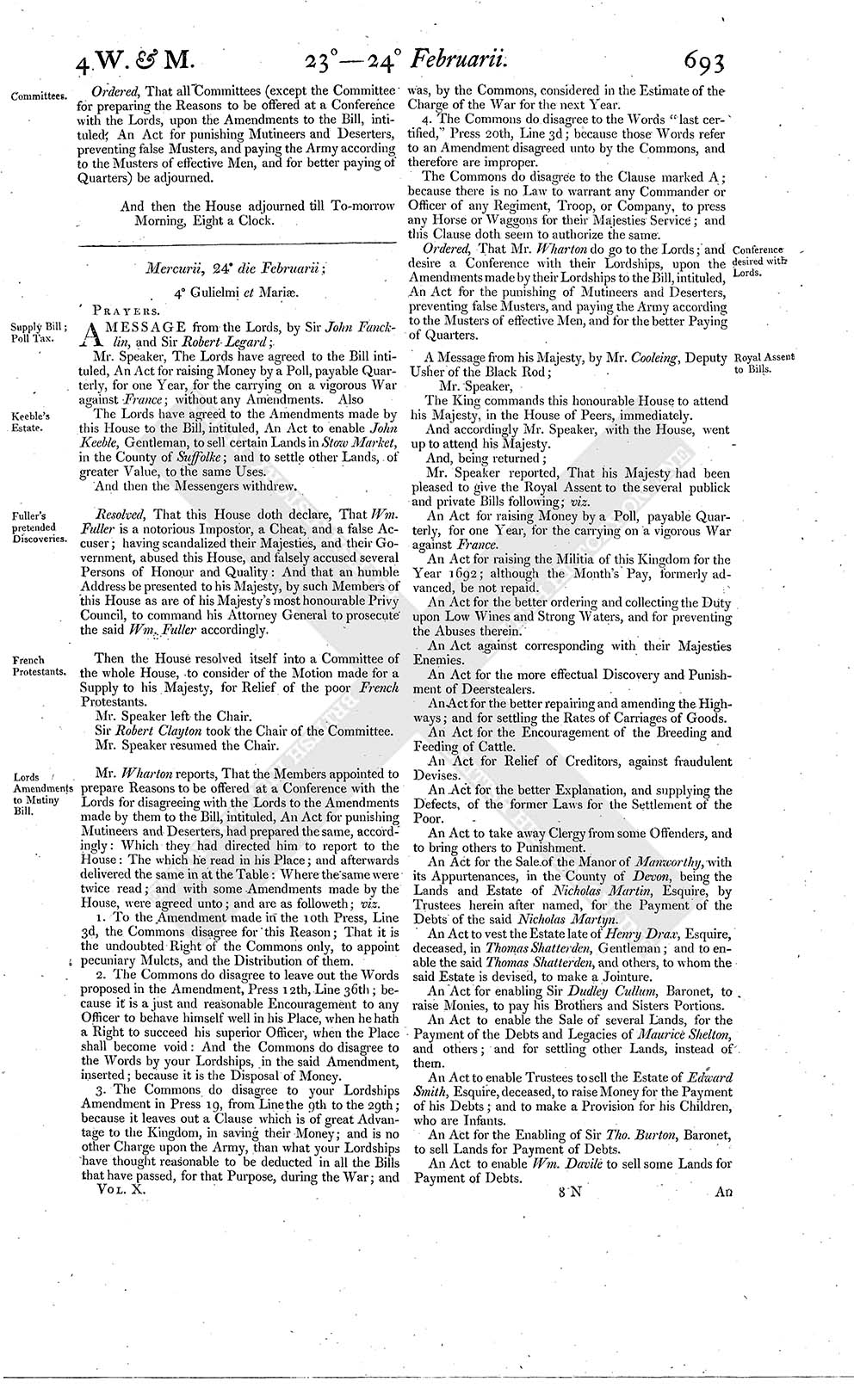
Ordered, That all Committees (except the Committee for preparing the Reasons to be offered at a Conference with the Lords, upon the Amendments to the Bill, intituled, An Act for punishing Mutineers and Deserters, preventing false Musters, and paying the Army according to the Musters of effective Men, and for better paying of Quarters) be adjourned.
And then the House adjourned till To-morrow Morning, Eight a Clock.