
Journal of the House of Lords: Volume 18, 1705-1709. Originally published by His Majesty's Stationery Office, London, 1767-1830.
This free content was digitised by double rekeying. All rights reserved.
'House of Lords Journal Volume 18: 11 February 1706', in Journal of the House of Lords: Volume 18, 1705-1709, (London, 1767-1830) pp. 94-97. British History Online https://www.british-history.ac.uk/lords-jrnl/vol18/pp94-97 [accessed 25 April 2024]


In this section
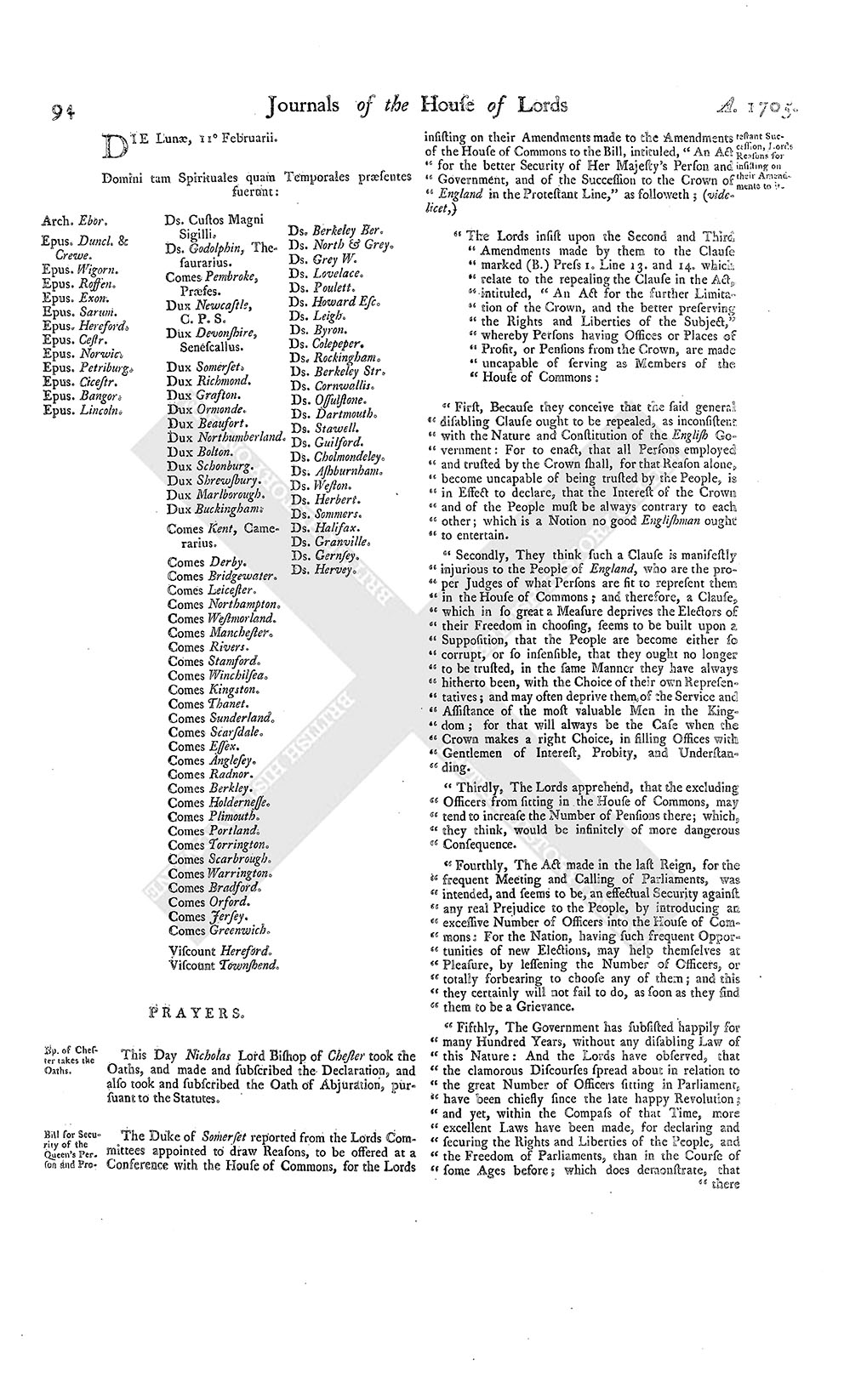
DIE Lunæ, 11 Februarii.
Domini tam Spirituales quam Temporales præsentes fuerunt:
PRAYERS.
Bp. of Chester takes the Oaths.
This Day Nicholas Lord Bishop of Chester took the Oaths, and made and subscribed the Declaration, and also took and subscribed the Oath of Abjuration, pursuant to the Statutes.
Bill for Security of the Queen's Person and Protestant Succession, Lords Reasons for insisting on their Amendments to it.
The Duke of Somerset reported from the Lords Committees appointed to draw Reasons, to be offered at a Conference with the House of Commons, for the Lords insisting on their Amendments made to the Amendments of the House of Commons to the Bill, intituled, "An Act for the better Security of Her Majesty's Person and Government, and of the Succession to the Crown of England in the Protestant Line," as followeth; (videlicet,)
The Lords insist upon the Second and Third Amendments made by them to the Clause marked (B.) Press 1. Line 13. and 14. which relate to the repealing the Clause in the Act, intituled, "An Act for the further Limitation of the Crown, and the better preserving the Rights and Liberties of the Subject," whereby Persons having Offices or Places of Profit, or Pensions from the Crown, are made uncapable of serving as Members of the House of Commons:
First, Because they conceive that the said general disabling Clause ought to be repealed, as inconsistent with the Nature and Constitution of the English Government: For to enact, that all Persons employed and trusted by the Crown shall, for the Reason alone, become uncapable of being trusted by the People, is in Effect to declare, that the Interest of the Crown and of the People must be always contrary to each other; which is a Notion no good Englishman ought to entertain.
"Secondly, They think such a Clause is manisestly injurious to the People of England, who are the proper Judges of what Persons are fit to represent them in the House of Commons; and therefore, a Clause, which in so great a Measure deprives the Electors of their Freedom in Choosing, seems to be built upon a Supposition, that the People are become either so corrupt, or so insensible, that they ought no longer to be trusted, in the same Manner they have always hitherto been, with the Choice of their own Representatives; and may often deprive them of the Service and Assistance of the most valuable Men in the Kingdom; for that will always be the Case when the Crown makes a right Choice, in silling Offices with Gentlemen of Interest, Probity, and Understanding.
Thirdly, The Lords apprehend, that the excluding Officers from sitting in the House of Commons, may tend to increase the Number of Pensions there; which, they think, would be infinitely of more dangerous Consequence.
Fourthly, The Act made in the last Reign, for the frequent Meeting and Calling of Parliaments, was intended, and seems to be, an effectual Security against any real Prejudice to the People, by introducing an excessive Number of Officers into the House of Commons: For the Nation, having such frequent Opportunities of new Elections, may help themselves at Pleasure, by lessening the Number of Officers, or totally forbearing to choose any of them; and this they certainly will not fail to do, as soon as they find them to be a Grievance.
Fifthly, The Government has subsisted happily for many Hundred Years, without any disabling Law of this Nature: And the Lords have observed, that the clamorous Discourses spread about in relation to the great Number of Officers sitting in Parliament, have been chiefly since the late happy Revolution; and yet, within the Compass of that Time, more excellent Laws have been made, for declaring and securing the Rights and Liberties of the People, and the Freedom of Parliaments, than in the Course of some Ages before; which does demonstrate, that there has been hitherto no Mischief from Persons in Office, and gives the Lords Cause to think, that such Clamours (though they may have created some Prejudice in the Minds of well-intentioned Persons), yet took their true Rise from ill-designing Men; who observed, with Regret, the active Zeal with which those who were in Employments under the Crown, supported the present Establishment, and pursued the Common Interest of Prince and People.
Sixthly, The Amendment made by the Lords to the Clause (B.) secures the Kingdom against future Excesses, in multiplying Offices (not necessary for the Service of the Government) upon any indirect Account, by disabling all, who shall hereafter come into any new-created or erected Offices, from being elected, or from sitting or voting as Members of the House of Commons. The Lords have also, by the same Amendment, disabled all Officers relating to the Prizes from sitting in the House of Commons; according to the Intent of a Bill which for that Purpose was sent up to the Lords by the last House of Commons.
Seventhly, The Commons in the Clause (B.) admit it to be reasonable, that the general disabling Clause should be regulated and altered: And the Lords are of Opinion, that there can be no safe and just Way of making such Alteration, but by naming expressly, and in certain and plain Words, what Officers ought to stand excluded from the House of Commons, and to repeal the general Clause as to all others; and therefore, the Form of the next Amendment of the Lords (from which they cannot depart) makes it necessary for them to insist upon the Word ["Repeal"]; and not to admit, that the Words ["regulated and altered"] should stand, as being wholly improper with respect to the Lords next Amendment.
The Lords insist upon their Fourth Amendment, Line 15:
1. Because that Amendment does in express Terms say what Offices shall be excluded, and who shall be liable to the Penalty mentioned in the Clause (B.) in Case they afterwards presume to sit. This Method of the Lords gives a fair Opportunity of considering distinctly the Nature of the Office, and weighing the Reasons on both Sides, before so hard a Judgement be passed, as that of excluding the Officer from his Seat in the House of Commons; whereas the Uncertainty of the Commons Clause deprives the Lords of any such Opportunity, since they cannot be sure of having under their Consideration all the Offices to which it will extend; and it cannot but be very dangerous to admit such an uncertain Clause, in regard to the Time of its taking Effect upon the Demise of the Queen without Issue; a Time, in all Probability, when cautious Men will be willing to find an Excuse for sitting still; and even when wife Men will be apprehensive of acting; since, by the Commons Clause, so great a Latitude will be left for uncertain Determinations as to the Persons who shall or shall not be excluded from Parliament.
2dly, The Time when this Clause is to take Place seems to be an unanswerable Objection (though it might be admitted at another Time); because it does directly contradict the main Design of the Bill, which is, to provide, that, when the Limitation to the Successor shall take Place, all Things should remain in the same State they were left at the Time of the Demise of Her Majesty without Issue; for which End, the Bill expressly appoints that the Parliament which last met and sat before that unhappy Accident should be continued, in order, not only to avoid the Mischiess of new Elections at such a Time, but even Disputes in the House of Commons about Elections: But the Clause (B.), if it should be agreed to, will make the House of Commons become an imperfect and defective Body, by turning out great Numbers of those who were legally chosen, and in Possession of their Seats, at the very Instant when the Nature of the Occasion necessarily requires, and the Bill expressly provides, that the Parliament must meet immediately.
3dly, Experience has shewn, that, when Men are engaged in Elections of Members to serve in the House of Commons, great Divisions arise amongst them, and Animosities are heightened to a dangerous Degree; and therefore, nothing can be of worse Consequence, than to give Occasion for these unhappy Ferments in the Kingdom, by making it necessary to have so many new Elections at such a Juncture, which must create many Disorders, even amongst the bestaffected Subjects; and will give a dangerous Opportunity to all that are disaffected, of disturbing the Public Peace. Elections will of Necessity draw together great Numbers; and, at the same Time, make it impossible for the Government to watch over them, or to obviate ill Designs, without doing what may be pretended to be an Infringement of the Freedom of Elections; so that great Bodies may get together, in order to set up the Interest of a Pretender to the Crown, without being observed; or at least, without being opposed, till it may be too late to suppress them: For Instance, suppose the Lords should agree to the Clause (B.), and that, at the Time of the Demise of Her Majesty without Issue, the Members who served for Portsmouth should be disabled, so that there must be a Proceeding to a new Election at that Place: At the Time of the Election, according to known Custom, the Garrison is to march out, and all Persons who will pretend to a Right of giving Votes must be admitted: The mere stating this Matter of Fact will sufficiently explain of what fatal Consequence this may be (if Advantage be taken of the Opportunity), for putting so important a Fortress into the Hands of such as may be far from meaning to keep it for the Benefit of the Protestant Successor. This may probably happen to be the Case, at that Time, in most of the other Garrisons; and the Enemies to the Succession (who, if this Clause was passed, would know where new Elections must be) would not fail to make their Preparations accordingly: And therefore, the Lords can never agree to a Clause of this Nature, which is first to take Place in the Parliament, that is, by this Bill to be continued upon the Demise of Her Majesty without Issue; because it seems to them to tend plainly to defeat the Design of the Bill, the Security of the Protestant Succession.
4thly, The House of Commons desire the Clause (B.) should be understood to be a self-denying Clause, principally designed for excluding Officers out of the House of Commons; whereas the Lords conceive the Clause to be a claiming for themselves, and a Kind of seizing to their own Use, so many of the most considerable Offices in the Kingdom, the greatest Part whereof are at least equally proper for the Lords, and have been often possessed by Lords, and other Commoners, not Members of Parliament; and had these privileged Officers been excepted only for the necessary Information of the House, One or Two of a Sort, or of each Commission, might have been sufficient for that Purpose. The Lords also cannot omit to observe, the Commons offer no Expedient, nor propose any Remedy, to restrain Members of the House of Commons from soliciting and procuring for their Relations and Dependents all those Offices for which they make Men uncapable of sitting among themselves: And the Lords think, that if Offices are so really destructive of free and impartial Proceedings in Parliament, as the Commons suppose; without some Provision of this Kind be made, Persons who are within Doors will remain as much liable to the Influence of Offices upon their Votes as before, since Offices given or refused, at the Solicitation of Members of Parliament for their Creatures, may give as strong a Bias to their voting, as if such Offices were given or refused to the Members themselves.
5thly, The Clause marked (B.) is liable to Objection, because it will exclude divers considerable Officers, who, by the Nature of their Employments, might be of great Service to the Public in Parliament; and, on the other Hand, does admit of many others, to whom the Lords think there are just Exceptions (in case it could be at all fit to proceed in the Method taken by the House of Commons); and particularly to those who have Pensions, which was ever thought the most dangerous Way of influencing Members of Parliament, and was found to be so in the Reign of King Charles the Second; and though the Clause is restrained to Pensions of Inheritance, or for Life, yet it is well known, the Payment of Pensions may be so precarious, that this Consideration alone may be allowed to affect Men's Votes, at least as much as an Office.
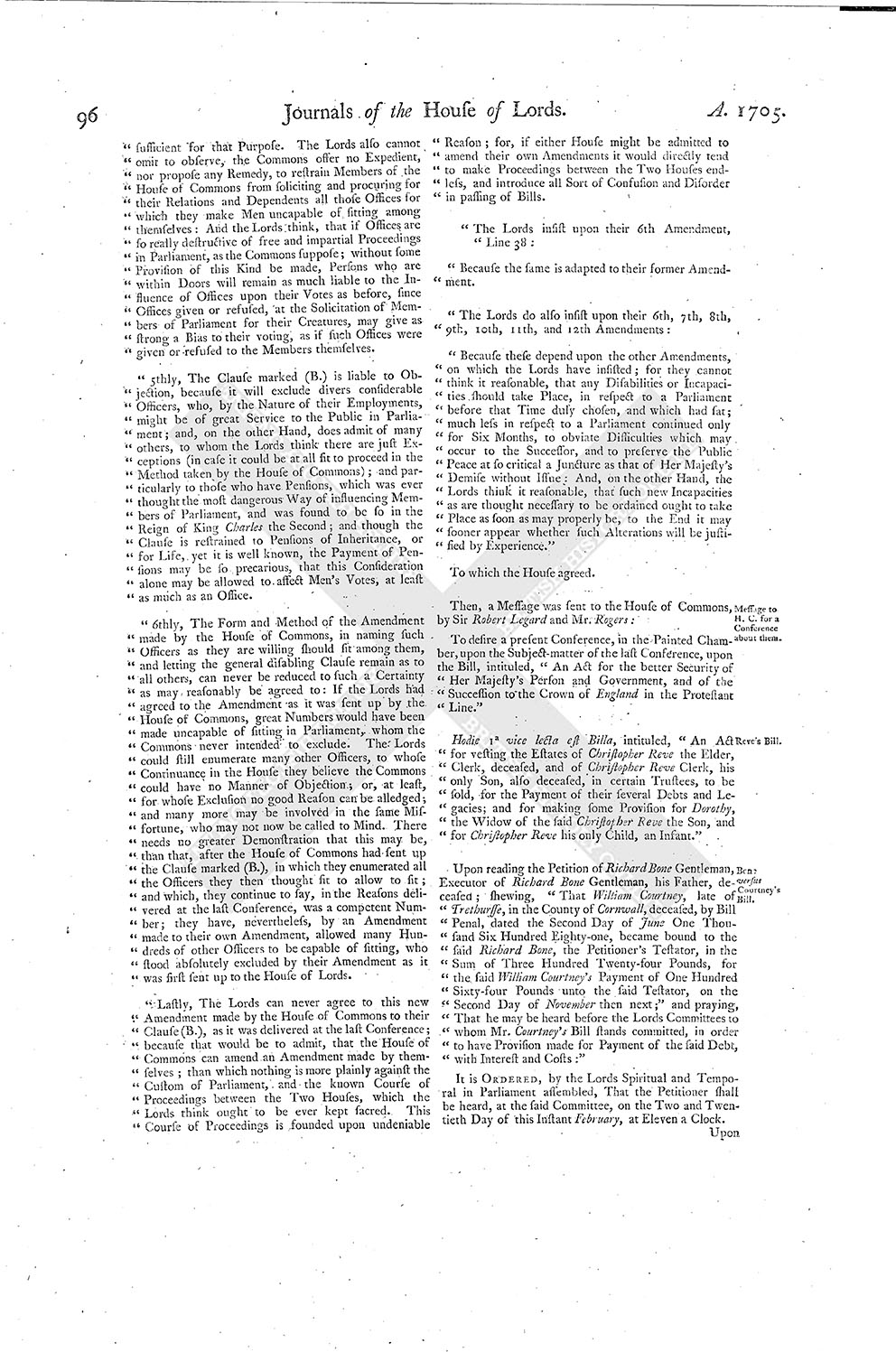
6thly, The Form and Method of the Amendment made by the House of Commons, in naming such Officers as they are willing should sit among them, and letting the general disabling Clause remain as to all others, can never be reduced to such a Certainty as may reasonably be agreed to: If the Lords had agreed to the Amendment as it was sent up by the House of Commons, great Numbers would have been made uncapable of sitting in Parliament, whom the Commons never intended to exclude. The Lords could still enumerate many other Officers, to whose Continuance in the House they believe the Commons could have no Manner of Objection; or, at least, for whose Exclusion no good Reason can be alledged; and many more may be involved in the same Misfortune, who may not now be called to Mind. There needs no greater Demonstration that this may be, than that, after the House of Commons had sent up the Clause marked (B.), in which they enumerated all the Officers they then thought fit to allow to sit; and which, they continue to say, in the Reasons delivered at the last Conference, was a competent Number; they have, nevertheless, by an Amendment made to their own Amendment, allowed many Hundreds of other Officers to be capable of siting, who stood absolutely excluded by their Amendment as it was first sent up to the House of Lords.
Lastly, The Lords can never agree to this new Amendment made by the House of Commons to their Clause (B.), as it was delivered at the last Conference; because that would be to admit, that the House of Commons can amend an Amendment made by themselves; than which nothing is more plainly against the Custom of Parliament, and the known Course of Proceedings between the Two Houses, which the Lords think ought to be ever kept sacred. This Course of Proceedings is founded upon undeniable Reason; for, if either House might be admitted to amend their own Amendments it would directly tend to make Proceedings between the Two Houses endless, and introduce all Sort of Confusion and Disorder in passing of Bills.
The Lords insist upon their 6th Amendment, Line 38:
Because the same is adapted to their former Amendment.
The Lords do also insist upon their 6th, 7th, 8th, 9th, 10th, 11th, and 12th Amendments:
Because these depend upon the other Amendments, on which the Lords have insisted; for they cannot think it reasonable, that any Disabilities or Incapacities should take Place, in respect to a Parliament before that Time duly chosen, and which had fat; much less in respect to a Parliament continued only for Six Months, to obviate Difficulties which may occur to the Successor, and to preserve the Public Peace at so critical a Juncture as that of Her Majesty's Demise without Issue: And, on the other Hand, the Lords think it reasonable, that such new Incapacities as are thought necessary to be ordained ought to take Place as soon as may properly be, to the End it may sooner appear whether such Alterations will be justified by Experience."
To which the House agreed.
Message to H. C. for a Conference about them.
Then, a Message was sent to the House of Commons, by Sir Robert Legard and Mr. Rogers:
To desire a present Conference, in the Painted Chamber, upon the Subject-matter of the last Conference, upon the Bill, intituled, "An Act for the better Security of Her Majesty's Person and Government, and of the Succession to the Crown of England in the Protestant Line."
Reve's Bill.
Hodie 1a vice lecta est Billa, intituled, "An Act for vesting the Estates of Christopher Reve the Elder, Clerk, deceased, and of Christopher Reve Clerk, his only Son, also deceased, in certain Trustees, to be sold, for the Payment of their several Debts and Legacies; and for making some Provision for Dorothy, the Widow of the said Christopher Reve the Son, and for Christopher Reve his only Child, an Infant."
Bone versus Courtney's Bill.
Upon reading the Petition of Richard Bone Gentleman, Executor of Richard Bone Gentleman, his Father, deceased; shewing, "That William Courtney, late of Trethursse, in the County of Cornwall, deceased, by Bill Penal, dated the Second Day of June One Thousand Six Hundred Eighty-one, became bound to the said Richard Bone, the Petitioner's Testator, in the Sum of Three Hundred Twenty-four Pounds, for the said William Courtney's Payment of One Hundred Sixty-four Pounds unto the said Testator, on the Second Day of November then next;" and praying, That he may be heard before the Lords Committees to whom Mr. Courtney's Bill stands committed, in order to have Provision made for Payment of the said Debt, with Interest and Costs:"
It is Ordered, by the Lords Spiritual and Temporal in Parliament assembled, That the Petitioner shall be heard, at the said Committee, on the Two and Twentieth Day of this Instant February, at Eleven a Clock.
E. of Kildare versus Shaen.
Upon reading the Petition of the Lady Frances Shaen, Widow and Relict of Sir James Shaen Baronet, deceased, on the Behalf of herself and her Son Sir Arthur Shaen Baronet; praying "further Time for answering to the Petition of John Earl of Kildare; and that an Order of the Thirteenth of May One Thousand Seven Hundred and One should be discharged, with Direction that the Rents then in Arrear, and the growing Rents of the Lands in Question, should be paid into the Court of Chancery in Ireland, there to remain, until a Cause there depending, between the said Sir Arthur Shaen and the said Earl of Kildare, should be heard and determined:"
It is Ordered, by the Lords Spiritual and Temporal in Parliament assembled, That the said Sir Arthur Shaen hath hereby Time allowed, for answering thereunto, until Tuesday the Six and Twentieth Day of this Instant February, at Eleven a Clock.
Message from H. C. with a Bill.
A Message from the House of Commons, by Mr. Southwell and others:
Who brought up a Bill, Intituled, "An Act for restoring to the Archbishopric of Dublin the Town and Lands of Sea-Town; and re-paying to William Lord Archbishop of Dublin the Money he paid for the same, upon Purchase thereof from the Trustees for Sale of the forfeited Estates in Ireland;" to which they desire the Concurrence of this House.
Archbp. of Dublin's Bill.
Hodie 1a vice lecta est Billa, intituled, "An Act for restoring to the Archbishopric of Dublin the Town and Lands of Sea-Town; and re-paying to William Lord Archbishop of Dublin the Money he paid for the same, upon Purchase thereof from the Trustees for Sale of the forfeited Estates in Ireland."
Digby's Bill.
Hodie 3a vice lecta est Billa, intituled, "An Act for vesting the Equity of Redemption of the Lands and Tenements lying in the County of Leicester, late the Estate of John Digby Esquire, deceased, in Trustees, to the Intent that the same may be sold, for the discharging of the Mortgages and other Incumbrances thereon."
The Question was put, "Whether this Bill shall pass?"
It was Resolved in the Affirmative.
Message to H. C. with it.
A Message was sent to the House of Commons, by Sir Robert Legard and Mr. Rogers:
To carry down the said Bill, and desire their Concurrence thereunto.
Answer from H. C.
The Messengers sent to the House of Commons return Answer:
That the Commons will give a Conference, as desired.
Ordered, That the Lords who managed the last Conference do manage this Conference.
Report of the Conference on the Bill for Security of the Queen's Person, and the Protestant Succession.
Then, the Commons being come to the Conference, the Managers Names were read.
Whereupon the House was adjourned during Pleasure, and the Lords went to the Conference.
Which being ended, the House was resumed.
And the Duke of Somerset reported, "That they had attended the Conference, and delivered their Reasons and the Bill to the Commons."
Thornhill's Bill.
Hodie 2a vice lecta est Billa, intituled, "An Act to vest certain Lands and Tenements, in the County of Kent, the Estate of Richard Thornehill Esquire, in Trustees, to be sold, for the Payment of Debts, and his Sisters Portions, charged thereupon; and for securing the Residue of the Purchase-money to the Uses of his Marriage Settlement."
Ordered, That the Consideration of the said Bill be committed to the Lords following; (videlicet,)
Their Lordships, or any Five of them; to meet on Monday the Eighteenth Instant, at Ten a Clock in the Forenoon, in the Prince's Lodgings near the House of Peers; and to adjourn as they please.
Barry's Bill.
Hodie 2a vice lecta est Billa, intituled, "An Act for settling and securing Part of the Estates of Robert Barry Clerk and Anne his Wife, for the Benefit of the said Anne and her Children; and Sale of other Part of the Estate of the said Robert Barry, for Payment of his Debts."
Ordered, That the Consideration of the said Bill be referred to the Lords Committees to whom Mr. Thornehill's Bill stands committed.
Their Lordships, or any Five of them; to meet at the same Time and Place.
Adjourn.
Dominus Custos Magni Sigilli declaravit præsens Parliamentum continuandum esse usque ad et in diem Martis, duodecimum diem instantis Februarii, hora undecima Auroræ, Dominis sic decernentibus.