Journal of the House of Lords: Volume 18, 1705-1709. Originally published by His Majesty's Stationery Office, London, 1767-1830.
This free content was digitised by double rekeying. All rights reserved.
'House of Lords Journal Volume 18: 28 January 1707', in Journal of the House of Lords: Volume 18, 1705-1709(London, 1767-1830), British History Online https://www.british-history.ac.uk/lords-jrnl/vol18/pp206-220 [accessed 9 May 2025].
'House of Lords Journal Volume 18: 28 January 1707', in Journal of the House of Lords: Volume 18, 1705-1709(London, 1767-1830), British History Online, accessed May 9, 2025, https://www.british-history.ac.uk/lords-jrnl/vol18/pp206-220.
"House of Lords Journal Volume 18: 28 January 1707". Journal of the House of Lords: Volume 18, 1705-1709. (London, 1767-1830), British History Online. Web. 9 May 2025. https://www.british-history.ac.uk/lords-jrnl/vol18/pp206-220.





In this section
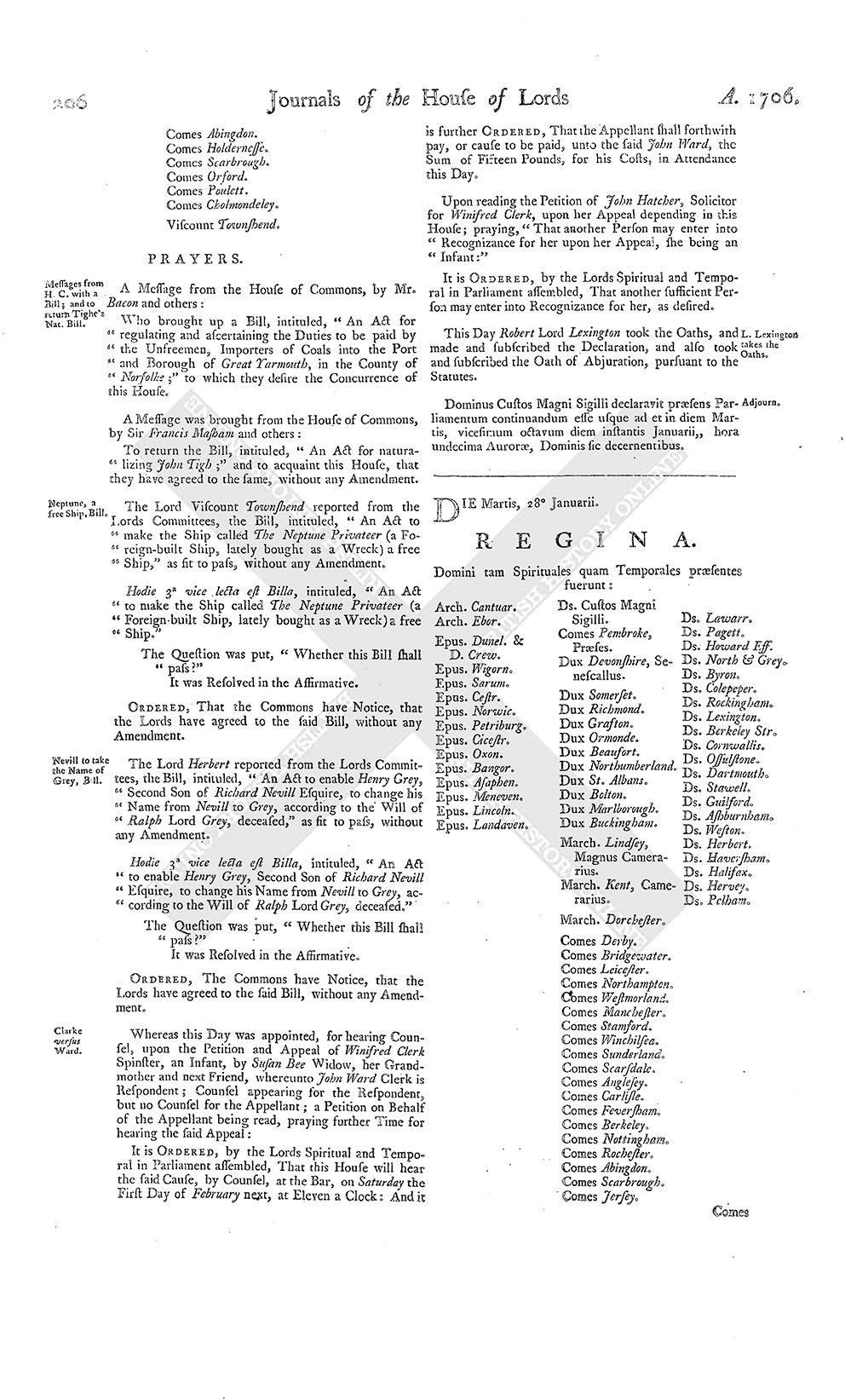
DIE Martis, 28 Januarii.
REGINA.
Domini tam Spirituales quam Temporales præsentes fuerunt:
PRAYERS.
Van Holt & al. Nat. Bill.
Upon reading the Petition of Henry Van Holte and others; praying Leave to bring in a Bill for their Naturalization:
It is Ordered, by the Lords Spiritual and Temporal in Parliament assembled, That the Petitioners have hereby Leave to bring in a Bill, according to the Prayer of their Petition.
Chamberlaine versus Newte.
Whereas this Day was appointed, to hear the Judges Opinions, in the Case of Roger Chamberlaine and John Newte, as to this Point, "Whether the Tithe payable for Corn ground in a Horse Malt Mill is a Personal, Predial, or Mixed Tithe; and in what Manner Tithe is to be paid for Corn ground in such Mill, if any Tithe is due for the same?"
It is Ordered, by the Lords Spiritual and Temporal in Parliament assembled, That the Judges shall be heard thereunto, on Wednesday the Fifth Day of February next, at Eleven a Clock.
The House was adjourned during Pleasure, to robe.
The House was resumed.
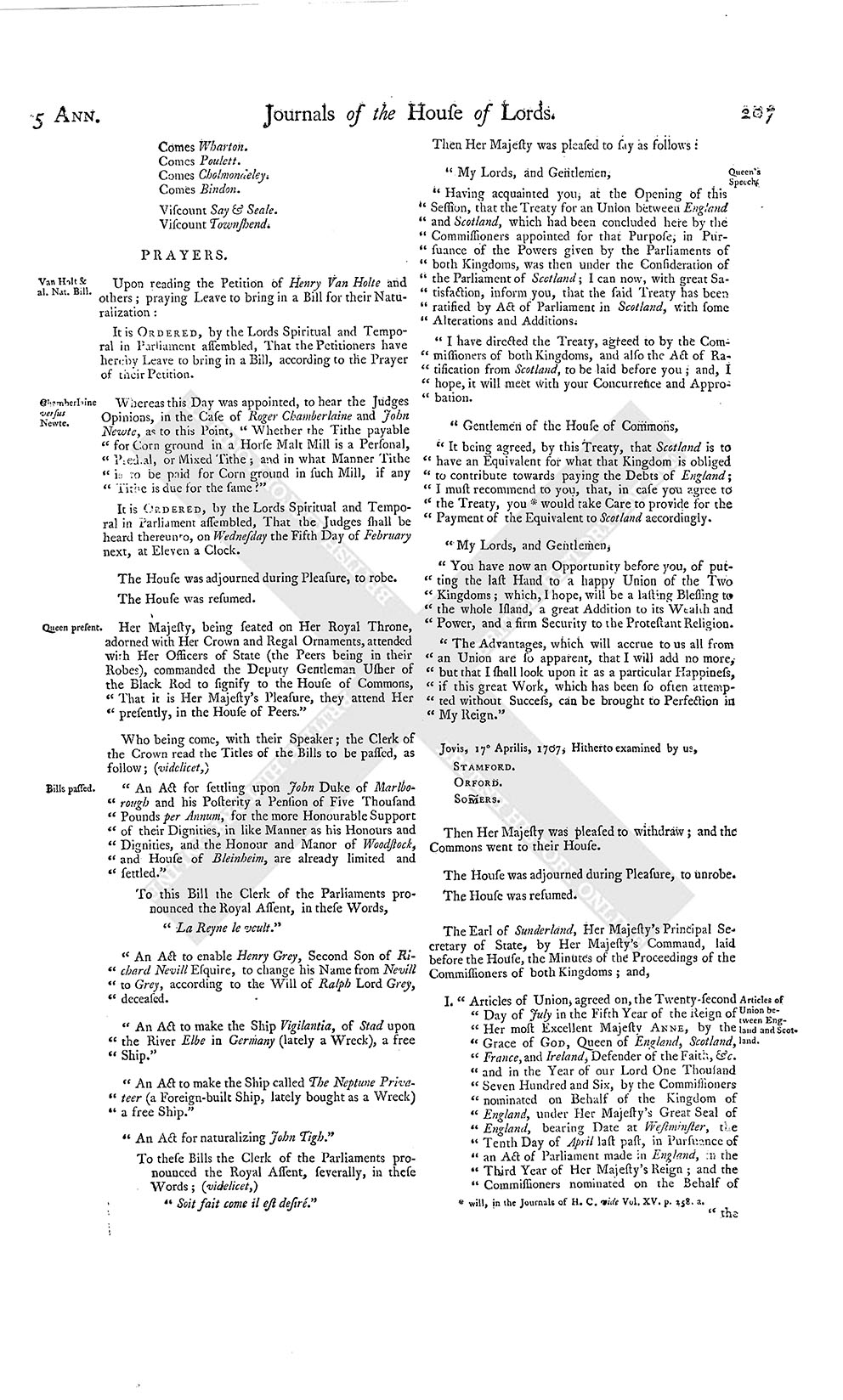
Queen present.
Her Majesty, being seated on Her Royal Throne, adorned with Her Crown and Regal Ornaments, attended with Her Officers of State (the Peers being in their Robes), commanded the Deputy Gentleman Usher of the Black Rod to signify to the House of Commons, "That it is Her Majesty's Pleasure, they attend Her presently, in the House of Peers."
Who being come, with their Speaker; the Clerk of the Crown read the Titles of the Bills to be passed, as follow; (videlicet,)
Bills passed.
"An Act for settling upon John Duke of Marlborough and his Posterity a Pension of Five Thousand Pounds per Annum, for the more Honourable Support of their Dignities, in like Manner as his Honours and Dignities, and the Honour and Manor of Woodstock, and House of Bleinheim, are already limited and settled."
To this Bill the Clerk of the Parliaments pronounced the Royal Assent, in these Words,
"La Reyne le veult."
"An Act to enable Henry Grey, Second Son of Richard Nevill Esquire, to change his Name from Nevill to Grey, according to the Will of Ralph Lord Grey, deceased.
"An Act to make the Ship Vigilantia, of Stad upon the River Elbe in Germany (lately a Wreck), a free Ship."
"An Act to make the Ship called The Neptune Priveteer (a Foreign-built Ship, lately bought as a Wreck) a free Ship."
"An Act for naturalizing John Tigh."
To these Bills the Clerk of the Parliaments pronounced the Royal Assent, severally, in these Words; (videlicet,)
"Soit fait come il est desire."
Then Her Majesty was pleased to say as follows:
Queen's Speech.
"My Lords, and Gentlemen,
"Having acquainted you, at the Opening of this Session, that the Treaty for an Union between England and Scotland, which had been concluded here by the Commissioners appointed for that Purpose, in Pursuance of the Powers given by the Parliaments of both Kingdoms, was then under the Consideration of the Parliament of Scotland; I can now, with great Satisfaction, inform you, that the said Treaty has been ratified by Act of Parliament in Scotland, with some Alterations and Additions.
"I have directed the Treaty, agreed to by the Commissioners of both Kingdoms, and also the Act of Ratification from Scotland, to be laid before you; and, I hope, it will meet with your Concurrence and Approbation.
"Gentlemen of the House of Commons,
"It being agreed, by this Treaty, that Scotland is to have an Equivalent for what that Kingdom is obliged to contribute towards paying the Debts of England; I must recommend to you, that, in case you agree to the Treaty, you (fn. 1) would take Care to provide for the Payment of the Equivalent to Scotland accordingly.
"My Lords, and Gentlemen,
"You have now an Opportunity before you, of putting the last Hand to a happy Union of the Two Kingdoms; which, I hope, will be a lasting Blessing to the whole Island, a great Addition to its Wealth and Power, and a firm Security to the Protestant Religion.
"The Advantages, which will accrue to us all from an Union are so apparent, that I will add no more, but that I shall look upon it as a particular Happiness, if this great Work, which has been so often attempted without Success, can be brought to Perfection in My Reign."
Jovis, 17 Aprilis, 1707, Hitherto examined by us,
Stamford.
Orford.
Somers.
Then Her Majesty was pleased to withdraw; and the Commons went to their House.
The House was adjourned during Pleasure, to unrobe.
The House was resumed.
The Earl of Sunderland, Her Majesty's Principal Secretary of State, by Her Majesty's Command, laid before the House, the Minutes of the Proceedings of the Commissioners of both Kingdoms; and,
Articles of Union between England and Scotland.
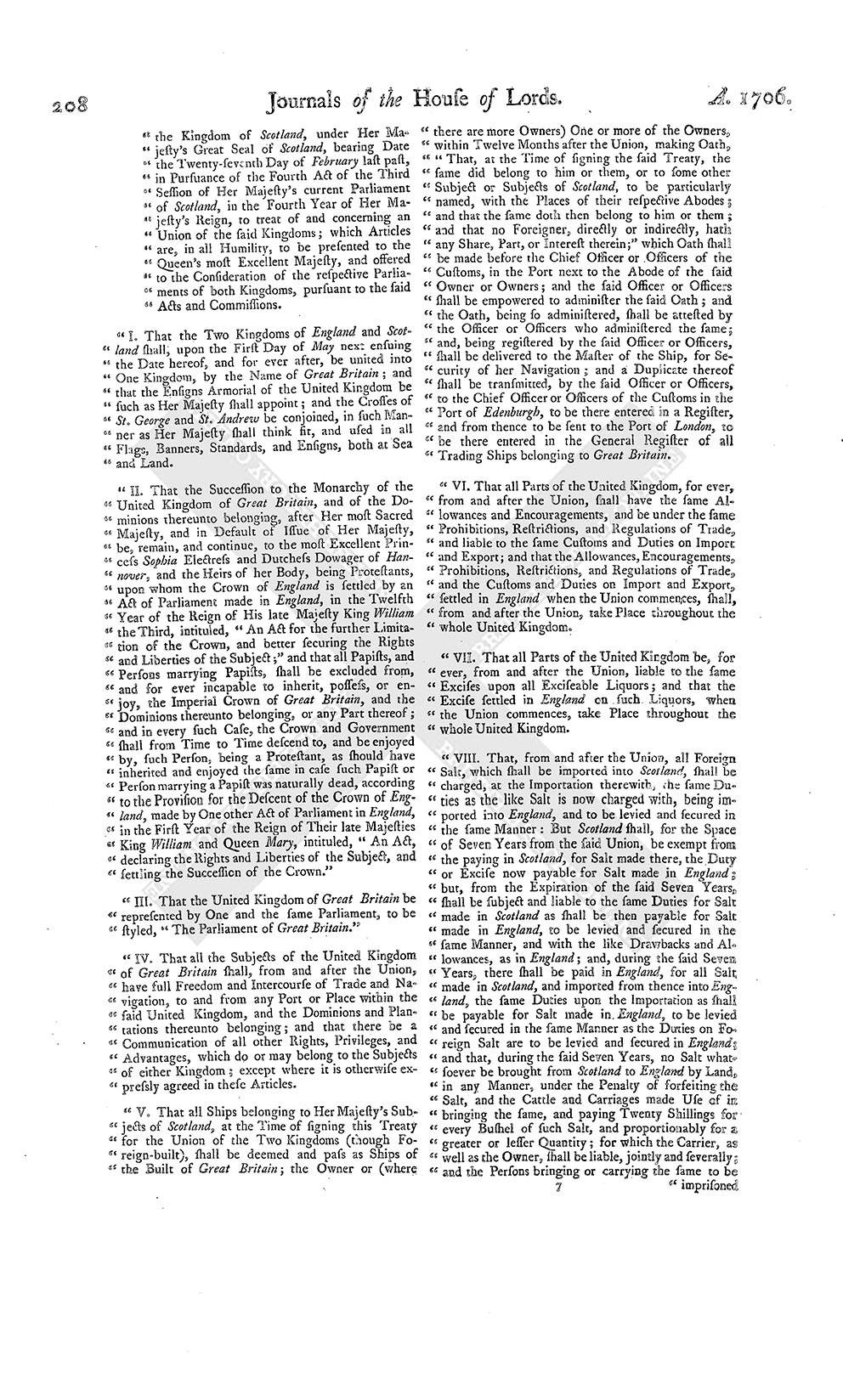
1. "Articles of Union, agreed on, the Twenty-second Day of July in the Fifth Year of the Reign of Her most Excellent Majesty Anne, by the Grace of God, Queen of England, Scotland, France, and Ireland, Defender of the Faith, &c. and in the Year of our Lord One Thousand Seven Hundred and Six, by the Commissioners nominated on Behalf of the Kingdom of England, under Her Majesty's Great Seal of England, bearing Date at Westminster, the Tenth Day of April last past, in Pursuance of an Act of Parliament made in England, in the Third Year of Her Majesty's Reign; and the Commissioners nominated on the Behalf of the Kingdom of Scotland, under Her Majesty's Great Seal of Scotland, bearing Date the Twenty-seventh Day of February last past, in Pursuance of the Fourth Act of the Third Session of Her Majesty's current Parliament of Scotland, in the Fourth Year of Her Majesty's Reign, to treat of and concerning an Union of the said Kingdoms; which Articles are, in all Humility, to be presented to the Queen's most Excellent Majesty, and offered to the Consideration of the respective Parliaments of both Kingdoms, pursuant to the said Acts and Commissions.
"I. That the Two Kingdoms of England and Scotland shall, upon the First Day of May next ensuing the Date hereof, and for ever after, be united into One Kingdom, by the Name of Great Britain; and that the Ensigns Armorial of the United Kingdom be such as Her Majesty shall appoint; and the Crosses of St. George and St. Andrew be conjoined, in such Manner as Her Majesty shall think fit, and used in all Flags, Banners, Standards, and Ensigns, both at Sea and Land.
"II. That the Succession to the Monarchy of the United Kingdom of Great Britain, and of the Dominions thereunto belonging, after Her most Sacred Majesty, and in Default of Issue of Her Majesty, be, remain, and continue, to the most Excellent Princess Sophia Electress and Dutchess Dowager of Hannover, and the Heirs of her Body, being Protestants, upon whom the Crown of England is settled by an Act of Parliament made in England, in the Twelfth Year of the Reign of His late Majesty King William the Third, intituled, "An Act for the further Limitation of the Crown, and better securing the Rights and Liberties of the Subject;" and that all Papists, and Persons marrying Papists, shall be excluded from, and for ever incapable to inherit, possess, or enjoy, the Imperial Crown of Great Britain, and the Dominions thereunto belonging, or any Part thereof; and in every such Case, the Crown and Government shall from Time to Time descend to, and be enjoyed by, such Person, being a Protestant, as should have inherited and enjoyed the same in case such Papist or Person marrying a Papist was naturally dead, according to the Provision for the Descent of the Crown of England, made by One other Act of Parliament in England, in the First Year of the Reign of Their late Majesties King William and Queen Mary, intituled, "An Act, declaring the Rights and Liberties of the Subject, and settling the Succession of the Crown."
"III. That the United Kingdom of Great Britain be represented by One and the same Parliament, to be styled, "The Parliament of Great Britain."
"IV. That all the Subjects of the United Kingdom of Great Britain shall, from and after the Union, have full Freedom and Intercourse of Trade and Navigation, to and from any Port or Place within the said United Kingdom, and the Dominions and Plantations thereunto belonging; and that there be a Communication of all other Rights, Privileges, and Advantages, which do or may belong to the Subjects of either Kingdom; except where it is otherwise expressly agreed in these Articles.
"V. That all Ships belonging to Her Majesty's Subjects of Scotland, at the Time of signing this Treaty for the Union of the Two Kingdoms (though Foreign-built), shall be deemed and pass as Ships of the Built of Great Britain; the Owner or (where there are more Owners) One or more of the Owners, within Twelve Months after the Union, making Oath, "That, at the Time of signing the said Treaty, the same did belong to him or them, or to some other Subject or Subjects of Scotland, to be particularly named, with the Places of their respective Abodes; and that the same doth then belong to him or them; and that no Foreigner, directly or indirectly, hath any Share, Part, or Interest therein;" which Oath shall be made before the Chief Officer or Officers of the Customs, in the Port next to the Abode of the said Owner or Owners; and the said Officer or Officers shall be empowered to administer the said Oath; and the Oath, being so administered, shall be attested by the Officer or Officers who administered the same; and, being registered by the said Officer or Officers, shall be delivered to the Master of the Ship, for Security of her Navigation; and a Duplicate thereof shall be transmitted, by the said Officer or Officers, to the Chief Officer or Officers of the Customs in the Port of Edenburgh, to be there entered in a Register, and from thence to be sent to the Port of London, to be there entered in the General Register of all Trading Ships belonging to Great Britain.
"VI. That all Parts of the United Kingdom, for ever, from and after the Union, shall have the same Allowances and Encouragements, and be under the same Prohibitions, Restrictions, and Regulations of Trade, and liable to the same Customs and Duties on Import and Export; and that the Allowances, Encouragements, Prohibitions, Restrictions, and Regulations of Trade, and the Customs and Duties on Import and Export, settled in England when the Union commences, shall, from and after the Union, take Place throughout the whole United Kingdom.
"VII. That all Parts of the United Kingdom be, for ever, from and after the Union, liable to the same Excises upon all Exciseable Liquors; and that the Excise settled in England on such Liquors, when the Union commences, take Place throughout the whole United Kingdom.
"VIII. That, from and after the Union, all Foreign Salt, which shall be imported into Scotland, shall be charged, at the Importation therewith, the same Duties as the like Salt is now charged with, being imported into England, and to be levied and secured in the same Manner: But Scotland shall, for the Space of Seven Years from the said Union, be exempt from the paying in Scotland, for Salt made there, the Duty or Excise now payable for Salt made in England; but, from the Expiration of the said Seven Years, shall be subject and liable to the same Duties for Salt made in Scotland as shall be then payable for Salt made in England, to be levied and secured in the same Manner, and with the like Drawbacks and Allowances, as in England; and, during the said Seven Years, there shall be paid in England, for all Salt made in Scotland, and imported from thence into England, the same Duties upon the Importation as shall be payable for Salt made in England, to be levied and secured in the same Manner as the Duties on Foreign Salt are to be levied and secured in England; and that, during the said Seven Years, no Salt whatsoever be brought from Scotland to England by Land, in any Manner, under the Penalty of forfeiting the Salt, and the Cattle and Carriages made Use of in bringing the same, and paying Twenty Shillings for every Bushel of such Salt, and proportionably for a greater or lesser Quantity; for which the Carrier, as well as the Owner, shall be liable, jointly and severally; and the Persons bringing or carrying the same to be imprisoned, by any One Justice of the Peace, by the Space of Six Months, without Bail, and until the Penalty be paid: And that, during the said Seven Years, all salted Flesh or Fish, exported from Scotland to England, or made Use of for victualing of Ships in Scotland, and all Flesh put on board in Scotland to be exported to Parts beyond the Seas, which shall be salted with Scotch Salt, or any Mixture therewith, shall be forfeited, and may be seized: And that, from and after the Union, the Laws and Acts of Parliament in Scotland, for pining, curing, and packing of Herrings, White Fish, and Salmon, for Exportation, with Foreign Salt only, and for preventing of Frauds in curing and packing of Fish, be continued in Force in Scotland, subject to such Alterations as shall be made by the Parliament of Great Britain; and that all Fish exported from Scotland to Parts beyond the Seas, which shall be cured with Foreign Salt only, shall have the same Easies, Premiums, and Drawbacks, as are or shall be allowed to such Persons as export the like Fish from England: And if any Matters or Fraud relating to the said Duties on Salt shall hereafter appear, which are not sufficiently provided against by this Article, the same shall be subject to such farther Provisions as shall be thought fit by the Parliament of Great Britain.
"IX. That whenever the Sum of One Million Nine Hundred Ninety-seven Thousand Seven Hundred Sixty-three Pounds, Eight Shillings, and Four Pence Half-penny, shall be enacted by the Parliament of Great Britain, to be raised in that Part of the United Kingdom now called England, on Land and other Things usually charged in Acts of Parliament there, for granting an Aid to the Crown by a Land Tax; that Part of the United Kingdom now called Scotland shall be charged by the same Act with the further Sum of Forty-eight Thousand Pounds, free of all Charges, as the Quota of Scotland to such Tax; and so proportionably for any greater or lesser Sum raised in England by any Tax on Land, and other Things usually charged together with the Land; and that such Quota for Scotland, in the Cases aforesaid, be raised and collected in the same Manner as the Cess now is in Scotland, but subject to such Regulations in the Manner of collecting as shall be made by the Parliament of Great Britain.
"X. That, during the Continuance of the respective Duties on Stampt Paper, Vellum, and Parchment, by the several Acts now in Force in England; Scotland shall not be charged with the same respective Duties.
"XI. That, during the Continuance of the Duties payable in England on Windows and Lights, which determines on the First Day of August One Thousand Seven Hundred and Ten; Scotland shall not be charged with the same Duties.
"XII. That, during the Continuance of the Duties payable in England on Coals, Culm, and Cinders, which determines the Thirtieth Day of September One Thousand Seven Hundred and Ten; Scotland shall not be charged therewith, for Coals, Culm, and Cinders, consumed there; but shall be charged with the same Duties as in England, for all Coal, Culm, and Cinders, not consumed in Scotland.
"XIII. That, during the Continuance of the Duty payable in England on Malt, which determines the Twenty-fourth Day of June One Thousand Seven Hundred and Seven; Scotland shall not be charged with that Duty.
"XIV. That the Kingdom of Scotland be not charged with any other Duties laid on by the Parliament of England before the Union, except those consented to in this Treaty; in regard it is agreed that all necessary Provision shall be made by the Parliament of Scotland for the Public Charge and Service of that Kingdom for the Year One Thousand Seven Hundred and Seven: Provided nevertheless, That if the Parliament of England shall think fit to lay any further Impositions, by Way of Customs, or such Excises with which, by Virtue of this Treaty, Scotland is to be charged equally with England; in such Case, Scotland shall be liable to the same Customs and Excises, and have an Equivalent, to be settled by the Parliament of Great Britain. And seeing it cannot be supposed that the Parliament of Great Britain will ever lay any Sort of Burdens upon the United Kingdom, but what they shall find of Necessity at that Time for the Preservation and Good of the Whole, and with due Regard to the Circumstances and Abilities of every Part of the United Kingdom; therefore it is agreed, that there be no further Exemption insisted on for any Part of the United Kingdom; but that the Consideration of any Exemptions beyond what are already agreed on in this Treaty shall be left to the Determination of the Parliament of Great Britain.
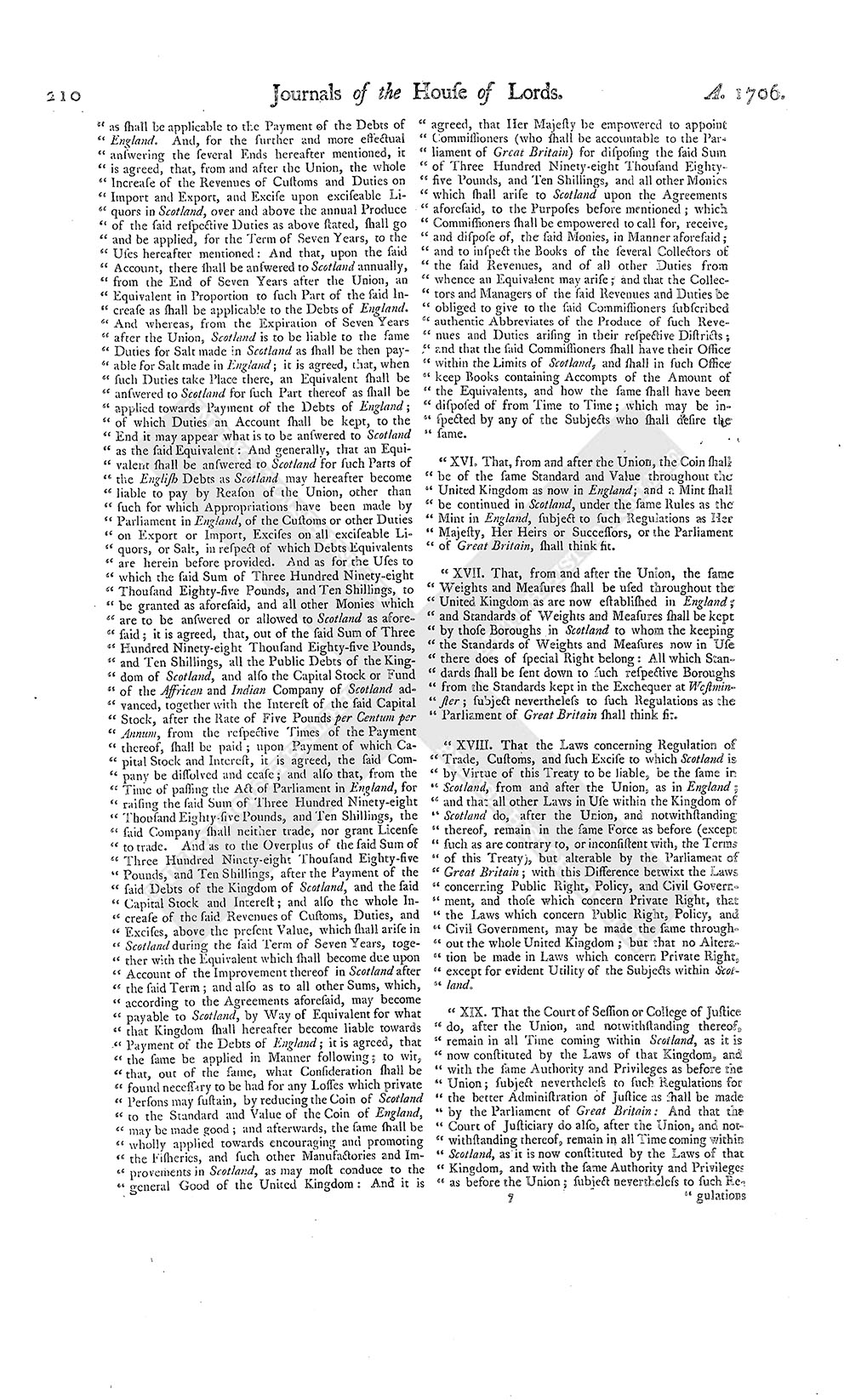
"XV. Whereas, by the Terms of this Treaty, the Subjects of Scotland, for preserving an Equality of Trade throughout the United Kingdom, will be liable to several Customs and Excises now payable in England, which will be applicable towards Payment of the Debts of England contracted before the Union; it is agreed, that Scotland shall have an Equivalent for what the Subjects thereof shall be so charged towards Payment of the said Debts of England, in all Particulars whatsoever, in Manner following; (videlicet,) That, before the Union of the said Kingdoms, the Sum of Three Hundred Ninety-eight Thousand Eighty-five Pounds, and Ten Shillings, be granted to Her Majesty, by the Parliament of England, for the Uses after mentioned, being the Equivalent to be answered to Scotland for such Parts of the said Customs and Excises upon all exciseable Liquors with which that Kingdom is to be charged upon the Union, as will be applicable to the Payment of the said Debts of England, according to the Proportions which the present Customs in Scotland, being Thirty Thousand Pounds per Annum, do bear to the Customs in England, computed at One Million Three Hundred Forty-one Thousand Five Hundred and Fifty-nine Pounds per Annum, and which the present Excises on exciseable Liquors in Scotland, being Thirty-three Thousand Five Hundred Pounds per Annum, do bear to the Excises on exciseable Liquors in England, computed at Nine Hundred Forty-seven Thousand Six Hundred and Two Pounds per Annum; which Sum of Three Hundred Ninety-eight Thousand Eightyfive Pounds, and Ten Shillings, shall be due and payable from the Time of the Union. And in regard that, after the Union, Scotland becoming liable to the same Customs and Duties payable on Import and Export, and to the same Excises on all exciseable Liquors, as in England, as well upon that Account, as upon Account of the Increase of Trade and People (which will be the happy Consequence of the Union), the said Revenues will much improve beyond the before-mentioned annual Values thereof, of which no present Estimate can be made; yet nevertheless, for the Reasons aforesaid, there ought to be a proportionable Equivalent answered to Scotland; it is agreed, that, after the Union, there shall be an Account kept of the said Duties arising in Scotland, to the End it may appear what ought to be answered to Scotland as an Equivalent for such Proportion of the said Increase as shall be applicable to the Payment of the Debts of England. And, for the further and more effectual answering the several Ends hereafter mentioned, it is agreed, that, from and after the Union, the whole Increase of the Revenues of Customs and Duties on Import and Export, and Excise upon exciseable Liquors in Scotland, over and above the annual Produce of the said respective Duties as above stated, shall go and be applied, for the Term of Seven Years, to the Uses hereafter mentioned: And that, upon the said Account, there shall be answered to Scotland annually, from the End of Seven Years after the Union, an Equivalent in Proportion to such Part of the said Increase as shall be applicable to the Debts of England. And whereas, from the Expiration of Seven Years after the Union, Scotland is to be liable to the same Duties for Salt made in Scotland as shall be then payable for Salt made in England; it is agreed, that, when such Duties take Place there, an Equivalent shall be answered to Scotland for such Part thereof as shall be applied towards Payment of the Debts of England; of which Duties an Account shall be kept, to the End it may appear what is to be answered to Scotland as the said Equivalent: And generally, that an Equivalent shall be answered to Scotland for such Parts of the English Debts as Scotland may hereafter become liable to pay by Reason of the Union, other than such for which Appropriations have been made by Parliament in England, of the Customs or other Duties on Export or Import, Excises on all exciseable Liquors, or Salt, in respect of which Debts Equivalents are herein before provided. And as for the Uses to which the said Sum of Three Hundred Ninety-eight Thousand Eighty-five Pounds, and Ten Shillings, to be granted as aforesaid, and all other Monies which are to be answered or allowed to Scotland as aforesaid; it is agreed, that, out of the said Sum of Three Hundred Ninety-eight Thousand Eighty-five Pounds, and Ten Shillings, all the Public Debts of the Kingdom of Scotland, and also the Capital Stock or Fund of the Affrican and Indian Company of Scotland advanced, together with the Interest of the said Capital Stock, after the Rate of Five Pounds per Centum per Annum, from the respective Times of the Payment thereof, shall be paid; upon Payment of which Capital Stock and Interest, it is agreed, the said Company be dissolved and cease; and also that, from the Time of passing the Act of Parliament in England, for raising the said Sum of Three Hundred Ninety-eight Thousand Eighty-five Pounds, and Ten Shillings, the said Company shall neither trade, nor grant License to trade. And as to the Overplus of the said Sum of Three Hundred Ninety-eight Thousand Eighty-five Pounds, and Ten Shillings, after the Payment of the said Debts of the Kingdom of Scotland, and the said Capital Stock and Interest; and also the whole Increase of the said Revenues of Customs, Duties, and Excises, above the present Value, which shall arise in Scotland during the said Term of Seven Years, together with the Equivalent which shall become due upon Account of the Improvement thereof in Scotland after the said Term; and also as to all other Sums, which, according to the Agreements aforesaid, may become payable to Scotland, by Way of Equivalent for what that Kingdom shall hereafter become liable towards Payment of the Debts of England; it is agreed, that the same be applied in Manner following; to wit, that, out of the same, what Consideration shall be found necessary to be had for any Losses which private Persons may sustain, by reducing the Coin of Scotland to the Standard and Value of the Coin of England, may be made good; and afterwards, the same shall be wholly applied towards encouraging and promoting the Fisheries, and such other Manufactories and Improvements in Scotland, as may most conduce to the general Good of the United Kingdom: And it is agreed, that Her Majesty be empowered to appoint Commissioners (who shall be accountable to the Parliament of Great Britain) for disposing the said Sum of Three Hundred Ninety-eight Thousand Eightyfive Pounds, and Ten Shillings, and all other Monies which shall arise to Scotland upon the Agreements aforesaid, to the Purposes before mentioned; which Commissioners shall be empowered to call for, receive, and dispose of, the said Monies, in Manner aforesaid; and to inspect the Books of the several Collectors of the said Revenues, and of all other Duties from whence an Equivalent may arise; and that the Collectors and Managers of the said Revenues and Duties be obliged to give to the said Commissioners subscribed authentic Abbreviates of the Produce of such Revenues and Duties arising in their respective Districts; and that the said Commissioners shall have their Office within the Limits of Scotland, and shall in such Office keep Books containing Accompts of the Amount of the Equivalents, and how the same shall have been disposed of from Time to Time; which may be inspected by any of the Subjects who shall desire the same.
"XVI. That, from and after the Union, the Coin shall be of the same Standard and Value throughout the United Kingdom as now in England; and a Mint shall be continued in Scotland, under the same Rules as the Mint in England, subject to such Regulations as Her Majesty, Her Heirs or Successors, or the Parliament of Great Britain, shall think fit.
"XVII. That, from and after the Union, the same Weights and Measures shall be used throughout the United Kingdom as are now established in England; and Standards of Weights and Measures shall be kept by those Boroughs in Scotland to whom the keeping the Standards of Weights and Measures now in Use there does of special Right belong: All which Standards shall be sent down to such respective Boroughs from the Standards kept in the Exchequer at Westminster; subject nevertheless to such Regulations as the Parliament of Great Britain shall think fit.
"XVIII. That the Laws concerning Regulation of Trade, Customs, and such Excise to which Scotland is by Virtue of this Treaty to be liable, be the same in Scotland, from and after the Union, as in England; and that all other Laws in Use within the Kingdom of Scotland do, after the Union, and notwithstanding thereof, remain in the same Force as before (except such as are contrary to, or inconsistent with, the Terms of this Treaty), but alterable by the Parliament of Great Britain; with this Difference betwixt the Laws concerning Public Right, Policy, and Civil Government, and those which concern Private Right, that the Laws which concern Public Right, Policy, and Civil Government, may be made the same throughout the whole United Kingdom; but that no Alteration be made in Laws which concern Private Right, except for evident Utility of the Subjects within Scotland.
"XIX. That the Court of Session or College of Justice do, after the Union, and notwithstanding thereof, remain in all Time coming within Scotland, as it is now constituted by the Laws of that Kingdom, and with the same Authority and Privileges as before the Union; subject nevertheless to such Regulations for the better Administration of Justice as shall be made by the Parliament of Great Britain: And that the Court of Justiciary do also, after the Union, and notwithstanding thereof, remain in all Time coming within Scotland, as it is now constituted by the Laws of that Kingdom, and with the same Authority and Privileges as before the Union; subject nevertheless to such Re gulations as shall be made by the Parliament of Great Britain, and without Prejudice of other Rights of Justiciary: And that all Admiralty Jurisdiction be under the Lord High Admiral, or Commissioners for the Admiralty of Great Britain, for the Time being; and that the Court of Admiralty now established in Scotland be continued; and that all Reviews, Reductions, or Suspensions of the Sentences in Maritime Cases, competent to the Jurisdiction of that Court remain in the same Manner after the Union as now in Scotland, until the Parliament of Great Britain shall make such Regulations and Alterations as shall be judged expedient for the whole United Kingdom, so as there be always continued in Scotland a Court of Admiralty, such as is in England, for Determination of all Maritime Cases relating to Private Rights in Scotland, competent to the Jurisdiction of the Admiralty Court; subject nevertheless to such Regulations and Alterations as shall be thought proper to be made by the Parliament of Great Britain: And that the Heretable Rights of Admiralty and Vice-Admiralties in Scotland be reserved to the respective Proprietors, as Rights of Property; subject nevertheless, as to the Manner of exercising such Heretable Rights, to such Regulations and Alterations as shall be thought proper to be made by the Parliament of Great Britain: And that all other Courts now in being within the Kingdom of Scotland do remain, but subject to Alterations by the Parliament of Great Britain: And that all inferior Courts within the said Limits do remain subordinate, as they are now, to the supreme Courts of Justice within the same, in all Time coming: And that no Causes in Scotland be cognoscible by the Courts of Chancery, Queen's Bench, Common Pleas, or any other Court in Westminster Hall; and that the said Courts, or any other of the like Nature, after the Union, shall have no Power to cognosce, review, or alter, the Acts or Sentences of the Judicatures within Scotland, or stop the Execution of the same: And that there be a Court of Exchequer in Scotland, after the Union, for deciding Questions concerning the Revenues of Customs and Excises there, having the same Power and Authority in such Cases as the Court of Exchequer has in England; and that the said Court of Exchequer in Scotland have Power of passing Signatures, Gifts, Tutories, and in other Things, as the Court of Exchequer at present in Scotland hath; and that the Court of Exchequer that now is in Scotland do remain, until a new Court of Exchequer be settled by the Parliament of Great Britain in Scotland, after the Union; and that, after the Union, the Queen's Majesty and Her Royal Successors may continue a Privy Council in Scotland, for preserving of Public Peace and Order, until the Parliament of Great Britain shall think fit to alter it, or establish any other effectual Method for that End.
"XX. That all Heretable Offices, Heretable Jurisdictions, Offices for Life, and Jurisdictions for Life, be reserved to the Owners thereof, as Rights of Property, in the same Manner as they are now enjoyed by the Laws of Scotland, notwithstanding this Treaty.
"XXI. That the Rights and Privileges of the Royal Boroughs in Scotland, as they now are, do remain entire after the Union, and notwithstanding thereof.
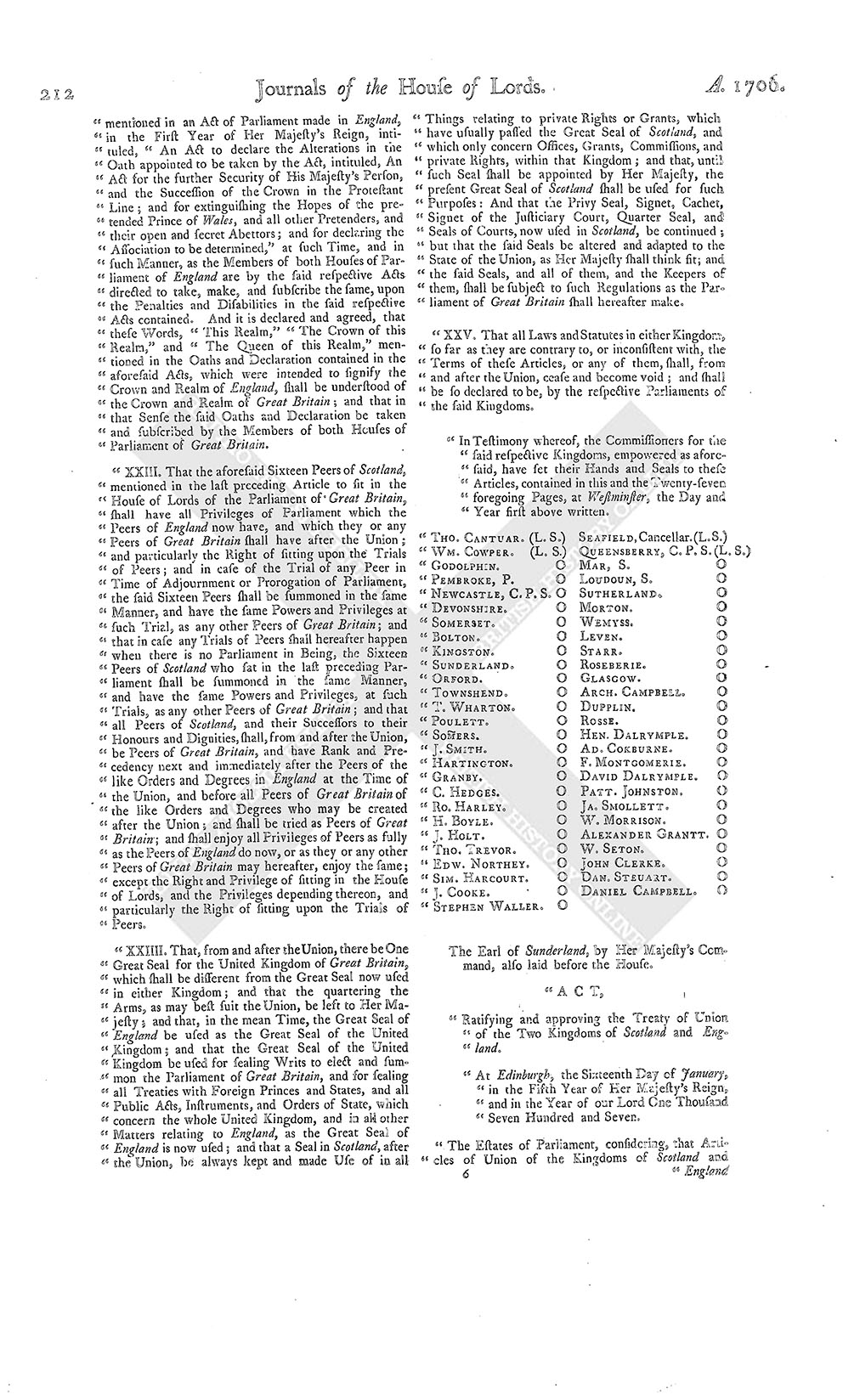
"XXII. That, by virtue of this Treaty, of the Peers of Scotland at the Time of the Union, Sixteen shall be the Number to sit and vote in the House of Lords, and Forty-five the Number of the Representatives of Scotland in the House of Commons of the Parliament of Great Britain: And that, when Her Majesty, Her Heirs or Successors, shall declare Her or Their Pleasure for holding the First or any subsequent Parliament of Great Britain, until the Parliament of Great Britain shall make further Provision therein, a Writ do issue, under the Great Seal of the United Kingdom, directed to the Privy Council of Scotland, commanding them to cause Sixteen Peers, who are to sit in the House of Lords, to be summoned to Parliament, and Forty-five Members to be elected, to sit in the House of Commons of the Parliament of Great Britain, according to the Agreement in this Treaty, in such Manner as by the Parliament of Scotland shall be settled before the Union; and that the Names of the Persons so summoned and elected shall be returned by the Privy Council of Scotland, into the Court from whence the said Writ did issue; and that if Her Majesty, on or before the First Day of May next, on which Day the Union is to take Place, shall declare, under the Great Seal of England, that it is expedient that the Lords of Parliament of England, and Commons of the present Parliament of England, should be the Members of the respective Houses of the First Parliament of Great Britain, for and on the Part of England; then the said Lords of Parliament of England, and Commons of the present Parliament of England, shall be the Members of the respective Houses of the First Parliament of Great Britain, for and on the Part of England; and Her Majesty may, by Her Royal Proclamation under the Great Seal of Great Britain, appoint the said First Parliament of Great Britain to meet at such Time and Place as Her Majesty shall think fit; which Time shall not be less than Fifty Days after the Date of such Proclamation; and, the Time and Place of the Meeting of such Parliament being so appointed, a Writ shall be immediately issued under the Great Seal of Great Britain, directed to the Privy Council of Scotland, for the summoning the Sixteen Peers, and for electing Fortyfive Members, by whom Scotland is to be represented in the Parliament of Great Britain; and the Lords of Parliament of England, and the Sixteen Peers of Scotland, such Sixteen Peers being summoned and returned in the Manner agreed in this Treaty, and the Members of the House of Commons of the said Parliament of England, and the Forty-five Members for Scotland, such Forty-five Members being elected and returned in the Manner agreed in this Treaty, shall assemble and meet respectively, in the respective Houses of the Parliament of Great Britain, at such Time and Place as shall be so appointed by Her Majesty; and shall be the Two Houses of the First Parliament of Great Britain; and that Parliament may continue for such Time only as the present Parliament of England might have continued, if the Union of the Two Kingdoms had not been made, unless sooner dissolved by Her Majesty; and that every One of the Lords of Parliament of Great Britain, and every Member of the House of Commons of the Parliament of Great Britain, in the First and all succeeding Parliaments of Great Britain, until the Parliament of Great Britain shall otherwise direct, shall take the respective Oaths appointed to be taken instead of the Oaths of Allegiance and Supremacy, by an Act of Parliament made in England, in the First Year of the Reign of the late King William and Queen Mary, intituled, "An Act for the abrogating of the Oaths of Supremacy and Allegiance, and appointing other Oaths;" and make, subscribe, and audibly repeat, the Declaration mentioned in an Act of Parliament made in England, in the Thirtieth Year of the Reign of King Charles the Second, intituled, "An Act for the more effectual preserving the King's Person and Government, by disabling Papists from sitting in either House of Parliament;" and shall take and subscribe the Oath mentioned in an Act of Parliament made in England, in the First Year of Her Majesty's Reign, intituled, "An Act to declare the Alterations in the Oath appointed to be taken by the Act, intituled, An Act for the further Security of His Majesty's Person, and the Succession of the Crown in the Protestant Line; and for extinguishing the Hopes of the pretended Prince of Wales, and all other Pretenders, and their open and secret Abettors; and for declaring the Association to be determined," at such Time, and in such Manner, as the Members of both Houses of Parliament of England are by the said respective Acts directed to take, make, and subscribe the same, upon the Penalties and Disabilities in the said respective Acts contained. And it is declared and agreed, that these Words, "This Realm," "The Crown of this Realm," and "The Queen of this Realm," mentioned in the Oaths and Declaration contained in the aforesaid Acts, which were intended to signify the Crown and Realm of England, shall be understood of the Crown and Realm of Great Britain; and that in that Sense the said Oaths and Declaration be taken and subscribed by the Members of both Houses of Parliament of Great Britain.
"XXIII. That the aforesaid Sixteen Peers of Scotland, mentioned in the last preceding Article to sit in the House of Lords of the Parliament of Great Britain, shall have all Privileges of Parliament which the Peers of England now have, and which they or any Peers of Great Britain shall have after the Union; and particularly the Right of sitting upon the Trials of Peers; and in case of the Trial of any Peer in Time of Adjournment or Prorogation of Parliament, the said Sixteen Peers shall be summoned in the same Manner, and have the same Powers and Privileges at such Trial, as any other Peers of Great Britain; and that in case any Trials of Peers shall hereafter happen when there is no Parliament in Being, the Sixteen Peers of Scotland who sat in the last preceding Parliament shall be summoned in the same Manner, and have the same Powers and Privileges, at such Trials, as any other Peers of Great Britain; and that all Peers of Scotland, and their Successors to their Honours and Dignities, shall, from and after the Union, be Peers of Great Britain, and have Rank and Precedency next and immediately after the Peers of the like Orders and Degrees in England at the Time of the Union, and before all Peers of Great Britain of the like Orders and Degrees who may be created after the Union; and shall be tried as Peers of Great Britain; and shall enjoy all Privileges of Peers as fully as the Peers of England do now, or as they or any other Peers of Great Britain may hereafter, enjoy the same; except the Right and Privilege of sitting in the House of Lords, and the Privileges depending thereon, and particularly the Right of sitting upon the Trials of Peers.
"XXIIII. That, from and after the Union, there be One Great Seal for the United Kingdom of Great Britain, which shall be different from the Great Seal now used in either Kingdom; and that the quartering the Arms, as may best suit the Union, be left to Her Majesty; and that, in the mean Time, the Great Seal of England be used as the Great Seal of the United Kingdom; and that the Great Seal of the United Kingdom be used for sealing Writs to elect and summon the Parliament of Great Britain, and for sealing all Treaties with Foreign Princes and States, and all Public Acts, Instruments, and Orders of State, which concern the whole United Kingdom, and in all other Matters relating to England, as the Great Seal of England is now used; and that a Seal in Scotland, after the Union, be always kept and made Use of in all Things relating to private Rights or Grants, which have usually passed the Great Seal of Scotland, and which only concern Offices, Grants, Commissions, and private Rights, within that Kingdom; and that, until such Seal shall be appointed by Her Majesty, the present Great Seal of Scotland shall be used for such Purposes: And that the Privy Seal, Signet, Cachet, Signet of the Justiciary Court, Quarter Seal, and Seals of Courts, now used in Scotland, be continued; but that the said Seals be altered and adapted to the State of the Union, as Her Majesty shall think fit; and the said Seals, and all of them, and the Keepers of them, shall be subject to such Regulations as the Parliament of Great Britain shall hereafter make.
"XXV. That all Laws and Statutes in either Kingdom, so far as they are contrary to, or inconsistent with, the Terms of these Articles, or any of them, shall, from and after the Union, cease and become void; and shall be so declared to be, by the respective Parliaments of the said Kingdoms.
"In Testimony whereof, the Commissioners for the said respective Kingdoms, empowered as aforesaid, have set their Hands and Seals to these Articles, contained in this and the Twenty-seven foregoing Pages, at Westminster, the Day and Year first above written.
The Earl of Sunderland, by Her Majesty's Command, also laid before the House.
"A C T,
"Ratifying and approving the Treaty of Union of the Two Kingdoms of Scotland and England.
"At Edinburgh, the Sixteenth Day of January, in the Fifth Year of Her Majesty's Reign, and in the Year of our Lord One Thousand Seven Hundred and Seven.
"The Estates of Parliament, considering, that Articles of Union of the Kingdoms of Scotland and "England were agreed on the Twentieth and Second Day of July One Thousand Seven Hundred and Six Years, by the Commissioners nominated on Behalf of this Kingdom under Her Majesty's Great Seal of Scotland, bearing Date the Twentieth and Seventh of February last past, in Pursuance of the Fourth Act of the Third Session of this Parliament; and the Commissioners nominated on Behalf of the Kingdom of England, under Her Majesty's Great Seal of England, bearing Date at Westminster, the Tenth Day of April last past, in Pursuance of an Act of Parliament made in England the Third Year of Her Majesty's Reign, to treat of and concerning an Union of the said Kingdoms; which Articles were, in all Humility, presented to Her Majesty upon the Twentieth and Third of the said Month of July, and were recommended to this Parliament by Her Majesty's Royal Letter, of the Date the Thirtyone Day of July One Thousand Seven Hundred and Six; and that the said Estates of Parliament have agreed to and approven of the said Articles of Union, with some Additions and Explanations, as is contained in the Articles hereafter insert, and sicklike; Her Majesty, with Advice and Consent of the Estates of Parliament, resolving to establish the Protestant Religion and Presbyterian Church Government within this Kingdom, has past in this Session of Parliament an Act, intituled, "Act for securing of the Protestant Religion and Presbyterian Church Government," which, by the Tenor thereof, is appointed to be insert in any Act ratifying the Treaty, and expressly declared to be a fundamental and essential Condition of the said Treaty or Union in all Time coming: Therefore Her Majesty, with Advice and Consent of the Estates of Parliament, in Fortification of the Approbation of the Articles as abovementioned, and for the further and better establishing of the same, upon full and mature Deliberation upon the foresaid Articles of Union and Act of Parliament, doth ratify, approve, and confirm the same, with the Additions and Explanations contained in the said Articles, in Manner, and under the Provision, after mentioned; whereof the Tenor follows:
"Ist Article. That the Two Kingdoms of Scotland and England shall, upon the First Day of May next ensuing the Date hereof, and for ever after, be united into One Kingdom, by the Name of Great Britain; and that the Ensigns Armorial of the said United Kingdom be such as Her Majesty shall appoint; and the Crosses of Saint Andrew and Saint George be conjoined, in such Manner as Her Majesty shall think fit, and used in all Flags, Banners, Standards, and Ensigns, both at Sea and Land.
"II. That the Succession to the Monarchy of the United Kingdom of Great Britain, and of the Dominions thereunto belonging, after Her most Sacred Majesty, and in Default of Issue of Her Majesty, be, remain, and continue, to the most Excellent Princess Sophia Electress and Dutchess Dowager of Hannover, and the Heirs of her Body, being Protestants, upon whom the Crown of England is settled, by an Act of Parliament made in England in the Twelfth Year of the Reign of His late Majesty King William the Third, intituled, "An Act for the further Limitation of the Crown, and better securing the Rights and Liberties of the Subject;" and that all Papists, and Persons marrying Papists, shall be excluded from, and for ever incapable to inherit, possess, or enjoy, the Imperial Crown of Great Britain, and the Dominions thereunto belonging, or any Part thereof; and in every such Case, the Crown and Government shall from Time to Time descend to, and be enjoyed by, such Person, being a Protestant, as should have inherited and enjoyed the same in case such Papist, or Person marrying a Papist, was naturally dead, according to the Provision for the Descent of the Crown of England, made by another Act of Parliament in England, in the First Year of the Reign of Their late Majesties King William and Queen Mary, intituled, "An Act, declaring the Rights and Liberties of the Subject, and settling the Succession of the Crown."
"III. That the United Kingdom of Great Britain be represented by One and the same Parliament, to be styled, "The Parliament of Great Britain."
"IV. That all the Subjects of the United Kingdom of Great Britain shall, from and after the Union, have full Freedom and Intercourse of Trade and Navigation, to and from any Port or Place within the said United Kingdom, and the Dominions and Plantations thereunto belonging; and that there be a Communication of all other Rights, Privileges, and Advantages, which do or may belong to the Subjects of either Kingdom, except where it is otherwise expressly agreed in these Articles.
"V. That all Ships or Vessels belonging to Her Majesty's Subjects of Scotland, at the Time of ratifying the Treaty of Union of the Two Kingdoms in the Parliament of Scotland, though Foreign-built, be deemed and pass as Ships of the Built of Great Britain; the Owner, or, where there are more Owners, One or more of the Owners, within Twelve Months after the First of May next, making Oath, "That, at the Time of ratifying the Treaty of Union in the Parliament of Scotland, the same did, in Haill or in Part, belong to him or them, or to some other Subject or Subjects of Scotland, to be particularly named, with the Place of their respective Abodes; and that the same doth then, at the Time of the said Deposition, wholly belong to him or them; and that no Foreigner, directly or indirectly, hath any Part or Interest therein;" which Oath shall be made before the Chief Officer or Officers of the Customs, in the Port next to the Abode of the said Owner or Owners; and the said Officer or Officers shall be empowered to administer the said Oath; and the Oath, being so administered, shall be attested by the Officer or Officers who administer the same; and, being registered by the said Officer or Officers, shall be delivered to the Master of the Ship, for Security of her Navigation; and a Duplicate thereof shall be transmitted by the said Officer or Officers to the Chief Officer or Officers of the Customs in the Port of Edinburgh, to be there entered in a Register, and from thence to be sent to the Port of London, to be there entered in the general Register of all Trading Ships belonging to Great Britain.
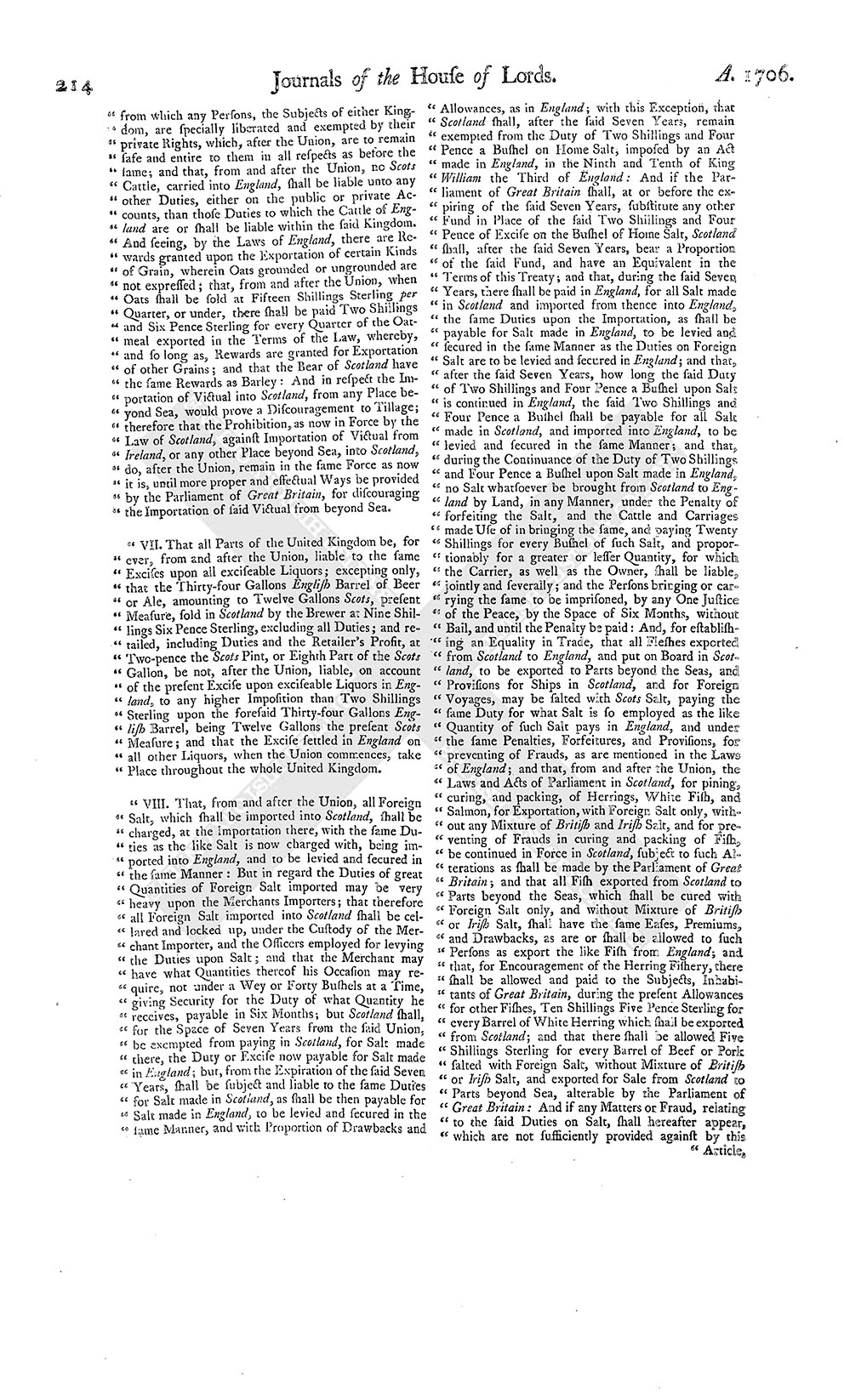
"VI. That all Parts of the United Kingdom, for ever, from and after the Union, shall have the same Allowances, Encouragements, and Drawbacks, and be under the same Prohibitions, Restrictions, and Regulations of Trade, and liable to the same Customs and Duties on Import and Export; and that the Allowances, Encouragements, and Drawbacks, Prohibitions, Restrictions, and Regulations of Trade, and the Customs and Duties on Import and Export, settled in England when the Union commences, shall, from and after the Union, take Place throughout the whole United Kingdom; excepting and reserving the Duties upon Export and Import of such particular Commodities, from which any Persons, the Subjects of either Kingdom, are specially liberated and exempted by their private Rights, which, after the Union, are to remain safe and entire to them in all respects as before the same; and that, from and after the Union, no Scots Cattle, carried into England, shall be liable unto any other Duties, either on the public or private Accounts, than those Duties to which the Cattle of England are or shall be liable within the said Kingdom. And seeing, by the Laws of England, there are Rewards granted upon the Exportation of certain Kinds of Grain, wherein Oats grounded or ungrounded are not expressed; that, from and after the Union, when Oats shall be sold at Fifteen Shillings Sterling per Quarter, or under, there shall be paid Two Shillings and Six Pence Sterling for every Quarter of the Oatmeal exported in the Terms of the Law, whereby, and so long as, Rewards are granted for Exportation of other Grains; and that the Bear of Scotland have the same Rewards as Barley: And in respect the Importation of Victual into Scotland, from any Place beyond Sea, would prove a Discouragement to Tillage; therefore that the Prohibition, as now in Force by the Law of Scotland, against Importation of Victual from Ireland, or any other Place beyond Sea, into Scotland, do, after the Union, remain in the same Force as now it is, until more proper and effectual Ways be provided by the Parliament of Great Britain, for discouraging the Importation of said Victual from beyond Sea.
"VII. That all Parts of the United Kingdom be, for ever, from and after the Union, liable to the same Excises upon all exciseable Liquors; excepting only, that the Thirty-four Gallons English Barrel of Beer or Ale, amounting to Twelve Gallons Scots, present Measure, sold in Scotland by the Brewer at Nine Shillings Six Pence Sterling, excluding all Duties; and retailed, including Duties and the Retailer's Profit, at Two-pence the Scots Pint, or Eight Part of the Scots Gallon, be not, after the Union, liable, on account of the present Excise upon exciseable Liquors in England, to any higher Imposition than Two Shillings Sterling upon the foresaid Thirty-four Gallons English Barrel, being Twelve Gallons the present Scots Measure; and that the Excise settled in England on all other Liquors, when the Union commences, take Place throughout the whole United Kingdom.
"VIII. That, from and after the Union, all Foreign Salt, which shall be imported into Scotland, shall be charged, at the Importation there, with the same Duties as the like Salt is now charged with, being imported into England, and to be levied and secured in the same Manner: But in regard the Duties of great Quantities of Foreign Salt imported may be very heavy upon the Merchants Importers; that therefore all Foreign Salt imported into Scotland shall be cellared and locked up, under the Custody of the Merchant Importer, and the Officers employed for levying the Duties upon Salt; and that the Merchant may have what Quantities thereof his Occasion may require, not under a Wey or Forty Bushels at a Time, giving Security for the Duty of what Quantity he receives, payable in Six Months; but Scotland shall, for the Space of Seven Years from the said Union, be exempted from paying in Scotland, for Salt made there, the Duty or Excise now payable for Salt made in England; but, from the Expiration of the said Seven Years, shall be subject and liable to the same Duties for Salt made in Scotland, as shall be then payable for Salt made in England, to be levied and secured in the same Manner, and with Proportion of Drawbacks and Allowances, as in England; with this Exception, that Scotland shall, after the said Seven Years, remain exempted from the Duty of Two Shillings and Four Pence a Bushel on Home Salt, imposed by an Act made in England, in the Ninth and Tenth of King William the Third of England: And if the Parliament of Great Britain shall, at or before the expiring of the said Seven Years, substitute any other Fund in Place of the said Two Shillings and Four Pence of Excise on the Bushel of Home Salt, Scotland shall, after the said Seven Years, bear a Proportion of the said Fund, and have an Equivalent in the Terms of this Treaty; and that, during the said Seven Years, there shall be paid in England, for all Salt made in Scotland and imported from thence into England, the same Duties upon the Importation, as shall be payable for Salt made in England, to be levied and secured in the same Manner as the Duties on Foreign Salt are to be levied and secured in England; and that, after the said Seven Years, how long the said Duty of Two Shillings and Four Pence a Bushel upon Salt is continued in England, the said Two Shillings and Four Pence a Bushel shall be payable for all Salt made in Scotland, and imported into England, to be levied and secured in the same Manner; and that, during the Continuance of the Duty of Two Shillings and Four Pence a Bushel upon Salt made in England, no Salt whatsoever be brought from Scotland to England by Land, in any Manner, under the Penalty of forfeiting the Salt, and the Cattle and Carriages made Use of in bringing the same, and paying Twenty Shillings for every Bushel of such Salt, and proportionably for a greater or lesser Quantity, for which the Carrier, as well as the Owner, shall be liable, jointly and severally; and the Persons bringing or carrying the same to be imprisoned, by any One Justice of the Peace, by the Space of Six Months, without Bail, and until the Penalty be paid: And, for establishing an Equality in Trade, that all Fleshes exported from Scotland to England, and put on Board in Scotland, to be exported to Parts beyond the Seas, and Provisions for Ships in Scotland, and for Foreign Voyages, may be salted with Scots Salt, paying the same Duty for what Salt is so employed as the like Quantity of such Salt pays in England, and under the same Penalties, Forfeitures, and Provisions, for preventing of Frauds, as are mentioned in the Laws of England; and that, from and after the Union, the Laws and Acts of Parliament in Scotland, for pining, curing, and packing, of Herrings, White Fish, and Salmon, for Exportation, with Foreign Salt only, without any Mixture of British and Irish Salt, and for preventing of Frauds in curing and packing of Fish, be continued in Force in Scotland, subject to such Alterations as shall be made by the Parliament of Great Britain; and that all Fish exported from Scotland to Parts beyond the Seas, which shall be cured with Foreign Salt only, and without Mixture of British or Irish Salt, shall have the same Eases, Premiums, and Drawbacks, as are or shall be allowed to such Persons as export the like Fish from England; and that, for Encouragement of the Herring Fishery, there shall be allowed and paid to the Subjects, Inhabitants of Great Britain, during the present Allowances for other Fishes, Ten Shillings Five Pence Sterling for every Barrel of White Herring which shall be exported from Scotland; and that there shall be allowed Five Shillings Sterling for every Barrel of Beef or Pork salted with Foreign Salt, without Mixture of British or Irish Salt, and exported for Sale from Scotland to Parts beyond Sea, alterable by the Parliament of Great Britain: And if any Matters or Fraud, relating to the said Duties on Salt, shall hereafter appear, which are not sufficiently provided against by this Article, the same shall be subject to such further Provisions as shall be thought fit by the Parliament of Great Britain.
"IX. That whenever the Sum of One Million Nine Hundred Ninety-seven Thousand Seven Hundred and Sixty-three Pounds, Eight Shillings, and Four Pence Half-penny, shall be enacted by the Parliament of Great Britain to be raised in that Part of the United Kingdom now called England, on Land, and other Things usually charged in Acts of Parliament there, for granting an Aid to the Crown by a Land Tax; that Part of the United Kingdom now called Scotland shall be charged by the same Act with a further Sum of Forty-eight Thousand Pounds, free of all Charges, as the Quota of Scotland to such Tax; and so proportionably for any greater or lesser Sum raised in England, by any Tax on Land, and other Things usually charged together with the Land; and that such Quota for Scotland, in the Cases aforesaid, be raised and collected in the same Manner as the Cess now is in Scotland, but subject to such Regulations in the Manner of collecting as shall be made by the Parliament of Great Britain.
"X. That, during the Continuance of the respective Duties on Stampt Paper, Vellum, and Parchment, by the several Acts now in Force in England; Scotland shall not be charged with the same respective Duties.
"XI. That, during the Continuance of the Duties payable in England, on Windows and Lights, which determines on the First Day of August One Thousand Seven Hundred and Ten; Scotland shall not be charged with the same Duties.
"XII. That, during the Continuance of the Duties payable in England, on Coals, Culm, and Cinders, which determines the Thirtieth Day of September One Thousand Seven Hundred and Ten; Scotland shall not be charged therewith, for Coals, Culm, and Cinders, consumed there; but shall be charged with the same Duties as in England, for all Coal, Culm, and Cinders, not consumed in Scotland.
"XIII. That, during the Continuance of the Duty payable in England, upon Malt, which determines the Twenty-fourth Day of June One Thousand Seven Hundred and Seven; Scotland shall not be charged with that Duty.
"XIV. That the Kingdom of Scotland be not charged with any other Duties laid on by the Parliament of England before the Union, except these consented to in this Treaty; in regard it is agreed that all necessary Provision shall be made by the Parliament of Scotland for the Public Charge and Service of that Kingdom for the Year One Thousand Seven Hundred and Seven: Provided nevertheless, That, if the Parliament of England shall think fit to lay any further Impositions, by Way of Customs, or such Excises with which, by virtue of this Treaty, Scotland is to be charged equally with England; in such Case, Scotland shall be liable to the same Customs and Excises, and have an Equivalent, to be settled by the Parliament of Great Britain; with this further Provision, That any Malt to be made and consumed in that Part of the United Kingdom now called Scotland, shall not be charged with any Imposition upon Malt during this present War: And seeing it cannot be supposed, that the Parliament of Great Britain will ever lay any Sorts of Burdens upon the United Kingdom, but what they shall find of Necessity, at that Time, for the Preservation and Good of the Whole, and with due Regard to the Circumstances and Abilities of every Part of the United Kingdom; therefore it is agreed, that there be no further Exemption insisted upon for any Part of the United Kingdom; but that the Consideration of any Exemptions, beyond what are already agreed on in this Treaty, shall be left to the Determination of the Parliament of Great Britain.
"XV. Whereas, by the Terms of this Treaty, the Subjects of Scotland, for preserving an Equality of Trade throughout the United Kingdom, will be liable to several Customs and Excises now payable in England, which will be applicable towards Payment of the Debts of England contracted before the Union: It is agreed, that Scotland shall have an Equivalent for what the Subjects thereof shall be so charged towards Payment of the said Debts of England, in all Particulars whatsoever, in Manner following; (videlicet,) That, before the Union of the said Kingdoms, the Sum of Three Hundred Ninety-eight Thousand and Eighty-five Pounds, Ten Shillings, be granted to Her Majesty, by the Parliament of England, for the Uses after mentioned, being the Equivalent to be answered to Scotland for such Parts of the said Customs and Excises upon all exciseable Liquors with which that Kingdom is to be charged upon the Union, as will be applicable to the Payment of the said Debts of England, according to the Proportions which the present Customs in Scotland, being Thirty Thousand Pounds per Annum, do bear to the Customs in England, computed at One Million Three Hundred Forty-one Thousand Five Hundred and Fifty-nine Pounds per Annum; and which the present Excises on exciseable Liquors in Scotland, being Thirty-three Thousand and Five Hundred Pounds per Annum, do bear to the Excises on exciseable Liquors in England, computed at Nine Hundred Forty-seven Thousand Six Hundred and Two Pounds per Annum; which Sum of Three Hundred Ninety-eight Thousand Eighty-five Pounds, Ten Shillings, shall be due and payable from the Time of the Union: And in regard that, after the Union, Scotland becoming liable to the same Customs and Duties payable on Import and Export, and to the same Excises on all exciseable Liquors as in England; as well upon that Account, as upon the Account of the Increase of Trade and People (which will be the happy Consequence of the Union), the said Revenues will much improve beyond the beforementioned annual Values thereof, of which no present Estimate can be made; yet, nevertheless, for the Reasons aforesaid, there ought to be a proportionable Equivalent answered to Scotland; it is agreed, that, after the Union, there shall be an Accompt kept of the said Duties arising in Scotland; to the End it may appear, what ought to be answered to Scotland, as an Equivalent for such Proportion of the said Increase as shall be applicable to the Payment of the Debts of England: And, for the further and more effectual answering the several Ends hereafter mentioned, it is agreed, that, from and after the Union, the whole Increase of the Revenues of Customs and Duties on Import and Export, and Excise upon exciseable Liquors in Scotland, over and above the annual Produce of the said respective Duties, as above stated, shall go, and be applied, for the Term of Seven Years, to the Uses hereafter mentioned; and that, upon the said Account, there shall be answered to Scotland annually, from the End of Seven Years after the Union, an Equivalent in Proportion to such Part of the said Increase as shall be applicable to the Debts of England; and generally, that an Equivalent shall be answered to Scotland, for such Parts of the English Debts as Scotland may hereafter become liable to pay by reason of the Union; other than such for which Appropriations have been made, by Parliament in England, of the Customs or other Duties on Export and Import, Excises on all exciseable Liquors; in respect of which Debts, Equivalents are herein before provided: And as for the Uses for which the said Sum of Three Hundred Ninety-eight Thousand Eighty-five Pounds, Ten Shillings, to be granted as aforesaid, and all other Monies which are to be answered or allowed to Scotland, as said is, are to be applied; it is agreed, that, in the First Place, out of the foresaid Sum, what Consideration shall be found necessary to be had for any Losses which private Persons may sustain, by reducing the Coin of Scotland to the Standard and Value of the Coin of England, may be made good; in the next Place, that the Capital Stock or Fund of the African and Indian Company of Scotland advanced, together with the Interest for the said Capital Stock, after the Rate of Five per Centum per Annum, from the respective Times of the Payment thereof, shall be paid; upon Payment of which Capital Stock and Interest, it is agreed, the said Company be dissolved and cease; and also that, from the Time of passing the Act of Parliament in England, for raising the said Sum of Three Hundred Ninety-eight Thousand Eighty-five Pounds, Ten Shillings, the said Company shall neither trade, nor grant License to trade; providing, that if the said Stock and Interest shall not be paid in Twelve Months after the Commencement of the Union, that then the said Company may from thenceforward trade, or give License to trade, until the said haill Capital Stock and Interest shall be paid: And as to the Overplus of the said Sum of Three Hundred Ninety-eight Thousand Eighty-five Pounds, Ten Shillings, after Payment of what Consideration shall be had for Losses in repairing the Coin, and paying the said Capital Stock and Interest, and also the hail Increase of the said Revenues of Customs, Duties, and Excise, above the present Value which shall arise in Scotland, during the said Term of Seven Years together, with the Equivalent which shall become due upon the Improvement thereof in Scotland after the said Term; and also as to all other Sums, which, according to the Agreements aforesaid, may become payable to Scotland, by Way of Equivalent for what that Kingdom shall hereafter become liable towards Payment of the Debt of England; it is agreed, that the same be applied in Manner following; (videlicet,) That all the public Debts of the Kingdom of Scotland as shall be adjusted by this present Parliament shall be paid; and that Two Thousand Pounds per Annum, for the Space of Seven Years, shall be applied towards encouraging and promoting the Manufacture of coarse Wool within those Shires which produce the Wool; and that the First Two Thousand Pounds Sterling be paid at Martinmas next, and so Yearly at Martinmas during the Space foresaid; and afterwards the same shall be wholly applied towards the encouraging and promoting the Fisheries, and such other Manufactures and Improvements, in Scotland, as may most conduce to the general Good of the United Kingdom: And it is agreed, that Her Majesty be empowered to appoint Commissioners, who shall be accountable to the Parliament of Great Britain, for disposing the said Sum of Three Hundred Ninety-eight Thousand Eightyfive Pounds, Ten Shillings, and all other Monies which shall arise to Scotland upon the Agreement aforesaid, to the Purposes before mentioned; which Commissioners shall be empowered to call for, receive, and dispose of, the said Monies, in Manner aforesaid; and to inspect the Books of the several Collectors of the said Revenues, and of all other Duties from whence an Equivalent may arise; and that the Collectors and Managers of the said Revenues and Duties be obliged to give to the said Commissioners subscribed authentic Abbreviates of the Produce of such Revenues and Duties arising in their respective Districts; and that the said Commissioners shall have their Office within the Limits of Scotland; and shall, in such Office, keep Books, containing Accompts of the Amount of the Equivalents, and how the same shall have been disposed of from Time to Time; which may be inspected by any of the Subjects, who shall desire the same.
"XVI. That, from and after the Union, the Coin shall be of the same Standard and Value throughout the United Kingdom as now in England; and a Mint shall be continued in Scotland, under the same Rules as the Mint in England; and the present Officers of the Mint continued, subject to such Regulations and Alterations as Her Majesty, Her Heirs or Successors, or the Parliament of Great Britain, shall think fit.
"XVII. That, from and after the Union, the same Weights and Measures shall be used throughout the United Kingdom as are now established in England; and Standards of Weights and Measures shall be kept by those Burghs in Scotland to whom the keeping the Standards of Weights and Measures now in Use there does of special Right belong; all which Standards shall be sent down to such respective Burghs from the Standards kept in the Exchequer at Westminster; subject nevertheless to such Regulations as the Parliament of Great-Britain shall think fit.
"XVIII. That the Laws concerning Regulation of Trade, Customs, and such Excises to which Scotland is, by Virtue of this Treaty, to be liable, be the same in Scotland, from and after the Union, as in England; and that all other Laws in Use within the Kingdom of Scotland do, after the Union, and notwithstanding thereof, remain in the same Force as before (except such as are contrary to, or inconsistent with, this Treaty), but alterable by the Parliament of Great-Britain; with this Difference betwixt the Laws concerning Public Right, Policy, and Civil Government, and those which concern Private Right, that the Laws which concern Public Right, Policy, and Civil Government, may be made the same throughout the whole United Kingdom; but that no Alteration be made in Laws which concern Private Right, except for evident Utility of the Subjects within Scotland.
"XIX. That the Court of Session, or College of Justice, do, after the Union, and notwithstanding thereof, remain, in all Time coming, within Scotland, as it is now constituted by the Laws of that Kingdom, and with the same Authority and Privileges as before the Union; subject nevertheless to such Regulations for the better Administration of Justice as shall be made by the Parliament of Great Britain: And that hereafter none shall be named by Her Majesty, or Her Royal Successors, to be ordinary Lords of Session, but such who have served in the College of Justice, as Advocates, or Principal Clerks of Session, for the Space of Five Years, or as Writers to the Signet for the Space of Ten Years; with this Provision, That no Writer to the Signet be capable to be admitted a Lord of the Session, unless he undergo a private and public Trial of the Civil Law before the Faculty of Advocates, and be found by them qualified for the said Office, Two Years before he be named to be a Lord of the Session; yet so as the Qualifications made, or to be made, for capacitating Persons to be named Ordinary Lords of Session, may be altered by the Parliament of Great Britain: And that the Court of Justiciary do also, after the Union, and notwithstanding thereof, remain in all Time coming within Scotland, as it is now constituted by the Laws of that Kingdom, and with the same Authority and Privileges as before the Union; subject nevertheless to such Regulations as shall be made by the Parliament of Great Britain; and without Prejudice of other Rights of Justiciary: And that all Admiralty Jurisdictions be under the Lord High Admiral, or Commissioners for the Admiralty of Great Britain, for the Time being; and that the Court of Admiralty now established in Scotland be continued; and that all Reviews, Reductions, or Suspensions of the Sentences in Maritime Cases, competent to the Jurisdiction of that Court, remain in the same Manner, after the Union, as now in Scotland, until the Parliament of Great Britain shall make such Regulations and Alterations as shall be judged expedient for the whole United Kingdom; so as there be always continued in Scotland a Court of Admiralty, such as in England, for Determination of all Maritime Cases relating to private Rights in Scotland, competent to the Jurisdiction of the Admiralty Court; subject nevertheless to such Regulations and Alterations as shall be thought proper to be made by the Parliament of Great Britain: And that the Heretable Rights of Admiralty and Vice Admiralties in Scotland be reserved to the respective Proprietors, as Rights of Property; subject nevertheless, as to the Manner of exercising such Heretable Rights, to such Regulations and Alterations as shall be thought proper to be made by the Parliament of Great Britain; and that all other Courts now in being within the Kingdom of Scotland do remain, but subject to Alterations by the Parliament of Great Britain; and that all inferior Courts within the said Limits do remain subordinate, as they are now, to the supreme Courts of Justice within the same, in all Time coming: And that no Causes in Scotland be cognoscible by the Courts of Chancery, Queen's Bench, Common Pleas, or any other Court in Westminster Hall; and that the said Courts, or any other of the like Nature, after the Union, shall have no Power to cognosce, review, or alter, the Acts or Sentences of the Judicatures within Scotland, or stop the Execution of the same: And that there be a Court of Exchequer in Scotland, after the Union, for deciding Questions concerning the Revenues of Customs and Excises there, having the same Power and Authority, in such Cases, as the Court of Exchequer has in England; and that the said Court of Exchequer in Scotland have Power of passing Signatures, Gifts, Tutories, and in other Things, as the Court of Exchequer at present in Scotland hath; and that the Court of Exchequer that now is in Scotland do remain, until a new Court of Exchequer be settled by the Parliament of Great Britain in Scotland after the Union: And that, after the Union, the Queen's Majesty and Her Royal Successors may continue a Privy Council in Scotland, for preserving of Public Peace and Order, until the Parliament of Great Britain shall think fit to alter it, or establish any other effectual Method for that End.
"XX. That all Heretable Offices, Superiorities, Heretable Jurisdictions, Offices for Life, and Jurisdictions for Life, be reserved to the Owners thereof, as Rights of Property, in the same Manner as they are now enjoyed by the Laws of Scotland, notwithstanding of this Treaty.
"XXI. That the Rights and Privileges of the Royal Burghs in Scotland, as they now are, do remain entire after the Union, and notwithstanding thereof.
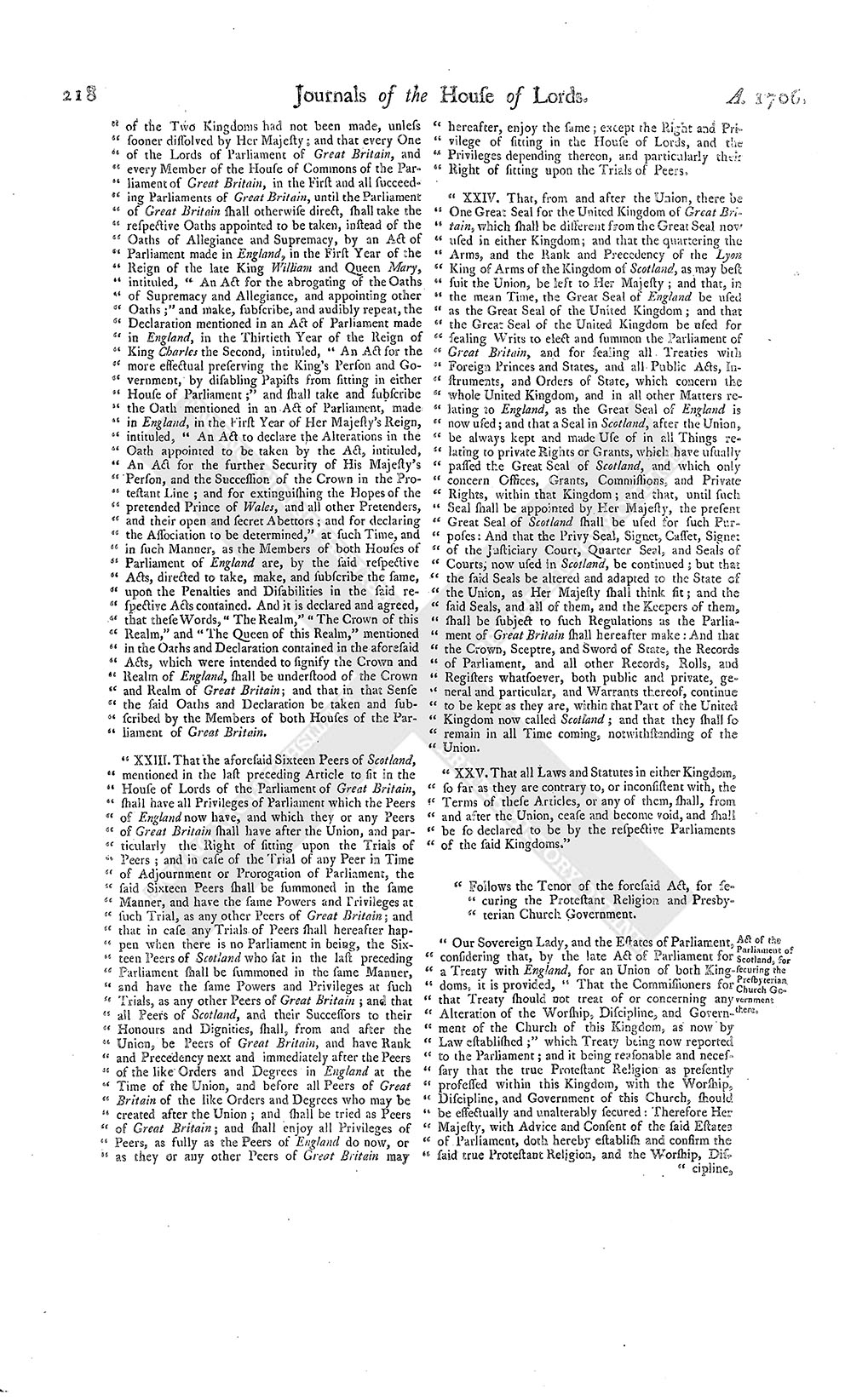
"XXII. That, by Virtue of this Treaty, of the Peers of Scotland at the Time of the Union, Sixteen shall be the Number to sit and vote in the House of Lords, and Forty-five the Number of the Representatives of Scotland in the House of Commons of the Parliament of Great Britain; and that, when Her Majesty, Her Heirs or Successors, shall declare Her or Their Pleasure for holding the First or any subsequent Parliament of Great Britain, until the Parliament of Great Britain shall make further Provision therein, a Writ do issue, under the Great Seal of the United Kingdom, directed to the Privy Council of Scotland, commanding them to cause Sixteen Peers, who are to sit in the House of Lords, to be summoned to Parliament, and Forty-five Members to be elected, to sit in the House of Commons of the Parliament of Great Britain, according to the Agreement in this Treaty, in such Manner as by a subsequent Act of this present Session of the Parliament of Scotland shall be settled, which Act is hereby declared to be as valid as if it were a Part of, and engrossed in, this Treaty; and that the Names of the Persons so summoned and elected shall be returned, by the Privy Council of Scotland, into the Court from whence the said Writ did issue: And that, if Her Majesty, on or before the First Day of May next, on which Day the Union is to take Place, shall declare, under the Great Seal of England, that it is expedient, that the Lords of Parliament of England, and Commons of the present Parliament of England, should be the Members of the respective Houses of the First Parliament of Great Britain, for and on the Part of England; then the said Lords of Parliament of England, and Commons of the present Parliament of England, shall be the Members of the respective Houses of the First Parliament of Great Britain, for and on the Part of England; and Her Majesty may, by Her Royal Proclamation, under the Great Seal of Great Britain, appoint the said First Parliament of Great Britain to meet at such Time and Place as Her Majesty shall think sit, which Time shall not be less than Fifty Days after the Date of such Proclamation; and, the Time and Place of the Meeting of such Parliament being so appointed, a Writ shall be immediately issued, under the Great Seal of Great Britain, directed to the Privy Council of Scotland, for the summoning the Sixteen Peers, and for electing Fortyfive Members, by whom Scotland is to be represented in the Parliament of Great Britain; and the Lords of Parliament of England, and the Sixteen Peers of Scotland, such Sixteen Peers being summoned and returned in the Manner agreed in this Treaty, and the Members of the House of Commons of the said Parliament of England, and the Forty-five Members for Scotland, such Forty-five Members being elected and returned in the Manner agreed in this Treaty, shall assemble and meet respectively, in their respective Houses of the Parliament of Great Britain, at such Time and Place as shall be so appointed by Her Majesty, and shall be the Two Houses of the First Parliament of Great Britain; and that Parliament may continue for such Time only as the present Parliament of England might have continued, if the Union of the Two Kingdoms had not been made, unless sooner dissolved by Her Majesty: and that every One of the Lords of Parliament of Great Britain, and every Member of the House of Commons of the Parliament of Great Britain, in the First and all succeeding Parliaments of Great Britain, until the Parliament of Great Britain shall otherwise direct, shall take the respective Oaths appointed to be taken, instead of the Oaths of Allegiance and Supremacy, by an Act of Parliament made in England, in the First Year of the Reign of the late King William and Queen Mary, intituled, "An Act for the abrogating of the Oaths of Supremacy and Allegiance, and appointing other Oaths;" and make, subscribe, and audibly repeat, the Declaration mentioned in an Act of Parliament made in England, in the Thirtieth Year of the Reign of King Charles the Second, intituled, "An Act for the more effectual preserving the King's Person and Government, by disabling Papists from sitting in either House of Parliament;" and shall take and subscribe the Oath mentioned in an Act of Parliament, made in England, in the First Year of Her Majesty's Reign, intituled, "An Act to declare the Alterations in the Oath appointed to be taken by the Act, intituled, An Act for the further Security of His Majesty's Person, and the Succession of the Crown in the Protestant Line; and for extinguishing the Hopes of the pretended Prince of Wales, and all other Pretenders, and their open and secret Abettors; and for declaring the Association to be determined," at such Time, and in such Manner, as the Members of both Houses of Parliament of England are, by the said respective Acts, directed to take, make, and subscribe the same, upon the Penalties and Disabilities in the said respective Acts contained. And it is declared and agreed, that these Words, "The Realm," "The Crown of this Realm," and "The Queen of this Realm," mentioned in the Oaths and Declaration contained in the aforesaid Acts, which were intended to signify the Crown and Realm of England, shall be understood of the Crown and Realm of Great Britain; and that in that Sense the said Oaths and Declaration be taken and subscribed by the Members of both Houses of the Parliament of Great Britain.
"XXIII. That the aforesaid Sixteen Peers of Scotland, mentioned in the last preceding Article to sit in the House of Lords of the Parliament of Great Britain, shall have all Privileges of Parliament which the Peers of England now have, and which they or any Peers of Great Britain shall have after the Union, and particularly the Right of sitting upon the Trials of Peers; and in case of the Trial of any Peer in Time of Adjournment or Prorogation of Parliament, the said Sixteen Peers shall be summoned in the same Manner, and have the same Powers and Privileges at such Trial, as any other Peers of Great Britain; and that in case any Trials of Peers shall hereafter happen when there is no Parliament in being, the Sixteen Peers of Scotland who sat in the last preceding Parliament shall be summoned in the same Manner, and have the same Powers and Privileges at such Trials, as any other Peers of Great Britain; and that all Peers of Scotland, and their Successors to their Honours and Dignities, shall, from and after the Union, be Peers of Great Britain, and have Rank and Precedency next and immediately after the Peers of the like Orders and Degrees in England at the Time of the Union, and before all Peers of Great Britain of the like Orders and Degrees who may be created after the Union; and shall be tried as Peers of Great Britain; and shall enjoy all Privileges of Peers, as fully as the Peers of England do now, or as they or any other Peers of Great Britain may hereafter, enjoy the same; except the Right and Privilege of sitting in the House of Lords, and the Privileges depending thereon, and particularly their Right of sitting upon the Trials of Peers.
"XXIV. That, from and after the Union, there be One Great Seal for the United Kingdom of Great Britain, which shall be different from the Great Seal now used in either Kingdom; and that the quartering the Arms, and the Rank and Precedency of the Lyon King of Arms of the Kingdom of Scotland, as may best suit the Union, be left to Her Majesty; and that, in the mean Time, the Great Seal of England be used as the Great Seal of the United Kingdom; and that the Great Seal of the United Kingdom be used for sealing Writs to elect and summon the Parliament of Great Britain, and for sealing all Treaties with Foreign Princes and States, and all Public Acts, Instruments, and Orders of State, which concern the whole United Kingdom, and in all other Matters relating to England, as the Great Seal of England is now used; and that a Seal in Scotland, after the Union, be always kept and made Use of in all Things relating to private Rights or Grants, which have usually passed the Great Seal of Scotland, and which only concern Offices, Grants, Commissions, and Private Rights, within that Kingdom; and that, until such Seal shall be appointed by Her Majesty, the present Great Seal of Scotland shall be used for such Purposes: And that the Privy Seal, Signet, Casset, Signet of the Justiciary Court, Quarter Seal, and Seals of Courts, now used in Scotland, be continued; but that the said Seals be altered and adapted to the State of the Union, as Her Majesty shall think fit; and the said Seals, and all of them, and the Keepers of them, shall be subject to such Regulations as the Parliament of Great Britain shall hereafter make: And that the Crown, Sceptre, and Sword of State, the Records of Parliament, and all other Records, Rolls, and Registers whatsoever, both public and private, general and particular, and Warrants thereof, continue to be kept as they are, within that Part of the United Kingdom now called Scotland; and that they shall so remain in all Time coming, notwithstanding of the Union.
"XXV. That all Laws and Statutes in either Kingdom, so far as they are contrary to, or inconsistent with, the Terms of these Articles, or any of them, shall, from and after the Union, cease and become void, and shall be so declared to be by the respective Parliaments of the said Kingdoms."
"Follows the Tenor of the foresaid Act, for securing the Protestant Religion and Presbyterian Church Government.
Act of the Parliament of Scotland, for securing the Presbyterian Church Government there.
"Our Sovereign Lady, and the Estates of Parliament, considering that, by the late Act of Parliament for a Treaty with England, for an Union of both Kingdoms, it is provided, "That the Commissioners for that Treaty should not treat of or concerning any Alteration of the Worship, Discipline, and Government of the Church of this Kingdom, as now by Law established;" which Treaty being now reported to the Parliament; and it being reasonable and necessary that the true Protestant Religion as presently professed within this Kingdom, with the Worship, Discipline, and Government of this Church, should be effectually and unalterably secured: Therefore Her Majesty, with Advice and Consent of the said Estates of Parliament, doth hereby establish and confirm the said true Protestant Religion, and the Worship, Dis cipline, and Government of this Church, to continue without any Alteration to the People of this Land, in all succeeding Generations, and more especially, Her Majesty, with Advice and Consent foresaid, ratifies, approves, and for ever confirms, the Fifth Act of the First Parliament of King William and Queen Mary, intituled. "Act, ratifying the Confession of Faith, and settling Presbyterian Church Government," with the haill other Acts of Parliament relating thereto, in Prosecution of the Declaration of the Estates of this Kingdom, containing the Claim of Right, bearing Date the Eleventh of April One Thousand Six Hundred and Eighty-nine; and Her Majesty, with Advice and Consent foresaid, expressly provides and declares, That the foresaid true Protestant Religion, contained in the above-mentioned Confession of Faith, with the Form and Purity of Worship presently in Use within this Church, and its Presbyterian Church Government and Discipline; that is to say, the Government of the Church by Kirk Sessions, Presbyteries, Provincial Synods, and General Assemblies, all established by the foresaid Acts of Parliament, pursuant to the Claim of Right, shall remain and continue unalterable; and that the said Presbyterian Government shall be the only Government of the Church within the Kingdom of Scotland: And further, for the greater Security of the foresaid Protestant Religion, and of the Worship, Discipline, and Government of this Church, as above established, Her Majesty, with Advice and Consent foresaid, statutes and ordains, That the Universities and Colleges of St. Andrew's, Glasgow, Aberdeen, and Edingburgh, as now established by Law, shall continue within this Kingdom for ever; and that, in all Time coming, no Professors, Principals, Regents, Masters, or others bearing Office in any University, College, or School, within this Kingdom, be capable, or be admitted or allowed, to continue in the Exercise of their said Functions, but such as shall own and acknowledge the Civil Government, in Manner prescribed, or to be prescribed, by the Acts of Parliament; as also that, before or at their Admissions, they do and shall acknowledge and profess, and shall subscribe to, the foresaid Confession of Faith, as the Confession of their Faith; and that they will practise, and conform themselves to, the Worship presently in Use in this Church, and submit themselves to the Government and Discipline thereof, and never endeavour directly or indirectly the Prejudice or Subversion of the same; and that before the respective Presbyteries of their Bounds, by whatsoever Gift, Presentation, or Provision, they may be thereto provided: And furder, Her Majesty, with Advice foresaid, expressly declares and statutes, That none of the Subjects of this Kingdom shall be liable to, but all and every One of them for ever free of, any Oath, Test, or Subscription, within this Kingdom, contrary to, or inconsistent with, the foresaid true Protestant Religion and Presbyterian Church Government, Worship, and Discipline, as above established; and that the same, within the Bounds of this Church and Kingdom, shall never be imposed upon, or required of them, in any Sort: And lastly, That, after the Decease of Her present Majesty (whom God long preserve), the Sovereign succeeding to Her in the Royal Government of the Kingdom of Great Britain shall, in all Time coming, at His or Her Accession to the Crown, swear and subscribe, "That they shall inviolably maintain and preserve the foresaid Settlement of the true Protestant Religion, with the Government, Worship, Discipline, Right, and Privileges of this Church, as above established by the Laws of this Kingdom, in Prosecution of the Claim of Right." And it is hereby statute and ordained, That this Act of Parliament, with the Establishment therein contained, shall be held and observed, in all Time coming, as a fundamental and essential Condition of any Treaty or Union to be concluded betwixt the Two Kingdoms, without any Alteration thereof, or Derogation thereto, in any Sort, for ever: As also, that this Act of Parliament and Settlement therein contained shall be insert and repeated in any Act of Parliament that shall pass, for agreeing and concluding the foresaid Treaty or Union betwixt the Two Kingdoms; and that the same shall be therein expressly declared to be a fundamental and essential Condition of the said Treaty or Union in all Time coming.
"Which Articles of Union, and Act immediately above written, Her Majesty, with Advice and Consent foresaid, statutes, enacts, and ordains, to be and continue, in all Time coming, the sure and perpetual Foundation of a compleat and entire Union of the Two Kingdoms of Scotland and England, under the express Condition and Provision, That this Approbation and Ratification of the foresaid Articles and Act shall be no Ways binding on this Kingdom, until the said Articles and Act be ratified, approven, and confirmed by Her Majesty, with and by the Authority of the Parliament of England, as they are now agreed to, approven, and confirmed by Her Majesty, with and by the Authority of the Parliament of Scotland; declaring nevertheless, That the Parliament of England may provide for the Security of the Church of England, as they think expedient, to take Place within the Bounds of the said Kingdom of England, and not derogating from the Security above provided, for establishing of the Church of Scotland within the Bounds of this Kingdom; as also the said Parliament of England may extend the Additions and other Provisions contained in the Articles of Union, as above insert, in Favours of the Subjects of Scotland, to and in Favours of the Subjects of England, which shall not suspend or derogate from the Force and Effect of this present Ratification, but shall be understood as herein included, without the Necessity of any new Ratification in the Parliament of Scotland: And lastly, Her Majesty enacts and declares, That all Laws and Statutes in this Kingdom, so far as they are contrary to, or inconsistent with, the Terms of these Articles as above-mentioned, shall, from and after the Union, cease and become void.
"The Act of Parliament written on this and the foregoing Twenty-six Pages is extracted from the Records of Parliament; and each of the said Pages is signed by me, Sir James Murray of Philiphaugh, One of the Senators of the College of Justice, Clerk to the Parliament, and to Her Majesty's Councils, Registers, and Rolls.
"Ja. Murray, Cl's Reg."
Then the said Articles were read, as signed by the Commissioners of both Kingdoms.
As also the said Act, ratifying and approving the Treaty of Union of the Two Kingdoms of England and Scotland.
Church of England, Bill for securing.
The House being moved, "That Leave may be given to bring in a Bill, for securing the Church of England, as by Law established:"
It was Ordered, That his Grace the Lord Archbishop of Canterbury do take Care that a Bill be prepared, and brought in, accordingly.
Proceedings relating to the Union, to be printed.
It is Ordered, by the Lords Spiritual and Temporal in Parliament assembled, That the Articles of Union, agreed on the Two and Twentieth Day of July in the Fifth Year of the Reign of Her most Excellent Majesty Queen Anne, by the Commissioners nominated on the Behalf of the Kingdom of England, in Pursuance of an Act made in England; and the Commissioners nominated on the Behalf of the Kingdom of Scotland, under Her Majesty's Great Seal of Scotland, pursuant to an Act made in Scotland; the Act made in the Parliament of Scotland, intituled, "Act, ratifying and approving the Treaty of Union of the Two Kingdoms of Scotland and England;" and also the Minutes of the Proceedings of the Commissioners of both Kingdoms, delivered into the House this Day by Her Majesty's Command, shall be forthwith printed and published.
House to be called.
It is Ordered, by the Lords Spiritual and Temporal in Parliament assembled, That To-morrow, at One a Clock, this House shall be called over; and all the Lords summoned to attend.
Adjourn.
Dominus Custos Magni Sigilli declaravit præsens Parliamentum continuandum esse usque ad et in diem Mercurii, vicesimum nonum diem instantis Januarii, hora undecima Auroræ, Dominis sic decernentibus.