
Journal of the House of Lords: Volume 3, 1620-1628. Originally published by His Majesty's Stationery Office, London, 1767-1830.
This free content was digitised by double rekeying. All rights reserved.
'House of Lords Journal Volume 3: 15 March 1621', in Journal of the House of Lords: Volume 3, 1620-1628, (London, 1767-1830) pp. 44-47. British History Online https://www.british-history.ac.uk/lords-jrnl/vol3/pp44-47 [accessed 24 April 2024]


In this section
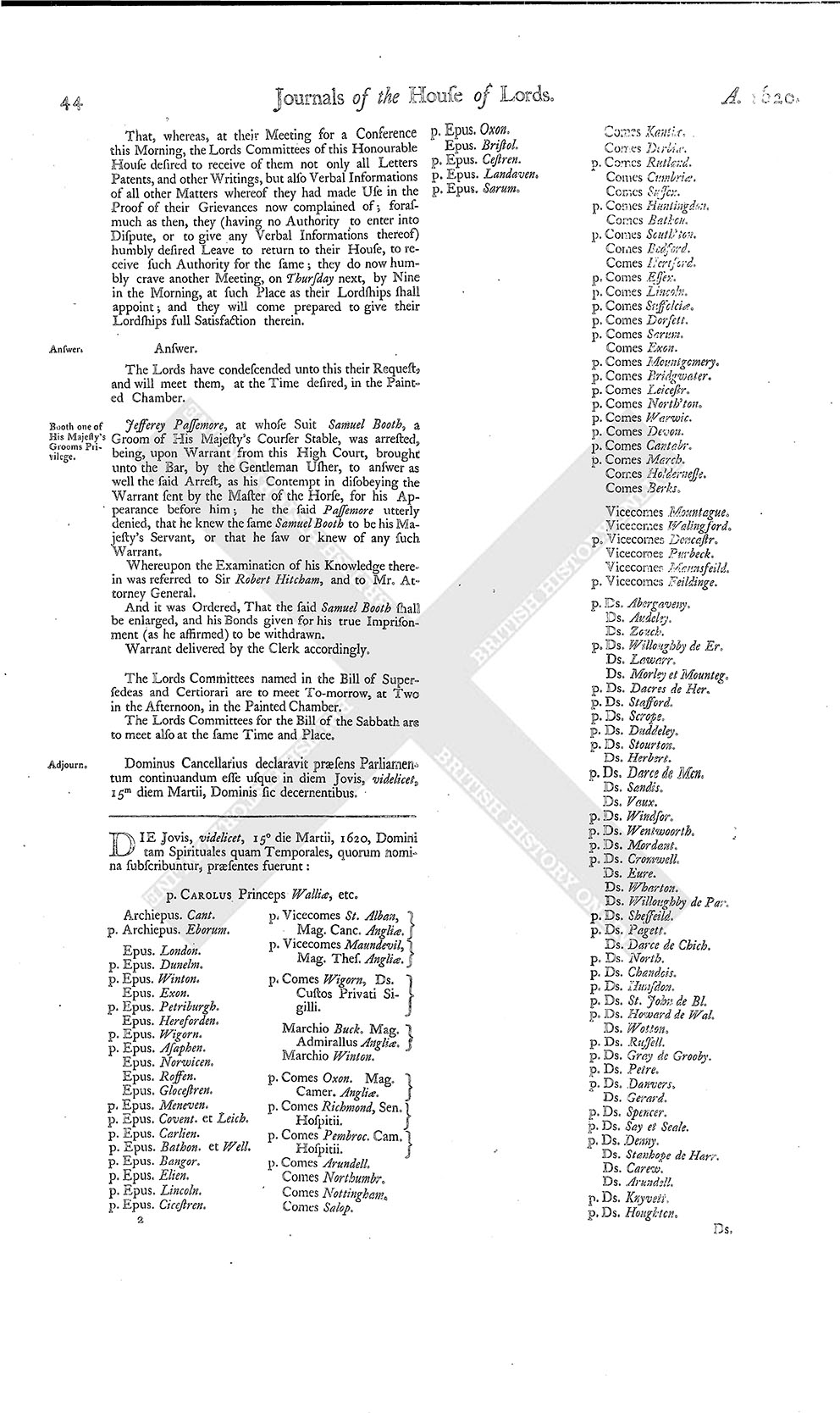
DIE Jovis, videlicet, 15 die Martii, 1620,
Domini tam Spirituales quam Temporales, quorum nomina subscribuntur, præsentes fuerunt:
p. Carolus Princeps Walliæ, etc.
Message from the House of Commons. The Prince to make Leases of Lands, Parcel of the Dutchy of Cornwall.
MESSAGE from the Lower House, by Sir Edward Cooke and others; who returned the Prince's Bill, intituled, An Act to enable the most Excellent Prince Charles to make Leases of Lands, Parcel of his Highness's Dutchy of Cornwall; and declared that the same passed their House with great Chearfulness and Alacrity, una voce.
He shewed likewife, that there was one only Amendment of the same Bill, and one Addition thereunto annexed.
The which Amendments and Addition were presently Twice read, and committed to the same Committees (prout antea), to consider of the same.
Booth, one of His Majesty's Grooms Privilege.
Mr. Serjeant Hitcham reported, That, in the Examination of the Matter between Jefferey Passemore and Samuel Booth, he found, that the said Passemore had very contemptuously broken the Privileges of this High Court, in the Arrest of the said Booth; whereupon the said Passemore was brought to the Bar; and it was Ordered, That he should be committed to the Prison of The Fleet, and to withdraw his Actions against the said Booth, for that they were of mere Vexation for Words, and not for Debt; and also that Nicholas King, the Deputy Bailiff of Westm. who arrested the said Booth, shall stand committed to The Fleet.
Jewell, Lord Stafford's Servant's Privilege.
Sir Robert Hitcham also reported, That Edward Newton, the Under-Sheriff's Bailiff of Surrey, did arrest William Jewell, after he knew that the said Jewell was the Lord Staffordes Man, by Jewell's shewing his Warrant of Privilege unto him.
Whereupon it was Ordered, That the said Edward Newton should be sent Prisoner to The Fleet,
And, That the said William Jewell, who was brought by Writ of Habeas corpus cum causa (which was openly read), should be discharged out of his Imprisonment.
Ld. Treasurer.
When the Lords Committees were ready to go into the Painted Chamber, to confer with Committees of the Lower House upon their Grievances; the Lord Treasurer declared, That, as every Man ought to have a high Esteem of his Honour, so he ought not to be so rash as to infringe the Orders of this Honourable House in Defence thereof; many might haply think him peremptory in Defence of his Honour the other Day, which he protested was not out of any Pride. He freely confessed, he spake at the last Conference more than he might by the ancient Orders of this House; but he neither loves Error, nor will contemn Order. And therefore moved, That whatsoever was spoken of him, or by him, might not be prejudicial to their Proceedings in this Business.
Ld. Chamberlain's Report.
The Lord Chamberlain made Report of the Conference this Morning with the Lower House, to this Effect: videlicet,
That the Commons delivered in the Declaration of their Grievances, and the Capita of their Proofs thereof in Writing, sub protestatione, not to be a Precedent for them to deliver in their Proofs in Writing hereafter.
Grievances.
Their Grievances were grounded upon Grants of the Forfeitures, and Dispensations of,
Penal Statutes for Inns.
Grants of Monopolies, for Gold and Silver Thread.
Grants of Concealments.
Penal Statutes.
Touching Penal Statutes. They highly commended His Majesty's Care, both now and in former Times, in referring the same to the Judges, and his Privy Council, and his Resolution not to grant Dispensations thereof.
Monopolies.
Touching the Grants of Monopolies, They shewed, that many Grants of that Nature, in former Times, have been questioned, and resolved to be unlawful; and instanced,
Sweet Wines.
In the Monopoly of Sweet Wines, granted by King Philipp unto the Town of Southampton.
Starch.
The Monopoly to Packington, for Starch.
Salt.
Monopoly for making of Salt, adjudged void, for that the Invention, alledged in the Grant, was not new.
Train Oil.
Monopoly to make Train Oil.
Cards.
Monopoly for Cards.
Concealments.
Touching the Grants of Concealments, they shewed, how dishonourable it were for any Lord to grant the like, much more for the King.
That a Cathedral Church and Twelve Hospitals were swallowed thereby; that it was contrary to the King's Royal Direction, in his Book of Bounty, wherein he refuseth to be moved for Grants of that Nature.
They set forth their Care in these Three Points;
1. Not to meddle with the King's Prerogative.
2. To preserve the King's Honour.
3. To restore to the Subjects their Wealth.
That they had delivered the Patents, Commissions, and other Writings demanded of them.
Two of the Declarations of the said Grievances so delivered, videlicet, that concerning Inns and the other concerning Concealments, were read.
Pages.
The Lord Houghton declared to the House many Abuses done to the Servants of divers Lords Bishops, by Pages, and others; the Examination whereof was referred to
The Lord Wentwoorth moved, and it was Ordered, That no Bill but the Prince's Bill should be read, until these Businesses of Sir Gyles Mompesson be passed and determined; and the House to sit on Convocation Days, for the more speedy Dispatch of that Business.
E. of Sussex excus'd.
Earl of Sussex, hath Leave to be absent.
Adjourn.
Dominus Cancellarius declaravit præsens Parliamentum continuandum esse usque in horam secundam post meridiem, Dominis sic decernentibus.
Post meridiem,
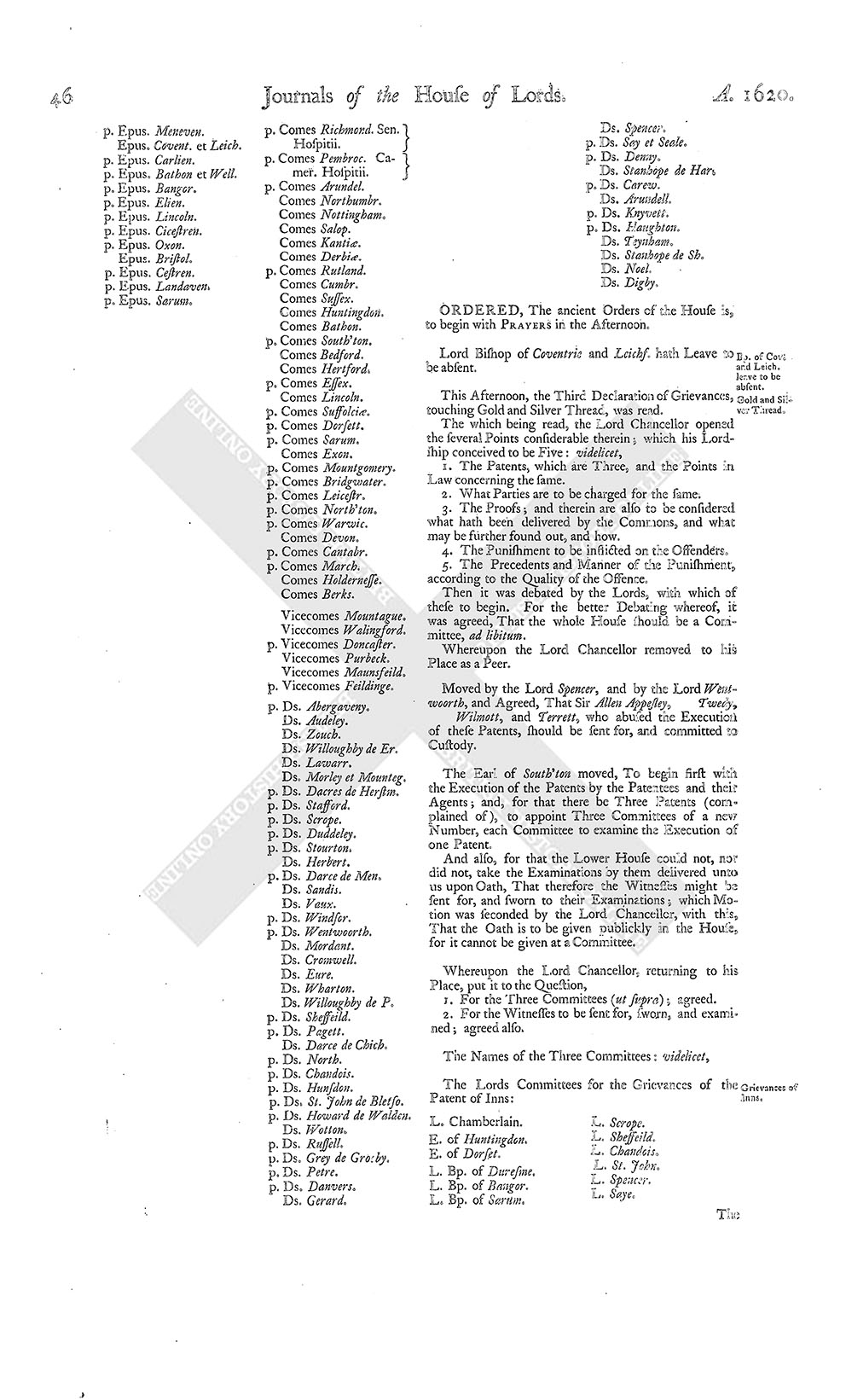
Domini tam Spirituales quam Temporales, quorum nomina subscribuntur, præsentes fuerunt:
p. Carolus Princeps Walliæ, etc.
ORDERED, The ancient Orders of the House is, to begin with Prayers in the Afternoon.
Bp. of Cov. and Leich. leave to be absent.
Lord Bishop of Coventrie and Leichf. hath Leave to be absent.
Gold and Silver Thread.
This Afternoon, the Third Declaration of Grievances, touching Gold and Silver Thread, was read.
The which being read, the Lord Chancellor opened the several Points considerable therein; which his Lordship conceived to be Five: videlicet,
1. The Patents, which are Three, and the Points in Law concerning the same.
2. What Parties are to be charged for the same.
3. The Proofs; and therein are also to be considered what hath been delivered by the Commons, and what may be further found out, and how.
4. The Punishment to be inflicted on the Offenders.
5. The Precedents and Manner of the Punishment, according to the Quality of the Offence.
Then it was debated by the Lords, with which of these to begin. For the better Debating whereof, it was agreed, That the whole House should be a Committee, ad libitum.
Whereupon the Lord Chancellor removed to his Place as a Peer.
Moved by the Lord Spencer, and by the Lord Wentwoorth, and Agreed, That Sir Allen Appesley, Twedy, Wilmott, and Terrett, who abused the Execution of these Patents, should be sent for, and committed to Custody.
The Earl of South'ton moved, To begin first with the Execution of the Patents by the Patentees and their Agents; and, for that there be Three Patents (complained of), to appoint Three Committees of a new Number, each Committee to examine the Execution of one Patent.
And also, for that the Lower House could not, nor did not, take the Examinations by them delivered unto us upon Oath, That therefore the Witnesses might be sent for, and sworn to their Examinations; which Motion was seconded by the Lord Chancellor, with this, That the Oath is to be given publickly in the House, for it cannot be given at a Committee.
Whereupon the Lord Chancellor, returning to his Place, put it to the Question,
1. For the Three Committees (ut supre); agreed.
2. For the Witnesses to be sent for, sworn, and examined; agreed also.
The Names of the Three Committees: videlicet,
Grievances of Inns.
The Lords Committees for the Grievances of the Patent of Inns:
|
L. Chamberlain. E. of Huntingdon. E. of Dorset. L. Bp. of Duresme. L. Bp. of Bangor. L. Bp. of Sarum. |
L. Scrope. L. Sheffeild. L. Chandois. L. St. John. L. Spencer. L. Saye. |
To meet at any Place, near the Parliament Presence, de die in diem, quousque &c.
Grievances of Gold and Silver Thread.
The Lords Committees for the Grievances of the Patents of Gold and Silver Thread:
|
E. of Arundell. E. of Oxford. E. of Essex. L. Bp. of Winchester. L. Bp. of Bath and Wells. L. Bp. of Chester. |
L. Wentwoorth. L. North. L. Hunsdon. L. Walden. L. Danvers. L. Haughton. |
To meet, ut supra.
Grievances of Concealments.
The Lords Committees for the Grievances of the Grants of Concealments:
|
E. of South'ton. E. of Leicester. E. of Cambridge. L. Bp. of Worcester. L. Bp. of Ely. L. Bp. of Lincoln. |
L. Willoughby. L. Pagett. L. Russell. L. Gray. L. Denny. L. Knyvett. |
To meet, ut supra.
The several Declarations beforementioned were delivered unto the first of each several Committee: videlicet,
That of the Grievances of the Inns, unto the Lord Chamberlain.
That of the Grievances of Gold and Silver Thread, unto the Earl of Arundell.
That of the Grievances of Concealments, unto the Earl of South'ton.
The Earl of South'ton moved, That, to the End it might be the more freely debated what Power shall be given to these Committees, the whole House may be a Committee again, ad libitum.
Whereupon, the Lord Chancellor removing to his Place as a Peer, his Lordship moved, That the Lords Committees would confer with Mr. Thomas Crew, Mr. Recorder of London, and Mr. R. Hackwell, for that these Gentlemen, being Members of the Lower House, had taken Pains in the several Examinations of these Grievances.
And, after many Motions touching this Business, the Lord Chancellor returned to his Place, and then it was Agreed and Ordered:
The Committees to prepare the Heads of the Validities and the Inconveniencies; to handle first the Execution of these Patents and Grants (complained of).
Each Committee to have Power to single out the Parties to be examined as Witnesses, and to single out the Delinquents to be examined upon Oath, and to be committed. The Oath to be given in the House.
Two Messengers to attend each Committee.
And it was moved by the Earl of Arundell, and Agreed, That the Lords Committees may inform the House of all incident Matters, to have further Direction herein if it shall be requisite.
Petition of Reynolds and Wright.
The humble Petition of Richard Reynoldes and Robert Wright, was read; the Tenor whereof followeth:
"To the Right Honourable Lords of His Majesty's High Court of Parliament assembled.
"The humble Petition of Richard Reynoldes and Robert Wright,
"Most humbly shewing,
"That your poor Petitioners having endured long Imprisonment as well in the Messengers Hands as now in The Fleet; and also having undergone that great Affliction, which it pleased your Honours to lay upon them, and still remain in Prison, to their excessive Charge, which hath tended to their utter Undoing for ever. May it therefore please your Honours, to commiserate the poor and distressed Estates of your Petitioners, whose Wives and Children are like utterly to perish, to be pleased to afford them your Honours Discharge, to be directed to the Warden of The Fleet, for their Enlargment. And they, as in Duty bound, shall pray for your Honours long Lives and happy Estates.
"Richard Reynoldes.
"Robert Wright."
Ordered, That the Prisoners shall be first brought to the Bar To-morrow Morning, to acknowledge their Fault.
A Warrant was thereupon delivered (subscribed by the Clerk) unto the Serjeant attending this House.
Adjourn.
Dominus Cancellarius declaravit præsens Parliamentum continuandum esse usque in diem crastinum, videlicet, 16m diem Martii, Dominis sic decernentibus.