
Journal of the House of Lords: Volume 3, 1620-1628. Originally published by His Majesty's Stationery Office, London, 1767-1830.
This free content was digitised by double rekeying. All rights reserved.
'House of Lords Journal Volume 3: 21 February 1624', in Journal of the House of Lords: Volume 3, 1620-1628, (London, 1767-1830) pp. 210-213. British History Online https://www.british-history.ac.uk/lords-jrnl/vol3/pp210-213 [accessed 19 April 2024]

In this section
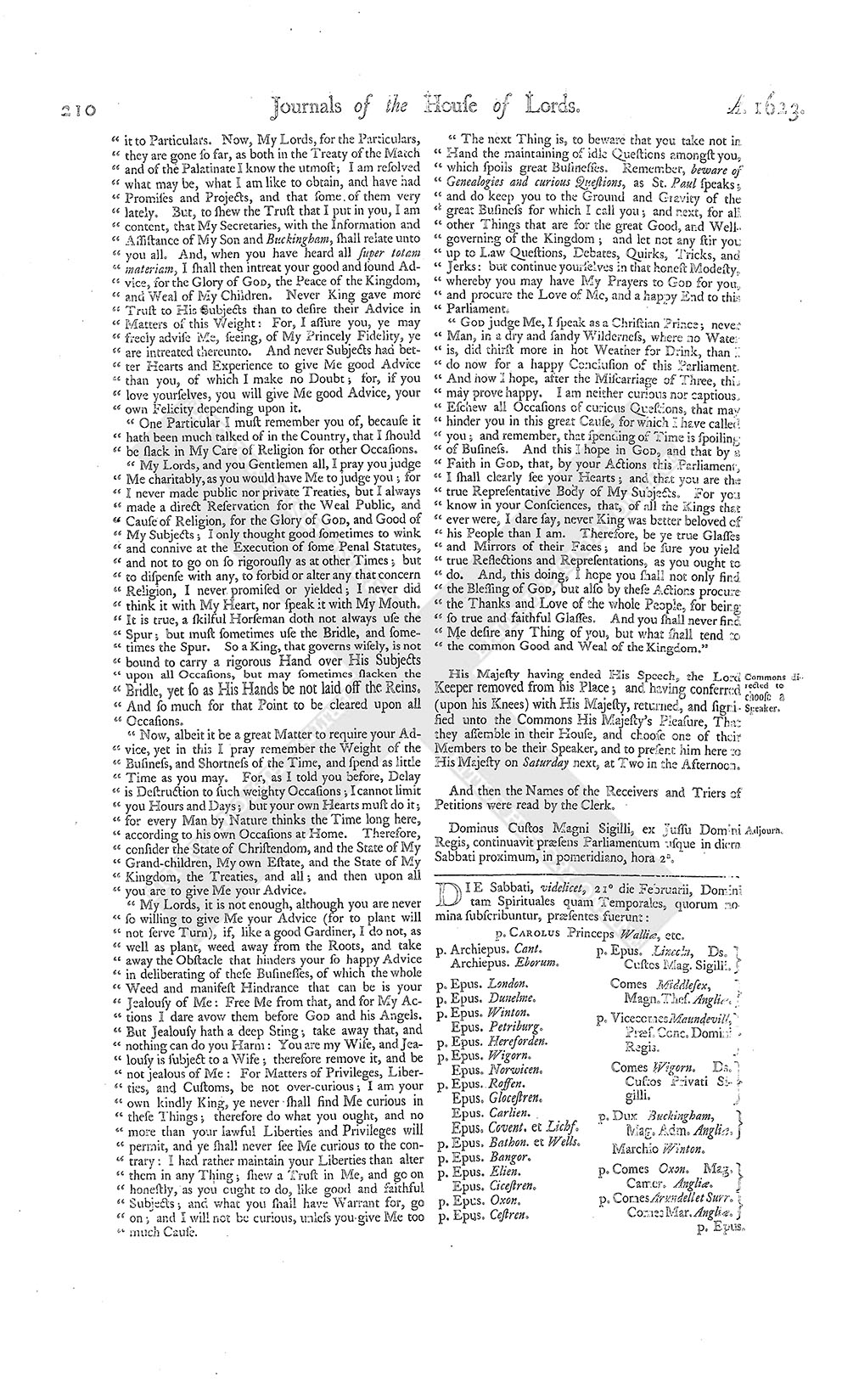
DIE Sabbati, videlicet, 21 die Februarii,
Domini tam Spirituales quam Temporales, quorum no mina subscribuntur, præsentes fuerunt:
p. Carolus Princeps Walliæ, etc.
Speaker of the House of Commons presented.
THIS Day, the King being sat in His Royal Throne, the Commons presented unto His Majesty Sir Thomas Crewe, Knight, Serjeant at Law, for their Speaker, who, being brought to the Bar, with great Reverence began his Speech on this Manner: videlicet,
"Most Gracious Sovereign,
"The Knights, Citizens, and Burgesses, Your Majesty's obedient and loyal Subjects, the Representative Body of Your Commons, according to their ancient Privilege, and Your Majesty's Gracious Directions, have chosen a Speaker; and, amongst so many Cedars of their Libanon, have looked down upon me, a low Shrub, who am not able to take upon me the Weight of such Services: Wherefore I desired them to take into their Consideration my Weakness and Disabilities, best known unto myself, and not unknown unto them; and that I might be excused; which I did not to decline public Duty, but out of a true Insight of my own Insufficiencies; which being not granted by them, I humbly appeal to Your High Throne; desiring Your Majesty to spare me, and to command them to proceed to a new and better Election."
This being said, the Lord Keeper, having first conferred with His Majesty, answered to this Effect: videlicet,
"Mr. Speaker,
Approved of.
"His Majesty observes that in you, which Gorgias did in Plato: Quod in Oratoribus eridendis se monstrabat esse Oratorem, That in speaking against Orators, he shewed himself the greatest Orator: Even so it fares with you in this Appeal to His Majesty; descendendo ascendis, your falling down in your own Conceipt hath raised you in all other Men's Opinions; by excusing yourself, you shew that there is nothing in you to be excused. His Majesty doth not only approve, but commend the Judgement of the Knights, Citizens, and Burgesses, in their Choice of you; et quod felix faustumque sit for an Omen, and good Luck to all their future Proceedings, hath crowned this first Work of theirs with the old Parliamentary Stile, Le Roy voet; exivit verbum ex ore Regis; His Majesty approves their Choice."
His Majesty having thus denied Mr. Speaker's Excuse, and approved of the Commons Choice of him, Mr. Speaker proceeded, and said:
His Speech.
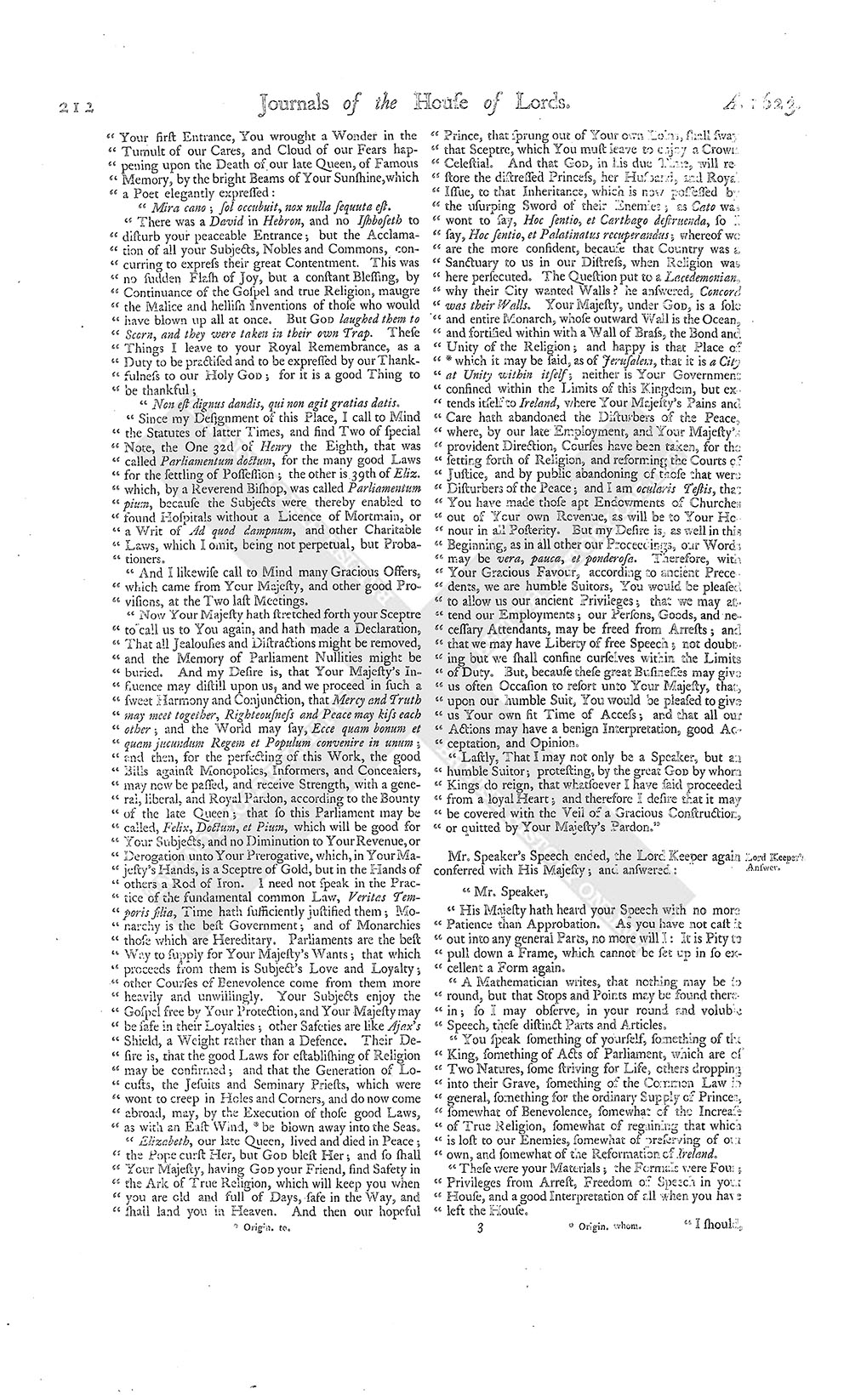
"Since I cannot bring an Olive Branch in my Hand, as a Sign of my Peace and Liberty, and that God, in whose Hands are the Hearts of Kings, et qui impellit, and no Man can resist, hath inclined Your Majesty to cast Your Eye of Grace upon me, and to confirm me in this Place, I am taught in the best School, that Obedience is better than Sacrifice, and will only say with a learned Father, Da, Domine, quod jubes, et jube quod vis; otherwise I have great Cause to be afraid of so great a Charge, to be executed before so great a Majesty, and in so great an Assembly, but that I hope Your Majesty will extend Your Sceptre of Grace, as Assuerus did, to sustain me in my Fainting. Your Majesty is Princeps Hæreditarius, descended from both the Roses, and have united both the Kingdoms: At Your first Entrance, You wrought a Wonder in the Tumult of our Cares, and Cloud of our Fears happening upon the Death of our late Queen, of Famous Memory, by the bright Beams of Your Sunshine, which a Poet elegantly expressed:
"Mira cano; sol occubuit, nox nulla sequuta est.
"There was a David in Hebron, and no Ishboseth to disturb your peaceable Entrance; but the Acclamation of all your Subjects, Nobles and Commons, concurring to express their great Contentment. This was no sudden Flash of Joy, but a constant Blessing, by Continuance of the Gospel and true Religion, maugre the Malice and hellish Inventions of those who would have blown up all at once. But God laughed them to Scorn, and they were taken in their own Trap. These Things I leave to your Royal Remembrance, as a Duty to be practised and to be expressed by our Thankfulness to our Holy God; for it is a good Thing to be thankful;
"Non est dignus dandis, qui non agit gratias datis.
"Since my Designment of this Place, I call to Mind the Statutes of latter Times, and find Two of special Note, the One 32d of Henry the Eighth, that was called Parliamentum doctum, for the many good Laws for the settling of Possession; the other is 39th of Eliz. which, by a Reverend Bishop, was called Parliamentum pium, because the Subjects were thereby enabled to found Hospitals without a Licence of Mortmain, or a Writ of Ad quod dampnum, and other Charitable Laws, which I omit, being not perpetual, but Probationers.
"And I likewise call to Mind many Gracious Offers, which came from Your Majesty, and other good Provisions, at the Two last Meetings.
"Now Your Majesty hath stretched forth your Sceptre to call us to You again, and hath made a Declaration, That all Jealousies and Distractions might be removed, and the Memory of Parliament Nullities might be buried. And my Desire is, that Your Majesty's Influence may distill upon us, and we proceed in such a sweet Harmony and Conjunction, that Mercy and Truth may meet together, Righteousness and Peace may kiss each other; and the World may say, Ecce quam bonum et quam jucundum Regem et Populum convenire in unum; and then, for the perfecting of this Work, the good Bills against Monopolies, Informers, and Concealers, may now be passed, and receive Strength, with a general, liberal, and Royal Pardon, according to the Bounty of the late Queen; that so this Parliament may be called, Felix, Doctum, et Pium, which will be good for Your Subjects, and no Diminution to Your Revenue, or Derogation unto Your Prerogative, which, in Your Majesty's Hands, is a Sceptre of Gold, but in the Hands of others a Rod of Iron. I need not speak in the Practice of the fundamental common Law, Veritas Temporis filia, Time hath sufficiently justified them; Monarchy is the best Government; and of Monarchies those which are Hereditary. Parliaments are the best Way to supply for Your Majesty's Wants; that which proceeds from them is Subject's Love and Loyalty; other Courses of Benevolence come from them more heavily and unwillingly. Your Subjects enjoy the Gospel free by Your Protection, and Your Majesty may be safe in their Loyalties; other Safeties are like Ajax's Shield, a Weight rather than a Defence. Their Desire is, that the good Laws for establishing of Religion may be confirmed; and that the Generation of Locusts, the Jesuits and Seminary Priests, which were wont to creep in Holes and Corners, and do now come abroad, may, by the Execution of those good Laws, as with an East Wind, (fn. 1) be blown away into the Seas.
"Elizabeth, our late Queen, lived and died in Peace; the Pope curst Her, but God blest Her; and so shall Your Majesty, having God your Friend, find Safety in the Ark of True Religion, which will keep you when you are old and full of Days, safe in the Way, and shall land you in Heaven. And then our hopeful Prince, that sprung out of Your own Loins, shall sway that Sceptre, which You must leave to enjoy a Crown Celestial. And that God, in his due Time, will restore the distressed Princess, her Husband, and Royal Issue, to that Inheritance, which is now possessed by the usurping Sword of their Enemies; as Cato was wont to say, Hoc sentio, et Carthago destruenda, so all say, Hoc sentio, et Palatinatus recuperandus; whereof we are the more confident, because that Country was a Sanctuary to us in our Distress, when Religion was here persecuted. The Question put to a Lacedemonian, why their City wanted Walls? he answered, Concord was their Walls. Your Majesty, under God, is a sole and entire Monarch, whose outward Wall is the Ocean, and fortified within with a Wall of Brass, the Bond and Unity of the Religion; and happy is that Place of (fn. 2) which it may be said, as of Jerusalem, that it is a City at Unity within itself; neither is Your Government confined within the Limits of this Kingdom, but extends itself to Ireland, where Your Majesty's Pains and Care hath abandoned the Disturbers of the Peace, where, by our late Employment, and Your Majesty's provident Direction, Courses have been taken, for the setting forth of Religion, and reforming the Courts of Justice, and by public abandoning of those that were Disturbers of the Peace; and I am ocularis Testis, that You have made those apt Endowments of Churches out of Your own Revenue, as will be to Your Honour in all Posterity. But my Desire is, as well in this Beginning, as in all other our Proceedings, our Words may be vera, pauca, et ponderosa. Therefore, with Your Gracious Favour, according to ancient Precedents, we are humble Suitors, You would be pleased to allow us our ancient Privileges; that we may attend our Employments; our Persons, Goods, and necessary Attendants, may be freed from Arrests; and that we may have Liberty of free Speech; not doubting but we shall confine ourselves within the Limits of Duty. But, because these great Businesses may give us often Occasion to resort unto Your Majesty, that, upon our humble Suit, You would be pleased to give us Your own fit Time of Access; and that all our Actions may have a benign Interpretation, good Acceptation, and Opinion.
"Lastly, That I may not only be a Speaker, but an humble Suitor; protesting, by the great God by whom Kings do reign, that whatsoever I have said proceeded from a loyal Heart; and therefore I desire that it may be covered with the Veil of a Gracious Construction, or quitted by Your Majesty's Pardon."
Lord Keeper's Answer.
Mr. Speaker's Speech ended, the Lord Keeper again conferred with His Majesty; and answered:
"Mr. Speaker,
"His Majesty hath heard your Speech with no more Patience than Approbation. As you have not cast it out into any general Parts, no more will I: It is Pity to pull down a Frame, which cannot be set up in so excellent a Form again.
"A Mathematician writes, that nothing may be so round, but that Stops and Points may be found therein; so I may observe, in your round and voluble Speech, these distinct Parts and Articles.
"You speak something of yourself, something of the King, something of Acts of Parliament, which are of Two Natures, some striving for Life, others dropping into their Grave, something of the Common Law in general, something for the ordinary Supply of Princes, somewhat of Benevolence, somewhat of the Increase of True Religion, somewhat of regaining that which is lost to our Enemies, somewhat of preserving of our own, and somewhat of the Reformation of Ireland.
"These were your Materials; the Formals were Four; Privileges from Arrest, Freedom of Speech in your House, and a good Interpretation of all when you have left the House.
"I should, from His Majesty, give Answer to them all; and will proceed Stop by Stop.
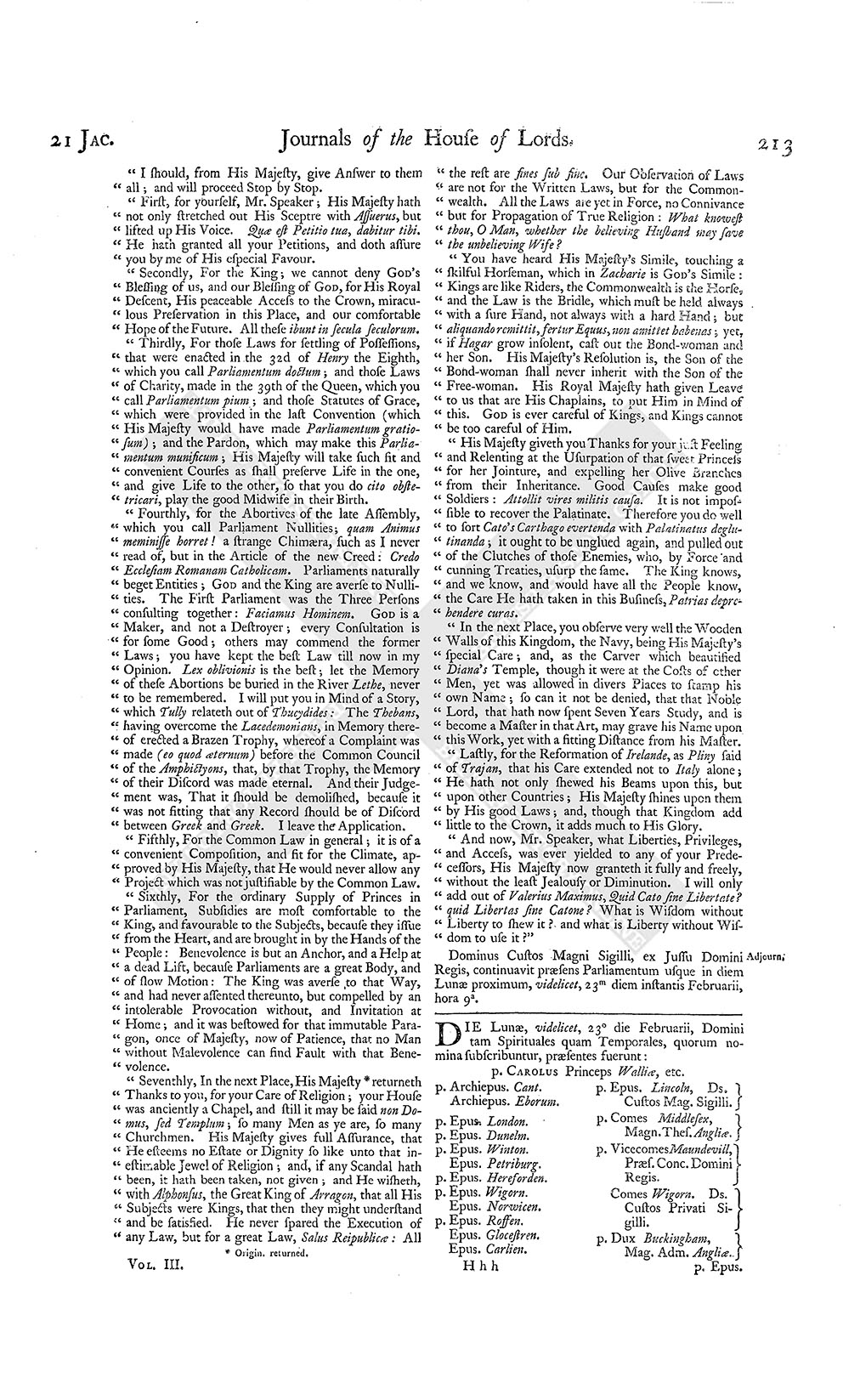
"First, for yourself, Mr. Speaker; His Majesty hath not only stretched out His Sceptre with Assuerus, but lifted up His Voice. Quæ est Petitio tua, dabitur tibi. He hath granted all your Petitions, and doth assure you by me of His especial Favour.
"Secondly, For the King; we cannot deny God's Blessing of us, and our Blessing of God, for His Royal Descent, His peaceable Access to the Crown, miraculous Preservation in this Place, and our comfortable Hope of the Future. All these ibunt in secula seculorum.
"Thirdly, For those Laws for settling of Possessions, that were enacted in the 32d of Henry the Eighth, which you call Parliamentum doctum; and those Laws of Charity, made in the 39th of the Queen, which you call Parliamentum pium; and those Statutes of Grace, which were provided in the last Convention (which His Majesty would have made Parliamentum gratiosum); and the Pardon, which may make this Parliamentum munificum; His Majesty will take such fit and convenient Courses as shall preserve Life in the one, and give Life to the other, so that you do cito obstetricari, play the good Midwife in their Birth.
"Fourthly, for the Abortives of the late Assembly, which you call Parliament Nullities; quam Animus meminisse horret! a strange Chimæra, such as I never read of, but in the Article of the new Creed: Credo Ecclesiam Romanam Catholicam. Parliaments naturally beget Entities; God and the King are averse to Nullities. The First Parliament was the Three Persons consulting together: Faciamus Hominem. God is a Maker, and not a Destroyer; every Consultation is for some Good; others may commend the former Laws; you have kept the best Law till now in my Opinion. Lex oblivionis is the best; let the Memory of these Abortions be buried in the River Lethe, never to be remembered. I will put you in Mind of a Story, which Tully relateth out of Thucydides: The Thebans, having overcome the Lacedemonians, in Memory thereof erected a Brazen Trophy, whereof a Complaint was made (eo quod æternum) before the Common Council of the Amphictyons, that, by that Trophy, the Memory of their Discord was made eternal. And their Judgement was, That it should be demolished, because it was not fitting that any Record should be of Discord between Greek and Greek. I leave the Application.
"Fifthly, For the Common Law in general; it is of a convenient Composition, and fit for the Climate, approved by His Majesty, that He would never allow any Project which was not justifiable by the Common Law.
"Sixthly, For the ordinary Supply of Princes in Parliament, Subsidies are most comfortable to the King, and favourable to the Subjects, because they issue from the Heart, and are brought in by the Hands of the People: Benevolence is but an Anchor, and a Help at a dead List, because Parliaments are a great Body, and of slow Motion: The King was averse to that Way, and had never assented thereunto, but compelled by an intolerable Provocation without, and Invitation at Home; and it was bestowed for that immutable Paragon, once of Majesty, now of Patience, that no Man without Malevolence can find Fault with that Benevolence.
"Seventhly, In the next Place, His Majesty (fn. 3) returneth Thanks to you, for your Care of Religion; your House was anciently a Chapel, and still it may be said non Domus, sed Templum; so many Men as ye are, so many Churchmen. His Majesty gives full Assurance, that He esteems no Estate or Dignity so like unto that inestimable Jewel of Religion; and, if any Scandal hath been, it hath been taken, not given; and He wisheth, with Alphonsus, the Great King of Arragon, that all His Subjects were Kings, that then they might understand and be satisfied. He never spared the Execution of any Law, but for a great Law, Salus Reipublicæ: All the rest are fines sub fine. Our Observation of Laws are not for the Written Laws, but for the Commonwealth. All the Laws are yet in Force, no Connivance but for Propagation of True Religion: What knowest thou, O Man, whether the believing Husband may save the unbelieving Wife?
"You have heard His Majesty's Simile, touching a skilful Horseman, which in Zacharie is God's Simile: Kings are like Riders, the Commonwealth is the Horse, and the Law is the Bridle, which must be held always with a sure Hand, not always with a hard Hand; but aliquando remittit, fertur Equus, non amittet habenas; yet, if Hagar grow insolent, cast out the Bond-woman and her Son. His Majesty's Resolution is, the Son of the Bond-woman shall never inherit with the Son of the Free-woman. His Royal Majesty hath given Leave to us that are His Chaplains, to put Him in Mind of this. God is ever careful of Kings, and Kings cannot be too careful of Him.
"His Majesty giveth you Thanks for your just Feeling and Relenting at the Usurpation of that sweet Princess for her Jointure, and expelling her Olive Branches from their Inheritance. Good Causes make good Soldiers: Attollit vires militis causa. It is not impossible to recover the Palatinate. Therefore you do well to sort Cato's Carthago evertenda with Palatinatus deglutinanda; it ought to be unglued again, and pulled out of the Clutches of those Enemies, who, by Force and cunning Treaties, usurp the same. The King knows, and we know, and would have all the People know, the Care He hath taken in this Business, Patrias deprehendere curas.
"In the next Place, you observe very well the Wooden Walls of this Kingdom, the Navy, being His Majesty's special Care; and, as the Carver which beautified Diana's Temple, though it were at the Costs of other Men, yet was allowed in divers Places to stamp his own Name; so can it not be denied, that that Noble Lord, that hath now spent Seven Years Study, and is become a Master in that Art, may grave his Name upon this Work, yet with a fitting Distance from his Master.
"Lastly, for the Reformation of Irelande, as Pliny said of Trajan, that his Care extended not to Italy alone; He hath not only shewed his Beams upon this, but upon other Countries; His Majesty shines upon them by His good Laws; and, though that Kingdom add little to the Crown, it adds much to His Glory.
"And now, Mr. Speaker, what Liberties, Privileges, and Access, was ever yielded to any of your Predecessors, His Majesty now granteth it fully and freely, without the least Jealousy or Diminution. I will only add out of Valerius Maximus, Quid Cato sine Libertate? quid Libertas sine Catone? What is Wisdom without Liberty to shew it ? and what is Liberty without Wisdom to use it?"
Adjourn.
Dominus Custos Magni Sigilli, ex Jussu Domini Regis, continuavit præsens Parliamentum usque in diem Lunæ proximum, videlicet, 23m diem instantis Februarii, hora 9a.