
Journal of the House of Lords: Volume 3, 1620-1628. Originally published by His Majesty's Stationery Office, London, 1767-1830.
This free content was digitised by double rekeying. All rights reserved.
'House of Lords Journal Volume 3: 16 April 1624', in Journal of the House of Lords: Volume 3, 1620-1628, (London, 1767-1830) pp. 306-311. British History Online https://www.british-history.ac.uk/lords-jrnl/vol3/pp306-311 [accessed 25 April 2024]



In this section
DIE Veneris, videlicet, 16 die Aprilis,
post meridiem, Domini tam Spirituales quam Temporales, quorum nomina subscribuntur, præsentes fuerunt:
p. Carolus Princeps Walliæ, etc.
Anstruther and Abercromy qualified for Naturalization.
Sir William Anstrother, Knight, and Patrick Abercromy, took the Oaths of Supremacy and Allegiance, according to the Statute, having exhibited their Bill of Naturalizing.
Young's Naturalization.
Hodie 3a vice lecta est Billa, An Act for the Naturalizing of John Young, Doctor of Divinity, Dean of the Cathedral Church of Winchester.
And, being put to the Question, was generally Assented unto.
The Lord Keeper reported the Conference Yesterday at Whitehall between the Two Houses, on this Manner, videlicet:
Report from the Conference, concerning the Lord Treasurer.
"At this Conference, Sir Edward Cooke (on the Behalf of the Commons) shewed, That the Knights, Citizens, and Burgesses assembled in Parliament, are always elected, the Knights by the Counties, the Citizens by the Cities, and the Burgesses by the Boroughs of the Kingdom:
"That Your Highness and my Lords do enjoy your Places by Blood and Descent; some of your Lordships by Creation; and the Lords Ecclesiastical by Succession; but the Members of the House of Commons by free Election. They appear for Multitudes, and bind Multitudes; and therefore they have no Proxies. They are the Representative Body of the Realm; for all the People are present in Parliament by Person Representative; and therefore, by the Wisdom of the State, and by Parliament Orders, the Commons are appointed the Inquisitors General of the Grievances of the Kingdom; and that for Three Causes:
"1. Because they have best Notice from all Parts thereof.
"2. They are most sensible, it is not your Lordships, but the weakest Commons, that go to the Wall.
"3. As in a natural Body, not the Disease, but the Neglect of Cure killeth, non morbus sed morbi neglecta curatio interficit; so the long Delay of Cure of Grievances corpus politicum interficit; and this would happen if they were not found out by the Commons.
"In their Inquisition, they found (what they scarce ever did before in this Kind) many great, exorbitant, and heinous Offences against a Member of this House, the Lord Treasurer; and they found him guilty after a strange Manner; for, in all the House, no Man said No; but concluded against him, nemine dissentiente.
"That the House appointed him (Sir Edward Cooke) to present Three Enormities unto your Lordships, much against his Mind; others were far more sufficient, as well in regard of his great Years, as of other Accidents; yet, he said, he would do it truly, plainly, and shortly.
"There were Two great Offences in general, which they had distributed into Two Parts; one of the which should be represented by him, and the other by his Colleague.
"That which he should represent, was to consist of Two Charges: 1. Gross and fordid Bribery. 2. For procuring good Orders of the Court of Wards to be altered; for it was done by his principal Procurement: 1. To the Deceit of the King. 2. Oppression of the Subject. 3. Enriching of his own Servants.
"He would begin with presenting unto your Lordships the Bribery. And here he craved your Lordships Favours, if he should seem long in touching some Circumstances; for Circumstances to Things are like Shadows to Pictures, to set them out in fuller Representations, wherein he promised to observe seriem Temporis.
Lord Treasurer's First Charge from the House of Commons.
"17° Jacobi, By the Lord Treasurer's Privity (for it concerned his Skill properly, which was Merchandize) a Lease of the Subsidy and Imposts of the French Wines was let to the Farmers of the Petty Farm at Forty-four Thousand Pounds Yearly Rent, and for Fifty Thousand Pounds Fine; with a Covenant from the King, that no more Impost should be laid during their Lease, because they knew that Impost would overthrow Trade.
"Yet the Farmers were not content with this Covenant for their Money and their Trade (for Money is their Plough, and Trade their Life); they desire an Addition of the King's Word to this Covenant: They have Access to the King; and that Covenant was confirmed and repeated by Him, verbo Regio, in the Presence of the Lord Treasurer; then they thought themselves in tuto, and that they did in portu navigare, freed from all Storms and Tempests.
"But behold, Anno 1621, the first Thing my Lord did in his Office was the laying of an extreme Impost, of Three Pounds per Tun, upon the French Wines, which the King, by reason of His Covenant, could not, and, by reason of His Word, would not surely do.
"This Imposition was against Justice, the Covenant, and Honour of the King. The King surely, had He been rightly informed, would never have done it.
"Upon this the Trade sank, and they became Suitors to his Lordship for Relief for Ten Months together; but with no Success.
"Michaelmas, 1622, They petitioned to his Lordship, That the Trade was overburthened, and themselves quite undone. It is a Rule, that a Commodity over-burthened enricheth not the King, but quite destroyeth the Trade; but hereof they have no Success.
"Then they prefer a Bill of Right against the King in the Exchequer, because of the Breach of Covenant; to the which they can obtain no Answer in Michaelmas Term. The King's Attorney knew well enough of the Bill, but could not for his Heart devise an Answer for it.
"December 22, 1622, The Term is out; they are out of the Money, and the Trade is gone. They appeal, therefore, to the Fountain of Justice, the King's Majesty. The King is very gracious unto them, and said, God forbid any Man should lose by Him; He knew nothing of this; it was the Lord Treasurer's Act and Device. And so His Majesty allowed them a Deduction of Nine Thousand Five Hundred Pounds to be made unto them in Nine Years. Well; verba sunt hæc; these were but good and gracious Words; it filled not their Purses. They must have a Warrant from the Lord Treasurer, to put this Favour of the King's into a public Act; and this they could not obtain from December to the End of June. The Men understand themselves very well, and look about them, how this Stay comes. One of them tells another, The Business sticks; my Lord looks for somewhat; and the Man was in the right, for so the Sequel proved.
"Five Hundred Pounds Bribe was paid to Jacob, for my Lord's Use; and straitway all was well; the Warrant went current, and all was passing well.
"One Thing remarkable: This was taken out of the Petty Farms, set down in their Monthly and Yearly Books, and called a Gratuity, Speciosaque nomina culpæ.
"Some great Space of Time after this, there was a Voice of a Parliament (Oh! said Sir Edward, Parliaments work wonderful Things!). Then the Lord Treasurer began to cast a Circle, and to fall to his Conjuring; he calls upon Jacob, and commands him to transfer it to the Great Farm. Here was observed, that Suppressio veri is an Argument of Guiltiness in the Law.
"Here was also observed (in a Parenthesis), that it is a blessed Thing of those that love Parliaments; and that surely this Lord, of all others, loved them not, because he cast himself into this dark Mist when he should meet them; nescio quid peccati portat ista purgatio; this argues much Guiltiness.
"Here he nominated his Witnesses; which, he said, were without Exception. This Bribe is proved by Hide, Dawes, Bushop, and by Abraham Jacob; he a Witness with a Witness; for Jacob blanched this Bribe as well as he could, and was taken in Three notorious Falsities.
"1. He was charged, the Money was delivered to him by Hide. He avowed he had never received it; yet, being confronted with Hide, he confessed it. There was One.
"2. He had received the Money, but gave his Bond for it. Hide affirming to his Face, the Bond was for other Money, and no Bond at all for this; he likewise confessed it. There was Two.
"3. He said, he never had any Warrant to enter the same in the Petty Farm; yet afterwards he avowed he had. And there is the Third Falsity.
"Here the Knight observed, that Jacob was my Lord's necessary Creature and petty Chapman, and had a Son that was his Secretary; and, because he was a Jacob, that is, a Supplanter, he desired your Lordships to take good Care of him.
"About the Beginning of this Parliament, my Lord sent for this Jacob, asked him if he had entered this Money in the Petty Farm? He said, Yea. Then, said my Lord, go about it presently, and see that the Cockets and all Things else be suppressed in the Petty Farm, and this Money removed to the Great Farm, for I would have all hid and suppressed.
"Here the Knight observed, that fordid Bribery is like Adam, and would fain get some Fig-leaves, if it could tell but where to gather them.
"Upon the Delivery of this Charge (as was desired by his Friends) to the Lord Treasurer, they of the House of Commons expected an Answer of some rare Wit, for so this Nobleman was reputed in that House. But his Lordship deceived their Expectation; for it was utterly in every Point, he would not say false, but surely untrue: Four Things he denied, as he was a Christian; and they all Four directly proved and made good against him. And so much was delivered concerning the First Bribe.
"The Second Bribe was of a strange Strain; and both these Bribes were received by him, in the Quality of a Treasurer.
"The Farmers of the Great Customs were to renew their Farms, and to put in Security of Forty-eight Thousand Pounds Rent (July 29, 1622).
"Here the Knight said, he would not enlarge himself, for the Business lay in a narrow Room. The Bribe is the Point. My Lord liked the Sureties well; but some of them sell off, and my Lord would not accept of the rest. Seven Thousand Five Hundred Pounds of the Rent was reserved for a Year and a Quarter; after long Delay of their Lease, and Five Hundred Pounds in Gold paid unto him by the Hands of Jacob; then the Security formerly rejected was now accepted; which Act of his Lordship's the Knight confuted by this Syllogism: The Sureties were either sufficient or insufficient; if sufficient, the Bribe was too much, and the Farmers oppressed; if insufficient, the Bribe was too little, and the King was cozened.
"The Second Bribe is proved by Worstenholm, Garraway, Williams, and (if you please) Abraham Jacob; and so much of these Two Bribes taken in the Capacity of a Treasurer.
"Now he comes to the Court of Wards; and shewed, that the Lord Treasurer's Offences herein are of a rare Strain: First, the Knight noted (by Way of Preface), that Honos, the Honour, must be given to him that deserved it; all the good Artifice of that Court began under Treasurer Salisbury. Then were Articles invented that holp the King to all His Revenues, and tied the Officers to their own Fees and Places. The King's Revenues prospered well then; and these Articles, by the Advice of the Judges, were confirmed under the Great Seal.
"When this last Lord came to be Master of that Court (for now, faith the Knight, he is not charged as a Lord, but as a Master), he complained he had not Elbow Room for these Articles; he was too much bound by them, and bound he was indeed; and therefore he projects new Articles; and these new Articles are charged with high Extortion, for in them are raised Double Fees; one Fee the Surveyor formerly had, and still retains justly; another parallel Fee to this, my Lord hath raised most unjustly and oppressingly.
"For Extortion is a grievous and consuming Enormity in a Common-wealth; it was the greatest Evil the High God could foresee would befall the Enemies of God:
"Let the Extortioner consume what he hath, and the Stranger devour his Labour.
"In these new Articles, his Lordship created a new Officer, a Secretary: The chief Proceedings there go by Way of Petition. In the former Articles, those Petitions were received by the Court, and entered by the Clerk, without any Fee, and so were to be found upon Record: But, in the new Articles, this new Officer is to receive these Petitions, and may (for any Rule to the contrary) suppress them; and for his Fee, he taketh what he pleaseth; and proved that he took Ten Pounds, Twenty Pounds, Four Pounds, Five Pounds, Three Dishes of Silver, and the like: He is altogether unlimited, unless peradventure his Oath doth limit him.
"Another Charge in this Court is this Abuse; videlicet, The Lord Treasurer's Place requires a whole Man, and so doth the Mastership of the Court of Wards; whereupon his Lordship was fain (as unable to wield those Two great Places) to invent a new Device, a Stamp, even with his own Name Middlesex. Now this Hand moves and guides the Seal of the Court; and therefore, being turned by the Hand of a young Secretary, may produce strange Consequences.
"Never any King did suffer a Subject to use a Stamp.
"Old Lord Burleigh had a Stamp, because of his Gout, but never suffered it to be used but in his own Presence. King Henry the Eighth had also a Stamp; but, by suffering it to be employed by another, an Act of Parliament was overthrown thereby.
"He said, he would conclude with one Example. If a Ward be not found within One Year, he is reputed concealed, and so falls within the Dispose of the Master of the Court of Wards. Now, by the Secretary's keeping of this Stamp and Petitions, he may so carry the Matter, that any Ward may prove concealed; and that this is no remote Possibility, he brought this Instance; À posse ad esse.
"My Lord's Secretary hath put to, and used this Stamp, for the deferring of an Office for Half a Year; and it is possible it might be done for a whole Year.
"The Knight said, he never knew Man before trust a Stamp in the Hand of another Man, to command the King's Revenue.
"He concluded this Point with this Observation: That my Lord was a Man raised very high, and very lately, and for expectation of Service; and that the King had been very beneficial unto him; and for him to be so supine in the King's Revenue, and so vigilant in his own, was the highest Ingratitude; et si ingratum dixeris, omnia dixisti.
"Here the Knight pressed upon him his Three Oaths taken as Master of the Wards, as Counsellor, as Lord Treasurer.
"1. As Master of the Wards:
"You shall well and truly serve the King and People.
"He did not so; he deceived the King, and oppressed the People.
"You shall truly counsel the King.
"He did not so; witness these Articles of Oppression.
"You shall do Right to all Men.
"Impossible he should do so, with his Stamp and these Articles.
"2. The second Oath, as Counsellor.
"You shall honestly (a good old Word), justly, and evenly, counsel the King.
"Not so in this Imposition, which came alone out of his Quiver, and was advised against the King's Covenant and the King's Word.
"3. The Third Oath as Treasurer.
"You shall well and truly serve the King and People.
"He doth not so that denies or delays the Subject (for every Delay is a Denial).
"An old Canon of the Law is,
"Nulli vendemus, nulli negabimus, nulli differemus Justitiam.
"You shall truly counsel the King in all Things.
"Judge your Lordships, whether the Lord did so, that gave Him Counsel to break His Word?
"Sir Edward Cooke (this learned Knight) said, That all this he spake by Command. And so prayed your Lordships to weigh it well with due Consideration, and to give Judgement according to the Demerits of the Cause."
Lord Treasurer's second Charge from the House of Commons.
"Sir Edwyne Sandys proceeded to this Effect: videlicet,
"The Knights, Citizens, and Burgesses, in the Lower House of Parliament assembled, had commanded him (undesirous of any such Employment) to second this Charge unto your Lordships: That he was undesirous thereof; for he had rather defend the innocent than discover the culpable; yet he was the Son of Obedience, and must perform what by that House he had received in Command.
"To decypher out this great Lord upon whom the Charge lay, he would give of him this Character to your Lordships:
"Nescia mens hominum est, Fatique ignara futuri, Et servare modum rebus sublata secundis.
"The Want of Measure and Moderation most Men complain of in this great Personage.
"That he would make his Entrance with Two Protestations; which (as you know) are Exclusions, not intended Conclusions.
"His First Protestation, That, in this Crimination against new Impositions, and Impositions upon Impositions, the House of Commons intend not to question the Power of imposing, claimed by the King's Prerogative; this they touch not upon; now they continue only their Claim; and, when they shall have Occasion to dispute it, they will do it with all due Regard to His Majesty's State and Revenue.
"For this Time, he desired the Word Imposition might be forborn, and the Word Oppression taken up in Lieu thereof; yet with a Reference to the Lord Treasurer only, but in no Means to the King.
"The Second Protestation, That they intend to lay now, no not the least Aspersion upon the Council Table, or any one Member thereof, the Lord Treasurer only excepted. The House of Commons remain fully satisfied, that he was the first Propounder.
"These Protestations premised, he branched the Oppressions into Three Natures; used in the Wines, Sugars, and Grocery Wares.
"And he promised to use this Method, to discover, first, some General Matters; then to fall to the Particulars.
"The Generals are Two:
"The First, the House of Commons conceive that my Lord Treasurer cannot be ignorant, that, in the laying of the first Imposition, in the Time of the Earl of Salisbury, it was promised in the Banqueting-house at Whitehall, that His Majesty would never lay any more Imposition upon Commodities, without the Consent of the People.
"The Second General, That my Lord Treasurer knew well how that, in the last Assembly of Parliament, Complaint was made in the Lower House of Commons, That the over-burthening of Trade was the destroying of it. He was himself employed by the House to the King to negotiate for Redress therein; he promised there that he would make it his Master-work.
"Quid dignum tanto feret hic promissor hiatu?
"The Issue of all was this, for his Lordship to devise new Burthens.
"These were the Two Generals; from these the Knight descended to Particulars, and began with the Wines.
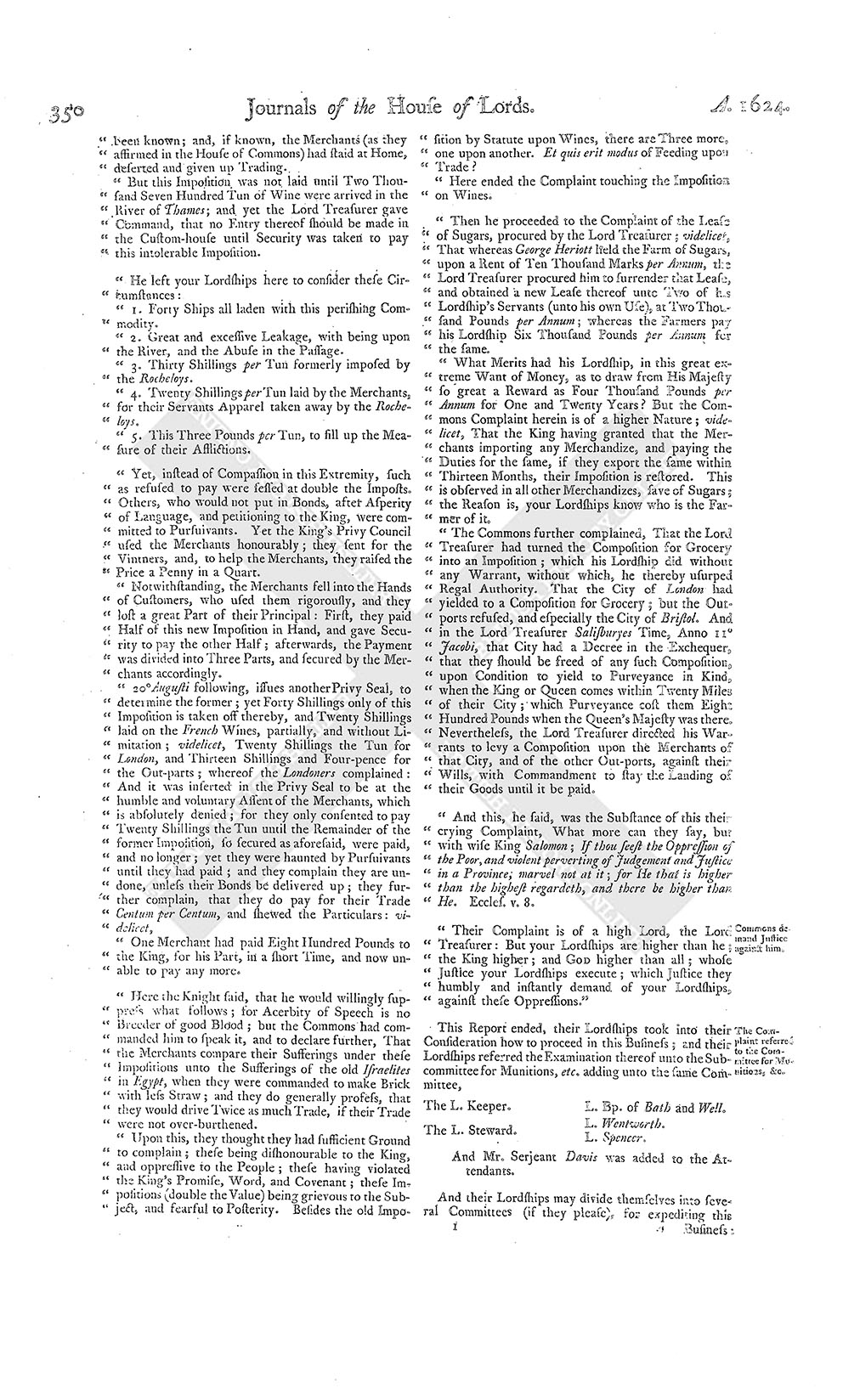
"He put your Lordships in Remembrance, That the Merchants had the King's Covenant and Promise; Covenant under Seal, Promise by His Royal Word, to lay no further Impositions; and they had Reason to desire it, for they paid a great Fine and Rent for the Farm, which your Lordships knew best; yet, for all this, 19° Jan. 19° Jacobi Regis, there issued forth a Privy Seal (fn. 1) for imposing Three Pounds per Tun on the French Wines, a grievous Imposition in the Matter, yet worse in the Manner; for, if it had been just, yet in Equity it should have been laid before the Voyage undertaken, and the Vintage made; then it had been known; and, if known, the Merchants (as they affirmed in the House of Commons) had staid at Home, deserted and given up Trading.
"But this Imposition was not laid until Two Thousand Seven Hundred Tun of Wine were arrived in the River of Thames; and yet the Lord Treasurer gave Command, that no Entry thereof should be made in the Custom-house until Security was taken to pay this intolerable Imposition.
"He left your Lordship here to consider these Circumstances:
"1. Forty Ships all laden with this perishing Commodity.
"2. Great and excessive Leakage, with being upon the River, and the Abuse in the Passage.
"3. Thirty Shillings per Tun formerly imposed by the Rocheloys.
"4. Twenty Shillings per Tun laid by the Merchants, for their Servants Apparel taken away by the Rocheloys.
"5. This Three Pounds per Tun, to fill up the Measure of their Afflictions.
"Yet, instead of Compassion in this Extremity, such as refused to pay were sessed at double the Imposts. Others, who would not put in Bonds, after Asperity of Language, and petitioning to the King, were committed to Pursuivants. Yet the King's Privy Council used the Merchants honourably; they sent for the Vintners, and, to help the Merchants, they raised the Price a Penny in a Quart.
"Notwithstanding, the Merchants sell into the Hands of Customers, who used them rigorously, and they lost a great Part of their Principal: First, they paid Half of this new Imposition in Hand, and gave Security to pay the other Half; afterwards, the Payment was divided into Three Parts, and secured by the Merchants accordingly.
"20° Augusti following, issues another Privy Seal, to determine the former; yet Forty Shillings only of this Imposition is taken off thereby, and Twenty Shillings laid on the French Wines, partially, and without Limitation; videlicet, Twenty Shillings the Tun for London, and Thirteen Shillings and Four-pence for the Out-parts; whereof the Londoners complained: And it was inserted in the Privy Seal to be at the humble and voluntary Assent of the Merchants, which is absolutely denied; for they only consented to pay Twenty Shillings the Tun until the Remainder of the former Imposition, so secured as aforesaid, were paid, and no longer; yet they were haunted by Pursuivants until they had paid; and they complain they are undone, unless their Bonds be delivered up; they further complain, that they do pay for their Trade Centum per Centum, and shewed the Particulars: videlicet,
"One Merchant had paid Eight Hundred Pounds to the King, for his Part, in a short Time, and now unable to pay any more.
"Here the Knight said, that he would willingly suppress what follows; for Acerbity of Speech is no Breeder of good Blood; but the Commons had commanded him to speak it, and to declare further, That the Merchants compare their Sufferings under these Impositions unto the Sufferings of the old Israelites in Egypt, when they were commanded to make Brick with less Straw; and they do generally prosess, that they would drive Twice as much Trade, if their Trade were not over-burthened.
"Upon this, they thought they had sufficient Ground to complain; these being dishonourable to the King, and oppressive to the People; these having violated the King's Promise, Word, and Covenant; these Impositions (double the Value) being grievous to the Subject, and fearful to Posterity. Besides the old Imposition by Statute upon Wines, there are Three more, one upon another. Et quis erit modus of Feeding upon Trade?
"Here ended the Complaint touching the Imposition on Wines.
"Then he proceeded to the Complaint of the Lease of Sugars, procured by the Lord Treasurer; videlicet, That whereas George Heriott held the Farm of Sugars, upon a Rent of Ten Thousand Marks per Annum, the Lord Treasurer procured him to surrender that Lease, and obtained a new Lease thereof unto Two of his Lordship's Servants (unto his own Use), at Two Thousand Pounds per Annum; whereas the Farmers pay his Lordship Six Thousand Pounds per Annum for the same.
"What Merits had his Lordship, in this great extreme Want of Money, as to draw from His Majesty so great a Reward as Four Thousand Pounds per Annum for One and Twenty Years? But the Commons Complaint herein is of a higher Nature; videlicet, That the King having granted that the Merchants importing any Merchandize, and paying the Duties for the same, if they export the same within Thirteen Months, their Imposition is restored. This is observed in all other Merchandizes, save of Sugars; the Reason is, your Lordships know who is the Farmer of it.
"The Commons further complained, That the Lord Treasurer had turned the Composition for Grocery into an Imposition; which his Lordship did without any Warrant, without which, he thereby usurped Regal Authority. That the City of London had yielded to a Composition for Grocery; but the Outports refused, and especially the City of Bristol. And in the Lord Treasurer Salisburyes Time, Anno 11° Jacobi, that City had a Decree in the Exchequer, that they should be freed of any such Composition, upon Condition to yield to Purveyance in Kind, when the King or Queen comes within Twenty Miles of their City; which Purveyance cost them Eight Hundred Pounds when the Queen's Majesty was there Nevertheless, the Lord Treasurer directed his Warrants to levy a Composition upon the Merchants of that City, and of the other Out-ports, against their Wills, with Commandment to stay the Landing of their Goods until it be paid.
"And this, he said, was the Substance of this their crying Complaint, What more can they say, but with wife King Salomon; If thou seest the Oppression of the Poor, and violent perverting of Judgement and Justice in a Province; marvel not at it; for He that is higher than the highest regardeth, and there be higher than He. Eccles. v. 8.
Commons demand Justice against him.
"Their Complaint is of a high Lord, the Lord Treasurer: But your Lordships are higher than he; the King higher; and God higher than all; whose Justice your Lordships execute; which Justice they humbly and instantly demand of your Lordships, against these Oppressions."
The Complaint referred to the Committee for Munitions, &c.
This Report ended, their Lordships took into their Consideration how to proceed in this Business; and their Lordships referred the Examination thereof unto the Subcommittee for Munitions, etc. adding unto the same Committee,
And Mr. Serjeant Davis was added to the Attendants.
And their Lordships may divide themselves into several Committees (if they please), for expediting this Business: and may send for any Witnesses (to be sworn here in the Court), that may conduce to the Examination thereof.
The Names of the said Committee:
Witnesses in the Lord Treasurer's Cause.
The Names of those that were sent for to be examined in this Cause: videlicet,
|
Bernarde Hide. Edmund Dawes. Bushop. Abraham Jacob. |
Sir John Wolstonholme. Henry Garraway. Jo. Williams. Jo. Harrison. |
Adjourn.
Dominus Custos Magni Sigilli declaravit præsens Parliamentum continuandum esse usque in diem crastinum, videlicet, 17m diem instantis Aprilis, hora 9a, Dominis sic decernentibus.