
Journal of the House of Lords: Volume 3, 1620-1628. Originally published by His Majesty's Stationery Office, London, 1767-1830.
This free content was digitised by double rekeying. All rights reserved.
'House of Lords Journal Volume 3: 8 June 1626', in Journal of the House of Lords: Volume 3, 1620-1628, (London, 1767-1830) pp. 654-669. British History Online https://www.british-history.ac.uk/lords-jrnl/vol3/pp654-669 [accessed 25 April 2024]







In this section
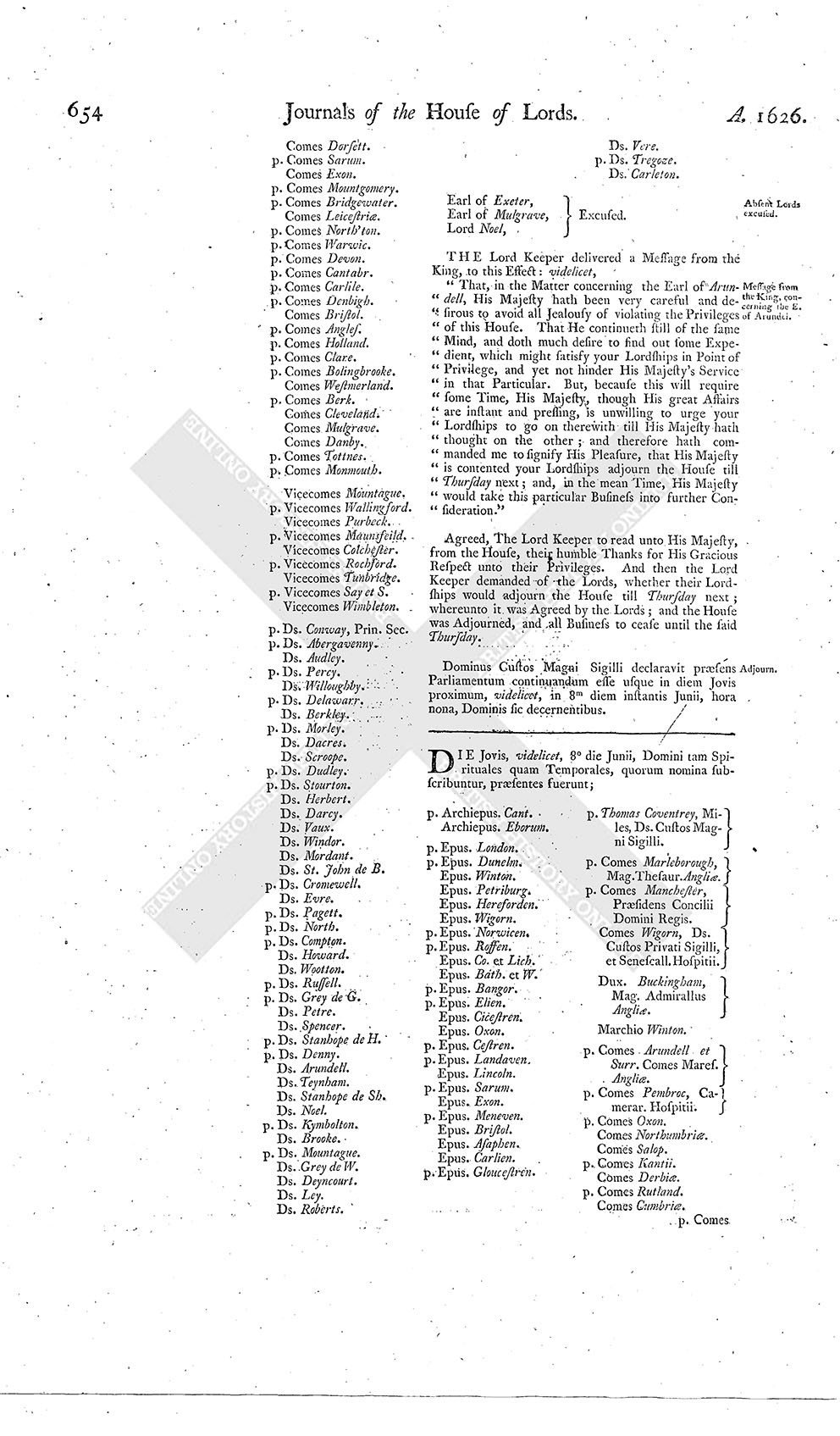
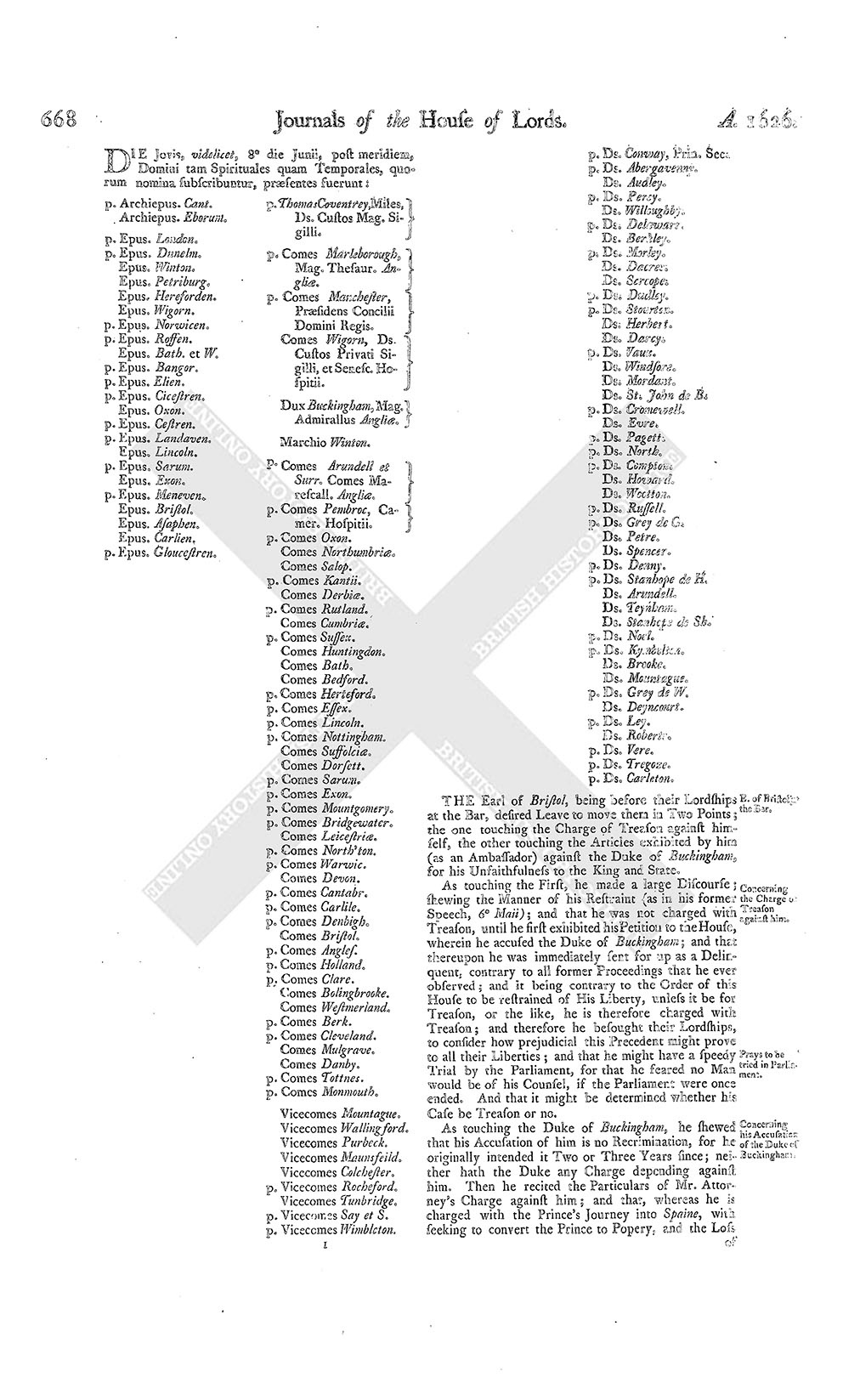
DIE Jovis, videlicet, 8 die Junii,
Domini tam Spirituales quam Temporales, quorum nomina subscribuntur, præsentes fuerunt;
Absent Lords excused.
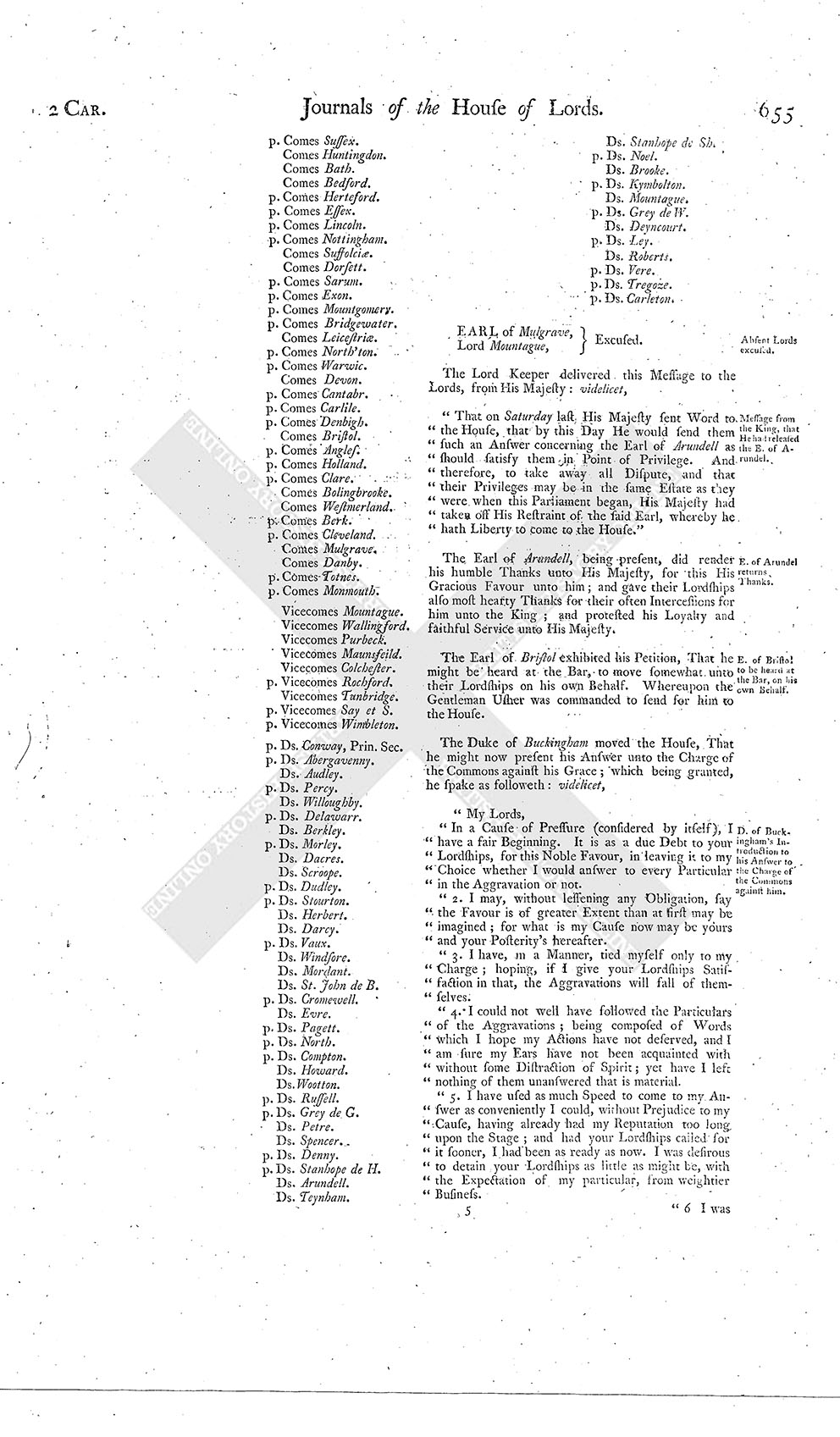
The Lord Keeper delivered this Message to the Lords, from His Majesty: videlicet,
Message from the King, that He had released the E. of Arundel.
"That on Saturday last His Majesty sent Word to the House, that by this Day He would send them such an Answer concerning the Earl of Arundell as should satisfy them in Point of Privilege. And therefore, to take away all Dispute, and that their Privileges may be in the same Estate as they were when this Parliament began, His Majesty had taken off His Restraint of the said Earl, whereby he hath Liberty to come to the House."
E. of Arundel returns Thanks.
The Earl of Arundell, being present, did reader his humble Thanks unto His Majesty, for this His Gracious Favour unto him; and gave their Lordships also most hearty Thanks for their often Intercessions for him unto the King; and protested his Loyalty and faithful Service unto His Majesty.
E. of Bristol to be heard at the Bar, on his own Behalf.
The Earl of Bristol exhibited his Petition, That he might be heard at the Bar, to move somewhat unto their Lordships on his own Behalf. Whereupon the Gentleman Usher was commanded to send for him to the House.
The Duke of Buckingham moved the House, That he might now present his Answer unto the Charge of the Commons against his Grace; which being granted, he spake as followeth: videlicet,
"My Lords,
D. of Buckingham's Introduction to his Answer to the Charge of the Commons against him.
"In a Cause of Pressure (considered by itself), I have a fair Beginning. It is as a due Debt to your Lordships, for this Noble Favour, in leaving it to my Choice whether I would answer to every Particular in the Aggravation or not.
"2. I may, without lessening any Obligation, say the Favour is of greater Extent than at first may be imagined; for what is my Cause now may be yours and your Posterity's hereafter.
"3. I have, in a Manner, tied myself only to my Charge; hoping, if I give your Lordships Satisfaction in that, the Aggravations will fall of themselves.
"4. I could not well have followed the Particulars of the Aggravations; being composed of Words which I hope my Actions have not deserved, and I am sure my Ears have not been acquainted with without some Distraction of Spirit; yet have I left nothing of them unanswered that is material.
"5. I have used as much Speed to come to my Answer as conveniently I could, without Prejudice to my Cause, having already had my Reputation too long upon the Stage; and had your Lordships called for it sooner, I had been as ready as now. I was desirous to detain your Lordships as little as might be, with the Expectation of my particular, from weightier Business.
"6. I was likewise grieved that my Business should be the Cause of the Loss of this Year for Foreign Attempts, and the Hinderer of those Resolutions that would have comforted our Friends abroad, and secured ourselves at Home; but in this, my Lords, I am sure you will easily acquit me in your Thoughts.
"7. When I look upon my Charge in general (as they did), without searching into the Integrity of my Heart and Actions (which are yet unknown to most of them), I wonder not so much at their Proceedings, the Particulars not being voted against me unanimously; but, had they taken the Means to have been better and trulier informed of the Particulars, or had given me Cause to have informed them, I assure myself they had not troubled your Lordships with this Charge.
"8. I confess there hath been that Contestation in the House of Commons concerning my Justification, that I cannot but acknowledge much Favour there from many; and, if the Actions of some others in that House do not make them conclude me of a worse Disposition than I shall hereafter be found; there is none but may say with me, I am at Peace with all.
"9. I shall now, for the present, apply myself only to the clearing of my Reputation; and for the future to those Actions and Endeavours which may re-possess me of that I have accounted one of my greatest Losses, their good Opinions.
"10. I would not speak nor profess this before your Lordships, if Reason and mine own Disposition did not counsel and warrant the Performance of it.
"11. For, First, who accused me?
"Common Fame.
"Who gave me up to your Lordships?
"The House of Commons.
"The one is too subtil a Body (if a Body), the other too great a one, for me to contest with.
"I am confident, when my Cause shall be tried, neither the one or the other, or Part of either, will be found to have any Ground of being my Enemies; but, as Fame is subtil, so is it often (and especially in Accusations) Half: Therefore, though the House of Commons have not willingly wronged me, yet I am confident it will be at length found that Common Fame hath abused both it and me.
"12. I presume the House hath proceeded against me, out of a hearty and zealous Affection to do their King and Country Service; and I hope, out of Christian Charity, to punish or mend my Faults (if Fame could have proved them), and not to ruin my Reputation, or destroy my Fortune. I shall never call such Proceedings wrong, that, seeking to cure my Errors, give me Opportunity to clear and publish mine Innocency.
"13. For the State itself, I have a little to say; it is but a little, I will not abuse your Lordships Patience. I was born and bred in it. I owe my Life. I have been raised to Honour and Fortunes in it (I freely confess) beyond my Merit. What I have wanted in Sufficiency and Experience for the Service of it, I have endeavoured to supply by Care and Industry; and could there be the least Alienation hereafter of my Heart from the Service of the State for any Thing that hath passed, I should be the ungratefullest Man living. Should but such a Thought stain my Heart, I would be content it were let Blood. If my Posterity should not inherit the same Fidelity, I should desire an Inversion in the Course of Nature, and be glad to see them earthed before me.
"My Answer to the several Points of my Charge, I shall crave Leave to deliver in briefly in Writing, and in Form of Law, but as naked as Truth loves to be; and so I leave myself and my Cause to your Lordships Justice."
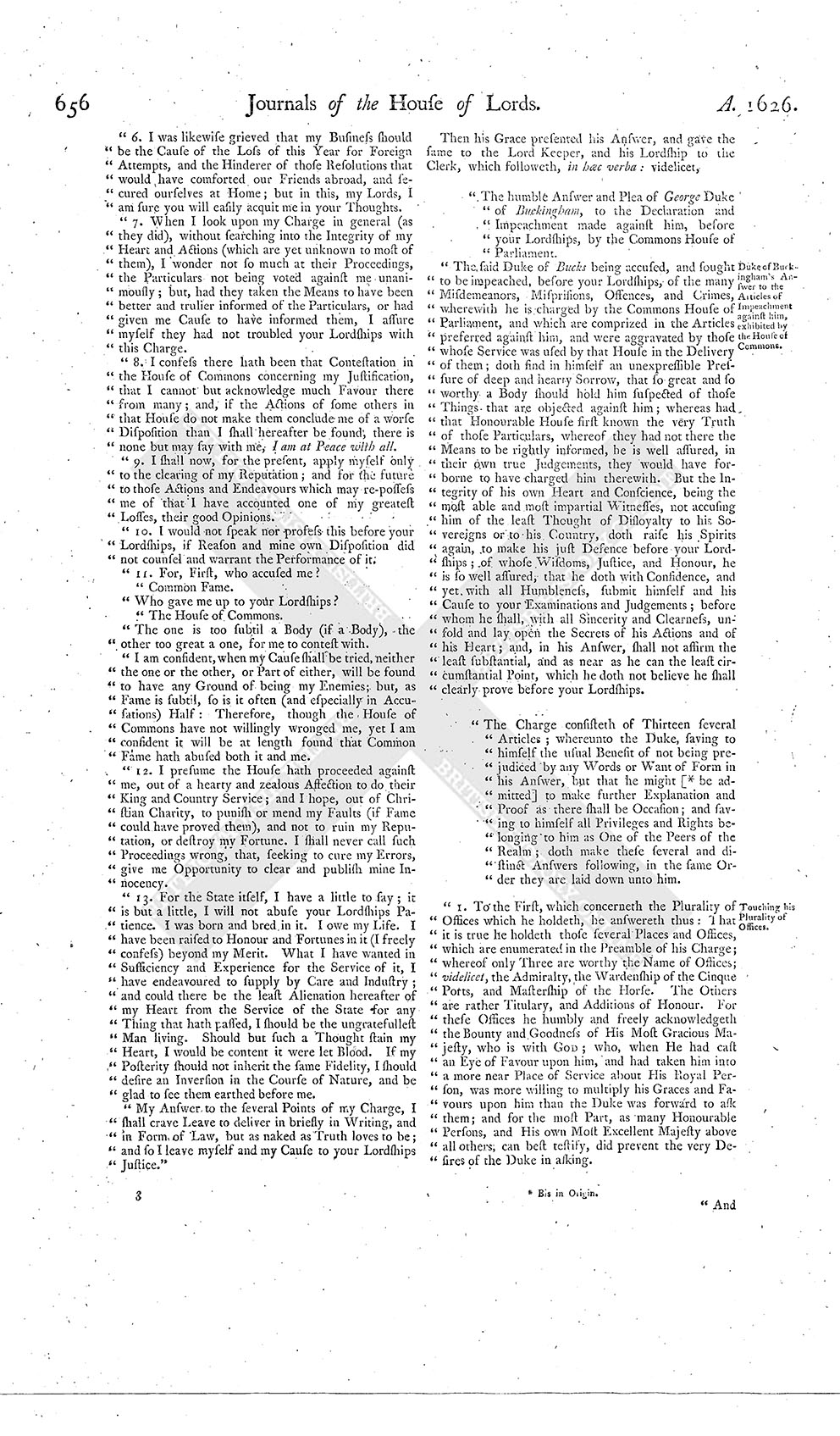
Then his Grace presented his Answer, and gave the same to the Lord Keeper, and his Lordship to the Clerk, which followeth, in hæc verba: videlicet,
"The humble Answer and Plea of George Duke of Buckingham, to the Declaration and Impeachment made against him, before your Lordships, by the Commons House of Parliament.
Duke of Buckingham's Answer to the Articles of Impeachment against him, exhibited by the House of Commons.
"The said Duke of Bucks being accused, and sought to be impeached, before your Lordships, of the many Misdemeanors, Misprisions, Offences, and Crimes, wherewith he is charged by the Commons House of Parliament, and which are comprized in the Articles preferred against him, and were aggravated by those whose Service was used by that House in the Delivery of them; doth find in himself an unexpressible Pressure of deep and hearty Sorrow, that so great and so worthy a Body should hold him suspected of those Things that are objected against him; whereas had that Honourable House first known the very Truth of those Particulars, whereof they had not there the Means to be rightly informed, he is well assured, in their own true Judgements, they would have forborne to have charged him therewith. But the Integrity of his own Heart and Conscience, being the most able and most impartial Witnesses, not accusing him of the least Thought of Disloyalty to his Sovereigns or to his Country, doth raise his Spirits again, to make his just Defence before your Lordships; of whose Wisdoms, Justice, and Honour, he is so well assured, that he doth with Confidence, and yet. with all Humbleness, submit himself and his Cause to your Examinations and Judgements; before whom he shall, with all Sincerity and Clearness, unfold and lay open the Secrets of his Actions and of his Heart; and, in his Answer, shall not affirm the least substantial, and as near as he can the least circumstantial Point, which he doth not believe he shall clearly prove before your Lordships.
"The Charge consisteth of Thirteen several Articles; whereunto the Duke, saving to himself the usual Benefit of not being prejudiced by any Words or Want of Form in his Answer, but that he might [ (fn. 1) be admitted] to make further Explanation and Proof as there shall be Occasion; and saving to himself all Privileges and Rights belonging to him as One of the Peers of the Realm; doth make these several and distinct Answers following, in the same Order they are laid down unto him.
Touching his Plurality of Offices.
"1. To the First, which concerneth the Plurality of Offices which he holdeth, he answereth thus: That it is true he holdeth those several Places and Offices, which are enumerated in the Preamble of his Charge; whereof only Three are worthy the Name of Offices; videlicet, the Admiralty, the Wardenship of the Cinque Ports, and Mastership of the Horse. The Others are rather Titulary, and Additions of Honour. For these Offices he humbly and freely acknowledgeth the Bounty and Goodness of His Most Gracious Majesty, who is with God; who, when He had cast an Eye of Favour upon him, and had taken him into a more near Place of Service about His Royal Person, was more willing to multiply his Graces and Favours upon him than the Duke was forward to ask them; and for the most Part, as many Honourable Persons, and His own Most Excellent Majesty above all others, can best testify, did prevent the very Desires of the Duke in asking.
"And all these particular Places he can and doth truly affirm, His late Majesty did bestow them of His own Royal Motion (except the Wardship of the Cinque Ports only), and thereto also He gave His Approbation and Encouragement. And the Duke denieth that he obtained these Places either to satisfy his exorbitant Ambition or his own Profit or Advantage, as is objected against him; and he hopeth he shall give good Satisfaction to the contrary, in his particular Answers ensuing, touching the Manner of his obtaining the Places of Admiralty and the Wardenship of the Cinque Ports; whereunto he humbly desireth to refer himself. And for the Mastership of the Horse to His Majesty, he saith it is a mere domestic Office of Attendance upon the King's Person, whereby he receiveth some Profit, yet but as a Conveniency to render him more fit for his continual Attendance. And in that Place, the Times compared, he hath retrenched the King's Annual Charge to a considerable Value, as shall be made apparent. And for the Number of Places he holdeth, he saith that, if the Commonwealth doth not suffer thereby, he hopeth he may, without Blame, receive and retain that which the liberal and bountiful Hand of his Master hath freely conferred upon him; and it is not without many Precedents, both in ancient and modern Times, that one Man, eminent in the Esteem of his Sovereign, hath at one Time held as great and as many Offices; but, when it shall be discerned that he shall falsisy or corruptly use those Places, or any of them, or that the Publick shall suffer thereby, he is so thankful for what he hath freely received, that, whensoever his Gracious Master shall require it, without (fn. 2) disputing with his Sovereign, he will readily lay down at His Royal Feet, not only his Places and Offices, but his whole Fortunes and his Life, to do Him Service."
"2. For his buying of the Admiral's Place, the said Duke maketh this clear and true Answer.
Touching his buying the Admiral's Place.
"That it is true, that, in January, in the Sixteenth Year of His late Majesty's Reign, His late Majesty, by His Letters Patents under the Great Seal of England, granted unto the Duke the Office of Admiralty, for his Life; which Grant, as he well knoweth it was made freely, and without any Contract or Bargain with the late Lord Admiral, or any other, and upon the voluntary Surrender of that noble and well-deserving Lord, so he is advised it will appear to be free from any Defect in Law, by Reason of the Statute of 5 Ed. VI, mentioned in this Article of his Charge, or of any other Cause whatsoever: For he saith, that the true Manner of his buying this Office, and of all the Passages thereof, which he is ready to make good by Proof, was thus: That Honourable Lord, the late Earl of Nottingham, then Lord Admiral, being grown much in Years, and finding that he was not then so able to perform that which appertained to his Place, as in former Times he had done to his great Honour, and fearing lest His Majesty's Service and the Commonwealth might suffer by his Defect, became an humble and earnest Petitioner to His late Majesty, to admit him to surrender his Office. His late Majesty was, at the First, unwilling unto it, out of His Royal Affection to his Person, and true Judgement of his Worth. But the Earl renewed his Petitions, and in some of them nominated the Duke to be his Successor, without the Duke's Privity or Forethought of it. And about that Time a Gentleman of good Place about the Navy, and of long Experience, of himself came to the Duke, and earnestly moved him to undertake the Place. The Duke, apprehending the Weight of the Place, and considering his young Years and Want of Experience to manage so great a Charge, gave no Ear unto it; but excused it, not for Form, but really and ingenuously, out of his Apprehension of his then Unfitness for it. This Gentleman, not thus satisfied, without the Duke, applied himself to the late King, and moved His Majesty therein, and offered Reasons for it, that the Duke was the fittest Man at that Time, and as the State of the Navy then stood, for that Place; for he said it was then a Time of Peace; that the best Service could be done for the present was to repair the Navy and Ships Royal, which then were much in Decay, and to retrench the King's Charge, and to employ it effectually; and that, before there was Personal Use of Service otherwise, the Duke, being young and active, might gain Experience, and make himself as fit as any other; and that, in the mean Time, none was so fit as himself, having the Opportunity of His Majesty's Favour, and Nearness to His Person, to procure a constant Assignment and Payment of Moneys for the Navy, the Want whereof was the greatest Cause of the former Defects. These Reasons persuaded His late Majesty, and, upon His Majesty's own Motion, persuaded the Duke to take the Charge upon him. And thereupon the Earl, voluntarily, freely, and willingly, and upon his own earnest and often Suit, surrendered his Place, without any Precedent, Contract, or Promise whatsoever, that might render the Duke in the least Degree subject to the Danger of the Law (which was not then so much as once thought upon); and, upon that Surrender, the Grant was made to the Duke: But it is true, that His Majesty, out of His Royal Bounty, for Recompence of the long and faithful Service of the said Earl, and for an Honourable Memory of his Deserts to Him and the Crown of England, did grant him a Pension of Ten Thousand Pounds per Annum, for his Life; which, in all Ages, hath been the Royal Way of Princes, wherewith to reward ancient and well-deserving Servants in their elder Years, when, without their own Faults, they are become less serviceable to the State. And the Duke also, voluntarily and freely, and as an Argument of his noble Respect towards so Honourable a Predecessor, whom to his Death he called Father, whose Estate, as he then understood, might well bear it, with His late Majesty's Privity and Approbation, did send him Three Thousand Pounds in Money; which he hopeth no Person of Worth and Honour will esteem to be an Act worthy of Blame in him. And when the Duke had thus obtained this Place of great Trust, he was so careful of his Duty, that he would not rely upon his own Judgement or Ability; but of himself humbly besought His then Majesty to settle a Commission of fit and able Persons for the Affairs of the Navy, by whose Counsel and Assistance he might manage that weighty Business with the best Advantage for His Majesty's Service; which Commission was granted, and yet continueth; and without the Advice of those Commissioners he hath never done any Thing of Moment; and by their Advice and Industry he hath thus husbanded the King's Money, and furthered the Service, that (fn. 3) whereas the Ordinary Charge of the Navy was Four and Fifty Thousand Pounds per Annum, and yet the Ships were very much decayed, and their Provisions neglected; the Charge was reduced to Thirty Thousand Pounds per Annum; and with that Charge the Ships all repaired and made serviceable, and Two new Ships builded Yearly; and for the Two last Years, when there were no new Ships built, the Ordinary Charge was reduced to Twenty-one Thousand Six Hundred Pounds per Annum; and now he dare boldly affirm, that His Majesty's Navy is in better State by much than ever it was in any precedent Time whatsoever."
"3. For his ouying the Wardenship of the Cinque Ports, he maketh this plain, ingenuous, and true Answer.
Touching his buying the Wardenship of the Cinque Ports.
"3. That, in December, in the Two and Twentieth Year of His late Majesty's Reign, he obtained the Office of Lord Warden of the Cinque Ports, and Constable of the Castle of Dover (being one entire Office), upon the Surrender of the Lord Zouch, then Lord Warden. The Manner of obtaining whereof was thus: The Lord Zouch, being grown in Years, and with his almost continual Lameness being grown less fit for that Place, he discovered a Willingness to leave it, and made several Offers thereof to the Duke of Richmond, and Richard Earl of Dorsett, deceased; but he was not willing to part with it without Recompence; Notice whereof coming to the Duke, by an Offer made from the Lord Zouch, he, finding by Experience how much and how many Ways both the King's Service might and many Times did suffer, and how many Inconveniences did arise to the King's Subjects, in their Goods, Ships, and Lives, by the Intermixture of the Jurisdictions of the Admiralty and Wardenship of the Cinque Ports, by the Emulation, Disaffection, and Contention of their Officers, as will clearly appear by these Particulars, amongst many others that may be instanced:
"1. Where the Admiral's Jurisdiction extends generally to all the Narrow Seas; the Warden of the Cinque Ports hath and exerciseth Admiral Jurisdiction on all the Sea Coasts from Showe Beacon in Essex, to the Red Noore in Sussex; and within those Limits there have been continual Differences between the Lord Admiral and the Lord Warden, whether the Lord Warden's Jurisdiction extends into the Main Sea, or only as far as the Low Water Mark, and so much further into the Sea as a Man on Horseback can reach with a Lance; which occasioneth Questions between those chief Officers themselves.
"2. There are many and continual Differences in executing of Warrants against Offenders; the Officers of the one refusing to obey or assist the Authority of the other: whereby the Offender, protected or countenanced by either, easily escapeth:
"3. Merchants and Owners of Goods questioned in the Admiralty are often enforced to sue in both Courts, and often enforced, for their Peace, to compound with both Officers.
"4. The King's Service is much hindered; for, the most usual and ordinary Rendezvous of the King's Ships being at The Downes, and that being within Jurisdiction of the said Warden, the Lord Admiral or Captains of the King's Ships have no Power or Warrant to press Men from the Shore, if the King's Ships be in Distress.
"5. When the King's Ships or others be in Danger on The Goodwyns, or other Places, within View of the Portsmen, they have refused to help with their Boats, left the King's Ships should command them on Board; whereby many Ships have perished, and much Goods have been lost.
"6. When Warrants come to press a Ship at Road for the King's Service, the Officers take Occasions to disobey the Warrants, and prejudice the King's Service; for, if the Warrant come from the Lord Warden, they will pretend the Ship to be out of their Jurisdiction; if the Warrant come from the Lord Admiral, they will pretend it to be within Jurisdiction of the Cinque Ports; and so, whilst the Officers dispute, the Opportunity of the Service is lost.
"7. When the King's Ships lye near the Ports, and the Men come on Shore, the Officers refuse to assist the Captains to reduce them to their Ships, without the Lord Warden's Warrant.
"8. If the King's Ships on the sudden have any Need of Pilots, for The Sands, Coasts of Flanders, or the like, wherein the Portsmen are the best experienced, they will not serve without the Lord Warden's or his Lieutenant's Warrant, who perhaps are not near the Place.
"9. When, for great Occasions for the Service of the State, the Lord Admiral and the Lord Warden must both join their Authority; if the Officers, for Want of true understanding of their several Limits and Jurisdictions, mistake the Warrants, the Service, which many-times can endure no Delay, is lost, or not so effectually performed.
"For these, and many other Reasons of the like Kind, the Duke, not being led either with Ambition or Hope of Profit, as hath been objected (for it could be no Increase of Honour unto him, having been honoured before with a greater Place; nor for Profit, for it hath not yielded him in a Manner any Profit at all, nor is like to yield him above Three Hundred Pounds per Annum at any Time), but out of his Desire to make himself the more able to do the King and Kingdom Service, and prevent all Differences and Difficulties, which heretofore had, or hereafter might, hinder the same; he did entertain that Motion: And doth confess, that, not knowing, nor so much as thinking, of the said Act of Parliament before mentioned, he did agree to give the said Lord One Thousand Pounds in Money, and Five Hundred Pounds per Annum, in respect of his Surrender; he not being willing to leave his Place without such Consideration, nor the Duke willing to have it without his full Satisfaction. And the Occasion why the Duke of Buckingham gave that Consideration to the Lord Zouch was, because the Duke of Richmond, in his Life-time, had first agreed to give the same Consideration for it; and, if he had lived, he had had that Place upon the same Terms. And when the Lord Duke of Richmond was dead, His late Majesty directed the Duke of Buckingham to go thorough for that Place; and, for the Reasons aforementioned, to put both these Offices together; and to give the same Consideration to the said Lord, which the Duke of Richmond should have given; and His late Majesty said, he would re-pay the Money. And how far this Act of his, in acquiring this Office, accompanied with these Circumstances, may be within the Danger of the Law, the King being privy to all the Passages of it, and encouraging and directing of it, he humbly submitteth to Judgement: And he humbly leaves it to your Lordships Judgements, in what Third Way, an ancient Way, an ancient Servant to the Crown, by Age and Infirmity disabled to perform his Service, can, in an Honourable Course, relinquish his Place; for, if the King Himself give the Reward, it may be said it is a Charge to the Crown; if the succeeding Officer give the Recompence, it may thus be objected to be within the Danger of the Law: And howsoever it be, yet he hopeth it shall not be held in him a Crime, when his Intentions were just and honourable, and for the Furtherance of the King's Service; neither is it without Precedents, that, in former Times of great Employment, both these Offices were put into one Hand, by several Grants."
Touching his not guarding the Seas.
"4. To this Article, whereby the not guarding of the Narrow Seas, in these last Two Years, by the Duke, according to the Trust and Duty of an Admiral, is laid to his Charge, whereof the Consequence, supposed to have been merely through his Default, are the ignominious infesting of the Coast with Pirates and Enemies, the endangering of the Dominion of those Seas, the extreme Loss of the Merchants, and Decay of the Trade and Strength of the Kingdom.
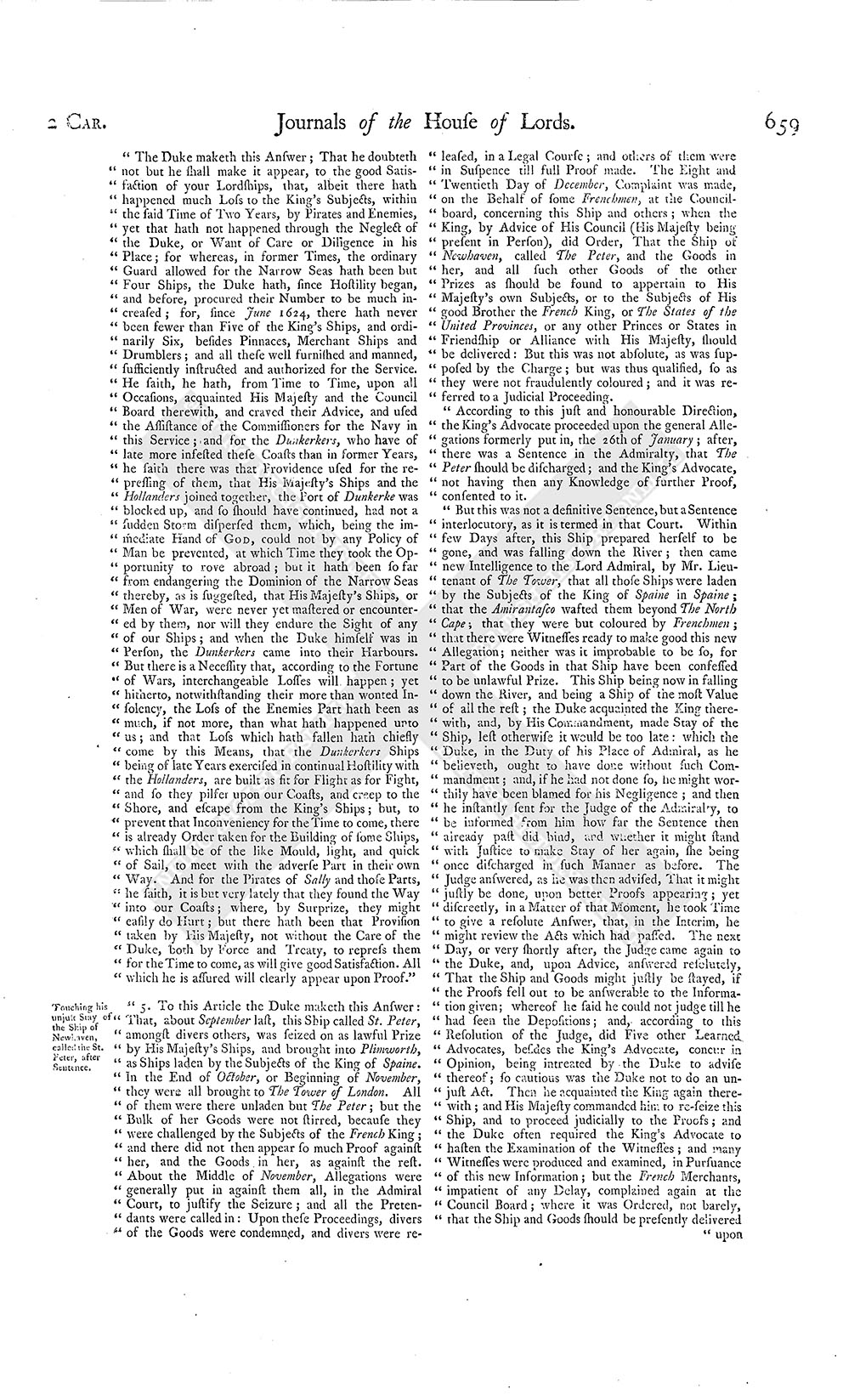
"The Duke maketh this Answer; That he doubteth not but he shall make it appear, to the good Satisfaction of your Lordships, that, albeit there hath happened much Loss to the King's Subjects, within the said Time of Two Years, by Pirates and Enemies, yet that hath not happened through the Neglect of the Duke, or Want of Care or Diligence in his Place; for whereas, in former Times, the ordinary Guard allowed for the Narrow Seas hath been but Four Ships, the Duke hath, since Hostility began, and before, procured their Number to be much increased; for, since June 1624, there hath never been fewer than Five of the King's Ships, and ordinarily Six, besides Pinnaces, Merchant Ships and Drumblers; and all these well furnished and manned, sufficiently instructed and authorized for the Service. He saith, he hath, from Time to Time, upon all Occasions, acquainted His Majesty and the Council Board therewith, and craved their Advice, and used the Assistance of the Commissioners for the Navy in this Service; and for the Dunkerkers, who have of late more infested these Coasts than in former Years, he faith there was that Providence used for the repressing of them, that His Majesty's Ships and the Hollanders joined together, the Port of Dunkerke was blocked up, and so should have continued, had not a sudden Storm dispersed them, which, being the immediate Hand of God, could not by any Policy of Man be prevented, at which Time they took the Opportunity to rove abroad; but it hath been so far from endangering the Dominion of the Narrow Seas thereby, as is suggested, that His Majesty's Ships, or Men of War, were never yet mastered or encountered by them, nor will they endure the Sight of any of our Ships; and when the Duke himself was in Person, the Dunkerkers came into their Harbours. But there is a Necessity that, according to the Fortune of Wars, interchangeable Losses will happen; yet hitherto, notwithstanding their more than wonted Insolency, the Loss of the Enemies Part hath been as much, if not more, than what hath happened unto us; and that Loss which hath fallen hath chiefly come by this Means, that the Dunkerkers Ships being of late Years exercised in continual Hostility with the Hollanders, are built as fit for Flight as for Fight, and so they pilfer upon our Coasts, and creep to the Shore, and escape from the King's Ships; but, to prevent that Inconveniency for the Time to come, there is already Order taken for the Building of some Ships, which shall be of the like Mould, light, and quick of Sail, to meet with the adverse Part in their own Way. And for the Pirates of Sally and those Parts, he saith, it is but very lately that they found the Way into our Coasts; where, by Surprize, they might easily do Hurt; but there hath been that Provision taken by His Majesty, not without the Care of the Duke, both by Force and Treaty, to repress them for the Time to come, as will give good Satisfaction. All which he is assured will clearly appear upon Proof."
Touching his unjust Stay of the Ship of Newhaven, called the St. Peter, after Sentence.
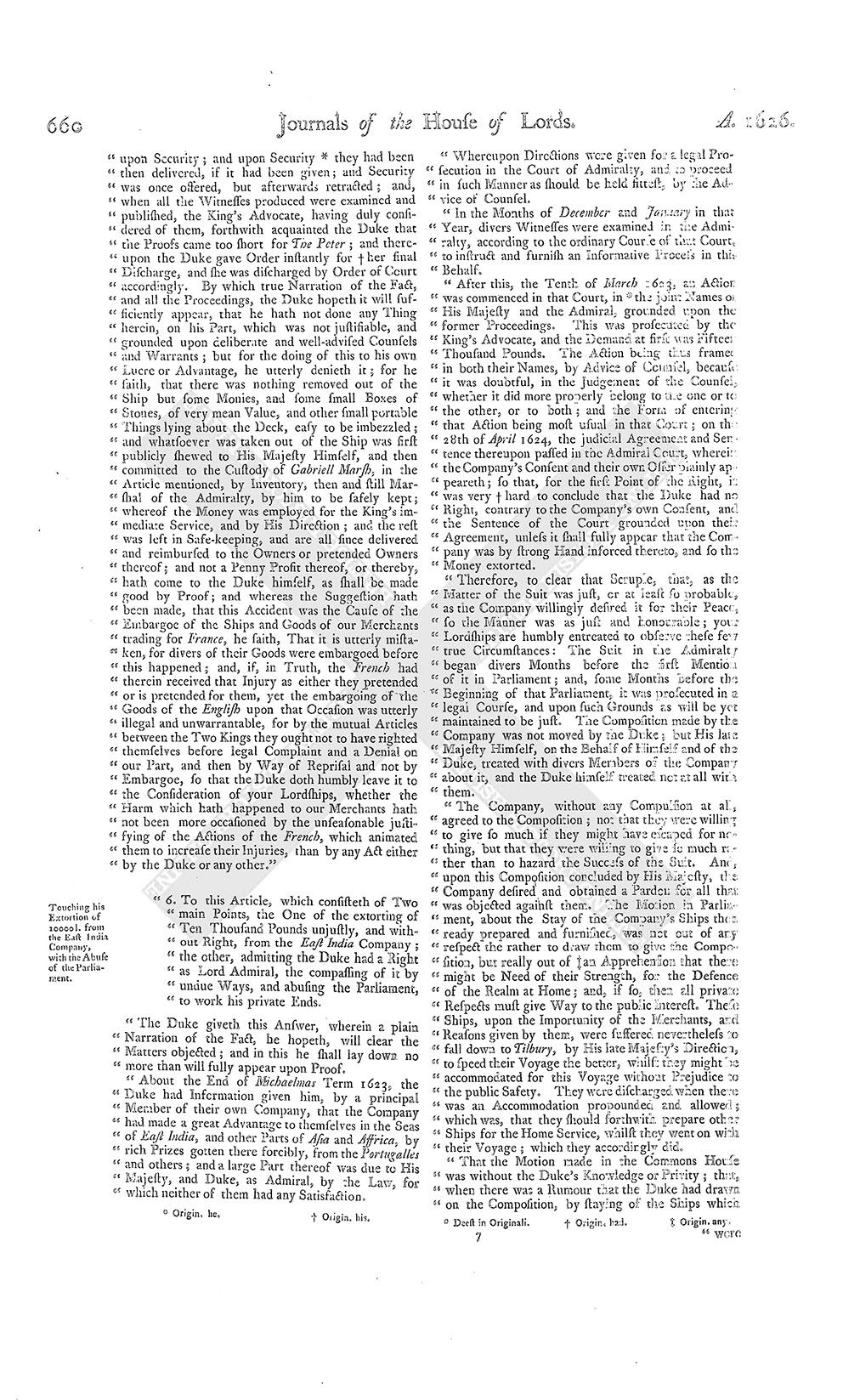
"5. To this Article the Duke maketh this Answer: That, about September last, this Ship called St. Peter, amongst divers others, was seized on as lawful Prize by His Majesty's Ships, and brought into Plimworth, as Ships laden by the Subjects of the King of Spaine. In the End of October, or Beginning of November, they were all brought to The Tower of London. All of them were there unladen but The Peter; but the Bulk of her Goods were not stirred, because they were challenged by the Subjects of the French King; and there did not then appear so much Proof against her, and the Goods in her, as against the rest. About the Middle of November, Allegations were generally put in against them all, in the Admiral Court, to justify the Seizure; and all the Pretendants were called in: Upon these Proceedings, divers of the Goods were condemned, and divers were released, in a Legal Course; and others of them were in Suspence till full Proof made. The Eight and Twentieth Day of December, Complaint was made, on the Behalf of some Frenchmen, at the Councilboard, concerning this Ship and others; when the King, by Advice of His Council (His Majesty being present in Person), did Order, That the Ship of Newhaven, called The Peter, and the Goods in her, and all such other Goods of the other Prizes as should be found to appertain to His Majesty's own Subjects, or to the Subjects of His good Brother the French King, or The States of the United Provinces, or any other Princes or States in Friendship or Alliance with His Majesty, should be delivered: But this was not absolute, as was supposed by the Charge; but was thus qualified, so as they were not fraudulently coloured; and it was referred to a Judicial Proceeding.
"According to this just and honourable Direction, the King's Advocate proceeded upon the general Allegations formerly put in, the 26th of January; after, there was a Sentence in the Admiralty, that The Peter should be discharged; and the King's Advocate, not having then any Knowledge of further Proof, consented to it.
"But this was not a definitive Sentence, but a Sentence interlocutory, as it is termed in that Court. Within few Days after, this Ship prepared herself to be gone, and was falling down the River; then came new Intelligence to the Lord Admiral, by Mr. Lieutenant of The Tower, that all those Ships were laden by the Subjects of the King of Spaine in Spaine; that the Amirantasco wafted them beyond The North Cape; that they were but coloured by Frenchmen; that there were Witnesses ready to make good this new Allegation; neither was it improbable to be so, for Part of the Goods in that Ship have been confessed to be unlawful Prize. This Ship being now in falling down the River, and being a Ship of the most Value of all the rest; the Duke acquainted the King therewith, and, by His Commandment, made Stay of the Ship, lest otherwise it would be too late: which the Duke, in the Duty of his Place of Admiral, as he believeth, ought to have done without such Commandment; and, if he had not done so, he might worthily have been blamed for his Negligence; and then he instantly sent for the Judge of the Admiralty, to be informed from him how far the Sentence then already past did bind, and whether it might stand with Justice to make Stay of her again, she being once discharged in such Manner as before. The Judge answered, as he was then advised, That it might justly be done, upon better Proofs appearing; yet discreetly, in a Matter of that Moment, he took Time to give a resolute Answer, that, in the Interim, he might review the Acts which had passed. The next Day, or very shortly after, the Judge came again to the Duke, and, upon Advice, answered resolutely, That the Ship and Goods might justly be stayed, if the Proofs fell out to be answerable to the Information given; whereof he said he could not judge till he had seen the Depositions; and, according to this Resolution of the Judge, did Five other Learned Advocates, besides the King's Advocate, concur in Opinion, being intreated by the Duke to advise thereof; so cautious was the Duke not to do an unjust Act. Then he acquainted the King again therewith; and His Majesty commanded him to re-seize this Ship, and to proceed judicially to the Proofs; and the Duke often required the King's Advocate to hasten the Examination of the Witnesses; and many Witnesses were produced and examined, in Pursuance of this new Information; but the French Merchants, impatient of any Delay, complained again at the Council Board; where it was Ordered, not barely, that the Ship and Goods should be presently delivered upon Security; and upon Security (fn. 4) they had been then delivered, if it had been given; and Security was once offered, but afterwards retracted; and, when all the Witnesses produced were examined and published, the King's Advocate, having duly considered of them, forthwith acquainted the Duke that the Proofs came too short for The Peter; and thereupon the Duke gave Order instantly for (fn. 5) her final Discharge, and she was discharged by Order of Court accordingly. By which true Narration of the Fact, and all the Proceedings, the Duke hopeth it will sufficiently appear, that he hath not done any Thing herein, on his Part, which was not justifiable, and grounded upon deliberate and well-advised Counsels and Warrants; but for the doing of this to his own Lucre or Advantage, he utterly denieth it; for he saith, that there was nothing removed out of the Ship but some Monies, and some small Boxes of Stones, of very mean Value, and other small portable Things lying about the Deck, easy to be imbezzled; and whatsoever was taken out of the Ship was first publicly shewed to His Majesty Himself, and then committed to the Custody of Gabriell Marsh, in the Article mentioned, by Inventory, then and still Marshal of the Admiralty, by him to be safely kept; whereof the Money was employed for the King's immediate Service, and by His Direction; and the rest was left in Safe-keeping, and are all since delivered and reimbursed to the Owners or pretended Owners thereof; and not a Penny Profit thereof, or thereby, hath come to the Duke himself, as shall be made good by Proof; and whereas the Suggestion hath been made, that this Accident was the Cause of the Embargoe of the Ships and Goods of our Merchants trading for France, he saith, That it is utterly mistaken, for divers of their Goods were embargoed before this happened; and, if, in Truth, the French had therein received that Injury as either they pretended or is pretended for them, yet the embargoing of the Goods of the English upon that Occasion was utterly illegal and unwarrantable, for by the mutual Articles between the Two Kings they ought not to have righted themselves before legal Complaint and a Denial on our Part, and then by Way of Reprisal and not by Embargoe, so that the Duke doth humbly leave it to the Consideration of your Lordships, whether the Harm which hath happened to our Merchants hath not been more occasioned by the unseasonable justifying of the Actions of the French, which animated them to increase their Injuries, than by any Act either by the Duke or any other."
Touching his Extortion of 10000£. from the East India Company, with the Abuse of the Parliament.
"6. To this Article, which consisteth of Two main Points, the One of the extorting of Ten Thousand Pounds unjustly, and without Right, from the East India Company; the other, admitting the Duke had a Right as Lord Admiral, the compassing of it by undue Ways, and abusing the Parliament, to work his private Ends.
"The Duke giveth this Answer, wherein a plain Narration of the Fact, he hopeth, will clear the Matters objected; and in this he shall lay down no more than will fully appear upon Proof.
"About the End of Michaelmas Term 1623, the Duke had Information given him, by a principal Member of their own Company, that the Company had made a great Advantage to themselves in the Seas of East India, and other Parts of Asia and Affrica, by rich Prizes gotten there forcibly, from the Portugalles and others; and a large Part thereof was due to His Majesty, and Duke, as Admiral, by the Law, for which neither of them had any Satisfaction.
"Whereupon Directions were given for a legal Prosecution in the Court of Admiralty, and to proceed in such Manner as should be held fittest, by the Advice of Counsel.
"In the Months of December and January in that Year, divers Witnesses were examined in the Admiralty, according to the ordinary Course of that Court, to instruct and furnish an Informative Process in this Behalf.
"After this, the Tenth of March 1623, an Action was commenced in that Court, in (fn. 6) the joint Names on His Majesty and the Admiral, grounded upon the former Proceedings. This was prosecuted by the King's Advocate, and the Demand at first was Fifteen Thousand Pounds. The Action being thus framed in both their Names, by Advice of Counsel, because it was doubtful, in the Judgement of the Counsel, whether it did more properly belong to the one or to the other, or to both; and the Form of entering that Action being most usual in that Court; on the 28th of April 1624, the judicial Agreement and Sentence thereupon passed in the Admiral Court, wherein the Company's Consent and their own Offer plainly appeareth; so that, for the first Point of the Right, is was very (fn. 7) hard to conclude that the Duke had no Right, contrary to the Company's own Consent, and the Sentence of the Court grounded upon their Agreement, unless it shall fully appear that the Company was by strong Hand inforced thereto, and so the Money extorted.
"Therefore, to clear that Scruple, that, as the Matter of the Suit was just, or at least so probable, as the Company willingly desired it for their Peace, so the Manner was as just and honourable; your Lordships are humbly entreated to observe these few true Circumstances: The Suit in the Admiralty began divers Months before the first Mention of it in Parliament; and, some Months before the Beginning of that Parliament, it was prosecuted in a legal Course, and upon such Grounds as will be yet maintained to be just. The Composition made by the Company was not moved by the Duke; but His late Majesty Himself, on the Behalf of Himself and of the Duke, treated with divers Members of the Company about it, and the Duke himself treated not at all with them.
"The Company, without any Compulsion at all, agreed to the Composition; not that they were willing to give so much if they might have escaped for nothing, but that they were willing to give so much rather than to hazard the Success of the Suit. And, upon this Composition concluded by His Majesty, the Company desired and obtained a Pardon for all that was objected against them. The Motion in Parliament, about the Stay of the Company's Ships them ready prepared and furnished, was not out of any respect the rather to draw them to give the Composition, but really out of (fn. 8) an Apprehension that there might be Need of their Strength, for the Defence of the Realm at Home; and, if so, then all private Respects must give Way to the public Interest. These Ships, upon the Importunity of the Merchants, and Reasons given by them, were suffered nevertheless to fall down to Tilbury, by His late Majesty's Direction, to speed their Voyage the better, whilst they might be accommodated for this Voyage without Prejudice to the public Safety. They were discharged when there was an Accommodation propounded and allowed; which was, that they should forthwith prepare other Ships for the Home Service, whilst they went on with their Voyage; which they accordingly did.
"That the Motion made in the Commons House was without the Duke's Knowledge or Privity; that, when there was a Rumour that the Duke had drawn on the Composition, by staying of the Ships which were then gone, the Duke was so much offended thereat, that he would have had the former Communication to have broken off, and have proceeded in a legal Course; and he sent to the Company to that Purpose: But the Company gave him Satisfaction that they had raised no such Rumour, nor would nor could avow any such Thing, and entreated him to rest satisfied with their public Acts to the contrary: That, after this, their Ships being gone, themselves, careful of their future Security, solicited the Dispatch of the Composition, consulted with Counsel upon the Instruments that passed about it, and were at the Charge thereof; and the Money was paid long after the Sentence, and the Sentence given after the Ships were gone, and no Security given at all for the Money, but the Sentence; and when this Money was paid to the Duke, the whole Sum (but Two Hundred Pounds thereof only) was borrowed by the King, and employed by His own Officers for the Service of the Navy. If these Things do upon Proof appear to your Lordships, as he is assured they will, he humbly submitteth it to your Judgements, how far verbal Affirmations, or Informations extrajudicial, shall move your Judgements, when judicial Acts, and those which were acted and executed, do prove the contrary."
Touching his putting of the Ships into the Hands of the French.
"7. To this Article, which is so mixed with Actions of Great Princes, (fn. 9) that he dareth not in his Duty publish every Passage thereof, he cannot for the present make so particular an Answer as he may, and hath, and will, do to the rest of his Charge.
"But he giveth this general Answer, the Truth whereof he humbly prayeth may rather appear to your Lordships by the Proof than any Discourse of his, which, in reason of State, will happily be conceived fit to be more privately handled.
"That these Ships were lent to the French King at first without the Duke's Privity; that, when he knew it, he did that which belonged to an Admiral of England, and a true Englishman; and he doth deny that, by Menace, or Compulsion, or any other indirect or undue Practice, or Means, by himself, or by any others, (fn. 10) he did deliver those Ships, or any of them, into the Hands of the French, as is objected against him.
"That the Error, which did happen, by what Direction soever it were, was not in the Intention any Ways injurious, or dishonourable, or dangerous to this State, or prejudicial to any private Man interested in any of those Ships; nor could have given any just Offence at all, if those Promises had been observed by others, which were prosessed and really performed by His Majesty and His Subjects on their Parts.
Since the Duke's Answer delivered into the House, he hath himself openly declared to their Lordships, that, for the better clearing of his Honour and Fidelity to the State in that Part of his Charge which is objected against him, by this Seventh Article, he hath been an earnest and humble Suitor to His Majesty, to give him Leave, in his Proof, to unfold the whole Truth and Secret of that great Action; and hath obtained His Majesty's gracious Leave therein; and accordingly doth intend to make such open and clear Proof thereof, that he nothing doubteth but the same, when it shall appear, will not only clear him from Blame, but be a Testimony of his Care and Faithfulness in serving the State."
Touching his Practice of the Employment of them against Rochel.
"8. To this Article, wherewith he is taxed to have practised for the Employment of the Ships against Rochell, he answereth, that he was so far from practising, or consenting, that the said Ships should so be employed; that he shall make it clearly appear, that, when it was discovered that they would be employed against those of the Religion, the Protestation of the French being otherwise, and their Pretence being that there was a Peace concluded with those of the Religion, and that the French King would use those Ships against Genoa, which had been an Action of no ill Consequence to the Affairs of Christendom; the Duke did, by all fit and honourable Means, endeavour to divert that Course of their Employment against Rochell; and he doth truly and boldly affirm, that his Endeavours, under the Royal Care of His most Excellent Majesty, hath been a great Part of the Means to preserve the Town of Rochill, as the Proofs, when they shall be produced, will make appear; and when His Majesty did find that, beyond His Intention, and contrary to the faithful Promises of the French, they were so mis-employed, He found Himself bound in Honour to intercede with the most Christian King, His good Brother, for the Peace of that Town and of the Religion, lest His Majesty's Honour might otherwise suffer; which Intercestion His Majesty did sedulously and so successfully pursue that that Town and the Religion there will and do acknowledge the Fruits thereof. And whereas it is further objected against him, that when, in so unfaithful a Manner, he had delivered the said Ships into the Power of a Foreign State, to the Danger of the Religion, and Scandal and Dishonour of our Nation, which he utterly denieth to be so; that, to mask his ill Intentions in cunning and cautelous Manner, he abused the Parliament at Oxon, in affirming, before the Committees of both Houses, that the said Ships were not, nor should be, so used or employed; he saith, under the Favour of those who so understood his Words, That he did not then use those Words which are expressed in the Charge to have been spoken by him; but, there being then a Jealousy of the mis-employing of those Ships, but the Duke having no Knowledge thereof, the Duke knowing well what the Promises of the French were, but was not then seasonable to be published; he, hoping that they would not have varied from what was promised, did say, That the Event would shew; which was no undertaking for them; but a Declaration of that, in general Terms, which should really be performed, and which His Majesty hath just Cause to expect from them."
Touching his compelting the Lord Roberts to buy Honour.
"9. That the Duke did compel the Lord Roberts to buy his Title of Honour, he utterly denieth; and he is very confident that the Lord Roberts himself will not affirm it, or any Thing tending that Way; neither can he or any Man else truly say so. But the said Duke is able to prove that the Lord Roberts was before willing to have given a much greater Sum, but could not then obtain it; and he did now obtain it by Solicitation of his own Agents."
Touching his Selling of Places of Judicature.
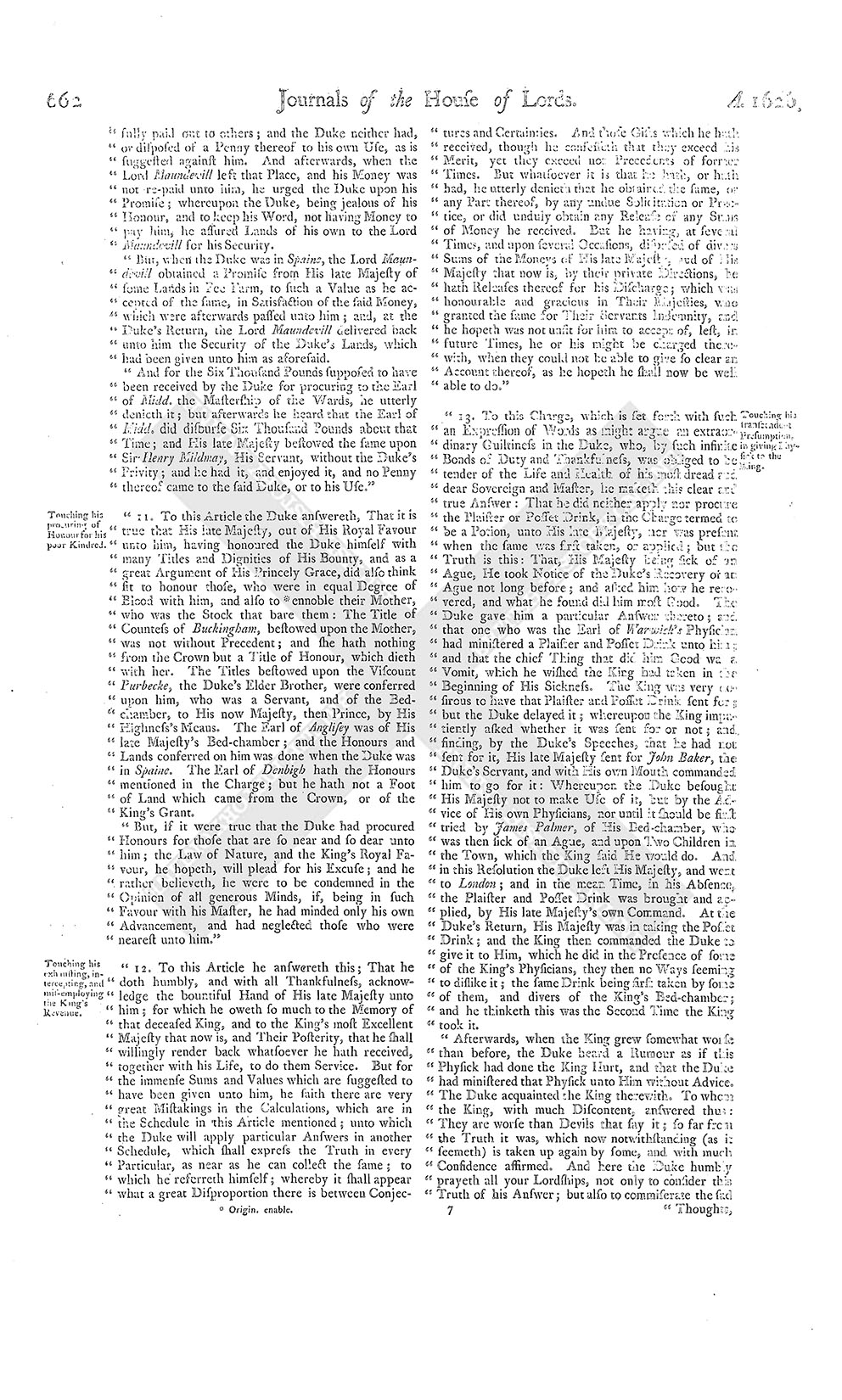
"10. For the Selling the Places of Judicature by the Duke, which are specially instanced in the Charge; he answereth, That he received not, nor had a Penny of either of these Sums to his own Use; but the Truth is, that the Lord Mandivell was made Lord Treasurer (fn. 11) by His late Majesty, without contracting for any Thing for it; but, after that he had the Office conferred upon him, His late Majesty moved him to lend Him Twenty Thousand Pounds, upon Promise of Re-payment at the End of a Year. The Lord Maundevill yielded to it, so as he might have the Duke's Word that it should be re-paid unto him; accordingly the Duke gave his Word for it. The Lord Maundevill relied upon it, and delivered the said Sum to the Hands of Mr. Porter, then the Duke's Servant, by the late King's Appointment, to be disposed as His Majesty should direct. And, according to the King's Direction, that very Money was fully paid out to others; and the Duke neither had, or disposed of a Penny thereof to his own Use, as is suggested against him. And afterwards, when the Lord Maundevill left that Place, and his Money was not re-paid unto him, he urged the Duke upon his Promise; whereupon the Duke, being jealous of his Honour, and to keep his Word, not having Money to pay him, he assured Lands of his own to the Lord Maundevill for his Security.
"But, when the Duke was in Spaine, the Lord Maundevill obtained a Promise from His late Majesty of some Lands in Fee Farm, to such a Value as he accepted of the same, in Satisfaction of the said Money, which were afterwards passed unto him; and, at the Duke's Return, the Lord Maundevill delivered back unto him the Security of the Duke's Lands, which had been given unto him as aforesaid.
"And for the Six Thousand Pounds supposed to have been received by the Duke for procuring to the Earl of Midd. the Mastership of the Wards, he utterly denieth it; but afterwards he heard that the Earl of Midd. did disburse Six Thousand Pounds about that Time; and His late Majesty bestowed the same upon Sir Henry Mildmay, His Servant, without the Duke's Privity; and he had it, and enjoyed it, and no Penny thereof came to the said Duke, or to his Use."
Touching his procuring of Honour for his poor Kindred.
"11. To this Article the Duke answereth, That it is true that His late Majesty, out of His Royal Favour unto him, having honoured the Duke himself with many Titles and Dignities of His Bounty, and as a great Argument of His Princely Grace, did also think fit to honour those, who were in equal Degree of Blood with him, and also to (fn. 12) ennoble their Mother, who was the Stock that bare them: The Title of Countess of Buckingham, bestowed upon the Mother, was not without Precedent; and she hath nothing from the Crown but a Title of Honour, which dieth with her. The Titles bestowed upon the Viscount Purbecke, the Duke's Elder Brother, were conferred upon him, who was a Servant, and of the Bedchamber, to His now Majesty, then Prince, by His Highness's Means. The Earl of Anglisey was of His late Majesty's Bed-chamber; and the Honours and Lands conferred on him was done when the Duke was in Spaine. The Earl of Denbigh hath the Honours mentioned in the Charge; but he hath not a Foot of Land which came from the Crown, or of the King's Grant.
"But, if it were true that the Duke had procured Honours for those that are so near and so dear unto him; the Law of Nature, and the King's Royal Favour, he hopeth, will plead for his Excuse; and he rather believeth, he were to be condemned in the Opinion of all generous Minds, if, being in such Favour with his Master, he had minded only his own Advancement, and had neglected those who were nearest unto him."
Touching his exhausting, intercepting, and mis-employing the King's Revenue.
"12. To this Article he answereth this; That he doth humbly, and with all Thankfulness, acknowledge the bountiful Hand of His late Majesty unto him; for which he oweth so much to the Memory of that deceased King, and to the King's most Excellent Majesty that now is, and Their Posterity, that he shall willingly render back whatsoever he hath received, together with his Life, to do them Service. But for the immense Sums and Values which are suggested to have been given unto him, he saith there are very great Mistakings in the Calculations, which are in the Schedule in this Article mentioned; unto which the Duke will apply particular Answers in another Schedule, which shall express the Truth in every Particular, as near as he can collect the same; to which he referreth himself; whereby it shall appear what a great Disproportion there is between Conjectures and Certainties. And those Gifts which he hath received, though he confesseth that they exceed his Merit, yet they exceed not Precedents of former Times. But whatsoever it is that he hath, or hath had, he utterly denieth that he obtained the same, or any Part thereof, by any undue Solicitation or Practice, or did unduly obtain any Release of any Sums of Money he received. But he having, at several Times, and upon several Occasions, disposed of divers Sums of the Moneys of His late Majesty, and of His Majesty that now is, by their private Directions, he hath Releases thereof for his Discharge; which was honourable and gracious in Their Majesties, who granted the same for Their Servants Indemnity, and he hopeth was not unfit for him to accept of, lest, in future Times, he or his might be charged therewith, when they could not be able to give so clear an Account thereof, as he hopeth he shall now be well able to do."
Touching his transcendent Presumption, in giving Physick to the King.
"13. To this Charge, which is set forth with such an Expression of Words as might argue an extraordinary Guiltiness in the Duke, who, by such infinite Bonds of Duty and Thankfulness, was obliged to be tender of the Life and Health of his most dread and dear Sovereign and Master, he maketh this clear and true Answer: That he did neither apply nor procure the Plaister or Posset Drink, in the Charge termed to be a Potion, unto His late Majesty, nor was present when the same was first taken, or applied; but the Truth is this: That, His Majesty being sick of an Ague, He took Notice of the Duke's Recovery or an Ague not long before; and asked him how he recovered, and what he found did him most Good. The Duke gave him a particular Answer thereto; and that one who was the Earl of Warwick's Physician had ministered a Plaister and Posset Drink unto him; and that the chief Thing that did him Good was a Vomit, which he wished the King had taken in the Beginning of His Sickness. The King was very desirous to have that Plaister and Posset Drink sent for; but the Duke delayed it; whereupon the King impatiently asked whether it was sent for or not; and finding, by the Duke's Speeches, that he had not sent for it, His late Majesty sent for John Baker, the Duke's Servant, and with His own Mouth commanded him to go for it: Whereupon the Duke besought His Majesty not to make Use of it, but by the Advice of His own Physicians, nor until it should be first tried by James Palmer, of His Bed-chamber, who was then sick of an Ague, and upon Two Children in the Town, which the King said He would do. And in this Resolution the Duke lest His Majesty, and went to London; and in the mean Time, in his Absence, the Plaister and Posset Drink was brought and applied, by His late Majesty's own Command. At the Duke's Return, His Majesty was in taking the Posset Drink; and the King then commanded the Duke to give it to Him, which he did in the Presence of some of the King's Physicians, they then no Ways seeming to dislike it; the same Drink being first taken by some of them, and divers of the King's Bed-chamber; and he thinketh this was the Second Time the King took it.
"Afterwards, when the King grew somewhat worse than before, the Duke heard a Rumour as if this Physick had done the King Hurt, and that the Duke had ministered that Physick unto Him without Advice. The Duke acquainted the King therewith. To whom the King, with much Discontent, answered thus: They are worse than Devils that say it; so far from the Truth it was, which now notwithstanding (as it seemeth) is taken up again by some, and with much Confidence affirmed. And here the Duke humbly prayeth all your Lordships, not only to consider this Truth of his Answer; but also to commiserate the sad Thoughts, which this Article hath revived in him. This being the plain, clear, and evident Truth of all those Things which are contained and particularly expressed in his Charge (the rest being in general require no Answer); he being well assured that he hath herein affirmed nothing which he shall not make good, by Proof, in such Way as your Lordships shall direct. He humbly referreth it to the Judgement of your Lordships, how full of Danger and Prejudice it is to give too ready an Ear, and too easy a Belief, unto Reports or Testimony without Oath, which are not of Weight enough to condemn any."
"He humbly acknowledgeth how easy it was for him, in his young Years, and unexperienced, to fall into Thousands of Errors, in those Ten Years wherein he had the Honour to serve so great and so open-hearted a Sovereign and Master; but the Fear of Almighty God, his Sincerity to true Religion established in the Church of England (though accompanied with many Weaknesses and Imperfections, which he is not ashamed humbly and heartily to confess), his Awfulness not willing to offend so good and gracious a Master, and his Love and Duty to his Country, have restrained him, and preserved him (he hopeth) from running into heinous and high Misdemeanors and Crimes. But whatsoever, upon Examination and mature Deliberation, they shall appear to be, lest in any Thing unwittingly or unwillingly within the Compats of so many Years he shall have offended, he humbly prayeth your Lordships, not only in those, but as to all the said Misdemeanors, Misprisions, Offences, and Crimes, wherewith he standeth charged before your Lordships, to allow unto him the Benefit of the Frec and General Pardon, granted by His late Majesty in Parliament, in the One and Twentieth Year of His Reign, out of which he is not excepted; and of the Gracious Pardon of His now Majesty, granted to the said Duke, and vouchsafed in like Manner to all His Subjects, at the Time of His most Happy Inauguration and Coronation; which said Pardon, under the Great Seal of England, granted to the said Duke, bearing Date the Tenth Day of February now last past, and here is shewn forth to your Lordships, on which he doth humbly rely. And yet he hopeth your Lordships, in your Justice and Honour, upon which with Confidence he puts himself, will acquit him of and from those Misdemeanors, Offences, Misprisions, and Crimes, wherewith he hath been charged. And he hopeth, and will daily pray, that, for the future, he shall, by God's Grace, so watch over his Actions, both public and private, that he shall not give any just Offence to any."
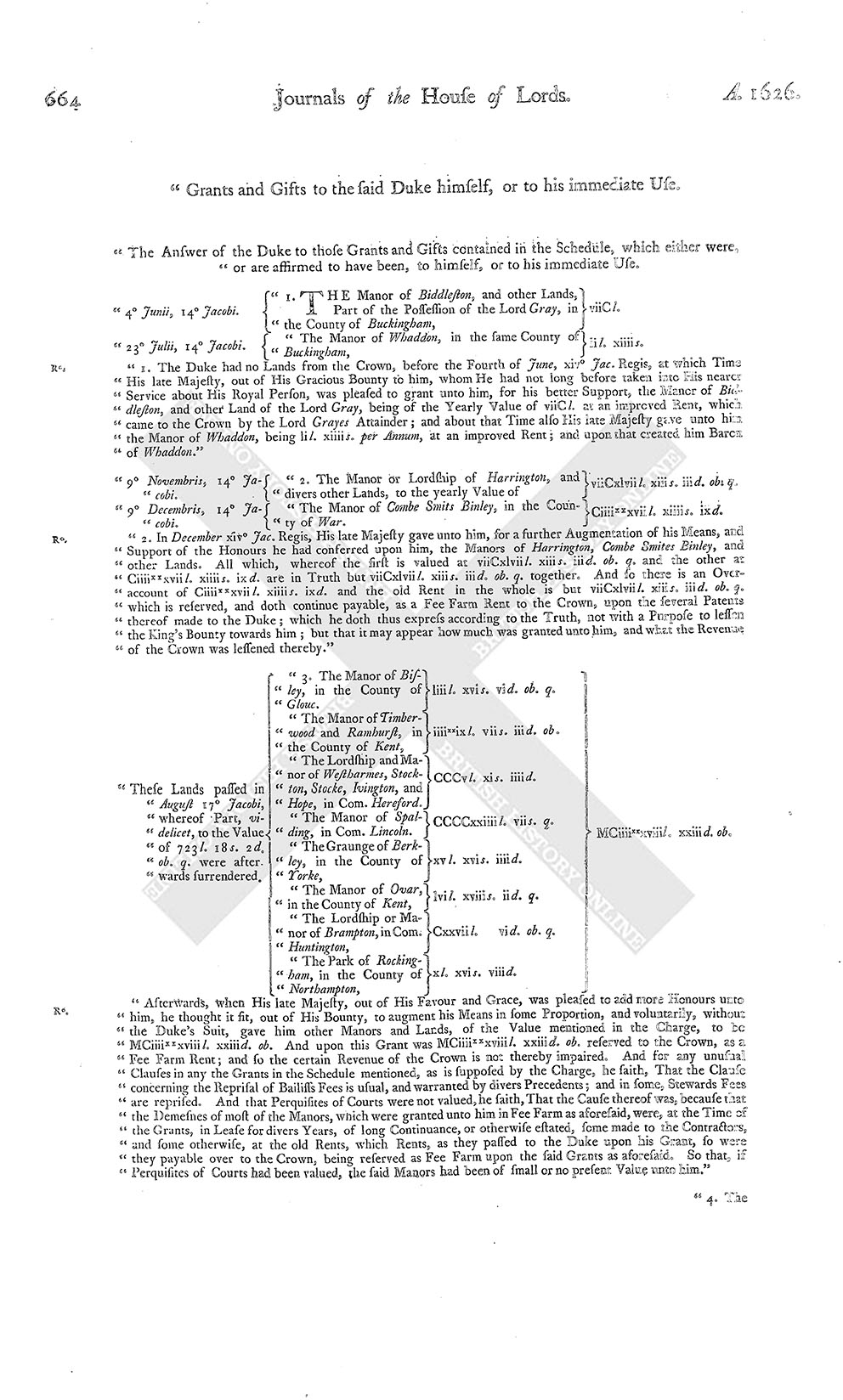
"Grants and Gifts to the said Duke himself, or to his immediate Use.
"The Answer of the Duke to those Grants and Gifts contained in the Schedule, which either were, or are affirmed to have been, to himself, or to his immediate Use.
"1. The Duke had no Lands from the Crown, before the Fourth of June, xiv° Jac. Regis, at which Time His late Majesty, out of His Gracious Bounty to him, whom He had not long before taken into His nearcr Service about His Royal Person, was pleased to grant unto him, for his better Support, the Manor of Biddleston, and other Land of the Lord Gray, being of the Yearly Value of viiC£. at an improved Rent, which came to the Crown by the Lord Grayes Attainder; and about that Time also His late Majesty gave unto him the Manor of Whaddon, being li£. xiiiis. per Annum, at an improved Rent; and upon that created him Baron of Whaddon."
"2. In December xiv° Jac. Regis, His late Majesty gave unto him, for a further Augmentation of his Means, and Support of the Honours he had conferred upon him, the Manors of Harrington, Combe Smites Binley, and other Lands. All which, whereof the first is valued at viiCxlvii£. xiiis. iiid. ob. q. and the other at Ciiiixx xvii£. xiiiis. ixd. are in Truth but viiCxlvii £. xiiis. iiid. ob. q. together. And so there is an Overaccount of Ciiiixxxvii £. xiiiis. ixd. and the old Rent in the whole is but viiCxlvii £. xiiis. iiid. ob. q. which is reserved, and doth continue payable, as a Fee Farm Rent to the Crown, upon the several Patents thereof made to the Duke; which he doth thus express according to the Truth, not with a Purpose to lessen the King's Bounty towards him; but that it may appear how much was granted unto him, and what the Revenue of the Crown was lessened thereby."
R°.
"Afterwards, when His late Majesty, out of His Favour and Grace, was pleased to add more Honours unto him, he thought it fit, out of His Bounty, to augment his Means in some Proportion, and voluntarily, without the Duke's Suit, gave him other Manors and Lands, of the Value mentioned in the Charge, to be MCiiiixxxviii£. xiiid. ob. And upon this Grant was MCiiiixxxviii £. xxiiid. ob. reserved to the Crown, as a Fee Farm Rent; and so the certain Revenue of the Crown is not thereby impaired. And for any unusual Clauses in any the Grants in the Schedule mentioned, as is supposed by the Charge, he faith, That the Clause concerning the Reprisal of Bailiffs Fees is usual, and warranted by divers Precedents; and in some, Stewards Fees are reprised. And that Perquisites of Courts were not valued, he faith, That the Cause thereof was, because that the Demesnes of most of the Manors, which were granted unto him in Fee Farm as aforesaid, were, at the Time of the Grants, in Lease for divers Years, of long Continuance, or otherwise estated, some made to the Contractors, and some otherwise, at the old Rents, which Rents, as they passed to the Duke upon his Grant, so were they payable over to the Crown, being reserved as Fee Farm upon the said Grants as aforesaid. So that, if Perquifites of Courts had been valued, the said Manors had been of small or no present Value unto him."
| "4. The Manor and Lordships of Brighton, with Lands in Melborne, Acon, &c. the Manor of Santon, and the Grange of Berkley, given in Exchange for Yorke-House, by Act of Parliament 21° Jacobi, | Cxl £. |
"4. The Manors mentioned numero 4° in the Schedule, as it appears by the Act of Parliament, were settled upon the Archbishop of Yorke and his Successors, not altogether in Exchange for Yorke House, but likewise in respect of the Grace and Favour which His then Majesty did bear to the said Church and See of Yorke, as in and by the said Act is expressed; the said Manors being conceived to be more profitable and commodious for the said Church than the said House was. 'Tis true, that afterwards it pleased His Majesty to confer the said House upon the said Duke, for his Habitation, near to the Court, and to the Royal Person of a King, on whom he was continually Attendant; which being merely a Place of Habitation and Dwelling, subject to Charge in the continual Repair, was not likely to have brought any great Revenue to the Crown, if it had rested there."
R°
"5. A Part of this Forest was, upon the Disaforestation of the same, allotted to Commoners, for the Satisfaction of such Common as they claimed to have within the said Forest. The Fee Farm, that is now reserved upon the Residue of the Forest, doth very near equal the clear Yearly Value, which hath heretofore been answered to the Crown, all Charges and Keepers Fees being deducted; so as that by this Grant the Revenue of the Crown is little diminished."
R°
R°
"6. For these Sums of Money he faith, That of the Lands formerly granted unto the Duke, in the Fourteenth and Seventeenth Years of His said late Majesty's Reign, it is Agreed, That the Duke did surrender Part of the same, to the Value of viiCxxiii£. xviiis. iid. ob. q. to the Crown, being at the same Rates at which they were granted to him; there having been neither Lease nor Estate, nor improved Rent, nor Profit by Wood, Sales, or otherwise, made by or to the Duke, for such Time as they remained in his Hands before the said Surrender (though others have often done so in the like Case); in Consideration whereof, it pleased His Majesty to assign other Lands, of the like Yearly Value, to have been conferred upon the Duke, in Lieu of the same so surrendered; but, before such Time as the same were granted to the Duke, true it is, that his Agents and Officers did contract for the Sale of the same to several Purchasers; and, to avoid both Charge and Circuit in conveying of the said Lands first to the Duke and then to the Purchasers, and to satisfy the Desire of the Purchasers, who were unwilling that the Land should be first passed to the Duke, in Consideration of the Surrender of the former, and so from the Duke to themselves, for Fear of any Defect which might happen to be in Multiplicity of Assurances in that Kind; therefore it was advised, that the Purchasers, or such as they trusted for them, should take immediate Estates from the Crown; which they did; and the several Sums of Money, which indeed they were to pay to the Duke, were paid to the King, into His Receipt of the Exchequer, and Tallies were strucken for the same. Howbeit the Duke doth acknowledge that he had Privy Seals for Receipt of the said several Sums again out of the Exchequer; yet in all this was there no Deceipt to His Majesty, for that the Lands so granted by His Majesty were the Lands intended to have passed to the Duke, in Lieu of the Lands surrendered; which Course of Proceeding was guided by former Precedent in the Point between other Parties; and by these Lands or Money the Duke had no new or other Advancement than he had before, or than he might have had by other Lands, if he had not surrendered them."
R°
"7. To this he refers himself to his Answer to that Article, which chargeth him with the selling of Places of Judicature. The xxM£. was Money lent by the said Earl to the King, and not paid to the Duke, as is pretended; and, if His Majesty did make Sale of any Lands to pay the same again, it nothing concerns the Duke."
R°
"8. There was no Part of this Money employed to or for the Use of the Duke; but, (fn. 13) he thinketh the same was otherwise employed for His late Majesty's Service, and by His special Direction, when the Duke was in Spaine."
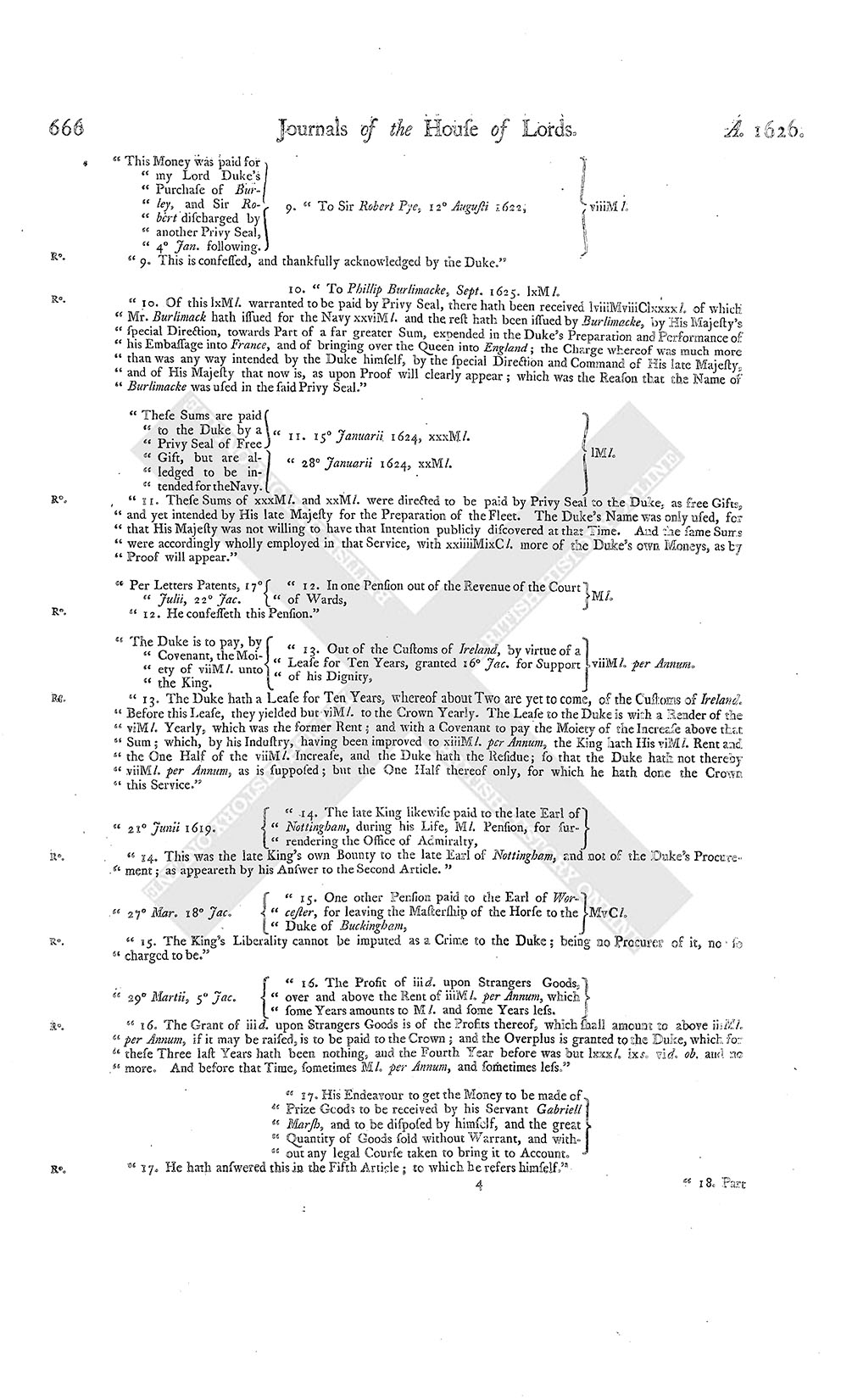
| "This Money was paid for my Lord Duke's Purchase of Burley, and Sir Robert discharged by another Privy Seal, 4 Jan. following. | 9. "To Sir Robert Pye, 12 Augusti 1622, | viiiM £. |
R°
"9. This is confessed, and thankfully acknowledged by the Duke."
10. "To Phillip Burlimacke, Sept. 1625. lxM £.
R°
"10. Of this lxM£. warranted to be paid by Privy Seal, there hath been received lviiiMviiiClxxxx £. of which Mr. Burlimack hath issued for the Navy xxviM£. and the rest hath been issued by Burlimacke, by His Majesty's special Direction, towards Part of a far greater Sum, expended in the Duke's Preparation and Performance of his Embassage into France, and of bringing over the Queen into England; the Charge whereof was much more than was any way intended by the Duke himself, by the special Direction and Command of His late Majesty, and of His Majesty that now is, as upon Proof will clearly appear; which was the Reason that the Name of Burlimacke was used in the said Privy Seal."
| "These Sums are paid to the Duke by a Privy Seal of Free Gift, but are alledged to be intended for the Navy. |
"11. 15 Januarii 1624, xxxM£. "28 Januarii 1624, xxM£. |
IM£. |
R°
"11. These Sums of xxxM£. and xxM£. were directed to be paid by Privy Seal to the Duke, as free Gifts, and yet intended by His late Majesty for the Preparation of the Fleet. The Duke's Name was only used, for that His Majesty was not willing to have that Intention publicly discovered at that Time. And the same Sums were accordingly wholly employed in that Service, with xxiiiiMixC£. more of the Duke's own Moneys, as by Proof will appear."
| "Per Letters Patents, 17 Julii, 22° Jac. | "12. In one Pension out of the Revenue of the Court of Wards, | M£. |
"12. He confesseth this Pension."
R°
"13. The Duke hath a Lease for Ten Years, whereof about Two are yet to come, of the Customs of Ireland. Before this Lease, they yielded but viM£. to the Crown Yearly. The Lease to the Duke is with a Render of the viM£. Yearly, which was the former Rent; and with a Covenant to pay the Moiety of the Increase above that Sum; which, by his Industry, having been improved to xiiiM£. per Annum, the King hath His viM£. Rent and the One Half of the viiM £. Increase, and the Duke hath the Residue; so that the Duke hath not thereby viiM£. per Annum, as is supposed; but the One Half thereof only, for which he hath done the Crown this Service."
| "21 Junii 1619. | "14. The late King likewise paid to the late Earl of Nottingham, during his Life, M£. Pension, for surrendering the Office of Admiralty, |
R°
"14. This was the late King's own Bounty to the late Earl of Nottingham, and not of the Duke's Procurement; as appeareth by his Answer to the Second Article."
| 27 Mar. 18° Jac. | "15. One other Pension paid to the Earl of Worcester, for leaving the Mastership of the House to the Duke of Buckingham, | MvC£ |
"15. The King's Liberality cannot be imputed as a Crime to the Duke; being no Procurer of it, no so charged to be."
| "29 Martii, 5° Jac. | "16. The Profit of iiid. upon Strangers Goods, over and above the Rent of iiiM£. per Annum, which some Years amounts to M£. and some Years less. |
R°
"16. The Grant of iiid. upon Strangers Goods is of the Profits thereof, which shall amount to above iiiM£. per Annum, if it may be raised, is to be paid to the Crown; and the Overplus is granted to the Duke, which for these Three last Years hath been nothing, and the Fourth Year before was but lxxx£. ixs. vid. ob. and no more. And before that Time, sometimes M£. per Annum, and sometimes less."
"17. His Endeavour to get the Money to be made of Prize Goods to be received by his Servant Gabriell Marsh, and to be disposed by himself, and the great Quantity of Goods sold without Warrant, and without any legal Course taken to bring it to Account.
R°
"17. He hath answered this in the Fifth Article; to which he refers himself."
R°
"18. The Duke denies the Practice for diverting this Sum to his own Use; neither did the said Fine, or any Part thereof, come to the Use of the Duke; but faith, that the Earl wanting Moneys, as it should seem, to pay the xxM£. His Majesty was pleased, at the Suit of the Duke, upon the earnest Solicitation of the Earl, to accept of him the Sum of vM £. in Money, and a Lease of the Farm of the Sugars, whereof the said Earl was possessed, and his House at Chelsey, in full Satisfaction of the xxM £. which Lease and House were and are assured to His Majesty accordingly, and to His sole Use and Benefit. And the said vM £. was accordingly employed for the Household and Wardrobe."
R°
"19. These Gifts to the Earl of Anglisey were of Free Gift and Bounty of the King unto him, to support his Honour; and the Warrant for passing of them was given by the King without the Procurement of the Duke, he being then in Spaine; and they were not of that Value which they are supposed to be of."
R°
"20. The Earl of Midd. hath been censured for his Offences, which are not to be imputed to the Duke; and this Earl was so well known to His late Majesty before his great Preferments, that His Majesty conceived him to be a fit Servant for the Crown; and, when he was in Place, he both did and could do what he thought best for himself, without the Duke, and both had and followed his own Ways."
"21. These have been obtained by the Suit of Sir Edward Villiers himself, and not by the Duke's Procurement."
After the Reading of the said Answer, the Duke made a short Speech, desiring their Lordships to expedite the Examination of the Cause; and then withdrew himself, and departed.
E. of Bristol's Hearing deferred.
The Earl of Bristol was brought before their Lordships, upon his Petition, desiring their Lordships to expedite the being far spent, he was deferred until the Afternoon.
Adjourn.
Dominus Custos Magni Sigilli declaravit præsens Parliamentum continuandum esse usque in postmeridianum hujus diei, hora secunda, Dominis sic decernentibus.
Post meridiem,
Domini tam Spirituales quam Temporales, quorum nomina subscribuntur, præsentes fuerunt:
E. of Bristol the Bar.
THE Earl of Bristol, being before their Lordships at the Bar, desired Leave to move them in Two Points; the one touching the Charge of Treason against himself, the other touching the Articles exhibited by him (as an Ambassador) against the Duke of Buckingham, for his Unfaithfulness to the King and State.
Concerning the Charge or Treason against him.
Prays to be tried in Parliament.
As touching the First, he made a large Discourse; shewing the Manner of his Restraint (as in his former Speech, 6 Maii); and that he was not charged with Treason, until he first exhibited his Petition to the House, wherein he accused the Duke of Buckingham; and that thereupon he was immediately sent for up as a Delinquent, contrary to all former Proceedings that he ever observed; and it being contrary to the Order of this House to be restrained of His Liberty, unless it be for Treason, or the like, he is therefore charged with Treason; and therefore he besought their Lordships, to consider how prejudicial this Precedent might prove to all their Liberties; and that he might have a speedy Trial by the Parliament, for that he feared no Man would be of his Counsel, if the Parliament were once ended. And that it might be determined whether his Case be Treason or no.
Concerning his Accusation of the Duke of Buckingham.
As touching the Duke of Buckingham, he shewed that his Accusation of him is no Recrimination, for he originally intended it Two or Three Years since; neither hath the Duke any Charge depending against him. Then he recited the Particulars of Mr. Attorney's Charge against him; and that, whereas he is charged with the Prince's Journey into Spaine, with seeking to convert the Prince to Popery, and the Loss of the Palatinate; he doth charge the Duke, that the Duke plotted with Gondomar to bring the Prince into Spaine, and to convert him to Popery; and that the Duke is in more Fault than any other for the Loss of the Palatinate; and that, whilst he was in Spaine, he wrote unto the late King of the Duke's Unfaithfulness, so that it cannot now be said to be a Recrimination: That yet he is restrained, and as a Traitor; and contrariwise the Duke of Bucks, being accused of Treason by him (a public Minister of the State), hath his Liberty.
Then he made Two Requests unto their Lordships; the one, that there might be an Equality between him and the Duke herein; the other, that Mr. Attorney might proceed against the Duke upon his Accusation; and he would not only prove the Duke's Unfaithfulness to the late King and His Majesty, but that the Narration which the Duke made to both Houses the other Parliament is very false.
The Earl having concluded this his Speech, delivered a Petition; which was read, in hæc verba:
E. of Bristol's Petition.
"To the Right Honourable the Lords of the Higher House of Parliament.
"The Humble Petition of John, Earl of Bristol.
"1. Humbly beseeching your Lordships, That you will be pleased to declare whether the Matter of the Charge be Treason or no; and that, if your Lordships shall adjudge it not to be Treason, the Word of Traitor and Traiterously might be stricken out of the Charge; and some such Course taken as to your Lordships shall seem meet for the speedy Prosecution and bringing of the Cause to Hearing.
"2. And that his own and Sir Walter Ashton's Dispatches might be brought into the Court (being his chiefest Evidence), to be used for his Defence.
"3. And that, if Mr. Attorney, by his Reply, shall give the Earl Occasion to declare, for his Justification, such Matters of Secrecy and Mysteries of State as are not to be divulged; that your Lordships will be pleased to move His Majesty to signify His Pleasure, to whom and in what Manner it shall be declared.
"4. And that the Earl may have Leave to come, with Mr. Maxwell, to the House, or wait upon Committees, when he shall find it needful for the Prosecution of his Cause, attending your Lordships Leisure.
"Bristol."
This Petition debated.
The Petition being read, the Earl was withdrawn; and the House being put into a Committee, it was read again in Parts, and fully debated. The House being resumed; it was read again, and these Four Answers were made unto the Four several Parts of the said Petition; and Ordered as followeth: videlicet,
Orders, in Answer to it.
"1. The House to sit To-morrow at Eight, and such Witnesses to be sworn as Mr. Attorney or the Earl of Bristol shall procure. And then the Committee to proceed to take the Examinations. And the Answer to the rest of this Part of the Petition to be deferred to further Consideration, after a full Examination taken by the Committee, and reported to the House.
"2. All such Dispatches as Mr. Attorney shall make Use of against the Earl to rest here, to be used by the said Earl for his Defence. And the House to be Suitors to the King for any other Dispatches to be brought hither, for the said Earl's Defence, as he shall particularly name.
"3. When any such Occasion shall be offered, the House will then consider what Course shall be taken herein.
"4. This is to be granted."
E. of Bristol acquainted with them.
These being thus Agreed and Ordered by the House, and their Lordships having also Agreed to give the Earl of Bristol a Reason why the First Part of his said Petition is not fully answered; the Earl of Bristol was brought again before their Lordships; and the Lord Keeper signified the said Orders unto him; and (having read the First) told him that the House had not fully (fn. 14) answered the First Part of his Petition, for Two Reasons, both in Favour to his Lordship; the First, for that they are loth to proceed to declare their Judgements or Opinions upon the bare Charge of Mr. Attorney, before the true Case appears upon the Proofs; the Second, for that, if they should declare his Cause to be Treason, then his Testimony against the Duke of Bucks would be weakened; and the Lord Keeper having read the Second, Third, and Fourth Orders also, the Earl of Bristol gave their Lordships humble Thanks; and so was withdrawn.
Adjourn.
Dominus Custos Magni Sigilli declaravit præsens Parliamentum continuandum esse usque in diem crastinum, videlicet, nonum diem instantis Junii, hora octava, Dominis sic decernentibus.