
Journal of the House of Lords: Volume 10, 1648-1649. Originally published by His Majesty's Stationery Office, London, 1767-1830.
This free content was digitised by double rekeying. All rights reserved.
'House of Lords Journal Volume 10: 29 August 1648', in Journal of the House of Lords: Volume 10, 1648-1649, (London, 1767-1830) pp. 461-475. British History Online https://www.british-history.ac.uk/lords-jrnl/vol10/pp461-475 [accessed 19 April 2024]







In this section
DIE Martis, 29 die Augusti.
PRAYERS, by Mr. Sedgwicke.
Domini præsentes fuerunt:
Comes Manchester, Speaker.
|
Comes Pembrooke. Comes Kent. Comes Mulgrave. L. Viscount Say & Seale. Comes Lyncolne. Comes Nottingham. Comes Rutland. Comes Suffolke. Comes Denbigh. |
Ds. Howard. Ds. North. Ds. Hunsdon. Ds. Dacres. Ds. Grey. |
Message to the H. C. with the Ordinance for London Militia to raise Forces;-- and about Montreul's Pass.
A Message was sent to the House of Commons, by Mr. Page and Dr. Aylett:
1. To deliver to them the Ordinance for listing of Horse and Foot by the Militia of London, with the Alteration, wherein their Concurrence is desired.
2. To put them in Mind of Monsieur Montreul's Pass.
Justice Roll excused.
Ordered, That Mr. Justice Roll shall be excused for his Absence and attending this House, to prepare himself for the Circuit.
Ordinance for settling Church Government.
Next, the Ordinance for settling of Church Government, was read the Third Time.
And the Question being put, "Whether to agree "to this Ordinance, as it hath been now read?"
It was Resolved in the Affirmative.
(Here enter it.)
Protest against it.
Memorandum, That, before the putting the aforesaid Question, the Earl of Lyncolne desired Leave to enter his Dissent, if it were carried in the Affirmative: Which the House gave Leave to; and accordingly doth enter his Dissent, by subscribing his Name.
"T. Lyncolne."
Letters from the King and Col. Hammond.
This Day the King's Letter of accepting the Treaty was read, with the List of the Persons Names the King desires to come to Him.
(Here enter them.)
Colonel Hamond's Letter was also read.
Message to the H. C. with the King's Letter.
A Message was sent to the House of Commons, by Mr. Page and Doctor Heath:
To deliver to them the Letter this Day received from the King, and also the List of Names.
Sir C. Compton, a Pass.
Ordered, That Sir Charles Compton shall have a Pass, to go down to the General.
E. of Lincoln and Lady Delawar.
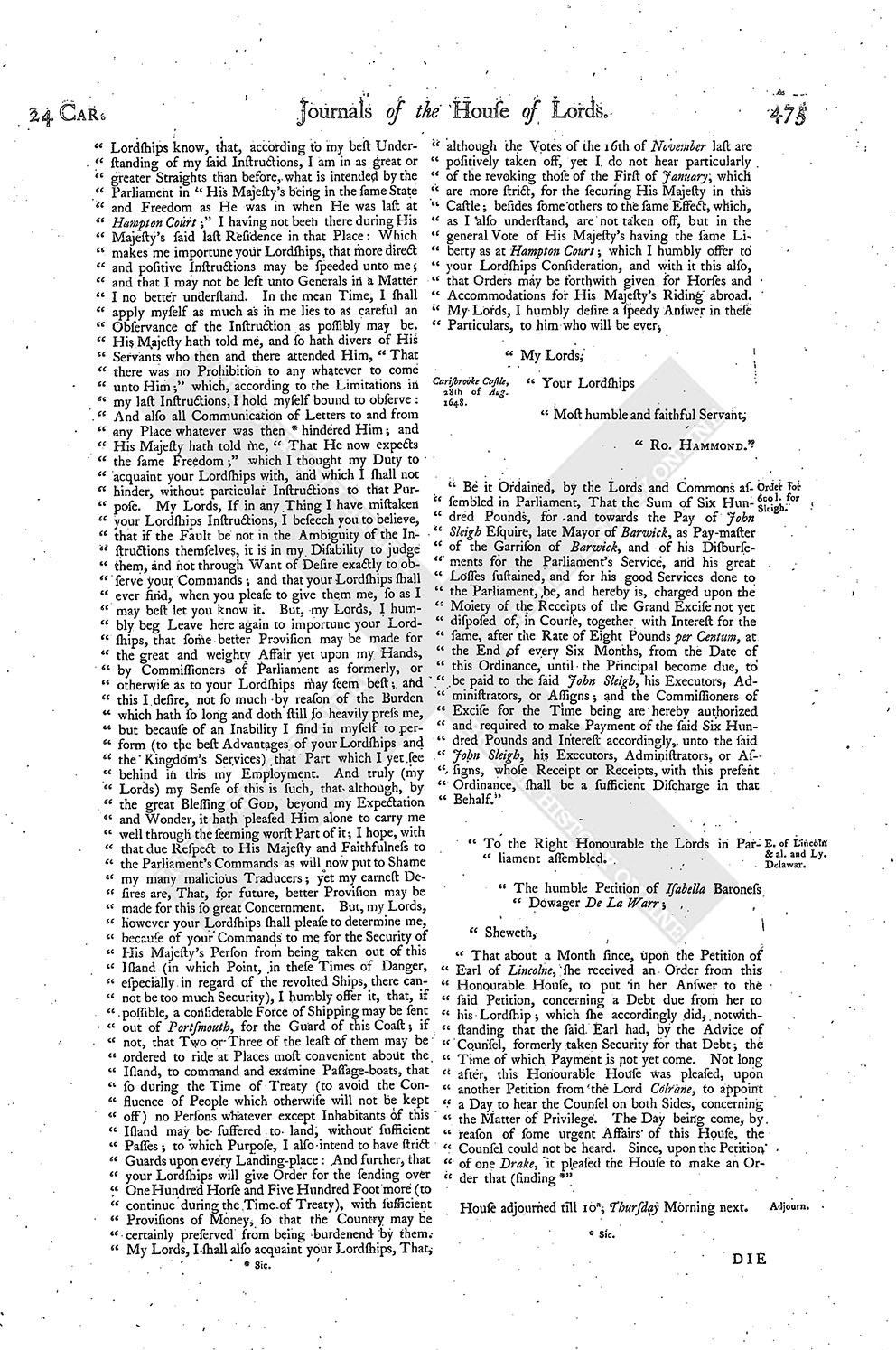
Upon reading the Petition of Isabella Lady La Warr: (Here enter it.)
And the Question being put, "Whether the Counsel of the Earl of Lyncolne and the Counsel of the Lady La Warr shall be heard this Day Sevennight (if they please), concerning the Matter of Privilege in this Case, or not?" The Votes were even.
Sleigh's Order.
The Order for Six Hundred Pounds, with Interest, to be paid to Mr. John Sleigh, was read, and passed.
(Here enter it.)
Dr. Burges's Petition, for his Grant of an Annuity.
Upon reading the Petition of Dr. Cornelius Burges; desiring his former Grant, by Ordinance, of Four Hundred Pounds per Annum during his Life, may be passed under the Great Seal of England.
Respited.
Propositions to the King.
Ordered, That the Propositions now to be sent to the King shall be printed and published.
Ordinance to settle Church Government.
Ordered, That the Ordinance for settling Church Government shall be printed and published.
Burnard to be instituted to Warnford;
Ordered, That Dr. Aylett give Institution and Induction unto Benjamin Burnard Clerk, to the Rectory of Warneford, in Com. South'ton; salvo Jure cujuseunque: Granted by the Great Seal.
and Howard to Hoo.
Ordered, That Dr. Aylett give Institution and Induction unto Lewis Howard Clerk, to the Vicarage of Hoo, alias St. Warbecke, alias St. Warbungh in Hoo, in the County of Kent, void by the Death of the last Incumbent; salvo Jure cujuscunque: Granted by the Great Seal.
(fn. 1) "Die Martis, 29 August. 1648.
Ordinance to settle Church Government.
"The Form of Church Government to be used in the Church of England and Ireland, agreed upon by the Lords and Commons assembled in Parliament, after Advice had with the Assembly of Divines.
"Be it Ordered and Ordained by the Lords and Commons in Parliament assembled, and by Authority of the same, That all Parishes and Places whatsover within the Kingdom of England and Dominion of Wales (as well Privileged Places and Exempt Jurisdictions as others) be brought under the Government of Congregational, Classical, Provincial, and National Assemblies; provided, that the Chapels or Places in the Houses of the King and His Children, and the Chapels or Places in the Houses of the Peers of this Realm, shall continue free for the Exercise of Divine Duties, to be performed according to the Directory, and not otherwise.
"That there be forthwith a Choice made of Elders, throughout the Kingdom of England and Dominion of Wales, in the respective Churches and Chapels, according to such Directions as hereafter follow; and all Classes and Parochial Congregations are respectively hereby authorized and required forthwith effectually to proceed therein accordingly.
"Directions for the Election of Parochial and Congregational Elders.
1. That Notice of the Election of Parochial and Congregational Elders, and of the Time when it shall be, be given, by the Minister, in the Public Assembly, the next Lord's-day but One before; and that on the said Lord's-day a Sermon be preached, preparatory to that weighty Business.
"2. That the Ruling Elders of a Parochial and Congregational Eldership shall be chosen by the several Ministers and Members of that Congregation respectively, or the major Part of them there assembled, being such as have taken the National Covenant, and are not Persons under Age, nor Servants that have no Families.
"3. That such shall be chosen for Ruling Elders as are Men of a good Understanding in Matters of Religion, sound in the Faith, prudent, discreet, grave, and of unblameable Conversation, and willing to undergo the said Office.
"4. That no Man be chosen for a Ruling Elder, but only for One Congregation, and that in the Place where his most settled Dwelling and Employment doth lie.
"5. That, when any Ruling Elder is to be chosen where an Eldership is constituted, it be done by the Eldership, with the Consent and Approbation of the People of that Congregation.
"6. That it shall be lawful for the Congregation respectively, or any other Persons, to exhibit Exceptions against any Persons elected as aforesaid, touching the Right of his Election, the Qualification of the Person before mentioned, or touching Matter of Ignorance or Scandal hereafter mentioned, to such Persons as are here after appointed to receive the said Exceptions.
"Concerning the Triers and Judges of the Integrity and Ability of such as are to be chosen Elders in the Province of London, and of the Inns of Court.
"1. These Persons following shall be Triers and Judges of the Integrity and Ability of such as are chosen Congregational Elders, in the several Classes within the Province of London, and of the Dueness of their Election, according to the Rules and Directions hereafter expressed.
"The First Classis.
"Ministers:
"Dr. Will. Gouge of Black Friers, Mr. George Walker of John Evangelist, Mr. Lazarus Seaman of Alhallowes in Breadstreet. Others: Mr. Rich. Brown Esquire of Black Friers, Mr. Rich. Turner Senior of Austine's Parish, Mr. Will. Kendall of Alhallowes in Breadstreet, John Clarke Doctor of Physic of Martin's Ludgate, Mr. Thomas Steines of Mildred in Breadstreet, Mr. Christopher Meredith of Faith's.
"The Second Classis.
"Ministers:
"Master William Reyner of John Baptist's, Mr. Charles Offspring of Antholin's, Mr. William Thomas of Pancras Soper-lane. Others: Mr. Alex. Jones of John Baptist's, Mr. Ralph Triplet of Nicholas Cole-Abbey, Mr. Thomas Coffin of Michael Royall, Mr. James Hayes of Bennet Sheerhogge, Mr. John Cock of James Garlickhith, Mr. Philip Owen of Mary Magdaline's Old Fish street.
"The Third Classis.
"Ministers:
Master Humphrey Chambers of Stephen's Walbrook, Mr. John Rawlinson of Mary Ab-Church, Mr. John Cardell of Alhallowes Lumbard-street. Others: Mr. John Warner Alderman of Stephen's Walbrooke, Mr. Robert Sweet of Mary Woolnoth, Mr. Michael Herring of Mary Wool-church, Mr. Rich. Young of Alhallowes Lumbard-street, Mr. Rich. Warner of Mary Ab-Church, Mr. Robert Mead of Laurence Pountney.
"The Fourth Classis.
"Ministers:
"Master John Lee of Mary on the Hill, Mr. Joseph Caryl of Magnus, Mr. Fulk Bellers of Michael Cornhill. Others: Master James Bunce Alderman of Bennet Grace-Church, Mr. Edward Hooker of Mary on the Hill, Mr. John Bellamy of Michael Cornhill, Mr. John Gyes of Andrew in Hubbert, Mr. John Hatler of Magnes, Mr. William Bramwith of Peter's Cornhill.
"The Fifth Classis.
"Ministers:
"Master John Conant of Botolph Aldersgate, Mr. Anthony Tuckney of Michael at Corne alias Querne, Mr. Simeon Ashe of Brides. Others: Sir John Wollaston Knight of John Zacharies, Mr. Edw. Honywood of Michael at Corne alias Querne, Mr. William Hart of Christ Church, Mr. John Johnson of Botolph Aldersgate, Mr. Rich. Flood of Peter's Cheape, Mr. John Sherman of Anne Aldersgate.
"The Sixth Classis.
"Ministers:
"Master Edmond Calamy of Mary Aldermanbury, Mr. John Arrowsmith of Martin's Iremonger Lane, Mr. Arther Jackson of Michael's Woodstreet. Others: Mr. Walter Boothby of Mary Aldermanbury, Mr. Will. Webb of Martin's Iremonger Lane, Mr. Will. Bisby of Laurence Jury,
Mr. Laurence Brinley of Mary Magdalin's Milkstreet.
"The Seventh Classis.
"Ministers:
"Master Robert Harris of Botolph Bishopsgate, Mr. Samuel Clarke of Bennet Fynk, Mr. Charles Newton of Michael Basingshaw, Mr. Leonard Cooke, Others Mr. Christopher Pack Alderman of Michael Basingshaw, Mr. James Russell of Stephen's Colemanstreet, Master William Williamson of Christopher's, Mr. Robert Launt of Peter's Poore, Mr. James Story of Bennet Fynk, Mr. Samuel Harsnet of Bartholomew Exchange.
"The Eighth Classis.
"Ministers:
"Master Will. Spurstow of Hackney, Mr. Tho. Porter of Katherine Creed-Church, Mr. Elidad Blackwell of Andrew Undershast. Others:
Mr. George Clarke of Hackney, Mr. Richard Shute of Cree-Church, Mr. Alex. Bence of Algate, Mr. Thomas Hutchins of Hellen's.
"The Ninth Classis.
"Ministers:
"Master Thomas Clendon of Alhollowes Barking, Mr. Thomas Valentine of Mary White-chappell, Mr. Thomas Carter of Olaves Hart-street, Others: Sir Edward Harrington Knight of Lives Hart-street, Mr. Francis West Lieutenant of The Tower, Mr. Edmund Trench of Alhollowes Staining,
Mr. Solomon Smith of Katherine Tower.
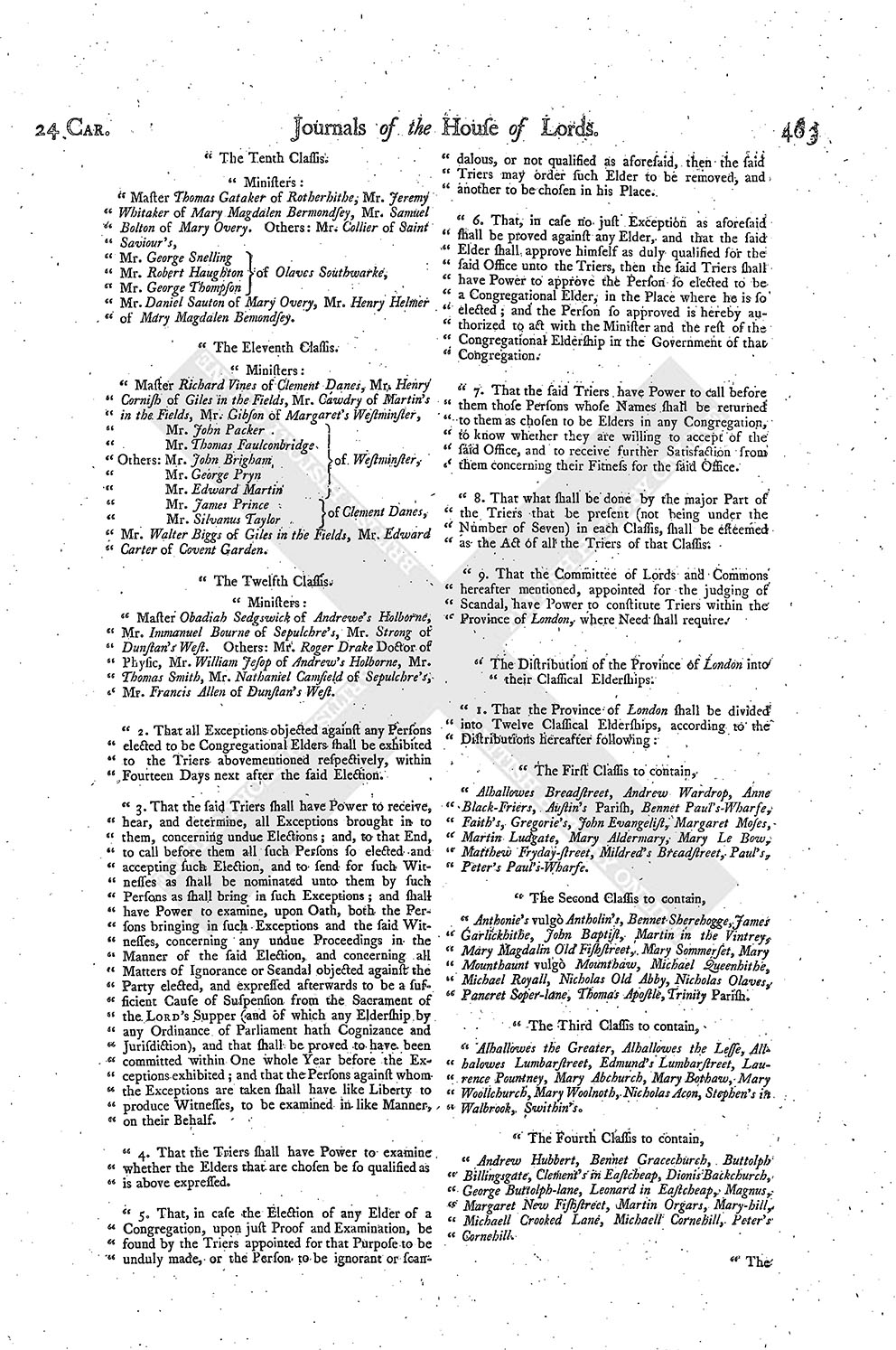
"The Tenth Classis.
Ministers:
"Master Thomas Gataker of Rotherhithe, Mr. Jeremy Whitaker of Mary Magdalen Bermondsey, Mr. Samuel Bolton of Mary Overy. Others: Mr. Collier of Saint Saviour's,
"Mr. Daniel Sauton of Mary Overy, Mr. Henry Helmer of Mary Magdalen Bemondsey.
"The Eleventh Classis.
"Ministers:
"Master Richard Vines of Clement Danes, Mr. Henry Cornish of Giles in the Fields, Mr. Cawdry of Martin's in the Fields, Mr. Gibson of Margaret's Westminster,
|
Mr. John Packer
Mr. Thomas Faulconbridge. Others: Mr. John Brigham Mr. George Pryn Mr. Edward Martin |
of Westminster, |
|
Mr. James Prince
Mr. Silvanus Taylor |
of Clement Danes, |
Mr. Walter Biggs of Giles in the Fields, Mr. Edward Carter of Covent Garden.
"The Twelsth Classis.
"Ministers:
"Master Obadiah Sedgswick of Andrew's Holborne, Mr. Immanuel Bourne of Sepulchre's, Mr. Strong of Dunstan's West. Others: Mr. Roger Drake Doctor of Physic, Mr. William Jesop of Andrew's Holborne, Mr. Thomas Smith, Mr. Nathaniel Camfield of Sepulchre's, Mr. Francis Allen of Dunstan's West.
2. That all Exceptions objected against any Persons elected to be Congregational Elders shall be exhibited to the Triers abovementioned respectively, within Fourteen Days next after the said Election.
"3. That the said Triers shall have Power to receive, hear, and determine, all Exceptions brought in to them, concerning undue Elections; and, to that End, to call before them all such Persons so elected and accepting such Election, and to send for such Witnesses as shall be nominated unto them by such Persons as shall bring in such Exceptions; and shall have Power to examine, upon Oath, both the Persons bringing in such Exceptions and the said Witnesses, concerning any undue Proceedings in the Manner of the said Election, and concerning all Matters of Ignorance or Scandal objected against the Party elected, and expressed afterwards to be a sufficient Cause of Suspension from the Sacrament of the Lord's Supper (and of which any Eldership by any Ordinance of Parliament hath Cognizance and Jurisdiction), and that shall be proved to have been committed within One whole Year before the Exceptions exhibited; and that the Persons against whom the Exceptions are taken shall have like Liberty to produce Witnesses, to be examined in like Manner, on their Behalf.
"4. That the Triers shall have Power to examine whether the Elders that are chosen be so qualified as is above expressed.
5. That, in case the Election of any Elder of a Congregation, upon just Proof and Examination, be found by the Triers appointed for that Purpose to be unduly made, or the Person to be ignorant or scandalous, or not qualified as aforesaid, then the said Triers may order such Elder to be removed, and another to be chosen in his Place.
"6. That, in case no just Exception as aforesaid shall be proved against any Elder, and that the said Elder shall approve himself as duly qualified for the said Office unto the Triers, then the said Triers shall have Power to approve the Person so elected to be a Congregational Elder, in the Place where he is so elected; and the Person so approved is hereby authorized to act with the Minister and the rest of the Congregational Eldership in the Government of that Congregation.
"7. That the said Triers have Power to call before them those Persons whose Names shall be returned to them as chosen to be Elders in any Congregation, to know whether they are willing to accept of the said Office, and to receive further Satisfaction from them concerning their Fitness for the said Office.
"8. That what shall be done by the major Part of the Triers that be present (not being under the Number of Seven) in each Classis, shall be esteemed as the Act of all the Triers of that Classis.
"9. That the Committee of Lords and Commons hereafter mentioned, appointed for the judging of Scandal, have Power to constitute Triers within the Province of London, where Need shall require.
"The Distribution of the Province of London into their Classical Elderships.
"1. That the Province of London shall be divided into Twelve Classical Elderships, according to the Distributions hereafter following:
"The First Classis to contain,
"Alhallowes Breadstreet, Andrew Wardrop, Anne Black-Friers, Austin's Parish, Bennet Paul's-Wharse, Faith's, Gregorie's, John Evangelist, Margaret Moses, Martin Ludgate, Mary Aldermary, Mary Le Bow, Matthew Fryday-street, Mildred's Breadstreet, Paul's, Peter's Paul's-Wharse.
"The Second Classis to contain,
"Anthonie's vulgò Antholin's, Bennet Sherehogge, James Garlickhithe, John Baptist, Martin in the Vintrey, Mary Magdalin Old Fishstreet, Mary Sommerset, Mary Mounthaunt vulgò Mounthaw, Michael Queenhithe, Michael Royall, Nicholas Old Abby, Nicholas Olaves, Pancret Soper-lane, Thomas Apostle, Trinity Parish.
"The Third Classis to contain,
"Alhallowes the Greater, Alhallowes the Lesse, Allhalowes Lumbarstreet, Edmund's Lumbarstreet, Laurence Pountney, Mary Abchurch, Mary Bothaw, Mary Woollchurch, Mary Woolnoth, Nicholas Acon, Stephen's in Walbrook, Swithin's.
"The Fourth Classis to contain,
Andrew Hubbert, Bennet Gracechurch, Buttolph Billingsgate, Clement's in Eastcheap, Dionis Backchurch, George Buttolph-lane, Leonard in Eastcheap, Magnus, Margaret New Fishstreet, Martin Orgars, Mary-hill, Michaell Crooked Lane, Michaell Cornehill, Peter's Cornehill.
"The Fifth Classis to contain,
"Anne Aldersgate, Buttolph Aldersgate, Brides, Bridewell, Christchurch, John Zacharie, Leonard Foster-lane, Mary Stainings, Michael in the Corne vulgò Querne, Olaves Silverstreet, Peter Cheape, Pedast alias Foster's.
"The Sixth Classis to contain,
"Albans Woodstreet, Alhallowes Hony Lane, Alphage, Giles Creeplegate, James Chappell, Laurence in the Jury, Martin in Iremonger-lane, Mary Aldermanbury, Marymaudlin's Milkstreete, Mary Colechurch, Michael in Woodstreet, Mildred in the Poultry, Olives in the Jury.
"The Seventh Classis to contain,
Alhallowes by the Wall, Bartholmew Exchange, Bennet Fyncke, Buttolph Bishopsgate, Christopher's, Margaret Lothbury, Michael Basingshaw, Peter Poore, Steven's Colemanstreet.
"The Eighth Classis to contain,
"Andrew Undershaft, Buttolph Algate, Ethelburge, Hackney, Hellen's, James Dukes Place, Katherine Creechurch, Leonard Shoreditch, Martin's Oteswitch vulgò Outwich, Mary Newington alias Soke Newington.
"The Ninth Classis to contain,
"Alhallowes Barkin, Alhallowes Stainings, Dunstan's in the East, Gabriell Fenchurch, Katherin Coleman, Katherin Tower, Margaret Pattons, Olaves Hartstreet, Peter's in the Tower, Stepney, Trinity Minories, Wapping, Whitechappell.
"The Tenth Classis to contain,
"George Southwarke, Lambeth, Mary Magdalen Bermondsey, Mary Overs, Newington Buts, Olaves Southwarke, Rotherhithe vulgò Redriffe, Thomas Hospitall, Thomas Southwarke.
"The Eleventh Classis to contain,
"Clement's Danes, Giles in the Fields, Knightsbridge, Margaret's Westminster, Martin's in the Fields, Newchurch, Peter's Westminster, Paul's Chappell in Covent Garden.
"The Twelfth Classis to contain,
"Andrew Holbourne, Bartholmew the Greater, Bartholmew the Lesse, Charterhouse, Dunston's in the West, James C'arkenwell, Mary Islington's, Sepulchre's.
"2. That all the several Parishes and Places within the Cities of London and Westminster, and the Parts adjacent, according as they are distinguished into Twelve several Classes, shall be the Extent and Bounds of the Province of London.
"3. That the Chapel of The Rolles, the Two Serjeants Innes, and the Four Innes of Court, shall be under the Presbyterial Government of those respective Classes within the Limits whereof they are situate.
"Concerning the Members of the Classical and Congregational Presbyteries in the several Counties of the Kingdom of England and Dominion of Wales.
"1. That the Committees or Commissioners named in the Ordinance of Sixty Thousand £ per Mensem, dated the 23 of June, 1647, or any Three or more of them, of the several Counties of this Kingdom, with the Assistance of such Ministers and others as they shall think fit, do forthwith meet, and consider how their several Counties respectively may be most conveniently divided into distinct Classical Presbyteries, where they are not already divided, and what Ministers and others are fit to be of each Classis; and they shall accordingly make such Division and Nomination of Persons for each Classical Presbytery; which Divisions, and Persons so named for every Division, shall be certified by the said Committees and Commissioners to the Committee of Lords and Commons for judging of Scandal; and that the Chancellors, Vice-chancellors, and Heads of the Universities, do likewise consider how the Colleges may be put into Classical Presbyteries, and do certify the same up to the said Committee of Lords and Commons; and that the said Certificates be made before the 25 of March next: Which Committee of Lords and Commons is required to approve and confirm the same, as they shall think fit, immediately upon Receipt of such Certificate.
"2. That the said several Classes respectively, being approved as aforesaid, within their several Precincts, shall act and execute all Power belonging to any Classis; and also shall have Power to constitute Congregational Elderships, where a competent Number of Persons so qualified for Elders as aforesaid shall be found; and, to that End, they have Power to proceed in the Trial, Examination, Approbation, and Removal, of such Persons as shall be chosen Congregational Elders, as the Triers abovementioned are authorized to do; and that all Exceptions against any Persons chosen to be Elders shall be exhibited at the next Monthly Meeting of the Classis; and where no Persons shall be found fit to be Elders as aforesaid, then that Congregation shall be immediately under the Classical Presbytery, until that Congregation shall be enabled with Members fit to be Elders as aforesaid.
"3. That the several Classis constituted as aforesaid, in the several Counties, within the Limits of the said respective Classis where no Congregational Presbyteries are already settled, shall have from Time to Time Power to nominate such Ministers and others as are qualified according to this Ordinance, to join with them in the same, to be approved by the Committee of Lords and Commons appointed to judge of Scandal, until such Time as Congregational Presbyteries shall be settled in the said respective Precincts; and that such Power shall be executed, not only in Cases of Death or other Departure of any Minister or Elder from the Place of their wonted Dwelling, but also in case of Increase of Ministers and of fit Persons to be Elders in their several Precincts.
"4. That when the said Congregational Presbyteries shall be settled within the said Limits, that then the said Congregational Presbyteries shall act according to the Power and Directions of this Ordinance in that Behalf.
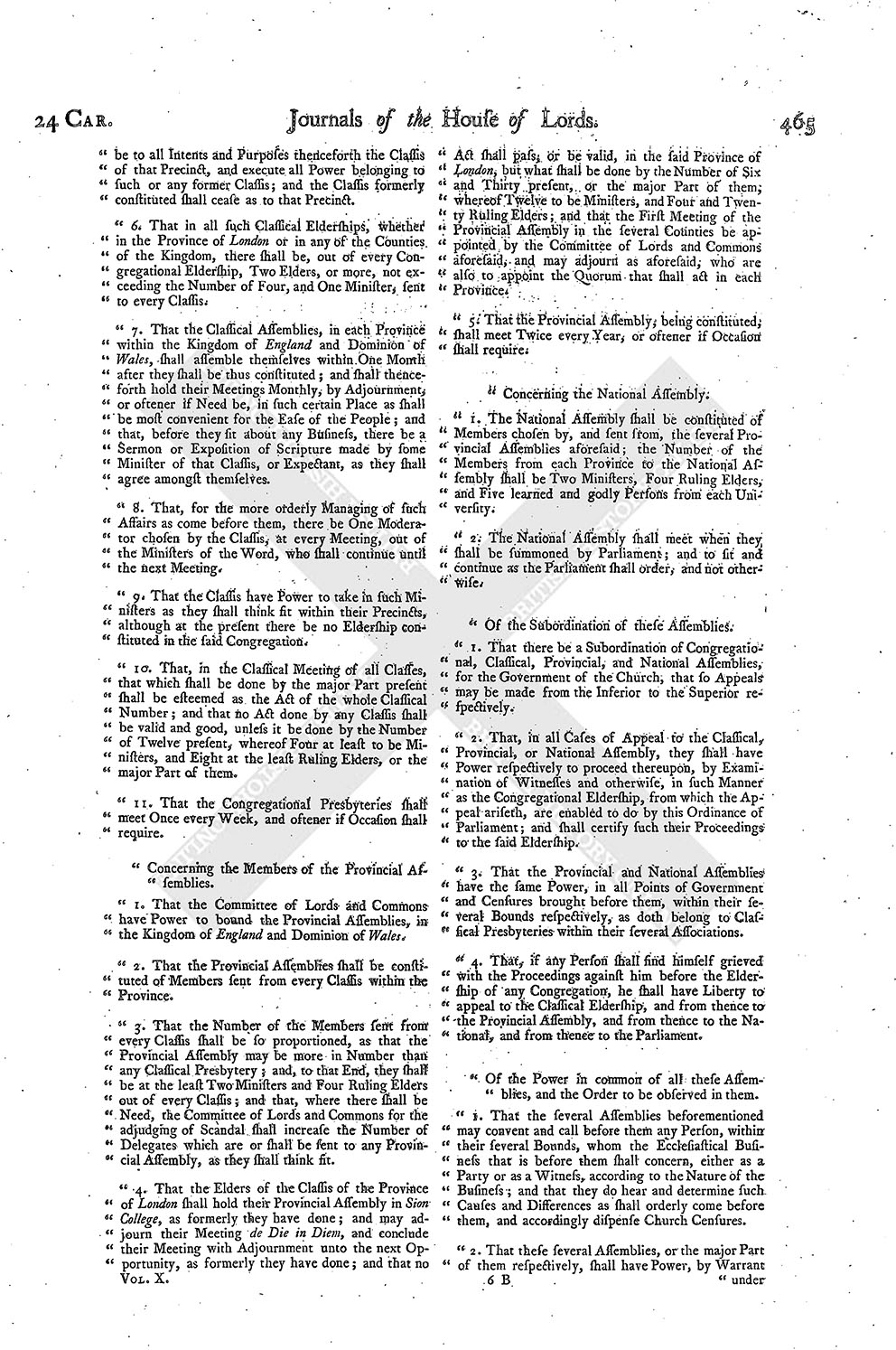
"5. That at any such Time as Seven Congregational Elderships, or more, shall be constituted into any Classical Precinct, in any of the Counties, by the respective Classis established as abovesaid, the same shall by them be signified to the several Congregational Elderships so established; and the said Congregational Elderships shall forthwith proceed to depute such of their Elders as are most fit, who, together with their Minister, shall meet as a Classis, and shall be to all Intents and Purposes thenceforth the Classis of that Precinct, and execute all Power belonging to such or any former Classis; and the Classis formerly constituted shall cease as to that Precinct.
"6. That in all such Classical Elderships, whether in the Province of London or in any of the Counties of the Kingdom, there shall be, out of every Congregational Eldership, Two Elders, or more, not exceeding the Number of Four, and One Minister, sent to every Classis.
"7. That the Classical Assemblies, in each Province within the Kingdom of England and Dominion of Wales, shall assemble themselves within One Month after they shall be thus constituted; and shall thenceforth hold their Meetings Monthly, by Adjournment, or oftener if Need be, in such certain Place as shall be most convenient for the Ease of the People; and that, before they fit about any Business, there be a Sermon or Exposition of Scripture made by some Minister of that Classis, or Expectant, as they shall agree amongst themselves.
"8. That, for the more orderly Managing of such Affairs as come before them, there be One Moderator chosen by the Classis, at every Meeting, out of the Ministers of the Word, who shall continue until the next Meeting.
"9. That the Classis have Power to take in such Ministers as they shall think fit within their Precincts, although at the present there be no Eldership constituted in the said Congregation.
"10. That, in the Classical Meeting of all Classes, that which shall be done by the major Part present shall be esteemed as the Act of the whole Classical Number; and that no Act done by any Classis shall be valid and good, unless it be done by the Number of Twelve present, whereof Four at least to be Ministers, and Eight at the least Ruling Elders, or the major Part of them.
"11. That the Congregational Presbyteries shall meet Once every Week, and oftener if Occasion shall require.
"Concerning the Members of the Provincial Assemblies.
"1. That the Committee of Lords and Commons have Power to bound the Provincial Assemblies, in the Kingdom of England and Dominion of Wales.
"2. That the Provincial Assemblies shall be constituted of Members sent from every Classis within the Province.
"3. That the Number of the Members sent from every Classis shall be so proportioned, as that the Provincial Assembly may be more in Number than any Classical Presbytery; and, to that End, they shall be at the least Two Ministers and Four Ruling Elders out of every Classis; and that, where there shall be Need, the Committee of Lords and Commons for the adjudging of Scandal shall increase the Number of Delegates which are or shall be sent to any Provincial Assembly, as they shall think fit.
"4. That the Elders of the Classis of the Province of London shall hold their Provincial Assembly in Sion College, as formerly they have done; and may adjourn their Meeting de Die in Diem, and conclude their Meeting with Adjournment unto the next Opportunity, as formerly they have done; and that no Act shall pass; or be valid, in the said Province of London, but what shall be done by the Number of Six and Thirty present, or the major Part of them, whereof Twelve to be Ministers, and Four and Twenty Ruling Elders; and that the First Meeting of the Provincial Assembly in the several Counties be appointed by the Committee of Lords and Commons aforesaid, and may adjourn as aforesaid, who are also to appoint the Quorum that shall act in each Province.
"5. That the Provincial Assembly, being constituted, shall meet Twice every Year, or oftener if Occasion shall require.
"Concerning the National Assembly.
"1. The National Assembly shall be constituted of Members chosen by, and sent from, the several Provincial Assemblies aforesaid; the Number of the Members from each Province to the National Assembly shall be Two Ministers, Four Ruling Elders, and Five learned and godly Persons from each University.
"2. The National Assembly shall meet when they shall be summoned by Parliament; and to fit and continue as the Parliament shall order, and not otherwise.
"Of the Subordination of these Assemblies.
"1. That there be a Subordination of Congregational, Classical, Provincial, and National Assemblies, for the Government of the Church, that so Appeals may be made from the Inferior to the Superior respectively.
"2. That, in all Cases of Appeal to the Classical, Provincial, or National Assembly, they shall have Power respectively to proceed thereupon, by Examination of Witnesses and otherwise, in such Manner as the Congregational Eldership, from which the Appeal ariseth, are enabled to do by this Ordinance of Parliament; and shall certify such their Proceedings to the said Eldership.
"3. That the Provincial and National Assemblies have the same Power, in all Points of Government and Censures brought before them, within their several Bounds respectively, as doth belong to Classical Presbyteries within their several Associations.
"4. That, if any Person shall find himself grieved with the Proceedings against him before the Eldership of any Congregation, he shall have Liberty to appeal to the Classical Eldership, and from thence to the Provincial Assembly, and from thence to the National, and from thence to the Parliament.
"Of the Power in common of all these Assemblies, and the Order to be observed in them.
"1. That the several Assemblies beforementioned may convent and call before them any Person, within their several Bounds, whom the Ecclesiastical Business that is before them shall concern, either as a Party or as a Witness, according to the Nature of the Business; and that they do hear and determine such Causes and Differences as shall orderly come before them, and accordingly dispense Church Censures.
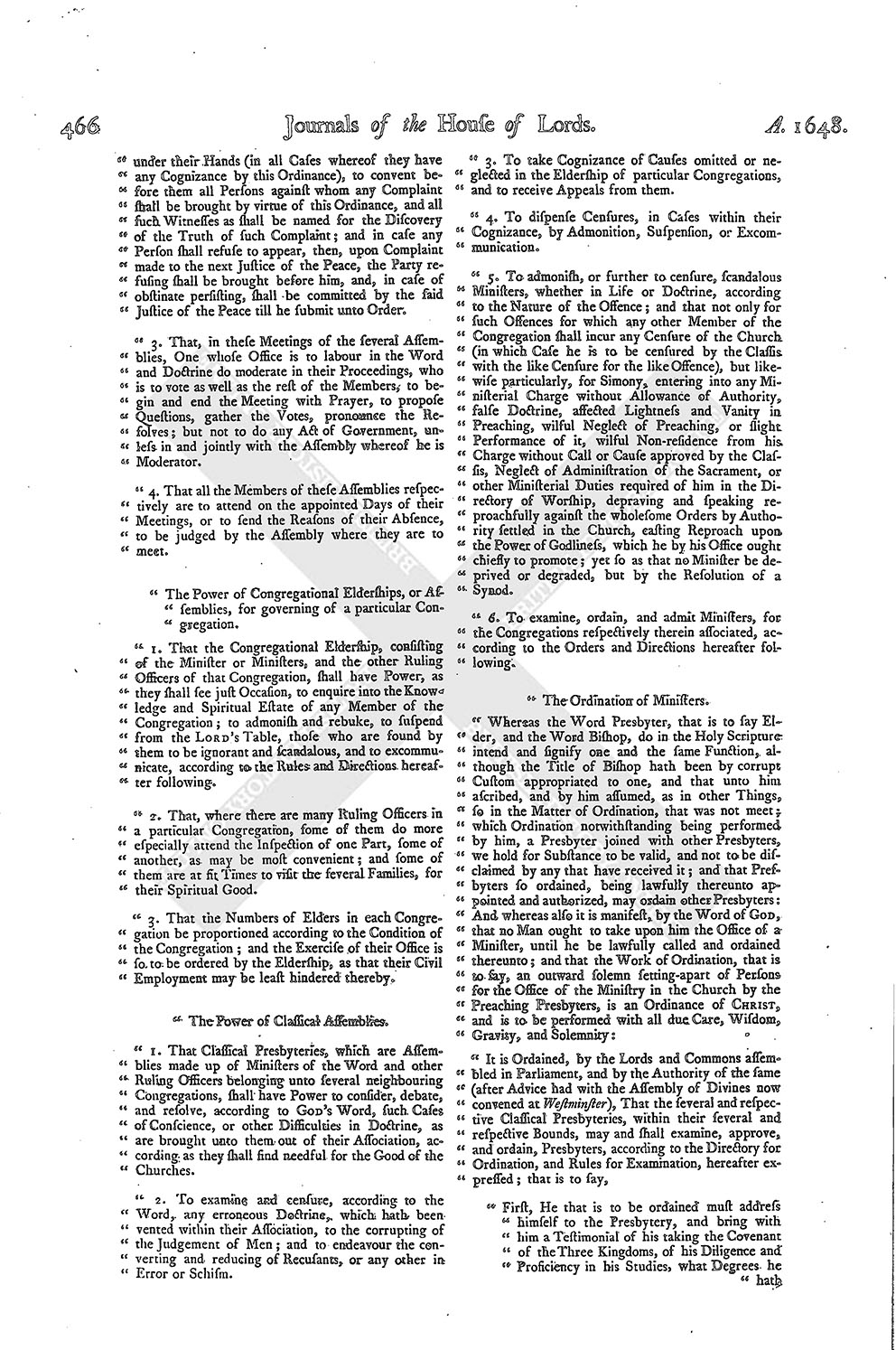
"2. That these several Assemblies, or the major Part of them respectively, shall have Power, by Warrant under their Hands (in all Cases whereof they have any Cognizance by this Ordinance), to convent before them all Persons against whom any Complaint shall be brought by virtue of this Ordinance, and all such Witnesses as shall be named for the Discovery of the Truth of such Complaint; and in case any Person shall refuse to appear, then, upon Complaint made to the next Justice of the Peace, the Party refusing shall be brought before him, and, in case of obstinate persisting, shall be committed by the said Justice of the Peace till he submit unto Order.
3. That, in these Meetings of the several Assemblies, One whose Office is to labour in the Word and Doctrine do moderate in their Proceedings, who is to vote as well as the rest of the Members, to begin and end the Meeting with Prayer, to propose Questions, gather the Votes, pronounce the Resolves; but not to do any Act of Government, unless in and jointly with the Assembly whereof he is Moderator.
"4. That all the Members of these Assemblies respectively are to attend on the appointed Days of their Meetings, or to send the Reasons of their Absence, to be judged by the Assembly where they are to meet.
"The Power of Congregational Elderships, or Assemblies, for governing of a particular Congregation.
"1. That the Congregational Eldership, consisting of the Minister or Ministers, and the other Ruling Officers of that Congregation, shall have Power, as they shall see just Occasion, to enquire into the Knowledge and Spiritual Estate of any Member of the Congregation; to admonish and rebuke, to suspend from the Lord's Table, those who are found by them to be ignorant and scandalous, and to excommunicate, according to the Rules and Directions hereafter following.
"2. That, where there are many Ruling Officers in a particular Congregation, some of them do more especially attend the Inspection of one Part, some of another, as may be most convenient; and some of them are at fit Times to visit the several Families, for their Spiritual Good.
"3. That the Numbers of Elders in each Congregation be proportioned according to the Condition of the Congregation; and the Exercise of their Office is so to be ordered by the Eldership, as that their Civil Employment may be least hindered thereby.
"The Power of Classical Assemblies.
"1. That Classical Presbyteries, which are Assemblies made up of Ministers of the Word and other Ruling Officers belonging unto several neighbouring Congregations, shall have Power to consider, debate, and resolve, according to God's Word, such Cases of Conscience, or other Difficulties in Doctrine, as are brought unto them out of their Association, according as they shall find needful for the Good of the Churches.
"2. To examine and censure, according to the Word, any erroneous Doctrine, which hath been vented within their Association, to the corrupting of the Judgement of Men; and to endeavour the converting and reducing of Recusants, or any other in Error or Schism.
"3. To take Cognizance of Causes omitted or neglected in the Eldership of particular Congregations, and to receive Appeals from them.
4. To dispense Censures, in Cases within their Cognizance, by Admonition, Suspension, or Excommunication.
"5. To admonish, or further to censure, scandalous Ministers, whether in Life or Doctrine, according to the Nature of the Offence; and that not only for such Offences for which any other Member of the Congregation shall incur any Censure of the Church (in which Case he is to be censured by the Classis with the like Censure for the like Offence), but likewise particularly, for Simony, entering into any Ministerial Charge without Allowance of Authority, false Doctrine, affected Lightness and Vanity in Preaching, wilful Neglect of Preaching, or slight Performance of it, wilful Non-residence from his Charge without Call or Cause approved by the Classis, Neglect of Administration of the Sacrament, or other Ministerial Duties required of him in the Directory of Worship, depraving and speaking reproachfully against the wholesome Orders by Authority settled in the Church, casting Reproach upon the Power of Godliness, which he by his Office ought chiefly to promote; yet so as that no Minister be deprived or degraded, but by the Resolution of a Synod.
"6. To examine, ordain, and admit Ministers, for the Congregations respectively therein associated, according to the Orders and Directions hereafter following.
"The Ordination of Ministers.
"Whereas the Word Presbyter, that is to say Elder, and the Word Bishop, do in the Holy Scripture intend and signify one and the same Function, although the Title of Bishop hath been by corrupt Custom appropriated to one, and that unto him ascribed, and by him assumed, as in other Things, so in the Matter of Ordination, that was not meet; which Ordination notwithstanding being performed by him, a Presbyter joined with other Presbyters, we hold for Substance to be valid, and not to be disclaimed by any that have received it; and that Prefbyters so ordained, being lawfully thereunto appointed and authorized, may ordain other Presbyters: And whereas also it is manifest, by the Word of God, that no Man ought to take upon him the Office of a Minister, until he be lawfully called and ordained thereunto; and that the Work of Ordination, that is to say, an outward solemn setting-apart of Persons for the Office of the Ministry in the Church by the Preaching Presbyters, is an Ordinance of Christ, and is to be performed with all due Care, Wisdom, Gravity, and Solemnity:
"It is Ordained, by the Lords and Commons assembled in Parliament, and by the Authority of the same (after Advice had with the Assembly of Divines now convened at Westminster), That the several and respective Classical Presbyteries, within their several and respective Bounds, may and shall examine, approve, and ordain, Presbyters, according to the Directory for Ordination, and Rules for Examination, hereafter expressed; that is to say,
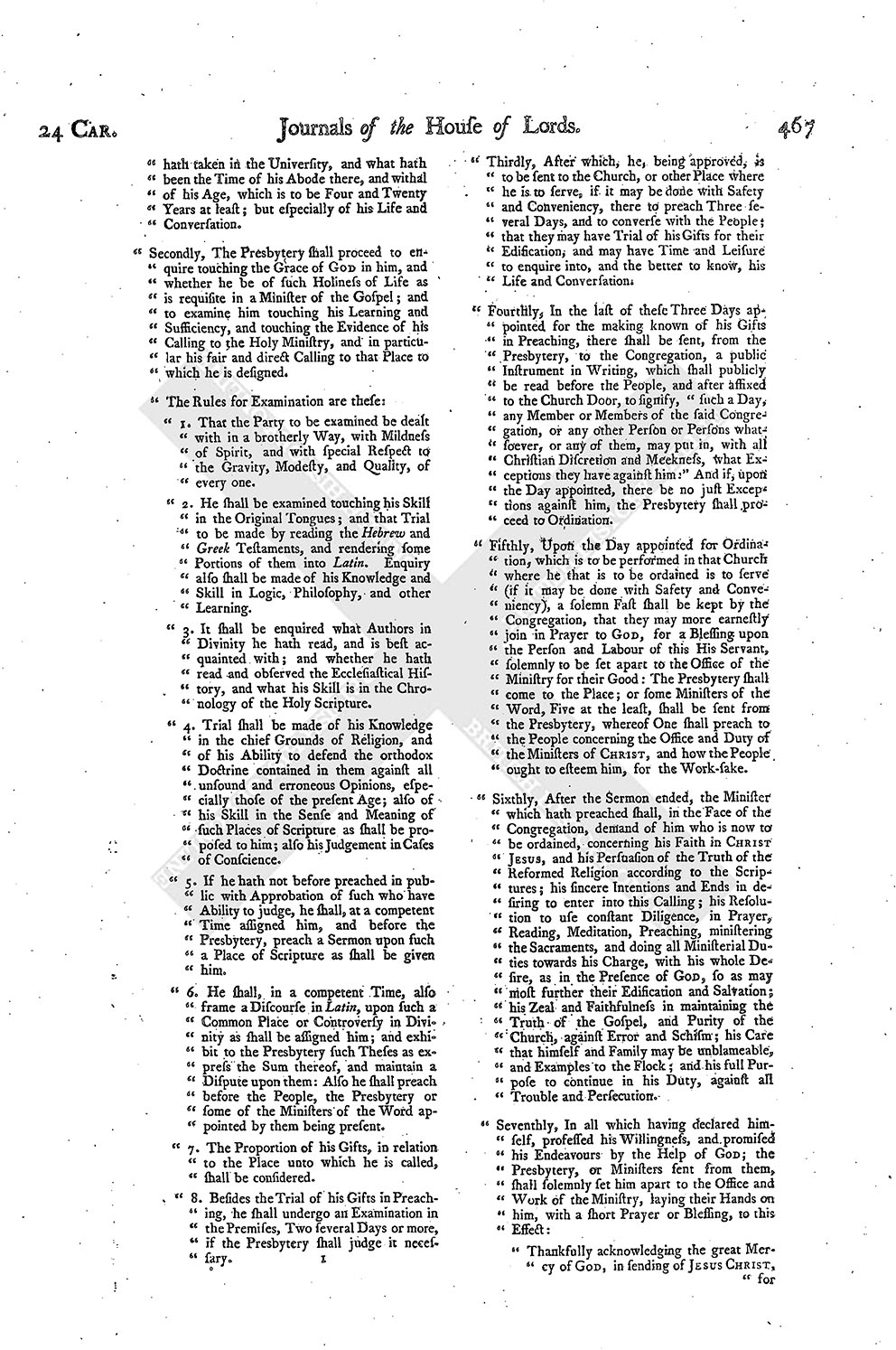
"First, He that is to be ordained must address himself to the Presbytery, and bring with him a Testimonial of his taking the Covenant of the Three Kingdoms, of his Diligence and Proficiency in his Studies, what Degrees he hath taken in the University, and what hath been the Time of his Abode there, and withal of his Age, which is to be Four and Twenty Years at least; but especially of his Life and Conversation.
"Secondly, The Presbytery shall proceed to enquire touching the Grace of God in him, and whether he be of such Holiness of Life as is requisite in a Minister of the Gospel; and to examine him touching his Learning and Sufficiency, and touching the Evidence of his Calling to the Holy Ministry, and in particular his fair and direct Calling to that Place to which he is designed.
"The Rules for Examination are these:
"1. That the Party to be examined be dealt with in a brotherly Way, with Mildness of Spirit, and with special Respect to the Gravity, Modesty, and Quality, of every one.
"2. He shall be examined touching his Skill in the Original Tongues; and that Trial to be made by reading the Hebrew and Greek Testaments, and rendering some Portions of them into Latin. Enquiry also shall be made of his Knowledge and Skill in Logic, Philosophy, and other Learning.
"3. It shall be enquired what Authors in Divinity he hath read, and is best acquainted with; and whether he hath read and observed the Ecclesiastical History, and what his Skill is in the Chronology of the Holy Scripture.
"4. Trial shall be made of his Knowledge in the chief Grounds of Religion, and of his Ability to defend the orthodox Doctrine contained in them against all unsound and erroneous Opinions, especially those of the present Age; also of his Skill in the Sense and Meaning of such Places of Scripture as shall be proposed to him; also his Judgement in Cases of Conscience.
"5. If he hath not before preached in public with Approbation of such who have Ability to judge, he shall, at a competent Time assigned him, and before the Presbytery, preach a Sermon upon such a Place of Scripture as shall be given him.
"6. He shall, in a competent Time, also frame a Discourse in Latin, upon such a Common Place or Controversy in Divinity as shall be assigned him; and exhibit to the Presbytery such Theses as express the Sum thereof, and maintain a Dispute upon them: Also he shall preach before the People, the Presbytery or some of the Ministers of the Word appointed by them being present.
"7. The Proportion of his Gifts, in relation to the Place unto which he is called, shall be considered.
8. Besides the Trial of his Gifts in Preaching, he shall undergo an Examination in the Premises, Two several Days or more, if the Presbytery shall judge it necessary.
"Thirdly, After which, he, being approved, is to be sent to the Church, or other Place where he is to serve, if it may be done with Safety and Conveniency, there to preach Three several Days, and to converse with the People; that they may have Trial of his Gifts for their Edification, and may have Time and Leisure to enquire into, and the better to know, his Life and Conversation.
"Fourthly, In the last of these Three Days appointed for the making known of his Gifts in Preaching, there shall be sent, from the Presbytery, to the Congregation, a public Instrument in Writing, which shall publicly be read before the People, and after affixed to the Church Door, to signify, "such a Day, any Member or Members of the said Congregation, or any other Person or Persons whatsoever, or any of them, may put in, with all Christian Discretion and Meekness, what Exceptions they have against him:" And if, upon the Day appointed, there be no just Exceptions against him, the Presbytery shall proceed to Ordination.
"Fifthly, Upon the Day appointed for Ordination, which is to be performed in that Church where he that is to be ordained is to serve (if it may be done with Safety and Conveniency), a solemn Fast shall be kept by the Congregation, that they may more earnestly join in Prayer to God, for a Blessing upon the Person and Labour of this His Servant, solemnly to be set apart to the Office of the Ministry for their Good: The Presbytery shall come to the Place; or some Ministers of the Word, Five at the least, shall be sent from the Presbytery, whereof One shall preach to the People concerning the Office and Duty of the Ministers of Christ, and how the People ought to esteem him, for the Work-sake.
"Sixthly, After the Sermon ended, the Minister which hath preached shall, in the Face of the Congregation, demand of him who is now to be ordained, concerning his Faith in Christ Jesus, and his Persuasion of the Truth of the Reformed Religion according to the Scriptures; his sincere Intentions and Ends in desiring to enter into this Calling; his Resolution to use constant Diligence, in Prayer, Reading, Meditation, Preaching, ministering the Sacraments, and doing all Ministerial Duties towards his Charge, with his whole Desire, as in the Presence of God, so as may most further their Edification and Salvation; his Zeal and Faithfulness in maintaining the Truth of the Gospel, and Purity of the Church, against Error and Schism; his Care that himself and Family may be unblameable, and Examples to the Flock; and his full Purpose to continue in his Duty, against all Trouble and Persecution.
"Seventhly, In all which having declared himself, professed his Willingness, and promised his Endeavours by the Help of God; the Presbytery, or Ministers sent from them, shall solemnly set him apart to the Office and Work of the Ministry, laying their Hands on him, with a short Prayer or Blessing, to this Effect:
"Thankfully acknowledging the great Mercy of God, in sending of Jesus Christ, for the Redemption of His People; and for His Ascension to the Right Hand of God the Father, and there pouring out His Spirit, and giving Gifts to Men, Apostles, Evangelists, Prophets, Pastors and Teachers; for the gathering and building up of His Church, and for sitting and inclining this Man to this great Work; to beseech Him to fill him with His Holy Spirit, whom in His Name we (fn. 2) set apart to this Holy Service, to fulfill the Work of his Ministry in all Things, that he may both save himself and the People committed to his Charge.
"Eighthly, This or the like Form of Prayer or Blessing being ended, let the Minister who preached briefly exhort him to consider the Greatness of his Office and Work, the Danger of Negligence both to himself and his People, the Blessing which will accompany his Faithfulness in this Life and that to come; withal let him exhort the People, and charge them in the Name of God, willingly to receive and acknowledge him as the Minister of Christ, and to maintain, encourage, and assist him, in all the Parts of his Office; and so by Prayer commending both him and his Flock to the Grace of God, after the singing of a Psalm, let the Assembly be dismissed with a Blessing.
"Ninthly, Let such as are, or shall be, chosen or appointed for the Service of Army, Navy, Colleges, or other Charge, be ordained as aforesaid, in such Church as the Classical Presbytery to which they shall address themselves shall think fit; and such Alterations made by the Minister that ordaineth, from the Exhortation last before prescribed, as the Circumstance of Place and Person shall require.
"Tenthly, Let every one which is, or shall be, chosen or appointed for any Place or Congregation, not being at that Time within the Bounds of any Classical Presbytery, be ordained by that Classis of Presbyters which he shall address himself unto, or by Five or any greater Number of Ministers of the Word, to be sent from that Presbytery; which Ordination is to be performed according to the Rules and Directions before prescribed, as far as with Safety and Conveniency may be.
"And be it further Ordained, by the said Lords and Commons, and by the Authority aforesaid, That every Person formerly ordained a Presbyter, according to the Form of Ordination which hath been held in the Church of England, and is to be removed to another Charge, do bring to the Presbytery where he is to be placed, if there be any, and if not, then to some other Presbytery, a Testimonial of his Ordination, and of his Abilities and Conversation, whereupon his Fitness for that Place to which he is to be removed shall be tried by his Preaching there, and (if it shall be judged necessary) by a further Examination; and so, without any new Ordination, he shall be admitted, if he be approved, as fit for that Place; and if any Person ordained Minister in Scotland, or in any other Reformed Church, be designed to a Congregation in England, he is to bring from that Church, to the Presbytery where he is to be placed, if there be any, and if not, then to some other Presbytery, a sufficient Testimonial of his Ordination, of his Life and Conversation while he lived with them, and of the Causes of his Removal, and to undergo such a Trial of his Fitness and Sufficiency, and to have the same Course held with him in other Particulars, as is set down in the foregoing Rule and Provision, touching the Examination and Admission of Persons formerly ordained in England.
"And it is further Ordained, That Records he carefully kept, by the Register to be nominated by the Presbytery, of the Names of the Persons ordained, with their Testimonials, of the Time and Place of their Ordination, and of the Ministers who did ordain them, and of the Charge to which they are appointed; and that no Money, or Gift of what Kind soever, shall be received from the Person to be ordained, or from any on his Behalf, for Ordination, or aught else belonging to it, by the Presbytery, or any of them, or any appertaining to any of them, upon what Pretence soever, except to the Register, for the Entry, Instruments, and Testimonial of his Ordination, which shall not exceed the Sum of Ten Shillings for each Person ordained.
"And it is yet further Ordained, by the Authority aforesaid, That all Persons who shall be ordained Presbyters according to this Directory shall be for ever reputed and taken, to all Intents and Purposes, for lawful and sufficiently-authorized Ministers of the Church of England, and as capable of any Ministerial Employment in the Church, with the Rights and Profits belonging thereunto, as any other Presbyters whatsoever already ordained, or hereafter to be ordained; and that all Presbyters who are hereby appointed and authorized to ordain, and shall (according to this present Directory) ordain any One or more Presbyters, are hereby declared to perform an acceptable Service to this Church and Kingdom, and shall have the Protection of both Houses of Parliament for their Indemnity. And what Presbytery soever, being in due Manner desired, shall, without just and true Cause, refuse or defer to ordain any Presbyter whom by the Rules and Direction of this Ordinance they ought to ordain, or shall omit or neglect to observe the Solemnity of Ordination in that decent and grave and godly Manner as is meet, it is hereby declared, That they are guilty of a very great Offence, and deserve severe Punishment.
"The Power of Synodical Assemblies.
"1. That Synodical Assemblies, whether Provincial or National, consisting of Pastors, Teachers, ChurchGovernors, and other fit Persons (when it shall be deemed expedient), where they have a lawful Calling thereunto, have Ecclesiastical Power and Authority to judge and determine Controversies of Faith and Cases of Conscience, according to the Word.
"2. They may also excommunicate, and dispense other Church Censures, in Cases that are orderly brought before them.
"Of Church Censures; and First, of Suspension from the Sacrament.
"1. That the several Elderships respectively, within their respective Bounds and Limits, have Power to suspend from the Sacrament of the Lord's Supper all ignorant and scandalous Persons, within the Rules hereafter following, and according to the said Rules and Directions.
Rules and Directions concerning Suspension from the Sacrament of the Lord's Supper, in Cases of Ignorance.
"1. All such Persons who shall be admitted to the Sacrament of the Lord's Supper ought to know, that there is a God; that there is but One Ever-living and True God, Maker of Heaven and Earth, and Governor of all Things; that this only True God is the God whom we worship; that this God is but One God, yet Three distinct Persons, the Father, Son, and Holy Ghost, all equally God.
"That God created Man after His own Image, in Knowledge, Righteousness, and true Holiness; that by One Man Sin entered into the World, and Death by Sin, and so Death passed upon all Men, for that all have sinned; that thereby they are all dead in Trespasses and Sins, and are by Nature the Children of Wrath, and so liable to Eternal Death, the Wages of every Sin.
"That there is but One Mediator betwixt God and Man, the Man Christ Jesus, who is also over all, God blessed for ever; neither is there Salvation in any other.
"That He was conceived by the Holy Ghost, and born of the Virgin Mary; that He died upon the Cross, to save His People from their Sins; that He rose again the Third Day from the Dead, ascended into Heaven, sits at the Right Hand of God, and makes continual Intercession for us, of whose Fulness we receive all Grace necessary to Salvation.
"That Christ and His Benefits are applied only by Faith; that Faith is the Gift of God; and that we have it not of ourselves, but it is wrought in us by the Word and Spirit of God.
"That Faith is that Grace whereby we believe and trust in Christ, for Remission of Sins and Life Everlasting, according to the Promises of the Gospel; that whosoever believes not on the Son of God, shall not see Life, but shall perish eternally.
"That they who truly repent of their Sins do see them, sorrow for them, and turn from them to the Lord; and that, except Men repent, they shall surely perish.
"That a godly Life is conscionably ordered, according to the Word of God, in Holiness and Righteousness, without which no Man shall see God.
"That the Sacraments are Seals of the Covenant of Grace, in the Blood of Christ; that the Sacraments of the New Testament are Baptism and the Lord's Supper; that the outward Elements in the Lord's Supper are Bread and Wine, and do signify the Body and Blood of Christ crucisied, which the worthy Receiver by Faith doth partake of in this Sacrament, which Christ hath likewise ordained for the Remembrance of His Death; that whosoever eats and drinks unworthily is guilty of the Body and Blood of the Lord; and therefore that every one is to examine himself, lest he eat and drink Judgement to himself, not discerning the Lord's Body.
"That the Souls of the Faithful, after Death, do immediately live with Christ in Blessedness; and that the Souls of the Wicked do immediately go into Hell Torment; that there shall be a Resurrection of the Bodies, both of the Just and Unjust, at the last Day, at which Time all shall appear before the Judgement Seat of Christ, to receive according to what they have done in the Body, whether it be Good or Evil; and that the Righteous shall go into Life Eternal, and the Wicked into Everlasting Punishment.
"2. Those who have a competent Measure of Understanding concerning the Matters contained in these Articles shall not be kept back from the Sacrament of the Lord's Supper for Ignorance; and the Examination and Judgement of such Persons as shall, for their Ignorance of the aforesaid Points of Religion, not be admitted to the Sacrament of the Lord's Supper, is to be in the Power of the Eldership of every Congregation.
"Rules and Directions concerning Suspension from the Sacrament of the Lord's Supper, in Cases of Scandal.
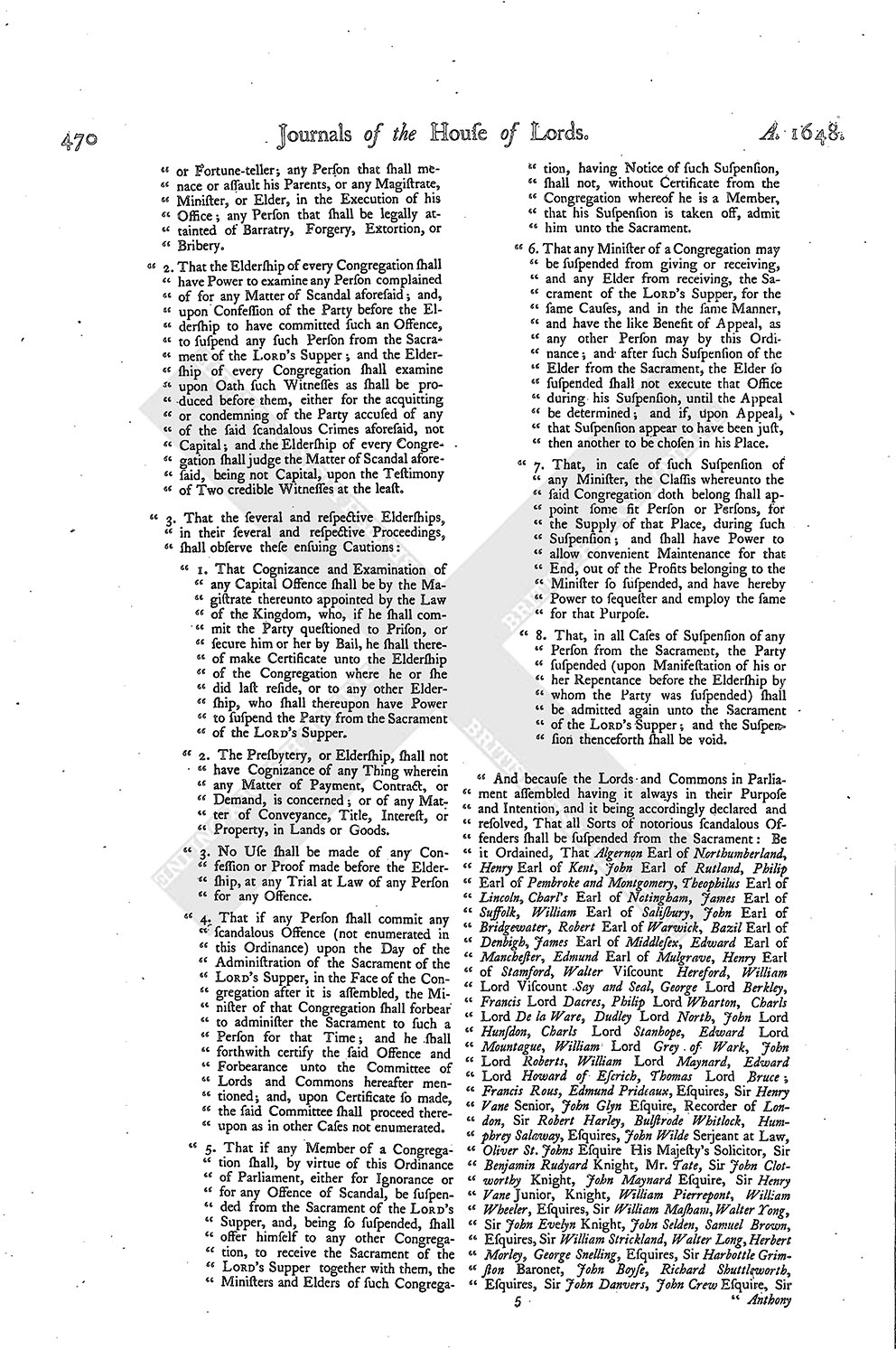
"1. That the several and respective Elderships shall have Power to suspend from the Sacrament of the Lord's Supper all seandalous Persons hereafter mentioned, appearing to be such upon just Proof made thereof, in such Manner as by this present Ordinance is hereafter appointed; that is to say, all Persons that shall blasphemously speak or write any Thing of God, His Holy Word or Sacraments; all Renouncers of the true Protestant Religion prosessed in the Church of England; and all Persons that shall by Preaching or Writing maintain any such Errors as do subvert any of those Articles the Ignorance whereof doth render any Person excluded from the Sacrament of the Lord's Supper; an incestuous Person, an Adulterer, a Fornicator, a Drunkard, a prophane Swearer or Curser; one that hath taken away the Life of any Person maliciously; all Worshipers of Images, Crosses, Crucifixes, or Relicks; all that shall make any Images or Pictures of the Trinity, or of any Person thereof; all Religious Worshipers of Saints, Angels, or any mere Creatures; any Person that shall prosess himself not to be in Charity with his Neighbours; all Persons in whom Malice appears, and they refuse to be reconciled; any Person that shall challenge any other Person, by Word, Message, or Writing, to fight, or that shall accept such Challenge, and agree thereto; any Person that shall knowingly carry any Challenge, by Word, Message, or Writing; any Person that shall, upon the Lord's-day, use any Dancing, Playing at Dice or Cards, or any other Game, Masking, Wakes, Shooting, Bowling, Playing, Playing at Foot-ball, Stool-ball, Wrestling; or that shall make or resort unto any Plays, Interludes, Fencing, Bull-baiting, or Bear-baiting; or that shall use Hawking, Hunting, or Coursing, Fishing, or Fowling; or that shall publicly expose any Wares to Sale, otherwise than is provided by an Ordinance of Parliament of the Sixth of April, 1644; any Person that shall travel on the Lord's-day, without reasonable Cause; any Person that keepeth a known Stews or Brothel house, or that shall solicit the Chastity of any Person for himself or any other; any Person, Father or Mother, that shall consent to the Marriage of their Child to a Papist, or any Person that shall marry a Papist; any Person that shall repair for any Advice to any Witch, Wizard, or Fortune-teller; any Person that shall menace or assault his Parents, or any Magistrate, Minister, or Elder, in the Execution of his Office; any Person that shall be legally attained of Barratry, Forgery, Extortion, or Bribery.
"2. That the Eldership of every Congregation shall have Power to examine any Person complained of for any Matter of Scandal aforesaid; and, upon Consession of the Party before the Eldership to have committed such an Offence, to suspend any such Person from the Sacrament of the Lord's Supper; and the Eldership of every Congregation shall examine upon Oath such Witnesses as shall be produced before them, either for the acquitting or condemning of the Party accused of any of the said scandalous Crimes aforesaid, not Capital; and the Eldership of every Congregation shall judge the Matter of Scandal aforesaid, being not Capital, upon the Testimony of Two credible Witnesses at the least.
"3. That the several and respective Elderships, in their several and respective Proceedings, shall observe these ensuing Cautions:
"1. That Cognizance and Examination of any Capital Offence shall be by the Magistrate thereunto appointed by the Law of the Kingdom, who, if he shall commit the Party questioned to Prison, or secure him or her by Bail, he shall thereof make Certificate unto the Eldership of the Congregation where he or she did last reside, or to any other Eldership, who shall thereupon have Power to suspend the Party from the Sacrament of the Lord's Supper.
"2. The Presbytery, or Eldership, shall not have Cognizance of any Thing wherein any Matter of Payment, Contract, or Demand, is concerned; or of any Matter of Conveyance, Title, Interest, or Property, in Lands or Goods.
"3. No Use shall be made of any Consession or Proof made before the Eldership, at any Trial at Law of any Person for any Offence.
"4. That if any Person shall commit any scandalous Offence (not enumerated in this Ordinance) upon the Day of the Administration of the Sacrament of the Lord's Supper, in the Face of the Congregation after it is assembled, the Minister of that Congregation shall forbear to administer the Sacrament to such a Person for that Time; and he shall forthwith certify the said Offence and Forbearance unto the Committee of Lords and Commons hereafter mentioned; and, upon Certificate so made, the said Committee shall proceed thereupon as in other Cases not enumerated.
"5. That if any Member of a Congregation shall, by virtue of this Ordinance of Parliament, either for Ignorance or for any Offence of Scandal, be suspended from the Sacrament of the Lord's Supper, and, being so suspended, shall offer himself to any other Congregation, to receive the Sacrament of the Lord's Supper together with them, the Ministers and Elders of such Congregation, having Notice of such Suspension, shall not, without Certificate from the Congregation whereof he is a Member, that his Suspension is taken off, admit him unto the Sacrament.
"6. That any Minister of a Congregation may be suspended from giving or receiving, and any Elder from receiving, the Sacrament of the Lord's Supper, for the same Causes, and in the same Manner, and have the like Benefit of Appeal, as any other Person may by this Ordinance; and after such Suspension of the Elder from the Sacrament, the Elder so suspended shall not execute that Office during his Suspension, until the Appeal be determined; and if, upon Appeal, that Suspension appear to have been just, then another to be chosen in his Place.
"7. That, in case of such Suspension of any Minister, the Classis whereunto the said Congregation doth belong shall appoint some fit Person or Persons, for the Supply of that Place, during such Suspension; and shall have Power to allow convenient Maintenance for that End, out of the Profits belonging to the Minister so suspended, and have hereby Power to sequester and employ the same for that Purpose.
"8. That, in all Cases of Suspension of any Person from the Sacrament, the Party suspended (upon Manifestation of his or her Repentance before the Eldership by whom the Party was suspended) shall be admitted again unto the Sacrament of the Lord's Supper; and the Suspension thenceforth shall be void.
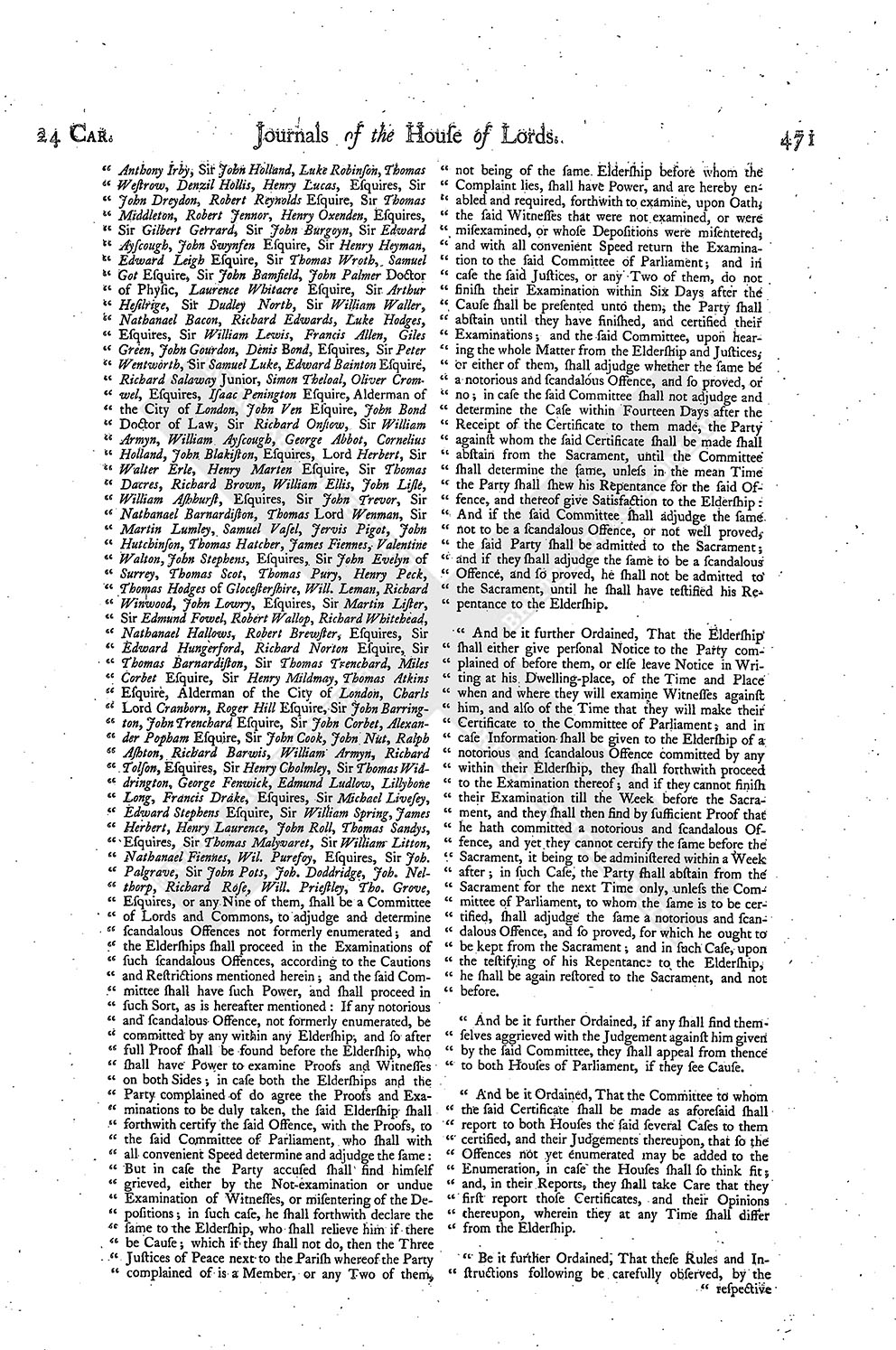
"And because the Lords and Commons in Parliament assembled having it always in their Purpose and Intention, and it being accordingly declared and resolved, That all Sorts of notorious scandalous Offenders shall be suspended from the Sacrament: Be it Ordained, That Algernon Earl of Northumberland, Henry Earl of Kent, John Earl of Rutland, Philip Earl of Pembroke and Montgomery, Theophilus Earl of Lincoln, Charl's Earl of Notingham, James Earl of Suffolk, William Earl of Salisbury, John Earl of Bridgewater, Robert Earl of Warwick, Bazil Earl of Denbigh, James Earl of Middlesex, Edward Earl of Manchester, Edmund Earl of Mulgrave, Henry Earl of Stamford, Walter Viscount Hereford, William Lord Viscount Say and Seal, George Lord Berkley, Francis Lord Dacres, Philip Lord Wharton, Charles Lord De la Ware, Dudley Lord North, John Lord Hunsdon, Charls, Lord Stanhope, Edward, Lord Mountague, William Lord Grey of Wark, John Lord Roberts, William Lord Maynard, Edward Lord Howard of Escrich, Thomas Lord Bruce; Francis Rous, Edmund Prideaux, Esquires, Sir Henry Vane Senior, John Glyn Esquire, Recorder of London, Sir Robert Harley, Bulstrode Whitlock, Humphrey Salaway, Esquires, John Wilde Serjeant at Law, Oliver St. Johns Esquire His Majesty's Solicitor, Sir Benjamin Rudyard Knight, Mr. Tate, Sir John Clotworthy Knight, John Maynard Esquire, Sir Henry Vane Junior, Knight, William Pierrepont, William Wheeler, Esquires, Sir William Masham, Walter Yong, Sir John Evelyn Knight, John Selden, Samuel Brown, Esquires, Sir William Strickland, Walter Long, Herbert Morley, George Snelling, Esquires, Sir Harbottle Grimston Baronet, John Boyse, Richard Shuttleworth, Esquires, Sir John Danvers, John Crew Esquire, Sir Anthony Irby, Sir John Holland, Luke Robinson, Thomas Westrow, Denzil Hollis, Henry Lucas, Esquires, Sir John Dreydon, Robert Reynolds Esquire, Sir Thomas Middleton, Robert Jennor, Henry Oxenden, Esquires, Sir Gilbert Gerrard, Sir John Burgoyn, Sir Edward Ayscough, John Swynfen Esquire, Sir Henry Heyman, Edward Leigh Esquire, Sir Thomas Wroth, Samuel Got Esquire, Sir John Bamfield, John Palmer Doctor of Physic, Laurence Whitacre Esquire, Sir Arthur Hesilrige, Sir Dudley North, Sir William Waller, Nathanael Bacon, Richard Edwards, Luke Hodges, Esquires, Sir William Lewis, Francis Allen, Giles Green, John Gourdon, Denis Bond, Esquires, Sir Peter Wentworth, Sir Samuel Luke, Edward Bainton Esquire, Richard Salaway Junior, Simon Theloal, Oliver Cromwel, Esquires, Isaac Penington Esquire, Alderman of the City of London, John Ven Esquire, John Bond Doctor of Law, Sir Richard Onslow, Sir William Armyn, William Ayscough, George Abbot, Cornelius Holland, John Blakiston, Esquires, Lord Herbert, Sir Walter Erle, Henry Marten Esquire, Sir Thomas Dacres, Richard Brown, William Ellis, John Lisle, William Ashburst, Esquires, Sir John Trevor, Sir Nathanael Barnardiston, Thomas Lord Wenman, Sir Martin Lumley, Samuel Vasel, Jervis Pigot, John Hutchinson, Thomas Hatcher, James Fiennes, Valentine Walton, John Stephens, Esquires, Sir John Evelyn of Surrey, Thomas Scot, Thomas Pury, Henry Peck, Thomas Hodges of Glocestershire, Will. Leman, Richard Winwood, John Lowry, Esquires, Sir Martin Lister, Sir Edmund Fowel, Robert Wallop, Richard Whitehead, Nathanael Hallows, Robert Brewster, Esquires, Sir Edward Hungerford, Richard Norton Esquire, Sir Thomas Barnardiston, Sir Thomas Trenchard, Miles Corbet Esquire, Sir Henry Mildmay, Thomas Atkins Esquire, Alderman of the City of London, Charls Lord Cranborn, Roger Hill Esquire, Sir John Barrington, John Trenchard Esquire, Sir John Corbet, Alexander Popham Esquire, Sir John Cook, John Nut, Ralph Ashton, Richard Barwis, William Armyn, Richard Tolson, Esquires, Sir Henry Cholmley, Sir Thomas Widdrington, George Fenwick, Edmund Ludlow, Lillybone Long, Francis Drake, Esquire, Sir Michael Livesey, Edward Stephens Esquire, Sir William Spring, James Herbert, Henry Laurence, John Roll, Thomas Sandys, Esquires, Sir Thomas Malyvaret, Sir William Litton, Nathanael Fiennes, Wil. Purefoy, Esquires, Sir Job. Palgrave, Sir John Pots, Job. Doddridge, Job. Nelthorp, Richard Rose, Will. Priestley, Tho. Grove, Esquires, or any Nine of them, shall be a Committee of Lords and Commons, to adjudge and determine scandalous Offences not formerly enumerated; and the Elderships shall proceed in the Examinations of such scandalous Offences, according to the Cautions and Restrictions mentioned herein; and the said Committee shall have such Power, and shall proceed in such Sort, as is hereafter mentioned: If any notorious and scandalous Offence, not formerly enumerated, be committed by any within any Eldership, and so after full Proof shall be found before the Eldership, who shall have Power to examine Proofs and Witnesses on both Sides; in case both the Elderships and the Party complained of do agree the Proofs and Examinations to be duly taken, the said Eldership shall forthwith certify the said Offence, with the Proofs, to the said Committee of Parliament, who shall with all convenient Speed determine and adjudge the same: But in case the Party accused shall find himself grieved, either by the Not-examination or undue Examination of Witnesses, or misentering of the Depositions; in such case, he shall forthwith declare the same to the Eldership, who shall relieve him if there be Cause; which if they shall not do, then the Three Justices of Peace next to the Parish whereof the Party complained of is a Member, or any Two of them, not being of the same Eldership before whom the Complaint lies, shall have Power, and are hereby enabled and required, forthwith to examine, upon Oath, the said Witnesses that were not examined, or were misexamined, or whose Depositions were misentered, and with all convenient Speed return the Examination to the said Committee of Parliament; and in case the said Justices, or any Two of them, do not finish their Examination within Six Days after the Cause shall be presented unto them, the Party shall abstain until they have finished, and certified their Examinations; and the said Committee, upon hearing the whole Matter from the Eldership and Justices, or either of them, shall adjudge whether the same bé a notorious and scandalous Offence, and so proved, or no; in case the said Committee shall not adjudge and determine the Case within Fourteen Days after the Receipt of the Certificate to them made, the Party against whom the said Certificate shall be made shall abstain from the Sacrament, until the Committee shall determine the same, unless in the mean Time the Party shall shew his Repentance for the said Ofsence, and thereof give Satisfaction to the Eldership: And if the said Committee shall adjudge the same not to be a scandalous Offence, or not well proved, the said Party shall be admitted to the Sacrament; and if they shall adjudge the same to be a scandalous Offence, and so proved, he shall not be admitted to the Sacrament, until he shall have testified his Repentance to the Eldership.
"And be it further Ordained, That the Eldership shall either give personal Notice to the Party complained of before them, or else leave Notice in Writing at his Dwelling-place, of the Time and Place when and where they will examine Witnesses against him, and also of the Time that they will make their Certificate to the Committee of Parliament; and in case Information shall be given to the Eldership of a notorious and scandalous Offence committed by any within their Eldership, they shall forthwith proceed to the Examination thereof; and if they cannot finish their Examination till the Week before the Sacrament, and they shall then find by sufficient Proof that he hath committed a notorious and scandalous Offence, and yet they cannot certify the same before the Sacrament, it being to be administered within a Week after; in such Case, the Party shall abstain from the Sacrament for the next Time only, unless the Committee of Parliament, to whom the same is to be certified, shall adjudge the same a notorious and scandalous Offence, and so proved, for which he ought to be kept from the Sacrament; and in such Case, upon the testifying of his Repentance to the Eldership, he shall be again restored to the Sacrament, and not before.
"And be it further Ordained, if any shall find themselves aggrieved with the Judgement against him given by the said Committee, they shall appeal from thence to both Houses of Parliament, if they see Cause.
"And be it Ordained, That the Committee to whom the said Certificate shall be made as aforesaid shall report to both Houses the said several Cases to them certified, and their Judgements thereupon, that so the Offences not yet enumerated may be added to the Enumeration, in case the Houses shall so think fit; and, in their Reports, they shall take Care that they first report those Certificates, and their Opinions thereupon, wherein they at any Time shall differ from the Eldership.
"Be it further Ordained, That these Rules and Instructions following be carefully observed, by the respective Elderships, in the dispensing of this Censure of Suspension from the Sacrament of the Lord's Supper:
1. That none be suspended from the Sacrament before Admonition, unless the Commission of the Sin, or the Information thereof to the Elders, be so immediately before the Time of the Administration of the Sacrament, that there be no Space for Admonition.
"2. That Offences which are private be not brought unto the Eldership, unless the Offender be privately admonished, and is not amended by such private Admonition.
"3. That, in all Cases, the Eldership specially labour to convince the Person offending, of the Sinfulness of that which is proved against him; and then of the Aggravations, as they shall be needful.
"4. That if they shall see Cause to judge, after the pressing of it upon his Conscience, that he yet remains unconvinced that it is a Sin, and therefore doth not express any Repentance for it, but not out of Stubbornness and Obstinacy, then they are not to suspend him from the Sacrament, until further Endeavours have been used to convince him, unless it appear that his Admission would be scandalous to the Congregation.
5. That, in lesser Offences brought before the Eldership, they proceed with special Lenity, as in greater with special Zeal, and so accordingly be more slow or quick in censuring those that are found guilty, and more facile or wary in admitting Expressions of Repentance.
"6. That if, upon Admonition, the Offender shall give Evidence of his Repentance, so as the Elders shall be satisfied, and the Parties offended can justly except nothing against it, let him not be kept from the Sacrament; but if he repent not, but remain obstinate, let him be suspended from the Sacrament, according to the Directions beforementioned.
"7. That if any Man accuse another for a scandalous Crime unjustly, the Eldership shall not only clear the wronged Person, but take Care that the Accuser may make such Acknowledgement as the Eldership shall advise, according to the Nature of the Fact.
8. That, in all Offences brought before the Eldership, they are to be careful to keep the Matter as secret as they can, even though they be forced to proceed to Suspension; and not to make it more public than the Nature of the Fact and the Impenitency of the Person doth constrain them.
9. In case any should be censured in the particular Congregation whereof he is a Member, he may presently appeal to the Classical Presbytery, or further if it be requisite; where not only himself may be cleared and righted, but such as have done the Injury may be censured: Yet, pendente Lite, let him abstain from the Sacrament.
Of Excommunication, and the Course of Proceedings therein.
The Order of proceeding with Offenders, who before Excommunication manifest Repentance.
1. When the Offence is private, private Admonition is in all Wisdom and Love to be observed, that the Offender may either be recovered by Repentance, or, if he add Obstinacy or Contempt to his Fault, he may be cut off by Excommunication.
2. If the Sin be publicly scandalous, and the Sinner, being examined, be judged to have Signs of unseigned Repentance, and nothing justly objected against it when made known unto the People; let him be admitted to public Confession of his Sin, and Manifestation of his Repentance before the Congregation.
3. When the Penitent is brought before the Congregation, the Minister is to declare his Sin, whereby he hath provoked God's Wrath, and offended His People; his Confession of it, and Profession of unseigned Repentance for it, and of his Resolution (through the Strength of Christ) to sin no more; and his Desire of their Prayers for Mercy and Grace, to be kept from falling again into that or any the like Sin; of all which the Penitent is to make a full and free Expression, according to his Ability.
4. Which being done, the Minister, after Prayer to God for the Penitent, is to admonish him to walk circumspectly, and the People to make a right Use of his Fall and Rising again; and so to declare that the Congregation resteth satisfied.
The Order of Proceeding to Excommunication.
1. Excommunication being a shutting-out of a Person from the Communion of the Church (and therefore the greatest and last Censure of the Church), let it be inflicted with great and mature Deliberation, and after all other good Means have been essayed.
"2. That such Errors as subvert the Faith, or any other Errors which overthrow the Power of Godliness, if the Party who holds them spread them, seeking to draw others after him; and such Sins in Practice as cause the Name and Truth of God to be blasphemed, and cannot stand with the Power of Godliness; and such Practices as in their own Nature manifestly subvert that Order, Unity, and Peace, which Christ hath established in His Church; and particularly all those scandalous Sins for which any Person is to be suspended from the Sacrament of the Lord's Supper, obstinately persisted in; these being publicly known, to the just Scandal of the Church, the Sentence of Excommunication may and ought to proceed, according to the Directions hereafter following.
3. But the Persons who hold other Errors in Judgement, about Points wherein learned and godly Men possibly may or do differ, and which subvert not the Faith, nor are destructive to Godliness, or that be guilty of such Sins of Infirmity as are commonly found in the Children of God, or, being otherwise found in the Faith and holy in Life (and so not falling under Censure by the former Rules), endeavour to keep the Unity of the Spirit in the Bond of Peace; and do yet out of Conscience not come up to the Observation of all those Rules which are or shall be established by Authority for regulating the outward Worship of God, and Government of His Church, the Sentence of Excommunication for these Causes shall not be denounced against them.
4. That, when the Sin becomes public and justly scandalous, the Offender shall be dealt withal by the Eldership, to bring him to Repentance, and to such a Manifestation thereof as that his Repentance may be public as the Scandal; but, if he remain obstinate, he is at last to be excommunicated, and in the mean Time shall be suspended from the Sacrament of the Lord's Supper.
And whereas there be divers and various Judgements touching the Power of Excommunication, and the proper Subject thereof; for the clearing of Difficulties, avoiding of Offences, and Preservation of Peace, let these following Directions be observed: In the great and difficult Cases of Excommunication, whether concerning Doctrine or Conversation, the Classical Presbytery, upon the Knowledge thereof; may examine the Person, consider the Nature of the Offence, with the Aggravations thereof; and, as they shall see just Cause, may decern and declare that he is to be excommunicated; which shall be done by the Eldership of that Congregation whereof he is a Member, with the Consent of the Congregation, in this or the like Manner:
1. As there shall be Cause, several public Admonitions shall be given to the Offender (if he appears), and Prayers made for him.
2. When the Offence is so heinous, that it cries to Heaven for Vengeance, wasteth the Conscience, and is generally scandalous, the Censures of the Church may proceed with more Expedition.
3. In the Admonitions, let the Fact be charged upon the Offender, with the clear Evidence of the Guilt thereof; then let the Nature of his Sin, the particular Aggravations of it, the Punishment and Curses threatened against it, the Danger of Impenitency, especially after such Means used, the woeful Condition of them cast out from the Favour of God and Communion of the Saints, the great Mercy of God in Christ to the Penitent, how ready and willing Christ is to forgive, and the Church to accept him, upon this his serious Repentance: Let these or the like Particulars be urged upon him, out of some suitable Places of Holy Scriptures.
4. The same Particulars may be mentioned in Prayer, wherein the Lord is to be intreated to bless this Admonition to him, and to affect his Heart with the Consideration of these Things, thereby to bring him unto Repentance.
5. If, upon the last Admonition and Prayer, there be no Evidence nor Sign of his Repentance, let the dreadful Sentence of Excommunication be pronounced, with calling upon the Name of God, in these or the like Expressions:
Speak this in the Third Person, if the Party be absent.
"Whereas thou, N. hast been by sufficient Proof convinced of (here mention the Sin); and, after due Admonition and Prayer, remainest obstinate, without any Evidence or Sign of true Repentance: Therefore, in the Name of the Lord Jesus Christ, and before this Congregation, I pronounce and declare thee, N. excommunicated and shut out from the Communion of the Faithful.
Let the Prayer accompanying the Sentence be to this Effect:
That God, who hath appointed this terrible Sentence, for removing of Offences, and reducing of obstinate Sinners, would be present with this His Ordinance, to make it effectual to all those holy Ends for which He hath appointed it; that the retaining of the Offender's Sin, and shutting him out of the Church, may fill him with Fear and Shame, and break his obstinate Heart, and be a Means to destroy the Flesh, and to recover him from the Power of the Devil, that his Spirit may be saved; that others also may be stricken with Fear, and not dare to sin so presumptuously; and that, all such corrupt Leaven being purged out of the Church (which is the House of God), Jesus Christ might delight to dwell in the Midst of them.
6. After the Denunciation of this Sentence, the People are to be warned, that they hold him to be cast out of the Communion of the Church, and to shun all Communion with him: Nevertheless, Excommunication dissolveth not the Bonds of Civil or Natural Relations, nor exempteth from the Duties belonging to them.
The Order of proceeding to Absolution.
If, after Excommunication, the Signs of Repentance appear in the excommunicated Person, such as, godly Sorrow for Sin, as having thereby incurred God's heavy Displeasure, occasioned Grief to his Brethren, and justly provoked them to cast him out of their Communion, together with a full Purpose of Heart to turn from his Sin unto God, and to reform what hath been amiss in him, with an humble Desire of recovering his Peace with God and His People, and to be restored to the Light of God's Countenance, and the Communion of the Church; let him be brought before the Congregation, and there also make a free Confession of his Sin, with Sorrow for it, to call upon God for Mercy in Christ, to seek to be restored to the Communion of the Church, promising to God new Obedience, and to them more holy and circumspect Walking, as becometh the Gospel; let him be pronounced, in the Name of Christ, absolved and free from the Censures of the Church, and declared to have Right to all the Ordinances of Christ, with Praising of God for His Grace; and Prayer, that he may be fully accepted to his Favour, and hear Joy and Gladness, to this Effect:
To praise God, who delighteth not in the Death of a Sinner, but that he may repent and live; for blessing the Ordinance of Excommunication, and making it effectual, by His Spirit, to the Recovery of this Offender; to magnify the Mercy of God, through Jesus Christ, in pardoning and receiving to His Favour the most grievous Offenders, whensoever they unfeignedly repent and forsake their Sins; to pray for Assurance of Mercy and Forgiveness to this Penitent, and so to bless his Ordinance of Absolution, that he may find himself loosed thereby; and that the Lord would henceforth so uphold and strengthen him by His Spirit, that, being sound in the Faith, and holy in all Manner of Conversation, God may be honoured, the Church edified, and himself saved in the Day of the Lord Jesus.
"Then shall follow the Sentence of Absolution, in these or the like Words:
"Whereas thou, N. hast for thy Sin been shut out from the Communion of the Faithful, and hast now manifested thy Repentance, wherein the Church resteth satisfied: In the Name of Jesus Christ, before this Congregation, I pronounce and declare thee absolved from the Sentence of Excommunication formerly denounced against thee; and do receive thee to the Communion of the Church, and the free Use of all the Ordinances of Jesus Christ, that thou mayest be Partaker of all His Benefits, to thy eternal Salvation.
After this Sentence of Absolution, let the Minister speak to him as to a Brother, exhorting him to watch and pray, or comforting him if there be Need: Let the Eiders embrace him; and the whole Congregation hold Communion with him, as one of their own.
Die Martis, 29 August. 1648.
Ordered, by the Lords assembled in Parliament, That the Form of Church Government, to be used in the Church of England and Ireland, be forthwith printed and published.
"Joh. Brown, Cler. Parliamentorum."
Letter from the King, accepting of the Treaty; and desiring One of His Grooms may have a Pass to Scotl.
"Carisbrooke, Monday the 28th of August, 1648.
"My Lord, and Mr. Speaker,
I have received your Letter of the 25th of this Month, with the Votes that you sent Me; which though they are not so full as I could have wished for the perfecting of a Treaty, yet, because I conceive by what you have done that I am in some Measure fit to begin one; such is My uncessant and earnest Desire to give a Peace to these My now distracted Dominions, as I accept of the Treaty; and therefore desire that such Five Lords and Ten Commoners as My Two Houses shall appoint be speedily sent, fully authorized and instructed to treat with Me; not doubting but what is now wanting will (at our Meeting upon Debate) be fully supplied, not only to the Furtherance of this Treaty, but also to the consummating of a safe and well-grounded Peace. So I rest
"Your good Friend,
Charles R.
"Here inclosed I have sent you the List that ye have desired. I desire, in order to One of your Votes, that you will send Me a Free Pass for Parsons, One of the Grooms of My Presence Chamber, to go into Scotland; and that ye would immediately send him to Me, to receive the Dispatch thither.
"For the Earl of Manchester Speaker of the House of Peers pro Tempore, and William Lenthall Speaker of the House of Commons."
Persons desired by the King to attend Him.
"Peter Newton and Clem. Kinnersley, to make ready the House for treating."
Letter from Col. Hammond, that the King has engaged not to leave the I. of Wight;-desiring an Explanation of his Instructions; and additional Forces, both Land and Sea, to be sent to the Island.
For the Right Honourable the Earl of Manchester, Speaker of the House of Peers pro Tempore.
My Lords,
"I Yesterday received a Letter and Instructions from both House of Parliament, by the Hands of Sir Peter Killegrew (who also then presented another to His Majesty); in Answer to which, I shall give your Lordships this Account: That although I apprehended a great deal of Ambiguity in the said Instructions (comparing the first of them with the last), which caused me to endeavour (as much as in me lay) to defer the taking of His Majesty's Engagement until I might receive from the Parliament an Explanation of my said Instructions (wherein I was very importunate with His Majesty); yet His Majesty pressing me to receive His Engagement accordingly, as it was signified to Him in His Letter and Votes from the Parliament; and lest any Obstruction of the Treaty should seem to lie upon me, which His Majesty told me (that in case of my such Delay) He must charge me with; upon most serious Consideration (though in much Doubtfulness), I resolved it my Duty to accept thereof: And accordingly His Majesty hath given the Engagement of His Royal Word to me (before Sir Peter Killegrew and other Gentlemen), as is expressed in my last Instruction. And this I now acquaint your Lordships with, in order to your Commands; but withal I must let your Lordships know, that, according to my best Understanding of my said Instructions, I am in as great or greater Straights than before, what is intended by the Parliament in "His Majesty's being in the same State and Freedom as He was in when He was last at Hampton Court;" I having not been there during His Majesty's said last Residence in that Place: Which makes me importune your Lordships, that more direct and positive Instructions may be speeded unto me; and that I may not be left unto Generals in a Matter I no better understand. In the mean Time, I shall apply myself as much as in me lies to as careful an Observance of the Instruction as possibly may be. His Majesty hath told me, and so hath divers of His Servants who then and there attended Him, "That there was no Prohibition to any whatever to come unto Him;" which, according to the Limitations in my last Instructions, I hold myself bound to observe: And also all Communication of Letters to and from any Place whatever was then (fn. 3) hindered Him; and His Majesty hath told me, "That He now expects the same Freedom;" which I thought my Duty to acquaint your Lordships with, and which I shall not hinder, without particular Instructions to that Purpose. My Lords, If in any Thing I have mistaken your Lordships Instructions, I beseech you to believe, that if the Fault be not in the Ambiguity of the Instructions themselves, it is in my Disability to judge them, and not through Want of Desire exactly to observe your Commands; and that your Lordships shall ever find, when you please to give them me, so as I may best let you know it. But, my Lords, I humbly beg Leave here again to importune your Lordships, that some better Provision may be made for the great and weighty Affair yet upon my Hands, by Commissioners of Parliament as formerly, or otherwise as to your Lordships may seem best; and this I desire, not so much by reason of the Burden which hath so long and doth still so heavily press me, but because of an Inability I find in myself to perform (to the best Advantages of your Lordships and the Kingdom's Services) that Part which I yet see behind in this my Employment. And truly (my Lords) my Sense of this is such, that although, by the great Blessing of God, beyond my Expectation and Wonder, it hath pleased Him alone to carry me well through the seeming worst Part of it; I hope, with that due Respect to His Majesty and Faithfulness to the Parliament's Commands as will now put to Shame my many malicious Traducers; yet my earnest Desires are, That, for future, better Provision may be made for this so great Concernment. But, my Lords, however your Lordships shall please to determine me, because of your Commands to me for the Security of His Majesty's Person from being taken out of this Island (in which Point, in these Times of Danger, especially in regard of the revolted Ships, there cannot be too much Security), I humbly offer it, that, if possible, a considerable Force of Shipping may be sent out of Portsmouth, for the Guard of this Coast; if not, that Two or Three of the least of them may be ordered to ride at Places most convenient about the Island, to command and examine Passage-boats, that so during the Time of Treaty (to avoid the Confluence of People which otherwise will not be kept off) no Persons whatever except Inhabitants of this Island may be suffered to land, without sufficient Passes; to which Purpose, I also intend to have strict Guards upon every Landing-place: And further, that your Lordships will give Order for the sending over One Hundred Horse and Five Hundred Foot more (to continue during the Time of Treaty), with sufficient Provisions of Money, so that the Country may be certainly preserved from being burdenend by them. My Lords, I shall also acquaint your Lordships, That, although the Votes of the 16th of November last are positively taken off, yet I do not hear particularly of the revoking those of the First of January, which are more strict, for the securing His Majesty in this Castle; besides some others to the same Effect, which, as I also understand, are not taken off, but in the general Vote of His Majesty's having the same Liberty as at Hampton Court; which I humbly offer to your Lordships Consideration, and with it this also, that Orders may be forthwith given for Horses and Accommodations for His Majesty's Riding abroad. My Lords, I humbly desire a speedy Answer in these Particulars, to him who will be ever,
"My Lords,
Carisbrooke Costle, 28th of Aug. 1648.
"Your Lordships
"Most humble and faithful Servant,
"Ro. Hammond."
Order for 600 l. for Sleigh.
"Be it Ordained, by the Lords and Commons afsembled in Parliament, That the Sum of Six Hundred Pounds, for and towards the Pay of John Sleigh Esquire, late Mayor of Barwick, as Pay-master of the Garrison of Barwick, and of his Disbursements for the Parliament's Service, and his great Losses sustained, and for his good Services done to the Parliament, be, and hereby is, charged upon the Moiety of the Receipts of the Grand Excise not yet disposed of, in Course, together with Interest for the same, after the Rate of Eight Pounds per Centum, at the End of every Six Months, from the Date of this Ordinance, until the Principal become due, to be paid to the said John Sleigh, his Executors, Administrators, or Assigns; and the Commissioners of Excise for the Time being are hereby authorized and required to make Payment of the said Six Hundred Pounds and Interest accordingly, unto the said John Sleigh, his Executors, Administrators, or Assigns, whose Receipt or Receipts, with this present Ordinance, shall be a sufficient Discharge in that Behalf."
E. of Lincoln & al. and Ly. Delawar.
"To the Right Honourable the Lords in Parliament assembled.
"The humble Petition of Isabella Baroness Dowager De La Warr;
"Sheweth,
"That about a Month since, upon the Petition of Earl of Lincolne, she received an Order from this Honourable House, to put in her Answer to the said Petition, concerning a Debt due from her to his Lordship; which she accordingly did, notwithstanding that the said Earl had, by the Advice of Counsel, formerly taken Security for that Debt; the Time of which Payment is not yet come. Not long after, this Honourable House was pleased, upon another Petition from the Lord Colrane, to appoint a Day to hear the Counsel on both Sides, concerning the Matter of Privilege. The Day being come, by reason of some urgent Affairs of this House, the Counsel could not be heard. Since, upon the Petition of one Drake, it pleased the House to make an Order that (finding (fn. 4) "
Adjourn.
House adjourned till 10a, Thursday Morning next.