
Journal of the House of Lords: Volume 7, 1644. Originally published by His Majesty's Stationery Office, London, 1767-1830.
This free content was digitised by double rekeying. All rights reserved.
'House of Lords Journal Volume 7: 25 February 1645', in Journal of the House of Lords: Volume 7, 1644, (London, 1767-1830) pp. 241-254. British History Online https://www.british-history.ac.uk/lords-jrnl/vol7/pp241-254 [accessed 26 April 2024]







In this section
DIE Martis, 25 die Februarii.
PRAYERS, by Mr. Sterry.
Ds. Grey de Warke, Speaker.
Message from the H. C. with Orders, &c.
A Message was brought from the House of Commons, by Mr. Nicolls;
To desire their Lordships Concurrence in these Particulars following:
1. An Ordinance to pay One Thousand Pounds, out of the Excise, to the Prince Elector. (Here enter it.)
Agreed to.
2. An Order to give Twenty Pounds to the Servant of Sir John Meldrum, that brought the News of the taking the Town and Harbour of Scarborough.
(Here enter it.)
Agreed.
3. An Order to pay Ten Pounds a Week to the Lord of Cherbery, for his Maintenance. (Here enter it.)
Agreed to.
The Answer returned was:
Answer.
That this House agrees to all the Particulars now brought up.
Alston released.
This Day Alston was brought to the Bar, by a Habeas Corpus, and released by Order of this House.
Papers relative to the Treaty at Uxbridge.
The Commissioners that treated at Uxbridge presented to this (fn. 1) House the Remainder of the Papers concerning the Treaty at Uxbridge; which were read, as followeth:
1. The Copies of Extracts of Letters sent to the King, upon which He was induced to grant the Cessation of Ireland. (Here enter them.)
2. The several Papers of the Treaty were read.
(Here enter them.)
Answer from the H. C.
Mr. Serjeant Whitfield and Mr. Serjeant Fynch return with this Answer from the House of Commons:
That they agree in referring the Paper of The States Ambassadors to the Committee of both Kingdoms, as is desired.
Thanks to the Scots Commissioners, concerning the late Treaty.
Ordered, That the Lord General and the Earl of Manchester do give Thanks to the Scottish Commissioners, from this House, for their great Pains expressed in the Business of the late Treaty at Uxbridge.
Message from the H. C. with Ordinances.
A Message was brought from the House of Commons, by Mr. Recorder of London;
To desire their Lordships Concurrence in these Particulars following:
1. An Ordinance for pressing of Soldiers.
Read Twice, and committed to these Lords following:
Any Three, to meet on Thursday Morning.
2. The adding of divers Persons, to be Deputy Lieutenants for the County of Kent. (Here enter them.)
Agreed to.
3. An Ordinance for imposing the finding of Foot by divers Persons.
Ordered, That this Ordinance, and the Ordinance for pressing of Soldiers, be read on Thursday Morning next.
The Answer returned was:
Answer.
That this House agrees to the Deputy Lieutenants for Kent: To the other Particulars, this House will send an Answer by Messengers of their own.
Order for 1000 l. to the Prince Elector, out of the Excise.
"Whereas John Towse Esquire, Alderman of the City of London, and the rest of the Commissioners of Excise and new Impost, have advanced and lent, for the Service of the Prince Elector Palatine upon Rhene, the Sum of One Thousand Pounds: Be it hereby Ordained, by the Lords and Commons assembled in Parliament, That the said Commissioners of Excise shall and may satisfy and reimburse themselves the said One Thousand Pounds, together with Interest for the same after the Rate of Eight Pounds per Cent. for so long Time as they shall be out of the same, or any Part thereof, out of such Intervals of Time as shall happen when other Payments already assigned upon the Excise shall not happen to fall due, or, for Default thereof, then as the same shall follow in Course; and shall not, by any other Order or Ordinance of One or both Houses of Parliament, be debarred from satisfying and reimbursing themselves accordingly: And it is likewise further Ordained, That the said Commissioners of Excise shall and may pay the said One Thousand Pounds unto James Harrington Esquire, Agent for the said Prince, for the Use aforesaid, whose Receipt shall be a sufficient Discharge unto them, and every of them, in this Behalf."
Order for 20 l. to Sir John Meldrum's Messenger.
"Ordered, by the Lords and Commons in Parliament, That Twenty Pounds be bestowed upon the Messenger that brought the Letter from Sir John Meldrum, of taking Scarborough Town, Church, and Harbour; and that the Committee of Lords and Commons for Advance of Monies at Habberdashers Hall do forthwith advance and pay unto the said Messenger the said Twenty Pounds."
Order for 10 l. a Week to Ld. Cherbury.
"Ordered, That the Committee of Lords and Commons for Advance of Monies at Habberdashers Hall do advance and pay unto the Lord Cherbury Ten Pounds Weekly, for his present Subsistence."
Deputy Lieutenants for Kent.
"Ordered, by the Lords and Commons in Parliament, That Sir Thomas Peirce Baronet, Henry Oxenden of Deane Esquire, Jo. Dixwell Esquire, Robert Hales Esquire, Sir John Rayney Baronet, shall be Deputy Lieutenants and Committees for the County of Kent."
Papers relative to the Cessation of Arms in Ireland.
"Extracts of the Lords Justices and Council's Letter, to the Speaker of the House of Commons in England.
Letter from the Lords Justices of Ireland, to the Speaker of the H. C. for Supplies of Money, &c.
"We have great Cause to praise God for magnifying His Goodness and Mercy to His Majesty and this His Kingdom, so manifestly and indeed wonderfully in that Victory.
"However, the Joy due from us upon so happy an Occasion is, we confess, mingled with very great Distraction here, in the Apprehension of our Unhappiness to be such, as, although the Rebels are not able to overcome His Majesty's Army, and devour His other good Subjects here, as they desire, yet both His Army and good Subjects are in Danger to be devoured by the Wants of needful Supplies forth of England; for, as we formerly signified thither, those Forces were of Necessity sent abroad, to try what might be done for sustaining them in the Country, so as to keep them alive until Supplies should get to us; but that Design now failing, those our Hopes are converted into Astonishment, to behold the unspeakable Miseries of the Officers and Soldiers for Want of all Things, and all those Wants made the more insupportable in the Want of Food, whilst this City (being all the Help we have) is now too apparently found to be unable to help us, as it hath hitherto done; and divers Commanders and Officers in the Army do now so far express their Sense of their Sufferings (which indeed are very great and grievous) as they declare that they have little Hopes to be supplied by the Parliament, and press with so great Importunity to be permitted to depart the Kingdom, as it will be extreme difficult to keep them here.
"By our Letters of the 23th of March, we signified thither the insupportable Burthen laid on this City for Victuals (fn. 2) for those of the Army left here when the Lord Marquis with the Forces he took with him marched hence; which Burthen is found every Day more heavy than other, in regard of the many Housekeepers thereby daily breaking up House, and scattering their Families, leaving still fewer to bear the Burthen.
"We also, by those Letters, and by our Letters of the 25th of February, advertised thither the higher Danger this Kingdom would incur, if the Army so sent abroad should, by any Distress, or through Want, be forced back hither again, before our Relief of Victuals should arrive forth of England.
"When we found that those Men were returning back hither, although we were (and still are) full of Distractions, considering the dismal Consequences threatened thereby in respect of our Wants, yet we consulted what we could yet imagine feisable, that we had not formerly done, to gain some Food for those Men; and found, that to send them or others (fn. 3) abroad into the Country we cannot, in regard we are not able to advance Money for procuring the many Requisites incident to such an Expedition. In the End, therefore, we were inforced to fix on our former Way, and so to see who had any Thing yet left him untaken from him to help us; and although there are but few such, and some of them poor Merchants, whom we have now by the Law of Necessity utterly undone, and disabled from being hereafter helpful to us, in bringing us in Victuals, or other needful Commodities, yet were we forced (fn. 4) to wrest their Commodities from them; and certainly there are few here, even of ourselves or others, that have not felt their Parts in the inforced Rigour of our Proceedings, towards preserving the Army; so as what with such hard Dealing, no less grievous to us to do than it is heavy to others to suffer, and by our descending (against our Hearts) far below the Honour and Dignity of that Power we represent here under His Royal Majesty, we have with unspeakable Difficulty prevailed, so as to be able to find Bread for the Soldiers for the Space of One Month.
"We are now expelling hence all Strangers, and must instantly send away for England Thousands of poor despoiled English, whose very Eating is now unsupportable to this Place.
"And now again, and finally, we earnestly desire, for our Confusions will not now admit the writing of many more Letters, if any, that His Majesty and the English Nation may not suffer so great, if not irrecoverable, Prejudice and Dishonour, as must unavoidably be the Consequence of our not being relieved suddenly; but that yet (although it be now even almost at the Point to be too late) Supplies of Victuals and Munition in present be hastened hither, to keep Life until the rest may follow, there being no Victuals in the Store; nro will there be a Hundred Barrels of Powder left in the Store, when the Out Garrisons (as they must be instantly) are supplied; and that Remainder, according to the usual necessary Expence, besides extraordinary Accidents, will not last above a Month: And the Residue of our Provisions must also come speedily after, or otherwise England cannot hope to secure Ireland, or secure themselves against Ireland; but, in the Loss of it, must look for such Enemies from hence, as will perpetually disturb the Peace of His Majesty and His Kingdom of England, and annoy them by Sea and Land, as we often formerly represented thither, which Mischiefs may yet be prevented, if we be yet forthwith enabled from thence with Means to overcome this Rebellion.
"We hope that a Course is taken there, for hastening hither the Provisions of Arms and Munition mentioned in the Docket sent with our Letters of the 20th of January, and the Six Hundred Horses which we then moved might be sent hither for Recruits; and that the Seven Thousand Eight Hundred Ninetythree Pounds, Three Shillings, for Arms to be provided in Holland (besides those we expect in London), hath been paid to Anthony Tierens in London, or to Daniell Wibrants in Amsterdam; and if that Sum had been paid as we at first desired, we might well have had these Provisions arrived here by the 10th of March, as we agreed; however, we now desire that that Money, if it be not already paid, may be yet paid to Mr. Tierens in London, or Mr. Wibrants in Amsterdam, that so those Provisions may arrive here speedily, which (considering that Summer is now near at Hand) will be very necessary, that, when our Supplies of Victuals, Munition, Cloaths, Money, and other Provisions, shall arrive, we may not, in the Public Service here, lose the Benefit and Advantage of that Season.
"And so we remain:
"From His Majesty's Castle of Dublin, 1643.
"Postscript.
"As we are ready to sign this Dispatch, we received at the Board a Paper, signed by sundry Officers of the Army now here at Dublin, which is in such a Style, and threatens so much Danger, as we hold necessary to send a Copy thereof here inclosed, whereby still appears the high Necessity of hastening away Money (fn. 5) for them and the rest of the Officers, and Victuals for the Soldier; without which, it will be impossible to contain them from breaking out into Mutiny.
"Exam'r, per
"John Thurloe.
Daniel Earle."
Letter from them to the King, to the same Effect.
"May it please Your most Excellent Majesty,
"As soon as we Your Majesty's Justices entered into the Charge of this Government, we took into our Consideration, at this Board, the State of Your Army here, which we find suffering under unspeakable Extremities of Want of all Things necessary to the Support of their Persons, or Maintenance of the Wars; here being no Victuals, Cloaths, or other Provisions, requisite towards their Sustenance; no Money to provide them of any Thing they want; no Arms in Your Majesty's Stores, to supply their many defective Arms; not above Forty Barrels of Powder in Your Stores; no Strength of serviceable Horse being now left here; and those few that are, their Arms for the most Part lost or unserviceable; no Ships arrived here, to guard the Coasts, and consequently no Security rendered to any that might ( (fn. 6) on their private Adventures) bring in Provisions of Victuals, or other Necessaries, towards our Subsistence; and finally, no visible Means, by Sea or Land, of being able to preserve for You this Your Kingdom, and to render Deliverance from utter Destruction to the Remnant of Your good Subjects yet left here.
"We find that Your Majesty's late Justices, and this Board, have often and fully, by very many Letters; advertised the Parliament in England of the Extremities of Affairs here, and besought Relief with all possible Importunity, which also have been fully represented to Your Majesty, and the Lord Lieutenant and Mr. Secretary (fn. 7) Nichollas to be made known to Your Majesty; and although the Winds have of late for many Days (and often formerly) stood very fair for Accessions of Supply forth of England hither, and that we have still with longing Expectations hoped to find Provisions arrive here in some Degree answerable to the Necessity of Your Affairs; yet now (to our unexpressible Grief), after full Six Months Waiting, and much longer Patience and Long-suffering, we find all our great Expectations answered in a mean and inconsiderable Quantity of Provisions; videlicet, Threescore and Fifteen Barrels of Butter, and Fourteen Ton of Cheese, being but the Fourth Part of a small Vessel's Lading, which was sent from London, and arrived here on the 5th of this Month, which is not above Seven or Eight Days Provision for that Part of the Army which lies in Dublin and the Out Garrisons thereof; no Money or Victuals (other than that inconsiderable Proportion of Victuals) having arrived in this Place, or sent from the Parliament of England, or from any other forth of England, for the Use of the Army, since the Beginning of November last. We have (by the Blessing of God) been hitherto prosperous and successful in Your Majesty's Affairs here; and should be still hopeful, by the Mercy of God, under the Royal Directions of Your Sacred Majesty, to vindicate Your Majesty's Honour, and recover Your Right here, and take due Vengance on those Traitors for the innocent Blood they have spilt, if we might be strengthened and supported therein by needful Supplies forth of England; but those Supplies having hitherto been expected to come from the Parliament of England (on which if Your Majesty had not relied, we are assured You would in Your high Wisdom have found out some other Means to preserve this Your Kingdom), and so great and apparent a Failure having happened therein, and all the former and late long-continuing Easterly Winds bring us no other Provisions than those few Cheeses and Butter, and no Advertisement being brought us of our future Supply to be so much as in the Way hither, whereby there might be any Likelihood that considerable Means of Support for Your Majesty's Army might arrive here in any reasonable Time, before we be totally swallowed up by the Rebels, and Your Kingdom by them wrested from You.
"We find ourselves so disappointed of our Hopes from the Parliament, as must needs trench to the utter Loss of the Kingdom, if Your Majesty in Your high Wisdom ordain not some present Means of Preservation for us: And considering that, if now, by Occasion of that unhappy and unexpected Failing of Support from thence, we shall be less successful in Your Service here against the Rebels than hitherto (whilst we were enabled with some Means to serve You) we have been, the Shame and Dishonour may, in the common Construction of those that know not the Inwards of the Cause, be imputed to us, and not to the Failings that disables us; and considering principally, and above all Things, the high and eminent Trust of Your Affairs here, depositd with us by Your Sacred Majesty; we may not forbear, in Discharge of our Duty, thus freely and plainly to declare our humble Apprehensions, to the End Your Majesty, thus truly understanding the Terribleness of our Condition, may find out some such Means of Support, to preserve to Your Majesty and Your Royal Posterity this Your ancient and rightful Crown and Kingdom, and derive Deliverance and Safety to the Remnant of Your good Subjects yet left here, as in Your excellent Judgement you shall find to be most for Your Honour and Advantage.
"And so, praying to the King of Kings to guide and direct You for the best in this high and important Cause, and in all other Your Counsels and Actions; we humbly remain:
"From Your Majesty's Castle of Dublin, the 11th Day of May, 1643,
"Your Majesty's Most loyal and most faithful Subjects and Servants.
"Exam'r, per
"John Thurloe.
Daniel Earle."
Letter from the Officers of the Army to the Lords Justices, to relieve their Necessities.
"My Lords,
"At our First Entrance into this unhappy Kingdom, we had no other Design than by our Sword to assert and vindicate the Right of His Majesty, which was here most highly abused, to redress the Wrongs of His poor Subjects, and to advance our own Particulars in the Prosecution of so honest Undertakings: And for the First of these, we do believe that, since our coming over, it succeeded pretty well; but for the last, which concerns ourselves, that hath fallen out (fn. 8) contrary to our Expectations, that, instead of being rewarded, we have been prejudiced; instead of getting a Fortune, we have spent Part of one; and, though we behave ourselves never so well Abroad, and perform the Actions of honest Men, yet we have the Reward of Rogues and Rebels, which is Misery and Want, when we come Home. Now, my Lords, although we be brought to so great (fn. 9) an Exigence that we are ready to rob and spoil one another, yet, to prevent such Outrages, we thought it better to try all honest Means for our Subsistence, before we take such indirect Courses: Therefore, if your Lordships will be pleased to take us timely into your Considerations, before our urgent Wants make us desperate, we will, as we have done hitherto, serve your Lordships readily and faithfully; but, if your Lordships will not find a Way for our Preservation here, we humbly desire we may have Leave to go where we may have a better Being. And if your Lordships shall refuse to grant that, we must then take Leave to have our Course to that First and primary Law which God hath endued all Men with; we mean, the Law of Nature, which teacheth all Men to preserve themselves.
"Exam'r,
"3 April, 1644.
"John Thurloe.
Daniel Earle."
Remainder of the Papers, which passed between the Commissioners at Uxbridge, concerning Religion, the Militia, and Ireland.
"20 Februarii, 1644.
"1. We conceive that the Reason why your Lordships do not give us any Answer to our Paper concerning the treating of disbanding all Armies, and for His Majesty's coming to Westm. may be because you have no Authority by your Instructions so to do; though we propose the same to your Lordships, and do still conceive it most conducing to the Conclusion of the Propositions upon Religion, the Militia, and Ireland, upon which we have treated; and we therefore desire your Lordships, that you will endeavour to have your Instructions so enlarged, that we may treat upon so important and necessary (fn. 10) an Expedient for the Public Peace. In the mean Time, we shall be ready to receive whatsoever your Lordships please to propose in the Business of Religion: presuming that, if your Lordships are not satisfied with our Answer therein, in which we have applied Remedies to whatsoever hath ever been complained of as a Grievance in the present Government of the Church, that your Lordships will make it appear that the Government by Bishops is unlawful, or that Government you intend to introduce in the Room thereof is the only Government that is agreeable to the Word of God; either of which being made evident to us, we shall immediately give your Lordships full Satisfaction in that your Proposition.
"By Command of His Majesty's Commissioners.
"Exam'r,
"John Thurloe.
Wm. Dugdale.
Daniel Earle.
Nic. Oudart."
"21 Febr. 1644.
"2. Whereas your Lordships, in your last Paper of Febr. 13th, were pleased to say, That (as you conceive) the continual Succession of Episcopacy from the Apostles Time was consented to on all Parts, and that you cannot remember that the contrary thereof was so much as alledged, much less that the Unlawfulness thereof was proved, the Question of the Unlawfulness thereof having never yet come into Debate; we desire your Lordships to remember, that, when a Divine in Commission with you undertook to prove the Jus. Divinum of Episcopacy, that his Arguments were not only answered by another Divine in Commission with us, but that Four or Five several Arguments were then brought by him out of the Scriptures, to prove the Unlawfulness of it; and afterwards, in an extrajudicial Debate between several Divines on both Sides, by Consent of the Commissioners, those Arguments were further made good by the Divines on our Side, and the pretended continual Succession of Episcopal Government from the Apostles Times was, as we conceive, at the same Time sufficiently disproved; so that we cannot but wonder that your Lordships should forget that the Unlawfulness of it was debated: And whereas, in your last Paper of February 20th, your Lordships were pleased to say, That, if it might be made appear that the Government by Bishops is unlawful, or that the Government which we desire to introduce in the Room thereof is [ (fn. 11) the only] Government that is agreeable to the Word of God, your Lordships would immediately give us full Satisfaction in our Proposition; we desire your Lordships to remember besides, what hath been proved in Debate, concerning the Unlawfulness of Episcopal Government; and, notwithstanding the general Experience, that the Government by Archbishops, Bishops, &c. hath been a Hindrance to Reformation and Growth of Religion, and prejudicial to the Civil State, and the manifest Evidence of the Thing itself that so much of the Government desired by us as hath been presented unto your Lordships is agreeable to the Word of God; how we have several Times offered ourselves to give your Lordships Satisfaction by Conference, if any Objections remained with your Lordships to the contrary, which we are still ready to do, and desire your Lordships full Answer to that and the rest of our Propositions concerning Religion.
"By Command of the Commissioners for the Parliaments of both Kingdoms.
"Exam'r.
"John Thurloe.
Jo. Cheisly."
"21 Februarii, 1644.
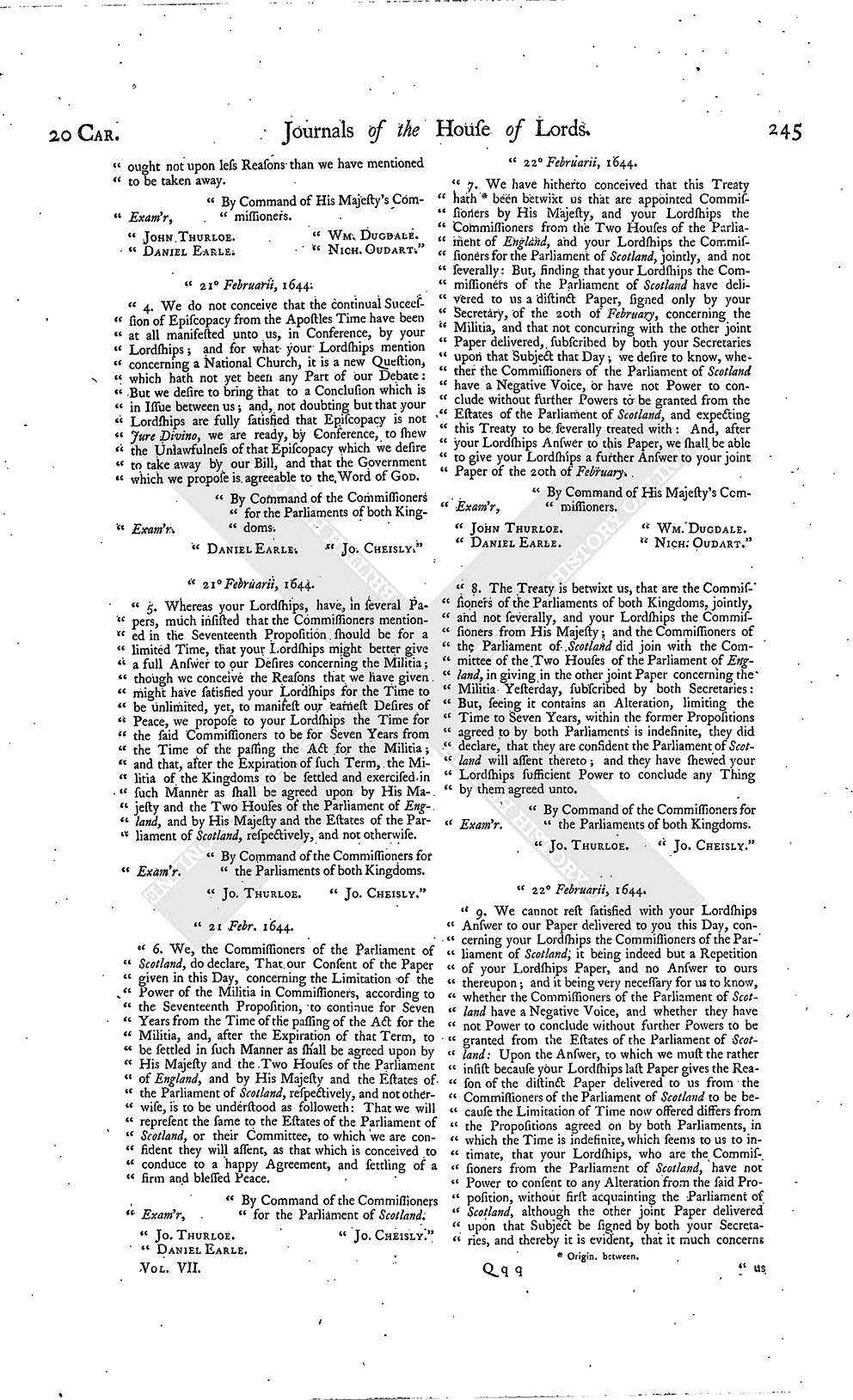
"3. We did conceive, that the continual Succession of Episcopacy from the Apostles Time had been so clearly manifested to your Lordships by our Conference on the 12th of this Instant, that your Lordships had been fully satisfied therein; the which since you are not, we would gladly be informed, when and where any National Church, since the Apostles Time, was without that Government: And since your Lordships are of Opinion that the Unlawfulness of Episcopacy was made good by those Arguments which were given by the Divines on your Part, which in Truth we did not understand to be made to that Purpose when they were first urged, and, being now again remembred, in our Judgements do not in any Degree prove the same; we being very ready to consent to the abolishing thereof, if the same can be proved: And your Lordships assuming that you have proved it, and so that you can again prove it, we desire your Lordships, by Conference, or in Writing, to satisfy us in that Point, which we hope, being in your Power as you say to do, and being a sure Way to put an End to this Debate by our yielding, your Lordships will not refuse to do: But if neither that nor the other Proposition, that the Government intended to be introduced by your Lordships is the only Government that is agreeable to the Word of God, can be evinced, we hope your Lordships will rest satisfied with the Reasons we have given your Lordships in Writing, why we cannot consent to your Propositions concerning Religion, as they are made, and insisted on by your Lordships; and that we have offered your Lordships a Remedy against all the Inconveniences that have been ever pretended in the Government as is now established by Law, and which ought not upon less Reasons than we have mentioned to be taken away.
"By Command of His Majesty's Commissioners.
"Exam'r,
"John Thurloe.
Wm. Dugdale.
Daniel Earle.
Nich. Oudart."
"21 Februarii, 1644.
"4. We do not conceive that the continual Suceession of Episcopacy from the Apostles Time have been at all manifested unto us, in Conference, by your Lordships; and for what your Lordships mention concerning a National Church, it is a new Question, which hath not yet been any Part of our Debate: But we desire to bring that to a Conclusion which is in Issue between us; and, not doubting but that your Lordships are fully satisfied that Episcopacy is not Jure Divino, we are ready, by Conference, to shew the Unlawfulness of that Episcopacy which we desire to take away by our Bill, and that the Government which we propose is agreeable to the Word of God.
"By Command of the Commissioners for the Parliaments of both Kingdoms.
"Exam'r.
"Daniel Earle.
Jo. Cheisly."
"21 Februarii, 1644.
"5. Whereas your Lordships, have, in several Papers, much insisted that the Commissioners mentioned in the Seventeenth Proposition should be for a limited Time, that your Lordships might better give a full Answer to our Desires concerning the Militia; though we conceive the Reasons that we have given might have satisfied your Lordships for the Time to be unlimited, yet, to manifest our earnest Desires of Peace, we propose to your Lordships the Time for the said Commissioners to be for Seven Years from the Time of the passing the Act for the Militia; and that, after the Expiration of such Term, the Militia of the Kingdoms to be settled and exercised in such Manner as shall be agreed upon by His Majesty and the Two Houses of the Parliament of England, and by His Majesty and the Estates of the Parliament of Scotland, respectively, and not otherwise.
"By Command of the Commissioners for the Parliaments of both Kingdoms.
"Exam'r.
"Jo. Thurloe.
Jo. Cheisly."
"21 Febr. 1644.
"6. We, the Commissioners of the Parliament of Scotland, do declare, That our Consent of the Paper given in this Day, concerning the Limitation of the Power of the Militia in Commissioners, according to the Seventeenth Proposition, to continue for Seven Years from the Time of the passing of the Act for the Militia, and, after the Expiration of that Term, to be settled in such Manner as shall be agreed upon by His Majesty and the Two Houses of the Parliament of England, and by His Majesty and the Estates of the Parliament of Scotland, respectively, and not otherwise, is to be understood as followeth: That we will represent the same to the Estates of the Parliament of Scotland, or their Committee, to which we are confident they will assent, as that which is conceived to conduce to a happy Agreement, and settling of a firm and blessed Peace.
"By Command of the Commissioners for the Parliament of Scotland.
"Exam'r,
"Jo. Thurloe.
Jo. Cheisly.
Daniel Earle."
"22 Februarii, 1644.
"7. We have hitherto conceived that this Treaty hath (fn. 12) been betwixt us that are appointed Commissioners by His Majesty, and your Lordships the Commissioners from the Two Houses of the Parliament of England, and your Lordships the Commissioners for the Parliament of Scotland, jointly, and not severally: But, finding that your Lordships the Commissioners of the Parliament of Scotland have delivered to us a distinct Paper, signed only by your Secretary, of the 20th of February, concerning the Militia, and that not concurring with the other joint Paper delivered, subscribed by both your Secretaries upon that Subject that Day; we desire to know, whether the Commissioners of the Parliament of Scotland have a Negative Voice, or have not Power to conclude without further Powers to be granted from the Estates of the Parliament of Scotland, and expecting this Treaty to be severally treated with: And, after your Lordships Answer to this Paper, we shall be able to give your Lordships a further Answer to your joint Paper of the 20th of February.
"By Command of His Majesty's Commissioners.
"Exam'r,
"John Thurloe.
Wm. Dugdale.
Daniel Earle.
Nich. Oudart."
"8. The Treaty is betwixt us, that are the Commissioners of the Parliaments of both Kingdoms, jointly, and not severally, and your Lordships the Commissioners from His Majesty; and the Commissioners of the Parliament of Scotland did join with the Committee of the Two Houses of the Parliament of England, in giving in the other joint Paper concerning the Militia Yesterday, subscribed by both Secretaries: But, seeing it contains an Alteration, limiting the Time to Seven Years, within the former Propositions agreed to by both Parliaments is indefinite, they did declare, that they are confident the Parliament of Scotland will assent thereto; and they have shewed your Lordships sufficient Power to conclude any Thing by them agreed unto.
"By Command of the Commissioners for the Parliaments of both Kingdoms.
"Exam'r.
"Jo. Thurloe.
Jo. Cheisly."
"22 Februarii, 1644.
"9. We cannot rest satisfied with your Lordships Answer to our Paper delivered to you this Day, concerning your Lordships the Commissioners of the Parliament of Scotland, it being indeed but a Repetition of your Lordships Paper, and no Answer to ours thereupon; and it being very necessary for us to know, whether the Commissioners of the Parliament of Scotland have a Negative Voice, and whether they have not Power to conclude without further Powers to be granted from the Estates of the Parliament of Scotland: Upon the Answer, to which we must the rather insist because your Lordships last Paper gives the Reason of the distinct Paper delivered to us from the Commissioners of the Parliament of Scotland to be because the Limitation of Time now offered differs from the Propositions agreed on by both Parliaments, in which the Time is indefinite, which seems to us to intimate, that your Lordships, who are the Commissioners from the Parliament of Scotland, have not Power to consent to any Alteration from the said Proposition, without first acquainting the Parliament of Scotland, although the other joint Paper delivered upon that Subject be signed by both your Secretaries, and thereby it is evident, that it much concerns us to know, whether the said Commissioners have a Negative Voice in this Treaty.
"For the Matter of your Lordships Paper concerning the Limitation of Time for the Militia to (Seven) Years, it is not possible, by reason of this Shortness of Time for the Treaty, it being Ten of the Clock this Night when your Paper was delivered, to give your Lordships a full Answer; it being necessary for us to receive Satisfaction from your Lordships, in Writing or by Conference, whether, by the Words ["and not otherwise"] your Lordships intend that, after the Expiration of the Time limited, His Majesty shall not exercise the legal Power which He now hath over the Militia, before the same be agreed upon by His Majesty and the Two Houses of Parliament of England, and by His Majesty and the Estates of the Parliament of Scotland, respectively; for which Resolution and Debate we heartily with the Time were sufficient, being very willing to give your Lordships all reasonable Satisfaction: And therefore we do propose to your Lordships, that, if the Treaty may not now continue, it may be adjourned for such Time as you shall think fit, and not totally dissolved, but again resumed; which we propose as the best Expedient now left us for the procuring of a blessed Peace, and by it the Preservation of this now miserable Kingdom from utter Ruin and Desolation.
"By Command of His Majesty's Commissioners.
"Exam'r,
"John Thurloe.
Wm. Dugdale.
Daniel Earle.
Nic. Oudart."
"20 Februarii, 1644.
"10. We are very sorry that our Answers formerly given to your Lordships in the Business of the Cessation, which was so necessary to be made, and, being made, to be kept, hath not given your Lordships Satisfaction; and that your Lordships have not rather thought fit to make the Reasonableness of your Propositions concerning Ireland appear to us, or to make such as might be reasonable in their Stead, than, by charging His Majesty with many Particulars which highly reflect upon His Honour, to compel us to mention many Things in Answer to your Lordships Allegations, which otherwise, in a Time of Treaty, when we would rather endeavour to prevent future Inconveniences than to insist on past Mistakes, we desired to have omitted: And we can no Ways admit, that, when the Cessation was made in Ireland, His Majesty's Protestant Subjects there could have subsisted without that Cessation, nor that the War can be maintained and prosecuted to the subduing the Rebels there, so long as this War continued in this Kingdom, which are the chief Grounds laid for the Assertions in your Lordships First Paper delivered this Day, concerning the Business of Ireland; neither can we conceive, that your Lordships have alledged any Thing that could in the least Degree satisfy us that His Majesty had no Power to make that Cessation, or had no Reason so to do, considering (as we have formerly said, and do again insist upon it, that by that Cessation, which was not made till long after this Kingdom was embroiled in a miserable War) the poor Protestants there (who, for Want of Supplies from hence, were ready to famish and be destroyed) were preserved, and that Kingdom kept from utter Ruin (so far was it from being a Design for their Destruction, or for the Advantage of the Popish bloody Rebels, as is insinuated); for it appears, by the Letter of the Lords Justices of Ireland, Sir William Parsons, and Sir John Burlace, and of the Council there, of the 4th of April, 1643, before that Cessation was made, directed to the Speaker of the House of Commons (a Copy whereof we delivered to your Lordships, though we presume you may have the Original), that His Majesty's Army and good Subjects there were endangered to be devoured, for Want of needful Supplies forth of England; and that His Majesty's Forces were of Necessity sent Abroad, to try what might be done for sustaining them in the Country, to keep them alive until Supplies should get to them; but, that Design failing, those their Hopes were converted into Astonishment, to behold the Miseries of the Officers and Soldiers for Want of all Things, and all those Wants made insupportable in the Want of Food; and divers Commanders and Officers, declaring they had little Hope to be supplied by the Parliament, pressed with so great Importunity to be permitted to depart the Kingdom, as that it would be extreme difficult to keep them there; and in another Part of that Letter (for we shall grieve you with Mention of all their Complaints) they express that they were expelling thence all Strangers, and must instantly send (fn. 14) away for England Thousands of poor despoiled English, whose very Eating was then insupportable to that Place; that their Consusions would not admit the writing of (fn. 15) many more Letters, if any (for they had written divers others, expressing their great Necessities); and, to the End His Majesty and the English Nation might not irrecoverably and unavoidably suffer, they did desire [ (fn. 16) that then,] though it were almost at the Point to be too late, Supplies of Victuals and Ammunition in present might be hastened thither, to keep Life until the rest might follow, there being no Victual in the Store, nor an Hundred Barrels of Powder (a small Proportion to defend a Kingdom) left in the Store, when the Out Garrisons (as they were to be instantly) were supplied; and that Remainder, according to the usual necessary Expences, besides extraordinary Accidents, would not last above a Month: And, in that Letter, they sent a Paper, signed by several Officers of the Army, delivered to them as they were ready to sign that Dispatch, and by them apprehended to threaten imminent Danger; which mentioned, "That they were brought to that great Exigence, that they were ready to rob and spoil one another; that their Wants began to make them desperate; that, if the Lords Justices and Council there did not find a speedy Way for their Preservation, they did desire they might have Leave to go away; that, if that were not granted, they must have Recourse to the Law of Nature, which teacheth all Men to preserve themselves:" And by a Letter of the Eleventh of May following, a Copy whereof we have also delivered to your Lordships, the Lords Justices and Council there did advertise His Majesty, that they had no Victuals, Cloaths, or other Provisions, no Money to provide them of any Thing they wanted, no Arms, not above Forty Barrels of Powder, no Strength of serviceable Horse, no visible Means by Sea or Land of being able to preserve that Kingdom; and that though the Winds had in many Days, and often formerly, stood very fair for Occasions of Supply forth of England, the Two Houses having then, and ever since, the full Command of those Seas, yet, to their unexpressible Grief, after full Six Months Waiting, and much longer Patience and Longsuffering, they found their Expectations answered in an inconsiderable Quantity of Provisions, videlicet, Seventy-five Barrels of Butter, and Fourteen Ton of Cheese, being but the Fourth Part of a small Vessel's Lading, which was sent from London, and arrived there on the 5th of May, which was not above Seven or Eight Days Provision for that Part of the Army in and about Dublyn; no Money or Victuals (other than that inconsiderable Proportion of Victuals) having arrived there, as sent from the Parliament of England, or from any other forth of England, for the Use of the Army, since the Begin ning of November before: And besides these whereof we have delivered Copies to your Lordships, it was represented to His Majesty, by Petition from that Kingdom, That all Means by which Comfort and Life should be conveyed to that gasping Kingdom seemed to be totally obstructed; and that, unless timely Relief were afforded His loyal Subjects, they must yield their Fortunes for a Prey, their Lives for a Sacrifice, and their Religion for a Scorn, to the merciless Rebels: Upon all which deplorable Passages, represented by Persons principally interested in the Manage of the Affairs of that Kingdom and the War there, in which Number were Sir Will'm Parsons, Sir John Temple, Sir Addam Loftus, and Sir Robert Meredith, Persons of great Estimation with your Lordships, to which we could add many other Advices and Letters from several Men of Repute and Quality, but that we will not trouble your Lordships with Repetition of private Advices, nor can think but your Lordships are now satisfied, that the Necessities of that Kingdom, which were the Ground of the Cessation there, were real, and not pretended; and therefore, for Excuses, we leave them to them that stand in Need of them; and we desire your Lordships to consider, as the distracted Condition of this Kingdom was, what other Way could be imagined for the Preservation of the Kingdom, than by giving Way to that Cessation: And though it is insisted on in your Lordships Paper, than some Protestants in Ulster, Munster, and Conought, who have refused to submit to that Cessation, have yet subsisted, yet your Lordships well know, those were generally of the Scottish Nation, who had strong Garrisons provided and appointed to them, and were in those Parts of Irel. near the Kingdom of Scotl. whence more ready Supplies of Victuals might be had than the English could have from England; and for whose Supply (as His Majesty hath been credibly informed, and we believe your Lordships know it to be true) special Care was taken, when the English Forces, and other Protestant Subjects there, were neglected, whereby they were exposed to apparent Destruction by Sword and Famine: And we cannot but wonder at the Assertion, that His Majesty's Forces have as much as lay in them endeavoured to prevent those Supplies for Ireland, and at the Mention of intercepting those Provisions near Coventry with His Majesty's own Knowledge and Direction; whereas we have formerly acquainted your Lordships, it was not known to His Majesty that those Provisions which were taken near Coventry, going thither, when His Majesty's Forces were before it, were intended for Ireland, till after the Seizure thereof, when it was impossible to recover them from the Soldiers; which might have been prevented, if a safe Conduct had been desired through His Majesty's Quarters, which, we are assured, He would have readily granted for these, or any other Supplies for that Kingdom, but was never asked of Him: And as there is no particular Instance of any other Provisions for Irel. intercepted by His Majesty's Forces but those near Coventry, which were inconsiderable, so we can assure your Lordships, that when His Majesty was in the greatest Want of all Provisions, and might have readily made Use of some provided for Ireland, lying in Magazines within His Quarters; yet He gave express Order for the sending them away, which was done accordingly; and would have supplied them further out of His own Store, if He had been able: And no Man can be unsatisfied of His Majesty's tender Sense of the Miseries of His Protestant Subjects in Ireland, when they shall remember how readily He gave His Royal Assent to any Propositions or Acts for raising Men, Money, and Arms, for them; that He offered to pass over in Person for their Relief, which His Majesty's Subjects of Scotl. approved, and declared to be an Argument of Care in His Majesty; and, if that had proceeded, it might in Probability have quenched the Flame of that unhappy Rebellion, as long before it might probably have been prevented, if the Army of Irish Natives there had been suffered to have been transported out of that Kingdom, as was desired by His Majesty: What Provisions are lately sent, or are now sending, to Irel. from the Two Houses, we know not: But His Majesty hath been informed; that even those Provisions are designed in Pursuance of the late Treaty concerning Irel. made with His Subjects of Scotl. without His Majesty's Consent, and only for such as have declared themselves against His Majesty's Ministers; and in Opposition of that Cessation to which many of them had formerly consented, though they have since, upon private Interest, and the Encouragement and Solicitation of others, opposed the same: And therefore His Majesty cannot look upon those Supplies as a Support for the War against the Irish Rebels; or as a Re-payment of those Monies, which, being raised by Acts of Parliament for that War, have been formerly diverted to other Uses; of which Money; One Hundred Thousand Pounds at One Time was issued out, for the Payment of the Forces under the Earl of Essex; and as to diverting the Forces provided for the reducing of Irel. (though we confess it ought not to be objected to His Majesty, considering the Forces under the Command of the Lord Wharton raised for Irel. had been formerly diverted, and employed against Him in the War here in England), yet it is evident they were not brought over till after the Cessation, when they could no longer subsist there, and that there was no present Use for them; and, before those Forces brought over, there was an Attempt to bring the Scottish Forces in Ireland, as likewise divers of the English Officers there, into this Kingdom; and since, the Earl of Leven their General, and divers Scottish Forces, were actually brought over.
"To the Allegation, that many Persons of all Sorts have forsaken the Kingdom, rather than they would submit to that Cessation, we know of none; but it is manifest, that divers, who had left that Kingdom because they would have been famished if they had continued there, since that Cessation have returned.
"Touching the Committees sent into Ireland, we have already answered, they were not discountenanced by His Majesty in that they (fn. 17) lawfully might do, although they went without His Privity; but conceive your Lordships will not insist, that they should sit with the Privy Council there, and assume to themselves to advise and interpose as Privy Counsellors: And we again deny the Subscription of the Officers of the Army was diverted by His Majesty; and it is well known, that some Officers, apprehending upon some Speeches that the Drift in requiring Subscription was to engage the Army against His Majesty, in Detestation thereof, upon those Speeches, rent the Book of Subscriptions in Pieces.
"For the Diversion of the Monies raised for that War, if they had been since re-paid, the contrary whereof is credibly informed to His Majesty, yet the present Diversion might be (and we believe was) a great Means of the future Wants of that Kingdom, which induced the Cessation.
"As to the denying of the Lord Wharton's Commission, we conceive we have already fully satisfied your Lordships of the just Reasons thereof.
"For the Letters whereof your Lordships have Copies, we conceive that you being thereby satisfied of the Contents, and that they came from the Lords Justices and the Council there, your Lordships need not doubt of the Truth of the Matter; and for the Names of the single Persons subscribing, we cannot conceive it is desired for any other Purpose, than to be made Use of against such of them as should come into your Quarters; you having not granted (though desired) that it should not turn to their Prejudice, if we should give in their Names.
"Upon what hath been said, it appears that His Majesty's English Protestant Subjects in Ireland could not subsist without a Cessation; and that the War there cannot be maintained, or prosecuted to the subduing of the Rebels there, during the Continuance of this unnatural War here, is evident to any Man, that shall consider that this Kingdom, labouring in a War which employed all their Force and Wealth at Home, cannot nor will spare considerable Supplies to send Abroad; or, if it could, yet, whilst there are mutual Jealousies, that there cannot be that Concurrence, in joint Advice betwixt the King and the Two Houses, as will be necessary if that War be prosecuted; and that His Majesty cannot condescend, or your Lordships in Reason expect His Majesty should, by His Consent to Acts of Parliament for the managing of that War, and raising Monies to that Purpose, put so great a Power into their Hands, who, during these Troubles, may, if they will, turn that Power against Him.
"And it is apparent, that the Continuance of the War here must inevitably cause the Continuance of the Miseries there, and endanger the rending of that Kingdom from this Crown.
"By Command of His Majesty's Commissioners.
"Exam'r,
"John Thurloe.
Wm. Dugdale.
Daniel Earle.
Nic. Oudart."
"22 Februarii, 1644.
"11. We are very sorry that your Lordships should continue in Opinion that it was necessary to make the Cessation in Ireland, when, by undeniable Proofs, and Consideration of all Circumstances, it (fn. 18) is most clear that the Necessities alledged for Grounds of that Cessation were made by Design of the Papists and Prelatical Party in England and Ireland, who so wickedly contrived the same, that the Provisions sent thither by the Parliament for Relief of His Majesty's good Subjects in Ireland were disposed of and afforded to the Rebels there in their greatest Wants; and then when your Lordships affirm the Protestants to be in so great Extremity, and even at that Time also when the Officers of our Army and Garrisons pressing for Leave to march into the Enemy's Country, to live upon them, and save their own Stores; some were drawn forth, and had great Quantities of Provisions out with them, yet were not permitted to march into the Enemy's Country, but kept near Dublin, until (fn. 19) their Provisions were spent, and then commanded back again; others could not obtain Leave to go forth, but were commanded to stay at Home, that their own Provisions might be the sooner consumed, and thereby the Necessity made greater; notwithstanding, by the Care of both Houses of the Parliament here for their Supply, were able to subsist, and did subsist at the Time of that Cessation, although the making thereof reduced them to far greater Necessities than otherwise they could have suffered, besides the notorious Advantage thereby to the Rebels, when their Wants and Extremities were most pressing: And we should not have troubled your Lordships again with these Answers, had they not been caused by your own Repetition of the Letters, of Part whereof you have given us Copies, though not the Knowledge of the Persons from whom they came, only you are pleased to mention the Lords Justices and Council there; yet we are assured, even by some who were of the Council at that Time when the Letters were written, that the same was done only to press for Supplies from hence, without the least Intention in them of inducing a Cessation; neither do the Copies contain any Thing tending to a Cessation, or the least Mention thereof; and we have Cause to grieve, not only at what your Lordships express concerning the Complaints from Ireland, and their great Extremities, but that, the same being procured and increased by the Popish Party, yet we should find such earnest Endeavours to lay the Blame and Neglect therein upon the Two Houses of Parliament here, who have been so zealous for their Relief, and whose only Care (under the Blessing of God) hath been their Preservation; and that, in the Heat of our own miserable Distractions, have continued their Supplies; and, from our own great Wants, we have not spared to afford our Brethren there the Means of their Subsistence: The Protestants in Munster, Connaught, and Ulster, who opposed this Cessation, were many of them English; and both they and the Scotts suffering under as great Wants and Failure of Supplies as the Protestants in other Places, and in no better Posture for their own Defence; notwithstanding, in a true Sense of their own Duty and Conscience, they have opposed, and still do oppose, the same: Neither were the English there neglected, as your Lordships have been misinformed by such who labour to destroy both Nations, and, as a Means thereto, to divide them.
"Besides the Goods seized near Coventry, we have mentioned other Particulars, asserted to be seized, not without His Majesty's own Knowledge and Direction, as we are informed, and are most unwilling to believe; neither do we understand it to be an Excuse for seizing some Goods, to say that His Majesty did forbear to seize others in His Power: But, when His Majesty shall rightly ponder the Horridness of that Rebellion, we hope those wicked Instruments, who contrived and do support the same, will have no Power to alter His Majesty's tender Sense of the Miseries of His Protestant Subjects in that Kingdom, nor at all to lessen His Piety and gracious Care for quenching the Flames of that unhappy Rebellion. We do again affirm unto your Lordships the Truth of what we said before, concerning the Supplies of Ireland by the Two Houses; and it seems strange, that what hath been lately sent should not be looked upon as a Support for the War against the Rebels, by which only the Protestants were enabled to defend themselves, and to infest their Enemies: Nor can we imagine any other Means as a Support of that just War, being most assured, that, if this had not been done, the Rebels must certainly have prevailed, and the Remnant of His Majesty's good Subjects in that Kingdom have perished.
"Your Lordships are pleased to remember some Monies by us employed, particularly One Hundred Thousand Pounds which was raised for Ireland, all which have been re-satisfied, with Advantage; and we must, as often as you are pleased to repeat it, refer your Lordships to our former just and clear Answers concerning the same; and the like for the Forces under the Command of the Lord Wharton: And we believe what your Lordships express concerning the Forces brought hither to His Majesty out of Ireland after the Cessation, it being One End for which the Cessation was made, that those Forces might be employed against the Houses of Parliament here; and those Scottish Forces which came over were not sent for. We know of no Persons who have returned into Ireland since the Cessation, except such as were Agents for the procuring thereof, and divers principal Rebels, who presumed to address themselves to His Majesty at Oxford, and were there countenanced. And it is probable, that some might endeavour to alienate the Hearts of the Officers of the Army there from the Two Houses, whereby their Service against the Rebels might be interrupted.
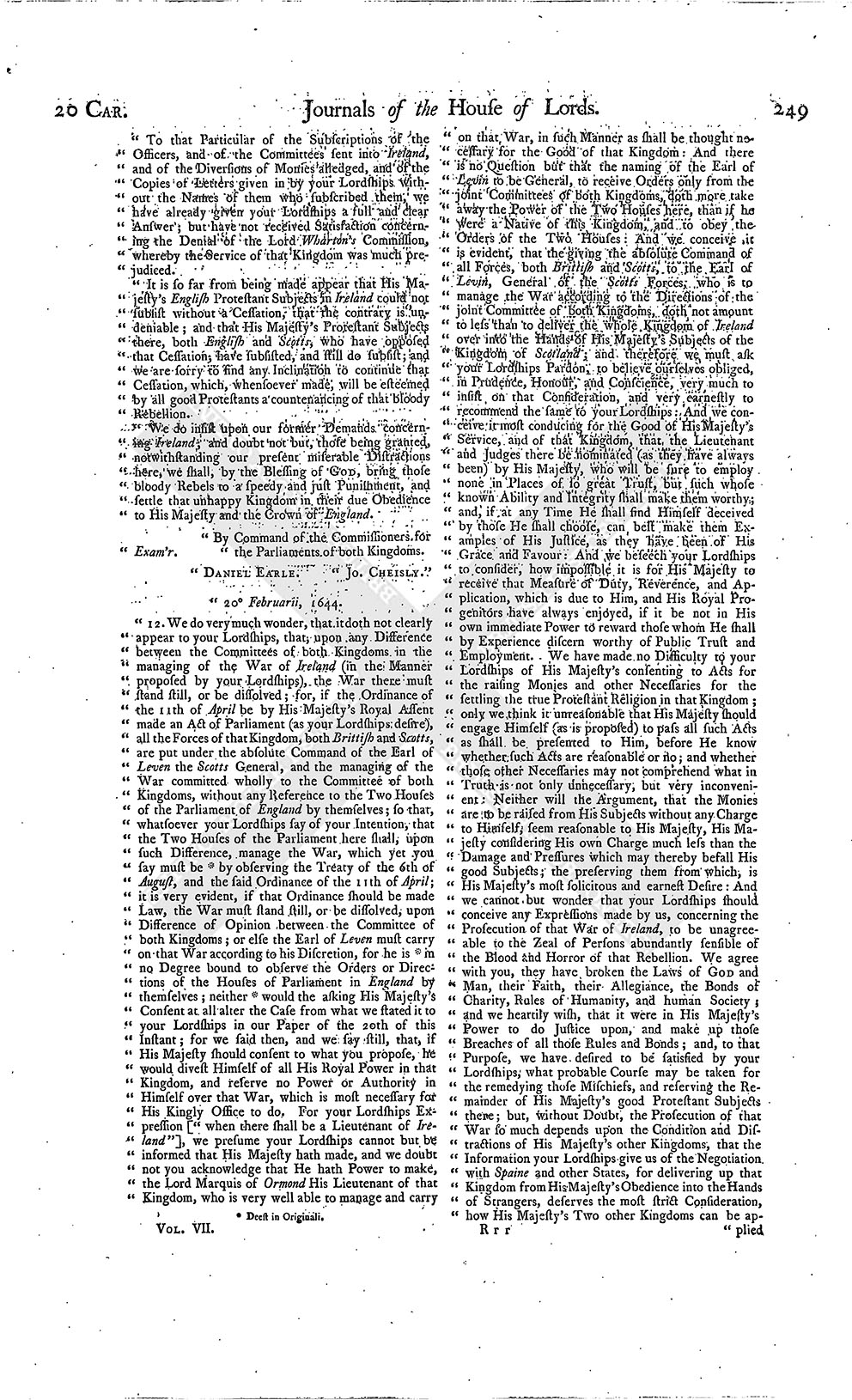
"To that Particular of the Subscriptions of the Officers, and of the Committees sent into Ireland, and of the Diversions of Monies alledged, and of the Copies of Letters given in by your Lordships without the Names of them who subscribed them, we have already given your Lordships a full and clear Answer; but have not received Satisfaction concerning the Denial of the Lord Wharton's Commission, whereby the Service of that Kingdom was much prejudiced.
"It is so far from being made appear that His Majesty's English Protestant Subjects in Ireland could not subsist without a Cessation, that the contrary is undeniable; and that His Majesty's Protestant Subjects there, both English and Scotts, who have opposed that Cessation, have subsisted, and still do subsist; and we are sorry to find any. Inclination to continue that Cessation, which, whensoever made, will be esteemed by all good Protestants a countenancing of that bloody Rebellion.
"We do insist upon our former Demands concerning Ireland, and doubt not but, those being granted, notwithstanding our present miserable Distractions here, we shall, by the Blessing of God, bring those bloody Rebels to a speedy and just Punishment, and settle that unhappy Kingdom in their due Obedience to His Majesty and the Crown of England.
"By Command of the Commissioners for the Parliaments of both Kingdoms.
"Exam'r.
"Daniel Earle.
Jo. Cheisly."
"20 Februarii, 1644.
"12. We do very much wonder, that it doth not clearly appear to your Lordships, that, upon any Difference between the Committees of both Kingdoms in the managing of the War of Ireland (in the Manner proposed by your Lordships), the War there must stand still, or be dissolved; for, if the Ordinance of the 11th of April be by His Majesty's Royal Assent made an Act of Parliament (as your Lordships desire), all the Forces of that Kingdom, both Brittish and Scotts, are put under the absolute Command of the Earl of Leven the Scotts General, and the managing of the War committed wholly to the Committee of both Kingdoms, without any Reference to the Two Houses of the Parliament of England by themselves; so that, whatsoever your Lordships say of your Intention, that the Two Houses of the Parliament here shall, upon such Difference, manage the War, which yet you say must be (fn. 20) by observing the Treaty of the 6th of August, and the said Ordinance of the 11th of April; it is very evident, if that Ordinance should be made Law, the War must stand still, or be dissolved, upon Difference of Opinion between the Committee of both Kingdoms; or else the Earl of Leven must carry on that War according to his Discretion, for he is (fn. 20) in no Degree bound to observe the Orders or Directions of the Houses of Parliament in England by themselves; neither (fn. 20) would the asking His Majesty's Consent at all alter the Case from what we stated it to your Lordships in our Paper of the 20th of this Instant; for we said then, and we say still, that, if His Majesty should consent to what you propose, he would divest Himself of all His Royal Power in that Kingdom, and reserve no Power or Authority in Himself over that War, which is most necessary for His Kingly Office to do. For your Lordships Expression ["when there shall be a Lieutenant of Ireland"], we presume your Lordships cannot but be informed that His Majesty hath made, and we doubt not you acknowledge that He hath Power to make, the Lord Marquis of Ormond His Lieutenant of that Kingdom, who is very well able to manage and carry on that War, in such Manner as shall be thought necessary for the Good of that Kingdom: And there is no Question but that the naming of the Earl of Levin to be General, to receive Orders only from the joint Committees of both Kingdoms, doth more take away the Power of the Two Houses here, than if he were a Native of this Kingdom, and to obey the Orders of the Two Houses: And we conceive it is evident, that the giving the absolute Command of all Forces, both Brittish and Scotts, to the Earl of Levin, General of the Scotts Forces, who is to manage the War according to the Directions of the joint Committee of both Kingdoms, doth not amount to less than to deliver the whole Kingdom of Ireland over into the Hands of His Majesty's Subjects of the Kingdom of Scotland; and therefore we must ask your Lordships Pardon, to believe ourselves obliged, in Prudence, Honour, and Conscience, very much to insist on that Consideration, and very earnestly to recommend the same to your Lordships: And we conceive it most conducing for the Good of His Majesty's Service, and of that Kingdom, that the Lieutenant and Judges there be nominated (as they have always been) by His Majesty, who will be sure to employ none in Places of so great Trust, but such whose known Ability and Integrity shall make them worthy; and, if at any Time He shall find Himself deceived by those He shall choose, can best make them Examples of His Justice, as they have been of His Grace and Favour: And we beseech your Lordships to consider, how impossible it is for His Majesty to receive that Measure of Duty, Reverence, and Application, which is due to Him, and His Royal Progenitors have always enjoyed, if it be not in His own immediate Power to reward those whom He shall by Experience discern worthy of Public Trust and Employment. We have made no Difficulty to your Lordships of His Majesty's consenting to Acts for the raising Monies and other Necessaries for the settling the true Protestant Religion in that Kingdom; only we think it unreasonable that His Majesty should engage Himself (as is proposed) to pass all such Acts as shall be presented to Him, before He know whether such Acts are reasonable or no; and whether those other Necessaries may not comprehend what in Truth is not only unnecessary, but very inconvenient: Neither will the Argument, that the Monies are to be raised from His Subjects without any Charge to Himself, seem reasonable to His Majesty, His Majesty considering His own Charge much less than the Damage and Pressures which may thereby befall His good Subjects; the preserving them from which, is His Majesty's most solicitous and earnest Desire: And we cannot but wonder that your Lordships should conceive any Expressions made by us, concerning the Prosecution of that War of Ireland, to be unagreeable to the Zeal of Persons abundantly sensible of the Blood and Horror of that Rebellion. We agree with you, they have broken the Laws of God and Man, their Faith, their Allegiance, the Bonds of Charity, Rules of Humanity, and human Society; and we heartily wish, that it were in His Majesty's Power to do Justice upon, and make up those Breaches of all those Rules and Bonds; and, to that Purpose, we have desired to be satisfied by your Lordships, what probable Course may be taken for the remedying those Mischiefs, and reserving the Remainder of His Majesty's good Protestant Subjects there; but, without Doubt, the Prosecution of that War so much depends upon the Condition and Distractions of His Majesty's other Kingdoms, that the Information your Lordships give us of the Negotiation with Spaine and other States, for delivering up that Kingdom from His Majesty's Obedience into the Hands of Strangers, deserves the most strict Consideration, how His Majesty's Two other Kingdoms can be ap plied to the Relief of the Third, whilst these Distractions are in their own Bowels; the Continuance of the Miseries in the Two must render those in the Third remediless, if it be not preserved by some other Means than the Prosecution of the War; neither can it be foreseen or determined, what Help or Assistance either Party may make Use of, when it finds itself oppressed and over-powered by the other, especially when it calls in any Help, and leaves no Means unattempted, to destroy the other: And we beseech your Lordships, in the Bowels of Christian Charity and Compassion, and in the Name of Him who is the Prince of Peace, and who will make an Inquisition for Blood, to consider whether all our Endeavours ought not to be, to stop these bloody Issues in all His Majesty's Dominions; and whether the just God of Heaven, who for our Sins hath made the several Nations under His Majesty's Government to be Scourges one of another, and of His Majesty Himself under whose Obedience they should all live, can be delighted with the Sacrifice of Blood, and the Blood of Christians; and whether it would not be more agreeable to our Christian Profession, to endeavour the binding up of those Wounds, which Interests, Passion, and Animosity, have made. We desire your Lordships to consider these Things, and to make such Propositions to us concerning Ireland, since it is apparent that those already made by you are by no Means fit to be consented to, as may be for the Growth and Propagation of the true Protestant Religion, the Peace and Happiness of that Kingdom, and the Welfare of all His Majesty's Dominions.
"By Command of His Majesty's Commissioners.
"Exam'r,
"John Thurloe.
Wm. Dugdale.
Daniel Earle.
Nic. Oudart."
"22 Februarii, 1644.
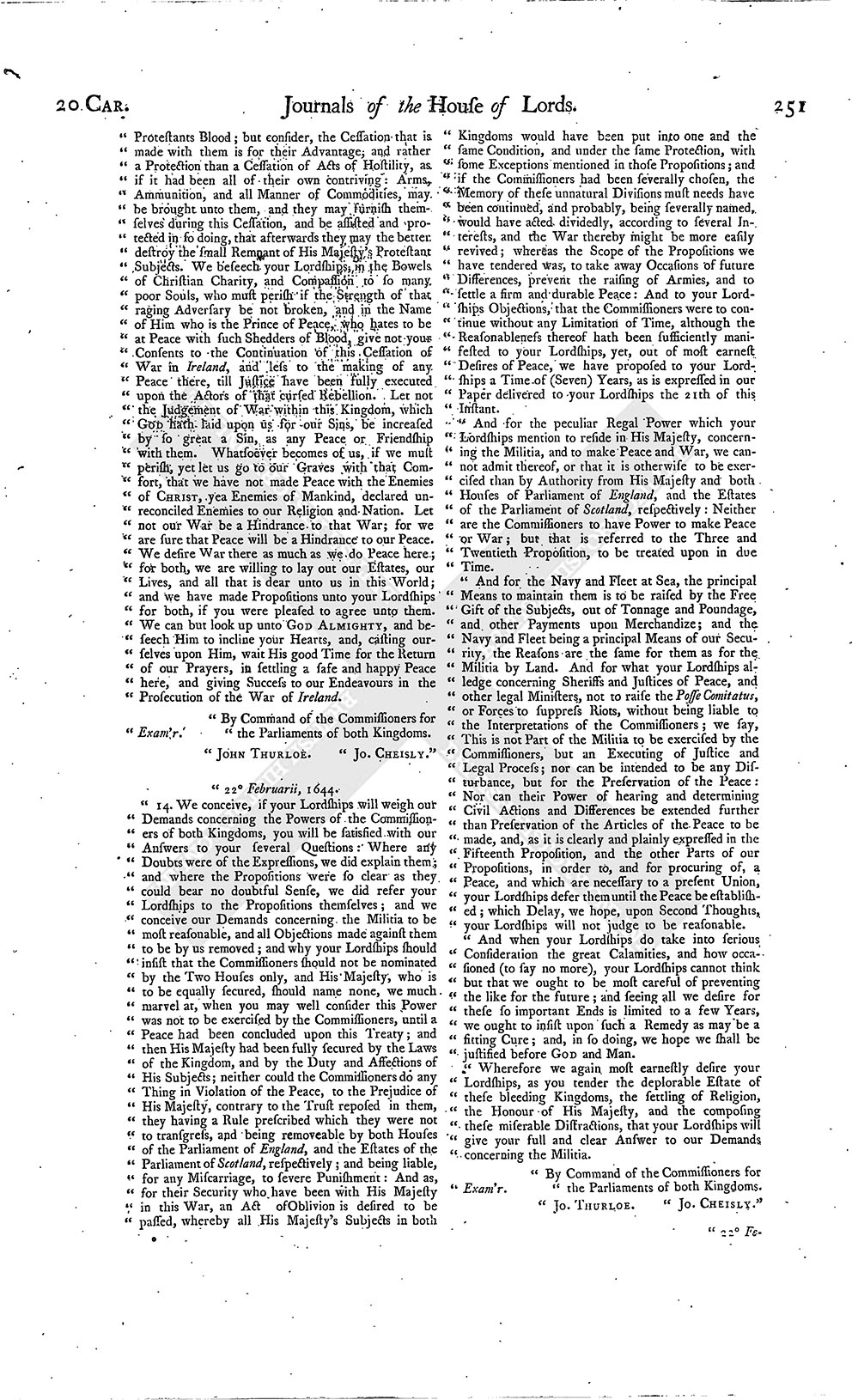
"13. It is not possible for us to give a more clear Answer than we have done, to shew that there can no such Inconvenience follow, upon confirming the Ordinance of the 11th of April by Act of Parliament, as your Lordships do imagine; it being desired that the Treaty of the 6th of August be in like Manner confirmed, by which the Commanders of the Scottish Forces in Ireland are to be answerable to His Majesty and the Two Houses of the Parliament of England for their whole Deportment and Proceedings there; and it being desired, by the Thirteenth Proposition, that the Prosecution of the War of Ireland should be settled in both Houses of Parliament; all which taken together, it cannot follow that, upon any Disagreement between the Committees there, the Earl of Levin may carry on the War according to his own Discretion. As for our Expression ["when there shall be a Lieutenant of Ireland"], which was used in our Answer to your Lordships Second Paper of the 20th of February, it was to satisfy your Lordships that there could be no interfering between the Powers of the Lord Lieutenant and of the Earl of Levin; and still we say, when there shall be a Lord Lieutenant chosen as is expressed in our Twentieth Proposition (for we do not admit the Marquis of Ormond to be so), the Commander in Chief of our Scottish Army is to receive Instructions from him, in such Manner as we have laid it down in that Answer of ours to your Lordships Paper above-mentioned; which will, we hope, satisfy your Lordships other Objection, that this is not to deliver over the whole Kingdom of Ireland into the Hands of His Majesty's Subjects of the Kingdom of Scotland, seeing such of that Nation as are there employed are to be subordinate to the Committee of both Kingdoms; and, in Case of Disagreement, an Appeal lies in the Two Houses of the Parliament of England, in whom the Power of prosecuting the War is to be settled: And we must insist to desire the Lord Lieutenant and the Judges in that Kingdom may be nominated by the Two Houses of Parliament, who have, by sad Experience, to the great Cost of this Kingdom, Expence of much Treasure and Blood, the Loss of many Thousands of Lives there, and almost of that whole Kingdom from His Majesty's Obedience, and an inestimable Prejudice to the true Protestant Religion, found the ill Consequence of a bad Choice of Persons for those great Places of Trust; therefore, for His Majesty's Honour, the Good of His Service, the great Advantage it will be to the rest of His Majesty's Dominions, the great Comfort to all good Christians, an even acceptable Service to God Himself, for the obtaining of so much Good, and the preventing of so much Evil, they desire to have the Nomination of those great Officers, that, by a prudent and careful Election, they may, by providing for the Good of that now miserable Kingdom, discharge their Duty to God, the King, and their Country: And certainly, if it be necessary to reduce that Kingdom, and that the Parliament of England be a faithful Council unto His Majesty, and fit to be trusted with the Prosecution of that War, which His Majesty was once pleased to put into their Hands, and they faithfully discharged their Parts in it, notwithstanding many Practices to obstruct their Proceedings, as is set forth in many several Declarations of Parliament; then, we say, your Lordships need not think it unreasonable, that His Majesty should engage Himself to pass such Acts as shall be presented unto Him, for raising Monies, and other Necessaries for that War; for, if the War be necessary, as never War was more, that which is necessary for the maintaining it must be had; and the Parliament, that doth undertake to manage it, must needs know what will be necessary; and the People of England, who have trusted them with their Purse, will never begrudge what they make them lay out upon that Occasion; not need His Majesty fear the Parliament will press more upon the Subject than is fit in Proportion to the Occasion. It is true, that heretofore Persons about His Majesty have endeavoured and prevailed too much, in possessing Him against the Parliament, for not giving away the Money of the Subject when His Majesty hath desired it; but never yet did His Majesty restrain them from it; and we hope it will not be thought that this is a fit Occasion (fn. 21) to begin. We are very glad to find that your Lordships are so sensible, in your Expressions, of the Blood and Horror of that Rebellion; and it is, without all Question, in His Majesty's Power to do Justice upon it, if your Lordships be willing that the Cessation and all Treaties with those bloody and unnatural Rebels be made void; and that the Prosecution of the War be settled in the Two Houses of Parliament of England, to be managed by the joint Advice of both Kingdoms, and the King to assist, and to do no Act to discountenance or molest them therein. This we dare to affirm to be more than a probable Course for the remedying those Mischiefs, and preserving the Remainder of His Majesty's good Subjects there. We cannot believe your Lordships will think it fit there can be any Agreement of Peace, any Respite from Hostility, with such Creatures as are not fit to live, no more than with Wolves or Tigers, or any ravenous Beasts, Destroyers of Mankind; and we beseech you, do not think it must depend upon the Condition of His Majesty's other Kingdoms, to revenge or not revenge God's Quarrel upon such persidious Enemies to the Gospel of Christ, who have embrued their Hands in so much Protestants Blood; but consider, the Cessation that is made with them is for their Advantage; and rather a Protection than a Cessation of Acts of Hostility, as if it had been all of their own contriving: Arms, Ammunition, and all Manner of Commodities, may be brought unto them, and they may furnish themselves during this Cessation, and be assisted and protected in so doing, that afterwards they may the better destroy the small Remnant of His Majesty's Protestant Subjects. We beseech your Lordships, in the Bowels of Christian Charity, and Compassion to so many poor Souls, who must perish if the Strength of that raging Adversary be not broken, and in the Name of Him who is the Prince of Peace, who hates to be at Peace with such Shedders of Blood, give not your Consents to the Continuation of this Cessation of War in Ireland, and less to the making of any Peace there, till Justice have been fully executed upon the Actors of that cursed Rebellion. Let not the Judgement of War within this Kingdom, which God hath laid upon us for our Sins, be increased by so great a Sin, as any Peace or Friendship with them. Whatsoever becomes of us, if we must perish, yet let us go to our Graves with that Comfort, that we have not made Peace with the Enemies of Christ, yea Enemies of Mankind, declared unreconciled Enemies to our Religion and Nation. Let not our War be a Hindrance to that War; for we are sure that Peace will be a Hindrance to our Peace. We desire War there as much as we do Peace here; for both, we are willing to lay out our Estates, our Lives, and all that is dear unto us in this World; and we have made Propositions unto your Lordships for both, if you were pleased to agree unto them. We can but look up unto God Almighty, and beseech Him to incline your Hearts, and, casting ourselves upon Him, wait His good Time for the Return of our Prayers, in settling a safe and happy Peace here, and giving Success to our Endeavours in the Prosecution of the War of Ireland.
"By Command of the Commissioners for the Parliaments of both Kingdoms.
"Exam'r.
"John Thurloe.
Jo. Cheisly."
"22 Februarii, 1644.
"14. We conceive, if your Lordships will weigh our Demands concerning the Powers of the Commissioners of both Kingdoms, you will be satisfied with our Answers to your several Questions: Where any Doubts were of the Expressions, we did explain them; and where the Propositions were so clear as they could bear no doubtful Sense, we did refer your Lordships to the Propositions themselves; and we conceive our Demands concerning the Militia to be most reasonable, and all Objections made against them to be by us removed; and why your Lordships should insist that the Commissioners should not be nominated by the Two Houses only, and His Majesty, who is to be equally secured, should name none, we much marvel at, when you may well consider this Power was not to be exercised by the Commissioners, until a Peace had been concluded upon this Treaty; and then His Majesty had been fully secured by the Laws of the Kingdom, and by the Duty and Affections of His Subjects; neither could the Commissioners do any Thing in Violation of the Peace, to the Prejudice of His Majesty, contrary to the Trust reposed in them, they having a Rule prescribed which they were not to transgress, and being removeable by both Houses of the Parliament of England, and the Estates of the Parliament of Scotland, respectively; and being liable, for any Miscarriage, to severe Punishment: And as, for their Security who have been with His Majesty in this War, an Act of Oblivion is desired to be passed, whereby all His Majesty's Subjects in both Kingdoms would have been put into one and the same Condition, and under the same Protection, with some Exceptions mentioned in those Propositions; and if the Commissioners had been severally chosen, the Memory of these unnatural Divisions must needs have been continued, and probably, being severally named, would have acted dividedly, according to several Interests, and the War thereby might be more easily revived; whereas the Scope of the Propositions we have tendered was, to take away Occasions of future Differences, prevent the raising of Armies, and to settle a firm and durable Peace: And to your Lordships Objections, that the Commissioners were to continue without any Limitation of Time, although the Reasonableness thereof hath been sufficiently manifested to your Lordships, yet, out of most earnest Desires of Peace, we have proposed to your Lordships a Time of (Seven) Years, as is expressed in our Paper delivered to your Lordships the 21th of this Instant.
"And for the peculiar Regal Power which your Lordships mention to reside in His Majesty, concerning the Militia, and to make Peace and War, we cannot admit thereof, or that it is otherwise to be exercised than by Authority from His Majesty and both Houses of Parliament of England, and the Estates of the Parliament of Scotland, respectively: Neither are the Commissioners to have Power to make Peace or War; but that is referred to the Three and Twentieth Proposition, to be treated upon in due Time.
"And for the Navy and Fleet at Sea, the principal Means to maintain them is to be raised by the Free Gift of the Subjects, out of Tonnage and Poundage, and other Payments upon Merchandize; and the Navy and Fleet being a principal Means of our Security, the Reasons are the same for them as for the Militia by Land. And for what your Lordships alledge concerning Sheriffs and Justices of Peace, and other legal Ministers, not to raise the Posse Comitatus, or Forces to suppress Riots, without being liable to the Interpretations of the Commissioners; we say, This is not Part of the Militia to be exercised by the Commissioners, but an Executing of Justice and Legal Process; nor can be intended to be any Disturbance, but for the Preservation of the Peace: Nor can their Power of hearing and determining Civil Actions and Differences be extended further than Preservation of the Articles of the Peace to be made, and, as it is clearly and plainly expressed in the Fifteenth Proposition, and the other Parts of our Propositions, in order to, and for procuring of, a Peace, and which are necessary to a present Union, your Lordships defer them until the Peace be established; which Delay, we hope, upon Second Thoughts, your Lordships will not judge to be reasonable.
"And when your Lordships do take into serious Consideration the great Calamities, and how occasioned (to say no more), your Lordships cannot think but that we ought to be most careful of preventing the like for the future; and seeing all we desire for these so important Ends is limited to a few Years, we ought to insist upon such a Remedy as may be a sitting Cure; and, in so doing, we hope we shall be justified before God and Man.
"Wherefore we again most earnestly desire your Lordships, as you tender the deplorable Estate of these bleeding Kingdoms, the settling of Religion, the Honour of His Majesty, and the composing these miserable Distractions, that your Lordships will give your full and clear Answer to our Demands concerning the Militia.
"By Command of the Commissioners for the Parliaments of both Kingdoms.
"Exam'r.
"Jo. Thurloe.
Jo. Cheisly."
"22 Februarii, 1644.
"15. We cannot express the great Sadness of our Hearts, that all our earnest Endeavours to give your Lordships Satisfaction, in all Particulars of this Treaty, have produced no better Effects towards a blessed Peace, which His Majesty and we who are trusted by Him do so heartily pray for, and that so many great Offers made by us to your Lordships, in the Particulars we have treated upon, should not be thought a good Progress on our Part in the said Treaty, as we find by your Lordships Paper, to our great Grief, they are not, and therefore that this must be the last Day of the Treaty. We desire your Lordships to consider, that we, being intrusted by His Majesty to treat with your Lordships for a safe and well-grounded Peace, have, upon the Matter of your Lordships Propositions, consented to many Particulars and Alterations of very great Importance; and that your Lordships, who were to treat with us, have not abated One Tittle of the most severe and rigorous of your Propositions, saving that you were pleased the last Night to propose in the Point of Time concerning the Militia; which, though it seems to be limited to Seven Years, in Truth leaves it as unlimited as it was before in your Propositions; for, at the End of (Seven) Years, it must not be exercised otherwise than shall be settled by His Majesty and the Two Houses of Parliament; so that all the legal Power now in His Majesty is taken away, and not restored after the Seven Years expired: Neither is there a full Consent to that Limitation offered by your Lordships the Commissioners of the Parliament of Scotland, nor have your Lordships offered to us any Prospect towards Peace, other than by submitting totally to those Propositions; the which if we should do, we should consent to such Alterations, as, by Constructions and Consequences, may dissolve the whole Frame of the present Government, both Ecclesiastical and Civil, in this Kingdom; and though the Particulars proposed by your Lordships have by Debate appeared not only evidently unreasonable, but, literally considered, to comprehend Things, and to be extended to Powers, not intended by yourselves; yet your Lordships have not been pleased either to restrain or interpret any Particulars in any other Manner than is set forth in the said Propositions.
"In the Matter of Religion, we have offered all such Alterations as we conceive may give Satisfaction to any Objections that have been or can be made against that Government; and have given your Lordships Reasons, not only why we cannot consent to your Lordships Propositions, but that even those Propotions, if consented to, could not be in order to a Reformation, or to the procuring the Public Peace: And we must desire your Lordships to remember, that, though you do, not only in your Covenant (which you desire may be taken by His Majesty, and enjoined to be taken by all His Subjects) undertake the Reformation in Point of Government, but even in Point of Doctrine too (thereby laying an Imputation upon the Religion itself so long professed in this Kingdom, with the general Approbation of all Reformed Churches); yet your Lordships have not given us the least Argument, nor so much as intimated in your Debate the least Prejudice to the Doctrine of the Church of England, against which, we presume, you cannot make any colourable Objection; nor have you given us the View in particular of the Government you desire should be submitted to in the Place of that you propose to be abolished; and therefore we propose to your Lordships (if the Alteration proposed by us do not give your Lordships Satisfaction), that so great an Alteration as the total Abolition of a Government established by Law may, for the Importance of it, and any Reformation in Doctrine for the Scandal of it, be suspended till, after the disbanding of all Armies, His Majesty may be present with the Two Houses of Parliament, and, calling a National Synod, may receive such Advice both from the one and the other, as, in a Matter of so high Concernment, is necessary; and we are most confident that His Majesty will then follow the Advice which shall be given Him. And as any Reformation thus regularly and calmly made must needs prove for the singular Benefit and Honour of the Kingdom, so we must appeal to your Lordships, whether the contrary, that is, an Alteration even to Things though in themselves good, can, by the Principles of Christian Religion, be inforced upon the King or Kingdom.
"In the Business of the Militia, though your Lordships do not deny that the Jealousies and Apprehensions of Danger are mutual, and that the chief End of depositing the Militia in the Hands of certain Persons is for Security against those Jealousies and possible Dangers, yet your Lordships insist, that all these Persons to be intrusted shall be nominated by the Two Houses of Parliament in England, and the Estates of the Parliament in Scotland; and that the Time for that great, general, and unheard-of Trust shall be in such Manner, that, though it seem to be limited to Seven Years, yet in Truth, by declaring that, after those Seven Years, it shall not be otherwise exercised than His Majesty and the Two Houses shall agree, His Majesty may thereby be totally and for ever divested of the Power of the Sword, without which He can neither defend Himself against foreign Invasion, or domestic Insurrection, or execute His Kingly Office in the Behalf of His Subjects, to whom He is sworn to give Protection; and to both these your Lordships add the introducing a Neighbour Nation, governed by distinct and different Laws (though united under One Sovereign), to a great Share in the Government of this Kingdom. Instead of consenting to their Changes, we have offered and proposed to your Lordships, that the Persons to be trusted with the Militia of the Kingdom may be nominated between us, or, if that be refused, that an equal Number shall be nominated by you, and the other Number by His Majesty; and that Half the Forts and Places of Strength within the Kingdom shall be in the Custody of those whom you think fit to be trusted therewith, and the other Half in such Hands as His Majesty pleases to commit the same to; and all Persons, as well these nominated by your Lordships as by His Majesty, may take an Oath for the due Discharge of the said Trust; which being considered, as the Security is mutual, so neither Part can be supposed to violate the Agreement, without very evident Inconveniency and Danger to that Part who shall so violate it; the whole Kingdom being likely, and indeed obliged, to look upon whatsoever shall in the least Degree violate this Agreement, as the Authors of all the Miseries which the Kingdom shall thereby suffer: And as it is most reasonable, that, for this Security, His Majesty should part with so much of His own Power as may make Him even unable to break the Agreement which shall be now made by Him and on His Part, so it is most necessary that, all Apprehension and Danger of such Breach being over, that Sovereign Power of (fn. 22) the Militia should revert into the proper Channel, and be (as it hath always been) in His Majesty's proper and peculiar Charge; and therefore we have proposed, that the Time limited for the Trust should be for Three Years, which, by the Blessing of God, will produce a perfect Understanding between His Majesty and all His People. And if there should be any Thing else necessary to be done in this Argument, either for Power or Time, that the same be considered after the Settlement of the Peace in Parliament: But whatever is now, or hereafter shall be, thought necessary to be done, we desire may be so settled, that this Kingdom may depend upon itself, and not be subject to the Laws or Advice of Scotland, as we think fit that Scotland should not receive Rules or Advice from this, having offered the like for Scotland as for England.
"In the Business of Ireland, your Lordships proposed not only that His Majesty disclaim and make void the Cessation made by His Royal Authority, and (fn. 23) at the Desire of the Lords Justices and Council of that Kingdom, and for the Preservation of the Remainder of His poor Protestant Subjects there, who were in evident Danger of Destruction, both by Famine and the Sword, but also to put the whole Managery of that War, and the Disposal of the Forces within that Kingdom, and consequently the Government of that Kingdom, into the Hands of the Scotts General, to be managed by the Advice of a joint Committee of both Kingdoms, wherein each should have a Negative Voice. We have acquainted your Lordships with the just Grounds of His Majesty's Proceedings in the Business of Ireland, which, we are confident, being weighed without Prejudice, may satisfy all Men of His Majesty's Piety and Justice therein; and we are very ready and desirous to join with your Lordships in any Course which may probably preserve and restore that miserable Kingdom.
"Having put your Lordships in Mind of their Particulars, as they have a general Reference to the Public Good of the Kingdoms; we beseech your Lordships to consider, that we have this great Trust reposed in us by His Majesty, and to remember how far these Propositions trench upon His peculiar Kingly Rights, without any, or any considerable, Recompence or Compensation in the Business of Religion. Your Lordships proposed the taking away His whole Ecclesiastical Jurisdiction (His Donations, His Temporalities of Bishoprics, His First Fruits and Tenths of Bishops, Deans and Chapters); instead whereof, your Lordships do not offer to constitute the least Dependence of the Clergy upon His Majesty: And for that so considerable a Part of His Revenue, you propose only the Bishops Lands to be settled upon His Majesty, reserving a Power to dispose even those Lands as you shall think fit; whereas all the Lands, both of Bishops, Deans and Chapters, in those Corporations must be dissolved, do undoubtedly belong unto His Majesty in His own Right.
"In the Business of the Militia, as it is proposed, His Majesty is so totally divested of His Regal Power of the Sword, that He shall be no more able either to assist any of His Allies with Aid (though Men were willing to engage themselves voluntarily in that Service), or to defend His own Dominions from Rebellion or Invasion; and consequently the whole Power of Peace and War, the acknowledged and undoubted Right (fn. 24) of the Crown, is taken from Him.
"In the Business of Ireland, the Power of nominating His Lieutenant or Deputy, and other Officers there, of managing, directing, or in the least Manner of meddling in that War, or of making of Peace, is proposed to be taken from Him.
"And, to add to all those Attempts upon His Kingly Rights, it is proposed to bereave Him of the Power of a Father in Education and Marriage of His own Children, and of a Master in rewarding of His own Servants: And therefore we refer it to your Lordships, whether it be possible for us, with a good Conscience, and the Discharge of the Trust reposed in us, to consent to the Propositions made to us by your Lordships.
"Lastly, we must observe to your Lordships, that, after a War of near Four Years, for which the Defence of the Protestant Religion, the Liberty and Property of the Subject, and the Privileges of Parliament, were made the Causes and Grounds; in a Treaty of Twenty Days, nor indeed in the whole Propositions upon which the Treaty should be, there hath been nothing offered to be treated upon concerning the Breach of any Law, or of the Liberty or Property of the Subject, or Privileges of Parliament, but only Propositions for the altering a Government established by Law, and for making new Laws, by which almost all the old are, or may be, cancelled; and there hath been nothing insisted on of our Part which was not Law, or denied by us that you have demanded as due by Law.
"All these Things being considered, and being much afflicted that our great Hopes and Expectation of a Peace is for the present frustrated, by your Lordships Declaration, that no more Time would be allowed for this Treaty; we are earnest Suitors to your Lordships, that you will interpose with the Two Houses, to whom we believe you have transmitted the Answers delivered by us to your Lordships, upon Religion, the Militia, and Ireland, that this Treaty, though for the present discontinued, may be revived, and the whole Matter of their Propositions, and those sent to them by His Majesty, which have not yet been treated on, may be considered; and that, depending that Treaty, to the End we may not treat in Blood, there may be a Cessation of Arms; and that the poor People of this Kingdom, now exposed to Plunderings and Spoilings, and other direful Effects of War, may have some Earnest of a blessed Peace.
"And because this Treaty is now expiring, if your Lordships cannot give a present Resolution, we desire, when you have represented this to the Two Houses, His Majesty may speedily receive their Answer.
"By Command of His Majesty's Commissioners.
"Exam'r,
"John Thurloe.
Wm. Dugdale.
Daniel Earle.
Nic. Oudart."
"22 Februarii, 1644.
"16. We conceive your Lordships cannot in Reason expect an Answer to the long Paper now delivered to us very late this Night, at the Close of the Treaty, a Thing of many Days Labour, which we apprehend to be rather a Declaration upon the Treaty than any Part thereof, and we could not imagine would be offered: But we cannot forbear, upon the Reading thereof, to mention thus much, That it seems, by many Particulars in that Declaration, it was resolved the Treaty should end with the Twenty Days, the Means to continue it being well known to be a good Progress in the Propositions for Religion, the Militia, and Ireland; and, by what we have received, we cannot find any Satisfaction in these was intended to be agreed unto. To that whereby your Lordships ascribe so much to your Lordships own Concessions, we shall only say, That for Religion, you have granted very little or nothing but what we are already in Possession of by the Laws of this Kingdom: For the Business of the Militia, your Lordships have not thought fit to consent to any One of our Demands; but in that, as in Religion, have made some new Propositions of your own, which are not in any Degree sufficient for settling and securing the Peace of the Kingdoms: As for the Propositions for Ireland, your Lordships are, so far from affording a Consent thereto, that you have justified the destructive Cessation there, and strongly implied an Intention to renew the same; and have not yielded to any Part of our Propositions concerning that Kingdom.
"We shall present your Lordships Papers to the Parliaments of both Kingdoms, who, upon due Consideration thereof, will do what is further neces sary for the Good and Peace of His Majesty's Dominions.
"By Command of the Commissioners for the Parliaments of both Kingdoms.
"Exam'r.
"Daniel Earle.
J. Cheisly."
"22 Februarii, 1644.
"17. Having the last Night given a Paper unto your Lordships, wherein we signified that we doubted not but that you were fully satisfied that Episcopacy is not Jure Divino; we are the more confirmed in it, because your Lordships have since that Time given us nothing in to the contrary; and we hope we have, by clear Arguments from Scripture and Reason, this Day likewise satisfied you, that the Government (fn. 25) by Archbishops, Bishops, &c. which we desire to be taken away by this Bill, is unlawful, and that the Government which we desire to be established is agreeable to the Word of God; and therefore we desire your Lordships to agree to the passing of this Bill, and to give us your full and clear Answer to this and the rest of the Propositions concerning Reliligion.
"By Command of the Commissioners for the Parliaments of both Kingdoms.
"Exam'r.
"John Thurloe.
Jo. Cheisly."
"22 Februarii, 1644.
"18. According to your Lordships Paper of the last Night, we attend your Debate this Day, concerning the Unlawfulness of Episcopacy; but did neither then, nor do now, acknowledge ourselves convinced by any Argument offered by you (fn. 26) that Episcopacy is not Jure Divino, the same having been the Opinion of very many learned Men in all Ages (which we do not censure or determine), but not insisted upon by us as the Ground of any Answer we have delivered to your Lordships; and we are so far from being satisfied with the Arguments from Scripture and Reason this Day urged to prove that the Government by Archbishops, Bishops, &c. which you desire to be taken away by this Bill, is unlawful, that the weightiest Arguments which were urged, in our Judgement, concluded (at most) against the Inconveniences which are remedied by the Alterations offered by us to your Lordships in our Paper of the 13th Day of this Month; and it seems strange to us, that your Lordships should think that Government (without which no National Church hath been since the Apostles Times till within these late Years) to be unlawful: And for the Government desired by you to be established, your Lordships have not offered any such particular Form of Government to us, that may enable us to judge thereof; and we cannot but observe, that the Arguments produced to that Purpose were only to prove the same not unlawful, without offering to prove it absolutely necessary; and therefore we conceive our Answer formerly given to your Lordships concerning that Bill, and your other Propositions concerning Religion, is a just and reasonable Answer.
"By Command of His Majesty's Commissioners.
"Exam'r,
"John Thurloe.
Wm. Dugdale.
Daniel Earle.
Nic. Oudart."
"22 Februarii, 1644.
"19. Your Lordships cannot expect a particular Answer from us this Night to the Two long Papers concerning Ireland, delivered to us by your Lordships about (Twelve) of (fn. 27) the Clock this Night: But, since there are many Particulars in those Papers, to which, if they had been before mentioned, we could have given your Lordships full Satisfaction, and for that we presume your Lordships are very willing to be satisfied in those Particulars which so highly reflect upon His Majesty, we desire your Lordships to receive the Answers, which we shall prepare to those Papers, in the Evening To-morrow, dated of this Night; and we doubt not to give your Lordships clear Satisfaction therein.
"By Command of His Majesty's Commissioners.
"Exam'r,
"John Thurloe.
Wm. Dugdale.
Daniel Earle.
Nic. Oudart."
Adjourn.
House adjourned till 9a cras.