
Journal of the House of Lords: Volume 8, 1645-1647. Originally published by His Majesty's Stationery Office, London, 1767-1830.
This free content was digitised by double rekeying. All rights reserved.
'House of Lords Journal Volume 8: 22 December 1645', in Journal of the House of Lords: Volume 8, 1645-1647, (London, 1767-1830) pp. 53-60. British History Online https://www.british-history.ac.uk/lords-jrnl/vol8/pp53-60 [accessed 25 April 2024]




In this section
DIE Lunæ, 22 die Decembris.
PRAYERS, by Mr. Dury.
Ds. Grey de Warke, Speaker.
Tooker's Petition, who came in upon the Declaration, and is now imprisoned.
Upon reading the Petition of Henry Tooker; shewing, That, being in Arms for the King, under the Command of Sir Wm. Ogle, is now come in, according to the Invitation of the Declaration of both Houses, and taken the Covenant, and performed all Things according to the said Declaration; but he is now arrested, at the Suit of James Baker, &c. for Things done by him when he was under Command on the King's Side, and is now in the Prison of The Compter, Woodstreate: Therefore desires Relief herein from the House."
Hereupon it is Ordered, That this Petition be referred to the same Committee as is appointed for Major Foxe's Petition. The Committee to meet on Wednesday next, in the Afternoon, at Three of the Clock.
Papers concerning the Answer to the King's Letter.
The Earl of Northumb. reported divers Papers from the Committee of both Kingdoms, being the Result of their Debates and Conferring with the Scotts Commissioners, concerning the Answer to the King's Letter.
The several Papers were read, as follow.
(Here enter them.)
Ordered, That these Papers shall be taken into Consideration To-morrow Morning.
Message from the H. C. with Letters, giving an Account of the Taking of Hereford;
A Message was brought from the House of Commons, by Sir Rob't Harley Knight, &c.
To communicate to their Lordships divers Letters, importing the good Success of some of the Parliament Forces, in the Taking of the City of Hereford; which were read. (Here enter them.)
for a Thanksgiving for it;
2. To desire Concurrence, that a Thanksgiving be the next Sabbath-day in London, and within the Line of Communication next, for the Taking of Hereford.
and with Orders.
3. To desire Concurrence, that Colonel Birch may be Governor of Hereford. (Here enter it.)
Agreed to.
4. To desire Concurrence in an Order for Twelve Hundred Pounds, for maimed Soldiers.
(Here enter it.)
Agreed to.
The Answer returned was:
Answer.
That this House agrees in all the Message now brought up.
A Message was brought, by Doctor Smyth, &c. from the Assembly of Divines:
That whereas the Assembly petitioned this House, to have (fn. 1) Leave to write an Answer to a Book lately published in the Name of the Dissenting Brethren of the Assembly; to which this House was pleased to give them Leave, and accordingly the Assembly have done; which they offer to their Lordships Consideration.
Order for Colonel Birch to be Governor of Hereford.
"The Lords and Commons assembled in Parliament do hereby nominate and approve of Colonel John Birch, to be Governor of Hereford; and that the Members of both Houses that are of the Committee of both Kingdoms do grant him a Commission accordingly."
Order for 1200l. for maimed Soldiers.
"Whereas a very great Number of sick and maimed Soldiers have from Time to Time been cured and relieved, for the Space of about Three Years past, in the several Hospitals, and other Places appointed for that Purpose, in and about London, whose great Charge having surmounted the Monies heretofore appointed for their Cure and Maintenance, so that there is great Sums due and in Arrear to Physicians, Chirurgeons, and Apothecaries, and for other necessary Occasions, in so much that there is no Means longer to continue the supplying of the Necessity of the said sick and wounded Soldiers, without some Payment of the Debts: It is this Day Ordered, by the Lords and Commons assembled in Parliament, That the Committee of Lords and Commons sitting at Habberdashers Hall London do Order, That Twelve Hundred Pounds be paid unto William Greenhill, John Pocock, John Randall, and Richard Hutchinson, Treasurers for the maimed Soldiers, out of the Composition of Robert Henly Esquire, for and towards the Payment of such Debts before-mentioned; and that the Acquittances of the said Treasurers, or any Two of them, shall be a sufficient Discharge for the same; and the said Committee of Habberdashers Hall are hereby enabled to compound with the said Robert Henly."
Papers between the Committee of both Houses and the Scots Commissioners, about a Treaty with the King.
1. Reasons presented by the Members of both Houses to the Scotts Commissioners, why there should be no Treaty about any Propositions to be sent to the King.
"That we desire to proceed so as may most continue the Union between the Two Kingdoms.
(fn. 2) Paper of the Committee of both Houses, 17 Dec. 1645.
"That the best Way to unite is, to have all pass without Treaty; for that then, the Propositions being all granted together, to the Satisfaction of both, there would not be any Advantage given to divide, by gratifying One Kingdom more than the other, as would be by Treaty where the Propositions are severally to be (fn. 3) trusted upon.
"Upon Experience of former Treaties, and likewise by the Letters that have been intercepted since the Treaty of Uxbridge, by which it appears that other Things prejudicial to the Parliament were only intended, under Colour of Treaty for Peace."
17 Dec. 1645.
"2. Wee have considered the Reasons presented by the Members of the Honnorable Houses, why there should bee noe Treaty aboute any Propositions to bee sent unto the King's Majesty; and doe retourne this Answere.
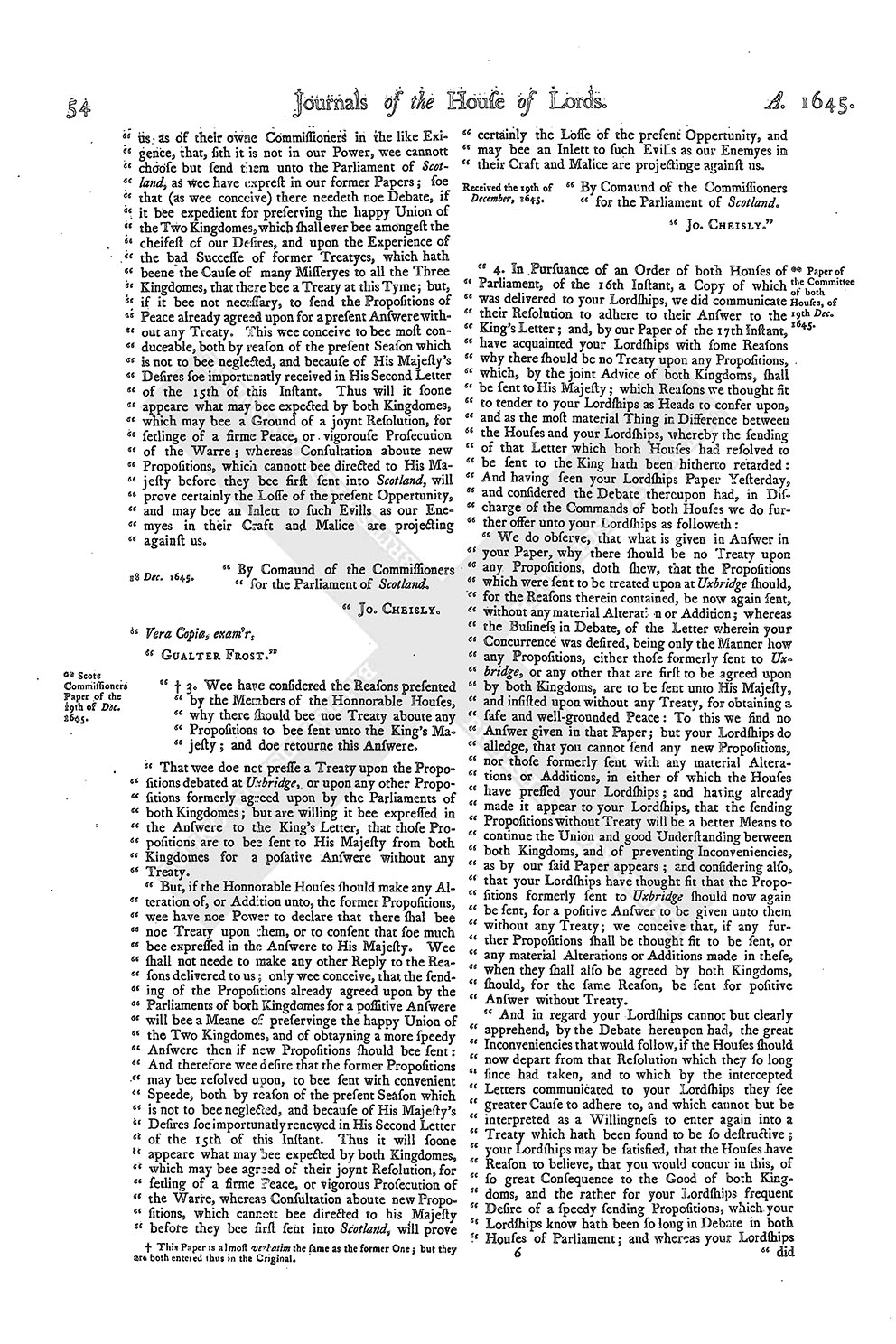
"That wee doe not presse a Treaty upon the Propositions debated at Uxbridge, or upon any other Propositions formerly agreed upon by the Parliaments of both Kingdomes; but are most willinge, and doe earnestly desire, that those Propositions may bee speedily sent for a positive Answere without any Treaty. Only, if the Honnorable Houses shall make any materiall Alterations of, or Addition unto, the former Propositions, they will in their Wisdome consider of us as of their owne Commissioners in the like Exigence, that, sith it is not in our Power, wee cannott choose but send them unto the Parliament of Scotland, as wee have exprest in our former Papers; soe that (as wee conceive) there needeth noe Debate, if it bee expedient for preserving the happy Union of the Two Kingdomes, which shall ever bee amongest the cheifest of our Desires, and upon the Experience of the bad Successe of former Treatyes, which hath beene the Cause of many Misseryes to all the Three Kingdomes, that there bee a Treaty at this Tyme; but, if it bee not necessary, to send the Propositions of Peace already agreed upon for a present Answere without any Treaty. This wee conceive to bee most conduceable, both by reason of the present Season which is not to bee neglected, and because of His Majesty's Desires soe importunatly received in His Second Letter of the 15th of this Instant. Thus will it soone appeare what may bee expected by both Kingdomes, which may bee a Ground of a joynt Resolution, for setlinge of a firme Peace, or vigorouse Prosecution of the Warre; whereas Consultation aboute new Propositions, which cannott bee directed to His Majesty before they bee first sent into Scotland, will prove certainly the Losse of the present Oppertunity, and may bee an Inlett to such Evills as our Enemyes in their Craft and Malice are projecting against us.
Dec. 1645.
"By Comaund of the Commissioners for the Parliament of Scotland.
"Jo. Cheisly.
"Vera Copia, exam'r,
"Gualter Frost."
** Scots Commissioners Paper of the 19th of Doc. 1645.
" (fn. 4) 3. Wee have considered the Reasons presented by the Members of the Honnorable Houses, why there should bee noe Treaty aboute any Propositions to bee sent unto the King's Majesty; and doe retourne this Answere.
"That wee doe not presse a Treaty upon the Propositions debated at Uxbridge, or upon any other Propositions formerly agreed upon by the Parliaments of both Kingdomes; but are willing it bee expressed in the Answere to the King's Letter, that those Propositions are to bee sent to His Majesty from both Kingdomes for a posative Answere without any Treaty.
"But, if the Honnorable Houses should make any Alteration of, or Addition unto, the former Propositions, wee have noe Power to declare that there shal bee noe Treaty upon them, or to consent that soe much bee expressed in the Answere to His Majesty. Wee shall not neede to make any other Reply to the Reasons delivered to us; only wee conceive, that the sending of the Propositions already agreed upon by the Parliaments of both Kingdomes for a possitive Answere will bee a Meane of preservinge the happy Union of the Two Kingdomes, and of obtayning a more speedy Answere then if new Propositions should bee sent: And therefore wee desire that the former Propositions may bee resolved upon, to bee sent with convenient Speede, both by reason of the present Season which is not to bee neglected, and because of His Majesty's Desires soe importunatly renewed in His Second Letter of the 15th of this Instant. Thus it will soone appeare what may bee expected by both Kingdomes, which may bee agreed of their joynt Resolution, for setling of a firme Peace, or vigorous Prosecution of the Warre, whereas Consultation aboute new Propositions, which cannott bee directed to his Majesty before they bee first sent into Scotland, will prove certainly the Losse of the present Oppertunity, and may bee an Inlett to such Evil's as our Enemyes in their Craft and Malice are projectinge against us.
the 19th of December, 1645.
"By Comaund of the Commissioners for the Parliament of Scotland.
"Jo. Cheisly."
** Paper of the Committee of both Houses, of 19th Dec. 1645.
4. In Pursuance of an Order of both Houses of Parliament, of the 16th Instant, a Copy of which was delivered to your Lordships, we did communicate their Resolution to adhere to their Answer to the King's Letter; and, by our Paper of the 17th Instant, have acquainted your Lordships with some Reasons why there should be no Treaty upon any Propositions, which, by the joint Advice of both Kingdoms, shall be sent to His Majesty; which Reasons we thought fit to tender to your Lordships as Heads to confer upon, and as the most material Thing in Difference between the Houses and your Lordships, whereby the sending of that Letter which both Houses had resolved to be sent to the King hath been hitherto retarded: And having seen your Lordships Paper Yesterday, and considered the Debate thereupon had, in Discharge of the Commands of both Houses we do further offer unto your Lordships as followeth:
"We do observe, that what is given in Answer in your Paper, why there should be no Treaty upon any Propositions, doth shew, that the Propositions which were sent to be treated upon at Uxbridge should, for the Reasons therein contained, be now again sent, without any material Alteration or Addition; whereas the Business in Debate, of the Letter wherein your Concurrence was desired, being only the Manner how any Propositions, either those formerly sent to Uxbridge, or any other that are first to be agreed upon by both Kingdoms, are to be sent unto His Majesty, and insisted upon without any Treaty, for obtaining a safe and well-grounded Peace: To this we find no Answer given in that Paper; but your Lordships do alledge, that you cannot send any new Propositions, nor those formerly sent with any material Alterations or Additions, in either of which the Houses have pressed your Lordships; and having already made it appear to your Lordships, that the sending Propositions without Treaty will be a better Means to continue the Union and good Understanding between both Kingdoms, and of preventing Inconveniencies, as by our said Paper appears; and considering also, that your Lordships have thought fit that the Propositions formerly sent to Uxbridge should now again be sent, for a positive Answer to be given unto them without any Treaty; we conceive that, if any further Propositions shall be thought fit to be sent, or any material Alterations or Additions made in these, when they shall also be agreed by both Kingdoms, should, for the same Reason, be sent for positive Answer without Treaty.
And in regard your Lordships cannot but clearly apprehend, by the Debate hereupon had, the great Inconveniencies that would follow, if the Houses should now depart from that Resolution which they so long since had taken, and to which by the intercepted Letters communicated to your Lordships they see greater Cause to adhere to, and which cannot but be interpreted as a Willingness to enter again into a Treaty which hath been found to be so destructive; your Lordships may be satisfied, that the Houses have Reason to believe, that you would concur in this, of so great Consequence to the Good of both Kingdoms, and the rather for your Lordships frequent Desire of a speedy sending Propositions, which your Lordships know hath been so long in Debate in both Houses of Parliament; and whereas your Lordships did the last Night desire to give in another Paper of the same Sense with the former, we have this Morning received a Paper from your Lordships, wherein you do express that you have no Power to declare that there shall be no Treaty upon any other Propositions than those formerly sent to Uxbridge, nor upon them with any Alteration or Addition, or to consent that to much be expressed in the Answer to His Majesty; to this, which we never knew before this Morning, we can give no further Answer till we have acquainted the Houses therewith: But considering the great Inconveniency your Lordships do alledge will ensue by Delay of sending of Propositions, and a present Answer to His Majesty; and for that the Inconveniencies are made so manifest to your Lordships of sending in any other Way than we have formerly expressed; and for that the Reasons to send any Propositions without a Treaty are the same for any other Propositions as for those sent to Uxbridge; and for that your Lordships were above Five Months since made acquainted with the Resolutions of both Houses to send Propositions without Treaty; and also for that your Lordships did, upon the First Resolution of the Houses to send this Letter, desire to confer with us concerning the same, and not declare any Want of Power: We therefore desire your Lordships to take into your further Consideration, how this Letter of so great Importance, resolved upon by both Houses, may with your Consent go speedily unto His Majesty.
"And to the Alterations to which your Lordships do desire, (videlicet,) to have these Words ["and should have accounted it a great Happiness if Your Majesty's Actions had been answerable"] to run thus ["and shall account it a great Happiness that Your Majesty's Actions be answerable"]; we desire it may continue as the Houses have resolved, to the End it may look as well to the Time past as to that to come."
Dec. 1645.
** For the House of Peers, 20th Dec. 1645.
"5. Upon the 10th of this Instant, your Lordships did communicate unto us the King's Letter of the 5th, together with the Answere of both Houses, wherein wee found ourselves included, as consenting to that which had not bin soe much as offered to our Consideration; whereas, upon all former Occasions, upon Matters of the like Nature, it hath bin the constant Practise of the Houses to crave our Advise, and mutuall Conferrence and Debate, to agree in One joynt Resolution: And your Lordships knowe the Matters conteyned in the Answere to bee of greate Importance themselves, and of neere Concernment to the Kingdome of Scotland; yet at this Tyme, upon what Considerations wee knowe not, the Honnorable Houses have resolved upon an Answere without acquainting us, and have voted us Consenters in those Things wherein wee have noe Power to agree; and, after wee had in our Paper of the 12th of this Instant declared our Disassent in some Particulers, have resolved to adhere to their Answere, which affirmes us to have given our Consent to those Perticulers: And therefore, that the sending an Answere to the King's Letter is retarded, doth appeare to proceed from the First Stepp an Enterance into the Busines, when that Answere was resolved upon without our Advise; and not from us (as your Lordships Paper seemes to insinuate), who presented our Thoughts thereupon to your Lordships upon the 12th of this Instant; to which wee had noe Retourne till the 17th, that your Lordships tendered to us some Reasons, whereunto wee made Answere upon the 18th; and haveing received your Lordships Reply of the 19th Yesterday in the Afternoone, wee doe this Morning retourne our Answere.
"And wee desire it may bee seriously considered, how prejudiciall it would prove to the Interest of the Kingdome of Scotland, that the Houses of Parliament should resolve upon Matters of this Nature and Consequence, without acquaintinge the Parliament of Scotland or their Commissioners; and, when such Resolutions are taken, to make it an Argument for the Kingdome of Scotland to give their Consent, becauses the Houses are ingaged, and cannott without Inconvenience depart from their Resolution, as was Yesterday debated at the Conferrence, and is againe intimated unto us in your Lordships Paper.
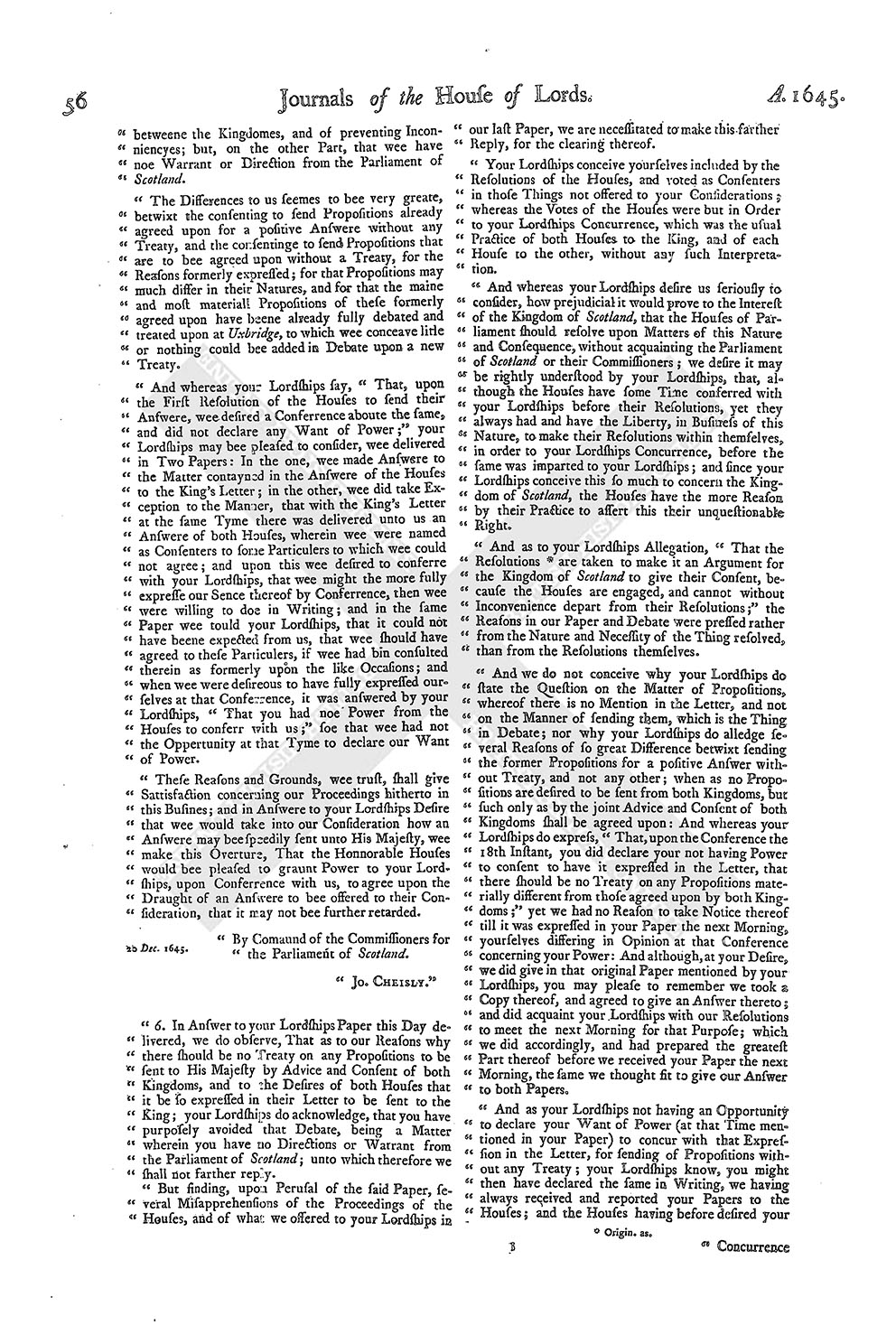
"Ours of the 18th did containe not only an Answere to your Lordships Reasons why there should bee noe Treaty upon any Propositions to bee sent to the King, but alsoe propound to your Lordships what wee conceived to bee the State of the Question, Whether it were not necessary to send the Propositions of Peace agreed upon by the Parliaments of both Kingdomes for a positive Answere, without any Treaty? And as wee have constantly pressed this ever since the 20th of June last, soe, upon this Occasion, wee thought it very seasonable for us to move, That it might bee expressed in the Answere to the King's Letters, to bee the Resolutions of both Kingdomes, to send these Propositions for a present Answere without any Treaty: As to the State of the Question as it was propounded by your Lordships, wee gave that which wee conceived to bee a reall Answere; which was, That wee had not Power to send any Propositions materially different from those agreed upon betweene the Kingdomes, without acquaintinge the Parliament of Scotland, and receiveing their Directions therein; and in Reason it cannott bee expected that it should be in the Power of any Commissioners of Parliament (as the Houses of Parliament may judge whether they would bee willing to grant Power to their owne Comissioners in the like Exigence) to determine absolutely that there should bee noe Treaty upon any Propositions to bee sent to the King, and to lymitt those that intrusted them in Things of soe greate Consequence concerning the Manner, before they were acquainted and had agreed upon the Matter of the Propositions, which in its owne Nature ought to preceed: And further, wee freely and cleerly tould your Lordships at the Conferrence, that wee had noe Power to declare that there should bee noe Treaty upon any Propositions materially different from those agreed upon betweene the Kingdomes, or to consent that there should bee any such Expression in the Answere to the King's Letter; and therefore wee understand not upon what Ground your Lordships should say in your Paper of the 19th, "That you never knew it before that Morninge," unlesse it bee meant that it was not in Terminis expressed in Writinge; and your Lordships may remember, this was the Reason why wee desired to amend some Expressions in our Paper, which your Lordships conceived to bee more cleerly delivered at our Conferrence. And when your Lordships had, upon the 18th at Night, retourned to us the originall Paper delivered in by us that Afternoone, wee did not expect that your Lordships in yours of the 19th would have made Answere to that Paper, but only to our other Paper, wherein wee expressed ourselves more fully to your Lordships Satisfaction: And if your Lordships wil bee pleased to looke againe upon our Papers, there wil bee nothing found in them which may give any Ground to apprehend that your Lordships have made it appeare to us that the sending Propositions without a Treaty wil bee a better Meanes to continue the Union and good Understandinge between the Kingdomes, and of preventing Inconniencyes; but, on the other Part, that wee have noe Warrant or Direction from the Parliament of Scotland.
"The Differences to us seemes to bee very greate, betwixt the consenting to send Propositions already agreed upon for a positive Answere without any Treaty, and the consentinge to send Propositions that are to bee agreed upon without a Treaty, for the Reasons formerly expressed; for that Propositions may much differ in their Natures, and for that the maine and most materiall Propositions of these formerly agreed upon have beene already fully debated and treated upon at Uxbridge, to which wee conceave litle or nothing could bee added in Debate upon a new Treaty.
"And whereas your Lordships say, "That, upon the First Resolution of the Houses to send their Answere, wee desired a Conferrence aboute the same, and did not declare any Want of Power;" your Lordships may bee pleased to consider, wee delivered in Two Papers: In the one, wee made Answere to the Matter contayned in the Answere of the Houses to the King's Letter; in the other, wee did take Exception to the Manner, that with the King's Letter at the same Tyme there was delivered unto us an Answere of both Houses, wherein wee were named as Consenters to some Particulers to which wee could not agree; and upon this wee desired to conferre with your Lordships, that wee might the more fully expresse our Sence thereof by Conferrence, then wee were willing to doe in Writing; and in the same Paper wee tould your Lordships, that it could not have beene expected from us, that wee should have agreed to these Particulers, if wee had bin consulted therein as formerly upon the like Occasions; and when wee were desireous to have fully expressed ourselves at that Conferrence, it was answered by your Lordships, "That you had noe Power from the Houses to conferr with us;" soe that wee had not the Oppertunity at that Tyme to declare our Want of Power.
"These Reasons and Grounds, wee trust, shall give Sattisfaction concerning our Proceedings hitherto in this Busines; and in Answere to your Lordships Desire that wee would take into our Consideration how an Answere may bee speedily sent unto His Majesty, wee make this Overture, That the Honnorable Houses would bee pleased to graunt Power to your Lordships, upon Conferrence with us, to agree upon the Draught of an Answere to bee offered to their Consideration, that it may not bee further retarded.
Dec. 1645.
"By Comaund of the Commissioners for the Parliament of Scotland.
"Jo. Cheisly."
"6. In Answer to your Lordships Paper this Day delivered, we do observe, That as to our Reasons why there should be no Treaty on any Propositions to be sent to His Majesty by Advice and Consent of both Kingdoms, and to the Desires of both Houses that it be so expressed in their Letter to be sent to the King; your Lordships do acknowledge, that you have purposely avoided that Debate, being a Matter wherein you have no Directions or Warrant from the Parliament of Scotland; unto which therefore we shall not farther reply.
"But finding, upon Perusal of the said Paper, several Misapprehensions of the Proceedings of the Houses, and of what we offered to your Lordships in our last Paper, we are necessitated to make this farther Reply, for the clearing thereof.
"Your Lordships conceive yourselves included by the Resolutions of the Houses, and voted as Consenters in those Things not offered to your Considerations; whereas the Votes of the Houses were but in Order to your Lordships Concurrence, which was the usual Practice of both Houses to the King, and of each House to the other, without any such Interpretation.
"And whereas your Lordships desire us seriously to consider, how prejudicial it would prove to the Interest of the Kingdom of Scotland, that the Houses of Parliament should resolve upon Matters of this Nature and Consequence, without acquainting the Parliament of Scotland or their Commissioners; we desire it may be rightly understood by your Lordships, that, although the Houses have some Time conferred with your Lordships before their Resolutions, yet they always had and have the Liberty, in Business of this Nature, to make their Resolutions within themselves, in order to your Lordships Concurrence, before the same was imparted to your Lordships; and since your Lordships conceive this so much to concern the Kingdom of Scotland, the Houses have the more Reason by their Practice to assert this their unquestionable Right.
"And as to your Lordships Allegation, "That the Resolutions (fn. 5) are taken to make it an Argument for the Kingdom of Scotland to give their Consent, because the Houses are engaged, and cannot without Inconvenience depart from their Resolutions;" the Reasons in our Paper and Debate were pressed rather from the Nature and Necessity of the Thing resolved, than from the Resolutions themselves.
"And we do not conceive why your Lordships do state the Question on the Matter of Propositions, whereof there is no Mention in the Letter, and not on the Manner of sending them, which is the Thing in Debate; nor why your Lordships do alledge several Reasons of so great Difference betwixt sending the former Propositions for a positive Answer without Treaty, and not any other; when as no Propositions are desired to be sent from both Kingdoms, but such only as by the joint Advice and Consent of both Kingdoms shall be agreed upon: And whereas your Lordships do express, "That, upon the Conference the 18th Instant, you did declare your not having Power to consent to have it expressed in the Letter, that there should be no Treaty on any Propositions materially different from those agreed upon by both Kingdoms;" yet we had no Reason to take Notice thereof till it was expressed in your Paper the next Morning, yourselves differing in Opinion at that Conference concerning your Power: And although, at your Desire, we did give in that original Paper mentioned by your Lordships, you may please to remember we took a Copy thereof, and agreed to give an Answer thereto; and did acquaint your Lordships with our Resolutions to meet the next Morning for that Purpose; which we did accordingly, and had prepared the greatest Part thereof before we received your Paper the next Morning, the same we thought fit to give our Answer to both Papers.
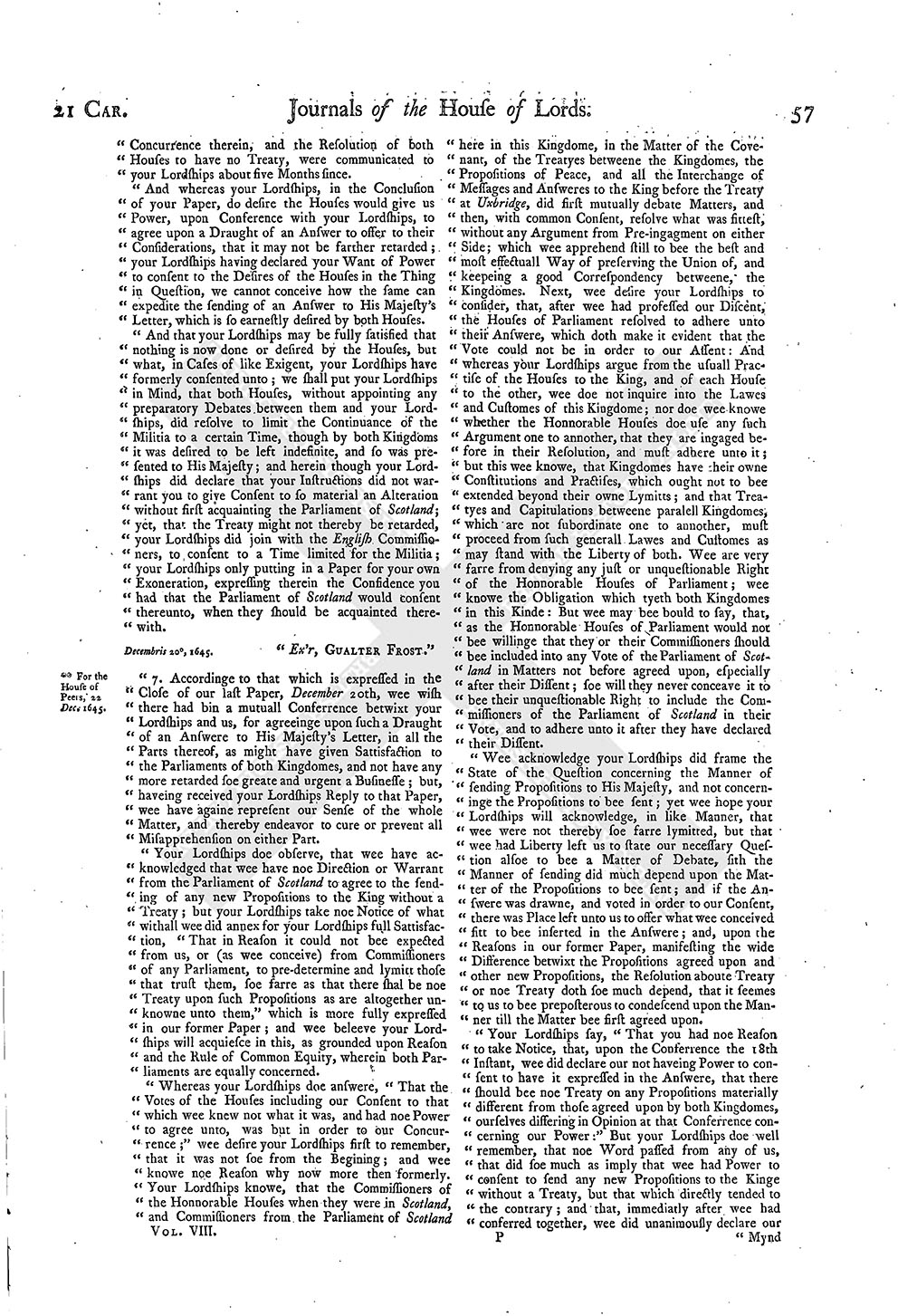
"And as your Lordships not having an Opportunity to declare your Want of Power (at that Time mentioned in your Paper) to concur with that Expression in the Letter, for sending of Propositions without any Treaty; your Lordships know, you might then have declared the same in Writing, we having always received and reported your Papers to the Houses; and the Houses having before desired your Concurrence therein, and the Resolution of both Houses to have no Treaty, were communicated to your Lordships about five Months since.
"And whereas your Lordships, in the Conclusion of your Paper, do desire the Houses would give us Power, upon Conference with your Lordships, to agree upon a Draught of an Answer to offer to their Considerations, that it may not be farther retarded; your Lordships having declared your Want of Power to consent to the Desires of the Houses in the Thing in Question, we cannot conceive how the same can expedite the sending of an Answer to His Majesty's Letter, which is so earnestly desired by both Houses.
"And that your Lordships may be fully satisfied that nothing is now done or desired by the Houses, but what, in Cases of like Exigent, your Lordships have formerly consented unto; we shall put your Lordships in Mind, that both Houses, without appointing any preparatory Debates between them and your Lordships, did resolve to limit the Continuance of the Militia to a certain Time, though by both Kingdoms it was desired to be left indefinite, and so was presented to His Majesty; and herein though your Lordships did declare that your Instructions did not warrant you to give Consent to so material an Alteration without first acquainting the Parliament of Scotland; yet, that the Treaty might not thereby be retarded, your Lordships did join with the English Commissioners, to consent to a Time limited for the Militia; your Lordships only putting in a Paper for your own Exoneration, expressing therein the Confidence you had that the Parliament of Scotland would consent thereunto, when they should be acquainted therewith.
Decembris 20, 1645.
"Ex'r, Gualter Frost."
** For the House of Peers, 22 Dec. 1645.
"7. Accordinge to that which is expressed in the Close of our last Paper, December 20th, wee wish there had bin a mutuall Conferrence betwixt your Lordships and us, for agreeinge upon such a Draught of an Answere to His Majesty's Letter, in all the Parts thereof, as might have given Sattisfaction to the Parliaments of both Kingdomes, and not have any more retarded soe greate and urgent a Businesse; but, haveing received your Lordships Reply to that Paper, wee have againe represent our Sense of the whole Matter, and thereby endeavor to cure or prevent all Misapprehension on either Part.
"Your Lordships doe observe, that wee have acknowledged that wee have noe Direction or Warrant from the Parliament of Scotland to agree to the sending of any new Propositions to the King without a Treaty; but your Lordships take noe Notice of what withall wee did annex for your Lordships full Sattisfaction, "That in Reason it could not bee expected from us, or (as wee conceive) from Commissioners of any Parliament, to pre-determine and lymitt those that trust them, soe farre as that there shall be noe Treaty upon such Propositions as are altogether unknowne unto them," which is more fully expressed in our former Paper; and wee beleeve your Lordships will acquiesce in this, as grounded upon Reason and the Rule of Common Equity, wherein both Parliaments are equally concerned.
"Whereas your Lordships doe answere, "That the Votes of the Houses including our Consent to that which wee knew not what it was, and had noe Power to agree unto, was but in order to our Concurrence;" wee desire your Lordships first to remember, that it was not soe from the Begining; and wee knowe noe Reason why now more then formerly. Your Lordships knowe, that the Commissioners of the Honnorable Houses when they were in Scotland, and Commissioners from the Parliament of Scotland here in this Kingdome, in the Matter of the Covenant, of the Treatyes betweene the Kingdomes, the Propositions of Peace, and all the Interchange of Messages and Answeres to the King before the Treaty at Uxbridge, did first mutually debate Matters, and then, with common Consent, resolve what was fittest, without any Argument from Pre-ingagment on either Side; which wee apprehend still to bee the best and most effectuall Way of preserving the Union of, and keepeing a good Correspondency betweene, the Kingdomes. Next, wee desire your Lordships to consider, that, after wee had professed our Discent, the Houses of Parliament resolved to adhere unto their Answere, which doth make it evident that the Vote could not be in order to our Assent: And whereas your Lordships argue from the usuall Practise of the Houses to the King, and of each House to the other, wee doe not inquire into the Lawes and Customes of this Kingdome; nor doe wee knowe whether the Honnorable Houses doe use any such Argument one to annother, that they are ingaged before in their Resolution, and must adhere unto it; but this wee knowe, that Kingdomes have their owne Constitutions and Practises, which ought not to bee extended beyond their owne Lymitts; and that Treatyes and Capitulations betweene paralell Kingdomes, which are not subordinate one to annother, must proceed from such generall Lawes and Customes as may stand with the Liberty of both. Wee are very farre from denying any just or unquestionable Right of the Honnorable Houses of Parliament; wee knowe the Obligation which tyeth both Kingdomes in this Kinde: But wee may bee bould to say, that, as the Honnorable Houses of Parliament would not bee willinge that they or their Commissioners should bee included into any Vote of the Parliament of Scotland in Matters not before agreed upon, especially after their Dissent; soe will they never conceave it to bee their unquestionable Right to include the Commissioners of the Parliament of Scotland in their Vote, and to adhere unto it after they have declared their Dissent.
"Wee acknowledge your Lordships did frame the State of the Question concerning the Manner of sending Propositions to His Majesty, and not concerninge the Propositions to bee sent; yet wee hope your Lordships will acknowledge, in like Manner, that wee were not thereby soe farre lymitted, but that wee had Liberty left us to state our necessary Question alsoe to bee a Matter of Debate, sith the Manner of sending did much depend upon the Matter of the Propositions to bee sent; and if the Answere was drawne, and voted in order to our Consent, there was Place left unto us to offer what wee conceived fitt to bee inserted in the Answere; and, upon the Reasons in our former Paper, manifesting the wide Difference betwixt the Propositions agreed upon and other new Propositions, the Resolution aboute Treaty or noe Treaty doth soe much depend, that it seemes to us to bee preposterous to condescend upon the Manner till the Matter bee first agreed upon.
"Your Lordships say, "That you had noe Reason to take Notice, that, upon the Conferrence the 18th Instant, wee did declare our not haveing Power to consent to have it expressed in the Answere, that there should bee noe Treaty on any Propositions materially different from those agreed upon by both Kingdomes, ourselves differing in Opinion at that Conferrence concerning our Power:" But your Lordships doe well remember, that noe Word passed from any of us, that did soe much as imply that wee had Power to consent to send any new Propositions to the Kinge without a Treaty, but that which directly tended to the contrary; and that, immediatly after wee had conferred together, wee did unanimously declare our Mynd to your Lordships, without the least Shaddowe of Difference, soe that your Lordships might that Night have rested sattisfyed that wee had noe Power to consent to have it expressed in the Answere to the King's Letter, that there should bee noe Treaty on any new Propositions.
"As to that your Lordships say, "You did agree to give an Answere to our First Paper of the 18th, and did acquaint us with your Resolution to meete the next Morning for that Purpose;" yet your Lordships, after you had delivered us that Answere, were pleased, upon our Desire to expresse our Mynd more fully in annother Paper, to retourne to us the originall Paper first offered, as if it had never beene given in by us, or to have beene taken into Consideration in your Lordships Answere; and therefore wee had Reason to expect noe Answere should have been retourned to that Paper, but to the other, which with all Diligence wee delivered the next Morning.
"And whereas your Lordships say, "What wee had not Oppertunity to declare at the Conferrence concerning our Want of Power, wee might have declared the same in Writing, the Houses haveing before desired our Concurrence in the Answere to the King's Letter, and the Resolutions of both Houses to have noe Treaty being comunicated to us aboute Five Moneths since;" and further say, "That wee haveing declared our Want of Power to consent to the Desires of the Houses in the Thing in Question, your Lordships cannott conceive how a Conferrence with us, to agree upon the Draught of an Answere, to offer to the Consideration of the Houses, can expedite the sending of an Answere to His Majesty's Letter;" wee desire it may bee remembred, that, as the Resolution of the Houses to have noe Treaty was comunicated to us Five Moneths sithence, soe did wee retourne the same Answere unto your Lordships at that Tyme which wee doe now, which was alsoe really contained in our Two Papers delivered in upon the 18th of this Instant, when wee desired a Conferrence of your Lordships, for which you did declare you had noe Power; and for which, if your Lordships had yet Power, wee conceive, upon former Experience of overcomeing greater Difficultyes, such an Answere to His Majesty's Letter might bee agreed upon as might sattisfy both Parliaments, and soe the sending of an Answere might have beene expedited; unlesse your Lordships thinke that the Answere drawne by the Houses without our Knowledge or Consent can suffer noe Alteration, which wee beleeve is not your Lordships Opinion, sith it was resolved upon by the Houses, as your Lordships say, with Referrence to our Consent.
"Whereas your Lordships say, "That wee may be fully sattisfyed that nothing is now done or desired by the Houses but what in Cases of the like Exigence wee have formerly consented unto; doe put us in Mynd, that the Houses of Parliament, without appointinge any preparatory Debates betweene them and us, did resolve to lymitt the Continuance of the Militia, contrary to that which was agreed upon by both Kingdomes;" your Lordships may bee pleased to remember, that, besides that the Commissioners of Scotland were then at Uxbridge, and not London or Westm. in the mutuall Debates of the Commissioners of both Kingdomes, it was conceived to bee conduceable, that the condescending to a Lymittation of Tyme, soe earnestly pressed by the King's Commissioners, if it could bee obtayned, would bee a Manifestation of their Desires of Peace; and thereafter the Committees of both Houses, haveinge mett apart, thought fitt to write to the Houses for their Resolution, but first of all to acquaint the Commissioners of Scotland therewith; which was done accordingly. This wee take for a preparatory Debate. And whereas your Lordships say, "That the Commissioners of Scotland did joyne with the Committee of both Houses, although they had noe Warrant from their Instructions soe to doe, only puting in a Paper for their Exoneration, expressing their Confidence that the Parliament of Scotland would consent thereunto; and that, therefore, wee may doe the like at this Tyme, in the like Exigence;" wee desire your Lordships, for your Sattisfaction, to consider that the one Case is much different from the other; for, although the Commissioners of Scotland had noe particuler Instructions for lymitting the Tyme of the Militia, yet they had good Grounds to make them consident that the Parliament of Scotland would bee of the same Mynd, as is intimated in their Paper mentioned by your Lordships: But concerning the Matter now in Debate, wee have acquainted the Estates of Scotland with the Votes of both Houses of the 6th of August, and with our Answere of the 14th, and at diverse Tymes, with such Earnestnes as beseemed us, desired their speedy Resolutions and particuler Directions; but they have not judged it convenient to grant us any further Power, expecting, noe Doubt, that the Houses of Parliament would either resolve to send to the King the Propositions formerly agreed upon, or, if they did intend any materiall Alterations of, or Additions unto, the former Propositions, they would have acquainted them therewith before this Tyme, it being now aboute 5 Moneths sithence the Houses of Parliament did resolve to send Propositions of Peace to His Majesty: And if these Alterations or Additions had bin sent in Tyme to the Kingdome of Scotland, wee might by this Tyme have bin furnished with their Instructions, and knowne their Will, both concerning the Matter of those Propositions and the Manner of sending them, that wee might have given perfect Sattisfaction to the Honnorable Houses for expediting that which is soe much desired by us all.
"Wee doe, therefore, renew our Desires concerninge our Overture in the End of our last Paper, that the Honnorable Houses may graunt Power to your Lordships, upon mutuall Conferrence, to agree upon a Draught of an Answere to His Majesty's Letter, to bee offered to their Consideration, whereby this tedious Debate may bee put to an End; and because the Alterations and Additions often mentioned, after 5 Moneths, are not yet resolved upon, and a long Tyme must bee spent before they bee agreed upon by both Kingdomes. Wee move againe, that the Propositions already prepared by Consent of both Kingdomes may bee sent for His Majesty's positive Answere, because more may bee lost by looseing the present Season and Oppertunity then can bee gained by new Propositions. If His Majesty's Intentions, when He is now brought lower then at any Tyme before, bee reall for Peace, and answereable to His Profession, the not hearkeninge unto His Desires may force Him to such desperate Courses, and to make such unnaturall Offers to Forraigne Princes and States, which may bee the Begining of a new Kinde of Warre, and the Cause of the Continuance and Increase of the sad Condition of these Three Kingdomes. And (fn. 6) if the King's importunate Solicitations by His Letters for Accomodation, and the Prince his offeringe his Mediation, to mention noe more, bee but Pretences, yet will they bee soe plausible in the Eyes of the World, unlesse they bee discovered by trying the Truth, in sendinge of Propositions, and takeing some speedy Course for Peace, that they may bee a Cause of multiplying Enemyes against us, and of much Missery to these Kingdomes. Whatsoever bee the Event, which is in the Hand of God, it is our Duty, and wil bee our Comfort, that wee embrace all Occasions of Pacification.
Dec 1645.
"By Comaund of the Commissioners for the Kingdome of Scotland.
"Jo. Cheisly."
Letter from Colonel Birch, with an Account of the Taking of Hereford, and desiring Supplies.
"For the Right Honourable the Committee of Lords and Commons for the Safety of both Kingdoms.
"May it please your Lordships,
"According unto your Commands, I drew forth near Nine Hundred Foot and my Troop of Horse, and, upon Advice from the Governor of Gloucester, I marched unto him; but finding the Way which was intended altogether frustrate, and the Governor of Gloucester not very well, I went with Sir John Bridges near to Heriford, and sent for thither the Two Gentlemen who Sir John had treated withall about the Business, who were then out of Heriford, fearing to come in Town; whom I satisfied myself of the Enemy's Security, and the Negligence of the Guards, which caused me to think of some other Way; and amongst others this was most prevalent with me, which, by God's Blessing, took Effect. The Way was this; to march in One Day and Night to Heriford from Gloucester; which done, I had provided Six Men in the Form of Labourers, and One with them to be a Constable, with a Warrant to bring these Men to work in the Town; to them I gave a good Sum of Money in Hand, and promised them a large Reward. These Men, with One Hundred and Fifty Firelocks, in the Dark of the Night, I intended to lodge near the Gate; and so near them as the Ground would admit out of Sight, I intended to draw a Body to second them, and enter with them, and so to furprize the Town upon the letting down the Bridge in the Morning. This I came back to Gloucester and informed Colonel Morgan of, desiring him to join with me to put it to Trial, which he condescended unto; and we marched Monday to that Purpose all Night, but fell short; and therefore, to delude the Enemy, 'treated back within Nine Miles of Gloucester. The next Day at Night we returned again, and with careful Spies and Scouts kept back Intelligence from them, so that they never discovered us; but I laid my Countrymen and Firelocks within Three Quarters Musket Shot, a Place which I had enquired out for the Purpose, which Party I left to be managed by my Lieutenant Colonel, who behaved himself very gallantly; and the main Body of Foot I led myself, Colonel Morgan being with the Body of Horse, which he undertook: And this Morning, upon the letting-down of the Bridge, the Countrymen went with their Pick-axes and Spades to the Bridge. The Guard beginning to examine them, they killed Three of the Guard, and kept the rest in Play until the Firelocks came up to (fn. 7) them; then made good until the Body came up; and it pleased God the Design so took, that we entered the Town with small Loss, in which we had Eleven Pieces of Ordnance, much Arms, and the Prisoners here inserted, there being many more in Town, as I believe, which One Day will discover. The Mercy is wonderful. I desire the Lord may have the Honour of it, for it is His own Work. I am deeply engaged by Monies laid out in this Business, and by Promise with Colonel Morgan. I humbly desire your Honours to give Order for the Sum you were pleased to give Order for this Business; and for myself, I shall endeavour to settle this Place, and wait your further Orders for the (fn. 8) Subsistence of my Regiment, which is in great Necessity, or what other Commands you shall be pleased to signify unto
"Your Honours
"Most faithful Servant,
"John Birch.
"I have herewith sent my Servant to wait upon your Honours, by whom I intreat to receive your Commands."
Hereford, Dec. 18th, 1645.
Another Letter from him, for Two Companies to be drawn from Bath, to reinforce the Garrison of Hereford.
"For the Right Honourable the Committe of Lords and Commons for the Safety of both Kingdoms. These.
"May it please your Lordships,
"According to your Commands, I marched with a Party, as in a former Letter signified by Colonel Morgan and myself we made bold to inform you; which, since (fn. 9) that Time, it hath pleased the Lord to shew His Power in our Weakness, by giving us this City, into which we forced our Entry this Morning, as by the Letter [ (fn. 10) signed by Colonel Morgan] and myself more particularly appears. The Resolution of the Soldiers carried them on beyond Imagination. I shall endeavour to set Things in Order here, according to that Command your Lordships have been pleased to give me. The Place is very evil-affected. I have here Nine Hundred Foot, but they will be too small a Number. I intend to add to them, if your Honours please, and make them up Twelve Hundred, which will be (fn. 11) seen enough for this ill-affected Place. When I marched hither, I left Two Companies at Bath; which being it is to be slighted, I shall humbly desire an Order for the drawing of those Two Companies to this Place, which would be a good Addition. I should have waited upon your Honours myself; but I dare not be absent, though my Extremity be great for Necessaries for my poor Soldiers. I shall humbly intreat you to signify your further Commands in that or any other Thing; which shall be carefully observed by
"Your Honours real Servant,
Hereford, Dec. the 18th, 1645.
"John Birch."
Letter from Colonels Morgan and Birch, with further Particulars concerning the Taking of Hereford.
"For the Right Honourable the Committee of both Kingdoms. These. Haste, Haste, Post Haste.
"May it please your Lordships,
"We gave you an Account in our last, that we found the City of Hereford, by our Intelligence, to be so strong both in iteself and the Resolution of the Defendants, that much Hazard would be in the gaining of it: Notwithstanding, having a Party of about Two Thousand Horse and Foot betwixt us, (videlicet,) of Gloucester Forces One Thousand and Fifty, and of Bath Forces Nine Hundred and Fifty, resolved to make Trial, by falling on upon the Place, unto which Endeavour the Lord was pleased so to add His Blessing, that this Morning, about Break of Day, we forced our Entrance, God putting such a Spirit into the Soldiers as was beyond Expression. Our Engagements to them was very large, the Design being very desperate; and also to some other Gentlemen, who were very helpful, and behaved themselves very gallantly in the falling on; which Engagements that we may be able to discharge, we humbly desire your Lordships to give Order for that Sum which you were pleased to promise for that Service. After they had marched this Night in the Snow up to the Middle Leg almost Twenty Miles in and out, (fn. 12) which, that the Enemy might not be jealous of, we marched the same March upon Monday Night, though with such Hardship that Three of our Men died in the Snow, and retreated upon Tuesday almost to Gloucester: They then believing we had been clear gone, were more secure; and we fell on unexpected. Our Loss was not considerable, God be blessed, whose Goodness was plainly seen (to Him be the Glory!). The Enemy fought it out in the Streets, where divers were slain, and the rest Prisoners. We are not able at present to particularize them; only those whose Names we can at this Instant be informed of we have here inserted. The Townsmen have suffered by the Soldiers, by reason we entered it by Force, and that the Enemy shot out (fn. 13) of the Windows and in the Streets. The Soldiers were so enraged, that we could not prevent them from Plundering, which we endeavoured much to have done; and shall be always ready to approve ourselves
Hereford, 18 Dec. 1645.
"Your Honours
"Most faithful Servants,
"John Birch. Thomas Morgan.
List of Prisoners taken there.
"Prisoners taken at Hereford, by the Governor of Gloucester, and Colonel Birch, now Governor thereof, December the 18th, 1645.