
Journal of the House of Lords: Volume 8, 1645-1647. Originally published by His Majesty's Stationery Office, London, 1767-1830.
This free content was digitised by double rekeying. All rights reserved.
'House of Lords Journal Volume 8: 23 December 1645', in Journal of the House of Lords: Volume 8, 1645-1647, (London, 1767-1830) pp. 60-65. British History Online https://www.british-history.ac.uk/lords-jrnl/vol8/pp60-65 [accessed 26 April 2024]


In this section
DIE Martis, 23 die Decembris:
PRAYERS, by Mr. Dury.
Ds. Grey de Warke, Speaker.
|
Comes Essex. Comes Pembrooke. Comes Manchester. Comes Lyncolne. Comes Warwicke. Comes Denbigh. Comes Sarum. Comes Midd. Comes Kent. Comes Northumb. |
Ds. Howard. Ds. Mountague. Ds. Robertes. Ds. North. Ds. Bruce. |
Papers from the Committee for the Admiralty.
The Earl of Warwicke reported from the Committee of the Admiralty, a Narrative of Doctor Walker's Negotiation in Flanders, together with a Letter to be subscribed by the Speakers of both Houses, and sent to the Governor of Flanders, if it should be approved of.
Then the Narrative was read. (Here enter it.)
Next, the Letter to the Governor was read, and Agreed to. (Here enter it.)
Another Paper was reported, and read, concerning the Building of new Ships. (Here enter it.)
Another Paper was reported, concerning the Payment of the Ships that did guard the Fishing.
(Here enter it.)
Another Paper was reported, for making John Locker to be Master of the Ship called The Weymouth, taken from Browne Bushell. (Here enter it.)
Ordered, (fn. 1) That all these Papers be communicated (fn. 2) to the House of (fn. 3) Commons.
Colonel Leyton to command the Horse at Plymouth.
Ordered, That Colonel Leyton do command the Horse at Plymouth; and the Concurrence of the House of Commons (fn. 3) desired.
Mynne's Goods not to seized.
Ordered, That a Letter be written, from the Speaker of this House, to Colonel Lawherne, "That he take Care that the Goods of Mr. George Mynne may not be seized, in Carmarthenshire, for Delinquency; and to let him know, that he hath paid his Fifth and Twentieth Part here; and that such Goods as have been taken from his Servant may be restored to him."
Cromwell and Tracy.
Ordered, That the Cause between Cromwell and Tracy shall be heard the 2d of January next, at this Bar.
Earl of Stamford's Business.
A Letter of the Earl of Stamford's was read; and Ordered, That the Committee for Privileges shall meet on Friday next, at Two of the Clock in the Afternoon, to consider of the whole Matters of the Earl of Stamford's Business.
Message from the H. C. with an Answer to the King's Letter.
A Message was brought from the House of Commons, by John Crewe Esquire, &c.
To desire Concurrence in these Particulars:
1. An Answer to the King's Letter, concerning a safe Conduct. (Here enter it.)
Read, and approved of; and Ordered to be communicated to the Scotts Commissioners, by the Members of both Houses as are of that Committee.
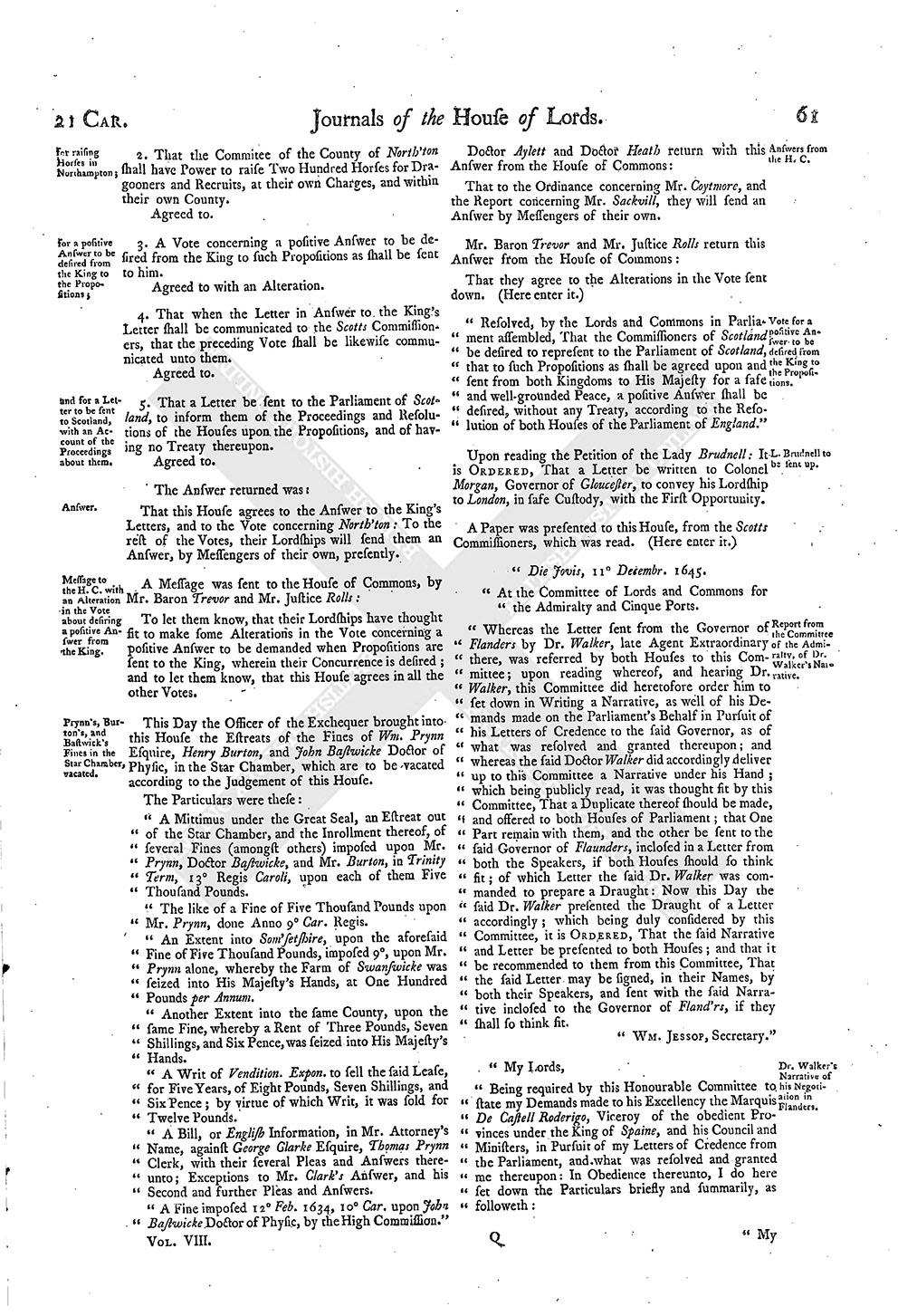
for raising Horses in Northampton;
2. That the Commitee of the County of North'ton shall have Power to raise Two Hundred Horses for Dragooners and Recruits, at their own Charges, and within their own County.
Agreed to.
for a positive Answer to be desired from the King to the Propositions;
3. A Vote concerning a positive Answer to be desired from the King to such Propositions as shall be sent to him.
Agreed to with an Alteration.
4. That when the Letter in Answer to the King's Letter shall be communicated to the Scotts Commissioners, that the preceding Vote shall be likewise communicated unto them.
Agreed to.
and for a Letter to be sent to Scotland, with an Account of the Proceddings about them.
5. That a Letter be sent to the Parliament of Scotland, to inform them of the Proceedings and Resolutions of the Houses upon the Propositions, and of having no Treaty thereupon.
Agreed to.
The Answer returned was:
Answer.
That this House agrees to the Answer to the King's Letters, and to the Vote concerning North'ton: To the rest of the Votes, their Lordships will send them an Answer, by Messengers of their own, presently.
Message to the H. C. with an Alteration in the Vote about desiring a positive Answer from the King.
A Message was sent to the House of Commons, by Mr. Baron Trevor and Mr. Justice Rolls:
To let them know, that their Lordships have thought fit to make some Alterations in the Vote concerning a positive Answer to be demanded when Propositions are sent to the King, wherein their Concurrence is desired; and to let them know, that this House agrees in all the other Votes.
Prynn's, Burton's, and Bastwick's Fines in the Star Chamber, vacated.
This Day the Officer of the Exchequer brought into this House the Estreats of the Fines of Wm. Prynn Esquire, Henry Burton, and John Bastwicke Doctor of Physic, in the Star Chamber, which are to be vacated according to the Judgement of this House.
The Particulars were these:
"A Mittimus under the Great Seal, an Estreat out of the Star Chamber, and the Inrollment thereof, of several Fines (amongst others) imposed upon Mr. Prynn, Doctor Bastwicke, and Mr. Burton, in Trinity Term, 13° Regis Caroli, upon each of them Five Thousand Pounds.
"The like of a Fine of Five Thousand Pounds upon Mr. Prynn, done Anno 9° Car. Regis.
"An Extent into Som'setshire, upon the aforesaid Fine of Five Thousand Pounds, imposed 9°, upon Mr. Prynn alone, whereby the Farm of Swanswicke was seized into His Majesty's Hands, at One Hundred Pounds per Annum.
"Another Extent into the same County, upon the same Fine, whereby a Rent of Three Pounds, Seven Shillings, and Six Pence, was seized into His Majesty's Hands.
"A Writ of Vendition. Expon. to sell the said Lease, for Five Years, of Eight Pounds, Seven Shillings, and Six Pence; by virtue of which Writ, it was sold for Twelve Pounds.
"A Bill, or English Information, in Mr. Attorney's Name, against George Glarke Esquire, Thomas Prynn Clerk, with their several Pleas and Answers thereunto; Exceptions to Mr. Clark's Answer, and his Second and further Pleas and Answers.
"A Fine imposed 12 Feb. 1634, 10° Car. upon John Bastwicke Doctor of Physic, by the High Commission."
Answers from the H. C.
Doctor Aylett and Doctor Heath return with this Answer from the House of Commons:
That to the Ordinance concerning Mr. Coytmore, and the Report concerning Mr. Sackvill, they will send an Answer by Messengers of their own.
Mr. Baron Trevor and Mr. Justice Rolls return this Answer from the House of Commons:
That they agree to the Alterations in the Vote sent down. (Here enter it.)
Vote for a positive Answer to be desired from the King to the Propositions.
"Resolved, by the Lords and Commons in Parliament assembled, That the Commissioners of Scotland be desired to represent to the Parliament of Scotland, that to such Propositions as shall be agreed upon and sent from both Kingdoms to His Majesty for a safe and well-grounded Peace, a positive Answer shall be desired, without any Treaty, according to the Resolution of both Houses of the Parliament of England."
L. Brudnell to be sent up.
Upon reading the Petition of the Lady Brudnell: It is Ordered, That a Letter be written to Colonel Morgan, Governor of Gloucester, to convey his Lordship to London, in safe Custody, with the First Opportunity.
A Paper was presented to this House, from the Scotts Commissioners, which was read. (Here enter it.)
"Die Jovis, 11 Decembr. 1645.
"At the Committee of Lords and Commons for the Admiralty and Cinque Ports.
Report from the Committee of the Admiralty, of Dr. Walker's Narrative.
"Whereas the Letter sent from the Governor of Flanders by Dr. Walker, late Agent Extraordinary there, was referred by both Houses to this Committee; upon reading whereof, and hearing Dr. Walker, this Committee did heretofore order him to set down in Writing a Narrative, as well of his Demands made on the Parliament's Behalf in Pursuit of his Letters of Credence to the said Governor, as of what was resolved and granted thereupon; and whereas the said Doctor Walker did accordingly deliver up to this Committee a Narrative under his Hand; which being publicly read, it was thought fit by this Committee, That a Duplicate thereof should be made, and offered to both Houses of Parliament; that One Part remain with them, and the other be sent to the said Governor of Flaunders, inclosed in a Letter from both the Speakers, if both Houses should so think fit; of which Letter the said Dr. Walker was commanded to prepare a Draught: Now this Day the said Dr. Walker presented the Draught of a Letter accordingly; which being duly considered by this Committee, it is Ordered, That the said Narrative and Letter be presented to both Houses; and that it be recommended to them from this Committee, That the said Letter may be signed, in their Names, by both their Speakers, and sent with the said Narrative inclosed to the Governor of Fland'rs, if they shall so think fit.
"Wm. Jessop, Secretary."
Dr. Walker's Narrative of his Negotiation in Flanders.
"My Lords,
"Being required by this Honourable Committee to state my Demands made to his Excellency the Marquis De Castell Roderigo, Viceroy of the obedient Provinces under the King of Spaine, and his Council and Ministers, in Pursuit of my Letters of Credence from the Parliament, and what was resolved and granted me thereupon: In Obedience thereunto, I do here set down the Particulars briefly and summarily, as followeth:
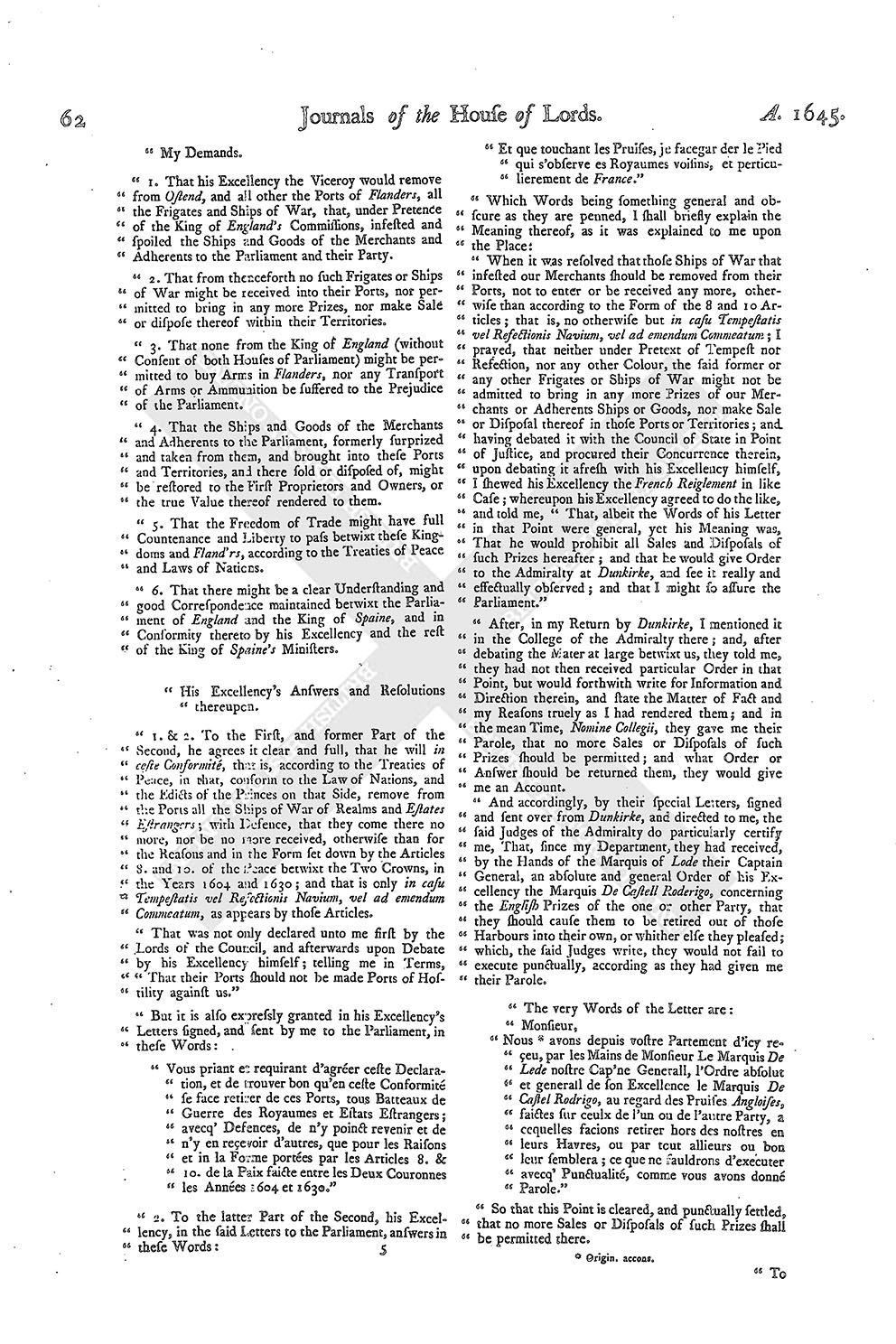
"My Demands.
"1. That his Excellency the Viceroy would remove from Ostend, and all other the Ports of Flanders, all the Frigates and Ships of War, that, under Pretence of the King of England's Commissions, infested and spoiled the Ships and Goods of the Merchants and Adherents to the Parliament and their Party.
"2. That from thenceforth no such Frigates or Ships of War might be received into their Ports, nor permitted to bring in any more Prizes, nor make Sale or dispose thereof within their Territories.
"3. That none from the King of England (without Consent of both Houses of Parliament) might be permitted to buy Arms in Flanders, nor any Transport of Arms or Ammunition be suffered to the Prejudice of the Parliament.
"4. That the Ships and Goods of the Merchants and Adherents to the Parliament, formerly surprized and taken from them, and brought into these Ports and Territories, and there sold or disposed of, might be restored to the First Proprietors and Owners, or the true Value thereof rendered to them.
"5. That the Freedom of Trade might have full Countenance and Liberty to pass betwixt these Kingdoms and Fland'rs, according to the Treaties of Peace and Laws of Nations.
"6. That there might be a clear Understanding and good Correspondence maintained betwixt the Parliament of England and the King of Spaine, and in Conformity thereto by his Excellency and the rest of the King of Spaine's Ministers.
"His Excellency's Answers and Resolutions thereupon.
1. & 2. To the First, and former Part of the Second, he agrees it clear and full, that he will in ceste Conformité, that is, according to the Treaties of Peace, in that, conform to the Law of Nations, and the Edicts of the Princes on that Side, remove from the Ports all the Ships of War of Realms and Estates Estrangers; with Defence, that they come there no more, nor be no more received, otherwise than for the Reasons and in the Form set down by the Articles 8. and 10. of the Peace betwixt the Two Crowns, in the Years 1604 and 1630; and that is only in casu Tempestatis vel Refectionis Navium, vel ad emendum Commeatum, as appears by those Articles.
"That was not only declared unto me first by the Lords of the Council, and afterwards upon Debate by his Excellency himself; telling me in Terms, "That their Ports should not be made Ports of Hostility against us."
"But it is also expressly granted in his Excellency's Letters signed, and sent by me to the Parliament, in these Words:
"Vous priant et requirant d'agréer ceste Declaration, et de trouver bon qu'en ceste Conformité se face retirer de ces Ports, tous Batteaux de Guerre des Royaumes et Estats Estrangers; avecq' Defences, de n'y poinct revenir et de n'y en recevoir d'autres, que pour les Raisons et in la Forme portées par les Articles 8. & 10. de la Paix faicte entre les Deux Couronnes les Années 1604 et 1630."
"2. To the latter Part of the Second, his Excellency, in the said Letters to the Parliament, answers in these Words:
"Et que touchant les Pruises, je facegar der le Pied qui s'observe es Royaumes voisins, et perticulierement de France."
"Which Words being something general and obscure as they are penned, I shall briefly explain the Meaning thereof, as it was explained to me upon the Place:
When it was resolved that those Ships of War that infested our Merchants should be removed from their Ports, not to enter or be received any more, otherwise than according to the Form of the 8 and 10 Articles; that is, no otherwise but in casu Tempestatis vel Refectionis Navium, vel ad emendum Commeatum; I prayed, that neither under Pretext of Tempest nor Refection, nor any other Colour, the said former or any other Frigates or Ships of War might not be admitted to bring in any more Prizes of our Merchants or Adherents Ships or Goods, nor make Sale or Disposal thereof in those Ports or Territories; and having debated it with the Council of State in Point of Justice, and procured their Concurrence therein, upon debating it afresh with his Excellency himself, I shewed his Excellency the French Reiglement in like Case; whereupon his Excellency agreed to do the like, and told me, "That, albeit the Words of his Letter in that Point were general, yet his Meaning was, That he would prohibit all Sales and Disposals of such Prizes hereafter; and that he would give Order to the Admiralty at Dunkirke, and see it really and effectually observed; and that I might so assure the Parliament."
"After, in my Return by Dunkirke, I mentioned it in the College of the Admiralty there; and, after debating the Mater at large betwixt us, they told me, they had not then received particular Order in that Point, but would forthwith write for Information and Direction therein, and state the Matter of Fact and my Reasons truely as I had rendered them; and in the mean Time, Nomine Collegii, they gave me their Parole, that no more Sales or Disposals of such Prizes should be permitted; and what Order or Answer should be returned them, they would give me an Account.
"And accordingly, by their special Letters, signed and sent over from Dunkirke, and directed to me, the said Judges of the Admiralty do particularly certify me, That, since my Department, they had received, by the Hands of the Marquis of Lode their Captain General, an absolute and general Order of his Excellency the Marquis De Castell Roderigo, concerning the English Prizes of the one or other Party, that they should cause them to be retired out of those Harbours into their own, or whither else they pleased; which, the said Judges write, they would not fail to execute punctually, according as they had given me their Parole.
"The very Words of the Letter are:
"Monsieur,
"Nous (fn. 4) avons depuis vostre Partement d'icy reçeu, par les Mains de Monsieur Le Marquis De Lede nostre Cap'ne Generall, l'Ordre absolut et generall de son Excellence le Marquis De Castel Rodrigo, au regard des Pruises Angloises, faictes sur ceulx de l'un ou de l'autre Party, a cequelles facions retirer hors des nostres en leurs Havres, ou par tout allieurs ou bon leur semblera; ce que ne fauldrons d'executer avecq' Punctualité, comme vous avons donné Parole."
"So that this Point is cleared, and punctually settled, that no more Sales or Disposals of such Prizes shall be permitted there.
"3. To the Third, his Excellency resolves it fully in his Letter to the Parliament, in these Words:
"Et pour ce que nul Transport d'Armes se peut faire de ces Pays sans Permission perticuliere de sa Majesté ou de son Gouverneur general, j'y procederay d'une telle Circonspection, que Personne n'aura Subject de s'en plaindre."
"Yet, at my coming to Dunkirke, I received Information, that certain Frigates and Arms were there provided and fitted, to be transported against the Parliament, or for the Assistance of the Irish Rebels; whereupon I went to the College, and complained against it, and after put in Writing in Lattin, requiring that Order might be given that no such Frigates nor Arms might be suffered to go forth.
"To which the Judges answered me again in Writing, in these Words:
"Ad quintum & ultimum, dicunt Judices, promulgatum esse Edictum ab aliquot Mensibus, quo Armorum simul ac Navium ad Bellum instructarum Transvectio prohibita est sub gravibus Pænis; quod pro debit. Officii Execution. mandabunt contra Transgressores."
"I was informed that they did give Order for staying those Arms accordingly, so that that Point likewise is fully agreed and settled.
"4. To the Fourth, which concerns the Restitution of what was past, or the true Value, his Excellency in the said Letter makes Answer in these Words:
"Mais pour ce que touche la Restitution des Batteaux et Marchandises desja prises, comme ce Poinct se trouve debattu en Justice mesmement, sur Contestation d'aucunes des Parties interessées; J'ay donné Ordre a ce que tous leurs Escrits sussent rejoind' es examines pour in en acquieter le plus raisonnablement que faire se pourra."
"His Excellency here hath agreed, and granted in Terms, that the Point coming to be debated in Justice upon Contestation of the Parties interested, he hath given Order that all their Writings shall be rejoined and examined, to acquit himself therein the most reasonably that may be; so that, if his Excellency, in Pursuance of this Agreement, do but give Order to the College at Dunkirke, to issue out Arrests and cumpulsory Process in ordinary Course, to bring in the Parties, to answer and abide the Judgement according to Law and Right, this Point is likewise clearly settled in a Way of Justice.
"5. To the Fifth, concerning Freedom of Trade, his Excellency in the Beginning of his Letter sets forth, "That he hath viewed the Propositions which I made in Behalf of the Parliament, in Pursuit of my Letters of Credence, touching the Freedom of Commerce, &c.; and that, in attending the Resolution of His Majesty thereupon, he would reigle himself according to the Treaties of Peace therein, conform to the Laws of Nations, and Edicts of the Princes on that Side."
"And besides this, the Marquis of Lede certifies the Admiralty at Dunkirke, in the Orders by him sent down to them (as he writes) from his Excellency (Num. 3.), of which I have a Copy from that Admiralty signed; (videlicet,)
"Sur le troisiesme S. E. respond, que le Commerce est et sera libre entre les Deux Couronnes."
"6. To the Sixth, touching the holding of a good Correspondence with the Parliament; there is no particular Mention of that in his Excellency's Letters to the Parliament; but in the Marquis of Lede's said Orders to the Admiralty of Dunkirke, it is answered in Terms in these very Words:
"Ordenandome de Notitia desta Resolution a les del Almarantasgo para que la tengau entendida y lo que debe observer se en lo que contienen con Animo de que no se falte a la Correspondencia que combiene se tenga con el Parliamento en lo que no se contraviene a los Articulos de la Paz."
"And to make it plainer:
"During the Time that I was debating the Questions in Point of Law and Right with the Lords of the Privy Council and Council of State at Bruxells, his Excellency being (in respect of giving Order to the Public Affairs) removed to Gaunt; I had Occasion to present several Requests to his Excellency by Letters. And his Excellency, in Return to me, in divers of his Letters signed with his own Hand, doth not (fn. 5) only fully express himself in the Point of holding all good Correspondency with the Parliament; but in some of them writes, that he passionately desireth to merit from the Parliament, and would grant me all that was in his Power within the Bounds of Justice, whereof I was a Professor.
"And so, (my Lords,) in Obedience to your Commands, I have summarily given your Lordships this brief Account; and I shall hope his Excellency will effectually and punctually perform in every Particular; for his Excellency assured me, and desired me from him and in his Name to assure the Parliament.
"Wal. Walker."
Letter to the Governor of Flanders, on the Subject of Dr. Walker's Negotiation.
"My Lord,
"I have received your Letters of Answer to the Propositions which Dr. Walker our Agent Extraordinary made unto you on our Behalf, in Pursuit of his Letters of Credence, touching the Liberty of Commerce, and the other Points therein contained; and having heard our said Agent thereupon; for the clearer explaining the Meaning thereof, we caused him to set it down in Writing under his Hand, and do here transmit it unto you inclosed; intreating your Excellency, upon Perusal thereof, finding it to be true, and to agree with the right Sense and Meaning of your said Letters, and your own Resolution upon the Points afore-mentioned, delivered to our said Agent, to write back unto us to that Purpose; and to enter it with you, as we will do the like with us, that it may be a Rule betwixt us, for Recourse to be made thereunto upon any Occasion, for the avoiding of all Misunderstanding, and advancing the Liberty of Trade betwixt our Merchants and yours, according to the Laws of Nations, and Treaties of Peace betwixt the Two Crowns.
"Dated in the High Court of Parliament, at Westm. this (fn. 6) "
Papers from the Committee of the Admiralty.
"Die Jovis, 11 Decembris, 1645.
At the Committee of Lords and Commons for the Admiralty and Cinque Ports.
For building new Ships in the room of the condemned ones;
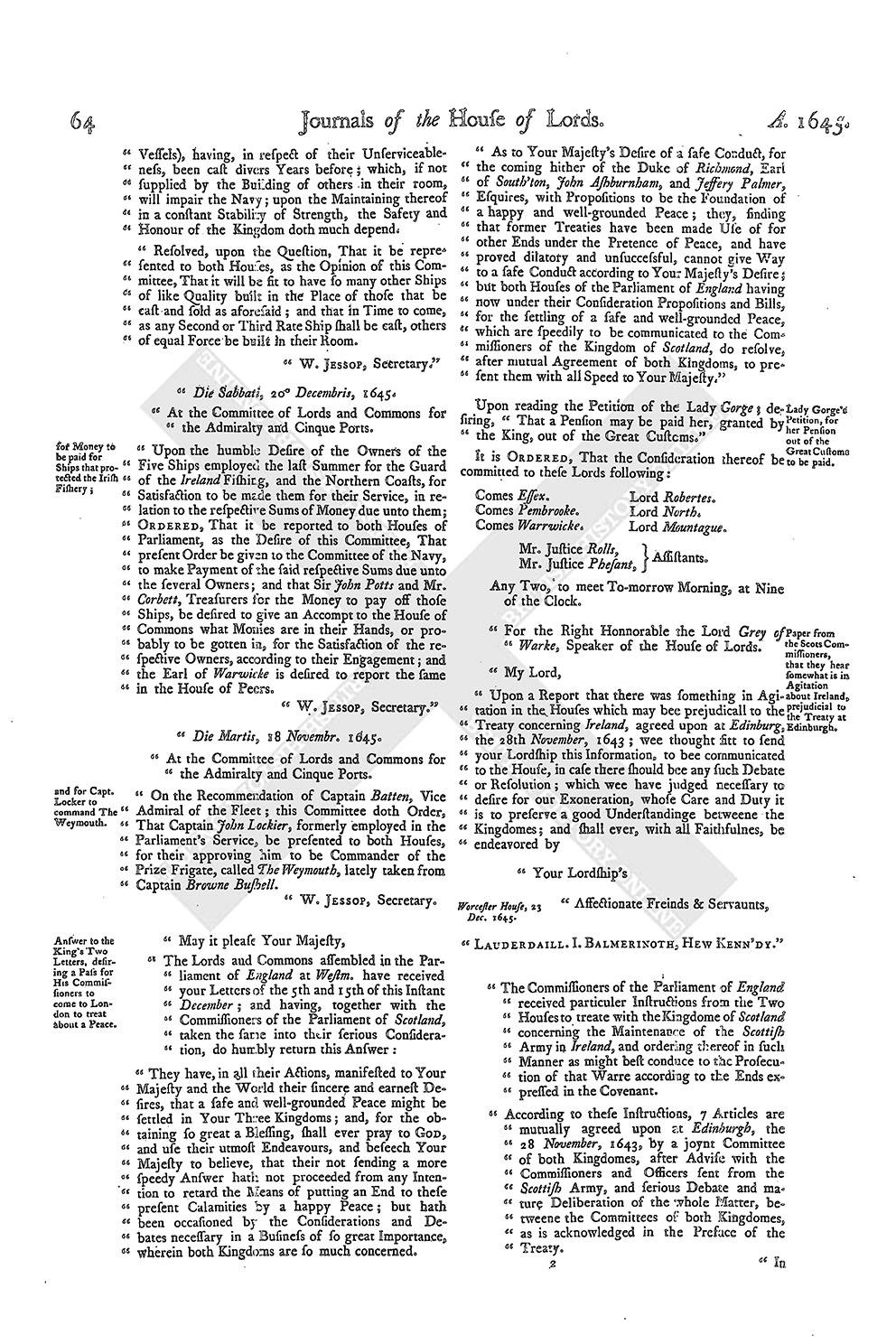
"The Earl of Warwicke did now make Report of the Proceedings of the Sub-committee Yesterday; and whereas it appears, that, since the Management of the Navy Affairs came into the Parliament's Hands, there are sold Four Ships, Part of the Navy, videlicet, One of Six Hundred and Twenty-one Tuns, One of Six Hundred and One Tuns, One of Five Hundred and Twenty-eight Tuns, and One of Two Hundred Eighty-seven Tuns, (besides Two small Vessels), having, in respect of their Unserviceableness, been cast divers Years before; which, if not supplied by the Building of others in their room, will impair the Navy; upon the Maintaining thereof in a constant Stability of Strength, the Safety and Honour of the Kingdom doth much depend.
Resolved, upon the Question, That it be represented to both Houses, as the Opinion of this Committee, That it will be fit to have so many other Ships of like Quality built in the Place of those that be cast and sold as aforesaid; and that in Time to come, as any Second or Third Rate Ship shall be cast, others of equal Force be built in their Room.
"W. Jessop, Secretary."
"Die Sabbati, 20 Decembris, 1645.
"At the Committee of Lords and Commons for the Admiralty and Cinque Ports.
for Money to be paid for Ships that protected the Irish Fishery;
"Upon the humble Desire of the Owners of the Five Ships employed the last Summer for the Guard of the Ireland Fishing, and the Northern Coasts, for Satisfaction to be made them for their Service, in relation to the respective Sums of Money due unto them; Ordered, That it be reported to both Houses of Parliament, as the Desire of this Committee, That present Order be given to the Committee of the Navy, to make Payment of the said respective Sums due unto the several Owners; and that Sir John Potts and Mr. Corbett, Treasurers for the Money to pay off those Ships, be desired to give an Accompt to the House of Commons what Monies are in their Hands, or probably to be gotten in, for the Satisfaction of the respective Owners, according to their Engagement; and the Earl of Warwicke is desired to report the same in the House of Peers.
"W. Jessop, Secretary."
"Die Martis, 18 Novembr. 1645.
"At the Committee of Lords and Commons for the Admiralty and Cinque Ports.
and for Capt. Locker to command The Weymouth.
"On the Recommendation of Captain Batten, Vice Admiral of the Fleet; this Committee doth Order, That Captain John Lockier, formerly employed in the Parliament's Service, be presented to both Houses, for their approving him to be Commander of the Prize Frigate, called The Weymouth, lately taken from Captain Browne Bushell.
"W. Jessop, Secretary.
Answer to the King's Two Letters, desiring a Pass for His Commissioners to come to London to treat about a Peace.
"May it please Your Majesty,
"The Lords and Commons assembled in the Parliament of England at Westm. have received your Letters of the 5th and 15th of this Instant December; and having, together with the Commissioners of the Parliament of Scotland, taken the same into their serious Consideration, do humbly return this Answer:
"They have, in all their Actions, manifested to Your Majesty and the World their sincere and earnest Desires, that a safe and well-grounded Peace might be settled in Your Three Kingdoms; and, for the obtaining so great a Blessing, shall ever pray to God, and use their utmost Endeavours, and beseech Your Majesty to believe, that their not sending a more speedy Answer hath not proceeded from any Intention to retard the Means of putting an End to these present Calamities by a happy Peace; but hath been occasioned by the Considerations and Debates necessary in a Business of so great Importance, wherein both Kingdoms are so much concerned.
"As to Your Majesty's Desire of a safe Conduct, for the coming hither of the Duke of Richmond, Earl of South'ton, John Ashburnham, and Jeffery Palmer, Esquires, with Propositions to be the Foundation of a happy and well-grounded Peace; they, finding that former Treaties have been made Use of for other Ends under the Pretence of Peace, and have proved dilatory and unsuccessful, cannot give Way to a safe Conduct according to Your Majesty's Desire; but both Houses of the Parliament of England having now under their Consideration Propositions and Bills, for the settling of a safe and well-grounded Peace, which are speedily to be communicated to the Commissioners of the Kingdom of Scotland, do resolve, after mutual Agreement of both Kingdoms, to present them with all Speed to Your Majesty."
Lady Gorge's Petition, for her Pension out of the Great Customs to be paid.
Upon reading the Petition of the Lady Gorge; desiring, "That a Pension may be paid her, granted by the King, out of the Great Customs."
It is Ordered, That the Consideration thereof be committed to these Lords following:
Any Two, to meet To-morrow Morning, at Nine of the Clock.
Paper from the Scots Commissioners, that they hear somewhat is in Agitation about Ireland, prejudicial to the Treaty at Edinburgh.
"For the Right Honnorable the Lord Grey of Warke, Speaker of the House of Lords.
"My Lord,
"Upon a Report that there was something in Agitation in the Houses which may bee prejudicall to the Treaty concerning Ireland, agreed upon at Edinburg, the 28th November, 1643; wee thought fitt to send your Lordship this Information, to bee communicated to the House, in case there should bee any such Debate or Resolution; which wee have judged necessary to desire for our Exoneration, whose Care and Duty it is to preserve a good Understandinge betweene the Kingdomes; and shall ever, with all Faithfulnes, be endeavored by
Your Lordship's
Worcester House, 23 Dec. 1645.
"Affectionate Freinds & Servaunts,
"Lauderdaill. I. Balmerinoth, Hew Kenn'dy."
"The Commissioners of the Parliament of England received particuler Instructions from the Two Houses to treate with the Kingdome of Scotland concerning the Maintenance of the Scottish Army in Ireland, and ordering thereof in such Manner as might best conduce to the Prosecution of that Warre according to the Ends expressed in the Covenant.
"According to these Instructions, 7 Articles are mutually agreed upon at Edinburgh, the 28 November, 1643, by a joynt Committee of both Kingdomes, after Advise with the Commissioners and Officers sent from the Scottish Army, and serious Debate and mature Deliberation of the whole Matter, betweene the Committees of both Kingdomes, as is acknowledged in the Preface of the Treaty.
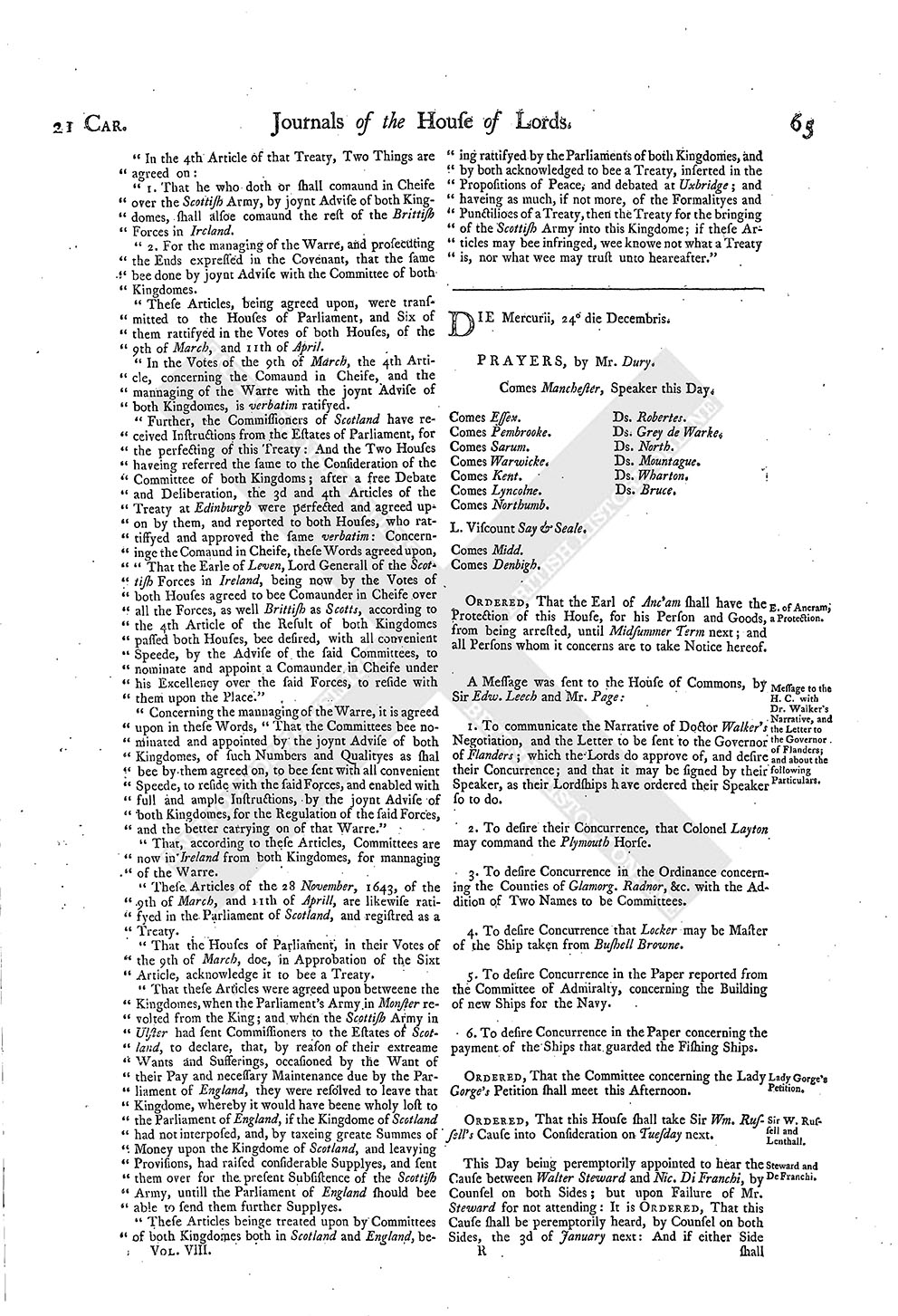
"In the 4th Article of that Treaty, Two Things are agreed on:
"1. That he who doth or shall comaund in Cheife over the Scottish Army, by joynt Advise of both Kingdomes, shall alsoe comaund the rest of the Brittish Forces in Ireland.
"2. For the managing of the Warre, and prosecuting the Ends expressed in the Covenant, that the same bee done by joynt Advise with the Committee of both Kingdomes.
"These Articles, being agreed upon, were transmitted to the Houses of Parliament, and Six of them rattifyed in the Votes of both Houses, of the 9th of March, and 11th of April.
"In the Votes of the 9th of March, the 4th Article, concerning the Comaund in Cheife, and the mannaging of the Warre with the joynt Advise of both Kingdomes, is verbatim ratifyed.
"Further, the Commissioners of Scotland have received Instructions from the Estates of Parliament, for the perfecting of this Treaty: And the Two Houses haveing referred the same to the Consideration of the Committee of both Kingdoms; after a free Debate and Deliberation, the 3d and 4th Articles of the Treaty at Edinburgh were perfected and agreed upon by them, and reported to both Houses, who rattiffyed and approved the same verbatim: Concerninge the Comaund in Cheife, these Words agreed upon, "That the Earle of Leven, Lord Generall of the Scottish Forces in Ireland, being now by the Votes of both Houses agreed to bee Comaunder in Cheife over all the Forces, as well Brittish as Scotts, according to the 4th Article of the Result of both Kingdomes passed both Houses, bee desired, with all convenient Speede, by the Advise of the said Committees, to nominate and appoint a Comaunder in Cheife under his Excellency over the said Forces, to reside with them upon the Place."
Concerning the mannaging of the Warre, it is agreed upon in these Words, "That the Committees bee nominated and appointed by the joynt Advise of both Kingdomes, of such Numbers and Qualityes as shal bee by them agreed on, to bee sent with all convenient Speede, to reside with the said Forces, and enabled with full and ample Instructions, by the joynt Advise of both Kingdomes, for the Regulation of the said Forces, and the better carrying on of that Warre."
"That, according to these Articles, Committees are now in Ireland from both Kingdomes, for mannaging of the Warre.
"These Articles of the 28 November, 1643, of the 9th of March, and 11th of Aprill, are likewise ratifyed in the Parliament of Scotland, and registred as a Treaty.
"That the Houses of Parliament, in their Votes of the 9th of March, doe, in Approbation of the Sixt Article, acknowledge it to bee a Treaty.
"That these Articles were agreed upon betweene the Kingdomes, when the Parliament's Army in Monster revolted from the King; and when the Scottish Army in Ulster had sent Commissioners to the Estates of Scotland, to declare, that, by reason of their extreame Wants and Sufferings, occasioned by the Want of their Pay and necessary Maintenance due by the Parliament of England, they were resolved to leave that Kingdome, whereby it would have beene wholy lost to the Parliament of England, if the Kingdome of Scotland had not interposed, and, by taxeing greate Summes of Money upon the Kingdome of Scotland, and leavying Provisions, had raised considerable Supplyes, and sent them over for the present Subsistence of the Scottish Army, untill the Parliament of England should bee able to send them further Supplyes.
"These Articles beinge treated upon by Committees of both Kingdomes both in Scotland and England, being rattifyed by the Parliaments of both Kingdomes, and by both acknowledged to bee a Treaty, inserted in the Propositions of Peace, and debated at Uxbridge; and haveing as much, if not more, of the Formalityes and Punctilioes of a Treaty, then the Treaty for the bringing of the Scottish Army into this Kingdome; if these Articles may bee infringed, wee knowe not what a Treaty is, nor what wee may trust unto heareafter."