Journal of the House of Lords: Volume 8, 1645-1647. Originally published by His Majesty's Stationery Office, London, 1767-1830.
This free content was digitised by double rekeying. All rights reserved.
'House of Lords Journal Volume 8: 25 May 1646', in Journal of the House of Lords: Volume 8, 1645-1647(London, 1767-1830), British History Online https://www.british-history.ac.uk/lords-jrnl/vol8/pp328-331 [accessed 30 April 2025].
'House of Lords Journal Volume 8: 25 May 1646', in Journal of the House of Lords: Volume 8, 1645-1647(London, 1767-1830), British History Online, accessed April 30, 2025, https://www.british-history.ac.uk/lords-jrnl/vol8/pp328-331.
"House of Lords Journal Volume 8: 25 May 1646". Journal of the House of Lords: Volume 8, 1645-1647. (London, 1767-1830), British History Online. Web. 30 April 2025. https://www.british-history.ac.uk/lords-jrnl/vol8/pp328-331.

In this section
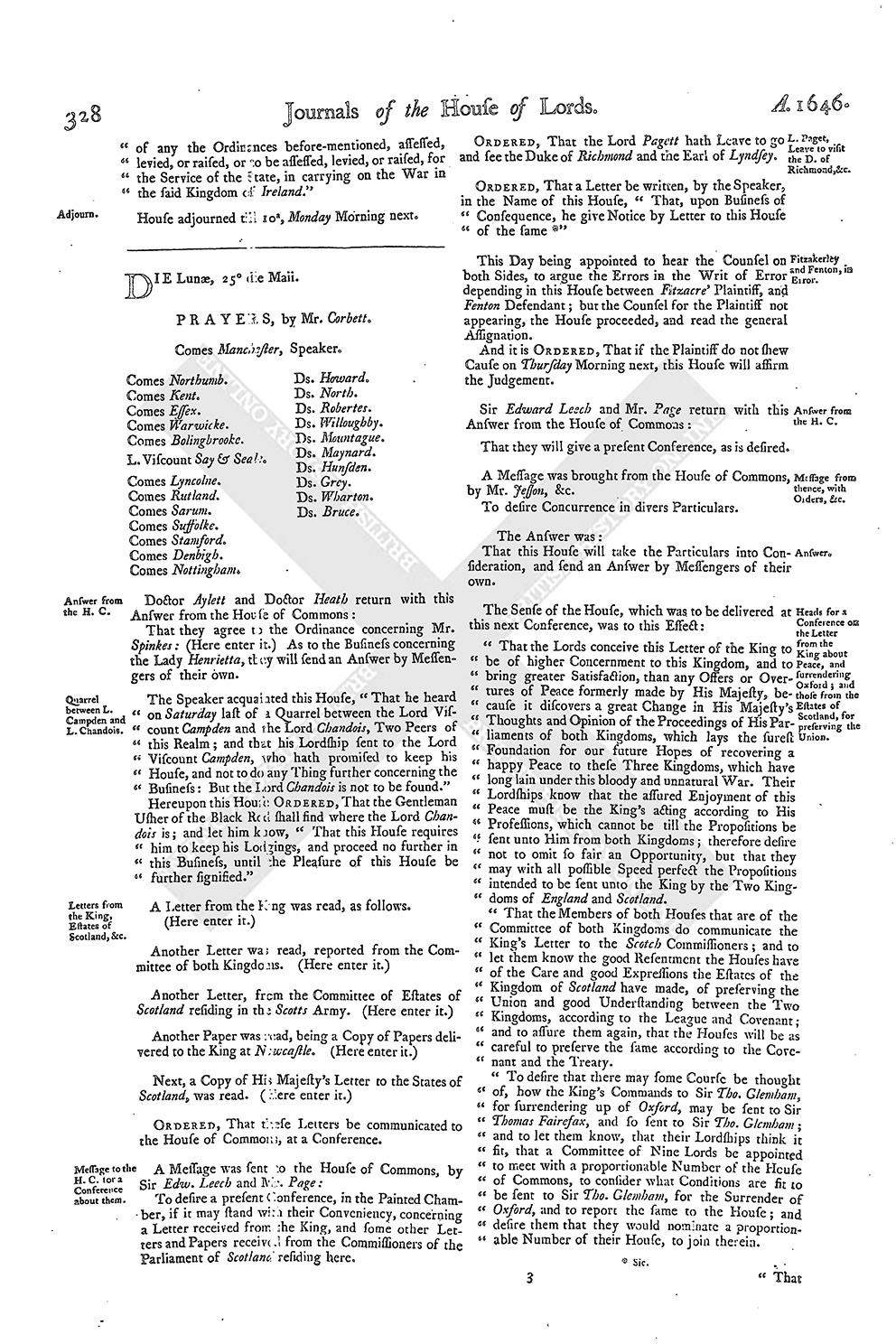
DIE Lunæ, 25 die Maii.
PRAYERS, by Mr. Corbett.
Comes Manchester, Speaker.
Answer from the H. C.
Doctor Aylett and Doctor Heath return with this Answer from the House of Commons:
That they agree to the Ordinance concerning Mr. Spinkes: (Here enter it.) As to the Business concerning the Lady Henrietta, they will send an Answer by Messengers of their own.
Quarrel between L. Campden and L. Chandois.
The Speaker acquainted this House, "That he heard on Saturday last of a Quarrel between the Lord Viscount Campden and the Lord Chandois, Two Peers of this Realm; and that his Lordship sent to the Lord Viscount Campden, who hath promised to keep his House, and not to do any Thing further concerning the Business: But the Lord Chandois is not to be found."
Hereupon this House Ordered, That the Gentleman Usher of the Black Red shall find where the Lord Chandois is; and let him know, "That this House requires him to keep his Lodgings, and proceed no further in this Business, until the Pleasure of this House be further signified."
Letters from the King, Estates of Scotland, &c.
A Letter from the King was read, as follows.
(Here enter it.)
Another Letter was read, reported from the Committee of both Kingdoms. (Here enter it.)
Another Letter, from the Committee of Estates of Scotland residing in the Scotts Army. (Here enter it.)
Another Paper was read, being a Copy of Papers delivered to the King at Newcastle. (Here enter it.)
Next, a Copy of His Majesty's Letter to the States of Scotland, was read. (Here enter it.)
Ordered, That these Letters be communicated to the House of Commons, at a Conference.
Message to the H. C. for a Conference about them.
A Message was sent to the House of Commons, by Sir Edw. Leech and Mr. Page:
To desire a present Conference, in the Painted Chamber, if it may stand with their Conveniency, concerning a Letter received from the King, and some other Letters and Papers received from the Commissioners of the Parliament of Scotland residing here.
L. Paget, Leave to visit the D. of Richmond, &c.
Ordered, That the Lord Pagett hath Leave to go and see the Duke of Richmond and the Earl of Lyndsey.
Ordered, That a Letter be written, by the Speaker, in the Name of this House, "That, upon Business of Consequence, he give Notice by Letter to this House of the same (fn. 1) "
Fitzakerley and Fenton, in Error.
This Day being appointed to hear the Counsel on both Sides, to argue the Errors in the Writ of Error depending in this House between Fitzacre' Plaintiff, and Fenton Defendant; but the Counsel for the Plaintiff not appearing, the House proceeded, and read the general Assignation.
And it is Ordered, That if the Plaintiff do not shew Cause on Thursday Morning next, this House will affirm the Judgement.
Answer from the H. C.
Sir Edward Leech and Mr. Page return with this Answer from the House of Commons:
That they will give a present Conference, as is desired.
Message from thence, with Orders, &c.
A Message was brought from the House of Commons, by Mr. Jesson, &c.
To desire Concurrence in divers Particulars.
The Answer was:
Answer.
That this House will take the Particulars into Consideration, and send an Answer by Messengers of their own.
Heads for a Conference on the Letter from the King about Peace, and surrendering Oxford; and those from the Estates of Scotland, for preserving the Union.
The Sense of the House, which was to be delivered at this next Conference, was to this Effect:
"That the Lords conceive this Letter of the King to be of higher Concernment to this Kingdom, and to bring greater Satisfaction, than any Offers or Overtures of Peace formerly made by His Majesty, because it discovers a great Change in His Majesty's Thoughts and Opinion of the Proceedings of His Parliaments of both Kingdoms, which lays the surest Foundation for our future Hopes of recovering a happy Peace to these Three Kingdoms, which have long lain under this bloody and unnatural War. Their Lordships know that the assured Enjoyment of this Peace must be the King's acting according to His Professions, which cannot be till the Propositions be sent unto Him from both Kingdoms; therefore desire not to omit so fair an Opportunity, but that they may with all possible Speed perfect the Propositions intended to be sent unto the King by the Two Kingdoms of England and Scotland.
"That the Members of both Houses that are of the Committee of both Kingdoms do communicate the King's Letter to the Scotch Commissioners; and to let them know the good Resentment the Houses have of the Care and good Expressions the Estates of the Kingdom of Scotland have made, of preserving the Union and good Understanding between the Two Kingdoms, according to the League and Covenant; and to assure them again, that the Houses will be as careful to preserve the same according to the Covenant and the Treaty.
"To desire that there may some Course be thought of, how the King's Commands to Sir Tho. Glemham, for surrendering up of Oxford, may be sent to Sir Thomas Fairefax, and so sent to Sir Tho. Glemham; and to let them know, that their Lordships think it fit, that a Committee of Nine Lords be appointed to meet with a proportionable Number of the House of Commons, to consider what Conditions are fit to be sent to Sir Tho. Glemham, for the Surrender of Oxford, and to report the same to the House; and desire them that they would nominate a proportionable Number of their House, to join therein.
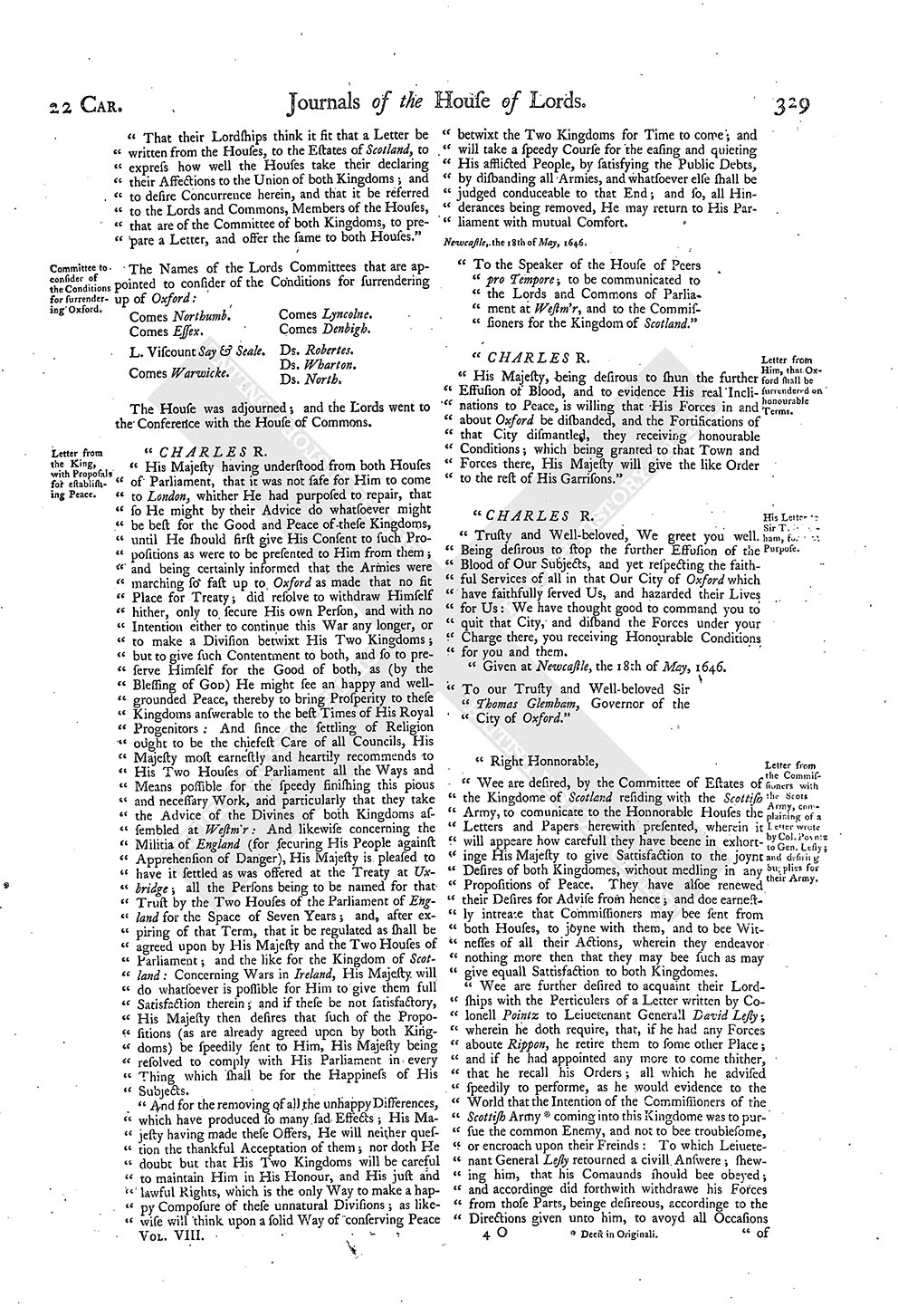
"That their Lordships think it fit that a Letter be written from the Houses, to the Estates of Scotland, to express how well the Houses take their declaring their Affections to the Union of both Kingdoms; and to desire Concurrence herein, and that it be referred to the Lords and Commons, Members of the Houses, that are of the Committee of both Kingdoms, to prepare a Letter, and offer the same to both Houses."
Committee to consider of the Conditions for surrendering Oxford.
The Names of the Lords Committees that are appointed to consider of the Conditions for surrendering up of Oxford:
|
Comes Northumb. Comes Essex. L. Viscount Say & Seale. Comes Warwicke. |
Comes Lyncolne. Comes Denbigh. Ds. Robertes. Ds. Wharton. Ds. North. |
The House was adjourned; and the Lords went to the Conference with the House of Commons.
Letter from the King, with Proposals for establishing Peace.
"CHARLES R.
"His Majesty having understood from both Houses of Parliament, that it was not safe for Him to come to London, whither He had purposed to repair, that so He might by their Advice do whatsoever might be best for the Good and Peace of these Kingdoms, until He should first give His Consent to such Propositions as were to be presented to Him from them; and being certainly informed that the Armies were marching so fast up to Oxford as made that no fit Place for Treaty; did resolve to withdraw Himself hither, only to secure His own Person, and with no Intention either to continue this War any longer, or to make a Division betwixt His Two Kingdoms, but to give such Contentment to both, and so to preserve Himself for the Good of both, as (by the Blessing of God) He might see an happy and wellgrounded Peace, thereby to bring Prosperity to these Kingdoms answerable to the best Times of His Royal Progenitors: And since the settling of Religion ought to be the chiefest Care of all Councils, His Majesty most earnestly and heartily recommends to His Two Houses of Parliament all the Ways and Means possible for the speedy finishing this pious and necessary Work, and particularly that they take the Advice of the Divines of both Kingdoms assembled at Westm'r: And likewise concerning the Militia of England (for securing His People against Apprehension of Danger), His Majesty is pleased to have it settled as was offered at the Treaty at Uxbridge; all the Persons being to be named for that Trust by the Two Houses of the Parliament of England for the Space of Seven Years; and, after expiring of that Term, that it be regulated as shall be agreed upon by His Majesty and the Two Houses of Parliament; and the like for the Kingdom of Scotland: Concerning Wars in Ireland, His Majesty will do whatsoever is possible for Him to give them full Satisfaction therein; and if these be not satisfactory, His Majesty then desires that such of the Propositions (as are already agreed upon by both Kingdoms) be speedily sent to Him, His Majesty being resolved to comply with His Parliament in every Thing which shall be for the Happiness of His Subjects.
"And for the removing of all the unhappy Differences, which have produced so many sad Effects; His Majesty having made these Offers, He will neither question the thankful Acceptation of them; nor doth He doubt but that His Two Kingdoms will be careful to maintain Him in His Honour, and His just and lawful Rights, which is the only Way to make a happy Composure of these unnatural Divisions; as likewise will think upon a solid Way of conserving Peace betwixt the Two Kingdoms for Time to come; and will take a speedy Course for the easing and quieting His afflicted People, by satisfying the Public Debts, by disbanding all Armies, and whatsoever else shall be judged conduceable to that End; and so, all Hinderances being removed, He may return to His Parliament with mutual Comfort.
Newcastle, the 18th of May, 1646.
"To the Speaker of the House of Peers pro Tempore; to be communicated to the Lords and Commons of Parliament at Westm'r, and to the Commissioners for the Kingdom of Scotland."
Letter from Him, that Oxford shall be surrendered on honourable Terms.
"CHARLES R.
"His Majesty, being desirous to shun the further Effusion of Blood, and to evidence His real Inclinations to Peace, is willing that His Forces in and about Oxford be disbanded, and the Fortifications of that City dismantled, they receiving honourable Conditions; which being granted to that Town and Forces there, His Majesty will give the like Order to the rest of His Garrisons."
His Letter to Sir T. Glemham, for that Purpose.
"CHARLES R.
"Trusty and Well-beloved, We greet you well. Being desirous to stop the further Effusion of the Blood of Our Subjects, and yet respecting the faithful Services of all in that Our City of Oxford which have faithfully served Us, and hazarded their Lives for Us: We have thought good to command you to quit that City, and disband the Forces under your Charge there, you receiving Honourable Conditions for you and them.
"Given at Newcastle, the 18th of May, 1646.
"To our Trusty and Well-beloved Sir Thomas Glemham, Governor of the City of Oxford."
Letter from the Commissioners with the Scots Army, complaining of a Letter wrote by Col. Povntz to Gen. Lesly; and desiring Supplies for their Army.
"Right Honnorable,
"Wee are desired, by the Committee of Estates of the Kingdome of Scotland residing with the Scottish Army, to comunicate to the Honnorable Houses the Letters and Papers herewith presented, wherein it will appeare how carefull they have beene in exhortinge His Majesty to give Sattisfaction to the joynt Desires of both Kingdomes, without medling in any Propositions of Peace. They have alsoe renewed their Desires for Advise from hence; and doe earnestly intreace that Commissioners may bee sent from both Houses, to joyne with them, and to bee Witnesses of all their Actions, wherein they endeavor nothing more then that they may bee such as may give equall Sattisfaction to both Kingdomes.
"Wee are further desired to acquaint their Lordships with the Perticulers of a Letter written by Colonell Pointz to Leiuetenant Generall David Lesly; wherein he doth require, that, if he had any Forces aboute Rippon, he retire them to some other Place; and if he had appointed any more to come thither, that he recall his Orders; all which he advised speedily to performe, as he would evidence to the World that the Intention of the Commissioners of the Scottish Army (fn. 2) coming into this Kingdome was to pursue the common Enemy, and not to bee troublesome, or encroach upon their Freinds: To which Leiuetenant General Lesly retourned a civill Answere; shewing him, that his Comaunds should bee obeyed; and accordinge did forthwith withdrawe his Forces from those Parts, beinge desireous, accordinge to the Directions given unto him, to avoyd all Occasions of Difference; and confessed, upon Consideration whereof, it is their earnest Desires, that, as Directions are given by them to all the Officers of the Scottish Army, soe the Honnorable Houses would bee pleased to give Order to the Comaunders of their Forces in those Parts, to forbeare all Provokings, Expressions, Speeches, or Actions, which may give just Cause (fn. 3) of Offence: And for preventing all Disorders and Inconveniencyes, they doe earnestly intreate that Directions may bee speedily sent to the Committee at Yorke, to appoint them Quarters; and that a considerable Supply of Money may bee sent unto them now, after soe much Want and soe long Sufferinge; which Desires being soe reasonable, and soe often renewed, wee are perswaded the Honnorable Houses will take them into their serious Consideration, and retourne a speedy and sattisfactory (fn. 4) Answer; and wee remaine
Worcester House, 25th of May, 1646.
"Your affectionate Freinds and humble Servaunts,
"Lauderdaill.
"W. Johnston. Hew Kennedy.
"Ro. Barclay.
"For the Right Honnorable the Speaker of the House of Peeres; to bee communicated to both Houses of Parliament."
Letter from the Committee of the Estates of Scotland, about the King's being in their Army, and for preserving the Union.
"Right Honnorable,
"By our last to you, the 6th of May, wee gave your Lordships an Accompt of the Mannor of His Majesty's comeing to our Army; and did crave your Advise what was to bee done, for the publique Good and mutuall Happines of both Kingdomes: And though as yet wee have had noe Answere retourned we esteemed it incumbent unto us, in Pursuance of the Ends contayned in the solemne League and Covenant (which have beene ever, and shal bee, the Scope of our Intentions), to give your Lordships a further Accompt of what is past betweene His Majesty and us, this you may knowe the true Posture of Affaires here. Wee did acquaint the Committee of Estates at Edinburgh with the King's unexpected comeing to us, who did send upp some of their Number to assist us in our just Desires to His Majesty. All our Labours and Endeavors have beene, that He would have beene pleased to send such a sattisfactory Message to the Parliament of England and our Commissioners at London, as might bee a happy Enterance to the setlinge of Religion and a well-grounded Peace: And for this Effect, those who were directed by the Committee of Estates, with our Advise, gave in a Paper to His Majesty, representinge the Resolutions of the Kingdome of Scotland, whereof wee have sent to our Commissioners a just Coppy, who will shew the same to your Lordships, and give you a further Accompt of all that is past. Wee earnestly desire that the Parliament of England may bee pleased to send some Commissioners from them, to bee Wittnesses of our Actions, and to give us Concurrence and Assistance in what may fall within the Compasse of Affaires here; and in the meane Tyme, that the Parliament will cause make tymeous Provision for our Army from London, and give Orders for their Quarters in such Places as may bee most convenient for the Army.
"Signed, by the Warrant, and at the Comaund, of the Commissioners of the Parliament of Scotland.
Newcastle, the 19th of May, 1646.
"Your Lordships Most humble Servaunt,
"Lothian."
Papers from them to the King: To give Satisfaction to the Desires of both Kingdoms;
"May it please Your Majesty,
"The Committee of Estates of Your Majesty's Native Kingdome of Scotland, hearinge of Your Repaire to their Army before Newarke, have comaunded us to attend Your Majesty here at Newcastle, and represent to Your Majesty the constant Affection that our Kingdome hath ever and yet doth (fn. 4) bear unto Your Majesty, notwithstandinge that their Proceedings hath bin misrepresented to You, and misunderstood by You; though they never had any Thoughts but such as might tend to the Advancement of the true Protestant Religion, the preserving of Your Majesty's just Power and Greatnes, and the Freedome and Liberty of the Subjects, with an happie Union and Understanding betweene the Kingdomes under Your Majesty's Government, as is exprest in our solemne League and Covenant: And now, seeing Your Majesty has thought fitt to come into our Forces here in England, wee hope You come with Intentions and full Resolutions to give all just Sattisfaction to the joynt Desires of both Your Kingdomes, for setling of Truth and Peace; and if Your Majesty comes with these reall Inclynations, You may bee confident that, next to the Glory of God and the Preservation of our Oathes in the Covenant and Treatyes with our Brethren in England, from which, with God's Assistance, wee will not swerve, nothing shal bee more deare to them then to preserve Your Majesty and Your Posterity in Your and their just Power and Greatnes.
Newcastle, 13th May, 1646.
"Signed, by
"Calender. Lanerick.
"Balmerinoth. (fn. 5) Mepburne."
that any Servants may attend Him, who have not been in Arms against the Parliament;
"May it please Your Majesty,
"Whereas Your Majesty, in the Close of Your Discourse, demaunded that those Servaunts whome Your Majesty should name might only have Liberty to serve Your Majesty, and that You would bee served with none others; what wee did in appointing Servaunts to waite upon Your Majesty, was done out of our earnest Desire to have Your Majesty well served, and in Absence of Your Majesty's other faithfull and unsuspected Servaunts; and shal bee very willinge that Your Majesty shall name any to waite upon You, who have not bin in actuall Service against Your Majesty's Kingdomes of Scotland and England, or have appeared as Enemyes to either of them."
14th May, 1646.
to begin the establishing of Peace;
"Having, at our First Audience, represented our Hopes and Confidence that Your Majesty came in to this Army with reall Intention and full Resolution to setle Truth and Peace in Your Majesty's Kingdomes; wee shall againe renew our Desires, that Your Majesty would bee pleased speedily to goe aboute the readiest Wayes and Meanes to effectuate the same, as well in England as in Scotland; which Your Subjects doe expect from You, and exceedingly long for; and if Your Majesty shall delay the present performing thereof, wee will bee necessitated, for our owne Exoneration, to acquaint the Committee of both Kingdomes at London, that a Course may bee taken, by joynt Advise of both Kingdomes, for attayning the just Ends exprest in the solemne League and Covenant."
Newcastle, 15 May, 1646.
and to resrain from conferring Titles of Honour, &c. on His Scots Subject.
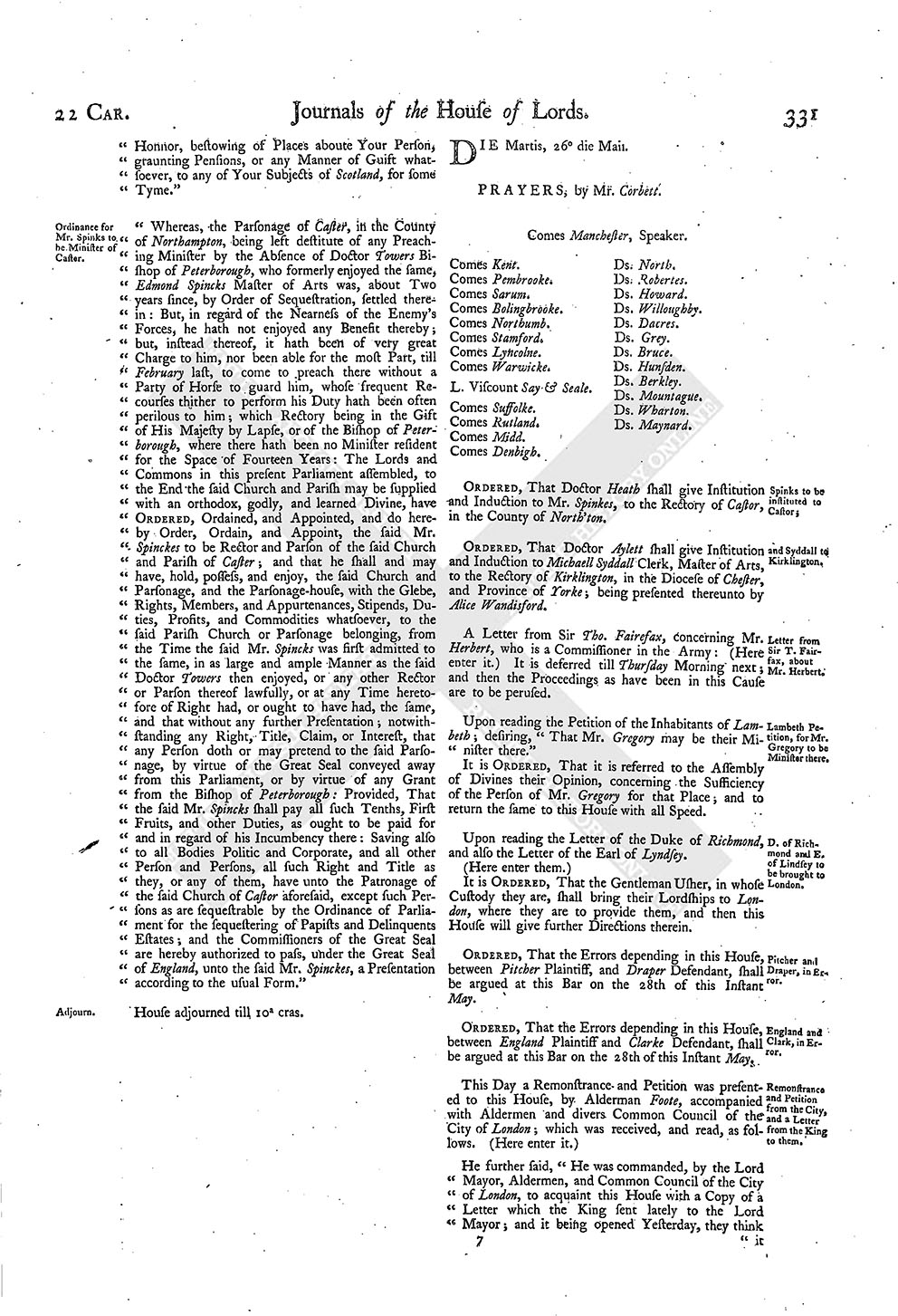
"Wee are further commaunded to represent (fn. 6) to Your Majesty, how usefull they conceive it would bee for Your Service, that Your Majesty would bee pleased to restraine Yourselfe from conferringe Tytles of Honnor, bestowing of Places aboute Your Person, graunting Pensions, or any Manner of Guift whatsoever, to any of Your Subjects of Scotland, for some Tyme."
Ordinance for Mr. Spinks to be Minister of Caster.
"Whereas, the Parsonage of Caster, in the County of Northampton, being left destitute of any Preaching Minister by the Absence of Doctor Towers Bishop of Peterborough, who formerly enjoyed the same, Edmond Spincks Master of Arts was, about Two years since, by Order of Sequestration, settled therein: But, in regard of the Nearness of the Enemy's Forces, he hath not enjoyed any Benefit thereby; but, instead thereof, it hath been of very great Charge to him, nor been able for the most Part, till February last, to come to preach there without a Party of Horse to guard him, whose frequent Recourses thither to perform his Duty hath been often perilous to him; which Rectory being in the Gift of His Majesty by Lapse, or of the Bishop of Peterborough, where there hath been no Minister resident for the Space of Fourteen Years: The Lords and Commons in this present Parliament assembled, to the End the said Church and Parish may be supplied with an orthodox, godly, and learned Divine, have Ordered, Ordained, and Appointed, and do hereby Order, Ordain, and Appoint, the said Mr. Spinckes to be Rector and Parson of the said Church and Parish of Caster; and that he shall and may have, hold, possess, and enjoy, the said Church and Parsonage, and the Parsonage-house, with the Glebe, Rights, Members, and Appurtenances, Stipends, Duties, Profits, and Commodities whatsoever, to the said Parish Church or Parsonage belonging, from the Time the said Mr. Spincks was first admitted to the same, in as large and ample Manner as the said Doctor Towers then enjoyed, or any other Rector or Parson thereof lawfully, or at any Time heretofore of Right had, or ought to have had, the same, and that without any further Presentation; notwithstanding any Right, Title, Claim, or Interest, that any Person doth or may pretend to the said Parsonage, by virtue of the Great Seal conveyed away from this Parliament, or by virtue of any Grant from the Bishop of Peterborough: Provided, That the said Mr. Spincks shall pay all such Tenths, First Fruits, and other Duties, as ought to be paid for and in regard of his Incumbency there: Saving also to all Bodies Politic and Corporate, and all other Person and Persons, all such Right and Title as they, or any of them, have unto the Patronage of the said Church of Castor aforesaid, except such Persons as are sequestrable by the Ordinance of Parliament for the sequestering of Papists and Delinquents Estates; and the Commissioners of the Great Seal are hereby authorized to pass, under the Great Seal of England, unto the said Mr. Spinckes, a Presentation according to the usual Form."
Adjourn.
House adjourned till 10a cras.