
Journal of the House of Lords: Volume 4, 1629-42. Originally published by His Majesty's Stationery Office, London, 1767-1830.
This free content was digitised by double rekeying. All rights reserved.
'House of Lords Journal Volume 4: 31 January 1642', in Journal of the House of Lords: Volume 4, 1629-42, (London, 1767-1830) pp. 551-555. British History Online https://www.british-history.ac.uk/lords-jrnl/vol4/pp551-555 [accessed 25 April 2024]


In this section
Die Lunæ, videlicet, 31 die Januarii.
Prayers.
The Duke of Richmond brought in his Answer in Writing to the Charge brought against him from the House of Commons on Saturday last, which his Grace, standing in his Place, read, in hæc verba:
Duke of Richmond's Answer.
The Reason of this Vote of the House of Commons (which to me must prove very heavy if it light upon me) are grounded upon these Three Reasons:
1. That, by Labour to have such Members chosen as I should name, and my Way of Menace afterward, did discover an Intention to overthrow the Freedom of Elections, and make a Party in Parliament.
2. That I did endeavour to corrupt Members of the House of Commons, after they were elected, even in a Matter of the highest Nature, for Support of Delinquents.
3. A Motion made in this House, which, if effected, would certainly be the Loss of Ireland, and hazard the Ruin of this Kingdom, and in Consequence make that necessary and good Act of Parliament for the Continuance of this present Parliament ineffectual.
And, upon these Three Reasons, the House of Commons have desired your Lordships to join with them in Petition to His Majesty,
That I might not have any Access to the Persons or Courts of the King or Queen's Majesty:
That I might be removed from all Offices and Places of Public Trust:
That this may be done with all Speed, in regard of the great Places of Trust and Confidence that I hold.
This is the Charge.
Though these Requests, if put in Execution, would much afflict me, yet the Sense of the House of Commons ill Opinion (which I judge by their Vote), which hath rendered me one of the malignant Party and an evil Counsellor to His Majesty, is a greater Cross than any that hath yet befallen me.
But I have this Comfort, that, as the House of Commons have passed this Vote, and made these Requests, upon me, without hearing my Defence; so that, when your Lordships shall have received my clear and ingenuous Answer; you, I hope, will be so far from joining in any such Request to His Majesty, that I shall presume to be an humble Suitor to your Lordships to clear my Innocence to the House of Commons, and set me right in their good Opinions, which I much desire, who, I doubt not, are so just as that they will be as ready to acquit as condemn, according as the Cause shall appear unto them.
And to your Lordships I affirm, by all that may procure Belief, that I did never malign the Prosperity and Happiness of the King and Kingdom or Parliament (my Interest in either may be some Persuasion to justify what I say), or did give the King my Master any Counsel whatsoever, but what in my own Heart I conceived to tend to the Advancement of His Honour, the Maintenance of the Public Good of the Kingdom, the Union of the King and His People each to other, and a right Understanding and Correspondence between Him and His Parliament.
And, from my Heart, cannot but declare against any, if there be, of a contrary Opinion: So far I am from a Thought of Prejudice to the Kingdom of Ireland, that I would rejoice as much to see the Protestants there settled in Peace, and their Possessions and the Protestant Religion there established, and the Rebels there suppressed, and that Kingdom reduced to Obedience, as any of His Majesty's Subjects, and be as ready to join in giving Assistance to effect it. And I crave Leave to let your Lordships know, that I have some Months since sent into Ireland, of my own, Thirty-nine Barrels of Powder, One Hundred and Twenty Muskets and Pikes, Sixty Corslets and Head-pieces, besides Match and Bullets both for great Ordnance and Muskets, to Colmore Castle, for the Defence of that and Londonderry, and the Country about; and I left One Hundred Pounds Sterling in my Agent's Hands, for the defraying the Charge of Transporting those Things.
To apply myself now to the particular Reasons of the Vote against me; it rests upon the Truth of the Fact, and your Lordships Judgement upon it, either to acquit or condemn me.
I shall wholly submit to your Lordships Judgement; but I must crave your Lordships Pardon for giving any Answer at all to the Third of the Reasons, touching what passed from me in this House, as well in respect of the Privilege of this House, where Things of that Nature (as I conceive) are to be questioned, as for that your Lordships have formerly taken the same into your Consideration, and I have undergone and performed your Lordships Sentence thereupon, before this Accusation; and I know it will not seem just to your Lordships that I should be in worse Condition than any other Subject, to receive a double Punishment for one and the same Offence; and I know your Lordships cannot but conceive it to be of more than ordinary Consequence in the Precedent.
For the other, I shall give your Lordships a distinct Answer, and must crave your Lordships Leave to deny some Things which have been charged upon me; but I shall ingenuously confess whatsoever I know to be a Truth touching these Things, how prejudicial soever it may prove to me, and rely more upon my own Innocence, than defend myself by denying a Truth, or affirming what is not a Truth.
Magna est Veritas, et prævalet.
I wish it may do so in what concerns me.
Regnet Justitia, et ruat Cælum.
I conceive the Proof for the First Reason inducing the House of Commons to believe an Intention in me to overthrow the Freedom of Election, and make a Party in Parliament, is upon the Information of Sir Henry Hayman, that I did write unto the Town of Hyth, to chuse one Captain Wimberly to serve for one of the Barons there, in this present Parliament; but he was not chosen. The Gentleman that gave this Information I do not know, but Information in this is true; and, if it be an Offence, I shall be so far my own Accuser that I have here brought a true Copy of that Letter which I sent to that Port (with a Witness who is (fn. 1) without to attest it), and shall desire your Lordships Judgement upon it; and other Recommendation than by that Letter only, I never made to that Town; but I was so far (before this Accusation) from thinking it an Offence, that I confess to your Lordships I wrote the like Letter to other Places within the Jurisdiction of the Ports; and I was informed that the Warden of the Cinque Ports had in all Times done the like.
But, it being no more but a bare Recommendation, their Choice was left free, and in some of those Places my Request prevailed, in some not; but I had never so much as a Thought of Evil against any who gave his Voice against the Party commended, and will hazard my Honour and Fortune, that no Man can affirm that I ever gave him the least Check upon that Occasion.
For the Copy of the Letter written by Captain Collins, suggested to be one of my Officers, and signified to be my Directions, I consess that Captain Collins was Deputy for the Lieutenancy of Dover-castle, which is under my Command; but whether Captain Collins wrote such a Letter or not to the Port of Hyth, I know not; but this I know for certain, that my Directions imported not so much; and I hope your Lordships will not deem it just to charge me with so high a Crime, drawing on so heavy a Punishment, for what an Under-officer shall do without my Knowledge, and yet shall in this conceal no Tittle of Truth from your Lordships; for it is true I did write to Captain Collins, and I shall shew your Lordships the very Letter itself, which I have sent for since your last Sitting; and, when I have told your Lordships the Occasion (which I shall make good by Proof, and by a Witness who is ready without, for I desire no Delay, the Burthen which I sit under is so heavy), your Lordships, by comparing the Letter with the Occasion, will, I am confident, find it far from a Crime; and the Occasion was this: I being Warden of the Cinque Ports, and the Writ of Summons of Parliament directed to me, I make Warrants to the several Ports for Election of their Barons, who, when they have made their Elections, return them to me, and I return them, with the Writ of Summons, to the Parliament; and I having made Warrants accordingly to the Ports, and received and returned their Barons elected, I was informed from the Port of Sandwich, that some had given Voices in their Elections which took Alms of the Town, and some other Questions moved here touching Election in other Places, for one of which there was a Petition in Parliament; Rye, as I was informed.
And, because I might be able to give an Account touching those Elections if Occasion were, I wrote for all the Ports in general, to be certified how the Elections went by the Poll; that is, to know how many Voices went for one, and how many for another; but for their Names I wrote not, though I had Ground given me by the Complaint of Sandwich; and, if Captain Collins, upon this Letter of mine, have been over exact, I hope that shall not turn to my Prejudice, nor his, since there was no ill Intent, or hath been any ill Consequence upon it. And this I affirm confidently to your Lordships, that not one Elector, in any of the Ports, was ever menaced or ill used by me, or my Direction. And I cannot be disproved in this; and your Lordships will hardly believe I wrote to Captain Collins out of any Intention of Revenge, when as, by the same Letter, I desired to be certified of the Poll in all the Ports, as well where the Party recommended by me was elected, as where he was not.
This is the whole Truth, and my Answer touching that Business; and, if it be an Offence to write a Letter to recommend a Gentleman for an Election, yet I hope it will not deserve so severe a Punishment; sure I am, I never understood it an Offence, for, if I had, I should not have done it myself, or believe it so generally done by others, who, I hope, shall never come in Danger of Punishment for it; and, before I go to the Second Head, I desire your Lordships to hear the Letters, and a Witness to prove the Occasion.
His Letter to Hythe, recommending Capt. Wimberly to be their Member.
My very loving Friends,
I have received a Writ, directed unto me, as Constable of Dover-castle, and Warden of the Cinque Ports, declaring His Majesty's Gracious Intention of a Parliament to meet at Westm. the Third of November next, whereof I now give you Notice, that, according to the usual Custom, you make Choice of your Barons, to attend His Majesty's Commands, at the Time and Place appointed; and, that this general Assembly may, as much as in you lies, be both happy to our King and Country, I recommend to your Care the Choice of such Persons as may only intend and most contribute to that End; because the Interest that I have now obligeth me to a particular Care of you in the Ports and Members, that, as you do your Duties in the general, so you look Home to yourselves and just Privileges, I can do no less than think upon some fit Persons to recommend to your Choice: I therefore desire your Town should elect Bevill Wimberly, Esquire, to be One of the Barons for your Corporation at this ensuing Session of Parliament, he being one whom I am most assured will shew himself zealous for the Public Good, or any just Thing wherein the Ports or your Town is concerned. I shall not use, nor I hope need, any Words of Precedent, to persuade this usual Respect to your Warden, by whose Care to maintain your Privileges as you have already received some Benefit, so you shall in every fitting Occasion hereafter bind him.
Octob. 3, 1640.
"Your loving Friend,
"J. (fn. 2) Lenos.
"To my Loving Friends, the Mayor and Jurato of Hythe."
Most Gracious Lord,
Answer from thence.
Your Grace's Letter, bearing Date at Yorke, the 3d of this present, we received the 12th; and, in regard it was directed to the Mayor and Corporation, we could not give your Grace such a satisfactory Answer as we for our Parts did desire; and therefore, this present Day, we called an Assembly, and acquainted the whole Corporation with your Grace's Request, and the Noble Person whom you recommended; but, far beyond our Expectation, and further beyond our Desires, we found many of them refractory. All the gracious Favours which we have received from your Grace, to maintain our Privileges (which we are most sensible of, and most thankful for, and repeated the same to them), could move those no more than to grant that he should be put in Election. The best of the whole Town embrace your Grace's Request with all Thankfulness; and the major Part of those that are so refractory are of the meanest Sort, and such as some of them are relieved by the Parishes where they live. Another Sort of them there are, which are more reserved; and, as we are credibly informed, adhere and have promised their Voices to one Mr. Parcheriche, a Stranger to us, who, before we had the least Notice of a Parliament, came hither, and hath drawn to him a great Number of Voices, insomuch as it is generally reported, and said in Town, that he shall be One of the Barons; and the same likewise appeareth by his own Letter, which we received this Day, without Date, wherein he expressed that he had now received Encouragement from most of the Corporation. These refractory Carriages of the Commons made us justly sorry; and yet nevertheless, notwithstanding all these Oppositions, we for our Parts are, and always shall be, ready, to the uttermost of (fn. 3) our Powers, not only to give our Voices for the Noble Personage whom you recommend, but to gain as many Votes for him, both by ourselves and Friends, as we can, and draw others, which stand Neuters, to our Party, and most humbly and willingly to embrace your Grace's Request, and readily grant the same; and so, in all Humility, we take our Leaves, and ever rest,
"Your Grace's most humble Servants to command,
Sandwich, 13 Oct. 1640.
"The Mayor and Jurats of Sandwich.
To our most Gracious Lord, the Lord Duke of Lenox his Grace, Constable of DoverCastle, Lord Warden, Chancellor, and Admiral of the Cinque Ports and their Members, Knight of the most Honourable Order of the Garter, and of His Majesty's most Honourable Privy Council. Present. These.
Captain Collins,
I have received from you those Returns of Elections the several Corporations of the Ports and Members have made of their Barons to Parliament, which I have, according to the usual Form, transmitted into the House of Commons; since the doing whereof, I hear of Questions that are likely to arise, concerning some of their Elections; wherefore I desire you, for my better Information, to require the Election of every Corporation by the Poll, that I may be able to give the House Satisfaction when they shall call upon the same, without Delay, or the Trouble of sending down; and this I would have you hasten, to be here at farthest with your own Up-coming.
November the 9th, 1640.
"Your Loving Friend,
"J. Lenos.
To my Loving Friend Captain Collins, Deputy for the Lieutenancy of DoverCastle. These.
2. The Second and only remaining Thing to be answered is, the endeavouring to corrupt the Members of the House of Commons after they were elected, for Support of Delinquents. The Offence that is charged, I am confident your Lordships will not find me guilty of.
All the Instance for Proof of this Charge against me is only upon a Message pretended to be delivered to one Mr. Perd, a Member of the House of Commons, by my Steward, who is my Cousin, Adrian Scrope, and some Speeches and Gestures of mine to Mr. Perd some Time after that Message. I know your Lordships will not take it upon an implicit Faith that it is true because it is charged against me; but I must crave your noble Justice as a Free Subject, as well as a Peer, to be judged secundum probata, as well as allegata; and, notwithstanding this Misfortune which is fallen upon me, I hope you believe I will not tell your Lordships an Untruth.
I confess I sent my Steward to Mr. Perd; and he being one who hath long been with me, I ever observed to carry himself honestly, and like a Gentleman, and that gives me Confidence that he delivered no such Message to Mr. Perd from me as is charged; and I protest to your Lordships, upon my Honour, that the Message I sent was no more than to this Purpose; that, if in the Business of Mr. Percy it fell in his Way to do him any just Favour, that I should take it as a Courtesy, and express it to him upon any fair Occasion; and this was without any other Intimation or particular Request whatsoever; and I am confident my Servant delivered it to him no otherwise, for he brought me a civil Answer of his Readiness to do any Thing he might with a good Conscience, which was as much as I desired; and I was so far from taking Offence, that, when I spake to Mr. Perd, it was only to avow my Servant, and to give him Thanks, and there was no such Thing as was informed now by him. Now, my Lords, Mr. Percy being my old Acquaintance, at School, in our Travels, and here at Home having lived Friends together, I thought I could not do less than to ask just Favours for him in his Distress. There was no unlawful Thing desired, no Bribe offered; if this be an Offence, as I hope it is not, yet I am confident it will not be so heinous as to draw so heavy a Censure upon me.
And because, my Lords, I would be quit of this great Burthen, I have caused Scrope to attend without, and desire your Lordships to examine him upon his Oath, touching the Trust of the Message, and what passed between Mr. Perd and him, for I am guilty of no Tittle more than what I have confessed to your Lordships. I know not what had passed in the House of Commons, or that Mr. Perd had ever spoken in that Business; and, if Scrope have desired him not to press that Business, or persuaded him not to call upon it, or intimated any Thing of the King or the Queen (which I believe he did not), it was without any Direction from me; and let him answer for it.
But I rather believe there was no Ill in the Message, because Mr. Perd did not then, nor at any Time since till this Question in the House of Commons, call upon him or me concerning it.
My Lords, I am no Lawyer, or Orator; but I am a Gentleman, and in that Consideration so much concerned in what is moved against me, as, though Life or a total Confiscation is not desired, yet, upon the Consequence of it, so much of Honour and Reputation depending, that I esteem it equal to any of those Censures; but I have so much Innocence in me, that I am confident that I cannot miscarry by your Lordships Judgement, and therefore have adventured to make my own Defence, who best know the Truth of mine own Heart, and so submit myself and Cause, which concerns me all I am, to your Lordships Judgement.
Richmond."
This being ended, his Grace desired, "That Thomas Webb, his Secretary, might upon Oath relate the Occasion of writing the Letters to the Port Towns, which was upon Complaint made to his Grace of the Manner of the Elections."
Message to the H. C. for Witnesses to be examined, touching their Complaint against the D. of Richmond.
Then a Message was sent to the House of Commons, by Sir Edward Leech and Doctor Bennett:
To let them know, that, in regard of their Offer at the Conference on Saturday, their Lordships desire that Sir Henry Heyman and Mr. Perd may come to this House, and, upon Oath, testify what they know concerning the Business touching the Duke of Richmond.
Tonnage and Poundage Bill.
Hodie 2a et 3a vice lecta est Billa, A Subsidy granted to the King, of Tonnage and Poundage, and other Sums of Money, payable upon Merchandize exported and imported.
And, being put to the Question, it was Resolved to pass as a Law.
Ebron, &c. sent for, to make their Submission for Contempt of the House.
The Lord Chief Justice reported, "That William Ebbron, William Crosse, George Reynolds, and George Thacker, (fn. 4) have refused to make their Acknowledgement before him of their Faults in disobeying the Order of this House:" Hereupon it is Order ed, That the Parties aforesaid shall be brought before this House To-morrow, and make their Submission for disobeying the Order of this House.
Bp. of Winton sworn in the Bishops Cause.
The Bishop of Winton, at the Desire of the Committee of the House of Commons, was sworn, and is to be examined in the Cause touching the Twelve Bishops that are impeached for High Treason.
Colonel Fitzwilliams, Four Hundred Irish for France.
Ordered, etc. That Colonel Fitzwilliams shall have Power, by virtue hereof, either by himself or by his Officers, to take up Four Hundred Irishmen, Voluntiers, by way of Recruits, and to send them into France; and, to the End that the said Irish, being so taken up, shall be carried only into France, the said Colonel Fitzwilliams is to enter into a Recognizance of One Thousand Pounds unto His Majesty, before the Lord Chief Justice of the King's Bench, that he shall take up only Irishmen for the making up of the said Number of Four Hundred, and to transport them only into the said Kingdom of France, as aforesaid.
The Lord Keeper reported, "That he had received a Letter from the King, with a Message to both Houses inclosed;" which were read, in hæc verba:
"CHARLES R.
The King's Message about the Book of Rates.
"Right Trusty and Well-beloved, We greet you well. Our Will and Pleasure is, That you deliver the Message inclosed, to be read in Our House of Peers, immediately before the passing of the Bill for Tonnage and Poundage; for which this shall be your Warrant. Given at Our Court at Windsor, the last Day of January 1641.
"Though His Majesty, having passed more Acts of Justice and Grace in this Parliament than have been past by (fn. 5) any of His Royal Ancestors, might well expect, from the Affection and Gratitude of His Parliament, to have received the Subsidy of Tonnage and Poundage for no less a Time than it hath been granted to any of His Predecessors; yet, in regard that, by a Clause in the Bill, He finds that His Parliament intends not to continue the old Book of Rates, and the settling a new one must require some Time, and in respect that otherwise it might beget an Interruption of Trade, give an Advantage to Foreign States, and leave the Seas unguarded, to the Danger of this Kingdom and Ireland, hath, at this Time, given a Commission for the passing of this present Bill the 25th of March; not doubting but, as soon as they may comply with their extraordinary Affairs, they will settle a new Book of Rates, and, by granting this Subsidy in the usual Manner, give a Proof of their Intention, which they have often expressed (for which He (fn. 6) is fully satisfied), to consider no less both His Subsistance and Splendor than their own Liberties and Interests."
Royal Assent to the Bills, by Commission.
Then the Lords Commissioners, being set upon a Form across the House, to give the Royal Assent to Two Bills, the House of Commons were sent for, who being come, with their Speaker, the King's Message was read before both Houses. Next the Commission was read; and then the Clerk of the Crown read the Titles of the Two Bills: videlicet,
1. An Act for a speedy Contribution and Loan, towards the Relief of His Majesty's distressed Subjects of the Kingdom of Ireland.
2. A Subsidy of Tonnage and Poundage, granted to the King, and other Sums of Money payable upon Merchandize exported and imported.
This Bill was not annexed to the Commission.
Then the Clerk of the Parliament pronounced the Royal Assent to them severally; which being ended, the House of Commons went to their own House.
A Message was brought from the House of Commons, by Mr. Walter Longe:
Message from the H. C. for Conference about the Petition of the Artificers of London.
To desire a Conference, by a Committee of both Houses, touching a Petition, which (fn. 7) the House of Commons have received from the Artificers in and about London.
The Answer returned was:
Answer.
That their Lordships will give a present Meeting, as is desired, in the Painted Chamber.
The King's Answer about Ld. Kymbolton, etc. referred.
Ordered, That the King's Answer to the Petition of both Houses, concerning the Lord Kymbolton, and the Five Members of the House of Commons, is referred to the same Committee as was appointed to draw the Petition; and their Lordships are to consider what is fit to be done thereupon, and to report the same to the House.
The House was adjourned during Pleasure, and the Lords went to the Conference; which being ended, the House was resumed.
The Earl of Southampton's Servant to be examined by the H. C.
The Earl of South'ton informed the House, "That he understood a Servant of his had spoken some unfitting Words, which the House of Commons were made acquainted with. His Lordship declared he was willing to withdraw his Protection from him, that his Man may be examined by the House of Commons."
Inigo Jones, Ne exeat Regnum.
It was informed, "That Inigo Jones, being declared against in this House by the House of Commons, for pulling down St. Gregorie's Church in London, and there being Proceedings thereupon, that he intends to go out of the Kingdom, to avoid the Judgement of this House:" It is Ordered, That the Lord Keeper do forthwith issue out a Writ of Ne exeat Regnum against him.
Trial of the Twelve Bishops deferred.
Ordered, That the Trial of the Twelve Bishops of High Treason by the House of Commons shall be put off until Friday next.
A Message was sent to the House of Commons, by Serjeant Ayliffe and Serjeant Glanvile:
Message to the H. C. to acquaint them with it.
To let them know, that this House hath deferred the Trial of the Twelve Bishops until Friday next; in the mean Time, any Three of the Lords Committees may examine what Witnesses the House of Commons shall desire and produce.
The Lord Lieutenant of Ireland delivered in a Paper from the Scotts Commissioners, which was read, in hæc verba: videlicet,
Request of the Scots Commissioners.
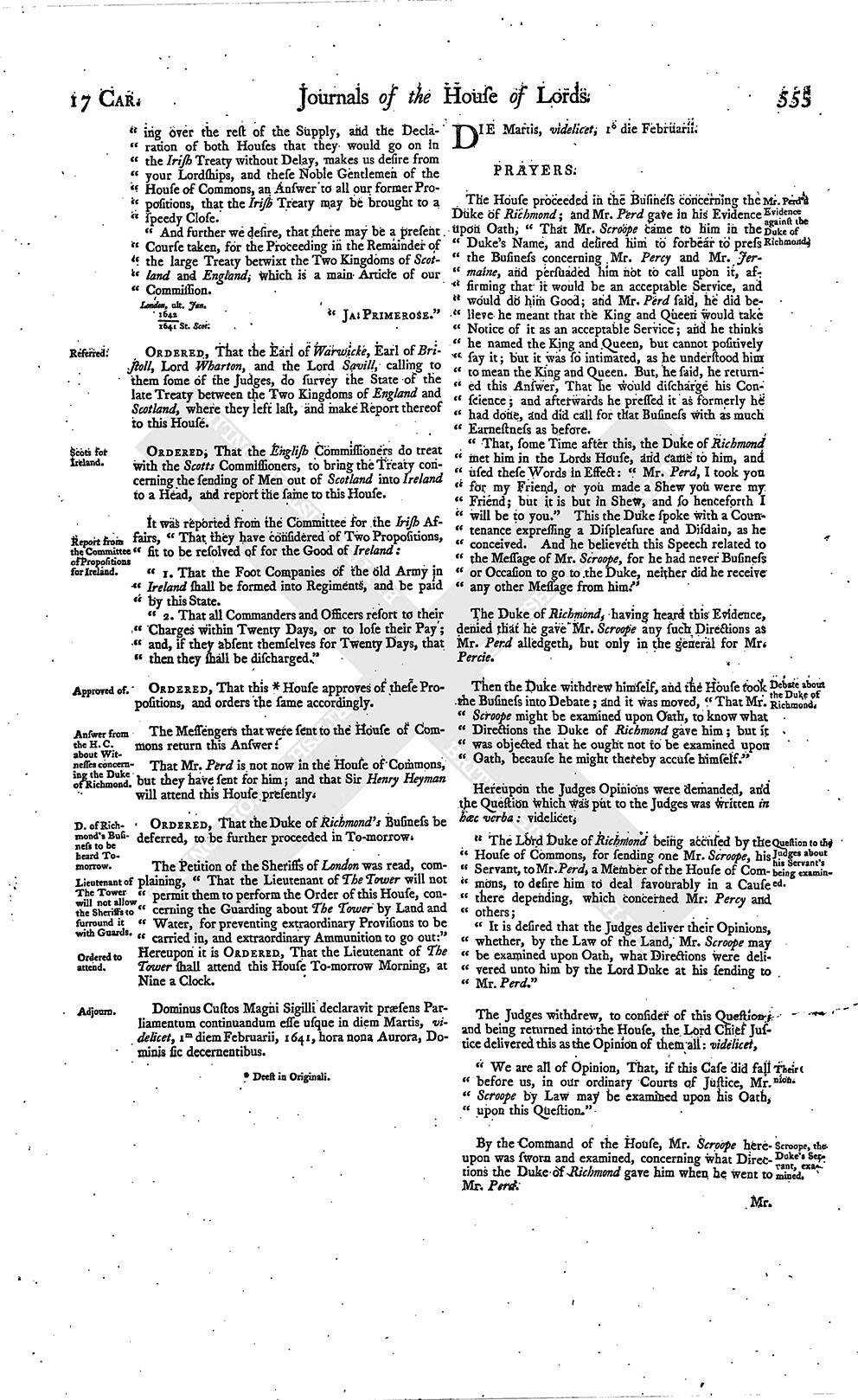
"The many Reports we receive from Scotland of the miserable Condition of the Protestants in Ireland, which is daily increased, the Danger of Delay, in regard of their present Despair of Aid, and the Rebels their Hopes of Succours from abroad, the Consideration of the Length of Time which hath been passed since the giving in of our Propositions, and which will be spent in resolving the Doubts which may arise from the Answers, or in levying and send ing over the rest of the Supply, and the Declaration of both Houses that they would go on in the Irish Treaty without Delay, makes us desire from your Lordships, and these Noble Gentlemen of the House of Commons, an Answer to all our former Propositions, that the Irish Treaty may be brought to a speedy Close.
And further we desire, that there may be a present Course taken, for the Proceeding in the Remainder of the large Treaty betwixt the Two Kingdoms of Scotland and England, which is a main Article of our Commission.
London, ult. Jan.
1642 16/41; St. Scot.
"Ja. Primerose."
Referred.
Ordered, That the Earl of Warwicke, Earl of Bristoll, Lord Wharton, and the Lord Savill, calling to them some of the Judges, do survey the State of the late Treaty between the Two Kingdoms of England and Scotland, where they left last, and make Report thereof to this House.
Scots for Ireland.
Ordered, That the English Commissioners do treat with the Scotts Commissioners, to bring the Treaty concerning the sending of Men out of Scotland into Ireland to a Head, and report the same to this House.
Report from the Committee of Propositions for Ireland.
It was reported from the Committee for the Irish Affairs, "That they have considered of Two Propositions, fit to be resolved of for the Good of Ireland:
"1. That the Foot Companies of the old Army in Ireland shall be formed into Regiments, and be paid by this State.
"2. That all Commanders and Officers resort to their Charges within Twenty Days, or to lose their Pay; and, if they absent themselves for Twenty Days, that then they shall be discharged."
Approved of.
Ordered, That this (fn. 8) House approves of these Propositions, and orders the same accordingly.
Answer from the H. C. about Witnesses concerning the Duke of Richmond.
The Messengers that were sent to the House of Commons return this Answer:
That Mr. Perd is not now in the House of Commons, but they have sent for him; and that Sir Henry Heyman will attend this House presently.
D. of Richmond's Business to be heard Tomorrow.
Ordered, That the Duke of Richmond's Business be deferred, to be further proceeded in To-morrow.
Lieutenant of The Tower will not allow the Sheriffs to surround it with Guards.
The Petition of the Sheriffs of London was read, complaining, "That the Lieutenant of The Tower will not permit them to perform the Order of this House, concerning the Guarding about The Tower by Land and Water, for preventing extraordinary Provisions to be carried in, and extraordinary Ammunition to go out:"
Ordered to attend.
Hereupon it is Ordered, That the Lieutenant of The Tower shall attend this House To-morrow Morning, at Nine a Clock.
Adjourn.
Dominus Custos Magni Sigilli declaravit præsens Parliamentum continuandum esse usque in diem Martis, videlicet, 1m diem Februarii, 1641, hora nona Aurora, Dominis sic decernentibus.