
Journal of the House of Lords: Volume 4, 1629-42. Originally published by His Majesty's Stationery Office, London, 1767-1830.
This free content was digitised by double rekeying. All rights reserved.
'House of Lords Journal Volume 4: 15 March 1642', in Journal of the House of Lords: Volume 4, 1629-42, (London, 1767-1830) pp. 645-646. British History Online https://www.british-history.ac.uk/lords-jrnl/vol4/pp645-646 [accessed 26 April 2024]

In this section
DIE Martis, videlicet, 15 die Martii.
PRAYERS.
Resolutions of the House in the Attorney General's Cause, with Protests against some of them.
The House took into Consideration the Business concerning Mr. Attorney General, what Judgement to give upon the Impeachment brought up from the House of Commons against him, for advising, contriving, and exhibiting Articles of Accusation, against the Lord Kymbolton, Denzell Holles, Esquire, Sir Arthur Haselrigg, Baronet, John Pym, John Hampden, and William Strode, Esquires; and, after a long and serious Debate, it was put to the Question,
"Whether, upon the whole Matter, Mr. Attorney General hath committed a Crime, for which he ought to be sentenced by this House?"
And it was Resolved affirmatively.
2. The Second Question was:
"Whether Mr. Attorney General, for this Offence, shall lose his Place of Attorneyship?"
And it was Resolved negatively.
These Lords following, before the putting of this Question, desired Leave to enter their Dissents to this Vote; which accordingly they did: videlicet,
The Third Question was: "Whether Mr. Attorney General shall pay a Fine to the King, for this Offence?"
And it was Resolved negatively.
These Lords following dissented to this Vote: videlicet,
The Fourth Question was: "Whether Mr. Attorney General shall pay Damages for this Offence, to the Parties that were accused?"
And it was Resolved negatively.
These Lords following dissented to this Vote: videlicet,
The Fifth Question was: "Whether Mr. Attorney shall be committed to The Tower for his Offence?"
And it was Resolved negatively.
These Lords following dissented to this Vote: videlicet.
Ds. Howard de Charlton.
Ds. Savill.
Ds. Seymour.
Bill for exempting Four Shires from the Marches of Wales.
Ordered, That the Bill for the exempting of the Four Shires from the Jurisdiction of the Marches of Wales, shall be proceeded in here at this Bar on Tuesday next, being the 22d of this instant March; and hereof those Persons that are concerned herein, or their Agents, are to have Notice, to attend the said Hearing accordingly.
Adjourn.
Dominus Custos Magni Sigilli declaravit præsens Parliamentum continuandum esse usque in post meridiem hujus instantis diei, hora 3a, Dominis sic decernentibus.
Post meridiem.
PRAYERS.
A Message was brought from the House of Commons, by Sir Henry Vane, Junior; which consisted of Two Parts:
Message from the H. C. about equipping the Summer's Fleet.
"1. That whereas both Houses have Resolved to set forth a Fleet of Ships this Year, for the Guarding of the Seas, which they hold to be a Thing of great Consequence; the House of Commons have passed a Vote, wherein they desire their Lordships Concurrence; videlicet, That the Lord Admiral shall be desired, that the Commander in Chief in this Summer's Fleet under his Lordship may be the Earl of Warwicke."
E. Warwick to command under the Lord Admiral.
Ordered, That this House joins and agrees with the House of Commons in this Vote; and that the Lord Admiral is hereby desired, from both Houses of Parliament, that the Commander in Chief of this Summer's Fleet under his Lordship, may be the Earl of Warwicke.
"2. That their Lordships would send them the Names of such Persons as are to be nominated by the Lords Lieutenants, to be Deputy Lieutenants of the several Counties of England and Dominion of Wales, according to the Ordinance of both Houses of Parliament for settling the Militia, that so they may be approved of by the Parliament."
Lords Lieutenants to name Deputy Lieutenants.
Ordered, That the Lords Lieutenants shall forthwith return the Names of such Persons as they think fit to be nominated to be Deputy Lieutenants, unto the Knights of the Shires that they are Lords Lieutenants of, that so they may be presented to the House of Commons, and receive Approbation.
The Answer returned by the Messengers was:
Answer to the H. C.
That this House hath agreed with the House of Commons in the Vote concerning the Earl of Warwicke; and that the Lords Lieutenants are Ordered to return the Names of Deputy Lieutenants to the Knights of the several Shires forthwith.
Message from the H. C. for the Lords to concur in some Votes for drawing up Heads for a Declaration.
A Message was brought from the House of Commons, by Mr. Nath. Fynes:
To acquaint their Lordships with some Votes made by the House of Commons, wherein they desire their Lordships Concurrence; which Votes are to be Heads for a Declaration to be drawn up by the Committee.
The said Votes were read, in hæc verba: videlicet,
Vote for putting the Kingdom into a Posture of Defence.
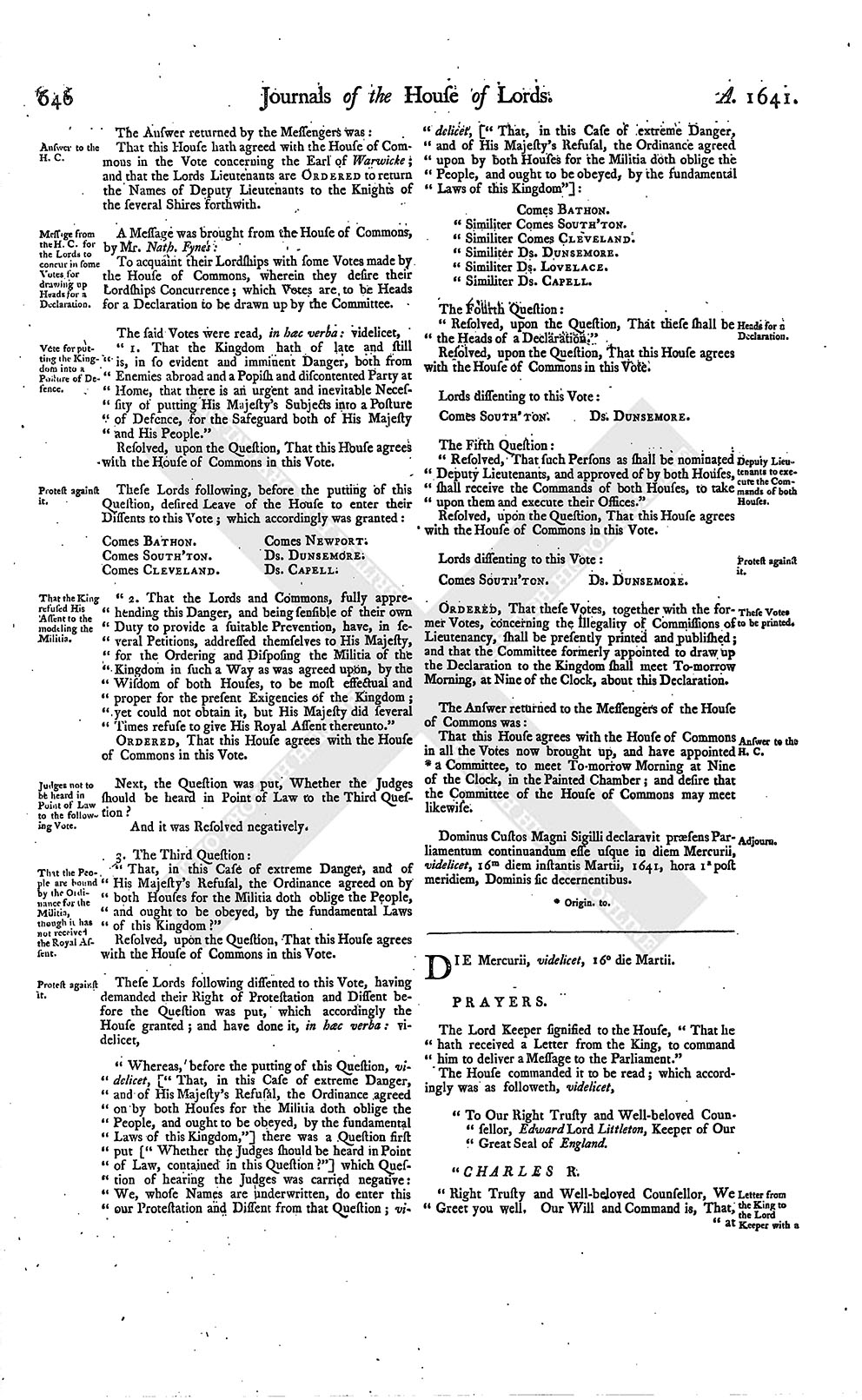
"1. That the Kingdom hath of late and still is, in so evident and imminent Danger, both from Enemies abroad and a Popish and discontented Party at Home, that there is an urgent and inevitable Necessity of putting His Majesty's Subjects into a Posture of Defence, for the Safeguard both of His Majesty and His People."
Resolved, upon the Question, That this House agrees with the House of Commons in this Vote.
Protest against it.
These Lords following, before the putting of this Question, desired Leave of the House to enter their Dissents to this Vote; which accordingly was granted:
That the King refused His Assent to the modeling the Militia.
"2. That the Lords and Commons, fully apprehending this Danger, and being sensible of their own Duty to provide a suitable Prevention, have, in several Petitions, addressed themselves to His Majesty, for the Ordering and Disposing the Militia of the Kingdom in such a Way as was agreed upon, by the Wisdom of both Houses, to be most effectual and proper for the present Exigencies of the Kingdom; yet could not obtain it, but His Majesty did several Times refuse to give His Royal Assent thereunto."
Ordered, That this House agrees with the House of Commons in this Vote.
Judges not to be heard in Point of Law to the following Vote.
Next, the Question was put, Whether the Judges should be heard in Point of Law to the Third Question?
And it was Resolved negatively.
3. The Third Question:
That the People are bound by the Ordinance for the Militia, though it has not received the Royal Assent.
"That, in this Case of extreme Danger, and of His Majesty's Refusal, the Ordinance agreed on by both Houses for the Militia doth oblige the People, and ought to be obeyed, by the fundamental Laws of this Kingdom?"
Resolved, upon the Question, That this House agrees with the House of Commons in this Vote.
Protest against it.
These Lords following dissented to this Vote, having demanded their Right of Protestation and Dissent before the Question was put, which accordingly the House granted; and have done it, in hæc verba: videlicet,
"Whereas, before the putting of this Question, videlicet, ["That, in this Case of extreme Danger, and of His Majesty's Refusal, the Ordinance agreed on by both Houses for the Militia doth oblige the People, and ought to be obeyed, by the fundamental Laws of this Kingdom,"] there was a Question first put ["Whether the Judges should be heard in Point of Law, contained in this Question?"] which Question of hearing the Judges was carried negative: We, whose Names are underwritten, do enter this our Protestation and Dissent from that Question; videlicet, ["That, in this Case of extreme Danger, and of His Majesty's Refusal, the Ordinance agreed upon by both Houses for the Militia doth oblige the People, and ought to be obeyed, by the fundamental Laws of this Kingdom"]:
Comes Bathon.
Similiter Comes South'ton.
Similiter Comes Cleveland.
Similiter Ds. Dunsemore.
Similiter Ds. Lovelace.
Similiter Ds. Capell.
The Fourth Question:
Heads for a Declaration.
"Resolved, upon the Question, That these shall be the Heads of a Declaration."
Resolved, upon the Question, That this House agrees with the House of Commons in this Vote.
Lords dissenting to this Vote:
Comes South'ton.
Ds. Dunsemore.
The Fifth Question:
Deputy Lieutenants to execute the Commands of both Houses.
"Resolved, That such Persons as shall be nominated Deputy Lieutenants, and approved of by both Houses, shall receive the Commands of both Houses, to take upon them and execute their Offices."
Resolved, upon the Question, That this House agrees with the House of Commons in this Vote.
Protest against it.
Lords dissenting to this Vote:
Comes South'ton.
Ds. Dunsemore.
These Votes to be printed.
Ordered, That these Votes, together with the former Votes, concerning the Illegality of Commissions of Lieutenancy, shall be presently printed and published; and that the Committee formerly appointed to draw up the Declaration to the Kingdom shall meet To-morrow Morning, at Nine of the Clock, about this Declaration.
The Answer returned to the Messengers of the House of Commons was:
Answer to the H. C.
That this House agrees with the House of Commons in all the Votes now brought up, and have appointed (fn. 1) a Committee, to meet To-morrow Morning at Nine of the Clock, in the Painted Chamber; and desire that the Committee of the House of Commons may meet likewise.
Adjourn.
Dominus Custos Magni Sigilli declaravit præsens Parliamentum continuandum esse usque in diem Mercurii, videlicet, 16m diem instantis Martii, 1641, hora 1a post meridiem, Dominis sic decernentibus.