Journal of the House of Lords: Volume 4, 1629-42. Originally published by His Majesty's Stationery Office, London, 1767-1830.
This free content was digitised by double rekeying. All rights reserved.
'House of Lords Journal Volume 4: 19 March 1642', in Journal of the House of Lords: Volume 4, 1629-42(London, 1767-1830), British History Online https://www.british-history.ac.uk/lords-jrnl/vol4/pp653-658 [accessed 30 April 2025].
'House of Lords Journal Volume 4: 19 March 1642', in Journal of the House of Lords: Volume 4, 1629-42(London, 1767-1830), British History Online, accessed April 30, 2025, https://www.british-history.ac.uk/lords-jrnl/vol4/pp653-658.
"House of Lords Journal Volume 4: 19 March 1642". Journal of the House of Lords: Volume 4, 1629-42. (London, 1767-1830), British History Online. Web. 30 April 2025. https://www.british-history.ac.uk/lords-jrnl/vol4/pp653-658.



In this section
DIE Sabbati, videlicet, 19 die Martii.
PRAYERS.
Earl of Salisbury's Commissions brought in.
The Earl of Sarum brought in Two Commissions of Lieutenancy, one for the County of Hertford, the other for the County of Dorsett.
Gay, the Printer, in Custody.
William Gaye, the Printer that printed the Paper of the Discourse between His Majesty and the Committees of both Houses at the Delivery of the Declaration, was brought to the Bar; but, being asked of whom he had the Copy to print that by, he confessed he had it of Sir Edward Littleton's Clerk.
Sir Edward Littleton's Clerk sent for.
Hereupon the House Ordered, That Sir Edward Littleton's Clerk should be sent for, to be examined concerning this Business; and that the said William Gaye shall remain in the Custody of the Gentleman Usher, until the Pleasure of this House be further known.
Geo. Benyon's Petition of Submission.
To be bailed.
Upon reading the Petition of George Benyon, acknowledging, "That he is truly sensible and heartily sorrowful for that Offence which hath drawn upon him their Lordships Censure of his Restraint and Imprisonment in The Tower, professing it was far from his Intention in what he did to give any Offence to this House, or the House of Commons; therefore desires their Lordships will be pleased either to release him, or that he may go upon Bail, according as their Lordships shall please to appoint:" Hereupon this House Ordered, That the said George Benyon shall be brought before this House, and enter into Recognizance of Two Thousand Pounds, to answer such Matters as are now depending in this House against him; and that he shall appear before the said Lords in Parliament at Three Days next after Notice shall be left at his House to that Purpose; and this being done, he is to be released from his Imprisonment in The Tower.
A Ne excat Regnum against Dr. Hughes.
Ordered, That the Lord Keeper shall cause a Writ of Ne exeat Regnum against Henry Hughes, Doctor of Physick.
Bill against mixing Wines.
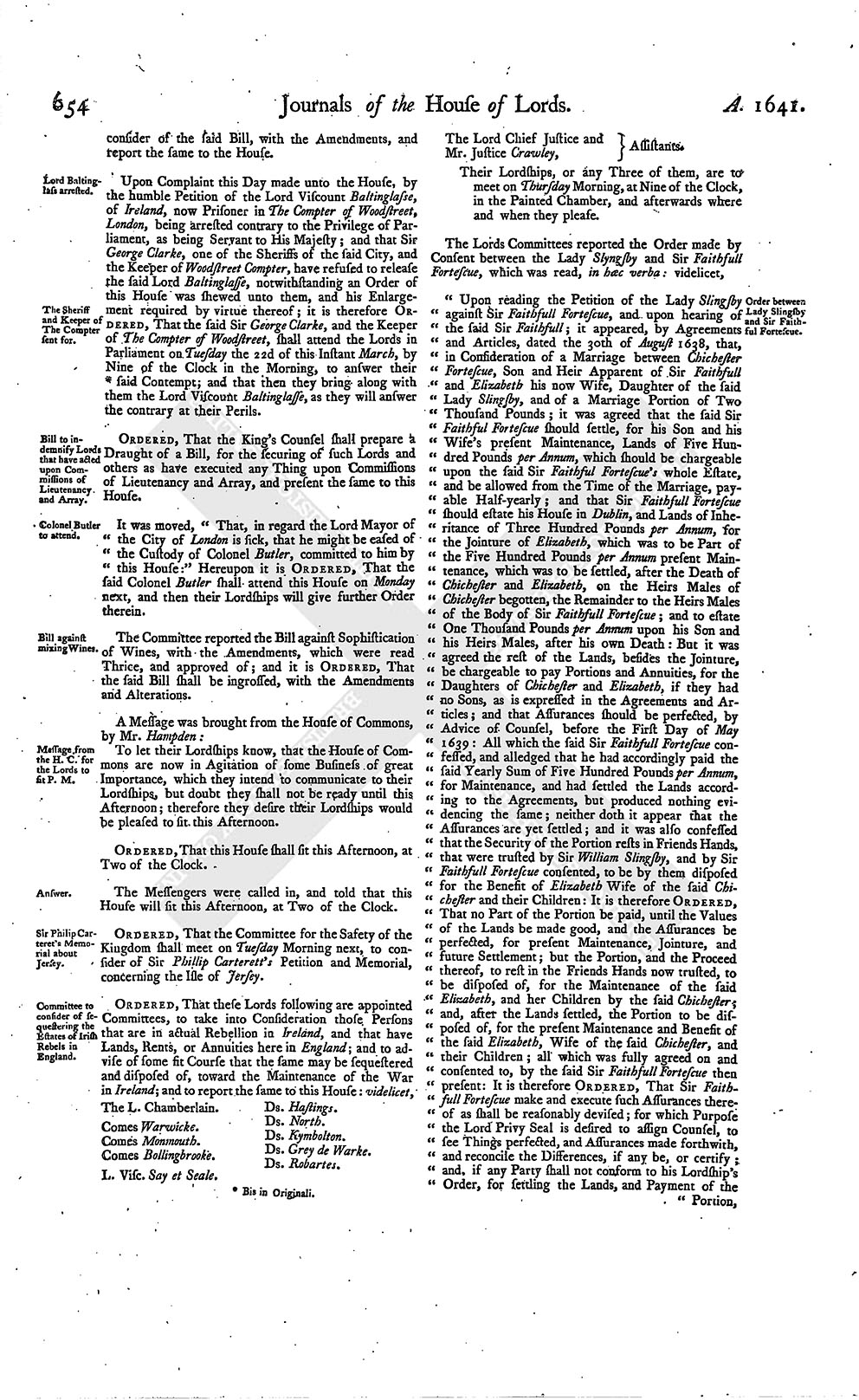
Ordered, That (fn. 1) the Committee for the Bill against the Sophistication of Wines shall presently meet, and consider of the said Bill, with the Amendments, and report the same to the House.
Lord Baltinglass arrested.
The Sheriff and Keeper of The Compter sent for.
Upon Complaint this Day made unto the House, by the humble Petition of the Lord Viscount Baltinglasse, of Ireland, now Prisoner in The Compter of Woodstreet, London, being arrested contrary to the Privilege of Parliament, as being Servant to His Majesty; and that Sir George Clarke, one of the Sheriffs of the said City, and the Keeper of Woodstreet Compter, have refused to release the said Lord Baltinglasse, notwithstanding an Order of this House was shewed unto them, and his Enlargement required by virtue thereof; it is therefore Ordered, That the said Sir George Clarke, and the Keeper of The Compter of Woodstreet, shall attend the Lords in Parliament on Tuesday the 22d of this Instant March, by Nine of the Clock in the Morning, to answer their (fn. 2) said Contempt; and that then they bring along with them the Lord Viscount Baltinglasse, as they will answer the contrary at their Perils.
Bill to indemnify Lords that have acted upon Commissions of Lieutenancy and Array.
Ordered, That the King's Counsel shall prepare a Draught of a Bill, for the securing of such Lords and others as have executed any Thing upon Commissions of Lieutenancy and Array, and present the same to this House.
Colonel Butler to attend.
It was moved, "That, in regard the Lord Mayor of the City of London is sick, that he might be eased of the Custody of Colonel Butler, committed to him by this House:" Hereupon it is Ordered, That the said Colonel Butler shall attend this House on Monday next, and then their Lordships will give further Order therein.
Bill against mixing Wines.
The Committee reported the Bill against Sophistication of Wines, with the Amendments, which were read Thrice, and approved of; and it is Ordered, That the said Bill shall be ingrossed, with the Amendments and Alterations.
A Message was brought from the House of Commons, by Mr. Hampden:
Message from the H. C. for the Lords to fit P. M.
To let their Lordships know, that the House of Commons are now in Agitation of some Business of great Importance, which they intend to communicate to their Lordships, but doubt they shall not be ready until this Afternoon; therefore they desire their Lordships would be pleased to sit this Afternoon.
Ordered, That this House shall sit this Afternoon, at Two of the Clock.
Answer.
The Messengers were called in, and told that this House will sit this Afternoon, at Two of the Clock.
Sir Philip Carteret's Memorial about Jersey.
Ordered, That the Committee for the Safety of the Kingdom shall meet on Tuesday Morning next, to consider of Sir Phillip Carterett's Petition and Memorial, concerning the Isle of Jersey.
Committee to consider of sequestering the Estates of Irish Rebels in England.
Ordered, That these Lords following are appointed Committees, to take into Consideration those Persons that are in actual Rebellion in Ireland, and that have Lands, Rents, or Annuities here in England; and to advise of some fit Course that the same may be sequestered and disposed of, toward the Maintenance of the War in Ireland; and to report the same to this House: videlicet,
Their Lordships, or any Three of them, are to meet on Thursday Morning, at Nine of the Clock, in the Painted Chamber, and afterwards where and when they please.
The Lords Committees reported the Order made by Consent between the Lady Slyngsby and Sir Faithfull Fortescue, which was read, in hæc verba: videlicet,
Order between Lady Slingsby and Sir Faithful Fortescue.
"Upon reading the Petition of the Lady Slingsby against Sir Faithfull Fortescue, and upon hearing of the said Sir Faithfull; it appeared, by Agreements and Articles, dated the 30th of August 1638, that, in Consideration of a Marriage between Chichester Fortescue, Son and Heir Apparent of Sir Faithfull and Elizabeth his now Wife, Daughter of the said Lady Slingsby, and of a Marriage Portion of Two Thousand Pounds; it was agreed that the said Sir Faithful Fortescue should settle, for his Son and his Wife's present Maintenance, Lands of Five Hundred Pounds per Annum, which should be chargeable upon the said Sir Faithful Fortescue's whole Estate, and be allowed from the Time of the Marriage, payable Half-yearly; and that Sir Faithfull Fortescue should estate his House in Dublin, and Lands of Inheritance of Three Hundred Pounds per Annum, for the Jointure of Elizabeth, which was to be Part of the Five Hundred Pounds per Annum present Maintenance, which was to be settled, after the Death of Chichester and Elizabeth, on the Heirs Males of Chichester begotten, the Remainder to the Heirs Males of the Body of Sir Faithfull Fortescue; and to estate One Thousand Pounds per Annum upon his Son and his Heirs Males, after his onw Death: But it was agreed the rest of the Lands, besides the Jointure, be chargeable to pay Portions and Annuities, for the Daughters of Chichester and Elizabeth, if they had no Sons, as is expressed in the Agreements and Articles; and that Assurances should be perfected, by Advice of Counsel, before the First Day of May 1639: All which the said Sir Faithfull Fortescue confessed, and alledged that he had accordingly paid the said Yearly Sum of Five Hundred Pounds per Annum, for Maintenance, and had settled the Lands according to the Agreements, but produced nothing evidencing the same; neither doth it appear that the Assurances are yet settled; and it was also confessed that the Security of the Portion rests in Friends Hands, that were trusted by Sir William Slingsby, and by Sir Faithfull Fortescue consented, to be by them disposed for the Benefit of Elizabeth Wife of the said Chichester and their Children: It is therefore Ordered, That no Part of the Portion be paid, until the Values of the Lands be made good, and the Assurances be perfected, for present Maintenance, Jointure, and future Settlement; but the Portion, and the Proceed thereof, to rest in the Friends Hands now trusted, to be disposed of, for the Maintenance of the said Elizabeth, and her Children by the said Chichester; and, after the Lands settled, the Portion to be disposed of, for the present Maintenance and Benefit of the said Elizabeth, Wife of the said Chichester, and their Children; all which was fully agreed on and consented to, by the said Sir Faithfull Fortescue then present: It is therefore Ordered, That Sir Faithfull Fortescue make and execute such Assurances thereof as shall be reasonably devised; for which Purpose the Lord Privy Seal is desired to assign Counsel, to see Things perfected, and Assurances made forthwith, and reconcile the Differences, if any be, or certify; and, if any Party shall not conform to his Lordship's Order, for settling the Lands, and Payment of the Portion, their Lordships, upon Complaint, will be pleased to give further Direction; and it is further Ordered, That the said Sir Faithfull Fortescue shall not depart out of this Kingdom, until he hath performed this Order."
Ordered, That this House confirms this Order, made by Consent; and Orders the same accordingly.
Adjourn.
Dominus Custos Magni Sigilli declaravit præsens Parliamentum continuandum esse usque in [ (fn. 3) post meridiem.] hujus instantis diei, hora 2a, Dominis sic decernentibus.
Post meridiem.
PRAYERS.
Peter Bergin's Cause, recommended by The States Ambassador.
The Lord Pagett informed this House, "That The States Ambassador doth recommend the Cause of one Peter Bergin to their Lordships Consideration, as the Justice of his Cause requires:" And the House Ordered, That the Lord Pagett should return this Answer to The States Ambassador, "That this House hath already heard and determined the Business which concerns the said Peter Bergin and others; and that the Money will not hold out to satisfy others and him too."
Message from the H.C. for a Conference, about an Answer to the King's last Message, and some Informations concerning the Safety of the Kingdom;
A Message was brought from the House of Commons, by Mr. Arthur Goodwin; which consisted of these Particulars:
1. To desire a Conference, at such Time as their Lordships shall please to appoint, touching a Message to be sent to the King, as an Answer to His Message lately sent from Newmarket; also touching some Informations which the House of Commons have received, touching the Safety of the Kingdom.
and for the Committee to meet about the Contribution.
2. To desire their Lordships would please to appoint the Place and Time when the Committees for the Contribution shall meet.
Committee for the Contribution.
Ordered, That the Committees for the Contribution shall meet on Monday Morning next, at Nine of the Clock, in the Painted Chamber; and that this House will give a present Conference, as is desired, in the Painted Chamber.
The Answer returned to the Messangers was:
Answer to the H. C.
That their Lordships will give a present Conference, in the Painted Chamber, as is desired; and that this House hath appointed the Committee for the Contributions for Ireland to meet on Monday Morning next, at Nine of the Clock in the Morning, in the Painted Chamber.
The House was adjourned during Pleasure, and the Lords went to the Conference; which being ended, the House was resumed.
Report of the Conference, concerning Informations about the Safety of the Kingdom, and for an Answer to the King's last Message.
Then the Lord Keeper reported the Effect of this Conference: "That the House of Commons have received divers Informations, concerning the Safety of this Kingdom, which they thought fit to acquaint their Lordships withall.
"The First was, a Letter of William Cranmer, the Deputy for the Merchant Adventurers at Rotterdam, written to Sir Henry Row, Governor, and Mr. Edwards, Deputy of the Company, in which Letter there was an Examination taken by Mr. Cranmer, of one James Henly, 14 Martii, Stylo novo; which was to this Effect: The said James Henly being an Englishman, and a Master of a Ship, there came a Gentlemanlike Man to him at Rotterdam, who did appertain to the Lord Digby, and told him that there was a Fleet ready at Elsenore, in Denmarke, and Thirty or Forty Thousand Men there ready, which had a Purpose to take their Passage for Hull; and did move and deal with him that he would go to Elsenore, there to take Charge as Master of a Ship, to conduct it to Hull; and the said Person did importune him to go with him, to speak to the Lord Digby, at The Hague, about the said Business, and promised to bear his Charges, and that he should have a good Ship under (fn. 5) him; and he should get Money and Credit by it. And he told him further, that the Lord Digby was bound for Elsenore; and that, if those Men which should pass from Elsenore to Hull should be likely to be over-matterd, that there might be more Soldiers, which might come in on the West Side of England, at Tarbaye, in the West Country.
"Next was read the Information of one Henry Dalliez, a Frenchman, Servant to Monsieur Freeze, Son to the Lord Chancellor of Denmarke, dated the 19th March 1641; who saith, That he came lately from Denmarke and Hamborough; and he heard in Denmarke of Levies of Men, and heard a common Report in Hamborough that those Levies were for England.
"The concurrent Prooss, which make the Credit of these Informations the more considerable, are, the Endeavours to have put the Earl of Newcastle into Hull, and his coming thither under a feigned Name.
"The Expressions in my Lord Digbie's Letters; His Majesty's withdrawing Himself into those Parts, notwithstanding the Advice of His Parliament.
"Thus much the House of Commons thought fit to communicate concerning their Informations from Denmarke; but, in regard the Conference was general, concerning the Safety of the Kingdom, they desire to acquaint their Lordships with some Informations they have received that the French Fleet is gone for Ireland: To this Purpose a Letter was read, written from Plymouth, the 11th of this Instant March, from one Francis Washington, to Mr. Thomas Hopkins, Merchant in London; [ (fn. 6) the Contents] whereof was, That the French Fleet is gone for Ireland; they steered away North-North-West, the Wind being at South.
"The House of Commons says, that these are some of the Materials of their Fears, and a further Cause of continuing and increasing their Distractions and Jealousies, and of pursuing the Courses already agreed upon, for securing the Kingdom, and putting the Subjects into a Posture of Defence.
"And because this Business hath been agitated in Holland, from whence Sir John Pennington is lately returned with the Fleet, and one Captain Wake, Captain of one of the Ships; the House of Commons desires their Lordships to join with them, in sending for Sir John Pennington and Captain Wake, for to be examined upon some Circumstances that may give further Light to this Information.
"It was further delivered at this Conference, That the House of Commons have thought it fit, that a Message, with all Speed, be sent to His Majesty, to answer some Things in His Majesty's late Speech to the Committee of Lords and Commons at Newmarkett, which seem to reflect upon the Honour of both Houses, and also to intimate to His Majesty the Contents of these Advertisements received out of Holland; and to renew the Desires and Advice of both Houses, for His Majesty's Return to His Parliament; a Draught of which Message the House of Commons present to their Lordships Consideration, desiring Concurrence therein.
Propositions of the House of Commons.
"Also the House of Commons desired their Lordships Concurrence in these Propositions following: videlicet,
No Forces to be admitted into Hull, but by Authority of both Houses.
"That a Command of both Houses be sent to Hull, by an Express to the Governor there, That he suffer no Foreign Ships to come in that Harbour, without very careful Examination, and Assurance that they be such as will do no Hurt; and that he receive no English or other Forces into that Town, but such as by the Wisdom and Authority of both Houses of Parliament shall be advised and directed to be received into that Town, and kept there, to preserve that Town, for His Majesty's Service, and the Security of the Kingdom.
The Fleet to examine Ships from Holland and Denmark to Hull.
"2. That the Lord Admiral may be desired to enquire the Reason why One of His Majesty's Ships is left behind in Holland, and how this Ship is employed, and when to return; and that his Lordship command the Ships now at Sea to examine all Ships that pass betwixt Holland and Hull; and likewise that he send some small Vessels to the Northward at Hull, that may give Intelligence of any Forces that are like to come from Denmark thither, and to enquire of all Vessels that come out of The Sound, what Preparations of Land or Sea Forces there are about Elsenore.
Forces levied in the North without Consent of both Houses to be suppressed.
"3. That the Lords Lieutenants and the High Sheriffs of the Northern Counties may receive Orders from both Houses, to suppress all Forces which shall be raised in those Parts without the Advice and Direction of the Lords and Commons in Parliament, and to (fn. 7) be especially careful of Newcastle, Hull, and other Towns of the Sea Coasts.
Letter to Mr. Pym, that the Navy will desert the Parliament, and that some Members betray their Counsels to the King. (Vide the Letter.)
"Next, was reported a Letter, without a Name, written to Mr. Pym, dated from Newmarket, the 8th of March 1641, intimating that the Navy will be treacherous to the Parliament; that Forces will be sent into Ireland out of France; that Declarations by the King will be printed, of the Grievances of the Parliament; and that some of the Members of the House of Commons betray all their Doings, and send the King the Heads of their Intents and Resolutions.
"Lastly, the House of Commons acquaint their Lordships, with an Answer which they intend to send to the King, concerning Mr. Pym's Speech; and to vindicate the House of Commons from some Passages in His Majesty's Declarations, which concern the Honour of that House; which they thought fit to let their Lordships know thereof."
The Report being ended; the House took all the Particulars of this Message into Consideration; and, after a serious Debate, Ordered, That the Lord Admiral shall be desired to send for Sir John Pennington and Captain Wake, to attend the Lords and Commons in Parliament, with all possible Speed.
Message to be sent to the King.
Next, the Draught of the Message to be sent to the King from both Houses was read; and, it being put to the Question, whether this House will join with the House of Commons in this Message to be sent to the King, adding these Words ["in or about"] the Time, &c.
And it was Resolved affirmatively.
Protest against it.
These Lords following, before the putting of the Question, desired Leave of the House to enter their Dissents to this Question; which the House granted: videlicet,
Answers to the Propositions of the H. C.
Concerning the First Proposition, "That Sir John Hotham shall not admit Forces into Hull;" it was Resolved, upon the Question, That it shall be propounded to the House of Commons, with this Alteration; videlicet, instead of these Words ["but by such as by the Wisdom and Authority of both Houses of Parliament"], to be ["without the King's Authority, signified by both Houses of Parliament"].
Concerning the Second Proposition; it is Ordered, That this House agrees with the House of Commons therein; and appoints the Lord Kymbolton to signify to the Lord Admiral, from both Houses, That it is their Pleasure, that his Lordship do presently give Order that all the Particulars be put into Execution with all Expedition.
Concerning the Third Proposition, about the Lords Lieutenants, and the Sheriffs of the Northern Counties, obeying such Orders as shall be sent from both Houses of Parliament, for suppressing all Forces that shall be raised in those Parts; it was Resolved, To be propounded to the Consideration of the House of Commons, whether this were not a Weakening to the Order of both Houses formerly given to the Sheriffs, &c. for suppressing of unlawful Assemblies.
Conference to be had with the H. C. about these Propositions.
Then the House Resolved, To have a present Conference with the House of Commons, to acquaint them with the Amendments and Alterations in the Message to the King, and these Propositions; and also to let them know wherein this House doth agree with them.
Next, was read a Copy of the Message which the House of Commons sent to His Majesty, as an Answer to His Majesty's Reply: videlicet,
Message from the Common to the King.
"May it please Your Majesty,
"Your Majesty's most humble and faithful Subjects, the Knights, Citizens, and Burgesses of the Commons House of Parliament, having considered Your Majesty's Reply to their Answer touching such Persons as have been licensed by Your Majesty to pass into Ireland, do most humbly beseech Your Majesty to believe, that they shall always with Thankfulness and Joy receive from Your Majesty any satisfactory Answer to their just Requests; and, as they hope they shall find in Your Majesty a Readiness to rectify those Things which have been done to their Prejudice, so will they be careful to remove all Apprehensions of their Actions or Speeches, which may seem to cast any Dishonour upon Your Majesty.
"For Your Majesty's better Satisfaction concerning the positive Affirmation that many of the chief Commanders now in the Head of the Rebels (after the Ports were stopped by Order of both Houses) have been suffered to pass by Your Majesty's immediate Warrant; may it please Your Majesty to consider, that herein they have affirmed nothing but what they had Cause to believe was true; the Grounds whereof they humbly present to Your Majesty.
"The First Ground is this, That both Houses of Parliament (having, upon Your Majesty's Commendation, taken into their Care the Suppression of the Rebellion in Ireland) had Reason to be especially watchful over the Ports; because the Rebels, abounding in Numbers of Men for the most Part ignorant of the Use of their Arms, could by no Means become dangerous or formidable to this Kingdom, but by the Access of Soldiers and Commanders, wherewith they were like to be furnished either out of France or Flanders, from both which Places the Passage into Ireland is more speedy and easy through this Kingdom; and therefore they could not choose but be very sensible of whatsoever gave Liberty, or Opportunity to such a Passage, as of a very hurtful and dangerous Grievance; for Prevention whereof, they did, upon the Seventh of November, agree upon an Order, to restrain all Passage into Ireland, but upon due and strict Examination by such Persons as were trusted to make those Licences.
"A Second Ground, that the other Licence granted to the Lord Delvin, and then acknowledged by Your Majesty's Answer, were such (both in regard of the Persons to whom they were granted, and the Extent of the Words in which they were granted) as were apt to produce such an Effect as is mentioned in that positive Affirmation; that is, to open a Way for the Passage of Papists, and other dangerous Persons, to join with the Rebels, and to be Heads and Commanders amongst them; which is thus proved:
"The Warrant granted to Colonel Butler (since the Order of Restraint by both Houses of Parliament) did extend to all Ports of England and Scotland, and did give free Passage to himself and to his Company, without any Qualification of Persons, or Limitation of Number; and this Colonel was himself a Papist, had a Brother in Rebellion, and General of the Rebels in Munster, was expected and very much desired by those Rebels, who, for a long Time, kept a Regiment to be commanded by him, as we have been credibly informed.
"The Second was granted to a Son of the Lord Netterfield, which Lord had Four Sons in England since the Rebellion, One of which is settled in England; Three others intended to pass into Ireland, and were all dangerous Persons, being Papists, bred in the Wars in the Service of the King of Spaine, and One of them lately become a Jesuit.
"The Third, to the Lord Delvin, extends to himself and Four Persons more unnamed; that one of those who should have passed with him is taken to be a Jesuit; and another, who calls himself Plonckett, seems to be a Man of some Breeding and Quality, and like to have been serviceable to the Rebels, and to have done Mischief if he had gone over.
"The Fourth, Sir George Hamilton, and Three more unnamed. This Gentleman is likewise a professed Papist, and may be doubted to be of the Party of the Rebels; One of that Name being mentioned in the Instructions of Sempill the Jesuit, amongst divers other dangerous Persons of the Popish Party in Scotland and Ireland; which Instructions were found in a Ship stayed in Cornwall, which was going into Ireland with divers Jesuits, Soldiers, and others, for the Encouragement of the Rebels.
"A Third Ground is this, That, by virtue and Authority of these Licences, several Persons have passed over, which are now in actual Rebellion and joined with the Rebels, and some have commanded amongst them, which is thus proved:
"One Captain Sutton did, by virtue and Authority of Your Majesty's Licence, embark at Whitehaven, in the Company of Colonel Butler, and was driven back by foul Weather, whereupon the Colonel stayed, and went to Chester; but that Captain reimbarked himself in the same Bottom, and passed into Ireland, where he went into Rebellion with the Lord Dunsany, and hath since obtained the Place of a Colonel amongst the Rebels, as we are very credibly informed.
"Two of the Sons of the Lord Netterfeild, one a Jesuit, and the other a Soldier, passed into Ireland in December last, both of them by virtue of Your Majesty's Warrant, as we have Cause to believe, for that they went both together in One Ship, and the Licence acknowledged to be granted by Your Majesty must needs be granted to One of them, seeing the other Brother, who lately endeavoured to pass over, did produce no Licence; and, upon his Examination, doth absolutely deny that he had any.
"A Fourth Ground (which we humbly offer to Your Majesty) is this, That Your Majesty cannot be assured that no other did pass upon Your Licence, as Your Majesty did conceive, and are pleased to express in Your Answer; and that we had great Cause to believe that divers others had passed over by Your Warrant besides the Persons aforementioned, and that for these Reasons:
"1. Because we received such a general Information, that divers now in the Head of the Rebels were passed by Your Majesty's Licence; which being true in Part, and easy to be effected in regard of the Nature and Extent of the Warrants, and probable to be attempted in regard of the Subtilty and Vigilancy of that Party to make Use of all Advantages, seemed to deserve Credit, which we should not have given to it if it had been a naked Information, without such Circumstances.
"2. Because we had concurring Advertisements from Ireland and Chester, that divers Priests, Jesuits, and Popish Commanders, had passed over, and were landed there, and particularly some of Colonel Buttler's Company; and that the Officers of the Ports had kept no Entry of the Names of these Persons, or of the Warrants by which they were transported.
"These, we hope, will be sufficient to persuade Your Majesty to believe, that, as we had some Cause to give Credit to the said Informations, so we had no Intention to make any ill Use of them to Your Majesty's Dishonour, but did impute the Blame to Your Ministers; who might have been more careful to have informed Your Majesty of the Quality of those Persons named in Your Licences, and so to have limited them that they might not have extended to others as they did, how many and dangerous soever.
"And they pray Your Majesty to rest assured, that they shall always be tender of Your Honour and Reputation with Your good Subjects; and, for this Cause, have made this true Declaration of the full State of this Matter, that they may think no otherwise of it than the Truth, and in all Things shall labour to establish a good Understanding and Confidence betwixt Your Majesty and Your People, which they heartily desire and pray for, as the chiefest Means of preserving the Honour, Safety, and Prosperity, of Your Majesty and Your Kingdom."
A Message was sent to the House of Commons, by Mr. Page and Dr. Bennett:
Message to the H. C. for a Conference about the Propositions.
To desire a Free Conference, by a Committee of both Houses, concerning the Propositions brought up this Afternoon at the Conference.
The Messengers return with this Answer:
Answer.
That the House of Commons will give a present Conference, in the Painted Chamber, as is desired.
Peter Heywood to answer Lord Strange.
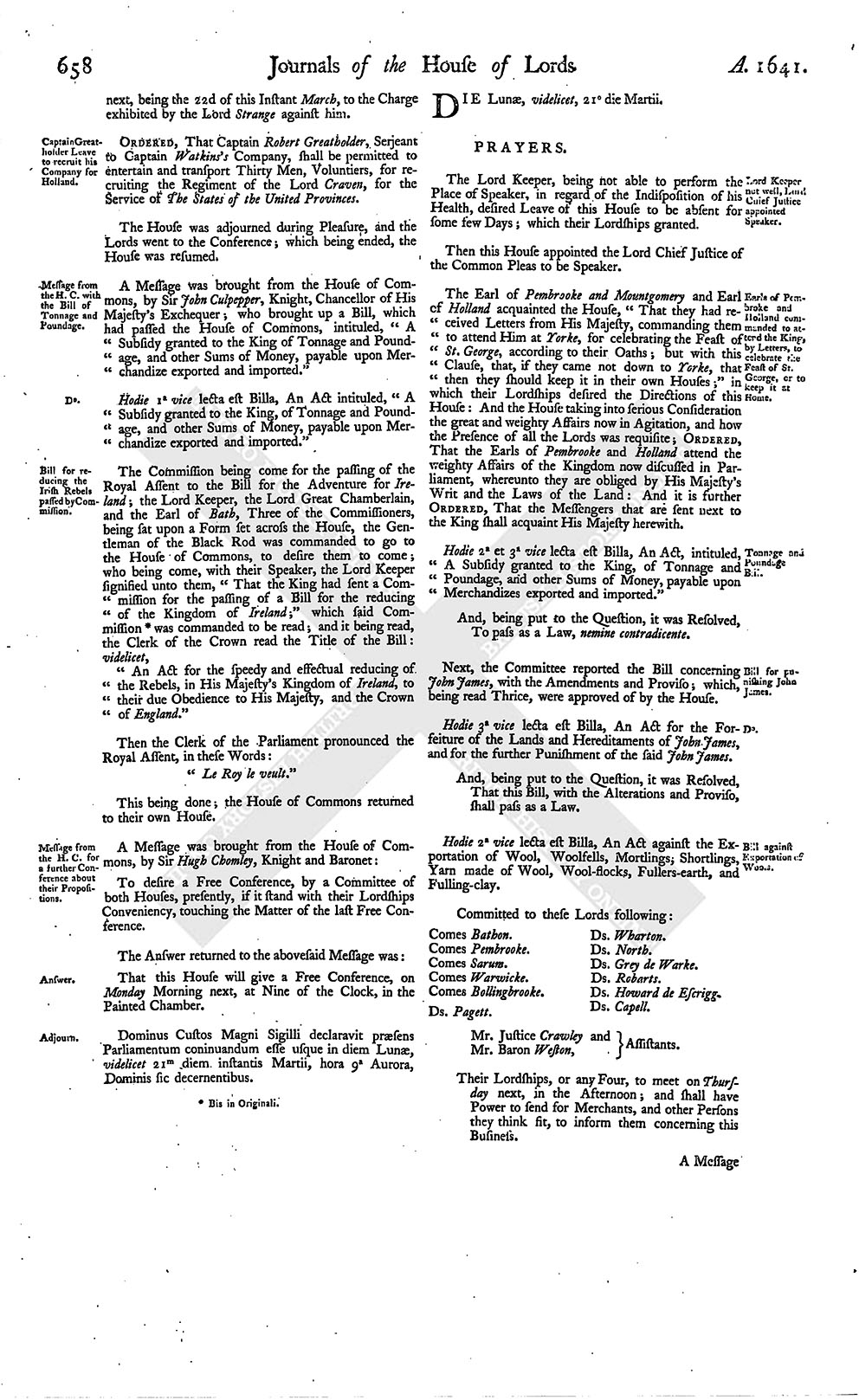
Ordered, That Peter Heywood, Gentleman, complained of to this House by the Lord Strange, shall put in his Answer in Writing peremptorily on Tuesday next, being the 22d of this Instant March, to the Charge exhibited by the Lord Strange against him.
Captain Greatholder Leave to recruit his Company for Holland.
Ordered, That Captain Robert Greatbolder, Serjeant to Captain Watkins's Company, shall be permitted to entertain and transport Thirty Men, Voluntiers, for recruiting the Regiment of the Lord Craven, for the Service of The States of the United Provinces.
The House was adjourned during Pleasure, and the Lords went to the Conference; which being ended, the House was resumed.
Message from the H. C. with the Bill of Tonnage and Poundage.
A Message was brought from the House of Commons, by Sir John Culpepper, Knight, Chancellor of His Majesty's Exchequer; who brought up a Bill, which had passed the House of Commons, intituled, "A Subsidy granted to the King of Tonnage and Poundage, and other Sums of Money, payable upon Merchandize exported and imported."
D°.
Hodie 1a vice lecta est Billa, An Act intituled, "A Subsidy granted to the King, of Tonnage and Poundage, and other Sums of Money, payable upon Merchandize exported and imported."
Bill for reducing the Irish Rebels passed by Commission.
The Commission being come for the passing of the Royal Assent to the Bill for the Adventure for Ireland; the Lord Keeper, the Lord Great Chamberlain, and the Earl of Bath, Three of the Commissioners, being sat upon a Form set across the House, the Gentleman of the Black Rod was commanded to go to the House of Commons, to desire them to come; who being come, with their Speaker, the Lord Keeper signified unto them, "That the King had sent a Commission for the passing of a Bill for the reducing of the Kingdom of Ireland;" which said Commission * was commanded to be read; and it being read, the Clerk of the Crown read the Title of the Bill: videlicet,
"An Act for the speedy and effectual reducing of the Rebels, in His Majesty's Kingdom of Ireland, to their due Obedience to His Majesty, and the Crown of England."
Then the Clerk of the Parliament pronounced the Royal Assent, in these Words:
"Le Roy le veult."
This being done; the House of Commons returned to their own House.
Message from the H. C. for a further Conference about their Propositions.
A Message was brought from the House of Commons, by Sir Hugh Chomley, Knight and Baronet:
To desire a Free Conference, by a Committee of both Houses, presently, if it stand with their Lordships Conveniency, touching the Matter of the last Free Conference.
The Answer returned to the abovesaid Message was:
Answer.
That this House will give a Free Conference, on Monday Morning next, at Nine of the Clock, in the Painted Chamber.
Adjourn.
Dominus Custos Magni Sigilli declaravit præsens Parliamentum coninuandum esse usque in diem Lunæ, videlicet 21m diem instantis Martii, hora 9a Aurora, Dominis sic decernentibus.