
A History of the County of Stafford: Volume 17, Offlow Hundred (Part). Originally published by Victoria County History, London, 1976.
This free content was digitised by double rekeying. All rights reserved.
'Smethwick: Other estates', in A History of the County of Stafford: Volume 17, Offlow Hundred (Part), (London, 1976) pp. 99-107. British History Online https://www.british-history.ac.uk/vch/staffs/vol17/pp99-107 [accessed 23 April 2024]
OTHER ESTATES.
The Beakes, a moated farmhouse in the south of Smethwick, belonged to William Hunt of the Ruck of Stones in the late 17th century. He was dead by 1692, and the Beakes with its farm passed to his daughter Beata, who in 1692 married Henry Hinckley of Northfield (Worcs.). Hinckley came to live at the Beakes and began to buy more property in Smethwick. In 1710 he became lord of the manor of Smethwick, and the Beakes descended with the manor, remaining the home of the Hinckleys, until at least 1740. (fn. 1) In 1764-5 the Beakes with upwards of 60 a. was occupied by a Mrs. Turner, and John Turner, a Birmingham merchant, was living there in 1771. (fn. 2) By 1798, (fn. 3) perhaps in 1771, (fn. 4) the Beakes had been bought by Thomas Hanson of Smethwick House. The Hanson family still owned it in 1815. (fn. 5) The Stubbs family is said to have lived there, presumably in the early 19th century: Mary Stubbs (d. 1818) and her daughter Ann (d. 1821) were resident in Smethwick when they died. (fn. 6) By at least 1814, however, there were two houses at the Beakes; one was the old farm-house, while the other, immediately to the south, was presumably newer. (fn. 7) In 1818 one of them was the residence of William Wynne Smith. (fn. 8)
William Sprigg was living at the second house between at least 1830 and 1843. In 1842 he owned 57 a. around it between the Halesowen parish boundary and the present Bearwood Road; the house stood in 6 a. of garden and shrubbery with an orchard at the rear. (fn. 9) The rest was farmed by William Marshall, who had been tenant of the old farm-house by 1834 and was still living at what had become known as Beakes Farm in 1864. (fn. 10) The second house seems always to have been known as the Beakes.
In 1845 and 1851 the house in which Sprigg had lived was occupied by William Fowler, a Birmingham solicitor and the third son of Thomas Leversage Fowler of Pendeford Hall in Tettenhall; in 1851 William's unmarried elder brother Thomas, the owner of Pendeford Hall, was living with him at the Beakes. (fn. 11) In the mid 1850s the house was occupied by George Vernon Blunt, a Birmingham merchant in the America trade, (fn. 12) and in the late 1850s Edmund Page, an ironmaster, was living there. (fn. 13) In the early 1860s it was the home of Thomas Astbury, an iron-founder. (fn. 14) It was occupied by a Mr. Smith in 1868, (fn. 15) by Joseph Stones in 1872, (fn. 16) by Edgerton Allcock in the 1880s, (fn. 17) and by a Mrs. Keeling in the 1890s. (fn. 18) The Beakes was probably demolished in 1897; certainly by 1903 its site, on the south side of the new Rawlings Road, had been built over. (fn. 19)
Beakes Farm was owned in the earlier 1860s by William Boycott of Hill Grove, Kidderminster (Worcs.). (fn. 20) It was occupied by the Powell family in the later 1860s and the 1870s, (fn. 21) by Joseph Vaughan in 1880, (fn. 22) by John Mould in 1888 and the earlier 1890s, (fn. 23) and by John Gosling from c. 1894 until c. 1902. (fn. 24) The house was then pulled down and the site built over. (fn. 25)
The house known as the Coppice stood on the north side of Cape Hill where Raglan Avenue was later built. It existed by 1814 (fn. 26) and may have been built for John Reynolds, one of the lords of Smethwick manor from 1790. About 1800 Reynolds was living at Shireland Hall, but by 1818 he had moved to the Coppice (fn. 27) and is the first known occupant. He was living there when he died in 1820. His son John succeeded him and was still living there in 1839. (fn. 28) In 1842 the Coppice with 21 a. was owned and occupied by Samuel Warden. (fn. 29) In the early 1850s P. H. Muntz, then in partnership with his brother G. F. Muntz at a Birmingham metal works, was living there. (fn. 30) In 1853 the house and estate belonged to William Wills. (fn. 31) By 1856 the house was mortgaged to Thomas Gibson, and in that year Gibson and his mortgagee leased it for use as a girls' reformatory. (fn. 32) The house remained a reformatory until 1879, but soon after that it was demolished and the estate was built over. (fn. 33)
The Coppice was a three-storeyed brick building facing east. To the north was a walled courtyard containing the out-buildings, which in 1838 included a barn, cow-house, and granary. The house then stood in 15 a. of 'ornamental pasture ground' divided into several inclosures and studded with oaks and other trees. It was screened from the main road by a belt of shrubberies and plantations, and there are also said to have been fine gardens 'laid out in Italian style'. (fn. 34)
A small copyhold farm in the north-east of Smethwick called the French Walls belonged to the Piddock family in the mid 17th century. (fn. 35) In 1661 William Piddock sold it to John Pearsall of Hawne in Halesowen (Worcs.). It passed to John's son Thomas, who in 1709 purchased the freehold from Philip Foley, lord of the manors of Harborne and Smethwick. The farm then consisted of a house and 20 a. of land. Thomas died in 1714 and was succeeded by his son, another Thomas (d. 1759). The younger Thomas's son, the Revd. John Peshall, who had changed the spelling of his name in order to establish a claim to a baronetcy, sold the estate in 1771 to John Turner, a Birmingham merchant then living at the Beakes. Turner was still alive in 1776, but by 1786 he was dead and the estate had passed to his brother, William Turner of Birmingham. In 1791 William, then living at Shenstone Moss, sold the estate to John Whately (d. 1794), a Birmingham gunsmith, (fn. 36) who was succeeded by his son Henry Pyddocke Whately. (fn. 37) In 1815 a number of properties formerly part of the French Walls and including the house were offered for sale in separate lots, (fn. 38) and the estate may thus have been split up. Nevertheless H. P. Whately still owned at least part of it in 1818. (fn. 39)
The Birmingham Canal was cut through the estate in 1768-9, and thereafter the land was increasingly developed for industry. By c. 1800 on the south side of the canal opposite Soho Foundry there was 'a large manufactory of gun-barrels, which are forged and bored, &c. by the aid of the steam engine'. It belonged to H. P. Whately and had presumably been erected in the 1790s after his father's purchase of the estate. (fn. 40) By 1815 the manufactory had become the French Walls flour-mill, but the mill with its 12-horse-power Boulton & Watt engine was then said to be 'capable of being converted to almost any manufacturing purpose'. By that time there was also some workers' housing on the estate. (fn. 41) In 1816 James Watt the younger bought the mill and in 1820 agreed to lease it to Henry Downing for an ironworks. Downing went bankrupt in 1829. (fn. 42) In the mid 1830s the forge was in the hands of the Bordesley Steel Co., and the estate also included a house, a farm, and 46 houses. (fn. 43) About 1840 the former gun-manufactory, flourmill, and forge formed Watt's French Walls iron and steel works, while George Downing occupied the house with 7 a. of garden and land, and there were some 40 workers' houses; (fn. 44) 7 a. of the estate on the north side of the canal between Soho Foundry and Rabone Lane were still undeveloped. (fn. 45) In 1842 the works passed to G. F. Muntz, who converted it for the production of non-ferrous metals. (fn. 46) Downing continued to live at the house until 1847 or 1848. (fn. 47) By the later 1880s the part of the estate on the south side of the canal was largely covered by Muntz's metal works and the Birmingham, Wolverhampton & Stour Valley Railway (opened in 1852); on the north side of the canal stood the local board's gas-works (opened in 1881). (fn. 48)
The Holly Lodge estate in north-west Smethwick was part of a larger one settled in 1710 on William Brearley of Handsworth at his marriage. (fn. 49) The property subsequently descended with estates elsewhere to his two daughters, Anna Maria who in 1743 married Charles Sacheverell (d. 1779) of New Hall in Sutton Coldfield (Warws.) and Mavesyn Ridware, and Jane who in 1758, as the widow of John Clopton, married Walter Gough of Perry Hall in Handsworth. (fn. 50) The sisters held the property as a joint inheritance which was preserved distinct from their husbands' estates, and in 1743 their Smethwick property consisted of a farm let to a tenant. (fn. 51) Both sisters subsequently purchased other estates in Smethwick which they owned separately from their joint property. (fn. 52) When Jane Gough died in 1781 she left her property to her sister for life. It was then to pass in tail male to Joseph Brearley, the son of her deceased cousin William Brearley of New Inn Hall in Handsworth, with remainders in tail to other members of the Brearley family. (fn. 53) Anna Maria Sacheverell died in 1795, having left all her real estate in tail male to Sir Robert Lawley, the 5th baronet, of Canwell Hall. (fn. 54) It thus became necessary to divide the estates which the sisters had held in Smethwick and elsewhere as their joint property, and a division was made in 1797 between a Joseph Brearley and Sir Robert Lawley, the 6th baronet. The Smethwick estate, consisting of 65 a. on the west side of Holly Lane between Oldbury Road and the Halesowen boundary, passed to Sir Robert; it was then being farmed by John Downing, who had taken a 21-year lease in 1794. (fn. 55) Sir Robert sold the farm in 1802 to William Crockett, a Handsworth maltster and corn-factor. (fn. 56)
In 1816 Crockett's property was sold under a Chancery decree. The northern part of the farm, 30 a. surrounding the farmhouse at the corner of Oldbury Road and Holly Lane, was bought by Thomas Downing and his brother George; the remainder, 34 a. near the Halesowen boundary, was bought by William Spurrier, a Birmingham lawyer. (fn. 57) In 1848 Thomas Downing sold his share to his brother George, who died later the same year. George's widow and their son William continued to live at the farmhouse. The widow died in 1858, about the time that William was building Holly Lodge to the south-west of the farmhouse. In 1859 William sold the farmhouse, then known as Holly House, and moved into Holly Lodge. He continued to live there until his death in 1901. The house then seems to have been occupied by his widow and his son W. E. Downing and is said to have stood empty for a few years after the son's move to Hagley (Worcs.). (fn. 58)
In 1920 Holly Lodge and its land were bought by Smethwick corporation for housing development. In 1922, however, the corporation opened a school in the house, and it continued as a school until 1932. Subsequently it became an orthopaedic clinic, (fn. 59) and it was still so used in 1971. Most of the land was then used as school playing-fields.
Lightwoods House in the south of Smethwick near the Harborne boundary took its name from the tract of woodland in the area. (fn. 60) The house is said to have been built by Jonathan Grundy in 1791, (fn. 61) but a brick in the wall immediately east of the entrance porch is inscribed 'Jonathan Grundy, June 19, 1780'. Grundy, the eldest son of Jonathan Grundy of Wigston Parva (Leics.), is the first known occupant of Lightwoods House and lived there until his death in 1803. His widow Hannah lived there until her death in 1815, and their daughter, also Hannah, lived in the house until she died unmarried in 1829. The house and its land then passed to Jonathan Grundy's niece Eliza, the wife of Henry Goodrich Willett. (fn. 62) In 1842 Willett, whose wife had died in 1837, (fn. 63) owned 38 a. of land in Smethwick; most of his estate lay immediately around the house, but part was between the present Bearwood, Waterloo, and Grange Roads. (fn. 64) Willett lived at Lightwoods House until his death in 1857. (fn. 65) His nephew, Captain H. J. Willett, occupied the house for a few months after his uncle's death, but in 1858 it was leased to George Caleb Adkins, a local soap manufacturer. Adkins bought the house with some land from Willett's trustees in 1865 and lived there until his death in 1887. (fn. 66)
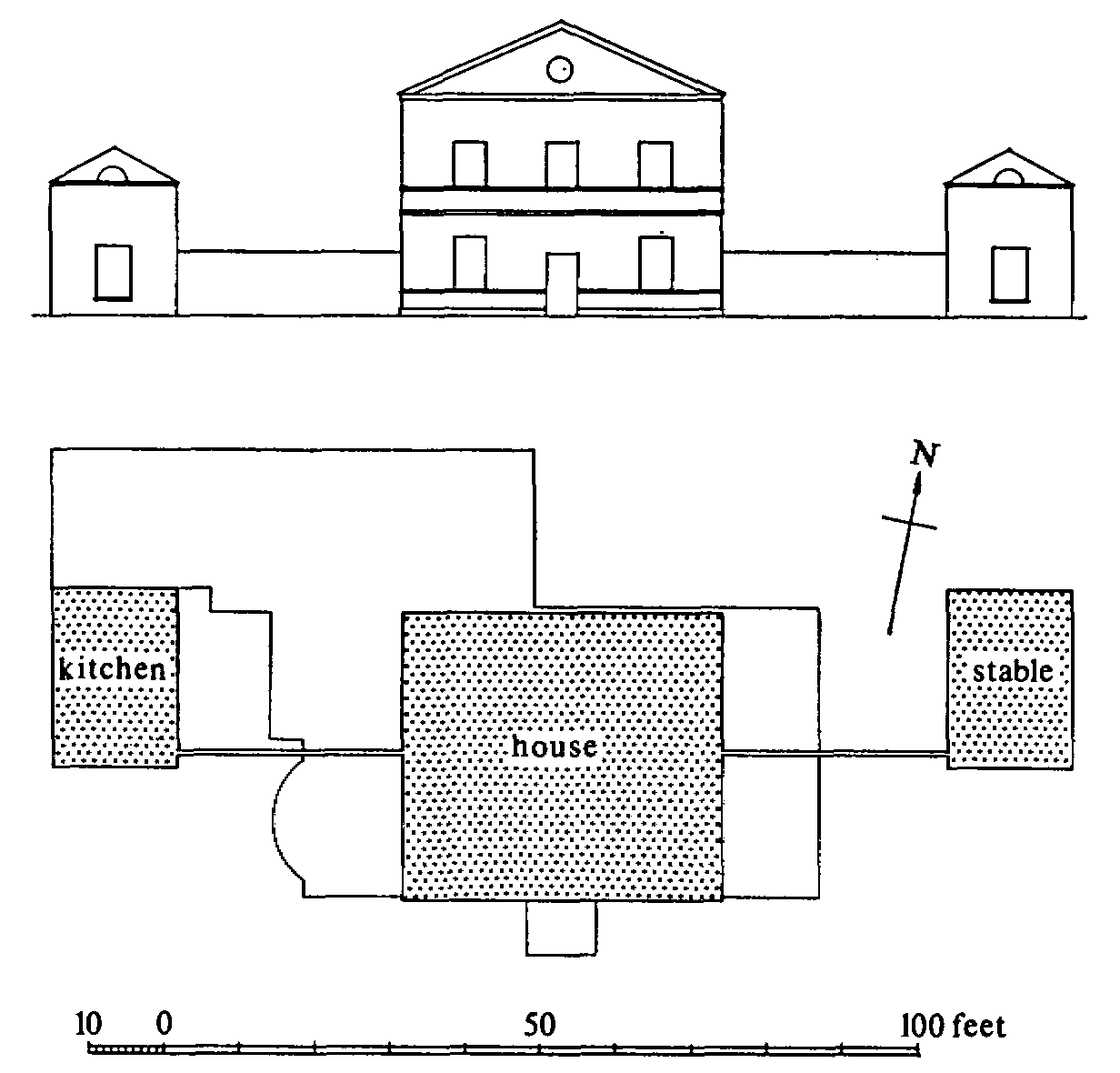
Lightwoods House
reconstructed elevation and plan, with the area of the 18th-century house stippled
In 1902, on the death of Caleb Adkins, apparently his son, Lightwoods House with its 16-acre park was put up for sale, and it seemed likely that the house would be demolished and the land used for housing. (fn. 67) Mainly through the efforts of A. M. Chance, however, the house and park were bought for the public. In October 1902 the committee which had raised the purchase money handed over the property to Birmingham corporation as a public park. About the same time other land was added bringing the boundary to Adkins Lane and Galton Road, and further subscriptions enabled the committee to buy more land in 1905. A feature of the park is the garden, opened in 1915, which contains specimens of the plants mentioned by Shakespeare. Since the opening of Lightwoods Park the house has at various times accommodated a public library, public refreshment rooms, and rooms for the Sons of Rest. In 1971 it was being converted into studios and offices by the lessees, John Hardman & Co. Ltd., stained-glass artists.
The original house was of brick with stone dressings and had a pedimented central block, with detached wings which housed the kitchen and stables. During the 19th century the symmetry of the original design was obscured by several extensions, the interior was remodelled, and the main front was enriched with stucco decoration in an early-18thcentury style.
The estate which became known as Piddocks farm was situated in the north-east of Smethwick near the Handsworth boundary. The Piddock family, sometimes known as Cowper alias Piddock, was living in Smethwick by the 1470s, (fn. 68) and by the 1570s it owned property in the north-east of Smethwick. (fn. 69) A William Piddock of Smethwick occurs in the early 17th century, (fn. 70) and he is perhaps to be identified with the William Cowper who founded a charity in 1623 but was then no longer living in Smethwick. (fn. 71) In 1624 Thomas Piddock, brother and heir of William Piddock who had recently died, was admitted tenant of William's copyhold lands in the manor of Harborne and Smethwick. (fn. 72)
The family property in Smethwick was apparently sold in the earlier or mid 17th century. In 1661 the estate known as Piddocks farm, formerly belonging to William Piddock, was owned by Henry Ford, who lived near by at Winson Green (in Birmingham). (fn. 73) Ford was a lawyer and from c. 1672 steward of Brome Whorwood's Sandwell estate in West Bromwich. In 1683 he sold Piddocks farm, with property in Winson Green and Handsworth, to John Willes, vicar of Bishop's Itchington (Warws.). (fn. 74) In 1707 Willes's son John sold the estates to Henry Carver of Birmingham. In 1733 the Smethwick portion consisted of Piddocks farm, then tenanted, and a disused water-mill on Hockley Brook. (fn. 75) In that year Carver included the former Willes estates in the marriage settlement of his son Henry and Elizabeth Guest. They subsequently descended to the younger Henry's son Edward, but in 1793, after Edward's bankruptcy, his assignees sold the Smethwick property to George Kennedy, a Birmingham surgeon. It then consisted of a farm-house and 71 a. of land.
The Birmingham Canal was cut through the estate in 1768-9, and in 1795 Kennedy sold 18 a. on the east side of the canal; James Watt built Soho Foundry there in 1796. Watt convenanted with Kennedy not to erect on the property 'any brasshouse or other works which are prejudicial to vegetation . . . except iron-foundries and steamengines'; even his foundries and engines, however, had to be sited back from the western edge of his newly acquired property. The rest of the estate was sold by Kennedy in 1796 to Alexander Walker, a Birmingham merchant. In 1816, after the bankruptcy of Walkers Sons & Co. and Alexander Walker's death, most of the property was bought by John Salter, the West Bromwich bayonet-maker. Salter immediately sold 6½ a. to J. L. Moilliet of Smethwick Grove. In 1825 Salter's executors sold the rest of the property to Moilliet, including the farm-house, which was known as Piddocks Farm or Cranford Farm by the 1790s. (fn. 76)
In 1835 Cranford farm was held by Joseph Eccles; between at least 1839 and 1853 the tenant was Charles Lutwyche. (fn. 77) No further reference to the farm has been found, and the house, which stood near Soho Bridge carrying the railway over the canal, was apparently demolished soon after the opening of the railway in 1852. (fn. 78)
The farm known as the Ruck of Stones in the northern extremity of Smethwick seems to have taken its name from a heap of stones which marked the parish boundary. The farm-house stood in Lewisham Road, formerly Ruck of Stones Lane. (fn. 79) By the later 16th century the farm seems to have belonged to the Hunt family. A William Hunt probably owned land in the north of Smethwick in 1575, and a William Hunt was apparently living at the Ruck of Stones in 1600, though he was no longer doing so in 1617; it is likely that he had been succeeded by a son of the same name. In 1630 William Hunt of Smethwick was fined £10 for not taking the order of knighthood, but in 1664 a William Hunt of Harborne parish was refused the right to a coat of arms. (fn. 80) William Hunt was assessed for tax on four hearths in 1666, and his house was one of the larger houses in Smethwick. (fn. 81) He was perhaps the William Hunt of the Ruck of Stones who was dead by 1692 and whose estate passed to his three daughters. (fn. 82) In the earlier 18th century the Ruck of Stones farm belonged to Margaret Hunt, one of the three. Under the terms of her will, proved in 1734, it passed to her cousin Elizabeth Hall for life and subsequently to Margaret's nephew Richard Grevis, son of Benjamin Grevis and Jane Hunt, and his son Henshaw. (fn. 83) Richard Grevis, who lived at Moseley Hall in King's Norton (Worcs.), died in 1759 having so encumbered the family estates with mortgages that they had to be sold during the 1760s. (fn. 84) Henshaw Grevis was offering the Ruck of Stones for sale in 1764; the estate then consisted of 140 a. let at will to Walter Adams, who was still the tenant in 1785. (fn. 85) In 1765 it was sold to the trustees of Jane Gough, the wife of Walter Gough of Perry Hall in Handsworth. (fn. 86)
Jane Gough (née Brearley) died in 1781. Under the terms of her will the Ruck of Stones passed to her sister Anna Maria Sacheverell (d. 1795) for life; thereafter it was entailed on their Brearley relatives. (fn. 87) In 1820 a Joseph Brearley of Pen Moel in Tidenham (Glos.) sold the Ruck of Stones; 6 a. were bought by Luke Pope, and the remainder by Richard Fryer of the Wergs in Tettenhall. (fn. 88) In 1825 Fryer sold his part of the estate to J. W. Unett, (fn. 89) who in 1842 owned 65 a. with the farm-house; the tenant of the house was then Hannah Scott. Other outlying portions belonged to the Pope family in 1842. (fn. 90) By 1851 William Holloway was living at the Ruck of Stones and farming 56 a. there; he was still farming in Smethwick in 1861, and in the 1860s and 1870s his widow Martha was running the farm. (fn. 91) By 1881 houses had been built over the area. (fn. 92)
The farm-house, as it existed in 1842, seems to have been a long building set back from what is now Lewisham Road and lying at right angles to it. (fn. 93) It seems to have survived until the later 1880s, but by the beginning of the 20th century its site was covered by part of the Surrey Works of Evered & Co. Ltd. (fn. 94)
Land in the south-east of Smethwick adjoining the county boundary was known as Shireland by the mid 16th century. In 1546 John Fyld of King's Norton (Worcs.) sold to William Sparry various properties in Smethwick which included a pasture called Little Shireland; it was said to lie between land called Great Shireland, the highway from Birmingham to Smethwick, and Rotton Park (in Birmingham). (fn. 95) By the 1680s there was a house in the area occupied by a member of the Jennens (or Jennings) family. (fn. 96) This was probably Edward Jennens who was living in Harborne parish in the 1660s and 1670s and had extensive property there; he lived in one of the largest houses in Smethwick, being assessed for tax on five hearths in 1666. (fn. 97) He was the son of a Birmingham ironmonger and a kinsman of Dorothy Parkes, who endowed Smethwick Old Church; his nephew Charles Jennens of Gopsall (Leics.), the librettist of Handel's Messiah, was one of her trustees. (fn. 98) The house in which Jennens lived in the 1680s may have been that which, under the name of Shireland Hall, was advertised for letting in 1765; described as 'fit for a genteel family', it had a 140-acre estate of arable, meadow, and pasture. (fn. 99) By 1767 the estate had passed to John Baddeley, lord of the manor, who then leased it out. (fn. 100) In 1791, after the expiry of the lease, the estate was split up. The greater part, 113 a., was taken by John Reynolds, who had recently acquired half the manor. Thomas Clift, who had been tenant of the Bear inn at Bearwood since 1776, took 26 a. and still occupied part of the estate in 1819. (fn. 101)
John Reynolds was living at Shireland Hall by c. 1800 and probably by 1796, (fn. 102) but it is uncertain whether the house he lived in was the Shireland Hall of the 1760s, for a new house, known like the old one as Shireland Hall, had by then been built on the estate. (fn. 103) It is possible that the old house survived as Shireland Hall Farm, which in 1814 stood some 30 yards south-west of the new hall. (fn. 104) The new hall, according to a newspaper advertisement of 1810, was built so as to make 'two good and complete houses', although it is clear that it then formed only one. It is variously said to have been rebuilt in the late 18th century by John Reynolds and to have been built in 1790 by Edward Cairns, a partner in Cairns, Frears, Carmichael, Halliday & Co., a Birmingham firm of merchants in the America trade. If the new hall was occupied as two residences from the time of its erection, it is possible that one of Cairns's partners lived in one of them: in 1792 'Mr. Edward Carnes & Freer' entered into possession of Shireland Hall and began to pay rent for it to the lords of the manor. Cairns lived at Shireland Hall until 1811. (fn. 105) It is possible that the Shireland Hall which was said to be John Reynolds's residence c. 1800 was the other half of the house built in 1790; in that case Freer, if he ever lived there at all, can have done so for only a few years. Reynolds was still living at Shireland Hall in 1803, but he had left by 1818. (fn. 106)
In 1810, presumably when Cairns was about to leave, the lease of Shireland Hall and a 56-acre farm was advertised for sale. (fn. 107) The freehold was apparently acquired by Richard Roberts, whose executor held the hall and 55 a. in 1842. (fn. 108) By 1818 the hall was occupied by a Miss Marmont, who conducted a girls' school there. (fn. 109) A few years later Edward Bagnall, a West Bromwich ironmaster, moved to the hall, and after he left the house is said to have been occupied by a retired Birmingham draper called Lander. The sequence of occupiers, however, is uncertain since by 1830 the house again consisted of two separate residences. (fn. 110) Thomas Townsend, a civil engineer and railway contractor, was living there between at least 1833 and 1835, (fn. 111) and between at least 1839 and 1851 it was the home of William Beynon. (fn. 112) It then became a school once more. In 1852 T. H. Morgan, a Baptist minister, was the tenant, and he ran a school there for the sons of clergy of all denominations until at least 1865. (fn. 113) By 1868 the Misses Beynon were running a girls' school there; they had gone by 1876 and were the last residents. From 1878 to 1886 the schoolroom in the hall was used for Wesleyan services, but otherwise the house was unoccupied. (fn. 114)
By 1856 there were plans for developing the area, although building did not in fact take place for many years. (fn. 115) By the early 1880s, however, development had begun. (fn. 116) Shireland Hall itself had become unsafe. In 1887 it belonged to Edward Mullett, a West Bromwich farmer; part of the building fell down that year, and shortly afterwards the hall was demolished. (fn. 117)
The late-18th century house was situated to the east of the present Shireland Road on land sloping gently towards the south-east; its site is now occupied by the two terraces of houses on the south side of Florence Road called Poplar Grove and Lime Grove. (fn. 118) In the 1820s it was a plain threestoreyed Georgian house with a low-pitched roof. A plan of c. 1857 shows a square house standing in wooded grounds; stretching back from the rear corners of the house were two irregular ranges of buildings, one of which may have been one of the original self-contained residences. Between two driveways running north to Cape Hill was a pool surrounded by plantations.
The house called Smethwick Grove stood near the eastern boundary of Smethwick on the east side of what is now Grove Lane. In 1813 the house with 16 a. of land was bought by J. L. Moilliet, a Swiss merchant who had settled in Birmingham by 1801. (fn. 119) He may have been living at the Grove before buying it. (fn. 120) During the next few years he greatly increased the size of the estate and by 1828 owned 59 a. His largest purchases, amounting to 30 a., were the southern and western portions of Piddocks (or Cranford) farm. In 1828 he bought the short stretch of the old line of the Birmingham Canal which ran through his estate; it had been rendered obsolete by Telford's improvements of 1824-7 and may have become an ornamental feature. (fn. 121)
Moilliet lived at Smethwick Grove until 1826. In 1801 he had married Amelia Keir, daughter of James Keir of West Bromwich, the chemist and industrialist, and the Moilliets were thus brought into contact with some of the leading intellectual figures of the time. Maria Edgeworth, the novelist, became a great friend of Amelia Moilliet and visited Smethwick Grove in 1819 and 1821. In 1826 Moilliet moved to Hamstead Hall in Handsworth and the Grove was let to George Bacchus, a partner in a Birmingham firm of flint-glass manufacturers. Bacchus left in 1830, and Moilliet's son James moved into the house after his marriage in 1832. He was still living there in 1837 but by 1838 had moved to Sutton Coldfield (Warws.). Thomas Atkins was living at the Grove in 1842. The house, with some adjacent land, was sold in 1846 to George Selby, a lawyer and partner in a tube-manufacturing concern. Soon afterwards Selby built a tube-works near by. (fn. 122) He still owned the house in 1855, (fn. 123) but the estate was by then losing its rural character: trees had been felled and various works built, while Shireland Brook, which bounded the estate to the east and divided Smethwick from Birmingham, had been culverted. (fn. 124) The house still stood in the earlier 1860s when Thomas Gibson lived there (fn. 125) but was probably demolished soon afterwards. Its site now forms part of the St. George's Works of Guest, Keen & Nettlefolds.
About 1830 Smethwick Grove was a plain twostoreyed Georgian house standing in well wooded grounds. (fn. 126) It overlooked lawns and a sheet of water— either a pool formed by damming Shireland Brook (fn. 127) or the old line of the Birmingham Canal.
A house known as Smethwick Hall existed by 1660 when Charles Lane lived there. (fn. 128) It probably stood in the north-eastern part of Smethwick where there was a house of that name by 1767. (fn. 129) The Lane family had lived in Smethwick from at least the early 16th century. (fn. 130) Charles Lane had moved to Harborne by 1666, presumably as a result of marriage with Mary Birch, the heir of Henry Birch of Harborne. In 1666 his assessment for tax on six hearths, the second largest assessment in the parish, was entered under the Harborne division of the parish, (fn. 131) and he is usually thereafter referred to as of Harborne. Plot mentions the house in the 1680s but does not name the owner or resident. (fn. 132) Lane seems to have been in continuous financial trouble, and by 1702 his affairs were apparently in the hands of his Birch relatives. In that year, when arranging for the enfranchisement of his copyhold estates, he recorded that several parts of his Smethwick estate had been sold. (fn. 133) He died in 1707. (fn. 134)
About 1780 Smethwick Hall seems to have been the home of the Rabone family, prominent Birmingham merchants. Richard Rabone was living there in 1834, and when he died in 1838 aged 85, he was said to have resided there for almost sixty years. (fn. 135) It is uncertain whether he died there as in 1835 Edward Rabone was said to be the occupant. He still lived there in 1850. (fn. 136) In 1851, however, the hall was occupied by a tenant, Samuel Clarke, who farmed 30 a. (fn. 137) He was still there in 1853 and was succeeded by John Howard Blackwell, tenant of an ironworks near Halford's Lane, who lived at the hall in at least 1854 and 1855. (fn. 138) By 1859 the Rabones had sold the hall to Joseph Gillott, a Birmingham steel-pen manufacturer. By then the house was known locally as Rabone Hall. (fn. 139) In 1862 the house and grounds were bought by a firm of hydraulic engineers, Tangye Bros. & Price of Clement Street, Birmingham. The house was demolished and the firm erected the Cornwall Works on the site. (fn. 140)
In the mid 19th century the hall, an irregular three-storeyed brick house, stood between the Birmingham Canal and the Handsworth boundary. A drive led south to what is now Rabone Lane, and the house was secluded from the road by trees. North of it there were pools and a wilderness. (fn. 141)
A house on the north-west side of Stony Lane near the western boundary of Smethwick was called Smethwick House by the early 1830s. (fn. 142) It was still so called in 1861 (fn. 143) but in the later 19th century it became known as Smethwick Hall. (fn. 144) It is said to have been built in 1746 by Thomas Hanson. A Thomas Hanson was living there by 1818; he was probably the son of the Thomas Hanson who died in 1800 aged 76. In 1842 Hanson owned 65 a. in Smethwick; outlying portions of his estate were let to tenants, but he retained 29 a., mainly meadow and pasture, around his house. He was still living there in 1846. (fn. 145) The house and estate were subsequently acquired by Thomas Darby, (fn. 146) but by 1851 they had passed to John Samuel Dawes, a partner in John Dawes & Sons, a firm of ironmasters with works in West Bromwich and Oldbury. Dawes, who was one of the founders of the Birmingham and Midland Institute, retired from the family firm c. 1857 to pursue his interest in geology. He was still living at Smethwick House in 1861, but he subsequently left to live in Edgbaston, where he died in 1878. (fn. 147) The house apparently remained in the ownership of the Dawes family, but for a number of years it was used as a school. In 1872 it was occupied by Thomas Townsend, and Mrs. Eliza Townsend was keeping a school there. By 1875 the Revd. J. Dixon and his wife were conducting a day and boarding school in the house. The school was later sold to a Baptist minister called Munns, who carried it on until the 1880s. (fn. 148) In 1885 George Dawes, a younger brother of J. S. Dawes, came to live at Smethwick Hall. Until he retired to Smethwick he had been running the Milton and Elsecar Ironworks near Barnsley (Yorks. W.R.), but the depression in the iron trade had forced him to close the works. He died at Smethwick Hall in 1888, and it was subsequently bought by Sir Richard Tangye. Sir Richard's son H. L. Tangye lived there for a time but later moved to Maxstoke Castle (Warws.). John A. Thompson, a member of a local family of maltsters, later lived at the hall. (fn. 149)
Early in the First World War Belgian refugees were living at the hall, but from 1916 to 1925 it was the home of Benjamin Shakespeare, clerk to the Smethwick justices. Already, however, the Smethwick Hall Estate Co. Ltd. was developing the estate. Auckland Road had been laid out and partly built up along the north-east edge by 1902. In 1928 the hall and the remaining 28 a. were bought by Smethwick corporation, which in 1930 opened Smethwick Hall Park on 8 a. of the grounds beside Stony Lane. The hall still stood in June 1937 but was demolished soon afterwards to make way for council schools opened in 1939. (fn. 150)
The hall was of three storeys in a plain Georgian style. About 1840 there were stables, cowsheds, and a barn beside the main drive curving down to Stony Lane. (fn. 151) In front of the house the grounds sloped sharply to a pool formed by damming the brook which flows north-eastwards alongside Stony Lane. The pool remains a feature of Smethwick Hall Park.
The house known as the Woodlands was probably built in the early 19th century. It existed by 1814, (fn. 152) when it stood in open country north of Cape Hill. It may have been built for John Wilkes Unett, a Birmingham solicitor and the first known occupant. He lived in Birmingham until at least 1800, but by 1830, and probably much earlier, he was living in Smethwick, almost certainly at the Woodlands. (fn. 153) By 1842 he owned 128 a. of land in Smethwick; 32 a. lay around his house, and the other properties consisted of 65 a. of the Ruck of Stones farm and 31 a. in the Broomfield area. (fn. 154) Unett lived at the Woodlands until 1856, when he retired from practice and moved to Milverton (Warws.). He died later the same year, still owning the Smethwick properties. From the late 1830s he was laying out new streets over much of his land. (fn. 155) In 1861 Hannah Shelley was living at the Woodlands. (fn. 156) The Unett family's Smethwick estates were being broken up for sale and development in the 1870s and 1880s. (fn. 157) About 1912 J. W. Hinton founded the Smethwick Working Men's Club at the Woodlands, and in the early 1950s the house, then said to be much altered, was still occupied by the club. (fn. 158) It was subsequently demolished and new premises for the club were built on the site, on the north side of Woodlands Street.
When Philip Foley sold the manors of Harborne and Smethwick to George Birch and Henry Hinckley in 1709, he retained a house and over 50 a. in the Roebuck Lane area. The property was subsequently sold to Thomas Finch, a Dudley ironmonger, whose widow and son sold it to Lord Dartmouth in 1756. (fn. 159) By 1842 the 4th earl owned most of the land between the Birmingham Canal, the West Bromwich boundary, and Halford's Lane, amounting to 110 a. (fn. 160) In 1865 the 5th earl sold 5 a. to the Great Western Railway Co. for the Stourbridge Extension Railway, opened in 1867. (fn. 161) In the 1880s, however, he still owned 105 a. in the area; 16 a. were occupied by the Sandwell Park Colliery Co., which had sunk its first shaft there in 1870. (fn. 162) Part of the estate was opened as Lewisham Park in 1905. (fn. 163) The neighbouring portion was being used as allotment gardens by 1913. (fn. 164) By the late 1940s, however, much of the land had been developed by industry, notably by Birmid Ltd. (fn. 165) The area formerly occupied by the colliery was derelict in 1971.