A History of the County of York: the City of York. Originally published by Victoria County History, London, 1961.
This free content was digitised by double rekeying. All rights reserved.
'The Minster and its precincts', in A History of the County of York: the City of York, ed. P M Tillott (London, 1961), British History Online https://www.british-history.ac.uk/vch/yorks/city-of-york/pp337-343 [accessed 9 May 2025].
'The Minster and its precincts', in A History of the County of York: the City of York. Edited by P M Tillott (London, 1961), British History Online, accessed May 9, 2025, https://www.british-history.ac.uk/vch/yorks/city-of-york/pp337-343.
"The Minster and its precincts". A History of the County of York: the City of York. Ed. P M Tillott (London, 1961), British History Online. Web. 9 May 2025. https://www.british-history.ac.uk/vch/yorks/city-of-york/pp337-343.
In this section
THE MINSTER AND ITS PRECINCTS
The Cathedral Church
The first cathedral church on or near the site of the present minster for which there is firm literary evidence is the wooden structure in which Paulinus baptized King Edwin. (fn. 1) No traces of this church have ever been found; it is unlikely that they would have survived for, soon after his baptism, Edwin began to build a church of stone to replace the other. By 632 sufficient of the building had been erected for Edwin's head to be buried in porticu Sancti Papae Gregorii, that is to say, in a chapel so dedicated opening off the body of the church. The building was completed by King Oswald, but by the time Wilfrid succeeded as bishop in 669 he found the church in disrepair; the roof had to be leaded, the windows glazed, and the walls whitewashed. The church was embellished by Wilfrid II (718-32). In 741 it probably suffered from fire but was repaired and soon appears in the records again. During the episcopacy of Æthelberht (767-78), a new church, dedicated to the Holy Wisdom, was built in York; whether this was a rebuilding of Edwin's church or another and new building contiguous to St. Peter's has already been discussed. (fn. 2)
During the next 300 years the cathedral church of York is frequently mentioned as the place of consecration for bishops, as the burial place of kings and other notables, and in other connexions, but little or nothing is said about the building itself. A gift of tin from Alcuin in 801 was probably made to roof a small, recently built belfrey; it seems likely that the church was damaged by the Danes after their capture of York in 866; King Eadred gave two large bells to the church in 946.
In 1069 Archbishop Ealdred died and was buried in the minster; he was perhaps the last notable person to be buried in the Saxon minster for, very soon after, the Normans 'thoroughly ravaged and burnt the holy minster of St. Peter'. There is no documentary evidence—nor has any archaeological evidence yet been found—to refute the supposition that the church then destroyed was that begun by Edwin. The precise location of the Saxon minster or minsters is not known; no walls, foundations, or floors of indisputably Saxon origin have ever been found on the present site though excavation there has been very limited. The most attractive hypothesis is perhaps that which places it (or them) west of the present choir and probably west of the present nave.
In 1075 a Danish army is said to have destroyed the church but whether this was the Saxon building repaired after William's wasting of the city or the new building erected by Thomas of Bayeux (10701100) is not clear; there is some reason to suppose that Thomas's work did not begin until after 1079. Thomas's contribution to the fabric is uncertain (fn. 3) but it seems likely that he built a nave, an aisle-less transept, and a central tower; and since the piers of the present central tower encase piers of Thomas's time, it is his work that first sets the size and proportions of the present church by setting the size of the central crossing. The only trace of a choir of this period that has been found is a concrete foundation platform with apsidal end lying under the foundations of a later choir. It has been suggested that Thomas laid the concrete platform but was unable to proceed much further with building a choir before his death. (fn. 4) A new choir was certainly built by Roger de Pont 1'Evêque (1154-81) and its dimensions can be determined from the remains of his crypt under it, still visible in the present crypt.
There is more certainty about the times at which each part of the present church was erected. The transepts were the first portion to be re-built. That on the south had probably been begun by 1227 and was complete by 1241 when Walter de Gray (archbishop 1215-55) founded a chantry in the east aisle of the transept. The north transept and the central tower have been ascribed to the treasurership of John Romeyn (c. 1260-5): the north, 'Five Sisters' window has been ascribed to such a date.
The new transepts and the tower clearly needed a nave in proportion—Archbishop Thomas's was shorter and narrower—and this was begun in 1291 by Archbishop John Romeyn, son of the treasurer. The western wall was not completed until 1338 and the roof was not timbered until 1354. During the building of the nave the chapter house and its vestibule were added on the north; the exterior of the chapter house was probably completed during the treasurership of Francis de FitzUrse (1335-52). It appears to have been the first chapter house on the site.
Throughout this period the choir was that built by Roger in the 12th century. A new one, with a Lady chapel, was begun by Archbishop Thoresby (135273) in 1361 and on his death the first four bays from the east were probably complete; the outer shell of the entire eastern arm was finished by 1405. At some date subsequent to this the central tower was recased; it seems to have been intended that it should be higher or surmounted by another structure, but one of the piers of the western side had to be rebuilt and this perhaps led to the abandonment of any plan to increase its size.
Only the two western towers now remained to be built; the southern one was probably begun about 1432 and building was still in progress in 1446; the northern one may have been started in 1456. Both towers were presumably complete by 3 July 1472 when the church was reconsecrated; the date has been observed as the anniversary of the completion of the building since that time.
The fabric of the church has not been altered since the 15th century (fn. 5) but has, of course, been frequently repaired and repairs to some parts have amounted to little less than rebuilding. Little appears to have been done to the exterior before the 19th century; changes to the interior consequent upon the Reformation and the changing pattern of worship are described elsewhere. (fn. 6)
The first major repairs occurred after the fire of 1-2 February 1829. This fire was started by an incendiary and lunatic, Jonathan Martin. Martin concealed himself in the minster after evensong and succeeded in setting the choir ablaze. The fire was not discovered until the following morning and was not extinguished until the evening of that day; in it perished all the woodwork of the choir, the roof, and some of the stained glass. A large public subscription was raised for the repair work and the new choir was opened on 6 May 1832. An almost equally disastrous fire began accidentally in the south-west tower in the evening of 20 May 1840; it spread to the nave roof and only the collapse of this appears to have prevented the whole fabric from being engulfed. Besides much minor damage, the south-west tower was burnt out, the nave piers severely cracked and chipped, and the west doors destroyed; the glass however, was very largely preserved. The nave was re-opened after restoration on 15 June 1843. A small fire in the lower roof of the western aisle of the north transept in 1909 was quickly extinguished and did little damage.
Most of the repair work undertaken since the 19thcentury fires has been consequent upon the ravages of weather and, especially, atmospheric pollution. The west front, for example, which had been generally repaired between 1802 and 1816, was restored after the 1840 fire but again needed extensive work in 1907; in the 1950's more work was necessary on the front itself and on the pinnacles of the southwest tower. The east end was restored in the 1840's and 1850's when, it is said, the pinnacles surmounting the wall were reduced in size; by the 1950's portions of the east end were considered unsafe. The south transept was extensively restored by Street between 1871 and 1880. Perhaps the most controversial piece of restoration was that done at the end of the 19th century: the pinnacles on the south side of the nave were restored in 1898, and between that date and 1906 the chapter added, in the face of a storm of antiquarian protest, pinnacles to the north side butresses, and flying buttresses on both sides. Whether the nave was ever supported by flying buttresses before this time remains uncertain. The chapter house was restored between 1843 and 1845 under the will of Dr. Stephen Beckwith who also gave the peal of twelve bells in the south-west tower to replace the peal of ten destroyed in the fire of 1840. The large bell known as 'Big Peter' or 'Great Peter' was placed in the north-west tower in 1845. The bells were tuned and rehung during 1914.
Four small buildings, attached to the fabric of the church, flank the south transept door. On the west a building is drawn out from the transept and was probably built in the early 15th century to house the library; it is now carried back to the wall of the nave and houses the diocesan registry and vestries. East of the transept lie two rooms, formerly used for the consistory court and now as vestries, and the Zouche Chapel; all these are thought to have been erected in the 14th century. In Drake's time they appear to have been accessible only through the Zouche Chapel but there are now entrances in the south choir aisle and the eastern aisle of the south transept. The Zouche Chapel was built under the terms of the will of the archbishop of that name (1342-52) against Archbishop Roger's choir and later altered to fit the new choir. The chapel has in recent times been used for chapter meetings (only the formal opening of meetings taking place in the chapter house) and to house the muniments, most of which, however, had been transferred by 1958 to the chapel of the archbishop's palace (now the Minster Library) in Dean's Park.
St. Sepulchre's and St. Mary-ad-Valvas
Only two other buildings were contiguous to the fabric of the church itself: the chapel of St. Mary and Holy Angels and the church of St. Mary-adValvas. The chapel was commonly known as St. Sepulchre's, perhaps because of its use as a churchyard chapel and because of its association with masses for the dead. (fn. 7) Some part of the chapel appears to have been built against the north wall of Archbishop Thomas's nave on a north-west and southwest axis. The site was excavated before 1847 by John Browne and a plan of the foundations then said to be found was published in his History of the minster (fn. 8) and marked on the Ordnance plan of 1852. Two blocked doorways on the north face of the nave are thought to have led into the chapel, one of them at the level of the upper floor. It is now impossible to be certain of the nature of the chapel buildings. The foundations uncovered by Browne may have been those of a vestibule or corridor leading from the minster to the chapel; (fn. 9) this vestibule had disappeared by Drake's time (fn. 10) and is not marked on a large-scale plan of the area of 1782, although the lower door appears to have been still open at that time. (fn. 11) The site and possessions of St. Sepulchre's had been leased in 1562 to George Webster 'queen's servant' who had held a lease of them since 1550 (fn. 12) but what buildings were then standing is not known. In 1816 Hargrove observed the demolition of a building which he identified as part of St. Sepulchre's; it had by that time become a public house known as 'The Hole in the Wall' and beneath it was found a prison. The public house had been named from a cavity, apparently in the wall of the prison, which was thought to have been used for immuring prisoners, but Hargrove shows, although his account is by no means clear, that it was an entrance to the prison.
It seems most likely that the building Hargrove saw demolished is that marked on the 1782 plan as a prison and is clearly to be identified with the archbishop's prison. (fn. 13) Whether St. Sepulchre's lay above it is another matter. The words ultra portam palatii used to describe the chapel in a 15th-century docu ment (fn. 14) probably mean 'above' rather than 'beyond' the gateway to the archbishop's palace. At all events it seems tolerably certain that St. Sepulchre's lay close to the north-west corner of the nave and that both the foundations uncovered by Browne and the building mentioned by Hargrove formed part of it, though not necessarily, it must be remarked, contemporaneously.
One other building lay close to, but did not perhaps actually adjoin, the minster—the church of St. Mary-ad-Valvas. (fn. 15) It has been suggested that it lay on a site adjacent to the Old Residence and that the doors referred to in its name may have been at the east end of Archbishop Roger's choir. (fn. 16) The church was united with St. John-del-Pyke in 1365 and its parish may well have been that part of Minster Yard marked by the Ordnance surveyors on their plan of 1852 as 'attached to the parish of St. John-del-Pyke in 1365 and separated from it in 1585 [recte 1586]'. If this was in fact the case the precinct was in early times a good deal more restricted than it later became (see below).
The Precincts
It seems likely that the greater part of the area that may be described roughly as the square framed by the city walls between Bootham and Monk Bars has been associated with the Church of York from earliest times, but the precise boundaries of the minster precinct are difficult to determine. On the north, probably as far as the boundary of the Ingram property, (fn. 17) most of the angle between the walls was occupied by the archbishop's palace and this area was perhaps strictly speaking outside the boundary of the capitular precinct; the northern boundary of the precinct may thus have run close to the walls of the minster itself. On the north-east it is possible that there lay the parish of St. Mary-ad-Valvas and that this area did not fall within the precinct until after 1365 or perhaps 1586 (see above). On the south-west there is some evidence that Petergate, from Bootham Bar at least as far as the present Minster Gates, formed a boundary in pre-Conquest times. (fn. 18)
Beyond this point the boundary is less clear. In 1285 (fn. 19) the chapter was licensed to enclose its churchyard and precinct with a stone wall 12 ft. high and the wall was to be provided with gates or posterns. In Drake's time the gates to the precinct were four in number: the principal one at the present Minster Gates, the others at the end of Lop Lane (now Duncombe Place), opposite the entrance to the Bedern, and 'in Ogleforth'. (fn. 20) A boundary which would have reached these gates and at the same time included the Old Deanery could have followed the boundary of St. John-del-Pyke parish as mapped by the Ordnance surveyors in 1852 and it is perhaps not too much to assume that such a boundary discloses the ancient precinct (see map).
The gates themselves have left little or no trace though they were all standing in Drake's time. (fn. 21) The remains of that at the end of Lop Lane seem to have been removed about 1827, (fn. 22) but Peter Prison, which lay just inside them, was not demolished until 1835. (fn. 23) The approach to this gate was widened by demolishing some houses on the south side of Petergate in 1860 to form the present Duncombe Place. (fn. 24) The rest of the gates had all but disappeared by 1818. (fn. 25) The site of that at the end of College Street (formerly Vicars Lane or Little Alice Lane) is marked by a brick and timber structure which probably embraces parts of the earlier gatehouse and the solar to which the Bedern gallery ran. (fn. 26) The fourth gate probably lay at the junction of Ogleforth and Chapter House Street close to the church of St. John-del-Pyke. East of this and outside the precinct, between the city wall and Goodramgate, lay Pyke parish.
Until the early 19th century the precinct appears to have been heavily built upon. From the Lop Lane gate to St. Michael-le-Belfrey a row of cottages obscured the west front; (fn. 27) within the precinct at this point lay the churchyard of St. Michael's, not removed until 1814; (fn. 28) the cottages and houses on the north side of Petergate were removed between 1824 and 1839. (fn. 29) On the south and east the Old Deanery, the Old Residence, St. William's College, and other houses crowded close to the walls of the cathedral church; on the north much of the space was taken up with the ruins of the archbishop's palace and the houses built within it. The problem of encroachment was no doubt an ancient one and was certainly recognized in the 17th century, for in 1633 Charles I complained to the chapter about houses built in and against the minster on the west and south, including one said to be 'within the very cross aisle'. (fn. 30) Tenements and shops are certainly to be seen on either side of the south door in an illustration of 1655-70; they were probably demolished after Dean Gale (1676-1702) had allowed the leases to run out. (fn. 31) Some prebendal houses also lay within the precinct; on the site of that of Salton, St. Williams' College was built (see below); one for Fenton was built in Precentor's Court in the early 18th century; in the 14th century those of Barnby and Dunnington probably lay outside the close in Stonegate and Petergate respectively. (fn. 32)
The cleaning and improvement of the precinct began in 1814 when the chapter obtained an Act enabling them to purchase property and take other measures towards that end; their powers were confirmed and enlarged by another Act of 1825. (fn. 33) Separate commissioners for Peter Liberty were appointed under the Improvement Act of 1825 (fn. 34) and in the following year 'widened the principal thoroughfare into Minster Yard from Ogleforth' (presumably Chapter House Street) and 'newly paved and flagged College Street'. (fn. 35) The demolition of the Petergate houses has already been described; the ground in front of the west door was lowered soon after 1814 when the steps into the minster were found; (fn. 36) on the north the improvements were associated with the demolition of the Ingram property and the creation of Dean's Park out of the grounds (see below); on the south the Old Deanery was demolished and its garden used as an open space in front of St. Peter's School, now the Song School (see below); at the east end two houses adjacent to the Old Residence were removed in 1861-2 and on the sites of the houses and their gardens was made College Green; (fn. 37) the Green was extended in 1955. (fn. 38)
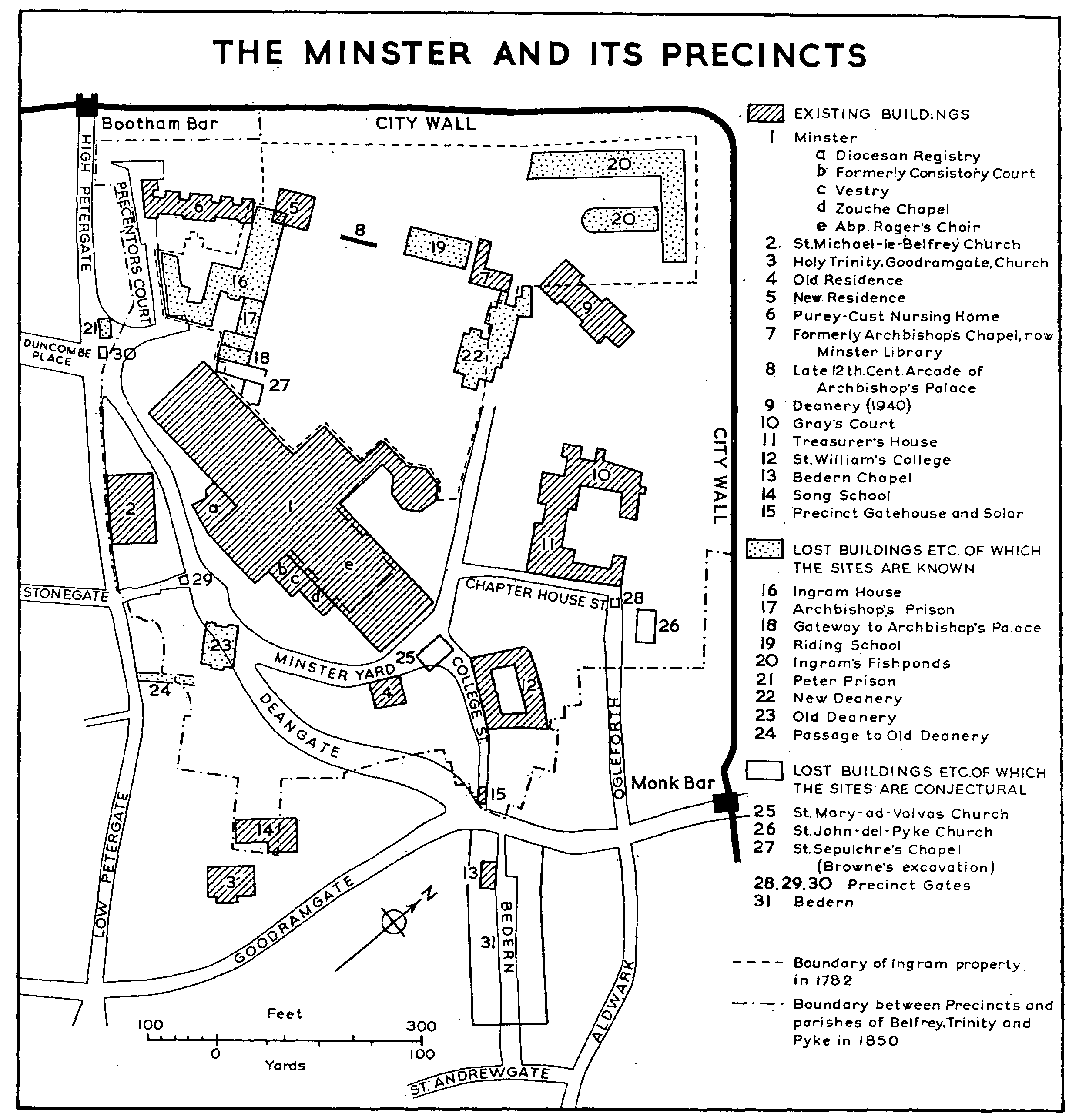
THE MINSTER AND ITS PRECINCTS
By 1880 the topography of the precinct was much as it now is and only one major alteration has been made subsequently—the cutting of the street, Deangate, from Petergate to Goodramgate in 1903. (fn. 39)
The Archbishop's Palace
The archbishop's palace lay on the north side of the minster and, with its grounds, may have occupied the whole plot later sold to Sir Arthur Ingram (see below). The palace was probably begun by Archbishop Roger; the only surviving remains are a late 12thcentury arcade, perhaps originally part of a walk or cloister, and a building probably of the early 13th century, long known as the chapel to the palace. In 1268 the grounds were extended by enclosing a plot between the palace and the city walls; right of access to the walls for defence purposes was reserved to the city. (fn. 40) Justices of oyer and terminer met in the palace in 1275; (fn. 41) costly alterations were made in 1327-8 when Edward III came to the city to conduct a Scottish campaign; (fn. 42) in 1400 a chamber was specially built in or near the palace so that Henry IV might comfortably watch a tournament taking place in the palace grounds; (fn. 43) Richard III took up quarters in the palace in 1483; (fn. 44) Henry VII attended a feast there in 1487; and Margaret Tudor visited it in 1503. (fn. 45) The destruction of the palace is said to have been begun by Archbishop Young (1561-8) when he removed the lead from the great hall to buy an estate for his son. (fn. 46) The ruins of the palace and its appurtenant buildings and land were granted to Sir Arthur Ingram about 1616. (fn. 47) Ingram built a house in the ruins adjacent to the north-west corner of the minster nave and laid out the grounds as pleasure gardens. The gardens were ornamented with statues and contained a tennis court, a bowling green (adjacent to the minster nave) and fish ponds (in the north-west angle of the present city walls). (fn. 48) Ingram entertained Charles I in his home in 1642, but, after Ingram's death in that year, the family seems to have deserted York for the more opulent mansion at Temple Newsam (W.R.). (fn. 49) The archbishop's palace remained in the Ingram family, however, and the whole property was cut up into small tenements and let out for a variety of purposes. Between 1734 and 1744 the tennis court site was occupied by a theatre; (fn. 50) in the 1780's and 1790's a riding school was conducted in the property; from the riding school a balloon ascent was made in 1785 and in its buildings in 1799 was to be seen a 'panorama' representing the British fleet at Spithead. (fn. 51) In 1782 the Ingram property comprised some twenty parcels leased to almost as many tenants; what appears to have been the main portion of the house built by Ingram was then in ruins. (fn. 52)
The whole property was purchased by the chapter after 1814 and gradually cleared and laid out in gardens. (fn. 53) The gate to the palace, the archbishop's prison adjacent to it, and the remains of the main part of Ingram's house were demolished between 1814 and 1816 and the chapter stone yard made on the site; (fn. 54) the rest was laid out in gardens in 1823. (fn. 55) The chapel of the palace, long ruinous, was repaired in 1813 for use as the chapter library; the building has been extended and was, in 1959, still so used; the arcades adjoining it were used as part of sheds until 1823 when they were cleared and the rubble removed to reveal the piers. (fn. 56)
The gardens and grounds thus cleared in the early 19th century, known after 1830 as Deanery, or, more recently Dean's Park, have changed little since that time, except for the building of the New Residence, the New Deanery, and the Purey-Cust Nursing Home, and the removal of the stone yard to Deangate. (fn. 57)
The Deaneries
A writ of William II, dated between 1089 and and 1095, licensed the canons to use land before the church for building lodgings; (fn. 58) a deanery may have been erected at this time but it is not mentioned eo nomine until 1164-75 when the deanery messuage was probably enlarged. (fn. 59) It is perhaps this building that is mentioned in a crenellation licence of 1302 when it is said to 'adjoin the churchyard'. (fn. 60) Two years earlier licence had been granted for the dean to enclose a path 60 ft. by 4 ft. leading from Petergate below his kitchen towards the churchyard for the enlargement of his plot. (fn. 61) It is possible that this refers to a lane that in the 19th century (fn. 62) ran from Petergate to the Old Deanery and the deaneries may thus have stood on or near that site at the south-east corner of the minster from early times. It was said, however, in 1538 that the Council in the North had formerly always met in the deanery, but, because there was no garden or open air for them, wished to meet elsewhere; such a description would not accord with the situation of the Old Deanery of the 19th century. (fn. 63)
Sir William Allanson (mayor 1633 and 1655) is said to have bought the deanery and lived in it; (fn. 64) this building, restored to the dean after 1660, is presumably the stone house of two floors with attics which, when it was demolished in 1831, was known as the Old Deanery. (fn. 65) In its gardens, adjacent to Holy Trinity, Goodramgate, was built new accommodation for St. Peter's School which moved there in 1833; (fn. 66) St. Peter's moved to Clifton in 1844 and the building was thereafter occupied by the School of Design and later by the Minster Song School which still used the building in 1959. (fn. 67)
The New Deanery, a stone house in Gothic style, was erected adjacent to the chapel of the archbishop's palace between 1827 and 1831. (fn. 68) This building was demolished in 1940 when the present deanery, a brick house north of the older site, was erected. (fn. 69)
The Residences
The Old Residence, a house standing at the southeast corner of the minster, was probably built in the early 18th century to house canons during their period of residence. (fn. 70) Nothing is known of any previous communal residence. The New Residence in Dean's Park, a stone house of two storeys with attics, was built in 1824. (fn. 71) The Old Residence was later occupied by the headmaster of St. Peter's School, the Chapter Clerk, the registrar, and others. (fn. 72) In 1959 it was used by the junior school of the York College for Girls. The New Residence was used by the chapter until 1920 when a new statute enabled canons in residence to live in other houses. (fn. 73) The furniture and fittings were then sold and in 1959 the house was let as offices. (fn. 74)
The Treasurer's House and Gray's Court
The house known since the 16th century as the Treasurer's House stands on the site of, and in part embraces, a house that in the mid-15th century and possibly as early as 1419 belonged to and was perhaps occupied by the treasurer of the minster. (fn. 75) Some 13th-century pillars, now supporting the gallery in Gray's Court, survive from the medieval house. The treasurership was resigned to the Crown in 1547. (fn. 76) The property of the treasurers was granted to Protector Somerset who immediately sold the 'mansion house of the treasurers' to Archbishop Holgate. It was still in Holgate's possession at his death in 1555 and was assigned by agreement with the executors to his nephew Robert Holgate. Some time later it was sold to Archbishop Young.
It is probable that Young bought the house to replace the archbishop's palace which he had partly demolished (see above). The house passed to his son George on his marriage in 1588 and was still held by him on his death in 1620. Sir George (as he later became) probably built the present Treasurer's House on an H plan about 1600 (see plate facing p. 356); the gallery over the 13th-century hall in what is now Gray's Court was also probably his work.
The house remained in the hands of the Youngs until 1648 when it was sold to Sir William Belt (Recorder 1625-38); Belt sold it to Sir Thomas Fairfax, and Fairfax, in 1663, to George Aislaby of York. From the Aislabys it came into the hands of Robert Squire who, according to Drake, rebuilt it; (fn. 77) Squire may have added the distinctive Flemish gables but otherwise his alterations were confined to windows and decoration.
In 1720 Squire's daughter, Jane, split the house up and let it to tenants and it was later sold in two parts. The northern wing, Gray's Court, came into the hands of William Gray in 1788; it was divided in the 19th century but brought into one house by Edwin Gray in 1900. Gray's Court and its gardens were purchased by the chapter in 1945 (fn. 78) and it was subsequently let out; in 1959 it was occupied principally by a department of St. John's College.
The larger part of the house, now known as the Treasurer's House, was similarly subdivided; the parts were purchased by Francis William Green, a Wakefield engineer, between 1897 and 1900. Green extensively restored the house and filled it with a collection of antique furniture. In 1930 he presented the house and its contents to the National Trust, who held the property in 1959. (fn. 79) It was from the Treasurer's House that, between 1782 and 1786, John Goodricke, the astronomer, made his observations. (fn. 80)
The Bedern
The collegiate buildings of the vicars-choral (fn. 81) lay east of the minster across Goodramgate; the boundaries of the precinct are perhaps roughly indicated by the parochial boundaries of the 1852 plan. It has been suggested that because the name of the area is Old English, a religious building—a 'prayer-house' —stood on the site before the Danish invasion and settlement of 866 when York's predominantly Scandinavian street names became fixed. (fn. 82) The fact, moreover, that until modern times the south-east boundary of the Bedern was approximately the line of the Roman garrison wall suggests that, as an enclosure, it was of very early origin. According to Dugdale, whose source is not known, the Bedern was given to the vicars-choral by William de Lanum in 1248; (fn. 83) it seems unlikely that the vicars, whose organization as a body dates from about this time, (fn. 84) occupied the Bedern earlier. The Bedern was enlarged by the acquisition of a small plot in Aldwark in 1335 and a chapel at the western end, adjacent to the gate into Goodramgate, was consecrated in 1349. (fn. 85) The chapel was probably built twenty years earlier; (fn. 86) it contained some early 14th-century stained glass in its windows which were described by Torre and which were not removed until 1816. (fn. 87) The chapel was in 1959 used as a store by the chapter.
Besides the chapel there was within the Bedern a common hall lying south-west of the present street; the hall was being repaired in 1328-9 and seems to have been kept in repair until the end of the 16th century when the practice of communal dining ceased. (fn. 88) Part of the hall was then incorporated in a dwelling house but it retained its identity sufficiently for Torre to observe it in the late 17th century. (fn. 89) Parts of the structure were found to be embodied in a confectionery works in 1924 (fn. 90) and much of it still remained in 1959.
The vicars' houses are thought to have faced the hall with gardens in between and an orchard behind. About a third of the vicars' houses were occupied by lay tenants even before the Reformation and thereafter they no doubt went rapidly out of use because they were unsuitable for married clergy. (fn. 91) It is not known when the medieval houses were demolished. (fn. 92) In 1844 it was reported that there were large houses in the Bedern, once fashionable homes but then sublet to 98 familes of whom 67 had only one room for all purposes. The living conditions were then amongst the worst in York. (fn. 93) The property bordering the present street was all built after 1865 when the possessions of the vicars passed to the Ecclesiastical Commissioners. (fn. 94)
Until modern times the only entrance to the Bedern was by a passage from Goodramgate standing opposite the College Street gate of the minster precinct. In 1396 licence was given to the vicars to construct a gallery over Goodramgate from the solar over their gate to that over the minster gate, thus allowing them to approach the minster without leaving the precinct. (fn. 95) The south-eastern end of the Bedern was opened into St. Andrewgate between 1850 and 1855. (fn. 96)
St. William's College
The college for the chantry priests of the minster was founded in 1461 and a building, substantially that now to be seen, erected between 1465 and 1467, on or near the site of the prebendal house of Salton. (fn. 97) The college was granted out from the Crown in 1549 and afterwards passed through a number of private hands until it was bought by Francis Green of the Treasurer's House about 1900. (fn. 98) In the early 17th century it was the home of a Sir Henry Jenkyns of Grimston (E.R.), who added the courtyard porch and a staircase, but thereafter it was divided into tenements and was so occupied when Green bought it. He sold it about 1906, for the price he had paid, to the Convocation of York as a meeting-place for that body. (fn. 99) The college was then restored and Convocation still met there in 1959; part of the building was then let out as offices. It was found on restoration that the structure had been extensively altered in the 17th and 18th centuries but in a small room in the south-east corner was found a wall frescoed in 15th-century style with trails of flowers, and there were some traces of structures that might have belonged to the prebendal house on whose site the college was built.