
Journal of the House of Lords: Volume 9, 1646. Originally published by His Majesty's Stationery Office, London, 1767-1830.
This free content was digitised by double rekeying. All rights reserved.
'House of Lords Journal Volume 9: 22 June 1647', in Journal of the House of Lords: Volume 9, 1646, (London, 1767-1830) pp. 285-287. British History Online https://www.british-history.ac.uk/lords-jrnl/vol9/pp285-287 [accessed 26 April 2024]


In this section
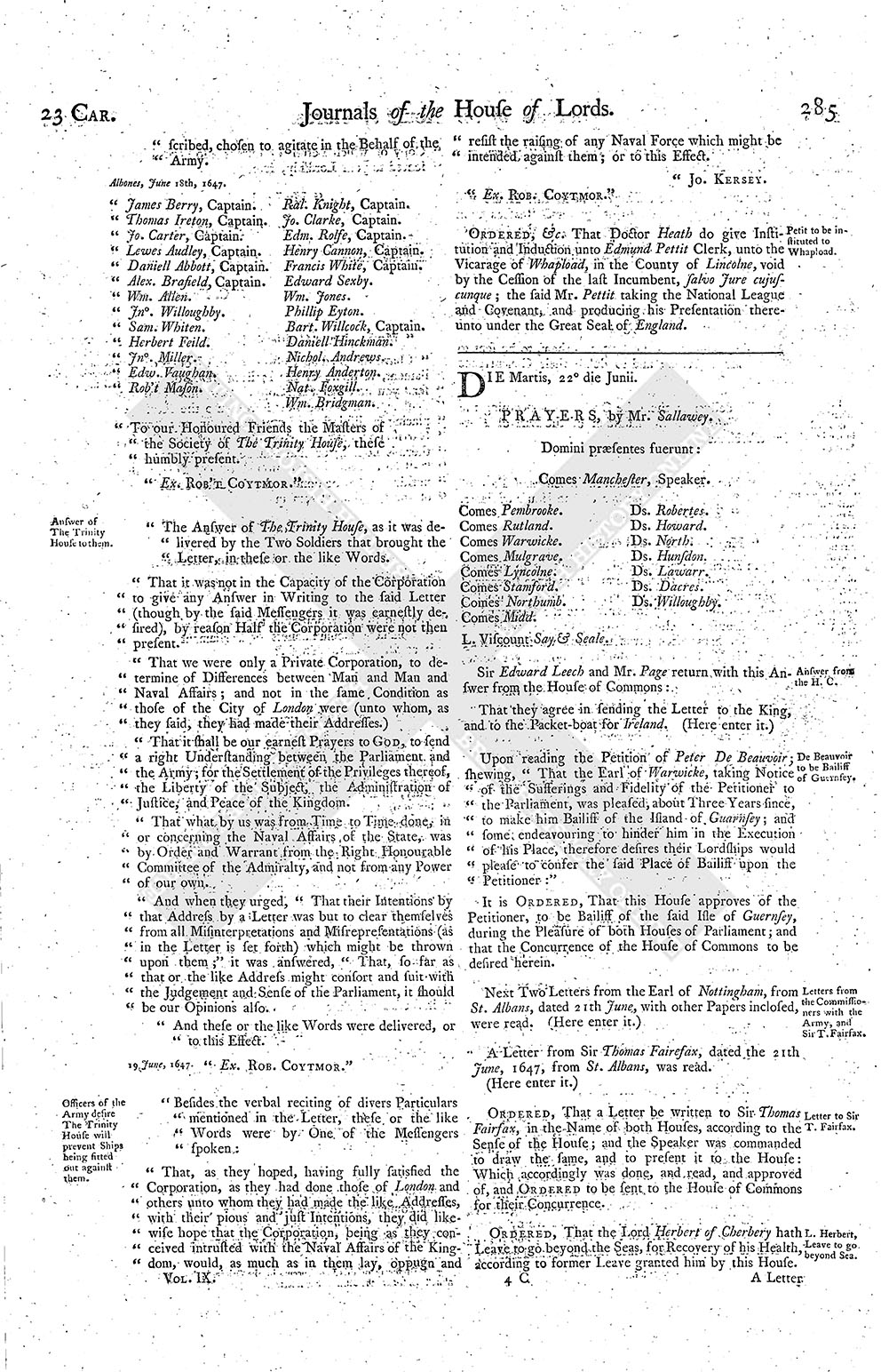
DIE Martis, 22 die Junii.
PRAYERS, by Mr. Sallawey.
Domini præsentes fuerunt:
Comes Manchester, Speaker.
Answer from the H. C.
Sir Edward Leech and Mr. Page return with this Answer from the House of Commons:
That they agree in sending the Letter to the King, and to the Packet-boat for Ireland. (Here enter it.)
De Beauvoir to be Bailiff of Guernsey.
Upon reading the Petition of Peter De Beauvoir; shewing, "That the Earl of Warwicke, taking Notice of the Sufferings and Fidelity of the Petitioner to the Parliament, was pleased, about Three Years since, to make him Bailiff of the Island of Guarnsey; and some endeavouring to hinder him in the Execution of his Place, therefore desires their Lordships would please to confer the said Place of Bailiff upon the Petitioner:"
It is Ordered, That this House approves of the Petitioner, to be Bailiff of the said Isle of Guernsey, during the Pleasure of both Houses of Parliament; and that the Concurrence of the House of Commons to be desired herein.
Letters from the Commissioners with the Army, and Sir T. Fairfax.
Next Two Letters from the Earl of Nottingham, from St. Albans, dated 21th June, with other Papers inclosed, were read. (Here enter it.)
A Letter from Sir Thomas Fairefax, dated the 21th June, 1647, from St. Albans, was read.
(Here enter it.)
Letter to Sir T. Fairfax.
Ordered, That a Letter be written to Sir Thomas Fairfax, in the Name of both Houses, according to the Sense of the House; and the Speaker was commanded to draw the same, and to present it to the House: Which accordingly was done, and read, and approved of, and Ordered to be sent to the House of Commons for their Concurrence.
L. Herbert, Leave to go beyond Sea.
Ordered, That the Lord Herbert of Cherbery hath Leave to go beyond the Seas, for Recovery of his Health, according to former Leave granted him by this House.
Letter to the Commissioners with the Army.
A Letter to be sent to the Earl of Nottingham, was read, and Agreed to.
Langham and Limbrey.
Ordered, That, on Thursday next, this House will hear the Judges several Arguments and Reasons upon which they grounded their Opinions, in the Case between Alderman Langham, &c. and Captain Lymbery, &c. In the mean Time, all Proceedings in this Business to stay.
Message to the H.C. with the Letter to Sir T. Fairfax;
A Message was sent to the House of Commons, by Sir Edward Leech and Mr. Page:
1. To communicate the Letter to them, to be sent to Sir Thomas Fairefax; and to desire their Concurrence therein.
and with the Ordinance to raise Money in the Isle of Wight.
2. To deliver to them the Ordinance concerning the Isle of Wight, with the Addition of the Earl of Pembrooke's Name.
Letter from the Commissioners with the Army, that the Money is arrived for it; but that they cannot get an Answer from Sir T. Fairfax, about moving his Quarters; and that Part of Col. Fortescue's Regiment are gone to the Army, who say, they were desired to engage against it.
"For the Right Honourable Edward Earl of Manchester, Speaker of the House of Peers. These.
"May it please your Lordship,
"In Discharge of my Duty, I think fit to acquaint your Lordship, that, several Times since I received your last of the 15th Instant, we have very earnestly solicited the General for Answer to the Command of both Houses, touching removing Quarter; which the General hath often given us Hope we should long ere this have received: But it is not as yet come, which seems strange to us.
"The General told us Yesterday, That Six Companies of Colonel Fortescue's Regiment that were designed for Ireland were come up very near the Army, and desired to be re-admitted; and that they pretended to be discontented, for that they are drawn this Way to engage against the Army.
"On Saturday Night late, the Month's Pay for the Army came hither, and the Committee from the Common Council of London, who presented a Letter to the General from the City. The Money is this Day paying out to the Army. We shall still earnestly press for an Answer, according to your Command; which, so soon as we shall receive, shall be immediately presented, from.
St. Albones, 21th of June, 1647.
"Your Lordship's
Humble Servant,
C. Nottingham."
Letter from them, with Sir T. Fairfax's Answer about the King's Removal.
"For the Right Honourable Edward Earl of Manchester, Speaker of the House of Peers. These.
"May it please your Lordship,
"In Answer to the several Matters contained in your Votes and Letter of the 17th Instant, which I have often pressed; this Night, about Nine of the Clock the General sent us a Letter, with the Copy of a Letter to yourself inclosed, in reference to the Affairs; the Copies of both which I herewith present to (fn. 1) your Lordship: And because, in our Judgements, the Answer is not full or certain, we have by Letter signified our Sense thereof to the General, and prayed him to take your Votes into further Consideration; a Copy of which Letter of ours is also herewith presented to your Lordship, from,
St. Albones, the 21th of June, 1647. past Twelve at Night.
"My Lord,
Your Lordship's
Humble Servant,
C. Nottingham."
Sir T. Fairfax's Letter to the Commissioners, inclosing it.
"My Lords and Gentlemen,
"I have returned an Answer to both Houses of Parliament, to theirs of the 17th of June, of which I send you here inclosed a Copy. As to those Two Particulars, of admitting new Forces into the Army, or placing or displacing of any Forces in any Fort or Garrison without the Approbation of the Houses, there is nothing of that Nature done by me; and I shall be careful, to the utmost of my Power, that nothing in that be done to the Prejudice or Disservice of the Kingdom. I remain
June 21, 1647.
"Your Lordships
Humble (fn. 2) Servant,
T. Fairefax.
"For the Right Honourable the Lords and Commons Commissioners of Parliament at St. Albones. These."
Letter from the Commissioners, to Sir T. Fairfax, pressing the Removal of the Army further from London, and for an Answer about the King's being moved to Richmond.
"SIR,
"We have perused your Letter, sent to us this Night by Scout-master General Watson, with the Copy of yours inclosed to the Houses of Parliament; and having thereupon considered the Votes of both Houses, and their Directions to us, we held it our Duty, in Discharge of the Trust committed to us, to let your Excellency know, That the Order of both Houses for the Removal of the Army Forty Miles from London is positive; and we are commanded to be very earnest in pressing your Excellency therein; as also to desire you to give the Parliament a speedy and positive Account of what you have done upon their Letter and Votes sent you, for Removal of the King's Person to Richmond; to both which Points we find your Answer, by the Copy sent us, to be defective and uncertain; and therefore do again very earnestly desire your Excellency to take the same into Consideration, and give a more full and certain Answer to what is expected from you by the Houses in these Particulars. We rest
June 21th, 1647.
"Your Excellency's
Humble Servants."
Sir T. Fairfax's Answer, about the King's going to Richmond, and the Removal of the Army further from London.
(fn. 3) "For the Right Honourable the Earl of Manchester, Speaker of the House of Peers, pro Tempore.
"My Lord,
"By your Lordship's of the 17th of June Instant, I am commanded to render the Charge of His Majesty to your Commissioners now attending His Majesty at Newmarkett: To which I humbly answer, That the Commissioners have attended the Person of the King ever since His coming from Holdenby, and have been desired by me to continue the Discharge of their Trust which was committed to them by the Parliament; which that it might be the better performed, I gave them a Guard of Two Regiments of Horse, who do at this Time attend the King and Commissioners at Newmarkett. I humbly conceive I have nothing else to answer to as touching this Matter. As to our Removal to further Distance from London, we intreat we may receive an Answer to the Desires of the Army in the Papers last we sent you; conceiving we shall neither give Satisfaction to the Kingdom nor to the Army, who are in Expectation of some Effect thereupon. There is also Information of daily underhand Preparations of Forces, and the keeping-up of those that are raised publicly avowed, together with other Grounds of Jealousy, occasioned by the Endeavours of some to bring in Foreign Forces, and by sending divers Officers into several Parts of the Kingdom, to possess Places of Strength, and to raise Men; which, to our Apprehensions, tend to the raising of a new War; whereof I thought fit to give you this Account. I remain
June 21th, 1647, St. Albons.
"Your Lordship's
Most humble Servant,
T. Fairefax."
Letter to the Commissioners with the Army, about the Report concerning some of Col. Fortescue's Regiment.
"My Lord,
"The Lords have received your Letter of the 21th Instant; and have commanded me to let you know, that they do well approve your earnest pressing the General's Answer to the Votes concerning his removing of his Quarters. And as to the Report of the Soldiers of Colonel Fortescue's Regiment, that they were drawn this Way to engage against the Army, they do desire you to enquire of the Grounds of that Misinformation; for they know not any Cause why such a Report should be raised.
"This is all I have in Command as
Your."
Letter to the King, desiring He will consent to remove to Richmond.
"May it please Your Majesty,
"Your Majesty's loyal Subjects, the Lords and Commons assembled in Parliament, out of the earnest Desire that the Peace of Your Three Kingdoms may have a speedy Settlement, have passed these Votes for Your Majesty's coming to Your House at Richmond, that then a joint Application may be made unto Your Majesty, from Your Parliaments of England and Scotland, to that Purpose. It is our humble Desire, that Your Majesty will be pleased to come accordingly; and our Prayers shall be to the Great God, that He will bless all Endeavours that shall tend to the preventing of further Distractions in Church and State, and to the procuring of a safe and well-grounded Peace.
"Your Majesty's Loyal Subjects and humble Servants.
"The Direction,
For His Majesty."
Letter to Sir T. Fairfax, that there are no Men raising to act against the Army, nor any Preparations of that Sort.
"SIR,
"The Lords and Commons assembled in Parliament have received your Letter of the 21th Instant, by which you give them an Account of several Informations that are given unto the Army, "That there are daily underhand Preparations made of Forces, and that there is a public Avowment of keeping Forces already raised." They did, by their former Letters unto you, affirm the contrary. They do again assure you, that there are no Forces either prepared or avowed by their Authority against the Army; and therefore they desire you to make known unto them the Grounds you have of these Reports. They likewise disclaim any Thought in them of bringing in Foreign Forces; and do desire you to make strict Enquiry into the Occasion of these Misinformations, that they may be certified from what Hands they come, that so the Authors of such Aspersions may be known and punished. They have no Knowledge of any Persons employed from them for the possessing of any Places of Strength, or for the raising any Men; and they hope there will be no Occasion to alter their Confidence they have of the Army, in relation to their solemn Engagements to preserve the Honour and Privileges of Parliament, the Safety and Peace of the Kingdom: Therefore they do fully and clearly declare the Falseness of these Informations to you, and do expect your Endeavours for the preventing of any such causeless Jealousies; and in regard of the Inconveniences that do and may come to the City of London and the Parts near adjacent, by the Army's being so near as now they are, they still insist upon their former Vote, for your not Quartering of the Army nearer than Forty Miles from London."