
Journal of the House of Lords: Volume 9, 1646. Originally published by His Majesty's Stationery Office, London, 1767-1830.
This free content was digitised by double rekeying. All rights reserved.
'House of Lords Journal Volume 9: 31 December 1647', in Journal of the House of Lords: Volume 9, 1646, (London, 1767-1830) pp. 619-621. British History Online https://www.british-history.ac.uk/lords-jrnl/vol9/pp619-621 [accessed 26 April 2024]

In this section
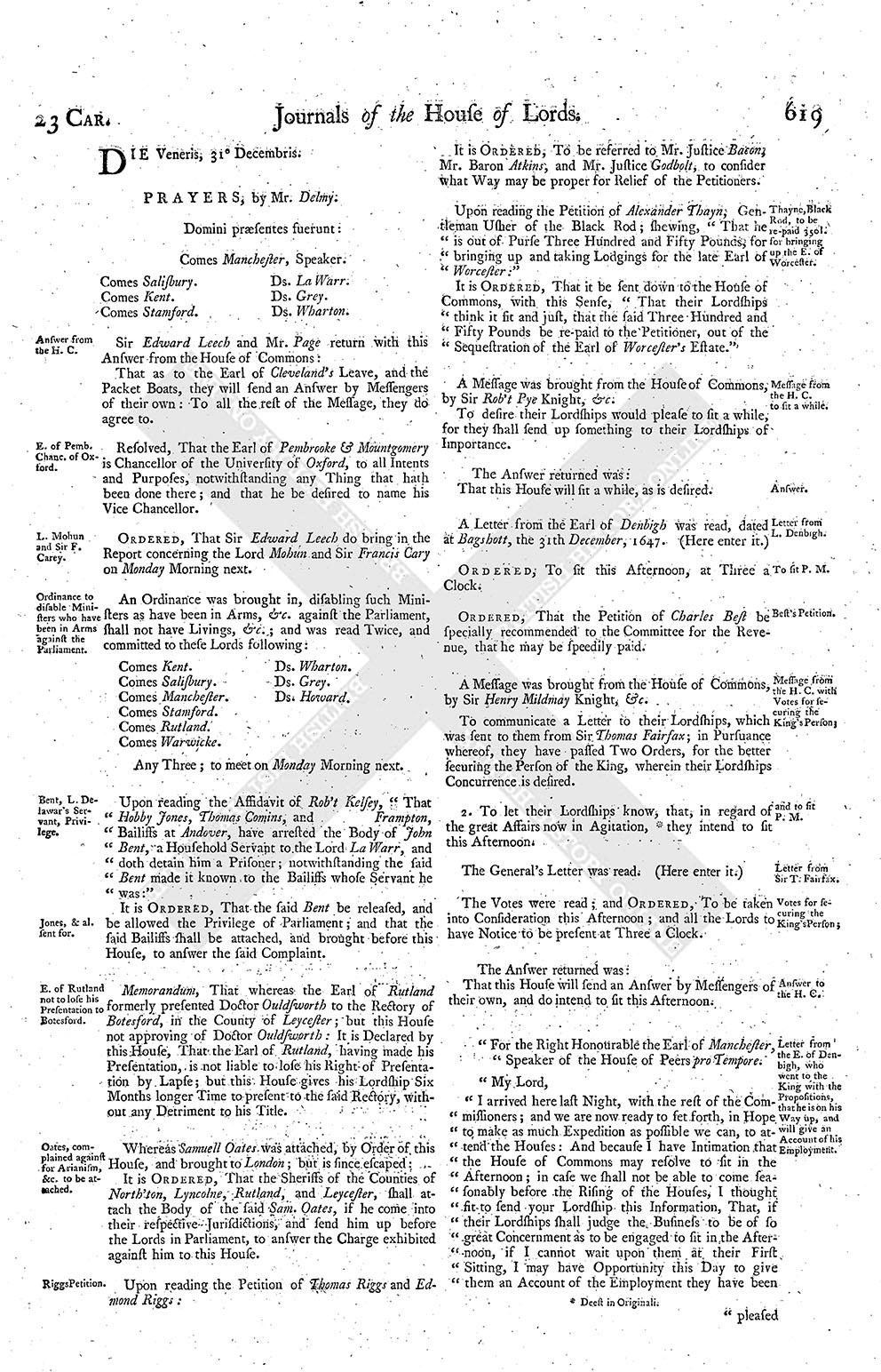
DIE Veneris, 31 Decembris.
PRAYERS, by Mr. Delmy.
Domini præsentes fuerunt:
Comes Manchester, Speaker.
Answer from the H. C.
Sir Edward Leech and Mr. Page return with this Answer from the House of Commons:
That as to the Earl of Cleveland's Leave, and the Packet Boats, they will send an Answer by Messengers of their own: To all the rest of the Message, they do agree to.
E. of Pemb. Chanc. of Oxford.
Resolved, That the Earl of Pembrooke & Mountgomery is Chancellor of the University of Oxford, to all Intents and Purposes, notwithstanding any Thing that hath been done there; and that he be desired to name his Vice Chancellor.
L. Mohun and Sir F. Carey.
Ordered, That Sir Edward Leech do bring in the Report concerning the Lord Mohun and Sir Francis Cary on Monday Morning next.
Ordinance to disable Ministers who have been in Arms against the Parliament.
An Ordinance was brought in, disabling such Ministers as have been in Arms, &c. against the Parliament, shall not have Livings, &c. and was read Twice, and committed to these Lords following:
|
Comes Kent. Comes Salisbury. Comes Manchester. Comes Stamford. Comes Rutland. Comes Warwicke. |
Ds. Wharton. Ds. Grey. Ds. Howard. |
Any Three; to meet on Monday Morning next.
Bent, L. Delawar's Servant, Privilege.
Upon reading the Affidavit of Rob't Kelsey, "That Hobby Jones, Thomas Comins, and Frampton, Bailiffs at Andover, have arrested the Body of John Bent, a Household Servant to the Lord La Warr, and doth detain him a Prisoner; notwithstanding the said Bent made it known to the Bailiffs whose Servant he was:"
Jones, & al. sent for.
It is Ordered, That the said Bent be released, and be allowed the Privilege of Parliament; and that the said Bailiffs shall be attached, and brought before this House, to answer the said Complaint.
E. of Rutland not to lose his Presentation to Botesford.
Memorandum, That whereas the Earl of Rutland formerly presented Doctor Ouldsworth to the Rectory of Botesford, in the County of Leycester; but this House not approving of Doctor Ouldsworth: It is Declared by this House, That the Earl of Rutland, having made his Presentation, is not liable to lose his Right of Presentation by Lapse; but this House gives his Lordship Six Months longer Time to present to the said Rectory, without any Detriment to his Title.
Oates, complained against for Arianism, &c. to be attached.
Whereas Samuell Oates was attached, by Order of this House, and brought to London; but is since escaped:
It is Ordered, That the Sheriffs of the Counties of North'ton, Lyncolne, Rutland, and Leycester, shall attach the Body of the said Sam. Oates, if he come into their respective Jurisdictions, and send him up before the Lords in Parliament, to answer the Charge exhibited against him to this House.
Riggs Petition.
Upon reading the Petition of Thomas Riggs and Edmond Riggs:
It is Ordered, To be referred to Mr. Justice Bacon, Mr. Baron Atkins, and Mr. Justice Godbolt, to consider what Way may be proper for Relief of the Petitioners.
Thayne, Black Rod, to be re-paid 350 l. for bringing up the E. of Worcester.
Upon reading the Petition of Alexander Thayn, Gentleman Usher of the Black Rod; shewing, "That he is out of Purse Three Hundred and Fifty Pounds, for bringing up and taking Lodgings for the late Earl of Worcester:"
It is Ordered, That it be sent down to the House of Commons, with this Sense, "That their Lordships think it fit and just, that the said Three Hundred and Fifty Pounds be re-paid to the Petitioner, out of the Sequestration of the Earl of Worcester's Estate."
Message from the H. C. to sit a while.
A Message was brought from the House of Commons, by Sir Rob't Pye Knight, &c.
To desire their Lordships would please to sit a while, for they shall send up something to their Lordships of Importance.
The Answer returned was:
Answer.
That this House will fit a while, as is desired.
Letter from L. Denbigh.
A Letter from the Earl of Denbigh was read, dated at Bagshott, the 31th December, 1647. (Here enter it.)
To sit P. M.
Ordered, To sit this Afternoon, at Three a Clock.
Best's Petition.
Ordered, That the Petition of Charles Best be specially recommended to the Committee for the Revenue, that he may be speedily paid.
Message from the H. C. with Votes for securing the King's Person;
A Message was brought from the House of Commons, by Sir Henry Mildmay Knight, &c.
To communicate a Letter to their Lordships, which was sent to them from Sir Thomas Fairfax; in Pursuance whereof, they have passed Two Orders, for the better securing the Person of the King, wherein their Lordships Concurrence is desired.
and to sit P. M.
2. To let their Lordships know, that, in regard of the great Affairs now in Agitation, (fn. 1) they intend to sit this Afternoon.
Letter from Sir T. Fairfax.
The General's Letter was read. (Here enter it.)
Votes for securing the King's Person;
The Votes were read; and Ordered, To be taken into Consideration this Afternoon; and all the Lords to have Notice to be present at Three a Clock.
The Answer returned was:
Answer to the H. C.
That this House will send an Answer by Messengers of their own, and do intend to sit this Afternoon.
Letter from the E. of Denbigh, who went to the King with the Propositions, that he is on his Way up, and will give an Account of his Employment.
For the Right Honourable the Earl of Manchester, Speaker of the House of Peers pro Tempore.
My Lord,
I arrived here last Night, with the rest of the Commissioners; and we are now ready to fet forth, in Hope to make as much Expedition as possible we can, to attend the Houses: And because I have Intimation that the House of Commons may resolve to sit in the Afternoon; in case we shall not be able to come seasonably before the Rising of the Houses, I thought fit to send your Lordship this Information, That, if their Lordships shall judge the Business to be of so great Concernment as to be engaged to sit in the Afternoon, if I cannot wait upon them at their First Sitting, I may have Opportunity this Day to give them an Account of the Employment they have been pleased to betrust me with, and to assure your Lordship of the real Affection and Service of
Bagshott, last of Dec. 1647, at 5 a Clock in the Morning.
"Your Lordship's
Most humble Servant,
B. Denbigh."
Letter from Sir T. Fairfax, about securing the King's Person; and that he has sent more Officers into the Isle of Wight for that Purpose.
"For the Right Honourable William Lenthall Esquire, Speaker of the Honourable House of Commons.
SIR,
Having lately received a Desire from Colonel Hammond, out of the Isle of Wight, That he may not be thought accountable for the Person of the King, which I conceive doth arise from his Apprehension of the too great Weight of such a Charge, unless he had more particular Order for his Warrant and Direction; I have sent Sir William Constable, Lieutenant Colonel Salmon, and Lieutenant Colonel Goffe, to be for the present assisting to him therein, until the Houses take such further Course as to their Wisdoms shall seem meet. The Business being of so great Concernment to the Kingdom, and too much for me to give a Resolution in; I held it my Duty earnestly to beg the Signification of your Pleasure, and such particular Direction as may be a Rule and Warrant both to mine and their Obedience who are to serve you; which will be faithfully observed by
Windsor, 30 Decembris, 1647.
"Your humble Servant,
T. Fairfax."
Adjourn.
House adjourned till 3a post Meridiem.
Post Meridiem.
PRAYERS, by Mr. Delmy.
Domini præsentes fuerunt:
Comes Manchester, Speaker.
|
Comes Kent. Comes Salisbury. Comes Warwicke. Comes Denbigh. Comes Rutland. Comes Stamford. |
Ds. North. Ds. Grey. Ds. La Warr. Ds. Howard. Ds. Wharton. |
Votes for securing the King's Person.
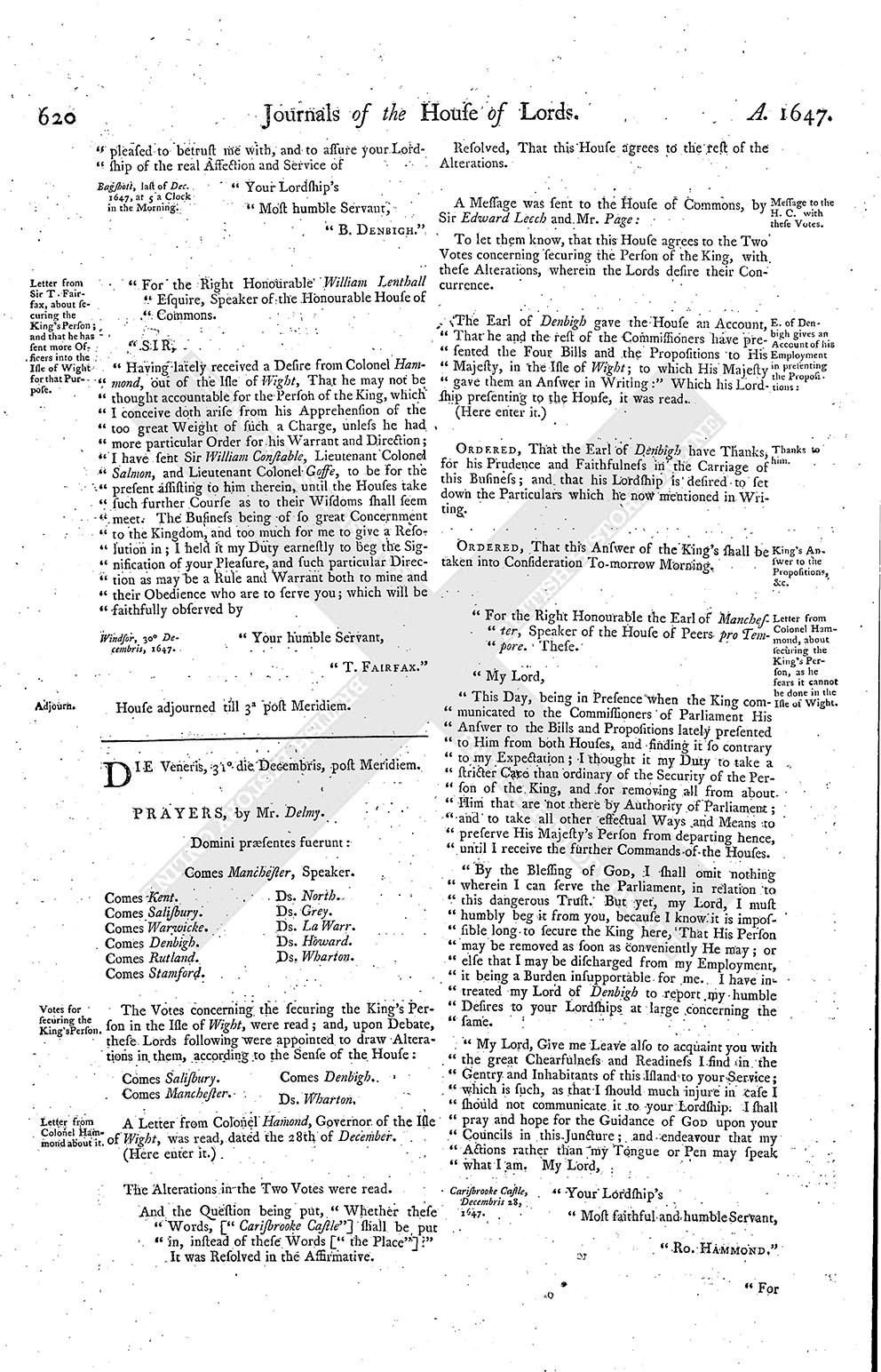
The Votes concerning the securing the King's Person in the Isle of Wight, were read; and, upon Debate, these Lords following were appointed to draw Alterations in them, according to the Sense of the House:
Letter from Colonel Hammond about it.
A Letter from Colonel Hamond, Governor of the Isle of Wight, was read, dated the 28th of December.
(Here enter it.)
The Alterations in the Two Votes were read.
And the Question being put, "Whether these Words, ["Carisbrooke Castle"] shall be put in, instead of these Words ["the Place"]?"
It was Resolved in the Affirmative.
Resolved, That this House agrees to the rest of the Alterations.
Message to the H. C. with these Votes.
A Message was sent to the House of Commons, by Sir Edward Leech and Mr. Page:
To let them know, that this House agrees to the Two Votes concerning securing the Person of the King, with these Alterations, wherein the Lords desire their Concurrence.
E. of Denbigh gives an Account of his Employment in presenting the Propositions:
The Earl of Denbigh gave the House an Account, That he and the rest of the Commissioners have presented the Four Bills and the Propositions to His Majesty, in the Isle of Wight; to which His Majesty gave them an Answer in Writing:" Which his Lordship presenting to the House, it was read.
(Here enter it.)
Thanks to him.
Ordered, That the Earl of Denbigh have Thanks, for his Prudence and Faithfulness in the Carriage of this Business; and that his Lordship is desired to set down the Particulars which he now mentioned in Writing.
King's Answer to the Propositions, &c.
Ordered, That this Answer of the King's shall be taken into Consideration To-morrow Morning.
Letter from Colonel Hammond, about securing the King's Person, as he fears it cannot be done in the Isle of Wight.
"For the Right Honourable the Earl of Manchester, Speaker of the House of Peers pro Tempore. These.
"My Lord,
"This Day, being in Presence when the King communicated to the Commissioners of Parliament His Answer to the Bills and Propositions lately presented to Him from both Houses, and finding it so contrary to my Expectation; I thought it my Duty to take a stricter Care than ordinary of the Security of the Person of the King, and for removing all from about Him that are not there by Authority of Parliament; and to take all other effectual Ways and Means to preserve His Majesty's Person from departing hence, until I receive the further Commands of the Houses.
"By the Blessing of God, I shall omit nothing wherein I can serve the Parliament, in relation to this dangerous Trust. But yet, my Lord, I must humbly beg it from you, because I know it is impossible long to secure the King here, That His Person may be removed as soon as conveniently He may; or else that I may be discharged from my Employment, it being a Burden insupportable for me. I have intreated my Lord of Denbigh to report my humble Desires to your Lordships at large concerning the same.
My Lord, Give me Leave also to acquaint you with the great Chearfulness and Readiness I find in the Gentry and Inhabitants of this Island to your Service; which is such, as that I should much injure in case I should not communicate it to your Lordship. I shall pray and hope for the Guidance of God upon your Councils in this Juncture; and endeavour that my Actions rather than my Tongue or Pen may speak what I am. My Lord,
Carisbrooke Castle, Decembris 28, 1647.
"Your Lordship's
Most faithful and humble Servant,
Ro. Hammond."
The King's Answer to the Bills and Propositions presented to Him.
"For the Speaker of the Lords House pro Tempore; to be communicated unto the Lords and Commons in the Parliament of England at Westm'r, and the Commissioners of the Parliament of Scotland.
"His Majesty's Answer to the Bills and Propositions presented to Him at Caresbrooke Castle, in the Isle of Wight, the 24th of December, 1647, by the Earl of Denbigh, Mr. Lisle, Mr. Goodwin, Mr. Kemp, and Mr. Bunkley, in the Name of His Two Houses of Parliament.
"CHARLES R.
"The Necessity of complying with all engaged Interests in these great Distempers, for a perfect Settlement of Peace, His Majesty finds to be none of the least Difficulties He hath met with since the Time of His Afflictions; which is too visible, when, at the same Time that the Two Houses of the English Parliament do present to His Majesty several Bills and Propositions for His Consent, the Commissioners for Scotland do openly protest against them; so that, were there nothing in the Case but the Consideration of that Difference, His Majesty cannot imagine how to give such an Answer to what is now proposed, as thereby to promise Himself His great End, a perfect Peace. And when His Majesty further considers, how impossible it is (in the Condition He now stands) to fulfil the Desires of His Two Houses; since the only ancient and known Ways of passing Laws are, either by His Majesty's Personal Assent in the House of Peers, or by Commission under His Great Seal of England; He cannot but wonder at such Failings in the Manner of Address which now is made unto Him, unless His Two Houses intend that His Majesty shall allow of a Great Seal made without His Authority, even before there be any Consideration had thereupon in a Treaty; which, as it may hereafter hazard the Security itself, so for the present it seems very unreasonable to His Majesty. And though His Majesty is willing to believe, that the Intention of very many in both Houses, in sending these Bills before a Treaty, was only to obtain a Trust from Him, and not to take any Advantage, by passing them, to force other Things from Him, which are either against His Conscience or Honour; yet His Majesty believes it clear to all Understandings, that these Bills contain (as they are now penned) not only the divesting Himself of all Sovereignty, and that without Possibility of Recovery either to Him or His Successors, except by Repeal of those Bills, but also the making His Concessions guilty of the greatest Pressures which can be laid upon the Subject; as in other Particulars, so by giving an arbitrary and unlimited Power to the Two Houses for ever, to raise and levy Forces, for Land or Sea Service, of what Persons (without Distinction of Quality) and to what Numbers they please; and likewise, for the Payment of them, to levy what Monies, in such Sort, and by such Ways and Means (and consequently upon the Estates of whatsoever Persons), they shall think fit and appoint, which is utterly inconsistent with the Liberty and Property of the People, and His Majesty's Trust in protecting them: So that, if the major Part of both Houses should think it necessary to put the rest of the Propositions into Bills, His Majesty leaves all the World to judge, how unsafe it would be for Him to consent thereunto; and if not, what a strange Condition (after the Passing of these Four Bills) His Majesty and all His Subjects would be cast into. And here His Majesty thinks it not unfit to wish His Two Houses to consider well the Manner of their Proceeding; that, when His Majesty desires a Personal Treaty with them for the Settling of a Peace, they in Answer propose the very Subject-matter of the most essential Parts thereof to be first granted: A Thing which will be hardly credible to Posterity.
"Wherefore His Majesty declares, that neither the Desire of being freed from this tedious and irksome Condition of Life His Majesty hath so long suffered, nor the Apprehension of what may befal Him in case His Two Houses shall not afford Him a Personal Treaty, shall make Him change His Resolution, of not consenting to any Act till the whole Peace be concluded. Yet then He intends not only to give just and reasonable Satisfaction in the Particulars presented to Him; but also to make good all other Concessions mentioned in His Message of the Sixteenth of November last, which He thought would have produced better Effects than what He finds in the Bills and Propositions now presented unto Him. And yet His Majesty cannot give over, but now again earnestly presses for a Personal Treaty (so passionately is He affected with the Advantages which Peace will bring to His Majesty and all His Subjects), of which He will not at all despair, there being no other visible Way to obtain a well-grounded Peace. However, His Majesty is very much at Ease within Himself, for having fulfilled the Offices both of a Christian and a King; and will patiently wait the good Pleasure of Almighty God, to incline the Hearts of His Two Houses to consider their King, and compassionate their Fellow Subjects Miseries.
"Given at Caresbrooke Castle, in the Isle of Wight, the 28th of December, 1647.
"For the Speaker of the Lords House pro Tempore; to be communicated to the Lords and Commons in the Parliament of England at Westm'r, and the Commissioners of the Parliament of Scotland."