Journal of the House of Lords: Volume 20, 1714-1717. Originally published by His Majesty's Stationery Office, London, 1767-1830.
This free content was digitised by double rekeying. All rights reserved.
'House of Lords Journal Volume 20: 25 May 1717', in Journal of the House of Lords: Volume 20, 1714-1717(London, 1767-1830), British History Online https://www.british-history.ac.uk/lords-jrnl/vol20/pp471-475 [accessed 9 May 2025].
'House of Lords Journal Volume 20: 25 May 1717', in Journal of the House of Lords: Volume 20, 1714-1717(London, 1767-1830), British History Online, accessed May 9, 2025, https://www.british-history.ac.uk/lords-jrnl/vol20/pp471-475.
"House of Lords Journal Volume 20: 25 May 1717". Journal of the House of Lords: Volume 20, 1714-1717. (London, 1767-1830), British History Online. Web. 9 May 2025. https://www.british-history.ac.uk/lords-jrnl/vol20/pp471-475.


In this section
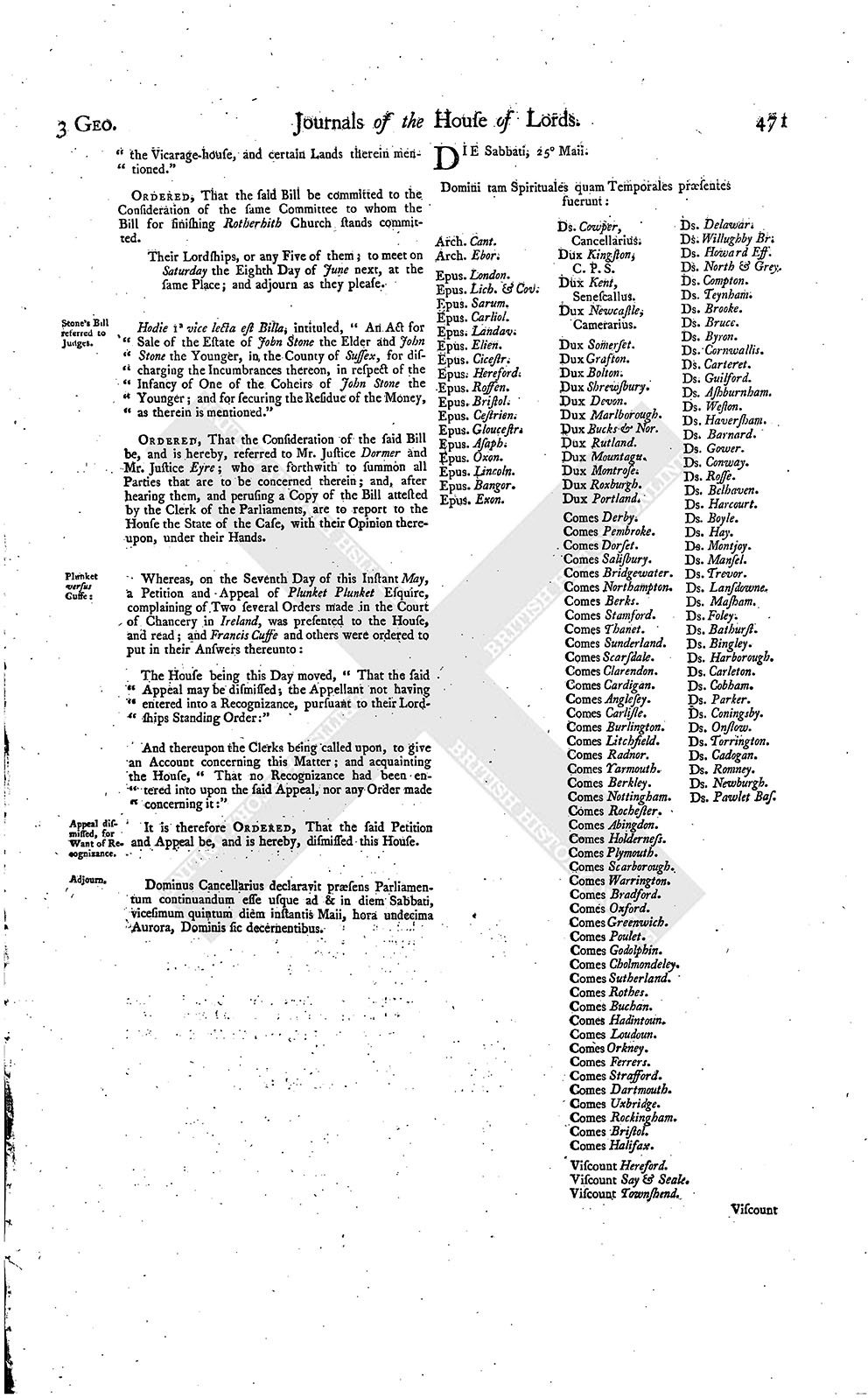
DIE Sabbati, 25 Maii.
Domini tam Spirituales quam Temporales præsentes fuerunt:
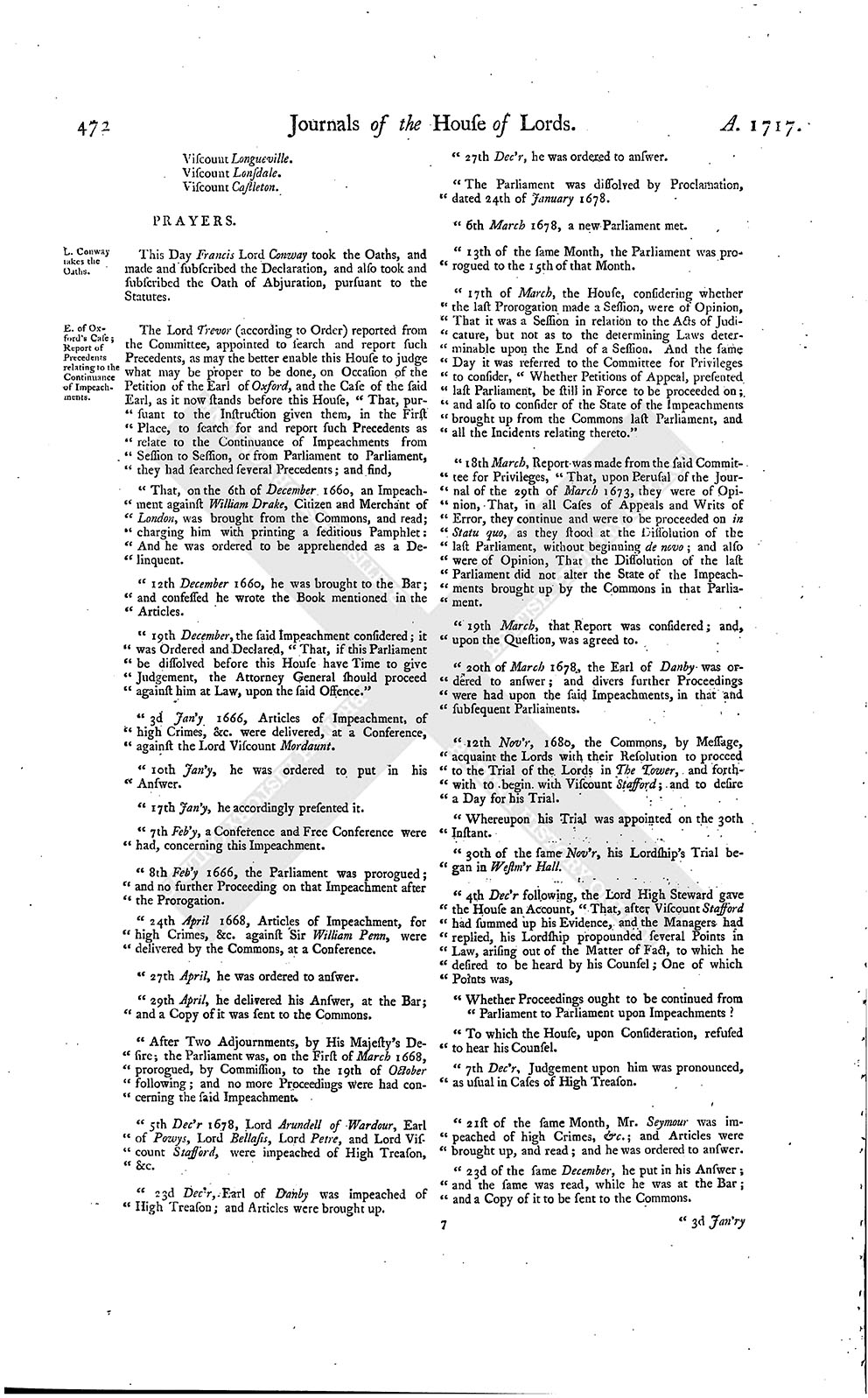
PRAYERS.
L. Conway takes the Oaths.
This Day Francis Lord Conway took the Oaths, and made and subscribed the Declaration, and also took and subscribed the Oath of Abjuration, pursuant to the Statutes.
E. of Oxford's Case; Report of Precedents relating to the Continuance of Impeachments.
The Lord Trevor (according to Order) reported from the Committee, appointed to search and report such Precedents, as may the better enable this House to judge what may be proper to be done, on Occasion of the Petition of the Earl of Oxford, and the Case of the said Earl, as it now stands before this House, "That, pursuant to the Instruction given them, in the First Place, to search for and report such Precedents as relate to the Continuance of Impeachments from Session to Session, or from Parliament to Parliament, they had searched several Precedents; and find,
"That, on the 6th of December 1660, an Impeachment against William Drake, Citizen and Merchant of London, was brought from the Commons, and read; charging him with printing a seditious Pamphlet: And he was ordered to be apprehended as a Delinquent.
"12th December 1660, he was brought to the Bar; and confessed he wrote the Book mentioned in the Articles.
"19th December, the said Impeachment considered; it was Ordered and Declared, "That, if this Parliament be dissolved before this House have Time to give Judgement, the Attorney General should proceed against him at Law, upon the said Offence."
"3d Jan'y 1666, Articles of Impeachment, of high Crimes, &c. were delivered, at a Conference, against the Lord Viscount Mordaunt.
"10th Jan'y, he was ordered to put in his Answer.
"17th Jan'y, he accordingly presented it.
"7th Feb'y, a Conference and Free Conference were had, concerning this Impeachment.
"8th Feb'y 1666, the Parliament was prorogued; and no further Proceeding on that Impeachment after the Prorogation.
"24th April 1668, Articles of Impeachment, for high Crimes, &c. against Sir William Penn, were delivered by the Commons, at a Conference.
"27th April, he was ordered to answer.
"29th April, he delivered his Answer, at the Bar; and a Copy of it was sent to the Commons.
"After Two Adjournments, by His Majesty's Desire; the Parliament was, on the First of March 1668, prorogued, by Commission, to the 19th of October following; and no more Proceedings were had concerning the said Impeachment.
"5th Dec'r 1678, Lord Arundell of Wardour, Earl of Powys, Lord Bellasis, Lord Petre, and Lord Viscount Stafford, were impeached of High Treason, &c.
"23d Dec'r, Earl of Danby was impeached of High Treason; and Articles were brought up.
"27th Dec'r, he was ordered to answer.
"The Parliament was dissolved by Proclamation, dated 24th of January 1678.
"6th March 1678, a new Parliament met.
"13th of the same Month, the Parliament was prorogued to the 15th of that Month.
"17th of March, the House, considering whether the last Prorogation made a Session, were of Opinion, That it was a Session in relation to the Acts of Judicature, but not as to the determining Laws determinable upon the End of a Session. And the same Day it was referred to the Committee for Privileges to consider, "Whether Petitions of Appeal, presented last Parliament, be still in Force to be proceeded on; and also to consider of the State of the Impeachments brought up from the Commons last Parliament, and all the Incidents relating thereto."
"18th March, Report was made from the said Committee for Privileges, "That, upon Perusal of the Journal of the 29th of March 1673, they were of Opinion, That, in all Cases of Appeals and Writs of Error, they continue and were to be proceeded on in Statu quo, as they stood at the Dissolution of the last Parliament, without beginning de novo; and also were of Opinion, That the Dissolution of the last Parliament did not alter the State of the Impeachments brought up by the Commons in that Parliament.
"19th March, that Report was considered; and, upon the Question, was agreed to.
"20th of March 1678, the Earl of Danby was ordered to answer; and divers further Proceedings were had upon the said Impeachments, in that and subsequent Parliaments.
"12th Nov'r, 1680, the Commons, by Message, acquaint the Lords with their Resolution to proceed to the Trial of the Lords in The Tower, and forthwith to begin with Viscount Stafford; and to desire a Day for his Trial.
"Whereupon his Trial was appointed on the 30th Instant.
"30th of the same Nov'r, his Lordship's Trial began in Westm'r Hall.
"4th Dec'r following, the Lord High Steward gave the House an Account, "That, after Viscount Stafford had summed up his Evidence, and the Managers had replied, his Lordship propounded several Points in Law, arising out of the Matter of Fact, to which he desired to be heard by his Counsel; One of which Points was,
"Whether Proceedings ought to be continued from Parliament to Parliament upon Impeachments?
"To which the House, upon Consideration, refused to hear his Counsel.
"7th Dec'r, Judgement upon him was pronounced, as usual in Cases of High Treason.
"21st of the same Month, Mr. Seymour was impeached of high Crimes, &c.; and Articles were brought up, and read; and he was ordered to answer.
"23d of the same December, he put in his Answer; and the same was read, while he was at the Bar; and a Copy of it to be sent to the Commons.
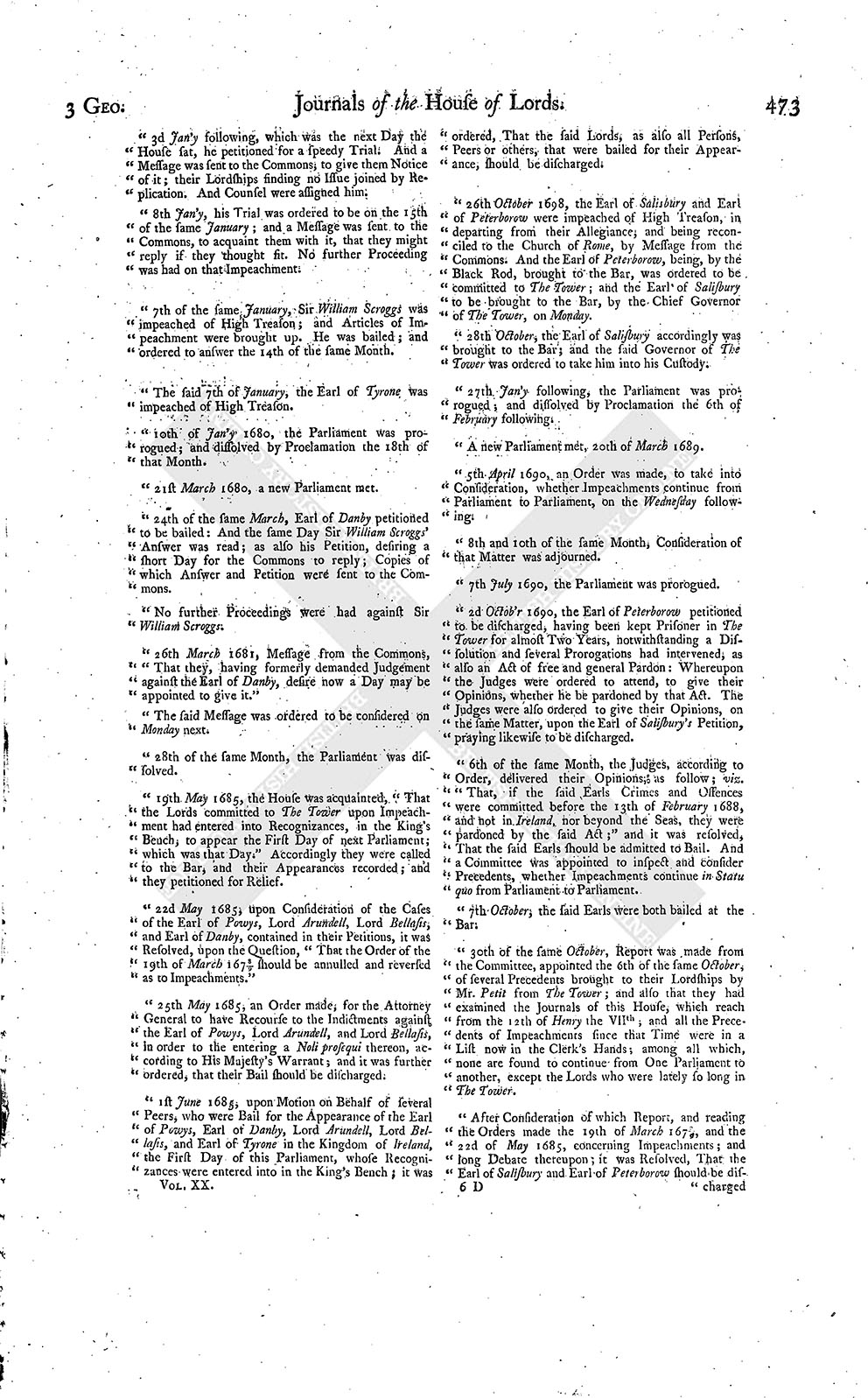
"3d Jan'y following, which was the next Day the House sat, he petitioned for a speedy Trial. And a Message was sent to the Commons, to give them Notice of it; their Lordships finding no Issue joined by Replication. And Counsel were assigned him.
"8th Jan'y, his Trial was ordered to be on the 15th of the same January; and a Message was sent to the Commons, to acquaint them with it, that they might reply if they thought fit. No further Proceeding was had on that Impeachment.
"7th of the same January, Sir William Scroggs was impeached of High Treason; and Articles of Impeachment were brought up. He was bailed; and ordered to answer the 14th of the same Month.
"The said 7th of January, the Earl of Tyrone was impeached of High Treason.
"10th of Jan'y 1680, the Parliament was prorogued; and dissolved by Proclamation the 18th of that Month.
"21st March 1680, a new Parliament met.
"24th of the same March, Earl of Danby petitioned to be bailed: And the same Day Sir William Scroggs' Answer was read; as also his Petition, desiring a short Day for the Commons to reply; Copies of which Answer and Petition were sent to the Commons.
"No further Proceedings were had against Sir William Scroggs.
"26th March 1681, Message from the Commons, "That they, having formerly demanded Judgement against the Earl of Danby, desire now a Day may be appointed to give it."
"The said Message was ordered to be considered on Monday next.
"28th of the same Month, the Parliament was dissolved.
"19th May 1685, the House was acquainted, "That the Lords committed to The Tower upon Impeachment had entered into Recognizances, in the King's Bench, to appear the First Day of next Parliament; which was that Day." Accordingly they were called to the Bar, and their Appearances recorded; and they petitioned for Relief.
"22d May 1685, upon Consideration of the Cases of the Earl of Powys, Lord Arundell, Lord Bellasis, and Earl of Danby, contained in their Petitions, it was Resolved, upon the Question, "That the Order of the 19th of March 1678 / 9; should be annulled and reversed as to Impeachments."
"25th May 1685, an Order made, for the Attorney General to have Recourse to the Indictments against the Earl of Powys, Lord Arundell, and Lord Bellasis, in order to the entering a Noli prosequi thereon, according to His Majesty's Warrant; and it was further ordered, that their Bail should be discharged.
"1st June 1685, upon Motion on Behalf of several Peers, who were Bail for the Appearance of the Earl of Powys, Earl of Danby, Lord Arundell, Lord Bellasis, and Earl of Tyrone in the Kingdom of Ireland, the First Day of this Parliament, whose Recognizances were entered into in the King's Bench; it was ordered, That the said Lords, as also all Persons, Peers or others, that were bailed for their Appearance, should be discharged.
"26th October 1698, the Earl of Salisbury and Earl of Peterborow were impeached of High Treason, in departing from their Allegiance; and being reconciled to the Church of Rome, by Message from the Commons. And the Earl of Peterborow, being, by the Black Rod, brought to the Bar, was ordered to be committed to The Tower; and the Earl of Salisbury to be brought to the Bar, by the Chief Governor of The Tower, on Monday.
"28th October, the Earl of Salisbury accordingly was brought to the Bar; and the said Governor of The Tower was ordered to take him into his Custody.
"27th Jan'y following, the Parliament was prorogued; and dissolved by Proclamation the 6th of February following.
"A new Parliament met, 20th of March 1689.
"5th April 1690, an Order was made, to take into Consideration, whether Impeachments continue from Parliament to Parliament, on the Wednesday following.
"8th and 10th of the same Month, Consideration of that Matter was adjourned.
"7th July 1690, the Parliament was prorogued.
"2d Octob'r 1690, the Earl of Peterborow petitioned to be discharged, having been kept Prisoner in The Tower for almost Two Years, notwithstanding a Dissolution and several Prorogations had intervened; as also an Act of free and general Pardon: Whereupon the Judges were ordered to attend, to give their Opinions, whether he be pardoned by that Act. The Judges were also ordered to give their Opinions, on the same Matter, upon the Earl of Salisbury's Petition, praying likewise to be discharged.
"6th of the same Month, the Judges, according to Order, delivered their Opinions, as follow; viz. "That, if the said Earls Crimes and Offences were committed before the 13th of February 1688, and not in Ireland, nor beyond the Seas, they were pardoned by the said Act;" and it was resolved, That the said Earls should be admitted to Bail. And a Committee was appointed to inspect and consider Precedents, whether Impeachments continue in Statu quo from Parliament to Parliament.
"7th October, the said Earls were both bailed at the Bar.
"30th of the same October, Report was made from the Committee, appointed the 6th of the same October, of several Precedents brought to their Lordships by Mr. Petit from The Tower; and also that they had examined the Journals of this House, which reach from the 12th of Henry the VIIth; and all the Precedents of Impeachments since that Time were in a List now in the Clerk's Hands; among all which, none are found to continue from One Parliament to another, except the Lords who were lately so long in The Tower.
"After Consideration of which Report, and reading the Orders made the 19th of March 1678/9, and the 22d of May 1685, concerning Impeachments; and long Debate thereupon; it was Resolved, That the Earl of Salisbury and Earl of Peterborow should be discharged from their Bail; and accordingly they and their Sureties were ordered to be discharged from their said Recognizances.
"A List has been produced before the Committee, which to them seems to be the List referred to in the said Report; which is ready to be produced, if the House shall think the same necessary.
"12th Nov'r 1690, upon Motion, "That a Day be appointed, for the Explanation of the Votes of the 30th of October last;" it was ordered to take the same into Consideration on the 18th of the same November, and all the Lords to be summoned; on which Day the House sat: But it doth not appear by the Journal that any Thing was done in Pursuance of that Order.
"27th April 1695, the Duke of Leeds was impeached of high Crimes and Misdemeanors; and Articles were on the 29th of the same Month exhibited against him. He put in his Answer the next Day; and a Copy of it was sent to the Commons.
"1st May following, a Message was sent to the Commons, to put them in Mind of the said Impeachment; the Lords conceiving the Session could not continue much longer.
"3d of the same May, the Parliament was prorogued; and dissolved by Proclamation, dated the 11th of October 1695.
"24th of June 1701, the House of Commons having impeached the Duke of Leeds on the 27th of April 1695; and on the 29th of the same Month exhibited Articles against him, to which he answered; but the Commons not prosecuting; the said Impeachment and Articles were ordered to be dismissed.
"17th May 1698, Peter Longueville was, amongst others, impeached of high Crimes, &c.; and Articles were brought up.
"27th of the same May, he put in his Answer, and pleaded Not Guilty.
"28th June, the Trial of Goudet and others, upon the Impeachments against them, was appointed on the 4th of July next.
"The same Day, the said Goudet, Barrau, Seignoret, Baudowin, Santiny, Diharce, and Pearse, relinquished their Pleas, and pleaded Guilty; and the Black Rod ordered to take them into Custody.
"30th June, Dumaistre put in his Answer, and pleaded Guilty; and the Black Rod ordered to take him into Custody.
"4th July 1698, Judgement was pronounced against the Eight Persons abovementioned; and no further Proceedings concerning Longueville.
"The next Day the Parliament was prorogued; and dissolved by Proclamation, dated the 7th of July 1698.
"The Committee have also inquired of Precedents of Indictments against Peers, which have been removed into the House of Lords by Certiorari, and the Proceedings thereupon; and find, that, on the 19th of March 1677, the Proceedings against the Earl of Pembroke, upon an Indictment, for the Death of Nathaniel Cony, had before the Commissioners of Oyer and Terminer at Hicks' Hall, upon which his Lordship was found Guilty of Felony and Murder, was brought into this House, in order to his Trial.
"4th April 1678, the said Earl was tried, and found Guilty of Manslaughter.
"15th July following the Parliament was prorogued.
"11th Nov'r 1685, the Lord Mayor and the rest of the Justices of Oyer and Terminer and General Gaol Delivery for London and Middlesex were ordered to return, by virtue of His Majesty's Writ of Certiorari, the Indictinent of High Treason, found before them, against the Earl of Stamford, then Prisoner in The Tower.
"14th Nov'r, the Indictment was delivered.
"16th Nov'r, the said Earl was ordered to be brought to the Bar.
"17th Nov'r, his Lordship was brought accordingly, examined, and his Trial appointed on the 1st of December following; and an Address to His Majesty, "That a Place be prepared in Westm'r Hall for his Trial."
"18th Nov'r, the King's Answer was reported, "That He had given Order accordingly."
"20th Nov'r 1685, the Parliament was prorogued; and, after several Prorogations, was dissolved the 2d of July 1687.
"And there doth not appear any further Proceeding on the said Indictment.
"4th Jan'y 1692, the Coroner's Inquest was brought in, concerning the Death and Murder of William Mountfort, wherein the Lord Mohun was found to be aiding and assisting.
"4th Feb'y following, his Lordship was tried; and found Not Guilty, and discharged.
"14th March following, the Parliament was prorogued.
"13th Dec'r 1697, a Writ of Certiorari was ordered, for removing the Indictment found against the Lord Mohun, concerning the Death of William Hill.
"10th Jan'y 1697, Resolved to proceed to his Trial.
"4th July 1698, the Clerk of the Crown read the Indictment to his Lordship; and he pleaded His Majesty's Pardon: Which was allowed by the House; and he was discharged.
"13th March 1698, an Indictment against the Earl of Warwick, for the Murder of Coote, was brought by Certiorari.
"25th March 1699, Lord Mohun allowed a Copy of his Indictment.
"28th March, the Earl of Warwick was tried, and found Guilty of Manslaughter.
"29th of the same Month, the Lord Mohun was tried, and found Not Guilty.
"4th May 1699, the Parliament was prorogued."
Which Report being read by the Clerk:
Motion that the Impeachment against the E. of Oxford is determined by the intervening Prorogation:
It was proposed, "To resolve, That the Impeachment of the Commons against the Earl of Oxford is determined by the intervening Prorogation."
And, after Debate thereupon;
The Question was put, "That it is the Opinion of this House, that the Impeachment exhibited by the Commons of Great Britain, against Robert Earl of Oxford and Earl Mortimer, for High Treason and other high Crimes and Misdemeanors, is determined by the intervening Prorogation?"
It was Resolved in the Negative.
Protest against rejecting it:
"Dissentient.
"1. Because there seems to be no Difference in Law between a Prorogation and a Dissolution of a Parliament, which, in constant Practice, have had the same Effect, as to Determination both of Judicial and Legislative Proceedings; and consequently this Vote may tend to weaken the Resolution of this House, May the 22d, 1685, which was founded upon the Law and Practice of Parliament in all Ages, without One Precedent to the contrary; except in the Cases which happened after the Order made the 19th of March 1678, which was reversed and annulled in 1685; and in Pursuance hereof the Earl of Salisbury was discharged in 1690.
"2. Because this can never be extended to any but Peers; for, by the Statute 4° Ed. IIIii, no Commoner can be impeached for any Capital Crime: And it is hard to conceive why the Peers should be distinguished, and deprived of the Benefit of all the Laws of Liberty to which the meanest Commoner in Britain is entitled; and this seems the more extraordinary, because it is done unasked by the Commons, who, as it is conceived, never can ask it with any Colour of Law, Precedent, Reason, or Justice.
"Nottingham.
"Abingdon.
"Fr. Roffen.
"North & Grey.
"Bruce.
"Dartmouth.
"Bathurst.
"Guilford.
"Mansel. Hay.
"Foley."
Committee to report Precedents as to Time of Trial.
Ordered, That it be an Instruction to the Committee, appointed to search and report such Precedents as may the better enable this House to judge what may be proper to be done, on Occasion of the Petition of the Earl of Oxford, and the Case of the said Earl as it now stands before this House, That they do search for, and report, such Precedents as relate to the appointing a Time of Trial.
Hopkins' Bill.
Ordered, That the Committee to whom Hopkins' Bill was referred be revived, and meet on Monday Morning next.
Lords to be summoned.
Ordered, That all the Lords be summoned to attend the Service of this House on Monday next.
Adjourn.
Dominus Cancellarius declaravit præsens Parliamentum continuandum esse usque ad & in diem Lunæ, vicesimum septimum diem instantis Maii, hora undecima Aurora, Dominis sic decernentibus.