
Journal of the House of Commons: Volume 11, 1693-1697. Originally published by His Majesty's Stationery Office, London, 1803.
This free content was digitised by double rekeying. All rights reserved.
'House of Commons Journal Volume 11: 12 January 1694', in Journal of the House of Commons: Volume 11, 1693-1697, (London, 1803) pp. 55-58. British History Online https://www.british-history.ac.uk/commons-jrnl/vol11/pp55-58 [accessed 20 April 2024]


In this section
Veneris, 12 die Januarii;
5° Gulielmi et Mariæ.
Prayers.
Chaplin's Estate.
SIR Joseph Tredenham presented to the House, according to Order, a Bill for Sale of the Estate of Susan Chaplin, and Dorothy her Daughter, for Payment of Debts, and making Provision for the said Dorothy and Susan: And the same was received, and read the First time.
Resolved, That the Bill be read a Second time.
Holt's Esta
Ordered, That Sir Tho. Mompesson, Mr. Campion, Sir John Bolles, Sir Tho. Roberts, Sir Ra. Dutton, Mr. Dyot, Mr. Clarke, Mr. Bennet, Mr. Dowdswell, Mr. Blowfield, be added to the Committee, to whom the Examination and Consideration of the Petition of Sir Charles Holt Baronet is referred.
Capiatur Fine.
A Bill for taking away the Capiatur Fine in the several Courts at Westminster was read the Second time.
Resolved, That the Bill be committed to Mr. Waller, Mr. Hungerford, Mr. Christy, Sir Roger Puleston, Mr. Wilmot, Colonel Deane, Mr. Kenyon, Mr. Blofield, Mr. Hawtry, Mr. Dryden, Mr. Herbert, Mr. Hutchinson, Mr. Lloyd, Sir Fra. Winington, Mr. Slater, Mr. Gilbert, Sir Hen. Goff, Mr. Hedger, Mr. Lutterell, Mr. Fuller, Sir Fra. Drake, Mr. Proby, Mr. Cooke, Mr. Travers, Mr. Lassells, Mr. Burdet, Mr. Papillion, Mr. Bockenham, Sir John Moreton, Mr. England; and all the Gentlemen of the Long Robe: And they are to meet this Afternoon at Four of the Clock, in the Speaker's Chamber: And are impowered to send for Persons, Papers, and Records.
Lea her Cutting.
A Bill for making more effectual a Statute made in the First Year of King James the First, concerning Tanners, Curriers, Shoemakers, and others, occupying the Cutting of Leather, was read the Second time.
Resolved, That the Bill be committed to Mr. Goldwell, Sir Chr. Musgrave, Sir John Knight, Mr. Hedger, Mr. Cook, Sir Ro. Davers, Mr. Hungerford, Mr. Campion, Mr. Waller, Mr. Henley, Mr. Newport, Mr. Fuller, Mr. Fenwick, Mr. Jeffryes, Mr. Blofield, Sir Ra. Carr, Mr. Hawtry, Sir Edw. Hussey, Sir John Barker, Mr. Sanford, Sir Jos. Tredenham, Mr. Lloyd, Mr. Lutterell, Mr. Onslow, Sir Cha. Bloys, Mr. Nicholas, Mr. Christy, Mr. England, Sir John Key, Mr. Kenyon, Sir Cha. Raleigh, Mr. Kerby, Sir Wm. Scawen, Colonel Lee, Mr. Arnold, Sir Tho. Roberts, Mr. Slater: And they are to meet this Afternoon at Four a Clock, in the Speaker's Chamber.
Exporting Copper, Iron, &c.
Ordered, That Leave be given to bring in a Bill for the Exportation of Copper, Iron, and Bell-Metal: And that Mr. Hungerford do prepare, and bring in, the same.
Encouraging Privateers.
Ordered, That the Lord Cornbury, Sir Cha. Raleigh, Sir Walt. Young, Mr. Sandford, Colonel Lee, Mr. Pollexfen, Sir Tho. Vernon, Mr. Thornhaugh, Major Vincent, and all the Members that serve for the Sea-ports, and CinquePorts, be added to the Committee, to whom the Examination and Consideration of the Petition of the Merchants of Mounts-Bay, in Cornwall, is referred.
Hawker and Pedlars
Ordered, That the Bill against Hawkers and Pedlars be read the Second time To-morrow Morning.
Irish Forfeitures.
Sir Rowland Gwynn reported, from the Committee appointed to receive Proposals concerning the Forfeitures in Ireland; and likewise for securing the Protestant Interest there; the Proposals received by the said Committee; which he read in his Place; and afterwards delivered the same in at the Clerk's Table: Where the same was read; and is as followeth; viz.
Irish Forfeitures.
That the Irish were, by the Court of Claims, after the Restoration, decreed to Two Millions Three hundred and Twenty-three thousand Eight hundred and Nine Acres profitable Land, English Measure, under the following Qualifications:
These Lands undisposed are either, Parts or Fractions of Towns possessed by Irish or English promiscuously without Title; or were, when Ireland was distributed unto the Adventurers, Soldiers, and transplanted Persons, looked upon as doubtful, whether forfeited or not, and so were never set out; a further Enquiry into the Title of those Lands before they were disposed of, being intended: For which Reason, those Lands never came under the Cognizance of the Commissioners of the Court of Claims; nor were they claimed by any.
These Lands have most of them, since the Court of Claims, been passed in Patent to those that discovered them, both before, and in the Court of Grace, without Distinction of English or Irish; the Person in Possession, and making the Discovery, being to have Preference: What Proportion hereof fell to the English, and what to the Irish, cannot be ascertained: But, admitting that no more thereof than 176,191 Acres, which is less than a Fourth Part, fell to the Papists Share, it will make, being added to what they were restored to by the Court of Claims, Two Millions and an Half of profitable Acres, English Measure.
This Estimate is, according to the generally received Opinion of those who very well understand that Kingdom, Half a Million of Acres less than what the Irish were possessed of at the time of their present Majesties Accession to the Crown: But, to keep greatly within Compass, supposing them to be possessed of no more than Two Millions and a Half of Acres, It is to be considered what Part hereof, by the late Rebellion, is forfeited, and what not; and what Part of the Forfeitures are remitted by the Articles of Gallway and Limerick.
It is notorious, that not an Irishman, who was in Ireland during the late Rebellion, and capable of being guilty thereof, either by being actually in Arms, or by aiding, abetting, and assisting the Rebels, is innocent: So that the only Persons, presumed to be so, are either, such as continued in England during the whole time, of which there are not above Three or Four known: or Infants of such an Age as could not capacitate them to bear Arms, or abet and assist the Rebels: In both which Cases it is to be noted, That the Heirs, or next in Remainder, may have been, and probably were, in Rebellion.
What shall be lessened of the Forfeitures in both the foregoing Cases, will be abundantly supplied by the Purchases made by the Irish Lawyers, Physicians, Merchants, and other Papists, since the Court of Claims; many of them having purchased very considerable Estates on the new Interest; the whole Body of the Irish Nation being a thriving People during the Two last Reigns.
That then which will lessen the Forfeitures from being at least Two Millions and a Half of Acres, are the Articles.
For the making a reasonable Estimate how much will be restored by the Articles, It is to be considered, Who, of Right, are intitled to the Benefit of them.
By the First Article of Limerick, all Inhabitants and Residents of Limerick are included: But how far those Words will extend, deserve mature Consideration; seeming, according to common Acceptation, to design no other, than such as had, for some time before, been Housekeepers, and paid Scot and Lot there; and not Inmates, and Persons come into the Town, and sent for thither, just before the Signing of the Articles, on purpose to claim the Benefit thereof.
All Officers and Soldiers in Garisons are likewise capitulated for, who should submit, &c.: Where it is to be considered, What shall be deemed a Garison; upon which very considerable Estates depend.
There are a Third Sort, which claim the Benefit of the Articles, by virtue of the additional Article, said to be agreed to, but omitted in the perfected Articles: And these are computed to be at least One half of those who claim the Benefit of the Articles: How far this additional Article shall take place, is humbly submitted.
On the Whole, it is humbly proposed, That the Saving for the Limerick and Galloway Articles may be in negative Terms, and not any positive confirming Words; forasmuch as it is hoped the Injustice of that additional Article may be discovered: But, supposing the additional Article be admitted, it will then be enquired, What will be restored by the Articles.
Of this, a certain determinate Calculation cannot be made; all those who pretend to the Benefit of the Articles, not having made Claim; of those who have claimed, and are adjudged by the Lords Justices, and Council, to have the Benefit of the said Articles, many are supposed not to be rightfully intitled thereto; others, not to have appeared to be so to them, although adjudged: An Instance whereof is plain in the Case of Sir James Cotter, who, claiming the Benefit of the Limerick Articles, was opposed by Mr. Serjeant Osborne, on their Majesties behalf, on this Suggestion; That, supposing him within the Benefit of the Articles, he had forfeited his Right thereto; and insisted to have this Matter heard at the CouncilBoard, both on Account of the Precedent, which might be of ill Consequence in other Cases, and likewise, for that a very considerable Estate depended hereon: But in this he was over-ruled; the Examination referred to Sir Richard Cox and Mr. Carlton; on whose Report, Sir James Cotter was adjudged within the Limerick Articles, and restored to his Estate.
All Persons who have taken Protection, are excepted out of the Articles; notwithstanding which, several claim the Benefit of the Articles, whose Wives, Children, or Friends, had desired Protections for them, and accordingly had such Protections: Notwithstanding which, the Exception out of the Article has been evaded, by the Protection's not being delivered into the Hand of the very Person himself.
Those who were on the Place, and made the strictest Observation, conclude, That not above Two Fifths of the Irish have any just Pretence to the Benefit of the Articles of Galloway or Limerick, even the additional Article being admitted: But, putting this beyond Exception, admitting Three Fifths, which is yet unconceivable, to be intitled thereunto, there will then remain a Million of Acres forfeited, which are worth, a good Title being made to the Purchaser by Act of Parliament, a Million of Money Sterling.
In order to the selling of which, it is humbly proposed, That the Gentlemen of Ireland may have Fee-Farms granted them of the forfeited Estates, at greater or lesser Rents, according to the respective Value of the Lands by them taken; they giving collateral Security by Statute-Staple, or such other way as shall be thought fit, of equal Value to the Estates by them taken; which Rents, so secured, will be very well worth Ten Years Purchase.
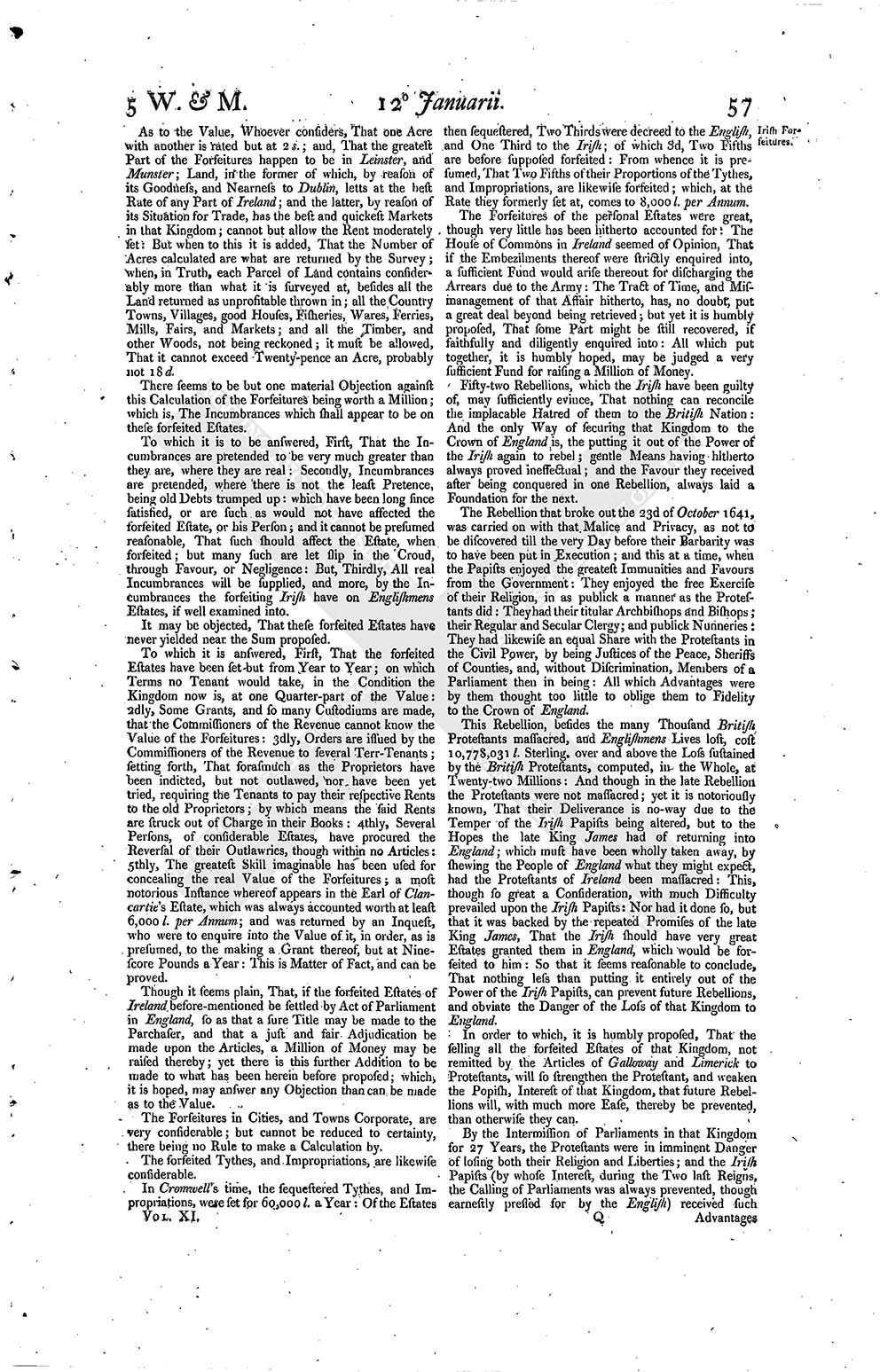
As to the Value, Whoever considers, That one Acre with another is rated but at 2s.; and, That the greatest Part of the Forfeitures happen to be in Leinster, and Munster; Land, in the former of which, by reason of its Goodness, and Nearness to Dublin, letts at the best Rate of any Part of Ireland; and the latter, by reason of its Situation for Trade, has the best and quickest Markets in that Kingdom; cannot but allow the Rent moderately set: But when to this it is added, That the Number of Acres calculated are what are returned by the Survey; when, in Truth, each Parcel of Land contains considerably more than what it is surveyed at, besides all the Land returned as unprofitable thrown in; all the Country Towns, Villages, good Houses, Fisheries, Wares, Ferries, Mills, Fairs, and Markets; and all the Timber, and other Woods, not being reckoned; it must be allowed, That it cannot exceed Twenty-pence an Acre, probably not 18d.
There seems to be but one material Objection against this Calculation of the Forfeitures being worth a Million; which is, The Incumbrances which shall appear to be on these forfeited Estates.
To which it is to be answered, First, That the Incumbrances are pretended to be very much greater than they are, where they are real: Secondly, Incumbrances are pretended, where there is not the least Pretence, being old Debts trumped up: which have been long since satisfied, or are such as would not have affected the forfeited Estate, or his Person; and it cannot be presumed reasonable, That such should affect the Estate, when forfeited; but many such are let slip in the Croud, through Favour, or Negligence: But, Thirdly, All real Incumbrances will be supplied, and more, by the Incumbrances the forfeiting Irish have on Englishmens Estates, if well examined into.
It may be objected, That these forfeited Estates have never yielded near the Sum proposed.
To which it is answered, First, That the forfeited Estates have been set but from Year to Year; on which Terms no Tenant would take, in the Condition the Kingdom now is, at one Quarter-part of the Value: 2dly, Some Grants, and so many Custodiums are made, that the Commissioners of the Revenue cannot know the Value of the Forfeitures: 3dly, Orders are issued by the Commissioners of the Revenue to several Terr-Tenants; setting forth, That forasmuch as the Proprietors have been indicted, but not outlawed, nor have been yet tried, requiring the Tenants to pay their respective Rents to the old Proprietors; by which means the said Rents are struck out of Charge in their Books: 4thly, Several Persons, of considerable Estates, have procured the Reversal of their Outlawries, though within no Articles: 5thly, The greatest Skill imaginable has been used for concealing the real Value of the Forfeitures; a most notorious Instance whereof appears in the Earl of Clancartie's Estate, which was always accounted worth at least 6,000 l. per Annum; and was returned by an Inquest, who were to enquire into the Value of it, in order, as is presumed, to the making a Grant thereof, but at Ninescore Pounds a Year: This is Matter of Fact, and can be proved.
Though it seems plain, That, if the forfeited Estates of Ireland before-mentioned be settled by Act of Parliament in England, so as that a sure Title may be made to the Parchaser, and that a just and fair Adjudication be made upon the Articles, a Million of Money may be raised thereby; yet there is this further Addition to be made to what has been herein before proposed; which, it is hoped, may answer any Objection than can be made as to the Value.
The Forfeitures in Cities, and Towns Corporate, are very considerable; but cannot be reduced to certainty, there being no Rule to make a Calculation by.
The forfeited Tythes, and Impropriations, are likewise considerable.
Irish Forfeitures.
In Cromwell's time, the sequestered Tythes, and Impropriations, were set for 60,000 l. a Year: Of the Estates then sequestered, Two Thirds were decreed to the English, and One Third to the Irish; of which 3d, Two Fifths are before supposed forfeited: From whence it is presumed, That Two Fifths of their Proportions of the Tythes, and Impropriations, are likewise forfeited; which, at the Rate they formerly set at, comes to 8,000 l. per Annum.
The Forfeitures of the personal Estates were great, though very little has been hitherto accounted for: The House of Commons in Ireland seemed of Opinion, That if the Embezilments thereof were strictly enquired into, a sufficient Fund would arise thereout for discharging the Arrears due to the Army: The Tract of Time, and Mismanagement of that Affair hitherto, has, no doubt, put a great deal beyond being retrieved; but yet it is humbly proposed, That some Part might be still recovered, if faithfully and diligently enquired into: All which put together, it is humbly hoped, may be judged a very sufficient Fund for raising a Million of Money.
Fifty-two Rebellions, which the Irish have been guilty of, may sufficiently evince, That nothing can reconcile the implacable Hatred of them to the British Nation: And the only Way of securing that Kingdom to the Crown of England is, the putting it out of the Power of the Irish again to rebel; gentle Means having hitherto always proved ineffectual; and the Favour they received after being conquered in one Rebellion, always laid a Foundation for the next.
The Rebellion that broke out the 23d of October 1641, was carried on with that Malice and Privacy, as not to be discovered till the very Day before their Barbarity was to have been put in Execution; and this at a time, when the Papists enjoyed the greatest Immunities and Favours from the Government: They enjoyed the free Exercise of their Religion, in as publick a manner as the Protestants did: They had their titular Archbishops and Bishops; their Regular and Secular Clergy; and publick Nunneries: They had likewise an equal Share with the Protestants in the Civil Power, by being Justices of the Peace, Sheriffs of Counties, and, without Discrimination, Members of a Parliament then in being: All which Advantages were by them thought too little to oblige them to Fidelity to the Crown of England.
This Rebellion, besides the many Thousand British Protestants massacred, and Englishmens Lives lost, cost 10,778,031 l. Sterling, over and above the Loss sustained by the British Protestants, computed, in the Whole, at Twenty-two Millions: And though in the late Rebellion the Protestants were not massacred; yet it is notoriously known, That their Deliverance is no-way due to the Temper of the Irish Papists being altered, but to the Hopes the late King James had of returning into England; which must have been wholly taken away, by shewing the People of England what they might expect, had the Protestants of Ireland been massacred: This, though so great a Consideration, with much Difficulty prevailed upon the Irish Papists: Nor had it done so, but that it was backed by the repeated Promises of the late King James, That the Irish should have very great Estates granted them in England, which would be forfeited to him: So that it seems reasonable to conclude, That nothing less than putting it entirely out of the Power of the Irish Papists, can prevent future Rebellions, and obviate the Danger of the Loss of that Kingdom to England.
In order to which, it is humbly proposed, That the selling all the forfeited Estates of that Kingdom, not remitted by the Articles of Galloway and Limerick to Protestants, will so strengthen the Protestant, and weaken the Popish, Interest of that Kingdom, that future Rebellions will, with much more Ease, thereby be prevented, than otherwise they can.
Irish Forfeitures.
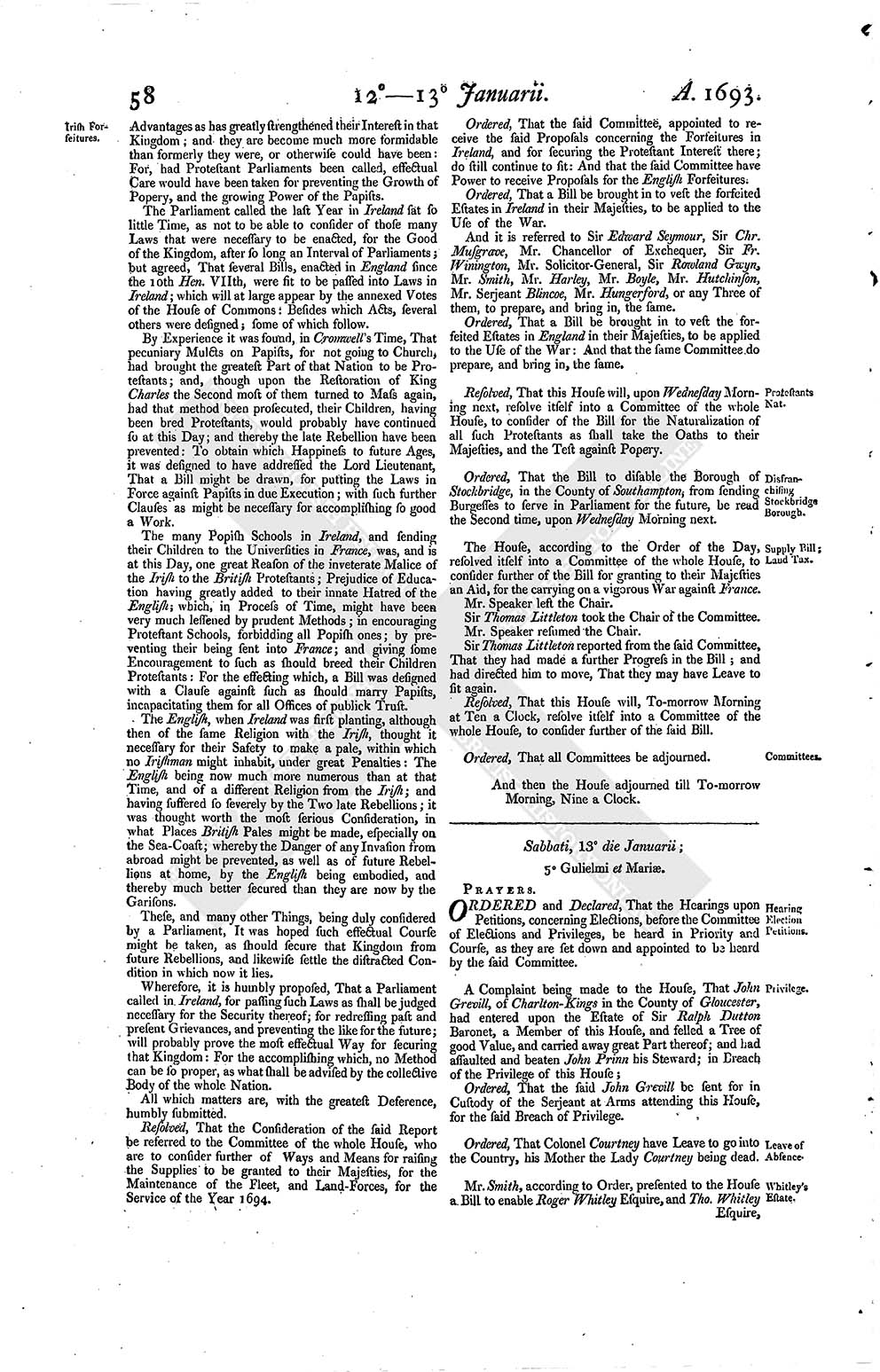
By the Intermission of Parliaments in that Kingdom for 27 Years, the Protestants were in imminent Danger of losing both their Religion and Liberties; and the Irish Papists (by whose Interest, during the Two last Reigns, the Calling of Parliaments was always prevented, though earnestly pressed for by the English) received such Advantages as has greatly strengthened their Interest in that Kingdom; and they are become much more formidable than formerly they were, or otherwise could have been: For, had Protestant Parliaments been called, effectual Care would have been taken for preventing the Growth of Popery, and the growing Power of the Papists.
The Parliament called the last Year in Ireland sat so little Time, as not to be able to consider of those many Laws that were necessary to be enacted, for the Good of the Kingdom, after so long an Interval of Parliaments; but agreed, That several Bills, enacted in England since the 10th Hen. VIIth, were fit to be passed into Laws in Ireland; which will at large appear by the annexed Votes of the House of Commons: Besides which Acts, several others were designed; some of which follow.
By Experience it was found, in Cromwell's Time, That pecuniary Mulcts on Papists, for not going to Church, had brought the greatest Part of that Nation to be Protestants; and, though upon the Restoration of King Charles the Second most of them turned to Mass again, had that method been prosecuted, their Children, having been bred Protestants, would probably have continued so at this Day; and thereby the late Rebellion have been prevented: To obtain which Happiness to future Ages, it was designed to have addressed the Lord Lieutenant, That a Bill might be drawn, for putting the Laws in Force against Papists in due Execution; with such further Clauses as might be necessary for accomplishing so good a Work.
The many Popish Schools in Ireland, and sending their Children to the Universities in France, was, and is at this Day, one great Reason of the inveterate Malice of the Irish to the British Protestants; Prejudice of Education having greatly added to their innate Hatred of the English; which, in Process of Time, might have been very much lessened by prudent Methods; in encouraging Protestant Schools, forbidding all Popish ones; by preventing their being sent into France; and giving some Encouragement to such as should breed their Children Protestants: For the effecting which, a Bill was designed with a Clause against such as should marry Papists, incapacitating them for all Offices of publick Trust.
The English, when Ireland was first planting, although then of the same Religion with the Irish, thought it necessary for their Safety to make a pale, within which no Irishman might inhabit, under great Penalties: The English being now much more numerous than at that Time, and of a different Religion from the Irish; and having suffered so severely by the Two late Rebellions; it was thought worth the most serious Consideration, in what Places British Pales might be made, especially on the Sea-Coast; whereby the Danger of any Invasion from abroad might be prevented, as well as of future Rebellions at home, by the English being embodied, and thereby much better secured than they are now by the Garisons.
These, and many other Things, being duly considered by a Parliament, It was hoped such effectual Course might be taken, as should secure that Kingdom from future Rebellions, and likewise settle the distracted Condition in which now it lies.
Wherefore, it is humbly proposed, That a Parliament called in Ireland, for passing such Laws as shall be judged necessary for the Security thereof; for redressing past and present Grievances, and preventing the like for the future; will probably prove the most effectual Way for securing that Kingdom: For the accomplishing which, no Method can be so proper, as what shall be advised by the collective Body of the whole Nation.
All which matters are, with the greatest Deference, humbly submitted.
Resolved, That the Consideration of the said Report be referred to the Committee of the whole House, who are to consider further of Ways and Means for raising the Supplies to be granted to their Majesties, for the Maintenance of the Fleet, and Land-Forces, for the Service of the Year 1694.
Ordered, That the said Committee, appointed to receive the said Proposals concerning the Forfeitures in Ireland, and for securing the Protestant Interest there; do still continue to sit: And that the said Committee have Power to receive Proposals for the English Forfeitures.
Ordered, That a Bill be brought in to vest the forfeited Estates in Ireland in their Majesties, to be applied to the Use of the War.
And it is referred to Sir Edward Seymour, Sir Chr. Musgrave, Mr. Chancellor of Exchequer, Sir Fr. Winington, Mr. Solicitor-General, Sir Rowland Gwyn, Mr. Smith, Mr. Harley, Mr. Boyle, Mr. Hutchinson, Mr. Serjeant Blincoe, Mr. Hungerford, or any Three of them, to prepare, and bring in, the same.
Ordered, That a Bill be brought in to vest the forfeited Estates in England in their Majesties, to be applied to the Use of the War: And that the same Committee do prepare, and bring in, the same.
Protestants Nat.
Resolved, That this House will, upon Wednesday Morning next, resolve itself into a Committee of the whole House, to consider of the Bill for the Naturalization of all such Protestants as shall take the Oaths to their Majesties, and the Test against Popery.
Disfranchising Stockbridge Borough.
Ordered, That the Bill to disable the Borough of Stockbridge, in the County of Southampton, from sending Burgesses to serve in Parliament for the future, be read the Second time, upon Wednesday Morning next.
Supply Bill; Land Tax.
The House, according to the Order of the Day, resolved itself into a Committee of the whole House, to consider further of the Bill for granting to their Majesties an Aid, for the carrying on a vigorous War against France.
Mr. Speaker left the Chair.
Sir Thomas Littleton took the Chair of the Committee.
Mr. Speaker resumed the Chair.
Sir Thomas Littleton reported from the said Committee, That they had made a further Progress in the Bill; and had directed him to move, That they may have Leave to sit again.
Resolved, That this House will, To-morrow Morning at Ten a Clock, resolve itself into a Committee of the whole House, to consider further of the said Bill.
Committees.
Ordered, That all Committees be adjourned.
And then the House adjourned till To-morrow Morning, Nine a Clock.