
Journal of the House of Commons: Volume 12, 1697-1699. Originally published by His Majesty's Stationery Office, London, 1803.
This free content was digitised by double rekeying. All rights reserved.
'House of Commons Journal Volume 12: 13 January 1699', in Journal of the House of Commons: Volume 12, 1697-1699, (London, 1803) pp. 402-406. British History Online https://www.british-history.ac.uk/commons-jrnl/vol12/pp402-406 [accessed 25 April 2024]



In this section
Veneris, 13 die Januarii;
10° Gulielmi Tertii.
Prayers.
Tone Navigation.
A PETITION of divers Inhabitants of the Town and Parish of Wellington, in the County of Somerset, was presented to the House, and read; setting forth, That the making the River Tone navigable, from Bridgwater to Taunton, will, by reason of the cheap Carriage of Sea-coal; and other heavy Commodities, be a great Benefit to Trade, and the Poor of Wellington: And praying, That all Encouragement may be given to the Bill, depending in the House, for making the said River navigable.
Ordered, That the Consideration of the said Petition be referred to the Committee, to whom the said Bill is committed.
Treasury Receipts and Issues.
Ordered, That the Lords Commissioners of the Treasury do lay before this House an Account of the Receipts and Issues of all Monies for the Year 1698.
Marshal of King's Bench.
Ordered, That Mr. Seviar be heard, by his Counsel' as to his Interest in the Prison of the King's-Bench, before the Committee to whom it is referred to inquire into the ill Practices, and Abuses, of the Prisons of the Fleet and King's-Bench.
Farewell's Nat.
A Message from the Lords, by Sir Miles Cook and Sir Lacon William Child:
Mr. Speaker,
The Lords have passed a Bill, intituled, An Act to naturalize Elizabeth Farewell: To which they desire the Concurrence of this House.
And then the Messengers withdrew.
The Bill was read the First time.
Resolved, That the Bill be read a Second time.
Button making.
An ingrossed Bill to prevent the making or selling Buttons made of Cloth, Serge, Drugget, and other Stuffs, was read the Third time.
Resolved, That the Bill do pass: And that the Title be, An Act to prevent the making or selling Buttons made of Cloth, Serge, Drugget, or other Stuffs.
Ordered, That Sir Richard Cocks do carry the Bill to the Lords, and desire their Concurrence thereunto.
Preservation of Game.
A Bill for the more effectual Preservation of the Game was read a Second time.
Resolved, That the Bill be committed to Mr. Hancock, Mr. Duke, Mr. Thornhagh, Sir Row. Gwyn, Sir John Philips, Sir Phil. Boteler, Sir Tho. Darcy, Mr. Eyre, Sir Edw. Ayscoghe, Sir Just. Isham, Mr. Hayes, Mr. Nicholas, Mr. Smith, Mr. Yates, Mr. Jervois, Mr. Thursby, Mr. Stringer, Mr. Kinaston, Sir Edw. Hussey, Mr. Lake, Sir John Bolles, Lord Coningsby, Mr. Hughes, Lord Fairfax, Sir Jac. Ashley, Sir Sam. Barnardiston, Sir Robert Clayton, Mr. Phillips, Lord Cornbury, Mr. Lowther, Mr. Carter, Mr. Vaugham: And they are to meet on Monday next, at Five a Clock in the Afternoon, in the Speaker's Chambers.
Sir Walter Young, from the Commissioners of the Customs, according to Order, presented to the House an Account of the Exportation from London and Out-Ports to Ireland, from Michaelmas 1696 to Michaelmas 1697.
And the Title thereof was read:
And the Account is as followeth, viz.
| English Spirits. | Gallons. |
| London | 7,026 |
| Out Ports | 4,836 |
| From Michaelmas 97, to Michaelmas 98. | |
| London | 14,241 |
| From Michaelmas 1697 to Lady-day 1698. | |
| Out-Ports | 51 |
| Total | 26,154 |
Ordered, That the Consideration of the said Account be referred to the Committee of the whole House to whom the Bill to encourage the Woollen Manufacture in England; and to restrain the Exportation of Woollen Manufactures from Ireland into any foreign Parts; and for the better preventing the Exportation of Wool from England and Ireland; is committed.
Privilege.
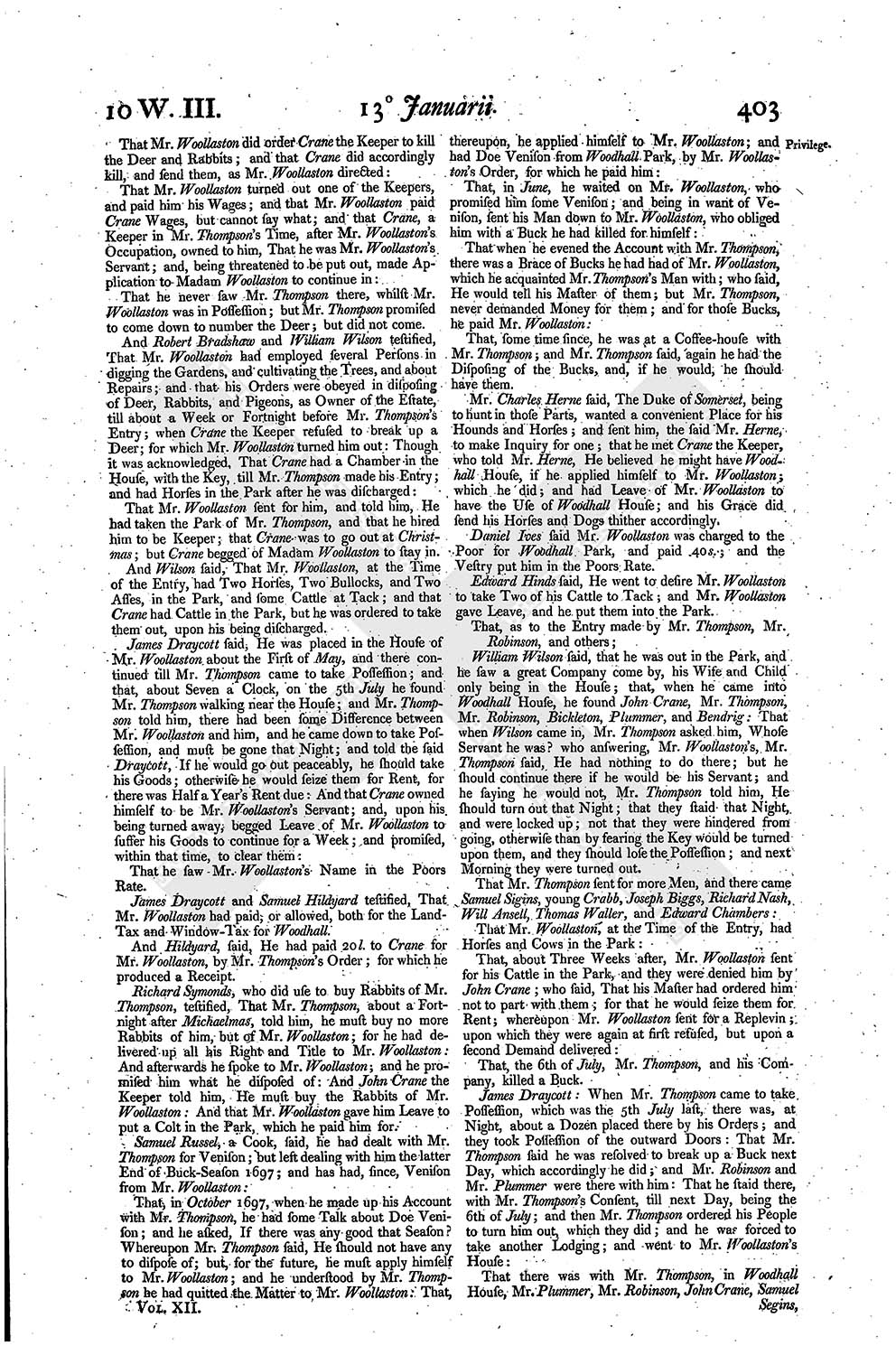
Sir Rowland Gwyn, according to Order, reported, from the Committee of Privileges and Elections, the Matter, as it appeared to the said Committee, touching the Complaint of the Breach of Privilege against Richard Woollaston Esquire, a Member of this House, and the Resolutions of the Committee thereupon; which he read in his Place; and afterwards delivered in at the Clerk's Table: Where the same were read; and are as follow; viz.
Upon the Complaint of Mr. Woollaston, for a Breach of Privilege committed against him, by Robert Thompson Esquire, Mr. Robinson, and others:
That Mr. Woollaston's Counsel disclaimed any Right or Title to Woodhall Park and House, the Estate of the Petitioner, Mr. Boteler; and insisted only upon Possession, so as to make it a Breach of Privilege; which gave Satisfaction to Mr. Boteler's Counsel:
But Mr. Woollaston's Counsel further insisted, That Mr. Thompson, in October 1697, had lett to Mr. Woollaston Woodhall Park and House, in the County of Hertford; and that Mr. Woollaston continued in Possession, from the said October to July following; upon the 5th or 6th Day of which Month, Mr. Thompson and Mr. Robinson entered into Woodhall House and Park, and put Mr. Woollaston out of Possession, during the Sitting of the Parliament, and his attending the Service of the House:
That, as to the Agreement between Mr. Thompson and Mr. Woollaston; they said, the Matter was transacted between themselves, without Witnesses; and so could only be proved by Circumstances.
And, as to Mr. Woollaston's Possession; they called Robert Bradshaw: Who said, That the First time Mr. Woollaston went to Woodhall was in October was Twelve Months; and that Mr. Woollaston (fn. 1) [continued] in Possession till July following, without any Disturbunce; during which time, he had been several times sent by Mr. Woollaston, to Crane the Keeper, with Orders about managing that Estate:
That he went very often to Mr. Thompson, to meet Mr. Woollaston about a Lease; and Mr. Thompson said, It would be ready in a little time; that what Goods Mr. Woollaston had Occasion for, he should have: and the others might remain, till he had an Opportunity of removing them: And that Mr. Thompson said, That he had lett the Park and House to Mr. Woollaston: That Mr. Woollaston was in Possession, and had Power to dispose of the Deer and Rabbits: And gave the Keeper Order to obey all Mr. Woollaston's Commands: And that Mr. Woollaston had the whole Profit of the Estate, except what was reserved in Mr. Thompson's Lease:
That Mr. Woollaston did order Crane the Keeper to kill the Deer and Rabbits; and that Crane did accordingly kill, and send them, as Mr. Woollaston directed:
That Mr. Woollaston turned out one of the Keepers, and paid him his Wages; and that Mr. Woollaston paid Crane Wages, but cannot say what; and that Crane, a Keeper in Mr. Thompson's Time, after Mr. Woollaston's Occupation, owned to him, That he was Mr. Woollaston's Servant; and, being threatened to be put out, made Application to Madam Woollaston to continue in:
That he never saw Mr. Thompson there, whilst Mr. Woollaston was in Possession; but Mr. Thompson promised to come down to number the Deer; but did not come.
And Robert Bradshaw and William Wilson testified, That Mr. Woollaston had employed several Persons in digging the Gardens, and cultivating the Trees, and about Repairs; and that his Orders were obeyed in disposing of Deer, Rabbits, and Pigeons, as Owner of the Estate, till about a Week or Fortnight before Mr. Thompson's Entry; when Crane the Keeper refused to break up a Deer; for which Mr. Woollaston turned him out: Though it was acknowledged, That Crane had a Chamber in the House, with the Key, till Mr. Thompson made his Entry; and had Horses in the Park after he was discharged:
That Mr. Woollaston sent for him, and told him, He had taken the Park of Mr. Thompson, and that he hired him to be Keeper; that Crane was to go out at Christmas; but Crane begged of Madam Woollaston to stay in.
And Wilson said, That Mr. Woollaston, at the Time of the Entry, had Two Horses, Two Bullocks, and Two Affes, in the Park, and some Cattle at Tack; and that Crane had Cattle in the Park, but he was ordered to take them out, upon his being discharged.
James Draycott said, He was placed in the House of Mr. Woollaston about the First of May, and there continued till Mr. Thompson came to take Possession; and that, about Seven a Clock, on the 5th July he found Mr. Thompson walking near the House; and Mr. Thompson told him, there had been some Difference between Mr. Woollaston and him, and he came down to take Possession, and must be gone that Night; and told the said Draycott, If he would go out peaceably, he should take his Goods; otherwise he would seize them for Rent, for there was Half a Year's Rent due: And that Crane owned himself to be Mr. Woollaston's Servant; and, upon his being turned away, begged Leave of Mr. Woollaston to suffer his Goods to continue for a Week; and promised, within that time, to clear them:
That he saw Mr. Woollaston's Name in the Poors Rate.
James Draycott and Samuel Hildyard testified, That Mr. Woollaston had paid, or allowed, both for the LandTax and Window-Tax for Woodhall.
And Hildyard, said, He had paid 20 l. to Crane for Mr. Woollaston, by Mr. Thompson's Order; for which he produced a Receipt.
Richard Symonds, who did use to buy Rabbits of Mr. Thompson, testified, That Mr. Thompson, about a Fortnight after Michaelmas, told him, he must buy no more Rabbits of him, but of Mr. Woollaston; for he had delivered up all his Right and Title to Mr. Woollaston: And afterwards he spoke to Mr. Woollaston; and he promised him what he disposed of: And John Crane the Keeper told him, He must buy the Rabbits of Mr. Woollaston: And that Mr. Woollaston gave him Leave to put a Colt in the Park, which he paid him for.
Samuel Russel, a Cook, said, he had dealt with Mr. Thompson for Venison; but left dealing with him the latter End of Buck-Season 1697; and has had, since, Venison from Mr. Woollaston:
Privilege.
That, in October 1697, when he made up his Account with Mr. Thompson, he had some Talk about Doe Venison; and he asked, If there was any good that Season? Whereupon Mr. Thompson said, He should not have any to dispose of; but, for the future, he must apply himself to Mr. Woollaston; and he understood by Mr. Thompson he had quitted the Matter to Mr. Woollaston: That, thereupon, he applied himself to Mr. Woollaston; and had Doe Venison from Woodhall Park, by Mr. Woollaston's Order, for which he paid him:
That, in June, he waited on Mr. Woollaston, who promised him some Venison; and being in want of Venison, sent his Man down to Mr. Woollaston, who obliged him with a Buck he had killed for himself:
That when he evened the Account with Mr. Thompson, there was a Brace of Bucks he had had of Mr. Woollaston, which he acquainted Mr. Thompson's Man with; who said, He would tell his Master of them; but Mr. Thompson, never demanded Money for them; and for those Bucks, he paid Mr. Woollaston:
That, some time since, he was at a Coffee-house with Mr. Thompson; and Mr. Thompson said, again he had the Disposing of the Bucks, and, if he would, he should have them.
Mr. Charles Herne said, The Duke of Somerset, being to hunt in those Parts, wanted a convenient Place for his Hounds and Horses; and sent him, the said Mr. Herne, to make Inquiry for one; that he met Crane the Keeper, who told Mr. Herne, He believed he might have Woodhall House, if he applied himself to Mr. Woollaston; which he did; and had Leave of Mr. Woollaston to have the Use of Woodhall House; and his Grace did send his Horses and Dogs thither accordingly.
Daniel Ives said Mr. Woollaston was charged to the Poor for Woodhall Park, and paid 40s.; and the Vestry put him in the Poors Rate.
Edward Hinds said, He went to desire Mr. Woollaston to take Two of his Cattle to Tack; and Mr. Woollaston gave Leave, and he put them into the Park.
That, as to the Entry made by Mr. Thompson, Mr. Robinson, and others;
William Wilson said, that he was out in the Park, and he saw a great Company come by, his Wife and Child only being in the House; that, when he came into Woodhall House, he found John Crane, Mr. Thompson, Mr. Robinson, Bickleton, Plummer, and Bendrig: That when Wilson came in, Mr. Thompson asked him, Whose Servant he was? who answering, Mr. Woollaston's, Mr. Thompson said, He had nothing to do there; but he should continue there if he would be his Servant; and he saying he would not, Mr. Thompson told him, He should turn out that Night; that they staid that Night, and were locked up; not that they were hindered from going, otherwise than by fearing the Key would be turned upon them, and they should lose the Possession; and next Morning they were turned out.
That Mr. Thompson sent for more Men, and there came Samuel Sigins, young Crabb, Joseph Biggs, Richard Nash, Will Ansell, Thomas Waller, and Edward Chambers:
That Mr. Woollaston, at the Time of the Entry, had Horses and Cows in the Park:
That, about Three Weeks after, Mr. Woollaston sent for his Cattle in the Park, and they were denied him by John Crane; who said, That his Master had ordered him not to part with them; for that he would seize them for Rent; whereupon Mr. Woollaston sent for a Replevin; upon which they were again at first refused, but upon a second Demand delivered:
That, the 6th of July, Mr. Thompson, and his Company, killed a Buck.
James Draycott: When Mr. Thompson came to take Possession, which was the 5th July last, there was, at Night, about a Dozen placed there by his Orders; and they took Possession of the outward Doors: That Mr. Thompson said he was resolved to break up a Buck next Day, which accordingly he did; and Mr. Robinson and Mr. Plummer were there with him: That he staid there, with Mr. Thompson's Consent, till next Day, being the 6th of July; and then Mr. Thompson ordered his People to turn him out, which they did; and he was forced to take another Lodging; and went to Mr. Woollaston's House:
Privilege.
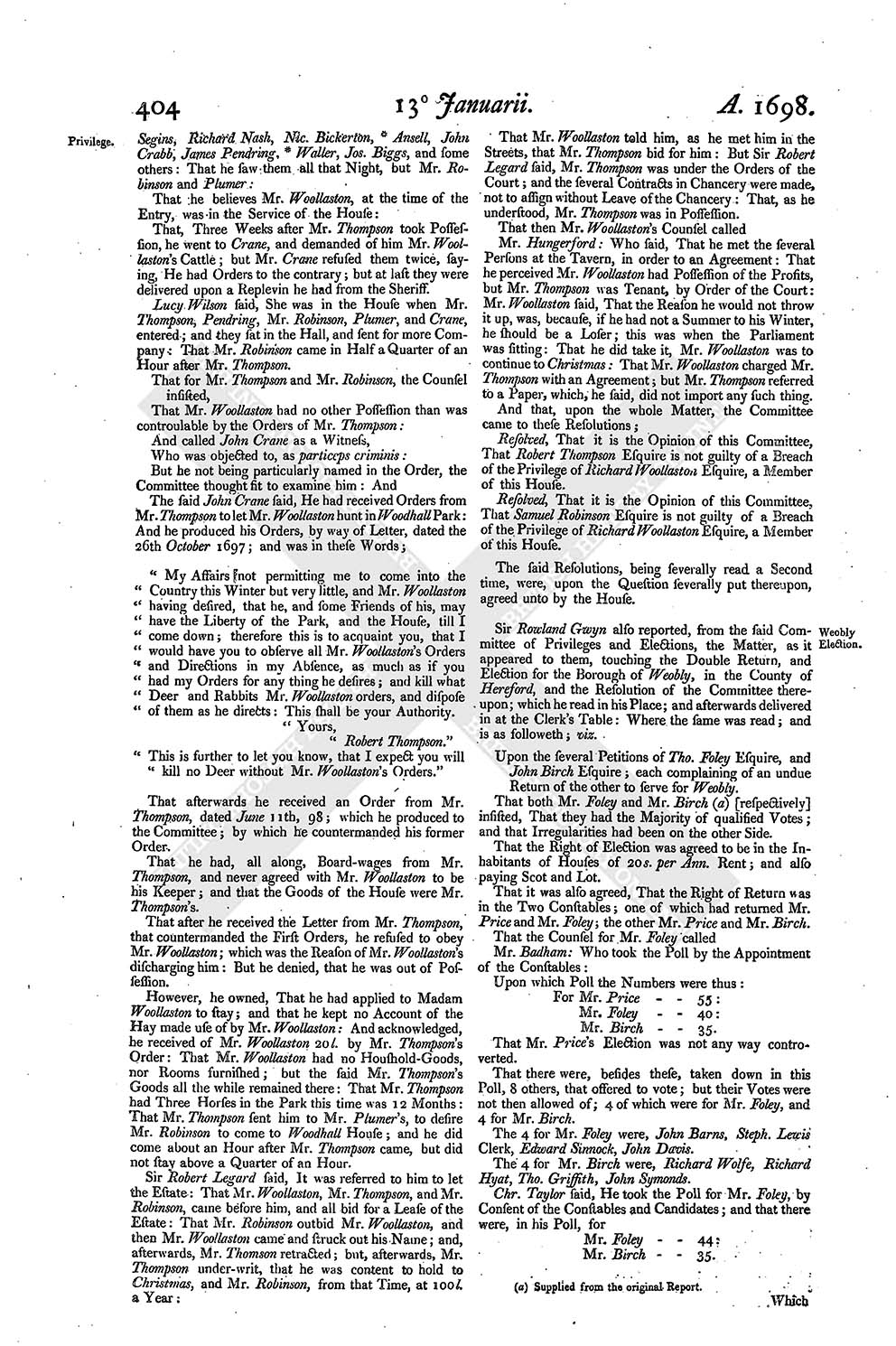
That there was with Mr. Thompson, in Woodhall House, Mr. Plummer, Mr. Robinson, John Crane, Samuel Segins, Richard Nash, Nic. Bickerton, * Ansell, John Crabb, James Pendring, * Waller, Jos. Biggs, and some others: That he saw them all that Night, but Mr. Robinson and Plumer:
That he believes Mr. Woollaston, at the time of the Entry, was in the Service of the House:
That, Three Weeks after Mr. Thompson took Possession, he went to Crane, and demanded of him Mr. Woollaston's Cattle; but Mr. Crane refused them twice, saying, He had Orders to the contrary; but at last they were delivered upon a Replevin he had from the Sheriff.
Lucy Wilson said, She was in the House when Mr. Thompson, Pendring, Mr. Robinson, Plumer, and Crane, entered; and they sat in the Hall, and sent for more Company: That Mr. Robinson came in Half a Quarter of an Hour after Mr. Thompson.
That for Mr. Thompson and Mr. Robinson, the Counsel insisted,
That Mr. Woollaston had no other Possession than was controulable by the Orders of Mr. Thompson:
And called John Crane as a Witness,
Who was objected to, as particeps criminis:
But he not being particularly named in the Order, the Committee thought fit to examine him: And
The said John Crane said, He had received Orders from Mr. Thompson to let Mr. Woollaston hunt in Woodhall Park: And he produced his Orders, by way of Letter, dated the 26th October 1697; and was in these Words;
"My Affairs [not permitting me to come into the Country this Winter but very little, and Mr. Woollaston having desired, that he, and some Friends of his, may have the Liberty of the Park, and the House, till I come down; therefore this is to acquaint you, that I would have you to observe all Mr. Woollaston's Orders and Directions in my Absence, as much as if you had my Orders for any thing he desires; and kill what Deer and Rabbits Mr. Woollaston orders, and dispose of them as he directs: This shall be your Authority.
"Yours,
"Robert Thompson."
"This is further to let you know, that I expect you will kill no Deer without Mr. Woollaston's Orders."
That afterwards he received an Order from Mr. Thompson, dated June 11th, 98; which he produced to the Committee; by which he countermanded his former Order.
That he had, all along, Board-wages from Mr. Thompson, and never agreed with Mr. Woollaston to be his Keeper; and that the Goods of the House were Mr. Thompson's.
That after he received the Letter from Mr. Thompson, that countermanded the First Orders, he refused to obey Mr. Woollaston; which was the Reason of Mr. Woollaston's discharging him: But he denied, that he was out of Possession.
However, he owned, That he had applied to Madam Woollaston to stay; and that he kept no Account of the Hay made use of by Mr. Woollaston: And acknowledged, he received of Mr. Woollaston 20 l. by Mr. Thompson's Order: That Mr. Woollaston had no Houshold-Goods, nor Rooms furnished; but the said Mr. Thompson's Goods all the while remained there: That Mr. Thompson had Three Horses in the Park this time was 12 Months: That Mr. Thompson sent him to Mr. Plumer's, to desire Mr. Robinson to come to Woodhall House; and he did come about an Hour after Mr. Thompson came, but did not stay above a Quarter of an Hour.
Sir Robert Legard said, It was referred to him to let the Estate: That Mr. Woollaston, Mr. Thompson, and Mr. Robinson, came before him, and all bid for a Lease of the Estate: That Mr. Robinson outbid Mr. Woollaston, and then Mr. Woollaston came and struck out his Name; and, afterwards, Mr. Thomson retracted; but, afterwards, Mr. Thompson under-writ, that he was content to hold to Christmas, and Mr. Robinson, from that Time, at 100 l. a Year:
That Mr. Woollaston told him, as he met him in the Streets, that Mr. Thompson bid for him: But Sir Robert Legard said, Mr. Thompson was under the Orders of the Court; and the several Contracts in Chancery were made, not to assign without Leave of the Chancery: That, as he understood, Mr. Thompson was in Possession.
That then Mr. Woollaston's Counsel called
Mr. Hungerford: Who said, That he met the several Persons at the Tavern, in order to an Agreement: That he perceived Mr. Woollaston had Possession of the Profits, but Mr. Thompson was Tenant, by Order of the Court: Mr. Woollaston said, That the Reason he would not throw it up, was, because, if he had not a Summer to his Winter, he should be a Loser; this was when the Parliament was sitting: That he did take it, Mr. Woollaston was to continue to Christmas: That Mr. Woollaston charged Mr. Thompson with an Agreement; but Mr. Thompson referred to a Paper, which, he said, did not import any such thing.
And that, upon the whole Matter, the Committee came to these Resolutions;
Resolved, That it is the Opinion of this Committee, That Robert Thompson Esquire is not guilty of a Breach of the Privilege of Richard Woollaston Esquire, a Member of this House.
Resolved, That it is the Opinion of this Committee, That Samuel Robinson Esquire is not guilty of a Breach of the Privilege of Richard Woollaston Esquire, a Member of this House.
The said Resolutions, being severally read a Second time, were, upon the Question severally put thereupon, agreed unto by the House.
Weobly Election.
Sir Rowland Gwyn also reported, from the said Committee of Privileges and Elections, the Matter, as it appeared to them, touching the Double Return, and Election for the Borough of Weobly, in the County of Hereford, and the Resolution of the Committee thereupon; which he read in his Place; and afterwards delivered in at the Clerk's Table: Where the same was read; and is as followeth; viz.
Upon the several Petitions of Tho. Foley Esquire, and John Birch Esquire; each complaining of an undue Return of the other to serve for Weobly.
That both Mr. Foley and Mr. Birch (fn. 2) [respectively] insisted, That they had the Majority of qualified Votes; and that Irregularities had been on the other Side.
That the Right of Election was agreed to be in the Inhabitants of Houses of 20s. per Ann. Rent; and also paying Scot and Lot.
That it was also agreed, That the Right of Return was in the Two Constables; one of which had returned Mr. Price and Mr. Foley; the other Mr. Price and Mr. Birch.
That the Counsel for Mr. Foley called
Mr. Badham: Who took the Poll by the Appointment of the Constables:
Upon which Poll the Numbers were thus:
That Mr. Price's Election was not any way controverted.
That there were, besides these, taken down in this Poll, 8 others, that offered to vote; but their Votes were not then allowed of; 4 of which were for Mr. Foley, and 4 for Mr. Birch.
The 4 for Mr. Foley were, John Barns, Steph. Lewis Clerk, Edward Sinnock, John Davis.
The 4 for Mr. Birch were, Richard Wolfe, Richard Hyat, Tho. Griffith, John Symonds.
Chr. Taylor said, He took the Poll for Mr. Foley, by Consent of the Constables and Candidates; and that there were, in his Poll, for
Which Difference of Numbers were occasioned, by his putting down for Mr. Foley the Four not allowed for him by the Constables: That Gough, one of the Constables, did allow these Four he had put down to Mr. Foley, the other not: And he delivered in a former Poll; wherein, he said, they had voted.
That Mr. Foley's Counsel then proceeded upon the Point of Irregularities on the other Side; and called,
Richard More: Who said, He was, before the Election, drinking with Mr. Jones, one of the Constables; and Mr. Jones said, That, if Mr. Birch had but Ten Votes, he would return him; and, after that, said, If he had but Three Votes, he would return him:
That, after the Return, he saw the Constable at Mr. Birch's Wind-mill, and Mr. Birch's Man put the Grice into his Bag; and be asked the Constable, Why he did not pay Toll; and the Constable answered, he was not to pay Toll as long as Mr. Birch's Wind-mill stood there.
Alben Thomas: Who said, He was at the last Election of Burgesses for Weobly: That, at the Beginning, all was very calm; but when Mr. Birch's Voices grew low, if any offered for Mr. Foley, they cried, No Voice! And Mr. Jones would cry, Hollow, Boys! No Voice! And if any offered for Mr. Birch, that were objected to, he would cry, A Voice, Boys! Hollow !
And the said Thomas said, That he was frequently with Mr. Foley, when he applied himself to the Electors: That what he said to them generally was, That he would serve them faithfully, if they did elect him.
That, on the Part of Mr. Birch, the Counsel called,
Thomas Harris: Who said, he took the Poll for Mr. Birch: That, upon his Poll, the Numbers were the same as upon the Constable's, as to those taken by Direction of both Constables; viz.
But he said, That, towards the End of the Poll, they were in great Confusion; and that, by Consent of Mr. Jones, the Constable, he put down 4 more that voted for Mr. Byrch; viz. Richard Hyat, Richard Wolf, John Symonds, Thomas Griffith: But, he believes, their Names were not heard by the other Constable, being at some Distance: That, afterwards, they compared the Poll; and the other Constable said, He would not allow the last 4:
That Two, viz. Morgan Evans and William Rosse, that polled for Mr. Foley, were polled with a Query; and the Poll was closed without the Queries being examined:
That he did not observe, that Mr. Jones used any Partiality; but there was a new Method of Callers, and Inspectors, who disturbed each other.
Thomas White, Evan Price, said, That Morgan Evans was not a Parishioner, because he had Notice by the Churchwardens, a Year before the Election, to find Security, or be gone; and that he did not find Security till after the Election; but he had paid to Church and Poor.
Evan Price also said, That John Philpot lives at the End of the House that belongs to Adams, and Haycock lives in the principal Part; and they gave separate Votes: But he owned it had been divided 7 or 8 Years:
That Richard Powell lives at the End of an House, formerly Mr. Gower's: But he owned it has been divided Four Years:
That Philpot and Powell both pay Scot and Lot; and their Votes were not objected to by either Constables; and Powell had voted before.
Evan Price, Sam. Meyrick, said, That Edward Maunder lives as a Bailiff with Mr. Bridges at Tiverton; and comes sometimes to Weobly, to a Woman, Inhabitant there, reputed to be his Wife, who pays the Poors Rate; though his Name be in the Church and Poors Book.
John Ward said, That William Rosse does not pay to Church and Poor; is not, to his Knowledge, in the Church and Poors Rate for 6 Years last past; but owned, that Rosse had voted in former Elections; and that Maunder's Name was in the Rate:
Weobly Election.
That James Greg had Notice to go out of the Parish; and was not in the Rate; but believes he had paid.
Thomas White said, That John Davis is a poor Man, follows Day-labour, and never did pay to Church and Poor:
That Edward Sinnock has a House in the Town, of 40 s. a Year; but 'tis set out to Two Maids, and he lives in a Place like a Barn; that the Maids pay to Church and Poor, and he is not charged in the Rate:
That John Barnes lives in Part of his own House in Weobly, and his Tenant pays to Church and Poor:
That Stephen Lewis, Clerk, is not taxed to Church and Poor; and his Predecessors never voted.
That, as to the Four that voted for Mr. Birch, but were not taken by Consent of both Constables;
John Ward said, That Richard Wolf rents 20 s. a Year, and pays to Church and Poor:
That Richard Hyat pays to Church and Poor, and has lived in Weobly Half a Year, or more, in a House of his own.
That Thomas Griffith is not in the Church-Rate, because the former Inhabitant was struck out for being poor, and a new Rate had not been made since Griffith came in:
That John Symonds lives in a House of 25 s. a Year, and Mr. Mallington pays for him.
Richard Hyat said, That Mr. Foley had, at the Election, before, desired his elder Brother to vote for him, and promised him a Place; but did not perform it: That when Mr. Foley asked him for his Vote, he told him he had been unkind; said Mr. Foley, I will give you 20 s. and 20 s. more upon Condition to have your Voice; and that Mr. Foley did give him 20 s.; but he voted for Mr. Price and Mr. Byrch.
James Sheppard said, Mr. Foley asked him for his Vote, and he told Mr. Foley, That Mr. Byrch owed him Money; and, if he would pay Mr. Byrch's Bill, he would vote for him: That 2 or 3 Days before the Election, Mr. Foley told him, If he came to Stoke, he should have it; but, he said, Mr. Foley gave him nothing; and he voted for Mr. Byrch and Mr. Price.
Theoph. Meyrick said, Mr. Foley owed him Money since the Election for last Parliament; and that he went to Stoke for his Money; and Mr. Foley said, the Parliament was dissolved, and he could give no Money at present; but told him, If he would trust 14 Days after the Sitting of the Parliament, he should have it: That Mr. Foley wrote a Letter to Mr. Williams, to let him have 40s. taking his Bond; which was done accordingly; and Mr. Hozier told him, Two Days before the Election, If he did not vote, he should have never a Peny; and if he did, he would engage he should have it (Which Hozier being examined to, denied): That he voted for Mr. Byrch and Mr. Price.
That Mr. Foley's Counsel, by way of Answer to what Mr. Byrch's Witnesses said, called,
Alben Thomas, Wm. Hozier: Who said, That Morgan Evans paid 40 s. Rent to Mr. Byrch, and pays to Church and Poor; and, if he would have voted for Mr. Byrch, had not been put to give Security:
That William Rosse pays 30s. a Year Rent; did pay to the Church and Poor, but now his Landlord pays for him: That he has voted in Three or Four Elections, and was never denied before:
That Philpot is in the Poors Book; and was not excepted to at the Election:
That Powell bought an Estate in the Town, which cost him 30 l.; and has before voted for Mr. Byrch:
That Maunder and Price both offered to vote for Mr. Foley; and Mr. Byrch did agree to admit One of them; and so Maunder's Name was put down in the Poll:
That James Greg rents 40s. a Year, and pays to Church and Poor; and was not objected to.
That as to the Four polled by Mr. Foley, that were not in the Constables Poll;
That John Davis is a Butcher by Trade:
That Edward Synnock is a Freeholder of 3 l. a Year, and does pay to Church and Poor; and voted before:
That John Barnes is a Freeholder, of 8 l. a Year; and the Estate hath been divided a Dozen Years; but the Landlord hath 3 l. a Year, and is in the Poors Rate:
That Stephen Lewis Clerk's Glebe is about 30 l. a Year, and his Predecessors did pay to Church and Poor; and his Predecessors compounded to find the Bread and Wine at the Sacrament; which Lewis now does; and voted before for Mr. Byrch, and was allowed.
That as to the Four in Mr. Byrch's Clerk's Poll;
That Wolf comes but occasionally, and dresses Hats; and believes his Rent not above 15 or 16 s. a Year; and does not pay to Church and Poor:
That Richard Hyat is of another Parish, and came but Two or Three Days before the Election, and went away a Week, or Nine Days, after:
That Griffith's Estate is purchased by Mr. Hozier, and his Rent but 16 s. a Year:
That there has been no Vote for Symonds' House this Twenty Years.
Morgan Evans said, That Barnes, in December last, being asked, If he knew any thing of the Matter of the Election, worth his going to London, he said, He did not.
Peter Booth said, He was at Stoke when Theophilus Meyrick came thither; but no Offer was made him; and when he told Mr. Foley, Meyrick was there, Mr. Foley said, He was sorry for it; for he was a great Rogue; and Mr. Foley would not speak with him alone, without his being by: That Meyrick demanded Money, but Mr. Foley did not own any to be due; but Mr. Foley ordered him to write a Letter to Mr. Williams, to lend him 40s. because he complained he was poor; and Mr. Williams did send him 40s. upon his Bond; but it was before the Parliament was dissolved.
That Mr. Byrch's Counsel, to justify the Four Votes taken by Mr. Byrch's Clerk, called,
John Price: Who said, That Richard Wolf, and John Symonds, live each in a House of 20 s. a Year; and their Landlords pay to Church and Poor for them:
That Richard Hyat, and his Family, came to the Town a Fortnight, or Three Weeks, before the Election; and is charged to Church and Poor.
Samuel Hobson said, Symonds' Landlord paid to Church and Poor for him:
That the Reason Griffiths was not in the Poors Rate, was, because a Rate had not been made since he came into the House.
And that, upon the whole Matter, the Committee came to this Resolution;
Resolved, That it is the Opinion of this Committee, That Thomas Foley Esquire is duly elected a Burgess to serve in this present Parliament for the Borough of Weobly.
The said Resolution being read a Second time;
Resolved, That the House doth agree with the Committee in the said Resolution, That Thomas Foley Esquire is duly elected a Burgess to serve in this present Parliament for the Borough of Weobly.
Ordered, That the Clerk of the Crown do attend this House To-morrow Morning, to amend the Return for the said Borough of Weobly.
Disbanding the Army.
Resolved, That this House will, To-morrow Morning, resolve itself into a Committee of the whole House, to consider further of the Bill for the speedy and effectual Disbanding the Forces in England and Ireland.
Woollen Manufactures.
Resolved, That this House will, upon Wednesday Morning, resolve itself into a Committee of the whole House, to consider of the Bill to encourage the Woollen Manufacture in England; and to restrain the Exportation of Woollen Manufactures from Ireland into any foreign Parts; and for the better preventing the Exportation of Wool from England . . . Ireland.
And then the House adjourned till To-morrow Morning, Eight a Clock.