
Survey of London: Volumes 29 and 30, St James Westminster, Part 1. Originally published by London County Council, London, 1960.
This free content was digitised by double rekeying. All rights reserved.
'St. James's Square: Nos 9, 10 & 11', in Survey of London: Volumes 29 and 30, St James Westminster, Part 1, (London, 1960) pp. 118-134. British History Online https://www.british-history.ac.uk/survey-london/vols29-30/pt1/pp118-134 [accessed 26 April 2024]
In this section
Nos. 9, 10 and 11 St. James's Square
Formerly St. Albans, later Ormonde, later Chandos House.
Builder, Benjamin Timbrell; supervised at No. 10, and probably at Nos. 9 and 11, by Henry Flitcroft, 1736. No. 9, oriel window on east front added by Messrs. Hesketh and Stokes, 1906. No. 11, stuccoed by Robert Adam, c. 1775; ground storey altered by Messrs. Trollope and Sons, 1877
The first building on this site, the largest house in the square, was probably erected in 1675 or 1676 and was first occupied by the freeholder of the square, the Earl of St. Albans, who lived here until 1682. (fn. 9) He had previously occupied a house in the south-east corner, on the southern part of the later site of Norfolk House. The new house appears to be first included, though misplaced, in the ratebook for 1675 (see page 189 n). In November of that year the Earl and Baptist May had conveyed the freehold of the site to John Grosvenor, a goldsmith, and Richard Hayburne, a carpenter, in trust for Richard Frith, the prominent bricklayer and builder. Frith was probably responsible for the erection of the house, which was later said to have cost £15,000. (fn. 10) The site was conveyed in two pieces with fronts to the square of seventy-five feet and forty-five feet and no mention was made of a building on it. But the reserved annual rents of £23 2s. 6d. and £13 17s. 6d. were said to have been so reserved in earlier grants of the leasehold interest to the same parties in April 1675. (fn. 11) The description of the vacant site may therefore date from the early part of the year. The division of the site in two pieces doubtless dates from a period before St. Albans decided to take the whole site himself; the western part, having the forty-fivefoot frontage, had at one time been intended to be granted to Arthur Young, a salter of London. (fn. 12)
Frith evidently conveyed the site back to the Earl, who in December 1676 mortgaged it and the newly built mansion, together with part of Mason's Yard, to trustees for his nephew Thomas Jermyn. (fn. 13)
Sutton Nicholls's view of c. 1722 (Plate 128) shows that the house, despite its size, did not depart from the original uniform style of the other houses in the square. The front to the square was eleven windows wide with a modest doorway, similar to the others in the square, in the penultimate bay at the west end, the rooms evidently being linked by the 'Great Passage' mentioned in an inventory of 1713.
In December 1682 the Earl sold the house for £9000 to James Butler, first Duke of Ormonde. (fn. 14) No ground-rent seems to have been reserved. (fn. 1)
For some thirty-three years the house was the town residence of the first and second Dukes of Ormonde. Something of its rather sparsely furnished grandeur in 1685 is indicated in an inventory among the Ormonde papers formerly at Kilkenny Castle. (fn. 15) There were some twelve rooms to a floor, with bedchambers on each storey. On the ground floor was a porter's lodge, and a hall, the chief furnishing of which was fifty leather buckets bearing the Ormonde crest, coronet and monogram. In the next room were firearms and halberds, placed there in the troubled summer of 1683. (fn. 16) Numerous paintings are mentioned, hanging or inserted over doors and chimneys: the great staircase had 'three peeces in the sealleing' and the Duchess's closet had a 'sealing peece'. The furnishings in general seem not to have been elaborate: in most rooms only a single table and chairs of walnut, olive wood, prince wood or deal, some japanned furniture, or, as in the Duke's drawing-room, an ebony table inlaid with gilt work. There were gilded leather 'carpets' and table covers and most of the rooms were hung with tapestry. Glass lanterns, gilt sconces, looking-glasses, two spring clocks and a pendulum clock completed the main furnishings: the only press or cupboard mentioned was in the steward's closet. No books or book-presses are mentioned, even in the chaplain's room, and no library is so designated. The curtains, upholstery and bedfurnishings were often of crimson and gold or, on the first floor, of more varied colours, with crimson, green and white brocade in the dining-room, white, green and gold velvet in the Duke's drawing-room and blue or crimson damask in the bedrooms. 'Turkey work' upholstery and 'Spanish' tables were confined to the second-storey rooms. (fn. 2)
The biographer of the first Duke observes: 'There never was more regularity and order in any private family than was constantly observed in the duke of Ormond's.' (fn. 17) The state maintained by the Duke or his successor is shown in an undated list of his establishment. There were forty household servants, a gentleman of the horse, two coachmen, eight other stablemen, a 'chasseur' or huntsman called Vandyke, and seventeen watermen. The stables contained twenty horses, five coaches and fourteen dogs. (fn. 18)
In 1697 the second Duke spent £472 on repairs. The workmen included James Horsley, bricklayer; Henry Cook, painter; and Henry Lobb, the joiner who worked in St. James's Church. In 1706 Lobb again executed joiner's work at the house and Jean Tijou was paid £90, but it is not known whether this was for work at St. James's Square or elsewhere. (fn. 19)
In 1698 the French ambassador, Count Tallard, occupied the house. (fn. 20)
Another inventory of 1713 (fn. 21) suggests that the furnishings had somewhat increased in elaboration since 1685, particularly in the more private rooms of the Duke and Duchess. More occasional tables, 'Indian' or japanned, marble side tables, screens, settees, easy-chairs, corner cupboards, Indian chests, window pelmets, and a glass bookpress in the Duke's dressing-room are mentioned. The ground-floor rooms had 'cane shashes' to the windows, probably screens to preserve privacy. The tapestry hangings seem to have been replaced on the ground floor by mohair or damask but many remained upstairs. Hardly any leather coverings remained except in the upper rooms. The ground floor contained a 'Blew room' and a 'baithing room', the latter furnished only with a table and carpet.
In April 1712 the second Duke, immediately before his departure from England to succeed Marlborough as Captain-General of the British and Dutch forces in the field against the French, conveyed the house to his younger brother, the Earl of Arran, in trust to sell it to pay the Duke's debts. (fn. 22) A condition was included by which the Duke retained possession until this sale was made. The house was not in fact sold and the Duke continued to pay the rates. The similarity of the terms of the conveyance to those by which, a week after his impeachment in the House of Commons as a Jacobite, the Duke conveyed the goods and chattels in the house to his brother in June 1715 (fn. 23) indicates that at the time of the first conveyance the Duke may already have had in mind the attempted protection of his estate against the consequences of political disaster which evidently impelled the later conveyance. If so, this suggests that before assuming the command in which he was called upon to carry out the 'Restraining Orders' designed to hobble the allied operations against the French he may have been more consciously a party to the disingenuously Francophil policy of the Tory government than has generally been thought. Ormonde's impeachment in June 1715 for his compliance with these orders was followed by his flight to France and his attainder on 20 August. (fn. 24)
In the following January, 1715/16, the Earl of Arran granted a seven-year lease of the house to the Marquis of Monteleon, the Spanish ambassador, at £600 per annum. (fn. 25) The ambassador did not, however, enjoy the full term, perhaps fortunately for the internal condition of the house, which a later owner said 'received more hurt the little time he was in than the Duke of Ormond had done in twenty years before'. (fn. 26) The validity of the lease was in any event overthrown in consequence of the Duke's attainder. In June 1717 the Earl of Arran laid claim before the Commissioners of Forfeited Estates, in whom the Duke's estates had become vested, to the house and its contents by right of the conveyances of 1712 and 1715, but in January and February 1719 these claims were dismissed by the Commissioners who chose to regard the conveyances as fraudulent on the grounds that the property and goods had remained in the Duke's possession and that the trusts to sell them had remained unexecuted. (fn. 27) The Commissioners had been relieved of the problem of dispossessing the ambassador, on which they had sought advice in May 1718, (fn. 28) by Monteleon's withdrawal following the breach between England and Spain in the summer of 1718, and they proceeded to sell the house and its contents by auction on 29 April 1719, while its former owner awaited unavailingly at Corunna the fleet which he was to command against Hanoverian England.
At the auction the house was bought for £7500 by Robert Hackett, described in contemporary newspapers as of Ireland and an attorney, and subsequently as of St. James's, Westminster. (fn. 29) Also bidding at the sale was James Brydges, Earl of Carnarvon, who on the same day was created Duke of Chandos. (fn. 3) A letter from Chandos to Lord Harcourt on 12 June (fn. 30) states that he was then still bent on obtaining the house: 'I was outbid upon the Sale, but . . . I am in Treaty with the Purchaser, and if he is not unreasonable in his demand, as at present He is, I shall still have it . . . .' Chandos evidently persuaded Hackett to part with it to him, at a good profit, for £10,000. (fn. 31) The sale was made on 12 January 1719/20 by the Commissioners to Chandos at the nomination of Hackett who was said to have contracted to pay the £7500 in trust for Chandos, whose own money it was. (fn. 32) At about this time Hackett was buying extensive Scottish estates from the Commissioners, on behalf of the York Building Company (fn. 33) with whom Chandos was closely associated. But it would appear, unless Chandos's letter to Lord Harcourt was disingenuous, that Hackett was not in fact filling the role of 'middleman', (fn. 4) and that the wording of the conveyance to Chandos expressed a fiction, presumably employed to facilitate the transference of Hackett's interest by right of the auction.
Chandos took possession of the house in the same year. According to a biographer (fn. 34) 'he had extensive structural alterations as well as decorative repairs made' but little of this work is recorded. When an inventory came to be made in about 1726 a value of £11,000 was put upon the house, the £1000 additional to the purchase price being accounted for by 'additions to the stables and making up the inner Court, Iron railes round the house [and work of] Mason, Joyner, Bricklayer, Plaisterer, Painter, Paviour'. (fn. 35) The iron railings were provided in 1719 by Hardinge (fn. 36) and during the winter of 1720 and the following summer unspecified work of no great extent by the bricklayer, John Hopkins, and by the plumber and painter is recorded. (fn. 37) In April 1722 'Jon. Baisselaer' provided 'Glass wares' to the value of £320. (fn. 38) A chimneypiece was designed for the house, perhaps by Christopher Cass. (fn. 39)
The adornments introduced by Chandos included two aboundingly allegorical ceilings in the visiting-room and picture-room, painted by the Venetian, Antonio Bellucci, who also worked for Chandos at Cannons, (fn. 40) and some of whose paintings commissioned by the Duke survive in the church at Whitchurch, Edgware. (fn. 41)
The interior character of the house during its occupation by Chandos is indicated in an inventory of about 1726. (fn. 35) The contents of the house were there valued at some £12,890. The total included £4000 for a bookcase in the Duke's dressing-room containing 'about 267 Jornals of ye Lords and Commons bound in Turkey Leather' (this and another in the same room were the only bookcases mentioned) and some £2040 for paintings, not all of which were valued. If the bookcases and hanging paintings are disregarded the furnishings were valued at about £6850.
The designation of the rooms now included a picture-room, music-room and smoking-room on the ground floor, and a state chamber and 'Salone' on the first floor. Forty-eight leather buckets were still the chief furnishings of the porter's hail, but the armaments in the next room had been sold off with the rest of Ormonde's furnishings. A few gilt leather coverings were still used, mainly in the upper bedrooms, and some expensive tapestries hung in the first-floor rooms, but there were fewer of these than in the Ormondes' time and most of the hangings, like the upholstery, were of damask, velvet, mantua silk, mohair or camlet. The first-floor rooms were hung mainly in crimson and the ground-floor rooms in blue or yellow. The chairs and tables were still chiefly of walnut or japanned ware.
The most valuable furnishings were in the Duke's visiting-room on the ground floor, with its painted ceiling, marble chimneypiece, framed paintings valued at £1420, flowered velvet hangings, curtains and vallances lined with 'yellow persian', upholstery in straw-coloured mantua silk, silver sconces and hearth furnishings and expensive silver drinking-utensils and tea-services.
No water-closets are mentioned, although they existed by 1734, (fn. 40) but one of the Duke's closets contained a bathing-tub with a 'great Square Copper over the same for hot water'.
Soon after moving into St. James's Square, Chandos suffered financially from the disaster of the South Sea Bubble. By early in 1724 he was thinking of disposing of the house, but in the end this was not accomplished for ten years or so. In the meantime he built himself a new house in Cavendish Square, the while attributing to financial necessity his vacillating attempts to get rid of the house in St. James's Square. (fn. 42)
In March 1723/4 Chandos was thinking of Walpole as a possible purchaser, and in June 1725 was prepared to sell the house to Lord Foley for £15,000. The following year he was concerning himself in the York Buildings Company's proposal to supply water for the basin being made in the centre of the square, but this may have been chiefly because of a financial interest in the company, (fn. 43) and in 1727 he was again negotiating to sell the house, this time with builders or speculators, one of whom was Mr. Phillips, doubtless the purchaser of the site of Halifax House (see page 158) which he had just redeveloped. The sale of the house as a residence continued to be difficult, and in September 1729 Chandos admitted to a middleman that in seeking a purchaser 'it will be more easy to find one among the Builders than amongst the Noblemen and Gentlemen'. (fn. 44) Nothing was done, and in 1731 Chandos was considering whether to sell the house, perhaps for £12,000 or £14,000, or to divide it into two, letting his son live in one part and selling the rest. In 1732 various projects were being discussed. Phillips (fn. 5) made a bid of £7500 for the house but did not buy, although Chandos was now willing to take £8000. Thomas Ripley was another potential purchaser. Mr. Merthins (probably the John Merttins who had been concerned in the redevelopment of the Halifax House site) offered 8000 guineas, but again Chandos, who was still uncertain whether to sell outright, let the site for building, or divide the house in two, failed to make a sale, and was soon offering it to grandees like the young Duchess of Marlborough, or the Duke of Devonshire, who could have it for £9450 and who, Chandos thought, could let the site to builders at 50s. or perhaps £3 per foot frontage. (fn. 45)
Finally, in January 1734/5 Chandos came to an agreement to sell the house to Benjamin Timbrell for £8400, about half the sum for which Timbrell later sold the redeveloped site. (fn. 46) Timbrell covenanted that he would pull down the house by the following July and would within two years build three houses fronting the square worth £14,000, and three others fronting York Street (see pages 285–7) worth £3000: the £8400 was to be paid by June 1737, plus interest at three per cent from June 1736. Chandos covenanted to convey any of the houses to any client of Timbrell's provided the purchase money was paid to him up to the value of £8400. Timbrell evidently already had at least one potential purchaser in prospect, and in the following month, February 1734/5, he came to an agreement with Sir William Heathcote of Hursley, Hampshire, (fn. 47) whose cousin, Sir John Heathcote, had bought No. 18 a year before. By this Timbrell covenanted that in consideration of £5700 paid him by Heathcote for the central site facing the square (No. 10) he would by October 1736 build a house there according to a detailed specification included in the agreement and in conformity to plans countersigned by Timbrell and Heathcote and deposited with Henry Flitcroft, who was a witness to the agreement. In recognition that 'it is next to impossible to enumerate or insert every particular work and thing requisite to be done in and about the building' the general direction of the work was committed to Flitcroft, who was also more specifically charged with the supervision of the chimneypieces. The plasterwork of the staircase was agreed to be executed 'in such and the same manner as Mr Turners in Sackville Street which was built by the said Henry Flitcroft'.
Flitcroft was probably paid £128 or so for his services. He was not necessarily wholly responsible for the design of the house. There exist undated proposals by Timbrell for building the house in slightly cheaper and simpler form than that finally agreed on, and without the octagonal room actually built on the first floor. Timbrell's proposals may have provided the basis on which Flitcroft elaborated a design better suited to Heathcote's ambitions. These seem to have been generous, and notes by Heathcote exist showing that in April 1736 he was paying additional sums for work on chimneypieces and other craftsmen's work beyond what was provided for in Timbrell's agreement. He paid an extra £20 'to have the Stuco on the Stair Case to be done very well by an Italian'.
The specification provided for the hall, stairs and ground-floor passage to be paved with Portland stone. Marble chimneypieces were fitted in the ground-, first- and second-floor rooms, and Portland stone chimneypieces in the garrets. Wainscot and parquetry flooring from the old Chandos House were permitted to be used at second-floor level.
The paved back court, under which the kitchen and scullery were situated, was to include at its northern end a 'seat or small building' with deal columns, pilasters and cornice, which was built but has since been removed (fig. 25).
The agreement mentions that the houses on each side of Heathcote's, Nos. 9 and 11, were to be of the same height and have 'the same Ornaments in all respects as this'. The three houses were in fact built as a uniform block within uniform iron railings. Timbrell was perhaps the more easily able to accomplish this because two of the purchasers were related: Heathcote at No. 10 was the father-in-law of the purchaser of No. 11, George Parker, second Earl of Macclesfield. No. 9 was taken by William Wollaston of Finborough, Suffolk, M.P. for Ipswich. The sale of the whole site with the six houses built on it, to the three owners, was made by a single conveyance in May 1736. (fn. 48) Heathcote paid his £5700, Wollaston £4750, and the Earl of Macclesfield £6150, making £16,600 in all. Chandos had previously mortgaged the property heavily, and the £8400 owed by Timbrell to Chandos was paid direct to the mortgagees by the Earl of Macclesfield and Heathcote, to discharge this encumbrance: Wollaston's purchase money and a residue of Heathcote's, making £8200, was paid to Timbrell.
The conveyance to the three new owners was to their individual use in perpetuity in respect of the three houses in the square, and to Timbrell's use in perpetuity in respect of the three houses he had built in York Street. The stable yard opening on to Ormond Yard, at the back of Nos. 10 and 11, which still survives (fig. 26), (fn. 6) was held to the joint use of Heathcote and the Earl of Macclesfield, while Wollaston had a small plot on each side of the entry to the yard, with the right to make a connecting passage over it.
No. 9 St. James's Square
For the building of this house see above.
The Wollastons owned this house from 1736 until 1765. (fn. 49) In 1790 it was taken by the Hoare family of Stourhead, Wiltshire, who remained here for nearly a hundred years. From 1888 the house was occupied by the Portland Club, for which the interior was altered in 1890, when a new billiardroom was formed, (fn. 50) and for which Messrs. Hesketh and Stokes of Cheapside added the oriel window at the northern end of the York (now Duke of York) Street front in 1906. (fn. 51) In 1943 the Royal Institute of International Affairs bought the house from the Portland Club, (fn. 52) and in 1957 proposed to demolish it, together with No. 10, and also No. 6 Duke of York Street. A Building Preservation Order was placed on the two houses in the square by the London County Council and confirmed by the Ministry of Housing and Local Government in 1959.
For the architectural description of this house see below.
No. 10 St. James's Square
For the agreement under which this house was built see page 122.
The Heathcote family owned the house from 1736 until 1890. From 1759 to 1762 the rates were paid by William Pitt, later Earl of Chatham, who in 1759 rented it from Sir Thomas Heathcote, (fn. 53) but he had been living at an unidentified house in the square in July (or perhaps May) 1757. (fn. 54)
From 1814 to 1819 the house was occupied by the owner, T. F. Heathcote, for whom George Dance prepared a scheme of decoration in Flitcroft's octagon: (fn. 55) the destruction of this room in 1925 makes it impossible to determine whether Dance's proposals were carried out. In 1820 the Earl of Blessington took the house and redecorated it. (fn. 56) On his death his widow, who was paying a rent of £840 per annum, let it furnished for £1350 per annum to the Windham Club, (fn. 57) which remained here until its removal to No. 13 in 1836.
William Ewart Gladstone occupied the house 'during the Parliamentary session of 1890'. (fn. 58) In December of that year the Heathcotes sold the house to Lord Kinnaird who in December 1923 sold it to the Royal Institute of International Affairs. (fn. 52) In 1925 Sir Herbert Baker carried out alterations, fitting up the library, and building a conference hall at the back. (fn. 59)
The demolition of the house was proposed in 1957, but a Building Preservation Order was placed on it and on No. 9 (see above) and confirmed in 1959.
For the architectural description of this house see below.
No. 11 St. James's Square
For the original building of this house see pages 122–3.
On 8 March 1766 the house was sold by the Earl of Macclesfield's widow to Alexander Nesbitt of the City of London, merchant, and Hugh Hammersley of Serjeant's Inn, esquire, under unspecified trusts. (fn. 60) On 19–20 June Nesbitt and Hammersley sold it to Joseph Alien of Furnival's Inn, gentleman, evidently in trust for Sir Rowland Winn, the fifth baronet, (fn. 61) who had recently succeeded to Nostell Priory in Yorkshire. (fn. 62) Work that Robert Adam carried out for Sir Rowland at Nostell was followed by the refronting of the London house in stucco and some interior redecoration. In July 1774 John Adam, Robert's elder brother, wrote to Sir Rowland with two designs for the new front to be executed in 'Mr. Liardet's Stonepaste', one 'quite plain' and the other 'with pilasters and corresponding ornaments'. The Adams promised that the latter, though costing 'something above £500' against £180 for the plainer treatment, 'would make as pretty a Front as any in the Square' and would improve the resale value of the house. (fn. 63) Sir Rowland chose the 'Gay front', (fn. 7) for which a design is preserved in the Soane Museum (Plate 141a). (fn. 64)
A letter to Sir Rowland from Robert Adam in February 1776 indicates that the redecoration, which seems to have included some work in the 'front room', was then newly completed. Adam was able to report that 'every creature admires your front & Sir Watkins (fn. 8) told me the Square was much obliged to you, as it was a great ornament to the whole inhabitants'. (fn. 65)
The fifth baronet died in February 1785. On 29 March Thomas Leach, probably the chaplain at Nostell, wrote to a Lincolnshire agent of the family that Lady Winn had a letter from the auctioneer, Christie, to 'Sir Rowland' (probably the deceased fifth baronet), 'wherein, her Ladyship informs me, if there is no mistake, that she learns the House was sold for £6930'. (fn. 66) Christie's sale of the furnishings took place in April. (fn. 67) The house stood empty for the last three-quarters of 1785 and throughout 1786, and in the following year was occupied by Sir Richard Colt Hoare, whose family occupied it, with other tenancies intervening, until 1876. (fn. 9) Despite Leach's report, however, it seems not to have been until May 1787 that Sir Rowland's widow, Sabine Louise, Lady Winn, finally conveyed the house to Thomas Haig of St. Martin's Lane, upholsterer, in trust for Sir Richard Hoare. This sale was said to be in obedience to a 'decree' (presumably of the Court of Chancery and occasioned by the sixth baronet's minority), and recited earlier indentures of 24 November 1785 and 3 June 1786 by which sums of £5138 13s. 11d. and £2868 3s. 1d. respectively were paid, probably to Lady Winn, by Haig on behalf of Sir Richard Hoare. (fn. 68)
From 1798 to 1817 the house was occupied by Alexander Davison, Nelson's prize agent, who assembled here a collection of historical paintings by British artists. (fn. 69) Some alterations, including the installation of a swimming-bath, were carried out by Henry Hoare during his occupation of the house from 1865 to 1876 (fn. 70) and in 1877 the lower part of the front was given its present appearance when Messrs. Trollope and Sons erected the present portico and balcony (Plate 140). (fn. 71)
Some small additions were made at the back for the owner, Lord Iveagh, in 1935. (fn. 51)
For the architectural description of this house see below.
Architectural description of Nos. 9 and 10 St. James's Square: exterior
The elevations of Nos. 9, 10 and 11 (Plate 140, fig. 22) were built to a regular design with slight variations in the spacing of the windows. The front of No. 9 to the square is three windows wide, No. 10 is four and No. 11 five. They are of four storeys above a basement and are constructed of pink brick. Nos. 9 and 10 have stone bands at ground- and first-floor levels and a plain stone cornice below the third storey. The squareheaded window openings have gauged flat arches and stone sills but the original thick glazing-bars survive only in the basement windows. The firstfloor windows to No. 10 have been cut down to the level of a stone balcony dating from about 1800, which has a light ornamental iron railing and iron supports beneath it. The front part of the attic to No. 9 has been increased in height and the windows facing the square have been raised. The roofs are slated but that to No. 10 has been reconstructed with dormer windows lighting a garret.
The return front of No. 9 to Duke of York Street (Plate 140, fig. 23) extends to a width of six window openings and has a central arched entrance doorway with stone jambs, moulded stone imposts and archivolt and a scrolled keystone, with a narrow window on either side. Stone Doric columns with a full entablature support a firstfloor bay window with canted sides, topped by a stone cornice and slated roof. Over it is a threelight lunette beneath the central pair of windows in the attic. The front was extended for a short distance to the north, probably not long after the house was built, and has the three-sided stone oriel at first-floor level which was added in 1906.
No. 10 has an architraved stone doorway flanked by plain margins with carved brackets supporting a moulded cornice, and the steps to it are flanked by stone obelisks on pedestals, carrying lamp-irons and link-extinguishers. The original cast-iron railings to the front areas, 'handsome iron palisadoes', are intact and, together with the obelisk lamp-holders, are mentioned in the Timbrell-Heathcote agreement. They are spearheaded and have urn finials with incomplete lamp-irons flanking the entrance to No. 9.
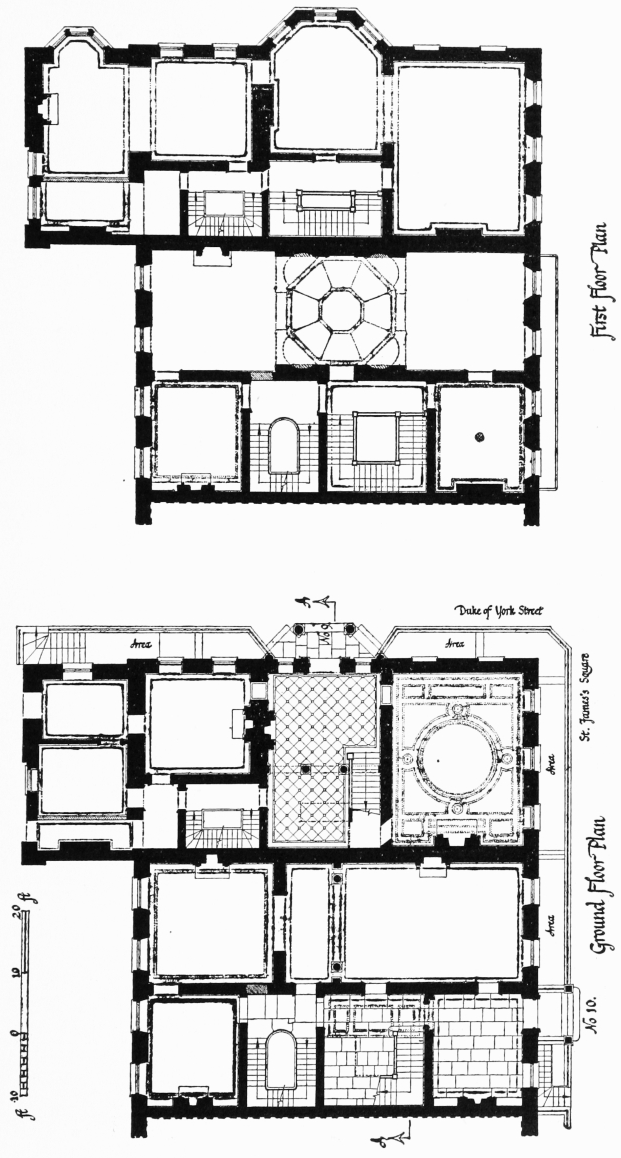
Nos. 9 and 10 St. James's Square, plans
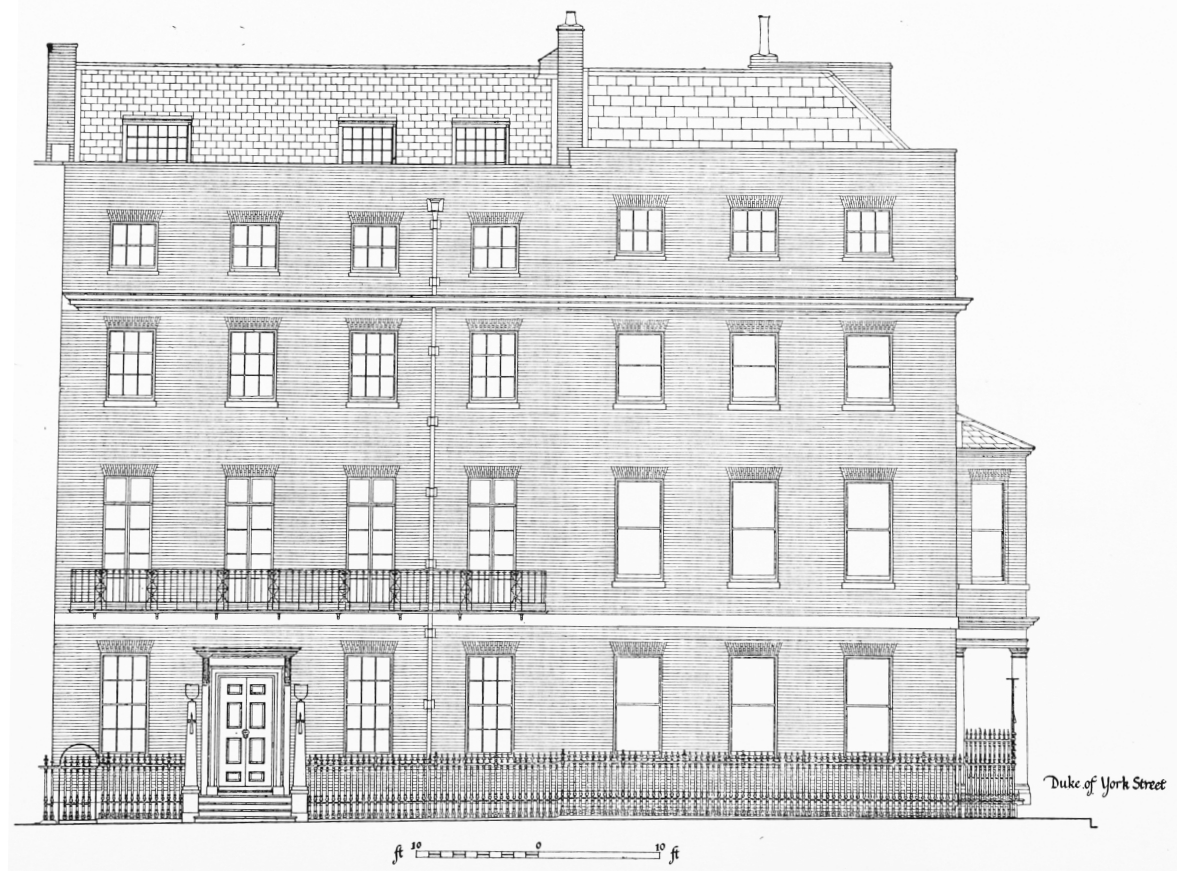
Nos. 9 and 10 St. James's Square, elevation to square
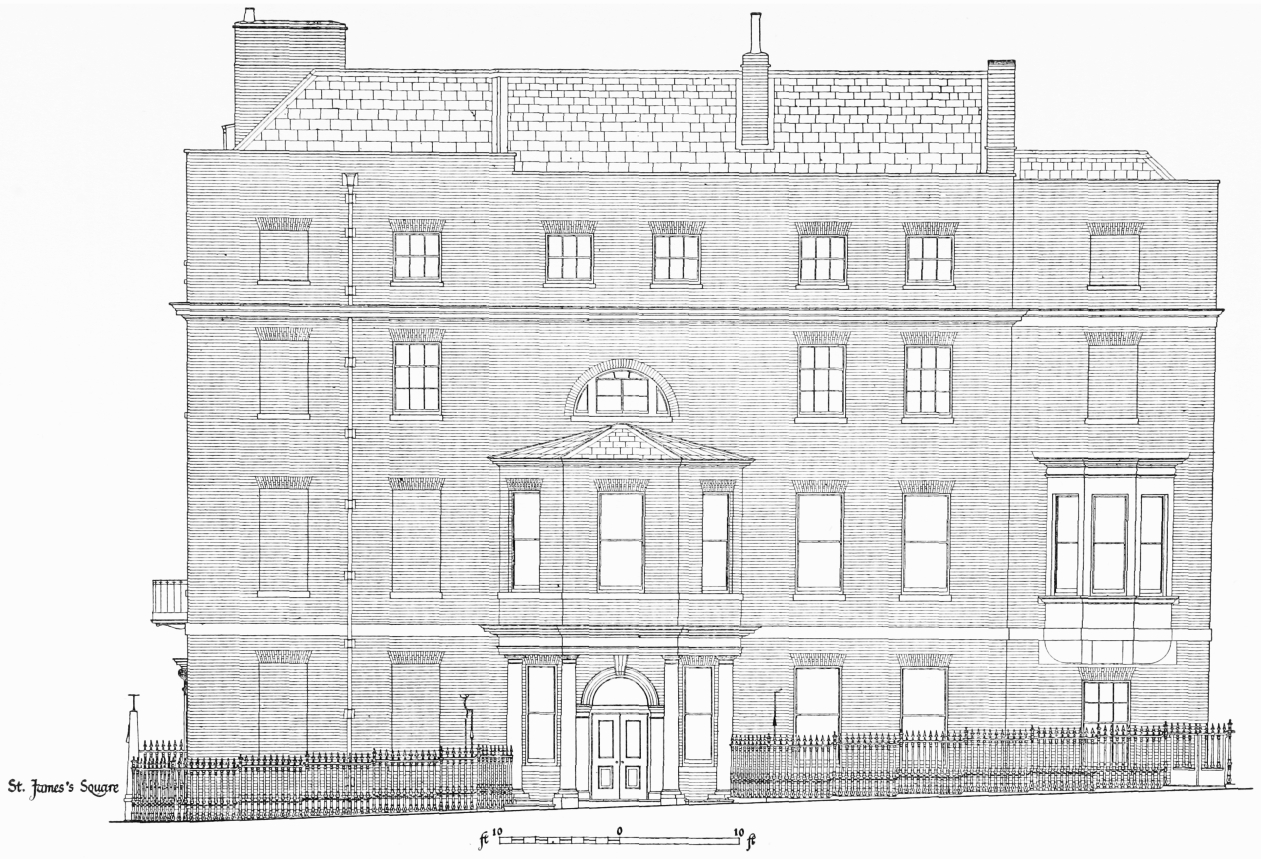
No. 9 St. James's Square, elevation to Duke of York Street
The rear elevations are also built of pink brick but with no stone dressings apart from the windowsills and the coping to the parapet. Brick bandcourses mark the level of the third floor and of the ceiling above it, but alterations and additions have obscured the original appearance of the lower floors.
Interior of No. 9
The entrance hall opens through a three-bay colonnade to the main staircase at the back. To the left (south) of the hall is a large room looking into the square, and to the right (north) a smaller room, with a closet and service stair behind it. The extension to the north contains two small rooms. The main staircase, rising only to the first floor, was top-lit until the compartment was recently ceiled at the second-floor gallery level. The first-floor plan corresponds with that below, and the room above the hall has a canted bay projecting over the entrance porch (figs. 21, 24).
The ground-floor rooms are largely intact. The Ionic colonnade in the entrance hall (Plate 142a) is of timber construction with unfluted columns and pilaster-responds supporting an entablature which has enriched mouldings, the modillion cornice alone being continued round the room. The doorways are dressed with architraves, pulvinated friezes, and cornices, and the six-panelled doors of mahogany are probably original. The wall faces are plain except for a moulded chair-rail and skirting. The stone chimneypiece, consisting of a plain architrave, frieze and cornice-shelf, is placed against a projecting face, finished with a cornice at three-quarters of the height of the room. The marble paving to the floor is modern.
The south room (Plate 144b) has similar doors and doorcases but the latter have lugged architraves with carved mouldings. The window architraves are also carved and the shutters plainly panelled. The dado is plain but the skirting-moulding and chair-rail are enriched with carving, and the face above is of wood framed to form wide and narrow panels, now partly altered. The chimney-breast was originally plain and is in two stages with a small capping where it sets back. The late eighteenth-century chimneypiece is of veined white marble, with an architraved opening flanked by plain margins, a frieze of red-brown marble ornamented with paterae of white marble, and a moulded cornice-shelf supported on carved brackets. The walls are finished with an enriched modillion cornice and the ceiling is divided by enriched mouldings into a large circular panel, shaped spandrel-panels, small circles in the middle of each side, and three narrow panels at either end.
The north room (Plate 144a) is similarly fitted but the panel mouldings are carved, the doorways have simple architraves and the ceiling is plain. The chimney-breast is crowned by a broken triangular pediment, enriched with carving, and the chimneypiece has a carved ovolo architrave, lugged, and framing marble slips. The plain oblong panel above is flanked by carved consoles and capped with an enriched cornice. The service staircase and the closet have been much altered as has the extension to the north where further additions have now been made.
The main staircase rises in three flights and has closed architrave-strings, a broad moulded handrail, substantial turned balusters and panelled newel-posts all of mahogany, but the treads and risers are of oak (Plates 142a, 145c). There is a moulded skirting, but the walls of the compartment are undecorated below the band of fret ornament marking the first-floor level. Above the first-floor pedestal the walls are divided by raised mouldings into panels containing Baroque plaster decorations composed of scrolled acanthus leaf, shells, husk-festoons and other motifs (Plates 142b, 143b, 143c). In the centre of the rear wall is a lugged architrave frame of plasterwork, supported on consoles, its sides decorated with drops and its head and base with scrolls of fruit and foliage, with a female mask above and a lion mask below. This frame contains an old copy of a painting by Rubens, the original of which was at Blenheim Palace during most of the eighteenth century (Plate 143a). The doors and doorcases are plainly moulded, and the first-floor stage is finished with an enriched modillion cornice, the compartment being now ceiled off above this level. Formerly, however, there was a second-floor gallery with an incurving centre and a handrail supported on turned wooden balusters (Plate 142c). One wall on this floor has now been removed but those remaining are decorated with panels in enriched frames. The slightly ornamented entablature has a dentilled cornice, and above is a high cove rising to a rectangular panel which is enclosed and divided by ornamented ribs and contains an octagonal roof-light.
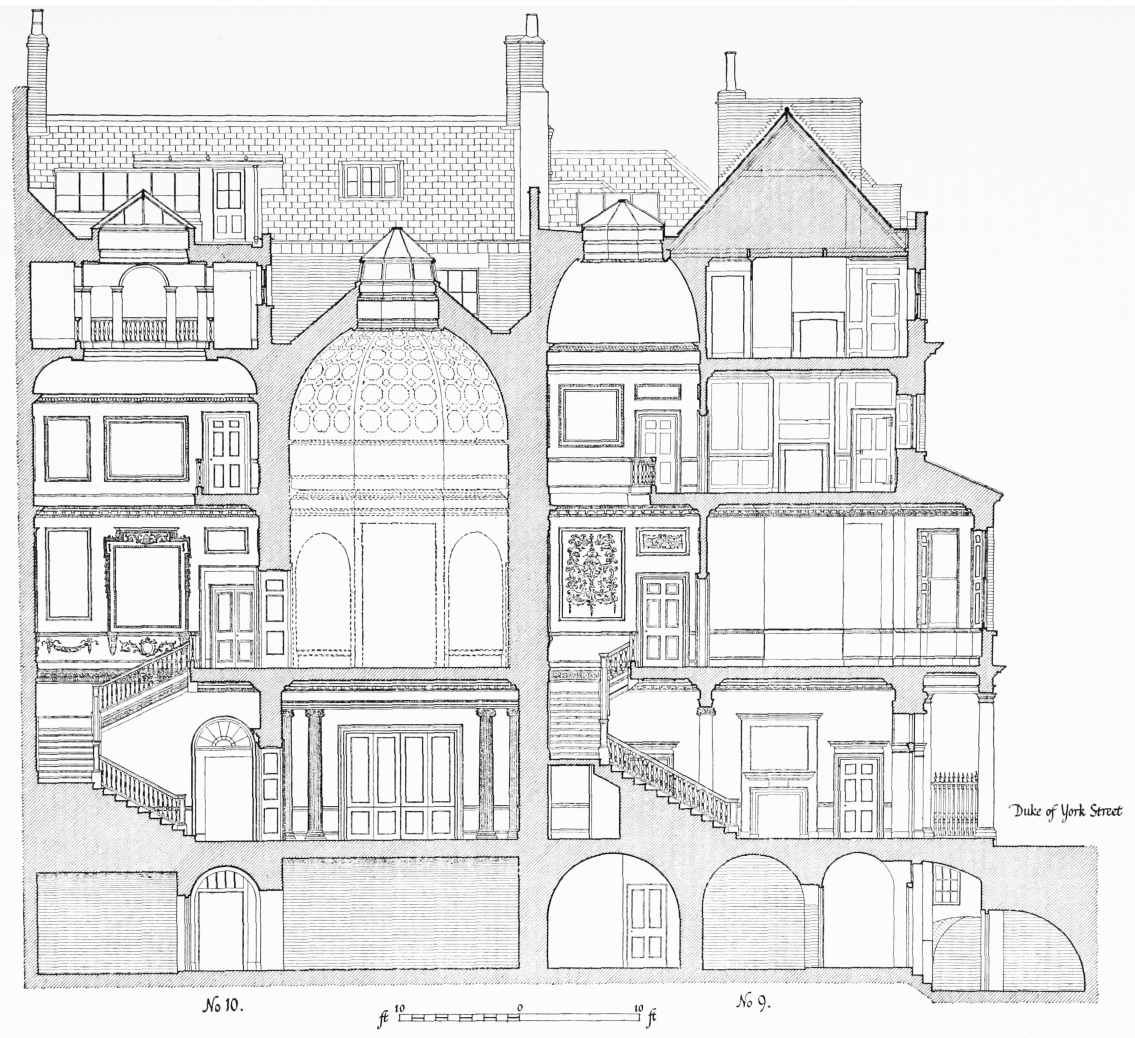
Nos. 9 and 10 St. James's Square, section A-A
On the first floor wide openings have been made between the rooms, which are now used as a library. Most of the enriched plaster cornices remain and also a good deal of the original woodwork, more richly carved than that on the ground floor. There are no original chimneypieces but in the northern extension is one of white marble with unorthodox Ionic columns and entablature, dating perhaps from the early nineteenth century.
The second-floor south room has woodwork with carved mouldings, and the chimneypiece appears to be original but with late eighteenth-century embellishments added. The plainly moulded architrave is of stone or marble set in a wood surround composed of a frieze with a central tablet, and narrow jambs with carved consoles supporting an enriched cornice-shelf. The frieze has been decorated with husk pendants and festoons, those on the tablet looped below paterae and laced across an urn, and the margins have long intertwined pendants of acanthus and husks, all this ornament being, presumably, of compo. The other rooms on this floor have plain rebated panelling with box cornices, and the chimneypieces consist of simply architraved openings with marble slips. One, however, has a frieze with a tablet bearing a fine female mask, but has no cornice-shelf.
Interior of No. 10
The house is divided internally into two nearly equal parts by a wall which runs from front to back. The western part is occupied on the ground floor by the entrance hall, the main staircase, the service staircase and a small back room. The eastern part contains a large front room with a screen of columns at the rear and a smaller room behind. The main staircase rises only to the first floor where there is on the west a small room above the entrance hall and another again at the back of the service stair. The eastern part originally contained a domed and top-lit octagonal ante-room, leading north and south into square bedchambers (figs. 21, 24).
The entrance hall (Plate 145a) is stone-paved and is lined for two-thirds of its height with simply moulded panelling, capped with a cornice which serves as an impost to an arch in the north wall, framing the pedimented doorway to the main staircase. In the west wall is a plain stone chimneypiece consisting of architrave, frieze and corniceshelf, flanked by a pair of recessed cupboards. The walls are finished with an enriched dentil cornice in plaster and the ceiling is plain. The main staircase compartment (Plate 145b) is also stone-paved and the cornice below the landing is similar to that in the hall. The doorcase leading to the front room has a carved moulded architrave, and a rich pulvinated frieze and cornice, but the other woodwork is plainly moulded. The service stair, reached through a round-arched opening, has little original work.
The large front room can be identified with Heathcote's 'Great Parlour', with its screen of 'Ionick Collumns and Pillasters fluted' at the rear (Plate 148a, 148b). The dado-rail and other woodwork is uncarved, the six-panelled mahogany doors have simple ovolo mouldings, and there is an enriched modillion cornice in plaster. The black marble chimneypiece, with Doric columns supporting a plain frieze and shelf, probably dates from the early nineteenth century. The two rear rooms are now without interest except that the larger has a late eighteenth-century chimneypiece of white marble, now stripped of most of its metal ornament. It has an architrave flanked by pilasters rising to blocks in the frieze, with a cornice-shelf above and the flat surfaces have rounded and rectangular panels, probably filled originally with paintings on copper, some of the mouldings being carved and others being of applied metal.
The main staircase is remarkably fine (Plates 145d, 146a). Constructed of oak, it has closed strings ornamented with a band of wave moulding, and a broad moulded handrail resting on carved waisted balusters, more slender than those to the staircase in No. 9, and square panelled newel-posts formerly with ball-finials. The lowest newel, at least, originally had carved drops in the panels. As already stated, Heathcote allowed £20 for the stucco work 'to be done very well by an Italian', not necessarily by the same hand as the decoration of the staircase in No. 9. The first-floor level is marked by a band enriched with fluting and wave moulding, the pedestal being carried round above it. In the centre of each wall is a panel with an elaborate architrave-frame decorated with masks, festoons, scrolls, acanthus buds and pendants at each side; the frame resting on the pedestal-rail which is supported by a pair of enriched consoles with an elaborate cartouche between them (Plate 146b). On either side of the framed panel is a narrow plain panel within a raised moulding and beneath the pedestal-rail is a festoon with pendants tied by ribbons.
The doors and architraves on the first-floor landing are of later date but there is an original enriched modillion cornice beneath the secondfloor level where a gallery, with plainly turned balusters, extends across the east side. The walls above are decorated with panels of the same width as those below, the central ones framed by a gadrooned moulding (Plate 147b). Above the enriched dentil cornice, a plain deep cove rises to a beam with a fretted soffit, supporting a gallery round all four sides of the compartment. Each face of the gallery is divided into three open bays by square columns with simple bases and caps; the wider central opening has a semi-circular arch with an ovolo-moulded archivolt (Plate 147a), and a balustrade with plain waisted balusters extends across each opening. The ceiling is decorated with narrow enriched panels and rosettes flanking a large square opening framed with a guilloche band. The square well has a deep plain architrave and frieze and a small cornice beneath a modern roof-light.
All that remains of the first-floor ante-room is the dome, which survives as a room on the floor above, with traces of octagonal coffering and a band of acanthus leaf beneath the lantern. The latter has an enriched architrave, a plain frieze and a cornice with further acanthus ornament, the octagonal roof-light probably being the original. The suite of ante-room and two bedchambers has been replaced by a large library, the rear part of which contains an early nineteenth-century chimneypiece of white marble. Its jambs have curved broadly reeded panels and the frieze (which is almost identical with that of the chimneypiece formerly in the front drawing-room of the Bristols' house in the square, No. 6) is well carved in high relief with naked boys harvesting grapes, the blocks at either end having comic and tragic masks. There is a plain moulding beneath the shelf and a blocking-course of concave section above it. The reason for the correspondence between this and the Bristols' chimneypiece is not known. An even finer chimneypiece of the same period formerly existed in the front part of the room. The narrow enriched architrave of the opening was flanked by excellently carved caryatids, which stood on sections of square fluted columns with moulded bases, and supported a carved cornice-shelf and a blocking-course similar to the last: the frieze had a carved relief representing a classical scene of victory. The other rooms on this floor contain nothing of interest. The second storey was originally finished in the same manner as in No. 9, with plain rebated panelling and box cornices, and simply architraved chimneypieces without cornice-shelves.
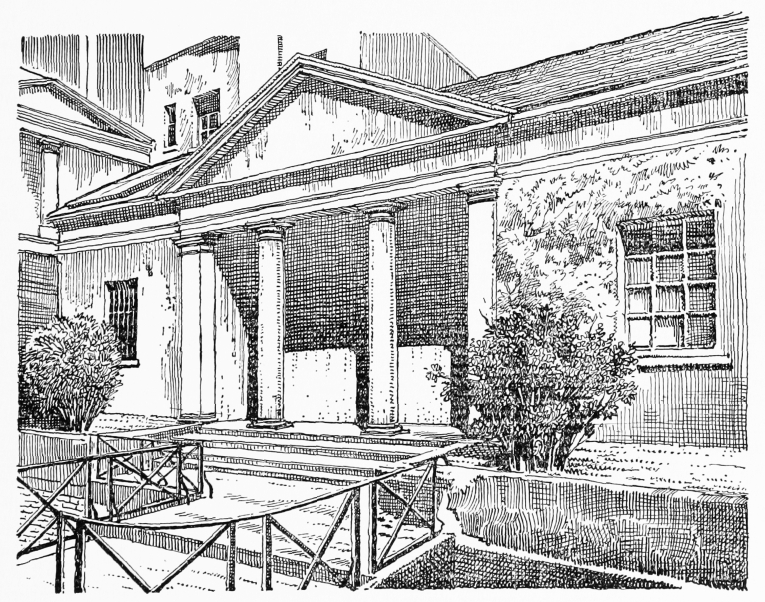
Garden pavilion at rear of No. 10 St. James's Square
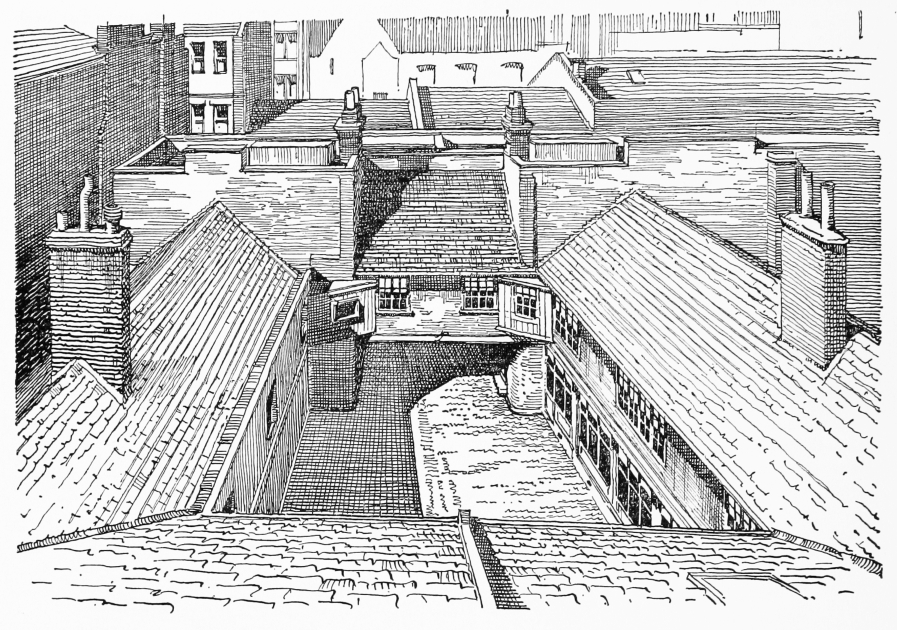
Stable yard at rear of Nos. 10 and 11 St. James's Square
At the back of the garden-court behind the house there was a single-storeyed building with walls which had been stuccoed and a slated roof. This garden pavilion consisted of a triangular-pedimented Roman Doric portico, distyle in antis, which was approached by four steps and flanked by small rooms, each with a front window (fig. 25). The building, presumably that mentioned in the original building agreement, was destroyed to make way for the conference hall. Behind it the stable yard mentioned above (numbered 15–18 consec. Ormond Yard), still survives surrounded by a two-storeyed building of pinkish-yellow brick with projecting eaves and a tiled roof partly replaced by slates. The original door and window openings have slightly cambered heads though most of them have been reconstructed (fig. 26).
Architectural description of No. 11 St. James's Square
J. Bowles's view, published in c. 1752 (Plate 130), shows clearly that the front of No. 11 was then quite uniform with those of Nos. 9 and 10, and that the present painted stucco-work covers Timbrell's brickwork while preserving the pattern of the original fenestration. The 'handsome iron palisadoes', railing the front areas of all three houses, also survive.
The five-windows-wide elevation was recast by Robert Adam with a central feature of three bays, having a rustic ground storey, four giant pilasters embracing the second and third storeys, and a pilastered attic with a balustraded parapet, the flanking bays being left plain. The giant pilasters rise from plain pedestals and had, originally, 'Tower-of-theWinds' capitals. As is usual in Adam's work, the entablature has no architrave, but the frieze was originally ornamented with paterae, placed over the pilasters and centrally in each bay. The atticstorey pilasters are of a simple Doric character, and the solid dies of the balustrade parapet were intended to carry statues. The Adam drawing (fn. 64) (Plate 141a) shows a porch with plain-shafted Doric columns and an entablature with a plain tablet between fluting and paterae.
The front is still substantially that designed by Adam, although some regrettable changes have been made (Plate 140). The pilaster capitals shown on the Adam drawing probably disintegrated and were replaced by the present Corinthian capitals. The paterae have gone from the entablature, and so has the guilloche band between the second and third storeys. The ground storey of each side bay has been rusticated and the porch, with the first-floor balcony and its Victorian Rococo ironwork, represents the work carried out by Messrs. Trollope and Sons in 1877.
The plan is simple and generally resembles that of No. 10. A stout wall, extending from the front to the back, divides the house into two unequal parts, the wider eastern part, originally containing, on the ground and first floors, two large rooms, one front and one back. The western part contains the entrance hall, with a room of the same size over it, a large staircase hall of oblong plan rising to the roof and a service stair at the back. Behind this is a wing containing a large room on to which a further extension has been built. The large back rooms on the ground and first floors have lately been subdivided.
The entrance hall has an oak dado, with small fielded panels, and a skirting and chair-rail with enriched mouldings. Oak architraves, carved with egg-and-dart ornament, surround the six-panelled mahogany doors. The chimneypiece is of veined white marble, with a shelf resting on heavy brackets. The plain ceiling, covered with silver foil, is surrounded by an enriched modillioned cornice of plaster, which is probably the only original feature of the room. The oak dado and architraves are obviously modern, and the mahogany doors probably date from the mid nineteenth century.
The most striking internal feature is the staircase hall, which is oblong in plan, with the stone stairs rising round the south, west and north walls, to gallery landings along the east wall at first- and second-floor levels. The mahogany handrail is supported by standard panels of wrought iron, each composed of three upright square-section bars, the middle one being laced with intersecting segmental bars and ornamented with lead castings. This railing, although late eighteenth-century in character, is not at all typical of Adam work and does not appear to have been used elsewhere by the brothers. The wall faces, above a panelled dado, are divided into panels by raised and enriched mouldings and the well is ceiled with a saucer dome, its centre open to a skylight. This dome rests on pendentives and is flanked on the north and south by coffered arches. The pendentives, and the lunette on each wall, are decorated with arabesques in the Adam manner, but the dome is adorned with four boldly modelled cartouches of Baroque character, perhaps a survival from the original decorations.
The ground-floor front room, until lately fitted up as a library, retains its original enriched modillioned cornice of plaster, but the panel mouldings on the ceiling might be modern. The oak dado is certainly modern, and the six-panelled doors of mahogany are probably mid nineteenthcentury. The chimneypiece of red and white marble, with a central tablet carved with a female mask and garlands, may be original. In the back room, the enriched skirting and dado-rail are probably original, as is the modillioned cornice of plaster, but the elaborate doorcases and chimneypieces are in the Edwardian 'Adam' taste. The room alongside is without interest, but all three rooms are approached through a small lobby, the doors being framed by enriched architraves which though refixed, are probably original to the house. The room in the back wing is lined with deal wainscot, with a pedestal dado below alternate wide and narrow ovolo-moulded panels. This room is similar in style to the front room in No. 9.
The front drawing-room on the first floor is elaborately decorated in a late Victorian or Edwardian version of the Adam style, but some of the ceiling plasterwork might well be that introduced for Sir Rowland Winn by Adam. This room, and the back drawing-room, which has been stripped of interest and subdivided, have chimneypieces of carved pine in the Adam style, probably modern. The smaller front drawing-room retains an enriched modillioned cornice of the 1736 period, and contains a white marble chimneypiece in Kent's manner.