Survey of London: Volumes 29 and 30, St James Westminster, Part 1. Originally published by London County Council, London, 1960.
This free content was digitised by double rekeying. All rights reserved.
'St. James's Square: No 31, Norfolk House', in Survey of London: Volumes 29 and 30, St James Westminster, Part 1, ed. F H W Sheppard (London, 1960), British History Online https://www.british-history.ac.uk/survey-london/vols29-30/pt1/pp187-202 [accessed 2 May 2025].
'St. James's Square: No 31, Norfolk House', in Survey of London: Volumes 29 and 30, St James Westminster, Part 1. Edited by F H W Sheppard (London, 1960), British History Online, accessed May 2, 2025, https://www.british-history.ac.uk/survey-london/vols29-30/pt1/pp187-202.
"St. James's Square: No 31, Norfolk House". Survey of London: Volumes 29 and 30, St James Westminster, Part 1. Ed. F H W Sheppard (London, 1960), British History Online. Web. 2 May 2025. https://www.british-history.ac.uk/survey-london/vols29-30/pt1/pp187-202.
In this section
No. 31: Norfolk House
Architects, Messrs. Gunton and Gunton, 1939
The history of this site is made obscure in some respects by the absence of the relevant title-deeds and estate papers of the Dukes of Norfolk. Some of this evidence is recorded by Dasent, who had access to the papers.
The present building has the same frontage of about 107 feet to the square as the house built by Matthew Brettingham for the Duke of Norfolk in 1748–52. This frontage comprised that of two older houses, the more southerly, with a frontage of about sixty-eight feet, being the original St. Albans House (A on fig. 36), first owned and occupied by the Earl of St. Albans before his removal to the site of Nos. 9–11, and the more northerly, with a frontage of about thirty-nine feet, being one of the three houses originally built by Lord Belasyse under a grant from the Earl (B on fig. 36).
The Dukes of Norfolk acquired the St. Albans House site in 1722 and the Belasyse house site in 1748. The history of these two sites is discussed before that of the house built in 1748–52 and its modern successor. In the following account the name 'Norfolk House' will, unless otherwise indicated, be applied only to the house which existed from 1748 to 1938.
St. Albans House site
The house built on this site by the Earl of St. Albans for his own occupation was the first erected in the square, within two years of the Crown's grant of the freehold in 1665 and during the period of the Earl's early plans for a square occupied by mansions even greater than those which were ultimately built. The history of the house does not, however, suggest that its construction was particularly sound. Nothing is known of its erection, although Sutton Nicholls's view of c. 1722 (Plate 128) shows that it had been built in a style uniform with that adopted for the other houses erected in the square in the next decade or so. Dasent summarizes an inventory of 1674 (fn. 11) and notes that this indicates that there were twelve or thirteen rooms in all on the main floors. The house is included in the ratebook for 1667. According to Dasent, on the authority of ratebooks no longer available, (fn. 12) this is the first year it appears. (fn. 1) Dasent says that the house was undoubtedly approached from Pall Mall when first built, (fn. 13) and this has perhaps encouraged the mistaken belief, not shared by Dasent, that the older building which until 1938 stood on the eastern side of the garden of Norfolk House (C on fig. 36) was the original St. Albans House, Sutton Nicholls's view, however, shows clearly that the house fronted on the square and this is confirmed by such evidence as survives from title-deeds. The statement that it was approached from Pall Mall probably derives from its inclusion in that section of the ratebooks down to 1672: the three houses in the opposite, south-westerly, corner of the square were similarly listed under Pall Mall in the ratebook for 1675. (fn. 2)

Norfolk House, layout plan. Based on the Ordnance Survey 1869
Key. The bold line indicates the boundary of the Norfolk House property in 1869.
A. Old St. Albans House. B. House on Belasyse freehold, bought for Duke of Norfolk in 1748. C. Garden block probably
erected by Earl of Portland, c. 1710–13. D. Houses hired by Prince of Wales, 1738–41. E. Broken-and-dotted line indicates
boundary of stables and yard (sometime Hubbard's Yard), leased from Crown in 1710. F. Dotted line indicates boundary
of stable yard (sometime Robin Hood Yard) as in 1794. G. Entrance to stable yard probably built by the New Street
Commissioners c.1814. H. Entrance to stable yard of No. 32 built by the New Street Commissioners c. 1814–16. I. Frontage of five houses acquired by Dukes of Norfolk between 1730 and 1777
The Earl was himself rated for the house down to 1672. (fn. 3) In 1669 it had been put at the disposal of Cosmo III, Grand Duke of Tuscany, during his visit to London. (fn. 14) The Grand Duke caused the King's birthday to be celebrated with a display by 'a machine with different fanciful artificial fire-works and squibs' before the house, and a distribution of Italian wine and beer to the onlookers. An unexplained episode in the house's history is its sale in April of the following year, 1670, for £5200 to the Earl of Essex, who sold it back to the Earl of St. Albans and his trustees in January 1670/1: (fn. 15) in 1679 Essex bought and occupied No. 19.
By deeds of March and May 1676 St. Albans and his trustees sold the house to the builder Richard Frith and his trustees, John Grosvenor and Richard Heyburne, reserving a rent of £36 per annum. (fn. 16) At that time St. Albans's big new house on the north side of the square was probably recently built or still building by Frith (see page 118), and the conveyance to him of the original St. Albans House may have been intended as some kind of security for his outlay on the new house. On 9 September following Frith and his trustees re-sold the house (it is not clear whether for £6000 or £6500) to James Bridgman of St. Martin's in the Fields, esquire, and William Masemore of the Middle Temple, gentleman (who the previous year had witnessed the Earl of St. Albans's grant of the site of No. 4 to Nicholas Barbon), as trustees for Lord Duras, Marquis de Blanquefort (subsequently, when second Earl of Feversham, commander of the royal forces at Sedgemoor), who moved into the house in the same year. In 1675 Lord Duras had married a daughter of the first Earl of Feversham, who lent him part of the purchase money, and whom he succeeded in 1677 as second Earl. Dasent records what he calls a bill of sale of the goods of Sir John Duncombe (the outgoing tenant), also of 9 September 1676, from St. Albans and Frith to Lord Duras. The 'goods' were presumably furnishings which were perhaps handed on from one owner to the next. (fn. 17) A few days later, on 12–13 September, Lord Duras's trustees mortgaged the house back to trustees for Frith, as security for the payment of the purchase price. (fn. 18) The second Earl of Feversham was rated for the house until 1681 although in 1677–8 he was ambassador in Paris, and he was again rated for the house in 1692–3, after a number of short tenancies. In March 1695/6 he and others, who were evidently mortgagees, conveyed the house for £5000 to two lawyers, Martin Folkes, esquire (a trustee of the Jermyn estate), and Andrew Card, gentleman, both of Gray's Inn, in trust for Sir Stephen Fox. (fn. 19) (fn. 4) The house was then already occupied by the second Earl of Sunderland (of whom Fox had been a creditor). (fn. 20) The Sunderlands inhabited the house until 1708, owning it in at least the later years of their occupation. During their residence here the house was the scene of the highly romantic return of the Jacobite Lord Clancarty to his wife, the second Earl's daughter, in 1698. (fn. 21)
In November 1708 Lady Wentworth was looking for a house in the square for her son, later Earl of Strafford, who eventually settled at No. 5. Two of her voluble letters describe old St. Albans House, which she seems to have thought better built than its later history suggests. (fn. 22) She describes it as 'a very good hous. . . . It has thre large rooms forward and two little ons backward.' The rooms were wainscoted at top and bottom, with provision for hangings and with 'picturs' inset over most of the chimneypieces. She conveyed the gratifying intelligence that 'New River water' was available, as well as a supply from lead cisterns, and that the chimneys did not smoke. She was evidently impressed by the amplitude and convenience of the back premises; this suggested to her that 'you may build a gallary over the offisis'. The construction was thought to be sound: 'they say this hous is soe strong it will last for ever'. In short, 'it is a noble hous'.
Lady Wentworth said that Lord Sunderland had found the house too small for him, and had disposed of it to a 'marchant' with whom she was dealing. (fn. 5)
By 1710 the house was in the possession of the second Earl (later first Duke) of Portland, who purchased the house at about this time, (fn. 23) and moved hither from No. 32. In September 1710 and in April and May 1712 the Earl acquired leases of additional stable yards and coach-houses. Part of this leasehold property, held from the Crown, was in Hubbard's Yard and gave access to the back or eastern side of the freehold site from St. Albans Street (E on fig. 36). (fn. 24) Previously, access to the back of the house had been only from Charles Street by a passage across the easternmost part of the site granted to Lord Belasyse, the use of which had been reserved in St. Albans's grant of 1670. (fn. 25) Lord Portland's leasehold acquisitions also included stable yards evidently communicating with Charles Street and he was perhaps responsible for the enlargement of the yard off that street shown in eighteenth-century maps and plans (fn. 6) (F on fig. 36). The present more extensive frontage of the 'Norfolk House' site to Charles Street forming the present No. 30 Charles II Street (G on fig. 36), was, however, probably formed in about 1814, when the back premises in the southeastern corner of the square were being reconstructed by the New Street Commissioners in consequence of the formation of Waterloo Place.
Dasent says that on acquiring the freehold of St. Albans House the Earl of Portland 'made extensive alterations and improvements utilizing the courtyard or garden for the erection of new reception rooms . . .'. (fn. 23) These improvements almost certainly included the erection of the building which until 1938 stood on the eastern side of the garden of Norfolk House and which has sometimes been supposed to have been the original St. Albans House (C on fig. 36; see also Plate 163, fig. 39). In the summer and autumn of 1713 Lord Berkeley of Stratton discussed Lord Portland's 'great room' in letters to his friend the Earl of Strafford, (fn. 26) who was thinking of building a similar addition in the garden of No. 5 (see page 100). (fn. 7) Lord Berkeley thought the room 'dark and unpleasant', but it was evidently admired and in 1714 was, with the 'Duke of Kent's Gallery' at No. 4, thought especially worthy of 'the Curiosity of a Stranger' viewing the square. (fn. 27)
The building on the east of the garden had a coved painted ceiling. This may have been one of the works of the Venetian, Giovanni Antonio Pellegrini, who is said to have painted 'the hall and Staircase and one or two of the great rooms' here for the Duke of Portland, and whose 'very noble and fruitfull invention' has been celebrated by Vertue. (fn. 28) Alternatively, Sebastiano Ricci, who worked for the Duke of Portland at Bulstrode, may have been responsible for the ceiling. (fn. 29) An architectural description of this building is given on page 200.
By deeds of 31 May and 1 June 1722 the Duke of Portland sold the house and assigned the leasehold properties at the back to Lord Howard of Effingham and Lord Frederick Howard, doubtless as trustees for the eighth Duke of Norfolk. (fn. 29) The price is said to have been £10,000. (fn. 30) The site was henceforward owned by the Dukes of Norfolk until 1938. The eighth Duke and the four succeeding Dukes all died here or in the rebuilt house.
In September 1737 Frederick, Prince of Wales, having been dismissed from St. James's Palace by his father, took the Duke of Norfolk's house furnished, at a rent said to be £1200 per annum. (fn. 31) The Prince was rated here and also for three adjacent houses in Pall Mall during the years 1738–41. It was in this house that the future George III was born, on 24 May (the New Style 'Fourth of June') 1738. (fn. 32) The Rev. James Dallaway, chaplain of the eleventh Duke of Norfolk, told his fellow topographer, J. T. Smith, that at that time 'only the buildings on the north side of the inner court were completed' and that it was these which were leased to the Prince. (fn. 33) This is perhaps the origin of the belief that the painted room on the eastern (not the northern) side of the garden was the birthplace of the future King. But Dallaway's account of the rebuilding of the house is not in other respects accurate, and it seems possible that the birth took place in the main part of the old house.
Some building at about this period was, however, in progress on the leasehold property to the east of the freehold site. On this Crown property immediately east of the garden block, a 'large and commodious kitchen' had in 1739 lately been built. Other coach-houses and stables here were said to be 'old and ruinous'. The Surveyor General of Crown Lands recommended a renewal of the Duke of Norfolk's leasehold interest, derived from the Duke of Portland, until Lady Day 1789. (fn. 25)
Old St. Albans House was itself already in decay, and this hastened the Prince's departure in the summer of 1741. On 4 June Lady Irwin wrote to Lord Carlisle: 'The Prince has met with a great disappointment in regard to Norfolk House; upon making some repairs the workmen found the house in a dangerous condition; upon this it was examined by two or three head builders, who report the front to the square to be in a falling condition—several cracks and failures in the wall. Upon this the Prince has left it, and proposes being in the country all winter.' (fn. 34)
It was not, however, until 1748 that the house was demolished and rebuilt with a wider frontage. This was made possible by the acquisition in that year of the adjacent house to the north, the site of which was incorporated in the new Norfolk House, but which had had a separate history as part of Lord Belasyse's freehold.
Lord Belasyse's house site
This house (B on fig. 36) was the southernmost of three which were built for the first Lord Belasyse, a younger son of Thomas Belasyse, Lord Fauconberg. They were built on a site with a frontage of 133 feet to the square south of Charles Street. The sites of the two more northerly Belasyse houses survive as those of Nos. 32 and 33.
The overall site was granted (fn. 35) by the Earl of St. Albans and Baptist May on 24 March 1669/70 to Viscount Fauconberg and Viscount Castleton in trust for Fauconberg's uncle, the first Lord Belasyse, at a rent of £30 per annum. (fn. 8) Dasent, who doubtless saw the original grant or an associated covenant, records that Lord Belasyse undertook to build three houses before 1671, as well as to pave the square sixty feet in breadth in front of his property. (fn. 36) The ratebooks suggest that the undertaking was not exactly fulfilled as Nos. 32 and 33 were the first to appear in 1673: all were first listed under Charles Street. The southernmost house first appears in 1674, its first occupant being the Countess of Newburgh. She remained here only until 1678 and the subsequent history of the house was one of comparatively short tenancies. From the Belasyses the house descended to John Talbot of Longford, Shropshire, (fn. 37) who lived there in 1706–7 and possibly later. For the years 1716–17 it was occupied by the Lord Mayor, Sir James Bateman. Sutton Nicholls in c. 1722 shows the original seventeenth-century front (Plate 128), and this doubtless survived until its demolition in 1748: when it was being offered for sale in January 1726/7 it was said to have been 'lately repaired and painted'. (fn. 38) It stood empty during 1726 and 1727, and in March 1727/8 was sold by John Talbot and his wife to Joseph Banks of Revesby Abbey, Lincolnshire, (fn. 39) who about this time was elected member of Parliament. He occupied the house for two years or so, and then let it to the Prussian minister, Count Daggenfielt, at a rent falling from £30 to £20 a month. In August 1731 repairs were being carried out. (fn. 40)
In 1748 an Act of Parliament was obtained (fn. 41) enabling the Banks family to sell the house, which had been entailed by a marriage settlement. The Act stated that the Duke of Norfolk's house to the south was 'now pulling down' to be rebuilt and that this removed the likelihood of leasing the Banks's house which was unlet and 'much out of Repair'. Whether this was so or not, the Earl of Effingham had agreed in March of that year to buy the house, undoubtedly on behalf of the Duke of Norfolk, for the very low sum of £1830. (fn. 41) In the same year the house was pulled down.
Norfolk House
The great house built for the ninth Duke of Norfolk between 1748 and 1752 was the work of Matthew Brettingham the elder, who also built No. 5. His account book survives and gives a rather summary statement of the work on the house. (fn. 42) The total cost, including the purchase of materials, but excluding the fine furnishings and perhaps also some of the interior decorative work, seems to have been about £18,575. This included payments in cash totalling £800 to Brettingham himself 'for my trouble Jorneys Drawings and expences and attendance'.
The 'pullying down' of the two old houses was completed by September 1748, and the rebuilding was begun in that month. By August 1749 the house was sufficiently advanced for a watchman to be employed; he was paid until the spring of 1751. In that year the Duke of Norfolk reappeared in the ratebook after two years' absence, while he lodged in No. 32, but the payment to workmen for building the house continued until the spring or summer of 1752.
One payment of £48 is mentioned 'for 32000 white brick from Norfolk'; their 'ship freight' cost £44 and land-carriage a further £13 11s. 6d. Payments to a Mr. Scott for bricks are also recorded, including one for £1000. There were also separate purchases of lime and sand.
Between September 1748 and July 1750 payments by Brettingham are recorded to 'Mr. Leoni, my clark' for 'trouble and attendance'; it is not known whether he was related to the Duke of Kent's architect (see page 90) who died in 1746. The mason was 'Mr. Rouchead', probably the mason later employed at No. 15. Other workmen were John Elliott and his brother, and William Clark, bricklayers; William Edwards, carpenter and joiner; another workman named Clark, a plasterer; Broadbelt, painter; Cook or Cock, plumber; Fitzgerald, slater; Stephens, smith; Airs or Ayray, glazier; and Davis, paviour. A Mr. Croucher paved over the Vaults' and a workman called Griffon was paid for 'paving the Square'.
The decoration of the interior continued for some years, and it was February 1756 when Mrs. Delany wrote to a friend: 'The Duke of Norfolk's fine house in St. James's Square is finished, and opened to the grand monde of London; I am asked for next Tuesday. . . .' (fn. 43) This reception celebrating the completion of the house was attended also by Horace Walpole who described the effect of the brand-new splendour on the guests: 'All the earth was there. . . . You would have thought there had been a comet, everybody was gaping in the air and treading on one another's toes. In short, you never saw such a scene of magnificence and taste. The tapestry, the embroidered bed, the illumination, the glasses, the lightness and novelty of the ornaments, and the ceilings, are delightful.' (fn. 44) This interior brilliance was in striking contrast to the quiet unostentatious exterior which is well shown in Bowles's view of c. 1752. By 1771 this exterior was being ridiculed by the author of Critical Observations on the Buildings and Improvements of London, whose hand can probably be seen in the more assertive façade of No. 15: 'Would any foreigner, beholding an insipid length of wall broken into regular rows of windows, in St. James's Square, ever figure from thence the residence of the first duke of England ? "All the blood of all the Howards" can never ennoble Norfolk House.' (fn. 45)
In 1802 the eleventh Duke bought from the Crown for £1634 the freehold of the stable yard running back to St. Albans Street which had hitherto been held on lease. (fn. 46) In December 1813 the stables here, which had evidently been repurchased by the New Street Commissioners, were being pulled down, (fn. 47) to allow the creation of Waterloo Place. At about the same time the Commissioners probably rebuilt the approach to the back of the house from Charles Street as a stable yard (G on fig. 36), with a wider frontage to that street of nearly seventy feet. (fn. 48) This, like the approach to No. 32 across the back premises of No. 33 which the Commissioners constructed (H on fig. 36), was on part of the original Belasyse freehold where five small houses faced Charles Street (I on fig. 36), which the Dukes of Norfolk seem to have acquired at some time between 1730 (fn. 49) and 1777, (fn. 50) and to have surrendered to the Commissioners. (fn. 51)
The eleventh Duke died in 1815. Before the twelfth Duke entered into occupation of the house it was repaired and stood empty for two years. (fn. 52) It was reported in 1819 that the Duke had in the previous year wished to raise his garden wall and had been prevented because it would darken houses in Pall Mall. (fn. 53) In September 1819 Robert Abraham, the Duke's surveyor, was certainly enquiring about the right of 'Ancient Lights' claimed in respect of No. 32, then rebuilding. (fn. 54) The work at Norfolk House was presumably completed by November 1820 when Creevey was shown over the house 'and a capital magnificent shop it is'. (fn. 55)
On the next change of occupant, with the succession of the thirteenth Duke in 1842, further changes were made. The most important was probably the addition of the stone porch and continuous balcony, said to have been erected by Robert Abraham. (fn. 56) An interior renovation, probably extensive, was carried out, and the house was not re-opened to society until July 1845, when its 'splendid & showy' appearance caused comment. (fn. 57)
In March 1928 abortive negotiations for the sale of the house were in progress, (fn. 58) and in July 1930 it was offered for sale by Hampton and Sons, who advertised it as 'eminently suitable for a Nobleman's Town House . . . or for a Club, Embassy or Colonial Office'. (fn. 59) The house was withdrawn, reputedly 'at an inadequate final bid of £250,000'. (fn. 60)
In November 1937 the Duke of Norfolk came to an agreement to sell the house. (fn. 61) The purchasers were Rudolph Palumbo of Culross Street, Park Lane, engineer, and P. M. Rossdale, of South Audley Street, company director, who in February 1938 formed a private company, Norfolk House (St. James's Square), Ltd., of Newcastleon-Tyne. (fn. 62) In the same month of November 1937 Messrs. Gunton and Gunton submitted plans on behalf of the purchasers for the rebuilding of the site. (fn. 63) Conditional consent to the rebuilding was given by the London County Council, which regarded the house as containing little work of architectural merit, although the musicroom was subsequently re-erected in the Victoria and Albert Museum. The furnishings of the house were sold in February 1938, (fn. 64) and the conveyance of the house itself made by the Duke to the company on 17 May. (fn. 65)
Requests by the architects of the proposed new building for permission to dispense with a garage on the site and to build higher than the eighty-foot vertical limit imposed by the London Building Act (1930) were strongly contested by the Council, in the face of the argument that the importance of the site and the character of the neighbourhood made the provision of a garage undesirable and that only an elevation higher than eighty feet would add to the beauty of the square.
On an appeal to the Minister of Health in October 1938 the Council's case, which put some weight on the value of height-limitation as a means of diffusing 'development' over the whole county, was successfully argued. It was pointed out that the limitations were less restrictive than those tentatively suggested in a Ministry of Health report of 1937–8, which would in certain areas have made relationship to the height of existing buildings the determining factor rather than the angular measurements specified in the London Building Act of 1930.
On the dismissal of the appeal in November, Messrs. Gunton and Gunton submitted plans for an elevation to the square of eighty-three feet in height. This was approved by the Council in January 1939, and the existing building, 'of no merit', (fn. 66) was raised upon the site. The northern wing of the building forms No. 30 Charles II Street and replaces the nineteenth-century stable yard. The contractor was Sir Frederick Minter.
A plaque on the front of the building records that here General Eisenhower formed the first Allied Force Headquarters, and planned and launched the North Africa campaign of 1942 and the invasion of north-west Europe in 1944.
Architectural description
The house erected between 1748 and 1752 was the largest and finest of the three, or possibly four, noblemen's town houses that were designed by Matthew Brettingham, senior, and built in fairly close proximity within St. James's parish. It is not surprising to find that most of the Palladian detail of Norfolk House was derived from Hoikham Hall, since Brettingham's architectural taste was formed there. It is also possible that the simple and effective plans of his London houses might have been inspired by the 'family' and 'strangers' wings at Holkham. Whether or not this is so, Norfolk House had much in common with the contemporaneous No. 5 St. James's Square, and was certainly the prototype of the later Cumberland House in Pall Mall.

Norfolk House, St. James's Square plans
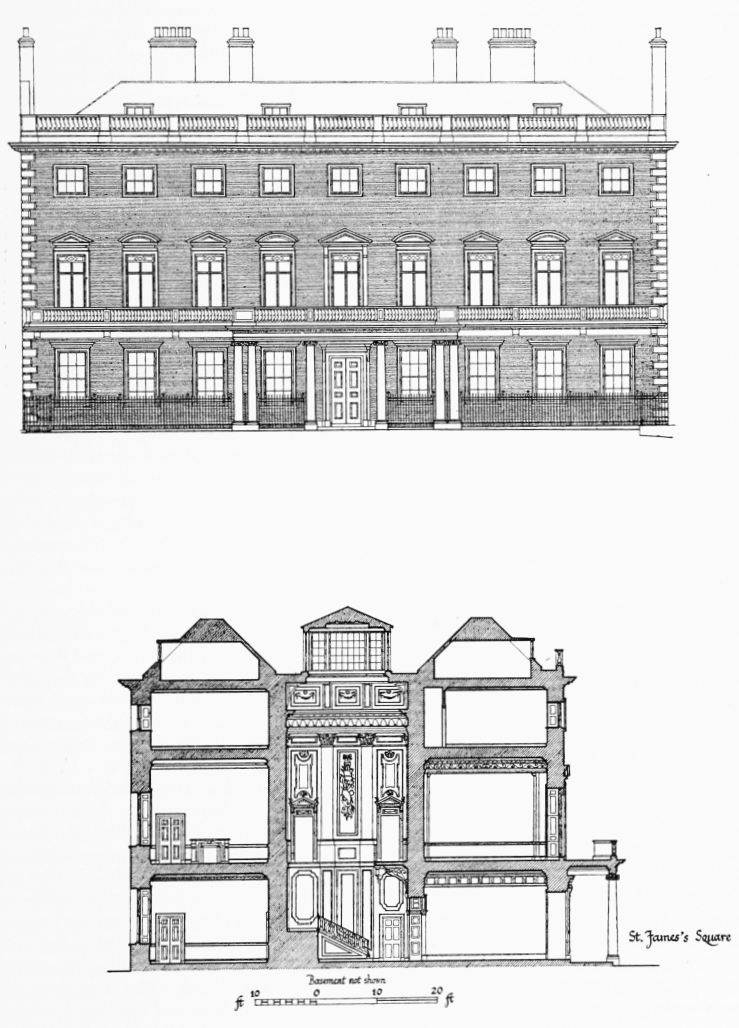
Norfolk House, St. James's Square, elevation and section A-A. Re-drawn from survey of 1937
Brettingham designed an oblong building, fronting about 107 feet to the square and having a depth of about 73 feet, but broken in on the northeast to form an area giving light and air to rooms on the north side (figs. 37–8). (fn. 9) The house contained a basement and three storeys—ground, principal, and chamber. On the ground storey, fronting west to the square, were three oblong rooms of similar size—the hall in the middle, the library or Duke's study on the north, and the morning-room on the south. An arched doorway opposite the front door led from the hall into the oblong top-lit compartment where the great staircase ascended to the principal storey. North of the great staircase was a square ante-room, serving the library and a bedroom, and south was the service stair, its compartment forming a lobby to the morning-room and the dining-room, a deep oblong room on the south side. There were two rooms on the east (garden) front, a square dressingroom and an oblong bed-chamber, and at the north end were two closets. These, and the adjacent ante-room, were lit by windows in the north wall, set back from the site boundary east of the library. The ground-storey layout was repeated on the principal storey, with the music-room and two drawing-rooms on the west front, the saloon or ball-room over the dining-room on the south, and the state bed-chamber and dressing-room on the east front.
The long front towards the square (Plate 153, fig. 38) was a simple Palladian design, built in 'white' bricks and dressed with stone, the ground storey serving as a base for an upper face containing two tiers of nine windows, widely and evenly spaced. A plain stone plinth underlined the ground storey, where the centrally placed doorway contained a door of two leaves, each with eight panels, framed in a stone doorcase composed of a moulded architrave flanked by plain jambs, with scrollconsoles supporting a cornice above a narrow pulvino-frieze. On each side of the doorway were four windows, each with barred sashes framed in a moulded stone architrave, rising from a plain sill and finished with a cornice. The two-storeyed upper face was underlined by a pedestal, with blind balustrades of waisted balusters below the principalstorey windows, each of them dressed with a moulded architrave, narrow pulvino-frieze, and a pediment—triangular and segmental alternately—the middle window emphasized by its slightly larger pediment resting on scroll-consoles rising from plain jambs. The original barred sashes of these windows were replaced by tall casements when the aprons were removed and the long balcony added. The chamber-storey windows were square, with barred sashes framed in moulded stone architraves. Long-and-short quoins, with chamfered arrises, marked each end of the front, which was finished with a modillioned cornice and a balustrade divided into nine bays by pedestals. The front area was protected by a very fine iron railing, divided into long and short panels by columnar standards crowned with coronets, each panel being composed of upright bars, linked at the foot with a spiked rail and at the head by an ornamental band, and having foliated finials. A short length of this railing survives against the north wall of No. 31a.
The Ionic porch, an addition attributed to Robert Abraham, projected from the three middle bays of the ground storey. Four widely spaced columns, that at each end paired with a squareshafted column, resting on low plinths and having moulded bases, plain shafts and diagonally voluted capitals, supported an entablature with a moulded architrave, plain pulvino-frieze, and a dentilled cornice. The balustrade, with waisted balusters between panelled dies, was returned and continued across the front, resting on shaped cantileverbrackets.
The interior was remarkable, along with that of Chesterfield House, for containing the first extensive display of French-inspired Rococo decoration in London. Here, however, Rococo exuberance was largely controlled by the strait-jacket of Brettingham's Palladianism; the frills were French but the underlying forms were unmistakably English.
Apart from a ring of delicate Rococo ornament around the lantern-boss, the entrance hall (Plate 154a) was rigidly Palladian, and its sober decoration was dominated by the elaborate chequer pattern of the marble floor. The wall surfaces were plain, but had been marbled, between the simply moulded skirting and the Doric entablature, where the metopes were modelled with the Norfolk badges—the white lion, the white horse, and the talbot hound. The west wall contained the front door between two windows, and the side walls were plain and unbroken except for the fireplace in the north wall. The chimneypiece was of dark marble, the opening being framed by a simple architrave between narrow pilasters capped with shell and husk-festoon motifs, and each splayed angle jamb was carved with a satyr mask, forming a corbel below the cornice-shelf. In the east wall were three doorways, that at each end having a mahogany six-panelled door framed by a moulded architrave, with a plain pulvino-frieze and cornice. The central doorway led to the great staircase and had a mahogany door of two leaves, each folding back into the door-lining. Above was a radial fanlight, and the opening was framed by plain pilasters with cornice-imposts, the arch having a moulded archivolt and a soffit of square coffers containing flowers.
The great staircase (Plate 154b) rose against the south, east and north sides of the oblong compartment, to a gallery landing on the west side. The stone stairs rested on a wall that finished with a moulded curb below the iron railing, formed by panels and standards of Rococo design and capped with a moulded mahogany handrail. The lower stage of the compartment was decorated in a rather overblown Rococo manner, probably mid nineteenth-century, the plastered walls being formed into panels with raised mouldings and roughtextured borders, and the stair retaining-wall being divided into bays by panelled pilasters, each capped with an elaborate acanthus ornament and pendant. Similar acanthus ornaments decorated the moulded fascia of the gallery landing, which was supported by two large and richly ornamented scroll-brackets, each resting on the keyblock of an arch. One of these arches framed the doorway from the entrance hall and the other was a sham doorway introduced to give symmetry. The spandrel between the scroll-brackets was filled with a great scallop-shell ornament, its curve followed by a rich festoon of fruits and flowers which appeared to pass through the brackets and fall in pendants, trailing on to the archivolts of the twin arches.
Each wall of the lofty upper stage was divided into three bays by plain-shafted Corinthian pilasters, rising from plain pedestals to support an unbroken entablature, having an anthemionornamented frieze and an enriched modillioned cornice. The middle bay of each wall contained a moulded panel enclosing a great trophy formed of arms and armour, modelled in high relief and hanging from a ribbon-bow. In the side bays were doorcases, each with its architrave moulding broken in and around an oblong panel containing a festoon, below a triangular pediment ornamented with neo-Greek acroteria. The doorcases on the gallery landing contained mahogany six-panelled doors, but the others framed large plate mirrors. Above each doorcase was a shaped panel below a scallop-shell. In this stage, the trophies, the Corinthian capitals, and the entablature may have survived from the eighteenth century, but the rest of the decoration probably dated from the 1840's. Above the entablature of the second stage was a low attic (Plate 154c), where each face was divided by concave-curving trusses into three panels, each decorated with a female mask above a festooned garland. The trusses supported the panelled soffit surrounding the lantern-light, which had glazed sides and a flat ceiling where a wide border of ornament, within a pattern of interlaced circles, surrounded a central panel containing a large lantern-boss of curling acanthus leaves. The decoration of the lantern-light might well have been introduced when the twelfth Duke entered into occupation in 1818.
The Duke's study, or library (Plate 155a), was an oblong in plan, with three windows in the west wall, a central doorway in the east wall, the fireplace in the north wall and doorways to cupboards at each end of the south wall. The decorations were simple, the walls having a wooden pedestal with enriched mouldings to the skirting and cornice-rail, and the plain face above was finished with an enriched modillioned cornice of plaster. The doorway and cupboards were furnished alike with fine mahogany doors, having three raisedand-fielded panels on each side of an astragal, and the doorcases of painted wood were composed of an enriched architrave, a pulvino-frieze of banded laurel-garland, and enriched dentilled cornice. Rococo plasterwork in low relief decorated the ceiling with a delicately fashioned border of C-scrolls and foliage, linking motifs of shells, rocaille-work and foliage with husk pendants pointing towards the central ornament of a chandelier-boss surrounded by C-scrolls, foliage and husk pendants.
The morning-room (Plate 155b) was very similar to the Duke's study, but had two doorways flanking the chimneypiece in the east wall. The mahogany doors were framed by architraves only, and the Rococo plasterwork of the ceiling was simpler and more natural in style, with treillagepanels introduced into the corner motifs. The chimneypiece of light-veined dark marble was very similar to that in the entrance hall, but had cherub heads at the angles below the corniceshelf. Above it was a chimney-glass with a frame designed as a vine-covered trellis, its segmental head rising into a large painting of poultry, in the style of Hondecoeter. The chimney-glass and its frame of gilded vines was echoed by the great pier-glasses between the windows, surmounting gilt wood console tables with white marble tops.
The dining-room (Plate 156a, 156c), a deep oblong in plan, had two windows in the east end wall, a door at each end of the west wall, and a door at each end of the long north wall where the fireplace was centred in a slightly projecting chimneybreast. Again, the decorations were in the same simple Palladian style, with Rococo touches, as in the other ground-storey rooms already described, but the pulvino-frieze of each doorcase was ornamented with a central flower flanked by a repeating motif of wave-scrolls emerging from shells. The white marble chimneypiece had tapering jambs rising to female masks, and a garlanded cartouche against the cornice-shelf. The flat ceiling was decorated with a border of C-scrolls fringed with rocaille-work and twined with foliage sprays and flowers, and the chandelier-boss formed the centre of an elaborate composition of C-scrolls, fruit and flower garlands, shell ornaments and delicate foliage sprays.
The bedroom and dressing-room on the east side were decorated in the same manner as the adjacent rooms, although their ceilings appear to have had more ornament, being smaller. The chimneypiece in the dressing-room was of heavily figured marble, with scroll-topped returns against the wall, tapering jambs festooned at the top with drapery, and a cornice-shelf decorated with a mask-cartouche.
On the principal storey were three front rooms, corresponding in size and general arrangement with those below, the music-room being to the north of two drawing-rooms which were united later by removing the transverse wall between them. Both drawing-rooms (Plate 157b) were decorated in a rich Palladian style recalling some of Kent's interiors at Holkham. In each room the walls were furnished with a wooden pedestal, its plain die painted white and the enriched mouldings of the skirting and cornice-rail gilded. The walls above were hung with figured crimson silkdamask and finished with a rich entablature of plasterwork, its frieze ornamented with foliated scrolls, to a different design to each room, and its cornice having dentils, enriched mouldings and bracket modillions, and flowers on the corona soffit. The south-room ceiling was modelled with a geometrical pattern of coffers, octagons and small diagonal squares, the octagons being formed with enriched architrave-like sinkings framing flowerbosses, and the squares having foliated bosses within enriched borders. In the middle room was a ceiling copied from that designed by Kent, after the antique, for the chapel at Holkham, with guilloche-decorated ribs intersecting to form a pattern of lozenge-shaped coffers, each sunk with an enriched border and containing a foliated boss. There was a chimneypiece of white marble in each room, that in the south room apparently of mid nineteenth-century date, but that in the middle room was very similar to the Rococo example in the music-room. Over each was a tall chimneyglass of elaborate design, its gilded framework of C-scrolls, palm-branches, garlands and trophies incorporating in the upper stage a landscape painting, attributed to Zuccarelli. These glasses were matched by the great pier-glasses placed above marble-topped console tables, between the windows of the west wall, the gilded wood frames of the glasses having elaborately decorated heads formed of C-scrolls arching to meet a pendent trophy. In each room the fireplace was centred in the long east wall, at each end of which was a doorway furnished, like the single doorway in the north end wall, with a mahogany six-panelled door framed in an enriched architrave, its head broken round an oblong frieze-panel and overlaid by a mask-cartouche flanked by festooned garlands. Above the doorcases were superportes formed of tall oblong paintings, landscapes in the south room and family portraits in the middle room, all uniformly framed.
The saloon, or ball-room, above the diningroom, was a deep oblong in plan with two windows in its east end wall, and doors at each end of the north and west walls (Plates 156b, 157a). Only its form and such minor details as the simple pedestal of the walls and the mahogany sixpanelled doors were of the eighteenth century, for the room had been sumptuously decorated in the 'Louis Quinze' style, perhaps about the time of the renovation in 1845, much of the enrichment being modelled or cast in papier mâché and carton pierre. Enriched raised mouldings divided each wall face into panels, wide and narrow alternately, the latter being decorated with foliated ornaments top and bottom, and above and below circular bosses placed centrally. Each wide panel was filled with mirror-glass, overlaid by an elaborate gilt frame to form a central glass, serpentine-headed, with narrow borders and spandrelshaped glasses. The mahogany six-panelled doors, probably Brettingham's, were framed with elaborate doorcases, each with an architrave having its outer mouldings broken at the head and returned in serpentine curves above a tympanum-panel of treillage, forming a scrolled pediment on which grimacing monkeys stood holding heavy garlands of fruits and flowers, festooned from a spirally fluted gilt ewer placed on a mask-fronted bracket between the pediment scrolls. In the panel over each door was a ducal coronet and a monogram composed in C-scrolls from the initials H and C over an N. The walls were finished with an entablature, its frieze divided by foliated brackets into square panels containing flowers, similar flowered panels decorating the soffit of the reduced cornice. The all-over geometrical pattern of the ceiling suggested an Adam derivation, with its regular arrangement of small circles sunk within larger circles, the latter being bordered and divided into quadrants by slightly raised ribs which also enclosed concave-sided lozenges and smaller circles which overlapped the large circles where they impinged. The sunk circular panels, the quadrant panels, and the ribs were decorated with delicate arabesques and meandering borders of foliage; the concave-sided lozenges and the smaller circles contained formal foliage-bosses.
The state bedroom (Plate 162c) and dressingroom were uniformly decorated, their walls having a golden-yellow figured silk-damask hung above the painted wooden pedestal, its die plain but the mouldings of its skirting and rail enriched and gilt. Each room was finished with a plaster cornice, delicately enriched with Rococo ornamentation, below a slightly coved ceiling where an elaborate display of C-scrolls, rocaille-work, shells and foliage work was composed to form a border and a centrepiece.
In the ante-room, north of the staircase, the decoration was Palladian except for the elaborate plaster panelling of the walls, which was in the Rococo taste of the 1840's. The wooden pedestal had a plain die and enriched mouldings to the skirting and cornice-rail, and the mahogany sixpanelled doors were framed in enriched architraves. The walls were finished with a plaster entablature, having an enriched architrave, a pulvino-frieze of banded laurel-garland, and an enriched cornice with plain modillions. Raised ribs, their soffits decorated with flowers in the squares of a simple fret, divided the flat ceiling into a geometrical pattern composed of a large oval enclosed by an octagon, this last being divided by four diagonal ribs and bordered on each cardinal face by an oblong flanked by semi-hexagons, with a square in each corner. The later wall decoration was dominated by the large panels placed centrally in each wall, where an oval or circular landscape painting was set in a rich plaster frame, with a ribbon-bow above and a festooned garland below, the last being linked by serpentine-scrolls to the inner panel-moulding. This framed a tall oblong with its corners incurved to allow foliage-bosses to be placed in the angles of the margin. Above each door was a panel having eared corners and serpentine-curved sides, with acanthus-bud pendants above and below a central foliage-boss.
The music-room, west of the ante-room and north of the drawing-rooms, was the finest and most remarkable interior feature of Norfolk House (Plates 158, 159, 160, 161, 162a, 162b), and it has fortunately been preserved and re-erected, without its windowed west side, among the period rooms at the Victoria and Albert Museum. The walls are lined with woodwork, painted a parchment colour with gilt ornaments, in a scheme of tall panels, wide flanked by narrow, above a pedestal having its die similarly panelled and the mouldings of its skirting and cornice-rail carved and gilt. Each angle of the oblong room contains the conjoined halves of a pilaster with a panelled shaft, and on the north wall is the chimney-breast, projecting very slightly, with one large rectangular panel serving as a plain ground for the elaborately framed glass above the chimneypiece. The face on each side of the chimney-breast contains a single panel.
The white marble chimneypiece (Plate 159a) has slightly canted pilaster-jambs, the panelled shafts containing floral pendants below acanthus leaves, and the frieze-blocks carved with small trophies of musical instruments. The corniceshelf curves gently forwards in a serpentine line above a fluted cove-frieze, broken by the uprising curves of architraves that end in scrolls against an elaborate Aurora mask, flanked with foliage branches. The chimney-glass consists of a large and almost square plate surrounded by shaped plates, put together with flat fillets enriched with flower and leaf sprays, and enclosed by an enriched architrave frame, the straight sides stopped by the scrolled ends of the head, which first curves inwards, then breaks horizontally to rest on acanthus-brackets, before arching upwards to terminate in scrolls against a mask-cartouche. From this last is suspended, by a ribbon-bow, an elaborate trophy of musical instruments (Plate 160a). The lower part of the glass is treated in the same Rococo fashion, with the sides of the frame breaking out squarely, then curving in, and after another square break at the base rising in scroll-pedimental form to a great fan-shaped sprout of acanthus-like leaves.
The panel on each side of the chimney-breast is recessed within an enriched moulding; the sides are straight and unbroken but at the top and bottom the moulding breaks into the panel with reversed curves, the inner curves crossing to merge into foliated scrolls, from which a floral pendant hangs and a foliage sprout rises.
The south end wall responds to the north, but as there is no chimneypiece the great glass extends to the base of the large panel, and two doorways framed in enriched architraves shorten the side panels. The pattern of the north wall is also repeated on the long east wall (Plates 159b, 160b), even to the elaborate frame and trophy of the glass, in the three panels—narrow, wide and narrow—on each side of the principal doorway. This, framed in an enriched architrave, is nearly central in the wall, below a square panel enclosing a circle containing a ducal coronet and a monogram of C-scrolls formed by the initials of the ninth Duke of Norfolk and his Duchess.
The pedestal projected slightly from the piers between the three windows in the west wall, to support great pier-glasses of similar design to those on the two end walls, but having slender garlanded columns at the sides instead of enriched architraves.
The walls are uniformly finished with an unbroken entablature consisting of an enriched architrave, a frieze delicately ornamented with foliated scrolls extending between Rococo cartouches, and a highly enriched modillioned cornice.
Intersecting ribs divide the flat ceiling (Plate 161) into a simple arrangement of compartments —a long oblong on each side, a short oblong in each corner, and in the centre a large oval and four spandrels. The rib-soffit is ornamented with a double-guilloche of circles containing flowers, heavy foliage-bosses cover the intersections, and the compartments are slightly sunk within borders of a formal foliage moulding. This purely Palladian framework, based on the ceiling of Inigo Jones's Banqueting House, provides the setting for some enchanting Rococo decorations. On the white ground of each compartment is a trophy of gilded plasterwork, composed of symbolic objects linked by C-scrolls, shells, rocaille-scrolls, palmbranches and foliage sprays. Within the central oval is a martial trophy, with a Roman cuirass and helmet, a spear, bow and quiver, and fasces, gathered around a Medusa-headed shield. In the long compartment on the east side is Painting, symbolized by the picture of Britannia on an easel, and a palette with brushes and a mahl-stick. The west side motif probably represents Surveying, with a globe, a flag, dividers and a rule. Sculpture is represented in the north end oblong (Plate 162a), by a bust with a mallet and chisels, and a square, while at the south end is Architecture or Building (Plate 162b), conveyed by a plan of Norfolk House, with dividers, compasses, square, rod and plumb-bob. (fn. 10) The motif of the north-east corner compartment is Music, with a lyre, an oboe and an open score, while the globe, circlet of stars and eagle in the north-west corner probably symbolizes Astronomy. The compass, sphere, dividers and board with diagram, in the south-east corner, must represent Geometry, and the strapped bundle of books in the south-west is surely Literature.
Garden block
On the east side of the garden court, facing Brettingham's building, was the long and narrow range doubtless built by Lord Portland soon after 1710 (Plate 163, fig. 39). Its west front, probably rebuilt when the new house was erected, was a simple composition in brick sparingly dressed with stone. There were three tiers of nine windows, the doorway in the middle ground-storey opening being dressed with a moulded architrave and a triangular pediment resting on consoles. All the windows were widely spaced, but the middle three were slightly closer than the others, and all were furnished with barred sashes recessed in plain openings with flat arches of gauged brickwork. There was a simple pedestal below the groundstorey windows, a continued sill below those of the principal storey, and the front was finished with a moulded cornice of wood, perhaps re-used, and a plain stone coping.

Norfolk House, St. James's Square, garden block, elevation and plans. Re-drawn from survey of 1937
The staircase, placed just north of the centre, divided the ground and principal storeys each into two rooms, although these had been subdivided later. The south ground-storey room appears to have been a kitchen, with a great fireplace formed by a segmental arch resting on plain-imposted piers. Above it was Lord Portland's 'great room' which must have resembled, in its heyday, the salone of a great Venetian palazzo. In its later, degraded state, the walls had been stripped of their coverings and the north end had disappeared behind a partition, but something of the old magnificence survived in the enriched dentilled cornice and the ceiling (Plate 163a), which was coved and decorated with Baroque plasterwork to form an architectural framework for the illusionist paintings. There was, in effect, a round arch at each end, an elliptical arch on each long side, and a shaped panel in the centre. The arches, which had false soffits modelled with widely spaced coffers, square and containing flowers, were linked by pendentives adorned with great scallop-shells below cartouches containing small grisaille paintings, and over the crown of each arch was a scrolled cartouche. These overlapped the surround of the central panel, a heavily moulded frame without enrichment, bordered with a frieze-like band modelled with scroll-consoles linked by garlands. The paintings, which seem stylistically to be more probably by Sebastiano Ricci than by Pellegrini, depicted scenes from the life of Hercules. His apotheosis on Olympus filled the shaped oblong central panel; the south lunette represented his struggle with Death for the body of Alcestis; and each side lunette pictured three of his labours, including the capture of the Cretan bull and the fight with the Nemean lion. The medallion in the south-east cartouche showed the infant Hercules strangling the serpents, but that in the south-west was defaced. The north end lunette and two grisailles were destroyed when that end of the room was remodelled and a floor inserted.