
Survey of London: Volumes 29 and 30, St James Westminster, Part 1. Originally published by London County Council, London, 1960.
This free content was digitised by double rekeying. All rights reserved.
'The Haymarket Opera House', in Survey of London: Volumes 29 and 30, St James Westminster, Part 1, (London, 1960) pp. 223-250. British History Online https://www.british-history.ac.uk/survey-london/vols29-30/pt1/pp223-250 [accessed 23 April 2024]
In this section
CHAPTER VIII
The Haymarket Opera House
This chapter describes the theatre known at various dates as the Queen's, the King's, Her Majesty's, His Majesty's, or the Opera House. It also describes the Royal Opera Arcade and the Carlton Hotel
With the single exception of the Theatre Royal, Drury Lane, the southern part of the site of Her Majesty's Theatre in the Haymarket has been in continuous use for theatrical entertainment for longer than any other place in London. From the middle of the reign of Queen Anne to the middle of that of Queen Victoria the opera nights at the theatre were amongst the most notable events of the London season. Musicians connected with the theatre include Handel and Haydn; dramatists, Vanbrugh, Congreve and Sheridan; architects, Vanbrugh, Novosielski, Leverton, Nash and George Repton. Yet despite the attraction which this long association with such varied and brilliant talent might be expected to exert over both theatrical and architectural historians, the history of the theatre has still to be satisfactorily elucidated. The following outline account has been written primarily from the architectural viewpoint, and makes only incidental reference to the performers and performances which would form the main theme of a complete study of the theatre.
During the reign of Queen Anne the theatre was called the Queen's Theatre. From the accession of George I (1714) to that of Queen Victoria (1837) it was known as the King's Theatre. From 1837 to 1901 it was called Her Majesty's Theatre, and from then until the accession of Queen Elizabeth II (1952), His Majesty's.
The theatre (Plates 24, 39) was originally built by (Sir) John Vanbrugh in 1704–5. Important alterations to the interior were made in 1778, perhaps by Robert Adam, and in 1782 by Michael Novosielski, and the theatre was destroyed by fire in 1789. It was rebuilt on a slightly larger site to the designs of Novosielski in 1790–1, and in 1816–18 it was provided with façades to Charles Street, the Haymarket and Pall Mall by John Nash and George Repton, who also built the Royal Opera Arcade on the west side. The theatre (but not the surrounding façades) was again destroyed by fire in 1867, and was rebuilt to the design of Charles Lee in 1868–9. This theatre and all the surrounding premises designed by Nash and Repton (except the Royal Opera Arcade) were demolished in the 1890's. The present Her Majesty's Theatre (on the northern portion of the site) was designed by C. J. Phipps and opened in 1897. The Carlton Hotel (on the southern portion) was also designed by Phipps, but after his death his plans were altered by L. H. Isaacs and H. L. Florence, and the hotel was opened in 1899; it was demolished in 1957–8 to make way for New Zealand House, designed by Robert Matthew and S. A. Johnson-Marshall.
Vanbrugh and the building of the theatre
At the opening of the eighteenth century Vanbrugh was a well-established dramatist on the threshold of a career as an architect. The three principal theatres in London were the Theatre Royal, Drury Lane, presided over by Christopher Rich, the theatre in Dorset Gardens, already nearing extinction, and the theatre at Lincoln's Inn Fields, where Thomas Betterton had performed in The Provok'd Wife in 1697. (fn. 23) Betterton's company was in disorder, and 'To recover them, therefore, to their due Estimation, a new Project was form'd of building them a stately Theatre in the Hay-Market, by Sir John Vanbrugh, for which he raised a Subscription of thirty Persons of Quality, at one hundred Pounds each, in Consideration whereof every Subscriber, for his own Life, was to be admitted to whatever Entertainments should be publickly perform'd there, without farther Payment for his Entrance'. (fn. 24) These subscribers were probably members of the Kit-Cat Club; (fn. 25) the only subscriber whose name is known is John Hervey, first Earl of Bristol. (fn. 26)
The ground ultimately acquired by Vanbrugh comprised a rectangle measuring 132 feet from north to south along the west side of the Haymarket and 145 feet in depth east to west; the west side backed on to Market Lane. The middle of this rectangle was an open yard (known in Vanbrugh's time as Phoenix Yard and later in the century as King's Yard) which was approached through a covered gateway from the Haymarket. The buildings occupying the site in 1703 included the Phoenix inn, stables, coach-houses and a number of small houses, (fn. 27) including five or six which fronted on to the Haymarket and backed on to the yard.
All this ground was, and still is, Crown land and was held by sub-tenants of the Earl of St. Albans on leases expiring in 1740. All but the northernmost of the houses fronting the Haymarket were held by Thomas Holford, citizen and baker ; (fn. 28) the end house and the rest of the rectangle, comprising Phoenix Yard, were held by William Wooley, citizen and haberdasher. (fn. 29)
Vanbrugh's first negotiations were for the purchase of Wooley's property, but 'perceiveing that the said Yard was not Large enough for the Buildings which . . . [he] intended to Erect upon the same' he entered into a provisional agreement dated 7 June 1703 for the purchase of Holford's houses facing the Haymarket. (fn. 28) On 15 June 1703 Vanbrugh wrote to Jacob Tonson, the secretary of the Kit-Cat Club: 'I have finished my purchase for the Playhouse, and all the tenants will be out by Midsummer-day; so then I lay the cornerstone; and tho' the season be thus far advanced, have pretty good assurance I shall be ready for business at Christmas.' (fn. 30) On 13 July he wrote to the same: 'Mr. Wms. has finish'd all the writings for the ground for the Playhouse they will be engross'd and I believe Sign'd on friday or Satterday; wch done, I have all things ready to fall to work on Munday. The ground is the second Stable Yard going up the Haymarket. I give 2000. for it, but have lay'd such a Scheme of matters, that I shall be reimburs'd every penny of it, by the Spare ground; but this is a Secret lest they shou'd lay hold on't, to lower the Rent. I have drawn a design for the whole disposition of the inside, very different from any Other House in being, but I have the good fortune to have it absolutly approv'd by all that have seen it.' (fn. 31)
Nicholas Hawksmoor, described as of Kensington, gentleman, may have been consulted over these plans, for he was a party to one of two assignments (fn. 29) of 4 August 1703 whereby Vanbrugh acquired Phoenix Yard and the northerly house in the Haymarket from William Wooley. Vanbrugh paid £600 down and undertook to pay a further £150 by 1 August 1706. (fn. 27) This is the only known evidence that Hawksmoor had any connexion with the theatre.
Negotiations with Holford for the acquisition of the rest of the Haymarket frontage did not proceed so smoothly. On 14 August 1703 Vanbrugh filed a bill in Chancery in which he complained that Holford, knowing that Wooley's property would be 'entirely uselesse' for a playhouse without possession of the Haymarket frontage, had refused to carry out the provisional agreement of 7 June except on exorbitant terms. Holford replied to this allegation in October 1703 (fn. 28) and on 21 June 1704 he started a counter-suit.
Apart from the information which they contain about Vanbrugh's plans for the theatre, neither of these disputes is of any importance. By June 1704 the theatre was in course of erection, and Holford alleged that Vanbrugh's 'Great Buildings of Brick' were of 'a very Excessive Largenesse' and that they would deprive him of light and of the use of Phoenix Yard, on to which his houses backed. He also complained that Vanbrugh had prolonged negotiations for purchasing the houses, and that he (Vanbrugh) intended to demolish them and 'make a Spacious Entrance or Avenue or prospect to the said intended great Buildings. . .,' (fn. 32) On 5 July the Court referred the dispute to arbitration, (fn. 33) and on 20 September Holford assigned the houses to Vanbrugh for £1120. (fn. 27) In 1719, when he was ending his active association with the theatre, Vanbrugh evidently regarded these houses in the Haymarket as a source of revenue for his family, for he granted 46-year leases of all of them to John Potter of St. Margaret's, carpenter, who rebuilt four of them in the following year. (fn. 34) They survived until 1793–4 when they and the adjoining houses to the south were demolished to make way for Novosielski's concert room.
In his petition of 21 June 1704 Thomas Holford stated that Vanbrugh was 'Confederating to and with Thomas Yeamans and Richard Billingshurst' in the erection of the theatre. (fn. 32) Richard Billinghurst carried out bricklayer's work at Greenwich Hospital in 1695; in 1701 he dug foundations there, and in 1712 he had a contract for taking down the brick pavilion at the northwest corner of the hospital. (fn. 35) He was one of the master bricklayers at St. Paul's Cathedral, where his work included part of the construction of the dome. (fn. 36) In July 1723 Vanbrugh refers to sketches for a garden wall (perhaps at Claremont) which was to be erected by 'Billinghurst'. (fn. 37) No record of Thomas Yeamans has been found, but in February 1699/1700 John Yemans or Yeomans, master bricklayer of Hampton-on-Thames, contracted for the brickwork and tiling at Winslow Hall, Buckinghamshire (probably designed by Sir Christopher Wren), and in 1708 he rebuilt the central tower of Kingston-on-Thames church. (fn. 23) His ledger, covering the years 1698–1711, mentions no work in London. (fn. 38)
The foundation stone of the theatre was laid in 1704. A contemporary account states that 'The Foundation was laid with great Solemnity, by a Noble Babe of Grace. And over or under the Foundation Stone is a Plate of Silver, on which is Graven Kit Cat on the one side, and Little Whigg on the other. . . . And there was such Zeal shew'd, and all Purses open to carry on this Work, that it was almost as soon Finish'd as Begun.' (fn. 25) The 'Little Whigg' or 'Noble Babe of Grace' was Anne, Countess of Sunderland, second daughter of the Duke of Marlborough. (fn. 39) Writing in 1882, however, Percy Fitzgerald states that when the walls of the theatre were being repaired in 1825, a stone with the following inscription was discovered: 'April 18th, 1704. This corner-stone of the Queen's Theatre was laid by his Grace Charles Duke of Somerset.' (fn. 40) (fn. 1) On 14 December 1704 Vanbrugh and William Congreve received the Queen's authority to form 'a Company of Comedians', (fn. 41) and the theatre was opened on 9 April 1705 with a performance of an Italian opera, The Loves of Ergasto. (fn. 42)
The first season was a failure. Congreve withdrew, and Vanbrugh became deeply involved in the interminable squabbles which beset the London stage at this time. On 7 May 1707 he leased the theatre to Owen Swiney for fourteen years, (fn. 43) (fn. 2) and on 31 December the Lord Chamberlain ordered that 'all Operas and other Musicall presentments be performed for the future only at Her Majesty's Theatre in the Hay Market', and forbad the performance of plays there. (fn. 44) In July 1708 Vanbrugh wrote to the Earl of Manchester: 'I lost so Much Money by the Opera this Last Winter, that I was glad to get quit of it; and yet I don't doubt but Operas will Settle and thrive in London.' (fn. 45) Italian opera as performed in London at this time was often slightly ridiculous (fn. 3) and it did not become popular until the arrival of Handel and the first performance of his Rinaldo at the Queen's Theatre on 24 February 1710/11. (fn. 46) Shortly afterwards Swiney 'found the Receipts . . . so far short of the Expences, that he was driven to attend his Fortune in some more favourable Climate' (fn. 47) — the first of several managers of the theatre to seek foreign refuge from their creditors—and John James Heidegger succeeded him as manager. (fn. 48) Heidegger's connexion with the theatre lasted until his death in 1749, and by 1719 his famous masquerades there were the rage in fashionable London. (fn. 49) (fn. 4)
In 1716 Vanbrugh obtained a Crown grant extending his leasehold interest in the site of the theatre and of the houses facing the Haymarket from 1740 to 1765. (fn. 50) In April 1718 he leased the theatre and entrance piazza only to Heidegger for seven years. (fn. 51) On 14 January 1718/19 he married Henrietta, daughter of Colonel James Yarburgh of Heslington Hall, Yorkshire. (fn. 52) His marriage seems to have been the occasion for Vanbrugh's withdrawal from virtually all active participation in the management of the theatre. On 16 March 1719/20 he leased the theatre and entrance piazza at a peppercorn rent to James and Thomas Yarburgh for the whole of his term from the Crown (subject to Heidegger's existing sevenyear lease), upon unspecified trusts which probably provided for his wife's future security. (fn. 53) On 7 October 1719 he settled his interest in the houses facing the Haymarket, which were then in course of rebuilding by John Potter (see above), on his sisters Elizabeth and Robina Vanbrugh for the term of their lives. (fn. 54) On 13 October 1720, in consideration of £6544, he assigned his interest in the theatre and the entrance piazza to his brother Charles, subject to three small annuities to three of his sisters and to the existing leases to Heidegger and the Yarburghs. (fn. 51)
In the 1720's Sir John Vanbrugh was one of the directors of the Royal Academy of Music at the King's Theatre. (fn. 55) After 1720 possession of the Crown lease was the only other connexion between the theatre and the Vanbrugh family; this connexion lasted until 1792. A letter written by Vanbrugh to Jacob Tonson on 29 November 1719 suggests that he welcomed the end of the association: 'I have no money to dispose of. I have been many years at hard Labour, to work through the Cruel Difficultys, that HayMarket undertaking involv'd me in; notwithstanding the aid, of a large Subscription Nor are those difficultys, quite at an end yet. Tho' within (I think) a tollerable View.' (fn. 56) (fn. 5)
Vanbrugh himself was in large measure responsible for the financial failure of the theatre. In Colley Cibber's often-quoted remarks about the building, 'every proper Quality and Convenience of a good Theatre had been sacrificed or neglected to shew the Spectator a vast triumphal Piece of Architecture! . . . For what could their vast Columns, their gilded Cornices, their immoderate high Roofs avail, when scarce one Word in ten could be distinctly heard in it? Nor had it then the Form it now [1740] stands in, which Necessity, two or three Years after, reduced it to: At the first opening it, the flat Ceiling that is now over the Orchestre was then a Semi-oval Arch that sprung fifteen Feet higher from above the Cornice; the Ceiling over the Pit, too, was still more raised, being one level Line from the highest back part of the upper Gallery to the Front of the Stage: The Front-boxes were a continued Semicircle to the bare walls of the House on each Side: This extraordinary and superfluous Space occasion'd such an Undulation from the Voice of every Actor, that generally what they said sounded like the Gabbling of so many People in the lofty Isles in a Cathedral. . . .' To the structural drawbacks of the theatre Cibber added that of situation, 'for at that time it had not the Advantage of almost a large City, which has since been built in its Neighbourhood: Those costly Spaces of Hanover, Grosvenor, and Cavendish Squares, with the many and great adjacent Streets about them, were then all but so many green Fields of Pasture. . . .' (fn. 57)
Cibber's remarks on the theatre appear to be the only contemporary or near-contemporary comment of any architectural value. After the important alterations which Cibber mentions and which were presumably made in 1707 or 1708, there is no record of any further structural alteration to the main body of the theatre until 1778. (fn. 6)
An important feature of the theatre was the 'long room', in which some of the masquerades were held; others took place on the stage. The plan on Plate 26 shows the long room and five other smaller rooms on the west side of the theatre overlooking Market Lane. These six rooms may probably be identified with the 'Six Rooms even with ye floor of ye Stage built on parte of the Ground lying between the Theatre and Markett Lane . . .' which are mentioned in Vanbrugh's lease of 7 May 1707 to Owen Swiney. (fn. 43) If this identification is correct, the long room must have either been part of the original fabric erected in 1704–5, or have been added during the alterations mentioned by Cibber. The latter appears to be the more likely.
Heidegger evidently found the theatre too small for his masquerades and other entertainments, for as early as 1719 he was in possession of the houses immediately to the south of the main body of the theatre. (fn. 58) (fn. 7) These buildings are shown on Plate 26. In order to increase the depth of the stage an archway was made in the party-wall between the south end of the theatre and the adjoining range; the extra space thus acquired was used 'for the purpose of occasionally lengthening the decorations'. (fn. 59) The archway is shown on the plan on Plate 26, and can be seen in the view of the interior of the theatre reproduced on Plate 24b.
Architectural description of Vanbrugh's theatre
Vanbrugh's theatre has been the subject of considerable speculation, and widely different ideas of its original appearance have been put forward, due to the fact that the few related drawings and engravings fail to give anything like a complete picture of the building. In considering these drawings it is necessary, at the outset, to correct any misconceptions about a plan (Plate 27b) in Sir John Soane's Museum (fn. 60) which has hitherto been dated c. 1720. (fn. 8) On this plan one of the rooms adjoining the theatre is marked 'late MacMahon's office'. In 1784 Parkyns MacMahon was secretary of the opera house and 'puff-master general to the fraternity of trustees'. (fn. 61) The calligraphy of the plan is similar to the only known example of Novosielski's own handwriting. (fn. 62) Hence there can be no doubt that the drawing shows the horseshoe auditorium formed in the Vanbrugh shell by Michael Novosielski in 1782, and is probably his original proposal for the reconstruction. It appears, therefore, that the earliest plan and section are Gabriel-Martin Dumont's, published about 1774 but recording the theatre after its alteration in 1707–8 (fn. 63) (Plate 26). There is also a crudely drawn plan made in 1777 in connexion with the grant of a Crown lease to Edward Vanbrugh (Plate 27a). (fn. 9) This shows the theatre building in virtually the same state as it was when Dumont recorded it. There is, however, one small but important addition— the proscenium doors or boxes on the stage. Of Vanbrugh's auditorium there is only the fine water-colour drawing in the Burney Collection of Theatrical Portraits in the British Museum (fn. 64) (Plate 24a), which has been reasonably identified as a representation of the proscenium arch. The exterior of the main building appears, incorrectly drawn, in Kip's prospect of London and Westminster (Plate 4) and the Haymarket front of the north-east arm is featured in some satirical engravings by Hogarth and the well-known water-colour drawing by William Capon (fn. 65) (Plate 25a), of which there are several copies.
To house his theatre Vanbrugh built a massive brick shell of oblong plan, some 130 feet in length from north to south, and 60 feet wide. The plan suggests that the east and west elevations were similar, each having two, or possibly three, tiers of eleven evenly spaced openings, the middle three contained in a projecting central feature. The openings in the top tier were oval windows, those below were arches framing doors and windows, and all were probably dressed with long-and-short rustic blocks in the manner of the three-bayed front to the Haymarket entrance arm, which was presumably added when Vanbrugh found he could not get possession of the houses on the site of his intended forecourt. Here it may be said that although the theatre was built on an enclosed site, Vanbrugh must have hoped, in time, to make it entirely free-standing. The balanced design suggests this, and Vanbrugh's own views on the insularity of churches and public buildings offer confirmation. Suggestions of domes and porticoes, however, are out of place, for Defoe, while deploring that such a building should be erected for profane use, likens it merely to 'a French Church, or a Hall, or a Meeting-House'. (fn. 66) A print in the British Museum Burney Collection of Theatrical Portraits, dated 1758, shows the Norwich theatre to have been a building of marked similarity to Vanbrugh's theatre, although much smaller. Of his own buildings the most closely allied in external character was, probably, the Military Academy at Woolwich.
The interior appears to have been of wooden construction, except for the vaulted passages of seven bays across the north end of the building. Colley Cibber's description of the auditorium as a 'vast triumphal Piece of Architecture' is consistent with the drawing in the Burney Collection (Plate 24a), which shows a 'Semi-oval Arch' springing from concave pedestals above the entablatures of widely spaced pairs of Corinthian columns. The arch has a deep soffit of real or painted coffers, and the archivolt is partly hidden by a cloud on which sport figures surrounding the royal arms. The arch spandrels are painted in perspective, probably continuing the decoration of the side walls. Instead of proscenium doors or boxes, each pair of columns frames a statue on a pedestal.
There are some points of correspondence between the Burney drawing (Plate 24a) and Dumont's engraved plan and section of the theatre as altered in 1707–8 (Plate 26). Both show plainshafted Corinthian columns flanking the apronstage, the Burney drawing having two on each side whereas the Dumont engraving has three. But Dumont clearly shows a profiled break in the entablature over the second column, and this suggests that the third column might have been added in 1707–8 when the side boxes were formed and the semi-oval arch was replaced by a lower flat ceiling. There are, it is true, two objections against this theory. Firstly, the Burney drawing shows the columns with high pedestals, whereas Dumont shows them without. Secondly, Cibber writes of the 'Semi-oval Arch that sprung fifteen Feet higher from above the Cornice' which, if Dumont's section is accurate, would have brought the crown of the arch well into the roof space. But a change in the stage floor-level might answer the first objection and it is quite possible that Cibber exaggerated the height of the arch.
The amphitheatrical pit, the 'boxes' behind the pit, and the two galleries shown by Dumont belonged, almost certainly, to the original fittingup of the auditorium, for Cibber described how 'the Front-boxes were a continued Semicircle to the bare walls of the House on each Side'. When the additions and alterations of 1707–8 are subtracted from Dumont's plan, we are left with something strongly resembling a theatre project attributed to Wren and thought to be a proposal for Drury Lane. (fn. 67) Of Vanbrugh's auditorium it remains to be said that, in all probability, the side walls and ceiling were decorated with trompe l'œil paintings, and only the columns and entablatures of the proscenium arch were fully modelled.
Although, as already stated, Vanbrugh's brick shell was probably intended to contain all or most of the appurtenances of the theatre, it can never have done so. There were no staircases within the shell to serve the upper tiers, no dressing-rooms for the performers, and no public rooms. As Dumont's plan shows, the main entrance and gallery staircases were in the Haymarket arm, approached through a deep 'piazza'. Over this was a large room which probably served as a coffee or concert room until the long room was built against the west side of the auditorium. A doublefronted house in Market Lane was used for offices and dressing-rooms, and alongside was the scenery dock. More of the Market Lane houses were acquired later to provide additional dressingrooms and scene-painting rooms. Against the south (back) wall of the stage was built a range containing two storeys and a basement. The middle room on the first storey was used as a tearoom during the masquerades, and formed an extension to the stage when deep perspective settings were mounted. On its east side was a card-room and on the west was a smaller tea-room. Two paintings of c. 1724 (one of which is reproduced on Plate 24b) are attributed to Giuseppe Grisoni and show how the theatre was arranged for masquerades. The pit was floored over flush with the stage, the bare walls of which were hung with painted cloths while the roof was closed in by a false ceiling painted in aerial perspective, apparently in the same style as the soundingboard ceiling over the front part of the auditorium. (fn. 10)
Later history of Vanbrugh's theatre and Novosielski's remodelling of 1782
The history of the King's Theatre for some thirty years after 1720 will always be associated with Handel and Heidegger. In 1718–19 'a project was formed by the Nobility for erecting an academy at the Haymarket. The intention of this musical Society, was to secure to themselves a constant supply of Operas to be composed by Handel, and performed under his direction.' George I subscribed £1000 a year (fn. 68) and from 1720 to 1728 the Royal Academy of Music performed opera at the theatre, with Heidegger as manager. (fn. 69) In January 1728/9 the academy agreed to permit Handel and Heidegger 'to carry on operas without disturbance for 5 years', (fn. 70) and a second academy presented opera from 1729 to 1733. At the end of Handel's contract with Heidegger in July 1734 the latter leased the theatre to the Opera of the Nobility, and opera continued until June 1737. (fn. 71) On 8 December 1741 Heidegger received the Lord Chamberlain's licence to perform operas and other theatrical entertainments 'at his Theatre in St. James's Hay Market' for four years and thereafter during pleasure. (fn. 72) In 1741 and for several subsequent seasons Charles Sackville, Earl of Middlesex and later second Duke of Dorset, managed the theatre. (fn. 73) In 1747 Heidegger was granted a seven-year sub-lease of the theatre (fn. 11) and took Robert Arthur, esquire, the proprietor of White's, into partnership for 'attending and assisting him in carrying on Balls, Masquerades and Assemblys'. (fn. 74) Heidegger died on 5 September 1749 (fn. 48) and by his will he left the bulk of his estate to 'my God Daughter Elizabeth Pappet, spinster'. (fn. 75) On 10 March 1749/50 the latter received the Lord Chamberlain's licence to perform operas and other theatrical entertainments 'at her theatre in St. James's Haymarket', (fn. 76) and on 2 September 1750 she married Captain (later Vice-Admiral Sir) Peter Denis. (fn. 48) Peter Crawford's long association with the theatre as both manager and part-owner is said to have begun at about this time. (fn. 77)
On 17 January 1751/2 Domenico Paradies and Francesco Vanneschi received the Lord Chamberlain's licence to perform Italian operas at the theatre during pleasure, (fn. 78) and on 16 May 1757 a similar licence for one year starting on 1 July 1757 was granted to Vanneschi only. (fn. 79)
In the latter part of the eighteenth century the King's Theatre became the subject of a series of disputes in which the Lord Chamberlain, the Crown lessees, the managers, the performers, the subscribers and a large number of creditors were all at some time involved. These disputes lasted with little intermission until about 1846, and gave the theatre a litigious notoriety which contributed to its final disuse as an opera house in 1889. The legal entanglements in which the theatre became involved have an important bearing on the architectural history of the building, and some explanation of them and their origins is therefore necessary. (fn. 12)
In 1736 Sir John Vanbrugh's brother Charles obtained from the Crown an extension of the lease of the theatre from Michaelmas 1765 to Lady Day 1785. (fn. 80) By his will (fn. 81) Sir John had bequeathed the houses facing the Haymarket and the vaults under the theatre to his son Charles, and in 1736 Dame Henrietta Vanbrugh was granted on behalf of her son (who was still a minor) an extension of his interest in this property from Michaelmas 1765 to Michaelmas 1786. (fn. 82) In 1745 Charles Vanbrugh the younger was killed at the Battle of Fontenoy, (fn. 23) and by his will (fn. 83) he bequeathed all his property to his mother. In October 1753 Dame Henrietta permitted her nephew Edward (son of Charles Vanbrugh the elder) to obtain for himself a renewal of the lease of her property in the Haymarket as well as of the theatre itself, (fn. 84) and in 1754 the latter was granted Crown leases which made up his interest in both the theatre and the adjacent property to 24 January 1804. (fn. 85) In 1777 Edward Vanbrugh's term was again extended to 1826. (fn. 86)
Through his marriage with Heidegger's goddaughter Elizabeth Pappet, Captain Peter Denis acquired the sub-leases of both the theatre and the adjoining property on the south side which Heidegger had acquired in order to lengthen the stage. Denis seems never to have taken any active share in the management of the theatre. He acquired from the Crown lessees—Edward Vanbrugh in the case of the theatre, and Henry St. George Darell (Dayrell) in the case of the adjoining property—extensions of his interest, (fn. 87) and after the death of his wife in 1765 (fn. 48) he assigned his interest in the whole property to Peter Crawford, Thomas Vincent and John Gordon for £14,000. (fn. 88) In 1769 the Hon. George Hobart, later third Earl of Buckinghamshire, purchased a half-share in the theatre. (fn. 89)
In January 1773 James Brooke of Fordingham, Dorset (fn. 90), bought Hobart's half-share and shortly afterwards a further one-third, making five-sixths of the whole property. (fn. 91) In 1775 Henry St. George Darell Trelawney covenanted to grant a sub-lease expiring in 1797 to Brooke and Peter Crawford (who held the outstanding one-sixth share) of the houses adjoining the south end of the theatre; and in 1777 Edward Vanbrugh granted a reversionary lease to Brooke of the theatre itself for a term beginning at Michaelmas 1782 and expiring at Michaelmas 1803. (fn. 92) Thus Brooke replaced Denis as sub-tenant of both parts of the theatre premises.
Vanbrugh's lease to Brooke required that the latter should 'repair and beautify the Theatre'. Brooke did not intend to fulfil this condition (fn. 93) and in 1778 he sold his entire interest in the theatre and adjoining property to Thomas Harris, the stage manager of Covent Garden Theatre, (fn. 48) and Richard Brinsley Sheridan for £22,000. (fn. 94) 'To the moment of this sale . . .', wrote R. B. O'Reilly, who was himself shortly to become deeply involved in the opera disputes, 'the Opera Business had uniformly been conducted with strict justice to the Landlord, Performers, and every person interested', (fn. 95) and there is no doubt that Sheridan's connexion with the theatre proved, both directly through his own financial incompetence and indirectly through his introduction of William Taylor as manager, a disaster for the welfare of opera in London.
Harris and Sheridan were able to pay only £10,000 of the £22,000 purchase money, and the theatre was therefore mortgaged to Henry Hoare, the banker, for the remaining £12,000. (fn. 96) They then raised between £7000 and £8000 by the sale of thirty-eight 'renters' shares' carrying the right of free admission for twenty-one years (fn. 97) — the first of several occasions when the facile expedient of anticipating revenue was adopted— and carried out 'considerable Repairs and Improvements' costing about £4000. (fn. 98) In November 1778 The Morning Chronicle reported that Harris and Sheridan had 'at a considerable expence, almost entirely new built the audience part of the house, and made a great variety of alterations, part of which are calculated for the rendering the theatre more light, elegant, and pleasant, and part for the ease and convenience of the company. The sides of the frontispiece are decorated with two figures painted by Gainsborough, which are remarkably picturesque and beautiful; the heavy columns which gave the house so gloomy an aspect that it rather resembled a large mausoleum or a place for funeral dirges, than a theatre, are removed.' (fn. 99) The Morning Post stated that Gainsborough's two figures represented Music and Dancing and were painted in white on the side wings before the curtain; they compared favourably with those of Cipriani at Covent Garden. (fn. 100) Thomas Pennant, writing in 1814, says that the architect for the work done in 1778 was 'Mr. Adams, who made so entire an alteration, that nothing remained of the original plan'. (fn. 101) (fn. 13)
After an unsuccessful season in 1778–9 Harris decided to dispose of his share in the theatre. (fn. 102) Giovanni Gallini, a dancing master who had been connected with the theatre for twenty-five years, made him a favourable offer, but Sheridan wanted to buy his partner's share, and Harris assigned his interest to him. (fn. 103)
Giovanni Andrea Battista Gallini (1728–1805) was a native of Florence and had made his début at the King's Theatre in 1753 as a ballet dancer. He subsequently became principal dancer, director of the dancers and finally stage manager. He was much in demand as a dancing master, and married Lady Elizabeth Peregrine Bertie, daughter of the third Earl of Abingdon. During a tour of Italy he received from the Pope the Knighthood of the Golden Spur, and was in consequence sometimes known in England as Sir John Gallini. He built the Hanover Square concert rooms. (fn. 48)
Gallini was a rich man, and the financial difficulties of Harris and Sheridan seem to have prompted him to make a determined effort to acquire the leasehold of the theatre. In May 1780 he bought Henry Hoare's £12,000 mortgage, 'imagining that by proceeding to a foreclosure (which he afterwards attempted) he could compel Mr. Sheridan to dispose of the Theatre upon his own terms'. Before he could put this idea into practice, however, Sheridan had given 'the entire controul of the money matters' to his friend William Taylor. (fn. 104) When Gallini applied for the payment of his mortgage Sheridan appears at first to have entered into a conditional agreement to sell his interest in the theatre to Gallini, but when in the summer of 1781 Gallini filed a bill in Chancery for either the payment of the mortgage or the conveyance of the property, Sheridan and Taylor staved him off with a payment of £9000, which was raised by twenty-four private subscriptions of £500 each. (fn. 105) In the latter part of 1781 Taylor bought the whole of Sheridan's interest in the theatre for some £12,333. (fn. 106)
Taylor's connexion with the theatre, which lasted directly until 1813 and indirectly almost until his death in 1825, proved even more disastrous than Sheridan's. In 1780 Taylor was about twenty-seven years of age (fn. 107) and until Sheridan introduced him to the King's Theatre he had been a banker's clerk (fn. 108) in the City, where his cleverness had procured him a considerable reputation. (fn. 109) Although manager of the theatre for most of the period between 1781 and 1812, he is said to have never known 'a note of music or a word of any tongue but English'. (fn. 110) He seems to have been simply an adroit financial manipulator with no resources of his own, and although after his imprisonment for debt in 1783 (fn. 111) he spent a large part of the rest of his life in nominal confinement within the Rules of the King's Bench, he nevertheless contrived to indulge his favourite pastimes of fishing and practical joking, (fn. 112) and represented the Borough of Leominster in Parliament from 1797 to 1802. (fn. 113) John Ebers, a later manager of the theatre, many of whose own troubles stemmed from Taylor's misapplied financial ingenuity, says that 'He quarrelled with every body, ridiculed every body, and hoaxed every body. . . . "How can you conduct the management of the King's Theatre," I said to him one day, "perpetually in durance as you are?" "My dear fellow," he replied, "how could I possibly conduct it if I were at liberty? I should be eaten up, Sir, devoured. Here comes a dancer—'Mr. Taylor, I want such a dress'; another, 'I want such and such ornaments'. . . . No, let me be shut up, and they go to Masterson (Taylor's secretary); he, they are aware, cannot go beyond his line, but if they get at me—pshaw! no man at large can manage that theatre; and in faith," added he, "no man that undertakes it ought to go at large." ' (fn. 112)
In the confused period between Taylor's purchase of the theatre in 1781 and its destruction by fire in 1789, Gallini continued his efforts to gain control while Taylor plunged the theatre into fresh legal and financial difficulties. In 1782 Taylor employed Michael Novosielski, then a scene painter, to make important structural alterations to the interior at a cost of between eight and ten thousand pounds, (fn. 114) two or three hundred workmen being employed from June to October. (fn. 115) A water-colour drawing in the possession of Dr. Richard Southern shows the interior of the theatre after these alterations (Plate 25b). The drawing is by William Capon and a note in his hand states that he painted it in 1820, but that it was 'measured and drawn' by him in 1785, when he 'assisted Mr. Novosielski in some parts of this decoration'. The view shows the theatre as set out for a masquerade.
Novosielski's remodelling of the theatre in 1782 must have removed all traces of Vanbrugh's interior except the stone gallery behind the pit. The depth of the working stage was reduced to add length to an auditorium planned on the conventional lines of an Italian opera house, with a large pit and five shallow tiers of horseshoe form. George Saunders, in his Treatise on Theatres (1790), describes the building at this stage of its existence. 'The form was then made an oblong rounded off at the end opposite the stage. The length was, from the stage-front [apron] to the opposite boxes, about 58 feet, and 23 feet more to the scene; the breadth between the boxes 43 feet; and the height 44 feet from the centre of the pit to the ceiling. There were three ranges of boxes, 34 in each range, besides 18 in a line with the gallery; in all 116, allowing the space of two for entrances into the pit. Each box was from 5 to 6 feet wide, from 7 to 7 feet 6 inches high, and 6 feet deep. Those in the first range being on a level with the stage, had their fronts continued in one even line to the central box; but all the ranges above, as also the first gallery, projected in curved lines over the pit. A second gallery was managed in the cove of the ceiling, which was groined for that purpose.' After listing some faults for which Novosielski could hardly be blamed, Saunders continues his criticism by remarking that the box-fronts were 'covered with paper ornaments, which were liberally distributed in every part of the theatre. The first gallery was low and inconvenient, and very little could be either discerned or heard there by those who were situated behind. The second gallery by being next to the ceiling was the best situation in the house for hearing, but very prejudicial to every other part.' (fn. 116)
The engraved plan in Saunders's Treatise conforms with his description and shows a very shallow working stage, a deep apron, and a deep horseshoe tier with parallel straight sides. There are considerable differences between this plan, probably prepared before the destruction of the theatre in 1789, and the Novosielski plan in the Soane Museum (Plate 27b), possibly made before the 1782 reconstruction. Novosielski gives greater depth to the working stage and less to the apron, the orchestra pit is larger, and the horseshoe tier has straight sides inclined towards the stage. Both plans, however, show thirty-four boxes in the tier, whereas a box subscribers' plan of 1783 (fn. 117) offers evidence that there were only thirty, the total number of boxes being 100 and not 116 as stated by Saunders. In view of other inaccuracies in Saunders's engraving, it is fair to assume that Novosielski's plan is in the main reliable and, omitting the two boxes on each side of the apron, it corresponds with the interior view (Plate 25b) drawn by William Capon, the scene painter who assisted Novosielski in decorating the theatre. This shows the straight-fronted first tier of boxes, with the pit entrance replacing the eighth box on each side; the three upper tiers with segmentalbowed fronts to each pair of boxes; and the top gallery with its front forming an entablature from which rises the deep cove with groined intersections through which the occupants had their very restricted view of the stage. The proscenium, not shown on Novosielski's or Saunders's plans, had a flat soffit and concave reveals decorated, like the box-fronts, with 'paper ornaments' somewhat in the Adam manner. Trophies, bosses and figure subjects in panels adorned the proscenium; the box-fronts had cameo medallions flanked by grotesque scrolls; and the ceiling represented a cloudy sky.
Novosielski remodelled the long room on Market Lane, giving it a concert platform of apsidal form, and he formed corridors outside the old Vanbrugh shell to give access to the new tiers of boxes. He also constructed an ingenious, but dangerous, double staircase to the top gallery, with one flight spiralling above the other, À la Chambord, the first serving the back rows and the second the front rows of benches.
Novosielski's work was enthusiastically proclaimed, and on the opening night the theatre 'was pronounced to be the most superb, if not the largest . . . in the Universe'. (fn. 118) More 'renters' shares' were sold to pay the debts incurred during Sheridan's administration, but Taylor's own debts amounted to £16,000 and in May 1783 'he was arrested by 20 or 30 of the unsatisfied Creditors and sent to Goal' [sic]. The performers, whose salaries were in arrears, 'refused to go on with the Operas and great Confusion ensued'. Shortly afterwards the sheriff held an auction sale of the theatre, and Thomas Harris bought the wardrobe, furniture and fixtures for £1500 and Taylor's rights in the leases for £60. Harris immediately sold these interests to Gallini, who, after deputing Peter Crawford to hold possession for him, departed to the Continent to engage performers for the season of 1783–4. (fn. 105)
Meanwhile Taylor had evidently found a legal flaw in the sale held by the sheriff, (fn. 14) but 'Being by duress vile, incapacitated from ostensibly superintending the concerns of the Opera-House', (fn. 119) he executed a deed expressing to convey the theatre to six trustees, of whom one was Michael Novosielski, in trust to apply the revenue to the payment of Taylor's debts; the deed also provided for the management of the theatre by the trustees, whose expenditure was limited to £18,000 a year. (fn. 120) The trustees then came to an agreement with Crawford 'to engage a Company to defeat Gallini'; Crawford and one of the trustees left for Italy where they encountered their rival, who had already engaged a number of performers. Gallini must have realized that his title through the sheriff's sale was at least open to question, for an agreement to share the management of the theatre pending the decision of the Court of Chancery seems to have been reached; (fn. 105) in practice, however, the trustees arrogated to themselves 'the exclusive management of every department'. (fn. 121) Their aim was said to be 'to keep possession of the Theatre, to get the Subscription Money and pay themselves only, for they discover no intention of Justice to any other Creditors'. (fn. 105)
The most prominent of the trustees was Novosielski, whose life at this period seems to have justified the accusations of extravagance which were made against the trustees. His salary was raised from £300 to £750, besides a house and coals. His wife was paid £150 for 'superintending the candles; and that an ample provision may be made for every branch of the family, her father is complimented with a salary of two hundred pounds as the superintendant [sic] of something, but what that something is, heaven only can tell'. (fn. 122) The ticket sellers were obliged, in defiance of the agreement with Gallini, to bring their whole receipts to his house in Market Lane, (fn. 123) and when he went to Italy to engage performers, he took with him his wife and 'a male companion, one Father Antonio, a character of a most whimsical description', the cost of this 'party of pleasure' being £1500. He is also said to have misapplied funds of the theatre to support Astley's Circus, in which he had shares. (fn. 124)
In August 1785 the Lord Chamberlain (the Earl, later Marquis, of Salisbury) announced that he would himself direct the operas for the ensuing season, (fn. 125) the trustees 'having equally disgusted the Performers and the Public'. In the following month, however, Gallini entered into an agreement with Taylor and the trustees whereby he became manager at a stipulated salary, the annual running expenses not to exceed £18,000. (fn. 126) Gallini appears to have remained manager until 1789, despite Taylor's efforts to have him removed and despite the endemic litigation which is best summarized in the words of the Lord Chancellor in 1788 'that there appeared in all the proceedings respecting this business, a wish of distressing the property, and that it would probably be consumed in that very court to which . . . [the interested parties] seemed to apply for relief'. (fn. 128)
Novosielski and the rebuilding of the theatre after the fire of 1789
On 17 June 1789 the theatre was burnt to the ground. 'A few minutes before ten at night, a most dreadful fire broke out . . . at the time when many of the performers were practising a repetition of the dances which were to be performed the next evening. The fire burst out instantaneously at the top of the Theatre, and the whole roof was in a moment in a flame. It burnt with so much rapidity, that while the people were running from the stage, a beam fell from the ceiling. The fire soon communicated to all parts of the house, and, from the nature of the articles with which it was filled, the blaze soon became tremendous.' (fn. 128) (fn. 15) Gallini immediately offered a reward of £300 for information about the cause of the fire, there being 'great Reason to believe that the Opera House was maliciously set on Fire'. (fn. 129) An anonymous pamphleteer writing some thirty years later says that Carnivalli, an employee whom Gallini had discharged, confessed on his deathbed to 'putting the torch to the original embarrassed theatre'. (fn. 130)
Taylor at once determined to rebuild the theatre, and he requested Gallini, the mortgagee, either to co-operate with him or to accept payment of the money due to him. (fn. 131) Gallini had recently fallen in with R. B. O'Reilly, a law student at Lincoln's Inn, whose 'early and constant passion' had been the study of architecture, (fn. 132) and who immediately became Gallini's legal adviser. 'Wavering and unsettled as he [Gallini] had ever been, and intent upon any prospect of immediate gain', he and O'Reilly seem to have acted with the utmost duplicity. (fn. 133) According to Taylor, Gallini decided to accept payment of his mortgage, and O'Reilly acted as his agent in drafting an agreement which was concluded on 15 August 1789. (fn. 134) O'Reilly does not mention this agreement, and states that Gallini verbally accepted Taylor's offer to purchase his interest, subject to the money being paid within a week; this condition was not fulfilled, and Gallini then 'desired his Solicitor . . . to declare he conceived all matters totally at an end'. (fn. 133)
Meanwhile, Taylor's application to Edward Vanbrugh for an extension of his leasehold interest, of which only fourteen years remained, was refused on 24 July 1789. Gallini and O'Reilly then reached an agreement with Vanbrugh for the purchase of the whole of his interest, which lasted until 1826, and obtained the consent of the Darell family for a renewal of the lease of the adjoining property. Being advised that 'it would be impracticable to build upon the old scite without the interference of Parliament', they then presented a petition to the House of Lords for leave to bring in a Bill, but the prayer was not granted. (fn. 135) They therefore abandoned their intention of building on the Haymarket site and submitted to the Lord Chamberlain a plan for the erection of a magnificent new opera house in Leicester Fields, provided 'we received the encouragement of a Patent'. (fn. 136)
At about the same time the Lord Chamberlain had also received proposals for an opera house from the Duke of Bedford and the Earl of Cholmondeley. In July 1789 Lord Cholmondeley had informed Taylor's solicitor that he and the Duke of Bedford were only planning a new theatre 'upon the presumption of the very great improbability . . . of the present building being re-established', and that they would give preference to the Haymarket site if it could be acquired free of legal entanglements. (fn. 137) Nothing came of this scheme, but in Sir John Soane's Museum there is a set of drawings by Robert Adam for a magnificent opera house in the Haymarket which may relate to it. These drawings are discussed on page 249.
At the end of August or early in September 1789 O'Reilly heard that his and Gallini's proposals for an opera house in Leicester Fields were 'likely to be approved of by the Lord Chamberlain, and after obtaining a licence for Gallini for opera at the Little Theatre in the Haymarket (now the Haymarket Theatre) during the ensuing season, O'Reilly went abroad 'to take a more particular view of the principal Theatres on the Continent'. (fn. 138) In Paris he saw the new theatre in the Palais Royal designed by Victor Louis, whom he commissioned to draw up plans for the proposed opera house in Leicester Fields. Upon his return to Paris from Italy, O'Reilly found that Louis's plan was 'upon a scale nearly as large as the Colloseum at Rome, to which it is similar in its form', and he therefore decided to use his own plans which he had already submitted to the Lord Chamberlain. (fn. 139) O'Reilly appears not to have paid Louis; it is also uncertain whether he brought the plans to England. (fn. 140)
In London, O'Reilly found that the plan for a new opera house in Leicester Fields 'had met with the Royal approbation' on 20 November, but the land had to be purchased before the Patent could be granted. (fn. 141) Meanwhile Taylor, in real or pretended ignorance of this rival scheme, had been making legal and financial arrangements for the rebuilding of the theatre on the old site, but had not made any approach to the Lord Chamberlain. On 8 December, and again ten days later, he wrote to the latter protesting at the injustice of the proposed Patent to Gallini and O'Reilly, and asking for the matter to be laid before the King. In a letter from the Lord Chamberlain dated 20 December he was informed that 'a patent for a new Opera House was so far engaged to Messrs. O'Reilly and Gallini', that it was 'totally useless to trouble his Majesty with your representation'. (fn. 142) By this time O'Reilly had agreed on behalf of Gallini and himself for the purchase of the land in Leicester Fields for £31,550, and had covenanted on his own behalf to pay £8000 within a month. (fn. 143)
The climax of the struggle had now been reached. Gallini determined to abandon O'Reilly, 'expecting by that means to become sole possessor of the Patent'. He refused either to sign the agreement or to assist O'Reilly in the payment of the money for which he had bound himself. Faced with ruin, O'Reilly applied to the Lord Chamberlain for redress, and was promised that the Patent should be granted to him alone, and not to Gallini. On the strength of this promise he concluded the purchase of the ground in Leicester Fields on 18 January 1790, and paid the £8000 for which he had covenanted. (fn. 144) On 1 February he consolidated his position by a provisional agreement with Edward Vanbrugh for the purchase of the latter's interest in the King's Theatre after the expiry of Taylor's term in 1803. (fn. 145)
The site of the proposed theatre consisted of two acres between the north side of Leicester Square and the south side of Gerrard Street. A detailed description of the proposed opera house appeared in The London Chronicle of 9–12 January 1790, which stated that 'the designs are Mr. Reilly's. The operative architect he employs, is another of our countrymen, Mr. Soame' [sic].
Gallini now became O'Reilly's most violent opponent. Taylor obtained the support of his creditors for the rebuilding of the theatre on the old site and joined the opposition which the proprietors of the Covent Garden and Drury Lane theatres were raising to O'Reilly's proposed Patent. As mortgagee Gallini appears to have assisted by granting Taylor possession of the ruins, (fn. 146) and on 3 April 1790, eleven days before the hearing of the case against O'Reilly's Patent, (fn. 147) the foundation stone of the new theatre in the Haymarket was laid. The ceremony was performed by John Hobart, Earl of Buckinghamshire, half-brother of the Hon. George Hobart, a former manager. Gold and silver coins were placed in a recess, and on the top of the stone there was the following inscription: 'The first stone of this New Theatre was laid on the 3d of April 1790, in the 30th year of the reign of King George III by the Right Hon. John Hobart, Earl of Buckingham. Auctor pretiosa facit'; upon the sides 'The King's Theatre in the Haymarket, first built in the year 1703' and 'But unfortunately burnt down on the 17th of June 1789'; and 'Prevalebit justitia'. (fn. 148) Taylor celebrated the occasion with an elaborate practical joke, (fn. 149) and he is alleged to have stated later that 'when I stood upon the reeking ruins, and laid the foundation stone, I had nothing in my pockets but both my hands, and I would have given the world for one guinea'. (fn. 150)
At the hearing in April 1790 of the case against O'Reilly's Patent it very soon became clear that the Lord Chancellor would recommend the Crown not to make a grant which would inevitably involve all parties having claims on the old theatre in heavy loss or ruin. (fn. 151)
O'Reilly, committed to the purchase of the ground in Leicester Fields, now 'saw no prospect but impending ruin'. (fn. 152) He therefore took a lease of the Pantheon in Oxford Street at the enormous rent of 3000 guineas (fn. 153) and on 30 June 1790 the Lord Chamberlain granted him a four-year licence for the performance of Italian opera there—a sop perhaps for the losses incurred through the failure of the Patent for the opera house in Leicester Fields. (fn. 154) James Wyatt, the original architect of the Pantheon, was employed to make the extensive alterations which this new use of the building required. (fn. 23)
Throughout the second half of 1790 there seems to have been intense rivalry in the completion of the two theatres. In October Novosielski's 'stupendous fabric' in the Haymarket was 'actually covering in', (fn. 155) but the staircase collapsed. (fn. 156) Gallini 'formed a plan of monopolizing the Dancers' at the expense of the Pantheon, and when this scheme failed he patched up another agreement with Taylor. (fn. 157) O'Reilly advertised that by his agreement of 1 February 1790 with Edward Vanbrugh he had purchased the King's Theatre after the expiry of Taylor's interest in 1803, and cautioned the public not to advance money upon so short a term. (fn. 158)
The first performance (a private one) at the Pantheon took place on 9 February 1791. (fn. 159) Taylor, to whom the Lord Chamberlain had refused to grant a licence for opera, (fn. 160) gave his first performance (also a private one) on 21 February, (fn. 159) and the theatre opened, for music and dancing only, on 26 March. (fn. 161)
The opera disputes of 1789–91 were commented on in several satirical prints of the time. The most interesting, entitled 'High Committee, or Operatical Contest', shows Taylor and O'Reilly engaged in a pugilistic encounter, with their respective backers ranged behind them. Taylor is supported by Sheridan, the Prince of Wales and the Lord Chancellor (Thurlow), and O'Reilly by Lady Salisbury and her husband the Lord Chamberlain, who holds a string attached to the nose of the King. (fn. 162) (fn. 16)
Novosielski's theatre survived, with considerable alterations and additions, until its destruction by fire in 1867. The design (Plates 29b and 30) intended to give the whole length of the building a direct frontage to the Haymarket, but the concert room which was to be between the main body of the theatre and the street was not built until 1793–4, and even then there was not enough money for the Haymarket front to be faced throughout with stone. The shell of Vanbrugh's original brick and stone-faced entrance at the north end, which was the only part of the theatre to survive the fire of 1789, (fn. 163) may have been incorporated into the new building. The theatre was famed for the excellence of its acoustics, which was attributed to the ceiling and box-fronts being constructed of thin boards covered by stout canvas. (fn. 164)
The legal position of the King's Theatre had now become so involved that a later manager could write without exaggeration that 'In the history of property, there has probably been no parallel instance wherein the legal labyrinth has been so difficult to thread.' (fn. 165) As has already been mentioned, Taylor's application immediately after the fire to Edward Vanbrugh for an extension of his leasehold interest, which expired in 1803, had been refused, and his rival O'Reilly had in February 1790 made a provisional agreement with Vanbrugh for the purchase of the latter's interest after the expiry of Taylor's term. But the new theatre built in 1790 was considerably larger than the old one, and the southern end of it was erected on land leased by the Crown to the Darell family. Taylor's interest in this ground seems to have been due to expire in 1797, (fn. 166) but on 23 June 1790 the Darell family assigned the remainder of their interest under the Crown, which was due to expire in 1814, to Thomas Holloway (fn. 167) of Chancery Lane, attorney. (fn. 168) Holloway appears to have been a speculator with property in Lambeth. (fn. 169) He was also a supporter of Taylor, who later stated that Holloway 'originally took this interest as a Friend of mine, more in trust for me and for my benefit, than as an interest for himself'. (fn. 170) In August 1792 Holloway sub-let the whole of the site of the theatre (of which he had by then become possessed) to Taylor (see below).
In the first half of 1791 O'Reilly incurred heavy losses at the Pantheon, and 'finding himself incapable of paying he retired to Paris in order to avoid his Creditors'. He was therefore unable to implement his provisional agreement with Edward Vanbrugh for the purchase of the reversionary interest in the King's Theatre. (fn. 166)
In this confused situation, with the two theatres heavily in debt, 'several high and distinguished Characters, from a wish to prevent competition . . . condescended to interfere, and to endeavour to effect a union of both interests'. Several meetings were held at Carlton House and Bedford House, (fn. 171) and ultimately it was proposed that Richard Brinsley Sheridan, Thomas Holloway and William Sheldon of Gray's Inn, esquire, should prepare a scheme for the promotion of opera at the King's Theatre for the benefit of all parties having claims against either that theatre or the Pantheon. The scheme was to be approved by the Prince of Wales, the Duke of Bedford and the Lord Chamberlain. In October 1791 proposals put forward by Sheridan, Holloway and Sheldon received the necessary approval, but before they could be put into effect the Pantheon was destroyed by fire on 14 January 1792. (fn. 166)
The scheme was nevertheless implemented, with some modifications. On 2 February 1792 Edward Vanbrugh assigned all his interest under the Crown, which was due to expire in 1826, to Sheridan and Holloway and their trustees; Vanbrugh received £12,000, an annuity of £400 during his and his wife's life, and he kept the insurance money (£3500) which became payable after the fire of 1789. (fn. 172) On 24 April 1792 Holloway was granted a reversionary Crown lease extending his interest in the part of the theatre site formerly held by the Darell family from 1814 to 1841. (fn. 173) By a lease of 1 August 1792 Sheridan and Holloway then extended Taylor's interest in the former ground from 1803 to 1825 (fn. 174) and by another lease of the same date Holloway extended Taylor's interest in the latter from 1792 to 1840. (fn. 175)
On 24 August 1792 a 'General Opera Trust Deed' (fn. 166) providing for the future regulation of the theatre was signed. The Prince of Wales, the Duke of Bedford and the Lord Chamberlain were to appoint five noblemen, in whom the general management of the theatre was to be vested; these five noblemen were to appoint a professional manager. (For some unknown reason the five noblemen were never appointed, and the management therefore devolved on Taylor.) (fn. 176) The profits of the King's Theatre and of the Pantheon when rebuilt were to be devoted to the payment of all outstanding debts, and three trustees were to be appointed to carry out the scheme. £10,000 were to be set aside for the completion of the King's Theatre. (fn. 166)
The first public performance of opera in Novosielski's new theatre took place on 26 January 1793, the dispute with the Lord Chamberlain over the licence having been settled. (fn. 177)
In 1797 Taylor was elected member of Parliament for Leominster, and so acquired immunity from his creditors. (fn. 113) His extravagant way of life at this time has been described by Lorenzo Da Ponte, Mozart's librettist, who on several occasions raised money for him. (fn. 178)
Immediately before the dissolution of Parliament in 1802 Taylor fled to France to avoid his creditors, and in the ensuing general election he was defeated at Leominster. (fn. 179) In 1803 he sold one-third of his interest in the theatre to Francis Goold (Gould) for £13,335; the management was to be vested in Goold during their joint lives, and in the survivor upon the death of either of them. In 1804 Taylor sold a further share to Goold, who also became mortgagee for the remainder of Taylor's share. (fn. 180) Goold was an Irish gentleman who had assisted in the foundation of the Union Club; he possessed 'a knowledge of the science of Music, and of the customs and manners of the Continent', and his brief reign as manager seems to have been a successful one. (fn. 181)
After Goold's death on 17 January 1807 Taylor resumed the management and refused to let Goold's executor, Edmund Waters, have any part in the running of the theatre. Waters had made a large fortune in New South Wales, and was described as 'a pietist' who 'piqued himself on the decorum of his conduct'. (fn. 179) After a long and acrimonious correspondence in which Taylor refused to divulge his address for fear of his creditors, Waters filed a bill in Chancery for possession of the theatre. (fn. 182) In August 1807 Taylor wrote that he feared Waters was intending to set fire to the theatre, which Waters interpreted to mean that Taylor was thinking of doing so. Waters retorted that he would take upon himself 'the sole and exclusive management of the Opera House', and in the autumn of 1807 two sets of performers were engaged. (fn. 183) With both parties at work in the theatre, a fracas took place and Waters was arrested for assaulting Mr. D'Egville, Taylor's acting manager (Taylor himself being 'prevented by pecuniary embarrassments from attending personally to execute the duties of management'). (fn. 184) D'Egville was subsequently convicted of assaulting Waters. (fn. 185)
In January 1808 arbitrators who had been appointed to settle the dispute between Taylor and Waters decided in favour of the latter, but Taylor seems to have ignored the award and continued as manager until 1813. (fn. 186) In 1810 the theatre is said to have opened 'with all its usual symptoms of bad management, exemplified by its internal appearance, disfigured by rags and dirt, and by the wretchedness of its scenery, dresses, and decorations, which would produce murmurs from the audience of a puppet-show'. (fn. 187)
In December 1813 the Lord Chancellor ordered the sale of the whole of Goold's share in the theatre, and Taylor was forbidden to interfere in the management. (fn. 17) In March 1814 Waters became the purchaser of Goold's seven-sixteenths share for £35,000; this sale was subsequently rescinded by the Court of Chancery, and at a second sale on 17 September 1816 Waters bought the whole property for £70,150. (fn. 160) In order to raise such a large sum of money Waters had to mortgage the theatre to Abraham Chambers, a banker, who in August 1820 refused to grant a further loan and shut up the theatre; Waters then withdrew to Calais. (fn. 188)
The architectural history of the building between its erection in 1790 and the addition of the Nash-Repton façades in 1816–18 may now be described. In 1793–4 seven small houses fronting the Haymarket and backing on to King's Yard and the east side of the theatre were demolished, (fn. 189) and replaced by a large concert room, which does not seem to have been regularly used until 1795, when Haydn gave his famous concerts there. (fn. 190) This addition was part of Novosielski's original design (Plate 29b), and he superintended its execution. (fn. 191) The cost 'for building the Great Concert Room, together with the other Rooms and Accommodations, including the Stone Work' was stated by Taylor to have been £19,900, exclusive of 'Decorations in painting' (£1460), furniture and furnishings (£10,600), an organ (£580), chandeliers (£1400), and smith's work (£1083). (fn. 192) The addition of the concert room gave the whole length of the theatre a direct frontage to the Haymarket. The 'Stone Work' mentioned above probably describes the stone facing of the ground floor and the two northern bays (Plate 29c); the rest of the Haymarket façade remained of plain brick until Nash and Repton's additions in 1816–18.
In 1796 the interior of the theatre was considerably altered by Marinari, who after Novosielski's death in the previous year had become the scene-painter. (fn. 193) Samuel Sandall (Sandell), upholder, of New Bond Street, was probably the contractor, (fn. 194) Taylor's contract with the latter being for £8000. (fn. 195) The coffee-room was decorated by Lipparotti, formerly painter to 'the late Empress of Russia'. (fn. 196) Under Thomas Leverton's direction a start was also made in the modification of Novosielski's uncompleted design for the Haymarket façade, the history of which is closely connected with that of the area surrounding the theatre.
Between 1795, when Novosielski died, and 1813, when John Nash's plans for the New (i.e. Regent) Street were adopted, Thomas Leverton and (until his death in 1809) John Fordyce made a number of unsuccessful efforts to complete the exterior of the theatre and improve the surrounding area. The widening of Pall Mall south of the theatre, the continuation of Charles Street (now Charles II Street) eastward into the Haymarket, the erection of an imposing colonnaded façade to these three streets, and the provision of a covered arcade on the west side of the theatre, were all propounded by either Leverton or Fordyce before 1800. After the approval of his scheme for the New Street in 1813 Nash was able to put these ideas into practical effect in 1816–18, but the credit for originating them belongs to Leverton and Fordyce.
Fordyce was appointed Surveyor General of His Majesty's Land Revenues in 1793, (fn. 197) and Leverton was architect to that department and also surveyor to the Theatres Royal in London. (fn. 23) In or shortly after 1795 Leverton submitted to Fordyce plans for widening Pall Mall, extending Charles Street and 'enlarging and completing the Opera House in a Style of Architecture, suitable for a National Theatre'. These designs (which have not survived) provided for a colonnade along the footway, an idea which Fordyce rejected 'on the ground of its liability to continued Nuisance'. Fordyce then ordered designs to be prepared omitting the colonnade, but providing for 'Arcades to be formed to the Centre of each Front'. (fn. 198) Leverton prepared a second set of designs (of which only some rough jottings made in 1811 survive), (fn. 199) and probably at about the same time he obtained Fordyce's approval for the formation of 'a Corridor of General Communication' on the west side of the theatre. Shortly afterwards Fordyce 'expressed a wish that the Public should in some degree be made acquainted with the intended Improvements of the Opera House', (fn. 200) and in 1797 Leverton exhibited at the Royal Academy a 'Design for finishing the King's Theatre'. (fn. 201)
Leverton later stated that 'the greater part of the Front towards the Haymarket was rebuilt under my direction' and in conformity with his second design. (fn. 202) This statement probably refers to the work described in The Monthly Mirror for November 1796, which states that 'the front wall, according to appearances, will be finished in a few days'. There is no record of any more work on the Haymarket façade until the Nash-Repton transformation of 1816–18, and it is therefore almost certain that Plate 29c represents Leverton's halffinished façade after the cessation of work in 1796. (fn. 18) The uncompleted design shown in this drawing does indeed correspond with Fordyce's directions for the omission of the colonnade and the provision of a projecting centrepiece. The two completed bays at the north end, which correspond with Novosielski's design, were probably built in 1793–4 (see above, page 237).
After his election to the House of Commons in 1797 Taylor promoted a Bill to implement the proposals of Leverton and Fordyce to widen the east end of Pall Mall immediately south of the theatre and to extend Charles Street eastwards into the Haymarket. This proposal, which was of course supported by Fordyce, provided for the demolition of a row of houses on the north side of Pall Mall immediately to the south of the theatre, and would have given the theatre a frontage to that street as well as to the Haymarket. Taylor's architect was Henry Holland, (fn. 203) who had rebuilt Drury Lane theatre in 1791–4. (fn. 23) His elevations have not been found, but a site plan marked 'HH Sloane Place 1799' shows that he proposed a covered colonnade along both the Haymarket and Pall Mall fronts. (fn. 204) The Act as passed in 1799 only authorized Taylor to extend Charles Street into the Haymarket (fn. 205) and Holland's designs were abandoned. Taylor proved unable to carry out the extension of Charles Street.
Architectural description of Novosielski's theatre
The body of Novosielski's new theatre was some 170 feet in length, north to south, and 90 feet in width, covering the area formerly occupied by Vanbrugh's building, the long room and houses in Market Lane, and the range behind the stage. The Haymarket frontage was still restricted to the narrow arm at the north end of the site, this having escaped the fire, but Novosielski clearly regarded this as a temporary measure. In his portrait by Angelica Kauffmann (Plate 30) he holds a plan of the theatre which shows a large vestibule along the east side of the auditorium, entered through a loggia from the Haymarket. When, however, the concert room came to be built on the site of the Haymarket houses, the opportunity to enlarge the theatre entrance was not taken.
Despite the evidence of some contemporary critics, Novosielski's theatre appears to have been well planned, in accordance with the standards of its day, and such faults as it had were mostly due to site limitations. The working stage, originally 45 feet deep, was at the south end of the oblong shell, as before, and a chain of foyers extended across the north end. The carriage entrance was in the Haymarket, where patrons passed through a vestibule into an apse-ended hall containing the grand staircase. The short middle flight descended to the pit and the two side flights ascended to the second-tier level, where the horseshoe corridor serving the principal boxes was approached by way of two linked foyers, an octagon and a rotunda, the last centred on the main axis of the auditorium. West of the rotunda was an oblong hall containing the staircase from the chairs' entrance in Market Lane. All the box corridors were served by two staircases, rising in semi-circular wells formed in the north-east and north-west spandrels. The 'portrait' plan shows secondary staircases of spiral form at the proscenium end of the corridors, but these, if built, would have been demolished in 1796 when the auditorium was lengthened. Novosielski's original arrangement of the auditorium is shown in an engraved 'Plan of the Boxes of the New King's Theatre—September 1790'. (fn. 206) There were five closely spaced tiers of horseshoe form, the first three each divided into 37 boxes. The fourth tier contained the gallery with 13 boxes on each side. The central part of the fifth tier was omitted to give headroom for the gallery, and each arm contained 13 boxes. In all, there were 163 boxes in the tiers, and 8 pit-boxes on each side of the capacious pit. In general, Novosielski appears to have taken Piermarini's La Scala, Milan, for his model.
In Britton and Pugin's Public Buildings of London (1825), J. B. Papworth wrote that Novosielski 'obtained some approbation in building this theatre, from the circumstances of its form and suitableness to the conveyance of sound; but was censured for advancing the stage so far into the arena, or pit, by which several of the boxes are thrown into the rear of the spot usually occupied by the chief performers'. (fn. 207) It is clear, however, that this criticism could only apply to the theatre after its remodelling by Marinari in 1796, and that Novosielski was not to blame. The portrait plan and the position of the original proscenium wall show that there were, at first, only fifteen feet between the curtain line and the front of the segmental apron. The excessive projection complained of was entirely due to the encroachment of the boxes upon the working stage space while the front line of the apron was left unchanged.
The aquatint by Rowlandson and Pugin, in The Microcosm of London, is dated 1809 and is probably a faithful representation of the interior as altered in 1796 (Plate 33b), but for the fact that both the print and the original setting-up drawing suggest a lyre-shaped auditorium whereas Repton's plan of c. 1816–18 (Plate 32b) shows that the straight canted sides of the horseshoe were continued when the apron boxes were added. There is no exact picture of the interior as finished by Novosielski in 1791, but its general appearance can be reconstructed by studying Rowlandson and Pugin's aquatint in conjunction with four engravings of varying crudity and accuracy, by van Assem, C. Neale, and others, all purporting to represent the interior of the King's Theatre. (fn. 208) Apart from van Assem, all show a proscenium formed by a deep segmental arch, springing from entablatures supported by pairs of Corinthian columns, between which are placed the proscenium doors with two boxes above. The partial obscuration of the arch by the royal arms supported by figures on clouds, strengthens the resemblance of Novosielski's proscenium to that of Vanbrugh's theatre, perhaps a deliberate reminiscence of the original building. If the columns, architrave and frieze are replaced by four additional boxes to each tier, and if the cornice is lengthened and returned across the stage opening, and the segmental arch extended by a square semi-dome, the result will be what Rowlandson and Pugin's aquatint shows. It is true that three of the engravings suggest that the spandrels above the segmental proscenium arch were flat, but van Assem, while omitting the reveals of the opening, does depict a saucer-dome and pendentives very similar to those in the aquatint.
For a description of the theatre as altered in 1796, it would be hard to better that which appeared in several issues of The Picture of London from 1806 onwards. John Feltham, the author, writing first of Novosielski's auditorium, states that 'The construction of the house was, however, neither elegant nor convenient, and the boxes were so irregularly formed, as to render the appearance of the house by no means pleasing to the eye. The general impression of its defects induced Mr. Taylor and Mr. Jewell to new model the interior of the building, and employed, about seven years ago, (fn. 19) Mr. Marinari (the present scenepainter of the theatre) to design a plan of improvements, after the form of one of the best theatres in Italy. His plan was approved of, and the alterations left entirely to his management. In the execution of Mr. Marinari's design, the internal part of the house suffered a complete change; each tier of boxes was enlarged, and rendered uniform with the others. The entrance of the pit was rendered more elegant and comodious. Indeed, every part of the theatre, except the stage, received all the improvements the genius of the artist could suggest. . . .'
Thus, 'with the exception of a good stage, the opera-house may now be fairly ranked among the first buildings in the country. . . . The fronts of the boxes are painted in compartments, [on] a blue ground with broad gold frames. The several tiers are distinguished from each other by a difference in the ornaments in the centre of the compartments. In the second tier these ornaments consist of Neptunes, Nereids, Tritons, Mermaids, Dolphins, Sea Horses, etc., etc. On the third tier the ornaments exhibit festoons and wreaths of flowers, sustained by Cherubs; Leopards; Lions; Griffins, etc., are the supporters of the fourth. The fronts of the fifth tier nearly correspond with those of the third. The dome presents a sky, in which the flame colour predominates. The coup d'œil of the whole is rich and magnificent, and considerably surpasses its former appearance.
'The stage is sixty feet in length, from the wall to the orchestra, and eighty feet in breadth from wall to wall, and forty-six feet across from box to box. From the orchestra to the centre of the front boxes, the pit is sixty-six feet in length and sixtyfive in breadth, and contains twenty-one benches, besides passage rooms of about three feet wide, which goes [sic] round the seats, and down the centre of the pit to the orchestra. The pit will hold eight hundred persons; price of admission half-a-guinea. In altitude, the internal part of the house is fifty-five feet from the floor of the pit to the dome. There are five tiers of boxes, and each box is about seven feet in depth, and four in breadth, and is so constructed as to hold six persons with ease, all of whom command a full view of the stage. Each box has its curtains to enclose it according to the fashion of the Neapolitan theatres, and is furnished with six chairs, but are not raised above each other as the seats of our English Theatres. The boxes hold near nine hundred persons, and price of admission to them is half-a-guinea. The gallery is forty-two feet in depth sixty-two in breadth, and contains seventeen benches, and holds eight hundred persons, price of admission five shillings. The lobbies are about twenty feet square, where women attend to accommodate the company with coffee, tea, and fruit. The great concert-room is ninety-five feet long, forty-six feet broad, and thirty-five feet high, and is fitted up in the first style of elegance.' (fn. 209)
It was not long before Marinari's improvements were found to fall short of perfection, for in 1799 considerable alterations were made to the pit, and the boxes were embellished and given an inclination towards the stage. (fn. 210) In 1807–8 the auditorium was entirely redecorated, The Times for 4 January 1808 reporting that 'The general appearance is light and airy; but it has not the imposing grandeur which seems to become a building devoted to the heroic opera, the most pompous of all scenic exhibitions. The fronts of the boxes are painted in pannels extending along four of them; the ground tier in imitation of marble, the second tier is a French grey, with a small medallion in the centre; the ground of the third tier is also in imitation of marble, but of a lighter cast and smaller vein than that of the ground tier; it has also groupes of figures extending the whole length of the compartments, and which being on a silver ground, are illuminated whereever the light of the chandeliers is reflected on them; the upper tiers are variegated, but have rather a naked appearance; the boxes are painted within sky blue, and the curtains are scarlet, and match the seats of the pit. The boxes belonging to the ROYAL FAMILY are all lined with scarlet drapery. The ceiling exhibits a beautiful mythological painting of Aurora in the centre, and full length figures are ranged around in illuminated compartments, which contribute to the elegant air of the whole Theatre.'
The auditorium was illuminated at this time by chandeliers suspended from brackets on the tier fronts, and the greasy smoke from many candles must have brought a quick deterioration of the new decorations, for in 1813 the theatre was described as 'this dirty and degraded temple of the Italian Muses'. (fn. 211) When the 1814 season closed, the long-needed redecoration was begun and the result was described in The Times of 16 January 1815. 'Last night this Theatre opened for the season. From the squalid and disarranged state in which it closed, great room as well as great necessity for improvement and cleaning were left to the new Manager [Waters], and certainly much less has been done to restore it to its rank among decent places of public resort. The fronts of the boxes have all been newly coloured. . . . The cieling [sic] represents the Genius of Music, with Iris, and some nondescript figures encircling him. . . . The former cieling [sic] was a striking and vigorous representation. The present must convey to a stranger the impression, either that the arts in England were at the lowest imaginable ebb, or that the arts had nothing to do with this Theatre. . . . The chandeliers are numerous and rich, and the effect as dazzling as anything to be found within the magic of chandeliers. . . . The adoption of glass bells or shades would be devoutly wished for. . . . Last night they poured down their wax on the beaux in the most unsparing profusion; and from their situation over the principal avenues of the Pit, have means of annoyance clearly unrivalled by the noxie of any of the metropolitan theatres.'
For the exterior Novosielski had designed a new front embracing the Haymarket entrance to the theatre and the new concert hall, a long and low composition of two storeys, almost equally high, with a central feature and wings, each of three bays, and end pavilions of one bay (Plate 29b). The lower storey was treated as a rusticated arcade, and the upper was dressed with a Doric colonnade, with arch-headed windows ranged between the paired columns. A low saucer-dome on a stepped base crowned the central figure, a triangular pediment emphasized each end pavilion, and the wings were finished with a baluzstrade, its dies surmounted by statues. An engraving by Chalmers (fn. 206) shows a Pegasus mounted over each end pediment, and the royal arms in front of the dome, but these adornments do not appear on the water-colour elevation reproduced on Plate 29b. The general composition so clearly resembles a design submitted by Robert Adam (see page 249, Plate 29a), as to suggest a plagiarism, but the bay treatment appears to have been derived from two buildings in Verona—the Gran Guardia Vecchia by Curtoni and the Palazzo Pompei by Sanmicheli. Nevertheless, it failed to please English critics, J. B. Papworth remarking that 'the order was very deficient in height' and that 'the parts were small and ineffective'. (fn. 207) (It is worth recalling that the single-storey Doric order of Spencer House was also disliked by some critics who obviously preferred the customary giant order of the English Palladians.) Only the two northern bays of Novosielski's front were built, being grafted on to the surviving north arm of Vanbrugh's building, possibly before the old houses to the south were demolished to make way for the concert hall extension. This was built with an arcaded ground storey of stone, in accordance with Novosielski's design, but the superstructure was given only a rough brick face. When Leverton was brought in to redesign the front in 1795–6, he retained the rusticated arcade as a base for the giant Ionic order with which he intended to dress the heightened superstructure. His design proposed a central feature of three bays, with detached columns supporting a triangular pediment; three pilastered bays on either side; a three-bay pavilion to the north and a quadrant of three bays at the south corner. The Ionic order was to be raised on a pedestal-course, with blind balustrades below the windows which were to be dressed with architrave, frieze and cornice, and angular pediments only to the windows in the central and end pavilions. The columns, pedestal-course, main cornice and crowning balustrade were to be of Portland stone, but 'the other External Parts' were to be 'of sound Brick covered with Parker's Roman Cement in Manner of Stone'. (fn. 212) The watercolour reproduced on Plate 29c shows the concert room with Leverton's unfinished front along with the Novosielski fragment. Malton's aquatint of Cockspur Street is dated 1797 and anticipates the completion of Leverton's design. (fn. 213)
The external transformation effected in 1816– 1818 by John Nash and George Repton was anticipated by two schemes, one prepared by Henry Holland and the other by Thomas Leverton. Both were connected with proposed street improvements and the general feeling that the exterior of the theatre should be made more worthy of the capital. Holland's scheme, of which only a rough plan dated 1799 survives, (fn. 204) envisaged an extension to the south to increase the depth of the stage, and provided new fronts towards the Haymarket and Pall Mall, each with a single-storey colonnaded loggia returned against accented corner pavilions. It is worth noting that Holland had intended similar colonnades for each elevation of his Drury Lane Theatre. Leverton's proposal, which was probably evolved about 1795, is shown on a plan referred to in a letter dated 12 January 1811. (fn. 214) The properties to the north and south of the theatre were to be rebuilt to improved frontage lines, and the whole block of buildings given a uniform appearance. Except for Market Lane, which was to become a 'Covered Passage', each front was to have a central loggia of three bays and wide end pavilions.
The completion of the exterior of the theatre by Nash and Repton 1816–18
In 1807 Thomas Holloway, the Crown lessee of the theatre, entered into negotiations with the Surveyor General 'for the purpose of obtaining such farther interest in the Premises as might enable him to enlarge the present Opera House, and finish it, as well as the new Street [i.e., Charles Street] according to such plan, and on such terms, as should be agreed upon'. (fn. 215) After Fordyce's death in 1809 the negotiations were carried on with Thomas Leverton, who 'made every effort' to induce Holloway 'to proceed in the Work' and in 1811 Holloway agreed that in return for the grant of a new long lease he would execute the second set of plans which Leverton had made in 1795–6. (fn. 216) These plans have not been discovered, (fn. 217) but some rough sketches have survived. These show that the plans provided for the widening of Pall Mall, the extension of Charles Street into the Haymarket, and the erection of an imposing façade along all three fronts; they also provided for 'a closed Corridor' along the west side of the theatre between Pall Mall and Charles Street—ideas which Nash and Repton put into practical effect in 1816–18. Holland's proposal for a covered colonnade along the Haymarket and Pall Mall fronts, which had been previously proposed by Leverton in 1795–6 and rejected by Fordyce, was again abandoned in favour of a central portico on each of the three fronts. (fn. 199)
The negotiations between Holloway and the Commissioners of Woods, Forests and Land Revenues were almost completed when the adoption of Nash's plan for the New Street (i.e., Regent Street) from Carlton House to Marylebone Park necessitated a reconsideration of the proposals for the Opera House. Nash's first plan, which was submitted in 1811, included proposals for the enlargement and insulation of the theatre. (fn. 218) In March 1813 he submitted two more alternative plans, the cheaper of which was approved by the Treasury, and on 10 July the New Street Act received the royal assent. (fn. 219)
Discussions on the improvement and completion of the Opera House were resumed shortly afterwards. On 31 August Nash submitted to the Commissioners of Woods and Forests a scheme embodying all of the proposals which Fordyce and Leverton had previously made, the only important modifications being the substitution of brick and stucco for Portland stone, and the provision of a continuous colonnade on the north, east and south sides. (fn. 220) Two months later Leverton submitted his third design for the building, which provided for it to be 'circular at its Corners instead of at right angled' ; (fn. 216) but he was too late, for Holloway had already signed Nash's designs and agreed with the Commissioners for a new lease. On 30 October the Commissioners reported to the Treasury in favour of Nash's scheme, (fn. 221) and in December preliminary approval was granted. (fn. 222)
On 28 February 1815 Holloway was granted a lease, expiring in 1912, of the whole site required for the extension of Charles Street and the widening of Pall Mall. In return he undertook to carry out these improvements and execute Nash's designs for the Royal Opera Arcade and the colonnade and façades to Charles Street, Haymarket and Pall Mall; with the exception of the south end of the arcade, where immediate possession of the existing premises could not be obtained, the whole scheme was to be completed by Lady Day 1818. The designs were evidently considerably modified, for those attached to the lease differ in several important respects from the building as actually completed. (fn. 223) According to James Elmes the executed designs were the joint work of Nash 'and his tasteful pupil' George Repton; (fn. 224) the plans and elevations by the latter (Plate 32) are in the library of the Royal Institute of British Architects.
The Nash-Repton exterior (Plate 32a, 32c) is well known from a number of engravings. The long front to the Haymarket was divided into three sections by two projecting pavilions, linked on the ground storey by a Doric colonnade of nine bays, and flanked by arcades each of six bays. The principal storey of the middle section had nine pedimented windows and over them was a long relief in terra-cotta by James George Bubb, representing the' Progress of Music'; (fn. 225) it is now deposited in the Tate Gallery. Above was an attic stage with nine oblong blind windows. The projecting pavilions were two storeys high; the lower contained the Doric colonnade and the upper contained a threelight pedimented window set in a segmentalarched recess. The north and south wings contained two tiers of windows, and there were attic-crowned corner pavilions, with one window per storey in each face. The upper part of the Pall Mall front, and that to Charles Street, was treated in the same manner as the wings of the Haymarket front, but the ground storey repeated the Doric colonnade of the central section, with an arch at each end. The western arch of each east—west front was the entrance to the Royal Opera Arcade (see page 248). The body of the building was of brick covered with Roman cement stucco, frescoed to match the entablature of Bath stone. The columns of the Roman Doric colonnades were of iron, each the result of a single casting.
The proposed designs for the new elevations, prepared by Nash and Repton in connexion with Holloway's lease of 1815, had an 'Empire' flavour quite absent from the executed designs. The earlier scheme was, in fact, much more closely related in style to the fronts and Haymarket return pavilions of Suffolk Place, originally designed by Nash to form a colonnaded 'New Street opposite the entrance of the Opera House'. (fn. 20) The general composition, however, was similar to that of the executed design, but the central section of the Haymarket front was only seven bays long, with round-arched windows to the first floor and a second tier of windows instead of the long bas-relief panel. A great triangular pediment, containing the royal arms flanked by cornucopiae, was repeated on the Pall Mall front. Each wing of the Haymarket front was to be seven bays long, but there were no corner pavilions. Groups symbolizing Music and Dancing were to be placed over the two-storeyed pavilions flanking the central section, and tripod altars, decked with musical instruments, surmounted the end bays of the arcades.
The interior was redecorated under Nash and Repton's direction, and new lighting was installed, a splendid gas-lit lustre suspended from the domed ceiling replacing the many chandeliers that hung from the tier fronts. An early-Victorian booking plan (fn. 117) shows that the auditorium then contained 145 boxes, besides 32 smaller boxes in the arms of the top tier. There were eight rows of stalls, with 222 seats; a pit with fourteen rows of benches; and four rows of gallery stalls, with 112 seats. For comparison, it is worth noting that the new auditorium in Smirke's Covent Garden Theatre, formed by Albano in 1846, had six tiers containing 188 boxes.
History of the theatre from 1820 to 1867
The manager of the theatre for most of the period 1820–7 was John Ebers (?1785–?1830), bookseller of Old Bond Street, who had previously acted for a number of holders of property-boxes and whose daughter married the novelist William Harrison Ainsworth. (fn. 48) In 1822 Abraham Chambers, the mortgagee, bought Waters's interest in the sub-lease of the theatre for £80,000 (fn. 226) but he shortly afterwards got into financial difficulties in which Ebers was also involved, and by 1827 both were bankrupt. (fn. 227) In 1825 the north wall of the theatre was found to be unsafe, and after 'Messrs. Smirke and Soane' had been instructed to report, it was entirely rebuilt, and the south wall repaired, at a cost of between £4000 and £5000 ; (fn. 228) (fn. 21) the superintending architect was John Shaw, senior. In their report Smirke and Soane stated that 'The whole of the Structure appears to have been originally executed in a very improper and unworkmanlike manner, and many of its defects are of long standing.' (fn. 229)
Ebers was succeeded by Messrs. Laurent and Laporte, the latter being a celebrated French actor to whom the sole management of the theatre soon fell. Laporte's connexion with the theatre, which lasted until his death in 1841, proved as insecure as that of his predecessors, for in 1835 he was for a short time imprisoned in the Fleet for debt. (fn. 230) (fn. 22) Towards the end of his life he proved unable to enforce discipline among the performers, some of whom formed 'a revolutionary conspiracy' which after the 'Tamburini row' of 1841, (fn. 231) led to the secession of 1846–7 and to the establishment of a rival Italian opera at Covent Garden. (fn. 232)
The next manager was Benjamin Lumley (1811–75), a young lawyer who had assisted Laporte since 1835. (fn. 48) Lumley was an able and cultivated man, and at first he was extremely successful. In 1845 he extricated the theatre from the interminable legal difficulties into which the assignees of Mr. Chambers and the representatives of Mr. Waters had plunged it, and bought the sublease for £105,000. In 1846 the theatre was renovated and redecorated at a cost of £10,000, (fn. 233) the architect being John Johnson, whose designs for repainting the ceiling appear to have been carried out by Mr. Marshall and Frederick Sang. (fn. 234)
In 1846–7 several of the principal performers, the conductor (Sir) Michael Costa, and many members of the orchestra seceded to the new Royal Italian Opera at Covent Garden (fn. 235) which opened on 6 April 1847. (fn. 236) Lumley struggled on until 1852, but in that year the theatre was closed until 1856, when the burning of Covent Garden theatre provided a favourable opportunity to reopen it. (fn. 237) Lumley assigned his sub-lease to Lord Ward, later Earl of Dudley, a very wealthy patron of art who had advanced large sums of money for the running of the theatre; in return Lumley was granted a sub-lease from Lord Ward. (fn. 238) Under his management the theatre remained open until 1858, when Lord Ward suddenly demanded payment of his rent; Lumley was unable to comply, and on 10 August 1858 he surrendered his lease and finally severed his connexion with the theatre. (fn. 239)
In 1860 E. T. Smith was manager, and minor improvements were made to the approaches, staircase and lobbies (fn. 240) but 'owing to th e extreme financial difficulty in which he was placed through his numerous outside speculations' the theatre remained closed in the following year. (fn. 241) In 1862 J. H. Mapleson took a twenty-one-year lease from the Earl of Dudley, (fn. 242) and in 1863 the theatre was redecorated by Messrs. Green and King. (fn. 243) Mapleson presented opera until 1867, his most successful production being Gounod's Faust in 1863; the first performance in England was attended by the composer. In 1863 the number of private boxes was considerably reduced, and the 'proscenium boxes' were removed. (fn. 244)
During the 1860's the theatre contained 'a small place once used as a concert room, but afterwards turned into a Bijou Theatre, difficult of ingress or egress and situated somewhere under the pit of the Opera House'. (fn. 245) It was done away with after the fire of 1867. (fn. 246)
In 1862 the colonnade on the Charles Street front was removed, the columns being set back against the pilasters of the main wall. (fn. 247) Part of the Charles Street front had been used for a number of years as a hotel, and in 1865 the Clergy Club and Hotel Company Ltd. added an extra storey above the existing cornice, and an attic with windows breaking through the balustrade; an extra storey was also added to the low rectangular turrets at the north-west and north-east corners of the Nash-Repton façade. The architect was John Barnett. (fn. 248)
The rebuilding of the theatre after the fire of 1867
On the night of 6 December 1867 the theatre was destroyed by fire, only the bare walls being left. Most of the shops which backed on the theatre in Pall Mall, and the hotel in Charles Street, suffered damage of varying severity; the Royal Opera Arcade survived with only relatively superficial damage. (fn. 249) The fire was thought to have been caused by an over-heated stove. (fn. 250)
The destruction of the theatre proved the deathknell for its use as an opera house. Mapleson and his company migrated to Drury Lane and Covent Garden and although he subsequently returned to Her Majesty's (fn. 251) (as it had been called since 1837) the theatre has never recovered the reputation which had given it and Covent Garden and Drury Lane their pre-eminence among the theatres of London.
Her Majesty's was rebuilt in 1868–9 to the designs of Charles Lee, assisted by his sons and his partner, William Pain (Messrs. Lee, Sons and Pain). Lee had been in John Nash's office during the building of Regent Street and on the latter's retirement he and James Morgan had taken over part of Nash's practice. The Nash-Repton façades to Charles Street, Haymarket and Pall Mall were retained. The contractors were Messrs. George Trollope & Sons and the cost was £50,000. (fn. 252)
Charles Lee's rebuilding of 1868–9 (Plates 34, 35) was obviously influenced by E. M. Barry's Royal Opera House, Covent Garden, opened in 1858. Although the new Her Majesty's was less attractive, as a plan on paper, than its predecessor, it was far superior in arrangement, offering commodious circulation to a well-designed auditorium, and a stage large enough for the most spectacular settings. The concert room on the Haymarket front was not rebuilt, and part of its site was absorbed by the spacious entrance hall, twice the width of its predecessor, with twin staircases leading to the upper tiers and saloons. The rest of the Haymarket frontage strip was given over to the royal entrance, administration offices, artistes' dressing-rooms, property rooms, and the extensive scene-painting shops and scenery docks.
To reduce the risk of destruction by fire, the minimum of combustible material was used in constructing the building. A massive brick wall, carried up through the roof, separated the stage from the auditorium, with no opening other than the proscenium which could be closed by the safety curtain. No use was to be made of the void space over the auditorium ceiling, and the roof itself was carried on iron lattice trusses. All of the saloons, dressing-rooms, passages, etc., had floors of Dennett's cement arches, and all the staircases were of stone, enclosed within brick walls. The floors of the tiers were of fireproof construction, being carried on wrought-iron rakers partly cantilevered out from the supporting cast-iron columns. The well of the auditorium was ceiled with a saucer-dome and four pendentives, formed by wide elliptical arches springing from massive brick piers, an arrangement similar to that at Covent Garden and one giving an almost unobstructed view from the amphitheatre.
The auditorium was just over 100 feet deep from the proscenium to the back wall of the amphitheatre, and the straight-sided horseshoe well had a maximum depth of 71 feet and a maximum width of 56 feet. The height, from the front of the pit to the crown of the dome, was 65 feet. There were four tiers, each divisible into twenty-nine boxes—giving a total of 116—and there were eight loges on each side of the fifth, or half-circle tier, the central arc of which contained five rows of amphitheatre stalls with six rows of amphitheatre benches behind. The pit held eleven rows of stalls and six rows of benches. In all, there were about 1800 places for opera performances, and 2500 for plays, when many of the box partitions were removed and rows of seats replaced the separate chairs.
The Builder contains the following description of the auditorium decorations: 'A trophied achievement in gilt carving, representing Apollo supported by Tragedy and Comedy, the work of M. Prodat, occupies the centre of the top of the proscenium. The ceiling, which is circular, is tinted in blue and gilt, and in each of its radial compartments is an oval panel, painted in imitation of a cameo, and containing the portrait of some famous composer. The names are—Beethoven, Handel, Mozart, Rossini, Meyerber, Verdi, Bellini, Donizetti, Weber, Auber, and Cherubini. The prevailing hue of the decoration is a pale salmon, picked out in cornices and panels with a variety of tints, and with enrichments of gold. The panels on the grand tier are divided by modelled trophies representing musical instruments, and other symbols have been executed in relief on the various tiers. The chandelier is 12 feet in diameter and 18 feet high.' The act drop, painted by the well-known scenic artist of the time, William Telbin, senior, presented an architectural composition framing an adaptation of Raphael's 'Parnassus' in the Vatican, the figures being painted by John Absolon. (fn. 253)
The new theatre remained empty until 1875, when it was opened for 'the evangelistic meetings of Messrs. Moody and Sankey'. (fn. 254) Mapleson presented opera in 1877 and 1878; when he took possession of the theatre 'there was not a single seat in the house, not a particle of paper on the walls; neither a bit of carpet, nor a chair, nor a table anywhere', and £6000 was spent on furnishings alone. (fn. 255) Subsequently the theatre was used for several seasons by the Carl Rosa Opera Company, and French plays and light opera were also presented. Mapleson returned again in 1889 but according to The Times the repertoire comprised 'works that had long ceased to attract a large public, the singers were exclusively of second-rate quality, and the standard of performance was extremely low'. The last operatic performance given in the house was that of Rigoletto on 25 May 1889. (fn. 254)
In August 1889 an unsightly iron and glass conservatory was erected at first-floor level in the centre of the Haymarket front. (fn. 256)
C. J. Phipps's theatre and hotel
The sub-lease of the theatre formerly held by the Earl of Dudley (d. 1885) was due to expire in 1891 (fn. 257) and in 1890 Mr. Tod Heady entered into a building agreement with the Commissioners of Woods and Forests, whereby he was to rebuild the entire block except the Royal Opera Arcade (the sub-leases of which did not expire until 1912) by Christmas 1895 and on the completion of the new buildings he was to be granted a long lease. (fn. 258) Between 1889 and 1895 a number of rebuilding schemes were considered, and abortive plans for the following buildings were made: theatre, hotel and an arcade running east and west (Walter Emden, 1889); hotel and shops (C. J. Phipps, 1890); unspecified building (Isaacs and Florence, 1892); opera house, restaurant, shops and club chambers (Walter Emden, 1895–6). Heatly proved unable to obtain financial backing for his rebuilding scheme, and became involved in a lawsuit with his mortgagee. He was also unable to obtain possession of No. 2 Pall Mall, the lease of which did not expire until 1912, and the only progress made before the end of 1895 was the demolition in 1892 of all the existing buildings except the arcade and part of the Pall Mall front. (fn. 259) In November 1895 Heatly's mortgagee assigned the building agreement of 1890 to the Law Guarantee and Trust Society, Ltd., and C. J. Phipps was commissioned to prepare plans for a theatre and hotel. In February 1896 the society entered into a provisional contract with Herbert Beerbohm Tree for the erection of the proposed theatre, and in November 1896 agreement was reached for the acquisition of No. 2 Pall Mall. Phipps's provisional plans for the whole site were submitted in March 1896 (fn. 260) and were finally approved by the Commissioners of Woods and Forests in February 1897. (fn. 261)
The foundation stone of the new Her Majesty's [34] Theatre was laid on 16 July 1896. The general contractor was H. Lovatt of Wolverhampton, and the estimated cost was £55,000; the interior decorations were by Romaine Walker, (fn. 262) who was Tree's consulting architect. Tree's first performance at the new theatre was given on 28 April 1897, (fn. 263) and his famous seriesof productions there lasted almost until his death in 1917. For most of this period the dome of the building was Tree's home; one room was fitted up as a banquetinghall, and another as a private living-room. (fn. 264)
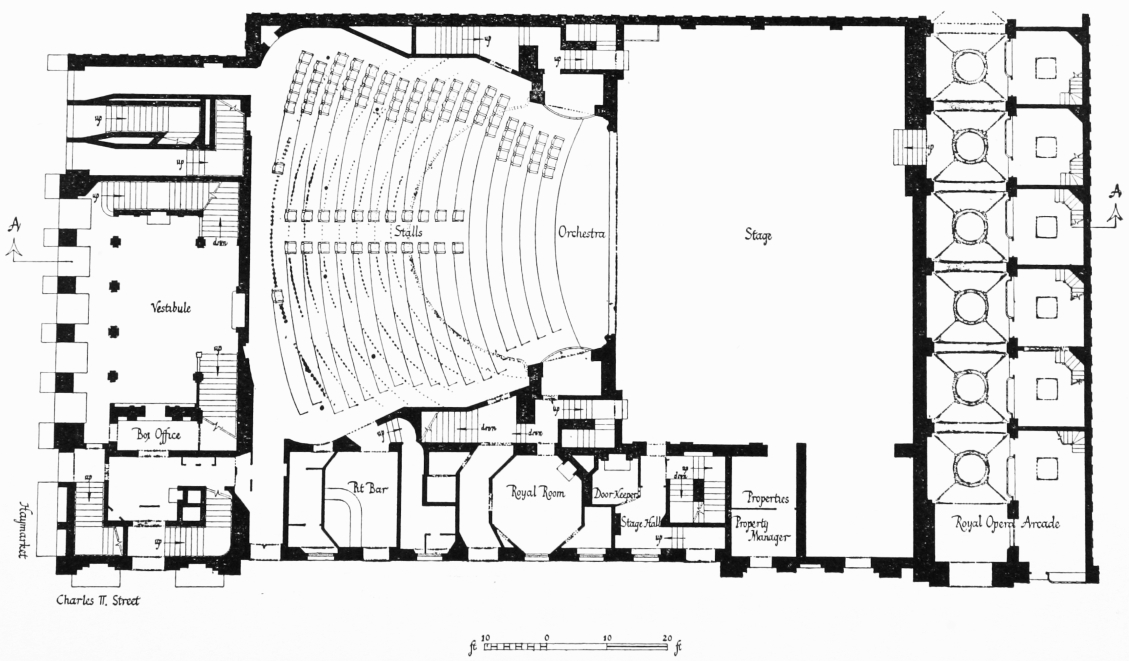
Her Majesty's Theatre, Haymarket, ground-floor plan
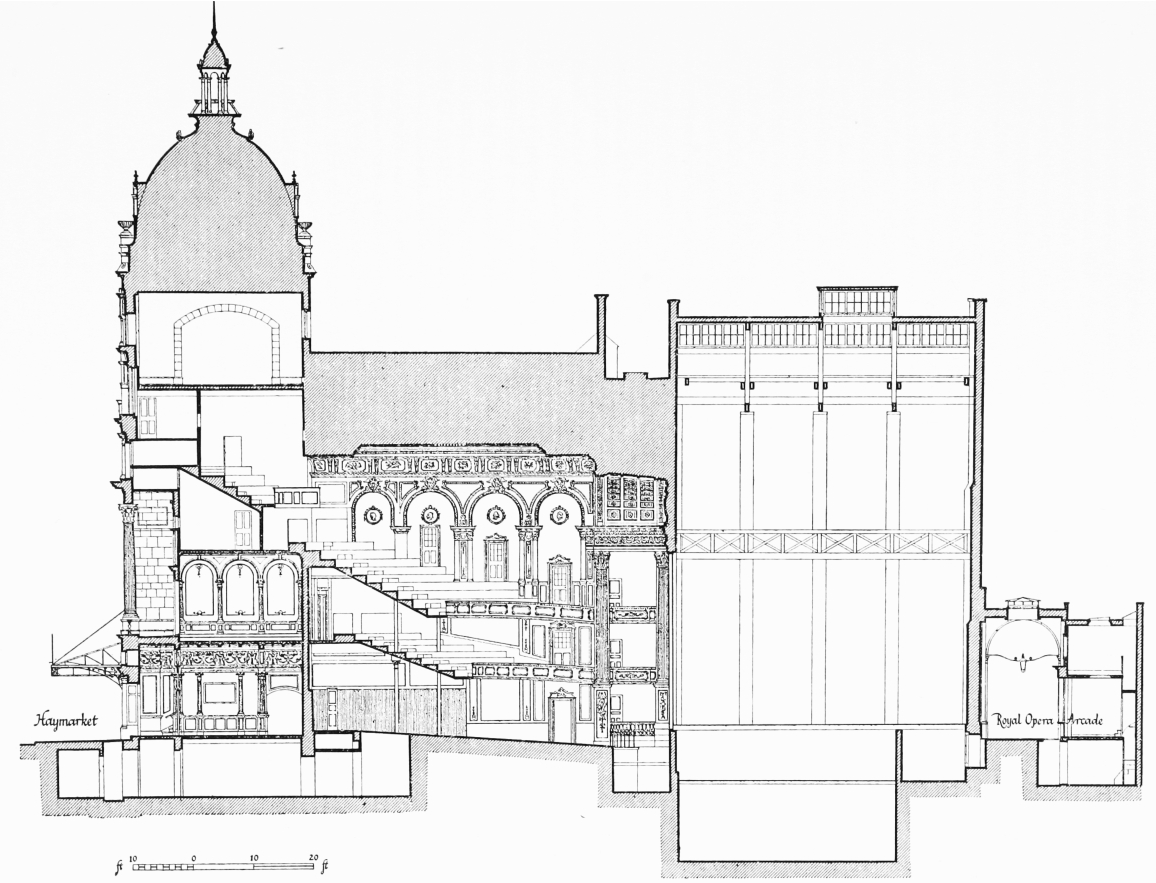
Her Majesty's Theatre, Haymarket, section A-A
The Carlton Hotel and Restaurant (immediately to the south of the theatre) was still in course of erection when Phipps died in 1897. Lewis H. Isaacs and Henry L. Florence were appointed architects for the completion of the building, (fn. 265) and in 1898 modified designs were approved by the Commissioners of Woods and Forests. (fn. 266) The alterations were largely concerned with the interior; with the exception of the treatment of the attic storey, Phipps's elevations were executed virtually unchanged. The decorations and furnishings were carried out by Messrs. S. J. Waring of Oxford Street, and the hotel was opened on 15 July 1899. (fn. 267) It was demolished in 1957–8 to make way for New Zealand House, designed by Robert Matthew and S. A. JohnsonMarshall.
Phipps's final plans provided for the erection of the theatre on the northern part of the site and the hotel on the remainder, which comprised about two-thirds of the whole. C. J. Phipps was one of the leading theatre specialists of his time, and Her Majesty's, his last work, is one of the best-planned theatres in London (figs. 45–6). Hotel and theatre were made uniform externally, and Edwin Sachs's comment on the design is worth quoting as an expression of contemporary opinion. 'The treatment is considered to be in the French Renaissance style and stone has been used throughout. The detail cannot, however, be termed satisfactory, nor does the exterior architecturally express the purpose of the building.' (fn. 268) Present-day connoisseurs of late-Victorian architecture are less censorious, and many will regret the partial demolition of a building which, though overspiced with eclectic details, had considerable panache.
The Haymarket front (Plate 36) was composed of three parts, each being nine bays wide. All were unified by a cornice over the ground storey (which included a mezzanine at the south end), the main entablature above the third storey, and the secondary cornice above the fourth storey. Each end of the front was most elaborately treated, the five middle bays being set forward, with a Corinthian colonnade forming a loggia in front of the secondand third-storey windows, and a high attic stage of three storeys which formed the base of a square dome, surmounted by an octagonal lantern with a spreading gallery. The recessed middle part of the front was, by contrast, subdued in treatment, with an arcade embracing the second- and third-storey windows, and a mansard roof fronted by a range of sharply pedimented windows, interspaced with niches and an elaborate central gable.
The theatre was planned on an east—west axis and the stage is on the west part of the site. With a depth of forty-nine feet and a width of sixty-nine feet six inches, it gave ample space for the most spectacular scenes in Tree's elaborate productions. The auditorium (Plate 37) has a seating capacity of 1319, contained in stalls and pit at ground level, and two partly cantilevered tiers, the first divided into dress and family circles, and the second into upper circle, amphitheatre and gallery. The entrance to all parts of the house, the foyers and saloons, are on the Haymarket front, and along Charles II Street is a shallow range of exits, with the royal entrance, the stage door, dressing-rooms and scenery dock.
The longitudinal section reproduced in Sachs's book was probably taken from Phipps's drawing, and shows a decorative scheme basically similar to that carried out, but coarsely detailed. Romaine Walker's decoration, although opulent, has a refinement rare for its time, especially in theatres, and much of the detail appears to have been copied or derived from Gabriel's Opera at Versailles. On each side of the scagliola proscenium frame are three boxes, superimposed between Corinthian columns with scagliola shafts and rich entablatures from which an elliptical arch rises, its soffit panelled with square coffers. Each curving side wall is modelled with a blind arcade of three bays, the arches springing from cornices over paired Corinthian pilasters. A coved cornice, with musical trophies placed in panels between paired consoles, surrounds the main ceiling which has a large saucer-dome divided by moulded ribs into wedge-shaped panels. These, and the spandrels of the blind arcades, are filled with paintings— eighteenth-century pastiches by a Mr. Black.
The Royal Opera Arcade
This, the only surviving part of the Opera House complex, is a covered walk some twelve feet wide, parallel with the Haymarket and extending between Pall Mall and Charles II Street. On its west side are eighteen (originally nineteen) small shops, each with a basement and a mezzanine room. The arcade is likewise composed of eighteen square bays, each ceiled with a simple groined vault rising to a circular skylight, the bays being separated by plain arch-soffits rising from plain-shafted Doric pilasters. Each shop has a display window, quadrant-curved at each end to bring it forward from the wall face, with a simply panelled stallboard, a window divided into large panes by delicately moulded glazing-bars, and a plain fascia below the cornice. The shop door on the right is similarly treated but does not project. In the tympanum above each shop-front is a lunette window, framed with a moulded archivolt and divided into three lights. The wall and ceiling surfaces, and the architectural ornaments, are in stucco, now uniformly painted but originally frescoed to represent Bath stone (Plates 38, 39).
The Adam designs for the Opera House
Among the collection of Adam drawings in Sir John Soane's Museum there are at least thirtythree, including sketches, which relate to a proposed rebuilding of the Opera House. Of these, the most important are in Volume 47, a highly finished set consisting of four plans, five sections, and two elevations, entitled 'Design for an Opera House, Assembly Room, and tavern connected therewith, proposed to be erected in the Haymarket and Pall Mall London' (Plate 28). Volume 28 contains ten drawings, most of them related to the set in Volume 47. Two, however, are alternative plans for a less ambitious scheme, and one is a design for the Haymarket front which is not related to any of the Adam plans. The composition of this design is remarkably similar to that of Novosielski's illfated front, and if Adam's is the earlier then Novosielski must be labelled a plagiarist (Plate 29a, 29b). The four drawings in Volume 10 are preliminary studies for the elevations of the grand design in Volume 47, and the eight sketches in Volume 27 are studies for the King's and Queen's boxes, perhaps intended for a reconstruction of the earlier theatre.
Unfortunately, not one of these drawings bears a date, and no evidence has yet come to light bearing on the circumstances whereby Adam came to prepare a scheme so carefully considered and, in the final set, so splendidly presented. It is, however, quite possible that the link is provided by John Hobart, Earl of Buckinghamshire, and his half-brother, the Hon. George Hobart. From 1769 to 1773 the latter held a half-share in the theatre, which he proceeded to manage, and in 1770 Adam made designs for his house in St. James's Square (No. 33) (see page 206), evidently acting on instructions from the Earl of Buckinghamshire. In 1790 the latter laid the foundation stone for Novosielski's new theatre, so that the Hobart connexion with the Opera House would seem to have lasted (perhaps only in indirect form) from 1769 to 1790 at least, and it is most likely that they would have enlisted the services of Adam in architectural matters. Thomas Pennant says that Adam made important alterations to Vanbrugh's theatre, and appears to be referring to the work done in 1778, (fn. 101) and it is possible that the royal-box designs belong to that date. The grand design was probably made after the fire in 1789, and certainly after 1780, for on the gallery plan is a suite of offices assigned faintly in pencil to Taylor, who became manager about that time.
It is reasonable to see Adam's magnificent opera-house design as an answer to the challenge offered to his reputation by James Wyatt, who had just transformed his own masterpiece, the Pantheon, into an opera house. Had Adam's scheme been realized, London would have had a theatre without a European rival save possibly for Victor Louis's Grand Thé;acirc;tre at Bordeaux. It is not surprising, however, that a design of such magnitude and of such startling magnificence failed to find support, and that the prize eventually fell to Novosielski.
The drawings in Volume 47 (Plate 28) show a building planned on a north-south axis, with the principal storey at first-floor level. The core of the plan is a large and deep auditorium with four parallel-sided horseshoe tiers and a flat ceiling with a shallow coved surround. The first two tiers are composed entirely of boxes, the third and fourth contain galleries flanked by boxes, the lower gallery being twice the depth of the upper. South of the auditorium is the stage with wing corridors behind colonnades of three bays, and a large back stage with a central apse leading to a lofty domed rotunda centred in the convex-curving Pall Mall front. This rotunda, designated the 'Professors' Entrance', was presumably for ceremonial use. North of the auditorium, but separated from it by a spacious foyer, is the Ridotto or Cotillion room, a great domed saloon of oval form with a wide ambulatory, entered on its east (Haymarket) side by way of a grand staircase, called the Queen's Stairs. This corresponds to an identical staircase, the King's Stairs, alongside the stage, and between the two is a series of rooms designated Tavern Parlours, etc. On the north side of the Ridotto room are three bridges, crossing an extension of Charles Street and linking the main building with an annexe containing the Tavern and a grand staircase for patrons arriving by coach or chair. At the west end of the Ridotto room is a Great Assembly room, from which extends southwards, flanking the auditorium and stage, a suite of three rooms linked by ante-rooms, for dancing, supping or card-playing. Some features of the plan, such as the oval Ridotto room, appear to have been directly imitated from the Bordeaux theatre.
The exterior was, presumably, to be faced with stone, or a mixture of stone and Liardet's stucco. The design for the Haymarket front is a striking composition of monumental character, exuberant and full of 'movement', with pedimented pavilions containing the King's and Queen's staircases, and a central portico surmounted by a 'Pantheon' dome. A similar dome crowns the Doric triumphal arch of the 'Professors' Entrance' in the middle of the Pall Mall front, which is a more sober and regular design with something of the flavour of Adam's Edinburgh University.
Befitting its slight structure, the auditorium decorations are light and airy, much in the manner of Adam's recasting of Drury Lane, with slender twisted columns and elegant termini, offering the minimum interference with sighting, supporting the tier fronts which are laced over with arabesques, fans and medallions. The proscenium flanks are more solidly treated and form a link with the stage, which also serves as a grand extension to the auditorium when used for masquerades and is decorated with all the formal splendour of a hall at Syon. The lobbies, staircases, and smaller assembly rooms are treated so that they form a fitting prelude and accompaniment to the great oval Ridotto room, where a Corinthian peristyle supports a lunette-pierced attic and a ribbed dome. To conclude, the whole interior is designed with that fine regard for ranging vistas, pleasing surprises, and splendid climax that is so characteristic of the work of Robert Adam.
James Lewis's designs for the Opera House
In his Original Designs in Architecture, published in two volumes in 1779–80, James Lewis included plans for a 'New Theatre designed for the Opera', intended for the Haymarket site; they are on a much smaller scale than those prepared by Adam, and are quite undistinguished. Lewis proposed an oblong building having a north-south main axis, with the principal entrances and coffeerooms facing south on to Pall Mall, and the stage with its scenery dock and painting rooms to the north of the site. The auditorium appears to be quite small when compared with those of Adam and Novosielski—a parallel-sided horseshoe with only fifteen boxes, albeit large ones, in each tier. On each side of the auditorium are more coffeeand card-rooms, but there is no sense of sequence in their arrangement.