
Survey of London: Volumes 29 and 30, St James Westminster, Part 1. Originally published by London County Council, London, 1960.
This free content was digitised by double rekeying. All rights reserved.
'Piccadilly, South Side', in Survey of London: Volumes 29 and 30, St James Westminster, Part 1, (London, 1960) pp. 251-270. British History Online https://www.british-history.ac.uk/survey-london/vols29-30/pt1/pp251-270 [accessed 25 April 2024]
In this section
CHAPTER IX
Piccadilly, South Side
Only the southern side of Piccadilly between the Haymarket and St. James's Street lies within the area covered by the present volume. The south side of the street between St. James's Street and the Green Park is in the parish of St. George, Hanover Square, and the Green Park is in the parish of St. Martin in the Fields. The north side of the street west of Burlington Arcade is in the parish of St. George, and the remainder is in the parish of St. James. The origin of the name 'Piccadilly' has been the subject of antiquarian discussion for over three hundred years, and the evidence will be set forth in the volume of the Survey of London concluding the description of the parish of St. James.
Piccadilly has for centuries been one of the two most important highways leading to the metropolis from the west; unlike Oxford Street there is, however, no evidence that a Roman road ran along Piccadilly. A plan of 1585 marks the road as 'The waye from Colbroke to London', (fn. 6) and its importance must have increased after the western section of the highway from Hyde Park Corner to Charing Cross had been stopped up for the formation of the Green Park in 1668 (see page 323). The repairing and paving of that part of the street between the Haymarket and Air Street was (along with a number of other streets in Westminster) placed under the superintendence of Commissioners appointed by an Act of 1662. (fn. 7)
According to C. L. Kingsford the name 'Piccadilly' was in the first instance attached to a range of houses on the east side of Windmill Street, from which it came to be applied generally to the neighbouring district. Shortly after the Restoration the street was called Portugal Street after Queen Catherine of Braganza, (fn. 1) but the name 'Piccadilly' was nevertheless commonly used to denote the eastern end of the street as far as Swallow Street. (fn. 8) Ogilby and Morgan's map of 1681–2 (Plate 2) and Blome's map of 1689 (Plate 3) both mark the eastern section as 'Pickadilly' and the stretch between Swallow Street and the park as Portugal Street. The Act of 1685 establishing the parish of St. James describes the glebe land adjoining the churchyard as fronting 'Pickedilly-Street alias Portugal-Street'. (fn. 9) Portugal Street continued to appear in the ratebooks until well into the nineteenth century, but in popular usage this name had been superseded much earlier. John Strype, writing in 1720, refers to the whole of the street from the Haymarket to St. James's Street as Piccadilly, (fn. 10) and in his map of 1746 (Plate 5) Rocque extends the use of this name as far west as Half Moon Street.
All the ground on the south side of Piccadilly between the Haymarket and St. James's Street formed part of the land leased in 1661 by the trustees of Henrietta Maria to the trustees of the Earl of St. Albans for thirty years; subsequent grants extended this term to 1740. In 1674 Charles II granted the freehold of the site of the present Nos. 162–165 (consec.) Piccadilly at the north-east corner of St. James's Street and Piccadilly, to Colonel Edward Villiers, (fn. 11) and in 1684 he granted the freehold of the site of the church and the greater part of the churchyard to Thomas, Lord Jermyn. (fn. 12) In 1830 the freehold of the site of the present Nos. 181–195 (consec.) Piccadilly, comprising the ground between Duke Street and the churchyard, was (together with other adjoining property) granted to the Governors of Bethlem Hospital in exchange for property owned by the hospital at Charing Cross, where the Government wished to make improvements. (fn. 13) The freehold of the remainder of the ground on the south side of Piccadilly between the Haymarket and St. James's Street still belongs to the Crown.
Building along the south side of Piccadilly appears to have begun in or shortly before 1658, and to have extended westward from the Haymarket. (fn. 14) The process was no doubt greatly accelerated after the grant of Pall Mall Field to the Earl of St. Albans's trustees in 1661, and Ogilby and Morgan's map of 1681–2 shows the whole stretch from the Haymarket to St. James's Street as covered with buildings. The St. Albans rent-roll of 1676 (fn. 15) shows that much of the ground on the south side was leased in plots extending to the north side of Jermyn Street, on to which many of the principal buildings appear to have faced. Those on the south side of Piccadilly were of no distinction, the noblemen's palaces for which the street was already famous being on the north side. In 1720 Strype, describing the south side from St. James's Street eastwards, mentions the 'White Horse Inn; then Elephant Inn; then next beyond Duke-Street is the King's Arms Inn; all three Inns of an indifferent Trade. Then beyond Church Lane . . . is Eagle-street. . . . Next into it is Fleece Yard, near the Hay Market, which hath a Passage into Germin-street, very ordinary built and inhabited: And near unto this Yard is Sadler's Court, which is but small and mean.' (fn. 10)
In his Critical Review of the Publick Buildings . . .in and about London and Westminster, published in 1734, Ralph does not mention any building on the south side of the street. He does, however, comment on the number of statuaries' yards on the north side facing the Green Park, (fn. 16) and an advertisement of 1726 of the sale of the stock-in-trade of Edward Vickers, mason, at his house and yard in Piccadilly 'over against Burlington House' suggests that there was also at least one such establishment on the south side. (fn. 17) In general the buildings on the south side have always been used as inns, shops and commercial premises rather than as private dwellings.
Tallis's elevation of 1839 of the south side of Piccadilly shows that it was composed largely of single-fronted houses, generally four storeys high and two windows wide above the shop-fronts. The principal exceptions to this generalization (apart from the Egyptian Hall and Fortnum and Mason's premises, which are described on pages 269 and 264 respectively) were the following:
Nos. 162–165 (consec.), a large and uniform building with shops on the ground storey flanking a central arched passage, a mezzanine treated as a pedestal to an upper face of two storeys, and an attic, all with seven widely spaced windows, the middle three being flanked by Corinthian pilasters to form a three-bay centrepiece.
No. 173, a four-storeyed front of simple design, perhaps by S. P. Cockerell, with four windows in each upper storey, those of the second storey being framed by arched recesses, and a cornice below the attic.
Nos. 174–175, two houses with canted bay fronts, four storeys high with ground-storey shopfronts of different design.
No. 200, a wide single-fronted house with a large canted bay window projecting from the second and third storeys and a top storey with three windows.
Nos. 204–205, a pair of uniformly fronted houses with bowed shop-fronts flanking the arched passage to Darby Court. The upper part of the front contained three tiers of four windows, the top storey being dressed with dwarf pilasters rising from a cornice resting on widely spaced brackets.
Nos. 208–209, a pair of four-storeyed houses, each fronted with a canted bay projecting above the shop-front.
An unnumbered house, possibly Webb's Hotel, just east of Nash's Piccadilly Circus, with a wide front, four storeys high. The ground storey contained three shop-windows interspersed with doors, and in front of the second storey was a long iron-railed balcony with a large lamp projecting over the second doorway. The upper part of the front, with five evenly spaced windows in each storey, was plain but for the long panel below the top-storey windows, and the crowning balustrade. All of these fronts, and many of the others, appear in Tallis's rendering to be of late eighteenth- or early nineteenth-century date.
In the early years of the twentieth century the greater part of Piccadilly was widened. Between 1905 and 1910 the London County Council acquired for this purpose three separate narrow strips of land on the south side of the street, between Duke Street and St. James's Street. Two of the strips, comprising the frontages of houses numbered 166–176 (consec.), were purchased from the Crown when the leases of the old premises expired. (fn. 18) The third strip, covering the frontages of Nos. 162–165 (consec.), was acquired from the Norwich Union Life Insurance Society. (fn. 19) The scheme was not extended to the remainder of Piccadilly between Duke Street and St. James's Street (i.e. Nos. 177–180 consec.) as the Crown leases still had long unexpired terms. (fn. 20) Other improvements made elsewhere in the street at about this time will be described in future volumes.
Booksellers in Piccadilly
In the second half of the eighteenth century the south side of Piccadilly between St. James's Street and St. James's Church became a favoured area for booksellers' and publishers' shops; only one such establishment, Hatchard's, at No. 187, now remains, and it is described on page 262.
In 1765 John Almon, bookseller and journalist, established himself at the house then No. 178 Piccadilly (now No. 176), where he remained until 1781. (fn. 21) Almon was patronized by Lord Temple and the Whigs, and was a close friend of John Wilkes. In 1781 he resigned the business to John Debrett, who was also patronized by the Whigs. (fn. 22) Debrett removed the shop to No. 179 (now No. 177) in 1788, and in 1797 he also occupied No. 180 (now No. 178), which had previously been occupied by Richard Beckford. (fn. 21) The first edition of his famous Peerage of England, Scotland and Ireland was published in 1802. (fn. 22) He remained in business in Piccadilly until 1803, and died in 1822. (fn. 23)
In 1781 John Stockdale, who had been employed as a porter by Almon, opened a bookshop of his own at the house then numbered 181 at the west corner of Duke Street. (fn. 23) By 1810 he had moved into the adjoining house, formerly Debrett's, where he remained until his death in 1814. The business was continued by his family until 1835. Stockdale's brother-in-law was James Ridgway, bookseller and publisher, who established himself at No. 170 (now No. 169) Piccadilly in 1806, (fn. 23) where he and his family remained until 1894. (fn. 24)
John Hatchard set up at No. 173 (now part of Nos. 166–173) Piccadilly in 1797; in 1801 he moved to Nos. 189–190 (now No. 187) where the firm of which he was the founder still remains (see page 262).
In 1797 or 1798 John Wright, bookseller and author, became the occupant of No. 169 (now part of Nos. 166–173) Piccadilly, and his shop there quickly became the morning resort of the friends of Pitt's ministry. In 1799 he also occupied the adjoining house to the west, then No. 168, which had previously been occupied by John Owen, the publisher of Burke's pamphlets, (fn. 23) and the Anti-Jacobin or Weekly Examiner, to which George Canning and others contributed, was issued from Wright's establishment. The business failed in 1802, and in 1803 Wright was imprisoned in the Fleet; (fn. 22) his name is not recorded in the ratebooks after 1804.
In 1842 William Pickering, the founder of the Aldine Press, removed his publishing business from Chancery Lane to No. 177 Piccadilly. After his death in 1854 the business was carried on there by James Toovey and his family until 1894. (fn. 25) The house continued in the occupation of the family until 1905, but the book-selling and publishing business appears to have ended in 1894. (fn. 24) William Pickering's son, Basil Montagu Pickering, established himself as a bookseller at No. 196 Piccadilly in 1858, where he remained until his death in 1878. (fn. 25) The firm survived as Pickering and Co. until 1881. (fn. 24)
In 1850 or 1851 the firm of Chapman and Hall came from the Strand to No. 193 Piccadilly, where it remained until its removal to Henrietta Street, Covent Garden, in 1881. (fn. 25) Chapman and Hall's authors included the Brownings, Trollope, Meredith and Dickens. (fn. 22)
No. 221 Piccadilly: the White Bear Inn
Demolished
An inn called the White Bear is said to have existed in Piccadilly in 1685. (fn. 26) Until its demolition in 1870 to make way for the Criterion Restaurant a coaching inn of this name stood on the site of No. 221 Piccadilly, and it is possible that the White Bear referred to in 1685 may be identified with this site.
The White Bear at No. 221 Piccadilly formed part of a plot of ground 80 feet wide and 150 feet deep which extended from the south side of Piccadilly to the north side of Jermyn Street. There were covered entrances at each end and the centre was occupied by a yard; in 1717 the leaseholder was Mary Fitzgerald. (fn. 28) Ogilby and Morgan's map of 1681–2 (Plate 2) marks the yard as Fleece Yard, and in the particulars of 1720 for the grant of a Crown lease of Mary Fitzgerald's plot the inn is called the Fleece. (fn. 28) In the subsequent negotiations of 1740–1 for the renewal of the lease the inn is variously described as the Fleece, and the 'White Bear and Fleece Inn'. (fn. 29) A licensed victualler's recognizance of 1743 gives William Miller as the proprietor of the White Bear in Piccadilly (fn. 30) and the ratebooks show that he occupied No. 221 Piccadilly; no recognizance for the Fleece appears to have survived. Rocque's map of 1746 (Plate 5) marks the yard as 'Wh. Bear Inn'.
In 1723 the buildings on Mary Fitzgerald's plot consisted of three houses in Piccadilly, one of which was the inn, and four in Jermyn Street. They had been 'considerably repaired' since 1717. (fn. 31) In 1741 they were described as 'in a Ruinous Condition [and] must be soon Rebuilt'; (fn. 32) in 1770 they were in good and substantial repair. (fn. 33)
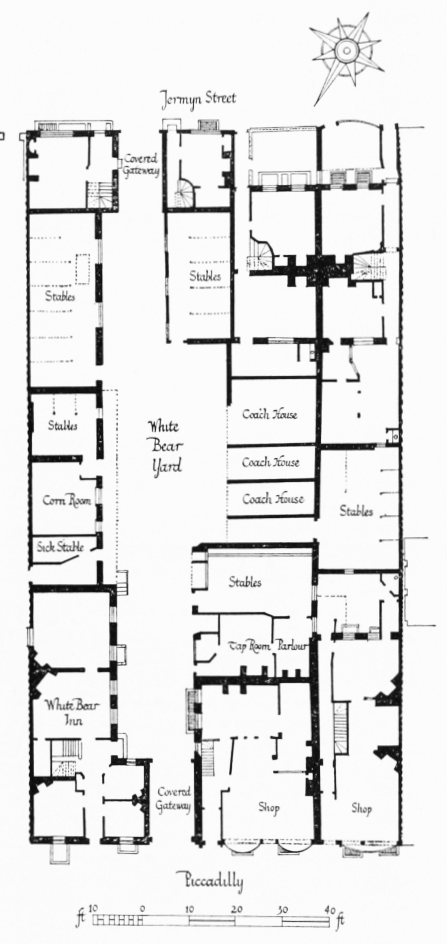
White Bear Inn and Yard, Piccadilly. Re-drawn from a plan in the Public Record Office
In the latter part of the eighteenth century the White Bear was one of the most important coaching inns in the West End of London (Plate 52b, fig. 47). Coaches and diligences left at five o'clock every morning for Dover, Margate, Ramsgate, Canterbury and Rochester, and there was also a night coach to Dover which left at half-past six in the evening. A very large number of West Country coaches which started at inns further east in London also called to pick up passengers at the White Bear. (fn. 34)
Luke Sullivan, who engraved Hogarth's 'March to Finchley', lodged at the White Bear, and John Baptist Claude Chatelain, the draughtsman and engraver, died there in 1771. (fn. 35)
The White Bear Inn survived for a considerable number of years after the end of the coaching age. The Crown lease of the whole plot between Piccadilly and Jermyn Street was due to expire in 1870, and in 1866 James Pennethorne, the architect to the Commissioners of Woods and Forests, reported that the houses were extremely old and worn out, and unworthy of the locality. A respectable hotel, known as Webb's Hotel, had been established in two of the houses in Piccadilly (Nos. 219–20), while the White Bear had become 'the resort of Sporting characters'. In 1866 a reversionary building lease of the whole plot (except two of the houses in Jermyn Street) was granted to Joseph Challis, the proprietor of Webb's Hotel, who in 1870 assigned the lease to Messrs. Spiers and Pond, the promoters of the Criterion Restaurant. (fn. 36) The White Bear Inn was demolished in 1870. (fn. 24)
In recent years the memory of the White Bear Inn has been revived by a restaurant of that name which stands on part of the Piccadilly frontage of the original plot.
The Criterion Restaurant and Theatre
In 1870 the building agreement for Nos. 219– 221 (consec.) Piccadilly and Nos. 8–9 Jermyn Street was purchased by Messrs. Spiers and Pond, a firm of wine merchants and caterers, (fn. 37) who held a limited architectural competition for designs for a large restaurant and tavern with ancillary public rooms. (fn. 37) The competition was won by Thomas Verity, (fn. 38) whose plans and elevations were published by The Builder (Plates 52c, 53). He designed a ground floor with vestibule, dining-room, buffet and smoking-room. The first floor was entirely devoted to dining-rooms and servingrooms. The whole of the Piccadilly front on the second floor was occupied by the grand hall. Behind it were another dining-room, service-rooms and a room tentatively labelled 'picture gallery or ball supper-room'. In the basement there was to be another hall, for concerts and the exhibition of pictures. (fn. 39)
Building work began in the summer of 1871, and was completed in 1873 at a total cost of over £80,000. (fn. 40) The contractors included Messrs. Hill, Keddell and Waldram and Messrs. George Smith and Company. (fn. 41)
In January 1873, when the carcase of the building was already completed, the proprietors successfully applied to the Commissioners of Woods and Forests for permission to convert the concert hall in the basement into a theatre, with entrances from both Piccadilly and Jermyn Street. (fn. 42)
The interiors of the new building were extensively decorated with ornamental tile-work, one of the first examples of the use of this material on such a scale following its successful use in the recently completed refreshment rooms at the South Kensington Museum (now the Victoria and Albert Museum). (fn. 43) The cartoons for the figure subjects were drawn by A. S. Coke. The ornamental tile-work and painted decorations of both the theatre and the restaurant were the work of Messrs. Simpson and Son. The sculpture was by E. W. Wyon. (fn. 44) The Criterion Restaurant was opened to the public on 17 November 1873 (fn. 45) and the Criterion Theatre on 21 March 1874. (fn. 46)
The new venture proved so profitable that within a short time the proprietors were making plans for the extension of the building. The sites of Nos. 222 and 223 Piccadilly adjoining the Criterion to the east were acquired, and building started in 1878, again from the designs of Thomas Verity. The contractors included Peto Brothers and W. Webster. (fn. 47) Decorations were carried out by Crossley of Newark, Messrs. Simpson and Sons, and Messrs. Bellman and Ivey. (fn. 48) The Criterion annexe was completed at the end of 1879 (Plate 53b). It extended the existing facilities, with more dining-rooms and bars, and another hall on the second floor. This was divided from the great hall of the main building by iron shutters, so that the two could be thrown together when necessary. There was also a suite of Masonic rooms. (fn. 49)
In November 1882 the Metropolitan Board of Works condemned the Criterion Theatre on the grounds that it would be unsafe in the event of fire. (fn. 50) As a result the proprietors carried out extensive alterations between March 1883 and April 1884. A new area open to the sky was formed on a site formerly occupied by part of the groundfloor dining-room. Corridors were built along the Piccadilly front, leading at one end to the boxoffice entrance and at the other to a new crush room and exit. In the auditorium most of the boxes were removed in order to increase the size of the circles. New decorations were carried out by Messrs. Simpson and Sons. The improvements also included an elaborate system of air conditioning and the installation of electric lights throughout the theatre. The architect responsible for this work was Thomas Verity and the builder was William Webster. The theatre was re-opened on 16 April 1884. (fn. 51)
At the same time the Criterion annexe was extended south, taking in the sites of Nos. 6 and 7 Jermyn Street. This work was completed in 1885, and was also carried out under Thomas Verity. (fn. 52)
Many alterations have subsequently been made in various parts of the restaurant. The first floor was damaged by fire in 1895 (fn. 53) and reinstated at a cost of £1395. (fn. 52) In 1898 the sills of the windows in the first-floor dining-rooms on the Piccadilly front were lowered to floor level and enclosed with ornamental iron balconies. In the same year the buffet was enlarged to include the former smoking-room at the Jermyn Street end. This was permitted by the Commissioners of Woods and Forests only on the condition that the decorations should be 'reinstated equal to the present ones'. They considered 'that a building so architecturally designed and well finished as the Criterion at the time it was built, should not be allowed to deteriorate'. (fn. 52)
In 1905 the ground-floor buffet became the 'Marble Restaurant'. Its street entrance was closed, and a new doorway made in a bay of the annexe, directly to the east. (fn. 52) In 1908 a continuous iron and glass shelter was added to the full length of the façade. (fn. 54)
Much more extensive alterations were made between 1921 and 1924, when the property immediately to the west was being rebuilt from the designs of Sir Reginald Blomfield. Parts of the upper floors of this block were added to the Criterion Restaurant, the whole of which was now to be reached by way of a new entrance and staircase in Regent Street. The former entrance vestibule in Piccadilly Circus and the ground floor of the Criterion annexe were converted into shops. The 'Marble Restaurant' and theatre were left as before. The whole of the remodelling was carried out from the designs of Messrs. William Woodward and Sons. (fn. 55)
Despite alterations and disfigurement, the Criterion front (Plate 53) may still be regarded as the best surviving work of Thomas Verity, a leading theatre architect of his day. The Second Empire masterpieces of Charles Gamier—the Paris Opera House and the Monte Carlo Casino —seem to have influenced Verity's design, which is carried out in stone, now painted, and is composed of a central face slightly recessed between wings, all similar in width and three storeys high. As originally completed, however, the first two storeys of the central face contained a great roundarched opening forming the deeply recessed entrance to the restaurant. In each wing the first two storeys have three-bay openings, wide between narrow, flanked by wide piers. In the ground storey these piers are plain, but those above are dressed with segmental-pedimented niches containing statues. A pedestal, with enriched panels in its die, underlines the lofty third storey where the central face has a group of three round-arched windows, their moulded archivolts rising from entablatures above plain piers flanked by Ionic half-columns. Carved in the spandrels are draped female figures, holding festoons looped below oblong tablets. In each of the wings paired Corinthian plain-shafted pilasters flank an Ionic Venetian window, its arched middle light being of the same size as those in the central face, with a fan-shaped lunette of wide and narrow panels, the former ornamented and the latter plain. The main entablature has an enriched architrave, a plain frieze except for the carved panels in the breaks above the Corinthian pilasters, and a dentilled and modillioned cornice which is returned to form large triangular pediments over the two wings. The high pedestal-parapet, its die enriched with ornamented panels, is a typically French feature, and so are the high pavilion roofs over the wings, with two tiers of dormers. These, and the single-storey roof over the centre, are crested with railings of ornamental ironwork.
The front of the eastern extension, built in 1878–9, corresponds with the main front in all its storey heights and horizontal elements. A large shop-front has replaced the original ground storey, but the upper part remains as a composition of two storeys, each divided into three bays by pilasters. The treatment of the second storey closely resembles that of the central face in the main front, and the Venetian window motif of the pedimented pavilions is repeated, between roundarched windows, in the lofty third storey.
The interior of the restaurant has undergone many changes, but one of its most famous features, the Long Bar, retains the 'glistering' ceiling of gold mosaic, coved at the sides and patterned all over with lines and ornaments in blue and white tesserae. The wall decoration may not be the original but it accords well with the ceiling, being lined with warm grey marble and formed into blind arcades with semi-elliptical arches resting on slender octagonal columns, their unmoulded capitals and the impost being encrusted with goldground mosaic.
The vestibule of the theatre is certainly original, its walls being lined with large plate mirrors set above a dado and between panels of coloured tilework, the panels ornamented with A. S. Coke's rather insipid figures in arabesque settings. The auditorium has several times been redecorated, but it retains its charming form and general atmosphere. The serpentine-fronted lower tier and lyre-shaped upper tier are supported by slender wreathed columns and have openwork fronts, all of ornamental cast iron. Two more substantial columns, with superimposed octagonal shafts, support the flat and circular main ceiling. This was originally painted with arabesques and figure medallions, but is now modelled with low-relief mouldings to form six wedge-shaped panels, each containing a Rococo cartouche, radiating round a circular lay-light.
No. 213 Piccadilly
These premises were rebuilt in 1862–3 from designs of A. P. Howell of Middle Scotland Yard. (fn. 56)
On 20 September 1894 Messrs. J. Lyons and Co. Ltd., the present occupants, opened their first teashop there. (fn. 57) Teashops were then something of a novelty, and before granting permission for Messrs. Lyons to receive a sub-lease, the Office of Woods and Forests, as ground landlords, specified that the new business was to be run on the same lines as the Aerated Bread Company's premises at No. 216 Piccadilly. In 1896 Messrs. Lyons extended their accommodation by taking in the back part of the rebuilt Nos. 18–21 (consec.) Jermyn Street. (fn. 58)
The present building is distinguished more by its historical associations than by its architectural qualities, which consist largely in eccentricity of detail. It has a pallid, yellow brick front dressed with stone, and contains four storeys, the upper of which each have four flat-headed windows grouped in pairs. The original ground storey was of no great interest, being divided by columns into four unequal bays, (fn. 59) and in the upper storeys emphasis is placed chiefly on the fourth storey and the dormer windows. The windows in the second storey have rusticated architraves with segmental heads and carved keystones, and the heads of the third-storey windows have incurving angles with architraves to match. Marking the third floor is a stringcourse which breaks into an arc over the pier dividing each pair of windows and in the fourth storey this pier is reduced to a slender Ionic column. The two pairs of windows are flanked by pilasters supporting a continuous entablature and parapet, and imposed on the parapet, corresponding to each pair of windows, is a big segmental pediment. Above each pediment is the carved stone front of a pair of dormer windows, brought well forward into the composition.
No. 212 Piccadilly
The present No. 212 Piccadilly was built in 1872–3 to house the Piccadilly branch of the National Provincial Bank. The bank was to occupy the ground floor of the new building, and to let the remainder for residential use. The architect was John Gibson of Great Queen Street and the builders were Messrs. George Myers and Sons. The carving was the work of John Daymond. (fn. 60)
In 1894 the Bank moved to a new building at Nos. 207–209 (consec.) Piccadilly, and their former premises at No. 212 were taken over by Slaters Ltd. as a restaurant and tea-room. Alterations made by Charles R. Guy Hall included a semi-circular shop window, which was inserted behind the columns of the ground-floor façade. (fn. 61)
In 1952–3 the restaurant was converted into a shop. The ground-floor columns were removed and an entirely new shop-front was inserted for Dolcis Ltd.
Only a pathetic fragment of Gibson's original elevation still survives, suspended over the cavernous shop-front of Dolcis Ltd. The four storeys were arranged behind a three-stage stone front, the second stage comprising the second and third storeys. Flanking each stage was a pair of rusticated Doric pilasters supporting an entablature, and dividing the three windows in each storey were two Ionic three-quarter columns and in the third stage rusticated pilasters. The two lower stages were of equal height and this, together with the repetition of the columns and pilasters, must have meant that the building always had the appearance of being on stilts. Additional decoration was limited to the triangular pediments of the second-storey windows, and to the cornice of the third stage, prominent, coved, and with supporting brackets rising from the frieze, the three dormer windows being brought well forward to add to its dominating effect. (fn. 62)
Nos. 207–209 (consec.) Piccadilly and Nos. 24–27 (consec.) Jermyn Street
In 1890 the National Provincial Bank purchased Nos. 207–209 Piccadilly to house a branch which had hitherto been accommodated at No. 212 Piccadilly. (fn. 63) At first the bank intended to reconstruct the ground and first floors of the existing building, which had been erected in 1879– 1880 to the designs of John Robinson, (fn. 64) but this scheme was abandoned in favour of complete rebuilding. Work on the new range appears to have started in the summer of 1892 and been completed in the spring of 1894. The architect was Alfred Waterhouse and the builders Messrs. Brass and Sons. (fn. 65)
In 1904 the bank acquired the lease of the adjoining building to the south, Nos. 24–27 Jermyn Street, (fn. 67) which had been erected in 1885–6, also to the designs of John Robinson. (fn. 63)
In 1905 the upper floors of the two buildings were joined together. (fn. 66) The alterations were carried out by Paul Waterhouse, who had assisted his father during the construction of Nos. 207– 209 Piccadilly. (fn. 67) In 1925 the ground floor of the Jermyn Street building was reconstructed by the bank for its own use, and the banking hall was redecorated. The architect was Michael Waterhouse of Staple Inn Buildings. (fn. 68)
The Piccadilly block by Alfred Waterhouse follows the design of Robinson's earlier Jermyn Street block in using broad pilasters to divide the bays, but its proportions are less regular and it is enriched with Baroque detail. It has four principal storeys, the upper parts of each having three mullioned-and-transomed windows towards Piccadilly, four towards Eagle Place, and one on the splayed angle of the building. The stone front is designed to emphasize the verticals, having broad, rusticated pilasters between the windows, and flanking them narrower pilasters which rest on the cornice of the window below. Each of these vertical features is completed by a segmental pediment rising out of the main cornice, and over each of the broad pilasters, above the cornice, is a finial resembling a miniature lantern. Minor cornices mark the first and third floors, and above the main cornice runs a tall parapet with elaborately carved panels. Great mullioned-and-transomed windows fill the whole of each bay in the ground storey, except for the western bay to Piccadilly and the bay on the angle, which contain doorways. The main entrance, on the corner, is ornamented with brown marble columns supporting an entablature, and over it is a big segmental pediment raised up on pilasters to form the frame for a low-relief sculpture.
Robinson's Jermyn Street block is also stonefronted and contains five storeys, each of the upper storeys having eight windows to Jermyn Street and two to Eagle Place. The pilasters are rusticated only in the second storey and two windows have been fitted into each bay, while the floor levels are firmly marked with a small cornice and frieze. The ground-storey bays, reconstructed by Michael Waterhouse in 1925, are defined by three-quarter columns of the Greek Doric order, an alteration in strong contrast with the Italianate treatment of the top storey, where the paired windows have round-arched heads with carved spandrels.
No. 203 Piccadilly: Simpson's
The main portion of Simpson's premises stand upon the site formerly occupied by the Museum of Practical Geology, which was demolished in 1935 (see page 272). The existing building was designed by Joseph Emberton and erected in 1935–6; the general contractors were John Mowlem and Co. Ltd.
The building contains a sub-basement, a basement and seven storeys, the sixth and seventh being set back from the north and south frontage lines. A small eighth storey houses storage-tanks and motor-rooms. The structural steel frame forms a grid of large squares, and cross-walls with fireproofed openings divide each floor into three sections, the front and back being three bays wide and two deep, while the central section is three bays deep but only two wide, with the staircases and lifts taking up the space on the west side.
However much Emberton's design for the Piccadilly front owed to the influence of Eric Mendelsohn, it was a pioneering work for London —one of the first truly functional exteriors. The ground-storey opening, spanning more than sixty feet, contains a range of doors recessed centrally between show windows of curved non-reflecting glass, with a stallboard and side piers of black marble, the entrance being emphasized by a projecting canopy of concrete and glass-lenses which serves to carry signs. (fn. c1) Above are six storeys of equal height, each containing one long window divided into three bays by bronze-cased mullions. The aprons between these windows are faced with stone slabs, simply moulded by successive narrow projections to form a sill above two fascias, deep below narrow, and at night these aprons are softly flooded with light from troughs above the windows. The same treatment is applied vertically to the stone piers at each end of the front, to which are fixed flagstaffs. The recessed face of the sixth storey contains three windows, and above it is a full-length canopy of concrete and glass-lenses, projecting to the building line and furnished with a track for travelling cradles. This canopy almost completely conceals the seventh storey, which is more deeply set back.
In 1956–7 the Jermyn Street frontage of Simpson's building was extended westward as far as Church Place.
Nos. 198–202 (consec.) Piccadilly, Nos. 1–5 (consec.) Church Place, and Nos. 32–35 (consec.) Jermyn Street
In 1899 the Office of Woods and Forests prepared a draft plan for the rebuilding of the whole block of property in Piccadilly and Jermyn Street which lay between the Museum of Practical Geology and Church Place (formerly Church Passage). The area was divided into five plots and building leases were offered to the existing lessees and tenants, several of whom entered into preliminary agreements. In the end the whole of the rebuilding on the five plots was carried out as a joint enterprise by two architects. (fn. 69) Two plots, comprising Nos. 198–200 Piccadilly and Nos. 2–5 Church Place, were redeveloped in 1903–4 by J. W. Lorden, a building contractor of Trinity Road, Upper Tooting; the architect was Robert Sawyer of Craig's Court, Charing Cross. (fn. 70) The other three plots, comprising Nos. 201–202 Piccadilly, Nos. 32–35 Jermyn Street and No. 1 Church Place, were redeveloped at the same time by J. Lyons and Co. Ltd. from the designs of W. J. Ancell of Staple Inn, Holborn. Sawyer appears to have been largely responsible for the Piccadilly and Church Place elevations, while Ancell designed the Jermyn Street frontage. (fn. 71)
The lower portion of Messrs. Lyons' block was opened on 10 October 1904 as the Popular Café. (fn. 71) The lower floors of Lorden's block were divided between a post office in Church Place and a shop in Piccadilly. The upper floors of both buildings seem to have been designed as a single unit numbered 199 Piccadilly and used as offices. (fn. 72)
The building was severely damaged by enemy action during the war of 1939–45, particularly those parts facing Church Place and Jermyn Street. In 1956–7 the Jermyn Street portion of the building was entirely rebuilt as an extension to the adjoining premises of Messrs. Simpson.
The Piccadilly face is stone-fronted and comprises five storeys and a garret. The three topmost storeys towards Piccadilly are uniformly designed, each having seven wide windows heavily ornamented with classical detail, five of them with two lights and two, flanking the three centre windows, built out as shallow segmental oriels of three lights. The return front, to Church Place, has a single window flanked by a pair with two lights, and on the angle, projecting over the ground storey, is a five-storeyed tower with a cupola. A prominent modillion cornice ties the composition together at eaves level, and there is a carved bandcourse marking the second floor. The windows of the main front are so arranged as to counter the strong horizontal emphasis of the composition, those in the third storey having segmental pediments almost touching the sills of the ones in the fourth storey, while they in turn have entablatures carrying small balustrades before the fifth-storey windows. A dormer window, brought well forward and ornamented with a pedimented stone front, surmounts each oriel. In the two lowest storeys no attempt has been made at uniformity, Nos. 198–200 having display windows with marble surrounds in the ground storey, and four pairs of segmental-headed windows with blocked architraves in the second storey, while in Nos. 201–202 both storeys are filled by a great roundarched opening. The arch and the circular lights flanking it in the second storey have lost their moulded architraves, and the two pedimented windows in the ground storey have been removed. (fn. 68)
No. 196 Piccadilly
Previous history of this site is described on page 54
On 24 April 1922 an agreement was completed between the Westminster City Council (the successor of the St. James's Vestry) and the London Joint City and Midland Bank, Ltd., for a building lease of the site of the vestry hall. The ground rent was £2600 per annum, with a year's peppercorn rent during rebuilding. (fn. 74)
The bank's architect, Thomas B. Whinney, (fn. 75) had by 12 May 1922 submitted a set of drawings of the proposed new building, the cost of which was not to be less than £25,000. (fn. 76) By the following August, however, the bank had called in Sir Edwin Lutyens to collaborate with its own architect and another design, for the elevations of which Lutyens was solely responsible, was submitted by the bank to the Westminster City Council for approval. (fn. 77)
It was not until the estimates had been fully considered by April 1923, that final permission was given for the work on the new building to begin; in January 1925 it was reported to be completed. (fn. 78) The builders were E. A. Roome and Co. of Hackney. (fn. 79)
The Midland Bank (Plates 18b, 273b) is perhaps the most delightful of Sir Edwin Lutyens's designs in his self-styled 'Wrenaissance' manner, it being a building not only charming in itself but perfectly related to St. James's Church by its style, scale and materials—a fine red brick dressed with Portland stone. The building is a cube in form, some forty-two feet each way, consisting of one storey with a high base and a low attic, roofed with a low pyramid of slates. Although the north front to Piccadilly is more elaborate than those facing east and south, all are properly related. The principal storey of the north front is divided into three bays, that in the middle containing a large sash window raised high above a brick face and a plain stone apron lettered MIDLAND BANK LIMITED. This window is elegantly dressed with an eared architrave that rises from a moulded sill on blockbrackets, and is finished with a plain frieze and a cornice resting on carved consoles. All but the upper third of each side bay is filled with a rusticated arch of chamfer-jointed stonework, with stepped voussoirs and a richly carved keystone rising to the underside of a small square window, set in a brick face between long-and-short quoins. The two-leaf door to the bank is recessed in the left-hand arch, below a plain stone lintel with a carved keyblock, the arch tympanum containing an oval light framed by a plain band and a wreath above palm branches. This is repeated in the right-hand arch above a brick face containing a shallow niche. Below the main cornice are two bands of stone, separated by a band of brickwork, the upper stone band forming a frieze and the lower one serving to link the heads of the stoneframed middle window in each front and the plain keystones of the brick-framed side windows. The attic stage is of brick with long-and-short stone quoins and, below the cornice, a plain stone frieze broken centrally by the carved keyblock of a small square window. This is flanked by carved stone pendants of fruits and flowers which are matched by similar pendants, linked by festoons, centred above the side bays.
The east front is bounded by long-and-short quoins and begins with a high brick base, finished with a stone band that forms a return to the imposts of the north-front arches. Above this band is a brick face containing three widely spaced windows which, though equally large, are strongly contrasted by their treatment. The middle window is framed by a stone architrave resembling that of the corresponding window in the north front, but having the addition of a triangular pediment, whereas each side window is plain with a flat arch of gauged brickwork and a plain keystone. The three square windows in the attic correspond with those below, the middle one being dressed with a carved keyblock and flanking pendants. The south front repeats the design of the east, without the carved dressings to the attic's middle window, and the roof terminates with a small pedestal, ball and weather-vane.
The large and lofty banking hall is panelled with walnut up to the window-sill level, and a balustraded gallery extends across the wide recess on the west side. The plastered walls above are simply treated to set off the details of the ribbed and compartmented ceiling, which is the only internal feature designed by Lutyens.
Nos. 190–195 (consec.) Piccadilly: the Royal Institute of Painters in Water Colours
Nos. 190–195 Piccadilly were rebuilt between 1881 and 1883 for the Royal Institute of Painters in Water Colours, (fn. 80) which had been founded in 1831 as the New Society of Painters in Water Colours. (fn. 2) The annual exhibitions were held at No. 16 Old Bond Street until 1834, at Exeter Hall until 1837, and from then, until the erection of the Piccadilly premises, at No. 53 Pall Mall. (fn. 82)
The new galleries with shops and a public hall beneath were built from the designs of E. R. Robson (Plates 48b, 49). The builders were Messrs. Holland and Hannen, and Messrs. Peto Brothers of Pimlico. There were six shops on the ground floor of the Piccadilly front, each with basement and mezzanine. Behind these was the Prince's Hall, a large room which was intended for public functions. The premises of the Royal Institute on the upper floor comprised three galleries, with a handsome staircase leading up from the main entrance in the centre of the Piccadilly front. The eight portrait busts which decorate the main façade were the work of Onslow Ford. The two sculptured figures which originally surmounted the main doorway were carved by Verheyden. The other architectural carving on the façade was executed by McCullock. The new building was opened on 27 April 1883 by the Prince and Princess of Wales. (fn. 82)
In about 1900 the Prince's Hall appears to have been joined to the Prince's Hotel at Nos. 36–38 Jermyn Street, which had been built in c. 1898. (fn. 24) In 1907–8 the proprietors of the hotel, who were now the head-lessees of the gallery building, rearranged the Royal Institute's rooms. The former central gallery and parts of the east gallery and vestibule were thrown together to make a large south gallery which could be used for social functions. The west gallery remained, and a new north gallery was formed on part of the site of the former vestibule and staircase. A new staircase was inserted in the north-east corner, and the entrance in Piccadilly was moved three bays to the east. (fn. 82) The façade was altered to suit these alterations.
Between 1911 and 1913 the present Nos. 39 and 40 Jermyn Street were built as a westward extension to the Prince's Hotel (see page 274). Between 1929 and 1933 the gallery building and both sections of the hotel were extensively altered, and Princes Arcade was constructed between Jermyn Street and Piccadilly. The hotel was converted into offices and business premises. (fn. 83)
The galleries of the Royal Institute were damaged by enemy action in 1940, and were reopened on 1 July 1948. (fn. 82) Three bays of the ground-floor façade have now been extensively altered by Pan American Airways, and the remainder of the lower parts of the building, with Nos. 36–40 Jermyn Street, is occupied by shops, restaurants and offices.
The building in its present state is no more than a sad relic of Robson's original design, its ground and second storeys, and indeed its whole proportions, having been ruthlessly sacrificed to commercial interests. A photograph of 1896 in the possession of the National Buildings Record (Plate 49b) shows a three-storeyed stone façade arranged in two stages, the two-storeyed upper stage being twice the height of the lower and almost completely devoid of windows, expressing the exhibition galleries within. The ground storey was divided into nine bays by pilasters supporting a simple but well-proportioned entablature, and in the middle and outer bays were three splendid Baroque doorways, each having a swan-neck pediment enclosed within a broken segmental pediment. The pediment of the larger middle doorway spread on to the second storey, and from it rose a pedestal bearing a cartouche and two draped female figures. Most of the upper stage survives, but the removal of the original secondstorey windows, which formed a continuous line across its foot, has given it a rather stunted look. The narrow bay at each end is flanked by boldly projecting pilasters, with partly fluted shafts and Composite capitals, supporting projecting sections of the crowning entablature. The wall face between these paired pilasters is decorated with a Doric secondary order, the short pilaster shafts being partly fluted, and the entablature frieze having triglyphs above the pilasters and a decoration of festoons and paterae over each bay. The three windows in the wide central bay are the only ones in the third storey, for the three bays on either side, and the one between the giant Composite pilasters, contain square panels enclosing wreathed roundels with busts of celebrated watercolour painters, these being inscribed, from east to west: Sandby, Cozens, Girtin, Turner, D. Cox, De Wint, Barret and W. Hunt. The recessed plain wall face between the secondary and crowning entablatures is decorated by the acroterial ornaments centred over the Doric pilasters, and the similar but larger ornaments in each end bay. A panelled and balustraded pedestal-parapet surmounts the crowning entablature, which consists of a moulded architrave, a frieze inscribed ROYAL . INSTITUTE . OF . PAINTERS . IN . WATER . COLOURS . FD_ 1831, and an enriched dentilled cornice with lion-head stops along the cymatium.
No. 189 Piccadilly: the Yorker Public House
Formerly the Yorkshire Grey Public House
In 1761 Richard Mangald was granted a victualler's licence for the Yorkshire Grey public house in Piccadilly, (fn. 84) and the ratebooks show that in that year he became the occupant of the house now numbered 189 Piccadilly.
The existing building appears to have been erected in 1898; (fn. 85) the architect is not known. Since 1955 the premises have been known as 'the Yorker'. (fn. 24)
In 1896, shortly before its demolition, the former Yorkshire Grey appeared as a fourstoreyed building closely resembling the one illustrated by Tallis, although the ground storey then had a Victorian front. (fn. 86) The upper storeys had an exposed brick front containing, in the second storey, a three-light window with Doric pilasters supporting an entablature, and, in each of the third and fourth storeys, a pair of windows with flat heads, the former having stucco architraves. There was a stuccoed bandcourse at sill level in the fourth storey, and a small top cornice of stucco with a plain frieze below.
The Yorker is a narrow, four-storeyed building with a pavilion roof containing a garret. Its ground storey has been completely altered, but the painted stucco front of the upper storeys, though mutilated, is still recognizable. There are three bays, the middle one being slightly recessed and wider than the others, and centrally placed in the roof is the ornate front of a dormer window. Stringcourses mark each floor and sill level, and the prominent modillioned main cornice is surmounted by a balustrade. The second storey contains four round-arched windows, the outer pair being flanked by pilasters. A three-light mullioned-and-transomed window fills the third and fourth storeys of the middle bay, and in each side bay is a single-light window with a transom. The dormer is also divided by mullions into three lights, but the middle one is surmounted by a small square light which is flanked by scrolls and finials and crowned with a concave-sided pediment decorated with finials.
No. 187 Piccadilly: Hatchard's
John Hatchard, the founder of Hatchard's bookshop, was born in 1768. He served his apprenticeship with 'Mr. Ginger', bookseller and publisher, of Great College Street, Westminster, and from 1789 to 1797 he was shopman to Thomas Payne, bookseller, of Mews Gate, Castle Street, St. Martin's. (fn. 87)
In an autobiographical note which he later made, John Hatchard records that 'I quitted the service of Mr. Thomas Payne 30th of June, 1797, and commenced business for myself at No. 173 Piccadilly, where, thank God, things went on very well, till, my friends desiring me to take a larger shop, I then did so, I think June 1801, at No. 190 in the same street. . .,' (fn. 88) The ratebooks first record John Hatchard in 1798 as the occupant of the house then numbered 173 Piccadilly. This house stood upon part of the site which was later occupied by the Egyptian Hall and adjacent buildings, and which is now occupied by the present Nos. 166–173 Piccadilly.
This first shop was evidently small—its rateable value was £27—and the ratebooks show that at midsummer 1801 John Hatchard removed to the site which the business still occupies. The house which stood there was then numbered 189–190 Piccadilly—possibly it consisted of two small houses joined together—and its rateable value was £75, the highest of all the houses in Piccadilly between Duke Street and St. James's Church. In 1820 the house was renumbered as No. 187. (fn. 21) (fn. 3)
No. 173 Piccadilly was occupied after John Hatchard's departure in 1801 by Benjamin Hatchard, (fn. 21) boot and shoe maker, (fn. 89) who remained there until 1810. The house was demolished shortly afterwards to make way for the Egyptian Hall, (fn. 21) and in 1811 Benjamin Hatchard was carrying on his business at Millbank Street, Westminster. (fn. 24)
John Hatchard has been described as an Evangelical and a Tory, and both these attitudes were reflected in the books which he sold. (fn. 90) After his death in 1849 he was succeeded by his son Thomas, who died in 1858. (fn. 91) The family connexion was continued until about 1880 by Henry Hudson, a great-grandson of John Hatchard. (fn. 92) The business was subsequently managed for many years by A. L. Humphreys, (fn. 93) a famous bibliophile, who published an account of the history of the firm in 1893.
Hatchard's premises were rebuilt in 1909 from the designs of Horace Cheston and J. Craddock Perkin. The new building included suites of offices on the upper storeys, and a photographer's studio in the roof. The bookshop occupied the basement, ground and first floors. (fn. 94) The present shop-front dates from this rebuilding, and is evidently a copy of the window shown in Tallis's view of 1839. (fn. 95)
The society now known as the Royal Horticultural Society was formed at a meeting held in one of the rooms over the shop on 7 March 1804; the event is commemorated by a plaque on the present building.
Tallis shows Hatchard's premises as having four storeys, each of the upper containing four flat-arched windows grouped in pairs. The shop-front was built out from the ground storey and divided into five unequal bays by fluted columns, the centre and outer bays containing doorways. Above the deep fascia and cornice was an iron railing forming a balcony to the second storey.
The present building has a stone-faced front of five storeys and a mansard with a glazed front. Each upper storey has five windows, the centre three grouped together and, in the third, fourth and fifth storeys, recessed, so that they are flanked by narrow, projecting bays. A Corinthian order with four fluted columns embraces the third and fourth storeys in the recessed centre, where the third-storey windows have round-arched heads dressed with keystones and pediments. Each end bay is plain up to the fifth storey, but there the window is round-arched and flanked by Doric pilasters supporting a triangular pediment. The shop-front, which is of wood, resembles the one illustrated by Tallis, but has no doorway in its eastern bay.
Nos. 181–184 (consec.) Piccadilly, Nos. 22–27 (consec.) Duke Street and Nos. 42–45 (consec.) Jermyn Street: Fortnum and Mason
Charles Fortnum, the founder of the firm of Fortnum and Mason, was a footman in the household of George III. In her journal Mrs. Papendiek, who was assistant keeper of the wardrobe to Queen Charlotte, records that owing to ill health Fortnum resigned from the royal service in the winter of 1788–9 and that he 'now settled in business as a grocer in Piccadilly, the success of which undertaking is well known'. (fn. 96) In 1770 the ratebooks first record Charles Fortnum as the occupant of one of the houses which stood on part of the site still occupied by the firm, and The London Directory for 1773 and subsequent years gives 'Charles Fortnum, grocer, Piccadilly'. It is therefore evident that the grocery was probably founded on part of its present site in 1770, and certainly by 1773. Until 1788–9 Fortnum appears to have divided his time between his official duties and his own business. (fn. 4)
In 1774 Charles Fortnum moved next door to larger premises, which also stood on part of the site still occupied by the firm. (fn. 21) In his will, made in 1814 and proved on 7 April 1815, he described himself as of Reading, esquire, and bequeathed all his property to three of his children, Charles, (fn. 5) Richard and Ann. (fn. 98)
After Charles Fortnum's death the business appears to have expanded. In 1816 the firm added to its accommodation by the acquisition of the adjoining house to the east (fn. 21) which Charles Fortnum had occupied from 1770 to 1774. In 1817 the firm appears in Kent's Directory as 'Fortnum and Mason, grocers and tea dealers' for the first time, in place of 'Fortnum and Co.' as in previous years. The new partner was probably John Mason, grocer, who died in 1837. (fn. 97)
In 1834 the firm embarked upon a major rebuilding scheme. In that year the Governors of Bethlem Hospital (who in 1830 had become the owners of the freehold of the site occupied by the business, see page 271) granted long leases to Richard Fortnum and John Mason of the two houses which the firm already occupied, and of that adjoining on the east side. No lease for the adjoining house on the west side, which extended down the east side of Duke Street, has been found, but it and the three houses leased to Fortnum and Mason were rebuilt as a large single block in 1834–5 (Plate 269a). (fn. 99) The new building contained a large four-bay shop occupied by Fortnum and Mason and flanked on either side by single-bay shops which at first were in separate occupation. There was a warehouse behind and a side entrance from Duke Street. (fn. 100) Part of the upper floors were used for residential purposes. (fn. 101) In 1844 Fortnum and Mason took over the adjoining shop on the west side and in 1909 that on the east. (fn. 21)
John Mason died in 1837. He bequeathed two thousand pounds 'to my worthy friend Charles Fortnum, now in Dean Street', and a number of other small legacies; the residue, which he described as 'all the houses in Piccadilly, Duke Street and in the yard, the Stock in trade, the Book debts etc.', was left to his partner Richard Fortnum. (fn. 97) It is not clear whether 'the yard' refers to a yard behind the new building in Piccadilly, or to Mason's Yard on the east side of Duke Street, with which he may have been connected.
In 1839 and 1840 the business was reconstituted, Frederick Keats (a nephew of Richard Fortnum), George Scorer and John Oakley each receiving a share of one-eighth of the profits, and John Selot one-sixteenth; the remainder was retained by Richard Fortnum who lived over the shop with his unmarried sister Ann. By his will, which was proved in 1846, Richard Fortnum left a number of legacies of the total value of over £50,000. He bequeathed his share in the business to his nephew Frederick Keats, but Scorer and Oakley were each to have the opportunity to purchase a further two-sixteenths share, and Selot a further one-sixteenth, provided that they agreed to renew the partnership until 1869. (fn. 102)
The foundations of Fortnum and Mason's reputation as provision merchants were laid by Richard Fortnum, and in the second half of the nineteenth century the business was greatly enlarged. In the early years of the present century the firm set out to cover a wider range of the retail trade. More accommodation was soon needed, and the present building, with frontages to Jermyn Street and Duke Street as well as Piccadilly, was erected in 1926–8. The architects were Messrs. Wimperis, Simpson and Guthrie and the builders Foster and Dicksee. (fn. 103)
Fortnum's old building (Plate 269a) will be remembered for its pleasant front of mildly Baroque character, painted red with dressings and ornamental details in cream. Interest was concentrated in the wide middle house, where the shop-fronts and the mezzanine windows were framed in a wide and lofty arcade of four bays, with moulded archivolts rising from Ionic pilasters having shouldered and down-tapering shafts. The two-storeyed upper face was bounded with rusticated pilaster-strips and contained two widely spaced tiers of segmental-headed windows. Each of the four lower windows had a segmental ironrailed balcony, resting on a large winged cherub head, and the tall opening was framed with an eared architrave and a segmental pediment containing a cartouche. The upper windows were more simply dressed, with moulded sills and eared architraves broken by triple keystones. The cornice of the main entablature was supported by paired brackets, and above was an attic storey divided by rusticated pilasters into four bays, each containing a round-arched window framed by an architrave with imposts and keystone. The pedestal-parapet was also divided into four bays, the breaks being emphasized with ball-finials, and the roof contained four prominent dormers, elaborately dressed with pedimented frames echoing those of the second storey. The narrow houses forming the wings were much plainer, the segmental-arched windows having moulded sills and plain keystones only. These wing houses were equal in width, but the west house had only one window in each storey whereas the east house had two.
The present building (Plate 269b) is neo-Georgian in style, with uniformly designed elevations of red brick dressed with Portland stone, and a steep pantiled roof. The shop-fronts, wood framed and surmounted by large fanlights with richly carved spandrels in the 'Queen Anne's Gate' manner, are ranged between plain stone piers that support a simple Doric entablature. The brick upper face, framed by the stonework of the longand-short quoins and the dentilled and modillioned main cornice, contains four storeys of small sash windows. The Piccadilly front has seven windows in each storey, the Jermyn Street front has thirteen, and in Duke Street a central face with nine windows is slightly recessed between wings, each three windows wide, these last being linked to the Piccadilly and Jermyn Street fronts by splayed corners faced with stone, each one window wide. Most of the windows have barred sashes in exposed box-frames, set in plain openings with stone sills and flat arches of gauged brick, some with plain keystones, but monotony is avoided by the device of uniting some of the second- and third-storey windows by dressing them with elaborate stone surrounds, the lower window having a cornicehood on consoles and the upper a frame of Ionic columns supporting a triangular pediment. This treatment emphasizes the second window from each end in all three fronts, the middle window in Duke Street and Jermyn Street, and those in the splayed corners, all these windows being linked by the cornice-stringcourse above the second storey. The Piccadilly front, each end of the Jermyn Street front, and the wings of the Duke Street front are surmounted by a brick-faced attic storey and a roof with one tier of dormers. Between these attics, the roof slope is carried down to the main cornice level, with an extra tier of dormers.
Nos. 178–180 (consec.) Piccadilly and No. 28 Duke Street
Between 1852 and 1854 G. A. Miller, the tenant of No. 179 Piccadilly, rebuilt three old houses, Nos. 179 and 180 Piccadilly and the adjoining house in Duke Street, as a single block of chambers with a shop on the ground floor for his business as an oilman and wax chandler. (fn. 104) In 1857 Miller purchased the adjoining property at No. 178 Piccadilly with the intention of incorporating it into his new building. At first he planned only to reconstruct the façade and add an additional storey, but in 1860 this scheme was abandoned in favour of complete rebuilding, which was carried out in that year. The façade of the new range was designed as a continuation of the earlier work, so that Nos. 178–180 now appear as a uniform block. Miller appears to have dealt directly with the Office of Woods and although he mentioned his 'builders', there is no record of who they were, or of who was responsible for the design of the building. (fn. 105)
The firm of Miller and Sons remained here until 1907–8. The building is now occupied by the French National Railways (S.N.C.F.).
Built of yellow brick and dressed with painted stucco or stone, this building has the pleasant but rather anonymous character of so much neoclassical work of the 1850's. The Piccadilly front has eight rectangular windows evenly spaced in each of its four upper storeys, and the ground storey is correspondingly divided into bays (except at the altered west end) by Doric plain-shafted pilasters, supporting a deep architrave and a frieze broken by brackets supporting the far-projecting cornice which forms a balcony to the second storey, fronted with a meagre cast-iron railing. The second storey is finished with a plain bandcourse and its windows are dressed with moulded architraves, the third window from each end being emphasized by the addition of a segmental pediment resting on consoles. The corresponding windows in the third storey are similarly dressed but have triangular pediments, linked by the cornice-stringcourse, the other windows having band-architraves and panelled aprons. The fourth- and fifth-storey windows all have bandarchitraves, but the accents are repeated in the fourth storey by the narrow frieze and cornice above the third window from each end. The front is finished with a plain frieze and a modillioned cornice. The Duke Street front is composed of a central face, three windows wide, projecting slightly from flanking faces of two windows, but the details are generally similar to those of the Piccadilly front.
Nos. 174–176 (consec.) Piccadilly and Nos. 52–53 Jermyn Street: the Piccadilly Arcade
The Piccadilly Arcade was built in 1909–10 from the designs of G. Thrale Jell of Waterloo Place. The builders were Messrs. Leslie and Co. of Kensington Square. (fn. 106) A ground-floor arcade of twenty-eight shops was laid out between Piccadilly and Jermyn Street, while the upper floors were designed as offices and chambers. (fn. 107) In 1915 part of the upper accommodation was converted into the Felix Hotel. (fn. 108)
In April 1941 the Jermyn Street end of the building was severely damaged by enemy action. The property was gradually reinstated, work being completed in 1957.
The Piccadilly front is a crowded composition, carried out in Portland stone. The lofty ground storey is simply treated, the masonry being reduced to two Composite plain-shafted columns widely spaced to frame the arcade entrance, and two pilasters terminating the narrow side bays. The cornice of the ground-storey entablature projects on modillion-brackets to form an iron-railed balcony to the second storey. The upper face, four storeys high, is divided into five bays by rusticated piers overlaid by plain strip-pilasters. Canted bay windows rise through three storeys in the three middle bays, stopping below the projecting balcony of the top storey, where the windows are recessed behind Ionic screens in each bay. The narrow bay at either end of the front is quite simply and solidly treated, with a single window in each storey, two having small iron-railed balconies while the topmost is framed in an architrave curved top and bottom. The crowning entablature consists of a plain narrow frieze and a cornice with dentils and modillions. There are two tiers of dormers in the slated roof, and over each end bay is a giant pedestal of stone, its panelled die containing a small window.
The White Horse Inn, Piccadilly
Demolished. Occupied the site of the Egyptian Hall, Nos. 170–171 Piccadilly
The White Horse Inn and yard which stood on this site are marked on Ogilby and Morgan's map of 1681–2 and on Blome's map of 1689 (Plates 2, 3). The yard was some 130 feet in length from east to west, and was approached from Piccadilly through a narrow entrance which (at least at the end of the eighteenth century) was covered at first-floor level by the adjoining houses. Rocque's map of 1746 (Plate 5) also shows a narrow passage leading into Jermyn Street, but Horwood's map of 1792–9 (Plate 6) shows that this had been blocked up.
In 1699 the proprietor of the White Horse Inn, which then had the highest rateable value of any house on the south side of Piccadilly between the Haymarket and St. James's Street, (fn. 21) was 'Mr. J. Brown'. (fn. 109) In 1718 George I granted a reversionary lease commencing in 1740 to his Sergeant Painter, Thomas Highmore. The premises were then described as consisting of the White Horse Inn and nine other houses fronting Piccadilly, two houses on the north side of Jermyn Street, and 'a back House' (presumably in the yard) which was said to be occupied by Highmore. (fn. 111) Later descriptions show that the whole plot had a frontage of 167 feet to Piccadilly. (fn. 111) In 1742 the Crown lease was renewed to Samuel Rush, to whom Highmore had assigned his interest; the Surveyor General reported at this time that part of the inn had been rebuilt, but that the other buildings, some of which were of timber construction, were old and needed considerable repairs. (fn. 111)
In 1747 John Williams was 'Keeper of the White Horse Inn in Piccadilly' (fn. 112) and he is known to have received victuallers' licences for the inn from 1743 to 1746. (fn. 113) After 1746 no licences or recognizances for the White Horse Inn have been discovered, but in a description of the premises made at the renewal of the Crown lease in 1762, James Mackay is given as the tenant of the inn. (fn. 114) Kent's Directory for 1780, however, describes Mackay as upholsterer, of 171 Piccadilly—the site of the inn. (fn. 115) The description of the premises made at the renewal of the lease in 1784 mentions the White Horse yard, but not the inn, (fn. 116) which had almost certainly ceased to exist.
By 1805 the Crown lease of Nos. 167–175 Piccadilly (now Nos. 166–173), with a total street frontage of 167 feet, had come into the possession of John Mackay, oilman. In that year he petitioned the Commissioners of Woods and Forests for an extension of his lease in order that he might rebuild part of the premises. The house formerly occupied by the inn had been divided into two, one of which was empty, and the stables and coachhouses in the yard were described as 'lately used as a public Stable Yard but are now unoccupied'. In his report on this petition the Surveyor General stated that all the premises needed rebuilding, and recommended that six dwelling-houses should be erected in accordance with designs prepared by Thomas Leverton and Thomas Chawner. Mackay agreed to these conditions and in 1806 his leasehold interest in the whole site was extended to ninety-nine years. (fn. 117) Demolition of the existing buildings appears to have begun in the same year, (fn. 21) but there were several years' delay before the rebuilding could proceed, and in 1810 Mackay had to make a fresh application to the Commissioners of Woods and Forests; (fn. 119) ultimately the Egyptian Hall was erected in the centre of the Piccadilly frontage.
The White Horse Inn which stood on the site of the present Nos. 170–171 Piccadilly had no connexion with coaching inns or offices known as the Old White Horse Cellar, the New White Horse Cellar, Hatchett's, or the Gloucester Coffee House, all of which were in that part of Piccadilly which lies in the parish of Saint George, Hanover Square, and will be described in a future volume of the Survey of London.
The Egyptian Hall
Demolished. Occupied the site of Nos. 170–171 Piccadilly
In about the year 1800 William Bullock, the naturalist, antiquarian and first proprietor of the Egyptian Hall in Piccadilly, opened a museum (which he called the Liverpool Museum) in Lord Street, Liverpool. From 1804 until its removal to London in 1809 the collection was housed in Church Street, Liverpool. (fn. 119) Bullock, who described himself as jeweller and silversmith to the Duke of Gloucester, (fn. 120) had begun his collection in about 1795. (fn. 121) It included curiosities brought back from the South Seas by Captain Cook, (fn. 122) and arms and armour purchased in 1800 from the former museum of Richard Greene in Lichfield. In 1806 the collection was enlarged by purchases from the sale of the Leverian Museum in London, (fn. 123) and by 1808 Bullock claimed to have 'upwards of Four Thousand . . . Natural & Foreign Curiosities, Antiquities & Productions of the Fine Arts'. (fn. 120) Besides the items already mentioned, the collection included miscellaneous curios from many parts of the world, models and works of art in various media, and an extensive display of botanical and zoological specimens.
In 1809 William Bullock brought his museum to London and established it at No. 22 Piccadilly, on the north side of the street. (fn. 124) An aquatint published in 1810 in Ackermann's Repository of Arts shows the collection as it was at this time. (fn. 125) Bullock was elected a Fellow of the Linnean Society in November 1810, despite the opposition of some of the Fellows who disliked the publicity with which he always surrounded himself. (fn. 126)
The museum seems to have been a great success in London, and by the end of 1810 Bullock was making plans for the erection of a permanent exhibition building on the south side of Piccadilly opposite the end of Bond Street. The site was part of the plot with a frontage of 167 feet which had been granted by the Crown under two leases in 1806 to John Mackay, oilman (see above). Rebuilding appears to have started in 1807, but work had stopped owing to 'the fraud and insolvency' of the builder. (fn. 119)
At this point Bullock applied to Mackay 'for a part of the said Ground, now vacant, for erecting thereon an extensive and substantial Building as a Museum for public exhibition'. In November 1810 Mackay petitioned the Treasury for three separate leases in place of the two which had been granted to him in 1806. His plan was to build one house and a warehouse on the eastern part of the ground, and three houses on the western part, with the proposed museum building in the centre. This latter was to consist of two houses and between them there was 'to be an Entrance to an extensive and substantial Building, of one storey in height, to be erected behind the same, and also behind the three Houses on the Western parcel', for use as a museum. The centre block was to have 'a front elevation in the Egyptian manner, and ornamented with Egyptian friezes'. (fn. 119) A plan and elevation of the buildings proposed for the whole site accompanied Mackay's petition (Plates 44b, 45a).
Mackay's proposals were approved, and in March 1812 he was granted a new Crown lease of the L-shaped central portion of the site. By this time the building had probably been completed. (fn. 127)
Mackay's architect was 'Mr. Cockerell' (fn. 119) (i.e., probably S. P. Cockerell), who may have been responsible for the design of the houses on either side of the Egyptian Hall. Bullock's architect for the latter was Peter Frederick Robinson, (fn. 128) a versatile artist who had published designs in a variety of medieval and sixteenth-century styles. He had been employed under William Porden at the Brighton Pavilion in 1801–2, and later in his career he was responsible for the design of the well-known Swiss Cottage tavern at St. John's Wood. (fn. 129) The façade of the building was ornamented with two large Coade stone statues of Isis and Osiris by Sebastian Gahagan (fn. 130) (fl. 1800– 1835). Building work probably began early in 1811, (fn. 119) and the museum appears to have been opened to the public in April or May of the following year. (fn. 131)
The new building was variously known as the London Museum, the Egyptian Hall or Museum, or Bullock's Museum. The two proposed houses on either side of the entrance to the museum were replaced by shops on the ground floor and an exhibition gallery on the first floor. One of the shops was occupied by a bookseller, (fn. 132) and the other was taken as an apothecary's shop under the name of the Medical Hall, by Richard Reece, the popular physician and herbalist, who attended Joanna Southcott during her final illness. (fn. 133)
According to the plan of 1810 (Plate 44b) there were two large exhibition galleries in the back part of the building. The first of these, immediately behind the staircase vestibule, must have been the 'great' apartment or room. (fn. 134) Somewhere beyond this, presumably in the wing which lay to the west of the main block, was the Pantherion, a special exhibition 'intended to display the whole of the known Quadrupeds, in a manner that will convey a more perfect idea of their haunts and mode of life'. It was reached by way of a basaltic cavern modelled on the 'Giants Causeway, or Fingall's Cave, in the Isle of Staffa'. The setting was an 'Indian hut, situated in a Tropical Forest', in which the animals were arranged against appropriate botanical backgrounds. (fn. 135)
The arms and armour were exhibited in a room (perhaps on the first floor overlooking Piccadilly) which had been fitted up to resemble a medieval hall. The rest of the exhibits must have been housed in the 'great apartment'. In 1812 Bullock claimed that his entire collection amounted to about fifteen thousand exhibits, and that its acquisition had cost him £30,000. (fn. 136)
The museum also offered special exhibits, of which the most famous was Napoleon's field carriage, shown in 1815–16. It had been captured after the Battle of Waterloo and subsequently brought to England together with all its lavish fittings. (fn. 137) The carriage was later sold, and after passing through the hands of several owners it was acquired for Madame Tussaud's exhibition in 1842. (fn. 138) Here it held an important place until its destruction by fire in 1925. (fn. 139)
In 1815 Bullock fitted up a 'Roman Gallery' for the display of a collection of classical art which he had made during a trip to Italy. He also intended to use the gallery, and an adjoining room, for exhibits which were to be offered for sale on a commission basis. These two rooms were on the ground floor, and may perhaps have replaced the Pantherion. The chief attraction seems to have been Le Thiere's enormous painting of the 'Judgement of Brutus', which was the first of a series of such large paintings to be shown at the Egyptian Hall. (fn. 140)
In 1819 Bullock converted the Egyptian Hall from a museum into a suite of exhibition and sale rooms, (fn. 134) and his collections (which he had previously unsuccessfully offered to the government for £50,000) were put up for sale by auction in the spring of that year. (fn. 141) Most of the ethnographical exhibits were acquired by the Berlin Museum; other collections were purchased by the University of Edinburgh. The arms and armour were acquired by Sir Samuel Meyrick, and later passed into the Spitzer Collection in Paris. (fn. 142) The 'great room' was now redesigned in the Egyptian style by J. B. Papworth (Plate 45b), who also seems to have been responsible for the design of a classical room, (fn. 143) perhaps the 'Roman Gallery' of 1815.
Exhibitions were still held at the Egyptian Hall after 1819. In 1820 Géricault's 'Raft of the Medusa' was shown, (fn. 144) and in the same year Benjamin Haydon hired one of the galleries to display his huge canvas of 'Christ's Entry into Jerusalem'. Haydon returned to the Egyptian Hall for several other exhibitions, the last occasion being shortly before his death in 1846. (fn. 22)
In 1821 the Egyptian Hall provided an appropriate setting for a model of a tomb found near Thebes in 1817 by the explorer Giovanni Belzoni. (fn. 145) In the following year visitors could see a herd of reindeer with their harness and sledges. They were accompanied by a family of Laplanders who had brought their huts and furniture with them. (fn. 146) An engraving from a drawing by Thomas Rowlandson records this exhibition. (fn. 147)
At the end of 1822 William Bullock left England for a visit to Mexico. In 1824 he published an account of the journey, (fn. 148) and put the objects which he had brought back on display at the Egyptian Hall. In 1825 he exhibited a set of tapestries which had been formerly in the royal collection and had been woven from the Raphael cartoons. (fn. 149)
Shortly after this Bullock seems to have sold his lease of the Egyptian Hall to the bookseller George Lackington. (fn. 150) By 1827 he was again in Mexico, returning by way of the United States during the course of that year. (fn. 151) He is said to have spent much of the next twelve years in Central or South America, and to have returned to London in 1840 with a collection of paintings which he planned to restore. Nothing more appears to be known of him from this date. (fn. 152)
After the sale of 1819 Bullock seems to have included exhibitions of freaks and curiosities among the attractions of the Egyptian Hall. His successors appear to have continued this policy to an increasing extent, although there were also art exhibitions and other attractions of a more conventional kind. In 1822 between three and four hundred people a day came to see a mermaid which had been manufactured in Japan from the head and shoulders of a monkey and the body of a fish. Later exhibits included two Eskimaux, an artificial chicken hatchery, the Burmese Imperial state carriage, a pair of Siamese twins, a live cobra and various monkeys, prehistoric skeletons, Aubusson carpets, Ojibbeway Indians, South African Bushmen, and a speaking automaton. Perhaps the greatest single attraction was the American dwarf, 'General' Tom Thumb. (fn. 153) In 1831 Lackington turned part of the Hall into a bazaar. (fn. 154)
The galleries of the Egyptian Hall were also used for the display of panoramic models and views. The model of the Battle of Waterloo which is now in the Royal United Service Institution was shown there in 1838 and again in 1845; (fn. 155) in 1848 Banvard's moving panorama of the Mississippi River was exhibited. (fn. 156) Between 1852 and 1860 Albert Smith used a first-floor room of the hall as a theatre for his lectures and dioramas. (fn. 157)
In 1850 Lord Dudley established his collection of pictures at the Egyptian Hall, (fn. 156) probably in the western wing at the rear of the main building. (fn. 158) Exhibitions of water-colours and drawings were regularly held there, the room being known as the Dudley Gallery. (fn. 159)
The last lessee of the Egyptian Hall was J. M. Maskelyne, who seems to have come there in the 1870's. He used the first-floor room at the front as an auditorium for his 'magical entertainments'. (fn. 160)
The building underwent some alteration during the course of its history. Perhaps the most extensive change was the subdivision of Papworth's great Egyptian gallery into two floors, with a galleried room on the first floor. (fn. 158) The date of this alteration is not known, but it was probably before 1853, (fn. 161) and certainly before 1879. (fn. 162) There were further unspecified alterations in 1884, when the architect was James George Buckle. (fn. 163)
At the expiry of the lease in 1905 the Egyptian Hall and the houses and shops on either side from No. 166 to No. 173 Piccadilly were demolished. The whole site, which corresponded with that first leased to Mackay in 1806, was redeveloped shortly afterwards as Egyptian House.
Architectural description
P. F. Robinson was probably the first English architect to design a wholly 'Egyptian' building, drawing much of his inspiration, no doubt, from such scholarly works as Jomard's Description de l'Egypt, then in course of publication. His Egyptian Hall was an extraordinary exotic among the prosaic brick house-fronts of Piccadilly, looking far more out of place than Foulston's later Egyptian library at Devonport, which was companioned by a Greek Doric town hall, a tall Doric column, and a Hindoo chapel.
Robinson's front (Plate 44a) must have had the effect of a design conceived in three dimensions but telescoped on to a single plane, with its three tall and narrow pylons, their side-taper exaggerated to give the effect of a battered face, rising in front of an immense broad pylon, this being the actual building face. A coved cornice cut across the three pylons to form a ground storey and a lofty upper stage. The lower part of each side pylon contained a window with a stepped head, and in the central pylon, which overlaid its neighbours, was the entrance, flanked by columns with bulbous shafts and lotus-bud capitals. The upper part of the central pylon was overlaid by the flat architrave framing a deep recess, containing a window flanked by the Coade stone statues of Isis and Osiris, which stood on an inscribed tablet and supported the architrave-head. (fn. c2) This was broken and raised in the middle, where it was finished with a coved cornice surmounted by outwardfacing sphinxes and a tablet bearing a large scarab, this tablet breaking into the coved cornice of the pylon. Each side pylon was lower than the central one and less elaborately treated, with a flat architrave framing a recessed window, finished like the pylon itself with a coved cornice decorated with a winged solar-disk. Above the central pylon was an oblong tablet inscribed MUSEUM, surmounted by a tapered block which penetrated the crowning cornice, a deep cove decorated with hieroglyph panels and lotus flowers between vertical reeding. Egyptian glazing being unknown, Robinson filled his windows with a pattern of large and small octagons linked by oblongs.
In his, presumably, original design (Plate 45a), Robinson set the three pylons against a plain screen wall, with the oblong and tapering tablets above the central pylon breaking the parapet line. A standing deity (? Amon) was to be placed in front of this feature, and a crocodile over each side pylon.
Some regard for archaeological truth may have controlled Robinson's fancy in the external design, but not Papworth's in the interior, if the evidence of Ackermann's engraving (Plate 45b) is to be believed. This shows the 'great room' as a large and lofty hall of conventional form, with a narrow gallery against the walls, its front supported by single and paired columns. The flat ceiling was surrounded by a cove and divided by ribs into three compartments, oblongs flanking a square out of which rose a circular lantern-light. Egyptian details, however, were applied in a nonsensical way. The small columns supporting the gallery were raised on tapered pedestals and had bulbous shafts, banded with lotus-ornament and hieroglyphs, with Hathor-heads projecting below the lotus capitals. The gallery, which cut across the monumental doorways in each end wall, had a railing formed of serpents holding chains, and in the lantern-light clerestory were glazed panels set in the outline of birds and papyrus-buds, between Osiris pillars and below a ceiling decorated with the signs of the Zodiac. The whole effect must have anticipated, in a startling way, the foyers of several 'Egyptian' cinemas built during the 1920's.
Nos. 166–173 Piccadilly
This building was erected shortly after the demolition of the Egyptian Hall and adjacent buildings in 1905. The architect was William Woodward. (fn. 164)
Apart from a single doorway, the ground storey of Egyptian House is filled with modern shopfronts, and such interest as the front has lies in the five-storeyed upper face. This is of stone, the composition being divided into a heavily fenestrated centre flanked by wings, each having three bay windows projecting from the third and fourth storeys with three-light windows above and below. The second and third storeys of the centre, each with ten windows, form a base for an Ionic order dividing the third and fourth storeys into five bays, with three-light windows placed between the three-quarter columns. An entablature with a plain frieze and modillioned cornice spans the front at fifth-floor level, and the attic above contains eleven pairs of windows, spaced to correspond with the bays below. The paired windows in the centre are divided by enriched panelled pilasters, supporting a forward break in the top cornice. The roof contains eleven pedimented dormers, also spaced to correspond with the windows in the attic. (fn. c3)
Nos. 162–165 (consec.) Piccadilly and No. 39 St. James's Street
The Norwich Union building at Nos. 162– 165 (consec.) Piccadilly and 39 St. James's Street was erected in 1907–9. The architects were Messrs. Ernest Runtz and Ford of Walbrook, and the builders Messrs. Patman and Fotheringham of Theobalds Road. (fn. 165) The building was to house the West End branch of the Norwich Union Life Insurance Society, but it was also designed to provide one or more sets of business premises on the ground floor and the seven upper floors were to be let as office or club accommodation.
Messrs. Runtz and Ford, who were associated with Norman Shaw over the Gaiety Theatre, seem to have produced in this building a design which completely travesties the late Baroque manner of that fine architect. The Piccadilly front has a wide central face slightly recessed between narrow, partly rusticated wings, and this arrangement is repeated towards St. James's Street where, however, there is only one wing and a portion of the centre. The angle of the building is splayed and the whole composition is divided into two lofty stages, the lower containing two storeys and the upper three. In addition there is an attic, and two tiers of dormers in the steeply pitched roof. The lower stage of the central face is filled with a vast metal-framed window of three bays, an unsubstantial support for the upper stage which is monumentally treated with an Ionic order of six three-quarter columns rising through the third and fourth storeys. This arrangement is echoed in the fifth storey by Doric pilasters, and in the attic by giant scroll-consoles. Each third-storey window has a segmental pediment broken by a keystone, and the oval windows in the fifth storey are adorned with festoons. A great round-arched opening forms the lower stage of each wing, and the main feature of the second stage is a three-light window in the third storey, dressed with Ionic columns and, above the middle light, a segmental pediment surmounted by cherubs and a cartouche. Another large arch frames a lunette window in the attic stage, rising from the main entablature which has a bold modillioned cornice. From the angle of the building projects a three-storey oriel window, its domed roof forming a pedestal for a large metal group—Justice with a man and woman crouching at her feet, perhaps symbolizing Foresight and Prudence.