Survey of London: Volumes 29 and 30, St James Westminster, Part 1. Originally published by London County Council, London, 1960.
This free content was digitised by double rekeying. All rights reserved.
'Jermyn Street', in Survey of London: Volumes 29 and 30, St James Westminster, Part 1, ed. F H W Sheppard (London, 1960), British History Online https://www.british-history.ac.uk/survey-london/vols29-30/pt1/pp271-284 [accessed 30 April 2025].
'Jermyn Street', in Survey of London: Volumes 29 and 30, St James Westminster, Part 1. Edited by F H W Sheppard (London, 1960), British History Online, accessed April 30, 2025, https://www.british-history.ac.uk/survey-london/vols29-30/pt1/pp271-284.
"Jermyn Street". Survey of London: Volumes 29 and 30, St James Westminster, Part 1. Ed. F H W Sheppard (London, 1960), British History Online. Web. 30 April 2025. https://www.british-history.ac.uk/survey-london/vols29-30/pt1/pp271-284.
In this section
CHAPTER X
Jermyn Street
Jermyn Street takes its name from Henry Jermyn, Earl of St. Albans, to whose trustees the whole of Pall Mall Field was leased in 1661 by the trustees of Henrietta Maria for thirty years. Subsequent grants extended this leasehold term to 1740. The grant of the freehold of St. James's Square in 1665 to the Earl's trustees included part of the ground on the south side of Jermyn Street which the Earl already held on lease.
On 1 April 1661 the Earl's trustees granted leases for twenty-three plots in Jermyn Street, of which nineteen were on the north side and extended north to Piccadilly; all these leases were for twenty-one years from Michaelmas 1660. (fn. 5) All the leases which his trustees subsequently granted of land in Jermyn Street were for terms ranging from forty-one to fifty years. By July 1675 a further thirty-nine such leases had been granted. The lessees included George Plucknett, (fn. 6) who witnessed Richard Rider's will (see page 317), William Harbord, esquire, (fn. 7) perhaps the politician of that name, (fn. 8) Ralph Norris, (fn. 9) perhaps a relation of Francis Norris, bricklayer, (fn. 10) and Henry Murrell, (fn. 11) woodmonger. (fn. 12)
The street is first mentioned by name in the ratebooks of St. Martin's for 1667, where it is called 'Jarman Streete'; (fn. 1) there are 56 entries, of which 36 relate to the north side. In 1675 108 names are recorded, 54 on each side. (fn. 13) Ogilby and Morgan's map (Plate 2) shows that the building of houses along both sides of the street had been completed by 1681–2.
Jermyn Street did not originally provide access either at its west end to St. James's Street or at its east end to the Haymarket (see Plate 2). Houses had been built along these two streets a few years earlier than in Jermyn Street, and it may be that the abrupt termination of the extremities of the latter was due rather to the difficulty and expense of buying and demolishing a number of the existing houses in St. James's Street and the Haymarket than to any deliberate design. Rocque's map of 1746 shows that a narrow opening (called Little Jermyn Street) to St. James's Street had been made, and at the eastern end a passage called Hammonds Court led to the Haymarket. John Nash's plan for the formation of the New Street (now Regent Street) from Carlton House to Marylebone Park provided also for the widening of the west end of Jermyn Street and for the continuation of the east end into the Haymarket, and these improvements were executed in c. 1819. (fn. 14) The formation of Regent Street also involved the demolition of a number of houses in Jermyn Street.
The freehold of about half of Jermyn Street still belongs to the Crown. Besides the church, churchyard and glebe land (the latter now occupied by Nos. 36–40 (consec.) Jermyn Street) the most notable exception is the range of houses on the south side of the street, comprising Nos. 88– 107 (consec.); they stand due north of St. James's Square and their site formed part of the ground granted freehold by the Crown to the Earl of St. Albans's trustees in 1665. Most of the oldest surviving houses in Jermyn Street, notably Nos. 88– 90, 93, 95–96, 98–99, stand in this range, which has been unaffected by the policy of periodic rebuilding exercised over Crown property (Plate 203).
The block on the south-east corner of Jermyn Street and Duke Street (Nos. 80–87 Jermyn Street and Nos. 18–20 Duke Street) was part of the Crown estate until 1830. In that year the Crown granted this and other property between Jermyn Street and Piccadilly to the Governors of Bethlem Hospital. The grant was made in exchange for property owned by the hospital at Charing Cross where the Government wished to make improvements. (fn. 15) The Governors have owned this property at the corner of Jermyn Street and Duke Street ever since and the hospital's coat of arms can be seen fixed to the outside walls of several of the houses. They may be 'the arms in Iron' ordered to be fixed on all the hospital's buildings in 1836. (fn. 16) The property between Piccadilly and Jermyn Street (much of which is now occupied by Messrs. Fortnum and Mason) has all been rebuilt since it was acquired by the hospital, but on the south side of Jermyn Street much less rebuilding has taken place.
From an early date there was a marked difference in the social status of the inhabitants of the western and eastern halves of Jermyn Street. Most of the more highly rated houses stood to the west of the church, and a number of them were occupied by persons of note. To the east of the church the rateable value of the houses declined progressively, due no doubt to their proximity to St. James's Market. Some of them were occupied as shops on the ground floor and as lodgings above. On his visits to London Thomas Gray, the poet, stayed in Jermyn Street 'at Roberts's the hosiers, or at Frisby's the oilman's. They are towards the east end, on different sides of the street.' Gray 'dined generally alone, and was served from an eating house near his lodging'. (fn. 17)
In 1815 Jermyn Street was said to contain 'a whole range of hotels. . . . All the articles of consumption are of the best; and the accommodations, much to the injury of taverns and lodging-houses, combine all the retirement and comforts of home with the freedom of access, egress, and ingress, which one generally expects when abroad.' On the north side were Reddish's, Blake's and Topham's, and on the south side Miller's (see page 277), and the St. James's. (fn. 18) The latter was situated half-way between Duke Street and Bury Street; Sir Walter Scott stayed there for three weeks in the summer of 1832, immediately before his final journey to Abbotsford, where he died on 21 September. (fn. 19) Nos. 85–86 Jermyn Street were occupied from c. 1830 until 1903 by the Waterloo Hotel, later the Hotel Jules. (fn. 20)
A list of distinguished residents and lodgers in Jermyn Street whose names are not mentioned below is contained in the Appendix.
Nos. 18–21 (consec.) Jermyn Street
Messrs. J. Lyons and Company's first teashop at No. 213 Piccadilly proved so successful that they entered into an agreement with the Office of Woods and Forests in January 1895 (fn. 21) for a building lease of Nos. 18–20 (consec.) Jermyn Street, adjoining their premises to the south. They intended to redevelop this property as an extension to their refreshment room, with chambers or flats on the upper floors. Designs for the building were submitted by Arthur Green of Suffolk Street, Pall Mall. (fn. 22)
In the autumn of 1895 Lyons transferred their original building agreement to Edward Keynes Purchase, architect, of Queen Victoria Street. He replaced Green's original design with one of his own, comprising a building in two parts. Facing Jermyn Street was a block of chambers and shops, while the northern part of the site was to be used as an extension to Lyons' Piccadilly premises. This latter block appears to have been finished by February 1896. (fn. 22)
The Jermyn Street range was begun in 1896 and completed in 1897 as Gordon Chambers. (fn. 21) The four shops on the ground floor were renumbered as 18–21 (consec.) Jermyn Street. The building has a crowded stone front five storeys in height, with a garret in the roof. Triple Ionic pilasters of red granite divide its ground storey into five bays, the centre one containing a pedimented doorway and the outer ones shop windows, while above them run a tall fascia and a cornice. The upper storeys are also divided into five unequal bays by broad pilasters, but here the spacing is different, with three windows in the middle bay, one in each flanking bay, and three in each outermost bay, the latter having bay windows rising through the second, third and fourth storeys. Narrow pilasters divide the windows within the bays, and each floor level is marked by a panelled frieze. The windows are generally flat-headed and plain, but in the third and fourth storeys roundheaded windows with carved spandrels provide a welcome relief from the predominating maze of straight lines. The small crowning cornice is surmounted by a balustrade, decorated with urn finials in positions corresponding with the broad pilasters below.
A plan of the first floor is reproduced on page 158 of Sydney Perks's Residential Flats of All Classes, 1905.
Nos. 24–27 (consec.) Jermyn Street See page 257.
The Museum of Practical Geology
Demolished. Site now occupied by Simpson Ltd.
The Geological Survey was established in 1835 with (Sir) Henry De la Beche as its first Director General. (fn. 23) In July of that year De la Beche wrote to the Chancellor of the Exchequer suggesting the formation of a collection of specimens illustrating the country's mineral wealth, (fn. 24) and in 1837 a building to house such a collection was obtained in Craig's Court, Whitehall. In 1838 a commission was appointed to ascertain the most suitable stone for the construction of the new Houses of Parliament, and as a result of the ensuing investigation a large number of specimens of building stones were added to the collection at Craig's Court. Within a few years the museum and the Survey staff there had outgrown the space available, (fn. 25) and larger premises were needed.
Largely through the influence of Sir Henry De la Beche, a scheme was prepared for a new and much larger museum building, with offices and laboratories for his staff on a site between Jermyn Street and Piccadilly. (fn. 26) The proposed site was Crown property and included Darby Court, an old passageway connecting these two streets. In 1845 the scheme for the erection of a building to house the Museum of Practical Geology, the Mining Records Office and the Geological Survey was approved by the Government. (fn. 27) The Commissioners of Works were made responsible for the construction of the building and James Pennethorne was commissioned to design it. (fn. 24) The cost was to be defrayed out of the land revenues of the Crown and the site was granted, by verbal arrangement and without any formal lease, to the Commissioners of Works at a ground rent of £853 per annum. (fn. 28) An Act of Parliament was also obtained to allow the closure of Darby Court. (fn. 29)
By November 1845 the demolition of the existing buildings on the site had begun, and by May 1847 the basement storey of the new building was complete. (fn. 28) Despite official announcements, the purpose of the building was commonly misunderstood. There were press reports that it was intended for a new post office, (fn. 30) whilst the Commissioners of Works received applications for the tenancy of the shops which, it was understood, were to be built under the new museum. (fn. 31) (fn. 2)
The building (Plates 46, 47, 48a) was probably completed in 1849, and in the following year the interior was furnished and the exhibits installed. (fn. 26) The museum was opened by the Prince Consort on 12 May 1851, (fn. 32) and contained in addition to the exhibition rooms a library, a large lectureroom and laboratories and offices for the Survey staff. (fn. 33) The cost of the building up to 1 January 1851 was £43,633, which included heating, ventilation, laboratory fittings and exhibition cases; (fn. 34) the contractor was John Kelk. (fn. 28) The fine bronze doors, which had been commissioned from Alfred Stevens for the Jermyn Street entrance, (fn. 35) were never executed, perhaps because of the artist's 'procrastinating love of perfection'. (fn. 36) Stevens's designs are now in the Victoria and Albert Museum. (fn. 37) The stone used for the exterior of the building was from the Anston and Bolsover quarries, (fn. 38) from which much of the stone used for the Houses of Parliament was also supplied. (fn. 39)
Within a few years the accommodation in the new building had become cramped, and the laboratories and teaching staff were transferred to South Kensington. (fn. 40) In 1855 additional accommodation in an adjoining house in Jermyn Street was acquired. (fn. 41)
In 1898 a report of the Select Committee on the Museums of the Science and Art Department recommended that the museum should be removed to a more convenient site in Exhibition Road. Between 1904 and 1906 negotiations were on foot for leasing the site and buildings to Messrs. J. Lyons and Company, who were prepared, in return, to erect another building elsewhere for the museum, at a cost not exceeding £50,000. (fn. 28)
No definite decision was taken about the transfer of the museum until 1928. In the meantime the yearly attendance had fallen from a pre-war level of 50,000 to about 21,000 in 1927. (fn. 42) In 1928 serious structural decay was discovered. Six of the great cast-iron roof beams were found to be broken and it had also become clear that there had been some movement in the foundations, perhaps caused by bombs which had fallen in Piccadilly, a few yards to the east of the buildings, on 19 October 1917. (fn. 43) Public interest in the whole matter was aroused and the removal of the museum and the disposal of the valuable Piccadilly site on more advantageous terms were the subject of a number of parliamentary questions. (fn. 28)
The erection of a new museum on the west side of Exhibition Road began in 1929; the collections in Jermyn Street were transferred to the new building in 1934 and the museum was opened in its new quarters in 1935. (fn. 44) In that year the site in Jermyn Street was leased to an investment company and the old building was demolished shortly afterwards. (fn. 45) The site is now occupied by Simpson Ltd. (see page 258).
Pennethorne's clever plan (Plate 46) made effective use of a difficult site having the great depth of some 155 feet between the two fronts, the only other possible sources of daylight being from windows opening to the small areas of properties adjoining the long sides, and from rooflights. The southern half of the ground storey consisted of a large exhibition-hall, divided by four-bay colonnades into three aisles, the middle one being narrow and having the northern end of its ceiling open to the upper exhibition-hall, and its southern end curtailed by steps descending to the Jermyn Street entrance. The northern half of the ground storey contained a lecture-theatre, Ushaped and having stepped seating descending to the basement level, and fronting to Piccadilly were offices and a library. The fine double staircase at the Jermyn Street entrance rose to the first floor, where there was a very large U-shaped exhibition-hall, ringed by two upper galleries and covered by a segmental roof of cast-iron construction, the cove and central range of panels being glazed (Plate 48a).
Although both fronts were admirable, that to Jermyn Street was especially fine (Plate 47a, 47c). Built in brick and dressed with stone, it was an astylar composition of two lofty storeys raised on a plain stone plinth containing the four oblong windows lighting the basement, two on each side of the great doorway. This dominating feature of the ground storey was intended to provide a rich setting for the bronze doors of Alfred Stevens, a magnificent design never realized. The double doors erected in their place were recessed in a tall rectangular opening, framed by a wide moulded architrave, its outer members highly enriched with carving and returned in at the foot to rest on a panelled plinth. This architrave and the oblong frieze-panel over the doorway, containing seven small square panels carved with scallop-shells, were framed by a band-architrave carved with a repeating pattern of highly formalized leaves flanking a central stem, the doorcase being finished with an enriched dentilled and modillioned cornice. In the brick wall face on each side were two rectangular windows, furnished with wooden casements and dressed with enriched and moulded stone architraves, cornice-capped and rising from moulded sills above panelled aprons, flanked by consoles, the sill being continued between the windows. Long-and-short chamfer-jointed quoins, and a stone bandcourse carved with a simple wavescroll, gave an appropriate finish to the ground storey. In the lofty upper storey were five rectangular windows, evenly spaced over the groundstorey openings, each being framed with a moulded architrave rising from a plain pedestalapron and finished with a plain frieze and dentilled cornice, the aprons being linked across the brick piers by continuing the stone plinth and moulded sill. This storey was also quoined, and finished with a narrow moulded architrave, a plain frieze, and a rich cornice with dentils and carved bracket-modillions. The low pedestal-parapet was raised on a high plinth for proper effect.
The Piccadilly front (Plate 47b, 47d) was entirely of stone and more richly treated. Again the composition was astylar, but the two storeys were more strongly defined and each was finished with an entablature. The six tall round-headed windows of the ground storey were recessed in the bays of an arcade, the five-sided piers having panelled shafts, the arch soffits and splayed reveals being similarly panelled. The archivolts rose from moulded imposts and the spandrels had raised panels in wide sunk margins, with plain roundels above the arch-crowns (Pennethorne's original drawing shows the spandrels carved with ornament surrounding oblong tablets, perhaps intended to receive the names of eminent geologists). This storey was bounded by straight chamfer-jointed quoins, and finished with a plain Doric entablature. The upper storey was underlined with a pedestal having projecting panelled dies below the six evenly spaced windows, each of which was dressed with an enriched architrave, a plain narrow frieze, and a triangular pediment. This storey was bounded by long-and-short quoins and finished, like the Jermyn Street front, with a narrow moulded architrave, a plain frieze, an enriched dentilled and modillioned cornice, and a plain pedestal-parapet.
Nos. 39 and 40 Jermyn Street
This building (Plate 275b) was built between 1911 and 1913 as a westward extension to the Prince's Hotel (see page 260) at Nos. 36–38 (consec.) Jermyn Street. The architects were Messrs. Emden, Egan and Co. of Lancaster Place, Strand.
It is a five-storeyed building with a stone front designed in a quaint 'Art Nouveau' manner. The ground storey has been altered, but from the centre of the three storeys above projects a wide, shallowly curved bow of five lights having on either side of it a segmental-headed recess containing two, or at the fourth storey three, windows in each storey. The bow rests on a bracketed platform which is continued across the front of the building and railed in at either side of the bow to form balconies. The five lights of the bow are divided into a group of three flanked by two single lights and these divisions are marked in the third and fourth storeys by four lean and curiouslooking columns resting on a stringcourse at second-floor level and supporting a strongly projecting cornice. The third-storey windows in the flanking recesses have an iron-railed balcony before each pair and the heads of the recesses are finished with dentilled dripstones which are overlapped by the cornice of the bow. In the centre of the fifth storey are four small windows arranged in pairs and at either side is a similar group of three windows. Completing the elevation is a small entablature with a modillion cornice and above it rises a steep mansard roof of almost vertical pitch.
Nos. 53–55 (consec.) Jermyn Street: Cox's Hotel
Demolished
In April 1836 William Cox, the proprietor of the Royal Hotel (formerly Gould's Hotel) at No. 55 Jermyn Street, applied to the Office of Woods and Forests for a building lease of these premises and of the adjoining house No. 54, then in separate occupation.
On the advice of its joint architects, Thomas Chawner and Henry Rhodes, the Office of Woods agreed to this request, subject to the proviso that the existing recessed front of No. 54 should be built up in line with that of No. 55. In October 1836 Cox submitted plans for a new hotel. These were soon approved and work started shortly afterwards. The new building was complete by the following summer, (fn. 46) and a Crown lease was granted to Cox in September 1837. (fn. 47) Chawner and Rhodes were themselves the architects. (fn. 48)
The hotel was evidently successful, for by 1842 William Cox had taken over No. 53 Jermyn Street, which adjoined it to the east. (fn. 46) The hotel had some fashionable pretensions and a number of peers and members of Parliament used it as a permanent London residence. (fn. 20)
Cox remained the proprietor until 1863. He was succeeded by Mrs. Eliza Maude Cox, presumably his widow, who continued until 1872– 1873. (fn. 49) The hotel came to an end in 1923–4, (fn. 20) when Nos. 53–55 Jermyn Street were demolished to make way for the present six-storeyed building, designed by Messrs. Yates, Cook and Darbyshire. (fn. 50)
Nos. 57 and 58 Jermyn Street
The former Nos. 56, 57 and 58 Jermyn Street were demolished in 1879 and rebuilt in the following year as a single block numbered 57 and 58 Jermyn Street. (fn. 51) The architects were Messrs. Archer and Green of Buckingham Street, Strand, and the builders Messrs. Bywaters. The external carving was by Mr. Kruner (possibly Joseph Kremer, a carver of Augustus Square, Regent's Park). (fn. 20) The basement and ground floor of the new premises were designed for use as a tailor's shop, with workrooms in part of the first floor. The remainder of the upper floors were divided into suites of residential chambers. (fn. 52) The building suffered some damage during the war of 1939–45.
The present building has a stone front of Second Empire Renaissance design, with a ground storey raised on a semi-basement, a lofty stage containing the second and third storeys, and an attic storey surmounted by exceptionally high dormer windows.
The composition consists of a central face, with three widely spaced windows to each storey, flanked by narrow wings loaded with rather pompous ornament which overlaps from each storey to the one above. The ground storey of the central face has rusticated pilasters between the windows and a clumsy iron railing before the semi-basement. There are prominent cornices above the ground- and third-storey windows, and a balcony with a wrought-iron railing projects from the third storey, resting on consoles flanking the second-storey windows. In the ground storey of each wing is a doorway with a huge cornice-hood, supported by consoles carved with festooned lion heads and surmounted by acroteria ornaments with scrolls and festoons, the eastern doorway being flanked by iron lamp-standards which were probably added early this century. The single windows in the second and third storeys of the wings are framed by a pair of carved pilaster-strips and a giant segmental pediment carried on consoles, the small attic-storey window being flanked by plain pilasters. Above the crowning cornice runs a plain parapet broken by the fronts of three pedimented dormer windows, the central dormer having three lights divided by Doric pilasters.
Nos. 59 and 60 Jermyn Street
When the leases of Nos. 59 and 60 Jermyn Street expired in April 1883, the Office of Woods demolished the two old houses and offered the combined sites for a new building. The new lessee was T. H. Ayres; his architect was John Robinson of Middle Scotland Yard, but Ayres appears to have supervised the building operations himself. Work began in the early summer of 1884 and was completed in 1885. (fn. 53) The Office of Woods had specified that the façade was to be of Portland stone and of a design equal in quality to that of the new Nos. 57–58 Jermyn Street. (fn. 54)
The ground floor was originally designed with two shops, but in October 1885 Robinson was granted permission to change these to residential chambers like those on the upper floors. In 1904 Robinson converted the western half of the ground floor into a shop, although the present front does not appear to be of that period. (fn. 55) The upper floors were used for many years as service flats; they and part of the ground floor are now used by the Over-Seas League. (fn. 20)
Robinson's front conforms with the main horizontal lines and proportions of its neighbour at Nos. 57–58, and is designed in an equally elaborate, but far less ponderous Renaissance manner. Each of the four storeys is divided into three bays, the centre bay narrower than the other two, by broad piers, or in the fourth storey by narrow paired pilasters, the last supporting a prominent bracketed entablature. The central bay of the ground storey contains an ornate, round-arched doorway with a Corinthian porch, and the remaining bays are filled with windows. The outer bays of the second and third storeys have bay windows set in shallow recesses, and the fourthstorey windows have round arches springing from pilasters. The third- and fourth-storey entablatures have ornamental friezes, and the pilasters are decorated, in the second storey by cartouches, and in the third storey by enriched panels. Above the crowning entablature rise three elaborately dressed two-light dormer windows, and at either end of the parapet is a tall obelisk with a ball-finial.
Nos. 70–72 (consec.) Jermyn Street and Nos. 21–24 (consec.) Bury Street
In 1901 the Office of Woods and Forests agreed to grant a building lease for Nos. 70 and 71 Jermyn Street and No. 25 Bury Street. The prospective lessee was G. F. Harrington, auctioneer and surveyor, who had been connected with Standen & Co. during the rebuilding of their premises at No. 112 Jermyn Street in 1900–1 (see page 283). Reginald Morphew, who had designed No. 112 Jermyn Street, was now commissioned by Harrington to design his new block of residential chambers, with shops in Jermyn Street and Bury Street. The Office of Woods stipulated that the main façades were to be of Portland stone and the southern end of the Bury Street front of brick and stone. When Morphew's designs were submitted to the Office of Woods in March 1902, the Crown surveyor found them 'quaint in character and rather bald'. He persuaded the architect to add more ornamental detail to the façades. (fn. 56)
The old houses on the site were demolished during the first half of 1902, and by March 1903 the new building was nearing completion (Plate 274a). (fn. 56) The building was severely damaged by blast during air-raids in April and October of 1941. It is now known as Tilamp House.
Morphew's building has the same highly original flavour that characterizes his earlier work at No. 112 Jermyn Street, although here the 'Art Nouveau' influence is more evident. On the angle is a square seven-storeyed tower with an imitation loggia beneath the boldly projecting crowning cornice, and flanking it are five-storeyed fronts with similar cornices broken by gables. In the centre of each storey of the Jermyn Street front is a wide segmental-headed opening, flanked in the second, third and fourth storeys by segmental bow windows. The head of the centre opening in the ground storey, which forms the main entrance, is loaded with ornament carved by Gilbert Seale, and the bows above are linked by ponderous balconies, the topmost forming a deep coved cornice.
Completing this front is a single gable in the centre of which is a wide window with a prominent carved sill and dripstone, the five lights being divided by Ionic columns. The Bury Street front is an expanded version of that to Jermyn Street, having a pair of bows at either side of the centre window with a gable corresponding to each pair, and, in addition, an extra window at the north end of each storey, those in the three principal upper storeys being round-arched with enriched dripstones. Plans of this building, and a short note on it, are contained in Sydney Perks's Residential Flats of All Classes (1905), fig. 153, pp. 155, 157.
No. 80 Jermyn Street: the Bunch of Grapes
The original house on this site was one of four erected by William Younge about 1674. (fn. 57) From 1783, at least, it has been occupied by dealers in liquor. In that year, when it was occupied by John Hickin(g)bottom, proprietor of the British Hotel (see page 278), it was described as an old building, and wine vaults below were mentioned. Samuel Rickards of Piccadilly, distiller, then owned the Crown lease. (fn. 58) When the freehold of the property was acquired by the Governors of Bethlem Hospital in 1830 (see page 271) the current Crown lease still had three years to run. (fn. 59) The house was probably partially rebuilt or refaced shortly afterwards and a new lease was granted in 1835 to Joseph Blockey, wine merchant, (fn. 20) for sixty-one years. (fn. 60) The name of the present public house, the Bunch of Grapes, appears first in the Post Office Directories in 1912, but there was a tavern of the same name somewhere in Jermyn Street in 1759. (fn. 61) George Raggett and Sons, ale and stout merchants, (fn. 62) (fn. 3) occupied part of the house for a time; they vacated it in 1907. (fn. 20)
The building was severely damaged by bombs in the war of 1939–45, and the two storeys which remain contain little of architectural interest. It formerly had four storeys with a garret in the mansard roof. The stuccoed fronts to Jermyn Street and Duke Street are respectively three and four windows wide. (fn. 63)
Nos. 81–83 (consec.) Jermyn Street: the Cavendish Hotel
The present hotel occupies three houses in Jermyn Street, No. 81, with a frontage of about forty feet, and Nos. 82 and 83, each with a frontage of about twenty feet. No. 81 was one of four houses erected about 1674 by William Younge. (fn. 57) Although it has undergone many alterations it appears never to have been completely rebuilt at one period. In the 1680's it was occupied by Sir Robert Gayre or Geere, (fn. 64) who gave a set of plate to the parish church (see page 45), and from 1706 to 1729 (fn. 65) by Henry Paget, first Earl of Uxbridge. (fn. 9)
In 1747 the lease of the house, together with that of the corner house on the west (No. 80), was purchased for Sir John Shelley, baronet, by his agent Charles Smelt. (fn. 66) The canted bay at the rear of No. 81 was probably added during Sir John's occupation. In 1775 the lease of the house was put up for auction and purchased by Robert Mayne. (fn. 67)
No. 81 became a hotel towards the end of the eighteenth century. (fn. 68) In 1811 Robert Miller, hotel keeper and wine merchant, petitioned for a new lease of the house, 'for many years past known as Miller's Hotel'. It was said to be very old, although 'both the fronts appear to have been rebuilt'. (fn. 69) Miller obtained a new lease in 1816 and undertook to spend £1500 by September 1816 on the erection of an additional storey with attics in the roof, the construction of a new staircase 'with a handsome Iron sky-light', and other general repairs. He was also granted at the same time a new lease of No. 20 Duke Street which was part of the hotel premises, and of No. 84 Jermyn Street. (fn. 70)
For a short period in the 1830's the hotel was called the Orléans Hotel but in 1836 its name was changed to the Cavendish. It became famous under the management of Mrs. Rosa Lewis, who succeeded Excelsior Lewis and became proprietress in 1904. (fn. 20)
In 1911 the Governors of Bethlem Hospital (who had owned the freehold since 1830, see page 271) granted Mrs. Lewis a reversionary lease of the Cavendish Hotel together with the Hotel Andre (the former British Hotel at Nos. 82 and 83 Jermyn Street), a private hotel at No. 84 Jermyn Street, and Nos. 18, 19 and 20 Duke Street. She undertook to spend £5000 on improvements. (fn. 71) She remained the proprietress until her death in 1952. (fn. 72)
Although there is no evidence of a complete rebuilding, No. 81 (Plate 203b) retains no trace of late seventeenth-century work and was probably rebuilt by stages. The house contains a basement, four storeys and a garret, and has a broad, five windows-wide front dating, probably, from the late eighteenth century. It is, however, difficult to be certain because the house was bombed and much of its front is a restoration in modern yellow brick. The window openings have plastered reveals and the sashes are complete with glazingbars, though probably not the original ones, while before each third-storey window is a finely patterned wrought-iron balcony. There is a raised bandcourse at sill level in the second storey and another, stuccoed, bandcourse marking the level of the third floor. The ground storey has been altered, but in the bay west of centre is an entrance porch with two fluted Doric columns.
The back elevation is partly concealed by later additions, but there remains visible a five-sided bay window of pinkish-yellow brick which rises through three storeys, each storey having three lights. Investigation was restricted to the ground floor, where only one large room at the back was of interest. This is lined with ovolo-moulded panelling and finished with a modillion cornice, the dado being blank with a moulded rail. In the west wall is an ornate white marble chimneypiece with a shouldered architrave, fluted and flanked by scrolls, and an entablature with an anthemion plaque in the centre of the frieze.
Nos. 82 and 83 Jermyn Street were rebuilt on the site of two earlier houses in 1727 by Benjamin Timbrell of St. George's, Hanover Square, carpenter, for Richard Waring of Jermyn Street. (fn. 73) In 1801 they were purchased by Samuel Barlow and were let by him in 1803 to John Hickinbottom, (fn. 74) the proprietor of the British Hotel, which he probably established there at this time. (fn. 75) Hickinbottom also obtained possession of some stables at the rear of Nos. 82 and 83 which in 1804 he converted into a coffee-room and laundry with some 'small sleeping rooms' over them. (fn. 74)
The hotel was not a success. Hickinbottom fell behind in the payments of his rent but he persuaded Barlow that all would be well by 'representing that he was laying out more money than the said Rents would amount to in the improvement of the premises' and that as the business was in 'so flourishing a state' Barlow's money was secure. By 1813 the rent due to Barlow amounted to £1300, and on pressing for payment he discovered that Hickinbottom's affairs were 'in a very embarrassed state'. The latter was declared a bankrupt, apparently for the second time, and Barlow recovered the two houses by an ejectment. He found that no substantial improvements had been carried out 'but that many alterations calculated merely for the convenience of the said John Hickinbottom's late business of a Hotel keeper have been made deteriorating rather than improving the true value of the premises'. (fn. 74) Barlow was granted a new lease in 1819. (fn. 75)
The hotel continued to be known as the British Hotel until 1908 when its name was changed to the Hotel André. (fn. 20) In 1911 it was taken over by Mrs. Rosa Lewis and since then has formed part of the Cavendish Hotel (see above).
Nos. 82–83 form a four-storeyed building with a stuccoed front, six windows wide, which probably dates from the early nineteenth century (Plate 203b). If the carcase is that of Benjamin Timbrell's houses no indication of it remains, either inside or out. The ground storey is rusticated with shallow horizontal channelling and forms the basement for a Doric order, the three pilasters of which divide the second- and third-storey windows into groups of three. There are no pilasters in the fourth storey but above the heads of the windows is a raised bandcourse and below the coping of the parapet a minor cornice. In the ground storey a wide doorway occupies the two bays east of centre, and at either side of it, springing from a plain area-railing, is an elaborate, cast-iron lampholder. A continuous balcony with a plain iron railing projects before the secondstorey windows, and before each of the windows in the third storey is a smaller balcony of the same pattern. It was possible to investigate only a small part of the interior and of this the only feature of any interest is a large white marble chimneypiece, plainly designed and probably contemporary with the front, in the eastern of the two first-floor front rooms.
No. 84 Jermyn Street
This was one of the three houses assigned in 1720 to Richard Waring, (fn. 76) but unlike the other two (Nos. 82 and 83) it was apparently not rebuilt within the next few years. In 1811, when Robert Miller, who had probably used the house for his wine-merchant's business (see page 277), held the Crown lease, it was said to be old 'but substantial' and required only about £300 to be spent on repairs. (fn. 69) He received a new lease in 1816 and covenanted to spend not less than £700 in repairs by September 1817. (fn. 70)
This is the best of the original houses in Jermyn Street, both in quality and state of preservation, although like the others it has lost its ground storey to a modern shop-front (Plate 203b). Now containing a basement, four storeys and a garret, it has a stuccoed front, three windows wide, with raised bandcourses at second- and third-floor levels, and box-frames in the second- and third-storey windows, though not the original ones. The fourth storey may be a later addition.
Greater interest attaches to the back wall, which is built of fine, pale yellow stocks lavishly dressed with red rubbing bricks. The windows have slightly curved heads and all but those in the fourth storey contain box-frames, while at secondfloor level is a raised bandcourse of red brick. At the western end is a tall Doric pilaster, also dressed with red brick and with a dentilled capital of cut brick, and this rises through three storeys, being continued by a pilaster strip in the fourth storey. Built out on the east is a two-roomed closet wing, three windows wide, which has the same characteristics as the back of the main block except that its slightly projecting southern room has no bandcourse at second-floor level. The closet has subsequently been heightened by a storey and extended at the southern end.
The plan of the house is the familiar two-room arrangement, with an entrance passage on the west leading to a dog-leg staircase at the back, and a projecting closet wing. The only unusual feature is that the closet wing has two rooms on each floor instead of one. Unfortunately the upper storeys could not be investigated, but a little of the original work does survive on the ground floor. There are box-cornices in the back room and the two closet rooms, the latter having six-panelled doors and panelled shutters, the panels being set in ovolo-moulded framing. Parts of the original staircase, which rises to the third floor, remain, having closed moulded strings, turned balusters, broad moulded handrails, square panelled newels with flat moulded caps, and turned pendants. The walls are furnished with a dado of plain rebated panelling as far as the second floor, and the firstand second-floor landings have box-cornices.
Nos. 88–90, 93–99 (consec.) Jermyn Street
That part of the south side of Jermyn Street on which Nos. 88–107 (consec.) now stand was included in the freehold grant made to the Earl of St. Albans's trustees in 1665. These houses have therefore been unaffected by the policy of periodic rebuilding exercised over Crown property.
About ten years seem to have elapsed after the grant before this part of the street was developed. 1675 is also the approximate date for the building up of the northern end of York Street, (fn. 65) and of the yards now known as Ormond and Apple Tree Yards, which run from east to west behind the houses in Jermyn Street.
In 1675 a site on the west side of York Street with a frontage of 200 feet to Jermyn Street was leased in five lots by the Earl's trustees for terms of forty-five years. (fn. 77) Nine houses were erected shortly afterwards (fn. 65) and some features from these original buildings appear, from architectural evidence, to be preserved in the present Nos. 89– 90, 93 and 95–96. No. 88, to the west of the site leased in 1675, and Nos. 98–99, to the east of Duke of York Street, also retain parts of older buildings and they too were probably erected about 1675. (fn. 65) Although these houses are undistinguished and have had very few noteworthy inhabitants they are remarkable in that they represent a fragment of the original development of the area.
No. 88 was occupied in 1679 by 'Esq. Ashburnham', perhaps William Ashburnham the royalist, who died in that year. (fn. 78) From 1696 until 1700 the occupant was (Sir) Isaac Newton, who moved in the latter year to a house next door (now demolished, on the site of No. 87) where he lived until 1709. (fn. 79) The freehold of the house was sold in 1730 by Lord Dover's trustees and devisees. (fn. 80) From 1799 until 1851 it was occupied by Floris, the firm of perfumers, which still carries on business at No. 89. (fn. 81)
In 1675 the site of No. 89 was leased to Maurice Hunt, (fn. 82) who occupied the house from about 1686 to 1701. (fn. 79) Since 1810 the firm of Floris has occupied the house. (fn. 81)
The site of No. 90 was leased to John Walmesly in 1675. (fn. 83) Walter J. Miller, architect, was employed to supervise repairs in 1883. (fn. 84)
Nos. 93–96 were built on a plot leased to George Mann in 1675. (fn. 85) No. 93 was altered in 1882 by T. W. Stevens, architect. (fn. 86) No. 96 appears in the ratebook for 1686 as 'the Blackmore's head'. It was presumably from this public house that the stable yard at the rear (now Ormond Yard) took the name of Blackmoor Head Yard, as shown on Rocque's map of 1746 (Plate 5). A deed of 1729 mentions a vault lying in front of the house under Jermyn Street. (fn. 87) In 1841 the name of the house was changed from the Blackmoor's Head to the Rose Tavern, and under this name it continued in use as a tavern until 1916. (fn. 20)
Nos. 89–90 (Plate 203a, fig. 48), 93 and 95–96 are a standard type of terrace-house, each one originally containing a basement, three storeys and a garret, with a closet wing projecting from the back and barrel-vaulted cellars extending beneath the street pavement. Their fronts have mostly been rebuilt with a covering of poor, early nineteenth-century stucco-work, and the whole range heightened by a storey, but a remarkable quantity of the late seventeenth-century work does survive.
The fronts are three windows wide but give little other indication of their original appearance, which can perhaps be best imagined by comparison with the former No. 107 Jermyn Street (of which there is a photograph in the London County Council's collection), where the exposed brick front was carried up to a stone-coped parapet, and the storeys were defined by raised bandcourses placed immediately above the segmental heads of the windows, the jambs of which were dressed with a lighter-coloured brick. Among the surviving houses only No. 90, with box-frames in its second- and third-storey windows and a solitary raised bandcourse at third-floor level, can offer any such features. No. 90 is of particular interest also in that it has a blind, or formerly blind, half-window at the eastern end of each storey. All the houses have back walls of dull-red brick, except for No. 96 where the bricks are purplybrown, and the floor levels of all but Nos. 90 and 96 are marked by raised bandcourses. The windows have segmental heads and some still contain box-frames, although the sashes have been replaced. The projecting closets are usually of brick and set to the east, but No. 89 has a larger, timberframed closet on the west, an arrangement which may also have existed at No. 96 before it was altered.
In these houses each floor invariably has a large room at the front with a smaller room and a staircase compartment at the back, and only in the positioning of the closet and the exact placing of the chimney-breast in the back room is a touch of variety introduced. The staircases are of the dogleg type, and substantial portions of original work remain at Nos. 90, 93, 95 and 96. They seem to have been of a uniform pattern, rising from basement to garret and having closed moulded strings, stout turned balusters, broad moulded handrails, turned pendants and thick, square newels with ball finials or, in No. 95, flat moulded caps.
Other internal fittings have survived only at Nos. 90 and 95, and of these No. 95 is perhaps the more characteristic. The entrance passage walls are lined with plain, rebated panelling finished with a moulded dado rail and a box-cornice, and the staircase compartment is entered through an arch formed by a pair of square, panelled Doric half-columns from which springs a round arch with a moulded archivolt and a plain keyblock. The east wall has unfortunately been moved slightly to the west, with the result that the upper panels on this side have disappeared and the arch is partly concealed. There is also a box-cornice in the first-floor front room. At No. 90 (fig. 48) the woodwork is of a superior quality and here the entrance passage is lined on the east side with raised-and-fielded panels in bolection-moulded framing, the stiles being developed into panelled pilasters. The arched screen has spandrels carved with winged cherub heads, the keyblock bears a grotesque head, and the arch is flanked by short panelled pilasters carved with pendants of leaves and fruit. Similar panelling remains in the groundfloor rooms, though in a rather fragmentary state since the two rooms have been made into one, and there are also box-cornices in the front room on the first floor and in both rooms on the second floor. The later work is of the plainest early nineteenth-century type, except for the first-floor front room of No. 93 which has a mid eighteenthcentury character, with a plaster modillion cornice enriched with egg-and-dart moulding, and a pedestal-dado having a rail carved with foliage. The architraves of the windows are decorated with a cable-moulding, and the shutters have fielded panels in ovolo-moulded frames with egg-and-dart enrichment.
The exterior of No. 89 is of some interest, its stuccoed upper storeys having flat raised architraves to the windows, those in the third storey having keystones, those in the second storey having triple keystones and cornice-hoods on consoles, and there is a cornice at third-floor level. In the ground storey is an early nineteenth-century shop-front, its window divided into eight large panes by thick glazing-bars and its wooden fascia finished with a pair of carved bracket-stops and a modillion cornice, over which is a royal coat of arms. The interior fittings of the shop are modelled on an original show-case acquired from the Great Exhibition of 1851.
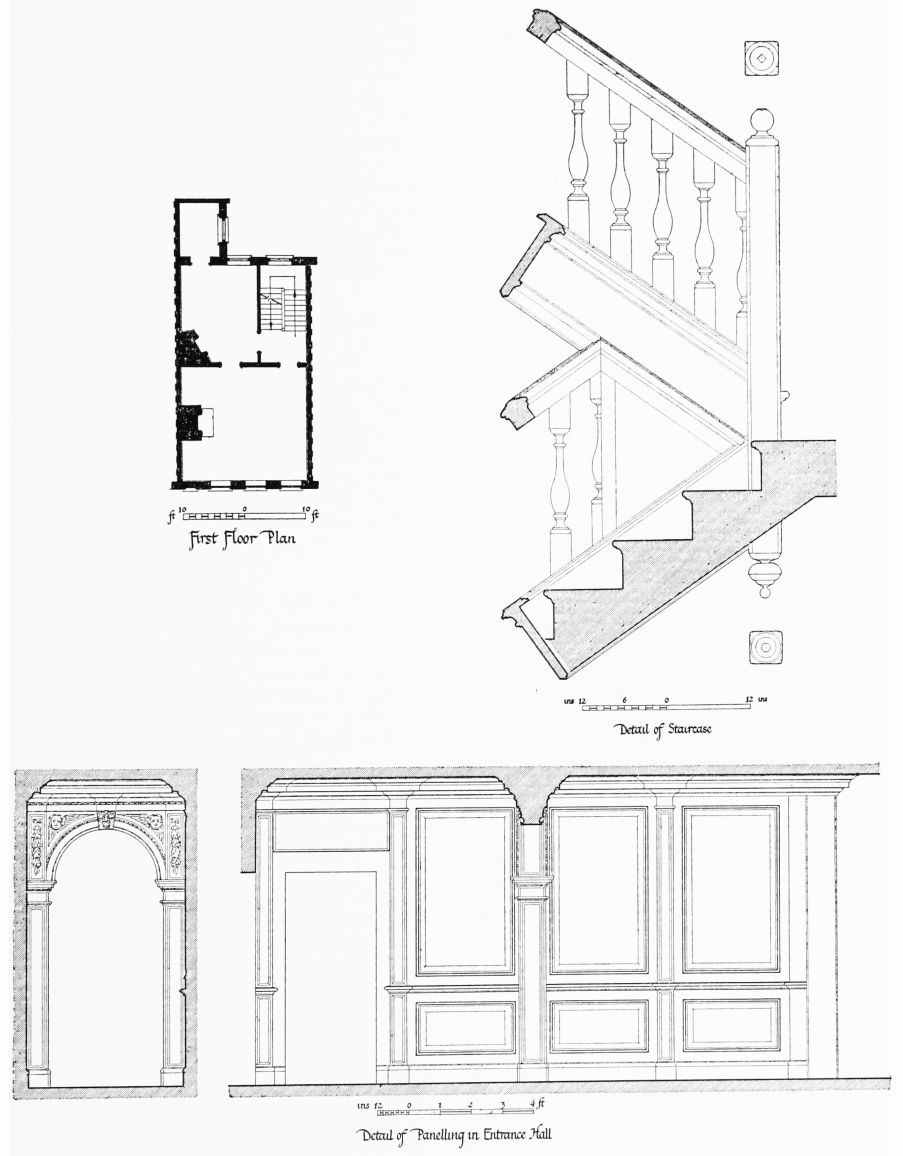
No. 90 Jermyn Street, plan and details
No. 88 also has a back wall of late seventeenthcentury character but its front has been entirely rebuilt in the late eighteenth or early nineteenth centuries. It has only two widely spaced windows to each storey with a stucco cornice at third-floor level, and the exposed brickwork appears to consist entirely of headers. A modern shop-front now occupies the ground storey, but a photograph of 1907 in the London County Council's collection shows that it was then covered with stucco and rusticated with horizontal channelling, a raised bandcourse marking the first-floor level. A plain iron railing guarded the basement area and before each of the second-storey windows, which have now been shortened, was a bowed iron balcony with a delicately patterned railing.
No. 94, while preserving the scale of the original house, appears to be a complete rebuilding of early nineteenth-century date.
No. 97, a corner house, is remarkable only for its late Victorian shop-front where the windows and doorways are framed with splayed unbroken architraves, enriched with a bold egg-and-dart moulding, in a series of elliptically arched openings. These form an arcade with five wide bays to Jermyn Street, one on the corner, and three narrow bays to Duke of York Street. The stone or cement face of this arcade is now painted a deep chocolate-brown, giving great prominence to the tall inset panels of polychrome tiles that decorate the piers. The front is finished with a dentilled cornice, partly overlaid by Baroque cartouches centred above the piers.
Nos. 98–99 have the best preserved exterior among the original houses, although early nineteenth-century alterations and the insertion of modern shop-fronts have combined to spoil their appearance (Plate 203d). Horwood and the Ordnance Survey maps show the building as two houses, with fronts to Jermyn Street, and it appears to have been numbered as two separate houses. However, the structural evidence points to its having been erected as a single building. It contains a basement, three storeys and a garret with fronts to Jermyn Street and Duke of York Street of four and three windows respectively. The present red-tiled mansard roof is entirely modern. Both fronts have raised bandcourses immediately above the heads of the windows but the Jermyn Street front has been stuccoed and its windows altered. Towards Duke of York Street the dull-red brickwork is still exposed and the windows are segmental-headed, all of them containing box-frames except for the northern window in each storey, which is blind, and the southern window of the second storey, which has a projecting bay window of wood. The doorway, in the ground storey of this front, has a moulded architrave and triangular pediment of stucco.
The plan is L-shaped with four rooms to each floor, the two rooms in the longer western side being separated by a staircase compartment. Of the fittings only the staircase is of any interest and this is mostly concealed by boarding. It is of the dog-leg type with closed moulded strings, rather thin turned balusters, a moulded handrail and square newels with rounded tops, the bottom newel being more elaborate with a cluster of balusters around it and the handrail twisting over them.
Nos. 104 and 105 Jermyn Street
The Society for the Prevention of Cruelty to Animals was founded in 1824 by the Rev. Arthur Broome, Rector of St. Mary's, Bromley St. Leonard (now Bromley-by-Bow). Among those present at the inaugural meeting in Old Slaughter's Coffee House, St. Martin's Lane, (fn. 4) was the Irish member of Parliament, Richard Martin, who in 1822 had sponsored the first Act for the protection of horses and cattle. The founding members of the new society also included William Wilberforce and Thomas Fowell Buxton, who took the chair at the first meeting.
The society was especially interested in the plight of draught horses, the conditions in slaughterhouses, and the abolition of bull-baiting and cock-fighting. During its early years it found little sympathy or support among the general public, and there were serious financial difficulties. Only the hard work and generosity of such men as Richard Martin and Lewis Gompertz saved it from extinction.
In 1835 the society (assisted by Joseph Pease) sponsored an Act which extended protection to a much wider range of animals. In the same year Princess Victoria became a patron of the society, and in 1840 she granted it permission to use the prefix 'Royal'.
The first office of the society was at No. 190 Regent Street. In 1839 the headquarters were at No. 3 Exeter Hall, Strand, and subsequently at No. 12 Pall Mall. (fn. 88)
In 1869 Miss (later Baroness) Burdett-Coutts laid the foundation stone of the present headquarters building at No. 105 Jermyn Street. This freehold site had been presented to the society by George Wood, one of the trustees, who had purchased it in the previous year. The new building was completed in 1870. (fn. 89) The architects were Messrs. Pain and Clark, surveyors, of Buckingham Street, Strand. (fn. 88)
In 1902 the society purchased the freehold of No. 104 Jermyn Street, (fn. 90) as an extension to its premises. The house was demolished and rebuilt in the following year, continuing the existing lines of No. 105 on its first and second floors. Above this, a new third floor, the full width of both buildings, replaced Messrs. Pain and Clark's heavy cornice. The ground-floor colonnade was extended across both fronts and the columns and piers rearranged. The architect in charge of the work was F. W. Roper of Adam Street, Adelphi. (fn. 91)
The work carried out in 1903 was in accord with the style of the building erected in 1869–70, although the wider frontage of No. 104 resulted in a lack of symmetry in the composition of the front elevation. The four storeys are stone-fronted, with a rusticated ground-storey face of black granite set off by Corinthian columns with shafts of red granite supporting a stone entablature. Two columns flank the doorway, on the east, which has above its entablature a segmental pediment containing a heavily festooned cartouche. At either side of the doorway is a small recessed window, and on the west is another group of three windows recessed behind a screen of two columns. The upper storeys are plainer, with raised quoins, and in the second and third storeys are two wide windows, one with two lights on the east, and the other with three lights on the west. Pilasters divide the lights, and support entablatures, the second-storey windows being the more elaborately dressed, having Corinthian pilasters, modillion cornices and, at sill level, a continuous guilloche band. In the fourth storey six small windows are grouped centrally, and above them, supported at either end by a console, is a projecting parapet with a line of dentils beneath it.
No. 106 Jermyn Street
No. 106 Jermyn Street was rebuilt in 1906–7 from the designs of Messrs. Treadwell and Martin of Charing Cross Road. The builders were Messrs. F. and H. F. Higgs of Herne Hill. The new building was designed as a block of offices with a shop on the ground floor. (fn. 92)
The narrow stone front is simply designed with a wide, four-storeyed bay window projecting out over the ground storey, and its interest lies in the detailing, which is in an 'Art Nouveau' version of the Jacobean style. The shop-front and the fascia are framed by a moulded architrave which is stopped close to the ground in medieval fashion and continued across the foot of the bay window above, at either side of which the line is broken to form a round-arched frame for a foliated cartouche. The bay is flanked by two long panels similarly arched for a cartouche, and there are thin mullions and transoms to the windows, beneath which, in the third and fourth storeys, are carved bands of foliage. The heavy moulded cornice is arched in the centre to correspond with the round arch of the window below, and above it rises a tall conical roof crowned with a ball-finial.
No. 112 Jermyn Street
Nos. 111a and 112 Jermyn Street and Nos. 7 and 8 Wells (now Babmaes) Street, then occupied by Standen and Co., were rebuilt as a single block (No. 112 Jermyn Street) in 1900–1 for Edward Standen Morphew. The new building was designed as a shop (subdivided in 1954–5) and a woollen warehouse for Standen and Co., with a single main entrance in Jermyn Street. (fn. 93) E. S. Morphew's brother, Reginald Morphew, was the architect, (fn. 94) and the builder was John Greenwood of Arthur Street. (fn. 93) The Crown surveyor, Arthur Green, described Morphew's design as 'somewhat different to what had been generally adopted on the Crown estate' (Plate 274b). (fn. 95)
Notwithstanding some 'Art Nouveau' details, this building is strongly reminiscent of an early Florentine palace, such as the Davanzati, with its great blocks of rugged masonry in the ground storey and the pseudo-loggia below the shadowy crowning cornice. Five-storeyed fronts face on to Jermyn Street and Babmaes Street and linking them is a five-sided angle turret, crowned by an octagonal belvedere with an ogee cupola. The Jermyn Street front contains two wide, segmental arches in the rusticated ground storey, and a pair of three-light mullioned windows in each of the three storeys above, those of the fourth storey having moulded segmental-arched heads. The fifth storey is lit by a series of small windows with round arches rising from Ionic columns resting on consoles, having the effect of a loggia. The turret has windows only in the second, fifth and sixth storeys, and in the Babmaes Street front the threelight windows in the upper face are set well to the south, giving the building an appearance of massive simplicity when viewed from the north-west.