
Survey of London: Volumes 29 and 30, St James Westminster, Part 1. Originally published by London County Council, London, 1960.
This free content was digitised by double rekeying. All rights reserved.
'Pall Mall, South Side, Existing Buildings: The Oxford and Cambridge University Club', in Survey of London: Volumes 29 and 30, St James Westminster, Part 1, (London, 1960) pp. 419-424. British History Online https://www.british-history.ac.uk/survey-london/vols29-30/pt1/pp419-424 [accessed 26 April 2024]
In this section
The Oxford and Cambridge University Club
Previous history of part of this site is described on page 378
'At a numerous Meeting of Members of the Universities of Oxford and Cambridge, held at the British Coffee House, Cockspur Street, on Monday 17 May 1830' it was resolved 'That a Club be formed consisting of Members of the Universities of Oxford and Cambridge to be called "The Oxford and Cambridge University Club".' At this meeting it was also decided that the club should consist of six hundred members, three hundred from each University, and that the affairs of the club should be entrusted to a committee of management, which was empowered to take a house for a term of up to seven years. The annual subscription was fixed at five guineas, with a tenguinea entrance fee for original members. To members elected later the entrance fee was to be fifteen guineas. (fn. 2)
This inaugural meeting was presided over by Viscount Palmerston, M.P. Members of the first committee of management included Colonel (later General Sir) Frederick Trench, who was a member of Parliament for most of the period 1807–47 and represented Cambridge 1819–32, and who interested himself in several schemes for the improvement of the metropolis; and the Rev. Hugh James Rose, later Professor of Divinity at Durham University and Principal of King's College, London. One of the club's trustees was Sir Robert Inglis (1786–1855), Tory M.P. for most of the period 1824–54, who in 1829 defeated Sir Robert Peel in the famous contest for the representation of Oxford University. (fn. 3)
For a few weeks the club appears to have hired a room at the British Coffee House. At a general meeting held there on 17 June the rules of the club were approved, and the committee reported that 467 original members had been elected, and that the number of candidates had considerably exceeded 600. (fn. 4)
On 16 June the committee agreed to take Sir John Beckett's house at the northern corner of King Street and St. James's Square for eighteen months at a rent of £1200. (fn. 5) This house was opened for members' use on 5 July 1830, and the club remained there until the end of 1837.
No attempt to find a permanent home for the club appears to have been made until 1834. In March of that year the committee declined an offer from Sir John Beckett to sell the freehold of his house in St. James's Square. (fn. 6) In April correspondence began with the Commissioners of Woods and Forests about the possibility of finding a building site on the south side of Pall Mall, (fn. 7) but the only site at first available was considered too small. As a result of this setback, negotiations that had been proceeding for an amalgamation with the United University Club were abandoned. (fn. 8) A second site was declined for the same reason as before, but on 8 May 1835 the Commissioners offered to grant the club a ninetynine-year lease of ground backing on to Marlborough House with a frontage of some ninetyfour feet to Pall Mall. (fn. 9) Sir Robert Smirke, who had been consulted by the club about the two earlier offers, was instructed to ascertain from the Commissioners whether some alteration might be made to the wall of the courtyard of Marlborough House so as 'to admit of a better back light', but the Commissioners refused to make any concession. (fn. 10) On 1 June Smirke reported to the committee that he considered the site was eligible for the erection of a house for the accommodation of up to 1200 members, and the committee therefore decided to accept the Commissioners' offer. Smirke was instructed to prepare plans and estimates. (fn. 11)
At the annual general meeting of the club held on 16 June 1835 the committee was authorized to take the site in Pall Mall and to spend up to £27,000 on the erection of a new house there. The approval of Smirke's plans and the superintendence of the building of the new house were the work of the committee: no special building committee was established. (fn. 12) Members of the committee during the years 1835–8 included Sir Robert Inglis; Russell Gurney (1804–78), a young barrister who later became Recorder of London; Charles Neate (1806–79), economist and political writer, a Fellow of Oriel and M.P. for the City of Oxford 1863–8; the Rev. Joseph Blakesley (1808–85), Fellow of Trinity College, Cambridge, and later Dean of Lincoln; and Edward Twisleton (1809–74), Fellow of Balliol, who later served on many government commissions. W. E. Gladstone was also a member of the committee, but did not attend many of its meetings. (fn. 13)
In the club archives are Smirke's four proposed plans for the new house, floor by floor. Three of them are signed and dated 2 July 1835. Only a few minor differences are discernible between these plans and the finished building. The committee seemed doubtful about Smirke's proposed design for the front elevation, and even asked 'whether he could not furnish the Committee with a different elevation of another Style of Architecture in compliance with the wishes of several Members of the Club'; but on learning that this would involve some alteration in the plan of the rooms, the committee resolved, on 30 July, 'That the original plan be now finally decided upon'. (fn. 14)
Tenders from six contractors were opened on 28 October. The lowest was from Messrs. Grissell and Peto of York Road, Lambeth, for £24,130, and this was accepted. (fn. 15) The disposal of the old buildings on the site was completed shortly afterwards and the ground was handed over to Smirke on 5 November 1835. (fn. 7)
The building of the club-house took twenty-six months. The minutes of the committee record very little of note as to the progress of the works. At the annual general meeting of May 1836 it was resolved that a smoking-room 'should be fitted up in the New Club House'. At the request of fifty members a special general meeting was held shortly afterwards to reconsider this motion, but it was re-affirmed by 91 votes to 76. (fn. 16) The only other matter with which either the committee or the members at large appear to have concerned themselves was the choice of wood for the library bookcases and marble for the chimneypieces. (fn. 17)
The new club-house was opened to members on 5 February 1838. (fn. 18) The contractor's final account was £19 10s. under his original tender of £24,130; but 'Extra Works' ordered by the committee during the progress of the building cost a further £977 16s. Sir Robert Smirke was paid £1254—five per cent of the cost. (fn. 19)
The design of the club-house has generally been attributed jointly to Sir Robert Smirke and his younger brother Sydney Smirke. (fn. 20) Yet all negotiations with the committee of the club were carried out by Sir Robert; and although 'Mr. Sidney Smirke' is recorded in the minutes as having once 'waited on' the secretary it was 'by the desire of Sir Robert Smirke, who is confined to his room by illness, to state that the Tenders . . . were necessarily delayed'. (fn. 21) The club records—plans, minutes, accounts—give no suggestion that two architects were involved. After the completion of the building, however, both brothers were elected honorary members of the club. (fn. 22) In 1857 and 1863, long after his brother had retired, Sydney Smirke was commissioned by the club to carry out minor alterations. (fn. 23)
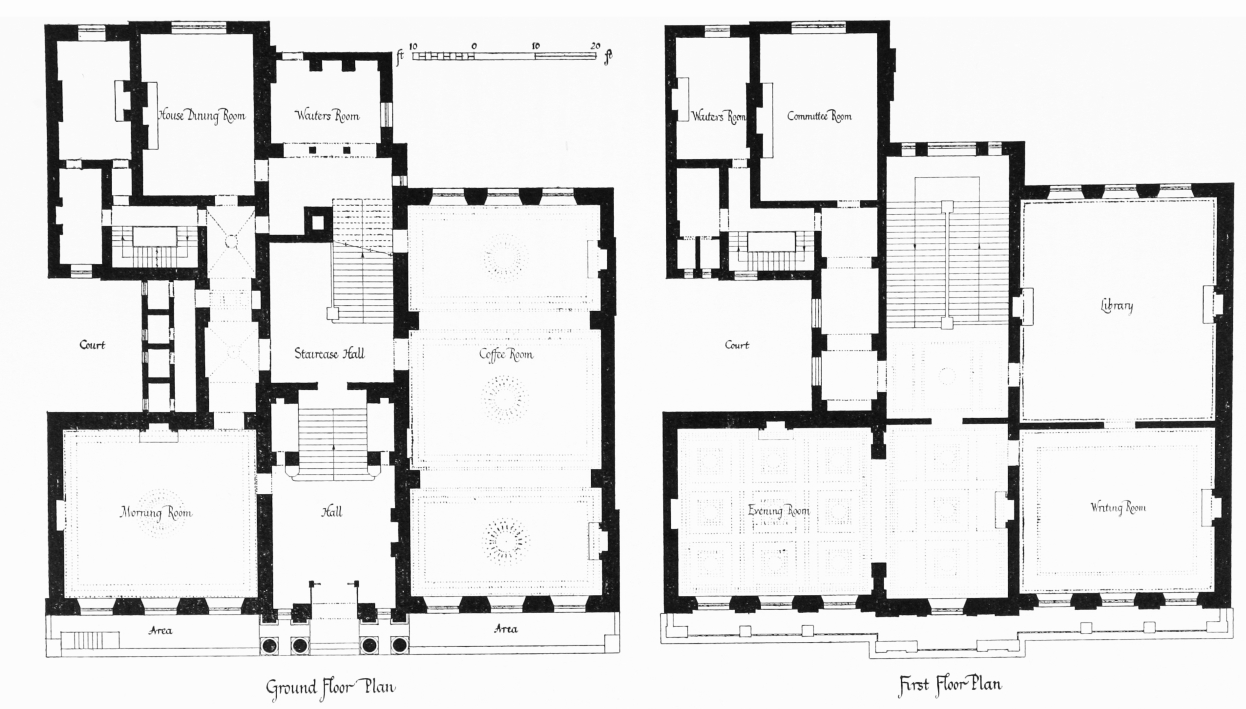
Oxford and Cambridge University Club, Pall Mall, plans of 1838. Re-drawn from The Civil Engineer and Architect's Journal
In 1907 the strangers' dining-room (formerly the house dining-room) was elaborately enlarged, (fn. 24) and major alterations (described below) were made to the staircase compartment, the architect being (Sir) Reginald Blomfield. (fn. 25) In 1912 a second bedroom storey was added, the dormer windows of which rise above the balustrade on the Pall Mall front. Blomfield was again the architect. (fn. 26)
In 1952 a Crown lease was taken of the next-door house on the east side, No. 77 Pall Mall, to accommodate lady associates.
Architectural description
This club-house occupies an irregular site, open only on the north, with a frontage of 94 feet to Pall Mall, the depth of the building ranging from 70 feet on the west side to 96 feet on the east. Nevertheless, the building is excellently planned, with a convenient arrangement of spacious and well-lit rooms (fig. 66).
When first built, the front of the club-house (Plate 104a) was observed to have 'an air of monumental grandeur, admirably suited to a building, which, from its connexion with the Universities, awakens attention to those proud features of our Constitution'. (fn. 27) The design is certainly bold in scale by London standards; the style (Graeco-Roman and Italianate) and the material (painted stucco) relate it to the two great club-houses in Waterloo Place; and a note of Regency elegance is sustained by the use of slender glazing-bars in the sash windows.
There are two lofty storeys, the lower arcaded and the upper divided by piers. Each storey has seven bays, the centre being emphasized by the portico and the slightly projecting wide bay above. A rusticated plinth contains the basement-mezzanine windows. The area railing, a scale-patterned grille of cast iron, was originally continuous on each side of the portico, but is now broken by stone pedestals bearing cast-iron standards for gas-flambeaux. The ground storey is stuccoed to represent an arcaded face of smooth stonework, rusticated with chamfered horizontal and vertical joints. Its wide piers are finished with Doric imposts from which spring the round arches of the tall and relatively narrow window-openings, three on each side of the portico. The portico is a dominating feature of the front. Four Corinthian columns in line, with plain shafts of stone, rising in widely spaced pairs from stone pedestals, carry a stucco entablature with bay-garland frieze and dentilled cornice. Above each of the four columns the frieze and dentil-band give place to a cartouche emblazoned with the arms of either University. The entablature is continued across each flanking face of the front, but the crowning members of the cornice project to form a balcony, resting on elaborately enriched console-trusses of cast iron which break the architrave and frieze. The balcony has a front of cast-iron railings by C. F. Bielefield, (fn. 28) with panels of rich scrollwork, between pedestals of stucco. Wide piers, coursed with chamfered joints, divide the upper storey into seven bays, each containing a tall rectangular window within a Doric surround, and an oblong panel above. In the emphasized middle bay, the window surround is fully articulated: complete pilasters on the face and reveals support an entablature having a frieze decorated with formal bell-flowers. In the three narrow bays on each side, the window surrounds are recessed and halfpilasters are employed. The panels over the windows contain bas-reliefs, modelled in Roman cement by William Grinsell Nicholl and now painted in the Wedgwood manner. They are from designs by Robert Smirke, R.A., the father of the architect, and they 'illustrate those exalted labours of the mind which it is the peculiar province of the Universities to foster and promote'. (fn. 29) From east to west the subjects are:
1 Homer, inspired by Athene, declaiming his epic to young and old.
2 Bacon recommending his philosophy to his auditors.
3 Shakespeare attended by Tragedy and Comedy.
centre Apollo and Athene, with the nine Muses and a fountain-nymph personifying inspiration.
5 Milton dictating his verses to his daughter, inspired by a superior agency seen hovering over him.
6 Newton explaining his system.
7 Virgil reciting his Georgics to a group of husbandmen. (fn. 30)
The crowning entablature is scaled to the full height of the front and comprises a moulded architrave, a frieze of anthemion ornament, and a cornice with dentils and enriched scroll-modillions. The front retains its original balustrade, with solid dies over the piers; but the roof with its eight dormers is the work of Blomfield.
The portico, central in the Pall Mall front, opens to a hall which, having its floor lower than the main ground-floor level, is of imposing height (Plate 104b). Two Doric pillars rising from projecting pedestals on either side make a division into two compartments, the larger, the entrance hall proper, being more or less square. Here, above the pedestal dado, coursed with chamfered joints, the plainness of walls and ceiling is relieved by a simple cornice defined by the gilding of its outer mouldings. At the south end, between the projecting pedestals, a wide flight of thirteen steps rises to a landing in front of the doorway to the staircase compartment. The door, of two leaves, is framed by a doorcase with a moulded architrave, plain jambs, and a cornice resting on enriched scroll-consoles. Engaged Doric pillars on either side of the doorway pair with the two already noticed, to carry a rectangle of cross-beams supporting the ceiling, in the centre of which is a large rectangular coffer. Narrow gilt mouldings emphasize the rectangles, and the capitals of the four Doric pillars are gilt.
The staircase compartment, two storeys high, is spacious and well lit (Plate 105). The staircase itself, of simple dog-leg form, is wide and generous, rising to a half-landing and returning to end at the first-floor landing. The massive balustrade comprises an architrave string, its top fascia ornamented with a wave-scroll which is repeated as a string round the walls of the compartment, and a cornice-handrail supported by stout balusters with solid dies at two intervals in the upper flight. Pedestals, with panelled dies and base-blocks for candelabra above the capping, terminate the balustrade of each flight. In 1907 (Sir) Reginald Blomfield lined the walls up to the first-floor level with panels of yellow Skyros marble in statuary framing, and replaced Smirke's three windowlights in the south end wall by a large Doric Venetian window. The college shields from the original window-glass were re-set in the corridor windows. (fn. 25) (fn. 1) The deep frieze of oblong panels in bay-garland mouldings is due to the same architect, but the ceiling is original. (fn. 31) It is divided into four equal bays by cross-beams resting on scrolled brackets, the soffits of the cross-beams enriched with encircled quatrefoils. Each bay is modelled with three recessed panels—wide between narrow—the middle one being ornamented with a formal foliage-boss within a wreath. The ground-floor level of the staircase compartment forms a vestibule to the principal rooms of that floor. A west doorway immediately at the foot of the stairs opens to the coffee-room: an east doorframe gives entrance to a short corridor leading north to the morning-room and south to the former strangers' dining-room, once enlarged by Blomfield but now split up.
The handsome, well-proportioned principal rooms are decorated by a spare but effective use of standard Grecian mouldings and ornament in cast plaster. During the latter half of the nineteenth century, apparently, 'Pompeian decorations on a ground of coffee and stone colour' had been introduced; but these were swept away by Blomfield in 1907, when a contemporary wrote, '. . . the whole effect of the new interior gives an amazing accession of air, of cheerfulness, and of well-proportioned space and colour'. (fn. 25)
In the morning-room (Plate 106a), which is almost square, the walls are divided, above the pedestal-dado, into large flush panels with enriched moulded frames, and there is a plain narrow frieze below the delicate cornice of acanthus leaves. A border of flower-heads and acanthus sheaves surrounds the ceiling, which is plain but for the central rose. This is composed of a circular grille, combining the functions of a ventilator and a chandelier-boss, decorated with large acanthus buds and surrounded with anthemion ornament. The chimneypieces, central in the south and east walls respectively, are of dark marble with diagonally projecting console-jambs supporting the cornice-shelf. Above, large matching heavy gilt frames contain, on the south a mirror, on the east a portrait of the first Duke of Wellington. The three arch-headed windows in the north wall have panelled shutters and soffits, and moulded architraves.
The fine coffee-room (Plate 106b) extends for the full depth of the building on the west side. Its length, 66 feet, is exactly twice its breadth. Each long wall is divided into three bays by engaged pillars having painted shafts and gilded anthemion-ornamented caps, with enriched console-trusses supporting cross-beams which divide the flat ceiling. Except that the large wall-panels are framed in cross-banded reeded mouldings (probably Blomfield's work) the general treatment of the room is on similar lines to that of the morning-room. Matching chandeliers carried in the three ceiling-roses are probably those referred to in the club accounts for 1867. The three windows in each end wall, round-arched in the north wall and straight-headed in the south, are finished in the same manner as those in the morning-room.
On the first floor the arrangement of the rooms is reversed, there being two (the north and south libraries) over the coffee-room, and one large room (the smoking-room) over the morning-room and entrance hall. The north and south libraries are related rooms, each almost square in plan (Plate 107b). For about two-thirds of their height the walls are lined with bookshelves designed in Russian birch on architectural lines to embrace the doors and fireplaces. The lower section forms a projecting dado for folios, with a moulded skirting and a rail ornamented with a bead-and-reel moulding. The upper part is finished with a combination of architrave and cornice, and the vertical divisions are formed by narrow pilasters with panelled shafts and Doric caps. The doorway between the two rooms, and all three fireplace recesses, are framed by larger pilasters of the same character, supporting projecting lengths of the entablaturecapping which are developed, in the south library only, into angular pediments. The north library has a chimneypiece of figured white marble, with panelled jambs and enriched consoles supporting the cornice-shelf. The two south library chimneypieces, east and west, are somewhat simpler in design, but, like the one in the north library, they contain fine grates of iron and brass and are surmounted by large plate mirrors, secretly fixed and filling the upper part of the recess. The upper wall face in each library is quite plain and finished with a simple entablature, the sole ornament of which is a narrow band of acanthus leaves. A plain cove rises to the bay-garland band and gilt moulding bordering the flat ceiling, which is plain but for a central boss-ventilator of similar design to that in the morning-room, already described.
The large smoking-room (originally called the evening-room or drawing-room) is perhaps the most handsome of the club's apartments (Plate 107a). Extending over both morning-room and entrance hall, it is lit by four of the windows on the north front. The westernmost of these, the window above the portico, diverges from the equal spacing of the other three; but Doric piers placed on the north and south sides of the room, at a position between the portico window and the others, restore the fenestral pattern without detracting from the room's impressive length. The piers have marbled shafts and enriched caps, and carry a deep cross-beam, the soffit of which is enriched with a bold guilloche pattern. Raised and enriched mouldings divide the walls into large panels with wide margins, and a rich finish is given by the anthemion frieze and dentilled cornice. These latter features, and the moulded architrave, are returned by the Doric piers and their crossbeam, so that the ceiling is in two distinct compartments. The major compartment is divided into square panels by guilloche-enriched ribs, paired laterally, and each panel contains a recessed and moulded square coffer with a formalized flower-boss. The decoration of the smaller ceiling-compartment is similar but not quite so elaborate. There are two chimneypieces, one in the south wall opposite the middle one of the three easterly windows, and one in the centre of the west wall. Both are of white marble, with a simple architrave flanked by panelled pilaster-jambs, diagonally placed, with enriched caps and armorial cartouches on the frieze-blocks below the corniceshelf. Over each is a tall mirror plate in a gilt frame, reeded and cross-banded, with a plain frieze and an enriched cornice. The doorcase of the main entrance from the grand staircase is composed of an architrave flanked by panelled pilaster-strips with elaborate consoles supporting an anthemion-enriched cornice above a baygarland frieze. A similar doorcase at the east end is a trompe I'œil feature framing a large mirror plate. The main entrance is no longer used, access now being only from the east corridor. There was originally a door to the north library, but it has been covered up. The dado-high bookcases, designed for the room, are interesting examples of transitional Regency-Victorian furniture.