Survey of London: Volumes 29 and 30, St James Westminster, Part 1. Originally published by London County Council, London, 1960.
This free content was digitised by double rekeying. All rights reserved.
'Cleveland Row', in Survey of London: Volumes 29 and 30, St James Westminster, Part 1, ed. F H W Sheppard (London, 1960), British History Online https://www.british-history.ac.uk/survey-london/vols29-30/pt1/pp487-509 [accessed 30 April 2025].
'Cleveland Row', in Survey of London: Volumes 29 and 30, St James Westminster, Part 1. Edited by F H W Sheppard (London, 1960), British History Online, accessed April 30, 2025, https://www.british-history.ac.uk/survey-london/vols29-30/pt1/pp487-509.
"Cleveland Row". Survey of London: Volumes 29 and 30, St James Westminster, Part 1. Ed. F H W Sheppard (London, 1960), British History Online. Web. 30 April 2025. https://www.british-history.ac.uk/survey-london/vols29-30/pt1/pp487-509.
In this section
CHAPTER XXVII
Cleveland Row
Cleveland Row takes its name from Barbara, Duchess of Cleveland, who lived at Cleveland (formerly Berkshire) House, part of the site of which is now occupied by Bridgwater House.
That part of Cleveland Row which runs between Selwyn House and Bridgwater House was formed about 1847 after the demolition of Cleveland House, and it occupies most of the site of the old forecourt and two projecting wings. All the rest of Cleveland Row was formerly part of the old highway which led from Charing Cross to Hyde Park (see page 322 and Plate 1), and the sites of Nos. 8–12 (consec.) Cleveland Row and Stornoway House were also part of the old road.
In 1850 a scheme was considered for the improvement of Cleveland Row, which, had it been carried out, would have provided a vista from Pall Mall to a magnificent entrance into Green Park. (fn. 3) The originator of this plan was apparently Sir Charles Barry, the architect of Bridgwater House, which was then nearing completion. He proposed to remove all the buildings between the latter and Stafford (now Lancaster) House to form a grand square. (fn. 4) As an entrance to the Green Park Barry designed a pierced screen which was to flank Nash's triumphal arch, then recently removed from its original position in front of Buckingham Palace (Plate 245). The scheme was not executed, and Nash's 'Marble Arch' was reerected in its present position at Cumberland Gate in 1851. (fn. 5)
When the Alliance Assurance Company building on the corner of St. James's Street and the present Nos. 3 and 7 Cleveland Row were erected in 1904–6 the opportunity to widen Cleveland Row was taken and the building line set back. (fn. 6)
North Side
All the ground on the north side of Cleveland Row, except the site of Berkshire House, was originally part of the Pulteney estate (fig. 81). According to a survey of 1667 there were, bordering the old highway from east to west, a house formerly occupied by Sir Henry Henne on the corner of St. James's Street; three houses grouped round Russell Court; a vacant site; three more houses; a grass plot; Berkshire House; some outhouses belonging to Berkshire House and a house occupied by William Smith. (fn. 7) The house on the corner of St. James's Street was assigned in 1663 by Sir William Pulteney to (Sir) Goddard Nelthorpe (fn. 8) and thereafter ceased to be part of the Pulteney estate. The land on which the outhouses of Berkshire House stood, together with the house occupied by William Smith and the grass plot on the east side of Berkshire House, were ceded by Sir William Pulteney for the use of the Duchess of Cleveland, who built two wings to Berkshire House on their sites; the freehold of these parts of the Pulteney estate was granted to the Duchess's son in 1690 (see page 493). The remaining property on the north side of the street which was still in Sir William Pulteney's possession at the time of his death in 1691 consisted of the three houses on the east side of Berkshire (then Cleveland) House, later Nos. 4–6 (consec.) Cleveland Row; a new house between them and Russell Court, erected between 1684 and 1686 on a vacant plot of land, later No. 3 Cleveland Row; another house in Cleveland Row on the west side of Russell Court, later No. 2 Cleveland Row; and three houses in Russell Court itself. (fn. 9) All this property continued to be let, either to individual members of the Pulteney family or to their trustees, on separate leases until 1822, when the whole of it was let to Sir Richard Sutton (fn. 10) (see page 28). Some of the old houses mentioned in this lease survived until the beginning of the twentieth century when they were demolished to make way for the Alliance Assurance Company building on the east side of Russell Court and the present Nos. 3 and 7 Cleveland Row, on the west side of Russell Court. Persons of interest who occupied these houses and former houses on their sites are listed below. (fn. 11)
No. 3 Cleveland Row. Hugh, first Earl of Cholmondeley, Treasurer of the Household, 1686–94; John Pulteney, son of Sir William, (fn. 12) and Surveyor General of Crown lands, 1695– 1720; (fn. 13) his son, Daniel Pulteney, politician, (fn. 14) 1721–30; Madam Pulteney, 1731–4; Sarah Pulteney, 1735–7; Margaret Pulteney, 1738– 1763; (Sir) Richard Joseph Sullivan, miscellaneous writer, 1784–7 ; John Fordyce, Surveyor General of Crown lands, 1788–97; Sir Gilbert Blane, physician, 1804–21; James Coppock, election agent, 1835–57.
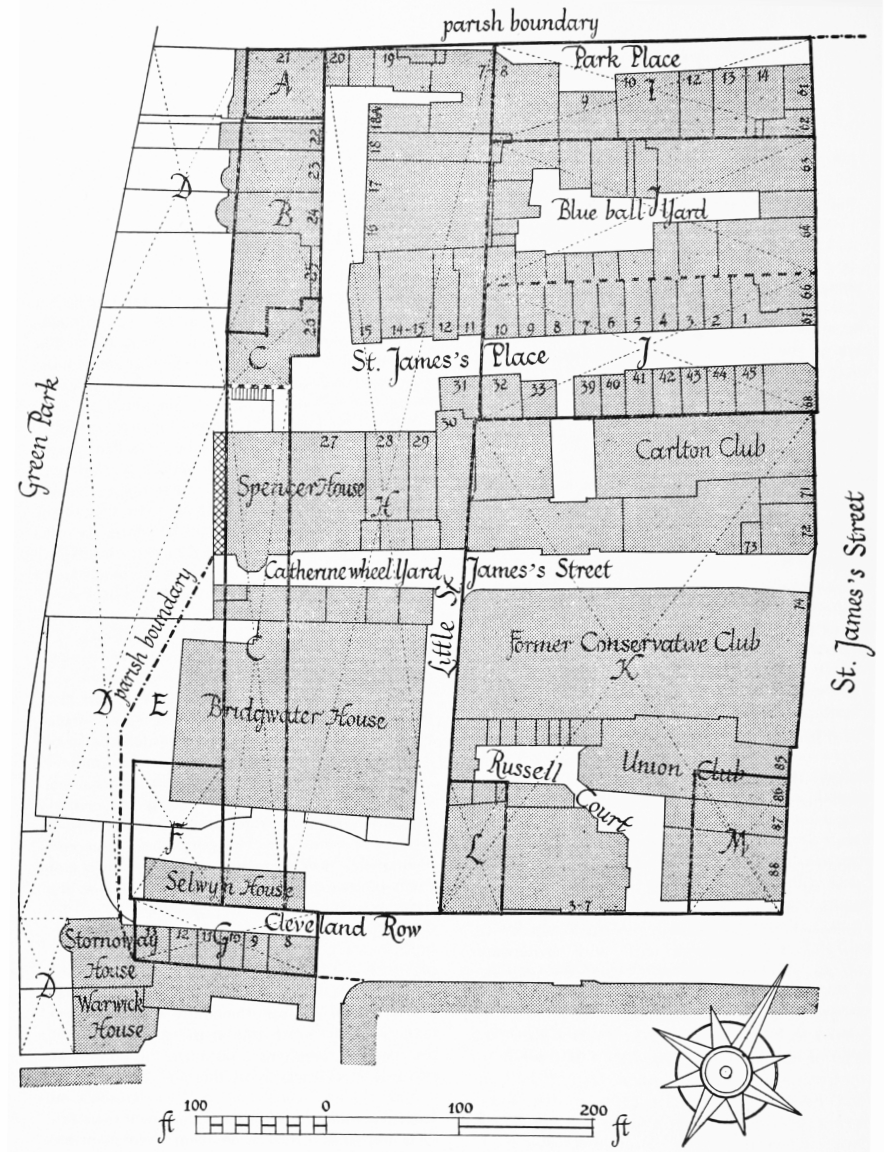
The Pulteney estate and Cleveland House and garden, layout plan. Based on the Ordnance Survey
A, C, F, I, L. Parts of Pulteney leasehold estate acquired by the Duchess of Cleveland and granted freehold by the Crown
to her son, the Duke of Grafton, in 1690. A. Part of Sandpit Field, C. Strip of land originally held with Berkshire House on
which west wing of Cleveland House was built and, north of dotted line, site sold to Francis Parry in 1695. F. House formerly
occupied by John Ogle. I. The Antelope. L. Site of east wing of Cleveland House. B, D, E. Part of Pulteney estate surrendered
to the Crown for formation of Green Park. B. Leased to Francis Parry in 1692. D. Part of park later leased by Crown for
use as gardens. E. Catherine Wheel Yard, stopped up in c. 1843. G. Part of old highway acquired by tbe Duchess of Cleveland
and granted freehold by the Crown to her son, the Duke of Grafton, in 1690. H. Site of Berkshire House (later Cleveland
House) and garden. J. Land granted freehold by the Crown in 1671–97 and, south of dotted line, acquired by the Devisscher
family. K. Part of Pulteney estate leased by the Crown to Sir William Pulteney in 1668. M. Site assigned by Sir William
Pulteney to (Sir) Goddard Nelthorpe in 1663.
No. 4 Cleveland Row. Lord Chamberlain's office, 1743–61 ; Secretary of State's office (with No. 5), 1770–83; Sir William Sidney Smith, admiral, 1811–12.
No. 5 Cleveland Row. Secretary of State's office (with No. 4), 1770–83; Captain Frederick Marryat, novelist, 1822–7; Viscount Lowther, later second Earl of Lonsdale, member of Parliament, 1831–6.
No. 6 Cleveland Row. John Grenville, Earl of Bath, 1670; Thomas Archer, ? the architect, 1717 ; (fn. 14) Francis Negus, the reputed inventor of negus, 1717–19; Robert Wood, traveller and politician, 1757–9, 1762–3; John Campbell, third Earl of Breadalbane, 1764–9.
Nos. 3 and 7 Cleveland Row
This building was erected in 1905–6 for Joseph Harry Lukach to the designs of Frank T. Verity. (fn. 15) The contractor was James Carmichael of Trinity Road, Wandsworth. (fn. 16) Negotiations for the rebuilding of part of the site had been proceeding since 1900 between Luckach and the Office of Woods and Forests, and William Woodward had submitted a number of plans on Luckach's behalf. Ultimately Woodward was superseded by Verity, whose designs were based on those already approved by the Crown. Verity's façade was intended to harmonize with both Bridgwater House and the adjoining Alliance Assurance building. (fn. 17)
The new building comprised three houses, then known as Nos. 3–5 (consec.) Cleveland Row, and a set of flats known as No. 7. (fn. 18) The top floor of the latter was occupied for many years by the London Fencing Club. (fn. 19) In 1909–10 the houses were converted into flats, with a single entrance at No. 3 Cleveland Row; the architect was F. T. Verity. (fn. 20) Part of the building is now occupied by the Sudanese Embassy. (fn. 21)
The building contains a semi-basement, four storeys, and a garret, and has Portland stone fronts towards Cleveland Row and Little St. James's Street which are typical examples of Frank Verity's urbane Parisian 'maisons-de-luxe' style (Plate 277a).
The long Cleveland Row front is divided into a wide central face and narrow wings by two projecting pavilions. Each storey of the central face contains four windows, a pair in the middle and one at each end; the pavilions have two windows in each storey; each end wing has one. The ground-storey face is channel-jointed throughout, forming wide and narrow courses alternately, and the low windows have segmental voussoired arches. The windows in the second and third storeys are linked vertically by plain band architraves, finished with cornice-hoods on triglyphed consoles. In the pavilions and wings, each hood forms a base for the wrought-iron balcony of the fourth-storey window, but in the central face the consoles support a continued balcony serving all four windows. The central face and wings are of plain ashlar, the projecting pavilions are coursed with channel-joints, and all are uniformly finished with a deep entablature, its architrave broken by the fourth-storey windows. The cornice has dentils and modillions in pairs, and above each pavilion is a stone dormer with two windows, dressed with Doric pilasters and a simple entablature. The high-pitched roof is broken by woodframed dormers and massive stone chimneystacks. The entrance in the east wing has a doorcase composed of Doric columns supporting a plain entablature. Two similar doorcases, in the end bays of the central face, have been replaced by windows. The front area is guarded by a stone pedestal containing panels of ironwork similar in design to the fourth-storey balconies.
Russell Court and Mews
Russell Court is shown on a plan of c. 1664. (fn. 22) It took its name from the family which occupied a house on the north side of the court. (fn. 23) In 1651 — Russell, gentleman, occupied the house (fn. 23) and Owen Russell was living there in 1667. (fn. 24)
Occupants of the former No. 3 Russell Court have included John Pulteney, Surveyor General of Crown lands, 1720–7, William Bulmer, printer, who founded the Shakespeare Press here, 1791– 1820, and William Seguier, followed by his brother John, both artists, who established a picture-restoring business here, 1834–56. (fn. 11) In 1788 Russell Court was extended to form a range of stable buildings, sometimes called Russell Yard or Mews. (fn. 25) There are no longer any buildings with fronts to Russell Court, and the north and east sides are now occupied by the backs of the Union Club and the Alliance Assurance building. Russell Mews, however, appears not to have been rebuilt, although adaptation to new uses has drastically altered its appearance. Two-storeyed stable buildings of yellow brick extend round its north and west sides, with a single bay of building on the south side. The stables occupy the ground storey of these buildings while the upper storey has chambers lit by small square windows with slightly curved heads, occasional taller windows with round heads being interspersed among them. One of these taller windows, at the east end, has an iron guard-rail. At first-floor level is a moulded stucco bandcourse, and set into the brickwork of the upper storey on the north side is an oval plaque bearing the profile of a woman's head in low relief.
Berkshire House
Demolished
Berkshire House stood opposite St. James's Palace on the north side of the old highway leading from Charing Cross to Hyde Park, on part of the site now occupied by Bridgwater House. Very little information about it has come to light, and the history of the site (H on fig. 81), the freehold of which has been privately owned since at least 1668, is especially puzzling. The absence of any record of the site being granted away by the Crown since the formation of the Bailiwick of St. James suggests that it was never part of the bailiwick, but its origin nevertheless remains obscure.
Berkshire House was built about 1626–7 (fn. 26) for Thomas Howard, the second son of the Earl of Suffolk. He entered the royal service as Master of the Horse to Charles I when the latter was Prince of Wales. In January 1621/2 he was created Lord Howard of Charlton and Viscount Andover and in February 1625/6 he received the Earldom of Berkshire. (fn. 27)
In March 1625/6 the Earl was granted a lease of a strip of land (part of the Pulteney estate) on the west side of Berkshire House, (fn. 28) the building of which therefore probably dates from about this time. The strip of land was used with part of the gardens behind the house (C on fig. 81). A grotto, mount and summerhouse were erected at the northern end of the slip, and at the south end kitchens and stables were built. (fn. 29)
Berkshire House is marked on Faithorne and Newcourt's map, published in 1658 (Plate 1) but it is difficult to distinguish it from the other buildings facing St. James's Palace which are known to have stood on its east and west sides at that time. The knot garden behind the house is also shown, surrounded by a wall, with the summerhouse in the north-west corner; the garden did not extend as far east as the map suggests, being separated from St. James's Street by part of the Pulteney estate (see fig. 81).
The Earl of Berkshire declared for the King on the outbreak of the Civil War and distinguished himself in the fighting that followed. (fn. 30) His house was commandeered by the parliamentary army for quartering soldiers and 'tho' the officers had shown some care, much prejudice had been done to the house'. (fn. 31)
In 1654 Berkshire House was occupied by the Portuguese ambassador who dated a letter from here on 22 April. (fn. 32) This is the first recorded use of the house by foreign ambassadors—a use which was to recur several times later in the century. Between 1658 and 1664 the Earl of Berkshire's name re-appears in the ratebooks, but in 1665 the house was taken over for the accommodation of the French ambassador.
The accounts of the repairs and alterations carried out by the Office of Works in preparation for the ambassador provide the only pointer to the appearance of the house. They mention a 'vollery', a vineyard, a laundry, stables with rooms over them, and a kitchen next the courtyard. The number of rooms in the house may be judged from the fact that forty-five chimneys had to be swept. Repairs included whitening the walls of the hall, the walls and ceiling of the great staircase, the 'freeze and Cornish' in the great dining-room, and the blackening of the 'bottoms' of several rooms above and below stairs. The hall was paved with stone and there was a gallery in which a new altar was set up. The great gates to the forecourt were repaired with 'bourds and battens' and distempered with 'timber Colour'. At the same time a new water supply was laid on from the main pipe which brought water to St. James's Palace from St. James's Field. (fn. 33)
During the autumn of 1666 the house was occupied by Edward Hyde, Earl of Clarendon and Lord Chancellor. (fn. 34) The building of his magnificent house in Piccadilly had begun earlier in the year and he probably only used Berkshire House as a temporary home.
By 1667 the Earl of Berkshire had mortgaged Berkshire House to the Earl of Craven (fn. 25) and in the following year he petitioned the King for a grant of £3000 in order to redeem the mortgage. (fn. 35) The money was promised, in return for his many services, but he died in 1669 (fn. 27) without having received it, (fn. 36) and the ownership passed from his family. The name of the house was changed shortly afterwards to Cleveland House (see below), but although it acquired a new name and was much altered in its external appearance (Plate 233a) the carcase of the original building appears to have survived until 1840 or 1841, when it was demolished to make way for Bridgwater House.
Cleveland House and Garden
Demolished
Berkshire House is reported to have been bought in 1668 by Charles II for his mistress Barbara Villiers, then Countess of Castlemaine and later Duchess of Cleveland. The house had probably been unoccupied since the Earl of Clarendon's flight to France in November 1667. He and Lady Castlemaine had been avowed enemies; she had had a share in bringing about his downfall, (fn. 37) and had publicly 'hoped to see his head upon a stake'. (fn. 38) Her acquisition of the house in which he had recently lived may have been for her a petty triumph over her ruined opponent.
In May 1668 William, Earl of Craven, Lord Berkshire's mortgagee, and Sir Anthony Craven sold the house for £6000 to George Villiers, Viscount Grandison, and Sir Alien Apsley. (fn. 39) Grandison was Lady Castlemaine's uncle, (fn. 27) and Apsley was treasurer of the household to the Duke of York; they were probably acting on behalf of the Countess.
Barbara Villiers (1641–1709) was the daughter of William, Viscount Grandison. She married Roger Palmer in 1659 and shortly afterwards became the mistress of Charles II. On her husband's elevation to the peerage she became Countess of Castlemaine, (fn. 40) and she was created Duchess of Cleveland in 1670. She appears to have been the least discreet and most predatory of all Charles's mistresses and although the acquisition of Berkshire House and her removal from her lodgings in Whitehall (fn. 41) marked the decline of her prime position in the King's court, she continued thereafter to reap benefits from their past association. (fn. 42)
By 1668 Berkshire House, which had been standing for about forty years, was probably considered old-fashioned and inconvenient, and the amount of land at her disposal was not sufficient for Lady Castlemaine's schemes for enlargement and improvement. In 1668 Sir William Pulteney had been required to surrender part of his estate to the Crown for the formation of the Green Park, and the Countess persuaded the King that parts which adjoined Berkshire House, and which were not needed for the formation of the new park, should not be returned to Sir William, but given to her. At some time between 1668 and 1670 (fn. 43) the Countess's trustees purchased the leases then in being, from Pulteney and his under-tenants, of the house and land formerly occupied by John Ogle and then by William Smith; the strip adjoining Berkshire House (which had been let by Sir William Pulteney's ancestor to the Earl of Berkshire and acquired by the Countess's trustees at the time of the purchase of the house); a grass plot on the east side of the house; and the tenement in St. James's Street called the Antelope which adjoined Berkshire House garden at its northern end. In addition the Countess acquired a piece of the old highway adjoining the Stable Yard of St. James's Palace and a piece of waste ground (part of Sandpit Field) outside the north-west corner of her garden. The last two, said the Surveyor General in a report of 1680, 'I take to be in her grace's possession without any grant thereof yet made by his Maty.' (fn. 44) The disposition of these six pieces of ground is marked on fig. 81 (A, C, F, G, I, L).
A week before the conveyance of the house was made Pepys heard a rumour that Lady Castlemaine was 'to go to Barkeshire-house, which is taken for her, and they say a Privy-Seal is passed for £5000 for it'. (fn. 45) In fact the conveyance was made for £6000 and a privy seal warrant for £8589 0s. 11d. was passed in 1675 to Viscount Grandison and Edward Villiers, which sum included £1800 for the purchase of the pieces of land which had belonged to the Pulteney estate. (fn. 46)
In 1670 Lady Castlemaine was created Duchess of Cleveland in her own right (fn. 27) and henceforth her new title became attached to Berkshire House. The additional land which she had acquired enabled the Duchess to build 'a fair stable' and yard on part of the old highway (page 504) and an ice-house in the north-west corner of her garden (page 534). She also built an east and a west wing on the old house which was thus provided with a larger forecourt, later known as Cleveland Square. (fn. 44) The front of the old house was evidently refaced and perhaps extended at the same time.
The engraving reproduced on Plate 233a shows the south aspect of Cleveland House after 1786–7, when the west wing was destroyed by fire. It shows that the front of the long main range was uniform in its vertical arrangement, with two lofty storeys defined by bandcourses, an attic with long oval windows below the modillioned eaves-cornice, and a steeply pitched roof containing hipped dormers. The horizontal spacing of the windows was curiously irregular, although the scroll-pedimented doorway was reasonably near the middle of the front. The artist has, however, taken the trouble to indicate a slight break in the front, three windows from the east end, and if this means that the east part of the range was an addition, it will be seen that the elevation was originally symmetrical, being eight windows wide with the openings spaced in pairs to flank recessed panels, and a wide pier in the middle of the front. It is worth noting that although the ground-storey windows were set in plain flat-arched openings, those of the second storey were dressed with apron panels and set, with plain tympana, in elliptically arched recesses. Windows treated after this fashion can still be seen at Nos. 52–55 Newington Green, Stoke Newington, houses built in 1658, and formerly existed in the mid seventeenth-century wing of Brooke House, Hackney.
The interior of Cleveland House was furnished in a lavish and splendid manner. Evelyn thought the staircase and gallery 'sumptuous' and the whole house 'noble' but 'too good for that infamous —'. (fn. 47) Some of the furniture was imported from the Continent. In 1673 three cases containing candlesticks and fire-irons, transported by the King's yacht, arrived at Cleveland House; eight painted screens and twelve 'fired wiggerd' screens came from Flanders; and a table, stands and a border for a looking-glass were brought from Calais. (fn. 48) The Earl of Chesterfield provided the Duchess with a figure for a fountain—'a Cupid kneeling on a rock and shooting from his bow a stream of water up towards heaven'. (fn. 49)
The Duchess occupied Cleveland House until 1677. (fn. 25) In that year she went to live in France, where she remained until 1684. (fn. 37) During her absence the house was let in 1679 and 1680 to the Marquis of Arronches, ambassador of the Prince of Portugal, who equipped it with 'costly furniture', 'rich [Japan] Cabinets', and a billiard-table, and entertained his guests with Portuguese dishes 'hash'd and Condited after their way'. (fn. 50)
In 1680 the Duchess and her trustees mortgaged the house for £4240, assigning it to Christopher Cratford, the nominee of the Earl (later the Marquis) of Powis, who had provided the money. (fn. 51)
It is not clear whether the Duchess occupied the house on her return to England in 1684, (fn. 37) but eventually, in 1688 or 1689, she succeeded in selling it to John Rossington, a speculator. (fn. 52)
Rossington first appears in the St. James's area in 1671 when, under the description of John Rossington of St. Martin's in the Fields, gentleman, he took a lease from Ambrose Scudamore of a piece of land on the south side of Pall Mall on which he built several houses. (fn. 53) It was probably one of these houses for which he was rated from 1671 to 1673. (fn. 25) There are several references to a 'Rossington', who may have been John, in Hooke's Diary during the 1670's, in circumstances suggesting an interest in the rebuilding of the City after the Fire, and John Rossington was also engaged in building ventures near Berkeley House and in Duke's Court, St. Martin's Lane, in 1685. (fn. 54) These were all minor schemes compared with the development of the Cleveland House estate, in which Rossington, described as a 'Master builder', was assisted by his brother Joseph, a bricklayer, (fn. 55) a nephew Joseph and, to a lesser degree, by a Robert Rossington, who was probably a lawyer.
His first venture in the area on the west side of St. James's Street seems to have been the laying out of the south side of Park Place on part of the Antelope site, of which he held a lease from either Sir William Pulteney or the Duchess of Cleveland's trustees (see page 542). Rossington had purchased Cleveland House still encumbered by the Powis mortgage, which had become vested in the bankers, Sir Francis Child and John Rogers. In March 1689 the mortgage was further secured by an assignment of the property from the Duchess of Cleveland, her son, the Duke of Grafton, their trustee, Sidney, Lord Godolphin, and John Rossington to Roger Jac(k)son and John Milbourne in trust for Child and Rogers. (fn. 56) The northern part of Cleveland House garden was probably excepted from this assignment, and was sold by Rossington in 1690 to the Marquis of Halifax (see page 517).
Rossington had probably also purchased the leases of the six pieces of land, mentioned earlier as being held with Cleveland House. In 1690 the Duke of Grafton, after two earlier unsuccessful attempts, (fn. 57) obtained a grant of the freehold of these six pieces from the Crown. (fn. 58) The Duke died later that year leaving his son Charles, an infant, as his heir at law, and the young Duke's guardians, Edward, Earl of Lichfield, and Sidney, Lord Godolphin, obtained an Act of Parliament enabling them to sell the six pieces. (fn. 59) They were conveyed, with the exception of the site of the Antelope, in 1693 to William Gulston and Aaron Kinton, in trust for Roger Jacson and John Milbourne. (fn. 60) Here again, presumably, Jacson and Milbourne were acting as trustees for Sir Francis Child and John Rogers.
On the same day that the conveyance of the five pieces was made all the parties concerned entered into an indenture of defeasance whereby Child, Rogers, Jacson, Milbourne, Gulston and Kinton covenanted on receipt of £11,431 12s. 6d., to be shared amongst them, to convey to John and Joseph Rossington all their interest in the Cleveland House estate. (fn. 61) The Rossingtons never did redeem the mortgage. Together with the mortgagees they had sold a second piece of Cleveland House garden in 1691 to the Marquis of Halifax and by 1700 had disposed of the rest of the estate in parcels (see pages 495, 504, 513). Their connexion with the estate did not end here, however, for they took several building leases of individual sites.
Judging from the number of lawsuits in which John Rossington became involved with the workmen engaged by him to develop the sites, he was not an efficient man of business. In 1696 he was said to have 'failed in the world' and Joseph Rossington (presumably his brother) followed him into insolvency. (fn. 62) About the year 1700 John Rossington was arrested at the instigation of his creditors and imprisoned. He 'removed himselfe' by habeas corpus to the Fleet and died about 1702, leaving his nephew, Joseph, as heir to his debts. (fn. 63) The history of the development of the Cleveland House estate is discussed in detail in the chapters on St. James's Place, Catherine Wheel Yard, Park Place and on pages 495, 504, in this chapter.
Cleveland House itself was hired from John Rossington in 1689 for the entertainment of the Dutch ambassadors (fn. 64) and towards the end of the year it was taken by Daniel Finch, second Earl of Nottingham, and Secretary at War, (fn. 65) who lived in Cleveland House until 1695. (fn. 25) During his occupation the two wings were separated from the main building and converted into separate houses, later numbered in Cleveland Square (see page 495).
Lord Nottingham was succeeded in 1696 by the Earl of Bridgwater, (fn. 25) who in 1700 purchased the freehold and the mortgage interest from John and Joseph Rossington, Sir Francis Child and his comortgagees for £5200. (fn. 56)
John Egerton, fourth Earl of Bridgwater, Viscount Brackley, and Baron Ellesmere, had succeeded to his father's titles in 1686. He was descended from Thomas Egerton, the brilliant lawyer and statesman, who had held office under Elizabeth I and had been Lord Chancellor from 1603 to 1617. (fn. 40)
The fourth Earl's heirs at law continued to own Cleveland House and its successor, Bridgwater House, until 1948. On his death in March 1700/1, Cleveland House passed to his son Scroop, the fifth Earl, who was created Marquis of Brackley and Duke of Bridgwater in 1720. (fn. 27) The Duke occupied the house until 1716 but in 1717 he removed to the larger of the two houses in the former east wing. (Sir) Paul Methuen, diplomatist, lived in Cleveland House from 1717 to 1721, and was succeeded by Charles, Viscount Townshend, statesman, from 1722 to 1730. (fn. 11) The Duke of Bridgwater returned to the house in 1736 and lived there until his death in January 1744/5. (fn. 66) His son, John, second Duke of Bridgwater, lived only a short time after his father's death and was succeeded in February 1747/8 by his brother Francis. (fn. 27) John's mother, the Duchess of Bridgwater, appears in the ratebooks in 1746 and 1747 but a note in the volume for the latter year records that 'the Dutchess went away' and refused to pay two-thirds of the rates still owing for that year. From then until 1757 the house was let by the third Duke, one of the tenants being his brother-in-law Frederick Calvert, Baron Baltimore, the rake (1754–6). (fn. 65) From 1757 till his death in 1803 the Duke occupied the house himself. (fn. 25)
Francis Egerton, third and last Duke of Bridgwater (1736–1803), devoted most of his time and money in early life to the improvement of his estates in Worsley and to the building of the canals from Worsley to Manchester and from Manchester to Liverpool, (fn. 37) but in his latter years he turned his attention to collecting pictures and restoring Cleveland House. He purchased the Trumbull collection in 1795 (fn. 67) and in the same year bought No. 3 Cleveland Square, originally part of the west wing of Cleveland House, from Lord Berwick, in order to have more room to display his pictures. (fn. 68) Between 1795 and 1797, Cleveland House was stripped down to its carcase, the front rebuilt and the interior entirely remodelled (Plate 233b, 233c). The architect employed for the new work was James Lewis, and the cost was £7000. The principal workmen employed by Lewis were Clark and Munn, bricklayers; Robert Wright, carpenter; David Thomas, plasterer; Martha Palmer, smith; Hugh Hunter, mason; J. Bingle and Henry Wood, masons (chimneypieces); and Mathew Bullock, carver. (fn. 69)
The Beauties of England and Wales (fn. 70) contains a description by the Reverend Joseph Nightingale of Cleveland House as altered and refronted by James Lewis. 'This is a stone building; and is very plain, but withal very chaste in its exterior.' Soane's lecture diagram (Plate 233b) shows quite clearly, however, that the entrance front in Cleveland Square was of yellow brick, dressed rather sparingly with stone. Lewis's design was a 'very chaste' essay in the Grecian style, composed of a central face, three windows wide, flanked by slightly recessed faces of the same width. The chief decorative feature was the Doric tetrastyle portico, like a miniature temple front, forming the porch, its cornice tying in with the plain bandcourse below the secondstorey windows. The window openings were plain but well-proportioned, of moderate height in the ground storey, tall in the second storey, and low oblongs in the attic, all having stone sills and flat gauged-brick arches. The front was finished with a mutuled cornice and plain parapet of stone, the last breaking against the triangular pediment crowning the central face.
Nightingale's account continues: 'The western end faces the Green Park. The drawing and dining room windows project in bows. The house consists of the following rooms: the new-gallery; the drawing-room; the Poussin-room; the passageroom; the dining-room; the anti-room; the oldgallery; the small-room; the cabinet-room; the library-rooms; Lady Stafford's apartments, &c.' All of these rooms are clearly shown on the plan in John Britton's Catalogue Raisonné, (fn. 71) where a dark hachuring indicates the walls of the rooms formed by Lewis (Plate 233c).
In 1798 an important addition was made to the Duke's picture collection when he, together with his nephew, Earl Gower, and the Earl of Carlisle, purchased the Orléans collection for £43,000. Michael Bryan acted as agent for the purchase and, after the buyers had made their selection, the residue of the collection was exhibited at Bryan's rooms in Schomberg House, Pall Mall, and at the Lyceum and sold for £41,000. (fn. 72)
It was perhaps as a result of this and other purchases made by the Duke that in 1799 James Lewis was required to prepare estimates for adapting existing rooms to make a new picture gallery, (fn. 73) but it is not known whether these alterations were carried out.
The Duke of Bridgwater died in 1803, unmarried, and on his death the Dukedom of Bridgwater and the Marquisate of Brackley became extinct. He left his house in Cleveland Row, and his pictures and plate, to his nephew, with remainder to his nephew's second son. (fn. 27)
George Granville Leveson-Gower, Earl Gower, who was the third Duke's nephew, became Marquis of Stafford in 1803, shortly after his uncle's death. (fn. 27) He carried on the third Duke's work of restoration at Cleveland House and had a new gallery built, designed by Charles Heathcote Tatham, to accommodate his own as well as his uncle's pictures. The new gallery was opened to the public in May 1806. (fn. 74)
In the plan in Britton's Catalogue Raisonné a light hachuring indicates the walls in Tatham's extension. It also gives a view of the 'new gallery' designed by Tatham, but nothing, unfortunately, of his 'principal staircase', which appears to have been ingeniously arranged and must have had a monumental effect. The engraving of the 'new gallery' (Plate 233d) shows it as an oblong room designed in a simple Roman manner, having at each end a wide apse with its semi-dome coffered in the style of those in the Temple of Venus and Rome. The ceiling was formed with a flat soffit, having two bands of square coffers, surrounding an oblong lantern-light with fully glazed sides and a flat ceiling, probably painted to represent a sky divided into squares by a rope-moulding. In this room can be seen, not only some of the masterpieces in the Stafford collection, but the two great console tables with marble tops supported by clustered dolphins, later to be placed in the saloon of Bridgwater House.
The Marquis also had new stable buildings erected in 1805 (fn. 25) on the site of the former east wing of Cleveland House, which had been destroyed by fire in 1786 or 1787. (fn. 75) James Lewis had charged the Duke for 'Designs for Building on the vacant ground whatever His Grace pleases', (fn. 76) and the Marquis's stables presumably replaced or extended stables designed by Lewis (see page 496).
The Marquis of Stafford was created Duke of Sutherland in 1833 and died shortly afterwards. (fn. 27) Cleveland House was inherited by his second son, Francis, who demolished it in 1840 or 1841.
Cleveland Square
Cleveland Square or Court was the name given to the courtyard in front of Cleveland House. On the south it opened into Cleveland Row and on the west and east it was enclosed by houses formed out of the wings of Cleveland House.
West side
In 1691 the west wing was divided into three houses facing east on to the courtyard; they first appear in the ratebook for that year as '3 houses not lett', but by 1692 all three were occupied. (fn. 25)
The most northerly house (Plate 233a), later known as No. 3 Cleveland Square, was first occupied by the Countess of Scarsdale. (fn. 25) It was sold in 1700 by Sir Francis Child, his co-mortgagees, and John and Joseph Rossington to the Rt. Hon. Richard Hill, the diplomatist, who was then a Commissioner of the Treasury, for £1800. (fn. 77) Richard Hill lived in the house until his death in 1727 (fn. 25) and was succeeded by his nephew, Thomas Harwood, who, on receiving a large share of his uncle's fortune, adopted the name of Hill. (fn. 40) He lived in the house until 1769, and was followed by his son Noel (fn. 25) who in 1784 was created Baron Berwick. (fn. 27) Lord Berwick occupied the house until his death in 1789, (fn. 66) and it was sold by his son, the second Baron Berwick, in 1795 to the Duke of Bridgwater. (fn. 78) The Duke incorporated the house with Cleveland House, and it was demolished at the same time as the latter for the erection of Bridgwater House.
The house in the middle of the west wing, later known as No. 2 Cleveland Square, was first occupied by the Countess of Thanet. (fn. 25) It was sold in 1698 by Sir Francis Child, his co-mortgagees and John and Joseph Rossington for £1370 to Sir Edmund Turnor. (fn. 79) Occupants of note included Robert Stewart, Viscount Castlereagh, later Marquis of Londonderry, 1795–1804, and the Hon. Thomas Grenville, statesman and book-collector, 1806–38. (fn. 25) About 1839 (fn. 25) Lord Francis Egerton purchased No. 2 Cleveland Square for £9300. (fn. 80) It was demolished shortly afterwards and its site laid into the new roadway (Cleveland Row) between Selwyn House and Bridgwater House.
The southernmost house formed from the west wing of Cleveland House, known as No. 1 Cleveland Square, was occupied from 1692 to 1694 by Sidney, Earl Godolphin, the statesman. (fn. 11) In 1694 the house was sold by Sir Francis Child, his co-mortgagees and the Rossingtons, to Colonel (later Major-General) William Selwyn (fn. 81) who lived there until 1701. (fn. 25) Later occupants included his son, Colonel John Selwyn, aide-decamp to the Duke of Marlborough, 1716–51; Thomas Townshend, son of Viscount Townshend, teller of the exchequer, 1760–80; William Selwyn's grandson, George Augustus Selwyn, wit and politician, 1781–91; and Stephen Rumbold Lushington, Indian official, 1813– l822. (fn. 11)
The removal of No. 2 Cleveland Square for the formation of Cleveland Row left No. 1 an island site, and in 1845 Sir Charles Barry designed a new flank wall for the house. (fn. 82) It was demolished in 1895 (fn. 25) and the present building, No. 15 Cleveland Row, known as Selwyn House, was built on the site (Plate 244c). Despite its late date, Selwyn House has an early Victorian appearance with its simply designed fronts of yellow brick, dressed with stucco. (fn. c1) The west front, facing Green Park, is four storeys high and three windows wide, those of the first and second storeys being contained in a segmental bow, finished with a simple entablature. The east front is asymmetrical, with a wide canted bay rising the full height of the front, flanked on the south by a narrow face, one window wide. The projecting ground storey of this front, and the doorway in the north front, are more florid in character than the rest of the exterior.
East side
Less is known about the history of the east wing of Cleveland House than about the west. It was not included in the sale of the main part of the house to the Earl of Bridgwater in 1700, (fn. 56) but was probably purchased by him not long afterwards. From the ratebooks it would appear that the east wing was occupied from 1691 to 1696 by Sir Caesar Cranmore and shortly after this to have been divided into four. (fn. 25) That part of the wing which abutted north on the body of Cleveland House was used from 1698 to 1702 as a royal wardrobe, for which the Countess, and then the fifth Earl, of Bridgwater, were rated between 1704 and 1707.
In 1707 the whole wing was either refashioned into two houses or pulled down and two new houses erected on the site, facing Cleveland Row. (fn. 83) The larger, easternmost, of these two houses was occupied by Lady Egerton, 1716, the first Duke of Bridgwater, 1717–36, and by his brother, Henry Egerton, Bishop of Hereford, 1737–45. (fn. 25) From 1760 to 1786 it was occupied as the Secretary of State's office.
Both houses were destroyed by fire in 1786 or 1787 (fn. 75) and the site was left open until 1796 when two houses and stables, perhaps designed by James Lewis (see page 495), were erected for the Duke of Bridgwater. (fn. 25) The site is now covered by part of the building Nos. 3 and 7 Cleveland Row, and by the southern end of Little St. James's Street (see page 510).
Bridgwater House (fn. 1)
In 1833 Lord Francis Leveson-Gower, second son of the first Duke of Sutherland, inherited Bridgwater House and the income arising out of the Bridgwater estates, and, under the terms of the third Duke of Bridgwater's will, assumed the name of Egerton. (fn. 80) He was created Earl of Ellesmere and Viscount Brackley in 1846. (fn. 27)
Soon after he succeeded to the inheritance it was found necessary to remove the roof of the 'old Part' of Cleveland House, which for lack of any contrary evidence may be identified as the original fabric of Berkshire House, because it was in danger of falling. On the removal of the old roof it was discovered that the supporting walls were too decayed to sustain a new one and it was decided to pull the whole of the old building down and to erect a new house. It was also decided to rebuild the newer part of the house, which had been erected in 1806, at the same time, for the better accommodation of the picture collection and for the sake of architectural unity. (fn. 80) The buildings were accordingly demolished in 1840 or 1841. (fn. 84)
The cost of the new house, as first designed by (Sir) Charles Barry, was estimated at £68,696. Of this sum £29,200, the valuation placed on the old buildings by Sir Robert Smirke and Charles Barry, was the personal liability of Lord Francis Egerton who, in having the house pulled down, had committed waste. As he had only a life interest in the Bridgwater estates he had to reimburse the trustees' fund for this amount out of his own pocket. To raise the remaining £39,496 the trustees were empowered to borrow by an Act of Parliament of 1842. (fn. 80)
Barry's first design for the new house was exhibited in 1841 (fn. 85) but six years elapsed before it was begun. The delay was caused by negotiations for providing the new house with a more imposing site and for improving the approaches. Briefly, these improvements entailed the closing of Catherine Wheel Yard on the west side, so that the new house fronted the Park; the demolition of No. 2 Cleveland Square so that the view of the front of the house was unobstructed; and the demolition of stables on the east side of Cleveland Square for a line of communication between Little St. James's Street and Cleveland Row intended as a substitute for the closed portion of Catherine Wheel Yard. An inquisition was held at Fenton's Hotel in St. James's Street in July 1843 before the UnderSheriff of Middlesex to determine any damage or prejudice which might be caused by the closing up of Catherine Wheel Yard and the extension of Little St. James's Street to Cleveland Row. The jury's verdict was favourable and royal licence was granted a year later in July 1844. (fn. 86) By 1847 Catherine Wheel Yard had been closed, No. 2 Cleveland Square had been pulled down, and Little St. James's Street had been extended southward to meet Cleveland Row. In that year an Act of Parliament enabled the Bridgwater trustees to make some more adjustments with the Crown over part of the northern side of Cleveland Square. (fn. 87) The site thus made available to the trustees had the Green Park on the west, the new roadways, named Cleveland Row and Little St. James's Street respectively, on the south and east, and Lord Spencer's stables on the north.
While these improvements were being carried out Barry was implementing his original design, which had been commended for its 'grandeur and stateliness'. (fn. 88) His diary for 1845 contains several allusions to work for Bridgwater House. In January of that year he was also engaged in designing a new flank wall for Lord Sydney's house (demolished and replaced by Selwyn House), presumably to conceal the scar left by the removal of the adjoining No. 2 Cleveland Square. (fn. 89)
In July 1845 Barry was asked to limit the expense of the new house to £30,000, (fn. 90) and in November and December he was hard at work on a new design, (fn. 91) assisted by his son Charles and another pupil, Somers Clarke. Charles Barry, junior, also kept a journal at this period. In November he noted that 'I do not get on as fast as I could wish—Clarke acts as a drag on me perhaps a salutary one however.' (fn. 92) In January 1846 he recorded that 'All in the office engaged in preparing drawings of the new Bridgewater House . . . the House is now settled as to design and is what Father calls Anglo Italian—or with Gothic principles of design perpendicular lines prevailing, with pure Italian profiles and interior decoration. It will I think be very handsome and imposing from its size—the gd. plan being 165 ft. by 122 and the height from ground line 64'.' (fn. 93) A few days later he wrote 'This will I think be a very grand mansion but one that will excite much animadversion on account of its style as being far from a pure one.' (fn. 94)
Digging for the foundations of the new house began in the latter half of January 1846, (fn. 94) and building began in July 1847, (fn. 95) by which time the street improvements had been carried out. The carcase of the house was finished by September 1848 (fn. 95) but the final plan of the interior was not settled until 1849. (fn. 96) Although the picture gallery was finished in time for the Great Exhibition and opened to the public in May 1851, (fn. 97) the house was not ready for occupation until the spring of 1854. (fn. 96) The builders of Bridgwater House were Messrs. Baker, and among the craftsmen employed for decorative work were C. H. Smith, principal stone carver, (fn. 96) John Thomas, carver, and Richard Westmacott, junior, who had designed a relief of Venus instructing Cupid (1838). (fn. 98)
After the death of Lord Ellesmere in 1857 (fn. 27) the second Lord Ellesmere called in a German artist, (fn. 96) J. Götzenberger, (fn. 99) to decorate the saloon. Barry, who had himself 'formed great designs' for the saloon, could not approve of Götzenberger's designs, which were very different from those which he had in his own mind. (fn. 100) However, Götzenberger's decorations were evidently confined to the spandrels of the lower arcade (see page 501) and have since been covered over.
The garden of Bridgwater House, which includes a part of the former garden of Spencer House, (fn. 101) was laid out by 1853, when a Crown lease was granted to the estate trustees. (fn. 102)
Bridgwater House was damaged by bombing in the war of 1939–45; it was sold in 1948 by the fifth Earl of Ellesmere to the Legal and General Assurance Society and let to the British Oxygen Company. The house was restored by Robert Atkinson and Partners in 1948–9.
Architectural description: the early 'Corinthian' design and its 'Elizabethan' variant
Some of Barry's designs for Bridgwater House have survived in tracings (the Murray tracings in the R.I.B.A. library) made from the original drawings. The tracings of the early design, presumably made in 1841, consist only of a principalfloor plan (Plate 234b) and a detail of the elevational treatment, but the layout of the principal floor suggests that Barry probably intended to provide two entrances in the south front, one towards the west serving the residence, and one towards the east serving the galleries.
The west range of the principal floor is laid out in a monumental style, with the state drawingrooms and dining-room placed respectively on the west and east sides of a barrel-vaulted and top-lit picture gallery. This private gallery is entered through screens from the south vestibule at the head of the great double staircase, and it extends north to the library or breakfast-room in the northwest tower. From the library, a top-lit gallery of five bays extends east, forming the north range and ending with a square gallery that opens on its south side to the great picture gallery in the east range. On the west side of this large oblong gallery is a series of five square top-lit cabinet rooms, and at its south end is a smaller oblong gallery, forming the end of the south-front range. A two-bay link, with alcoves probably intended for sculpture, leads west to the ante-gallery from whence a domed and vaulted enclosed Italian stair descends north, east and south to the gallery entrance in the ground storey. The rest of the southfront range and the south end of the west-front range are taken up by the private apartments. The internal court, a large oblong with service staircases forming irregular projections into the north-west and south-west angles, does not appear to have been intended to serve as a monumental feature of the design.
This plan, for a much larger building than was eventually executed, clearly shows the west front divided into nine equal bays by engaged columns, with paired pilasters at each end, and the long south front divided by pilasters into fifteen bays of the same width as those in the west front, while the recessed west face of the north range has two windows. Only one of the Murray tracings can, with certainty, be regarded as relating to this early plan. It is the well-studied detail of two bays, No. 17 in folio C7, which shows a low ground storey with a face of chamfer-jointed stonework, resting on a battered plinth and having vermiculated quoins and surrounds to the segmental-arched windows. The ground storey forms a base for a giant Corinthian order of plain-shafted columns and pilasters, rising from pedestals, through two storeys, and supporting an entablature that has a pulvinated frieze and a modillioned cornice, a lapse by Barry into the Ionic mode. Each intercolumniation contains one window of each storey, that of the principal storey being dressed with a moulded architrave, eared and shaped at the foot, rising from a balustraded pedestal and finishing with a pulvinated frieze and triangular pediment, the wall face behind being of channel-jointed stones. The chamber-storey window is square, and has an eared architrave broken by a plain keystone and rising from a cornice-sill resting on consoles. The main entablature cornice is dressed with tiles and above it rises a tall balustrade, broken by pedestals surmounted by tall-necked urns.
Although this detail relates perfectly to the early plan, it also relates to a small-scaled drawing, No. 41 in volume one of Barry's sketches, which is an elevation for a colonnaded front of seventeen bays, the five middle bays opening to a recessed wall face. This elevation, two bays longer than the south front of the early plan, may be an even earlier design for Bridgwater House. In the same volume is a design for the west front (Plate 234a), probably later than the early plan, using the Corinthian order to dress the two-storeyed upper stage with six bays divided by columns and each end bay flanked by paired pilasters. The groundstorey windows are square, and have moulded architraves broken by keystones and set in a face of rusticated and vermiculated stonework. The face of the upper stage is channel-jointed, the Corinthian capitals are linked by a frieze of garlanded masks, and the entablature has a flat plain frieze. The recessed tower at the north end has a rusticated and vermiculated ground storey, below a lofty face containing a single window for the principal storey, elaborately dressed with paired rusticated pilasters and a shell-tympanum within a rusticated arch, and a range of three oblong windows below the main entablature. The top stage is a belvedere, with three tall windows separated by columns and flanked by panelled piers which support a deep frieze of panels carved with figure subjects, and a Vignolesque bracketed entablature, the crowning balustrade being similar to that of the west front.
Before considering the penultimate design, it is necessary to comment on the 'Elizabethan' elevations (Plate 235) designed, probably, as an alternative to the Corinthian exterior just described. Barry, perhaps inspired by Robert Smithson's Wollaton, dresses each of the three storeys with an order, using Doric pilasters with banded shafts throughout, and finishes each front with a crested parapet broken above the pilasters by pedestals with obelisks. The west front has a central face of five bays with single pilasters, between pavilions with bay windows flanked by paired pilasters, also used to decorate the chimney-stacks that flank the elaborate cresting above each bay window. The three middle bays of the south front are re-spaced—narrow, wide, and narrow— to form a 'gate-house' feature with two turrets rising above the narrow bays. It should be noted that this front shows a central entrance, which is not easily related to the principal-storey arrangement of the early plan.
The 'penultimate' design and its development into the final design
The building of Bridgwater House was actually begun in July 1847 to plans which are here described, for convenience of reference, as the 'penultimate' design. This is well represented by the tracings in the Murray collection (Plate 236), and is for an oblong building, irregular on the north and east sides, with ranges of fairly uniform width surrounding an oblong court which, in the basement and ground storey, is equally divided into east and west courts by the first flight of the Italian staircase. The entrance vestibule, in the middle of the south-front range, has a screen of columns on its east side opening to the porter's hall, and a service stair on the west. The vestibule leads to the inner hall, a square divided by four columns to form a central space surrounded with 'aisles', its east and west sides opening to corridors of domed compartments, these returning along the east and west sides of the court. The west corridor has doors opening first to Lord Ellesmere's room, next Lady Ellesmere's room and then a large oblong drawing-room, all overlooking Green Park. At the end is an ante-room serving the square drawing-room on the west and the diningroom on the east, the last having a bay window projecting from the north side. The east corridor serves first the suite of rooms in the south range, then passes the upper part of the kitchen on the east, and ends with a door to Lord and Lady Ellesmere's private suite in the north range. To return to the inner hall, the north aisle projects into the central court and opens to the Italian staircase, walled, vaulted and domed, its first flight rising north to a half-landing, then branching east and west to arrive at each end of the principal-storey corridor. This is formed as a series of square compartments, domed with oculusskylights, and extends along the west, south and east sides of the internal court. A door at the west end of the south corridor opens to an ante-room serving the oblong state dining-room in the southwest angle, and the state drawing-room on the west front. At the north end of the west corridor is a door opening to the 'west loggia' of the picture gallery, a great oblong room in the north range with an 'east loggia' to balance the west. In the north-west angle is the 'anti-gallery' or drawingroom, with doors opening to the state drawingroom and to the 'west loggia' of the gallery. The south-east angle of the principal storey contains suites of private rooms, and a simple arrangement of bedrooms and dressing-rooms fills the L-shaped chamber storey over the west and south ranges. Above the kitchen in the east range are three floors of rooms, mostly for servants, and further staff accommodation is provided above the stables flanking the service court adjoining the house on the east.
By persuading Lord Ellesmere to agree to an additional expenditure of £4616 13s. 9d., Barry was able to make the changes, few but far-reaching in their effects, which produced the final design (Plate 237). (fn. 96) The major change was to be brought about by roofing the central court to form the great two-storeyed hall, or saloon, surrounded by arcades opening to the ground-floor and principal-storey corridors. The inner hall was omitted and the vestibule now opened through a small ante into the unbroken south corridor. The Italian staircase was moved to the east range, over the kitchen, opening out of the middle bay of the ground-floor corridor and rising east, south, and west to land at the south-east corner of the principal-storey corridor. This was now continued across the north side of the saloon, taking the space allotted for the east and west branching flights of the original staircase. The saloon, which is the finest feature of Bridgwater House, is therefore an afterthought, all the more curious when it is remembered that the Reform Club saloon, which it so closely parallels, was a similar afterthought, taking in Barry's plans of 1838 the place of the cortile in his competition design.
Exterior
Although more richly ornamented and certainly less pure in style than the Travellers' and Reform club-houses, there is nothing in the Italianate exterior of Bridgwater House that can have called forth the observation of Charles Barry, junior, already quoted, that the style is 'what Father calls Anglo Italian—or with Gothic principles of design, perpendicular lines prevailing'. This suggests that the 'penultimate' plans were originally to be clothed with 'Elizabethan' elevations (probably a condensed version of the large earlier design) although the Murray tracings clearly indicate the executed design (Plate 236).
The north and east elevations, being of secondary importance, are somewhat irregular in their design and are cement-faced with stone dressings. The entrance front (south) and the Green Park front (west), with their north and east end returns, are uniformly treated and faced with Portland stone (Plate 238). Their composition is astylar, the ground storey having a rusticated face with simply treated windows, the lofty principal storey being of fine ashlar with elaborately dressed windows, and the attic or chamber storey forming a frieze-like band of windows between panelled piers below the splendid cornicione and crowning balustrade. The south front has nine widely spaced windows in each storey, and a central porch, but the west front is composed of a central face with five windows, less widely spaced than those in the south front, flanked by slightly projecting pavilions with a three-light window in each storey. The angles of these pavilions and of the south front are emphasized with wide straight quoins of chamfer-jointed stones with vermiculated faces and plain square arrises. The ground storey has a pedestal with a die of vermiculated stones, and is built in regular courses of chamfer-jointed smooth stones, the windows having recessed plain margins and voussoired flat arches with slightly projecting keystones. A key-fret band forms a narrow frieze below the cornice which finishes the ground storey and underlies the principal-storey pedestal. This has a high plinth and a low die, ornamented with raised plain panels and broken by the blind balustrades of the windows. Each tall window opening is dressed with a moulded architrave, eared at the head and flanked by sequin-ornamented pilasterstrips, with garlanded scroll-consoles supporting a dentilled cornice and a segmental pediment. Its tympanum is carved with flowers and foliage scrolls flanking a cartouche bearing a monogram of interlaced E's, and the frieze below is decorated with a bay-leaf garland and a tablet inscribed 'SIC DONEC'. The three-light window in each of the west front pavilions has a balustraded balcony, and the narrow side lights are finished with straight entablatures, the middle light having a segmental pediment like the rest of the windows in this storey. A moulded stringcourse with a diagonalribbon guilloche band finishes the principal storey and underlines the attic, where the square windows have moulded architraves, their jambs inset and dressed with husk pendants. The piers between the windows are decorated with raised-and-fielded panels in ovolo-moulded frames. The cornicione, which is in Vignola's style, has a moulded architrave and a frieze divided into metopes, each containing a flower carved in a square panel, by cyma-reversa brackets with plain profiles and fluted faces. Plain bracket-modillions support the corona of the cornice, and its cymatium is decorated with dolphin-head stops, placed over each alternate bracket and modillion. The crowning balustrade is divided into bays by panelled pedestals supporting ovoid urns, broken by vermiculated blocks and finished with pineapples. At each end of the south front, and flanking each west-front pavilion, rise chimney-stacks of Jacobean monumentality, each face being decorated with tall niches, two in the wide north and south faces and one in the east and west, recessed between Doric pilasters, their shafts broken by vermiculated blocks and supporting bracketed entablatures.
The paved terrace on the west front and the basement areas on the south are bounded by stone balustrades, that to the terrace being broken in front of each end pavilion by the wide steps that descend to the garden. The south-front area balustrades sweep inwards with shallow segmental curves, between circular altar-like pedestals raised high on octagonal bases, to a wide break in the middle of which stands the entrance porch (Plate 239b). This has a narrow trabeated opening in each return face and a wide arch in front, flanked by engaged Doric columns, one on each face and one on the angle. These columns stand on pedestals with raised vermiculated panels on their dies, and have plain shafts broken by vermiculated bands. The moulded impost of the arch reappears as a cornice over the side openings, and its moulded archivolt is broken by vermiculated voussoirs and a scrolled keystone carved with a lion holding a spearhead. The entablature frieze is carved on each return face with a key-fret continuing that of the ground-storey stringcourse, but the front face bears the inscription 'RESTITVTA ANNO DOMINI MDCCCXLIX'. The corona of the cornice, except for the shallow section above each side opening, projects boldly on mutules, and the balustrade above extends between paired pedestals centred over the columns.
Interior
The front door opens through a modern draught-lobby into the entrance vestibule (Plate 241a), which closely resembles that of the Travellers' Club, being a deep oblong barrel-vaulted hall with a Doric colonnade of three bays, here on the east side, opening to the porter's hall which is almost square and has a flat ceiling. The columns, and the respondent pilasters on the west wall, stand on black marble plinths and have moulded bases of white marble, plain shafts of Sienamarbled scagliola, and plaster capitals with eggand-dart enrichment on the echinus. They support an architrave which is continued round all the wall faces of the vestibule and forms an impost for the archivolt of the plain tympanum over the doorway in each end wall. Enriched astragals divide the barrel-vault into six rings of five square coffers, with plain margins and enriched sunk mouldings. The porter's hall ceiling is also patterned with square coffers, but here the margins are not divided by astragals and the recessed mouldings are not enriched. The wall faces are plain throughout, but in the middle of the east wall of the porter's hall is a chimneypiece of simple classical design, probably of stone but now marbled white and Siena.
A narrow link, with doors opening east and west to service stairs, leads north from the vestibule into the middle compartment of the corridor on the south side of the saloon, or central hall.
The saloon of Bridgwater House (Plate 242) resembles a roofed-in Italian cortile even more closely than does the earlier saloon of the Reform Club, where the central space is surrounded by elegant superimposed colonnades. Here the oblong central space is enclosed by substantial walls, presumably intended for exterior walls, pierced by the superimposed arcades which open to the corridors of the ground and principal storeys. The lower arcade is simply treated, the wide piers being faced with green-marbled scagliola and finished with moulded imposts of peach-coloured marble, which is also used for the moulded archivolts of the round arches. The plain spandrels are now painted in imitation of Siena marble, once more concealing the stiff neo-classical paintings of figures representing the Muses and the Virtues (Plate 242), most probably the paintings by Götzenberger to which Barry, with good reason, objected. The entablature of the lower arcade is probably of plasterwork, painted and gilded, with a frieze of guilloche-ornamented panels between groups of four fluted console-brackets, placed above each pier and supporting the enriched unbroken cornice. The upper arcade, quite properly, is more elegant and elaborate than the lower, with paired Corinthian pilasters on each pier, standing on pedestals and rising through the moulded impost to support the main entablature. Great use is made of marble and marbled scagliola, the arched openings having open balustrades of alabaster, resting on a green plinth between pedestal dies of red porphyry, and the fluted pilaster-shafts are white against the Siena facing of the piers. The enriched impost and archivolts are of plaster, greywhite and gilt, and the spandrels are painted a soft grey. Between the crown of each arch and the Corinthian entablature is a scrolled keyblock modelled with a mask, female and bearded male appearing alternately. The highly enriched entablature projects slightly above each pair of pilasters, and here the frieze has the Ellesmere cypher in a panel between paterae, breaking the rich foliated Vitruvian scroll. The cornice has dentils and scroll-modillions, and flowers are set in the panels of the corona soffit, but the cymatium is plain.
Above the entablature rises the great cove of the ceiling, each face being divided into bays corresponding with the arcades, and each bay containing a large panel of glazing set in a trellised framework. The moulded frames of the panels are partly overlaid by the high-relief plasterwork on the wide ribs, a tour de force of Baroque decoration by an artist (fn. c2) who drew from Italian and South German sources, whose figures must surely owe something to Bernini's marble groups in the Villa Borghese. This decoration begins with a balustrade extending between festooned pedestals, placed above the breaks in the Corinthian entablature. Standing tiptoe on these pedestals, or flying above them, are lightly veiled nymphs with outspread wings, attended by erotes and engaged in the pursuits and pastimes of country life. Along the head of the cove extends a heavy garland of fruits and flowers, suspended from large flowers over the ribs and held in festoons by pairs of erotes above each of the large glazed panels. The flat ceiling has a wide border formed of L-shaped panels at each end, filled with trophies of the chase, and long panels on each side, filled with musical instruments, all on a groundwork of oak branches. Between these panels, the guilloche-ribs curve to encircle large roundels containing high-relief portraits of gods and goddesses. The central part of the ceiling is divided by transverse guilloche-ribs into three square panels, each sunk within an enriched modillioned cornice and containing a laylight in the form of a trellis-patterned saucer-dome, surrounded by a highly enriched entablature.
The ground- and principal-storey corridors have the effect of loggias opening to the saloon, and each is divided into a sequence of square compartments by pilasters linked by arched soffits, every compartment being ceiled with a saucerdome on pendentives. The walls and piers are simply treated but the surfaces of the domes, pendentives and soffits are divided by enriched mouldings into panels and borders which are painted with a great variety of arabesques, grotesques and figure medallions in a style derived from the cinquecento decorations of the Villa Madama and Raphael's loggia in the Vatican. The arabesques are reasonably faithful to the sources, but Victorian sentimentality is very evident in much of the decoration, such as the dome in the upper corridor where the surface is painted to represent an Italian Renaissance arcade with cupids on swings in the garlanded openings, and roses and hollyhocks rising against the sky.
The walls and pilasters of the ground-storey corridor are lined with marbled scagliola, the pilasters are green, the jambs of the arches red porphyry, and the wall faces red porphyry with large panels of grey porphyry bordered with a fret design in gold, serpentine and block, imitating South Italian mosaic. Set into the panel of each end bay of the west corridor wall are small reliefs of classical subjects, carved in white marble by Richard Westmacott, junior, and as the other panels have plaster centres, now painted to resemble the porphyry, it seems evident that similar reliefs were intended for all the bays. The groundstorey corridor does not extend behind the north side of the saloon and the arches there are recesses filled with mirror-glass, protected at the base by ornamental grilles. The dolphin console-tables, from the 'new gallery' in Cleveland House, were placed in the second and fourth arches. In the principal-storey corridor (Plate 241b), a warm grey marbled scagliola is used to face the piers, but the wall surfaces generally are now plain.
The Italian staircase is a perfected and more richly decorated version of that in the Reform Club (Plate 240). Here the walls are lined with scagliola in a scheme of grey panels and red porphyry borders between green pilasters, with panel-mouldings and a finishing cornice of peachcoloured marble. The barrel-vaulted ceiling over each flight is pitched at a different angle to the rise of the stair, so that the five coffers of each ring are not distorted but range from the lozenge to the square. All have gilt flowers and foliage arabesques on a malachite-green ground within enriched frames, and the ribs are decorated with small flowers. The soffits of the arches linking the pilasters are panelled and painted with grotesques, and the saucer-domes over the landings are coffered with diminishing rings of octagons, hexagons and squares, above a rich modillioned cornice and pendentives that are painted with arabesques on a gold ground, with borders imitating mosaic.
After the magnificence of the saloon, the ground-storey rooms seem very austere, probably more so now that they lack the original furnishings and have been divided. The partitions, however, have been designed with regard to the rooms they divide, and have glazed upper parts to allow each ceiling to be seen as a whole.
The large south-west room, Lord Ellesmere's room, was fitted as a library and lined with high bookcases. These are of plain design, in wood originally grained, the projecting dado-section having had doors fitted with wire-mesh. The tall upper section has glazed doors with narrow giltwood frames, and is finished with a plain frieze and cornice. The wall faces above are finished with a reduced entablature, and a plain cove rises to the flat ceiling where raised mouldings form four L-shaped panels round a recessed oblong panel. Between the two windows in the south wall is the fireplace, with a fine chimneypiece of grey marble, decorated in the Empire style with gilt-metal mounts—an ivy-wreathed thyrsus on each pilaster-jamb, and foliage-tailed griffins between three masks on the frieze.
The three other rooms on the west front are respectively a square, an oblong, and a square in plan. All are as simply decorated as the library, each with plain wall faces between the pedestal and cornice, and a plain cove rising to a flat ceiling where flush panels in moulded frames surround a recessed central panel, an octagon in the south room and circles in the others. The south room retains its white marble chimneypiece, a neoclassical example with a narrow cornice-shelf resting on female terms, the frieze being ornamented with acanthus scrolls. The doors in this suite are generally of plain design, in waxed oak.
By contrast with the simplicity of the private rooms on the ground storey, the utmost splendour prevails throughout the suite of state rooms at the west end of the principal storey. Here, however, Italian cinquecento taste generally gives place to French dix-huitième in magnificent decorations that show Barry's freedom from stylistic prejudice.
The state dining-room (Plate 243a) in the southwest angle has an oblong plan, with a screen of widely spaced Corinthian columns across the west end to form a shallow bay and frame the three-light window. There are two small service doors in the east end wall, three windows evenly spaced in the south wall, and the north wall has the fireplace in the centre and, on the left, the great two-leaf door opening to the ante-room. The walls are furnished with a panelled pedestal, painted white with its mouldings enriched and gilded, and the face above is hung with red and gold embossed leather (lincrusta). The monumental chimneypiece is of red marble, probably scagliola, with gilt metal ornaments. A leaf-garland moulding surrounds the opening; garlanded terms with lion heads support the shelf, which has a gadrooned edge imitating drapery, and the panelled frieze is overlaid by a Baroque cartouche bearing the Ellesmere cypher below a coronet. The doors, each with three panels—a tall oblong with squares above and below—are white with gold enrichments, and the enriched architrave of the great doorway is finished with a festooned superporte. The two Corinthian columns and the antae of the screen have plain pedestals and moulded bases of white marble, fluted and cabled shafts of red marble, and gilt capitals. They support an enriched architrave and a frieze that is divided into sections by scrolled brackets, fronted with crested female masks and garlands, each section containing a panel with incurved corners, its surface decorated with a winged figure with a bifurcated tail of foliage scrollwork. This frieze continues all round the room and the brackets serve to support the guilloche-ornamented ribs that frame the ceiling and divide it into compartments, three large oblongs each with two narrow oblongs on its north and south sides. The large compartments are recessed with rich modillioned cornices and are decorated with panels of gilded trellis within plain margins. The smaller compartments are less deeply recessed but are also decorated with trelliswork. The whole of this plasterwork is delicately coloured, the ornaments being in light and dark gilding on grounds of parchment and eau-de-nil.
The ante-room of the state suite (Plate 243c) is a narrow oblong in plan, with a window in its west wall and a great door of two leaves placed centrally in each other wall. The south doorway leads to the dining-room just described, and the north doorway opens to the state drawing-room (Plates 243b, 244a), now divided into equal parts by a well-designed transverse screen, but still visibly a large oblong room with four windows in its west wall and a great doorway in each end wall. The ante-room and the state drawing-room are uniform in their decoration, the walls having a low pedestal with a die of long panels, all painted white with the enriched mouldings gilt, and the face above is hung with a figured flock-paper in tones of mossy green. The doors are formed with three panels, coloured parchment with rich ornamentation in white on gold, the tall panels containing ovals with the Ellesmere cypher. The enriched architraves have a wide garlanded band, and the great twoleaf doors in the end walls are finished with foliated coved cornices, crested with a garlanded cartouche flanked by putti and surmounted with a coronet. The windows have the same enriched architraves as the doors, and the walls are finished with an entablature composed of an enriched architrave, a frieze boldly modelled with a festooned garland suspended from ribbon-bows and held up by winged putti, and a dentilled cornice that merges into the wide guilloche-ornamented ribs framing the ceiling and dividing it transversely into four bays, each containing three compartments—a square flanked by oblongs. These compartments are recessed with rich modillioned cornice borders and their flat surfaces are divided by plain margins into a simple geometrical pattern of panels, all filled with elaborately foliated arabesques in low relief. Most of the enriched mouldings and the arabesque ornaments are in two tones of gilding on grounds of parchment, white or eau-de-nil, but the garlands and putti of the frieze are in white on a celadon-green ground. In the south part of the room is a splendid chimneypiece carved in white marble which, if not re-used from old Cleveland House, shows a return to the style of Scheemakers and the taste of mid eighteenthcentury England, with its opening framed by a classical architrave, and a dentilled cornice-shelf broken forward at each end to rest on the head of a female figure, clothed in filmy draperies, with one arm upraised to hold a garland festooned across the central tablet of the frieze.
The north-west drawing-room is square in plan, having a three-light window in the west wall, the fireplace central in the north, and doors in the east and south sides. The long-panelled pedestal and mossy-green flock-paper of the state drawing-room are repeated here, but the walls are finished with a highly enriched cornice, below a deep quadrant cove with each face designed as a panel of trelliswork overlaying vertical branches and sprays of formal foliage. More elaborate and boldly modelled foliage branches and scrolls rise from acanthus leaves in each angle. The flat ceiling is bordered with a band of oak-leaf branch which also encloses a large circle. Within this is a recessed circular panel surrounded by smaller panels, four circles with foliage-bosses between long panels with segmental sides, each modelled with a grotesque foliage mask flanked by the foliated scroll-tails of griffins. The central panel has a wreathed border-moulding, next a cove with small palm leaves, and the interior is filled with foliated branches with flower-ended scrolls, radiating from an acanthus-boss. The doors, architraves, and the white marble chimneypiece are almost identical with those in the state drawing-room (Plate 244b).
The east doorway of the square drawing-room originally opened to the 'west loggia' of the picture gallery, which suffered considerable war-damage and has been rebuilt with three floors of offices in its great height.
The Bridgwater House gallery lacked the magnificence of its counterpart in Lancaster House, but was nevertheless a noble setting for the great collection it was designed to house. A lofty room, oblong in plan, its long north and south side walls provided unbroken fields for the exhibition of pictures, but at each end was a Corinthian screen, opening to a shallow bay or 'loggia'. Each screen was composed of two columns, spaced to form one wide and two narrow intercolumniations between two engaged square-shafted columns, all having pedestals, bases, and fluted-and-cabled shafts of white-marbled scagliola, and gilded capitals. The entablature, with a painted frieze and an enriched cornice with dentils and modillions, was continued round the room, below the cove surrounding the ceiling, a cove panelled with clerestory lights. The outer roof of the gallery originally followed the contour of the cast-iron roof trusses, which were formed as elliptical bows with a horizontal tie to strengthen them and support the flat ceiling above the cove.
The 'east loggia' of the picture gallery had two doorways, that in the south side opening to the ante-room off the north-east angle of the saloon corridor, and that in the north wall leading to the staircase by which the general public were admitted to the gallery.
At the east end of the south range is a suite of rooms with several interesting features. The bedroom in the south-east angle has a corner chimneypiece of white marble, with a simple bolection-moulded surround, and the walls are finished with a heavy dentilled cornice surrounding a ceiling where raised mouldings frame a circular panel and four spandrel panels. The next room has a simple cornice and a plain cove rising to a flat ceiling with mouldings framing flush panels, an octagon between two narrow oblongs. The chimneypiece of white marble is charmingly carved, the jambs with nymphs standing in scallop-shells, holding draperies behind them and supporting the cornice-shelf, and the frieze is decorated with water-flowers between scallopshells. The small room adjoining on the west has a dentilled cornice and, rather surprisingly, a simple version of an Inigo Jones ceiling, with ribs forming a central oval surrounded by squares and oblongs.
South Side
Nos. 8–12 (consec.) Cleveland Row
Soon after 1668 the Duchess of Cleveland appropriated, without any lease or conveyance from the Crown, that part of the old highway on which Nos. 8–12 Cleveland Row and the eastern part of Stornoway House now stand (G on fig. 81). On this site, which measured 140 feet by 49 feet, and which included the present roadway she built 'a fair stable' with a yard 'walled in for dung'. (fn. 44) This property was later conveyed by the Crown to her son, the Duke of Grafton, in 1690 (fn. 103) and together with the other five pieces of Crown land formerly held by the Duchess was sold in 1693 to the group of speculators who had obtained control of the Cleveland House estate. (fn. 60) The stables were demolished and by 1699 three houses had been built on part of the site of the present Nos. 8–12. Three more houses must have been built shortly afterwards for a deed of 1700 (fn. 56) mentions 'six messuages newly built' on this site. (fn. 2)
In 1762 the freehold of all six houses was in the possession of Elizabeth Rogers, spinster, and they were then said to have been formerly in the tenure or occupation of the Countess of Thanet, George Lane, John Shorter, Hugh Jones and Thomas Sisham. (fn. 104) Of these only John Shorter appears in the ratebooks; he occupied No. 11 from 1723 to 1748.
In the eighteenth century Nos. 8–12 Cleveland Row do not appear to have been occupied by persons of note; Sir Henry Sheeres, military engineer, who lived at No. 12 in 1707, and General Lord John Murray, Colonel of the Black Watch from 1745 until his death in 1787 and for many years M.P. for Perth, who from lived 1734 to 1747 in the same house, are exceptions. (fn. 11) The rateable value of all six houses was low, only that of the easternmost exceeding twenty-six pounds per annum; in the early 1780's Nos. 10 and 11 were unoccupied for several years.
From 1798 to 1807 William Denison lived in the western portion of the house now numbered 8; he may have been the millionaire and M.P. of that name. (fn. 11) Major-General Sir George Madden, who served with distinction with the Portuguese army during the Peninsular War, is listed in the ratebooks as the occupant of No. 9 from 1814 to 1823, and Major-General Sir John Hamilton, who was Inspector General of the Portuguese army, appears as the occupant of No. 12 from 1810 until 1822. (fn. 11) Throughout the greater part of the second half of the nineteenth century No. 9 was used as a lodging-house.
It may be presumed that the houses in this terrace were originally uniform in their modest size, their simple interior arrangements, and their plain fronts, except that they were built in pairs with mirrored plans and the end house, now part of No. 8, was designed to face east (Plate 230). Discounting the later additions and alterations, they all have cellars or basements and at least three floors of two rooms, with garrets in the roof. The brick fronts have had a coat of Regency stucco, jointed to resemble masonry and painted, and the second-storey windows have been lengthened and furnished with elegant iron balconies, but the storey-bandcourses and the regular pattern of three windows to each upper floor attest to the late seventeenth-century building date. A curious feature of all but one house is the transformation of the middle second-storey window into a shallow bay window, the charming modern example at No. 10 being segmental in plan and having a semi-domed roof. In every house the ground storey is coursed with channel-jointing and the east-facing front of No. 8 is quoined in all of its four storeys, which are five windows wide except for the second storey where there are two large three-light windows behind a trellised verandah of three bays. The windows in the two upper storeys of this front are framed with moulded architraves and furnished with Gothic window-guards, and above the crowning dentilled cornice is a balustrade, broken by three tall architrave-framed dormers.
What appears to be the most interesting and least altered interior is that of No. 9 (Plate 231), where the second- and third-storey rooms are panelled in pine, simply finished in the back rooms but with some carved enrichments in the front room of the second storey. The staircase is of a simple dog-leg pattern with closed strings, turned balusters and moulded handrails housed into square newels. The ground-storey rooms have been remodelled, perhaps in the early nineteenth century, and united by substituting for the dividing wall a screen of fluted Ionic columns.
Warwick House, St. James's Stable Yard, and Stornoway House, Cleveland Row
Stornoway House stands upon the site of the old highway which led from Charing Cross to Hyde Park. The eastern half of the site of the house formed, with the site of Nos. 8–12 Cleveland Row, part of the ground granted by the Crown in fee to Henry Duke of Grafton in 1690 (G on fig. 81). At that date the boundary of the Green Park stood further east than it does now and the ground on which the western part of Stornoway House was later built appears to have been incorporated into the park when the highway was stopped up in 1668; this part of the site of the house has therefore always been in the possession of the Crown. At the end of the nineteenth century the freehold of the eastern part of the house was re-acquired for the Crown by the Commissioners of Woods and Forests. The boundary of the parish of St. James runs through the middle of the house, the western part of which, and all of Warwick House, stands in the parish of St. Martin in the Fields. The history of the two houses is closely intertwined and both have therefore for the sake of convenience been included in the present volume.
Warwick House
Immediately to the south of the site of Warwick House stood the Queen's Library, erected by William Kent for Queen Caroline in 1737. (fn. 5) Rocque's map shows that this building projected further west into the park than the adjoining buildings to the north. The latter consisted of a number of small old buildings (including some encroachments on the park) which in 1769 were acquired by Dame Mary Broughton Delves, who in that year married Henry Errington (fn. 105) of Sandhoe, Northumberland, where he owned extensive lands. (fn. 106) In October 1769 Henry and Mary Errington petitioned the Crown for an extension of their lease, their intention being 'to make improvements by pulling down the said old Buildings and erecting some Buildings which will be an Improvement to His Majesty's estate'. They also sought permission to advance their intended buildings some thirteen feet into the park to within ten feet of the western front of the Queen's Library. (fn. 107)
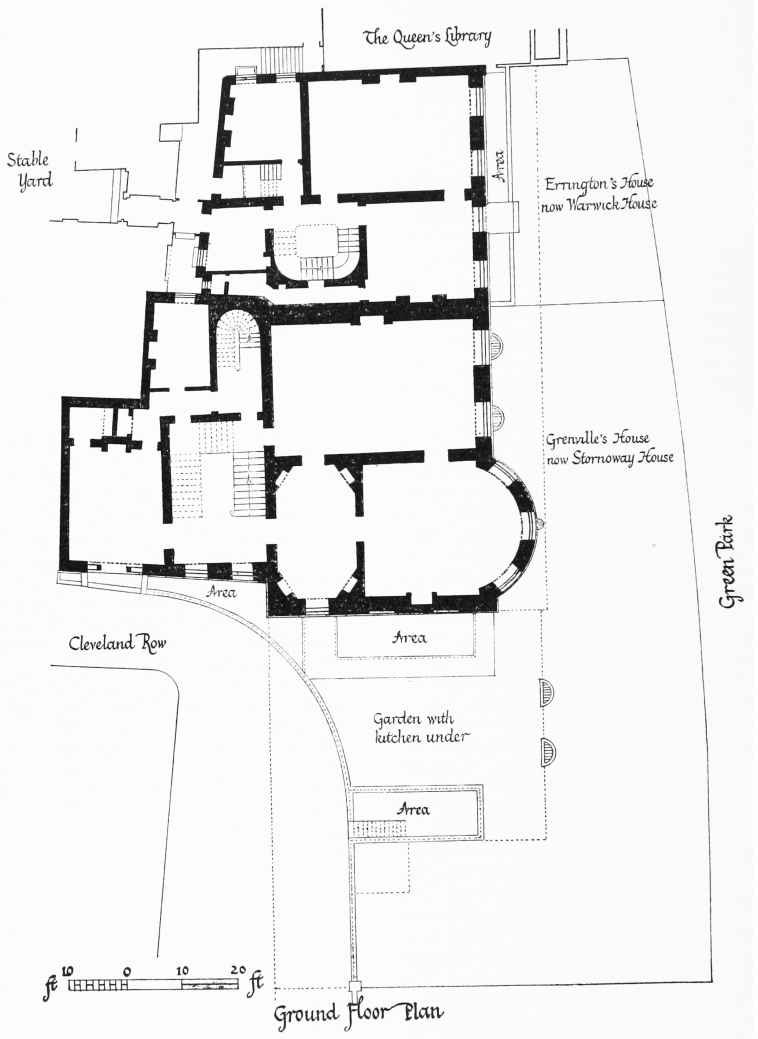
Warwick House, Stable Yard, and Stornoway House, Cleveland Row, ground-floor plan of 1798. Re-drawn from a plan in the Public Record Office
In his report on this petition Peter Burrell, the Surveyor General, raised no objection to the extension of the Erringtons' leasehold interest in the existing buildings. On the advancement of the building line into the park, however, he pointed out that the proposal would 'have no disagreeable Effect' so long as the Library (which projected ten feet further) existed; 'But . . . I should ill discharge my Duty . . . if I did not take Notice of the great objection to permit any Encroachments in the green Park and in the View of a Palace where their Majestys have fix'd their favourite Residence. This Grant, if carryed into Execution, may possibly draw on his Majesty many more applications, particularly from the End of this Ground to Lord Spencer's. I must therefore submit how far this case may be distinguish'd from all others; Or whether the precedent may not be attended with future Inconvenience.' (fn. 107)
Despite this wise warning, which was borne out at the end of the eighteenth century by the general advancement of the gardens of the houses facing the park (see page 540), the Erringtons were granted a new lease and were permitted to advance their building line. (fn. 108) In 1770–1 the house now known as Warwick House was erected for them on the southern part of the ground; the architect was Sir William Chambers (fig. 82).
In May 1770 Chambers wrote to Errington that he was 'willing to contract with you for the building . . . for four thousand pounds exclusive of the three Chimney pieces for the best rooms, three ceilings for the same and any other extrordinary enrichments you may Choose to Introduce; all which I have valued at about four hundred pounds more'. The erection of the house involved slight damage to an adjoining house in Cleveland Row, and the contrivance of the entrance, which was from Stable Yard, proved troublesome; alterations had to be made to the adjoining house there, which was occupied by Dr. Morgan and who, according to Chambers, wished 'to have a house built for him to make amends for the inconveniency he has been put to'. (fn. 109)
Errington appears to have wished to have chimneypieces of a particular pattern, but designed by Chambers. The latter stated that 'I cannot give designs for them without breaking through an establish'd rule: they are inventions of Mr. Payne's [James Paine, the architect] and he must be applyd to for them, and as I have no connections with him myself I must entreat the favour of you to make Application. He lives in Salisbury Street in the Strand and will not only furnish you with the designs but likewise with the Chimney pieces and keeps Statuary for the purpose and works I believe, as well and upon as easy terms as any other Tradesman.' Ultimately the chimneypieces appear to have been supplied to Chambers's designs by John Walsh, for another undated letter from Chambers states that 'I believe Mr. Walshe's proposals about the Chimney piece are reasonable, and if he will send me the size of the tablet I will make a drawing for it. In a day or two I shall have the drawings done for your other two Chimney Pieces and I will then send for Mr. Wash [sic] to hear his proposals. I think he will execute them very well.' (fn. 110)
Chambers's correspondence also refers to a painted ceiling. On 29 August 1771 he wrote to Errington that 'I have 6 Pictures by me for your Ceiling which are copys of Things found at Herculan. It will require 7 more which I will get done for you if you please on reasonable Terms.' In the following month he wrote that he would 'immediately order the other paintings for your Ceiling'. (fn. 111) The paintings were executed by Cipriani, and survived until at least 1894. (fn. 112)
Henry Errington lived in the house until his death in 1819. (fn. 113) The house was then occupied for a number of years by William Noel Hill, later third Baron Berwick, and other members of that family. In 1827 some adjoining houses in Stable Yard were demolished, and Hill was given permission to enclose a piece of ground ten feet wide between the house and the newly formed public passage into the Green Park, and to form a new entrance. (fn. 114) In 1853 the Crown lease was acquired by the Earl of Warwick, (fn. 115) who in that year was granted permission to build an additional storey with a curb roof. (fn. 116) In 1859 he became the occupant and he and other members of his family lived there until 1907. (fn. 117) In 1860 he erected a bow window on the south side and a glass conservatory over the entrance hall; the architect was A. Salvin. During the course of the Earl of Warwick's occupancy the house is said to have been 'almost rebuilt'. (fn. 116) Since 1924 it has been occupied by Viscount Rothermere (formerly the Hon. Esmond Harmsworth). (fn. 118)
This much altered building has a cementfaced exterior in the French Renaissance taste of the late nineteenth century. The west front, facing Green Park, has four storeys each with four windows, those of the ground and second storeys having round-arched heads. There is a prominent entablature below the attic storey, and the high-pitched roof contains two tiers of dormers. The only external feature in mid-Georgian style is the shallow porch of wood to the Stable Yard entrance, with Roman Ionic columns supporting a triangular-pedimented entablature and framing a round-arched opening.
The principal rooms are richly decorated but all the work is obviously modern except, perhaps, for the north-west room on the ground storey where the walls are lined with painted deal up to the plaster entablature (Plate 232a). This panelling is mid eighteenth-century in style, the chimney-breast, the end and south side walls each having a large panel framed by a raised egg-anddart moulding, lugged at the corners. On the end wall this panel is flanked by doorways, with doorcases composed of an eared architrave, a carved pulvino, and an enriched triangular pediment, the face above containing a sunk oblong panel in eggand-dart ovolo-moulded framing. The side wall is similarly treated but the chimney-breast panel is surmounted by a carved female mask with fruitand-flower festoons, and flanked by tall and narrow sunk panels, each side recess containing one large sunk panel. The chimneypiece is later in style—a most elegant design in wood and compo with scrolled consoles above tapered jambs, and a frieze decorated with husk festoons and paterae, broken by a tablet modelled with scrolls flanking a vase, the cornice-shelf having a fluted fascia. The walls are finished with a panelled frieze and an enriched modillioned cornice, and the ceiling is decorated with low-relief plasterwork which combines an Adamesque oval fan in the centre with the Rococo frames diagonally placed in the corners.
The chimneypiece and plaster ceiling recall certain aspects of Sir William Chambers's style, but the staircase (Plate 232b) could more certainly be assigned to him. It rises round the curving face of a D-shaped compartment, with a continuous sweep of stone treads from landing to landing, and it is furnished with a finely moulded mahogany handrail resting on paired bar-balusters alternating with foliated S-scrolls, all of wrought iron. Unfortunately, however, the railing of the first flight and landing has been bracketed out on coarse Victorian socket-pieces, and the walls of the first two stages of the compartment have been divided into panels with raised plaster mouldings. In the back staircase balustrade are some re-used turned wooden balusters of a typical late seventeenth-century pattern.
Stornoway House
In or shortly before 1794 William Wyndham, Baron Grenville, took a sub-lease from Errington of the house on the northern portion of the latter's ground (now occupied by the western part of Stornoway House); he probably also bought the adjoining freehold land (now occupied by the eastern part of Stornoway House), which had belonged to Errington. In July 1794 Grenville and Errington petitioned the Crown for a long lease of all of Errington's ground, Grenville 'being desirous of building a substantial Dwelling House . . . for his own habitation' on the northern part, and 'of making Subterraneous Offices and Areas within a small part of the Park and without [i.e., outside] the limits of the Ground' granted to Errington. (fn. 117)
This petition was referred to John Fordyce, the Surveyor General, who owing to some doubts which had arisen over the interpretation of the recent Act for the regulation of Crown lands, did not report on it until 1798. (fn. 117) During these years Fordyce was engaged in finally settling the line of demarcation between the east side of the Green Park and the gardens of the houses facing it (see page 541), and it may be inferred that this was another cause of the delay.
Lord Grenville (1759–1834) was Secretary of State for Foreign Affairs from 1791 to 1801 and after Pitt's death he presided over the Ministry of All the Talents in 1806–7. (fn. 37) In this powerful political position he therefore 'proceeded to build his new House, confiding that the Lease would be renewed to an adequate extent'. (fn. 117) A draft building agreement dated 24 June 1794 between Grenville and Samuel Wyatt of Albion Mill House, Blackfriars, architect, has survived, (fn. 119) and the ratebooks indicate that the house was completed by 1796. It has been said (fn. 120) that the design of the house was the work of Lady Grenville, but it seems very much more likely that Samuel Wyatt was the architect (fig. 82). (fn. 121) In 1799 the Crown granted long leases of both Errington's and Grenville's houses, and of a strip of ground in front of them which was to be enclosed as gardens; the width of this strip ranged from seventeen feet at the south end of Errington's house to twenty-six feet at the north end of Grenville's, and the line of demarcation between the park and the garden which was established then has been maintained ever since. (fn. 122)
Lord Grenville only lived in his new house until 1800. In the following year he was succeeded by Miles Peter Andrews, (fn. 25) dramatist and powdermagazine owner, whose plays were said to be 'like his powder mills, particularly hazardous affairs, and in great danger of going off with a sudden and violent explosion'. Andrews's lavish entertainments were a great attraction for the fashionable world. (fn. 37) After Andrews's death in 1814 the house was occupied by Sir William Scott (later Baron Stowell), maritime and international lawyer, until 1817. (fn. 11) He was succeeded by John George Lambton, later first Earl of Durham, who played an important part in the preparation of the Reform Bill of 1832 and later wrote his famous Report on the Affairs of British North America; during part of his occupancy the house was known as Durham House. (fn. 11) After his death in 1840 the house was occupied by other members of his family until 1844, when the Crown lease was acquired by Sir James Matheson, M.P., by whom the house was named Stornoway House. (fn. 123) Sir James Matheson, and after his death his widow, lived there until 1896 (fn. 118) and during their occupancy the freehold ground on which the eastern part of the house stood was acquired by the Crown. (fn. 124) From 1898 to 1924 the house was occupied by Colonel and Mrs. F. A. Lucas, and from 1926 until its partial destruction by enemy action in the war of 1939–45, by Lord Beaverbrook. (fn. 118) The house was rebuilt in 1958–9, only the outside walls of the earlier fabric being retained.
Although the exterior probably preserves the original fenestration pattern, it has been faced with cement to an Italianate design (Plate 244c). The ground storey is coursed with channel-joints and the windows have plain openings. The lofty second storey is quoined and finished with a bold cornice, and the windows are dressed with aprons, moulded architraves and pediments. The attic face is plain and its windows are dressed with architraves that break into the frieze of the crowning entablature. The dominating features are the three-windows-wide segmental bow facing Green Park, and the north return front which is three windows wide and finished with a large and richly ornamented triangular pediment. The recessed face of the north front has four windows in each upper storey, the arched doorway being below the easternmost pair.