Survey of London: Volumes 33 and 34, St Anne Soho. Originally published by London County Council, London, 1966.
This free content was digitised by double rekeying. All rights reserved.
'Soho Square Area: Portland Estate, Nos. 8 and 9 Soho Square, The French Protestant Church', in Survey of London: Volumes 33 and 34, St Anne Soho, ed. F H W Sheppard (London, 1966), British History Online https://www.british-history.ac.uk/survey-london/vols33-4/pp60-63 [accessed 30 April 2025].
'Soho Square Area: Portland Estate, Nos. 8 and 9 Soho Square, The French Protestant Church', in Survey of London: Volumes 33 and 34, St Anne Soho. Edited by F H W Sheppard (London, 1966), British History Online, accessed April 30, 2025, https://www.british-history.ac.uk/survey-london/vols33-4/pp60-63.
"Soho Square Area: Portland Estate, Nos. 8 and 9 Soho Square, The French Protestant Church". Survey of London: Volumes 33 and 34, St Anne Soho. Ed. F H W Sheppard (London, 1966), British History Online. Web. 30 April 2025. https://www.british-history.ac.uk/survey-london/vols33-4/pp60-63.
In this section
Nos. 8 and 9 Soho Square: The French Protestant Church
The French Protestant church which was erected in 1891–3 stands upon the site formerly occupied by the two houses numbered 8 and 9 Soho Square.
No. 8
Sir John Key was living here in 1691. He was succeeded by Lady Holcroft, 1692–7, and Captain Kerr, 1711–12. (fn. 1)
The most notable residents of this house were a succession of schoolmasters who occupied No. 8 from 1725 to 1805. In November 1725 the then tenant, William Glanville, esquire, assigned his lease of the house to Martin Clare, a schoolmaster then occupying No. 1 Soho Square. (fn. 2) Clare had first opened his school at No. 1 in 1717, and in a school text-book entitled Youth's Introduction to Trade and Business, which he published in 1720, he described himself as 'M. Clare, School-Master in Soho-Square, London, with whom Youth may Board, and be fitted for Business'.
Late in 1725, or early in 1726, Clare moved his school from No. 1 to No. 8, where it became known as the Soho Academy and continued to be, throughout the eighteenth century, one of the most celebrated and successful of private boarding schools. Detailed information on the life and working of the school is to be found in the Rules and Orders for the Government of the Academy in Soho Square which Martin Clare published in the late 1740's, in association with his partner and eventual successor, the Reverend Cuthbert Barwis. The fee for board and tuition was £30 per annum, plus extras. The boys were taught mathematics, geography, French, drawing, dancing and fencing, and there were weekly lectures on morality, religion and natural and experimental philosophy, 'for the Explication of which, a large Apparatus of Machines and Instruments [is] provided'. The pupils had the use of a pew in St. Anne's Church and of another in one of the nearby Huguenot chapels. (fn. 3)
Dr. Barwis assumed sole control of the Soho Academy after Clare's death in 1751, (fn. 1) and thereafter the most notable feature of school life appears to have been the theatrical performances of Shakespeare's plays, which were regularly presented by the boys. This innovation proved so successful that Dr. William Barrow, a later master, claimed that 'several of the actors, who have since attained considerable eminence in our publick theatres, imbibed in the academy … their first passion for the stage'. (fn. 4) He was no doubt referring to Joseph Holman, John Liston and John Bannister, all celebrated actors in their day, and all former pupils of the Soho Academy. Another pupil was the dramatist Thomas Morton. William Betty, the boy actor celebrated as the 'Young Roscius', is also said to have been a pupil, though this is unlikely. He did not come to London until December 1804, shortly before the closure of the school, which by this time had discontinued these dramatic performances. Instruction in drawing and painting was also given and both Thomas Rowlandson and J. M. W. Turner attended the school for a time. Other pupils included Philip Hardwick, the architect, Henry Angelo, the author of the Reminiscences, John Horne Tooke, the politician and philologist, and the sons of James Boswell and Edmund Burke. (fn. 5)
Doctor Cuthbert Barwis died in 1782 leaving the house in Soho Square, together with all the school furniture and equipment, including the maps, globes and prints and his 'mathematical and philosophical instruments and apparatus' to his nephew John Barwis, who had been associated with him in the management of the school for some years. (fn. 6) John Barwis retained the school until 1785, when he was succeeded by Dr. William Barrow until 1799 and then by the Reverend William Whitelock until 1805. (fn. 1) In its later years the number of pupils at the academy declined. This may have been due to Barrow's decision to discontinue the theatrical performances for which the school had been celebrated. In the 1804 edition of his Essay on Education, he wrote that the plays had exposed his pupils and school to censure and moral danger, even though the performances had attained 'an extraordinary degree of excellence'. (fn. 4) Nevertheless, the school was still described as late as 1801 as 'the first academy in London'. (fn. 7)
After 1805, when the academy closed or moved to premises elsewhere, No. 8 was in commercial occupation until 1891, when it and the adjoining No. 9 were demolished to make way for the present French Protestant church. (fn. 1)
No. 9
In September 1678 Richard Frith and William Pym leased this house to Mary Perkins. The first known occupant was Sir Richard Onslow, later Speaker of the House of Commons and first Baron Onslow, who took a lease of the premises in February 1691/2. (fn. 8) He lived here until his death in 1717, and was succeeded by his widow, who died in 1718. Later inhabitants include Lady Monoux, widow of Sir Philip Monoux, third baronet, 1735–43; the Duchess of Wharton, widow of Philip, Duke of Wharton, 1752–66, and Owen Salusbury Brereton, M.P. and Vice-President of the Society of Arts, who had formerly lived at No. 11, 1767–98. (fn. 1)
The French Protestant Church
This church, though now occupying a building erected only in 1891–3, can trace its descent from the earliest congregation of Protestant refugees to settle in London, a tradition commemorated in the carved tympanum over the entrance door of the present building. In July 1550 Edward VI licensed the foreign Protestant refugees in London to hold their own services. In October 1550 the French and Dutch refugees took a lease of the chapel of St. Anthony's Hospital in Threadneedle Street, but a few weeks later the Dutch withdrew from this arrangement, leaving the Huguenots in sole possession. They and their successors remained in Threadneedle Street (except during the reign of Mary Tudor) until 1840, the original building being rebuilt after its destruction in the Great Fire. In 1843 a new Huguenot church was opened in St. Martin's le Grand, (fn. 9) but in 1887 it was demolished to make way for extensions to the adjoining General Post Office. The congregation then moved into temporary quarters at the Athenaeum Hall, Tottenham Court Road, until a suitable site for another church could be purchased and a new building erected.
After two years of enquiry the consistory of the church decided to purchase a plot of land in Soho Square. This site comprised the existing Nos. 8 and 9 which, it was proposed, were to be demolished to provide a combined frontage to the square of fifty feet and a depth of one hundred and ten feet. The freehold was owned by a Mr. Trotter, a descendant of John Trotter, founder of the Soho Bazaar, who was prepared to sell the site for £10,500.
The consistory commissioned (Sir) Aston Webb to design a new church and in March 1889 petitioned the Attorney General, without whose sanction they could not proceed, for permission to purchase the site in Soho Square and to erect a new church. This was to be built at a cost of between nine and ten thousand pounds and to accommodate a congregation of four hundred. In addition the building was to contain a vestry and library, living quarters for the pastor, and a schoolroom in the basement. The building costs and the purchase price for the site were to be paid out of the compensation money which the consistory had received for the demolition of their former church. The members were anxious to start building as soon as possible as they were unable to hold communion services in their temporary quarters in Tottenham Court Road, the Athenaeum Hall being used as a public dance hall on weekdays.
The Attorney General did not give his consent to the consistory's scheme until October 1890 and it was not until April 1891 that the demolition of the two old houses on the site began. In the meantime the congregation removed from the Athenaeum Hall to the chapel behind No. 7 Soho Square which had formerly been occupied by a group of Baptists.
The foundation stone of the new church was laid on 28 October 1891 and the building was completed early in 1893. It was dedicated on 25 March 1893. The building contractors employed were Messrs. Higgs and Hill, whose tender was for £10,194. (fn. 10)
The church is in Aston Webb's early manner, derived in part from the final phase of FrancoFlemish Gothic. There are, in addition, certain late Romanesque overtones blended into a design which is particularly successful internally. A four-storeyed block faces the square, with living accommodation above an entrance lobby flanked by a library and an ante-room. The aisled church immediately behind, has four bays running north and south and a curved apse between a pair of vestries (fig. 9).
The building materials externally are plumcoloured brick and light red terra-cotta, the residential block having a steeply pitched roof of greenish slates. The front has a terra-cotta facing to the ground storey, with five roundarched openings, the subsidiary ones being subdivided (Plate 21a). The somewhat Romanesque character of the larger central doorway is emphasized by the archaic style of the carving in the stone tympanum, which was inserted in 1950. The upper part of the front, largely of brick, has two narrow projections with hipped roofs, framing a recessed centre. Here a small three-sided bay window rises through an enriched corbel table at the level of the third storey into a gable treated with ascending shell-headed niches. The gable is topped by a cross and on the apex of the roof is a small timber cupola.
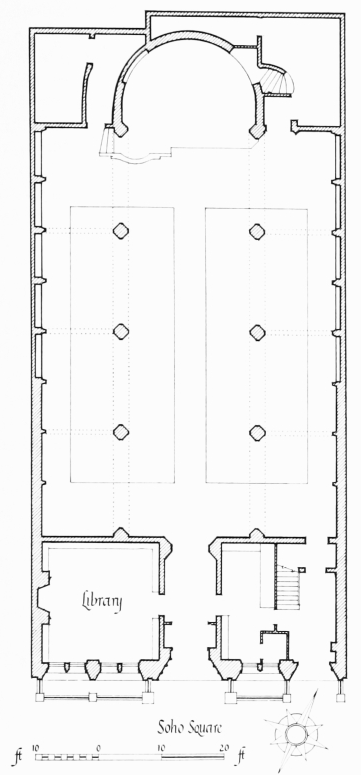
French Protestant Church, Soho Square, plan
The interior (Plate 21b) is of buff terra-cotta and similarly coloured brickwork. The roundarched arcades to the church are of four bays, the piers having paired shafts at either side with vestigial imposts. There is no triforium. A narrow gallery runs in front of the wide, three-light clerestory windows. The barrel roof is of wood and a high arch with moulded imposts frames the apse with its wooden panelled semi-dome and five round-headed windows. A plain cross is set between the two parts of the organ, and benching extends round the apse below. A wide low terracotta pulpit stands to the west of the sanctuary. The aisles have arcaded walls and rib-vaulted roofs with a rectangular top light to each bay. In front of the vestry door in the east aisle is a small terra-cotta font and other, apparently original, fittings include the hooped iron light-pendants and the dark-stained pine pews; two royal coats of arms of carved wood are preserved in the library and in the side entry, that in the library being probably of the late Stuart period and the other apparently Hanoverian.